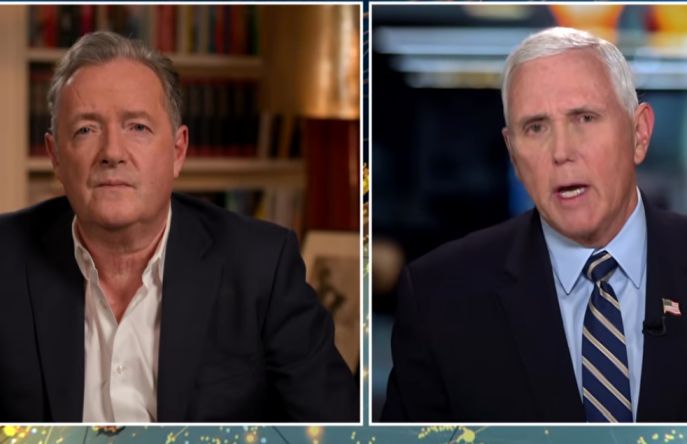
Editor’s Notes: In this high-stakes episode of Piers Morgan Uncensored, Piers explores the massive geopolitical fallout of “Operation Epic Fury,” the coordinated US and Israeli military offensive aimed at dismantling the Iranian regime. The program features exclusive interviews with former Vice President Mike Pence and former Israeli Prime Minister Naftali Bennett, who argue that the strikes are a necessary and long-overdue response to decades of state-sponsored terrorism. A fiery panel of experts and activists then debates the legal and moral ramifications of the conflict, questioning whether this “leadership decapitation” will liberate the Iranian people or spiral into a disastrous regional war. This comprehensive discussion examines the immense risks of President Trump’s boldest foreign policy gamble and how it might forever reshape the Middle East. (Mar 3, 2026)
TRANSCRIPT:
Opening Remarks
PIERS MORGAN: Whatever your view of the US-Israeli attack on Iran, it’s a moment of history which will forever reshape the Middle East. Whether the new world is a better, safer place, we don’t know. That’s the reality of war. There’s a lot we don’t know, and it sets off deadly chain reactions which cannot be controlled.
The Ayatollah is dead, and nobody should mourn a murderous dictator who presided for decades over state-sponsored terrorism across the world. But we don’t know if his replacement will be as bad or perhaps even worse.
President Trump says Iranian dissidents should take this once-in-a-lifetime opportunity to sweep into power, but we don’t know how they’re supposed to do that. The civilian protesters don’t have the guns. President Trump says the war should last up to four weeks. As Iranian bombs rained down on Gulf states who did not want a war, we don’t know if it can be contained. US allies in the UAE, Qatar, Saudi Arabia, and elsewhere may well tell the US that it just can’t wash its hands in a regional war it started.
And above all, we don’t know what the US justification for the war really is. Donald Trump’s conversations with individual journalists over the weekend have echoed his shifting position in the weeks leading up to the attack. On the one hand, it’s about Iran’s nuclear capabilities, which Trump had said were obliterated and set back decades only last year. On the other, it’s about freedom for Iranians and protection for protesters, which many in his base feel is simply not America’s business.
It’s precisely because we don’t know so much. This is an enormous gamble by the American president, by far the biggest across either of his presidencies. Trump’s legacy will surely now be defined by what happens next, just as Tony Blair and George W. Bush are defined by the wars in Iraq and Afghanistan. A free and democratic Iran allied with the West would be an outcome that eclipses any of Trump’s domestic failures or successes. But the same thing applies with equal menace to a regime change that goes the way of US-led regime changes in Afghanistan, Libya, Iraq, and elsewhere.
We don’t yet know which it will be, and it may not be in America’s control.
Interview with Former Vice President Mike Pence
PIERS MORGAN: Well, before we debate with my panel, I’m pleased to say I’m joined for the first time on Uncensored by Mike Pence, the 48th Vice President of the United States, who, of course, served in the first Trump administration. Vice President Pence, welcome to Uncensored.
MIKE PENCE: Thank you, Piers. Thanks for having me on.
The Justification for Operation Epic Fury
PIERS MORGAN: Very good to have you, particularly at such an obviously historic moment for the world. First of all, let’s just cut to the quick here about this attack on Iran. What do you think is the justification — the legal justification in particular, but also the moral justification — for Operation Epic Fury?
MIKE PENCE: Well, first, Piers, if I may, let me just say how proud and impressed I am with the armed forces of the United States, with our joint chiefs, with the masterful planning that our armed forces have executed flawlessly in the first several days of Operation Epic Fury. It’s truly been inspiring.
And I also want to give all the credit in the world to President Donald Trump for his bold and decisive action in moving against the Iranian regime, unleashing our forces in partnership with our cherished ally Israel and their courageous IDF forces. I think it has been a promising and encouraging first few days. But the real work lies ahead, as you suggest.
And I believe, in answer to your question, that the real objective here is to confront a war that started 47 years ago. The truth is that from the time American hostages were taken in 1979, to the time that 220 Marines fell, 20 more American service members were cut down in a terrorist attack in Beirut sponsored by Iran. Iran has been waging war on the United States, on Israel, on the West for 47 years.
Our response has been, all along the way, it seems to me, to slice away at the tentacles — whether they be Hezbollah, Hamas, the Houthis, or the insurgents in Iraq. But now, by authorizing this action, President Trump has unleashed the armed forces of the United States. Israel has unleashed its armed forces to take the fight really to the heart of terrorism, which is the mullahs in Tehran, many of whom have been eliminated.
But now comes a time where I think we have to see this through and create the conditions where the people of Iran — who have longed for freedom and democracy and human rights — can reclaim their country.
The Legal Justification
PIERS MORGAN: In terms of the legal justification — I mean, that’s the kind of moral argument that you’ve laid out, and there are many people that agree with it. But there are many people that agree perhaps that there was a moral argument for taking out the Ayatollah, for example, and for trying to dismantle this regime, but who remain very concerned about the legality of this.
We saw that with my country, the UK, who refused to sanction any involvement in this first wave of the attack, and have only belatedly — a day later — sanctioned use of bases because they want to protect British citizens in the Middle East.
MIKE PENCE: Well, I never thought I’d miss Tony Blair. Going back to your first point — look, we’ve had a special relationship between the United Kingdom and the United States since the end of World War Two. I always said it could be defined during my years in Congress and through the White House by a simple truth: that when we go, the UK goes.
And to see Keir Starmer and to see the hemming and hawing and the hesitation — which I’m glad to see now giving way to a recognition, with the attack on your base in Akrotiri in Cyprus — it seems that now the Starmer government is waking up to the real widening threat that Iran presents in this moment. But it’s been disappointing to see that, but better late than never.
But in terms of the legal justification, I must tell you — when it comes to international law, it seems like international law for literally generations has been that terrorist organizations and the leading state sponsor of terrorism in the world can strike without being hit back directly. But that nations of the West, notably the United States of America, are constrained from striking back directly at them.
And I think this is a moment where President Trump, learning that Iran was reconstituting its nuclear program — when it has long advocated for not only “death to America,” but for wiping Israel off the map — when Iran is developing and maintaining an arsenal of ballistic missiles that threaten Israel and our other allies across the Arab world, including Americans, tens of thousands of Americans stationed at US bases there — it seems to me more than justified the action in this instance.
But again, there’s a lot of talk. I saw in one major newspaper over here today that President Trump had pledged not to start a war. Well, I hold the view that Iran started this war 47 years ago. And President Trump, with the greatest military force on earth allied with Israel and now a growing number of our allies across the Arab world and in the West, is purposing to finish it. And I believe that he’ll do a great service to history if we see it all the way through and eliminate the ability of this regime to continue to tyrannize the people of Iran.
The Iraq War Parallel
PIERS MORGAN: You referenced Tony Blair there, and it’s interesting because I think Tony Blair has been the kind of elephant in the room in the thinking of the current UK government about how to respond here. Because, as I’m sure you’re aware, in the start of this century, in the build-up to the war in Iraq, Tony Blair went against public opinion in the UK, went without a second UN resolution, believed he had the legal authority, used the argument that Saddam Hussein had weapons of mass destruction in Iraq and therefore had to be stopped.
And then, of course, we know what happened — we went in collectively, US, UK, other allies. There was a ferocious war, there was a ground war, and these weapons simply didn’t turn up. So the pretext for the war turned out to not exist. And as a result, people have condemned Tony Blair and George Bush since then.
But also the fallout from that — because there was no prior planning that people could really perceive properly — was that you saw the rise of ISIS, you saw huge unrest in the region, and so on. And what I think people are concerned about here is that we could be, if we’re not careful, stumbling into a similar situation where now the tinderbox has been well and truly let off. No one’s quite sure what happens. And that if you don’t have any boots on the ground, can you actually affect regime change in the way that Donald Trump would like to? And if you can’t affect regime change, what are you left with?
MIKE PENCE: Well, I think you raise a very good point, and it’s a cautionary tale. Where my mind goes — the comparison to the overwhelming force that the United States is bringing to bear against Iran now, in concert with our allies in Israel, and as I said, a growing number of Arab countries and Western allies — is more analogous to the Persian Gulf War than to the Iraq War.
I mean, President George Herbert Walker Bush marshaled an enormous amount of military resources, including allies across the region and across the West. He drove Saddam Hussein’s military out, and I think, in a very real sense, restored deterrence for the better part of a decade to that region of the world — until, of course, our nation was struck on 9/11. And with the UK at our side, we took the fight to our terrorist enemies in Afghanistan.
But I think the objective here — in addition to confronting the bases for this invasion, as the administration has described — also gives us an opportunity to restore the deterrence that was squandered during the Biden administration, during that disastrous withdrawal from Afghanistan.
I must tell you, Piers, that I think it’s no coincidence that we have this reckless withdrawal from Afghanistan, the Taliban overruns the country, reversing all the gains that we’d made for the people in that nation — and then within a year, Russia invades Ukraine. Within a year after that, with Iran supporting them, Hamas launches the worst attack on the Jewish people since the Holocaust on October the 7th. Add to that the 12-day war, the use of ballistic missiles by Iran for the first time against Israel.
The region has, since that disastrous withdrawal from Afghanistan under President Joe Biden, seen evil emboldened across the world. And today, thanks to the courage of our armed forces, the decision of our commander in chief President Donald Trump, and the strength and efforts of Israel and our other allies in the region, I think we have an opportunity — if we see it through — to really restore deterrence to the region and set the table, not just for a free and democratic future for the people of Iran, but for the opportunity for a more peaceful future in the wider world.
The UK’s Response and the Special Relationship
PIERS MORGAN: We talked briefly about Keir Starmer and his reluctance to get involved at the first stage as it all went off. It was interesting to me that you had Prime Minister Carney in Canada and also Albanese in Australia immediately offering full support to the United States and Israel — neither particularly known as hard-right conservative leaders, and yet were very quick to offer their unequivocal support. This made Keir Starmer, the Prime Minister of the UK’s, reluctance to do that all the more notable. What is your message to the British Prime Minister about this and the potential precedent that he may have set?
MIKE PENCE: Well, my message to Prime Minister Starmer is that the people of the United States and the people of the United Kingdom truly do have an unbreakable bond. Our nation will always be grateful to the people of Great Britain for standing with us and taking the fight to our enemies after 9/11. I visited those bases downrange in Afghanistan, of course, in Iraq. And there’s never a time that I saw the American flag flying without the flag of the United Kingdom and Great Britain right next to it. And so there’s a tremendous bond there.
And this is a moment, I think, where Prime Minister Starmer should yield to our shared history and not wait for Iran to strike any further at UK interests across the region. Lean in and set aside whatever concerns and differences there have been in recent months, and focus on the task at hand.
And I want to emphasize this point, Piers — I think we have to see this through. I think one of the lessons of the Persian Gulf War was that while it did reestablish deterrence for a decade, the truth is that we had to go back. We had to fight again. And Saddam Hussein, because we had not destroyed his ability to tyrannize his own people with his military, his own people were not able to rise up and change the trajectory of Iraq.
Mike Pence on Trump’s Foreign Policy Doctrine
This is a moment where I think we need to see this fight through. We need all of our allies in the West with us, including the UK and Germany and France, and of course with Israel at our side. And I think what’s most remarkable is that in their desperation, Iran is really strengthening the ties between the United States and Israel and other Arab nations across the region by their military strikes in UAE and in Qatar.
I mean, this is a community of nations that has long understood that Iran is the greatest threat to peace and security in the region. But now with yesterday’s joint statement and the like, I think we’re entering into a whole new season, which if we see it through, actually mean the Abraham Accords were in fact just a down payment on a whole new set of relationships and a more peaceful future across the wider Arab world.
Piers Morgan: Yeah. It definitely seems a massive strategic error, I think, by Iran to go after the Gulf States in the way that they have pretty indiscriminately with dropping bombs into hotels in Dubai and so on. I think that is having the opposite effect to what they might have hoped, which would be to try and separate the Gulf states from Israel and the United States.
What do you say to Trump voters in particular who voted for him in 2024 because one of his big repeated pledges was he wouldn’t take America into foreign wars, that we were done with doing that. America first meant America looking after America’s interests in America. Now Axios is reporting today, no president in the modern era has ordered more military strikes against as many different countries as Donald Trump. How do those two positions sit comfortably together?
Mike Pence: Well, you know, I wasn’t on the ticket the last time around, Piers, but I was elected with the president in 2016 and on the ticket again in 2020. And I can tell you, I like to tell people, I think I know President Trump better than his most ardent defenders. And the President I served with is no isolationist.
You look at the record of our administration after Syria crossed that red line using chemical weapons on their own people. We hit them with cruise missiles not once, but twice when President Obama had refused to do so. We took down not only the ISIS caliphate, but their leader, Abu Bakr al-Baghdadi. And I was there when the president made the decision to take out the head of the Iran Revolutionary Guard, Qasem Soleimani, back in January of 2020. This is a president who doesn’t lead from behind.
He leads from the front. And I frankly think most of the supporters of the president, people that I came to know from coast to coast in this country, understand that. And they also understand that this is a president who is going to prosecute America’s interest and take action that he believes is necessary to protect our nation, whether that be in Venezuela, where the head of a dangerous failed narco state, Nicolas Maduro, was captured and removed, and now that nation is on a trajectory toward normal relations with the United States of America, or whether it be the present action in Operation Epic Fury.
Iran has been a threat to the security of the people of this country, our armed forces in the region, our cherished ally Israel for generations. And thanks to President Trump’s decision and that of Prime Minister Netanyahu and the support of our allies across the region and the world, we have an opportunity to finish it.
Piers Morgan: Vice President Mike Pence, I really appreciate you coming on Uncensored at such a busy time in the news. Thank you very much.
Mike Pence: Thank you, Piers.
Panel Discussion: The Moral and Legal Case for War
Piers Morgan: Well, I’m joined now by my panel, which includes Ana Kasparian, executive producer and host of The Young Turks, Glenn Greenwald, the host of System Update, Jonathan Conricus, retired lieutenant colonel and IDF spokesman, and Mark Kimmitt, former general and US assistant secretary of state, and Goldie Ghamari, the former Canadian lawmaker and Iranian activist. Well, welcome to all of you.
Ana Kasparian, your response to Mike Pence there, laying out a moral and legal justification for these attacks on Iran.
Ana Kasparian: First, I would like to ask Goldie whether she apologizes for laughing as Cenk Uygur on the last episode he was on was talking about dead American soldiers as a result of wars that the US gets dragged into on behalf of Israel. Goldie, do you apologize for laughing at the thought of dead American soldiers?
Goldie Ghamari: Anna, no one’s buying your jihadi propaganda lies. Everyone knows that Ella and I were laughing at —
Ana Kasparian: Oh, jihadi propaganda to be concerned about dead American soldiers who were forced to fight on behalf of Israel. Interesting. Okay. To answer your question —
Goldie Ghamari: Can I answer the question?
Ana Kasparian: One hundred and seventy-five little girls have been slaughtered, Piers. In an Iranian school that was the first Israeli strike —
Piers Morgan: Anna, Anna, hang on one second. You asked her a question, so I will let Goldie respond. Then you can respond to my question.
Ana Kasparian: Well, she responded by claiming I’m sharing jihadi propaganda. I’m talking about dead American soldiers. So do you apologize or not?
Goldie Ghamari: Okay. May I respond? Thank you. So we were laughing at Cenk’s bizarre anti-Semitic tropes about how Israel is responsible for every single incident that happens in the war. We were not laughing at —
Ana Kasparian: That’s not what he said.
Goldie Ghamari: American soldiers. And you actually edited the video. You edited the video. So there you go. Everyone knows that you’re lying. You’re a laughing stock. You’re a joke. Everyone can go back and watch the episode for Piers’s show. The only ones who were —
Piers Morgan: Okay. You know what? Look. Anna, you said your piece about Goldie. She’s responded. Let’s get back to the bigger picture, which I’m sure the other panelists would prefer us to.
Your response to Mike Pence — but both on the moral argument, because I do think that there are lots of people I know, including many on the left, who can understand a moral argument for getting rid of what has been a ruthless, bloodthirsty, vile regime that has caused terror not just to its own people, but to the wider world. But hesitate about whether this is the legal thing to do. So I don’t think it’s just people on the right saying, go, go, go. People on the left saying, well, I’m glad he’s gone. I’m glad the Ayatollah’s gone. I’m glad a lot of the top leadership have gone. But I’m not sure this is legal, and the precedent being set is very dangerous.
Ana Kasparian: My view of this current war against Iran is that Iran did not pose a threat to the United States. Their ballistic missiles did not have the capability to reach the United States, and the notion that this was all about Iran’s weapons was a lie from the very beginning. This is about a regime change war on behalf of Israel.
Israel would like to be the hegemon in the Middle East, and the United States is spilling blood and basically using its treasure to help Israel build an empire that I guarantee you will turn around and, well, we’ll suffer the consequences of that at some point. But we’re suffering the consequences of it right now.
I mean, the first thing Israel did is strike an Iranian girl school killing one hundred and seventy-five people. That’s according to the New York Times, which typically likes to bury the wrongdoings of the Israeli government and military. I don’t see this as a just war. I don’t think that President Donald Trump has a plan for what happens following the slaughter of the Ayatollah or the destruction of the Iranian regime. In fact, he has said as much. He said it is not the US’s job to figure out who leads Iran next, which means that there will be a power vacuum, and we know how that plays out in other countries where we’ve done similar things.
And in regards to Syria, let’s not mistake what actually happened in Syria. Okay? The Obama administration began arming Al Qaeda terrorists — Al Qaeda terrorists who actually fought our soldiers in Iraq — and now we have a supposedly former Al Qaeda terrorist as the leader of Syria. We didn’t do good things in the Middle East, including in Syria. So Mike Pence is a complete and utter joke in what he said during that interview.
The School Strike: What Do We Know?
Piers Morgan: Okay. Jonathan Conricus, just first off, the attack on the school or the explosion at the school that caused so many deaths, particularly of young girl students. There does seem to be at the moment ongoing confusion about exactly what has happened there. The school was next to one of the Revolutionary Guard bases. It used to be part of the base until recently, apparently several years ago, it was sort of separated from the base.
And, you know, depending on which report you see, but none of them appear to be definitive. This was either an Israeli or American missile that caused this to happen, or it could have been an interception by the Revolutionary Guard, or it could have been indeed a missile, as some have claimed, fired by the Revolutionary Guard that hit the school by mistake. We don’t seem to know for sure yet. Do you have any intelligence that can one hundred percent verify what’s happened there?
Jonathan Conricus: No. I’ve been asked in various networks, and I’ve done a lot of interviews over the last two and a half days. And that topic comes up when someone is grasping to try to undermine the American and Israeli operation against the regime, because it is a relatively convenient tool to use.
Usually, it’s not by people who have compassion for civilians, for Iranian schoolgirls, or for Iranians in general, but it’s usually for people who have something either against President Trump and his policies or very often against the state of Israel. So I’ve looked into it, and so far, it’s kind of a messy situation where I can’t really make sense of what happened, whether it’s Israel or the US who struck, or whether it’s some type of a false flag operation by the IRGC.
I wouldn’t be surprised in any of the options. It could be an American or an Israeli strike at a proper military target that happened to be too close or co-located within or next to a school, and it could be something that was cooked up by the IRGC specifically for the purposes of having something to clutch at and having something to feed international media to show allegedly wrongdoing.
I put that into stark contrast with very deliberate actions of the Iranian regime when they are firing at seven or eight sovereign countries in the region, and they’re firing at almost exclusively civilian targets. They’re firing at cities in Israel. And we already have eleven civilian casualties confirmed, all of them civilian, none of them military, most of them women and children, one elderly man. They’ve been killed in various incidents where Iranian missiles have exploded in Israeli cities. We have confirmed deaths in the UAE, in Saudi Arabia, in Kuwait, and a lot of incoming missiles on Cyprus, Jordan, and other locations.
And of course, we could speak about this incident, and I’m sure that many people who have issues with Israel would want this to be the story. They would want one errant attack or one unexplained situation to be the headline, because it supports the agenda. These are, by the way, the same people who, when Iranians were marching in the streets and being gunned down by the Iranian regime, we didn’t hear a lot of them speak about what was going on, and we didn’t hear a lot of those people who now allegedly care about Iranian schoolgirls speak about the atrocities of the regime. It is the typical hypocritical position of so many people. It only depends on who has allegedly done the killing. Doesn’t matter who was killed and how this can be cynically and politically used.
Ana Kasparian: Okay. All know there’s one country that seems to have an affinity for slaughtering children, and that country is Israel. But anyway —
Goldie Ghamari: No. That’s actually Iran.
Ana Kasparian: But —
Goldie Ghamari: That’s actually the Islamic Republic of Iran.
Trump’s Warning: Boots on the Ground?
Piers Morgan: Okay. Also, I think, from what’s happened in Gaza, it is prudent to get to actual facts before we pass too censorious judgment. And I prefer to do that because I think if we don’t, that way madness lies.
As we’re talking, General Kimmitt, President Trump has told the New York Post that he’s not ruling out sending US ground troops into Iran if they were necessary. He said Operation Epic Fury was way ahead of schedule by taking out dozens of Tehran’s top officials. He said, quote, “I don’t have the yips with respect to boots on the ground. There were, like every president says, there’ll be no boots on the ground. I don’t say that. I say probably don’t need them or if they were necessary.”
He also told CNN earlier today that the big wave in the conflict is yet to materialize, indicating the US has not yet begun to strike Iran forcefully and suggesting more significant action is imminent. So where do you feel we are with this, General Kimmitt, and how precarious would it be for the US to commit boots on the ground? You know, I talked earlier to Vice President Pence about the parallels here with Iraq back in 2002, 2003, where committing boots on the ground turned out really historically to be a disaster. Could we be sleepwalking our way into another disaster here?
Mark Kimmitt: Well, first of all, I hope there’s a little stability while I’m answering the questions.
The Panel Debate: Iraq Parallels, Friendly Fire, and the Iran Mission
MARK KIMMITT: First of all, as one of those boots that walked on that ground in Iraq in 2003, I think that nobody wants to see us repeat the mistakes of that operation. And for that matter, as we look forward to whatever emerges from this situation in terms of the government, I certainly hope we don’t count on the expatriates to come in and solve the problem for us.
But, look, I think it’s important to understand we didn’t do regime change. It’s highly unlikely we’re going to do regime change. We’ve done what the president has said in so many words is we are doing a leadership decapitation, as Israel did with Hezbollah.
And he said to the Iranian people, “I’m opening the door for you. You’ve got to figure out what to do after that.” So where we are on the operation now, we’ve hit about ten thousand targets. We’ve got a lot of work to do. But at the end of the day, we can’t get mission creep in this operation.
Seen it, been there, done it. We ought to stick to our end state that we’re seeking, which is no nukes, no ballistic missile program of any size, and no proxies, because that was our end state at the negotiating table and the negotiations failed. We shouldn’t be changing our objectives just because we’re using military force. The purpose of this military force is to get back to the negotiating table and finally get what three presidents, ever since we’ve discovered the nuclear program, has tried to get.
Now the fact remains it’s highly unlikely that we’re going to see that anytime soon, and the only way we’re going to get the Iranians back to the negotiating table for those purposes is through strong use of force.
And look, you ask why now? And the very simple answer is, legally, a preemptive strike meets our conditions. Do you want to be facing across from that negotiating table a nuclear armed Iran with long range ballistic missiles? Better to do this now.
Starmer’s Reluctance and the UK’s Role
PIERS MORGAN: And just before I go to Glenn Greenwald, when I spoke to Vice President Pence, we talked about the parallels with Iraq, and he was quite scathing about Prime Minister Starmer’s reluctance to get involved at the first stage of this operation, refusing to allow Americans to use the bases, the UK bases and so on. What is your view of that? Because it did seem a marked departure in the normal practice of the UK to allow American forces to do that. Did you think that was a mistake by the UK prime minister?
MARK KIMMITT: No. I just — it appears you and I have been around a long time. We went through Iraq together. The fact is, I think that Starmer just did not want to be referred to as Tony was, as the British poodle. So I think what he wanted to do is give it a little bit of time, make it look like this is an independent decision of his rather than being — we do have a special relationship, but we’re not tied at the hips, and Britain is not a proxy for the United States. We knew, particularly if the Iranians started firing back, that Britain would come in the way that the Saudis and the Emiratis have come in.
Tensions Over American Soldiers and the “Trope” Debate
MARK KIMMITT: And one last comment. On it, please quit using the tropes on American soldiers. I’ve had to bury seven American soldiers. They went into the battlefield.
ANA KASPARIAN: How is it a trope? How is it a trope to see American soldiers die on behalf of Israel’s wars? How is that a trope? Explain that to me. What is dying on behalf of Israel?
MARK KIMMITT: I’m not going to dignify that.
PIERS MORGAN: Let me read you what Israeli media has been saying. So, American soldiers came under friendly fire in Kuwait. I don’t know if any of them have died. Hopefully, none of them have died. But on Channel 12, Niv Raskin said this: “We need to emphasize this is an incident involving American forces and not, heaven forbid, an incident involving Israeli forces.”
ANA KASPARIAN: And why is he representative of anything? Who makes him representative of anything? Why are you sharing people here?
PIERS MORGAN: In Israeli media —
ANA KASPARIAN: No. Saying he’s not even a big figure. He’s a talking — sacrificing American soldiers is totally okay, I guess.
PIERS MORGAN: Well, okay. I want to bring him in. I want to bring him in.
ANA KASPARIAN: I would like him to answer my question. Why is that considered a trope? Why is it considered a trope to be concerned about American soldiers during these endless, nonsensical wars? Why is that considered a trope?
MARK KIMMITT: Many times have you gone to Arlington and paid your respects?
ANA KASPARIAN: You terrorist piece of crap. I’m talking to the general. Tell me why that’s a —
MARK KIMMITT: I’m not — you honor the memory of foreign American soldiers —
ANA KASPARIAN: Can we go back to the question? Can I be — can I bring some order to this, please?
Friendly Fire Incident and the Fog of War
PIERS MORGAN: Now, Jonathan, let me conduct the panel, please, because Glenn’s been waiting very patiently. Before I come to you, Glenn, and I will give you plenty of time to speak, I can promise you that. General, just explain why you consider that to be a trope. And secondly, I was really struck by this friendly fire incident because I can’t remember — I’m sure you will be able to correct me here — but has it ever happened before that three American fighter jets have all been downed in a friendly fire incident, apparently here by Kuwaiti forces by mistake, as they went over Kuwaiti airspace? Can you remember three American fighter jets going down in friendly fire in one incident?
MARK KIMMITT: No. And I’m sure those Kuwaiti soldiers that fired those shots will remember that for the rest of their lives. Luckily, none of the airmen were killed. They got to other aircraft alive and relatively unhurt. We call it the fog of war.
PIERS MORGAN: And in relation to the — why is it a trope? You think it’s a — I think, to be fair to Ana Kasparian, just answer her question. Why do you view that as a trope, what she said?
MARK KIMMITT: I’m not going to dignify it with a response.
ANA KASPARIAN: You just want to smear me. Okay. With nonsensical claims, but you can’t even answer why you even believe in the smear. What is the trope? You can’t answer it. Right?
MARK KIMMITT: I’ll tell you why. Being concerned about Americans dying on a —
ANA KASPARIAN: No. I want — that avenge is a general. Total hypocrite.
MARK KIMMITT: The general —
ANA KASPARIAN: Total hypocrite.
PIERS MORGAN: The general has chosen not to respond. That’s his right. I want to go to Glenn. Glenn, you’ve been waiting very patiently.
Glenn Greenwald: Echoes of Iraq and the Credibility of War Advocates
GLENN GREENWALD: Thank you. Look, this is a story that a lot of passions are going to run very high here. I don’t have all the answers to what I think is going to happen here. It does, to me, bring back a lot of bad memories from the Iraq war, which was started in many people’s eyes who perpetrated it for the best of intentions. Saddam was a bad guy doing bad things to his people, killing many of them, running a ruthless regime, possessing weapons of mass destruction, and he had to be stopped.
I’ve been on this rodeo of rhetoric before, and it feels to me like we’re on a very similar path now. But Iran is an altogether bigger and more difficult scenario than even Iraq was. You’ve got two hundred and twenty odd thousand Revolutionary Guard. You have nearly a million regular army. You have many other paramilitaries, hundreds of thousands more. This idea that America has, or Donald Trump has, that by doing these strikes you’re going to start a big revolution amongst the people on the ground — they’ve got to get past one and a half million very heavily armed people that will try and stop them. And we saw recently they stopped thirty thousand of them by killing them.
So do you think that the mission here is even achievable? And do you think what has happened is legal?
I am glad, Piers, that we started the segment with Mike Pence because he is an American elected official who voted for the Iraq war in 2002 and 2003, continued to defend it for many years. And unlike many American politicians who did that, who ended up saying they regretted it or it was a mistake, Mike Pence, to this very day, believes that going into Iraq was the right thing to do.
And everything that he said in justification and defense of this new war was exactly the things that he and all the other American leaders who wanted this war in 2002 and 2003 were saying then. But it’s not just the Iraq war. It’s also exactly what happened in Libya. President Obama said, “Oh, don’t worry. This isn’t a regime change war. It’s just to protect the people of Benghazi.” And that ended up being a regime change war that destroyed Libya. It’s what we did in Afghanistan where we were told, “Oh, we’re just going in to get Osama bin Laden.” And then twenty years later, our troops leave, trillions of dollars spent, huge numbers of dead, and the Taliban march right back into power. And you can even go back to Vietnam, where we were lied into that war, lied through that war, by many of the same people who are telling us now that we have to do this.
It is astounding to me that somebody like Mike Pence, or so many other people who lied to the public continuously and led our country into disastrous wars one after the next, are now just speaking as though none of it ever happened. It would be like if a journalist published eight or nine different fraudulent stories with fake quotes and fake sources, and the next day woke up and said, “Oh, I know I did those things in the past, but I think I should still have credibility for you to listen to my reporting today even though I did all of that.”
Greenwald Questions the IDF’s Military Structures in Tel Aviv
The other point I want to make is I want to ask Jonathan, because I honestly — it is very, very difficult, I have to confess, not just for me but for the world, as the polls show, to listen to an Israeli official in an Israeli accent give lectures on the need to have compassion for civilians after everything we just watched Israel do, vaporizing tens of thousands of people in Gaza, all throughout the Middle East, attacking countries.
But since he is here, I do want to ask him. Jonathan, there are a lot of reports in mainstream western press about how the IDF has built its primary military and intelligence structures, not just within key residential areas in Tel Aviv, but also underneath. Is it true that the IDF has built key military and intelligence targets within residential areas of Tel Aviv and beneath residential targets in Tel Aviv, the way that the western media has continuously reported? Is that actually true?
Jonathan Conricus Responds: The Kiryah and Military Transparency
JONATHAN CONRICUS: Yeah. I can give a relatively short and plain answer to it. Surprising question. I’ve read some of your reporting, and you seem like an informed guy. But, yes, the IDF headquarters, referred to as the Kiryah, is indeed located in Tel Aviv. It is surrounded by civilian buildings, and inside the headquarters — not underneath civilians, but underneath the headquarters itself — is a bunker, which is not a revolutionary concept for militaries. That bunker is a few stories below ground. Its name is indeed the Zion Citadel, and that is where some of the Israeli officers and generals conduct military operations from.
I suppose some of the strikes, if not all of the strikes that are ongoing in Iran today, are managed from there. When Iran targeted that location — they’ve targeted it now, they have targeted it in the past, and Hezbollah has targeted it in the past, and so have many others — you actually never heard anybody in Israel, definitely not anybody official, say that it isn’t okay and it’s not a military target. It is a military target.
We cannot move Tel Aviv out of the way, and the base is probably too big to move out of the way. And if it is hit, then it is on Israel because it is a military target. But there is a very big difference here between doing that — having a properly marked and disclosed location, which is the IDF base, everybody knows that it’s there — and doing what our enemies do, which is hide underneath and between the civilian population, disguised as civilians and using civilians as human shields. There are no civilians above the base used as human shields, and there are no civilians that are told to be in a certain location so that our enemies won’t strike.
Greenwald: What Comes After the Regime?
GLENN GREENWALD: Okay. A, because that’s a common thing to do. Piers, can I get the answer? Can I just make one quick point? Can I just make one quick point about the moral aspect that we raised?
You know, you said none of us should be mourning a vicious dictator. And the two quick things I will say about that is, we were told that about Saddam Hussein. We were told that about Muammar Gaddafi. Certainly in Libya, we were told, “Oh, Muammar Gaddafi” — that’s certainly a good thing. What came after in Libya was some of the worst, most nightmarish dystopia that the world has seen in the past fifty years, certainly far worse than what it had under Gaddafi.
And I think a lot of this depends on what succeeds in Iran. Is it going to be this incredibly destroyed state, balkanized with anarchy, where ISIS and Al Qaeda can fill the power vacuum as they did with the invasion of Iraq? Is it going to be an even worse tyrant, like the Shah of Iran was, or some other worse militias and factions?
And then the other point is it’s a little bit hard to hear the United States and Great Britain and other countries say, “Oh, we’re doing this for the moral reason that we want to cleanse Iran of tyranny,” when our closest allies and partners in that region that we prop up and give military technology and spying technology are at least as savage and brutal dictatorships as Iran is — Saudi Arabia, Egypt, the Emiratis, going throughout the rest of the world to Uganda, Rwanda.
The Moral Case for Regime Change: A Contested Debate
We love dictatorships. We prop up tyrannies all the time. I think it’s very hard to make a moral case, especially as you’re bombing civilian places all throughout Iran, that we somehow are doing this because we want to bring freedom and democracy to the Iraqi people, the Iranian people. The last time we did change the government in Iran, we imposed a horrific dictator on them for twenty, thirty years called the Shah of Iran. And now we want to do it with his son.
So these moral questions are much more complex than is the Ayatollah good or a bad guy.
Okay. Goldfarb, you were rolling your eyes out. We should have no moral reasons at all. Again, there was no morality in our negotiations last Thursday for no nukes, no missiles, and no proxies.
And I don’t think if we start getting into the moral regime change, everything you’re describing, Glenn, if we’re trying to get into another Iraq, that’s the mission creep we don’t want to see. We are now using the military force to achieve the end state that our negotiations weren’t able to do. And candidly, I also agree with you that we shouldn’t completely wipe out the leadership of the country. LBJ, Lyndon Baines Johnson once said, he’s an SOB, but he’s our SOB. We now have Darcy Rodriguez as one of our SOBs.
We have Ahmed Al Sharra as one of our SOBs. Emmanuel Noriega in Panama was one of our SOBs. The fact remains is we ought to have a very limited mission, which is simply to use military force to compel Iran back to the negotiating table for them to give up their missiles, their nukes, and their proxies. We can do it now. We won’t be able to do it when they have a nuclear weapon.
I just agree with that. I wish everybody were as candid as the general about the absence of a moral case here. Yeah. I agree with you. I thought it was quite refreshing.
Goldie Ghamari on Iran’s History and the Fall of the Regime
Piers Morgan: Let me go to Goldie Ghamari. You’ve been waiting patiently. You were rolling your eyes at Glenn Greenwald there. Why?
Goldie Ghamari: You know, just this whole communist revisionist propaganda about the 1953 coup d’état. Mossadegh was a communist traitor. He was funded by the Soviets. The Shah of Iran was actually installed in 1941. That’s when he ascended the throne. And everyone loves to talk about 1953, but no one ever talks about 1906 when we had the constitutional monarchy — sorry, the constitutional revolution — which led to the first democratically elected parliament of Iran.
So as of 1906 up until 1979, Iran was a constitutional monarchy, very similar to England. In fact, Piers, the Queen of England visited Iran in the early 1960s for a ten-day state visit because that’s how much the Shah of Iran and Queen Elizabeth were close friends.
With respect to what’s happening today, first of all, I just want to say, thank you to the United States. Thank you to Israel for everything that they’re doing. We Iranians, we’re so grateful, and I can tell you that this has been one of the most amazing weekends, not just for me, but for Iranians in occupied Iran and around the world.
Hearing the news of the death of Khomeini, that’s like the equivalent of hearing the news of the death of Hitler. It’s just something that we have been waiting for for so long. And all I can say is thank you so much. God bless America. Am Yisrael Chai.
We cannot wait until Iran is free, and we can welcome Americans and Israelis back to Iran with open arms and be the allies that we were prior to 1979.
Ana Kasparian on the Ayatollah and US-Israel Relations
Piers Morgan: Okay. And Ana Kasparian, you know, look, everyone would love that to be the case. I think it’s extremely difficult to get there, as we will probably see. Your colleague, Cenk Uygur, who you referenced at the top of the show, he did a tweet which even I recalled. I like Cenk a lot. But he called the Ayatollah courageous because he hadn’t gone on his knees to Israel. Did you agree? Do you think the Ayatollah Khomeini was a courageous man?
Ana Kasparian: Well, he never capitulated to the Israelis. And we live under a government where regardless of which party is in power, is on its knees on behalf of Israel. So I understand what he’s talking about. He’s talking about government leaders, a country’s leader, in the case of Iran. As much as I did not agree with the Ayatollah, I’m not a religious person, and I certainly don’t like extremism or supremacy of any kind. The fact of the matter is, he didn’t embarrass his people by getting down on his knees to pleasure Israel as our leaders here in the United States do.
So I understand the point that he was trying to make. And I think if you talk to a lot of Americans, they are embarrassed by the fact that our leadership rarely represents our best interests and seems to prioritize the best interests of Israel in every instance. And I think that what we’re experiencing right now is a good example of that.
Disputed Casualty Numbers: A Heated Exchange
Piers Morgan: But this is an Ayatollah who only a few weeks ago slaughtered thirty thousand of his people to repress them from protesting.
Ana Kasparian: That number is not confirmed. So you regurgitating it is very questionable, Piers. Where’d you get that number from?
Piers Morgan: Well, how many do you think were killed?
Ana Kasparian: We don’t know the exact number, but to say that thirty thousand people were slaughtered during those short weeks is ridiculous to me. Iran has put out specific dates in the report. Killed, and it’s around three thousand. We don’t know what the exact number is, but you really think thirty thousand people were killed? You’re not going to question that? Thirty thousand?
Piers Morgan: Well, I just — I’m curious if you don’t think it’s thirty thousand, how many do you think it was?
Ana Kasparian: I don’t know the exact number. No one knows the exact number.
Piers Morgan: But if you don’t know the number, how do you —
Ana Kasparian: My point — well, hang on. Hang on. Hang on.
Piers Morgan: Hang on a second.
Ana Kasparian: I’ve said multiple times — no. I’m not going to hang on for a second. I’ve said multiple times. That doesn’t mean that it’s untrue that they never capitulated to what Israel demanded of them. Whereas here in the United States, we literally still use our treasure on behalf of Israel. That’s the point that Cenk was trying to make. And I think it’s a pretty accurate one.
Piers Morgan: Understood. Okay. You can make that point. I’m questioning — hang on one second, please. I’m questioning the use of the word courageous about a ruthless, despotic monster. And I’m curious why you are so confident it’s not thirty thousand people who were killed, but you have no idea how many people were killed. How can you be sure it wasn’t thirty thousand?
Ana Kasparian: I don’t know how many people were killed. You don’t know how many people were killed. Right. So you don’t know it wasn’t thirty thousand. The number you’ve heard is questionable to say the least, especially when you know that Mossad was on the ground. There were armed terrorists on the ground. You know security forces were killed during those shootings. Look. To just regurgitate the number that is being perpetuated by the Israelis is ridiculous to me. We don’t know the exact number. So rather than regurgitate it, we can say that there was a high casualty count. We don’t know the exact number. It’s that simple.
Piers Morgan: But you did regurgitate — hang on. Hang on one second. Hang on. Let me please let me finish. You did regurgitate, Anna, with respect, all the numbers given to you by the Hamas-run Health Authority of Palestinian casualties without any hesitation. Was this confirmed by the Israelis, Piers? That was confirmed by the Israelis for that. Right?
Ana Kasparian: But the idea that — I don’t understand your apparent keenness to downplay the ruthlessness of the Ayatollah or Cenk’s enthusiasm for calling this guy courageous. I’m just not going to regurgitate Israeli propaganda as you’re doing right now, Piers.
Jonathan Conricus Defends Israel’s Perspective
Piers Morgan: Piers, can I have a word? Jonathan Conricus.
Jonathan Conricus: Yeah. I mean, since my country has been mentioned so many times by people of questionable moral backgrounds and motivations, I’d like to say a few things about my perspective.
Ana Kasparian: Rich coming from a guy who would — the slaughter, the mass slaughter business.
Jonathan Conricus: Yeah. I didn’t interrupt you. I didn’t use bad things. So please stay in your lane. I didn’t interrupt you. And stay out of line.
Ana Kasparian: Hurry up.
Jonathan Conricus: No. I don’t have to hurry up, and I don’t take orders from you, Anna. And I will speak because you’ve spoken a lot, and you’ve said a lot of nonsense, and I want to give my perspective on what’s going on. And it’s ridiculous to frame this as something whereby Israel is in the driving seat. This is an American-led operation where there are clearly defined goals by the US that serve US strategic interest. That’s one set of issues that is separate from the ones that is relevant to Israel. There’s a lot of overlap.
But here’s the Israeli perspective. We live in our national homeland, which we have about three thousand years of documented and archaeological history that connects us to it, yet we are surrounded by about five or six different terrorist organizations that are funded by Iran, by the Islamic regime, who all operate against Israel, killing our civilians, harassing our people, infringing on our sovereignty, and all conniving and trying to bring about the destruction of the state of Israel.
These organizations — Hamas, Islamic Jihad, Hezbollah, former Iranian proxies in Syria, the Houthis in Yemen, Iranian proxies in Iraq — are all funded by, orchestrated by, and armed by Iran, and the overarching idea is to annihilate the state of Israel. The Islamic Republic has an outspoken goal, which they have been pursuing for the better part of thirty years, to destroy the state of Israel. They’re not just saying it. They are doing it, they have been enacting it.
They have been squandering the resources of the Iranian people. They have been mismanaging the funds of Iran, neglecting Iranian people, and they have been prioritizing militants and terrorists in Gaza, in Lebanon, in Judea and Samaria, in Syria, in Iraq, in Yemen, and other places around the world. Why? Because they have this feverish focus, this sick focus on Israel, trying to destroy and annihilate the Jewish state.
When Iranians say we want to destroy Israel, we listen to it, and we take it with real value because we understand that they’re serious. And I’ll finish with this, Piers. The motivation from Israel is we want to live in our homeland without Iranian terror organizations, without Iranian ballistic missiles, and without Iranian nuclear weapons that are aimed at us.
Ana Kasparian: You want to ask about Judea and Samaria? If you ask about Judea and Samaria, yes, that is part of the Jewish people — which the whole world says is not yours. You’re the expansionist state. You’re the aggressor state. You’re the terrorist state, and you’re financed by the United States.
Jonathan Conricus: We came back to our homeland. We were expelled from it, and we came back.
Piers Morgan: Okay. Jonathan, I gave you good time. I want to let Glenn finish with a response to what you just said. Glenn.
Glenn Greenwald on Israeli Expansionism and American Interests
Glenn Greenwald: I mean, this is the victim mentality. The whole world is against us. We just want to be a peaceful country. The reality is it’s not the position of the Iranian government that their borders should be expanded. It’s the position of the Israeli government that their borders should be radically expanded, including into places and in ways that the United States government for decades under both Democratic and Republican leadership has said is a direct threat to American interest. Settlements in the West Bank, annexing the West Bank, moving into Gaza, bombing Lebanon, expanding into Lebanon.
Is the fanatical expansionist nuclear-armed dangerous power in the Middle East that the United States pays for, that American soldiers died for. And this narrative used to be dominant in the West. But people have seen the true face of Israel and US support for Israel over the past couple of years. And you see it in polling, not just in the United States, but around the world, that people see Israel and increasingly the United States as the rogue countries that are the true danger to the world. As an American, I wish that weren’t true. I’m doing everything possible in my power to change it. A lot of other people are as well. But that is the reality for now.
Will the Iranian Regime Fall by June?
Piers Morgan: Okay. Goldie, just very quickly because we’ve run out of time. Polymarket are predicting, in relation to the question, will the Iranian regime fall by June the thirtieth? They’ve currently had a forty-one percent chance, with over five million dollars in that market. That’s a lot of money going down on this Iranian regime falling by the end of June. Do you share that optimism?
Goldie Ghamari: I mean, I don’t really pay attention to Polymarket, but I’m going to tell you, Piers, that I have a feeling that the Islamic regime is going to fall by the Persian New Year’s spring equinox. That’s my prediction, March twentieth.
Piers Morgan: And General Kimmitt, what would be your quick response to that?
Mark Kimmitt: I don’t think it’s going to fall. Larijani has already said he’s going to crack down. They brought back Wahidi, who founded the Iranian Revolutionary Guards Quds Force in 1988. At this point, there seems no fracturing in the IRGC or in the Basij. But it could happen. Things degrade.
Goldie Ghamari: General, may I buy you a beer in Iran when it’s free?
Mark Kimmitt: When Iran is free, you have to owe me a trip to Iran so I can buy you a beer and tell you I told you so. Looking forward to it.
Piers Morgan: Love that.
Goldie on Iran’s Liberation and the Path Forward
Nothing would make me happier than for Iran to be a civil society, democratic society that abides by human rights.
Piers Morgan: This is a strong dictator. And it’s got a pretty strong… I would ask you, Goldie. I wish it was the case. Tell me how we get the IRGC, the Basij and the army, to lay down their weapons.
Goldie Ghamari: Well, many of them are already laying down their weapons. It’s President Trump’s peace through strength strategy. A lot of videos have actually come out today, General, showing a number of defections. And for those who do not want to lay down their weapons, the only option is to exterminate them.
We Iranians are very grateful that the United States and Israel are getting rid of all of these Islamic terrorists that have occupied our country for the last forty-seven years. Because ultimately, you cannot negotiate with terrorists who chant death to America and death to Israel.
Piers Morgan: Goldie, I think the strategy is fantastic. Goldie, I hope you’re right. I pray you’re right. I would love to see that. I’m just a pessimist.
Goldie Ghamari: That’s okay.
Piers Morgan: I’ve got to leave it there. I think we’d all like a beer at the end of this if there was peace and prosperity for everyone involved. That would be a wonderful pipe dream. Alright. Sadly, I think we’re a long way off that. But thank you all to my panel very much.
Interview with Former Israeli Prime Minister Naftali Bennett
Piers Morgan: I’m joined now by Naftali Bennett, the former Israeli prime minister. Naftali Bennett, welcome back to Uncensored.
A lot of people believe that what we’re seeing here is the culmination of Benjamin Netanyahu’s forty-year dream, which is the dismantling of the Iranian regime. And that is more in Israel’s interest than anybody else’s, and that America has been sucked into supporting this. And already what we’re seeing is a slightly out of control situation, which could, if we’re not very careful here, lead to a full blown war in the Middle East. What is your response to that?
Does Donald Trump seem to you as someone who will be dragged into something he doesn’t want to do?
Naftali Bennett: I would say knowing him, no. But I also think that Benjamin Netanyahu has clearly been very persuasive to Donald Trump in the way that he has now gone after Iran. He’s taken — not the nuclear option, that would be too ironic — he’s taken the maximum option he could take in terms of a full blown attack on the Iranian regime. He’s dismantled many of the top people, but it does beg the question, what does victory look like here?
Well, Israel doesn’t drag anyone, and allies don’t drag each other into anything. Allies work together towards a shared goal, and the goal is to remove Iran as a nuclear threat to the world. Unfortunately, after the June twelve-day war, Iran resumed with full thrust moving their nuclear facilities under a huge mountain called Pixas Mountain, which is way deeper than Fordow, and it’s immune to any sort of bomb.
Not only that, they doubled down on production of ballistic missiles that can reach Israel, Europe, and later on intercontinental ballistic missiles that can reach the United States. Listen, we listen to these people. We listen to what they say. They say that America is the big Satan, Israel is the small Satan. We want to annihilate you. And all that we’re doing is not letting them achieve that. That’s the whole thing. This is a matter of self defense. If we had not acted now, later on, we could not act. And by then, Iran would have gone nuclear and had thousands of ballistic missiles.
The Question of Nuclear Transparency
Piers Morgan: Is your position in Israel that every country should be properly transparent about their nuclear capability?
Naftali Bennett: Our position is to not allow nations that explicitly say they want to annihilate another nation acquire a nuclear weapon.
Piers Morgan: Right. But countries should be transparent about their nuclear capability.
Naftali Bennett: I think the world needs to prevent countries that have genocidal intent from acquiring any sort of meaningful weapons, certainly not nuclear weapons.
Piers Morgan: I think you’re probably ahead of me. I think you know why I’m asking you this — it’s because Israel has never admitted whether it has itself got nuclear weapons. And I’ve always been quite baffled by this. I’ve asked Benjamin Netanyahu multiple times, “Has Israel got nuclear weapons?” And he just doesn’t answer. I mean, you’re a former prime minister of the country. So let me ask you. Does Israel have nuclear weapons?
Naftali Bennett: Israel has always been clear that we’re not going to be the first ones to introduce nuclear weapons to the region. But I want to be also very clear. Israel never has, never had, and never will have any intent on destroying other countries. It’s really simple. If Iran, if Hezbollah, if Hamas decide to stop wanting to destroy our country, there will be no wars. We never want any war. All we’re doing is trying to prevent others from destroying us. It’s really that simple.
Piers Morgan: Right. But my question was very simple too. So does Israel have nuclear weapons?
Naftali Bennett: I said Israel’s policy has always been that we wouldn’t be the first to introduce nuclear weapons. But I also want to say, Piers, that creating this sort of equality or equating us to Iran or to someone who has genocidal desires, it’s false equivalence.
Piers Morgan: Yeah. But I’m not comparing you — I’m comparing you to the United States or the UK or countries like that that have nuclear weapons. They all tell people, yes, we have them. And here’s how many we have. The only country in the world which doesn’t answer the question. Although you do seem to be suggesting from your answer that Israel doesn’t have them, when most people believe you do. And I’m just curious why it’s a question that causes such weird ambiguity on behalf of Israel.
Why, if everyone else should be transparent about nuclear capability and is transparent about it, why does Israel get a pass? Why can’t you just say, “Yeah, we have nuclear weapons and here’s how many we’ve got?”
Naftali Bennett: As I said, we’re not going to be the first ones to introduce — but I will say that no other country… So does that mean you don’t have any?
Piers Morgan: I believe, Piers, you’re a very intelligent guy, and you can ask it in twenty different ways. And all I can say is there’s no other country on earth that is so threatened by others.
And I also want to say something. We’re doing the work of the world — the hard, tough work of neutralizing genocidal regimes from acquiring nuclear weapons. Look at Iran right now. They’ve shot at the Saudis, at Bahrain, at the Emirates, at Kuwait, at Jordan, even at Cyprus in Europe. They’re shooting everyone that didn’t even shoot them.
So just imagine if now they had intercontinental ballistic missiles with a nuclear warhead. So instead of thanking Israel for doing this tough, thankless job, everyone’s condemning us. That’s okay. We’re used to being condemned by the world, but I will not apologize for defending the world and doing everyone else’s hard job. We should be thanked, not condemned.
What Does Victory Look Like?
Piers Morgan: What does victory look like for you in this war that has just been started?
Naftali Bennett: Well, there’s a bunch of options. The most basic one is Iran totally dismantled from its nuclear program and its ballistic missile program. However, there is an opportunity, and it’s not up to Israel or America to define this. We are creating a once in a lifetime opportunity for the wonderful people of Iran to rise up against the horrible, genocidal regime — this religious regime that’s been killing and terrorizing its own people.
And we’re creating the conditions for them to do it, because right now, Israel and America are not only targeting nuclear and ballistic missile targets. We’re also targeting the secret police — those guys who beat up women who don’t cover their heads — and the Basij and IRGC. And we’re hitting them more and more and weakening the regime. So if you will, the chains of oppression that are on the Iranian people are becoming weaker and weaker, but they’ll have to sort of remove those chains and rise up. This is something we cannot guarantee. It’s up to them to decide.
Piers Morgan: That’s Naftali Bennett. Thank you for coming back on Uncensored. I really appreciate it.
Naftali Bennett: Thank you, Piers.
Related Posts
- Transcript: President Trump Remarks at Wheeler High School in Marietta, GA
- Transcript: What It’s Really Like Inside Trump’s World w/ Maggie Haberman & Jonathan Swan
- Transcript of Rolling Stone Interview: Zohran Mamdani
- Transcript of Tucker Carlson Interview: The Mishal Husain Show
- Transcript: President Trump Speaks at FIFA Reception in New York City