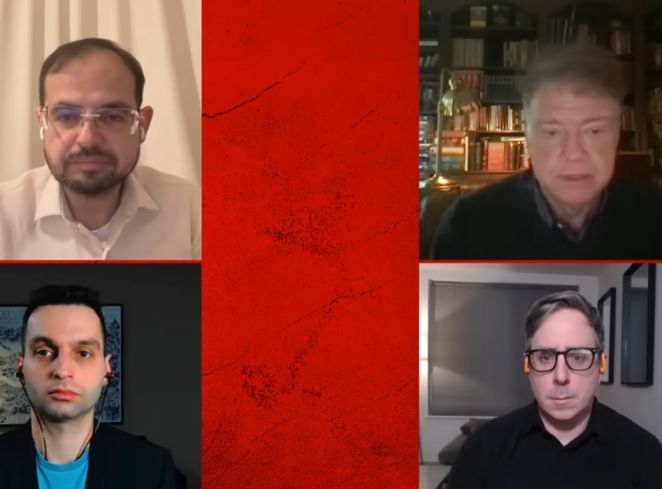
Editor’s Notes: In this comprehensive breakdown from Triggernometry, investigative journalist Richard Miniter and former MI6 double agent Aimen Dean join the show to analyze the massive military strikes against Iran. The experts discuss the strategic objectives behind the US and Israeli air operations, the collapse of centralized Iranian command, and the potential for a fundamental regime shift. Beyond the immediate conflict, the conversation explores how these events serve as a high-stakes chess move to recalibrate global influence against Russia and China. It provides a detailed look at the complex interplay between Middle Eastern stability and the future of international power dynamics. (March 2, 2026)
TRANSCRIPT:
Introduction
KONSTANTIN KISIN: A very warm welcome to our very special live update on the situation in Iran. We are super excited, if it’s an appropriate word, to bring this to you, because we have literally two of the very best guests in the world to discuss this.
We have the amazing American investigative journalist, former repeated former guest of Triggernometry, of course, Richard Miniter, who’s written a number of bestsellers including about terrorism, Losing Bin Laden, Mastermind and Leading From Behind. And in addition to that, he’s based in Washington D.C. from which he can bring us all the inside scoops.
And in addition to that, we of course have Aimen Dean, another former guest of the show, who is a former Al Qaeda member, became an MI6 double agent and he is now the co-host of the Conflicted podcast with Thomas Small, another of our former guests, which covers the various conflicts in the Middle East. And he’s coming to us live from Dubai where he’s literally got fighter jets zooming past them, behind them.
So welcome to you both, gentlemen. Thank you so much for joining us. We really first and foremost just want to find out, Richard, tell us first of all, what has happened in the last two days?
The Scale of the Air Campaign
RICHARD MINITER: Well, it is the largest series of air sorties that Israel has ever conducted and one of the largest in US history as well. So we’re looking at in the last 48 hours something approaching 2000 separate sorties looking at Israel and the United States combined. This air operation is one of the largest in human history. The number of targets on the ground destroyed — they’re still doing battle damage assessments — but it is immense.
It is interesting what they’re not striking. They’re not striking water, power and other things for the most part, except where those power facilities enable launching of long range missiles.
The most interesting thing to have happened, which suggests that this will be a much longer conflict than might be strictly necessary — if you think about it in terms of the 12-day war that was waged earlier this late last year, or you look at the Gulf War, for example, the shock and awe campaign of the Gulf War — is that the Ayatollah Khamenei, before he died, apparently issued standing orders to individual military units allowing them to act on their own.
Iran’s foreign minister, in complaining on state-run broadcasts about the attack on Oman, said, “We have no control over those units. They’re functioning on standing orders.” They didn’t mean to attack Oman, but Oman has served as a vital intermediary between the Europeans and the Americans on the one hand and Iran on the other, long seen as a kind of Switzerland of the Gulf region. For them to be attacked indicates that there’s no longer centralized command and control over the military. They’re deciding on their own targets and they’re in a use-it-or-lose-it situation. In other words, if they do not use their rockets and missiles now, their drones now, they may not exist 24 to 48 hours from now. So they’re doing their own target selection.
What does all that mean strategically? It means that getting control, getting someone to negotiate with who could actually stop the Iranian attacks, will be very difficult. The Iranians are very intelligent, very sophisticated, 3D chess-playing kind of people, and have been for centuries. And the fact that the Ayatollah figured this out in advance, knew his life may well be taken, and that of his top leadership, dispersed authority down precisely to lengthen the war.
So this person who has directed attacks against Israelis, Americans and Europeans for more than four decades, even in death, set up an autopilot to allow for the continuing carnage. This is a blood-stained legacy. He will not be mourned by many outside of the inner circle.
Iran’s Remaining Military Capacity
KONSTANTIN KISIN: And Richard, before we bring Aimen in, just very quickly — you mentioned that they’ve got a use-it-or-lose-it situation. If you don’t launch the missiles, they’re going to be destroyed. How many do they have? Have they launched most of them? Have they launched a tiny fraction of them? How long is this going to carry on?
RICHARD MINITER: It’s hard to know. There are almost certainly people at the Ministry of Defense in Israel or at the Pentagon here in the United States who have very accurate counts based on satellite data and on-the-ground intelligence. We don’t know what capacity of theirs is functioning. And it’s not just the functioning of the rocket or the missile or the drone itself, but it’s the ability to gather targeting information. As we see these missiles, drones, or what have you — these attacks go wider — it indicates that their targeting capability is declining. And of course those things are being actively found and bombed.
But also bear in mind that they have units in caves and underground bunkers that can emerge under the sky, launch, and then automatically retract back into those underground bunker situations. The Israelis have a limitation — they cannot generally drop bombs of more than 5,000 pounds. So those will require US strikes. And there are frankly more targets than there are planes to take them all out.
So how many do they have left?
Aimen Dean’s Perspective from Dubai
KONSTANTIN KISIN: Aimen, give us your perspective, particularly given that you are in Dubai and know the region very well. What is your take on everything that’s been going on? What has happened in the Middle East?
AIMEN DEAN: Well, it was coming. Basically it was inevitable that this clash will take place and there was no going back. At the end of the day, the Ayatollah’s regime — the Islamic Republic of Iran — for decades was building a terror network within and outside of Iran in order to challenge the status quo within the region, to challenge both the American, Israeli, Saudi, Egyptian, and Turkish power in the region.
First of all, we have to understand that their ambition for a nuclear weapon was born out of the lessons gained from North Korea and how North Korea was able to withstand, or at least have this immunity from invasion, due to the fact that they developed a nuclear device. And so from 2005 onward — so 20 years — they accelerated their nuclear weapon program. But then of course they were under far more scrutiny than North Korea for all the obvious reasons, because of the fact that they have proxies across the region, including Hezbollah. And then they built the Iraqi militias after the US invasion of Iraq. And then they built the Houthi militia — starting from, some people say, 2009, but I do believe it started really as early as 1994 in Yemen. In addition to that, of course, they supported Hamas since 2009 onwards.
In my opinion, all of these activities put so much scrutiny on their nuclear program and the fear that if they become a nuclear-armed state — and since they are the largest terror-sponsor state in the region and across the world — then that would make it extremely difficult to counter their expansionist ambitions.
After all, the dear leader of North Korea, whether Kim Jong-un and his father or grandfather, never had any proxy militias or any expansionist ambitions — taking over Japan or establishing militias in the Philippines. They were contained.
The problem with Iran, given the fact that it’s 1.7 million square kilometers, it has a 92 million population, and they have an ideological flavor to their constitution that makes it imperative that they export the revolution to other states under the ideology of the Shia Muslim faith — which believes in eschatology and the return of a savior, a messiah figure, a Mahdi — all of these meant that they will use the Shia minorities of the region as a Trojan horse in order to undermine other governments.
And so one way or another, a clash was inevitable, especially with Israel and of course with Israel’s most important ally, the United States. So what happened on February 28 was the inevitable outcome of decades of accumulated policies and accumulated strategic milestones that led to that moment.
The Role of October 7th
FRANCIS FOSTER: And Aimen, that being the case, what role did October 7th play in this? Was it a catalyst or did it make the inevitable even more inevitable?
AIMEN DEAN: It did really make the inevitable more inevitable. Because if this is what one of the smallest, least-supported proxies of Iran could do — and thus from a space of 340 square kilometers, which is the Gaza Strip — if Iran was so reckless that they would send Hamas and the entirety of the population of Gaza on a suicide mission, what would they do with Hezbollah and Lebanon later?
And of course, remember that during October 7, the Assad regime was still there in power and they could have also stormed from the Golan Heights.
So at the end of the day, they realized that we have tolerated a state sponsor of terror and the existence of the cancerous phenomenon of the heavily armed and numerous non-state actors who could threaten nation states across the region and wreak havoc across the region. And so there was that moment, that realization that we can no longer whatsoever tolerate the presence of non-state actors supported by this ideologically driven, eschatological — high on eschatology, I would say, high on prophecies of a savior’s — regime in order to undermine the nation states across the region.
Not only Israel, but also Saudi Arabia, which suffered a lot at the hands of the Houthis in Yemen, as well as Bahrain, which suffered instability, and the civil wars in Syria and Yemen, which combined killed 2 million people and displaced 25 million others. Many people don’t understand that the legacy of Iran in the region is extremely bloody — unlike the unfortunately leftist rosy vision of Iran, which presents them as freedom fighters or an oppressed minority and therefore we need to treat them with velvet gloves.
Arab World’s Reaction to the War
FRANCIS FOSTER: Before we move over to Richard, has there been broadly support from the Arab nations for this war?
AIMEN DEAN: When the news of Ayatollah Khamenei being killed was broadcast across the region, there were celebrations not only in Iran itself — where people went out and started playing music and dancing on the streets, that’s in Iran — can you imagine the scenes in Syria where people were distributing sweets and celebrating the fall of the tyrant that fueled their 14 years of bloody civil war? And in Yemen where people are still suffering from the outcome of the civil war that was fueled by him.
And so you can imagine the people of Saudi Arabia, the people of Bahrain, the people of Kuwait, the people of the UAE. These are people who did not have any favorable view of the Islamic regime in Iran. So there is broader support under the basis that this is a kind of chemotherapy that the region needs in order to get rid of a cancerous tumor, which is the institution and the ideals of the Islamic Revolution in Iran — and its IRGC, the spearhead when it comes to funding and equipping and training terror organizations in the region.
Is This a Regime Change War?
KONSTANTIN KISIN: And Richard, I imagine that all of us here are happy to see scenes of people in Iran celebrating this person and this regime no longer being there to brutalize them, to kill them in their thousands. We see people all over the world celebrating.
But I also think those of us who grew up in the era of the war in Iraq in particular — whenever people utter the words “regime change,” I sort of get a bit of a shiver going down my spine and I don’t necessarily get that excited about it.
And one of the things I’d like for us to discuss as well is where this is going, because I was just looking while you guys were talking at the Kalshi odds for Reza Pahlavi being the next leader of Iran — it’s like 25%. So it doesn’t look like that is going to be the direction of travel. So is this a regime change war? And if it is, what is the next regime actually going to look like?
The CIA’s No-Kill List and the Question of Regime Change
RICHARD MINITER: Well, is it a regime change? We have to look at, first of all, that Israel and the United States have very different desired end states. In Israel, they would love to see Reza Pahlavi or someone like him have a constitutional monarchy that focuses Iran on rebuilding its civil infrastructure. I mean, there are massive water shortages. 70% of its provinces are without 24 hour electricity or without ready access to water. Five of the reservoirs that feed Tehran, which is a city of about 10 million with the surrounding area of about 18 million, five of those reservoirs are at 10% or less capacity. So there’s a profound humanitarian catastrophe that was underway before this bombing began, which this bombing will only accelerate.
So the Israelis would like to see a peaceful transition with a monarchy that supervises elections and a more modest Iranian state that focuses on solving the problems of its own people. That does not appear to be the desired end state of the Trump administration. They just simply want an Iran that leaves its neighbors alone. If there can be some rebuilding projects that benefit American and European companies, fine.
But the most important element here, which has not been reported, is the CIA has given a no-kill list to the Israelis. A group — we don’t know who’s on that list, but five to ten names, maybe more — of people they’re not allowed to target. That indicates to me, and it’s just my private interpretation, that the CIA already has someone in mind from the power structure that would take over. That is not a regime change, that is a pruning and a moderation of the current regime. Now, events on the street may make that CIA plan impossible, but the CIA tends to like continuations based on variations rather than wholesale change, because wholesale change is impossible to predict the outcome of.
Iran’s Fractured Demographics and the Question of Succession
So let’s look at Iran for a moment. Depending on which census numbers you believe, 91 to 93 million people — a large majority report that they are Shia Muslims, but of very different persuasions. Outside of that, who are native Persians, you have a lot of minorities: Azeris, Azerbaijanis, a lot of Kurds, other ethnic groups as well, a growing number of Christians, a growing number of Zoroastrians. We don’t have good numbers on any of this because to report religious conversion is to invite punishment and death under the old regime. But these people have very different ideas about what they’d like to see take over.
Regarding Pahlavi, who I’ve met but it’s been a few years — who is a very urbane, educated, liberal-minded man — the Israelis are entirely enamored of him. The Trump White House appears to actively dislike him as treacherous and double-sided, not understanding that he has to unite factions and make lots of side deals, which means that at different times, in different places, he will say different things. This is something that they feel is not businesslike, and they find him as frustrating to deal with as Zelensky, maybe more so.
The Arab governments of the Gulf have also been alienated by Pahlavi when he demanded large sums of money, including payments to his Swiss bank accounts, without a lot of accountability or a plan. And then the Europeans, aside from the French, also seem a little bit cool to Pahlavi. So I think the prediction market of 25% may be generous. He doesn’t have an outside supporter who seems to like him.
On the other hand, the younger people — those under 25, which is a majority of the population in Iran — do seem to like him. Remember, these people were not alive when the last Shah was ruling their country. And so they don’t have a nostalgic view, they have an idealistic view. And he may be able to summon them. And if he has a large swell of popular support, it may not matter what dreams the CIA has concocted in its quiet cubicles. So this is very much a jump ball.
Trump’s Political Timeline and the Pressure for a Quick Victory
The Trump people are also looking at political reality in the United States. Somewhere between a quarter and a third of Americans surveyed are in favor of this bombing campaign. The calculation of the Trump people is: if this turns into a quick victory, that support will jump to 60%. Americans love victory the way the Romans did, and for very similar reasons. A quick victory means the bombing stops. There is not a prolonged civil war, or even much of a civil war at all. And Iran seems to be going on with the business of tending to its own affairs and stopping the financing of proxies and terror attacks.
The quickest path there is a Maduro-like solution. But that might be the reality on the ground. Venezuela, as Francis knows, is a much different country than Iran. Iran has many centers of power. The geography is important here, dividing the country with mountain ranges which form cultural pockets. It has very different numbers of ethnic minorities and religious minorities that have different views as well.
And there are outside groups such as the Baluch in Pakistan, who have Baluch cousins across the border in southwest Iran — or southeast Iran rather — who would like to start taking out coastal batteries and elements of the Iranian navy that are laying sea mines to block the Strait of Hormuz and drive up oil and gas prices to exact pain on the West. But they would want some guarantees and some smaller subsidiary sovereignty for the Baluch people inside Iran — which is not in the CIA’s plans. So it is a jump ball. Who knows what’s going to happen.
But one thing we do know is that the Israeli vision, the Iranian vision, and the US vision — three different visions — will separate over time, and they have very different short-term political needs. Israel is probably taking a longer-term view because their scheduled elections are not for several years. But the US has scheduled elections in November, and early voting begins in mid-September. So the desire for something quick that could be reported as a victory is intense.
Meanwhile, the Iranians are also very short-term thinking because they are starved of electricity, of water, and increasingly of food. So there may not be philosopher kings who can design the ideal outcome, and we don’t know what it’ll be.
What Do the Gulf Arab Nations Want?
KONSTANTIN KISIN: Well, one vision that wasn’t mentioned there, Aimen, is what is the vision of the Gulf Arab nations? As you were describing earlier, everyone bangs on about Israel being behind this, but they’re ignoring the fact that the Saudis were literally on the phone to Trump in the week before going, “Do it now, do it now.” From what we are told, there was an article in the Washington Post. What about the Gulf countries? What do they want?
AIMEN DEAN: Well, look, at the end of the day, the Saudis in particular — who, along with the Emiratis, are the drivers of the overall Sunni Arab states’ policy towards Iran — the policy was always trying to do containment up until 2015. But then after 2015, the containment policy turned out to be completely counterproductive, because Iran, after feeling emboldened — the Islamic regime, after being emboldened by the successes they had in building their proxies in Iraq, saving Assad in Syria from falling during the civil war, and of course by emboldening Hezbollah — they built up the capability of the Houthis, which then was at the southwestern flank of Saudi Arabia.
And suddenly the Saudis found themselves surrounded from three sides. It was always the north, which is Iraq; the east, which is Iran; and now suddenly the south, which is Yemen. They always felt that only one strait was vulnerable, which is the Strait of Hormuz. And now they have the Mandab Strait to worry about as well. Suddenly they felt that their energy export security was threatened. They felt that their food security in particular was also threatened, because they were dependent on overseas imports into Saudi Arabia.
And then there’s water security too. Many people don’t understand that Saudi Arabia is 95% dependent on water desalination. During the war between Iraq and Iran, and the introduction of the ballistic missile tit-for-tat fight between Saddam’s Iraq and Khomeini’s Iran, King Fahad of Saudi Arabia at that time realized that they were attacking each other’s oil rigs. What if one of these missiles found their way into one of the three major water desalination plants in the eastern province on the Gulf —
The Saudi Betrayal and the Path to Détente
AIMEN DEAN: We will have a total collapse of society because Saudi Arabia wasn’t designed to hold 38 million people. In fact, it’s not even designed to have 3 million people based on the water shortage that they have. And that’s why the King had decided to build 17 more water desalination plants of smaller sizes in the Red Sea, only for the Houthis then to appear on the Saudi’s Red Sea flank, threatening the water desalination there. So the Saudis felt since then that only confrontation is the real policy. And this is when the temperature started to rise.
But then, while the Saudis felt that they were frustrated, of course, because of the fact that air campaigns never succeed in dislodging groups like the Houthis — I mean, just look at America with the Taliban and Afghanistan — but nonetheless, they felt that when there was a change of administration from President Trump in the first administration to President Biden, or shall I call it Obama’s third term, when that happened. And of course there was a rather pathetic, rather unbecoming of the United States desire of restoring the nuclear program agreement, the JCPOA with Iran.
And because of certain figures within the Biden administration, whether it is the former Obama administration figures like Valerie Jarrett or a new figure like Robert Malley in the Biden administration, they put significant pressure on the Biden presidency in order to carry favor with Iran and the Iranian regime at that time, to actually put pressure on the Saudi side to end the war with the Houthis.
By then, the Houthis, over an eight year period, had launched more than 1,000 ballistic missiles and 2,000 drones against Saudi Arabia. And all of them were Iranian made, by the way, and Iranian smuggled to them. So how do you then pressure the Saudis to stop the war? The Saudis are saying, “We are going to stop the war only when the Houthis give up the access to the sea so they don’t threaten international maritime traffic. And if they give up any long range offensive weapons, more than 150 kilometer range, if they do that, we will end the war and they can form a power sharing agreement with the other Yemeni parties and we will end the war.”
The Biden administration said that, no, the Houthis will not accept that. But because we have far greater priority in a pathetic nuclear agreement that we need with the Iranians, we’re going to stop giving you the munitions that we agreed to supply you and that you purchased and paid for in good faith. We will not give it to you so you can carry out your war.
And the Saudis said, “By all means, we’ll make our own.” But then the Biden administration went further, and that was between November and December of 2021, when they said to the Saudis, “Well, we’re going to stop supplying you with the Patriot missile systems that are necessary to intercept the Houthi ballistic missiles. So you become sitting ducks.” And when the Saudis are saying, “Well, we have enough supply for about six months, seven months, we’ll continue the fight.” So by March of 2022, the administration gave the biggest stab in the back to the Saudis by saying, “We’re not going to update the software. So you’re truly going to be sitting ducks now. Your water, your oil facilities…”
And already in 2019, Saudi Aramco was struck and almost 5.7 million barrels of oil every day for 22 days were lost to global production. The Biden administration gave the Saudis the trauma of their lives — that you cannot rely on America, because America was slavishly seeking the satisfaction of rabid fanatical mullahs in Tehran, favoring them over an ally that has been steadfast beside them for 75 years.
That changed the equation. And that’s why the Saudis decided that if Iran is so powerful that even America is kissing the ring and asking for forgiveness for what Trump did before in terms of tearing apart that awful nuclear deal, then you might as well do a deal with them. And that’s why the Saudis went to China, and by March of 2023, the Chinese brokered a deal between the Saudis and the Iranians for a détente, for a non-aggression pact. And that was borne out of the fact that the Saudis cannot trust any American administration after that, of betraying them just in order to seek a deal with the Iranians over the national security interests of the Saudis.
The B2 Strike That Changed Everything
What happened? What changed? Trump came back, and what changed everything was the B2s on 24th June last year smashing the nuclear facilities in Fordow, Natanz and Isfahan. That changed the mindset of the Crown Prince of Saudi Arabia, MBS — that okay, maybe now there has been a significant shift in American policy. We can now trust that there will be a regime — not change necessarily — they were looking at actual regime containment that could finally push them back into their own borders in a way that would deter them from interfering in their neighbours’ affairs.
And that’s why the UAE and Saudi Arabia, despite their differences in Yemen and Sudan and elsewhere, they were united in the fact that it’s now or never. And so when the Saudis saw the two aircraft carriers and the biggest buildup in the Middle East since 2003, they realized that it’s now or never. And they agreed with the Israelis on this.
FRANCIS FOSTER: But that being the case, Aimen, you outlined what was happening beautifully in Saudi and the other countries. It’s still one hell of a gamble, isn’t it?
Iran’s Internal Collapse: Economy, Society and the Regime
AIMEN DEAN: One of the things I’ve been talking to people from the Ministry of Foreign Affairs in Saudi Arabia and in the UAE, and other diplomats and ambassadors and security services, intelligence services — they tell you, “We are worried about refugees coming across the water, like what happened after the Iranian Revolution in 1979. And it could have a destabilizing civil war. We have ethnic makeup.” But I disagreed with them in a sense that, look, civil wars generally in the Middle East happen because of external pressures actually pulling the country in question apart.
But in this case, there is almost a consensus among Iran’s neighbours in Pakistan, Turkey and the Gulf states that Iran, post revolution or post regime collapse, should remain united. They want it to be united. That’s the first thing. Because a divided one will be a catastrophe for the region because of ethnic and sectarian strife — it will tear the rest of the region apart. Just look what happened in Syria. We don’t want a Syria ten times over.
However, it was inevitable because of the fact that the regime built itself over the bureaucracy of the Shah. So it built itself layer after layer. But then these layers were really rotten and they’re going to collapse at any time.
The reality is that the Iranian society — if you want to simplify the sentiment — 25% of the Iranian population would gladly kill the regime and the ayatollahs, and 25% of the society would gladly kill for the regime and the ayatollahs. They are the other end of the spectrum, the zealots, the fundamentalists. And then you have the 50% in the middle who want to live. They don’t want to kill or kill for someone or die for someone. So they are the ones who always were looking to live. They are pragmatists.
One of the things about the Iranian people, whether Persians or Azeris, or Kurds or Lurs or Arabs or Baluch — they are amazing. They are actually people who are pragmatists, however they want to live. The problem here is that exactly in these four letters — L, I, V, E — they want to live, is where the regime was hit in an Achilles heel spot.
In our podcast Conflicted, on the 21st of October episode, I was talking about the fact that, since I was a banker once — I know, basically I was choosing one form of terrorism to another into banking — but I was a banker once, was the head of the Financial Intelligence Unit in the Middle East for one of the global banks. And one of the things I always look at is stability linked to currency fluctuation.
So I was looking at the fact that on the eve of the end of the 12 days war, the Iranian currency was 600,000 rials per dollar. Then of course, on the 21st of October, with my co-host Thomas, we were discussing the fact that the currency broke through the 1 million per dollar. I told him, “Thomas, I’m worried because if it passes 1.3 million per dollar, that’s mass protest territory.” And then of course, 28 December of 2025, it passed 1.35 million. And this is when the bazaaris — the trading classes, the business classes — they called for the strikes and the protests, because that’s it. This is now the incompetence of the regime.
And because of the perceived incompetence of the regime — not even perceived, it’s real — they are a bunch of incompetent people when it comes to managing the economy. They actually invited that on themselves by not only degrading the living standards of the people, but also without giving the people some light at the end of the tunnel — that we know what we are doing and we know how to negotiate with the US to lift the sanctions or to ease them in order to improve the living standards. No, they were just arrogant in their belief that the people will follow them no matter what, even in the darkness of a tunnel that has no light at the end of it. And that’s where things went too bad.
Now, I said in that episode also, if it reaches 1.6 million, that’s civil war territory. Now it is at the moment standing at 1.6, 1.65, possibly 1.7 even. It means that they have mishandled the economy completely.
The $2 Trillion Wasted Legacy
And that’s why we need to understand that the fact of the matter is that the Iranian people, after the 12 days war ended, they woke up to the reality that the regime, since 2005 until 2025 — these 20 years — wasted roughly $2 trillion of lost GDP, accumulated GDP losses every year: 30 billion, 40 billion, 60 billion, 80 billion. Every year they were losing these figures due to sanctions over the nuclear program that hardly cost about 20 or 30 billion dollars. And in addition, they spent during this period $300 billion on Hamas, on Hezbollah, on the Houthis, on propping up the Assad regime, on the Syrian Civil War.
$2.3 trillion — to money-savvy Iranians, that is so much to take. But they were always told, “It’s for the pride of the nation. We’re going to be a nuclear power. We’re going to have this beautiful mushroom cloud in a test of nuclear strength. In front of everyone, we flex our muscles.” But then it all went up in dust when President Trump authorized the use of the GBU-57 bunker busters. And these bunker busters basically did not only just penetrate deep into the mountain and collapse it over the enriched uranium — it collapsed their hopes and ambitions.
And they realized, “We are led by donkeys and idiots,” and as a result we lost everything. So it’s like the children who saw their compulsive, drunken, gambling father in a Vegas casino, wasting the entire family silver on a hope and a prayer and a prophecy that one day they will win the jackpot, only to become a jackass, unfortunately. And that’s why they were angry and they went out onto the streets.
FRANCIS FOSTER: Look, Aimen, I quite agree with you on this, but I think one part of the puzzle that we haven’t addressed yet is the Islamic Revolutionary Guard. Because you look at them and you think, and you look at the number of people that they’ve got in that army, anywhere from 150,000 to 200,000 people. You’ve also got the secret police, the regular police. I mean, this is going to take one hell of an effort to try and defeat these people.
The IRGC’s Religious Fanaticism and Economic Power
AIMEN DEAN: Surely it’s 265,000, if we look at the entirety of their force, because remember, the IRGC is multiple factions. It’s not only one faction. But I always simplify it by the economy faction, the money faction, I will call it, basically. And the real zealot faction.
The reality is that the IRGC controls 40 and up to 45% of the entire economy thanks to the sanctions and thanks to the way they created these companies. I mean, I used to be a financial investigator in counterterrorism finance. And so I used to see a lot of their companies in Khatam al-Anbiya, Shahid foundation, and looking at their infiltration into more than 100 sectors — from telecommunications, the medical sector, pharmaceuticals, export, import, construction, and of course, above everything else, the energy sector, gas and petrochemicals and oil.
And when you look at everything they do, it was about enriching the IRGC to become a very powerful benefactor of all of the proxies they have across the region under the umbrella of the Quds Force, which is a part of the IRGC, responsible for their external armies. The armies as a whole — Hezbollah, Houthis and Iraqi militias and Hamas and all of that — at some point numbered 700,000 people combined within the entire Middle East under arms, outside of the state control. Like that was scary.
But then also, what is their mission? If you look at the IRGC, the IRGC doesn’t stand for the Iranian Revolutionary Guard Corps, it stands for the Islamic Revolutionary Guard Corps. And their entire mission is not only just because they have fanatical allegiance to the supreme leader.
Because remember, by the way, Article 5 of the Constitution of the Islamic Republic — which is weird, by the way, you will be surprised — who the head of the state is. The head of the state, you would expect, will be either the president or the supreme leader himself. But the reality is that neither of them are the head of the state. According to Article 5 of the Iranian constitution, the head of the state is actually a five year old boy who went missing 1,200 years ago, which is the figure of the Imam Mahdi.
And okay, of course for me, and for you and for everyone else basically listening, that’s a bit weird. But for them it is faith. It’s an article of faith. And okay, I respect their faith, but not to the extent where it becomes that a disputed figure — whether real or mythical — becomes the head of a state in a modern nation state in the 21st century.
And that who then becomes the head of the state on his behalf will be the jurist, the grand jurist, the grand cleric who would be the steward on his behalf until his much anticipated return. And because of that allegiance that the IRGC give to that figure of the supreme leader — that deputy, on behalf of that either mythical or religious figure, depending on where you sit, which side of the fence you sit on — you end up with a fanatical zeal, the readiness to kill 30,000 people of your own people in two days on the 8th and 9th of January this year to defend that regime.
Because you do believe that it’s a divinely ordained regime and that there is a blueprint, that if this regime survives, it’s the regime that would be there to give the banner and to be the vessel through which the empire of this much awaited Messiah will be established and to vanquish all the other rivals in the region, with his divine powers.
I mean, I know it sounds foreign to you. Foreign to me. But remember when people tell me, “Oh, they are rational, at the end of the day,” I say no, they are pragmatists sometimes, but they’re never rational. And anyone who falls into the illusion that they are rational will hit the wall, just like Trump said. “I don’t know why they are not surrendering. I don’t know why they are not coming for a deal.” Well, because they are not rational. Don’t deal with them as rational.
Is Trump Gambling His Presidency on This?
KONSTANTIN KISIN: That being the case, Richard, thank you for your patience. It strikes me that Francis’s question was exactly right, but Aimen covered the one side of it. I’d love you to cover the American side of it. Francis said this is an extraordinary gamble. And given what Aimen has just described about the dedication, the religious dimension, everything else — is President Trump gambling his presidency and his legacy on this, and is this a big risk to him and to his entire administration?
The Strategic Calculus: Trump, Iran, and the Threat of Nuclear Apocalypse
RICHARD MINITER: War is always a big risk, but sometimes not going to war is a bigger risk. I think that Trump chose a time well before the midterms, so he has got off ramps and options so that this does not dominate the headlines in the critical voting period.
The view from Washington is that there is a three seat majority for the Republicans in the House of Representatives. Three elections could turn control of the House. If the House is lost to the Republicans, the last half of the Trump administration will be entirely investigations, impeachments, paranoid claims and justified claims. Unfortunately, right. The administration is staffed with human beings and some of those human beings are flawed, and so nothing will happen.
So the president needs foreign policy victories, and most importantly foreign policy quiet, so that he can focus on domestic reforms that would win votes. Because ultimately, there’s never been a case in American history that I’m aware of — including the Vietnam War — that foreign policy was the number one issue for American voters. So that’s one piece of it.
Another is that I think the president is aware — certainly his advisors are, and I’ve talked to those people — that what’s called Twelver Shia Islam, this particular sect of Shia Islam — and let’s not paint with such a broad brush, most Shia do not share this perspective — but Ayatollah Khamenei absolutely did. And his followers among the Houthis in Yemen absolutely do. And many aspects of Hezbollah, many of the factions of Hezbollah, share this.
What is important about this — you’ve heard Aimen talking about the missing Imam — they believe in a kind of messiah, a Mahdi, who will return in the form of this five year old boy who disappeared 1,200 years ago, apparently down a well. And that to bring about his return, you need the end of the world. So giving these people atomic weapons means they will want to end the world for deeply religious reasons and see themselves as glorious until that final moment. Kind of like Beneath the Planet of the Apes, in which the whole world explodes.
These are the absolute worst people to have atomic bombs — people who actually want to use them. Other more normal countries that have atomic bombs use them in a different way. They use them by threatening to use them and therefore never using them. That is the real power of an atomic bomb. “We could do this. So instead, make a deal with us.” That is why, for example, the West has not fully backed Ukraine in the Biden years — they were afraid of Russia launching atomic attacks.
Also, the Iranians have studied the Libyans, the Ukrainians and the South Africans. Those are the only three powers that were declared to have publicly and believably had atomic weapons. Of those that we absolutely know for certain had atomic weapons and gave them up, how did the rulers of those countries turn out?
Well, from the Iranian perspective — the white South African government lost power. You could argue that was a good outcome or a bad outcome, but that’s the result. The Libyans gave up their weapons — they seem to have had chemical and biological weapons as well. And where’s Gaddafi now? He died an ignominious death on the side of the road and his country’s beset by civil war. And of course we know what happened in Ukraine after its 1994 treaty to give up the atomic weapons that the Soviets had left behind in that country.
So they said: one, we need to have atomic weapons, and two, we need to never give them up. The North Koreans have learned the same lesson about not giving up weapons, and they will not give up easily, but they do not have a religious reason to bring about the end of the world.
What Is Trump Really Playing At?
RICHARD MINITER: So what is Trump playing at? Ending a threat to mankind from a regime that has shown great willingness to kill millions of its own people. If we add the Iran-Iraq war, these various bombings, the starvation that has occurred in many of the more distant provinces, the malnourishment that has accrued in others, and then the massive terrorist attacks.
Also greatly overlooked is Putin’s letter following the death of Ayatollah Khamenei. He called it a cynical murder by the US, but read the rest of his remarks — he clearly saw Iran as an ally. Iran wasn’t always the world’s largest state sponsor of terrorism. The USSR was. Terrorism is not a Muslim invention. It is a Russian invention. It is the Novemberists of the 1830s, the anarchists of the 1860s. In Russia, it becomes a tool of the tsar in the 1890s, using the Armenians against the Turks, which ultimately led to the genocide carried out by the Turks. But the Turks had a long line of atrocities against themselves to point to in justification. I’m not saying it makes it right. I’m just describing the history.
And then under the Soviets, terrorism becomes a key foreign policy tool — in the Middle East, in Europe. Look at the Red Army Faction, the Baader-Meinhof guys. Look at South America and look at the Weathermen in the United States and others. They clearly think they can amplify their power through proxy forces. And so the Iranians fully absorbed these Russian lessons.
And don’t forget, there were — until recently — 300 Russian engineers at Bushehr working on their atomic weapons program. Those are the ones we know about. We also know that the Iranians manufactured drones for the Russians to use in Ukraine and elsewhere. So some of the people who do not want a regime change in Iran are Russia and China, because this will put them on their back feet.
Now, if it is accomplished, this would be something that Trump can point to as a victory. This massively decreases Russia’s — and to a lesser extent China’s — influence in the region.
Image vs. Interest: What Does America Actually Want from Iran?
RICHARD MINITER: If a non-sectarian regime takes over, even if it’s composed of former military elements and is not a democratic dream — bear in mind, Trump is making a distinction which his critics simply don’t understand — the difference between rebuilding a regime in America’s image versus in its interest.
Image means it’s a copy of Westminster and Washington — there are elections and by-elections and neutral counting of votes and an independent judiciary and property rights and all these wonderful Anglo-Saxon institutions. This is not what they were attempting to do under the Bush years in Iraq, but it is certainly what the critics charged them with. In fact, when I talked to Rumsfeld’s deputy, Paul told me straight up: “Our best outcome for Iraq in 10 or 15 years is Romania 1995.” So the neocons were much more realistic in their planning than we’ve been told.
But the image regime change is a carbon copy of Britain and America — and that’s impossible given the people and the pressures acting on those people. Now let’s look at its interest. Its interest is much simpler. An Iran that is not at war with its neighbors through proxy terrorist forces or directly, in any way. An Iran that is not a humanitarian catastrophe.
Iran has today one of the highest inflation rates in the world. And as Aimen said, inflation always predicts civil war if it’s hyperinflation. So we’re not going to see boots on the ground — certainly not if the Trump administration has its way. But somebody’s going to have to stabilize the currency and perhaps dollarize Iran, either through a currency board — which is unlikely given how rotten its institutions are — or probably complete dollarization, replacement of the currency with the US dollar.
That’s easier in Iran than it sounds, because their exports are mostly received in dollars for oil and gas, and they import electricity from Turkey and Azerbaijan and pay for those in US dollars. So moving to dollarization, with a nearly worthless currency now, is not as far-fetched as it seems. And it may well be that the Israelis have been helping by counterfeiting currency inside Iran. Remember, a million Iraqis go into Iran every day to go to work and then go home at night, so it’s very easy to carry counterfeit currency into that country.
But their own mismanagement of the currency aside — stabilizing the currency and enabling people to have electric power, food and water stability, and not being a threat to their neighbors — those are the two things you need to maintain an American interest in the region.
That doesn’t mean that there is a democratic utopia. That doesn’t mean that all the problems of Iran are solved as if by a magic wand. It means that Iran is no longer a tiger devouring its neighbors. It’s a den of wolves who stay in their den of wolves.
The IRGC Problem: Can Iran Be Reformed?
KONSTANTIN KISIN: Well that makes a lot of sense and you laid that out beautifully. But I think my question remains because I guess what you’re describing is, you know, you take out Darth Vader and you install his lieutenant who’s not quite as bad. Right. But Aimen’s point is, well, the Islamic Revolutionary Guard Corps, these are fanatics. And who is it in a country like Iran where there are 200 something of them with guns that is likely to take over?
Once you take out the top leadership, it’s probably not going to be, as you suggest, some liberal minded person. So is it actually realistic even to have what you are describing, which is a regime that is in America’s interest? Like what happened in Venezuela, when you take out the top guy and you replace them with another person of the same ilk who’s just going to be much more compliant and much more friendly, is that actually likely in Iran? That’s why I’m asking you if Trump is gambling.
RICHARD MINITER: Well, all war is a gamble, but he is absolutely gambling. Because if you leave it up to the Iranian people to decide and different Arab and non-Arab outside groups provide them with arms, you’re going to have one of several outcomes. Either the MEK takes over — those are people that the US can work with, but it would be a mistake to call them liberal minded humanitarians. They have a severe creed of their own. There is a smaller chance that the son of the Shah can take over. There are ethnic groups that may want to have control over their own regions.
I think the chance of a civil war is very high unless somebody can establish order very quickly and have the loyalty of the military to do it, which is less ideological than the Islamic Revolutionary Guards. And the Israelis are already at the decision that you just have to kill as many of these people as possible. You can’t change their minds, you have to stop their minds. The US is not there. And the fact that it’s giving a no-kill list, which I don’t think is publicly known, indicates that the US has a very different view. They would like this to be over as soon as possible. A four-week campaign is what the Israelis were able to get out of them. But if there was a shorter campaign option, I’m sure that Trump would take that. The threat needs to be neutralized, not utopia created.
FRANCIS FOSTER: And Aimen, do you think a four-week campaign maximum is realistic? Because to my completely untrained eye, I think this could potentially last for years.
AIMEN DEAN: Look, there is no way — absolutely no way — of having a more pragmatic leader in Iran without getting rid of the IRGC. Because the IRGC call all the shots in terms of military ideology. They are the elite fighting corps. It’s like saying basically that I’m going to install a Roman emperor, but against the will of the Praetorian Guard. Good luck with that. Without the help of the Praetorian Guard, without their agreement, there would be no emperor.
KONSTANTIN KISIN: And sorry to interrupt you — and you’re the expert here — but I think even that does a disservice to what we’re actually talking about. Because the Praetorian Guard on many occasions murdered the emperor and installed the one that they preferred. But what you’re talking about is a religious fanaticism on top of that, which I think is much harder still, surely.
AIMEN DEAN: Exactly. And that’s why I’m saying that the reason why we now have four people controlling Iran at the moment. You have the head of the judiciary, who is bloodthirsty — a nasty person who handed thousands, if not tens of thousands, of death sentences in his entire career. Then you have Ayatollah Arafi, who is an extremely hardline jurist and is now the spare Ayatollah, if you can call him that. Then you have the extremely useless President Pezeshkian. And then you have, of course, the wily fox Ali Larijani, who is a man of all seasons — the Thomas Cromwell of Iran.
These four people are now controlling Iran. Ali Larijani as the head of the National Security Council. But the other three — the President, Ayatollah Arafi who’s the spare Ayatollah, and the head of the judiciary — are forming the three-member interim leadership council until a new Ayatollah is confirmed. And the indications at the moment are that they may even confirm Ayatollah Arafi as the current leader. Why? Because he is the IRGC’s top pick. And as long as the IRGC calls the shots in Iran, there will be no reformist, there will be no one who will act in America’s interest. Anyone who comes and tries even to act in America’s interest will be murdered before they even take office.
That’s why we have to understand that without absolutely dismantling and uprooting the IRGC as an institution and as a fighting force from Iran, there is no hope for the future. It is a state within a state. It is a cancerous tumor inside Iran. And without taking it down, there is no future for that country.
KONSTANTIN KISIN: Richard, you look like you wanted to weigh in. Feel free if you did.
The No-Kill List and the Question of American Memory
RICHARD MINITER: Yeah, a couple of things. One is the regime is a humanitarian catastrophe for its own people. But those people are largely — because they’re Iranians and they are very Iranian in their Iranianness — riven into factions and hard to unite. And they’re unarmed for the most part. So who is on that no-kill list is the question the White House press corps should be asking. I suspect Larijani is on that list, that the CIA would like to work with him.
AIMEN DEAN: Yes.
RICHARD MINITER: That will not lead to — it might lead to a more tempered regime, but it will not lead to the regime that all of the democratic reformers are dreaming about. He might weaken the dress requirements for women, which are massively unpopular. There’s a great video out of a morality police woman being forced off a train in Tehran a couple of days ago by a crowd of women, some of whom had completely uncovered hair. So among the educated, of which there are a lot in Tehran, there is a great hatred of these so-called Islamic rules — which are not in the Quran, by the way. These are the interpretations of ayatollahs over the years. So he may do some things there. He’s certainly going to have to do some economic reforms. And when pressed to undo the ties to various terror groups, he is unlikely to comply, because that’s the only counter-weapon he has.
Also accelerating this are two things which have not come up before. One is current experience in America, and the second is American history.
Quick American history: in 1979, 52 American diplomats were held for 444 days. When I asked the deputy head of the Iran desk in the State Department in the Obama years whether these two numbers meant anything to him — 52 and 444 — he just shook his head like these were random numbers. I said, “Okay, how old are you?” He said 37. I said, “Well, for everyone over 45, these numbers are in their brain for the rest of their lives.” That is how many hostages were held for how long. And the national dishonor. There was Ted Koppel on network television, which had a big audience in 1979, holding a special every single night called America Held Hostage, with the number of days that it had gone on. And it frequently had video of blindfolded American diplomats and American marines being beaten.
There is an almost Roman sense of American honor that needs to be slaked. So anybody over 45 or over 50 who’s looking at the Iran situation, that is also in their field of vision — they remember that. The amount of sympathy for this regime among those who are over 45 in America is a negative number for the most part, unless you’re highly ideologically motivated.
KONSTANTIN KISIN: Right.
Terror Attacks on U.S. Soil and the Political Calculus of War
RICHARD MINITER: The dislike of this regime is intense. So American history also influences current American experience. We had a stabbing and shooting attack on the Washington D.C. Metro which appears to be linked to an Islamic militant who may have been motivated by Iran — though all the facts have not come out. And then we had an attack in Austin, Texas, with a guy wearing a shirt that says “Property of Allah,” and underneath that shirt an Iranian Islamic Revolutionary flag. And we have the FBI admitting that there are some 700 Hezbollah — not Iranian, just Hezbollah — terrorist sleeper cells believed to be in the United States, very few of which are under direct surveillance.
So as these proxy attacks increase in the United States, the American thirst for war will go up massively. Trump’s ability to end the war — his vaunted off-ramp — may politically disappear if the terror attacks increase in number or in lethality. And there might be political risk in stopping the war before the American people feel that security and safety has been returned.
If these terror attacks are directed by Iran and if they continue — two big ifs — then nothing less than complete eradication of the Islamic Revolutionary Guard will be the desired outcome. This is a miscalculation by the Iranians of an enormous amount.
AIMEN DEAN: Yes.
FRANCIS FOSTER: That being the case, and we’re talking about American attitudes to war — surely when they start seeing servicemen coming home in coffins, that is going to affect all of America, but particularly the MAGA, America First element of Trump’s base, which is an incredibly large part of it.
RICHARD MINITER: Yes, but this is a very popular misunderstanding even in America. Americans are not turned off by body bags. They’re turned off by people dying for no reason. If there’s a clear cause that the American people think is just, then the World War II death tolls did not deter people from supporting the efforts against Germany and Japan. It’s where political goals seem hazy and not directly tied to U.S. interest that support erodes.
If there are more terror attacks — and the evidence is still emerging, these could be volunteer efforts by random lone individuals, it is possible — but it is more likely that it is organized at some level by the Iranians. If these continue, then just like Pearl Harbor, just like 9/11, the American interest in war will go up massively. We are not Europeans. We do not tolerate mayhem caused by foreign actors against innocent civilians, especially women and children. That is simply not tolerated by a large number of Americans.
And so Trump’s ability to end the war, his vaunted off-ramp, may politically disappear if the terror attacks increase in number or in lethality. That is a much bigger gamble. And there might be political risk in stopping the war before the American people feel that security and safety has been returned. If these terror attacks are directed by Iran and if they continue — two big ifs — then nothing less than complete eradication of the Islamic Revolutionary Guard will be the desired outcome. So this is a miscalculation by the Iranians of an enormous amount.
Geopolitics: Is This Really About Russia and China?
KONSTANTIN KISIN: Well, it sounds like this is going to potentially run and run, and really will be a thing that could have a huge impact on geopolitics, on American politics, on the Trump presidency. We’ve got five minutes left, and I want to touch on geopolitics before we wrap up.
But before I do, I think our audience would have been enjoying this so far, and I just want to remind them — Aimen Dean, The Conflicted podcast, they can go and listen and check that out. And of course, Richard, with you — Losing Bin Laden, Mastermind, Leading from Behind, and a whole bunch of other very successful books that you’ve written about issues very closely related to this. So I hope people go and check both of your work out after this.
But the final issue that I think we should tackle before we wrap up is the geopolitics of it. We recorded an interview with Canadian opposition leader Pierre Poilievre this morning with Francis. And his view was the US is effectively engaging in what you might — he didn’t use the term proxy war — but he did feel that dealing with Iran in this way is a direct anti-Chinese dominance move, anti-Russian dominance move. Aimen, you’re shaking your head. Richard, maybe just briefly — a minute and a half each — on the geopolitics of this. Is this about Russia and China? Is this just about the Middle East? And what is likely to be the geopolitical impact of all of this?
Final Thoughts and Geopolitical Implications
AIMEN DEAN: You want me to go first?
RICHARD MINITER: Yeah, please.
KONSTANTIN KISIN: 90 seconds, Aimen.
AIMEN DEAN: 90 seconds.
KONSTANTIN KISIN: Okay, first, imagine you’re on the BBC, mate. You’ve got 90 seconds and I’ll interrupt you seven times.
AIMEN DEAN: No problem at all. I’m used to it.
Well, look here, first of all, we have to understand that the Iranian regime established proxies, established terror cells all across the world with Hezbollah, of course, like basically in places from Latin America, West Africa, the United States, from Dearborn, Michigan, all the way to Romania and Eastern Europe, all the way to Mauritius where they have their banking empire.
So at the end of the day, it’s not about China or Russia. It’s about the fact that Iran itself is a gigantic beast of terror networks, money laundering networks worth about $74 billion a year. You are talking about a radicalization movement that is trying to subvert Islam and the Islamic nations. You have a movement that is actually within the IRGC that’s trying to swallow their neighbors, which could upset, especially when their neighbors, and with Iran together, they control about 60% of the world’s oil reserves, 40% of the world’s natural gas reserves. This is a threat to global energy security and energy safety.
When you say America first, America cannot be first at home unless if it is first in the world. And therefore you cannot allow a regime like this to threaten the safety, stability of the global energy markets, for ideological reasons that have no place in the realm of rational thinking and logic.
And the idea that it’s about Russia and China — no, Iran is as big a threat, if even more than Russia and China combined. And it needs to be dealt with, as a problem by itself, not because it is linked to either Russia or China.
KONSTANTIN KISIN: Okay, Richard, your final thoughts, particularly on the geopolitics of all of this?
RICHARD MINITER: Yeah. So let’s just focus on Russia and China. If the regime changes in Iran, the drone production for Russia disappears. That has an enormous impact on the Ukraine war. This may be a piece of a puzzle for Trump to get to peace in Ukraine, and it may force the Russians’ hand. That’s number one.
Number two, the source of cheap oil. With sanctioned oil, the Chinese are able to buy Iranian oil at below market price. We’ve now seen in the last month a brand new relationship with India. The Trump administration has taken the eye out of BRICS, with India being the eye. And the Indian navy is boarding and in some cases sinking the shadow fleet of Russian and Iranian oil tankers. That will increase and be increasingly coordinated. The ability of the regime to fuel China will go down, and then with the change in regime, it will cease to exist.
What does this mean? This means that China will not have the oil and gas that it needs from Iran to cross the Taiwan Strait or to do other things. And its economy will almost certainly slow down, so its ability to menace its neighbors will slow down. So for those China hawks at the Pentagon and elsewhere in the administration, they see that undermining Iran is key to weakening China.
If you look at what Rubio, the Secretary of State, has been doing in South America — not just in Venezuela, but the ongoing negotiations with the President of Colombia, who will, in the next few months, almost certainly step down. His wife has fled to Sweden and is seeking asylum in that country. You will start to see changes in Nicaragua and in Cuba and eventually Mexico, that also pushes China and Russia out of the Western Hemisphere. Maybe they can hold a toehold in Bolivia and in Brazil, but even those are fragmentary.
So if you look at it on the world, if you spread out the world map and you see what they’re doing, Iran is the latest move in a continuing of chess moves to fundamentally weaken Russia and China and eventually to turn them against each other. This is a level of almost Nixonian, Kissingerian complexity being done by eight people, one of whom is Trump, who only talk to themselves. And that includes Rubio, Hegseth and so on — the so-called Gang of Eight, Suzy Weiss and so on.
But this is a very complicated chess move. Critics tend to look at these things as isolated episodes and then try to make historical parallels. “Oh, this will be another Stalingrad, this will be another Iraq, there’ll be another Afghanistan,” and so on. They simply do not — they have not spread out the world map and put pins on the map to see all of the different moves being made, to see the pattern that is obvious only at the highest level.
This is a fundamental recalibration of global geopolitics against Russia and China. Iran is just a piece of it.
Closing Remarks
KONSTANTIN KISIN: Gentlemen, thank you so much for sharing your knowledge and wisdom and expertise with us. And thank you so much for tuning in and watching it. We had tens of thousands of people watching this live. There will be hundreds of thousands who watch it in the final analysis, if not millions, and listen to it. Thank you for being here. Please hit the like button and leave a comment so more people see that this has been here. And thank you for being with us for an hour and a bit. Richard, Aimen, thank you so much for joining us. It’s been a real pleasure to get your knowledge and to help to understand a little bit more of what’s going on. With that, we’ll be signing off, and we’ll see you soon.
RICHARD MINITER: Thanks, guys.
Related Posts
- Transcript of Manish Tewari Interview: ANI Podcast with Smita Prakash
- Transcript of Annie Jacobsen Interview: Biological Warfare on Shawn Ryan Show #323
- Transcript: Mayor Mamdani Interview on Weekly Show
- Transcript: Tucker Interviews Dr. Chris Martenson on Global Energy Crisis
- Transcript of Arnab Ray Interview: ANI Podcast with Smita Prakash #EP-433