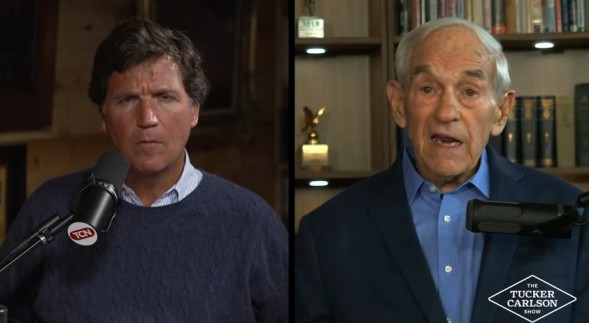
Editor’s Notes: In this episode of the Tucker Carlson Show, host Tucker Carlson sits down with former Congressman and three-time presidential candidate Ron Paul to reflect on his decades-long career as a “prophet” of American politics. Carlson opens the video by highlighting how many of Paul’s once-ridiculed warnings—ranging from the instability of fiat currency to the unintended consequences of interventionist foreign policy—have remarkably come to fruition.
The conversation delves into Paul’s unwavering commitment to the principles of liberty, non-violence, and Austrian economics, which he argues are more relevant today than ever as the U.S. faces record debt and economic uncertainty. Despite the dire state of current affairs, the 90-year-old statesman remains an optimist, sharing his belief that a new generation is waking up to the truth through homeschooling and independent media. It is a compelling retrospective on a man who has spent his life advocating for a moral framework of “no lying, stealing, cheating, or murder” in both personal and government life. (Feb 12, 2026)
TRANSCRIPT:
Judging a Man by His Enemies
TUCKER CARLSON: If you can judge a man by his enemies, former Congressman Ron Paul of Texas, the long-retired obstetrician, the 90-year-old three-time member of Congress and three-time presidential candidate, is a very, very good man because he has the best enemies.
Here, for example, is an exchange between Jeffrey Epstein and one of his friends. This takes place in early 2012 when there is conversation, as there pretty much always is in the United States for the last 30 years, about when and how we should bomb Iran.
# Ron Paul: The Prophet Washington Hated
Bomb Iran. And Epstein’s friend writes to him this during an election year, everyone in Congress is falling all over themselves to show support for Israel. Except for that dinkus, Ron Paul.
Ron Paul, yeah. Jeffrey Epstein and his friends did not like Ron Paul. But what’s not to like about Ron Paul?
Ron Paul is, and you’re going to see him speak in just a moment, probably one of the most manifestly decent men ever to serve in the Congress. Married to the same woman since 1957. Beloved by his children, grandchildren, now great-grandchildren. A man who spends his spare time riding his bicycle and tending roses. A person who has articulated the principles of nonviolence throughout his entire public career.
A guy who thinks that it is not just unfashionable but totally immoral to judge people on the basis of their blood. Who thinks racism and antisemitism are anti-Christian. The guy who’s never said a single thing against a group ever, not once. In short, a thoroughly decent man of principle.
Why does everyone hate Ron Paul?
Discovering Ron Paul in 2007
Well, there are a couple reasons. In fact, I personally discovered this way back in 2007 when I covered Ron Paul. He was running for president that year. I’d actually voted for him 19 years before, in 1988 in college for president. I knew nothing about him, but it seemed like an amusing protest vote. He was running as a libertarian then, but fast forward to 2007.
He was running in the 2008 presidential campaign and I thought, this guy looks kind of interesting. I really didn’t know much about him, so I went on the road with him for a week and I wrote a long profile for the New Republic magazine. I was working in television, but I thought it was kind of interesting to write magazine stories again. So I did.
And I learned a couple of things about Ron Paul. One, as noted, enormously nice person, gentle temperament, decent, not flashy, not greedy, not dishonest.
Two, I learned that Ron Paul is very sincere about monetary policy. Paul would give these stem-winders about fiat currency and the gold standard and why the Fed was a scam and he drew enormous crowds, at least relative to the topic.
Now, at the time, again, this was 19 years ago, no one was talking about the gold standard in public and getting anything but laughter and jeers. You were a gold bug. You were insane. You were a moron. Gold wasn’t even a topic. If you could check the transcripts from CNBC for the year 2007, gold probably not even mentioned.
It seemed crazy to care about monetary policy then, but Ron Paul did, and his audiences responded. That was the first thing I noticed. I had no idea this was a resident issue. I knew nothing about it. So I assumed since I lived in Washington and was pretty well informed, that no one else knew anything about it either. But I was wrong.
The Currency Question Nobody Was Asking
Tens of thousands, hundreds of thousands, in the end, millions of Americans were thinking about the stability and the strength of the US dollar. And they were convinced that excessive money printing since the early 1970s, when the dollar was detached from gold, which is to say from reality, when it became a purely fiat currency redeemable for nothing, they were convinced that the US dollar was weaker than their leaders said it was.
And they knew this because the price of goods they bought every week seemed to be going up over time and no one was mentioning it. Or the goods themselves were becoming smaller. There was shrinkage. This is a well-known phenomenon now. Back in 2007, people weren’t talking about it quite as much.
If you were 37 in 2007, when you were in first grade in this country, a Snickers bar cost 20 cents. By 2007, it cost nearly a dollar. And it was smaller. In that and countless other ways, it was obvious that actually this currency wasn’t worth what they told us it was. And it was becoming worth less. And only Ron Paul was talking about that.
And he was making a number of other points too. One was that the United States wasn’t actually deriving any benefit from all of these foreign wars, that it just wasn’t helping us at all. And that in the end, maybe violence isn’t the solution.
He wasn’t making hostile points.
And that’s basically all Ron Paul said. He mostly wanted to talk about monetary policy and gold, but for the crime of saying what he said about foreign policy, he was truly hated.
The Smear Campaign Begins
And the word went out: time to discredit Ron Paul. I had no idea any of this was going on until I filed my story to the New Republic at the end of 2007. And it was kind of skeptical, but amused and affectionate. I liked Ron Paul. Who wouldn’t like Ron Paul? What a nice man. I didn’t understand some of what he was saying. I didn’t agree with other parts of it, but it wasn’t hostile. It was kind of detached and amused and sometimes bemused.
So I file it, and the editor says, oh, I like the story. Good job. We’re done.
Then two days later, I got a call from that very same editor at the New Republic who said, we have a problem. Ron Paul, it turns out, is a racist and an anti-Semite.
And I said, really? I’m not working for Ron Paul. I’ve got no emotional attachment to the campaign. But he didn’t seem like a bigot to me. He seemed like a nice Christian man.
Oh, no. The editor said, we sent out a reporter called Jamie Kirchick, a recent Yale graduate and a fervid neoconservative, to go check into Ron Paul’s background. And it turns out that he had newsletters back in the 1980s that used racist terms, and we think he’s an anti-Semite based on his foreign policy.
I said, okay. And so then the author of that piece, Jamie Kirchick, called me and kind of grilled me: you spend time with this man, this bigot? So Jamie Kirchick occupying the moral high ground.
Immediately, I said, I’ve got nothing to do with that. I didn’t hear Ron Paul say anything about it. And they tried to kill my piece. But I pushed hard, and it ran at the very end of 2007. Not that anyone cares. It’s the New Republic and has a readership of like 1,900 people. But I cared since I wrote the piece.
And then the very next issue, the first issue of 2008, a cover story by Jamie Kirchick on how you may have reached the wrong conclusion about Ron Paul in the last issue. Actually, the guy’s a racist, an anti-Semite, probably can’t prove it, but of course he is. White Christian guy, right-winger.
The piece was actually called “Angry White Man,” written about the least angry white man this country’s ever produced. People have called Ron Paul many things, and some of them may be true. Angry they’ve never called him, because he’s definitely not angry, as you’re about to see. But they went out of their way, and by they, I mean organized neoconservatives, to smear Ron Paul.
Not simply as wrong on the issues, in fact, not as wrong on the issues. They didn’t bother to engage on the issue philosophically or practically, but wrong as a person. Unacceptable. You are not allowed to like Ron Paul because he’s bad. He’s Nazi-adjacent. In fact, his family may be German.
That was 2008.
The 2012 Campaign: Attacks Intensify
By the time Ron Paul, totally undeterred by the way, ran for president again in 2012, they were foaming at the mouth. Not because the Ron Paul movement had become huge or inevitable. He was never in danger of being elected president, but because his decency itself was his calling card.
Ron Paul was clearly not a bad person, no matter what they said about him. And his ideas made a kind of inherent sense. There was a coherence to his worldview, and that was a massive threat to the members of our media and commentariat who’d like to use your tax dollars to fight wars on behalf of Israel. That is just a fact.
And so the reaction to Ron Paul in that campaign was, how to put it, over the top. For example, here was a young Ben Shapiro live-tweeting a Republican debate that year that included Ron Paul. I’ll quote selected portions.
Quote: “Ron Paul is manifestly insane,” wrote a young Ben Shapiro, who somehow got into Harvard. You wonder how. “As in previous debates, he’s now gripping the pen as he would the neck of a Jew.”
Imagine writing that about somebody, accusing someone of wanting to murder, in fact, strangle to death, quote, “a Jew.” That’s a pretty serious thing to say about a person. In fact, that’s slander. And on what basis did a young Ben Shapiro of Harvard, fresh off his deal with Facebook, which he got somehow, on what basis did he make such a claim?
Well, on none. Ron Paul never attacked the Jews. Has never attacked the Jews. I bet my house Ron Paul has never had an unpleasant thought about the Jews or anyone else. Again, you’ll judge for yourself in just a moment. But that played no role in Ben Shapiro’s slander.
Again, this is December 15, 2011, Ben Shapiro live-tweeting: “Gingrich almost drops his pen. Ron Paul grabs it and wrings it like the neck of a Jew.”
“Rick Perry had the memorable moments of the evening other than Ron Paul’s corpse leaning toward the grave and strangling the Jews.”
Again: “Ron Paul says sentiment is mixed about Israel and taking action against Iran. Um, does Ron Paul know a Jew?”
You could go check the transcript. Probably unlikely Ron Paul used the word “Jew.” He wasn’t talking about Jews. He was talking about the nation-state of Israel, the secular country with borders and a military and a government and a very sophisticated lobbying arm of which Ben Shapiro was a part, trying to get the US taxpayer to foot the bill for another one of its wars.
It’s that simple. And he objected. And everyone else on stage, of course, was for it. Newt Gingrich obediently getting behind Israel as always. He knows who pays the bills. But Ron Paul, who doesn’t really care about money, doesn’t believe in fiat money anyway, standing apart independently saying, I don’t think this is a good idea.
And Ben Shapiro, among many others, attacking him as an anti-Semite. Whoa.
Why They Really Hated Ron Paul
So I guess as you assess this, you see that this isn’t the first time this dynamic has been in play in this country. In fact, it’s been in play every single time anyone in the professional commentariat dares to question the military alliance between the United States and this foreign country and the wars that the United States is fighting on its behalf.
That is somehow an attack on an entire religion or on an entire people. That of course is slander. It’s untrue. It will inevitably get people killed when you say that. But they say it anyway because it’s effective.
So they hated Ron Paul. And a big part of the reason is because he opposed their wars. But there’s another reason. It wasn’t just on foreign policy that Ron Paul made people mad.
What really enraged the entire Washington D.C. commentary class about Ron Paul is that he was right. Not that he was lying, not that he was hateful, not that he was a secret racist or Nazi. All untrue. But they wouldn’t care if those things were true.
What really made them mad is that Ron Paul precisely, crisply, and honestly diagnosed the problem and predicted the result years in advance.
The Prophet Nobody Wanted to Hear
Ron Paul in political terms is what we call a prophet. And if there’s one thing we know about prophets is that they usually get stoned to death by angry crowds. In fact, almost always. People hate being told the truth about future events, particularly when they’re implicated in the causes of those disasters. They just hate it.
Nobody wants to hear about how they’re on the wrong path. And so people who call it early are 100% of the time hated for it. They’re not rewarded. They’re not given some prize. There’s no Nobel Prize for predicting the future. There’s only a jail sentence or slander from Ben Shapiro and Jeffrey Epstein’s friends, the New Republic and the rest of the liars.
And Ron Paul of all observers of American society may have gotten it more precisely right than anyone. And if you don’t believe it, here’s a selection of Ron Paul predictions from 2002. Keep in mind that was almost 25 years ago and Ron Paul saw it clearly.
Ron Paul’s 2002 Predictions
RON PAUL: Watch, Mr. Speaker. Our government intervention in the economy, the private affairs of citizens and the internal affairs of foreign countries leads to uncertainty and many unintended consequences. Here are some of the consequences about which we should be concerned.
I predict U.S. taxpayers will pay to rebuild Palestine, both the West Bank and the Gaza, as well as Afghanistan. U.S. taxpayers pay to bomb these areas, so we will be expected to rebuild them. Peace of sorts will come to the Middle East, but will be short lived. There will be big promises of more U.S. money and weapons flowing to Israel and to Arab countries allied with the United States.
Federal Reserve policy will continue at an expanding rate with massive credit expansion which will make the dollar crisis worse. Gold will be seen as an alternative to paper money as it returns to its historic role as money.
Military and police powers will grow, satisfying the conservatives. The welfare state, both domestic and international, will expand, satisfying the liberals. Both sides will endorse military adventurism overseas during the next decade.
The American people will become poorer and less free, while they become more dependent on the government for economic security. The war will prove to be divisive, with emotions and hatred growing between the various factions and special interests that drive our policies in the Middle East. Agitation from more class warfare will succeed in dividing us domestically.
And believe it or not, I expect lobbyists will thrive more than ever during the dangerous period of chaos. I have no timetable for these predictions, but just in case, keep them around and look at them in five to ten years. Let’s hope and pray that I’m wrong on all accounts.
Tucker’s Reflection on Ron Paul’s Prophetic Vision
TUCKER CARLSON: Ugh. It makes the hair on your arms go up. Imagine having a vision of the future that precise. Would you be able to sleep somehow? Ron Paul has been able to. He’s 90 years old. You’ll see in a second. He looks like he’s had a good night’s sleep in the last 24 hours.
But those predictions are so precise that it’s spooky. He predicts massive credit expansion before the global financial crisis. This is six years before 2008. He predicts the inevitable expansion in both military adventurism and domestic police powers. He predicts that both sides will support this. He predicts that the dollar will become weaker and the gold will rise in compensation. He predicts every major trend of the last 25 years. Precisely.
And so you have to ask, how did he do that? He’s not into witchcraft. He’s a conventional Protestant Christian. He doesn’t have a gypsy telling him the future. No. Instead, he relies on principles that he believes in and a very simple moral framework.
Ron Paul is often described as a libertarian, but that both over and understates the case. In fact, Ron Paul is fundamentally a moral voice. Ron Paul opposes lying, stealing, cheating and murder. It’s that simple. This isn’t complex. Joseph Fletcher, situational ethics, it’s no. Lying, stealing, cheating and murder are wrong. They’re always wrong. They’re wrong when you do them, they’re wrong when the U.S. Government does them, they’re wrong when a client state in the Middle East does them, they’re always wrong. Period.
That is Ron Paul’s framework for the world. That’s his actual ideology. And it turns out if you stick to that, you can see the future pretty precisely.
So the New Year is here. But that does not mean you’ve got to overhaul your whole life. Despite claims to the contrary, you don’t have to take drastic measures. Make a few changes here and there and you’ll be a lot better off. And you can start with the snacks in your pantry.
Now, products from standard American chip brands are, let’s be honest, pretty repulsive. Filled with chemicals that make you feel heavy and bloated. They don’t even taste that good. They’re not good for you. We recommend an upgrade with Masa Chips. Masa is the easiest way to eat clean without feeling like you’re on a diet. The chips contain three ingredients. That’s it. Organic corn, sea salt, 100% grass fed beef tallow, and that is it. No seed oils, no mystery chemicals, just food, actual food.
And they’re amazing. And you feel great after you don’t feel weighed down. We particularly enjoyed the cobanero flavor lately. But they’re all great. You want to give them a try? Visit masachips.com, M-A-S-A chips.com Tucker, use the code Tucker for 25% off your first order. Or you can click the link in the video description or you can scan the QR code to claim this outstanding offer.
So with that, we want to show you hour long interview we did today with Ron Paul, who as we said, is 90 years old and he’s in amazing shape. More evidence that clean living and clear thinking pay off over time. But we also thought it’d just be worth pausing and saying, congratulations, Ron Paul, and shame on the rest of us. Him for his genius and us for not recognizing it at the time. And I’m definitely in that category.
But the key to getting better is repenting. We’re going to repent of our skepticism of Ron Paul’s predictions. They’ve been proven true. And now the man who predicted them, Ron Paul.
The Interview Begins
Congressman Ron Paul, thank you very much for doing this.
RON PAUL: It’s great to be with you.
TUCKER CARLSON: Oh, gosh, it’s an honor to have you. I remember traveling with you on a campaign that you did in the fall of 2007 and you gave speeches about the Federal Reserve. And I remember thinking, I know nothing about the Federal Reserve. I don’t see how this is a big issue. I was completely wrong. How were you able to tell almost 20 years ago that monetary policy would determine the future of the country?
Austrian Economics and Monetary Policy
RON PAUL: Well, it’s because I got fascinated with this issue a long time ago and I studied Austrian economics and they emphasize these various things. They teach you to think about the ramifications of policy. And I also warn us who are involved not to try to predict the day things are going to happen. But trends are very important.
And for instance, if you print too much money, the value of the money goes down and history shows, the history is very important because countries have practiced these issues and trying to get a free lunch. And they’ve been doing it even before Roman times, you know, of the abuse of the monetary system.
So monetary policy became fascinating with me and it was especially emphasized, you know, on August 15, 1971, because the predictions of Austrian economics during the 60s when I was reading about economics and especially economics, Mises and Hayek and others, they said this would happen. And that was when we, that was our first declaration of bankruptcy. We said, yeah, we printed money, we passed it out, we said it’s as good as gold, $35 an ounce. It was all a fib.
They knew, they had to know what, a little bit about history. But they always think this time is going to be different. We’re smarter than they are. We have computers and they talk into themselves and they convince themselves that they can get by and keep from the trouble that printing money and subsidizing big government always fails.
TUCKER CARLSON: So for those who haven’t followed this and may not know what you’re referring to, August of 1971, the Nixon administration. What happened that day, that was the declaration of bankruptcy?
The Nixon Shock of 1971
RON PAUL: Well, I can remember it precisely because I had been very much involved, but not anticipating what I heard. One Sunday night I was sitting in front of the television watching the news come in and oh, a special, a special news clip. And they put up President Nixon and all of a sudden bored in my eyes open. Boy, the longer that short speech went, the more my eyes open. And I said, this is a big deal, it’s going to have an effect. It might be one of the biggest things that ever happened in monetary history.
And it was just a major date for what our country is against. And it was so clear cut to me that bad stuff is going to happen this and we’re approaching that time when bad stuff will really be happening to us because you just can’t print money and lie to the people forever. It’s all based on a lie and it’s fraud, it’s counterfeit money.
And people without computers know better. People with computers are probably distracted because they think the computer is going to solve their problem and it doesn’t, it gives them reassurance and it doesn’t work.
TUCKER CARLSON: So that was the day that Nixon disconnected the dollar from gold. You could no longer redeem your dollars for gold. I have to ask you. The United States claims to have, the U.S. Government claims to have the world’s largest gold reserves. Some of them are held in Fort Knox. They haven’t actually been audited in a real way in almost 100 years, despite a lot of lying about it. Why haven’t America’s gold reserves been audited, you know, bar for bar? And what do you think that tells us?
Truth and Empire
RON PAUL: Well, it’s sort of a characteristic of what we’re dealing with today in the current events that you can’t tell the truth because you know, truth is treasonous, you know, to empires.
TUCKER CARLSON: Yeah.
RON PAUL: And they can’t tell the truth. But they also have to have the people behind it, somebody has to get something from it. And the deep state, the military industrial complex and you know, the drug companies all, they get something from it. But it finances bad things and therefore they’re talked into it so the people support it.
And then other people say we know better and we’ll be cautious and we know how to run a monetary system, you know, better than ever, but they don’t. It looks like, you know, a free lunch, but it isn’t. It’s based on, they should, if they had dealt with it in a serious way in a moral sense, that printing money and telling the people that it’s backed by gold and it’s steady and we could have the currency, the reserve currency of the world and we’re going to get rich over. Well, that was half true because it wasn’t true. But it worked for a little while and it still works to a degree, but I think the handwriting is on the wall. This is not going to continue.
And I think that’s why we’ve seen an explosion of our problems. And the one thing that I look at or two things because they’re one of the same, is the debt going up and what the price of gold is. Because the price of gold, although it can be rigged and delayed and, but ultimately the price of gold is telling you there’s problems out there. So there’s something big going on. But it’s just sort of a catch up of all the things that we’ve been doing, you know, pretending that we can police the world, threaten everybody, drop bombs on people, defy the Constitution and then punish the people who want to tell us that the few we have in Washington, they want to reveal the truth but they don’t want, but they suffer the problem because they get blamed for treason. They are defying what we said.
And, you know, I was there for a little bit and they would charge you. They, I felt, though they didn’t bother me too much. I sort of left me alone. But they would say, oh, you don’t help the president. You don’t do. But why don’t you measure things by whether or not we’re following the oath of office? And that made them mad. They didn’t.
I think what they’re putting up with now, the few we have, is they’re putting up with something much worse because the danger is much worse and people are gathering around to pick up the pieces. Who’s going to run things? So now we see people talking about, well, we even like fascists, and we elect communists and all. And that’s out of fear because people are sensing the people are always a little bit smarter and ahead of what the members of Congress are doing.
Most people think that these congressmen are smart and they know what to do. No, the people, the people are ahead of the, the people are ahead of the government and the Congress. And believe me, if you just listen to them, you know, they tell you things that you never hear when you hear people who are in office and when times get tough.
Truth Wins in the End
The sad part is some of the people who know a little bit better and might want to associate with, you know, this radical idea that you take your oath of office seriously, they know better. But ultimately, though, I’m always encouraged, I’m not discouraged because I always think truth wins out in the end. Truth works. And I figure, well, if they don’t listen to me now, maybe somebody will scratch something down, maybe somebody will read it.
Because I think that the majority of people want to hear it. You know, they do want to hear it. And I think that’s why when I say something that radical, he can’t go. He’s going to be out of office in no time. And, you know, they put a stone. But I think basically the nature of mankind is they have this, they have this challenge between good and evil. And I think that, you know, the good part of a free society is a rocky road to go, but I think ultimately people will come down.
And right now we’re in the interim of it, we’re trying to sort it out and there’s a lot of people really mixed up and it’s going to, that difficulty is going to get much worse because the system that we’ve lived on and off, you know, special interest, running things. That’s coming to an end. I’m convinced of that. You can see all these people here.
The Impact of Mass Migration on Western Nations
TUCKER CARLSON: They just came out of the dunes. There’s got to be around 100 of them. And now a boat’s going to try to come around and pick them up in a single generation. Europe has changed forever. This is the result of decades of mass migration, more than it has in the last 2,000 years.
UNIDENTIFIED SPEAKER: Whoa. Easy, easy, easy. Whoa, whoa, whoa.
TUCKER CARLSON: We followed one of the deadliest trade routes on Earth, from Africa to the Canary Islands to Spain, France, ending in the UK. In many cities, natives are now the minority. This was not an accident, didn’t happen organically. You’re not imagining it. The governments of Western Europe and the United States and Canada, New Zealand and Australia did this on purpose to their own people. They opened their border and they paid for the rest of the world, the third World, to move into their countries. This is what happens when you let.
UNIDENTIFIED SPEAKER: A bunch of foreigners completely overtake your country.
TUCKER CARLSON: Along the way, we uncovered the entire system of criminal networks, NGOs and criminal governments coordinating together to destroy the West. Watch replacing Europe only on TuckerCarlson.com.
The Role of Education and Information
Well, I think you’re right. And part of the problem is it doesn’t work anymore. Part of the problem is everyone knows what’s going on thanks to the Internet. It’s hard to lie to people in the way that government used to. What happens then? So if our monetary system, our political system, the social fabric, all of them come undone at once, where does that leave us? What happens next all depends on what.
RON PAUL: The people who think are the thought leaders who have written about it and describe the society. You want the people who promote liberty and you do you know that the people will recognize that. We see a couple people really getting the grief in Washington that are in office and they’re saying the right thing. And you have to be able to pick that out and find out what they’re talking about. So it is education against the politicians. And I think that. I think basically that people, if they have the information, they will do the right thing or lean in that direction.
But I also think you have to pay the bills. And to pay the bills now is what our national debt recognizes. You know, they say it’s, you know, a few trillion dollars here and there is going to be $40 trillion, but it’s much bigger than that. Everything is based on the falsehood of the paper currency and the printing of money. And now, now people are waking up to this people are starting to realize that just having a lot of money, they haven’t seen the correction yet because they’re still saying, oh yeah, my prices are going up, I need more money from the government, you know, lack of connections.
And I think what I see my responsibility as an individual is that if I think that I’m on the right track, I should try to share that with other people. And I think it’s very receptive. The little bit of opportunity I had with running for the president, I was so impressed with the willingness of people to listen. And it was, there’s great support. It’s the thought leaders of the country. What we have on our, you know, our universities are, you know, a strong detriment, you know, to what we have, the foreign policy and the power in Washington.
You know, a lot of good people, when the conditions get tougher or you have a charlatan that can bamboozle people, they drift over. So right now Washington, Washington is not helping us out. But there’s a lot of other people that are that I, I, I, I happen to be an optimist because I think the information is getting out. We have good talk show hosts out there and things listen and I think people want to do, but it is a big job and I think it’s the most important thing is not to have more guns and more government.
You need more education on understanding what freedom is all about and why we’ve had greatness in this country and the information is available there. That’s when I get excited, when I realize that so many good things do happen. But we’re still have the majority of the people who got hold of the government power. They have gotten us this into this mess. So it’s up to the people to wake up and make sure our ideas get out there.
Truth Tellers in Washington
TUCKER CARLSON: You made reference a couple of times to good people in Washington. You said there are a couple of truth tellers in Washington who are under attack. Who are you referring to? Who are those people?
RON PAUL: Well, the list is so short.
TUCKER CARLSON: Yes, it is.
RON PAUL: I don’t know. I don’t like to pick out then because somebody else might be 95% of what I like. Some might be 80%. So no, there’s only, there’s only a couple. Most people know that, you know, I’m very prejudiced and I very biased because I think my son’s doing a pretty good job.
TUCKER CARLSON: Yes.
RON PAUL: And I think he knows what’s going on and I think there are others that are doing that. But I think, I don’t think the answer is In Washington, I think the answer is recognizing why we have to get away from Washington and we have to get people to understand. So the educational system is good, but our educational system goes in the wrong direction. They, for 100 years, have gone completely away from the original intent of the Constitution.
So I see as an educational system, I never dreamed I’d ever go to Congress. I never dreamed I’d stay very long. I never dreamed that anybody would pay any attention. But people were starving. They’re starving for somebody to talk straight with them. And that, I think, is. I think there’s some very good things going on. But we have to recognize the truth of what’s happening. And I think it’s ideological. And I really, deep down, see a lot of good things happening. But most important is that we recognize, you know, the good and the bad.
And I think that sometimes I wonder how we did get some attention in the presidential races, because young people. I was so. I got excited about. Young people would, you know, they were so positive and excited. And I would ask a young person, I said, I just lectured to you for an hour. I said, and I. For 45 minutes, all I did was tell you what a mess we have. And you’re here talking how wonderful it is. But I always wanted to finish with what the answer is. But you got to see the problem if you want to convince people to do something else.
But when the educational system is all biased against liberty, against these principles of individual responsibility, it’s pretty tough. But in that area, I get optimistic with recognition of how dangerous it is because we still Republican or Democrat. The foreign policy is really very, very dangerous. There’s too many big weapons. And I think we need a better understanding. But most people do. Most people don’t say, you know, I’d like to go to war. I want to carry a gun and shoot people. Most people worry about why are we doing this? And they’re asking questions.
But they’ve been able to win the psychological war because if you object to it, you’re un American, you know, But I. I think it’s. Education is the most important thing that we do and understanding and some. Some moral basics that people should understand. Like if you. If you and I can’t go and steal, why don’t we let the government steal all the time, take stuff from them? It’s not rightfully theirs, and they. And then they want to have all the power, so the problems aren’t complex.
And that’s what delighted me when I would talk to young people. They seem to understand that it seems like the young people would respond even against all the propaganda of the college universities and all the media practically and the movies and everything else. If you talk to them straightforward. I would ask a student who was excited about what I was saying. I said, but so and so just said that too. You know, when we had our debates, I said, he said the same thing. He says, yeah, but he wasn’t telling the truth. You know, people can recognize it.
So I come down as being an optimist with a lot of caution about what we have to go through to restore the principles that most people would endorse. If you just offered to in principles there’s too much political power and money involved. But I think that number of people that I meet are very decent people and yet we have nothing. Just think of my lifetime, how many wars we’ve had, you know, and they’re so unnecessary. So looking at some of the basic principles of what a liberty sized society would do, it’s not that difficult. And that’s really what is in my heart and what I want to promote.
America’s Wars and Their Impact
TUCKER CARLSON: Well, I have to ask you about war. So you were born in 1935, you were 10 when the Second World War ended. So you’ve seen all the wars, Second World War, Korea, Vietnam, everything since war on terror. Have any of those wars made life better for Americans, do you think?
RON PAUL: Probably not. I can’t argue the case. And it’s control of patriotism that if you don’t do this, you’re not a patriotic person. People do that and they’re so easily convinced that I have to sacrifice something. You have to defend what you believe in, but you don’t have to sacrifice any of your freedoms to get it. And they say, well we have to do this to get along. People in Congress say yeah, you’re right Ron, on this issue. But we can’t get there. So this only give them half of this pie right now. So they see themselves as being, being able to work it out with the problems we have. But I think that’s wrong.
And I think especially young people, I like to, I talk to a lot of young people and even people that are a little bit older who have a youngish type of an attitude, open mindedness to what the country should be all about and what liberty is all about. So I think it’s so fantastic. But I also recognize that the world is imperfect and we’re not going to see it perfect society. You just have to sort of help guide it in certain directions. And the freer we are, I think the Better. The more tyranny we have, the worse off we are.
But it takes. It takes a moral understanding of what our relationship should be with the government. And that’s where it gets touchy, because people want to use it. The few want to own, control the deep state, whoever they are. They have. They’re the ones who, you know, controls the politician and all the legislation and the spending. But that’s coming in. We’re broke. And everybody’s starting to know, even though we knew it was broke. And that was my discovery. And that in 1970. Well, when Bretton woods broke down, you know, and 1970, and when Nixon gave that speech, I knew that.
But it took a long time. We were so wealthy, we were spoiled, and we could defy the principles of liberty and decency because we were so rich. And still are rich. We’re still consuming, but we’re not producing. I mean, we have a moral crisis. But that’s where I’m optimistic, because I think that number is growing. I think there are a lot of young people looking at it differently. I think our technology is helpful. I think people who have interesting talk shows and good views of, and share some of these views makes it different. And I think there’s some very good things going on.
And I also accept the idea that perfection is not achievable, but it is definitely available to us to go in a certain direction if we be, as a country, going in the wrong direction for a long time.
Spending on Foreign Wars Despite National Bankruptcy
TUCKER CARLSON: Well, there’s this very strange phenomenon we’re watching right now where as the country becomes poorer, we’re bankrupt, you said. I think everyone agree with that. We spend even more on foreign wars. We spend more now than we did 10 years ago, and we’re poor. Why do you think that’s happening?
Ron Paul on Liberty, Education, and Changing the System
RON PAUL: Well, I think our effectiveness isn’t being pursued through intellectual means and philosophy because our universities are crowded by this false illusion that it’s the government’s responsibility to do everything. And people don’t, I think they basically accept it, but they have trouble challenging the university system.
When I was in college, I was asking a lot of questions. Then it finally dawned on me I wasn’t getting very many good answers. But I think that I also have a very favorable thought that everybody is born with a chance to come to a right decision about nonviolence. You know, no lying, cheating, stealing and killing. Yes, that’s pretty simple. And you don’t need this many laws. You just shouldn’t treat people like that.
And most people say, well, that sounds easy. Yeah, but the trouble is most of the individuals do. Yeah, I don’t lie, cheat or steal or kill, but the government does. You have to apply those rules to the government. And then we would get ahead and there are some there. But boy, I’ll tell you what, just look at the people that hold the line for no lying, cheating and stealing and take it to the government and tell the government they can’t do it either. They get into big trouble.
They might be the most libertarian, freedom loving people in the world and they will get the rest of them. Oh, but they’re challenging our system and you don’t want them to ruin our system because we have to help people get along and solve our problem that we created. You know, it’s such a farce.
But the good news is the system is coming to an end. The good news also is that there’s an alternative. The good news is that more and more people are looking at the freedom alternative. But the bad news is it’s entrenched and there’s going to be a lot of havoc that goes through the country finding those people.
But I was so encouraged with what went on in the presidential campaign because, you know, the young people came out and for the two times I did, that was good. Several years I would walk out there, stadium, where do they come from? What are they doing here? They say, well, they came here to hear what you have to say. I said, but I don’t have a speech so I can talk about liberty. No, but there’s something going on.
So talking to young people excites me and I hope it keeps me young too. See, I want to benefit from it all.
Tucker Questions Ron Paul on Israel
TUCKER CARLSON: Well, it has so far. So when you were in Congress and you served in Congress for quite a while, as I remember, you were attacked for not being supportive enough of Israel. Do you think that was fair? Why were your views on Israel different from some of your colleagues?
RON PAUL: Well, because I think that I do support Israel, but I don’t support their policies. You know, Israel is not what the neocons tell us or what is happening now. Because I think Israel, let’s say the West, the United States, are flat out broke and they’re all fighting war. I think Israel is going to be in a worse shape.
Yeah, so, but I think they’re pampered in a way that all we have to say, you know, Goldberg came here first. She didn’t come to the government. She came here to get personal help. But it turned into this boondoggle of getting stuff for free. I think Netanyahu’s been to the country with his hands out in the last year four or five times.
TUCKER CARLSON: Seven.
RON PAUL: Seven times? Boy, I got to catch up. I can’t keep up with them. And they’re always with their hands out. And I think that’s where we’re under a lot of pressure to how to handle it because I’m cautious, because I’m not looking for a fist fight, I’m looking for an intellectual fight, you know, argument.
So the people that get disturbed by this, you know, I don’t need this. And, but I think when people hear it and have a chance, I think they choose liberty, you know, I really do. People don’t, they, I think the one basic practical enemy was the fact that our universities taught us junk economics. You know, like I said a minute ago, you know, the government gets involved and they do it and they claim that deficits don’t matter and yet I think they really matter. And I think common sense is lacking on that.
But I think that Israel’s following a dangerous path, you know, in a way, because what are they going to do if we’re totally bankrupt tomorrow? And what’s going to happen? And what if they became more freedom loving? What if they did? My suggestion for some of our foreign policy problems. We’re in 126 countries spending billions of dollars and I have a solution. I says, we just marched in, just march out. You know, what would happen then if we just got out of that? I mean, it would reduce the number of problems.
The Power of the Internet and Education
People don’t have enough confidence in liberty. They’ve been indoctrinated. And that’s why, you know, in spite of the shortcomings of the Internet, we get to see your show on the Internet. There are so many advantages, you know, in the Internet. So a message I never dreamed would get more than 15 people out of a college campus all of a sudden. And the message had been spread, people want to hear it. So, and I think those numbers are growing. I really do. And I think that, I think there’s a lot of positive things happening.
But it’s still, I think it’s an intellectual fight, I think it’s educational. I think the fact that we have so many special interests and so much indoctrination and we have the schools against us, the whole work, but now there’s homeschooling and there’s more homeschooling than ever before. When it was started, they tried to close it down, because some of the goofy people knew what was coming. So there’s a lot of good stuff coming out with homeschooling, and we’re very positive on that.
But I still think it’s an education. Ultimately, it’s an educational fight to get people to understand. Because how do you go into somebody that they have a family, the father’s not working, and they have six kids, and they’re getting everything coming from the government. I mean, you have to really, you know, be persuasive. But I believe so strongly in it that you can persuade people because this one we have is failing. And they have to see the connection of the failure in this system related to bad ideas.
And like, maybe government deficits aren’t a good idea. That shouldn’t be too hard. Printing money, maybe that’s a bad idea too. Maybe telling people how they live their lives is a bad idea. Maybe they can take care of themselves, maybe more. But there’s more criminality when you have an overly oppressive government. On and on. There’s so many advantages to living in a free society.
Ron Paul’s Political Journey
I sort of did think I was going into politics, didn’t necessarily want into it. Was in for a couple months and they threw me out. And then I did it again. And after eight years, I said, this isn’t for me. So I got out and went back to medicine. But then after that I was back in. Back in the office, back in office again, I think over 20 years. But it was always trying to talk to people about ideas. And I think it’s exciting. And I think that the big thing is people should enjoy what they’re doing.
I hate the violence that comes out of what we had. You even pointed at us to a degree about, in my lifetime, all the wars have been going on. I was born in 1935, and believe it or not, I was a good student when I was very young. I remember things that were going on in the Depression and World War II and Korea, Vietnam and on and on, and it makes no sense whatsoever. And it defies logic and good common sense. It defies morality.
If you talk to young people in that tone, most of them say, that’s it. But of course, there’s always that few. The people who run the show, the people who run our government and design our government so that all the legislation is controlled. There’s not too many that stand up for liberty, but there’s a lot of people who do, and they welcome it.
I felt like people, people like to hear it because even though I might spend when I had bigger crowds at times I talked to a lot of young people. I could spend 45 minutes, you know, talking about how bad things were, how stupid it was and how dumb the audit system was, how ridiculous the foreign policy was in a bottle. After there were 10 minutes left or so I would switch, I would say we don’t have to have this. Then I have my 10 minute pitch for liberty.
Whether it’s monetary policy or foreign policy, social policy or living well and all this and that I was so impressed and so pleased that afterwards young people would come up. It happened several times. So I think I thought important they would come up and say, you know what I liked about your speeches? You were really positive. Yes, here I’m 45 minutes. But I had to set the stage. There’s trouble out there, but you can do something about it.
The Joy of Spreading Liberty
So that’s what excites me when things happen in a positive way. We have to talk to young people and if they’re older, like a few people I know, you talk to them as if they’re young. And I think that’s it. It’s a young idea. Liberty is still was a young idea. And I think that I find out and the other thing people should realize is they should have fun doing it. You know, I think it’s a lot of fun.
If you identify, we have conferences and we, you know, small things like that, not like a Tucker’s conference. I will have a couple people there and we talk about, we talk about, you know, policies and things and it was wonderful. And they were always so positive and I come away, they were making me positive and understanding.
So when I found out that telling the truth, even when it was dire, they reacted in a positive way. And you know, I still am impressed that if I did that for 45 or 50 minutes and told them what a mess this is and then give them 10 minutes of what it could be like. The 10 minute was always uplifting and I couldn’t believe that. Well, I was surprised. That’s the way I felt and believed.
But I was always shocked that people came up as boy, you are the most positive person I’ve ever heard talk because there is an answer to it to me is the principles of liberty and decency. I think they answer most of our problems.
Ron Paul’s Career as an Obstetrician
TUCKER CARLSON: You practiced as an obstetrician for your career. How many babies do you think you delivered?
RON PAUL: 4,000.
TUCKER CARLSON: You know the answer.
RON PAUL: And don’t hold me to the number. Maybe it was 3,800 or 4,200. I tried. Somebody asked me that, and I did it in my head because I started off, I delivered a few babies when I was an intern, a resident in the military. My medical practice. When I had my medical practice open up in Lake Jackson, Texas, I was the only OB doctor around, and it was a whole county, so I was pretty busy. So, no, I delivered a lot of babies and to me was a wonderful thing. I psychologically wasn’t as good at, you know, chronic illnesses. I love the joy of delivering a new life.
TUCKER CARLSON: Wonderful. And some of those babies have got to be approaching retirement. Do you ever meet them?
RON PAUL: All the time. And I said, no, they’ll stop me on the street and he’ll look like somebody. He’s 40 or 45 years old, and he’ll tell me that I delivered him.
TUCKER CARLSON: No way. That’s wonderful.
RON PAUL: It was a joyful, joyful occupation.
TUCKER CARLSON: How old were you when you started buying gold?
Ron Paul’s Journey to Austrian Economics
RON PAUL: I was interested in the monetary issue when I was probably 10 years old. And then later on, I found out why I didn’t have any gold coins. I’ve been interested. Not exactly. There wasn’t a date that I was always interested in a monetary issue, but when I got really excited about it was when Bretton Woods broke down, you know, the Bretton Woods system and that issue. And it was just fascinating with me because the monetary issue was there and I would look at all the literature I got, and it turned out that what I was reading was Austrian economics, free market economics and monetary policy.
And to me, it’s so exciting because the other economic systems are pretty sterile and they’re pretty boring. Where Austrian economics takes into the factor of human action, of course, that’s Mises’ book, Human Action. Why do they do this? Why do people love liberty? Why do they do this? Why do they… So I thought that was early on, but probably I was growing gradually when I was in college because I always had two books when I was free, I’d read Austrian economics, and it still fascinates me.
So I think ideas are crucial and at the camp. The first campaign I ran in was purely out of just the curiosity. It was in 1974. You know, the Republicans weren’t doing very well in 1974, so I did it because nobody else would run. There were only three Republicans in the Congress at the time, so… But something happened. I tried to quit twice, but I kept going back, going back because there were… It almost was there almost like an indivisible calling.
But I had certain rules. I wasn’t going to get involved in those fights. And I wanted to share my understanding of how the system should work. And actually it was something I grew to understand and like, because other people liked it, you know. You know, I’d ask people, why are you here? You know, why are you asking me this? But people are interested in ideas and I think they can see. Like, I think I already told a story that you talk to people and you present it to it. They’ll say, oh yeah, that’s right, you said that this is true. They’re looking for truth.
Even though you say strong things, look, it’s your fault, but this is the answer. And then we come across… Well, it’s a very positive philosophy. So I don’t know. Yeah, to me I enjoyed it because young people seem to wake up, you know.
TUCKER CARLSON: Yes.
The Power of Ideas and Young Minds
RON PAUL: And young people. But even at the age I talk about young people, but I really… People have a young attitude. The young people are willing to think long. So sometimes you get the most youngish ideas from… Probably has been thinking this and they might be real old, like over 70 or something, you know, and they would be very positive.
And so I ended up loving to do that. I loved medicine and I love the idea that I had so many opportunities because basically it’s something that I think is very, very positive. Imperfectly, it’s not perfect, obviously that what I found out that we will never reach, that it’s a matter of going which direction. Man is not perfect. But I think people who believe in liberty and believe that these basic principles of nonviolence, they can contribute a whole lot.
And it’s very open ended. You know, it’s open to anybody who wants to think about that complicated philosophy I just described. People should want to commit violence. And it fits into foreign policy and it fits into our own government. So as the years went on, I saw our own government being the government being violent. Because I don’t think we should have about 80% of what we have. We should have a lot less government. But the amount of government, that’s the force that we need.
But they always fail. They’re failing now. The opportunity is there. People will listen to common sense. And I think when it’s based with a moral principle, people understand it, but they’re hungry for the message. And I think it’s delightful when people say they’ll come in now. I just love it when somebody will come up and say, you did this. You convinced me of this. And this is what I’ve been doing.
So there’s an invisible group, there’s a, you know, there’s an… You never know who you talk to. Yes, there’s an invisible number of people out there that has been and influenced. And I figure that I got the benefit because I was influenced by the people who would be interested in talking about the issues. And I love doing that.
Vindication on Gold
TUCKER CARLSON: Is it strange to be vindicated on gold? For example, I remember people made fun of you. I’ll confess with shame that I made fun of you as a gold bug because you would never stop talking about gold. And now it’s so obvious that you were right. You were always right. Right. And I doubt many people have apologized to you. But how does it feel to be you and to see the world come around to your conclusion?
RON PAUL: Well, I’d qualify your statement. I wish I could say I’m always right. No, hopefully I’m always going in the right direction anyway. So it’s… I love dealing with the issue of the ideas because they’re more important than what you hear from the politicians. I was mixed in with a group of people that probably almost the opposite of libertarianism, but there were people in our history that were very libertarian. Our founders had a libertarian streak in them. But nobody of course will be perfect. But if people are moving in the right direction.
I really love talking to young people who get excited about this because now I see people coming back and I’ll meet them and they look like they might be 22 or 25. I said, when did you get started? He said, oh, when I was 14. I read something you said. So young people, young people were found interest.
One time I had a mother and a son to come to my office, the congressional office, after I had a campaign and he was the one. Oh, I thought she would be talking to him. No, it’s… He wants to talk to you. He’s the one that converted me. So the son that was 14 was excited by something I said. I thought, well, this is magic, this is something wonderful. And I think… And it’s probably something that is powerful.
But what about if a person’s doing that and saying bad things, what you need to do is get out a gun and shoot that guy if he did that to you. There’s some of that. So you have competition out there. But I came across a lot of people and the young people, they tend to be more open minded and are willing to open their minds. That’s what I think is exciting.
Advice for Living a Meaningful Life
TUCKER CARLSON: My last question, Congressman, is about your life and what you’ve learned. You’ve lived such a long time and you’ve lived so successfully. You’ve made a difference, you’ve done things you loved, you’ve got a close family. I mean, you’ve won. What advice would you give young people about how to live their lives?
RON PAUL: I think one… You have to be curious and looking for the truth.
TUCKER CARLSON: Yes.
RON PAUL: And then you have to look for people that you can trust. And you could find it because there’s always literature and you’re looking for the truth. And I was always excited about it. I remember one of the books I started when I got involved in economics was Human Action. And that’s not a little book, you know. So I don’t think it’s the same for everybody. But I think young people, I think we have a natural curiosity, but the enemy knows that too. And that’s why they’re in there. That’s why they’re in our public educational system. Them, they want to influence too.
But in spite of all the power and money they spend on trying to put us out of it completely, I think our numbers are growing, you know, the people who really want to know the truth. And that excites me when that happens. And I believe that it’ll be a better world. But what you have to take on is no war. And they say, well, what are they going to do? I have to go over there and save people. That’s why we have a… What do you think we have our troops in 126 countries for? Yeah, for finding truth and peace.
So when they see this, they get excited about it. But if you get their attention, it’s really impressive to me how they might sort of turn the switch on, you know that to me, mine was more, mine wasn’t a switch, mine was gradual. But I always became fascinated with reading about history and economic policy. I loved it when I discovered what we describe as Austrian economics, which is the free market advice about sound money and freedom of choice and governments that are about 10% of what we have now.
And… But that is… It is an economic problem and a political problem, but it’s really a moral problem. It has to be defined in moral terms that they should have a right to tell you what to do. But there’s a rule you can’t hurt anybody, but there’s a morality that you don’t hurt anybody else and then you do what you want.
TUCKER CARLSON: Yes.
The Moral Foundation of Liberty
RON PAUL: And the rule is simple and frequently there would be a problem. Like right now, there are things in the market, in the political scene of why aren’t you supporting him where you used to do that? And this sort of thing. But I think that I’ve always had a rule that I offer it. They may take it, may not. If they want more, they’ll ask for it.
One of the people that influenced me a lot about tone. What is your tone? Is Leonard Read. And Leonard Read set up a foundation after World War II called a Foundation for Economic Education. I met him, became friends with him, and he said, it’s not a political problem. It’s not a political problem, it’s an educational problem. And I bought into all that. But when I ran for office, he was for me, you know, he was sick and tired of those people in government that was doing nothing more than expanding control over their life.
So I think that I’m sort of a little bit mixed on the Internet, because a lot of trash is out there, a lot of evil out there. Yes, but just the thing. You and I might not be talking. If we didn’t have an Internet, we wouldn’t be. So I think it’s wonderful that we have it. But I get a lot of questions about how you support a candidate. But no, I think we all know it, because I believe strongly in the system of nihilism and people, people wanting to, you know, write bad laws and do bad things to us at the same time.
People have an instinct for what liberty is all about, people who tell the truth. And it’s a contest between bad and good, good and evil. And it’s ultimately a personal choice. But you could be influenced by other people, too. And that part is the part that I really enjoy is talking to people. When I think I’m talking to two people or three people or 10 people. And I love to go to the universities when I get 15 out. Where’d the crowd come from? And now I think it’s just wonderful that people, that I still could do this.
But there’s a lot of encroachment on this, and I’m sure you’re aware of it. And the control of the First Amendment now is not an automatic. I’ll tell you what, you can get into trouble with the authoritarians who are still in the organization. They may be out there and our numbers may be growing, but they still have guns against us. They have the governments, and that’s where the danger is.
But fortunately, though, I think it’s an ideological argument as to where we have to convince people it’s better to live in a free society than on an authoritarian society. Of course that’s true. And you could describe what a free society. Yeah, that’s exactly what I believe. Yeah, I said, but you cannot give any authority to do what you might want to do to the government.
Most people have succumbed and they give it to the government. They live what they see as a moral life and they give all the responsibility. But I think when people, you know, are badgered and run by an immoral government that you ought to do something about it. I thought our government was running an immoral monetary system, a crooked, I mean a real bad system all designed for warmongering all. But I didn’t take a gun. But I did take it on as an obstacle for me and people needed to know about, you know, lying about money.
And the reception was bigger than I ever thought. You even said something that your minds have been changed. I’m sure I didn’t change your mind. Somebody else did that. You saw a difference with Austrian economics later on and monetary policy and all this. So I get excited when people say that they’ve changed their minds because they should, because liberty should be exciting and it’s dangerous be in the transition. But it’s the lack of liberty that causes all our wars is my opinion.
Hope for the Future of Liberty
TUCKER CARLSON: Do you have hope that as you said, there are some people on both sides calling for fascism, calling for communism. People feel insecure, our old systems are going away. You said that clearly and everybody feels that. And so they’re calling for a central power to calm things down. That’s the trend that I see. Do you have hope that we will retain our basic liberties in the midst of this change?
RON PAUL: Well, you’ve described the contest perfectly and of course I don’t know the answer, but I know that if we do nothing, I know the answer, it’ll get worse. And then the Hitlers or the Mussolinis, they will take over and they’re around, matter of fact, they’re already in vain. They’re now bold enough to run as communists and socialists and all this stuff, the lack of liberty.
But I still am an optimist because we are getting good stuff out on the Internet and there’s a lot of people that know it. There are so many people that want to have an interview and I say, well what’s this? Here is somebody that heard me talk 20 years ago. Yes, he has his own organization. The war is on, but it’s ideological for me and I think that’s wonderful. I think it’s wonderful by talk show hosts, whether they’re on TV or radio or whatever. Because we have to change people’s minds.
And because just bulldozer then and say, well, he’s a bad guy, let’s boycott, let’s shoot him, let’s put him in prison, let’s get control of the Department of Justice, and we’re going to do good. It’s a vicious bad idea. So that we who believe in something have to present the cause for liberty. And that should be a goal, it should be a very noble goal to struggle for liberty.
Well, what about our moral bearings? Well, that’s going to be up to the individual, but they have a better chance than right now with an authoritarian government. And when you look at the authoritarianism, just look at the regulations that we have, stack of regulations that we have. And that’s not the right way.
The Power of Ideas and the Fight for Liberty
But I still think we’re going in the right directions ideologically. There’s a lot more people that talk about the money issue. You know, things like that, when I got interested in it, it was probably a little bit in the 50s. Matter of fact, it was really early because, you know, I delivered milk and delivered papers and had coins. I would save my dimes and nickels back then. Then the dimes had silver in it. Can you imagine? It’s hard to imagine. So silver dollars back then, I remember when we had silver dollars. But now it’s all different and it’s not in the money.
So I think that’s the one thing I think people should realize that this whole thing I’m talking about, so you can tell I’m a little bit excited. I think it’s an exciting idea. I can’t think of anything more entertaining and interesting and valuable is talk about, describe and work for liberty. Because that’s where you can practice your liberty and practice your beliefs and you can learn forever. You know, it is like, okay, I went through 12 grades. Now I’m going to, I passed. So that’s it. No, each thing isn’t, you learn more from it. And I think it’s all available to us.
So I’m very thankful for the liberties that we do have and the amount of people we can reach. If you’d have asked me this even when I was in college, starting to think about to ever have talked to as many people as I have since then, I would say you’re dizzy. What have you been drinking, I’m not going. So I started going to colleges. And, you know, there were times I’d get 15 people out on a college campus, wanted to talk about freedom and libertarianism.
So it’s one of those things that I’ve been really involved in, and I think it’s so important and it should be fun. That’s one thing. When I give a talk and tell people for 45 minutes how terrible it is and the young people, and you have to do something about it. I said that, you know, I think you should in everything you do. When we come to a founder, a meeting, a conference that we have, we claim that you’re supposed to have fun here, tell the bad stuff. And like I said that one person heard all the bad stuff. He says afterwards, boy, you’re really an optimist. But five or ten minutes was talking to good stuff. But I think that’s great.
So I think there’s a lot available to us. I think the Internet is a mixed bag. There’s a lot of bad stuff out there, but there’s a lot of good stuff out there, too. And I try to avoid the bad stuff.
TUCKER CARLSON: Good.
RON PAUL: I don’t want to be influenced.
TUCKER CARLSON: Congressman Ron Paul, joy radiates off you. It always has. And it just makes you a very unusual person. And we’re grateful you took the time for this conversation. Thank you very, very much.
RON PAUL: Thank you. It’s a delight to be with you.
TUCKER CARLSON: It is a delight. Thanks a lot. Thanks for watching the Wednesday edition of the show. We stream live every week, Wednesday, 6pm Eastern on TuckerCarlson.com. Members can watch the show live, join the members only chat and take part in the conversation in real time. We’re grateful to be doing it and grateful that you watch it. Thank you.
Related Posts
- Bondi, Baal, and the Dow @ The Tim Dillon Show #483 (Transcript)
- You’ve Been Lied To About Masculinity – Scott Galloway @ TRIGGERnometry (Transcript)
- Joe Rogan Podcast #2454: w/ Robert Malone (Transcript)
- Nicolai Petro: Europe at a Crossroads at Munich Security Conference (Transcript)
- Tucker Carlson: Epstein Files, NATO, Iran & China’s Rise (Transcript)