Share & Care!
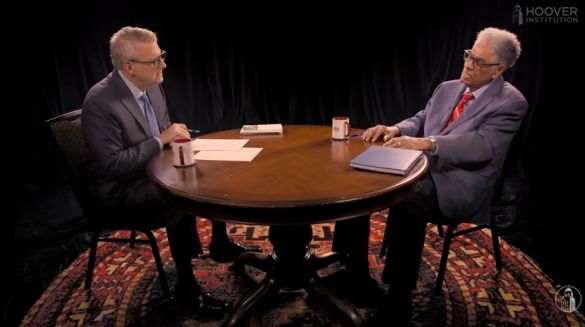
Editor’s Note: In this insightful episode of Uncommon Knowledge, Peter Robinson sits down with renowned intellectual and Hoover Institution fellow Thomas Sowell to discuss the critical state of American education. Sowell reflects on his own journey from the segregated South to the halls of Harvard, emphasizing how access to quality schooling and a habit of reading transformed his life. The conversation explores the historical success of black educational institutions like Dunbar High School and the modern-day impact of charter schools, while critiquing the ideological and political barriers that often hinder student achievement. From the failures of the university system to the vital importance of school choice, Sowell offers a data-driven perspective on the high price children pay for misguided educational ideas. (Jan 27, 2026)
TRANSCRIPT:
Introduction: A Life Shaped by Education
PETER ROBINSON: Welcome to this special edition of Uncommon Knowledge. I’m Peter Robinson. Thomas Sowell lived as a boy in a house without plumbing in Gastonia, North Carolina, spent his teen years in Harlem, tried out for the Brooklyn Dodgers—how history might have been different—served in the United States Marine Corps, holds degrees from Harvard, Columbia and the University of Chicago, taught at Douglass College, Cornell, Howard, Brandeis, Amherst and UCLA, has published at least 40 books (there are different ways to count them depending on revised editions, new editions, reprints, and so forth), and has served for 48 years now as a fellow at the Hoover Institution.
Tom, you and I talked about the conversation we’re about to have today and you said you wanted to devote it to one topic. Not economics, not race, not sociology or culture. You want to talk about education.
THOMAS SOWELL: Yes.
PETER ROBINSON: Why?
Why Education Matters: A Failing Institution
THOMAS SOWELL: The reason I have such a focus on education is that it is one of the major institutions of our society that is failing, more so I think, than most of the other major institutions of our society. And it’s failing in two different ways. It’s failing to teach students how to think. It’s failing to give them a background of knowledge of history, and it’s failing to allow them to express views that are different from what is being propagandized. These have become propaganda agencies more so than educational institutions. And I think more than that.
PETER ROBINSON: The—
THOMAS SOWELL: The way education is set up as an institution, there’s nothing in it to cause them to change, to correct themselves. If you’re in private business, if you’re making widgets, if you’re not making widgets that the public wants or will put up with, then you will discover that because you can’t sell them, you will be losing money and you will be forced out of business.
Milton Friedman used to say that people call this a capitalist society, a profit society. It’s a profit and loss society. And the losses are just as important as the profits because the losses force people to stop doing things that are not working. And only those who are doing things that can be self-supporting can continue.
That’s not true with education. Public school education, you have the almost inexhaustible amount of money from the taxpayers. Private schools are becoming private more in name than in reality. They’re getting billions of dollars of taxpayers’ money and there’s very little following of what happens so that they can keep on doing things that are wrong for generation after generation.
My book Inside American Education is one that I want to have people take a look at, not because it’s a new book, but precisely because it’s an old book. By reading it, you see that things that we have newly discovered that are wrong with the schools, sometimes as a result of the COVID pandemic and homeschooling that came out of that—those things have been like that for 30 years or more.
There’s one particular item, for example. Someone discovered that in Minnesota, the schools were teaching boys about tampons. And some people seized upon that and said, “What a strange thing that is.” It is. But it has been doing that for more than 30 years. And you would never have known that except for the pandemic.
Any idea that the public can keep up with what is going on in the schools in any serious way is false. You have to have something, some mechanism by which the schools can be changed or the people can be allowed out of those schools without their having to be able to keep up with what’s actually going on.
A Personal Journey: The Power of Reading
PETER ROBINSON: Tom, as I read your life, your life story here, A Personal Odyssey, and we’ve known each other for a long time—one of the reasons you feel so deeply about education is because of the difference it made in your life. Could I ask you just to tell a couple of stories? You’ve moved from North Carolina to Harlem. You meet a kid named Eddie, and Eddie takes you to a strange institution. Can you tell us about that? You still remember it vividly?
THOMAS SOWELL: Oh, yes, yes, yes. Eddie came from a much better educated family than I did. But my family appreciated education. And therefore, even before I arrived in New York, they had picked out Eddie as someone that I must get to know because he can tell me things that they don’t know, introduce me, really, to parts of the world that they’re not familiar with.
And the first thing he did was take me to a public library. And I came into this big building with enormous numbers of books. I wondered, “Why am I here? I don’t have enough money to buy one book.” I was already thinking like a Chicago economist. And his explanation—it was hard for me to understand, but he eventually convinced me to reluctantly take out a library card and to borrow a couple of books.
And since I arrived in the summer, I had no school to go to.
PETER ROBINSON: Have you ever given any thought to how your life might have turned out if you had stayed in North Carolina?
THOMAS SOWELL: I try not to think of that.
PETER ROBINSON: All right. That bad?
THOMAS SOWELL: Yes, that was—I mean, there was a reason why blacks were moving out of the South by the millions in the first half of the 20th century, and they understood that there was not much point staying to try to change the minds of the people in the South. You simply take yourself out of the South.
Now, older people had connections that couldn’t do that, but a disproportionate number of younger people just left the area, and that had a major effect on their income and other opportunities.
PETER ROBINSON: Right. You went on to become—you developed the habit of reading. We’re compressing this just a little bit. You developed the habit of reading. You would become a student at Howard University. You transfer from Howard to Harvard, and from Harvard on, Tom Sowell becomes the Tom Sowell we know—an intellectual, an author, an academic. But there are years before you go to Howard.
THOMAS SOWELL: Oh, yes.
PETER ROBINSON: In which you have some very hard times. So my question is this. On education, very few people are going to become anything like the intellectual that you went on to become. But all of us experience hard times. How did that habit of reading, of educating yourself, of acquiring knowledge, help to sustain you through those hard times?
The Struggle to Catch Up: Ability and Education
THOMAS SOWELL: Well, it did in terms of morale and so on. But there’s another aspect of my education that I think may have some relevance. It was common in those days when kids came out of the South and went to school in New York, at least black kids—I think it was probably true of the whites as well—that they would be put back automatically, put back one year, because the difference in the educational quality was that great.
And when I enrolled in New York, they said they were going to do that. And I asked to see the principal, and I thought I was ready to take on the school in New York without being put back a year. And I convinced him he would let me try. It was a decision—it was a bad decision on my part, but it also tells you something about ability and what the limits are.
So I was put in 4A3—the fourth grade, A being the fall semester, and three—they had what they call ability grouping. In those days, the best students were put in 4A1, the second best in 4A2, and they put me in 4A3. And I found I couldn’t do the work. I couldn’t keep up. I couldn’t do the work.
Having been one of the best students in my class in North Carolina, I was now the worst student in the class in Harlem. And whoever was next to worst was probably a lot better than I was. And I can remember at one point actually crying over my homework because I was just absolutely stunned. And of course, when I turned to the adults for help, they said, “We don’t have any kind of education to enable us to help you.” And so it was a real struggle.
Now, at the end of that semester, I received a commendation card from the principal as the most improved student in his class, which I was happy about, but I still hadn’t improved enough. So when they promoted me—where I would normally have gone from 4A3 to 4B3—they put me in 4B4, the lowest class, because I still had not caught up.
And so I finally got my act together, and I got back. I went to 5A3. So now I’m up there with only the third lowest.
PETER ROBINSON: And so—
THOMAS SOWELL: And it was only after that that I made it finally to 5B1. But it took a year and a half to do that. And so, despite the success I had in later years, the fact is that mere raw ability by itself only goes so far. And I think a lot of what is being said doesn’t take that into account.
PETER ROBINSON: The work, the decent schooling, dedicated teachers who know their jobs—it all still matters, no matter how bright the kids are.
THOMAS SOWELL: Well, that’s true, but it’s also true that the difference between Charlotte and New York was huge. And moreover, in later years, when I’m doing research on IQs, I happened to come across the IQs for the kids in that school at the time that I was in that school. Their average IQ was 84.
PETER ROBINSON: Really?
THOMAS SOWELL: Yes. And now I go on. And so at the end of the sixth grade in the elementary school, I was then assigned to a predominantly white junior high school. And now I entered at 7A1. And it so happened that in this school, there was also a different class called 7AR, and that was the rapid advancement class. And that was a class for students with IQs of 120 and above.
And someone in the school personnel decided they would find out if there were any kids who had IQs over 120 who were not in that class already. And they discovered that there were four, and I was one of them. And so despite that, I had to struggle for a year and a half to catch up with kids whose IQs were 84.
Now I go into the 7AR. And I remember the first math exam there when the teacher brought back the corrected things. He said, “I didn’t think this was a tough exam for a class like this, but only one person made 100 on it. And his name was—” And he starts going through the things, trying to find it. “His name was—” And being something of a wise guy, I said, “Thomas Sowell.” He said, “Yes, that’s the name.”
PETER ROBINSON: Oh really?
THOMAS SOWELL: But the point is that—so here I am. I couldn’t—I had trouble keeping up with kids whose IQs were 84 until I finally, a year and a half later—
PETER ROBINSON: Gotten—
THOMAS SOWELL: Up into the top class. And yet at that point I could then go anywhere and do anything.
PETER ROBINSON: So as you have demonstrated pretty amply in the years since, you have a first-rate mind. But it would have been wasted if you had—that’s a hint as to what would have happened if you’d faced the very sparse, poor education if you’d stayed in North Carolina.
THOMAS SOWELL: Yes.
The Story of Dunbar High School
PETER ROBINSON: All right, Tom, you and I have talked about the story of Dunbar High School.
THOMAS SOWELL: Yes, the high school.
PETER ROBINSON: You first wrote about it in 1974. All-black high school in Washington. I’m going to quote you now. “As far back as 1899, Dunbar students came in first in citywide tests given in both black and white schools.” I want to repeat that. The black kids at Dunbar came in first.
THOMAS SOWELL: Wait, that was an error. That was an error.
PETER ROBINSON: Oh, it was, yes.
THOMAS SOWELL: That was from reading what someone else had said. In later years, I did my own research. There were four, and they came in ahead of two of the white schools.
The Legacy of Dunbar High School
PETER ROBINSON: Okay, all right, thank you for correcting your own work. Over the 85-year span, 1870 to 1955, most of Dunbar’s graduates went on to college, even though most Americans, white or black, in those years, did not.
THOMAS SOWELL: Yes.
PETER ROBINSON: All right, then we get the Supreme Court decision in Brown requiring schools to be desegregated. Dunbar was all black. They’re shifting all around in Washington, D.C. They move in some white kids, they take black kids from the local neighborhood. It had been that black kids from clear across town, if they wanted to go to Dunbar, could go, and Dunbar sinks.
And now I want to quote you again because this is something that I’ve heard you comment on often. Quote: “Social pathology has held an enduring fascination for researchers and nowhere more so than in the study of black Americans. Isolated successes receive occasional attention, but large scale or institutional progress and excellence seem to be almost shunned. With all the voluminous outpourings on black educational pathology, there has been an almost total neglect of black educational successes.” Why?
THOMAS SOWELL: That is a question that I have not been able to solve, which I hope someone in the younger generation will do that. And then there have been other schools, one that I—by the time I came along to do my research on Dunbar, Dunbar had already was no longer a school what it had been.
But there was one black school that impressed me enormously. It was in New York City, and I was collecting data, and I went to the principal’s office there to ask if he had any data on the test scores of the people in his school. And he said to me, yes, and I’ll show it to you later, but you won’t believe the data unless you see the students.
And so this was in a regular ghetto school. In fact, I phoned a friend I knew in New York and told him I was in town and we’d get together for lunch. And I said, I have a rented car. And I told him where I was. He said, you sure are brave to park a car in that neighborhood. And he said, brave, but I’m sure he meant foolhardy, but nevertheless.
And the principal, instead of giving me the usual Potemkin Village tour, he said, we’ll walk down this hallway on each of these floors, and you pick out whichever room you want to go into, and we’ll come in there and sit for a while. And so that’s what we did, every floor in the building.
And I came in, and this was just a typical ghetto school. All those kids spoke the king’s English. All of them had very good answers to all the questions that were asked. And it was just as if it was some middle class or higher place. And I two or three rooms on each floor, and it’s all the same.
And only after that did he turn the test results over to me. And this school was far superior to any of the other schools in this district. And it was by no means any better off socioeconomically than their neighborhood would certainly know better, but it could be done. That was half a century ago. Nobody that I know of has ever taken the slightest interest in that school.
The Missing Century of Black Progress
PETER ROBINSON: Tom, you’re the first guest who can say, refer to work he’s done half a century ago. So this is related to the lack of interest. It’s related. Here’s another point that I’m very struck by that you have made in our conversations over the years, and that is that from the—from emancipation from the end of the Civil War to before the Civil Rights Acts and before the Civil Rights movement of the 1960s, you’ve got a century, a clean century, a pretty clean century. 1865 to 1965.
And do African Americans remain immured in the status of former slaves? No. They get educations. They’re making tremendous progress. Of course, they stay behind blacks. But there is demonstrable progress. The black family, by and large, remains intact. And there’s progress of all kinds in that century.
Or I’ll put it—Condi Rice and I went down to Birmingham, Alabama, about a year and a half ago, and we did a show there on Birmingham. And we did a show because it was the 60th anniversary of Dr. King’s, the so-called youth march, when kids from high school and so forth marched in Birmingham.
And I went down there thinking that Condi and her generation, who’d gone from segregated Birmingham to lead big—of course, Condi’s a special case because she’s former Secretary of State, but she made the point that from her neighborhood, lots of kids did well.
I went down there thinking that they were the heroic generation. And of course, those achievements are enormous. But I decided that their parents and grandparents were the heroic generation because they had gone from zero education as emancipated slaves in three, four generations. Condi’s father and mother were both teachers.
Condi took me back to her neighborhood and she said, in this neighborhood, on Saturday afternoon, you’d have seen little kids playing. But on Saturday morning, I had my piano lesson. The little kid across the street had a French lesson. All the kids were kept in to be educated.
Okay. And yet this heroic—to me, a heroic century has just disappeared. It’s gone down the memory hole. We don’t have historians writing about that. It’s a missing century. Why? I don’t understand why. Why isn’t that part of our history?
THOMAS SOWELL: I think a good part of it would be that it would undermine the things that people are doing now that are supposed to be advancing people who are low income and less educated. And they want to take credit for the progress that’s been made as if it all started with the 1960s.
And I mentioned the place in Brooklyn, but I mean, Dunbar High School, to give you some idea, out of Dunbar High School there came the first black man to graduate from the Naval Academy at Annapolis, the first black general in the army, the first black cabinet member, the first black man to become a full professor at a nationally known university. I think I left out one or two.
But there was also a doctor who became internationally known because of his work on blood plasma, which apparently came in handy during World War II when there were a lot of injured people in Britain who needed blood plasma.
And again, I know of nobody who’s followed up. There have been two books that I know are written about Dunbar, one by a former teacher and the other, but there was not—the Tawarmer teacher had some data in her book, but nobody since then.
And when I wrote it, I thought, you know, of course, the whole educational effort following from the 1954 decision by the Supreme Court was that separate schools were inherently unequal. And it so happens that Dunbar High School was located within walking distance of the Supreme Court that declared its existence impossible.
Whether the Chief Justice Warren believed that himself or not. And he takes this picture that you see that blacks, because they’re kept out of the white high schools, this will so affect their picture of the world and themselves that it will be a big educational handicap.
Now, it so happens I went to one of those segregated schools in the South. There were no white people in our neighborhoods. There were no white people in our churches. There were no white people in our places where we played. If we found white people in the school, we would wonder what the hell was going on.
But just one false assumption like that can for years, decades now, keep the truth from coming out because people get a vested interest in that. Whatever—people paid any attention at all to my work on Dunbar High School, and there were very few spent their time trying to discredit its relevance. Those were middle class people.
None of them cited a speck of evidence that they had any idea of either the income or the occupations or the parents of those kids. Now, it so happens I did have some, and it was not—there were some multiple number of kids whose mothers were maids as compared to those whose fathers were doctors. And that was true back in 1895 when they bested two of the three white high schools.
And so what you have among intellectuals of all people is a notion that there’s some set idea and anything that goes against that idea, they’re not interested in pursuing it.
PETER ROBINSON: Got it.
Charter Schools: Proof That Education Works
PETER ROBINSON: Your 2020 book, Charter Schools and Their Enemies. You examined a number of charter schools. This is 2020. It’s a good number of years after you grew up in Harlem. But you went back to Harlem and you discovered charter schools that were using classrooms in public school buildings, drawing from the same population.
So it’s the same kinds of kids being taught in the same buildings under the same New York State curriculum as those in the public schools. And here’s what you found, that not only did the kids, and we’re talking here mostly about black and Hispanic kids, not only did these kids do better than minority kids in public schools. But on one subject after another, they tested better than white kids out in the suburbs.
So you discovered what you’ve always known. But you bring forth evidence and you have appendix after appendix with test scores. All the evidence is in the book, the 2020 book, Charter Schools and Their Enemies. We know how to educate little black kids and little Hispanic kids and give them an opportunity.
And here is why it is called Charter Schools and Their Enemies, because the charter schools were under intense political pressure from liberals. And you note that Mayor Bill de Blasio, then mayor of New York, had ended the expansion of charter schools. He put the charter schools under pressure.
So I’m going to quote you: “It is a painful irony that people who are promoting the make-believe equality of inclusion and diversity in schools are attacking charter schools that are producing the real equality of educational achievement.”
Again, what’s going on? Why wouldn’t liberals embrace and celebrate and try to promote charter? Why wouldn’t everybody attempt to celebrate this result?
THOMAS SOWELL: Well, for one thing, their whole vision of the world is one in which the government has to step in and rescue blacks. And the liberals preempt the decision making of blacks and of other groups in the past who have been low income and having difficulties.
And it will never occur to them that those people know their own situation far better than any liberal knows it. One of the people who has written about this is a man who graduated a Summacum Lodge from Harvard that may charitable people may think of that as a mitigating factor, but he says openly himself that he really has not looked at the data.
But he’s been writing articles and books showing why you shouldn’t support charter schools. And he said, well, obviously the parents don’t know enough to be able to pick the right schools for their kids and something has to be done for it.
So it’s a—I mean, facts are really a danger to the egos of a lot of people with high IQs and low information.
The Trump Administration and Universities
PETER ROBINSON: Universities. We’ve got the Trump administration taking all kinds of actions with regard to universities. They’ve used federal funding to bring pressure on universities and DEI. They’ve used civil rights investigations to crack down on antisemitism. They’ve instigated immigration and customs investigations of foreign students who’ve been accused of contributing to campus unrest. They’ve used Title 9 to keep biological men out of women’s sports. And so it has gone.
Your old alma mater, Harvard University. Yes, yes, yes. Don’t feel guilty. You didn’t know any better at the time, Tom.
THOMAS SOWELL: I did know better at the time.
PETER ROBINSON: Oh, you did?
THOMAS SOWELL: I didn’t go to my graduation. I gave them my forwarding address and left.
PETER ROBINSON: Send the diploma to me when you get to it.
THOMAS SOWELL: Yes. And I’ve only kept in touch with one person, a roommate of mine in Harvard. I’ve never gone to any of the annual class reunions or even when I was living at one point, one year, a 30-minute drive from Harvard.
PETER ROBINSON: All right, so let me quote the president of Harvard, current president of Harvard, Alan Garber, who was at Stanford for many years. This is an interview he gave last spring: “The administration’s measures don’t even hit the same people that they believe are causing the problems. Why cut off research funding? Sure, it hurts Harvard, but it hurts the country. I don’t know what Trump’s motivations are, but I do know that there are people who are fighting a cultural battle. They don’t like what’s happened to campuses.”
All right, so let me ask the Harvard man, does the president of Harvard have a point? The Trump administration is using crude instruments.
THOMAS SOWELL: Whatever instruments that they’re using, they should use more of them.
PETER ROBINSON: Really?
THOMAS SOWELL: Yes.
The Problem with Universities
Again, getting back to what Milton Friedman said, you know, that the losses are as important as the profits. That the big problem with universities is that you very seldom, almost never find a university going out of business. No matter how bad they are, the money keeps coming in.
And as far as research, there’s no reason in this world why research can’t take place in places other than universities. In fact, I strongly suspect that most research, whether to find cures for cancer or anything else, is going on to a great extent outside of universities already. And so there’s nothing indispensable about what universities are doing.
And I think if one or two Ivy League universities went bankrupt, I think it would be a very good thing for the other universities that survive to understand that they don’t get the taxpayers’ money just because they’re used to getting it. Something has to be done to show it.
Affirmative Action: A Policy That Harms All Groups
PETER ROBINSON: All right, affirmative action. This is you writing in 2012. I’m quoting you. “Anyone who follows public policy issues can easily think of policies that help one group at the expense of some other group. What is rarer is a policy that on balance, harms all groups concerned, even if in very different ways. Affirmative action policies in the academic world can claim that rare distinction.” Explain that.
THOMAS SOWELL: Well, there’s a lot of talk about how whites and Asians lose when they have affirmative action for blacks and Hispanics. And that’s true. But I think that the blacks and the Hispanics and other such groups lose far bigger.
This came to me back in the 1960s when I was teaching at Cornell, and they decided they would bring in black students without having to meet the same standards as the other students. And very soon it turns out that half the black students were on academic probation because they weren’t meeting the standards of the work that they were facing.
And so I went over to the administration building to look up the SATs of these students who were being admitted. And I found that the average black student admitted to Cornell University scored at the 75th percentile nationwide.
PETER ROBINSON: Which is good.
THOMAS SOWELL: Yes, but of course, the average liberal arts student at Cornell scored at the 99th percentile. And so instead of being in another good college, someplace where the other people were scoring at the 75th percentile, where they would have been fine, they were brought to Cornell to fail.
And of course, their failure created a lot of internal bitterness. And of course there were always some people there to tell them that this is all because the professors are racist and so on.
PETER ROBINSON: So Cornell selected good students, good students, black kids to bring to Cornell so—
THOMAS SOWELL: They could fail at Cornell rather than succeed somewhere else.
PETER ROBINSON: To spend four years teaching them to feel inadequate.
THOMAS SOWELL: And I strongly suspect most of them never graduated.
PETER ROBINSON: Oh, really?
THOMAS SOWELL: There are data from other places I’ve looked at, and it’s not uncommon. Certainly in the University of California system where great numbers were led into UCLA and UC Berkeley and it was the norm for the majority not to graduate. And so you come and spend years of your life in vain and then drop out.
The Supreme Court and Affirmative Action
PETER ROBINSON: The 2023 Supreme Court case, Students for Fair Admissions versus Harvard. The court overruled the 1978 Bakke and the 2003 Grutter decisions, which held admissions based on race for reasons of campus diversity to be constitutional. Now in 2023, two years ago, the Court says otherwise.
Writing for the majority, Chief Justice Roberts, “Universities have concluded wrongly, that the touchstone of an individual’s identity is not challenges based, skills built or lessons learned, but the color of their skin. Our constitutional history does not tolerate that choice.” Is it finally over?
THOMAS SOWELL: No. And I say that without having read all the opinions, but I asked one of my assistants to simply go through the majority opinion and see if there’s some place in that opinion where they leave an opening for not carrying out the thing. And sure enough, it came back and there it was.
But the Bakke decision was wonderful reading. It was wonderful reading until you got to the point where they essentially said you cannot have racial quotas if you call them racial quotas, but you can have them if you don’t call them racial quotas. Because they’re saying, you can take into account this and that, that if someone has an essay that they submit and refer to the fact that I grew up in a ghetto or barrio or whatever, that that’s there. And that’s in the Chief Justice’s opinion in this.
PETER ROBINSON: Yes, that’s right. In the most recent decision.
THOMAS SOWELL: And so we’ll find out how many people are they going to let in through that loophole. But I thought it was strange that Harvard, with its $50 billion endowment, could not hire their own lawyers to think of how you can get around this and to have the Chief Justice of the United States offer a helpful hint. And so we’ll see how well concrete courses that get to the Supreme Court are either accepted or rejected.
PETER ROBINSON: Tom, why is it so hard? We fight a civil war over this. Then we have the 14th amendment, then we have the Civil Rights Acts and the civil rights movements, and here we are with a Supreme Court decision two years ago. And Tom Sowell says, no, they’re still leaving a loophole. They’re still winking, nodding, nudging that universities may still make distinctions based on race. Why can’t we just end it? Why has it been so hard?
THOMAS SOWELL: Because so many people have so much invested in their vision of the world. In their vision of the world, they are the saviors of low income minority people. And that minority progress has been due to them. And now to come along and have it say that it’s not so and that the remaining problem are all due to racism.
Now, the one that gets me is when they say that due to slavery, a black family was not established. And then, therefore, you have all these black families where there’s no father present.
The Myth of Slavery’s Legacy on the Black Family
PETER ROBINSON: So, Tom, here’s the argument still in the air, and the argument is that the black family is under pressure. There’s so many homes in which fathers are not present. Daniel Patrick Moynihan wrote, it’s 50 years, more than 50 years now since Moynihan wrote his, what was it called, report on the Negro family, which was the word in those days.
He was very concerned about the, now we call it the out of wedlock rate. In those days, it was the illegitimacy rate of 25%. Now it’s up over 60%. Okay. And the argument is this is a legacy of slavery because black families were broken up to be sold off and so forth during slavery. And Tom Sowell responds to that one how?
THOMAS SOWELL: There is a definitive study of the black family called “The Black Family” by Herbert Gutman. Herbert Gutman spent more than a decade on it. I can remember telling him, I hope I would live to see him finally finishing it. And he showed that that was utter nonsense.
PETER ROBINSON: Utter nonsense.
THOMAS SOWELL: Utter nonsense. Certainly by the 1920s, most blacks were raised by two parent families. As of 1940, 17% of black children were raised by one parent families.
PETER ROBINSON: Over 80% in two parent families.
THOMAS SOWELL: That’s in 1940. This is before all the wonderful things that people take credit for in the 1960s. And after the 1960s and later on in that century, 68% of black children were raised in one parent families.
PETER ROBINSON: Families.
THOMAS SOWELL: Four times as many. And if you look at other things, you find the same things. When you compare the rhetoric with the hard data, you find that they’re opposite.
The Unintended Consequences of Social Programs
You find that outside the racial area as well. For example, sex education was brought into the public schools on a grand scale in the 1960s. The idea was that this would prevent teenage pregnancy, it would prevent venereal diseases. It so happens that, and then the word “crisis” is used a lot. It so happens that syphilis and gonorrhea in 1960 were far lower than they were in 1950. It so happens that—
PETER ROBINSON: You may have misspoken there or I misunderstood. They were in 1960, they were lower than they had been a decade earlier.
THOMAS SOWELL: That’s right. So now, instead of there being this crisis of rising venereal disease and teenage pregnancy, there was a falling rate of venereal disease and a falling rate of teenage pregnancy until they brought in the sex education.
PETER ROBINSON: I see.
THOMAS SOWELL: And more generally that as the schools began to become places where they took on tasks such as teaching kids to have different sexual ideas and so forth and all those sorts of things which they are liberating the children from their parents and so on. I have some data here that in 19—the rate of suicides among children 15 to 19 years old was 3.5. I don’t know whether that’s percent. It can’t be that. But the rate was whatever the other number was, but it was 17.9.
And so all the things that were going right until they came in with their solutions started going wrong. And that was true in this other area. It’s true that among blacks, the homicide rate of black males in the 1940s declined by 18% and then declined again by 22% in the 1950s.
In the 1960s we had this great revolution in the Supreme Court, where all sorts of new rights for criminals were found in the Constitution, which no one had found before. And from mid-1960 to mid-1970, the homicide rate doubled after having gone down every decade for three consecutive decades.
And one of the great tragedies is that people who are devoted to a particular set of ideas don’t want any other ideas in. They’re not about to want a debate because it’s a debate they’re going to lose.
Lyndon Johnson vs. Frederick Douglass
PETER ROBINSON: Tom, let me give you two quotations, if I may. Here’s Lyndon Johnson in 1965 at the very beginning of the civil rights legislation, the civil rights movement and so forth. Lyndon Johnson, President Johnson. “You do not take a person who for years has been hobbled by chains and bring him up to the starting line of a race and then say, you are free to compete with all the others. It is not enough.”
Well, there you have a statement of the sort of goodwill involved in affirmative action and all these various programs. We need to give African Americans a head start. You can’t just bring them up to the starting line.
Now, here, one century earlier, is Frederick Douglass speaking. “Everybody has asked the question, what shall we do with the Negro?” That was the word in those days. “I have had but one answer from the beginning. Do nothing with us. If the apples will not remain on the tree of their own strength, if they are worm eaten at the core, if they are early ripened disposed to fall, let them fall. I am not for tying or fastening them on the tree in any way. And if the Negro cannot stand on his own legs, let him fall also.”
That sounds, to modern ears, that sounds very, very harsh. If you had to choose between Lyndon Johnson and Frederick Douglass, what would you choose?
THOMAS SOWELL: It would be Frederick Douglass all the way. Frederick Douglass, as you probably know, was born a slave. He escaped. He educated himself and made his living writing, including books as well as newspapers and so forth. And it’s hard to see how—
Well, one of the things, one of his books, for example, was recently reprinted in recent years, and the irony in it was that there are all sorts of footnotes added to it, you see, because the language he uses, this man who probably never spent a day in school in his life, the language that he uses and mastered has to be explained to our expensively under-educated students today so they’ll know what he’s referring to. It is such a painful irony.
Questions from Colleagues: Artificial Intelligence
PETER ROBINSON: Tom, I’ve heard from several people whom you know and mostly admire. I think a few of these people you’ve tangled with over the years. But that’s you. There are very few people you haven’t tangled with over the years. I myself try to stay on your good side. I work very hard at that.
But I’ve got a few questions for you from other people. George Will: “In your 95 years you have seen many end of time apocalypses come and go. From automation will produce chronic unemployment to resource depletion will impoverish the future. Now we hear the claim that artificial intelligence will make human beings obsolete. How should we think about AI? Am I, George Will, a dunce? Because I think the locution ‘artificial intelligence’ is an oxymoron.”
THOMAS SOWELL: Wow. There are a lot of things I have—my own experience with artificial intelligence has been somewhat negative.
PETER ROBINSON: Really?
THOMAS SOWELL: Yes. There are people who go on YouTube and they have simulated my voice and they have had me, this simulated voice, saying things that I never said, things that are the opposite of what I’ve ever said. And I gather that one of these things originates as far away as England.
Fortunately I have an attorney in New York who has taken up the matter and we’ve had about half a dozen of them removed from YouTube. But this is the kind of thing—anybody can be imitated and the imitation sounds plausible.
PETER ROBINSON: Charles Murray.
THOMAS SOWELL: All right.
The American Experiment and Its Future
PETER ROBINSON: America in 1789 was unique geographically in the characteristics of its self-selected population and in its position at the apogee of the Scottish Enlightenment Hypothesis. This is Charles reading Hypothesis. The creation of a limited government was a one-time event never to be repeated. What we have seen over the last 60 years is not a setback from which the American experiment can recover, but a downward spiral that was inevitable after the Supreme Court decisions of 1937-1942. Charles asks this question: are we doomed?
THOMAS SOWELL: Wow. I hate to be definitive. I take some consolation that all of us are fallible.
PETER ROBINSON: Even Charles.
THOMAS SOWELL: All of us are fallible. And so I offer my opinion with that caveat. I do think that there is a very serious chance that we are doomed because we have institutions where people in pursuing their interests are destroying the larger interests of the whole society.
These people who are coming around shooting people and calling them fascists and so on—these people are so ignorant that they don’t even know what the fascists are doing. Charles Kirk goes around, went around talking to people, trying to convince them fascists don’t do that. Fascists shoot people.
PETER ROBINSON: What is your definition of socialism? Well, in the theoretical, the abstract or the practical? Take your pick. So socialism as written by Marx is when the workers own the means of production. In the actual practical, it’s when a small group of very powerful, pernicious people are able to control the rest of the population under the guise of helping the many, when in reality it helps the few. And you get dictatorship, murder and slave slaughter, and the revolution never actually comes.
THOMAS SOWELL: And so it’s the person who kills him thinking that he’s a fascist, who is himself a fascist and the opposite of the man he’s murdering. I don’t think it’s coincidence. Supposedly this was a scholarship student, but you have intolerant universities as the norm.
People who go around trying to give talks on universities—there are many others—and they are kept from doing so by mobs. Professors who have spent a lifetime studying some subject in great depth, like Stephen Thernstrom at Harvard, who was editor of the American Ethnic Group Encyclopedia, he had to stop teaching because people were making it impossible for him.
And if you look at the history of what these people have been doing, and some of that history is in my book from 30 years ago, Inside American Education, it’s horrifying.
Signs of Hope?
PETER ROBINSON: Tom, may I take a stab at cheering you up a little?
THOMAS SOWELL: It’s a monumental task, but go ahead.
PETER ROBINSON: All right, so we have—we’ve already talked about the Trump administration. Makes me a little queasy because it feels to me as though they’re going out of some of these universities with a slight sledgehammer. Your view is let them do it. But the DEI infrastructure has been very substantially dismantled or renamed. Well, all right. But at least there’s some kind of visible attempt to—
THOMAS SOWELL: What percentage of the people who are in that are no longer in that? I no longer have a job?
PETER ROBINSON: Well, I know at the University of Pennsylvania, Texas—of course, the short answer is I don’t know. And I’m sure that university administrators, their impulse is to reshuffle people around. But I know at the University of Texas, the Texas legislature made DEI illegal and required the university to fire these people and then held hearings to make sure that university administrators were doing so.
So there’s at least one case where the legislature, which is in charge of a great public institution, said, “Enough of this,” and seems to have done so with real rigor.
THOMAS SOWELL: So there’s one case, and I think Florida as well.
PETER ROBINSON: Florida as well. Florida as well. Correct. And here on charter schools, I looked this up. Since you published Charter Schools and Their Enemies five years ago, more than 500 new charter schools have opened around the country and the number of states with school choice legislation, which makes it easier for parents to choose charter schools, private schools and so forth, has risen in these five years from 18 states to 30. Hopeful?
THOMAS SOWELL: Hopeful.
PETER ROBINSON: Hope. Okay, you’re full of hope. Are you feeling—have I cheered you up?
THOMAS SOWELL: Well, let’s not ask for miracles, but—
PETER ROBINSON: All right.
The Charter School Battle
THOMAS SOWELL: But I think in New York, fortunately we had Mayor Bloomberg who was favorable to the charter schools and he allowed them to move into vacant buildings. He was followed immediately by Bill de Blasio who was totally against, did everything he could against the charter schools.
And in California there’s a law which states that charter schools cannot suspend or expel a student for creating problems in the school.
PETER ROBINSON: Now—
THOMAS SOWELL: That law can’t even offer a pretense of doing something that is educationally worthwhile. It is doing something that is worthwhile to keep the charter schools from attracting more people out of the teachers unions which are paying millions of dollars to politicians’ campaigns.
And so we have an institutional situation in which teachers unions collect billions of dollars in dues and then invest millions of dollars around the country to politicians who will protect the teachers unions from competition.
PETER ROBINSON: It is a straightforward racket.
THOMAS SOWELL: Yes, that’s right. It is not a—I mean schools, we think of them as noble places. Their goals are noble. But it’s amazing how many people will sell that down the road.
A Question from Africa
PETER ROBINSON: Tom, a question from someone you won’t know. A young man called Ariel Von D. Let me tell you about him. A number of years ago I received a letter out of the blue postmarked Ghana. And it was from Ariel Von D. And he told me how much your work meant to him.
So I got together about a dozen—now your assistant helped me get together about a dozen of your books and I shipped them off to him in Africa. And Ariel Von D has a question for you.
“A deep-seated discontent for political leadership across Africa has resulted in a wave of coup d’état in recent years, particularly in West Africa. People are even open to the Chinese style of government under communism. I do not think either coups or communism can happen without bloodshed. What would your counsel of wisdom be for political leaders and young people in West Africa? How can we turn our nations to prosperity while keeping them democratic and free?”
THOMAS SOWELL: Wow, that’s a very, very tough one. I’m not sure how confident I am that Western European nations which have been democratic and free for some time are going to remain so in the next generation or two. So I really cannot honestly offer him an answer. I can hope that there will be people who will fight.
But one of the reasons I recommended this old book of mine is that it makes—
PETER ROBINSON: Which one? Inside Higher Education. Which book?
THOMAS SOWELL: Inside American Education.
PETER ROBINSON: American Education, yes.
THOMAS SOWELL: Because it shows how hard it is for people to even know what is going on inside educational institutions. And that goes not only for the public schools, but also for the universities.
It’s wonderful to hear all these people talk about diversity is so wonderful in the schools. Yes, but diversity to them means white leftists, black leftists, female leftists, and Hispanic leftists, you know, and that’s a somewhat limited notion of diversity.
When people say, you know, that we want—there needs to be more diversity, I ask them, “How many Republicans are there in your sociology department?” Often it is—I don’t think I’ve ever heard an answer as large as 10.
PETER ROBINSON: Right.
What Gets You Up in the Morning?
PETER ROBINSON: Two more questions. Condoleezza Rice. Tom, you’ve devoted much of your work to our failings, especially to the failings of our education system. But like you, I—Condi—I’m an academic, and I know that you have to possess a certain basic optimism to remain productive. And no one has been more productive than you. What gets you up in the morning? What are you optimistic about?
THOMAS SOWELL: I am optimistic about the fact that I am—although my office is located on a university campus, I am not part of the university outside the Hoover Institution. And I think the Hoover Institution, which some years ago was voted the top think tank in the world, that those are places where you do have the right to think how you think and not be harassed over it.
And I think that if the Ivy League and other universities lost some of their members, that a lot of the research would go on outside of the university. The university is trying to hide behind the fact that, yes, they’re doing some serious medical research and that research can go on without the university.
And I think it will be wonderful if that fact is brought home by one or two Ivy League institutions shutting down when they lose their automatic access to the taxpayers’ money to do whatever they want with that money, regardless of what the money was allegedly given to them for.
I still remember a case. I haven’t been a recipient of a huge amount of that money, but when I was at Cornell, I can remember I had some grant that I had. And in the late spring I got a call from one of the administrators and he said, “So you haven’t touched the remains of that grant since last October. When are you going to spend it?”
And I said, “Actually, I plan to spend it in the next couple of weeks.” He said, “Good.” And he hung up. He didn’t care what I spent it for, just spend it, because if you don’t spend it, it’ll look like you didn’t need it and that’ll make it harder for us to get more money next time.
And so this is—I’m not sure that whatever I was spending it on was something urgently needed by the taxpayers.
A Question from Justice Thomas
PETER ROBINSON: Tom, last question. This question comes from Mr. Justice Clarence Thomas. Now, I want to repeat that this is a question from the senior Associate Justice on the United States Supreme Court. So I myself feel the impulse to swear you in on this one.
Here’s Justice Thomas’s question: “Thomas Sowell, were you ever tempted, ever, to temper or change your opinion because of actual or anticipated hostile reactions?”
THOMAS SOWELL: No. And there’s a reason for that. It required no courage whatsoever. It so happened that even though I wanted to be an academic, I wanted to teach—I really hadn’t thought about writing books or anything like that—but unfortunately, as I thought at the time, but I think in retrospect, fortunately, I was unable to get a spot that I wanted.
And so I became an economist in the federal government. And then after about a year or so, I got an offer for an academic post and I took it, even though that represented a 20% reduction in my income, which I could ill afford at the time. But I did.
And then I went on to another academic post and I was then offered a job at AT&T, which at that time was the world’s largest corporation. And I took it at double what I was being paid in the academic world. And when I later decided I would go back to the academic world and finish my Ph.D., I was told, “Listen, anytime you want to come back, you’re welcome.”
And so I got into—you’ll be surprised to learn that I was controversial at Cornell. And I was told by one of the other assistant professors—I was there, I was an assistant professor on a three-year contract—that my contract was not going to be renewed because I had really rubbed some people the wrong way, you see. And I let them know.
And I said, “Well, since in fact it was said to me by one of the key people who had power that these are the people who are going to be voting on whether your contract gets renewed.” And I said, “Well, since I make my decisions as I see fit, I assume they’ll make their decisions as they see fit.” And I got up and walked out.
And so I told this to my wife and she says, “What if you get fired?” I said, “I’ll go back to the phone company, we can use the money.” And she said, “In that case, give—”
PETER ROBINSON: Them hell.
THOMAS SOWELL: So it took no courage because I knew that I could always make more money doing something outside of the academic world because I’d already had it. And so the threat of a higher income is not a very effective threat.
PETER ROBINSON: And you’ve been giving them hell ever since.
THOMAS SOWELL: I hope so.
Looking Forward
PETER ROBINSON: Tom, couple last questions. I noticed, as best I count it, after turning 80, you wrote seven books. Now, that’s seven books. And you also revised editions of earlier books. I know it’s bad manners to ask a writer what he’s working on, but what are you working on now?
THOMAS SOWELL: A new book that I’m writing and a revision of my economics basic economics textbook.
PETER ROBINSON: Tom, would you bring our conversation to an end by reading a passage from your book, A Personal Odyssey?
A Life’s Work and Legacy
THOMAS SOWELL: Let me read. Okay. If I find something in here that I change my mind, I’ll change it as we go.
“What, if anything, will endure from what I have written is, of course, something that I will never know. Nor is what I have said and done enhanced or been enhanced or reduced by my personal life. However fashionable amateur psychology has become, what has been done stands or falls on its own merits or applicability.
The whole point of looking back on my life, aside from the pleasure of sharing reminiscences, is to hope that others will find something useful in their own lives. Justice Oliver Wendell Holmes said it best: If I could think that I had sent a spark to those who come after, I should be ready to say goodbye.”
PETER ROBINSON: Tom Sowell. By the way, I can’t help thinking Justice Oliver Wendell Holmes may be ready to say goodbye, but Justice Clarence Thomas is not.
THOMAS SOWELL: I hope not, because he’s a lot more valuable.
PETER ROBINSON: Tom Sowell. Thank you. Thank you for this special edition of Uncommon Knowledge, the Hoover Institution and Fox Nation. I’m Peter Robinson.
Related Posts
- Jared Isaacman: A New Era for NASA and American Space Exploration (Transcript)
- Transcript of Bill Gurley: Searching for Feynman at All-In Summit 2026
- Transcript of Neil deGrasse Tyson Interview: This Past Weekend #683
- Transcript: Elif Shafak and Robert Macfarlane Interview on Writing w/ David Perell
- Transcript: How Does Your Brain Know Where You Are? w/ Edvard Moser – World Science Festival