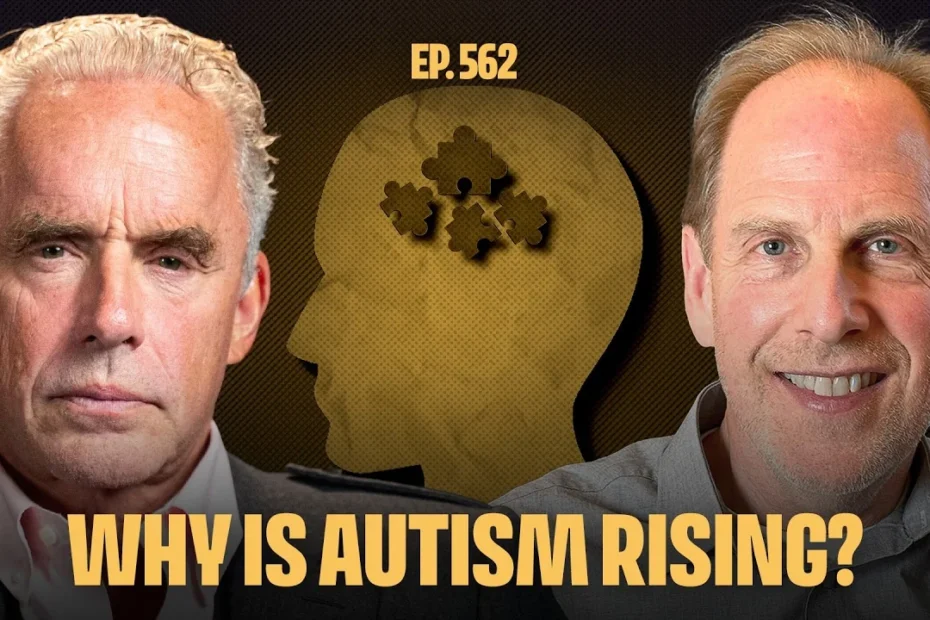
Read the full transcript of renowned psychologist and educator Dr. Jordan B. Peterson in conversation with psychologist and autism researcher Dr. Simon Baron-Cohen on The Dr. Jordan B. Peterson Podcast on “What Do We Actually Know About Autism?” which was filmed on July 5th, 2025.
Introduction and Research Domains
DR. JORDAN B. PETERSON: Hello everybody. My guest today, Professor Simon Baron-Cohen, is a world renowned clinical psychologist and director of the Autism Research Center at Cambridge. He’s done groundbreaking work on autism, empathy, systemizing and the extreme male brain. In doing so, he’s reshaped our understanding of neurodiversity.
He’s the author of numerous books, including his latest, “The Pattern Seekers: How Autism Drives Human Invention.” He spoke to us at length today about tool use, about theory of mind, and most controversially, perhaps the differences in male and female approaches to the world and male and female neurological structure. Join us for that.
Well, Dr. Baron-Cohen, I have been looking forward to talking to you for a long time. I followed your research, I don’t know for how long, 15 years, 20 years? A long time. And there’s a lot of things that we share interest in.
So I thought what I’d do to begin with is outline your main domains of interest and you can correct me and make sure that I’ve got that formulated properly because I would like to walk through them in some relatively systematic and empathic manner.
So tell me what you think of this breakdown. You’re very interested in how people adopt the mindset of other people, how we understand other people. And I really want to talk to you about that. So I want to throw some ideas at you and see how your vision of mutual understanding and emotional alignment differs and maybe is similar.
You’re very interested in gender differences, call them sex differences just to be politically incorrect. That shades off into your concern with systematizing versus empathizing, which is a dimensional analysis of interest, although it shades into temperament. You’re quite curious about empathy and evil and you’re very interested in pattern seeking.
So are there other major domains that might be worth delving into or does that give us a reasonable rubric?
DR. SIMON BARON-COHEN: That’s a great framework. And I just want to start by saying I’m honored to be in conversation with you. I’ve been looking forward to talking to you for a long time, too. And actually, this is going to sound funny, but I was sitting right at the back when you spoke at the O2 Centre in London, and that was probably one of your largest gigs, and I was way at the back row. So you were quite small on stage. But it was fun listening to you. And I’m looking forward to our conversation.
In terms of the topics, I guess there’s one other thing to mention, which is that I’m the director of the Autism Research Center in Cambridge, and on the long list of topics that you mapped out for us, I guess we’ll probably touch on the field of autism and autistic people.
DR. JORDAN B. PETERSON: Yeah, yeah. I guess I would have segued into that through systematizing and empathizing. But it is good to highlight it as a major concern since it is a major research area of yours.
Understanding Others: Theoretical Foundations
Okay, well, that’s good. Maybe we’ll start with understanding others. And so let me ask a relatively complicated question, and then I’d like you to indicate your agreements and disagreements if you would.
So I was very influenced in my understanding of social perception by J.J. Gibson and his theory of affordances, and also by Jeffrey Gray and his essentially cybernetic neuroscience theory. And so this is how I’m understanding it at the moment, and it’s relevant to an understanding of stories and also an understanding of mind, I think, is that we shape our perceptions around a goal, a destination, let’s say our perceptions are guides to navigation.
And when we occupy the conceptual space of someone else, we adopt their goal. That sinks our perceptions and it also sinks our emotions because we experience emotions in relationship to a goal. And I was also influenced in that notion by Piaget, the developmental psychologist who was interested in how children establish shared frames of reference in games.
So, anyways, I’m curious. Start with that, if you would.
DR. SIMON BARON-COHEN: It’s interesting to hear your influences because mine are a little bit different. So for me, the major influence in how I think about other people’s minds and the whole question of how do we imagine what someone else is thinking and what they might be feeling? The influence came from the philosopher Daniel Dennett. And I don’t know if you know his work, but he published—
DR. JORDAN B. PETERSON: Yes, I interviewed Dennett.
DR. SIMON BARON-COHEN: Okay.
DR. JORDAN B. PETERSON: And I know his work.
The Intentional Stance
DR. SIMON BARON-COHEN: Yeah, yeah. So he published a really important book called “The Intentional Stance,” probably in the late 70s or early 80s. And the idea of the intentional stance is that when we look around at the world, like the world of objects, we don’t particularly attribute mental states. But when we look at people, what humans do, and some people would say uniquely, is that we take this intentional stance.
That’s to say we try to imagine what’s going through their mind. And mental states, he argued, cover not just emotions and goals. You picked out those two. But importantly also epistemic states. So beliefs, what people know.
So in every conversation, in every interaction, what most people are doing is that they’re monitoring the other person’s state of mind. What does the other person know? What do they think? What do they want? What are they feeling? And in my terminology, more recently, I call that cognitive empathy. But Dennett called it the intentional stance. Taking the intentional stance.
So the word “intentional” is meant to cover the whole range of mental states that another person might have.
For example, that other people want to stay alive, so they’re going to stay in their lane and not swerve into our lane. And that other people can see us, and we can see that they know that we can see them. So many different kinds of unconscious processing of what other people are thinking, what they believe, what they know, what they want. And that’s happening in every conversation, or at least it should be.
DR. JORDAN B. PETERSON: So the intentional stance, I think that idea was influenced by Husserl and Heidegger, maybe Heidegger more particularly, because he insisted that our fundamental attitude towards the world was one of care. And that’s a good way, I think, of uniting perception with emotion.
If we perceive our destinations, I guess you’re doing that on the highway with other people too. One of the destinations would be to arrive alive, for example. So you’re inhabiting a shared structure of value and that highlights certain perceptions and foregrounds certain perceptions and hides others.
Cognitive vs. Affective Empathy
DR. SIMON BARON-COHEN: Okay, so I think you’ve just introduced an extra element, which is, do we care about another person? And I would say that that’s an extra element because you could adopt the intentional stance. You could think about other people’s thoughts without really caring about them.
And if you think about a psychopath or somebody with antisocial personality disorder, they can model what someone else is thinking, but they may not care about the person’s well-being. They may not care about their feelings.
So a psychopath, for example, can deceive you, they can manipulate you to believe that something’s true when it’s not. They turn up at your front door and they pretend that they are the gas man coming to read the gas meter. And then once they’re in your house, they might mug you. So they clearly don’t care.
But most people don’t operate with the lack of care. So that’s why I think there’s a difference between the simple act of can you imagine what someone’s thinking and do you care about another person’s feelings and whether they’re going to suffer or not?
DR. JORDAN B. PETERSON: Right. Well, is it fair to say perhaps that that’s a matter of value prioritization? I mean, I’ve increasingly been conceptualizing antisocial behavior, even psychopathy as a form of delayed immaturity.
I mean, we know that two year olds are relatively egocentric and we also know that there’s a subset of two year olds who are willing to use aggression to pursue their ends. It’s about 5% of boys seem to be like that temperamentally. Most of them are socialized by the time they’re four, by the way. But the ones that aren’t tend to be life term persistent offenders.
But so if it’s a— Imagine that the initial stages of maturity with regard to intention are narrowly self focused. Right. So they might be hypothalamic even. They’re basic drive focused and they don’t take anyone else into account, they don’t take reciprocal interactions into account.
And then as you mature, it seems to me that you prioritize the relationship over immediate gratification because you learn. Well, you learn that’s the pathway to friendship, for example, because friendship is— Go ahead.
Early Development of Empathy
DR. SIMON BARON-COHEN: So I would take a slightly different view. I mean, people talk about the terrible twos and when my kids were 2 years old, I didn’t find them terrible actually. I mean, sometimes they have their own wishes and they get upset if they’re frustrated that they can’t have what they want. But I don’t think most two year olds are just driven by self interest and purely in the pursuit of their own goal. Some two year olds maybe.
But there are these studies, I’m sure you know, you brought in Piaget, but also you’re really referencing the field of developmental psychology. But there are these tests that I’m sure you’re aware of where the mother might be playing with a toy hammer and she acts as if she’s hit her thumb with the hammer and shows some pain.
And even two year olds will look up at the mother’s face when she is in pain. They recognize that and they may come over and console her or give her a kiss or give her a hug or a cuddle because she’s acting as if she’s in distress.
So I don’t think even the typical 2 year old is oblivious to another person’s feelings and nor are they kind of like detached psychopaths where they just don’t care that somebody else is in pain. They actually have the natural reaction of wanting to alleviate another person’s suffering.
And of course there may be differences in maturation. I think that’s what you’re saying. We might get onto the controversial area of gender differences and whether girls on average might be developing faster in terms of being able to recognize other people’s feelings and respond with an appropriate emotion.
The way I started talking about this earlier was to talk about cognitive empathy, which in my framework is the recognition element, recognizing what someone is thinking or feeling. But the flip side of the coin, the other fraction of empathy I call affective empathy and that’s having an appropriate emotion, an appropriate emotional response to somebody else’s state of mind.
And of course for most people, most interactions combine the two. The cognitive element, I might be reading your face, I might be reading your body language, or I might be inferring what you’re thinking or feeling from the context, what I know about you. But the affective part should be kicking in very quickly because if I see that you’re bored or if I see that you’re a little bit upset or angry, I should be responding in real time with an appropriate emotion.
Bridging Different Approaches to Empathy
DR. JORDAN B. PETERSON: So I wonder if there’s a way of bridging the gap between the approaches that we took. I mean, it seems to me likely that empathy, broadly speaking, is sufficiently crucial to social creatures like us that it might be represented at multiple levels of neurological function.
And so those affective responses, emotional responses that you described as characteristic of two year olds, which are obviously there and which vary with the child’s temperament to some degree. I wonder if those are a more primordial and immediate form of social cognition contrasted with— And maybe this is related to your notion of cognitive empathy— with the understanding of long term reciprocity that develops when children learn to play complex multiplayer games and extend them across time.
Right, so tell me again, that affective empathy, is that more instinctual, would you say?
Theory of Mind Development and Autism
DR. SIMON BARON-COHEN: Yeah, I mean, I guess it begs the question, what do we mean by an instinct? But I’m sure it’s very rapid. But what I liked about something you said earlier was about the developmental kind of timetable or the unfolding of these things in early childhood, because I used to work in this field and the field is broadly called theory of mind.
When does a child develop a theory of mind? When is a child able to appreciate what someone else knows and believes and thinks? And the consensus back then, and I think the literature still supports this, is that it’s not till about the age of three or four that kids can appreciate that somebody else may have a false belief. You know, that Jordan thinks it’s Tuesday, but actually it’s Wednesday.
So it takes till the age of about three or four before kids can know what is true and understand that somebody else might hold a false belief about the world. And then it takes a little bit longer, not till the age of five or six before they can do what’s called second order false belief. You know, that I think that you believe that somebody else believes something false. That’s a kind of, so it’s kind of like at a meta level.
And these, you know, I can easily see that these are kind of orders of magnitude of complexity that kids have to master. And if we bring this back to autistic kids, there’s quite a lot of evidence that they show delays in mastering some of these kind of social, social cognitive or levels of theory of mind reasoning.
The Complexity of Autism Spectrum Disorders
DR. JORDAN B. PETERSON: Let’s dive, diverge slightly into the realm of autism. Briefly, I want to ask you some specific questions there. So I know that the classification of autistic spectrum disorders has widened tremendously since the original formulation of the concept. And I suppose that segues or shades into your work on systematizing and empathizing, which is maybe even a broader conceptual framework.
It seems to me, I mean, it may be, it depends on the severity of autism, but it seems to me that the notion that relatively severely or even moderately autistic people are impaired in their theory of mind is appropriate. But the initial symptoms of severe autism seem to me to be so neurologically primary that they point to something more fundamental, that maybe that theory of mind deficits are a secondary consequence because they don’t severely autistic children.
They’re often very delayed in their language development. And that’s not true of, it’s not particularly true of people with down syndrome who are also very cognitively impaired. They still develop language quite fluidly, let’s say. But also, this is the strangest thing I think, and you can tell me what you think about this, is that while autistic children often don’t like to be touched, and that’s really something, because mammals like to be touched.
And so whatever’s gone wrong is so primordial that it’s part of a system that we share with all mammals. And so tell me how you reconcile that with the theory of mind hypothesis.
Rethinking Severity and Multiple Dimensions
DR. SIMON BARON-COHEN: So I guess the theory of mind hypothesis, I would criticize it as being too simplistic in the sense that autism isn’t just a single thing. There are multiple dimensions to autism, multiple factors. And theory of mind may be just one of those. But if you just focus on that, you may be missing many other aspects to autism.
I’m just going to pick you up on a couple of things. One is the word severe. You talked about severe autism, and I wonder how we’re going to define that, because I think the way you were starting to define it is if a child’s not talking. So if a child is not only autistic but also has language delay, that makes it more severe. And I think you were also hinting that if a child not only is autistic but also has a learning disability or in the US it’s called an intellectual disability. So their IQ is below the average range. Again, that would make it more severe.
And I think what we’ve come to understand is that there are many different types of autism, although we’ve only got a single word in the U.S. it’s called Autism Spectrum Disorder, ASD. I personally don’t like that terminology because the word disorder is quite stigmatizing. But nevertheless, I just use the word autism as a kind of umbrella concept.
But you can have autism with language delay or without language delay, with intellectual disability or without, with ADHD or without so many different kind of combinations, co occurring conditions. But whether you’d say that one is more severe than another, it’s not clear to me.
You could have somebody, and I’ll give you an example of an autistic man who didn’t speak until he was 11, didn’t read or write until he was 18, but he’s now a professor in my university. So at what point in his development would you say his autism was either severe or his autism as a lifelong condition was severe? There’s a lot of change.
And even just taking that one indicator of language delay wouldn’t have told us what his intellectual level was. And that’s something that I’ve certainly learned, that you can have autistic people who have no expressive language, no speech, maybe they need to communicate through devices, but cognitively or intellectually, they may be very smart. So it’s very easy to kind of underestimate somebody just because they can’t speak.
Defining Core Features of Autism
DR. JORDAN B. PETERSON: Well, we can use that differentiation as a springboard to getting to the heart of two matters, I would say. So what I would, in an attempt to answer the question with regard to severity, one of the things we might want to do is lay out the cardinal features of autism, because as a multidimensional disorder, I mean, the fact that it’s a multidimensional disorder risks obscuring its central features.
And I tried to highlight language delay and more importantly, antipathy towards touch, which I think is the most. I mean, that’s just so incomprehensible, that particular. So how would you characterize the autism at its core? And also maybe we can use that to move into a discussion of systematizing versus empathizing, if those two things are intelligibly related.
Touch Sensitivity and Predictability
DR. SIMON BARON-COHEN: Yeah, yeah, yeah. So I’ll come on to the definition of the core characteristics of autism in just one second, but I realize I didn’t pick up on your quite interesting observation that some autistic people don’t like to be touched. And again, I’m just being careful to not generalize it because it may not be true for all autistic people.
But the way I interpret that, and you’re absolutely right that most humans enjoy intimate touch. You know, it calms them down. It makes them feel emotionally closer to the other person if it’s in the context, for example, of a loving relationship, like between a parent and a child. So why would an autistic child or some autistic kids not like to be touched?
And for me, that may come down to not understanding the other person’s state of mind. What does the other person want when they touch you? It may come down to the unpredictability of it. If somebody doesn’t announce that they’re going to touch you and they just touch you out of the blue. We know that autistic people don’t, in general, don’t like things that are unpredictable.
And it’s going to kind of segue into this whole concept of systemizing, because if you can systemize the world, you can predict it. And autistic people. So this kind of brings us into maybe some of the areas of how you define autism that autistic people have a hard time with unexpected change. If things are predictable, they do fine.
And, you know, in the world of music, where you can play the same song over and over again or watching your favorite video and you can watch the same episode over and over again, the world is beautifully predictable. And some autistic kids really gravitate towards domains which are predictable, where there’s the opportunity for repetition so that there’s nothing that catches them out.
And clinically, like you, I’m a clinical psychologist. You know, what I see and what I hear people, autistic people tell me, is that when unexpected things happen, they get very stressed. And, you know, and that could be just going into the classroom at school, but where instead of being able to sit in your favorite chair or the chair you’ve always sat in, somebody else is sitting there and you’re expected to sit somewhere new.
Or maybe there’s even like a change in the wallpaper. It could be a small change. It could be that your mum has given you a different T shirt to wear and the texture of that T shirt is different to your favorite T shirt. So it might be at a very sensory level, but it’s a change. And so dealing with unexpected changes seems to be a cause of challenge for many autistic people.
Autism as Disability and Difference
But now if we just go back to Your main question, how do I define autism? I don’t call it a disorder. I’ve already mentioned that I see autism as a disability. That’s really important to acknowledge. The disability is in social relationships and communication and also being able to cope with unexpected changes. But I also see autism as a difference.
And that word really comes from the relatively recent framework of neurodiversity, the autistic people, right from birth and actually before birth, their brains are developing differently, not necessarily disordered, simply different. So that when they emerge into the world, they may not be looking, for example, at faces the way a non autistic child would be doing so because faces move unpredictably, especially if you can’t imagine what’s behind the movement of someone else’s face or somebody else’s eye.
If I suddenly look to my left, you can make sense of that because you may be thinking, “Simon has seen something that he’s interested in,” but you’re already attributing a perceptual state. He’s seen something and you know, an epistemic state. He’s interested in something, maybe a volitional state. He’s seen something that he wants.
Young kids can make all of these attributions so that faces and facial expressions and eye movements are not confusing. They’re actually. They’re very easy to interpret. Autistic kids may be a bit delayed in reading another person’s body language and facial expression and tone of voice because they may have trouble with cognitive empathy or theory of mind.
Abstraction and Concrete Thinking
DR. JORDAN B. PETERSON: So are you thinking that? I’m thinking I interviewed Temple Grandin and so I’m going to talk about some of the things she said here in a moment. But are you hypothesizing, perhaps as a unifying rubric, that the autistic condition is characterized by a relative inability to infer a uniting. It’s like a uniting narrative or a uniting concept.
Because what you implied was that if I’m watching your face, which is changing, unlike the background, let’s say, which is very stable, that the reason that doesn’t trigger anomaly detection anxiety in me is because I understand the thread of our conversation, and that thread is a unifying reference point. And I can assume that all the manifestations of your differences are a variation of that single thing.
So Temple Grandin told me that she can’t, or she had real difficulty abstracting in a very particular way. So she said, for example, and you see this with some autistic drawings, she doesn’t. She can’t bring to mind a Generic church. You know, how children draw a house with a triangle for the roof and a square for the house and the door and two windows, that no house looks like that. But all houses are like that. Right. It’s more like a hieroglyphic or an abstraction.
Same with those stick figures. Right. They’re kind of quasi linguistic abstractions. And Grandin said when she thinks of any phenomenon, she doesn’t think of a generalization. She thinks of a concrete exemplar and can’t abstract upward. I wonder if that’s the same issue as this lack of theory of mind.
Degrees of Theory of Mind Challenges
DR. SIMON BARON-COHEN: So, first of all, again, sorry to pick you up on that word lack, but it’s a kind of. It’s relative degrees of disability. You know, a lack of theory of mind is the extreme point. And I wrote a book back in 1995 called “Mind Blindness,” which kind of conveys this idea that some people might be totally blind to someone else’s state of mind. But that would be the extreme case for many people.
And this is a spectrum of individual differences. But for many autistic people, it may not be a complete lack of theory of mind. It might just take them longer to infer what someone is thinking or feeling.
And by the way, you use the word narrative of the narrative of our conversation, that assumes you’ve got linguistic information to go on. But actually, for a non autistic person, you don’t necessarily need language. You know, you and I could have a playful interaction without words. And, you know, parents do this with their infants long before the infant has language.
Or if you’re watching a mime artist like Marcel Marceau, you know, you can infer what the mime artist is thinking or what they’re trying to communicate just through facial expression, through eye movement, through gesture. So words, of course, give you another set of information, like a printout of what might be going on in someone else’s mind.
But the basic ability of just imagining what another person is thinking or feeling or wanting or intending or hoping, you know, all of that could be done without words. And that’s why you can have, for example, two deaf people communicating perfectly well without speech, just reading each other’s hand movements or finger movements or facial expressions.
DR. JORDAN B. PETERSON: Right. Can you infer a narrative merely through drama? I mean, that seems to me to be what you’re pointing to is you can act it out. Like, it seems to me that what a narrative is is a verbal description of a drama. Right. And the drama is embodied in the way that you described. So that A mime artist can manage it or people can act it out.
The Fundamentals of Communication and Joint Attention
DR. SIMON BARON-COHEN: I would say that the fundamentals, whether you’re going to call it a drama, the fundamentals of communication is that two people, at least two people, establish a topic. And right now we’re having a conversation and we’re both recognizing what is the topic of conversation.
And that’s an incredible thing when you stop to think about it, because if you look at two individuals from any other species, if you think of two sheep in the field or two dogs that might be in your home, the animals are not establishing a topic that they’re then going to communicate about.
And yet in humans, if you think about a typical toddler, they use the pointing gesture. So an 18 month old, even younger, a 14 month old child will point to something, look back at their parent to see if the parent is looking at what they’re pointing at. So they’ve established a topic of conversation, all without words. And autistic kids often are delayed in the ability to produce the pointing gesture.
DR. JORDAN B. PETERSON: Oh, okay, okay. That’s crucial.
DR. SIMON BARON-COHEN: Yeah. Or if you suddenly look out the window, I’ll turn to look at what you’re looking at.
DR. JORDAN B. PETERSON: Right.
DR. SIMON BARON-COHEN: And a 14 month old child will do that. That was the work of Jerome Bruner, developmental psychologist way back in the 70s. He called it joint attention or shared attention.
And of course, you can elaborate it into a narrative, because when we’re in the audience and we’re watching a play in a theater, we’re not only modeling what is the actor trying to convey, what’s going on in the actor’s mind, but we’re keeping track of how do all the sequences in the narrative fit together into a narrative arc.
So you can make it as complex as you like, but the simple building blocks are being able to imagine what someone else is thinking or attending to. But can I bring us back to something that you said about Temple Grandin? Is that okay?
DR. JORDAN B. PETERSON: Absolutely.
Autism as Difference: Attention to Detail and Pattern Recognition
DR. SIMON BARON-COHEN: Yeah. Because I said that autism was a difference, not just a disability. And some of the differences include excellent attention to detail. Temple Grandin talks about this in some of her books where she notices things that other people miss, just small details in the environment.
So if she was looking in the church, she’d be looking at the shape of the windows or the number of the windows or the texture of the bricks, all the small detail. So excellent attention to detail, often excellent memory for detail.
And then, you know, something that I introduced in my recent book, “The Pattern Seekers,” is excellent pattern recognition. And this kind of relates to what you were saying that for non autistic people, we seem to move very quickly to the general. Although we look at specific things like this specific church, we very rapidly slotted into a category called churches.
And then we kind of abstract so that if we’re asked to draw the church, as you gave the example, we don’t produce a very lifelike, a photographic representation of this particular icon. Yeah, I mean, it’s almost like our drawing or our memory of the object is filtered through what are the general properties of churches?
Or if we have to draw a picture of a dog, we might have in our mind kind of the general prototype of a dog, and that’s what we draw. Whereas for an autistic person, the details matter. And actually they seem to be very, they have a cognitive style where they prefer to stay in the specifics rather than to generalize very quickly.
The Power of Systemizing
And that brings us onto the topic of systemizing. Because when you systemize, what you’re trying to do is understand a system that’s in front of you could be any kind of system. It could be the light switch in the house where you’re trying to understand what happens. If the switch is up or down, is it turning on this light or that light?
It could be the water faucet or tap, as we say in the U.K. you know, if I turn the tap, you know, clockwise, the water comes out faster. So you’re looking at these little systems in the world. It could be the keyboard in your house where you kind of learn that if I play this note or this combination of notes, I get this particular sound. But it’s the detail that matters.
Because if you start moving to the abstraction or to the general, you’re not going to understand the system in front of you. And I see this as an asset. You know, in the old days, they used to say that autistic people have difficulty generalizing. I actually see this as an asset rather than a disability.
Because if you really want to understand, let’s say the iPhone 10 rather than the iPhone 12, there’s a world of difference in the operating systems between these two devices. And if you’re going to become an expert in this device, don’t rush to try to understand what do all iPhones share? Just try and understand this particular system in front of you.
And that could be true for anything you’re trying to systemize. You might be trying to understand the wings of a butterfly, of this particular butterfly, or the structure of a snowflake, or, you know, how birds are able to fly but not all birds, how this particular bird is able to fly. That’s a natural system. You know, the iPhone is more of a digital or, you know, electronic system. Music we talked about earlier is a kind of set of notes.
But what systems share is that they are rule governed. So when you systemize, you’re trying to analyze the rules that govern the system in order to predict how the system works or to understand the system in great depth. This is where I see the strengths of autistic people.
This fits into this whole neurodiversity framework. If we just focus on the things that they have challenges with, it’s like a deficit model. But if we recognize that brains develop differently and that some brains in some humans in the world focus more on systems than they do on people, because systems are ultimately predictable.
If you focus on the rules, I call these “if and then” rules. If I take something and I do something to it, then I get a particular result. So it’s kind of Boolean logic, trying to understand how a system works. And bringing this back to autism. There’s growing evidence that autistic people are better than non autistic people at understanding systems, at pattern recognition, which is obviously a great asset in a lot of different environments.
Systemizing vs. Empathizing: Two Dimensions of Human Cognition
DR. JORDAN B. PETERSON: So do you see, okay, so two things. Is there a dimension of systematizing or systemizing and a dimension of empathizing? Because I’ve seen your model as systemizing on one pole and empathizing on the other. But okay, no, but it’s two distributions. Okay.
One other question too, just to cram it in there and we’ll get both of them at the same time, maybe. Well, I couldn’t help but think while you were talking that I guess this sort of came out of my study of mythology. You know, in the story of Genesis, it’s engineers that build the Tower of Babel. Like it’s the people we would call engineers, and they’re inclined to a kind of technological worship.
But there’s something deeper underneath that. I think that might be relevant to the discussion that we just had, which is that human beings are staggeringly remarkable in their ability to use tools. And is that systemizing tendency, natural variation in the proclivity to see the world as a place of tools, you know, in the Gibson model that I’ve elaborated?
So once you specify a target of a destination, your perception orients itself to show you a pathway. Okay, now destination pathway, tools, obstacles. Okay, but there’s this. Now, Gibson didn’t talk about this, but there’s a social equivalent, because friends and foes are like the social analysis of tools and obstacles.
And then I’m wondering if, you know, the empathizing types construe the world as a place of social relations in relationship to a goal. And the systemizers see tools and obstacles. You said the autistic proclivity is also to hyper react to the unexpected. You know, the unexpected is a very particular form of obstacle. Right. It’s when the system doesn’t do what it’s supposed to do.
And you could imagine that if you’re system oriented, that part of that might be sensitivity to deviation because it indicates a flaw in your understanding of this. So is it associated with tool use, do you think? Is this something that fundamental?
DR. SIMON BARON-COHEN: Sorry, is what associated with tool use.
DR. JORDAN B. PETERSON: Systemizing. Are the neurological variations you’re describing variations in tool use proclivity?
Human Invention and the Archaeological Evidence
DR. SIMON BARON-COHEN: Absolutely. So my last book, “The Pattern Seekers,” the subtitle was “How Autism Drives Invention.” And the book is really a theory of invention, by which I mean how humans, homo sapiens, uniquely have the capacity for generative invention. We don’t just invent one tool and leave it at that. What seems to be unique about our species is that we invent unstoppably.
And in the book, what I do is I go back through the archaeological evidence which suggests that humans have been inventing complex tools for at least 70 to 100,000 years. And I kind of take the reader through, for example, the first bow and arrow, which the evidence is there in archeology, was about 70,000 years ago.
It’s a much more complex tool than the kind of tools that other species use. You know, a monkey or an ape that picks up a rock to use it as a hammer to crack a nut is using a tool. But it’s a very simple tool. And they could even just be achieving the outcome, getting the juicy fruit through associative learning, that using the rock to crack the nut gets you the juicy fruit, it gets you the reward. And so they repeat that. And many species have been repeating that kind of simple tool use for millions.
DR. JORDAN B. PETERSON: Of years with no innovation.
DR. SIMON BARON-COHEN: There’s no innovation and there’s no complexity to the system. Whereas a bow and arrow uses this “if and then” Boolean logic, that if I take a stretchy fiber and I attach an arrow to it and release the tension, then the arrow will fly. So it’s “if and then” and the first musical instrument, again, it’s a complex tool, was actually from 40,000 years ago.
It was the hollow bone of a bird, which one of our ancestors had drilled holes into it. So it’s a flute, the first musical instrument that’s been found. But the “if and then” algorithm that drives human invention is if I blow down the bone and I cover one hole, then I get a particular note. But if I blow down the hollow bone and cover two holes, I get a different note.
So the ancestor who invented this flute had created a complex tool and also had created a complex system, which is music itself. Music follows rules or patterns. You know, you can have different notes that sit in relation to each other, you can have musical keys, you can have musical phrases that repeat, etc. So just like any other system, it’s rule governed.
And back to your point, is systemizing a dimension of individual differences? Absolutely. We can all systemize to some level. So, you know, if something goes wrong at home, you can try and fix it by understanding the system. You know, if your door handle won’t open, that’s the problem that you’re, the challenge that you’re trying to solve. And you might try and understand, well, what’s actually stopping the handle from turning, but you’re using that.
DR. JORDAN B. PETERSON: Decompose it into parts.
The Nature of Systemizing and Human Innovation
DR. SIMON BARON-COHEN: Yeah. And what Temple Grandin was telling us, and what autistic people do when they approach a problem is they try and take the problem apart. They want to see what are the individual components, the “if,” the “and,” and the “then” and what.
What drives human invention is that once we’ve understood the pattern, the “if” and “then,” we can then play with the “if,” because that’s one parameter. Or we could play with the “and,” which is the operation in. Engineers call it input, operation, output, but I call it “if” and “then.”
Some of us systemize better than others. Autistic people may systemize nonstop that they’re looking around the world and they’re fascinated by how is that table made, how is the leg of the table actually joined to the table surface itself, or why is that table leg a little bit wonky? So they’re trying to understand the system. Or could you take an existing system and make a change to it so that you’ve invented a new system?
We can think of autistic people who have used systemizing to their advantage. And one example would be Elon Musk. Elon Musk came out as autistic a few years ago. He’s an engineer and we can take this back to the Tower of Babel when the Old Testament was being written. That may have only been 3,000 or 5,000 years ago. Humans have been doing this systemizing for at least 70 to 100,000 years, building things as complex as the Tower of Babel.
But the engineers, the systemizers, needed to make sure that the tower was going to stand up and was going to be able to withstand the wind, was made from the right materials, how all the pieces were going to lock together, just like when we drive over the bridge in San Francisco. Those were the engineers and the systemizers who produced that incredible invention.
But the empathizers might be on another bell curve of individual differences. Some people have a greater interest or drive to empathize, and they’re the ones who might be much more focused on communicating and checking how other people in the community are doing, checking in with their friends, with their family, making sure nobody’s left out. They’re not so focused on why is the door sticking? Or how is this radio made? But they’re more interested in can I communicate, can I create relationships and can I look after relationships.
Sex Differences and Evolutionary Patterns
DR. JORDAN B. PETERSON: Now you have associated those differences with sex differences as well. And I know among chimpanzees there are marked sex differences in play toy preference in juvenile chimps. So if you give a male juvenile something that approximates a doll, he’s likely to tear it apart. Whereas a female is likely to take even a block of wood and treat it as if it’s an infant. And chimpanzee juvenile males prefer wheeled toys to infant-like toys, which is quite remarkable given that they don’t really have any.
Now I’m wondering if there is an association between that and hunting, for example. And also I’m curious about what you’ve made of the sex differences. We kind of hypothesized already that a landscape, perceptual landscape, could be differentiated systematically. So you’re looking for tools and obstacles, or it could be differentiated socially. I mean, obviously your relationships with people are another means to joint ends or individual ends. So you could imagine the world lays itself out to people as a place of things or is a place of social interactions.
And it also sheds some light on maybe the hyper reactivity to novelty that is characteristic of the systematizer. Because one of the potential pitfalls of paying attention to detail would be sensitivity to variation in detail. Whereas if your proclivity is to perceive higher up the abstraction chain, those differences are going to vanish in the generalization.
DR. SIMON BARON-COHEN: Yeah, but as soon as you move to the general, you’re going to lose a lot of information.
DR. JORDAN B. PETERSON: Right, right. Of course. That’s part of the advantage of moving to the general.
Hyper-Systemizing and Focused Learning
DR. SIMON BARON-COHEN: Yeah. So if I call them hyper-systemizers, a hyper-systemizer, which may characterize some or many autistic people, they care more about the particular system in front of them to understand this particular system. So what would be an example?
Let’s say that the child is building a tower out of LEGO bricks. Many autistic kids love Lego, and they often focus for long periods. Sometimes it’s called obsessions. But I think that’s a pejorative way of describing what they’re doing. They’re locked into the detail of how do all the bricks fit together and what they’re trying to build. But they may not be looking at other children’s faces in the room or at adults who are trying to interact with them because they’re so focused on the system that they’re trying to build.
They’re not trying to think of what are all the different possible systems I could build. They’re just trying to build this particular system. Once they’ve done that, they may then, under their own control, make a change to the system. So it’s not that they’re averse to all change, but they want change to be under their control.
And I guess what’s challenging for autistic kids or for a systemizer, a strong systemizer, is in the social world. In the playground, for example, you’ve got kids running around. You’ve got lots of people talking to you at once. Some of the verbal communication may not be literal. So you’re trying to track the meaning of words. When someone’s using sarcasm or using metaphor or other kinds of figurative language, you’ve got not just focusing one to one in our conversation, it’s a little bit easier because it’s one to one.
But imagine if we were in the pub and there are six people talking at once, and you’re trying to keep track of what does one person think about what someone else has just said or what someone else is thinking. So it’s these multiple levels of employing a theory of mind in real time and being expected to react with a socially appropriate response. All of that is too many moving parts.
Whereas taking apart a transistor radio and putting it back together again, or taking apart – I’m going to use a nice domestic example. Imagine a three-year-old child who takes the toaster in the kitchen, takes it apart to understand what is it, what happens inside when I push the lever down and when the lever comes up and the toast pops out. That’s a child who’s going to be a future engineer, a future systemizer.
Reframing Repetitive Behaviors as Strengths
And I think for a long time, because I’ve been working in the field of autism for 40 years, in the bad old days, we would have tried to discourage autistic kids and autistic people from their repetitive behavior, sometimes called obsessional behavior. We thought that was bad for them because they’re never going to learn about the real world if all they do is for hours and hours is take the toaster apart and put it back together again.
But actually, that’s their learning style for many autistic kids. And if we see that not as a bad thing, but as a good thing, that they take a 1,000-piece jigsaw puzzle and they want to put it together again in a complete way to understand how every piece fits into the whole. You hear of these anecdotes of autistic kids who can do that, maybe not even using the picture on the right side of the jigsaw puzzle, they can do it face down. So they’re using the shape and understanding how every shape looks in a unique way with every other shape, but they can do this very rapidly.
So we should focus on the strengths of autistic people and that could then become their stepping stone into flourishing in education and flourishing in the place of work. But if we’re expecting all kids to be hypersocial, checking each other’s faces, checking each other’s relationships and body language, and reading between the lines, picking up hints, autistic kids may appear to be struggling, whereas if we focus on their strengths, we can say, “Well, this kid’s got a gift.”
Let’s not worry about whether the child is making eye contact or not. Let’s just let the child learn in their own way and see how far they can go. And parents who recognize their child’s autism as neurodivergence, that we don’t have to expect all kids to learn the same way, to process information in the same way. Just let the kid follow what they’re interested in. Those kids might decide “I want to do mathematics all day,” sure enough, and they end up in university and they’re on the fast track into advanced mathematics, even if along the way they haven’t really managed to learn how to write an essay with a beginning, a middle and an end which communicates to a reader, because that’s not their interest. Their interest is how numbers fit together, just like how pieces of the jigsaw fit together.
Personality Dimensions and Educational Implications
DR. JORDAN B. PETERSON: Let’s talk about the relationship between this hyper focus on tool use and systemizing as opposed to functioning in the social world and sex differences and also the consequences of that in the education system. And I want to add another dimension too. Just before I stopped being a university professor, I was starting to take a look at the relationship between your scales, systemizing and empathizing and the big five personality dimensions. Because empathizing sounds an awful lot like agreeableness. Right. At a trait level.
And I’m wondering if I should know this, but I don’t if there’s been some well-conducted research assessing the relationship between these interest patterns. I mean, there are studies of interest patterns as well. The RIASEC model, I can’t remember who developed that. I mean, there is a taxonomy of interests that’s been quite well documented. But I was curious about it temperamentally. So let’s talk about the sex differences, the implications of that in education, and then the temperamental issue.
Large-Scale Research on Gender Differences
DR. SIMON BARON-COHEN: Sure. So I should have really responded to your question about sex or gender differences earlier, but let’s bite the bullet. So we found over many years actually that in the general population, that’s to say the non-autistic population, there are these on average sex or gender differences both in empathy and in systemizing.
So what we find in small-scale studies is that girls and women on average score higher on tests of empathy and on measures of empathy, and boys and men on average score higher on tests of systemizing and measures of systemizing. I say small-scale because back in the day we would be testing a few hundred people. But now you can do online research, you can really do research at scale.
So we published a study back in 2018 which was 600,000 people taking the empathy quotient, the EQ and the systemizing quotient, the SQ, they did it online. So that’s how we could achieve such large sample sizes. And we found, sure enough, replicating the smaller studies, that women on average score higher on the EQ and men on average score higher on the SQ.
DR. JORDAN B. PETERSON: How big a difference is it in standard deviation terms?
DR. SIMON BARON-COHEN: It’s a great question. It’s a significant difference. I’d need to look up the effect size and I could contact you after the conversation. But it’s a significant difference. And especially when you have these large samples, they jump out at you. They were robust gender differences.
We’ve also used a performance test of empathy called the eyes test. It’s also called the reading the mind in the eyes test where you look at photographs of people’s eyes. And the test is whether you can infer what someone might be thinking or feeling just from looking at the emotional expression around the eyes. Because the eyes…
DR. JORDAN B. PETERSON: Right, so that’s a gestalt.
DR. SIMON BARON-COHEN: It’s a gestalt, yeah. I mean, it is. If you imagine like a letterbox, you’ve only got this much information, but it turns out to be very rich in information about another person’s state of mind. And women on average score higher on the reading the mind in the eyes test compared to men. And just a few years ago, 2022, we published a study showing across 57 different countries. So this was independent of culture. You see this female superiority on the test.
DR. JORDAN B. PETERSON: Are there tests that are that straightforward on the systemizing side that show the male advantage?
Understanding Cognitive Differences and Gender Patterns
DR. SIMON BARON-COHEN: There are, I mean, one quite old one which you may remember is called the embedded figures test, where you have to find a target as quickly as you can that’s embedded in a larger design and men are faster and more accurate in finding the part within the whole. So that might be a systemizing test.
We’ve just completed the development of another test which is more about mechanical reasoning, trying to ask people whether a lever will move up or down depending on the cog wheels that are moving in different directions. So you’re having to kind of – it’s kind of like looking inside an old fashioned watch to understand the drivers, the cogwheels, driving movements of levers. And males perform faster and more, you know, higher. They score higher on average on that test.
So these are controversial areas, as you know, because the field of sex difference research or gender differences research understandably gets a lot of pushback. We all want a society which is where there is gender equality, but that’s more about our social values. It’s not necessarily a scientific question about whether male and female children and adults, whether their minds work in the same way on average. And I keep using those two words “on average” because the best we can do as scientists is compare groups of females and groups of males on these different measures and see if we find a difference.
Environmental Factors and Genetic Expression
DR. JORDAN B. PETERSON: In the temperament literature, the differences in agreeableness, which I think are most closely related to empathizing there, they maximize in gender neutral societies. They don’t minimize. Right. So the – so yeah, so in this, this is not controversial research from the technical perspective because it’s been unbelievably well established.
So you can rank order countries by the degree to which they’ve implemented sexual, say, parity in the law and in society on sexual grounds. And then you can look at the differences in magnitude of temperament differences between men and women and what you find is clearly the case that, well, for example, differences in agreeableness and neuroticism are maximized in the Scandinavian countries. So if you flatten out the environmental variation, you seem to maximize the genetic variation.
And I’m curious with regards to empathizing and systemizing, if you rank ordered, if you did the same analysis, do you know if there’s any evidence that…
The Connection Between Empathy and Agreeableness
DR. SIMON BARON-COHEN: It’s a great question. I haven’t seen any research on it. But first of all, going back to your question about is empathy closest to agreeableness? If we think about the big five personality dimensions, that makes sense to me and there may be some data out there that confirms a correlation.
But agreeableness, I would say, and you’re the personality psychologist here between the two of us, so you tell me. But agreeableness to me involves keeping track of how someone else is feeling and what they might be thinking. You and I are having a very polite conversation, so we’re being very agreeable, probably because we don’t want to insult each other, we don’t want to hurt each other’s feelings. So we’re kind of exercising our agreeableness.
But that is really what I was calling empathy earlier on. If you don’t care about the other person’s feelings, you can be as rude as you like. Driving your point home in a debate. You could be very blunt, you could be very direct, you could be very insulting. There’s all kinds of different ways that you could use language which would not be agreeable, even if you’re making a very logical point. So I think I’d agree with you on that kind of overlap between these dimensions of individual differences.
The Positive Aspects of Disagreeableness
DR. JORDAN B. PETERSON: Well, the most relevant element of that, I would say is not so much the somewhat obvious point that agreeableness and empathizing might be associated. I would say what’s more interesting from a scientific and social perspective is whether low agreeableness is associated with systemizing because one of the things that’s peculiar about the personality and psychopathology research is that there’s a tremendous number of positive trait names and identifiers on the empathizing side, on the agreeable side, but there’s very little positive about the disagreeable side.
And that’s a big mistake, because it’s a normal distribution for a reason. And there’s just as many reasons to be disagreeable as there are to be agreeable. The question is, and you know, this is a comic trope with regard to engineers because they tend to be somewhat parodied as blunt and disagreeable in their prioritization of systemizing over empathizing. Do you ever watch “The Big Bang Theory”?
DR. SIMON BARON-COHEN: Yeah.
DR. JORDAN B. PETERSON: Yes. Well, so. So, I mean, all of the humor in “The Big Bang Theory” is systemizing over empathizing. Yeah, pretty much. And…
DR. SIMON BARON-COHEN: Yeah. And that character. What’s the name of the main character in “The Big Bang Theory”?
DR. JORDAN B. PETERSON: Yeah, the gangly physicist. Is it Steven Simon?
Brain Types and Individual Differences
DR. SIMON BARON-COHEN: No, neither of those. It’ll come back to both of us in a second. But, you know, some people wonder whether he’s playing the role of an autistic person because he’s fascinated by science and the world of systems and technology, but he may not be paying equal attention to other people’s feelings.
In the room, we have this phrase, “read the room,” autistic people. And maybe some engineers may be less focused on reading the room because they’re focused on understanding the system and making sure it’s working. Right now, you and I are surrounded by mechanics and engineers making sure that the cameras are working fine, the sound systems are working fine, and that’s their job, you know, that’s their talent. And they may be kind of less, you know, focused on, are we both comfortable or are we communicating? Are we on the same topic? You know, they’re more kind of focusing on the engineering of our interaction or of the situation.
But coming back to gender just because I know that in – this is, again, a topic of mutual interest. The reason I say, “on average,” gender differences is you can find individuals who are atypical for their gender. When we do those big studies, we’ve classified the population into people who lean more towards empathy than systemizing, or those who lean more towards systemizing than empathy. So those are two brain types. We call them type E and type S.
And then there are people in the middle who are kind of equal in their empathy and their systemizing. We call them type B for balanced. And then there are people at the extremes, people who empathize non-stop, but maybe may find systemizing challenging and vice versa. People who systemize non-stop and may find empathy challenging.
And in that big online study we had 36,000 autistic people take part and they tend to be in the type S profile, so leaning more towards systems than empathy or even in the extreme type S where there’s a bigger discrepancy between their systemizing and their empathy.
But back to gender, you know, you can find females. Well, maybe I should kind of back up a little bit. What we find is that more women than men are type E. It’s about 40% of women and 20% of men. And more men are type S. Again, it’s about 40% of males and 20% of females.
But this is already kind of telling you that this isn’t about gender. It’s about, you know, because you can’t prejudge an individual man or a woman just from their gender. It’s about the type of brain that they have.
And so kind of bringing this into politics, if you like, it would be wrong to prejudge a female applicant in a job. Let’s say the job is an engineering job based on her gender. Or if the job was all about communication skills and empathy, maybe you’re being interviewed to be a good psychotherapist. Again, it would be wrong to assume that the woman would be the better fit for the therapist job and the man would be the better fit for the engineering job. Because it’s not about your gender, it’s about what kind of brain you have.
And you know, even if we see these on average differences between the genders, and those are interesting, we’ve been very interested to see whether one of the drivers of those on average gender differences are prenatal hormones like testosterone, which, you know, and the male fetus produces twice as much testosterone than the female fetus. And that hormone has been demonstrated in animal studies to change brain development.
But supposing you’re a female fetus exposed to a higher level of testosterone prenatally in the womb, you might end up with a brain that’s a bit like Temple Grandin. You know, she engineers systems even though she’s chromosomally female.
Research on Androgenized Girls
DR. JORDAN B. PETERSON: There were studies done on a cohort of androgenized girls. They were looking, the studies that I recall were done to look at sexual preference because the androgenized girls had more male pattern, had a more masculine pattern of play. And but they, it turned out that it had very little effect on their, on their sexual attraction. They were more masculine in their play patterns as juveniles, but it didn’t tilt them towards female attraction. I don’t know if that have the androgenized females been studied in relationship to systemization or…
DR. SIMON BARON-COHEN: So we did a study way back where we looked at a medical condition called congenital adrenal hyperplasia. And so these are girls who for genetic reasons are producing more androgens prenatally and their play is more masculinized in terms of their choice. They tend to choose toys that typical boys would choose, like the Lego and the toy vehicles and so forth.
And we gave them a test of autistic traits, actually. So we asked the parents to assess how many autistic traits the girls with CAH, congenital adrenal hyperplasia have relative to their sisters raised in the same environment who do not have CAH. So one group of girls were hyper androgenized and the other group of girls biologically related were not.
And we found that the girls with CAH had a higher number of autistic traits and they have been studied for their kind of interest in objects and systems by Melissa Hynes, the person whose work I’m most familiar with.
So I don’t want our listeners to think that hormones are the only factor because obviously children are born into a particular world where maybe girls and boys are treated differently by their parents. They’re exposed to different messages from the media, from the toy industry, even teachers may be unconsciously treating boys and girls differently. So social factors may well be feeding into all this. But we were quite interested to see whether prenatal hormones or some aspect of our prenatal biology may also be playing a role.
Transitioning to Malevolence Research
DR. JORDAN B. PETERSON: I’m going to touch, unfortunately, we have 15 minutes left in this section. I think for everyone watching and listening, what we’re going to do on the Daily Wire side is talk about the political ramifications of this work, but also the personal consequences of the political ramifications. Because I’m interested to hear your story about the public reception of your work and how that’s impacted your ability to do research and what that’s taught you. So I think we’re going to talk about that on the Daily Wire side.
One of the things we haven’t talked about yet that constitutes a shared interest that’s relevant to what we’ve been discussing as well is you’ve written books that are focused on the issue of malevolence, psychopathy, you wrote “Zero Degrees of Empathy,” you wrote “Science of Evil.” And I mean, I’m very interested in malevolence and in cruelty and in psychopathy. Not so much the callousness as the cruelty and the delight in cruelty.
And so I’m curious, we only have 15 minutes, but I would like to know first how that interest relates to your other interests, but also maybe you could give us a bit of an insight into your broad conclusions.
The Science of Evil and Empathy
DR. SIMON BARON-COHEN: Yeah. So just of all, first of all, just so that our listeners are not confused, the two books that you mentioned are the very same book, but they came out under different titles. In the UK it’s called “Zero Degrees of Empathy,” and in the US it’s called “The Science of Evil.” I wouldn’t want people to rush out to the bookstore and buy both books because they’ll just discover that as soon as they open it that it’s the same book under two different titles.
But I start that book with a personal anecdote, which is that when I was seven years old, my father told me about the Holocaust. I come from a Jewish family, and for many people, the cruelty of the Holocaust is kind of one of the big questions about how could human beings treat one another with such extreme cruelty.
And he told me about the gas chambers. He told me about how Jews were subject to human experimentation. And he told me that his first girlfriend’s mother had her hands amputated in the concentration camp and sewn on backwards so that her thumb was where her little finger should be and vice versa. So the Nazi doctors were conducting experiments on people out of a fascination with what was possible, trying to break through new barriers in surgery, for example, but without any regard for their patience or the inmate’s subjectivity or feelings.
So this has been a lifelong question for me about cruelty. And often extremes of human cruelty are just dismissed as evil. I say dismissed because what you often hear in a court of law, a criminal court, is the defendant is evil. That’s why he or she committed these acts of cruelty. Whereas for a scientist, I don’t feel the word evil really explains what’s happened. How was the person able to do that?
Whereas I think looking at the idea of empathy and the idea that we may either be born with different levels of empathy, say, for genetic and neurological reasons, or we may lose our empathy, perhaps because of social factors, ideological factors. Think about the people that flew the planes into the twin towers on 9/11, and they believed that they were doing the right thing without much thought for the victims that they were about to create.
I guess that’s one answer to your question is that I thought that if we take the idea of empathy and individual differences in empathy, that might give us more explanatory power into the question of why do some people behave with cruelty and others behave with kindness? Why do some people rush over to help other people when they see a victim in the street? They see an old lady has fallen down. The empathy is the impulse to rush over and help to alleviate somebody else’s suffering. And other people will walk by, the so called bystander effect in social psychology. They can almost switch off their empathy.
So that’s one reason why I got into that and wrote that book. But also, when you look across the range of disabilities and conditions in psychiatry, whether we’re talking about autism or psychopaths, empathy seems to be a kind of… it comes up a lot. It seems to be something that crops up a lot across people with different diagnoses. And I really wanted to explore in a single book how different aspects of empathy can result in different outcomes.
Autism vs. Psychopathy: Different Empathy Profiles
So in the case of autistic people, they seem to have very good affective empathy. They care about others, but they have challenges in cognitive empathy. That’s to do with the recognition part. Interpreting or inferring what someone might be thinking or feeling once it’s pointed out to them. They care about another person and they want to stand up for justice, they want to help people.
The psychopath almost has the mirror opposite profile. They have good cognitive empathy. We talked about this a bit earlier. That’s how they can deceive others and make you believe that something’s true when it’s not. But they don’t seem to care about others, so they’ve got reduced affective empathy. And that’s how they’re able to torture their victims, for example, without caring.
DR. JORDAN B. PETERSON: I read a study recently that showed that there was substantial variation in periaqueductal gray activation in people when they were observing the suffering of others. And so periaqueductal gray activation seems to be pretty tightly associated with the experience of pain. And so part of that empathy could be something as direct as when I see you in pain. What I experience is a pain like response. And you could imagine wide individual variation in that.
And so let me turn that a little bit because there’s a tough question lurking here too, which is it seems to me likely that what you’re pointing to is the relationship between the capacity for cruelty or callousness and lower levels of empathy. Now, it’s one thing to walk by an old lady who’s fallen down on the street and not help, and it’s another thing to kick her, right? And so mere lack of empathy doesn’t seem to me to suffice for positive cruelty.
But then I’m also curious, you’ve contrasted systematizing and empathizing, and I think maybe you already answered this with regards to your distinction between affective and cognitive empathy. But is there… so there is evidence that lower empathy might be associated with callousness. You’d see also that with agreeableness, by the way, that’s mirrored in the trait research. But is there indication that systemizing is associated with more callousness? Or is that merely a matter of that cognitive empathy blindness, so to speak?
The Empathy-Systemizing Trade-off
DR. SIMON BARON-COHEN: Exactly. I think it’s more the latter. So when we were talking earlier, I was presenting this idea as if empathy and systemizing are two independent dimensions. So in the way I’ve kind of tried to explain this in my work, I literally plot empathy along the Y axis and systemizing along the X axis. And you can find all of us fall somewhere. All of us fall somewhere in that space in the four quadrants.
But we do find a small but significant inverse correlation. There’s a kind of trade off that the higher your empathy, the more difficulty you have on systemizing and vice versa. Obviously it’s true that you can find very empathic systemizers and very systematic empathizers. But nevertheless, the population isn’t randomly distributed. We tend to… we said earlier that more women tend to be up and towards the empathy end of that, those two distributions, and more men tend to be leaning more towards that or located more towards the systemizing end of those two distributions.
I think when we think about autistic people, as I said, they don’t tend to be callous, they tend to struggle with understanding other people. And so some of them even avoid other people. They’re not out to hurt others. They may just retreat into the world, the predictable world of objects and systems. The child who’s playing with their Lego is a kind of almost a stereotype of an autistic child. They’re not actively seeking to hurt others.
But what you were describing, where somebody goes over and actually kicks the old lady, that’s not just low empathy. There’s some kind of pleasure in hurting another person. So obviously we need to factor in more than just empathy that if you’re a child, for example, who’s been bullied and it makes you feel bigger and stronger to bully others. We have this phenomenon where the victim turns into a victimizer, which has always been a paradox for psychiatry. Why is it that kids who know what it feels like, who know how painful it is to be on the receiving end of child abuse, for example, when they grow up, might abuse their own kids? And it’s not deterministic. It’s not that they all do that.
DR. JORDAN B. PETERSON: In fact, most of them don’t. Right. Most people who are abused as children don’t grow up to abuse their children, although most people who abuse their children were abused as children.
DR. SIMON BARON-COHEN: So there are these really interesting, important developmental sort of effects that we need to understand. And if you do engage in cruelty, like child abuse or hurting others, is it just a lack of empathy, or is it that the activity itself is giving you something.
The Dark Tetrad and Sadism
DR. JORDAN B. PETERSON: Yeah, positive delight. I think you can’t understand the phenomenology you were describing in the concentration camps without taking, like, real sadism. And the dark tetrad research seems to indicate that, too. The dark tetrad research was originally the dark triad, Machiavellian, psychopathic, and narcissistic. But further investigation indicated that sadism was a necessary addition. And sadism is best defined as positive delight in the unnecessary suffering of others. Right. So there’s a kick there that’s not merely like, inability to experience, like, direct physiological empathy. Your pain is my pain.
DR. SIMON BARON-COHEN: Yeah. There’s this word called schadenfreude that I’m sure you know, taking pleasure in someone else’s misfortune. So it’s not just a kind of lack of empathy or not caring. It’s actually that someone else’s misfortune actually makes you feel bigger and stronger.
DR. JORDAN B. PETERSON: In the story of Cain and Abel, Cain becomes murderous, obviously, and then he’s the father of the genocidal mob, essentially. That’s how the story develops. But there’s a very interesting interchange between him and God right at the beginning of the story because Cain is complaining bitterly to God that his sacrifices aren’t being accepted and that he’s a failure.
And God says two things to him. He says, “If you did well, you’d be accepted.” So implying that Cain isn’t exactly bringing his best to the table. But then he also tells him that his theory of his misery is wrong. God says you think you’re miserable because you’ve been rejected and you failed. But actually what happened is that you were rejected and you failed and you didn’t learn from it. And then something came along to tempt you. That sin that crouches at the door, and you invited it in. Right. To have its way with you. He used… God uses the analogy of a sexually aroused predator and tells Cain that he invited this spirit in and that that’s what’s possessing him.
DR. SIMON BARON-COHEN: Right.
DR. JORDAN B. PETERSON: It’s a very sophisticated psychological analysis because it’s not merely, let’s say, a deficit in empathy. There’s another factor which is… it’s something approximating a decision or a series of decisions to revel in suffering. And that’s not something psychologists have done a good job of explaining.
Sibling Rivalry and Competition
DR. SIMON BARON-COHEN: No, but I mean, you’ve reached to the Bible as one set of stories to try and understand this. But we could reach to a much closer example, closer to home, which is sibling rivalry. Because sibling rivalry was described as something that’s quite normative. If you have kids as parents, it’s one of the most heartbreaking things, is to see two of your kids fighting each other or arguing with each other when we just want our kids to love each other.
DR. JORDAN B. PETERSON: Right, right. Competition for status and attention. Well, that’s part of the Cain and Abel story too, of course, because that’s a sibling rivalry story.
DR. SIMON BARON-COHEN: Absolutely. So whether they’re competing for resources or competing for parental attention, there may be something more than empathy that’s at play in terms of what’s driving our behavior. That we feel better if we’re maybe higher status or feel a bit more powerful.
DR. JORDAN B. PETERSON: Yeah, exactly.
DR. SIMON BARON-COHEN: Feel a bit more powerful.
DR. JORDAN B. PETERSON: Yeah. Well, it does look like… yeah, it does look like something like a turn to power as an adaptive strategy. Right. A turn to power and domination rather than reciprocity and cooperation.
Dehumanization and Scientific Curiosity
DR. SIMON BARON-COHEN: But if we go back to those doctors in the concentration camps performing medical experiments, Mengele being maybe the prime example, where he was doing experiments on twins. He was interested in the biology of twins and trying to understand, can we do experiments on twins, children, Jewish twins that were brought in as prisoners. Can we do experiments where we could remove the organ from this child and see what happens, given that they’re genetically identical?
That wasn’t sadism in the sense, or he wasn’t necessarily getting pleasure out of it. He was just pursuing scientific curiosity. But where the Nazis had said it’s okay to treat people as subhuman, it’s okay to treat this group of people as if their subjectivity doesn’t matter. Just like in many labs animal research is conducted. It’s almost as if we say, well, it’s okay to experiment on a rat or on a mouse. Maybe we’ll anesthetize them, but we’re still going to sacrifice them for the sake of our scientific question. And under the Nazi regime, Jews and other minorities were treated as subhumans, almost giving a license or permission to treat other people as if they were objects.
DR. JORDAN B. PETERSON: Right, Right. Well, that seems… and I guess maybe we’ll close with that. That seems at least in part like a move to subordinate the empathic to the systemizing. Right. Is that you can treat people… one of the contributing factors to the kind of evil that you described is the possibility of treating people as if they’re no more than cogs in a machine or parts of a… inanimate parts of a system.
The Erosion of Empathy in Political Climates
DR. SIMON BARON-COHEN: And I know that we’re kind of running out of time, so I’ll be brief on this point. But if we look at that period from 1933 when Hitler got into power through to when the concentration camps were in full swing in the early 1940s, they were incremental changes where step by step, Jews and other minorities were being deprived of their civil rights, their human rights, being treated as if they were people without feelings and didn’t warrant equal status in society.
And if that happens, that’s a kind of shift in our political climate. And it’s very easy for these social changes and political changes to erode empathy. We can start treating refugees as if they are less than. Or we can treat other minorities as if they are inferior if it’s legitimized by, for example, the government.
Finding Balance Between Systemizing and Empathizing
DR. JORDAN B. PETERSON: So many ethical conundrums are rectified by striking the right harmonious balance. And I guess that’s what we’ve concluded with regards to systemizing and empathizing.
So for everybody watching and listening, we’re going to continue our discussion on the Daily Wire side for another half an hour. And I’m going to talk to Simon about the political ramifications and repercussions of his research and what all that also means for the state of investigative science, all things considered, especially on the clinical end. So it would be good if those of you who are inclined would join us on the Daily Wire side for that conversation.
Thank you very much for agreeing to talk to me today. It’s been a pleasure. I could talk to you for much longer and delve into more of the details about our differences and similarities in understanding and interpretation. I’d sure love to see that Big Five research done on systemizing in particular and agreeableness, because it’s a burning core question, at least for a personality theorist. And I don’t have a lab anymore, unfortunately.
DR. SIMON BARON-COHEN: First of all, I want to thank you because the conversation, I’ve really enjoyed it. I’m looking forward to the next segment after the break.
DR. JORDAN B. PETERSON: All right. Good. And thank you, everybody, for your time and attention.
Related Posts
- Neil deGrasse Tyson on UFO Files, Trump & Alien Existence (Transcript)
- Mel Robbins Podcast: w/ Dermatologist Dr. Shereen Idriss (Transcript)
- Diary Of A CEO: w/ Glucose Goddess Jessie Inchauspé (Transcript)
- Professor John Lennox: AI Is Humanity’s Attempt to Make God (Transcript)
- What’s Changing, What Kids Must Learn w/ Sinead Bovell @ SXSW (Transcript)