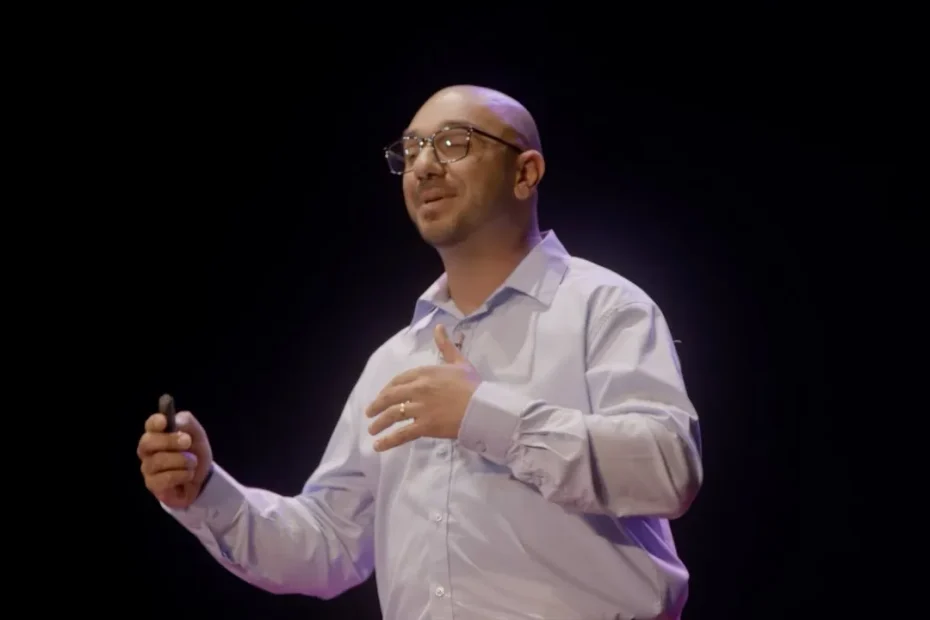
Read the full transcript of Kibar Moussoba’s talk titled “What does it mean to be a positive person” at TEDxAmoskeagMillyard 2024 conference.
Listen to the audio version here:
TRANSCRIPT:
The Question of Positivity
KIBAR MOUSSOBA: Has anyone ever asked you why you are the way you are? I know it’s a weird question. I get, “Kibar, why are you always positive?” “Kibar, how are you always so positive?” I get this question pretty often and I’ve always thought of it as an interesting question because how do you answer a question like that?
Am I always positive? I certainly don’t feel like I’m always positive. I have good days and bad days just like everyone else. I get cut off in traffic. I’ve received that unexpected bill in the mail. I’ve even been passed up for that promotion at work. I certainly wasn’t feeling very positive in those situations. But in general, come to think of it, sure, I guess I would consider myself a positive person. But why? What does it mean to be a positive person?
Is it just smiling through the bad times or is there something deeper to it? I’ve learned for me positivity is about perspective. It’s about finding the strength to see a challenge as an opportunity.
Childhood in Beirut
I recently watched a home movie from back in 1986. My brother and I were playing in the living room of our Beirut home. I was just over a year old, barely walking. My brother, almost five years old, knew that he wanted to be a doctor. So he had a toy syringe in his hand, and he was trying to give me a shot because it would make me stronger.
As I watched this video of my brother and I playing in the living room, I began thinking of what could possibly be happening just outside that window, and what was going through my parents’ minds as they watched their children play that afternoon. You see, during this time, Lebanon was still in the midst of a civil war. Gunfire and explosions were just as common as dogs barking and birds chirping.
How could my parents ensure their two boys would grow up in a safe, healthy, and positive environment? What kind of future would we have if we stayed in Lebanon? Were they willing to leave everything behind and start over? My parents had everything in Lebanon. A wonderful family, great friends, a terrific house, careers, but nothing was more important than the health and safety of their children. So they made the tough decision to immigrate to the US.
A New Beginning in America
After an eventful move from the Middle East to the United States, we found ourselves in New Hampshire living with my great aunt. The four of us took the one bedroom while she and her husband slept on the couch. As the only one who spoke English, my dad found a job at a hotel doing maintenance, and my mom worked diligently to learn English so she could get a job.
In the coming months, we would relocate to Texas, relocate back to New Hampshire, realize an issue with our immigration paperwork, and ultimately be deported. Fortunately, this was resolved quickly. But it took me years to understand the magnitude of what my parents had done for us.
The Power of Perspective
It truly hit me when I was in fourth grade, and we got our American citizenship. I remember the day after we were officially sworn in as American citizens. I walked into school that morning, and my teacher pulled me up to the front of the class and asked me what I had done the day prior. I remember the conversation well because I was already a little grumpy, not a morning person, and I was not interested in standing in front of the whole class.
But I remember saying something like, “Yeah. We had to go to Boston, and we had to sit in front of this man and answer a lot of his questions, and then we had to take pictures in front of the American flag.” After explaining a bit about American citizenship, she said one thing that stood out for me that I’ll never forget. She said, “You didn’t have to, you got to.”
This small change in a word began my journey of perspective. It became a tool. My parents didn’t have to leave everything behind. They didn’t have to struggle to find work and learn a new language. They didn’t have to start over. They got to build a new foundation for a better future for their children.
Facing Adversity After 9/11
This perspective, however, was put to the test on September 11, 2001. I was in high school, sitting in my second period class when we watched the news. I wasn’t very clear on what was happening at the time. It just looked like a horrific accident. But it didn’t take long before I heard those dreaded words from the news reporter: “It appears to be a terrorist attack.” It was at that moment I knew we were in for a long road.
I was impressed with how long it took before the bullying started, almost three hours. His name was Dan. I vividly remember all the comments and racial slurs from him and his little group of friends. Days became weeks. Weeks turned into months of news stories and articles of violence and discrimination, and all I could think of was that I had to sit there quietly. Quietly, while administrators hung paper American flags in every window of my high school that read, “United We Stand.”
I was so proud of my American citizenship because I knew what it truly meant. I knew what my parents had to go through to get us here. To have more opportunity. To have a better life. To escape from war. Up until this point, I had adopted the “I have to” becomes “I get to” mentality, but during this time in my life, it wasn’t working.
My positivity, my perspective was gone.
Finding My Voice
By September 2002, I had experienced a very difficult year. To add salt to the wound, the English department at my high school decided to hold an essay competition and invited all the students to write about their reflections over the past year. “What does freedom mean to you?” Or something to that effect.
I was not in the right headspace for this, but something told me that this could be an opportunity. I wasn’t sure exactly what that opportunity was yet, but it was a feeling of certainty. I began writing simply to get my thoughts together like journaling. This was the way for me to articulate the real picture, to get down on paper what I was experiencing, to allow at least someone to see our true unity.
It took less than a day for my English teacher to pull me into a conversation with him and the high school guidance counselor. After they confirmed that I was okay, they shared with me their plan to evolve the essay competition from simply submitting a paper in class to a big assembly where the finalists would read their essays to the whole community, and I was a finalist.
It was as if fate did what it was supposed to do. Everyone who said those things, everyone who called me a terrorist, who made comments about my country, my family, my identity, would now hear how they impacted me. I slowly felt my positivity return. I left that office feeling a bit nervous, a bit anxious, but also hopeful.
The following week the entire school gathered for the assembly. One by one, finalists stood up at the podium to recite their essays about freedom. I went last. I started with the six words that would change perspectives for a lot of people that day: “I was born during a war.”
For four minutes I spoke about what “United We Stand” could look like. For four minutes I spoke about what my family went through in hopes for a safe and healthy future. For four minutes, I spoke about how my family escaped from war, and now war had followed us here. You could hear a pin drop.
As we exited the assembly, I was immediately stopped by Dan, the bully. He didn’t say a word, but he stuck out his hand, and he had a look of remorse on his face. I knew what he wanted to say, but he didn’t say a word. The handshake was enough. It was a powerful reminder that positivity can sometimes be about finding the courage to speak your truth, and that doing so could lead to understanding and change.
When I shook his hand, I was at peace. My positivity was back. I got to turn a painful experience into an opportunity for connection. Now the sacrifices my parents made to ensure our health, safety, and a better future seem to be on track. But health, health can be tricky.
Facing a Health Crisis
The summer after my nineteenth birthday, I started experiencing some pain in my stomach. After a few weeks, the pain became more severe and more frequent, so I decided to get it checked out. My doctor was on vacation, so they had me see the other guy. And after several visits and “let’s try this medication and that medication,” it was clear that he was stumped.
By the third appointment, about two months after the initial visit, he said something that I’ll never forget: “It’s definitely not cancer.” I’m sorry. What? Cancer? Where did cancer come from?
As soon as I left the exam room, I went straight to the receptionist’s desk and insisted on a follow-up appointment with my actual doctor. That appointment yielded different results. Within a week, I was admitted to the hospital, spent seven nights, and had emergency abdominal surgery. We still didn’t have answers, but I was in a lot less pain. “It’s definitely not cancer.” Why would he say that?
About a month later, I got the phone call. It was around 5:30 PM. I was at the dinner table with my grandparents, my parents, and my brother. It was cancer. She wasn’t sure what kind. Hodgkin’s, non-Hodgkin’s, early stage or advanced, no answers, but a referral to oncology.
I wasn’t sure how to feel that night. My grandparents were crying in the living room and trying to watch Lebanese TV. My mom was in her bedroom crying on the phone with her sister. My dad was on his computer researching ways to cure cancer. Everyone began processing the news in different ways except for me. I didn’t know how I should process.
Finding Strength in Support
What I did know is that I had to call Maria. Maria, or shall I say Mrs. Courtney? She was my high school music teacher. Maria was one of those teachers that made a huge impact on my life. I had learned Maria’s story through our academic time together. She had breast cancer and overcame so much through her journey. She was one of the strongest people I knew, and she was a survivor.
So I had to call her. She gave me advice that would put me in the best headspace possible for what’s to come. “Listen to your body and use your support system.”
For about a year, there were trips to Boston hospitals to meet with specialists, countless oncology appointments for chemotherapy, and more medication than I care to describe. Throughout this time I used my support system, phone calls with Maria, late night chats with my brother. I spent time with my friends and my family. I surrounded myself with the people that I love.
I used my support system and made it through a time that seemed like it should be the worst days of my life, but I would argue they were among the best. Because not too long after, I got to speak at Relay for Life events. I got to hug people as they told me how I helped them regain some hope. I got to speak to other patients and inspire them to keep fighting, encouraging them to use their support system. I was in remission for five years, and I’ve been cancer free for fifteen.
The Essence of Positivity
My parents’ decision to move us to America, my teacher’s simple but profound words, and my journey with cancer have all contributed to my understanding of what it means to be positive. Every challenge, every setback, every moment of uncertainty has been an opportunity to grow, to learn, to become stronger.
It’s not about ignoring the difficult times or pretending they don’t exist. It’s about recognizing that when there’s a challenge there’s a chance to find something positive. An opportunity to create a new habit, a new perspective.
So ask me again, “Kibar, why are you always so positive?” Because over the past 39 years, I’ve been able to shift my perspective and see the silver lining when faced with challenges. But I like to think it’s because my brother gave me a shot when I was little to make me stronger.