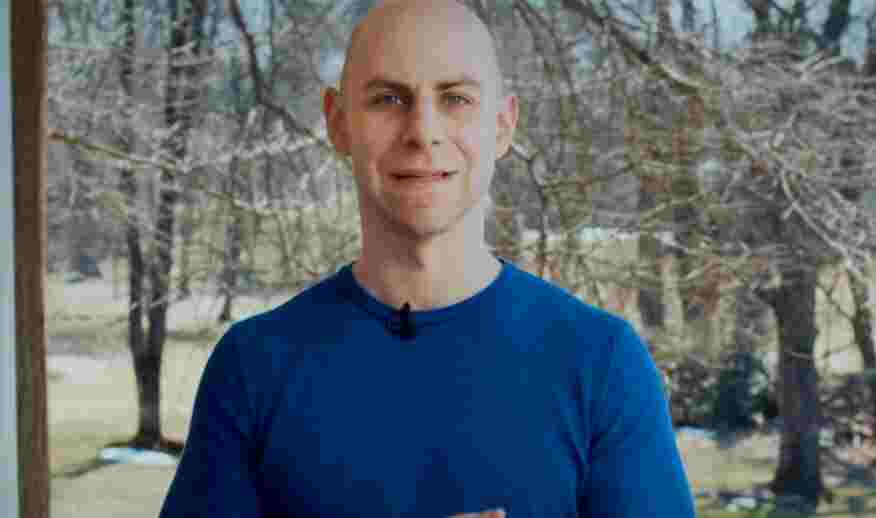
Read the full transcript of organizational psychologist Adam Grant’s talk titled “What Frogs In Hot Water Can Teach Us About Thinking Again” at TED Talks 2021 conference.
Listen to the audio version here:
TRANSCRIPT:
The Frog in the Boiling Pot
ADAM GRANT: You might have heard that if you drop a frog in a pot of boiling water, it’ll jump out right away. But if you put it in lukewarm water and then slowly heat it up, the frog won’t survive. The frog’s big problem is that it lacks the ability to rethink the situation. It doesn’t realize that the warm bath is becoming a death trap until it’s too late. Humans might be smarter than frogs, but our world is full of slow boiling pots.
Think about how slow people were to react to warnings about a pandemic, climate change, or a democracy in peril. We fail to recognize the danger because we’re reluctant to rethink the situation. We struggle with rethinking in all kinds of situations. We expect our squeaky brakes to keep working until they finally fail on the freeway. We believe the stock market will keep going up even after we hear about a real estate bubble.
And we keep watching “Game of Thrones” even after the show jumps the shark. Rethinking isn’t a hurdle in every part of our lives. We’re happy to refresh our wardrobes and renovate our kitchens. But when it comes to our goals, identities, and habits, we tend to stick to our guns. And in a rapidly changing world, that’s a huge problem.
The Organizational Psychologist’s Perspective
I’m an organizational psychologist. It’s my job to rethink how we work, lead, and live. But that hasn’t stopped me from getting stuck in slow boiling pots, so I started studying why. I learned that intelligence doesn’t help us escape. Sometimes it traps us longer.
Being good at thinking can make you worse at rethinking. There’s evidence that the smarter you are, the more likely you are to fall victim to the “I’m not biased” bias. You can always find reasons to convince yourself you’re on the right path, which is exactly what my friends and I did on a trip to Panama.
The Panama Adventure
I worked my way through college, and by my junior year, I’d finally saved enough money to travel. It was my first time leaving North America. I was excited for my first time climbing a mountain, actually an active volcano, literally a slow boiling pot. I set a goal to reach the summit and look into the crater.
So we’re in Panama. We get off to a late start, but it’s only supposed to take about two hours to get to the top. After four hours, we still haven’t reached the top. It’s a little strange that it’s taking so long, but we don’t stop to rethink whether we should turn around. We’ve already come so far. We have to make it to the top. Do not stand between me and my goal. We don’t realize we’ve read the wrong map.
We’re on Panama’s highest mountain. It actually takes six to eight hours to hike to the top. By the time we finally reach the summit, the sun is setting. We’re stranded with no food, no water, no cell phones, and no energy for the hike down.
Escalation of Commitment
There’s a name for this kind of mistake. It’s called escalation of commitment to a losing course of action. It happens when you make an initial investment of time or money, and then you find out it might have been a bad choice. But instead of rethinking it, you double down and invest more. You want to prove to yourself and everyone else that you made a good decision.
Escalation of commitment explains so many familiar examples of businesses plummeting. Blockbuster, BlackBerry, Kodak, leaders just kept simmering in their slow boiling pots, failing to rethink their strategies. Escalation of commitment explains why you might have stuck around too long in a miserable job, why you’ve probably waited for a table way too long at a restaurant, and why you might have hung on to a bad relationship long after your friends encouraged you to leave.
It’s hard to admit that we were wrong and that we might have even wasted years of our lives. So we tell ourselves, “If I just try harder, I can turn this around.” We live in a culture that worships at the altar of hustle and prays to the high priest of grit. But sometimes, that leads us to keep going when we should stop to think again.
The Downside of Grit
Experiments show that gritty people are more likely to overplay their hands in casino games and more likely to keep trying to solve impossible puzzles. My colleagues and I have found that NBA basketball coaches who are determined to develop the potential in rookies keep them around much longer than their performance justifies. And researchers have even suggested that the most tenacious mountaineers are more likely to die on expeditions because they’re determined to do whatever it takes to reach the summit.
In Panama, my friends and I got lucky. About an hour into our descent, a lone pickup truck came down the volcano and rescued us from our slow boiling pot. There’s a fine line between heroic persistence and stubborn stupidity. Sometimes the best kind of grit is gritting your teeth and packing your bags. “Never give up” doesn’t mean keep doing the thing that’s failing. It means don’t get locked into one narrow path and stay open to broadening your goals.
The ultimate goal is to make it down the mountain, not just to reach the top. Your goals can give you tunnel vision, blinding you to rethinking the situation. And it’s not just goals that can cause this kind of shortsightedness. It’s your identity too.
Identity and Rethinking
As a kid, my identity was wrapped up in sports. I spent countless hours shooting hoops on my driveway, and then I got cut from the middle school basketball team all three years.
I spent a decade playing soccer, but I didn’t make the high school team. At that point, I shifted my focus to a new sport, diving. I was bad. I walked like Frankenstein. I couldn’t jump. I could hardly touch my toes without bending my knees, and I was afraid of heights. But I was determined.
I stayed at the pool until it was dark, and my coach kicked me out of practice. I knew that the seeds of greatness are planted in the daily grind, and eventually, my hard work paid off. By my senior year, I made the all-American list, and I qualified for the Junior Olympic Nationals. I was obsessed with diving. It was more than something I did. It became who I was. I had a diving sticker on my car, and my email address was diverag@aol.com.
Diving gave me a way to fit in and to stand out. I had a team where I belonged and a rare skill to share. I had people rooting for me and control over my own progress. But when I got to college, the sport that I loved became something I started to dread. At that level, I could not beat more talented divers by outworking them. I was supposed to be doing higher dives, but I was still afraid of heights. And 6 AM practice was brutal. My mind was awake, but my muscles were still asleep. I did back smacks and belly flops, and my slow boiling pot this time was a freezing pool. There was one question, though, that stopped me from rethinking: If I’m not a diver, who am I?
Identity Foreclosure
In psychology, there’s a term for this kind of failure to rethink. It’s called identity foreclosure. It’s when you settle prematurely on a sense of who you are and close your mind to alternative selves. You’ve probably experienced identity foreclosure. Maybe you were too attached to an early idea of what school you’d go to, what kind of person you’d marry, or what career you’d choose. Foreclosing on one identity is like following a GPS that gives you the right directions to the wrong destination.
After my freshman year of college, I rethought my identity. I realized that diving was a passion, not a purpose. My values were to grow and excel and to contribute to helping my teammates grow and excel. Grow, excel, contribute. I didn’t have to be a diver to grow, excel, and contribute.
Research suggests that instead of foreclosing on one identity, we’re better off trying on a range of possible selves. Retiring from diving freed me up to spend the summer doing psychology research and working as a diving coach. It also gave me time to concentrate on my dorkiest hobby, performing as a magician. I’m still working on my sleight of hand. Opening my mind to new identities opened new doors.
Research showed me that I enjoyed creating knowledge, not just consuming it. Coaching and performing helped me see myself as a teacher and an entertainer. If that hadn’t happened, I might not have become a psychologist and a professor, and I probably wouldn’t be giving this TED Talk.
Overcoming Fear and Embracing Change
See, I’m an introvert, and when I first started teaching, I was afraid of public speaking. I had a mentor, Jane Dutton, who gave me some invaluable advice. She said, “You have to unleash your inner magician.” So I turned my class into a live show. Before the first day, I memorized my students’ names and backgrounds, and then I mastered my routine.
Those habits served me well. I started to relax more, and I started to get good ratings. But just like with goals and identities, the routines that help us today can become the ruts we get trapped in tomorrow. One day, I taught a class on the importance of rethinking, and afterward, a student came up and said, “You know, you’re not following your own principles.” They say feedback is a gift, but right then, I wondered how do I return this?
I was teaching the same material the same way year after year. I didn’t want to give up on a performance that was working. I had my act down. Even good habits can stand in the way of rethinking. There’s a name for that too. It’s called cognitive entrenchment, where you get stuck in the way you’ve always done things.
Just thinking about rethinking made me defensive, and then I went through the stages of grief. I happened to be doing some research on emotion regulation at the time, and it came in handy. Although you don’t always get to choose the emotions you feel, you do get to pick which ones you internalize and which ones you express. I started to see emotions as works in progress, kind of like art.
If you were a painter, you probably wouldn’t frame your first sketch. Your initial feelings are just a rough draft. As you gain perspective, you can rethink and revise what you feel. So that’s what I did. Instead of defensiveness, I tried curiosity. I wondered, what would happen if I became the student?
I threw out my plan for one day of class, and I invited the students to design their own session. The first year, they wrote letters to their freshmen selves about what they wish they’d rethought or known sooner. The next year, they gave passion talks. They each had one minute to share something they loved or cared about deeply. And now all my students give passion talks to introduce themselves to the class.
I believe that good teachers introduce new thoughts, but great teachers introduce new ways of thinking. But it wasn’t until I ceded control that I truly understood how much my students had to teach one another and me. Ever since then, I put an annual reminder in my calendar to rethink what and how I teach. It’s a checkup.
Just like you go to the doctor for an annual checkup when nothing seems to be wrong, you can do the same thing in the important parts of your life. A career checkup to consider how your goals are shifting, a relationship checkup to reexamine your habits, an identity checkup to consider how your values are evolving. Rethinking does not have to change your mind. It just means taking time to reflect and staying open to reconsidering.
A hallmark of wisdom is knowing when to grit and when to quit, when to throw in the towel on an old identity and dive into a new one, when to walk away from some old habits and start scaling a new mountain.
Your past can weigh you down, and rethinking can liberate you. Rethinking is not just a skill to master personally. It’s a value we need to embrace culturally. We live in a world that mistakes confidence for competence, that pressures us to favor the comfort of conviction over the discomfort of doubt, that accuses people who change their minds of flip-flopping, when, in fact, they might be learning. So let’s talk about how to make rethinking a norm.
Embracing Rethinking as a Norm
We need to invite it and to model it. A few years ago, some of our students at Wharton challenged the faculty to do that. They asked us to record our own version of Jimmy Kimmel’s mean tweets. We took the worst feedback we’ve ever received on student course evaluations, and we read it out loud.
“It was easily one of the worst three classes I’ve ever taken, one of which the professor was let go after the semester.”
“The number of stories you tell gives Aesop’s fables a run for its money. Less can be more.”
“Ouch. You’re so nervous. You’re causing us to physically shake in our seats.”
“So great to finally have a professor from Australia.”
“You started strong, but then got softer. You need tenure, so toughen up with these brats.”
“I’m from Alabama.”
“Professor Sinkinson acts all down with pop culture, but secretly thinks Ariana Grande is a font in Microsoft Word.”
After I show these clips in class, students give more thoughtful feedback. They rethink what’s relevant. They also become more comfortable telling me what to rethink. Because I’m not just claiming I’m receptive to criticism. I’m demonstrating that I can take it.
We need that kind of openness in schools, in families, in businesses, in governments, in nonprofits. A couple years ago, I was working on a project at the Gates Foundation, and I suggested that leaders could record their own version of mean tweets. Melinda Gates volunteered to go first, and one of the points of feedback that she read said, “Melinda is like Mary effing Poppins, practically perfect in every way.” And then she started listing her imperfections. People at the Gates Foundation who saw that video ended up becoming more willing to recognize and overcome their own limitations.
They were also more likely to speak up about problems and solutions. What Melinda was modeling was confident humility. Confident humility is being secure enough in your strengths to acknowledge your weaknesses, believing that the best way to prove yourself is to improve yourself, knowing that weak leaders silence their critics and make themselves weaker, while strong leaders engage their critics and make themselves stronger.
Confident humility gives you the courage to say, “I don’t know,” instead of pretending to have all the answers, to say, “I was wrong,” instead of insisting you were right. It encourages you to listen to ideas that make you think hard, not just the ones that make you feel good, and to surround yourself with people who challenge your thought process, not just the ones who agree with your conclusions.
And sometimes, it even leads you to challenge your own conclusions. Like with the story about the frog that can’t survive the slow boiling pot. I found out recently that’s a myth. If you heat up the water, the frog will jump out as soon as it gets uncomfortably warm. Of course it jumps out. It’s not an idiot.
The problem is not the frog. It’s us. Once we accept the story as true, we don’t bother to think again. What if we were more like the frog, ready to jump out if the water gets too warm?