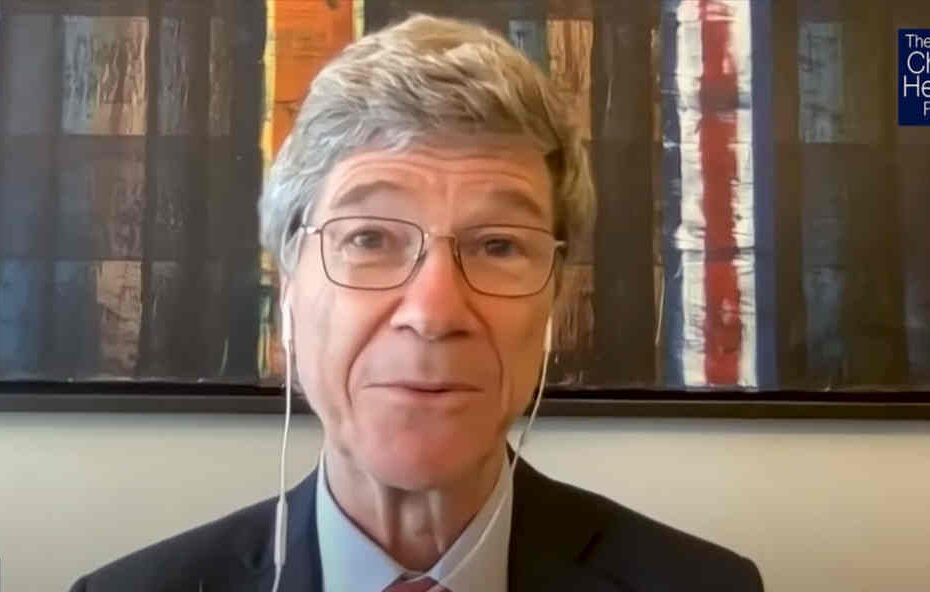
Read the full transcript of American economist and public policy analyst Jeffrey Sachs’ interview on The Chris Hedges Report titled “What JFK Tried To Do Before His Assassination”, Premiered September 29, 2023.
The Cuban Missile Crisis: A Turning Point for Peace
CHRIS HEDGES: John F. Kennedy’s last battle, cut short by his assassination, was the effort to build a sustainable peace with the Soviet Union. Jeffrey Sachs, professor of economics at Columbia University, in his new book, “To Move the World,” chronicles the campaign by Kennedy from October 1962 to September 1963 to curb the arms race and build ties with his Soviet counterpart, Nikita Khrushchev.
Sachs looks at the series of speeches Kennedy gave to end the Cold War and persuade the world to make peace with the Soviets. Kennedy implemented the Partial Nuclear Test Ban Treaty in 1963. But Kennedy’s vision was not shared by many cold warriors in the establishment, including some within his administration and especially within the military.
Joining me to discuss “To Move the World: JFK’s Quest for Peace,” is Professor Jeffrey Sachs. I want to begin with the Cuban Missile Crisis, because this is a moment that you write about in your book, where Kennedy is battling particularly the military figures like Curtis LeMay, who was the head of the Air Force, who want to engage in a hot war to essentially bomb Cuban missile bases and even Soviet ships. And this, I think, precipitated the change that came about within Kennedy.
JEFFREY SACHS: Let me say first what a pleasure it is to be with you and how good it is to talk about these issues on their 60th anniversary, because they are completely alive today in the context of the war in Ukraine as well, where the US and Russia are, in effect, at war. And I’m afraid our leaders are not learning the lessons that Kennedy learned and espoused.
I think even before the Cuban Missile Crisis, it’s worth saying that Kennedy came into office in January 1961, intent on peace, but found himself at the brink of nuclear annihilation just a year and a half afterwards. And that was not only shocking, but rather a sign of how extraordinarily dangerous the world was and continues to be.
Kennedy’s Early Challenges and the Bay of Pigs Disaster
So Kennedy came in in January 1961, not aiming for war, but aiming for negotiation and peace. And remember, in his inaugural address, he had the famous line: “Let us never negotiate out of fear, but let us never fear to negotiate.” And he knew the dynamics of how things can get out of hand. He understood that the world was dangerous and he was going to avoid it.
And yet the first year was a massive debacle because the CIA came to him and said, “Mr. President, now you have to implement the invasion of Cuba.” And he had serious doubts about it. But like most presidents and certainly most presidents in their first months, he went along and said, “Okay, you can do it, but I’m not going to give air cover.” And some flaky set of decisions from the CIA and Kennedy had them go forward.
And of course, the Bay of Pigs invasion of Cuba was itself a debacle, a disaster, led to a horrible interchange with Khrushchev, who wrote in a private channel to Kennedy, “Stop this piracy of people in your government.” And Kennedy wrote back brazenly, “No, it’s not my government. This is independent of the United States.” And Khrushchev wrote back, in effect, “Don’t lie to me like that, Mr. President.”
CHRIS HEDGES: I want to stop you there because you write in the book about two times the Kennedy administration lied to the Soviets and how destructive that was to building relationships.
The Destructive Pattern of Lies and Deception
JEFFREY SACHS: Actually, the first lie came when the Soviet Union shot down a CIA spy plane, the U-2 spy plane with Gary Powers, just on the eve of what was supposed to be a summit between Eisenhower and Soviet Union Party Chairman Nikita Khrushchev.
And CIA lies for a living. We know this, but it lied to the President of the United States, also saying, “Mr. President, don’t worry, they can’t shoot down the spy plane, it’s too high. And if they do shoot down the spy plane, it’s designed to disintegrate. And if it doesn’t disintegrate anyway, the pilot is going to take his cyanide pill. There’s no way anything can happen to embarrass you.”
And of course they shoot down the spy plane. They get the wreckage, they get the pilot alive, Gary Powers. They don’t announce that. They say we have been spied upon and downed a plane without revealing those details. And Eisenhower comes out and says, “No, no, no, no, this is a weather craft that went off course from Turkey.” And then the Soviets reveal we have the fuselage, we have the pilot who has told us about his spy mission. Direct blatant lies.
Then soon after this comes the direct blatant lies of the Bay of Pigs. It’s dangerous. And this is the CIA, by the way, and it’s the CIA until today, in my view, it is lying and unaccountable and really never called to task for these lies because the public doesn’t know them, doesn’t understand what’s going on. But from the Soviet-US point of view, within months of the Kennedy administration, this air was poisoned.
The Unresolved German Question
And there was one other thing that was absolutely precipitating all of this, which was fundamental and completely never discussed in America almost at all. But there had been no peace treaty at the end of World War II. And the Cold War emerged, in fact, over a bitter dispute between the Soviet Union and the United States about the future of Germany.
The Soviet Union had lost more than 20 million people in the war and did not want to see Germany remilitarized. The United States, on the other hand, decided that the three occupied regions from the western side, the US, French and British regions, would form a single new Federal Republic of Germany.
The remaining fourth part, the Soviet occupied part, would become the German Democratic Republic, the GDR. But the western side would become the bulwark of a new military alliance, NATO. And it would be remilitarized.
And the Soviet Union said, “No, we just lost more than 20 million people. Now within a few years, you’re remilitarizing.” Well, of course, the United States never listened, never negotiated. And at the end of the 1950s took another step. Eisenhower was flirting with the idea maybe we should just give our allies control over nuclear weapons as well so we can reduce the US troops numbers in Europe. Eisenhower was very frugal. He was a fiscal conservative, and he wanted to bring troops home and use the nuclear shield.
And so there was at the end of the 1950s, lots of talk about nuclear sharing. And this was freaking out the Soviet Union also. And the United States doesn’t know how to talk to anybody. There’s no diplomacy. There are mortal enemies. There’s no one to negotiate. And so the situation by the time Kennedy came in was completely fraught.
The Missile Crisis Unfolds
Then came the Bay of Pigs. Then Khrushchev said, “Okay, we need to teach Americans a bit of their own lessons. We’ll put missiles in Cuba.” And Khrushchev had a quite remarkable exchange with Andrei Gromyko as Foreign Minister. Gromyko said, “No. What war?” And Khrushchev said, “No, not war. Just basically teach these Americans about their arrogance. They have missiles in Turkey. We’re going to put missiles in Cuba.” Nothing about war.
But of course, everything immediately spiraled out of control when the missile placements were discovered and the subterfuge that the Soviets were using to place the missile systems in place. And it was like the subterfuge of the United States doing what it did on its side. Things get out of hand.
And as soon as Kennedy saw the U-2 spy plane over Cuba taking these pictures of missile sites, he convened an executive committee, ExComm. And it was almost unanimous. “Well, we got to shoot down these sites. We have to take them out before they can be deployed.” And it was unanimous essentially, that there needed to be an immediate war. And the Joint Chiefs were told to go off and plan the military campaign against Cuba. Would it be an air campaign? Would it just be to take out the sites, how many troops would be needed, and so forth.
The Diplomatic Alternative
Kennedy, interestingly, to make a very long story short, had lunch by coincidence with Adlai Stevenson, the US Ambassador to the United Nations, on the first day of the Cuban Missile Crisis, when Kennedy had seen the pictures. And Adlai Stevenson said to Kennedy, “Well, of course, you need diplomacy to end this and exchange the missiles with the Turkish missiles.”
Kennedy was shocked because no other advisor had said anything about diplomacy. It was basically unanimous for a military approach, which, by the way, almost surely—maybe too strong, although I’m not sure it is—but most likely would have led to nuclear annihilation, because our doctrine was that if we were attacked by a nuclear weapon, we would give a full response, by the way, full meaning not only the Soviet Union, but Eastern and Central Europe, China, hundreds of millions of people killed. And now we learned afterwards from the nuclear winter, maybe all of humanity perishing from starvation afterwards.
But Stevenson laid the idea of maybe a negotiated settlement. Well, to make a long story short, as people know, Kennedy really almost alone, though, with this hint from Stevenson, and then with his brother Robert pushing and Ted Sorensen pushing and a few others pushing, turned the tide over a few days that don’t do something precipitous. “Let’s try to figure out what’s in Khrushchev’s mind.”
Kennedy’s Realization About the Dangers of War
And Kennedy came to realize, because he had people like the Air Force, had Curtis LeMay who just wanted nuclear war, it seems, or first strike against the Soviet Union, that he was surrounded by a lot of hotheads who could end the world. And he realized Khrushchev probably was as well. And the two of them came to realize, “We better tamp this down.” And they did, and they agreed on a deal of this removal of missiles both from Cuba and from Turkey.
The big mistake Kennedy made, and I always think it’s unfair to call it a mistake because he saved the world. So you get a lot of credit for that. But the mistake he made was insisting that the deal be secret so that it looked to the American people like he had simply faced down the Soviet Union and they had backed away because it wasn’t known that the removal of the American missiles were part of an exchange. And that wasn’t known for decades, actually.
CHRIS HEDGES: Let me just stop you there, because right in the preface—and I didn’t know this—you talk about once that machinery begins to be put in place, a human error can trigger a nuclear catastrophe. You write: “One Alaska-based U.S. Air Force pilot had not gotten the message. This was not to send flights over Cuba. And after taking off to collect air samples to check on Soviet nuclear testing, the pilot had become disoriented and inadvertently flown his plane into Soviet airspace. Soviet fighter jets scrambled to intercept the U-2 while due to the high alert status prompted by the crisis, the US planes sent to escort it back to base were armed with nuclear warheads and had the authority to fire.”
How Close We Came to Nuclear Annihilation
JEFFREY SACHS: Yes, and actually that was one of the episodes that brought us to the brink of nuclear annihilation. But there was one even more dramatic which was that after the agreement was reached between Kennedy and Khrushchev, there was a disabled submarine in the Caribbean that was part of a squadron and it was the one in that squadron that carried nuclear-tipped torpedoes.
And when that disabled sub rose, normally the US might drop depth charges on the submarine to get it to force it to rise, but a jackass—I think is the right technical term—dropped live hand grenades as he was flying over this rising submarine. And the skipper thought our sub is under attack. There must be a Russian submarine—sorry, Russian submarine, that was my point. Disabled Russian submarine, excuse me.
And they thought they were under attack and that there must be a war at the surface. It was disabled and out of communication. And so the captain of the vessel ordered that the nuclear-tipped submarine be loaded into the torpedo bay and that it be fired. And if it had been fired under US nuclear doctrine, being attacked by a nuclear weapon, including a nuclear-tipped torpedo under US doctrine would have launched that full-scale response that would have destroyed humanity.
And the order to fire was countermanded at the last moment by virtue of the fact that there happened to be a Soviet party official who was senior to the captain of the vessel who said “I don’t think it’s a good idea we should rise without firing.” And they did. And it turned out there wasn’t a war on the surface and there wasn’t a need to launch the torpedo.
We came within a second of ending the world. And that was after the agreement had been reached between the USSR and the United States. And Martin Sherwin, the late historian who now people know as the person who co-wrote the great book “American Prometheus” on J. Robert Oppenheimer wrote this story in his wonderful last book before he passed away “Gambling with Armageddon,” which is a history of the Cuban Missile Crisis, absolutely phenomenal.
Kennedy’s Transformation and the Peace Speech
CHRIS HEDGES: As is American Prometheus. They’re both great books. He wrote that with Kai Bird. Of course. You can visit that submarine. I think it’s in San Francisco. I did. The Russian submarine is a museum. So Kennedy walks away from this horrified at how close the world came to nuclear Armageddon. But he also walked away with a deep distrust of the military.
And I want to talk about the decision to give this speech, which I had not read in full until I read it in your book and then went and listened to. Has to be one of the most courageous acts by a politician, you could argue, perhaps, since anything FDR did. And it’s utterly remarkable. And what’s frightening or disturbing is that I can’t see any political figure giving a speech like that again. So let’s talk about how Kennedy changed and what he set out to do. And of course, it was all cut short by his assassination in November of 1963.
JEFFREY SACHS: I think, first, it’s fair to say that being President of the United States is a tough job. And it’s impossible to do right in the early days and early years because you don’t get it. And our security state in the United States, which was created by the National Security Act of 1947, which created a secret security state and a private army of the United States called the CIA, which is one half its function because it does intelligence and it does private warfare of the United States.
And the whole apparatus is secret and largely out of control. And it is absolutely out of control by any public understanding or scrutiny or accountability or congressional oversight today as it was in the early 1960s. Well, Kennedy came in with a lot of energy and idealism and brilliance. And he stumbled terribly in the first year with the Bay of Pigs Cuban invasion, and then in the second year, the near disaster of the Cuban Missile Crisis.
And my view is he had the potential for greatness at the beginning. And by his third year, he had become a magnificent politician and statesman of the first order. One of our truly great presidents. Not so much in the first two years, although the potential was there. But the growth that came through this set of trials was extraordinary.
Already after the Bay of Pigs, Kennedy was so disturbed by the CIA that he was beside himself about how they had led the US and his administration and himself personally into this awful debacle. He didn’t trust the CIA after the Cuban Missile Crisis, and after hearing people like Curtis LeMay even essentially calling Kennedy a traitor for not launching the war or a coward and feeling all of this pressure for war. He was profoundly disturbed and profoundly moved and profoundly scared at how fragile the world was. And he was determined to do something in 1963.
CHRIS HEDGES: Let me just interject. He fired Dulles and he fired Bissell. So he actually took on the CIA establishment and triggered deep animus. And I want you, as you go on, to talk about this speech. But one of the things I found fascinating from your book is how few people informed about what it was he was about to say. And so I want to make sure we talk about the content of what he said.
The Revolutionary Peace Speech
JEFFREY SACHS: So Kennedy wanted to say to the American people, peace is possible, even with the Soviet Union, even with the other side. And the whole content of the speech is they are human beings like we are. They want to live, they want to protect their children, they want to have a future.
And this speech is unbelievable because it’s the only foreign policy speech I know of anywhere where it is not telling the other side what to do, not making threats, not reveling in glory, not saying we are number one, not saying they are evil, but saying to the American people, we need to reconsider our own position.
And remember today, we’re told every day by the completely irresponsible, reckless and ignorant mass media like the New York Times, I’m going to say, because it’s terrible. And like the Washington Post and others, there’s no one to talk to. There’s no one to negotiate with over Ukraine. And in the Cold War, in 1963, it was even more like that. The Cuban missile crisis had just occurred. Could you even imagine negotiating with the Soviet Union?
And Kennedy’s whole message is, we can negotiate. They want the same things. They too will abide by treaties as long as those treaties are also in their interest. And they can be relied upon to abide by treaties that are in their interest and also in our interest. There is a benefit of cooperation. This is rational. In fact, the pursuit of peace is the rational end of rational men, says President Kennedy.
CHRIS HEDGES: I just want to read a couple sections because it is an absolutely remarkable and as you point out, Drew Sorensen, beautifully elegiac and just gorgeously written. But these are some of the things just I want to read three short sections.
“I speak of peace. This is Kennedy as the necessary rational end of rational men. I realize that the pursuit of peace is not as dramatic as the pursuit of war, and frequently the words of the pursuer fall on deaf ears. But we have no more urgent task.”
And then he says, “So let us not be blind to our differences. But let us also direct attention to our common interests and to the means by which those differences can be resolved. And if we cannot end now our differences, at least we can help make the world safe for diversity. For in the final analysis, our most basic common link is that we all inhabit this small planet. We all breathe the same air. We all cherish our children’s future, and we are all mortal.”
And just to conclude, he asks in the speech, “What kind of peace do we seek? Not a Pax Americana enforced on the world by American weapons of war. Not the peace of the grave or the security of the slave. I am talking about genuine peace, the kind of peace that makes life on Earth worth living. The kind that enables men and nations to grow and to hope and to build a better life for their children. Not merely peace for Americans, but peace for all men and women. Not merely peace in our time, but peace for all time.” I mean, this is incredible.
The Speech’s Impact and Kennedy’s Strategy
JEFFREY SACHS: It gives you goosebumps. Of course, I’ve listened, I don’t know how many dozens or hundreds of times to the speech I’ve made my family listen on so many occasions. But the words are thrilling. The words are mesmerizing in their beauty, and Ted Sorensen has a big hand in that as well, and in their ability to make change.
And I think one of the things that Kennedy also says in here, which is incredible, is his advice on leadership. And I don’t have exactly the words here, but to paraphrase, he says, “By defining our goal more clearly, by making it seem more manageable and less remote, we help all people to see it, to draw hope from it, and to move irresistibly toward it.”
So the goal of peace if made to be manageable, practical, like a treaty to stop atomic testing of atmospheric testing of nuclear weapons, is a practical, manageable step, and people draw hope from it. So the speech was so riveting and powerful, by the way, kept completely outside of the bureaucracy. It was essentially hidden from the security apparatus, from the State Department, the CIA, even the White House. Only Sorensen and Kennedy worked on it basically until the last moment. Then they said, “I’m giving this.” Kennedy said, “I’m giving it.” So it could not be vetoed by State or by the Defense Department or the National Security Council or anybody else.
And he gave it. And what is amazing, absolutely amazing, is that Khrushchev heard it, was carried away, summoned the US Envoy, Kennedy’s envoy to Moscow, Averil Harriman, and said, “This is the finest speech by an American president since FDR. I want to make peace with your President.” The words were so powerful, the motivation, the ideas were so powerful. Kennedy disseminated the speech through Pravda, Zvestia Online.
CHRIS HEDGES: Isn’t that hilarious? Pravda reprinted it.
JEFFREY SACHS: Exactly. And broadcast the speech. And within a few weeks, they had signed the agreement within a few weeks. Absolutely. An astounding achievement. Then Kennedy, just to say he was also the grassroots politician, he was a political guy to the core. He went out to campaign for it. And so he took his tour around the United States. The Joint Chiefs, oh, well, we don’t know. They come to testify in Congress and try to knock down this agreement.
And Kennedy carried the American public overwhelmingly and then won a decisive victory in the Senate 60 years ago, just now for the ratification of this treaty. And this is the time when we’re talking, is the time of the UN General Assembly. Kennedy went to tell the leaders what this meant in another completely magnificent address. And he said, “This is not the end of conflict, but it is a ray of hope piercing through the clouds.”
And he ends his address to the world leaders assembled in front of him in the chamber of the UN General Assembly. Kennedy, having brought peace, brought hope, and all the world leaders assembled in front of him. And he says to them that “Archimedes is said to have told his friends, give me a place to stand, and I can move the world. Fellow leaders of the world, let us see if we can take our stand here in this place, in this time, to move the world towards peace.”
And you just can’t get better than that. The idealism, the hope, the practicality, and Kennedy infused the whole world with it. And then they killed him.
CHRIS HEDGES: And we’ve lost it. We’ve lost it.
The Assassination and Its Consequences
JEFFREY SACHS: And they killed him. Because I’m personally convinced after having studied this in depth for decades now, and now we have the report completely debunking the Warren Commission, with the magic bullet being no magic bullet at all, but a bullet that the Secret Service pulled out of the back of Kennedy’s seat and put on the stretcher, debunking the entire forensic basis of the Warren Commission. I’m pretty convinced that it was rogue elements within the US Government itself.
CHRIS HEDGES: Well, Allen Dulles.
JEFFREY SACHS: Allen Dulles. Can’t get more evil.
CHRIS HEDGES: Can’t get more evil than that.
JEFFREY SACHS: Exactly. We don’t know exactly who, but this was a conspiracy, and it was a conspiracy against peace. And, you know, our security state is in full force. Our president, in my view, was not in control and in any event has been a hardliner and a cold warrior. Whatever you want to call it well past the Cold War. These neocons don’t understand peace. They don’t understand negotiation, they don’t understand diplomacy. They don’t understand the nuclear threat.
And one other point, Chris, of the speech that I think is so pertinent and completely neglected. Kennedy says, “Above all, while defending our own vital interests, nuclear powers must avert those confrontations which bring an adversary to a choice of either a humiliating retreat or a nuclear war. To adopt that kind of course in the nuclear age would be evidence only of the bankruptcy of our policy or of a collective death wish for the world.”
And the US has gone out to humiliate Putin and to defeat Putin. And Russia has 6,000 nuclear weapons. What are we doing? What are we thinking? Of course, I take it a little bit, even a step back. I think this is, I call it the war of NATO enlargement, because I think the entire war in Ukraine came because the United States so recklessly and imprudently kept pushing, pushing, pushing NATO enlargement. Russia saying stop, it’s a red line, stop. And then not to Ukraine, for heaven’s sake, not to Ukraine, our 2,300 kilometer border, not to surround us in the Black Sea.
And the US is deaf to this. And then trying to humiliate Putin and doing exactly the opposite of what Kennedy said. And I take it seriously when Kennedy says in that remark about not pushing a nuclear power to a corner, he says “above all,” as if that’s the synthesis of what he’s learned from the Cuban Missile Crisis. Above all, don’t humiliate a nuclear adversary. And our people don’t even know it. We don’t have diplomats and we don’t have a president, in my view, that understands the job of keeping the foot on the brake. So it’s a very dangerous time.
CHRIS HEDGES: In this last part, I want to ask you what happened. So you have this incredible moment in American history. Of course, Khrushchev doesn’t last much longer. After Kennedy’s assassination, the hardliners regain control in the Soviet Union. What happened? Just run through that historical period to where we are now.
The Path to Détente and Nuclear Treaties
JEFFREY SACHS: Of course it’s complicated, but there was a period of détente and of arms agreements. The Partial Nuclear Test Ban Treaty of 1963, which we’ve been discussing, led directly to the Nuclear Non-Proliferation Treaty a few years later. A really momentous achievement to not stop nuclear proliferation, but definitely to slow it down dramatically because Kennedy rightly worried about 30 or 40 nuclear powered or nuclear weapons countries by the time we are now and it is around 10, absolutely not safe and in control, but not the mass proliferation. And the treaty of 1963 played a critical part in that.
Détente came. We had our ups and downs. We had huge tensions in the early 1980s when Reagan proposed to put intermediate range nuclear weapons into Europe. And the Cold War intensified, heated up again. Then came Gorbachev. And Gorbachev was a great statesman, the greatest of our age of that time, a man of peace. And he and Reagan actually realized the potential for peace and negotiated an end to the Cold War.
Gorbachev’s Promise and America’s Betrayal
And quite remarkably, it was Gorbachev who unilaterally said in 1990, “I will disband the Warsaw Pact military alliance of the Soviet Union.” And James Baker III, the Secretary of State of George Bush Sr. who had followed Reagan as president, Baker ran to assure him, “We will never take advantage of your decision, President Gorbachev. We will not move NATO one inch eastward.” And this was repeated by the German government that was interested in German reunification. And Hans Dietrich Genscher, the foreign Minister of Germany, promised no NATO enlargement.
Of course, as soon as the Soviet Union ended at the end of 1991, the US cheated. And it cheated till this day. And despite vast documentary evidence, we have a lot of people saying, “Oh, we never promised anything.” It’s true. Gorbachev didn’t get it in writing in a treaty because they weren’t making treaties. They were arranging the end of the Cold War. But Gorbachev was promised, and those promises were sheer lies.
CHRIS HEDGES: I just want to interject. I was there. I covered the unification of Germany. I covered the East German revolution, revolution in Czechoslovakia, in Romania. And they could not have unified Germany without Soviet acquiescence.
The Missed Opportunity for Peace
JEFFREY SACHS: And Gorbachev said, “This is important for us. You not take advantage of us.” It was very, very clear. And I was there as an economic advisor to Gorbachev’s team and then to President Yeltsin’s team and to President Kuchma’s team of Ukraine. I saw these events also very, very close up. And we had a chance for peace.
And the United States said, “Well, it’s not peace we want. We want unipolarity, we want world hegemony. We’re now the most powerful country in the world. We won, you lost. We’re going to even take out every ally you ever had, whether it’s Syria or Iraq or Libya or Serbia or others. We’re going to go in one by one and clean up the act, because we can do it with impunity. Now, who are you? You’re a defeated power.”
And so the United States treated Russia with contempt, engaged in regime change operations all over the region, usually with some mix of CIA background and National Endowment for Democracy and NGOs pouring in money and mucking up the local politics to get someone that would be compliant with the United States.
NATO Expansion Despite Warnings
And Russia kept saying, “Wait a minute, wait a minute, you promised. And you keep moving eastward towards us.” Clinton started the process of NATO enlargement. His own Secretary of Defense, Bill Perry, was aghast and thought about resigning, said, “This is going to mess up everything.” Of course, the very architect of containment policy, George Kennan, who invented containment in 1947 in his long telegram and in his Foreign Affairs article, said, “You start NATO enlargement, you’re going to have absolutely a new Cold War.”
But American politicians cannot hear anybody’s concerns. And the arrogance is breathtaking and the ignorance is breathtaking in my view. And the power of the military industrial security state in the United States is awful and breathtaking as well.
So under Clinton, three countries joined NATO, and then under Bush Jr. 2007, seven more countries. The three Baltic states, Latvia, Lithuania, Estonia, Romania, Bulgaria, Slovakia and Slovenia. And Russia’s now being cornered by the advancing NATO. And Putin says in 2007 at the Munich Security Conference, “Stop, stop. You promised in 1990 no advance, and now all you’re doing is advancing your military.”
And in 2002, by the way, the United States unilaterally pulled out of the Anti-Ballistic Missile Treaty and started to put in Aegis missiles on Russia’s borders, nearby Russia in Poland and Romania in particular. So Putin says, “Stop this.”
The Ukraine Crisis Unfolds
And what does the United States do in response? Bush Jr. instructs his ambassador to NATO. Interestingly, Victoria Nuland, who was Cheney’s foreign policy advisor, then US Ambassador to NATO, then suddenly is Hillary’s foreign policy advisor, then suddenly the Assistant Secretary of State in 2014, when the US was part of the overthrow of the Ukraine government, to get someone that was suppliant to the US desire for NATO enlargement.
And so the tensions kept rising until 2014. The United States participated in a regime change operation. Very typical, overthrowing a Ukrainian president that wanted neutrality, Viktor Yanukovych. And at that moment, Putin said, “You’re not getting our naval base in Crimea” and took back Crimea because it was not going to fall into NATO hands.
And the Russian part of Ukraine, ethnic Russian part of the Eastern Donbas, was aghast at the Russophobic regime that had come into power with the US connivance in February 2014. So it called to break away. And it required a treaty, two treaties in fact, Minsk 1 and Minsk 2, to try to make peace within Ukraine itself.
The Failure of the Minsk Agreements
And the idea of the Minsk 2 agreement was that the eastern part of Ukraine, which is ethnically overwhelmingly Russian, would have autonomy within Ukraine, a federal Ukraine. And the United States opposed federalization and the Ukrainians opposed it. They signed the treaty, the UN Security Council endorsed the treaty and they blew it off. The Ukrainians and the Americans, “Forget it. We don’t have to implement it.”
So by the time Biden came in in 2021, Minsk had fallen apart. The US was arming Ukraine to the teeth. Biden came in full cold warrior. “We’re going to expand NATO to Ukraine. Yes, we are.” And Putin said, “No, you’re not.”
And in December 17, 2021, Putin put on the table a draft US-Russia security agreement based on NATO not enlarging to Ukraine and these missiles not being pointed at Russia. And I called the White House at that point to senior official and said, “Negotiate. You’ve got a basis to avoid war.” “No, don’t worry. But anyway, NATO enlargement is none of Russia’s business.” That’s the formal policy of the United States of America. It’s mind-bogglingly stupid. NATO enlargement’s not part of Russia’s business. Well, whose business is it part of?
CHRIS HEDGES: I want to insert there that Victoria Nuland, of course, is part of the Biden administration back at the State Department. And I want to ask—
JEFFREY SACHS: Keeps getting promoted as we get deeper and deeper into war. It’s unbelievable. But that’s the deep state. Is she Republican, is she Democrat? Doesn’t matter. She’s for war. That’s it.
CHRIS HEDGES: Well, the Democratic Party has become more fervently the war party than even the Republican Party.
The Reversal of Party Positions on War
JEFFREY SACHS: If you look at the base, the Democrats are the warmongers, the Republicans want peace. It’s amazing. It’s something that’s absolutely astounding. But basically the American public, as usual, has been lied to again and again and again told that there’s no predicate to this war, there’s no basis of negotiation. They have no idea that Russia’s tried to negotiate all the time throughout.
But the US attitude is we don’t have to talk to them. And if you don’t talk to them, you end up with war. Whereas Kennedy’s whole point was we can negotiate with the other side. That was the whole point of Kennedy’s achievement of the partial Nuclear Test Ban Treaty.
CHRIS HEDGES: Well, it’s kind of chronicle of a war foretold. Because William Burns, we know from released cables, sent cables back from, he was the ambassador in Moscow saying it doesn’t matter where you are on the political spectrum in Russia, you don’t essentially turn Ukraine into a hostile entity on Russia’s border. And he’s ignored. I just have one last question—
JEFFREY SACHS: Just to say, by the way, because that memo which is entitled “Nyet means Nyet,” right?
CHRIS HEDGES: Yes.
JEFFREY SACHS: And saying it’s not just Putin, it’s all the Russians.
CHRIS HEDGES: That’s right.
JEFFREY SACHS: The only reason we saw it is WikiLeaks.
CHRIS HEDGES: Yes.
The Secrecy of Government and Media Complicity
JEFFREY SACHS: Because our government is so secretive the American people are not told anything about what’s going on. And your former paper, the New York Times, right?
CHRIS HEDGES: Yes.
JEFFREY SACHS: They’re not. I love the New York Times that published the Pentagon Papers. Now it’s completely in the hands of government. Doesn’t question a word. Weird.
CHRIS HEDGES: I have one last question and it’s alarming. We’ll have to do a show on the deterioration of American journalism. As you know, I’m a very strong supporter of Julian. So how, especially having worked in Russia, how do you characterize the Russian invasion of Ukraine?
Characterizing the Russian Military Operation
JEFFREY SACHS: I characterize it as occurring in the eighth year of a war that started with the overthrow of Viktor Yanukovych and escalated after that as totally avoidable because if Biden had negotiated with Putin in December 2021, the war would have been avoided.
I regard it as an attempt at the beginning to force Ukraine to the negotiating table. And within a few days of the launch of this so-called special military operation, which was not an invasion at the scale to take over Ukraine. It was a military operation to push Ukraine to the negotiating table within a few days. Zelensky said “We can negotiate.” A few more days, he said “We can be neutral. We need security guarantees, but we can be neutral.”
I know because I’ve spoken to the people that were involved in the negotiations in March 2022 that these negotiations were making tremendous progress on the basis of Ukrainian neutrality and non-enlargement of NATO. And we know that one day the negotiations stopped. The Ukrainians walked in to the Turkish mediators and said, “We’re not negotiating now, we’re taking a break from negotiating.” They stopped. Why?
America Blocks Peace Negotiations
The United States told them, “You don’t need to negotiate, you need to defeat Russia, you don’t need to accept neutrality. We’ve got your back.” And the United States pushed Ukraine into an escalating war, thinking that the combination of economic sanctions and HIMARS and other wonder weapons would force Putin to back down. Putin didn’t back down. In fact, he mobilized in the summer of 2022.
So America’s game of chicken didn’t exactly work. It led to another round of escalation, and it’s especially led to a bloodbath. Completely predictable, because Americans have refused. And by Americans, I mean Biden, our president, who’s responsible, and his team have rejected negotiations at every turn.
And they tell us, which is a lie, that there’s no one to negotiate with and that Russia’s not interested in negotiating. And that’s a lie. The difference is Russia’s interested in negotiating an end to NATO enlargement, and the United States is interested in going wherever it pleases. No other country, not even a nuclear superpower, allowed to have a red line on their side in their neighborhood.
Whereas we are in the 200th anniversary of the Monroe Doctrine. So we said 200 years ago, no one in the Western Hemisphere should meddle. And Russia’s not allowed to say, “We don’t want your military on our border.” No, that’s not Russia’s business. So this is a massive, colossal failure of US diplomacy.
CHRIS HEDGES: Great. I want to thank the Real News Network and its production team, Cameron Granadino, Adam Coley, David Hebden and Kayla Rivera. You can find me at chrishedges.substack.com.
Related Posts