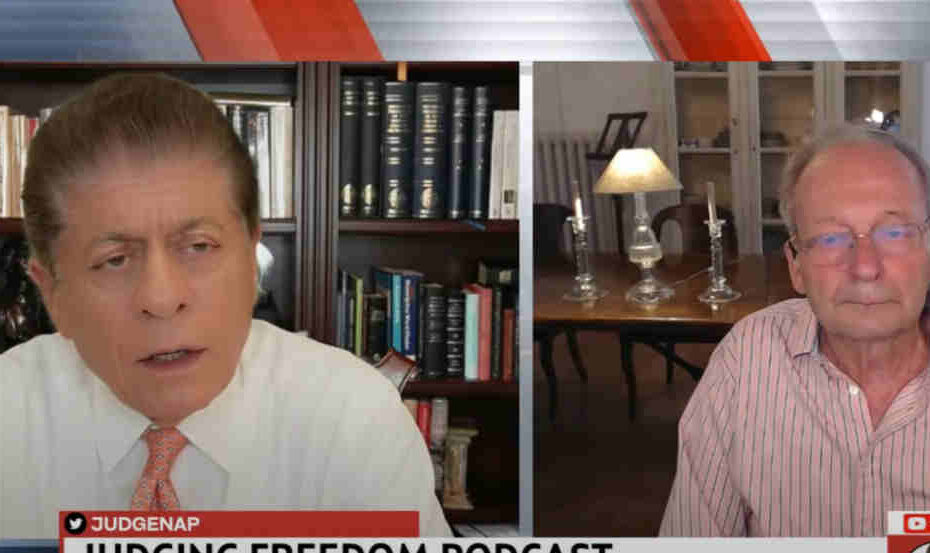
Read the full transcript of former British diplomat Alastair Crooke’s interview on Judging Freedom Podcast with Judge Napolitano on “Why Trump Abandoned His Ceasefire Demands”, August 18, 2025.
Introduction
JUDGE NAPOLITANO: Hi, everyone. Judge Andrew Napolitano here for Judging Freedom. Today is Monday, August 18th, 2025. Alastair Crooke will be here with us in just a moment with his analysis of what happened in Alaska on Friday.
Alastair Crooke, welcome here, my dear friend. Was there a clear winner and clear loser to whatever happened in Alaska on Friday?
The Breakthrough: Mutual Recognition of Narratives
ALASTAIR CROOKE: Oh, very clearly, yes, because always in terms, and I made this point to Senator George Mitchell when he was in Ireland and afterwards in the Middle East. I said, you know, there’s no politics can begin until each side says that it can understand and accept the narrative of the other. Now that’s what’s happened. This is so important that for the first time, Russia’s narrative was being listened to and treated with respect.
But first of all, I mean, this is something we discovered long ago. You can say to the other side, look, I don’t agree with your version of history. I don’t agree with your vision of the future. But now, finally, I accept that what you have is a legitimate perspective of your community, of your people. Only at that point does politics become possible.
When you refuse, when you deny that there is another point of view, when you deny there is another perspective which has validity at least for their people, and that they respect your perspective or accept that you have one – even if neither side agree on a common position – this is the breakthrough. This was the breakthrough in Ireland and elsewhere.
Only then can politics become possible when both sides agree that the other side does have a point of view, and it is one that is valid within its own circumstances. I think that was crucial, absolutely crucial shift that took place because Trump listened and Putin had the ability to put to him another perspective, and he listened to that.
The Symbolic Importance of the Meeting
The other thing that was really crucial was the symbolism. I mean, the extraordinary symbolism. You know, Russia has been isolated, it is a war criminal, all of this stuff, and there it was. How often has Trump actually met a visitor on the tarmac and escorted him from the aircraft to his car? I mean, this is unprecedented.
And quite clearly they met in friendly circumstances. It was clear there was a rapport, that there was an ability to talk to each other, and that’s very important. There was the ability to speak to each other. That was obvious even on the tarmac, that they respected each other and that they could listen. And there was good empathy between the two.
The Real Deal: Putin’s Peace Plan Replaces Kellogg’s Approach
And, of course, the outcome was extremely important. Of course, it’s early days now, hugely important, because what we had was a complete change in the situation. This is really the beginning of something. Not the end of something. This is the beginning of the end of perhaps in due course.
But the deal, what was the deal? Well, everyone’s saying, well, there wasn’t a deal. There was a deal, but it’s not the one that everyone is talking about. The deal was that Kellogg’s frozen conflict ceasefire is out, gone. That’s not there anymore. Instead, what is being talked about and what is in is Putin’s peace plan, the peace plan dealing with the big issues.
And also where there were no talk of tariffs, no talk of security guarantees. Yes, there is all sorts of noise today and yesterday about security guarantees, but that wasn’t said by any Russian in their description of the discussion or the others.
Trump’s Strategic Advantage
So what has Trump got out of it? Well, Trump has got out of this, I think, very clearly an advantage. And the advantage is that Russia is going to force the European Union and Zelensky to peace. He’s going to force it by military means, by the use of military force, that they will ultimately have to come to terms with peace.
So this is a new path ahead. This is important that it is done like this. And I think it’s quite clear that Trump – it’s quite simple in some ways. Trump does not want to escalate with the EU. He doesn’t want to escalate inside, domestically in America. And so he’s content, I think, and this is my speculation, but I think he’s content to let Putin take the EU there to face the military realities of the situation in Ukraine.
And also it’s obvious there really are realities. You probably understood that just before the talks, Russia took out all the Sapsan missile production that was taking place. This was really a German long range Taurus missile, 500-800km range that was being built in Ukraine. So the Germans could say they weren’t giving it directly to them, but that’s been destroyed.
So what military forces has Europe got to apply if the US is pulling out? So this is the deal in a sense – the US exits Ukraine and the EU basically has to put up or shut up. And really it hasn’t got much to put up with. I mean, it hasn’t got the means to do anything really about it.
The Private Understanding
And so in a sense this is, I think the understanding perhaps they reached when they were sitting together in the presidential car, the beast, I think it’s called, when they were alone together. And I think probably Trump said, listen, I want to get out of this, I want to get out of this and you know, maybe you can help us get out of this too.
And we will do our part with the Europeans and we’ll do our part as best we can with the pressures that are on me to try and find a way in which you can bring about a solution through force, military force, to the point at which the EU and Zelensky really don’t have any choice.
And there is a deal and there is a template. People don’t talk about it, but it’s Istanbul plus is the template. Yes, Istanbul includes security guarantees for Ukraine, Russian security guarantees too, for Ukraine with others involved in the original one in 2022. This was the agreement reached in Istanbul in April of 2022. And China was to be another guarantor of this process.
So all of this noise and kerfuffle, I mean, it’s all in the Istanbul agreement. Of course, the first point was to get to the point where both sides understood each had their view. And they may not be at the moment, they may be miles apart, but that is the beginning of politics. Now politics has to follow that. We have to see what happens and where it goes.
Putin’s Perspective on Ukraine
JUDGE NAPOLITANO: So as I read you, and I’m going to play a little clip from the core of what President Putin said in Alaska. You are praising President Trump for his audacity, good audacity to sit down, meet with and listen to the Russians, something that hadn’t happened since the early days of Biden’s presidency and you’re praiseworthy of President Putin for sticking to his guns, so to speak. It does seem as though General Kellogg and the neocons have been thrown aside. But I’ll ask you about that in just a minute. First, however, President Putin in Alaska:
VIDEO CLIP BEGINS:
VLADIMIR PUTIN: The situation in Ukraine has to do with fundamental threats to our security. Moreover, we’ve always considered the Ukrainian nation, and I’ve said it multiple times, a brotherly nation, however strange it may sound in these conditions. We have the same roots and everything that’s happening is a tragedy for us and terrible wound. Therefore, the country is sincerely interested in putting an end to it.
At the same time, we’re convinced that in order to make the settlement lasting and long term, we need to eliminate all the primary routes, the primary causes of that conflict. And we’ve said it multiple times to consider all legitimate concerns of Russia and to reinstate a just balance of security in Europe and in the world on the whole. And I agree with President Trump, as he has said today, that naturally the security of Ukraine should be insured as well. Naturally, we are prepared to work on that.
VIDEO CLIP ENDS:
Putin’s Historical Perspective and Trump’s Education
JUDGE NAPOLITANO: I’m going to guess, just a guess. I’d like to know if you agree with me, that President Putin gave a lecture to the Americans, not unlike the first long answer he gave in his interview with Tucker Carlson where he addressed, and I’m now using President Putin’s own words, the genesis and the causes of the Ukrainian crisis. And that that might have been the first time that Donald Trump heard that version of events. Because he’s not going to get it, and surely didn’t get it from the neocons with which he surrounds himself.
ALASTAIR CROOKE: Absolutely correct. And what was not picked up so much was in that interview with Tucker Carlson was that Putin said, listen, we offered an exit from this conundrum. We offered that in April 2022. We were negotiating that and that was stopped dead. And what we’d have to find now is a suitable exit from this process, one that America can live with, Russia can live with Ukraine, and we have to find an exit, a decent exit from the process.
Why Trump Suddenly Changed Course
So you asked me the question, so why did Trump do this? Why suddenly, after seemingly trying to avoid the Ukraine issue, because it was so difficult and so intractable, does he suddenly dash off or send Witcoff dashing off to Moscow and say, can we have a meeting as soon as possible?
And I think again, Michael Wolff, who has been talking to all his old friends in the White House, he’s the author responsible for a number of books on Trump, said, look, what was going on in the White House in that week leading up to the Witcoff visit was Trump was saying, look, how do we get out? I want to find, deal with this Epstein problem. It just keeps coming back.
I mean, during that week there was a book that was published with a sensation in Britain about Prince Andrew and his sort of predilections, sexual predations and his financial affairs. But it also showed the connection, it repeated the connection between Trump and Epstein which maddened Trump who said, no, I don’t have anything to do with Prince Andrew. Well, there are masses of photographs that he did.
And then we had, of course, Melania does a lawsuit saying that, no, Epstein didn’t introduce me to Trump. So all of this is really irritating. And he wants to try and get out. And so he suddenly decided, look, I’m just going to do it. I pull out, I’m going to do it. I’m going to try and get out. I’m going to do this thing, I’m going to have to do this.
This is what Wolff says, he said to his people, I’m going to have to do Ukraine. The Epstein drumbeat and the other pressures, the pressures from the Senate, the pressures from the neocons, the pressures on the economic front are growing. So I’m going to have to do Ukraine.
And he says, and Michael Wolff says very clearly, look, a pull out, yes, a pull out. It’ll be a give to the MAGA, a diversion from Epstein, something to take them away from this. Doesn’t completely restore his position with MAGA. But if he can produce something to MAGA and what do they want? MAGA wants out from the war. No more money spent on it. They want it finished. So he decided last week, I’m going to have to do this because otherwise I can’t get out from under this endless drumbeat of problems.
Questions About American Security Guarantees
JUDGE NAPOLITANO: Well, unfortunately for him, I think Epstein is going to be front and center after Labor Day when the Republicans in the House attempt to enforce their subpoena to the Justice Department. And the Justice Department will have no choice but to surrender all 250,000 pages of that file.
What do you think is meant by an American assured – not NATO assured – American assured security agreement. What could that be? American troops on the ground? More American military equipment in western Ukraine? I know they haven’t worked that out, but it’s almost inconceivable to me that Trump would want American personnel there.
The Istanbul Plan and Security Guarantees
ALASTAIR CROOKE: It is inconceivable. And as I say, the Istanbul plan from 2022 did provide guarantees, and they provided guarantees, but they were only to come into being. The guarantors would insist on limitations of treaty agreements with other countries or foreign forces on the ground, and in those circumstances would be the guarantee of the security of Ukraine.
I don’t think – I mean, I don’t know and I don’t know what exactly was discussed. I mean, I think much of these details have been left. But I think the main point I’ve been trying to make is, I think in a sense, what Trump is doing as Putin pursues finding an outcome of the conflict militarily, Trump is flooding the information space.
Trump and Witkoff are flooding the information space in order to baffle and also to try and get out from under the other pressures on him – not Witkoff, but the Senate and the proposal to sanction Russia and the Europeans, who are going to come this afternoon and be telling him at great length how he’s got to – that America must give guarantees, must put European forces on as soon as a ceasefire, and they want him to go back.
Because basically, what is all this about? This is about what Brzezinski said back in ’76 and very clear. Russia, with Ukraine in its sphere of influence is a major power in the heartland, in the Asian heartland. Russia without Ukraine in its sphere of influence is just a regional power. And what we want to do is to make sure Ukraine stays outside of Russia’s sphere of influence. And Russia, of course, wants to keep Ukraine, or much of it, inside its sphere of influence, because that does make a difference and make a big part.
The Land Swap Question
JUDGE NAPOLITANO: What do you think that Trump and Witkoff were talking about when they said land swaps? I mean, a swap implies land going both ways. We know what the Russians want. We know the geographical area they control. But what would go the other way? Why do they use the word swap?
ALASTAIR CROOKE: I did mention, I think before in last program, I said there seems to have been that Witkoff misunderstood something that Putin said – that he said that if they started, if there was a withdrawal from the Donbas and the start of the withdrawal from the Donbas, then during that period, we could have a sectoral ceasefire while that was going on in Zaporizhzhia and Kherson.
Of course, there can be no land swap. It’s ridiculous to suggest it. It’s in the Russian constitution. Even if Putin wanted to, he cannot give away land that is constitutionally now part of Russia. He has no ability to do that. So this is nonsense.
And I fear somewhat that Witkoff – I’m sure he’s a very intelligent man, but somehow I think he gets a bit befuddled. I mean, Ukraine is complicated. There’s a long history to it, and he says sometimes things that cause more confusion than help. There is absolutely no evidence whatsoever of any change in Russia’s position at all. It came out of this family on their own position.
Trump’s Radical Shift
JUDGE NAPOLITANO: Trump has changed radically. He’s gone from ceasefire to peace treaty. He now appears to accept the fact, after listening to Putin’s lecture on Friday, that Russia’s claims on Crimea and the four oblasts are either historically and culturally accurate or militarily inevitable. Has Trump thrown the neocons, Senator Graham, under the bus?
ALASTAIR CROOKE: Ostensibly, yes, but then again, it’s Trump, and we have all the European pack arriving or arrived already in Washington to try and undo this. And Trump sometimes veers from one place to another, and it’s possible that under pressure, he will say something else, but I doubt it, because, as I say, it seems deeply his desire to give something to MAGA and what he wants to do, to sort of as a give to them is the end of the Ukraine war.
And it suits him. I mean, this is actually the best outcome for him if Russia actually does it and pursues it and reaches a forced outcome. Because there’ll never be an agreement as things stand. The sides are too far apart. There can be no agreement as things stand. So something has to be forced.
And this is what Putin is taking on his shoulders to do, the forcing of an outcome. But he is doing it in a way in which he understands the diverse pressures that are on Trump and therefore gives him more latitude.
Russia’s Strategic Approach
And so Russia is not responding to all the sort of information flood, this flood of suggestions of what was said in Moscow. He has given one statement to the Russian senior leadership which said, “This is what was agreed, that’s it.” And there were no concessions whatsoever. But he’s not going to go and embarrass Trump or Witkoff by saying, “No, that wasn’t right. What we really said was this or something.”
No, the game of this, the deal of this is both sides now understand the position of the other and see that there is a possibility – it may not work, but a possibility that this could come to a conclusion with Ukraine and one that understands the United States needs, or rather Trump’s particular needs, but also respect.
And that’s why I think already we started to hear them talking about the big picture, which I’ve always said would be where Putin would be going to talk about nuclear issues, treaty and the Arctic. And he did. And on the eve before Trump went off, he issued an executive order that defining Exxon’s earlier interest in a particular field in the Arctic.
The Bigger Strategic Perspective
So I think both of them see a bigger perspective. And the important thing to remember is what’s the next meeting coming up or maybe coming up? Well, which it is at the beginning of September is the 80th anniversary of the Japanese surrender and they are celebrating that in Beijing. And Putin is going. Xi obviously is going. And it’s suggested that Trump will be invited.
This is Trump’s – this is the perspective that Putin and Xi are deliberately holding out to Trump. We can sit with you and we can find a strategic perspective, not just about Ukraine. We can move beyond it and you can suggest this is a great victory and it will be a victory in a certain way.
JUDGE NAPOLITANO: Alastair Crooke, thank you, my dear friend. A terrific and brilliant analysis. Deeply appreciated as always. And of course, we’ll look forward to seeing you again next week.
ALASTAIR CROOKE: Thank you very much. Thank you.
JUDGE NAPOLITANO: A busy day coming up at 10 this morning on all of this. Ray McGovern at 11:30 this morning on all of this. Larry Johnson at 2 o’clock this afternoon on all of this. Colonel Douglas McGregor at 3 o’clock this afternoon. While the world has been watching Alaska, what’s still happening in the Middle East with Aaron Mate, Judge Napolitano for Judging Freedom.
Related Posts