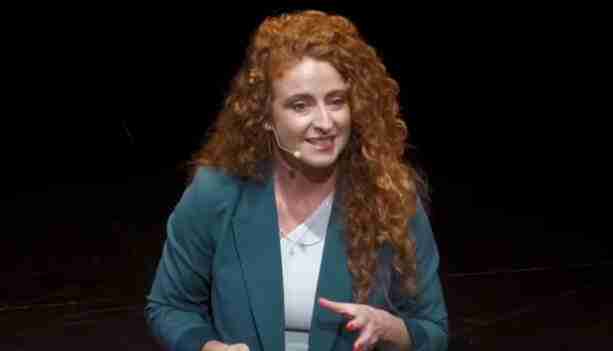
Read the full transcript of Margaux Miller’s talk titled “Why You’re Bad At Online Networking” at TEDxWinnipeg 2024 conference.
Listen to the audio version here:
TRANSCRIPT:
The Evolution of Networking
Alright, I want to see a show of hands. How many of you have ever deleted an email or a social media request because it was written like pure spam? Yeah, or maybe you deleted it because they got your name wrong, or they used an awful cliche like “we share mutual interests,” but never took the time to tell you what those were?
I remember a long time ago, I sent an email to a business acquaintance of mine. I was hoping to draw them into my network and maybe get some feedback. And so I work hard on it and I send it off. And to my surprise, instead of emailing me back, they sent me a text message. Awesome! It worked. Turns out it was not so awesome. The text message was to ask me why I sent them a mass message instead of a personal one. Needless to say, I was embarrassed, but at least I got that second chance via text message.
The Changing Landscape of Networking
Things have evolved a lot since then. And I’ll start by telling you this: today’s version of networking has changed. We once had classes on etiquette. And then my parents’ generation and probably many of you got literal instructions on how to shake hands and make eye contact. And then the internet blew up. And now there is no instruction at all. The skills that once served us well in conference rooms and at networking events are no longer enough. Now our network spans the globe.
Today we have over 5 billion internet and social media users, respectively, around the world. Most of us accessing our digital identities through the device that you either have in your hand right now or close enough. But this is great. Because what this means is that we can reach almost anyone, anywhere, instantly.
And yet, despite these digital advancements, over 60% of people still prefer in-person networking. So take a look down the row beside you. This means that well more than half the people there are likely not fully skilled or comfortable when it comes to maximizing their online community and connections.
The Importance of Modern Networking
And now I won’t make you raise your hand for this next one, but is it possible you might still change jobs one day? If so, you should know that the vast majority of job placements are now happening through networking. They’re happening through personal and professional connections.
And so what do we do with this? Well, first, this is not a talk about you becoming an influencer. Meaningful online connection is not about how many followers you have or what you look like. Yet, ignoring the power of connecting online, that’s not just outdated, it’s a significant missed opportunity. And what we need is a new playbook.
Now making up for my bad email days, I have since made a career out of connecting people online around the world. And drawing from a wealth of global interactions, I’ve distilled for you six ways to make better connections online, beginning right now.
Tip #1: Connect, Don’t Collect
We’re in an era where scrolling can feel like connecting. And where we often overlook the fact that building a helpful community for ourselves is not a numbers game. Rather, it’s based on the quality and the depth of our relationships. Think of the common Pareto principle, where 20% of our connections yield 80% of the results.
And for this to work, we have to know why we’re reaching out, have a goal, and do your homework. A strong first impression comes from stronger preparation. Take this message from Tali, for example. She was looking for a remote job in community building and identified me as someone who could help her. But rather than jump right in, Tali did her research on what mattered to me, and then she tailored her outreach authentically. This worked, and I ended up getting on a call with her.
What also can work is sharing what you liked about a recent presentation they gave, or an article they wrote, as a way of showing genuine interest. And you can use AI and large language models as a way of doing efficient research for you. Just remember, it’s a tool for personalization, not a silver bullet.
Tip #2: Don’t Make It About You
Dale Carnegie famously said, “You can make more friends in two months by being interested in other people than you can in two years by trying to get other people interested in you.” Think about that for a minute. When you receive a message, you want to feel like you’re the ideal recipient for that message, not just one of many. So include a clear purpose, a call to action, and if you can, make that person feel special.
Tali also did this very well in the second part of her message to me. She asked for a call about my career journey. This was great for two reasons. First, she asked clearly for what she wanted, the call. And second, she made it about my experience, which makes it real easy to say yes, because I don’t need to prepare to talk about myself.
I hear complaints from friends all the time that get messages with no purpose. The message literally just says, “hello,” or “I would like to connect,” full stop. That’s the whole message. Because the sender is thinking, well, I’ll get to the real point once they respond. Don’t do this. With no compelling reason for that person to reply, it’s likely you won’t get that second chance.
Tip #3: Become a Familiar Face
A few years ago, I discovered a woman online named Anna.