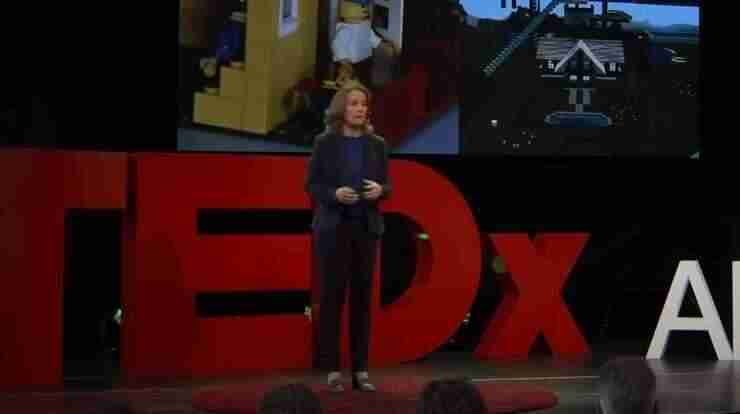
Read the full transcript of Deborah Nas’ talk titled “Will Technology Shape Our Future Or Will We” at TEDxAlkmaar 2023 conference.
Listen to the audio version here:
TRANSCRIPT:
The Influence of Technology on Our Future
DEBORAH NAS: Will technology shape our future or will we? I think Marshall McLuhan’s insight from the 1960s is still relevant today. We shape our tools and then our tools shape us. Radio and TV broadened our worldview, mobile devices and the Internet changed when, where, and how we work, cars expanded our habitat, and planes made us global travelers. Technology creates many new possibilities, but unfortunately, it is also destructive.
Transportation pollutes our air, electronic devices create huge amounts of electronic waste, and digital technologies gave rise to big tech companies and sophisticated surveillance systems. It won’t be long before we have to deal with the consequences of transformational technologies like AI and quantum. We often feel that technology just happens to us, that we have no control over it. But technology doesn’t create itself; it’s humans that create technology. More specifically, it’s a small group of people that take the lead.
The Technology Optimist’s Dilemma
They are the technology optimists, and I’m one of them—or at least I used to be one of them. I think I am a technology optimist having an identity crisis. I first thought differently about technology a few years after having kids. Meet my sons, Ramsey and Jordan. Especially Jordan is this boy with an exceptional talent for anything digital.
As a baby, he became physically wild when he saw my iPhone. At the age of two, he knew how to switch WiFi networks if he had a slow connection. At the age of three, he knew what he wanted to become in life: a YouTube star. If you have kids, you might recognize the situation. You’re first going to take your picture with mommy, and then you’ll get your ice cream, but in any other situation, it looked like this.
I was like a mobile electronics store carrying iPads, game consoles, batteries, extra headsets—you name it, and I had it with me. Although I facilitated this as a mom, I was deeply worried at the same time. What does it do to his eyes? Will he need glasses soon? How about his brain? Are some of the games maybe too violent? Does he have enough friends? How are his social skills developing?
As a mother, I want to limit his screen time and force him to play outside as I did as a little kid, but I also have another role in life. In my professional life, I’m a part-time professor at the Delft University of Technology, and I work with companies to speed up technological innovation.
The Professional Perspective
Looking at Jordan as an innovation professional, I have a very different perspective. I see his affinity and his talent for digital technologies, and I feel I should nurture this talent and facilitate him to become whoever he wants to be. This put me in a very interesting position because, as a professional, I observed my feelings as a mother with interest and wondered: What am I afraid of?
Historical Fears of Technology
It’s really good research, and I found that there is a historical consistency to how people have worried and how they express these worries about technological innovation. Basically, humans have feared technology since writing was the latest thing.
Greek philosophers argued that writing would be bad for our brains. If we would write everything down, we don’t have to remember things. It would instill forgetfulness in our minds and make our knowledge superficial. Fast forward to the printing press, when the upper class feared that books would spread rebellious and irreligious thoughts amongst the common people; they feared they would lose control over what was being printed. Newspapers would hurt the social fabric of society because, until then, people physically came together to learn about the news and talk about it.
But with the newspaper, people would be in their home by themselves reading about the news. Cinemas would demoralize society. The TV generation would never learn how to read or write well, and when the Internet arrived, we saw the most bizarre headlines. The Internet was bad for everything. One of the things being it would make our knowledge more superficial.
This time because you would jump from article to article without an interest in reading longer pieces. These are just a few examples, but we see similar arguments recurring over and over again. Loss of cognitive and physical abilities, loss of social skill, loss of morale, and loss of control being the most prominent ones. When we envision societal change through technology, we tend to frame it in terms of loss.
The Lego vs. Minecraft Debate
Let’s look at an example. If you enjoyed playing with Lego as a kid, chances are you’d rather see your children or grandchildren play with Lego over a digital game like Minecraft. Most people immediately point out what you lose when you move to the digital world: fine motor skills and 3D insights. Kids gain another type of fine motor skills and 3D insight in the digital world, but if you’re not familiar with those yourself, you tend to judge them as less valuable. You maybe even never mastered or tried Minecraft. Essentially, it’s a digital Lego.
You can mine all sorts of materials and then craft any object you like, and because it’s a digital world, possibilities are endless. If you make a rational comparison between the two, Minecraft comes out really well. Nevertheless, we stick to our preference for Lego because we tend to choose what we understand, value, and are familiar with. If you didn’t grow up with digital games, you’re often prejudiced. It’s bad for your eyes, it’s bad for your brain, and worst of all, you can get addicted, and that will put you in social isolation.
The Book vs. Video Game Thought Experiment
Steven Johnson came up with a brilliant thought experiment saying, “What if books were invented after video games?” So try to imagine for a moment there are no books, no newspapers, no magazines; you do not read, but you do play video games all of the time, and everybody around you does it—it’s a normal thing to do.