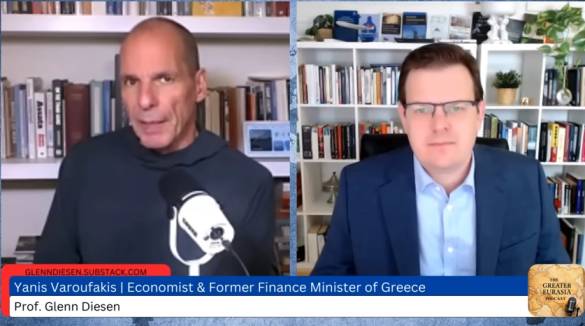
Editor’s Notes: Economist and former Greek Finance Minister Yanis Varoufakis joins Glenn Diesen to argue that Donald Trump’s new “Board of Peace” marks a historic turning point for the global order. He explains why UN Security Council Resolution 2803, which approved the Board with Trump as its unelected, unaccountable chair, effectively signals the self-abolition of the United Nations and the erasure of Palestinian rights from international law. Varoufakis situates this move in a longer history of colonial corporate power, from the East India Companies to today’s big tech and “cloud capital,” and warns that corporations are again displacing states as primary imperial actors. The conversation also dissects how U.S. hegemony, the “rules-based international order,” and Western centrists have paved the way for this privatized empire—and what it means for conflicts from Gaza to Ukraine and beyond. (January 25, 2026)
TRANSCRIPT:
The End of the United Nations
GLENN DIESEN: Welcome back. We are very privileged to be joined today by Yanis Varoufakis, the former Finance Minister of Greece, professor, and also the founder of DiEM25, that is Democracy in Europe Movement. So thank you for coming on. I have been looking forward to speaking with you regarding Trump’s new Peace Board, which many people interpret as an effort to push aside and replace the United Nations and international law itself.
You have referred to Trump’s Peace Board as an abomination. Now, I was wondering, why do you see this being so dangerous?
YANIS VAROUFAKIS: I don’t just see it as being dangerous. I think that historians of the future will remember November 17, 2025, when Resolution 2803 of the Security Council approved the Board of Peace and Donald Trump as its owner and chair. That approval by the Security Council, I do believe, is going to go down in history as the end of the United Nations.
Essentially, the United Nations abolished itself through that resolution. Now, at the time, you will recall that only two countries abstained in the Security Council. It was China and Russia. I have to say that I was mad that they did, but then again, when I heard their arguments, I thought, unfortunately, they may have a point.
But the reason why I’m saying that it abolishes the United Nations, Glenn, is because, you know, come to think of it, essentially what it does is it is a recognition of the end of history—not in Francis Fukuyama’s terms, but in terms of the end of history regarding the Israeli-Palestinian conflict.
You will recall, and I’m sure our audience knows this very well, that the United Nations Security Council has been making every few months, every year, all the time, some efforts to keep on the rails the peace process, or whatever is left of the peace process between the two sides, the Israeli side and the Palestinian side.
And the United Nations has this tactic, or let’s say it’s an institutional memory, not tactic, institutional memory, whereby, you know, every resolution follows the previous resolutions. So, you know, if you follow the history of the engagement of the United Nations with the issue of Palestine, you’ll find that there is a continuity. It begins with the recognition of two parallel states, Israel and a Palestinian state. One of them was inaugurated, the other one never was.
Erasing Palestinian Rights from International Law
And then it moves on to resolutions after every battle was fought, every defeat of the Palestinian people. What the November 17 resolution accepting the Board of Peace as the next step in this process, what it does, it annuls this whole history.
Essentially, it was a remarkable success by Donald Trump to step in and salvage the bacon of Benjamin Netanyahu, because you will recall that before that resolution, before the ceasefire, the so-called ceasefire—because there is no ceasefire. I mean, Palestinians are being killed and starved to death on a daily basis as we speak.
What that so-called ceasefire and the resolution by the Security Council did was essentially to save Netanyahu from a major propaganda defeat. You will remember that four major countries, middle powers—Canada, Australia, Britain and France—recognized the state of Palestine. It was a very hypocritical recognition because they never, if they really wanted to do something about bringing about the Palestinian state, which they recognized so hypocritically, they would have stopped arming Israel, they would have embargoed Israel, they would have done all the things that the BDS movement says they should be doing.
That they never did that. But nevertheless, it was still a major defeat for Netanyahu. Trump steps in, imposes that ceasefire, brings about the notion of a Board of Peace which will be totally outside international law, totally outside the history of the Palestinian occupied lands as occupied lands, and effectively resets the clock as if we are going back to 1945 or 1948 or maybe even before that.
That saved Netanyahu because, you know, let’s face it, the International Court of Justice in June of 2024 had clearly stipulated that Israel was in breach of international law, ordered Israel to withdraw from East Jerusalem, the West Bank and Gaza. You had international condemnation of the genocide. You have International Criminal Court indicting Netanyahu and his former defense minister as war criminals.
And with that resolution, the United Nations Security Council effectively annulled all of this, and we go back to a situation then—and this is the point, the main point I want to make—whereby Gaza doesn’t belong to the Palestinians anymore. There are no Palestinians in the resolution. They don’t exist. As if it is terra nullius, an empty land.
And I’m mentioning that term very poignantly because terra nullius was the legalistic term that European colonial powers used back in, you know, a century ago or more than two centuries ago, in order to justify colonizing various lands around the world, from Australia, New Zealand, Kenya, South Africa and so on. The first thing that the European colonizers did was to say that land has no people and no history, no owners.
It’s outside international law. It’s like, you know, going to an asteroid between Jupiter and, I don’t know, some other planets.
And, you know, the fact that the United Nations recognized that and recognized that there is going to be a corporation, a corporation, a private company that is going to have, as a lifelong chairman, a man—not a president, not a representative of the people, but a man called Donald J. Trump—and that he has no obligation whatsoever. He’s not answerable to the board, he’s not answering the United Nations, he’s not answerable even to the Congress of the United States of America. And he simply has to give a report every six months to the United Nations if he wants to. It’s not even a report that has to be approved of or anything like that.
So essentially, the United Nations annulled itself when it approved of that resolution on November 17, 2025. And I have to—this is how I’m going to complete my long answer. Apologies for taking so long, but I’m livid about all this.
Why did the French and the British, who had supposedly recognized the state of Palestine, including Gaza, only a few weeks before, why did they accept that? Well, they accepted that because for them, this was something that concerned brown people in the Middle East. It didn’t concern them.
Now they know better. They know that the Board of Peace is not just about Palestine, it’s not about Gaza. And now the Board of Peace is about everything. And, you know, you have all these Bond villains that Trump has amassed, has surrounded himself with, and he’s talking about Greenland tomorrow, he’s going to talk about Canada.
And, you know, now the chickens are coming home to roost, metaphorically speaking. And you have people like, you know, Mark Carney, the Liberal premier of Canada, prime minister of Canada, coming out with a very interesting speech in Davos recently saying, “Oh, my goodness, you know, this is the end of the world as we knew it.”
Well, you idiots, you brought this about by approving a United Nations resolution which effectively annulled the United Nations and annulled international law and annulled your right to exist.
Ethnic Cleansing and the Privatization of International Law
GLENN DIESEN: Well, I remember when Trump first proposed to ethnically cleanse the entire population of Gaza, have the United States take over the region and create this Riviera of the Middle East. To be honest, at the time, I interpreted it as an effort to shake up the status quo and create some room for maneuver, but I thought it was going to be a bit limited as well.
But this, as you said, this is something a lot bigger. This is again, and I think I didn’t take it literally, I thought, because what he says and what he does is two very different things. But I think, yeah, we opened up Pandora’s box with this one.
But another aspect of this whole thing is the whole what you already alluded to, which is that this is a private corporation and even the members have to pay in a billion dollars. How do you make sense of this privatization of international law, merging all this commercial interest with coercion and essentially law? Because this is—well, it’s not unprecedented, but it is. Well, where is this going?
YANIS VAROUFAKIS: You know what surprises me, Glenn, what surprises me is that people are surprised because, you know, I have always followed a very simple strategy, a very simple method of thinking. I take seriously what villains say.
So, you know, Donald Trump, maybe he’s not the most cogent and eloquent of theorists in the history of the universe, but he’s got people around him who are. If you ever listen to Peter Thiel speak to various tech lords that he has amassed around him, they have a very clear view of the future. Their future is the replacement of the state by corporations.
They talk about free cities, and they don’t mean it in terms of freedom of the citizens. They mean it in terms of cities that belong to corporations, where the board, the members of the board of the corporation are free to do whatever they want with the city. They went to Honduras and they carved out a chunk of Honduras and they turned it into a corporate mini-state. And this is what they want to do. They want to convert our cities, they want to convert our states, they want to convert Gaza, Greenland. Tomorrow it will be Canada, maybe. My country, well, my country has already been taken over by corporations after 2015.
It’s totally consistent with their own very specifically and clearly stated political philosophy. So, you know, as I said, I’m only surprised that people are surprised.
The Return of Corporate Colonialism
And you did allude to the fact that this is not unprecedented. Now, if you look at the history of colonialism, it does not begin with states, it begins with corporations. It was the Dutch East India Company and the British East India Company that conquered Asia and similar corporations conquered Africa.
People said, and you mentioned that, “Oh my God, he’s asking people to chip in a billion dollars in order to be, you know, legitimate members of the Board of Peace.” Well, isn’t that how the East India Company was created? Businessmen got together in a kind of thatched-roofed building in London at some point in 1599, if my memory serves me right. And they all chipped in. They became shareholders, and not only shareholders, but the shares were tradable as well.
And off they went. And they occupied, took over India and then they took over Indonesia and then they took over parts of Southeast Asia. At some point, the East India Company had 200,000 soldiers under its command. It was only later that this was nationalized when it was facing financial difficulties. It was a state bailout or a crown bailout. And that’s how the British Empire, you know, begun.
So this is what he wants. That’s what Peter Thiel, that’s the various thinkers and technocrats and tech lords around him. That’s how they imagine the world. Now, that is not surprising at all.
I tell you what is surprising. Maybe not that surprising, but more surprising it is that the rest of the world went along with it. The British went along with it. The French went along with it. Every single Arab country went along with it. Turkey, that supported Hamas to a very large extent, went along with it. Qatar, which had Hamas leaders on its soil, went along with that.
You had, you know, countries like Egypt and Algeria waxing lyrical about Donald Trump, calling him a man of peace, right? And of course, you had the Europeans who thought, “Well, why do we care?” As I said before, this is about Palestinians. It’s not about Palestinians. It’s about you folks as well.
So the only silver lining I see in this disaster for the world and for humanity is that the centrists who, you know, just like, think about it a bit like the Weimar Republic, Hindenburg handed over the chancellorship of Germany to Hitler, thinking he can control him. And look what happened to those liberals who were more afraid of the left than they were of the Nazis. In the end, they ended up in the same prison camp. So it’s only a tiny silver lining. The catastrophe is still with us.
The Monster We’re Feeding
GLENN DIESEN: I think that’s a great point that, well, eventually it will come for you as well. And I think it was obvious in a message that Macron sent to Trump, which he then published, this private message on his Truth Social, which was Macron apparently wrote him, saying that, “Listen, we are fully with you, you’re doing great things in Syria and Iran, we are completely with you, but just leave Greenland alone.”
This assumption, if we just cheer him on, back him in what he might be doing to other parts of the world, perhaps he will leave us alone. But I think we’re just feeding and building up this monster, which, as you said, it’s going to be out of our control.
But what does this mean for—I mean, I was going to ask how you expect Wall Street and the military-industrial complex and Big Tech to react to such a thing, if they would support it. But overall, there’s a tendency in capitalism to have this concentration of wealth to the point when a democracy can no longer work.
I mean, this is not just opponents of liberal democracy, sorry, of capitalism, which suggest. But even liberal capitalists, be it classical capitalists, that is like David Ricardo, made this note in his work that with every new technological innovation, they would concentrate more power in capital as opposed to labor, and that would skew the whole relationship. Do you see it in this context that now we’re going to have corporations beginning to displace entire nations?
The Corporate Takeover of Empire
YANIS VAROUFAKIS: Well, as I said before, corporations began the process of imperialism and, you know, militarism, corporatism and imperialism went hand in hand. At some point when corporations, just like when Wall Street went belly up in 2008, they were essentially nationalized, essentially bailed out. Their losses were passed on to the state. This is exactly what happened decades ago.
And now that they are back on their feet, they are taking over the states again. So you asked me what would the response of the military industrial complex be of big tech and Wall Street? Well, let me take these one at a time.
The ones who are loving it are big tech because, you know, I’ve written a book a couple of years ago called Technofeudalism in which I argue that a new form of capital has emerged. Living in a phone, it’s called cloud capital. It’s not producing anything except the power directly to control our minds and through that, to amass particular forms of rents in their pockets of big tech.
And this cloud capital over the last few years, especially after the war in Ukraine and the genocide in Gaza, this cloud capital is merging with the military industrial complex because we have autonomous AI drones, we have software by Palantir that is running on the servers of Amazon Web Services and of Google and of Microsoft. And these pieces of software are being trained in Gaza, they are being trained in Ukraine.
And then, you know, the result of this training leads to pieces of software that then are sold to the National Health Service in Britain, for instance. So you have the privatization of the National Health Service by American cloud capital trained in the killing fields of Gaza. So as I said, big tech is loving it.
And this is why people like, you know, Jeff Bezos, like Mark Zuckerberg, even Elon Musk, who disliked, despised Donald Trump, have surrounded him and they are, you know, treating him. They’re looking at him as their great benefactor.
And just another dimension, which explains the great enthusiasm of big tech for Donald Trump, you know, with the Genius Act last April that he passed through the Senate and through the House of Representatives, essentially he’s legitimizing the privatization of the dollar through big tech, through companies like Tether. And now, you know, you’re going to have Google and Apple and others, you know, issuing their own stablecoins.
These are not like—they are cryptocurrencies, but they’re nothing like, let’s say, Bitcoin, which is a bit anarchic. No, these are US dollar denominated cryptocurrencies. And that is going essentially, we’re going back to the 19th century when private banks had a capacity to mint dollars, a capacity that was at some point taken over and monopolized by the Fed. And the Fed has had its wings clipped.
So big tech loves all that. It loves the Board of Peace. It loves what’s happening in Palestine. It loves what’s happening with stablecoins and the privatization of the dollar.
The military industrial complex is a little bit more worried. I mean, they like war, they like, you know, these interventions. They like the fact that they’re selling huge quantities of weapons to Ukraine with European money, more recently that Israel is eating up their, you know, 10,000, 20,000 pound bombs like confetti. They love that.
They’re a little bit worried that companies like Palantir, the big tech companies, the techno-feudal war machines as I call them, they are, you know, sort of competing with them. They’re a little bit worried about that.
But I think that the one of the three conglomerates that you mentioned in your question, that is Wall Street, I think they’re the ones who are the most worried by Donald Trump. And they’re worried because, as I said with the Genius Act, he is effectively eating into their financial rents on behalf of big tech companies, of Tether, of stablecoins and so on.
They will try to join them. JP Morgan, for instance, is about to issue its own stablecoin, but they are worried. So when you see that Donald Trump is fighting over who’s going to control the Fed, he’s trying to clip the wings of the chairman of the Fed and also of the powers of the Fed through legislation like the Genius Act. This is because the Fed belongs to the large banks, the Wall Street banks, and they don’t want to have to compete with Silicon Valley, with the West Coast.
So, but nevertheless, it’s clear to me that so far, at least so far, Donald Trump manages to dominate those three: Wall Street, big tech and the military industrial complex. And they’re on board with what he’s doing, the Board of Peace and the dissolution essentially of the United Nations, turning the United Nations effectively into what the League of Nations was, an empty shell.
The Fraud of the Rules-Based International Order
GLENN DIESEN: This whole dissolution of the United Nations—it seems this started more than, well, at least 30 years ago. It seems that, as you mentioned before, the Prime Minister of Canada, he made his comments at Davos and I thought this was interesting because he more or less called the so-called “rules-based international order” a fraud.
And I agree with this sentiment because I think at least if you go back to Kosovo, this is when we started saying, well, it wasn’t legal but it was legitimate. And the assumption was that the legitimacy rested on liberal democratic or humanitarian justification.
So in other words, what we said was international law is supreme. However, because we’re champions of liberal democracy, we’re allowed to refer to human rights, to democracy, to give ourselves the right to be exempted—not the Chinese or Russians or others. But it’s kind of the sole prerogative of the political West. So it became a hegemonic order to some extent.
What I thought was interesting with the Canadian Prime Minister, he kind of recognized that, yeah, this is, you know, there was very selective and again the common denominator was not the human rights but the power of the political West. So he seems to see that which shouldn’t just take a look at what Trump’s doing now, but in the wider context.
Meanwhile, the Europeans, they really bend the knee to Trump here and they seem to bow and do as they’re told. Indeed, if you only look at 2025, what they backed in Gaza, attacks on Iran, they didn’t mention the US bombing of Nigeria, but also participating in Yemen, of course, installing this horrible government in Syria.
So it doesn’t seem like they want to go back to international law in this, but rather return to this “rules-based international order” where the political West is the entity that exempts itself from law. That is, the Europeans just want to be inside of this hegemonic construct. It doesn’t want to be on the outside. Is this what differentiates the Europeans from the Canadians now?
YANIS VAROUFAKIS: No, I don’t think so. I think, look, Mark Carney’s speech was very interesting and very well scripted and well delivered. And as you said, he did say things that no liberal centrist has said so far. But in the end I don’t see much of a difference between him, between Canada and Britain or France. The hypocrisy is oozing out of every pore of their bodies, including Mark Carney.
It’s, you know, for another purpose, nothing to do with this discussion between you and I. Just before we connected, I was making notes, reading very carefully for the second time Mark Carney’s speech and I was making some notes. If I may read something that I wrote here, you know, he says that, yeah, as you said, he says that, you know, the rules in the “international rules-based order” was fake or quasi-fake or partial fake. So that’s a big thing.
By the way, the BBC, Deutsche Welle, never, never reported that part of the speech by Mark Carney. Okay, just put an asterisk there.
But then he goes on and says, at least he said, you know, American hegemony helped provide public goods and that’s why it was tolerated by Canada, by Europe and so on. And then he explains what these public goods were. He says, “Open sea lanes.” Really? Ask the Cubans, did they ever have open sea lanes?
Then he says, “A stable financial system.” What, has he forgotten 2008? Has he forgotten the weapons of mass financial destruction, which were not an aberration? They were part and parcel of this international based—whatever “rules-based order.” The whole, you know, the Washington Consensus was built on financialization.
So to say that, you know, the Americans were providing us with public goods, including a stable financial system—the only thing that the financial system before 2008 or 2015, 2016, when Trump came along, the only thing it was not was stable. It was a totally unstable disequilibrium.
And then he goes on to say “collective security.” Really? Has he ever spoken to Iraqis or Afghanis, you know, millions dead? What about Libyans? They wrecked that country. Okay, there was a tyrant there, Mr. Gaddafi. And what happened after the “international rules-based order” bombed Libya? They just destroyed the place. There’s no country as Libya anymore.
And also “in support of a framework for resolving disputes.” Really? What happened to Palestine during the “international rules-based order”? What kind of disputes were resolved there? The genocide, the ethnic cleansing, the apartheid state, you know, was effectively erected upon this “international rules-based order.”
So, you know, even Mark Carney’s great speech is riddled with hypocrisy. And what is he proposing to do? He wants to have a new alliance between middle powers with Germany and with France and with Britain. Well, if you really want to do that, begin with a peace process for Ukraine. Where’s your peace process for Ukraine? An alternative and, you know, a replacement of what Trump and Putin are doing. Nothing.
The only, you know, idea that they have about Ukraine is that they should find more weapons for Ukraine to continue killing Ukrainians and Russians in this reproduction of the First World War with drones that kill thousands of people without any resolution in sight.
What about Mr. Carney’s proposal about Palestine? What is he proposing about Palestine? Nothing. You know, he’s going to recoil. He gave a great speech. He will be remembered for a great speech that described the situation reasonably well and had absolutely nothing to offer in terms of what to do about it.
Because let’s face it, you know, you heard what Trump said today, that if Canada ratifies the agreement, the Free Trade Agreement or the trade agreement with China, he’s going to slap 100% tariffs on them. Now, what happens to the auto workers in Canada who will lose their jobs because, you know, they are producing cars and parts, spare parts for American companies? Does he have a plan for that? Is he going to invest in, you know, is he going to bring BYD in to take over from Ford and General Motors? No, he’s got no such plan.
The Desperation of Declining Hegemony
GLENN DIESEN: Yeah, that’s a good point because of course it’s a good speech. But the honesty and principles which he suddenly comes to champion, one has to ask why right now? And you know, like the day before Trump went out and put a post on Truth Social, which he had fixed with AI, a map of North America which is also colored in Canada in the American flag, so in front of the European audience. So he knows that after Greenland, the US might come for Canada. So it seems that this is suddenly why the principles come into play.
But it is, it is still extraordinary that there’s not more pushback against this, though. Just as a final question, do you see this more in the larger context of the US having to find a new approach to dominance?
Because after World War II, the US had many benefits. It was a technological leader. Through the war, it had built up this industrial power. It had begun to control all the international sea lanes. It asserted control over a lot of the natural resources from Saudi Arabia, other places. It had a key role in the financial institutions, the World Bank, the IMF. And of course the world then signed up to the dollar as the world’s reserve currency. So it was the economic hegemon.
So in those regards, a liberal economic system is a good thing when you’re the hegemon, much like Britain in the 19th century, because it means you integrate the world under your administration.
But what we see now is the desperation of the US—all these wars, the economic wars. Is this rooted in the inability to compete with China? And overall the US exhausting itself, as you see, with their debt, essentially a desperate effort to reshuffle the deck, develop a new system, just anything which would put the US back on the throne.
The End of American Hegemony and the Nixon Shock
YANIS VAROUFAKIS: I have a slightly different perspective on this. What he described as the post-war American hegemony ended in 1971. It was exactly as you described it up until 1971, during the Bretton Woods era. Here you had in the 1950s and 60s, you had hegemon. It was a surplus country. It was technologically advanced, it was a net exporter. And the whole point of Bretton Woods was to retain the surplus position of the United States.
Now, by the end of the 1960s, it lost that position for a number of reasons which we don’t need to get into now, including the Vietnam War, the Great Society, the fact that it was American capital that invested heavily into German and Japanese industry. And the result was the German Japanese industry became more efficient than the American ones.
And at some point, especially with the Vietnam War, you know, in the end, the Bretton Woods system was no longer sustainable because it was based on the idea that America would be a surplus country. It would be dollarizing Britain, Europe and Japan, so as to allow Europe, Britain and Japan to keep buying the net exports of the United States. But once the net exports went, that system went. And of course, the Americans themselves blew it up.
The Reversal of the Recycling Scheme
And then they replaced it with a very different system, not the one that you described, the system which is based on the reversal of the recycling scheme that was Bretton Woods. Instead of America being the surplus country, recycling surpluses, its surpluses into Europe and Asia and Japan in particular, and later China, what happened was now it had a deficit, and it used the deficit to create aggregate demand in Europe and in Japan and later in China, sending IOUs, dollars to them, which then were repatriated to New York, and they became three things.
Government bonds, in other words, funding the American federal government, secondly, some shares that were allowed to buy the foreigners. And thirdly, primarily real estate, which is what made Donald Trump, Donald Trump.
So, you know, this attempt to maintain the hegemony after they had fallen behind, after they had become a deficit country, that was Nixon. And Nixon had no problem waging an economic war against his allies. So, you know, Trump is not the first president to wage an economic war.
When John Connolly, the Treasury secretary of Richard Nixon, after the blowing up of the Bretton Woods system by Richard Nixon on 15 August 1971, he went to Europe and he said to Europeans, you know, you’re stuffed. I’m here to obey you. “The dollar is my currency and your problem.” And the Europeans went into a tailspin.
And, you know, they tried to create their own Bretton Woods, their own fixed exchange rate system. So they went through various configurations of a fixed exchange rate regime, and they were failing with a Snake within the European Monetary system with the European Exchange Rate Mechanism. In the end, they created the euro. There was a disaster for, you know, for investment in Europe, for integration and so on.
Reagan and the Plaza Accords
And similarly, remember what Ronald Reagan did in 1985 to the Japanese, you know, the Plaza Accords? He put a gun on their head and said, I’m going to put 200% tariffs on you unless you revalue it again. And they did. And the result is that the Japanese miracle died there and then.
So this is not new. What is new? The fundamental difference between the Nixon shock and the Trump shock is China. Because when Nixon was shocking his allies the way that I just described, there was no competing economic system. There was a Soviet Union, but already it was in decline from, you know, the late 60s, early 70s. It was abundantly clear that the Soviet economic system did not have the capacity to compete in terms of technological advancement, in terms of exports, in terms of all the things that matter in financial markets and in markets more generally.
The China Factor
But Trump is trying to create a new Nixon shock in the context of a China which is advancing exponentially, which is already twice, three times the size of American industry in terms of even big tech. Half of the AI experts now in the world are Chinese. They are not Brits or Germans and so on. They are Chinese. In terms of green energy, already we see the reduction in reliance on fossil fuels and massive expansion in green energy, which European, and particularly Trump’s America, is turning its back to.
So he’s trying to extend American hegemony by means of privatizing the dollar through the genius act, as I was saying before, and through essentially blowing up the European Union, blowing up Canada, blowing up his allies, because he’s a realist. He tried to bamboozle the Chinese. He failed. The Chinese won the trade war against him. He’s already effectively succumbed to that.
In April, you will see that there will be a meeting between Trump and Xi, and they will extend the truce. And I think they will keep extending it because the United States needs China more than China needs the United States in terms of rare earths, in terms of a number of critical materials for American industry and for the American military industrial complex.
Trump’s Strategy: Divide and Extract
And what he’s doing is he says, okay, well, I’m not going to extract maximum rents from my allies. I’m going to coexist with the Chinese. But, you know, I don’t want to have to deal with the European Union as a whole, so I’m going to undermine the European Union. I want to deal with the Germans, I want to deal with the French, I want to deal with the Italians, I want to deal with the Canadians. So I’m going to put the cat amongst the pigeons.
You know, when the Europeans complained that, oh, my God, you know, by threatening to take over Greenland, you are blowing up NATO and the EU? Well, exactly. That’s what he wants. He wants to be—
GLENN DIESEN: Yeah.
YANIS VAROUFAKIS: He sees the Western Hemisphere as a bicycle wheel where he’s the hub and they have the spokes, and even if some spokes are broken, the bicycle wheel still works.
European Delusions and the Path Forward
GLENN DIESEN: Yeah. No, I think this is a thing the Europeans probably have to understand because I think the assumption is the more they give in, then eventually he will be—well, disloyalty will be appreciated and he will see the value of having Europe as a partner. I think all he sees is weakness and looking for something to extract as he decouples from Europe. So it’s extraordinary to watch.
Anyways, thank you so much for letting me pick your brain on the weekend. And as you said, if this is actually ending to the end of the United Nations, I think it’s quite a dramatic development. But as you said, a lot of the people who will complain help to bring this about as well. So thanks again.
YANIS VAROUFAKIS: Thank you, Glenn.
Related Posts