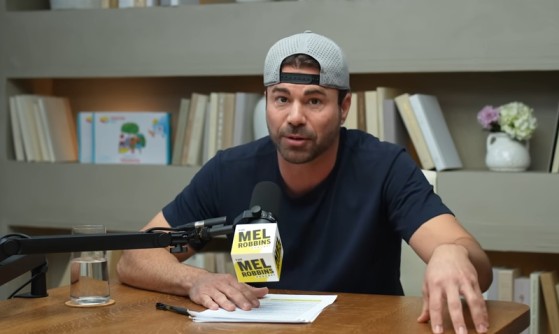
Here is the full transcript of American YouTuber Mark Rober’s interview: ‘Treating Life Like an Experiment’, on The Mel Robbins Podcast, December 11, 2025.
Brief Notes: NASA engineer–turned–YouTube superstar Mark Rober joins Mel Robbins to share a powerful mindset shift: treat your entire life like an experiment. Drawing from his work on the Mars Curiosity rover, viral science videos, and massive projects in education, Mark breaks down how to turn failure into data, fear into curiosity, and goals into fun, testable challenges. He explains his “Super Mario effect,” why hiding the vegetables makes learning irresistible, and how thinking like an engineer can help you make better decisions, feel more confident, and stay excited about progress. If you feel stuck, overthinking, or scared to try something new, this conversation gives you a practical framework to start moving forward today.
Introduction
MEL ROBBINS: Mark Rober in the house.
MARK ROBER: I’m so excited to be here.
MEL ROBBINS: I am so excited to be here too.
MARK ROBER: You’re one of my heroes. On the digital front, I feel like we’ve kind of had similar stories. So I feel like I’m in the room with a hero that’s very relatable to me.
MEL ROBBINS: Well, I feel the same. And you’ve made a huge impact in a lot of my family members’ lives. My nephew, my son is a monster fan. I would not let him skip college for the day to come in and meet you. I’m a mean mom.
But I would love to start, Mark, by having you tell me how could my life be different if I take everything to heart that you’re about to share and teach us today about failure, about creativity, about really being true to yourself and knowing who you are. And I apply it to my life.
The Power of Frameworks for Viewing Failure
MARK ROBER: I think something that’s helped me a lot in life is valuable frameworks, especially when looking at challenges and when looking at failure. Viewing failure in a way that it doesn’t mean you are a failure, but it almost flips it where it’s exciting.
And that approach to problems and challenges, seeing them as exciting opportunities, really is a framework thing that I’ve found has just been an incredible help in my life.
MEL ROBBINS: I personally love frameworks because it feels then like the things I need to do feel a little less arduous, and it doesn’t feel like the things I screwed up are so personal.
MARK ROBER: Yes.
MEL ROBBINS: And I love the idea that you have a framework to help make better decisions.
MARK ROBER: My favorite feeling, truly, is when that aha moment when you learn something new and you have a new framework and it allows you to kind of see the world. We’ve all read a book or listened to a podcast that sticks with you and then changes. The book “Let Them” is this for so many people.
And I love that moment so much. The only thing I love more is giving that to someone else. I love to be that conduit.
From NASA Engineer to YouTube Creator
MEL ROBBINS: How do you describe what you do? You know what I mean, for somebody who may be listening right now or watching right now, and they’re like, I love this guy. Who’s this guy? What’s this guy do? Tell me more about this guy. How would you describe what you do?
MARK ROBER: So I’m a mechanical engineer. I got my bachelor’s and master’s in mechanical engineering. I worked at NASA for a decade working on the Curiosity rover.
MEL ROBBINS: Wait, the thing that went to Mars?
MARK ROBER: Yeah.
MEL ROBBINS: What did you do with that?
MARK ROBER: I worked on the jetpack that lowers it to the ground and then some hardware on the top deck of the rover. So the arm digs in the dirt, dumps it into the belly of the rover, and my hardware accepted the sample.
MEL ROBBINS: That’s so cool.
MARK ROBER: And it’s still working to this day, so fingers crossed.
MEL ROBBINS: Wow. Okay. So you worked at NASA.
MARK ROBER: Yep.
MEL ROBBINS: Doing all kinds of cool stuff.
MARK ROBER: Yep. And then I worked at Apple for five years in their special projects group.
MEL ROBBINS: That, like, top secret stuff.
MARK ROBER: Yeah. I worked on the Apple car.
MEL ROBBINS: You did?
MARK ROBER: Yeah, which didn’t end up becoming a thing.
MEL ROBBINS: I was going to say, is there an Apple car?
MARK ROBER: They canceled it soon after I left.
MEL ROBBINS: Okay, well, it’s because you left.
MARK ROBER: Yeah, I like to think so. And so then, and only then when I had 10 million YouTube subscribers at that point, did I quit my actual job to do YouTube full time.
The Birth of a YouTube Channel
MEL ROBBINS: Okay, so hold on. How did you, and why did you start making videos on YouTube? Because you got big jobs at NASA and Apple.
MARK ROBER: Yeah.
MEL ROBBINS: And how old are you when you started tinkering, I’ll say?
MARK ROBER: My first video I uploaded, I was 31 years old.
MEL ROBBINS: Okay.
MARK ROBER: And it was a Halloween costume. It was an iPad in front and an iPad in back. If you do a FaceTime video call, it looks like you have a hole in your body because the camera in front shows what’s on the back. So it’s a practical illusion.
MEL ROBBINS: Oh, so you have the camera in the back calling, you have the camera in the front calling the camera in the back, and vice versa.
MARK ROBER: So then, if you wave your hand in the front, it shows that on the screen in the back. So if you cut a hole in your shirt, it looks like you have a hole in your body.
MEL ROBBINS: Oh, my God. So both ways.
MARK ROBER: Both ways. So it was very… And I love ideas that are really simple and that you could just make with stuff you already have.
And it went super viral out of the gate, like 3 million views. And I was like, well, this is a good feeling. I have way more ideas. And back then, you didn’t know you could make money or get famous on YouTube. You’re just sharing ideas.
MEL ROBBINS: Got it.
MARK ROBER: And basically, I’ve uploaded one video a month since that day. So almost 15 years now.
MEL ROBBINS: So for 15 years, one video a month since that day. And the videos are all explaining super cool things, mostly about science, generally.
MARK ROBER: It might be, you know, someone stole a package from my porch. I engineered a glitter bomb that could get revenge on porch pirates, where it has four phones inside that record and upload to the cloud. But there’s also a cup that spins a pound of the world’s finest glitter.
Of course, there’s some fart spray in there, so they have to get rid of it out of their house. We built eventually 20 and put them on porches all across America.
MEL ROBBINS: Okay.
MARK ROBER: In spots we knew were hot spots for getting porch pirates.
MEL ROBBINS: Okay.
MARK ROBER: And then we just tracked them all, and we would know when one got stolen. And then everyone’s watching the footage real time, and you get some pretty hilarious reactions.
The Secret to Viral Content: Evoking Emotion
MEL ROBBINS: Wow. So you have 71 million subscribers on YouTube. Why do you think these experiments that you elaborately orchestrate, why do you think they connect so deeply, not just with kids, but with people of all ages and backgrounds around the world?
MARK ROBER: You just have to evoke a visceral response. In other words, it has to make them laugh. They have to feel excited. They just have to feel something. For something to be remarkable, it has to be able to be remarked about.
And so you don’t share a video you don’t finish watching. So if you could just make them feel something, then they are way more likely to actually take action and share it.
I think this is applicable in people’s lives. If you want… a lot of times you just want to focus on the facts. Well, the facts are on my side, so I’m just going to state the facts. But if you don’t emotionally connect with someone, maybe you want to pitch something to your boss. It’s this big idea, right? Maybe you want to apologize to your partner or your kid.
If the emotion’s not there, it doesn’t cause that shift in the heart. And we survived long before written language to tell stories to each other. And so it’s in our DNA to resonate with stories.
And I think this is very applicable for people’s lives of just leaning into the story and the emotion of a thing just for interpersonal relationships. Your apologies will be accepted faster and more earnestly. You will find that you can pitch ideas to coworkers, even just where are we going to eat?
You are more influential if you can remember that we are hardwired to tell stories.
How to Use Storytelling as a Tool
MEL ROBBINS: So if you don’t think you’re a good storyteller or you’re a really shy person, is there any advice that you have about how you can use this framework of thinking about the emotion or… I love that thing that you said, to be remarkable, you have to have people remark about you.
And telling somebody a story or moving them emotionally or getting them excited about something is what makes people remark about you. So how could somebody think about storytelling as a tool to use to prepare for anything, whether it’s a date or it’s a job interview, or it’s having a hard conversation or it’s trying to go viral, making your next video?
MARK ROBER: The biggest downside, especially as an engineer, I get this, is to focus on the facts. Let’s say you’re selling a thing. It’s like, well, my processor has 20% more gigahertz. People don’t care. It’s just a spec sheet, right?
MEL ROBBINS: Yep.
MARK ROBER: They want to know how this will make them feel. So I think part of it is empathizing with the other person you’re talking to and putting yourself in their shoes and understanding from their perspective what would feel meaningful to them.
Hiding the Vegetables: Making Learning Irresistible
MEL ROBBINS: You only do one video a month. When you are sitting down to think of the idea, are there particular checkboxes that you go through? Because one of them has to be, what emotion are we evoking? What story are we telling?
Is there a framework you use that helps you architect the type of experiment that you’re going to do? Or how you’re using kind of this… How do I evoke something? How do I engineer a story that creates emotion for people?
MARK ROBER: What I do is I like to say, hide the vegetables.
MEL ROBBINS: What does that mean? Oh, you mean blend them? What are you talking about?
MARK ROBER: No, no, no. That’s all I’ll say. So at the end of the day, my goal is to reach as many brains as possible with this story of learning how to think critically, to be curious, to embrace failure. Thinking like an engineer, even if you’re not an engineer. That is my North Star.
So the way I do that is hiding the vegetables. So I might have a video that’s a 15-ton Jell-O pool, which is very hard to do, by the way.
MEL ROBBINS: A 15-ton Jell-O pool?
MARK ROBER: That’s right.
MEL ROBBINS: Is that a swimming pool full of Jell-O?
MARK ROBER: Yes. That weighs 15 tons, which no one has literally ever in the history of the Internet actually pulled that off. We were the first because we had to go to… because Jell-O, you have to boil it and you have to cool it down.
MEL ROBBINS: Yes.
MARK ROBER: So I went to the perfect spot in the United States where overnight it would get to refrigerator temperatures. We boiled it in six huge 55-gallon drums. It took a full week. I lost 10 pounds because I was so stressed out.
But we pulled it off and you could see someone belly flopping in a pool of Jell-O. That’s a very clickbait title and thumbnail. But once you click on the video, Mel, is where I get you. Because pretty soon you’re learning about chemistry, you’re learning about the scientific method, you’re learning about the variables we controlled.
I can’t teach you if I don’t have your attention. So by teaching science in this way via spectacle, you come in, you get hooked, you’re like, wait, what? And so that’s what I really do. I get your attention, I hide the vegetables.
A Big Announcement: Full Science Curriculum
MARK ROBER: And this is actually something I have not really talked about this publicly, Mel, but can I give you a big bombshell here, a big announcement here? We’re taking all the tricks I’ve learned over 15 years of hiding the vegetables, of teaching science in a way that’s exciting.
Kids are kids and adults are choosing to watch these. We’re on YouTube. There’s so many other options they can click on. So we’re going to make a full science curriculum. Third to eighth grade. This includes really cool videos, includes a lot of their favorite YouTubers that they already watch.
MEL ROBBINS: Oh my gosh.
MARK ROBER: It includes resources for teachers. It includes really cool demos they can do in class that are very inexpensive. It also adheres to all the science standards. And then we’re making it free for all teachers.
MEL ROBBINS: Are you kidding me?
MARK ROBER: No. It’s going to cost like three. It’ll take about three years total. We’re about a year into it and yeah, I just feel like teachers specifically, it’s such a—it’s the most, I think, important profession and perhaps the most underappreciated or under supported profession. So especially these teachers who are paying their own money for curriculum, it’s terrible.
So it’s kind of like, hey, reinforcements are on the way. We got you. We’re coming with this really cool thing. So that I think will be the most important thing I do my whole life. I’m really excited about it.
MEL ROBBINS: I can see how emotional it makes you.
MARK ROBER: Yeah, I’m really, really excited about that.
MEL ROBBINS: Why does this bring up so much for you?
The Impact of Great Teachers
MARK ROBER: You know, I myself am product of great teachers. My mom, she passed away six months before I even made my first YouTube video. And she didn’t even go to—she barely graduated high school. But she has had more impact on my life than anyone by a very comfortable margin.
Which honestly I almost think is a beautiful thing where you never really know the full measure of your life. The impact that you have regardless of what you believe about what happens when we die. I think we can all agree a successful life is one where you leave the world a better place than you found it. And the impact you have on others, you’ll just never really know.
And I almost think it’s beautiful that she had no idea that what happened just right after she passed away where I started getting all this reach and now I’m trying to reach as many brains as possible and basically what she did for me and what other great teachers did for me, that’s what teachers are. They’re seed planters.
So if we want to invest in the future of the world, there’s big problems coming down the pipeline. Mel, this is an all brains on deck situation. So we should be investing in the seed planters, those who are creating the next generation of big problem solvers.
And so just this idea of supporting and celebrating them and just saying thank you and also just putting a thumb on the scale that’s like, this is a cool profession and people should aspire to be this. My dream job, truly, and I’ve said this for a decade, is to be a middle school or high school science teacher.
Honestly, I thought by now I would be retired and I would just be doing that as a volunteer. And then what I realized is by the way, I still want to do that. That is still going to be what I do eventually. But I can have more impact using the platform that I have by supporting other teachers in the meantime.
MEL ROBBINS: Well, you know, I’m so moved. I didn’t think I’d cry talking to you. Honestly, I kept thinking you would be my dream science teacher for my kids. And I’m sure as you’re listening or watching this, you’re like, man, I wish Mark was my kid’s teacher.
And what occurred to me is that your mom is clearly with us and that you actually are the world’s science teacher. That is what you’re doing. You just happen to have the largest science classroom in the world. Really. That’s what you’re doing.
Following Your Passions One Step at a Time
MARK ROBER: Yeah. I mean, I guess it’s funny because I don’t think about it in those terms. I’m just like, what’s the next video I want to make next month? That’s exciting to me. And I think that is—yeah, I kind of think when people are like, what’s your 10 year plan? Especially when they ask kids in middle school or something, it’s like, I don’t know. Nobody knows.
Any adult who tells you, oh, yeah, I knew I’d be exactly right here in my life 20 years ago. Bull. That’s not true. My philosophy is it’s like crossing a river and there’s a bunch of stones on it. You don’t necessarily know the right path. But what I can do is I could wiggle the three rocks in front of me and it’s like, oh, this is the best rock right here. So I’m going to hop on this one.
And now that I’m on that one, now I could touch my toe out and wiggle the next three. So my whole thing, and I really try to tell this to kids as well, it’s like, whatever the options are in front of me, okay? I’m going to pick the best one. I’m just going to put everything into this thing.
And then once you do that, now suddenly, guess what? Four more doors open. And now choose the best one from there. And now, oh, now there’s seven more doors. And so if you’re 15, you don’t know what you want to be when you grow up. What makes you excited. Do you love to draw? Just draw a ton and get as good as you can be. Do you love to write? Well, then just write as much as you can. Talk to other folks, learn more about that.
And I just like a life where you just follow your passions is one that just very naturally just feels very, very fulfilling. And so when you say, hey, you’re in a position, you’re the world’s science teacher, it’s like, I don’t know. I guess I’m not looking at that, Mel. I’m looking at the rock in front of me.
MEL ROBBINS: Yes.
MARK ROBER: And then, yeah, sometimes you zoom out, and you’re like, oh, holy crud. 71 million subscribers and 20 billion views on science videos. Yeah, that is a lot. But it’s like, I mean, my team will tell you, we’ll release the video. And they’re like, oh, the video’s great. I’m like, wait, what? I’m already on the next thing. No, we got more work to do.
The Secret to Success
MEL ROBBINS: I want to pause on this, because I think you actually just shared a story that has the absolute secret to success in it, and that is that if you focus on something that is truly tied to something you deeply care about, and you are also focused on the impact that it can have on somebody else.
And so you talked about evoking emotion and setting up a story. We’re all like, oh, world’s biggest cello thing. This is cool, but you’re hiding the vegetables in it. So you’ve become a master at the craft of teaching science, but you have never lost focus on the one lesson in front of you, the one rock, as you say.
And that’s the secret, because the second you pick your head up and go, 2 billion views and this, that, and the other thing, you’re now no longer looking at the actual thing that you loved doing. You’re looking at the wrong data.
Let’s talk about failure, because you’ve built your career on experiments, and at the very beginning, you said that there is a framework that you could teach us about failing and getting excited about failing. And I got to be honest with you, I’m not excited about failing, Mark.
The Super Mario Effect
MARK ROBER: Yeah. So I think what I found over time is the first time I noticed this, was trying to make a dart board where you get a bullseye every time, where you could throw a dart. It would track the dart through the air, it would predict where it would land, and then it would move the dartboard in 400 milliseconds.
MEL ROBBINS: No way.
MARK ROBER: That’s less than a blink of an eye.
MEL ROBBINS: Wow.
MARK ROBER: And that video took me three years to build that. And there were a lot of setbacks, Mel. There was a lot of moments where it’s like, oh, we thought this would work, but it doesn’t. And what I realized is at no part in any of that was I like, I’m a failure. This is the worst. I want to give up.
It’s almost like with each setback, I was more and more determined. I learned one more way not to do it. And what I realized is it’s like a video game. I call this the Super Mario effect.
MEL ROBBINS: Okay?
MARK ROBER: In any video game, there’s an objective or a goal. You have to rescue the princess from the castle or get a certain amount of points. But there’s obstacles in that way. There might be pits, there might be bad guys. And if you die, you go back to the beginning and you just keep trying. And over time, you get better and better, and you learn to avoid the obstacles better and better.
You know, Super Mario Brothers, you’re just trying to pass the level. And on that level, there’s pits that you could fall into. There’s sliding green turtle shells. There’s lots of ways that you could die. But no one ever picks up that controller for the first time and falls into a pit and is like, I’m such a failure. I’m an idiot. How embarrassing. I’d never want to play this again.
No. Instead you’re like, oh, crud. Okay, there’s a pit there. I got to remember that next time, I’m going to come a little faster. I’m going to jump a little earlier. And so by having this attitude toward failure, by focusing on rescuing the princess from the castle, the focus is on the princess and the goal in mind, you focus on the win. You’re not focused on the failures.
And that doesn’t mean it doesn’t sting. On level 8-1, there’s this huge pit you have to jump over and land on this tiny little platform. It’s really hard to do. And you’ve made it all the way there. And then you die. And it stings, Mel. It still hurts. It’s not this Pollyanna attitude of like, oh, well, everything’s good.
MEL ROBBINS: Well, and even the sound at the end when you die is like, oh, yeah.
MARK ROBER: Right. It’s very sad. Even the sound, but it stings. But you’re immediately like, what did I learn? Now I’m going to try this again, because I now know one more way not to attempt that jump.
Handling Failure in Front of Others
MEL ROBBINS: How do you use this when a lot of the failing that people need to do is in front of other people? Or you might get negative feedback, or people might comment on your video, or you might look stupid at work? Do you see what I’m saying? What would you say to the person that’s like, okay, I can do that with a video game, but I still can’t talk at work?
MARK ROBER: I think we overestimate the negative impact on failure and underestimate our ability to handle it when we’re imagining towards the future of this failure thing. And I think it’s a repetition thing. I get that. I hate public speaking, and it’s a goal of mine right now. It’s one of my Super Mario level things I’m working on.
And what I’m finding is just the more reps I do it, the more times I do it, you do normalize to it. So I think I get that fear, and I recognize that it is different when you’re in front of other people. But it’s one of those things that just, you just—it’s exposure therapy and fail small in front of small groups of people, and then you can eventually fail bigger and bigger.
But even still, I will say, this framework really does help. You know, I’ll have videos that will bomb, and they’ll be a 10 out of my last 10. And it stings. It’s like falling in that pit. But it’s like, oh, you know what, though? This kind of makes sense because we started a little differently, and we did it this way.
And so immediately, just the way my brain works. And that’s a big failure, Mel. In front of a lot of people, and it stinks for a day. But immediately, the way the framework works is I’m like, what did I learn from that?
And I call that thinking like an engineer, meaning, you know, to get the rover on Mars, we tested so many things because you just don’t know. And no one, if you have a test that fails at NASA for a landing strut, no one’s like, oh, you’re a failure. It’s like, oh, great, now we know the limits of what this thing can do, so let’s redesign it.
As an engineer, this is just how you think. If you are not failing, that’s a problem. You need to be testing the limits to understand. If you’re being so conservative on everything, you have no idea how much bigger and cooler this thing could be. Each time you fail, you are learning something. You’re learning one more way not to do it.
So I think if they can approach it that way and find the positivity in the fail and the learning in the fail, then it gives it a purpose.
Treating Life Like a Video Game
MEL ROBBINS: You just gave me a huge aha moment as a mom, and I want—as you’re listening or watching, I want you to steal this. I want you to use this with every single gamer in your life. Because I think one of the things that I got very wrong is you tend to attack the gaming because you think the person in your life who’s good at gaming or loves gaming is avoiding life by gaming.
And I just realized I missed a huge opportunity as a parent because Oakley was only gaming as much as he was because he was good at it, and he was doing it because he was doing it with his friends, and he was doing it because he was learning these incredible skills and that you’re talking about thinking like an engineer, tinkering, experimenting, failing, starting over, the resilience, the get back and go, the building that muscle over and over and over and over again.
It’s evidence that they have resilience. It’s evidence that they can experiment and fail and learn. It’s evidence that they can figure it out.
MARK ROBER: Trying it and then learning.
MEL ROBBINS: Yes.
MARK ROBER: And by the way, you shouldn’t just nail it right out of the gate. I think that’s what people expect, right? Well, if I’m good at it, you don’t expect that in a video game. Why would you expect that in life? You learn a lot more in failure sometimes, especially with kids, than just by succeeding at a thing.
Making Your Goal to Fail
MEL ROBBINS: You know, one of the things that I would love to have you speak to for the person who’s listening or watching, who’s scared to try something new because they don’t want to mess up. They don’t want to look cringy, you know, they’re worried about what their friends are going to think. What is your message to somebody who’s on that precipice, knowing they want to grow and change, but are actively talking themselves out of it?
MARK ROBER: I would say start small and make your goal to fail.
MEL ROBBINS: What do you mean, make your goal to fail?
MARK ROBER: I just went through this myself, Mel, where it’s like, I have—I like to play chess occasionally, and I found I wasn’t playing chess because I felt like if I lost, somehow I would internalize it. Something about me, this is playing online, and I’m like, what am I doing? So I made a goal that I want to lose 10 games.
MEL ROBBINS: What? I love this.
MARK ROBER: This was my goal.
MEL ROBBINS: Do you know I’m starting to learn chess? I feel really stupid. And so I played once with Oakley. He smashed me. And then I’m like, okay, I don’t want to play with anybody else because I don’t want to look dumb. So it’s your goal to lose 10 times in a row?
MARK ROBER: 10 times or just 10 times. In a—that’s—it doesn’t necessarily need to be in a row, but it’s like, hey, I’m going to play these games. And I check a box, I win when I fail this many times, and that just resets everything, right?
And it totally worked for me because now I—and then I exposed myself to losing more, and now I don’t even think about it. And I love—I don’t internalize it as a negative thing. And now I’m enjoying and playing way more chess.
So if you’re nervous about speaking up at work, you know, if you’re—maybe it’s public speaking, maybe dating an interview. It could be dating an interview. Maybe you love to draw and you want to make a YouTube video talking about it. Just make your goal, let’s say for the YouTube case, just to make 10 videos. Don’t think anything about views. Don’t think anything about any sort of metrics.
MEL ROBBINS: Go for zero views.
MARK ROBER: Yeah, go for zero views, right? Your win is just getting it up and starting to flex that muscle. And it’s just like anything in life. It’s exposure therapy. And the more you’re exposed to it, the better you get. You build those muscles, right? It’s just like training in a gym. Those muscles get stronger, you get more adapted to it. And then you look back at where you were a year ago, and you’re like, oh, man, I can’t believe I was ever worried about this.
MEL ROBBINS: Well, here’s what’s genius about that, Mark, is that I think there’s a lot of talk about how failure should be the thing we go for. But what you just did with that framework is you said, no, the goal is to fail.
MARK ROBER: Yeah.
MEL ROBBINS: I love that. It’s so subtle, but it’s a really genius way to do it.
MARK ROBER: Just get the pressure off yourself and understand that will happen. And don’t try and avoid that thing.
Making Science Fun: Simple Demos That Teach
MEL ROBBINS: So, Mark, one of the things that is just your genius is that you make science and learning and failing so fun and humor and silliness is kind of part of the formula. I know that you brought something to show us.
MARK ROBER: Oh, yeah. So here’s an example of just a very simple demo. I’ll pull up. That’s down here.
MEL ROBBINS: Okay. So he’s reaching down right now. If you’re not watching on YouTube, but you’re probably going to want to watch this on YouTube at some point, you’ve got a—oh, you got a hairdryer.
MARK ROBER: Yes. This is a simple hairdryer you’d have at home. And just a ping pong ball.
MEL ROBBINS: Yeah.
MARK ROBER: Okay, so what I’m going to do, Mel, I’m going to turn this on. And the ping pong ball is levitating in this hair dryer. But even as you twist it left and right, it magically stays in the airflow.
MEL ROBBINS: Right.
MARK ROBER: So this is a principle called the Coanda effect. Essentially, what’s happening is it’s creating a little low pressure bubble.
MEL ROBBINS: Okay.
MARK ROBER: For the ball to float in. That’s why even at a side angle like this, it’s still floating. This is the principle behind what makes curveballs curve in baseball. It’s the same kind of principle of air flowing around the side to create little bubbles.
MEL ROBBINS: Oh, because—because—because the air is coming straight up and out of the hairdryer, but when it hits the mass of the ball, it goes up on the sides of it, so it’s almost like cupping it with the fluid that is air.
MARK ROBER: I’m learning it’s exactly it now. Wow. You explained that so well. But what’s so great—that’s such a simple demo of Harry Potter levitation. Right. I mean, you literally look, you know, like a wizard just hovering this thing. And it’s just—this is junk you have lying around your house.
So it’s a demo that explains it. That’s really cool. That’s very approachable. Right. This isn’t some fancy scientific instruments. A ping pong ball and a hairdryer. Yes. Here’s another one that I think will work well on a podcast. Okay. I’ve got a cup.
MEL ROBBINS: You’ve got a little plastic cup like you see in backyard barbecue.
MARK ROBER: Yeah. Like those red solo cups. Yeah. There’s just a normal string here.
MEL ROBBINS: Yeah. It’s just a white string that you’ve tied to the—you’ve punched a hole at the end.
MARK ROBER: So it pokes through the end of the bottom of the cup. And then I have a little bit of a—in fact, I’m going to dip this in my water here. Okay. It’s just a paper towel.
MEL ROBBINS: Yep. Nothing fancy.
MARK ROBER: And what’s interesting now is I’m going to try and make a chicken sound. You tell me if this makes sense.
MEL ROBBINS: A chicken sound with a plastic cup and a string and a wet paper towel.
MARK ROBER: See if you believe it. Ready? Here we go.
MEL ROBBINS: That’s exactly what that sounds like.
MARK ROBER: So all we’re doing with this little cup and making a little chicken demo is there’s vibrations. As the friction on the string rubs against the paper towel, it vibrates the bottom of this cup. It’s a diaphragm. It’s like a drum. And then it’s amplified through the cup so it becomes like a little speaker.
In other words, if I take this same string and I rub it without the cup, what you would expect to hear is what I anticipate happening. You just don’t hear much. You kind of hear it, but it doesn’t have that amplification. Because what’s happening with the bottom of this cup is, as I vibrate pushes all the air molecules that are up against the bottom of this cup, it pushes them out, and they bonk into other air molecules, and they keep bonking until it hits your eardrum.
And it just—it registers those movements of molecules bumping in your eardrum. And we call that sound. And if it’s a high frequency, that means the bumping happens more frequently. So, you know, if it’s a high frequency, a high pitch, that’s just the bumping happening faster.
MEL ROBBINS: Faster.
MARK ROBER: Okay. If it’s a low frequency, the bumping is happening less frequently. We call that a low frequency.
MEL ROBBINS: So does this also explain why if you—my kid—my kid Oakley showed me this. If you need a speaker and you don’t have one, you can stick your phone in a cup and play it in a cup, and then the cup amplifies it.
MARK ROBER: That’s exactly it. That’s right.
MEL ROBBINS: Whoa.
MARK ROBER: It concentrates the air molecules all pushing together in the same direction to eventually hit your ear. So just simple little demos like that where it’s like, I could have tried to explain that with words, but if you can viscerally get your hands on it and it’s not a complicated thing—those are the moments where you, I think you create more aha moments.
Applying Curiosity to Your Life Goals
MEL ROBBINS: So how would you recommend that the person who’s listening or watching right now apply the fun and the curiosity toward their own goals in life?
MARK ROBER: Curiosity is actually—and creativity and curiosity are—that’s a muscle that can be developed. I do think some people are just born more naturally curious. And probably born a little bit more naturally creative. But there’s a huge middle ground. The research shows this. We’ve worked a lot with Dr. Adam Green from Georgetown.
And you can actually measure, you know, your brain using the—if you measure the alpha brain waves, that’s highly correlated to creative problem solving, creative thinking. So you can measure this with an EKG. And what he found is that it’s a muscle.
MEL ROBBINS: Creativity is a muscle.
MARK ROBER: Yes. The more time you spend in that space, the more comfortable you are with it, the more quickly your brain goes to that spot. So it’s kind of like this idea of a mindframe of just viewing the world through a lens of curiosity. Viewing the world through a lens of, “Huh. Why is that?” Right?
The best words to hear in science aren’t “eureka, I discovered it.” The best words that lead to the most scientific breakthrough is “huh. I wonder why that happened.” It starts with an observation. You’re like, that was unexpected.
MEL ROBBINS: When we first sat down, you talked about frameworks for understanding yourself and what you value and for really being happier, authentically happier. What have you learned about happiness?
The First Principles Approach to Happiness
MARK ROBER: So in engineering, we call it first principles approach. Like if you’re trying to go to Mars, start from a very first principle. What are the basic fundamentals that you need to know? How much energy do you need to get there? What are just basic building blocks?
And I think for happiness there’s some basic building blocks that intuitively I’ve really tried to maintain as life has gotten crazier. And that comes down to relationships and living according to what my personal values are. Being value driven and having a goal of what is my impact in this world and what is the reason I’m here. So being motivated intrinsically by those types of things and not letting all this other stuff be a distraction.
I think a lot of people have to buy their fancy things to realize, oh, that wasn’t what actually brings happiness. And I have this, Mr. Beast is a buddy of mine, he’s another YouTuber and him and I have this debate a lot. His thing is like, oh, you can either be really successful or you can be happy. You can’t be both.
And there’s many decisions I’ve made that sort of would have helped me have more reach or would have meant that I could have more money or have more whatever. But I don’t want to just have this flash in the pan and go really hard and just totally burn out. If you do that, then you spike back down to nothing.
But if you just sort of build one step at a time, happiness is found by just incremental level ups, just little hits of dopamine. I’m just like, oh, I got a little bit better. Oh, I got a little bit better.
And I think in life, I’ve really tried to, we could have 500 employees and have all this venture capital do all this stuff. But I’ve pushed against all that and I’m just like, if I want to reach as many brains as possible, the right way to do it is just we’re just little by little we’re going to creep up to this thing. And as a result, I’ve never gotten burnt out on YouTube. And I would say, I’m more stoked now than I have been in 15 years.
MEL ROBBINS: I think the way that I would relate to it is there were periods in my life, especially when we were struggling financially, where I thought the secret to happiness was going to be a different car or a nicer handbag or the ability to go on a nicer vacation with my kids.
You might be, as you’re listening or watching in this moment in your life where you’re so focused on chasing the weight on the scale or the figure in the bank account or the house in a certain neighborhood because you think that solves all your problems. And I actually thought it would.
The Power of Gratitude
MARK ROBER: I think the good news is, if this is something that resonates and you struggle with, there is a very good solution for it. And the antidote to this feeling of needing and chasing that dopamine, getting the next thing is gratitude.
So, you know, this is why sometimes you hear like having a gratitude journal or like before you go to bed each night, literally writing down three things that happened that day that you’re grateful for, because at any one time, incredible amounts of both abundance and scarcity exist in our world. It just depends on which one you want to focus on.
And so when I find myself in this thing and feeling down that I should be doing better, I should be having more, the reset is like, man, look at what I have in my life. And almost a hack for this, if you’re still struggling to be grateful, imagine, take something away, say like a partner or someone that means a lot to you. How would you feel?
And that is a good reset of like, why am I worrying about what I’m going to bring to the potluck on Friday and stressing over this in my life. That is such a small problem compared to what it could be.
And I think it’s a reset then of like, when you come home. And at the end of the day, I think relationships do matter. And I think the research bears this out. Happiness is correlated to the quality of the relationships in your life. And for me, I find that to be as true as well.
So then it’s like, well, then I shouldn’t be on my phone when I come home. And if at work I’m in this hyper optimization mode and I get stuff done and I have people around me. When you get home, you need to flip that and you need to not be efficient with your kids.
The phone goes down and your goal should be flipped. I need to be as inefficient as possible. I’m going to read this book four times. I’m not going to skip the pages. I’m going to sit here and play this thing with them. Your goal when you get home should be be as inefficient as you possibly can. And that will yield the best results for fostering a child that feels like they’re being raised in this loving environment, especially with all the distractions we have today.
Be Inefficient With Your Kids
MEL ROBBINS: I think that’s the best parenting advice I’ve heard in a very long time. No, I mean it. Because part of why we’re so stressed out, I’ll just speak for myself, is we’re optimizing for efficiency and productivity as parents.
MARK ROBER: Yeah.
MEL ROBBINS: And we need to do the opposite because kids need your presence and your attention. They don’t need to jam 50,000 things into the next 15 minutes.
MARK ROBER: Yeah. When they’re telling that story that’s very long winded and they’re going over and over and repeating, I want to be like, yeah, yeah, get to the point. What happened?
MEL ROBBINS: Yes.
MARK ROBER: That’s not the point. The end of the punchline of their story is not the point. Your undivided attention and showing that they matter. That’s the point.
MEL ROBBINS: I want to make sure that as you were listening or watching, that you did not miss the rock solid piece of gold that Mark dropped in the middle of the story about gratitude.
Because if I think back to some of the hardest moments in my life, those moments where you’re like, life is unfair, I suck, the world sucks, everyone around me sucks. I’ve really blown it. And those moments happen to all of us.
If I had had the negative gratitude piece of advice that you just dropped on us, okay, even in the worst moment, think about removing somebody you love. Even though I was a complete jerk and constantly angry at Chris when we were almost a million dollars in debt, there’s not a second that I wished he was gone.
And so if you have something in your life that you don’t want to lose, then you have something to be grateful for. And that helps you start where you are. And it helps remind you of what you actually value.
How to Get Unstuck
MARK ROBER: How.
MEL ROBBINS: As an adult, because adults get stuck, and you can get really stuck in the story that you’re telling yourself that whether it’s a story, I don’t know what I want, or it’s too late for me, or I’ve screwed up so many times I can’t. I don’t even know what direction to turn.
How do you use some of these principles? Whether we’re talking about the alpha brainwaves or we’re talking about the kind of question prompts that naturally make your imagination go. How would you recommend that somebody who does feel very stalled in life or feels stuck in life and doesn’t feel creative and doesn’t feel innovative and can’t even imagine something bigger or better than where they’re at right now, how do you start to change that story? How do you lean into what might be possible?
MARK ROBER: I think gamifying it and treating it as an opportunity to learn and to get better and to optimize. If you ever played Zelda, if you ever played any game, if you’ve ever gone on to accomplish something great, just remember what that was like.
It started small and you most likely were excited about the process. So what can you do to hide the vegetables for yourself? And then it’s exciting because you feel like you’re getting better. Failure has purpose. You embrace the failure as the quickest way to get to something amazing.
MEL ROBBINS: The thing that I would also add is that in every one of your experiments and every one of your videos and everything that you’ve done, you did not hold open the possibility that you wouldn’t eventually get there. And so there is also this faith involved where you say, if I keep going, if I’m willing to learn, I am going to figure this out, and this is going to work out for me.
MARK ROBER: But I will say with a caveat.
MEL ROBBINS: Yes.
MARK ROBER: That it may look different than I thought it would look.
Closing Thoughts
MEL ROBBINS: Mark, what are your parting words?
MARK ROBER: I feel grateful to be here, sitting across the table from you, Mel. To have these values and these things that you care about, to share it with a bunch of people is like, even if you’re not sharing it with a bunch of people, just to be able to move the needle in a way you think is beneficial for the world on any scale is incredible. And to do it on this scale, sitting across from you is like dream come true.
MEL ROBBINS: Well, the feeling’s mutual. I’m a huge fan. You’re so much better in real life, and you’re pretty fantastic in what you do. I just, on behalf of absolutely everybody who will listen to this, I want to thank you for the gift that you are to the world.
And you know what? I’m also so happy that you’re here. Thank you for being here. Thank you for sharing this with the people that you care about. Thank you for listening to something that is going to help you create a better life.
There is no doubt in my mind that everything that Mark’s taught us today is going to help you make changes, take risks, be more resilient. Have a curious mindset. I just love this. I cannot wait for my kids to listen to this. I can’t wait to share this with people.
And one more thing I want to tell you in case no one else tells you, I wanted to be sure to tell you, as your friend that I love you and I believe in you, and I believe in your ability to create a better life. And I know that everything that Mark shared with us today is exactly what you need to do that.
All righty. I will be waiting for you in the very next episode. I’ll welcome you in the moment you hit play. Thank you for watching all the way to the end here on YouTube. Don’t you love Mark? Oh, my God. We have to have him back. Thank you for sharing this. Thank you for watching all the way to the end. And I know you’re thinking, okay, what should I watch next? I think you’re going to love this, and I will be there to welcome you in the moment you hit play.
Related Posts
- How Elon Achieves the Impossible w/ Eric Jorgenson (Transcript)
- Michael Singer: How to Let Go of Everything That’s Hurting You (Transcript)
- Dr. Gabor Maté: Link Between Your Childhood and Why You’re Addicted to Approval (Transcript)
- Bialik’s Breakdown: w/ Holistic Psychologist Dr. Nicole LePera (Transcript)
- RiseGuide: Cancel vs Unsubscribe vs Delete (What Each One Does)