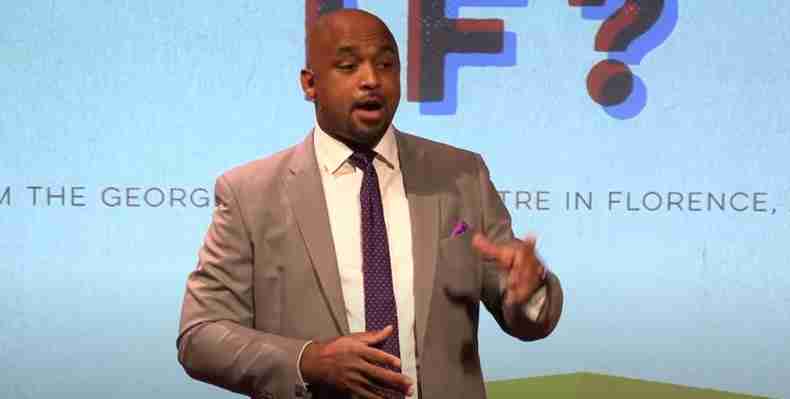
Full text of Kent D. Ballard, Jr.’s TEDx Talk titled ‘THE LIFE-LONG IMPACT OF ABSENT FATHERS’ at TEDxWilsonPark conference.
Listen to the audio version:
TRANSCRIPT:
Kent D. Ballard, Jr. – Educator
Fatherless is an interesting word. Everyone has a father, but how that father relates to their children is a different story.
Everyone in this room has a father, but everyone has a different experience with their father. I took the time to think about eight different types of fathers, and I’m pretty sure that I left out some of them, so please forgive me in advance.
Let’s first talk about the DISNEY DAD. This is the all-inclusive dad who is at everything. I mean, this dad was always available. The first to sign up for a PTA event and didn’t even mind overlooking an Alabama football game for the bake sale. He is a Disney dad. Everybody knows at least one Disney dad, but some of us had a hollow dad.
That HOLLOW DAD was in the home but was emotionally disconnected. Some of us had a stone-cold Steve Austin dad who was quick to grab a beer, quick to throw a punch, or quick to hurl insults at their family. That father was very emotionally and very physically abusive.
Some of us had a PEEKABOO DAD that was constantly in and out of their children’s lives. Others had a HIDE-AND-GO-SEEK DAD. Dad, is he here? Mom, have you seen him? Was he here this weekend? Where is dad? Some of us had a hide-and-go-seek dad.
Others of us had the experience of losing a father or had the experience of a divorcing parent situation. Those fathers are called HOPSCOTCH DADS. Those, unfortunately, by court mandate, were offered the opportunity to be in and out of the child’s life every other weekend or every other week. Hopscotch dads.
Then there are some that were INVISIBLE DADS. Those dads we never saw and we never even knew who they were. Some of us have had the issue of losing a father completely, to death or however that happened, but it’s very unfortunate. Those we call ANGEL DADS.
Regardless of whatever type of dad we had, we all had one.
BUT WHAT DOES THE DEFINITION OF FATHERLESS MEAN? Fatherless, in this case, actually puts the responsibility and the ownership on the father to be engaging, to be enlightening, to be encouraging, and to equip their children. Fathers who fail to create a firm foundation for their children actually put their children at a great disadvantage. The children that actually have to go through a fatherless situation have the ability or look at life in a different format. There is no guessing or second guessing to even think that a child that has gone through such a difficult situation has not had to overcome some significant barriers.
In fact, it is a fact that children who have both parents are more inclined, especially if those parents gave them clear boundaries and clear expectations, those children are more likely to be emotionally, educationally, socially, and also behaviorally more prominent. We have to understand that there are all different types of scenarios, but we must understand how to help students or help children get through some of these scenarios.
I personally had a peekaboo dad. He was consistently in and out of my life. I remember always wondering, did my dad really love me? And if he did, isn’t love an action word? Hmm.
As a child, I remember sitting on the corner or right on the edge of my grandmother’s couch, waiting on my father to arise. I remember the distinct sound of someone coming up the stairs. My grandmother had a wooden porch and we can hear when visitors were coming. My grandmother had a door that was made of glass, but it had 16 panes on it. And on this side of the door, there was a curtain. Anytime we went to look at or to see who was coming in, we would open that curtain to find that kind visitor.
Every time my father would come to visit, there was always this great anticipation of a game of peekaboo. I would go to the door and open that curtain. And lo and behold, he will pop his face right into that panel where I opened the curtain. Oh, what a great feeling. I was so excited to see him. Matter of fact, I was so excited that he took his time to come and see me. I felt special. I felt loved.
But oh my goodness, I wondered what he would teach me. Would he teach me to play the drums? He was excellent at that. In fact, that’s how my mother and father met. She was the lead singer. He was the drummer. Would he teach me to play a rhythm or would he teach me something about photography?
I tell you, I don’t know very many people who are as gifted with a camera as he is. Would he teach me something about putting something in a frame or would he teach me to defend myself?
As a single child, as growing up with my mom, I needed all the help that I can get. We loved karate. In fact, he loved Bruce Lee. He loved Bruce Lee to the point that he was going to name me Kato, the character from the Green Hornet. That wouldn’t work for me. I would have probably changed my name by now. No offense to those called Kato.
But at the same time, I remember sitting there at the same corner, at the same edge of that couch and him not coming and him not showing up. And I remember asking myself, why isn’t he here? I’m ready. My book bag is on. I have my items. I’m ready to go. I just want to hang out.
Did you know that 70 percent of African-American children grow up in a single parent home?
Seventy percent! And the majority of those children actually are raised by their mother.
The American legal system is very hard on those attempting to go through the child support process. In fact, that time can take from three to six months. And that’s only if both parents are cooperating. That time could easily extend to nine or 12 months only to get child support.
Did you know that there are almost 14 million children that are in the child support system in the United States? 14 million! This number is astronomical. And over 50 percent of those are being raised or those who are accepting child support are women. 50 percent.
So when we look at the data, $287 is the average that someone on child support will receive. $287 a month! The census would tell us — the most recent census would tell us that those who are receiving child support are only receiving up to maybe 60 percent of that which is owed. That means that on average, a family or a custodial parent could actually receive maybe $3,500 a year. How in the world can you raise a child on $3,500 a year?
When we really look at it, when we really investigate deeper, we have to come up with an understanding of how we can change the system for the better. When I really stop to pause and think about the damage that is done to the children that are going through this fatherless process, I quiver and I lament for them.
The distractions that they have to go through, the things that they have to overcome. Did you know that children that grow up without their father are more likely to have a diminished worldview of themselves, low self-esteem? Did you know that they are more likely to not necessarily believe that they can actually accomplish that which they reach for? This is a very difficult situation for a child to be in.
Did you know that children that grow up without their father are more likely to have behavioral issues, more likely to have mental health issues, more likely to have children outside of wedlock or be extremely promiscuous or be more promiscuous?
Did you know that those same children are more likely to end up in jail or to end up homeless? This is a constant issue over and over again that we see in our society.
Did you know, or maybe you didn’t, but I actually conducted a survey of 50 men and I asked them the question, what is the worst part about growing up without a father? Some of them said I felt guilty. I felt like it was my fault. Some of them said that I really did not learn how to be a man. I wasn’t taught to be a man. Some of them said that I really struggled with understanding how to operate in society. I’m really hurt for those young men who actually answered in that way.
I learned how to be a man through what I call inverse intelligence. I had to look at the opposite of what I saw before me and really create an environment for myself that I was able to utilize to operate. Now, you can only imagine how difficult that could be.
But what if, what if we as a society will hold each other accountable for what we do as a society? We often rely on the federal systems or we rely on school systems or the police systems to help in that way. But what if we were to hold each other accountable? What if we were to be at a situation where we could, what if siblings were able to hold each other accountable? What if siblings were able to say, listen, I’m not going to allow you to not live in your child’s world. I, if I had a sibling that went through that, I would make sure that he or she cared for, loved as much as possible that child because that child deserves it.
What if, let’s go a little deeper. If we were to address some of the skeletons that were in the closets and we were able to bring those skeletons out as a family and really address them and bury them well, what if we were able to actually change the world from inside of a family and out?
There are several things that we may be able to do as a society, but what about the fatherless? The fatherless, I give you three or four different final points.
As a child who has to endure the pain and the suffering of not having a father, I really suggest and I hope that you would do one of four things, that you would recognize, number one, that you have to start with you. Everything starts from within. Secondly, you have to be able to acknowledge the fact that, wait a minute, your father may have not provided you with what you longed for. It wasn’t the car. It wasn’t the Barbie. It was actually his time that you really wanted. When you’re able to verbalize that to him, then you actually have an advantage.
Thirdly, if you’re able, as a fatherless child, to be able to recognize that he may not ever be what you wanted him to be, then you may be able to stand firm on both feet and recognize that you have more power than you ever gave yourself acknowledgement for. And then lastly, if you’re able to simply appreciate those who have walked with you, you also strengthen yourself.
I know that my mother has moved mountains for me throughout my life. She has not only moved mountains, she traveled over 800 miles to be here with me today. I am very thankful and appreciative. I’m very thankful for my wife who has really walked with me through these trials and tribulations, over hills and through valleys. I’m very thankful.
Those four pieces are absolutely necessary for the fatherless. But what you also, in closing, what we have to do is create those vaccines that will eradicate fatherlessness from our society. One of those vaccines has to be accountability. We have to hold men accountable for what they do.
Four, those who are in that scenario, forgiveness. You have to release the opportunity. You have to release that pain and you have to stand on your own dot in your own time. I know that I have done the work and in transparency, I invited my father here today and unfortunately, he said that he was going to be here and he’s not. Again, I’m 40 years old and I’m still playing peekaboo with my dad. It’s very unfortunate, but I’m in a different place now and I can stand firmly and I know that that’s not a reflection of me. That’s a reflection of him.
What if we were able to change the world one family at a time by simply applying accountability? I know we can do it. Thank you.