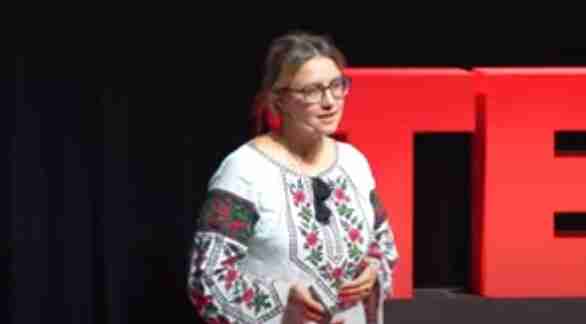
Here is the full text and summary of Yelyzaveta Pidopryhora’s talk titled “From Fear to Action: Creating Tangible Impact Amidst War” at TEDxIEMadrid conference.
Listen to the audio version here:
TRANSCRIPT:
Hi, my name is Lisa and I was born and raised in Kyiv, Ukraine. And I always have been passionate about the social innovations and I always said to myself that one day I’m going to open a social enterprise. At that time, one day seemed to me like far away in the future, maybe seven or ten years down the line when I feel more prepared. But guess what? I already did it.
Last year at the age of 20, I opened a social enterprise in the middle of the full-scale war. And right now, I would like to tell you a story about how I did it.
At 5 a. m. on the 21st of February, I woke up from the sounds of the explosion. At first, I thought that maybe someone is just fooling around with the fireworks. But as soon as I was trying to make sense of what was going on, the fear started creeping. And since I was a little child, when I was scared at night, I would come to my mom’s room, silently knock at her door and say, could you help me? This time, I did the same.
I woke up my mom and the next hour was spent trying to figure out what was going on. My mom remained so calm. She told me not to wake up my little brother and little sister, fearing that that could be their last peaceful sleep.
Later, the same day, we needed to go down to the basement for our safety. Me and my sister were sitting in the cold, dark shelter, trying to stay strong without not knowing what’s going to be ahead of us and how much time we have left. As I was feeling completely powerless at that moment because of the heaviness of the situation, the anchoring laughter of the children around me really helped.
The kids were staying kids. They were playing with the things around them in the shelter. And for me, it was a deep moment of reflection and gratitude for everything, for all of the unique experiences I lived, for all of the amazing people I met, for all of the meaningful projects I worked on.
You know, I think at that moment, I actually was saying a warm, nice goodbye to my life, being sure that the next morning is not coming. However, during the night, I was impressed by the power of my community fighting for life. I saw my friends joining the army. I saw people helping other people gathering resources. I saw my dad cooking bread for the people around us. Some of the people were packing their pets and plants to the bunker.
Some of the people did not do that. It was too late for them. But nobody wanted to be a victim. Everyone was driven by the love to their country, and fear could not stop it.
The next morning arrived, and it gifted me with the new opportunity to do things I’m passionate about. And I made a decision. I’m staying, and I’m going to find a way how to create a real, tangible impact to my community during these dark times.
So I started to look for volunteering opportunities. This is Tolia. He is my mentor. And since everything started, he worked tirelessly to help people in need. Over the night, he fundraised 12,000 euros with just 700 followers. And I asked him if I can help. He said yes. The main problem was with logistics, because he fundraised the money, but he hadn’t time to purchase things and deliver them to the people in need. So I offered a hand.
While I had already a driving license, I didn’t have a car. So the first challenge I faced was to actually tell to my dad that, can I have your car? I know that you really love it, but can I really have it? I really need it this time. And even though I have only two years of the driving experience, and there’s missiles falling down every day on the streets of the Kyiv, can I still have it?
And the remaining old dots, I got it. And I think that was the first dot that got interconnected. But let me emphasize in one moment that the lack of the car, I don’t think it would stop me, because my desire to make the impact was so strong that I would use any other possibility. I would take a bike. I would find another transportation system.
The main idea was to use what I already had, and that’s what I did. Since that moment, my days remained the same. And as one English writer once said, that where there’s a will, you’re going to always find a way. So with my car, I could deliver only two to four requests per day, because of the curfew, I could not do that more.
But after, as the time was passing, and the war was continuing, and becoming more and more violent, the people, the number of people of need was increasing, as soon as the international help was increasing, too. So understanding the remaining change that had to be done, and the new opportunity, Tolia decided to tap to the resources available. He secured the warehouse, and he united a new team of volunteers. He wanted to create an NGO, which would have a sustainable long-term impact, because we didn’t know when the war is going to finish.
And for me, that was the next big job. Why? Because Tolia asked me to become the head of NGO, due to the fact that I had a previous experience of leading the organization in Ukraine a year ago.
So now, it was not about me managing a car, and what I had inside it, but it was about the warehouse, 20 volunteers, and tracts of medicine.
During that time, we fundraised more than 35,000 euros, we covered more than 800 requests, and delivered more than 100,000 medical items.
But as time was passing by, we started to feel physically and mentally exhausted. It felt like the edge of the burnout, living the same trauma every day. The donations remained going down, because of the war impact on the economy. But what was even harder, is to stay mentally healthy.
When you consume so many news, like bombing of the maternity house in Mariupol, the massacre in Bucha and Irpin, the occupation and destruction of the place where you and your friends grew up in. We started to lose our loved ones.
My heart was changing, but I knew that I’m not going to stop helping. In order to survive mentally, I realized that I need to come back to one important tool, which is reflection. During my mentorship sessions with Tolia, we really embraced that tool, so I knew the power of it. However, I was not ready to reflect by my own.
Together with the whole community and all volunteers around me, we really needed a space where we could acknowledge our achievements right now, see and gasp for our emotions in the present, and to see the path for the future. But the question I had, how are we going to make it? What resources are we going to use? We are in the middle of the full-scale war.
And here was the next lesson — what I learned is that the key lies not in the number of dots you have, but in the way of you and your ability to connect them creatively. Two years ago, in 2021, I conducted 17 interviews with the social entrepreneurs all around Ukraine, and that time I told myself, one day I’m going to open a social enterprise.
I didn’t know how, what, when, but I knew that I’m going to do it when I feel prepared. So on the 1st May 2022, one year later, we opened a social enterprise, a co-working space in Kyiv. You see, my parents, they purchased the space in 2008 on credit, and then they could not do anything with that because they had no money as soon as they lost jobs due to the financial crisis. So the place remained covered in dust and absolutely untouched for 12 years.
And it’s funny because at the beginning of my entrepreneurship journey, I faced the same financial constraints. I had also no money to do with it, anything. So I decided to talk to my friends. I asked for help. So my friend Alex, who is an amazing, talented architect, he helped me to design the layout of the place. Liza, the guru from the social media, helped me to create the captivating branding. Then Nastya, the skilled journalist, helped me to communicate our mission and idea to the audience.
And now that Lisa, she is a scientist, she helped to organize everything as becoming an event manager. And of course, Tolia. Through all this time, he has been my mentor and guiding me through the whole process. He believed in the idea so much that he became the first speaker on our first opening event.
By the way, I didn’t tell you that we opened a co-working space with no chairs, no tables, and no kitchen. Even more, at the very beginning, on the first event, there was no door to the bathroom. So in order to create some privacy, I repurchased the carton that we used for the painting the walls and that worked. We called that work in progress.
The lack of furniture did not stop us from pursuing our mission because the first month, we asked all of our visitors to bring their own chairs, yoga mats, or carpets. And they agreed. We were super honest with our community so they were supportive on every step. We focused on what we had at that moment. It was a space and people.
And let me tell you that the community played a crucial role of the success of this idea. It’s hard. Honestly, it’s really hard to say how I felt and how everyone felt around us at that moment. But if I would say that in a couple of words, it’s that everyone wanted to contribute. Everyone.
Initially, we planned to have events every weekend. And you know what? There was no single time where I needed to actively search for a speaker. They were approaching me by themselves. All my friends gave me the referrals. So I was basically embracing what I had at that moment. That’s why our space in the end hosted events on the topic of history, economy, philosophy, first aid, and mosaic workshops, poetry, music nights, tea ceremonies, media literacy lectures, all kinds of things that at that time resonated with our community.
And in those four months, we achieved a remarkable thing. We hosted 22 events. We gathered together 140 people, created a local strong community, and raised 1,400 euros for our NGO.
I’m happy to tell you that in July, we also got the grant to furnish our place with the chairs and tables. That opportunity came from the organization where I had an internship before. So now the space can be fully served for the community in still very, very dangerous times.
So looking back, looking back at that Lisa who was sitting in the shelter that night on 21st of February, hugging her little sister and saying bittersweet goodbyes to her life. Is there any way she would know that this all will happen to her, to me? Is there any way any of us can know what can happen to us?
I know that sometimes we can feel like there’s no way we can make it. There’s no enough resources, time, money, knowledge. I know that feeling. When I was sitting there in the bunker, I felt powerless. I mean, I didn’t have anything to act. I didn’t have a car. I didn’t have a capacity to handle the things. I didn’t have money to do the things.
I didn’t have people. But now I understand that it was just a feeling. And I would say that it’s totally okay to feel unprepared to do things that you are passionate about. And of course you’re not going to rid of that feeling. I still feel unprepared every day. But the fear should never stop you. The things that you need, you already have.
Don’t be afraid of the direction because your passion is going to shape your movement. You will connect your own dots on the way when you solve your problems. I felt unprepared to open my own social enterprise at age 20 in the middle of the full-scale war. But my passion to help my community was way stronger.
So next time when you feel like you cannot move, but at the same time you feel like you can’t stop because it’s your passion, I would like you to ask yourself one question. What can I do based on what I have right now?
Thank you.
Want a summary of this talk? Here it is.
SUMMARY:
Yelyzaveta Pidopryhora, known as Lisa, delivered a captivating talk titled “From Fear to Action: Creating Tangible Impact Amidst War.” In this inspiring speech, she shared her personal journey of opening a social enterprise in Kyiv, Ukraine, during a full-scale war. Here are the key points from her talk:
1. Passion and Aspiration: Lisa’s passion for social innovations and her dream of opening a social enterprise motivated her to take action. She initially thought this goal was distant in the future but soon realized she was ready to act.
2. Awakening to Fear: Lisa’s story began with a sudden awakening to the sounds of explosions. She realized her city was under attack, and fear gripped her. She recalled seeking comfort from her mother, just as she did as a child.
3. Community Resilience: Lisa’s community rallied together during the war. Friends joined the army, people helped each other, and her father even baked bread for those in need. Fear couldn’t extinguish their love for their country.
4. Taking Action: Lisa began her journey by volunteering and assisting a mentor named Tolia. She offered her help with logistics despite facing challenges like a lack of transportation due to curfews and missile attacks.
5. Creativity in Connecting Dots: Lisa highlighted the importance of creative problem-solving. She demonstrated this by repurposing her parents’ unused space to open a co-working social enterprise, utilizing the skills of friends and mentors.
6. Community Engagement: Lisa’s social enterprise thrived because of community support. They hosted various events and fundraisers, raising funds and creating a strong local community, even in the midst of danger.
7. Adapting to Circumstances: Despite facing resource constraints and the ongoing war, Lisa emphasized the importance of focusing on what one has at the moment and making the best use of those resources.
8. Overcoming Fear: Lisa urged the audience not to be paralyzed by fear and to take action based on their passions. She acknowledged that feeling unprepared is natural but emphasized that passion can drive one to overcome obstacles.
9. The Power of Reflection: Lisa highlighted the importance of reflection in staying mentally healthy and resilient, especially in the face of traumatic events.
10. Endurance and Hope: Despite the challenges and trauma of war, Lisa’s story is one of endurance and hope. She showed that even in the most dire circumstances, one can create a positive impact through determination, creativity, and community support.
In summary, Yelyzaveta Pidopryhora’s talk is a powerful testament to the human spirit’s resilience and ability to create positive change, even amidst adversity. Her story serves as an inspiration for individuals to overcome fear and take action in pursuit of their passions, using the resources they have at hand.