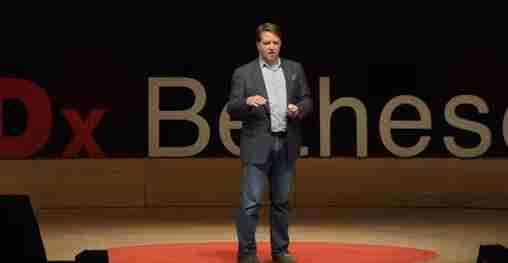
Read the full transcript of Matt Paxton’s talk titled “STUFFED: The Unintended Result of Our Attachment to Personal Belongings” at TEDxBethesda 2019 conference.
Listen to the audio version here:
TRANSCRIPT:
The Power of Music and Memories
1984, I was nine years old. I was in my bedroom in Richmond, Virginia, and this song was playing in my head. I was Danielson. I was the karate kid, I was ready to do the crane. Four years later, I’m in Morbius Middle School. My best friend Sean Harrington, we’re preparing for a track meet, and he hands me the headphones. He said, “This will get you pumped up.”
“Push it real good,” all right? I did not know that three women from Queens would change my life forever. A few more years, I’m walking into my dorm, first day of college, at Mary Washington College in Fredericksburg, and I hear this song at the end of the hall. I still don’t know that song, but I still sing it every time I hear it on the radio.
I eventually walked into that room, and I met Hilario Ellis, a guy that would eventually become my best friend, an investor in many of my companies, and the namesake of my third son. The cheeseburger, not the two bananas.
The Emotional Connection to Stuff
We’re talking about music here for a minute, because that music, man, it brings us right back where we are, right? And the music is about the memories. So I’m the guy from Hoarders, am I here to talk about music?
No, all right, I’m going to talk about stuff. I’m going to talk about a lot of stuff, but just like music, the memories attached to our stuff put us right back in a really happy place. If you don’t know me yet, I’m Matt Paxton. I am from that TV show “Hoarders,” man, I have seen it all, all right? I’ve seen everything from 300 cats to actually finding Babe Ruth’s baseball bats. I’ve been on Howard Stern, I’ve written books, I even got to clean out an office with Jimmy Kimmel.
But I have spent almost 20 years helping people deal with their stuff, at a very personal level. I’m in the offices, I’m in their homes, I’m going through their closets, I’m going through their memories. The one thing I’ve learned in my 15 years is the stuff actually holds us back. We buy the stuff because it brings us happiness, or we think it’s going to bring us happiness.
What I’ve found out is, just like heroin, anybody want to believe me on this, all right? It’s short-term gratification. It’s not long-term.
The Psychology of Hoarding
Let’s talk about my Hoarders. That’s a nice little level 5 Hoard, that’s a much skinnier version of me, I need to update that picture.
All my Hoarders, they’re good people, really good people. Bad stuff has happened to them. They’re looking for their happiness and self-worth in stuff, and it turns out they look for so much happiness, they’re trying to cover up that pain, and so they go to buy more stuff, and it doesn’t solve that pain. All it does is build up, and it actually holds them back from living. Most of my clients, they’ve lost their jobs, they’ve lost their spouses, they’ve lost their homes, they’ve lost everything in hopes that they would get it.
I actually had a lady, she collected yarn, skeins, right, not scones. Scones you eat, skeins you knit, and she had 8,000 things of yarn in her house. She did it because she made blankets for babies, and she’d give them away, and people would say, “Oh, you’re the best, thanks,” and they’d give her hugs, and they’d say, “I love you, awesome.” So she started buying more yarn, because the more yarn she bought, the more blankets she made, the more love she received. The problem was, she couldn’t give those blankets away fast enough, and couldn’t make them fast enough, and she actually lost her house because she had so much yarn, and it actually was the mice that were living inside the yarn that was the problem.
Generational Differences in Stuff
Now I work with my downsizing seniors. This is our grandparents, their stuff represents decades and decades of hard work, and their self-worth and happiness comes from passing it back down to the next generation. The dining room is a great example of this.
Our grandparents, my mom and my aunt fought over who got the china cabinet. The grandkids were fighting over who has to take the dining room cabinet. The problem with all that stuff is, I think we got a bunch of millennials in here, nobody wants it, nobody wants any of that stuff. And I’ve learned is the reason our parents held on to the dining rooms, well, it’s because their families, their time with their family, their loved ones, their happiness, their self-worth, it started in that dining room. But now, ours is in the family room, or it’s in a car, or it’ll go on vacation somewhere else.
Many of my senior clients now, they actually can’t move out of their house, because they’re dealing with their stuff. How many of you have your adult children’s stuff still in your house? How many of you still have your adult children in your house? It’s kind of a thing, all right?
And a lot of my clients can’t move, because they’re holding on to that stuff, they’ve become storage units. Then there’s Gen X, that’s me. And we’ve spent a long time trying to buy everything for our kids. We work so hard to provide everything for our kids: cars, schools, camps, toys, clothes, books.
Man, I spent $900 on a cell phone the other day. Would my grandfather spend $900 on a cell phone? Not a chance. He would literally spank me for doing so, all right?
My self-worth comes from buying all that stuff.
And so I go to work, and I work really, really hard to get as much money as I can to buy those things. It becomes a pretty bad cycle, because I work hard, I buy things, I miss the things with my kids, and I feel bad for not being there, so what do I have to do? I’ve got to buy more stuff, and it’s a vicious cycle, all right?
The True Cost of Stuff
It turns out our kids don’t want that stuff. They say they do, but I found this the other day. This was a note that my son had drawn. It’s actually in his feelings diary, and it said, “lonely,” and he wrote, “Will someone please play with me?”
My son asks me that every day. I said, “Buddy, I’ve got to finish this email. Just let me finish this real quick.” And I even justified, “Buddy, we can’t live in this awesome house, I can’t buy you all these things if I don’t work here, so I’ll be there in a few minutes.”
And I pass off my kid to work. So is the stuff holding us back? Yeah. Everywhere.
Solutions for Decluttering
All right. So, how do we fix it? I can give you a lot of things, but it’s real simple. Less stuff equals more time, right?
More money, more problems, okay? Ninety-nine problems and my stuff is one, okay? So I need to keep going. All right, there’s a couple ways out there that we look at.
Do the items spark joy? That’s a very popular method now. And that does work for a lot of people. That’s great. But for me, my seniors, and my hoarders, this doesn’t work, because the problem is, all of it sparks joy. That’s why I bought it, okay? That’s like saying, which Cheez-It do you like? I like them all, all right?
Minimalism has actually come a long way. I was really against it at the beginning, but the more I study it, man, it’s got some real beliefs in there, all right? Their core belief is having less stuff leaves room for more experiences. And I believe that’s true.
Theory, on paper. I love it. But I got to get rid of my other stuff, and that’s hard. All right, how about I just go cold turkey? I’m going to get an RV. I’m going to move out to California. I’m going to live on an organic farm. I’m going to get rid of all of it.
We think about that every once in a while. That’s not realistic. We live in America. We buy stuff. That’s what we do, all right? And then we judge people for did or didn’t buy the stuff, okay? So what do I believe in? Use it or lose it.
It’s a really simple philosophy. If you actually use it, keep it. Because if you don’t actually use it, guess what? You’re going to lose it.
And I don’t mean lose it physical item. I mean lose it mentally. I got people that are losing time, money, space, relationships, and opportunities every day because they’re holding on to this stuff. So what are our tips?
Practical Tips for Decluttering
Well, first, man, you just got to get started. I struggle with weight, clearly, all right? This has become an issue for me in my life. I’ve gained 50 pounds over the last five years.
Did I do it overnight? It took me five years. One cheese at a time, all right? And you can’t clean your house that you’ve been in for 30 years in a weekend. That’s not realistic. You can go 10 minutes. That’s realistic. You can do it.
I call it a 10-minute sweep. You can clean for 10 minutes every night, five nights a week. Could I go walking for 10 minutes a night every night? I should, yeah. I could. I don’t. So I acknowledge the challenge of that, but you can. And this is how you get started.
10-minute sweep, one foot by one foot area. That’s it. You can do that every night, all right? I want you to get brutally honest with yourself. This is my closet. Over there on the right, those are size 28. As we move left, I go from 28s to 30s to 32s. I got a long run of 34s.
And I got three pair of 36s. I’m wearing one of them right now. All right? Three of 30 pants fit me.
That means 90% of the pants in that closet do not fit me. Can I get rid of some of those jeans? There’s a pair of black stonewashed jeans I got with a Bell Biv DeVoe T-shirt, and it was cool back then. They have gone from being cool to not cool to ironically cool to not cool again, all right?
It’s time to get rid of those. All right, now I’m using humor on purpose, because if you don’t use humor when we’re talking about stuff, it can get really depressing. I got families that break up over this stuff, all right? And you’re all laughing because you all got a closet like this.
That’s what guest room closets are for, all right? Last one, well, second one is donate. Donate, donate, donate, donate. This is my belief.
If you got here today, if you’re watching this at home, guess what, your life is better than a lot of people, all right? You can donate. I promise you I’ve been working with seniors for a very long time. Every one of my clients would rather, when given the opportunity, they would rather give something away than sell it for their own money.
And I had a lady, her husband was a master carpenter in the 40s, 50s, and 60s. And we’re cleaning out his tool shed. Now, these are not regular tools that you and I get at Lowe’s, all right? These are masterful things.
And we had an offer of about $30,000 for that tool set. And her kids really wanted to take it, because I don’t care who you are, that’s a lot of money. And she said, “Matt, I don’t want to sell it. He had an apprentice.
My sons don’t know about his apprentice down the street. And it’s a really nice guy, and he and his wife are starting a family, and they don’t have any money. What do you think? Can I give this stuff to them?”
I said, “Ma’am, it’s yours. You do whatever you want to do.” And she said, “I’d like to be there when you give it to them.” And man, it was like a TV show.
The baby’s crying, the mom is crying, the husband is crying, and it changed, it literally changed his life forever. That is worth no money. All right? There’s no amount of money that’s as good as actually giving that away.
Just donate, donate. Last one, paper. Bills, books, cards, pictures. I got three young sons.
I got a lot of mediocre art coming home every single day. All right? It’s fine. It’s okay. But it’s not. He ain’t going to be an artist. All right? But it’s too much.
All right? It’s all memories. Pictures are the hardest. I’m telling you, stuff is attached to memories. The reason we can’t get, most people inherit photo albums. You know, I find pictures from, I live in Richmond, and I found a lady, she had like three carousels full of slides from a trip to Virginia Beach in 1984. So what? Right?
But we feel an obligation to go through all that stuff. Most of my clients that are moving, downsizing and moving, they say, “I’m happy to move, I’m ready, just got to go through all the pictures real quick.” Right? I say take the pictures.
Best rule on the pictures is if you don’t know the name of anybody in that picture, I think it’s fair to go. All right? Because a lot of times, your parents are the last ones that knew who was in the picture. Right?
If you are the last person that knows who are in the pictures, then this is the tip for you. Keep 20 pictures. That’s it. I get a Ziploc gallon bag, and I put 20 pictures in there.
And I want them to be old pictures. You see this lady? That’s someone’s grandma. She’s hot. She’s smoking. She’s hanging out with someone that’s not grandpa. That’s the story your grandkids need to hear. Not the one of you holding your purse at the zoo yesterday.
All right? This actual picture, I had a client where we were showing it to her granddaughter. She’s like, “That’s not grandpa. Who is that?”
She’s like, “Oh, that’s Fernando.” And I’m like, I want to know more about Fernando. All right? And she’s like, “You know, I was working at MIT.
I was an art professor.” And her granddaughter’s like, “You worked at MIT?” And that’s how that daughter found out that her mom was a professor at MIT. The pictures hold the stories.
And the stories are what matter. But if you don’t tell the stories, that’s why you got to hold on to the stuff. All right? So what’s visionary about this?
Finding Balance as an Entrepreneur
Well, I’m a lifelong entrepreneur. Since I was 23. 20 years I’ve been an entrepreneur. I’m tired, man.
I’m really, really tired. And I’m looking for energy to keep going. I got another 20 years of this. And it’s exhausting.
And I found a new thing. Balance. I’m not particularly good at it. But what I found is the stuff is what distracts me as an entrepreneur.
When I’m looking at buying a car, when I’m looking at buying a farm, when I’m looking at something else, you know what I’m not doing? Working on my business. And I’m not working on my family. So I’ve learned the money that we make, we get it all to go buy stuff.
Well, me buying stuff is holding me back from making more money. More money, more problems. All right? Now, can I put the phone down and say, I’m never going to check my email after five again?
I’m not going to answer the phone. No. We’re in a global economy. Sorry. You’re going to be hustling if you’re an entrepreneur. It’s just the way it is. All right? So that’s not realistic.
All right? Now, what is realistic? Use it or lose it. All right?
Now, what do I do? I’m going to clear my physical space and my mental space. All right? I do put the phone down at night. I go to bed earlier now so I can get up. I used to stay up really late and do emails until two or three in the morning. And I always somehow watched like a Fast and the Furious 6 somewhere along the way there. Okay?
Or Goldberg, that loses me. I’m gone on that. All right? Here’s the deal. You can put your phone down. You can wait to answer emails in the morning. Every minute, you can. When my son says, “Hey, can we play?”
The answer needs to be yes. All right? We now have a one-uno rule. Anytime my son says I want to go play, great. We play one game of uno. And guess what that does? It gives me a little more balance. It gives me a little more time.
And when I’m hanging out with my sons, guess what I don’t need to go do every month? Go buy a bunch of stuff to make up for the time I’m not there. All right? Be selfish with your time and be really specific because when you say yes, you’re creating the memories.
You’re creating the time for your kids to have 13 years from now when you’re way gone. Because when I hang out with my boys, I need to be doing some karate chopping. I need to be blasting my 80s rap in the car and I need to be singing a ridiculous song as loud as I can because that is what gives me my balance and my time with my boys. Thank you, guys.