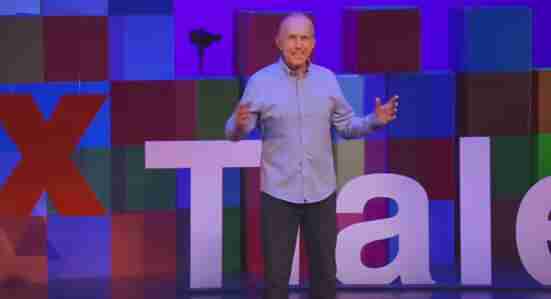
Read the full transcript of Dave Osh’s talk titled “Overcoming Bias to Unite Our Divided World” at TEDxTralee 2024 conference.
Listen to the audio version here:
TRANSCRIPT:
DAVE OSH: Have you ever dated someone who wasn’t quite what you expected? My wife did. Here’s what happened. I started dating online in 2005 and I took it very seriously. I wrote a long dating profile as if I were looking for a Nobel Prize laureate in literature. After editing this masterpiece a hundred times, I finally clicked the submit button. And then nothing. Even after a few days, I didn’t get it. I really put myself out there.
It took a few weeks until I received a wink from an American woman named Ainsley, living in the jungles of Borneo, Malaysia. Of all places. The problem was that I couldn’t date her in Malaysia due to my Israeli citizenship. So after three months of chatting on the phone, Ainsley came to meet me in Singapore.
I was waiting for her in a shopping mall and saw this beautiful woman walking in my direction. I gave her a huge smile, but she ignored me and continued walking. I called after her. “Ainsley, I’m Dave.” She turned to me and looked up. “Hey, you’re much taller than I expected.”
Over dinner, I discovered I had made a mistake converting my height from meters to feet on a dating platform. I made myself five inches shorter. Ainsley had to overcome a subtle prejudice about dating a shorter man. It was an unforgettable moment in which I learned to always under promise and over deliver. After eight months of long distance relationship, we moved in together, married two years later, and lived happily ever after, experiencing many other funny cultural misunderstandings.
The Nakba Discovery
Until a few years into our marriage, Ainsley told me, “I’m watching a documentary about the Nakba. It means catastrophe in Arabic. How come you never mention it?” “What? Nakba? Dave? Are you joking? You’re an Israeli. That’s your history. The expulsion of Palestinians in 1948.”
I thought we were losing years of trust in just one minute. But I didn’t back off. “Look, the Palestinians were not expelled. They left voluntarily during their wars. Arab countries started trying to prevent the establishment of the state of Israel.” “Dave, just watch it.” And I did.
I was glued to the screen for an hour, watching thousands of Palestinians dispelled at gunpoint. I was shocked. I knew only one part of history. The part that tells how the Jewish people return to the homeland after 2000 years in exile.
I became obsessed about learning the other side. And the other side was that Palestinians were already in Palestine for many years. The more I learned, the more I realized how my family, schools, and the media shaped my values, beliefs, and behaviors.
Cultural Conditioning
Well, aren’t we all subject to cultural conditioning? Of course. But I was indoctrinated to see Palestinians, Arabs, and even the rest of the world through a discriminative lens of Jewish religion, history and nationalism. There’s a difference between education and indoctrination. Education teaches us how to think. Indoctrination teaches us what to think. And I was indoctrinated.
The Nakba was a taboo in Israel. My history books never mention it. Instead, I learned a lot about existential threats. There were two mantras I heard many times when I was young. “Arabs hate Jews and they want to throw us all into the sea.” It was, and it still is, us against them. And this narrative led me to serve 20 years as a fighter pilot in the Israeli Air Force fight unnecessary wars and dismiss everything outside my culture.
Religious indoctrination played a major role in my cultural conditioning. It created discrimination that led to division similar to the conflict in Northern Ireland. The troubles, where the Protestant majority limited the rights of the Catholic minority. Such discrimination in both Palestine and Northern Ireland generated social divide, resistance and violence.
I visited Belfast recently. The scars are still visible 26 years after the Good Friday peace agreement bridged the gaps and ended the violence. Also, look around the world. Our society has become more and more divided. We have polarised in so many aspects of our lives such as immigration, climate change, and economic inequality. And it all starts with cultural conditioning.
Behaviors Shaped by Cultural Conditioning
It shapes our behaviors in different ways. Here are just three examples:
- The first one is controlling. Some of us tend to get things done in a certain way. It’s my way or the highway. I’m obsessed with putting food containers in the exact same place in the fridge. Ainsley drives me nuts when she moves them around. Isn’t that weird? I know, but guess what? My parents were the same. They resented people who did things differently than them.
- The second one is judging. Some of us tend to criticize other people’s points of view. We argue endlessly to prove that we are right and they are wrong. We need to outsmart everybody to feel good about ourselves. If I earn a dollar every time I thought someone was an idiot, I could have retired many years ago.
- The third one is pleasing. Some of us tend to avoid conflict and stay passive in disagreements. We are afraid to challenge authority or group norms. We don’t want to risk the relationship by rocking the boat.
You see, cultural conditioning shapes different behaviors like controlling, judging, and pleasing. More importantly, it also shapes our worldview, the lens we see ourselves, others, and issues. I wish I had known it earlier.
Breaking Free of Cultural Conditioning
After giving up my Israeli citizenship and becoming a Singaporean, we moved to Malaysia. Yes, the country I couldn’t even visit before. I started traveling to Middle Eastern countries, doing business and making friends with people I had previously considered enemies.