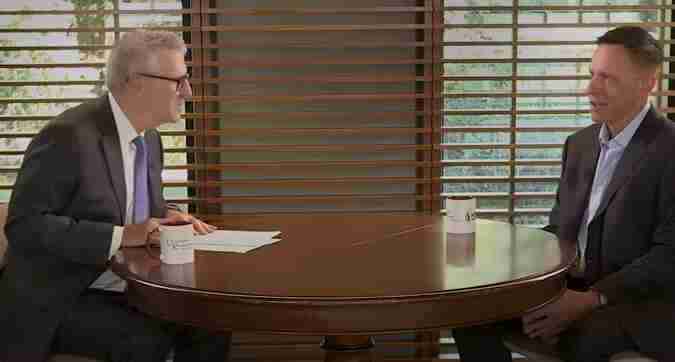
Read the full transcript of Uncommon Knowledge 2024 episode titled “Apocalypse Now? Peter Thiel on Ancient Prophecies and Modern Tech” which was recorded on October 8th, 2024.
Listen to the audio version here:
TRANSCRIPT:
PETER ROBINSON: Welcome to Uncommon Knowledge. The End Times, Armageddon, the Antichrist. If you suppose the only people who take those concepts seriously are snake handlers and the hollers of Kentucky, think again. Peter Thiel on Uncommon Knowledge now.
Welcome to Uncommon Knowledge. I’m Peter Robinson. Peter Thiel earned his undergraduate and law degrees here at Stanford. He was a co-founder of PayPal, the firm that all but invented FinTech, the first outside investor in Facebook, the firm that all but invented social networks, and a co-founder of Palantir, the firm that all but invented defense tech.
Although he’s staying out of politics, this year, Mr. Thiel has had a hand in launching the careers of a number of political figures, including J. D. Vance. Mr. Thiel speaks often on philosophy, religion, tech, and society in forums as diverse as the Cambridge Union, the Aspen Ideas Festival, and the Joe Rogan Experience. You gave Joe Rogan three hours. Peter, it’s about time you came back.
PETER THIEL: I was trapped for three hours there.
The End Times
PETER ROBINSON: Peter Thiel on The End Times. Today, by the way, this is going to be episode one of two, our first conversation on this very large topic. Peter, two quotations.
Matthew 24:35-36, quote, “Heaven and Earth will pass away, but of that day and hour no one knows, not even the angels of heaven,” close quote. Peter Thiel, we don’t know the day and the hour, but maybe we can guess the century. Explain yourself.
PETER THIEL: Well, man, you know, this is a very broad topic. It’s in this larger question about the extraordinary history of our time. The modern world, maybe Renaissance onward, has been this world of ever-progressing scientific and technological development. And there is this very profound sense that there are things that change, the dimensions of technology, military technology, communications technology, where things are not timeless and eternal. There was a gunpowder revolution in the 17th century, and that changed the social structure and the political structure.
And there is a certain arc to history. It’s not just technology, but it is a driver. And certainly, and again, many different ways of getting at this, but there certainly are dimensions of the technology that have become extremely powerful in the last century or two that have an apocalyptic dimension. And perhaps it’s strange not to try to relate it to the biblical tradition.
Nuclear weapons can rain down fire and brimstone and destroy the world. And then we have a biblical tradition that maybe doesn’t say that this is inevitably going to happen, but that something like this might well happen if humans are left to their own devices. Should we at least be asking questions, figure out ways for these things to inform one another?
The Role of Universities
PETER ROBINSON: So obviously, we’ll come in a moment to the analyses, to the signs of the times. But first, a moment on why you’re asking these questions. And as I understand your argument, Peter, you feel you need to ask them and to prompt a conversation, at least in part, because universities won’t, which is odd in some ways. The biblical framework, these texts may be 2000 years old, but they’ve informed Western civilization and taken up the time of scholars through these centuries. It has been an understanding in Western culture, Western culture at least, that history is going someplace.
And if there is an endpoint, no matter how far off in the future it may be, we’re closer to it now than we were 2000. All right. So all of these seem to me plausible, valid, and serious questions. Why are universities ill-equipped to grapple with this?
PETER THIEL: Well, that’s very over-determined. But certainly, there’s some relationship between the university and the universe. It is supposed to somehow, in its ideal form, in its early modern 17th, 18th century form, the university was supposed to represent some kind of integration of knowledge across a lot of disciplines where they all would fit together. And for a variety of reasons one can cite, this has broken down over time.
There are ideological reasons, but maybe there also are practical reasons where the amount of knowledge became too great for any single person to master. And then you had division of ever narrower sub-disciplines. Adam Smith has this metaphor in the 19th century of a pin factory, manufacturing pins, and there are 100 people in the pin factory, and they’re all doing different things, and nobody knows how to make a pin anymore. So it’s efficient, but it’s this hyper-specialization.
And there’s probably been an analog to that on the university side where maybe someone like Goethe could still understand something about everything, or Hilbert, a great mathematician around 1900, could still understand all of math. And he would set these 25 problems for the 20th century for mathematicians to solve, in some ways, set the agenda for the field of mathematics. And even as rigorous a subject area as mathematics, in some ways, has devolved into something close to literary theory where, you know, one mathematician doesn’t know what the other one’s doing, and it’s sort of these very incommensurate modes of discourse, and anything that has to do with making sense of the larger whole has gotten badly lost. And I thought for a long time that we need to ask a variety of questions about the larger whole.
You know, one kind of a scientific and technological question is simply, are we still progressing as we were in early modernity? Are things, by whatever metric you choose, are they getting better? Is life expectancy going up? Is the GDP increasing? Is the quality of life by various metrics going up? Are we going faster? You know, we’re moving from planes to supersonic planes to space planes.
And that seems like a very basic kind of macroeconomic question, incredibly hard to ask, but surely an important one.
And then, you know, there are, and I’ve spoken about this in many other contexts, but my intuition is that in many places there’s been relative stagnation, the hyper-specialization disguises a certain type of decadence. We have these narrow experts saying how, you know, wonderful they are, the cancer cell people sell it. Cancer researchers say they’re going to cure cancer in the next five years, and the string peoples say they’re the smartest physicists and they know everything, but maybe it’s just some weird academic power game where they’re blocking everybody else, and on and on. And so there is, you know, even before we get to the big question of history, there’s a question just of, you know, the history of science and technology.
It progressed a lot. Maybe it’s progressing more slowly. Why has that changed? What’s going on there?
PETER ROBINSON: You said, so fragmentation, hyper-specialization in the university, the feeling of kind of disintegration into silos, that’s one aspect of it. Another aspect of it, I’m checking this, and this is the form of a question, is whether an extreme rationalism maybe emerges from that specialization or maybe informs it. But I’ve heard you say, I’ve got a quotation here from you, “under the rationalist view, you can’t even talk about the end of your own life, let alone the end of the world.” That there’s something about the regnant view, I’m trying to resist the word ideology, because ideology isn’t quite the right, but the way the university conducts its business rules out questions of life, death, sin, redemption, the meaning of history.
And yet those are the, so what I’m trying to get at is special, hyper-specialization, yes. Is there also something else, something about the sheer, the regnant view that makes it very hard for universities to grapple with big questions?
PETER THIEL: Yes, they seem hard to grapple with it. Why is probably harder to say? Certainly, if we do something like the radical life extension project, you know, people in the 17th, 18th centuries were very optimistic about it. Benjamin Franklin, Francis Bacon, you know, you had all these ideas that you could extend human lifespan by centuries. As late as the late 19th, early 20th century, there was a movement called Cosmism in the sort of, around the time of the Soviet revolution, 1920s Soviet Union. And it claimed that for the revolution to succeed, you had to physically resurrect all the dead people using science.
And it was workers of the world unite, and to sort of get with the times, their slogan was dead of the world, unite. And then, of course, they didn’t make much progress on this. And then at some point, by the time you get to Stalin and the show trials, and the death seemed to be going up, not down. But there was a moment when they thought it might even be possible.
There was an incredible ambition and incredible energy to modern science. It was perhaps downstream from Christianity. If the promise of Christianity is a physical resurrection, then science could offer that too. It was a possibility. Maybe it was a rival to Christianity. You know, you don’t need Christianity if we can do it through science. And then there is a strange way that the project in many dimensions feels very exhausted, even though, of course, people still genuflect to science. They believe in science with a capital S.
But the ambition has been really beaten out. If you look at the individual scientists, it’s sort of, it’s much less of this sort of heroic, you know, bold figure breaks with dogmas and thinks for him or herself. And it’s much more, you know, in late modernity, you’re, I don’t know, you’re just a robot in a, you know, ever smaller talk in an ever bigger machine or something like this.
The Apocalypse
PETER ROBINSON: Right. This notion of the end of times in the biblical framework, Rene Girard, Rene Girard, an important figure here, professor of French literature here at Stanford, but also a theologian. I think it’s fair to call him a theologian and philosopher, wrote very, very widely, although that was outside his Stanford work. You became friends with him. It happens that he was a neighbor of mine. We both knew Rene.
All right. Rene Girard in 2009. Few still talk about the apocalypse. The apocalypse, of course, is the word referring to the destruction or end of the world, as described in the book of Revelation. Rene: “Few still talk about the apocalypse. And they usually have a completely mythological conception of it. Strangely, they do not see that the violence we ourselves are in the process of amassing and that is looming over our own heads is entirely sufficient to trigger the worst,” close quote.
So there we come to the first question about how you understand these things. The apocalypse, as presented in the biblical framework, as symbols of spiritual realities or the apocalypse as a plain prediction about how the world could or indeed will end.
PETER THIEL: Yeah, it’s, let’s see, it is the way Girard would have put it and the way I came to see it as well, was it in some sense, the apocalyptic prophecies are just a prediction of what humans are likely to do in a world in which they have ever more powerful technologies, in which there are no sacred limits on the use of these technologies, in which human nature has not, you know, maybe not gotten worse, but has not gotten better. And it has this sort of, you know, limitless violence aspect to it.
And I think Girard had all these sort of provocative formulations, like it is just a scientific prediction of what humanity is likely to do in a world of ever more powerful, ever more powerful technology. And then, you know, there sort of are all these different things when we say in terms of the biblical apocalyptic accounts, but Girard was very skeptical of the idea that somehow the violence came from God. And he always thought that, you know, atheists and fundamentalists disagree on the secondary and relatively not so important question of whether or not God exists. But they agree on the far more important question that one of God’s attributes is violence.
And so the violence comes from God. And this is, you know, this is the new atheist.
PETER ROBINSON: In the evangelical view, the destruction of the world is God exercising justice on the world.
PETER THIEL: It is. Yeah, right. It’s some version of justice, anger, wrath, some version of the anger, wrath of God. And then, you know, the atheist one’s a little bit stranger because you don’t really believe God exists. But still, it is somehow, you know, it’s not humanity. Humanity, you know, is not that dangerous, at least in sort of the mainstream, you know, Lockean, Rousseauian accounts.
PETER ROBINSON: So you’ve made the point, I must admit, I’d forgotten this. You’ve made the point that Rene used to observe that the church, the Catholic Church in its liturgy and in homilies used to make quite a lot of the end times and warn people to prepare for judgment and so forth. Up until 1945, when the church seems to have decided to go easier on that because people needed comfort more than exhortation about the end times. Obvious point. What happened in 1945?
PETER THIEL: Well, we got nuclear weapons and the stuff became real in a way that seemed completely implausible in the 17th, 18th century. I mean, when people were writing about these things in the 18th, even 19th century, it was the idea that the world was just too big a place.
It could not possibly be destroyed. We didn’t believe God would do it. We no longer believe that God was so violent that God would do it if he existed. And then the technology was getting more powerful, but it didn’t quite seem possible to do something on a worldwide scale.
The Napoleonic wars are quite violent. World War I is significantly worse, but it’s still somehow localized. It’s not the whole planet. And then there is something that gets released with nuclear weapons and maybe even more with thermonuclear weapons. And then you end up building not dozens, but thousands and thousands of them in the 60s and 70s.
PETER ROBINSON: Rene’s point that the apocalyptic literature correctly read is simply a prediction of what human beings will do to each other suddenly becomes, up until 1945, quite a minute, how could human beings possibly be responsible for the end of the world? And after Hiroshima and Nagasaki, the answer is only too obvious.
PETER THIEL: There’s liberal theologian writing in 1780, the argument for why you should read apocalyptic literature is because occasionally you get these millenary movements and people go crazy. And it’s worth reminding yourselves of the madness of crowds. And then the secondary reason you can read it is for your amusement. And that was sort of the enlightenment optimism circa 1780. And there were, of course, all these incredibly scary ideas.
The Antichrist would kill so many people, he would come with a crematorium to burn the bodies of all the people he killed. And it was just this sort of war of medieval notions people had. And of course, then after the end of Hitler in 1945, this stuff just wasn’t so funny anymore. And then Gerard’s intuition was that it’s almost like when a knowledge becomes too real and too close, it’s like some, I don’t like psychological repression or something like this, but you want to sort of steer away from it.
PETER ROBINSON: We can’t bear to look at it.
PETER THIEL: We don’t want to talk about it quite as much. We need to reassure people, we need to tell people this is not really what it’s about. And of course, there were all these strange elements of the mythical that were brought in. It was named after all these terrible gods from ancient Greece, with Saturn, the god who ate his own children, and Zeus throws down thunderbolts, and we have fire raining down with Jupiter rockets from the heavens. There was this strange return of the mythical in this very, in the equations of the physicists.
The Threat of Advanced Technology
PETER ROBINSON: Development since 1940. Again, Rene, “the violence we ourselves are in the process of amassing.” So development since 1945, two quotations here. Sir Martin Rees in his 2003 book, “Our Final Century.” There’s a cheerful title for you. “The nuclear threat will be overshadowed by others that could be as destructive and far less controllable. Advanced technology will offer new instruments for creating terror and devastation. Instant universal communications will amplify their societal impact.” This is over 20 years ago. “Disastrous accidents, for instance, the unintended creation and release of a noxious, fast-spreading pathogen are possible. I think the odds are no better than 50-50 that we will survive to the end of the present century.”
Quotation two, Revelation 16:16, “and the demonic spirits assembled the kings at the place that in Hebrew is called Armageddon.” I want to get the word Armageddon in here, because you use it. It’s important in your analysis.
Okay, so the notion is the idea of some kind of final cataclysmic event. Revelation tells us that in a book written some 2,000 years ago. Martin Rees’s book is written 21 years ago, and it’s all entirely plausible.
PETER THIEL: Sure, and I think there is a way we can come back to this in describing all of this in a much more rationalist, non-theological way. So you can talk about existential risk, and there is existential risk of nuclear war. There’s existential risk of bio-weapons or dangerously engineered bio-weapons, maybe of AI and killer robots or autonomous weapon systems guided by AI. There is existential risk around the environment, maybe not just climate change, but maybe there’s all sorts of other dimensions where there’s some argument. We have one planet, and you want to be a little bit careful and not mess it up totally.
Artificial Intelligence
PETER ROBINSON: Peter, on AI, I’ve never had a chance to just put this one to you. I’ve never, I don’t know as much about it as you, obviously, but I’ve been aware of a technology that was so polarizing from the get-go. There are plenty of people who say, calm down, AI is going to lead to one medical breakthrough after another.
It’ll produce such abundance that we don’t need to worry about jobs. We’ll be able to provide for our pets one. And then, of course, there’s this other strain that will have military, well, here, Henry Kissinger. I found this good quotation from Kissinger’s last book, which he wrote with Eric Schmidt. Quote, “if you imagine a war between China and the United States, you have artificial intelligence weapons. Nobody has really tested these things on a broad scale, and you can’t tell exactly what will happen when AI fireplanes on both sides interact. So you are then in a world of potentially total destructiveness,” close quote. And your view, how are we to understand AI?
PETER THIEL: Well, partially it’s unknown. It can mean a lot of different things. It’s poorly defined. AI can mean the next generation of computers, the last generation of computers, anything in between.
You know, I think the classic definition of AI was something that passed the Turing test and that could fool you into thinking it was a human being. In some sense, that had not been passed, but was passed by ChatGPT in late 22, early 23. And so that is a pretty significant development.
PETER ROBINSON: Does it feel like an inflection point as important as 1945?
PETER THIEL: I think it’s on par. Let’s say in the computer world, I think it’s on par with the internet in the late 90s. And then there are so many different ways it can be applied that it’s, you know, that are good and that are dangerous that it’s hard to know how to quite weight them all out. But if I had to score the Silicon Valley debate, I’m not on the Luddite side.
I always try to be more on the pro-tech side. But if I had to score it as a debate, I do believe the effective altruists are winning the argument. And the argument is something like there are a lot of dangerous corner cases with this technology and we should be really careful. We don’t quite know how it’s going to work. Maybe it doesn’t become a godlike intelligence, which is some of the sort of futuristic transhumanist nonsense.
But it could just be this autonomous weapon system on a drone where we want to make them autonomous because if you have a human in the loop, the human gets jammed. So there’s a logic to a lot of these things where, and then the aspects of it become more first strike type weapons. And there’s some kind of crazy arms race between the US and communist China.
Then how does this affect that arms race and change it? So there are sort of a lot of questions like that. I would say the larger existential risk point that I’ve always made is that there’s a way in which the people who are worried about these existential risks, and you can also criticize them and criticize them for being Luddites and et cetera, but you can also criticize them for not being apocalyptic enough because most of the time they’re just focused on one. It’s like the nuclear weapons people are still just talking about nukes and Greta, it’s just the climate.
She’s not worried about AI and she’s not worried about nukes and much less the COVID virus that was bioengineered in the Wuhan lab or something like this. I’ve often thought you should get all these people who are worried about existential risk in a room and they have to fight it out and decide which ones really matter and how to prioritize them. And in some sense, the scary answer is there’s some truth to all of them.
And then if we were to do that exercise fully, what I would want to do is I would also like to throw in one more existential risk that in my mind is as big as all these technological risks of nuclear war and runaway bioweapons and weaponized AI with autonomous weapon systems. And that’s the risk of a totalitarian one-world government. And again, like with all the other existential risks, it’s hard to know how to measure these things probabilistically because we only have one world. Once you get a totalitarian one-world government, you can’t reverse it.
And then the reason I like to throw that risk in is that it seems to me that the implicit solution to existential risks of all the other sorts is to lean in to a sort of very non-democratic one-world state that will highly regulate and stop these technologies. And if Greta gets everyone on the planet to ride a bicycle, maybe that’s a way to solve climate change, but it has sort of this quality of going from the frying pan into the fire.
The Slowing of Progress
PETER ROBINSON: Right. Again, if I understand your argument, this is already clear in the way we lead our lives in this slowing of progress. Now, this seems to me is worth dwelling on because it shows that the fear is real and has genuine effects in the way we all lead our lives, but we have to spend a moment or two defining it.
So if I may, let me start with a quotation from you. “There has been a narrow cone of progress around computers, the internet, and maybe now artificial intelligence. But if tech means producing more with less, then we should be seeing dramatic economic progress. We don’t. The millennials are not dramatically better off than their boomer parents,” close quote.
Okay. So you mentioned it a moment ago, but return to this notion of slowing technical progress, this great disappointment by contrast, what we see around us today, what we feel around us today, by contrast with a century or so ago.
PETER THIEL: Or even late 60s.
PETER ROBINSON: Yes, yes.
PETER THIEL: Star Trek, the sort of optimistic science fiction of the 50s and 60s, where we’d have flying cars, you’d have supersonic aviation everywhere, all sorts of cures for diseases. And yes, there was an incredible amount of progress in this world of bits, much less in the world of atoms. I always think a lot of what we do is embedded in this physical world of atoms. And so when that slows, that’s definitely felt as quite stagnant.
The question I always then get at, and then you get into endless debates, is this true? Or is there still a lot of progress? How would one measure it? I tend to measure it in things like these economic terms and the way that the average millennial is having a tougher time than their boomer parents at the same point in life. And so at least there’s something, even if we’re not completely stuck, it’s in some sense not really moving as fast as it used to. And then there’s always a question of why this is, and why questions are overdetermined. And as a libertarian, I always like to say it’s too regulated, and the FDA regulates the drugs too much.
If you regulated drugs, if you regulated video games like the FDA regulates drugs, we’d still all just be playing Pong. And so there’s a libertarian anti-regulatory thing. There is an argument that the schools aren’t teaching people, and they’re not teaching people to be scientists. Some of the educational institutions are broken, this sort of an anti-liberal argument.
Some truth in all of this. There is a Tyler Cohen argument that somehow the low-hanging fruit was picked. There was a bunch of easy discoveries to make, and now nature’s cupboard is kind of bare, and you have to reach really hard to make a modest discovery. And maybe that’s true. Maybe that’s just sort of a self-serving excuse of baby boomers who didn’t do as much as the generations that came before. But it is very striking. One way to quantify this, even if we say the rate of progress in broad fields is the same as it was a hundred years ago, not that it’s slowed, but even if we say it’s the same, if you think of PhDs, there are probably a hundred times as many PhDs today as there were in, say, 1924. And so it’s the same rate of progress.
And the average PhD is 99% less productive than people were a hundred years ago. And that doesn’t seem like a very healthy scientific ecosystem. So there’s some sense that maybe it’s slowed. But the overarching explanation that I’ve come to think is a very important one is just this idea that in some way, science and technology were this trap that humanity was building for itself, that there were these apocalyptic risks, and maybe going very slow was better than racing towards Armageddon.
I was born in 1967. I always often express frustration that I’m stuck in these office buildings or houses that are decades old. There are all these parts of our society that feel lame, slow-changing, low energy, low testosterone, nothing is going on. And then I do wonder if we were in a Judson’s type world, we might not even be sitting here to talk about it.
It might have self-destructed by that. If you had a JFK as president on amphetamines going mano a mano with Khrushchev, it worked. In 1962, it would have worked every time.
PETER ROBINSON: So by the way, I didn’t make a note of this, but someplace I saw you say that Facebook had 10 years of good press. In other words, 10 years of optimism before the project curdled in the public mind, and that AI went from good to bad in about a month. This loss of optimism.
So I have a quotation here, “there are many explanations for this deceleration in tech,” this is you, “but the explanation, I believe, tech got scary. We’re leery of it now. We’re not embracing it in the way that we used to.” Add to that the notion that, again, I’m thinking this through, but I’m putting it to you as a question. This isn’t the way things were supposed to be when the Cold War ended.
PETER THIEL: Sure.
PETER ROBINSON: Right? Sure. Russia was supposed to work. There was a democracy and free markets. And instead, we have this crazy man, Putin, invading Ukraine. By now, there should have been at least some kind of rudimentary peace in the Mideast. Perhaps the most striking contradiction of what we expect was that by now, China was supposed to be democratic, it was supposed to follow the pattern of South Korea and Taiwan, where first you have economic growth and economic growth creates expectations, including expectations of freedom, free speech, and these countries become democratic. China was supposed to follow that.
Things are not going the way they were supposed to. Add to that our own sense of polarization in this country, that this country somehow, and there’s just a lot of feeling of it’s subjective. It’s very difficult to get at, but it feels to me as though there’s a lot of free floating dread. And it’s hard to articulate.
PETER THIEL: Very hard. I’ll give one example and you can think about this what you will, but a lot of my conservative friends are very critical of Fauci and all the lockdowns and the masks and the social distancing and the vaccine that didn’t really work. And on the surface level, these critiques are, I think, quite legitimate. It was not the correct protocol for some kind of flu.
It was, however, roughly the right protocol if you thought it was a bioweapon. And if you think it’s a very dangerous, humanly engineered bioweapon, those are roughly all the kinds of things that you might do. And so the kind of critique I have of Fauci is that, yeah, that’s what he was scared of, I think. That’s why I steel man him, give him the benefit of the doubt.
And then the real critique is that you weren’t supposed to infantilize our population and not talk about it. And that’s what he was scared about. And he was so scared about it, he couldn’t even talk about it. And there probably are a lot of things like this where, yeah, there is this pretty inchoate fear, but we’re so scared we can’t even talk about it cogently.
The Concept of the Catechon
PETER ROBINSON: There’s one more concept we need to flesh out, a term that you use. We’ll put all the pieces of this together, although that may happen in the second part of our conversation. And that is the catechon. The term comes from the Greek for he or that, which restrains. We’ll come in a moment to your analysis of the catechon through history.
But first, again, the concept itself, St. Paul in his letter to the Thessalonians, chapter two, verses six to seven. “And now you know what is restraining,” again, in Greek catechon. “And now you know what is restraining, that he may be revealed in his own time. For the mystery of lawlessness is already at work. Only he who restrains,” the catechon, “he who now restrains will do so until he is taken out of the way,” close quote. Now, that’s a very enigmatic passage.
The church has never defined the term. The church fathers, the early writers and thinkers in the church, wrote about it, but tended to add that their views were speculative. So we don’t have any thoroughly worked out theology of the catechon, but we do have, 2,000 years ago in St. Paul, a notion of some force holding back chaos, holding back evil, holding back some force that’s restraining.
We get to Cardinal Newman, writing in the 19th century, Cardinal Newman, a great thinker and theologian, in my judgment, the best pro stylist of the whole century in English. Cardinal Newman writes, “we know from prophecy that the present framework of society and government is that which withholdeth,” again, the catechon. So he identifies it with a framework of society and government. All right.
That’s my little effort to present the concept of the catechon. You use that concept how? You identify the catechon through history.
PETER THIEL: Yes. As you said, it’s a rather mysterious concept. You can identify it with the good aspects of the Roman Empire, certain political aspects of the Roman Catholic Church, individuals, institutions that somehow are trying to hold this runaway chaos in check. I don’t think it’s purely reactionary. You can think of Metternich post-Napoleon, this sort of catechontic, but he’s also modernizing.
It is a thing of history though. And so there are ways to do it that can be good for a time, but that will not necessarily work for all times. But I would always maybe go back to the apocalyptic specter would be Antichrist or Armageddon. And I think there is a lot in this runaway science technology that’s pushing us towards something like Armageddon.
And then there is the natural pushback on this is we will avoid Armageddon by having a one world state that has real teeth, real power. And the biblical term for that is the Antichrist. And the Christian intuition I have is, I don’t want Antichrist. I don’t want Armageddon. I would like to find some narrow path between these two where we can avoid both. And then certainly there are ways that you defer it if you can. You try to do new things. I don’t think it’s a purely reactionary thing.
It’s not a pure Benedictine option where you just retreat into a monastery or something like that. I think that’s the most accelerationous thing possible. That’s resisting. It sort of clears the field. It’s like the Lord Acton line, all that is necessary for evil to triumph is that good men do nothing. And so this is where I’m always, the Benedictine option can be good for personal sanctification, but to the extent we’re talking about society.
PETER ROBINSON: Rod Dreher wrote a book about this. The idea is that Christians simply drop out. Society is going in the wrong direction and Christians simply drop out.
PETER THIEL: And I don’t want to argue with him on the level of personal sanctification or people saving their souls. My political social intuition is that it’s the height of irresponsibility because that is just in effect hitting the accelerator towards the Antichrist Armageddon.
The Antichrist in Scripture
PETER ROBINSON: Okay. Let’s finish this first part of our conversation with more on the Antichrist. Let me take a moment to set this up, if I may. A few passages from Scripture. Daniel chapter 7, “in the first year of Belshazzar, king of Babylon, Daniel had a dream. There before me was a beast, fearful, terrifying, very strong. It had great iron teeth and it ate its victims and trampled their remains underfoot.”
Second Thessalonians chapter 2, we’re back to St. Paul. He’s writing about the end times. “It cannot happen until there has appeared the wicked one, the lost one, the enemy who raises himself above every object of worship and flaunts the claim that he is God.” Revelation chapter 13, “then I saw a beast emerge from the sea and they prostrated themselves in front of the beast saying, who can compare with the beast? Who can fight against it? And all the people of the world will worship it.” There are people who take all of this seriously. We’ve already quoted Rene Girard. We’ve already quoted Cardinal Newman.
But Daniel dates from the Iron Age. Thessalonians and Revelation are 2000 years old. Contemporary society, we sit here in Stanford University, contemporary society all but ignores these texts or derides them of interest only to snake handlers, as I mentioned, snake handlers in Kentucky hollers. You are no snake handler.
PETER THIEL: Not that I’m aware of.
PETER ROBINSON: Not that I’m aware of. So we’ll come to how the Antichrist might arise, what we must do to people. We’ll come to that in our second conversation. But the first thing I want to establish is why do you take this seriously?
PETER THIEL: Well, again, one can take it seriously without taking it completely literally. But just let me maybe defend Daniel and the Old Testament prophet. And if you contrast it with, let’s say, a Greco-Roman understanding of history, Thucydides, Herodotus. Thucydides writes the account of the Peloponnesian Wars between Athens and Sparta. And it has a timeless and eternal character. It’s the rising power against the existing power.
Athens, the rising power. And the Thucydides trap is when this repeats itself with Wilhelmine Germany against Britain in 1914, or perhaps today, China against the US. It’s timeless and eternal. The particulars don’t matter. The speeches people give don’t matter. Thucydides makes them up. And it’s sort of like a natural, cyclical kind of a view of history or one where there is no specific history. By contrast, I do not think it’s an exaggeration to say something like Daniel was the first historian where the things that matter are one time and world historical.
And there was a creation, there was a fall, there’s a mosaic revelation. It’s going somewhere. And the choices people make matter. And some of the choices matter in a very, very big way. And in this way, that Christ’s ministry and death and resurrection was a part of history or a hinge moment of history. And then there are ways it continues. And I think that that’s sort of a feel for history. And something like Hegel is just a pale shadow of the Judeo-Christian sense of history.
You know, you could say, we’re going to have to qualify this very carefully, but you could say that the New Testament God is the first progressive because the new supersedes the old. And so it’s the first time that there is something new, just by virtue of it being new, something new that comes in through history. All these ways you have to qualify it. If you go too progressive, you get to something like Marcion or Marx. But if you say it’s all in the Old Testament, that’s not quite right either.
PETER ROBINSON: So you take it seriously because you don’t believe history is Groundhog Day. It doesn’t happen over and over and over again, this cyclical aspect, the eternal recurrence, in some fundamental way, the meaninglessness of it. History is going someplace. And if it’s going someplace, that means there will be an endpoint.
PETER THIEL: And there are important things that will happen that are different from things that happened in the past. And so if we want to have a feel for our times, for what is going on in the world in the early 21st century, there are ways we can try to reference it to the past. You could say there’s some parallel between the decline of the United States and the fall of the Roman Empire.
But the differences are surely really important. It’s happening in a world of nuclear weapons and instantaneous communication. And and, you know, it’s happening in a very post-Christian or hyper-Christian world, not in a pagan world. And somehow, the classical approaches to history always downplay the things that are, you know, one-time, unique, world historical. And I think we should take our bearings more from that.
PETER ROBINSON: Peter Thiel, thank you.
Join us for part two. This is a sentence I never thought I’d utter. Join us for part two to hear about the Antichrist. For Uncommon Knowledge, the Hoover Institution, and Fox Nation, I’m Peter Robinson.