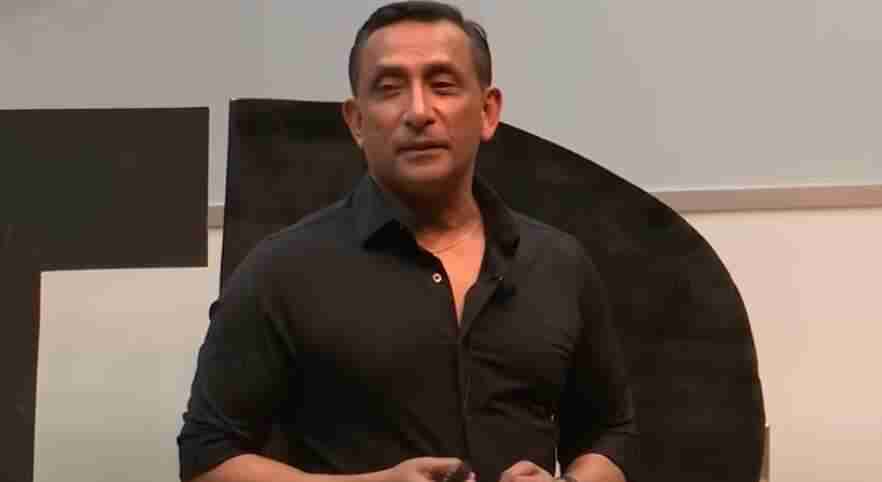
Read the full transcript of Sugata Biswas’ talk titled “How To Use Micro-Risks To Pursue Your Goals” at TEDxUTD 2024 conference.
Listen to the audio version here:
TRANSCRIPT:
The Fear of Failure
SUGATA BISWAS: “What if I fail? What if I fail?” Those four words and the fear they engender can crush dreams in their infancy and keep a person from stepping into a life filled with meaning, purpose, and fulfillment. What if I fail is not a question that we’re born with.
The fear of failure is something that we are taught. And over time, it becomes a filter through which we experience our lives.
Childhood Innocence
When I was four, I immigrated to the United States with my family. There I am in the leopard print. As you can see, I had a much bolder sense of fashion back then. I was on an adventure and everything was new. My dad had told me about something called snow. Snow was white, it was cold, it fell down from the sky like rain but floated. You could make things with it, but then it could turn to water and disappear in an instant. Now if that’s not magic, I don’t know what is.
When people would ask me, “What’s the first thing you want to do when you get to America?” Easy, collect snow in a cup, sprinkle some sugar on it, and eat it. What else would you do? I wasn’t too worried whether I’m not supposed to say that or if I’m going to get laughed at by saying that. I just simply answered the question. The fear of failure was not something that existed in my world.
Learning to Fear
This is third grade me. This is the boy that learned to fear the consequences of failure. Our teacher had asked us to copy down a series of long numbers that she’d written on the board. Now, the way she wrote it, you could see it one of two ways. As rows of numbers stacked on top of each other, or as columns of numbers standing next to each other.
One of my friends, Andrew, he and I saw it the exact same way, that we saw it as columns and we were writing it down vertically. Our teacher was walking around checking our work. She got to Drew and asked him what he’s doing. Clearly, she was upset. He tried to mumble something, but before he could, she grabbed his paper, held it up in the air and said, “Look, look how stupid he is.” Everybody laughed. Everybody but me.
I just remember feeling really, really scared. That year, I saw Drew transform. The teacher labeled him as stupid and he started to act the label. Somehow, by meeting their low expectations, he lessened the punishment. By the end of the year, he had become his label. The message was clear. Fear on any level will be severely punished. Don’t take any risks.
“What if I fail” became a mantra for my inner critic. That fear then became this filter and I started living through it. Over time, it became invisible to me.
Breaking the Hold
A leadership workshop many years later would begin to break that hold. Halfway through the workshop, we played a game that involved solving a puzzle. The rule was you could only move a puzzle piece one at a time. Each of us had our own puzzle and we had a support person behind us. If we made a correct move, the support person would applaud. If we made an incorrect move, there’s no response.
The game started and I sat frozen, motionless. I was trying to do the whole game from start to finish in my head because I didn’t want to seem like I made a mistake. And then, corner of the room, applause. Instantly, I could feel my stress rising, my inner critic getting louder and louder and my fear response kicking in. Then, more applause from all around the room.
So frustrated with myself, I just grabbed a piece and I moved it. Shockingly, applause. It was a correct move. I grabbed another piece, moved it. Nothing. Incorrect move. Put it back. Took another piece, moved it. Again, applause. Then, I figured it out.
I still didn’t know all the moves I needed to make to solve the puzzle, but I understood how to go about it. I just needed to try. Even if it’s wrong, I’ll learn something from it. And that will inform my next move.
The lesson was clear. Action is part of the learning process.
A Life-Changing Accident
The fear of failure still had me in its grip and it would continue to do so until an accident changed everything. Later that year, I attended the final business meetings for my company. I flew to Dallas to come and do the meetings. When the meetings ended, we were all very excited. Those were the last meetings. And we all want to get back to our families. We want to enjoy the holidays. And we’re all so excited.
Driving down the highway, it was complete incessant chatter. We approached an overpass. And when we crested the overpass, we saw that on the other side, two large trucks had gotten into an accident and were blocking our way. I didn’t really think very much of it. It was still quite a ways away. But I do remember thinking, we need to slow down.
Then, the entire car got silent. We weren’t slowing. The overpass was completely covered in black ice. Jake desperately tried to slow the car and then maybe veer it to one little gap so we can avoid the accident.
When we hit the truck, a suitcase that was behind me came and hit me on the head, momentarily knocking me out. From there, my memories are just bits and pieces, smelling the gunpowder from the deployed airbags, shattered glass everywhere, helping Willie to the side of the road, looking back, and seeing him raise both arms, begging for cars to slow down, and witnessing another truck hit our car, where Amy was still trapped inside.
By the time we got to the car, Amy looked like she was sleeping, peacefully, her head resting on her arm over the center console. Later, I’d be told that she’d died on impact that day.
The grief was unbearable, and in the time since then, the days and the weeks that passed, another thought slowly sank in. That could have easily have been me. All my life, I did exactly what I was told, with the belief and the hope that one day, one day it would be my turn. But in life, there are no guarantees.
Before I die, I just wanted one turn to do something I’ve always wanted to do just for me. For years, I’d dreamt of starting my own firm, but there was always a good reason not to. Kids, bills, a corporate job with a consistent paycheck. And what if I failed?
The list was long and logical, and I promised myself, though, one day, one day I would do it, but just not today. And what if I fail? Over time, it became easier and easier to brush that dream aside. What if I fail?
Then, the accident. What if I fail? I didn’t have time for that question anymore, and that changed everything. I realized that those promises that I was making to myself were just empty words coming from a place of fear.
Shortly after, I started my company, helped to co-found my company, and for the next 15 years, helped it to grow and become a successful firm that it is. That was my journey. The experience of the accident was the final push that I needed to finally remember my dream and to have the energy to overcome my fears. I understood that, for me, the fear of failure was deep-seated, and where it had begun was in that place so many years before.
Overcoming Fear
But what do I do about it now? Where do I go from here? When I thought about failure and the fear of it, I thought about what it teaches us. Fear teaches us, do nothing, because if you don’t try, then you technically didn’t fail.
Don’t raise your hand in class. What if you don’t know the answer? Don’t say hello to your neighbor. What if they don’t say anything back? Don’t start exercising. What if you can’t do it? Our default becomes comfort and safety. What I’ve learned is that those are the two that can kill our dreams.
So, what do we do? What I’ve discovered is that a relatively simple approach of taking micro-risks and developing a practice of micro-risks can help us to be able to identify and expand our tolerance for risk, and expand our ability to not only take risks, but become comfortable with the discomfort that comes from it.
The Practice of Micro-Risks
So, micro-risks are just that. They’re small, manageable risks that are designed to recalibrate our feelings towards risk-taking itself. This practice has four critical components to it. First, definition, then intention, then action, and then reflection.
Definition is this first part where we define what area it is that we want to talk about, and what area, and what a micro-risk is for us. So, a micro-risk for one person could be an extreme risk for someone else. It’s okay to start where you are, and we all don’t need to start in the exact same place.
Next, intention. Intention is, the idea here is to purposefully set your mind to wanting to identify where you can take a micro-risk, and to decide ahead of time that you will act upon it.
Next, action. So, at this point, you’ve identified what a micro-risk is for you, and you’ve set an intention to find that risk and to act upon it. So, here, the action is just trying. One of the ways I feel that fear kept me locked in is this idea that if I act, what if I fail? But the beauty here is that it’s okay not to do it perfectly. In fact, it’s the attempt that becomes the most critical part of it.
The fourth part is reflection, and the reflection, I think, may be the most important part of this entire practice. Now, reflection isn’t an opportunity for you to criticize yourself. It’s not a letter grade that you give to yourself. It’s simply an opportunity to reflect on the experience. How did it go? Did you go through with it? If you didn’t, reflect as to why. If you did, what happened? How did you feel? How did your body feel? How did your mind feel?
It is through this process that you’ll begin to understand, is this a micro risk? Are you ready to take something more? It is, if you can do this part with no judgment and to truly just reflect on the experience, this will be the most valuable aspect of the entire practice.
Living Without Fear
And throughout this journey, you have to decide where it is that you want to go. What would it be like if you could live your life without the fear of failure? What would you do? What talent would you allow to come forth, even if you weren’t very good at it? Not at first. Would you learn to sing? Would you learn to dance? Would you learn to explore? What would you do?
And how would it be with other people who are living their lives without the fear of failure? How would you be with them? Would you judge them for their imperfect attempts? Or would it strengthen you to be kinder, to be gentler with them and yourself?
So what do we do? Well, we’re here. And this is a good place to start. You can decide today what area you might want to work on. And from there, decide what micro-risk are you ready to take. Do you want to wear that T-shirt that everyone thinks is completely outdated but that makes you feel good? Do you want to sing at the top of your lungs to your favorite song in the car, even though there are other people in the car? What is it that you choose to do?
If these sound like they’re too much or too little, do something else. You don’t need to go through a near-death experience to start living your life. A practice of micro-risk can help you expand your tolerance for risk and start to deprogram yourself from the conditioning that we’ve had of avoiding risk, of avoiding failure. If you want to live a purposeful life, a life that you want to experience, it is inherently risky and it is inherently uncomfortable. But that, the promise of it, is tremendous.
Think of this, that what would happen if we could change the question from “What if I fail” to “What if I succeed?”