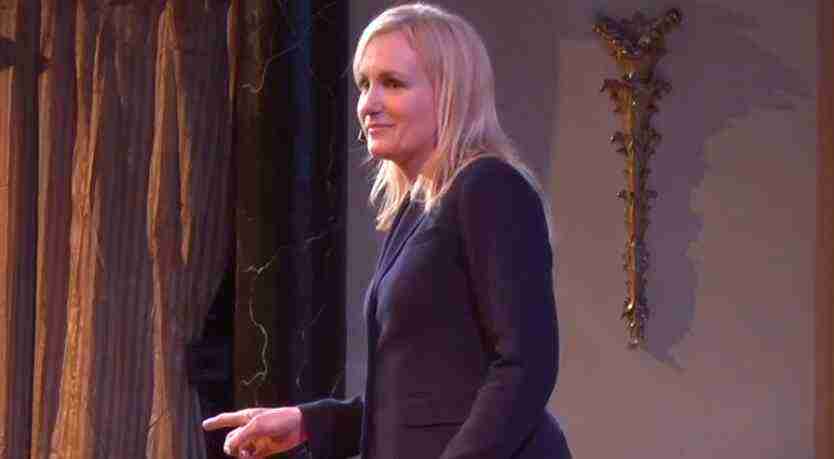
Read the full transcript of Dr. Julie Hasson’s talk titled “The Teachers We Remember” at TEDxEustis 2019 conference.
Listen to the audio version here:
TRANSCRIPT:
A Chance Encounter
DR. JULIE HASSON: I want to start by telling you about something that happened at the grocery store. I was in the produce section looking for the perfect avocado when I heard someone call my name. I looked up and I thought that face looks familiar. There was something about the dimples and the brown eyes. And as this beautiful 22-year-old woman came closer, I recognized the little girl I taught in second grade.
It was Ali. And we stood there by the avocados and talked about her life now, and we talked about what she remembered from our year together. And Ali asked me, “Miss Hasson, do you remember reading the book, ‘Stone Fox’ to our class?” And I said, “Yes. That’s one of my favorite books.”
And she asked, “Miss Hasson, do you remember the part when Willie was winning the dog sled race and all of a sudden his dog Searchlight collapsed? And then Stone Fox caught up and he stopped, and he made all the other racers stop so that Willie could pick up his dog and carry him across the finish line.” And I said, “Yes, of course, I remember that part.” And then she asked, “Do you remember what you told us at the end of that book?” And I had to say, “No.”
Because I have no idea what I said to those kids fifteen years ago. I’ll be honest, I hardly remember what I said to students yesterday. But Ali did. She said, “You told us that winners aren’t always the fastest ones. Sometimes winners are just the brave ones who don’t quit.”
And then she said something that every teacher longs to hear. She said, “You know, sometimes when things get really hard and I feel like giving up, I think about that book and I think about what you told us, and I just keep going.” We talked for about another hour. I hugged her, and then I watched my student go back out into the world. And that conversation by the avocados made me feel so good because I want to be the kind of teacher students remember.
The Impact of Teachers
Isn’t that what all teachers really want? To leave a lasting impact, to teach these lessons that students carry and use throughout their lives? But that conversation also made me think about kids who weren’t like Ali. I’ve taught hundreds, maybe thousands of kids over the course of my career, and I know I haven’t left a lasting impact on all of them. I wondered how many I failed to connect with in meaningful ways and how many opportunities for impact I missed.
And most importantly, I thought about how I could have a greater impact and how I could do that more consistently. And my reunion with Ali also made me remember the teachers who made an impact on my life. I thought about Miss Russell who taught me how to read, Miss Barenz Hein who helped me find my voice, and Mr. Resiniti who forever changed the way I look at the world. Who are the teachers you remember? What are the things they said or did that stick with you?
Researching Teacher Impact
A few years ago, I became a professor. I still teach. Now I teach teachers, which is really hard because they know all my teaching tricks. You can’t get anything past the teachers. But the other part of my job is to do research, and my focus is on teacher impact.
I knew that as a qualitative researcher, if I really wanted to understand teacher impact, I had to go out and interview people who had once been students in kindergarten through twelfth grade. Okay. These people are not hard to find. I suspect that this TEDx audience is full of former students. I just needed to put myself where they congregate.
So I showed up at city parks, craft fairs, farmers markets, college campuses with this sign that said, “Let’s chat about a teacher you remember.” And people stopped to talk with me. I know I was as surprised as you are because sitting at the park with a sign was not my usual method of data collection. But it was the best crazy idea I ever had because I’ve learned so much about teacher impact from the people I met. I’ve now talked to hundreds of people from age 18 to 85, and I realize everyone has a story about a special teacher.
The Power of Transformation
But then I started to wonder why do we remember some teachers so clearly but not others. So I took the data and laid it all out and started to analyze it, and the answer became evident. You see, we don’t remember being taught. We remember being transformed. We remember the teachers who help us change and grow.
Over the course of a semester or a year, they facilitate our transformation so that we’re not the same people when we leave their classes as we were on the day we met them. And although these memorable teachers teach, their impact happens by design. It doesn’t happen by chance or default. They have this long-range vision and they don’t get caught up in the day-to-day small stuff and minutia. It’s like they’re too busy prospecting for our potential.
And the teachers we remember loved and appreciated us just as we were, but they also held this vision for who we could become. And they realized their role in making that vision come true. So under this big overarching theme of transformation, the data fell into three main ways teachers change students’ hearts, ways teachers change students’ minds, and ways teachers change students’ lives. I’d like to start with hearts.
Changing Hearts
When teachers changed hearts, they did things like increase our self-worth, make us feel more valued and important.
They extended compassion and helped us become more compassionate people. And they magically cultivated this sense of belonging so that we felt we were a part of something bigger. One of my favorite stories in the data that speaks to the way a teacher can change a child’s heart came from a man named John.
John is a military veteran. He’s a career firefighter. He’s accumulated seven decades of wisdom. I promised him I would describe it that way. He’s a tough guy. But when he sat down next to me at a craft fair to tell me about his third-grade teacher, Miss Andrews, he started to cry. He said, “You know, I grew up in poverty, in a home plagued by addiction and abuse. And when I got to school, I noticed how different I was from the other kids. I longed to be like them.”
My teacher, Miss Andrews, used to invite me to her home after school for a snack. Somehow, she recognized that I was hungry. And one day as I was leaving her house, she handed me a package. It was wrapped in brown paper and tied up with string. And I remember running all the way home to open that package.
And when I did, I spent hours staring at these three new neatly pressed school shirts that had been folded inside. And John said, “That was a changing moment in my life because I realized someone does love me. Someone does care about me.” And Miss Andrews helped him understand that he was worthy of love and belonging. John’s story helped me understand that it isn’t really the gestures that make such an impact on students, it’s the meaning they ascribe to those gestures.
It wasn’t the snacks or the shirts, it was the way those snacks and shirts made him feel about himself. Now I don’t want to give you the wrong impression that the teachers we remember are always the soft sweet ones. Because sometimes the teachers who leave a lasting impact administer a healthy dose of tough love. I see you nodding. You know what I mean? They push us. They challenge us. They hold high expectations. They change our minds.
Changing Minds
And they change our minds by deepening our knowledge or understanding of a topic, by facilitating our critical thinking or broadening our perspective. I met a young man named Jay who’s now a science teacher.
And Jay said, “I have to tell you that I’m teaching today because of my algebra teacher, Mr. Mann.” Jay explained Mr. Mann was his algebra teacher the second time around. He had already failed algebra one. Jay described himself as a confident kid in high school, a basketball player, but he was intimidated by math. And Jay said, “I remember Mr. Mann’s exact words on my first day of class. He said, ‘You are going to have a quiz every day. That quiz will only cover what we did the previous day. All you have to do is show up, pay attention, and go over the material when you get home.'”
Jay said, “The stakes were high for me, so I did exactly what he said. And as days turned into weeks, I started to master algebra. Halfway through the semester, I was helping other students.” And Jay said, “By the end of that class, I didn’t just pass algebra, I had the highest grade.” And then he said something really important about teacher impact. He said, “Now when I encounter a challenge like algebra or anything else, I realize that it’s doable if I just take it one day at a time.” Jay illustrated the way we take a lesson from a memorable teacher, and we learn to apply it to other areas of our life.
Changing Lives
But perhaps the most dramatic and moving stories in my collection are the stories of the ways teachers have impacted the trajectory of their students’ lives. They’ve done it by creating opportunities, opening up possibilities, and boosting our confidence. Maria is a great example. When I met Maria on a college campus, she looked so young, I could hardly believe she was in her second year. She had her hair in braids and a baseball cap on, and she said, “I’m here because of Mr. Diaz, my high school science teacher.”
Maria explained that she grew up in a migrant family, a family that moved three or four times a year. She said, “Every time my family moved, I would be behind in some classes, ahead in others. Some credits didn’t transfer. I needed a scholarship. A scholarship was my only hope, and I was losing hope.”
“And then I met Mr. Diaz. He saw some potential in me and went to my home after school to talk to my mom and dad. He explained that I had a good chance if I could just stay put and finish the classes at my high school. He convinced my mom and dad to let me live with my aunt and uncle, and he took me home from STEM club. He even helped me fill out my college essays and applications.”
She said, “Now I’m one of five girls in my engineering class, and I know I have to work really hard, but I’m motivated because I have a dream.” And Maria said, “My dream is to start a foundation to help other migrant girls go to college.” This is the unending impact of a teacher. Because when a teacher helps one student, that one may go on to help so many others. It’s these never-ending karmic ripples that teacher impact creates.
John’s story, Jay’s story, Maria’s story are all part of a growing collection called the Chalk and Chances Project. Chalk and Chances is an online community that celebrates and elevates memorable teachers. All of the stories there are inherently beautiful and valuable, but they also contain lessons. Because if we know what makes a lasting impact, we can do more of it. We can become memorable and impactful by design.
The Teacher Shortage Crisis
I like to imagine a world in which every child has a teacher with the power to change hearts, minds, and lives. But that dream is tenuous right now because we are in the midst of a critical teacher shortage. In my Central Florida district alone, we started the school year with 1,100 teacher vacancies. I have thousands of kids just in my district who did not have the benefit of the impact of a trained teacher. And that’s not just true in my district. That’s a national trend.
Now some teacher vacancies are due to retirement or population growth, but a growing number are due to teachers choosing to leave the profession. And it’s not just about salaries. It’s about having the resources and the autonomy to do their work. It’s about having the freedom to make an impact.
Because when teachers are forced to focus narrowly on academic achievement and even more narrowly on student achievement test scores, their ability to make an impact is limited. When teachers are forced and pressured to grow test scores above all else, they lose what is most fulfilling in their work. But we can do something about this. We can advocate for policies that enable teachers to make decisions in their own classrooms. We can advocate for policies that empower teachers to respond to the needs they see in their students.
The Power of Appreciation
There is something else we can do about this. We can express appreciation for the teachers who made an impact on our lives because moments like the one I had with Ali in the grocery store are the lifeblood of teachers. It’s what keeps us going. Was there a teacher who changed your heart, who made you love yourself a little bit more, or maybe changed your mind, made you think about something differently, or changed your life, that you’re on a whole new path? Please reach out and thank that teacher if you can.
It means everything. The teachers I remember have always inspired me, and I hope that their legacies live on through me. The teachers we remember live on because the impact they had on us now inspires the impact we make on others. Maybe that’s the best way to thank them, to be mindful of our own impact. Fully love and accept people just the way they are, and at the same time see their potential, you help them become the best versions of themselves.
That’s what the teachers we remember did for us. And maybe when you least expect it, like when you’re digging through the avocados in the grocery store, you just might get a sweet validation of your own impact. Thank you.