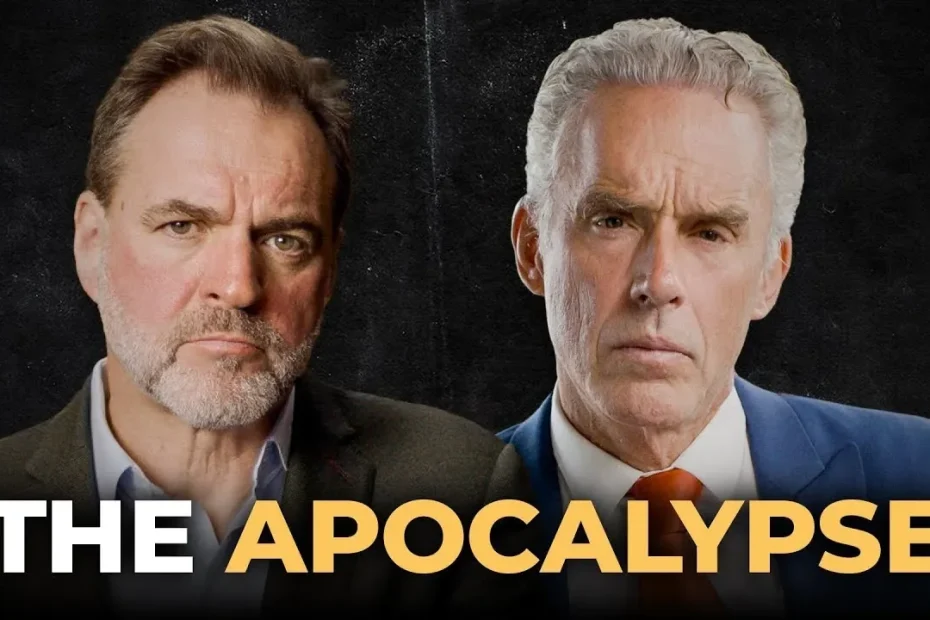
Read the full transcript of historian and author Niall Ferguson’s interview on The Dr. Jordan B. Peterson Podcast episode #404 titled “A Psychologist and Historian Discuss the End of the World”, Dec 12, 2023.
Listen to the audio version here:
TRANSCRIPT:
Introduction
JORDAN PETERSON: Hello everyone watching and listening. Today I’m speaking with historian and author Niall Ferguson. We haven’t spoken before, although I’ve wanted to for a long time. We discuss the historical and deeply mythological precedent of world-ending narratives, how the global doomsday ethos abdicates local responsibility while empowering the elite class, the out-of-control gigantism plaguing our administrative states today, and how we might strive as individuals to deal with the genuine tragedy of life morally, humbly, and religiously.
So I was reviewing your book, Doom, this morning, and I’ve been wanting to talk to you about it for a long time. I’m very interested in the apocalyptic vision and its implications for political organization and psychological organization as well. And I thought I’d just start with a couple of comments to get us going.
The apocalypse, in some ways, is always upon us, and you write about that in your book. I mean, because people might ask, well, why has mankind always been consumed at the narrative level with notions of the end of the world? And the answer to that is, at least in part, because we always inhabit demarcated conceptual worlds and even embodied worlds, and all of those worlds do come to an end. And so the idea that there’s a universal end is built into the fabric of reality, and it’s something that we have to permanently contend with.
And so it’s there as a lurking existential abyss, but it’s also there as a practical problem that we have to contend with. And the grand apocalyptic visions, the book of Revelation, for example, are in part attempts to structure our apprehension of the eternal apocalypse, and to also help us determine practically and politically how that might be at least staved off, although perhaps even managed more comprehensively.
And so I guess I’m curious, why did your interests, do you think, coalesce around the conception of doom? And it’s been a couple of years now since this book was published. How have your conceptions changed, and what did you learn as a consequence of investigating this narrative trope so deeply?
The Fascination with the End of the World
NIALL FERGUSON: There’s a great sketch in the Beyond the Fringe album, which goes right back to Peter Cook and Dudley Moore, Jonathan Miller, and Alan Bennett in the 1960s. And the sketch is the end of the world, and it’s essentially a sect of millenarians who gather on a hill to anticipate the end of the world. They have a long and quite amusing discussion about what it’s likely to involve. Will the veil of the temple be rent asunder? And the time comes, they count down to the end of the world, and nothing happens. And Peter Cook, who’s the leader of the sect, ends the sketch by, “Well, never mind, lads, same time next week.”
And I always thought that was very funny, because the end of the world has been consistently overpredicted by human beings for millennia. We’re fascinated by the idea of the end of the world, and I think it’s for a slightly different reason from the one that you hypothesized.
We have the reality that we as individuals end to contend with. That’s just one of the givens of human life, even for billionaires in Silicon Valley. Right now, the end of their individual lives is inevitable. And that’s really the hardest thing to deal with about life, that it ends. And we also know how it ends, we know what that’s like, because at some time or another in our lives, we encounter death. The death of a grandparent, a parent, of a friend.
We also see things being destroyed. We see buildings collapse or bridges. We see fires consume areas of woodland. So we know what dissolution looks like, not just for us as individuals, but we know what it looks like for expanses of land or edifices. And I think we therefore infer the consoling thought that it’s all going to go down in flames at some future date.
And the great monastic religions have as one of their centerpieces the end of the world. It’s there in Islam as well as in Christianity. And I think it’s also exciting. I think we find the end of the world a kind of cinematic prospect, which is why there are so many movies about it as well as works of science fiction.
So we’re fascinated by the end of the world because it’s clearly a spectacular prospect, but it’s also consoling to us. We may die as individuals, but everything’s going down at some point. And the issue is when. So many Christians at successive periods in the history of Christianity have anticipated quite an imminent end of the world. And of course, they’re always disappointed, like Peter Cook and Dudley Moore.
The Consolation of Apocalypse
JORDAN PETERSON: So the consoling issue, I mean, the easy read on that, I suppose, is that the end of the world is the precondition for the establishment of an ever more glorious paradise. And you can understand a consolation in that. But you’re pointing to a different kind of consolation, I suppose, which is, it seems to me, and correct me if I’m wrong, that something like schadenfreude is that the fact that we end is easier to swallow if we understand it in relationship to the potential end of everything. So I don’t exactly understand why you highlighted consolation. I can see it in the heavenly vision, let’s say, post-apocalypse, but you seem to be pointing to something else.
NIALL FERGUSON: Well, of course, religion offers an afterlife that will be better and resurrection in the case of the great monotheistic religions. But I don’t think that’s always what’s in people’s minds when they contemplate the end of the world.
I was very struck as I was researching the book how many times in the midst of a localized disaster, individuals said it felt like the end of the world.
The Adventure of Apocalypse
JORDAN PETERSON: Well, you know, there might be another element to it as well. I mean, the Terminator movie series came to mind when you were walking through your discussion, I suppose, in reference to the science fiction representations of the end of the world. And all of our conceptual schemes, when they encounter an obstacle, undergo a collapse into a kind of chaos and then a potential regeneration. And that’s the same as the stage transition in Piagetian child development. And it’s the same as the scientific revolution.
And every act of learning is simultaneously the death of some set of preconceptions. And there’s pain in that, which is partly why we don’t like to have our ideas challenged. But, you know, there’s also adventure in it.
And part of the reason that people do go to watch movies like the Terminator and the plethora of end of the world movies that do make themselves manifest is because I think we can see in the confrontation with cataclysm, an adventure. I mean, that’s what people are doing in a theater when they’re watching the Terminator series. I mean, it’s a dreadful adventure, but it’s a total adventure. It’s completely engrossing.
And it might be that you could imagine, and I think that this is part of the emphasis of the Judeo-Christian notion of ultimate sacrifice, you could imagine welcoming the apocalyptic reality of the world with open arms, being willing to undergo that adventure of continual death and transformation and that transforming it, that entire death and rebirth process into something like the most exciting possible adventure.
I mean, you know, what you do see in the biblical corpus, there’s always a wrestling with the apocalyptic reality of existence socially and individually. And there is the insistence throughout the text that the appropriate way to deal with that is not to run from it or deny it, but to really to the degree that it’s possible to welcome it with open arms. Now, that’s a very tricky thing to manage, obviously. How do you welcome the death of everything with open arms? But in some ways, it doesn’t matter because it’s a reality that people have to face.
The Spectacle of Apocalypse vs. the Dullness of Heaven
NIALL FERGUSON: I think what’s fascinating about the Book of Revelation is that it’s so spectacular. It’s an extraordinary visualization of a cataclysm. And it’s really very elaborate. It’s worth reading and trying to picture it in your mind, and you realize that you would need the most advanced computer graphics to realize it on a screen.
I think it’s partly that you need a spectacular prelude for the kingdom of God to be plausible, because the terrible truth about the kingdom of God is that it does sound quite dull. I mean, the reality about the saints and angels and God himself is that they don’t really know how to throw a party, and we need more than that to excite us. So I think that the apocalypse is attractive because it’s so much more exciting than the ultimate outcome, the utopian outcome of heaven.
Now, what’s interesting about science fiction is that it really discards utopia. There’s some utopian science fiction, but most of it’s dystopian. You gave the example of the Terminator movie series. That’s part of a long tradition of visualizing an end of the world which is dystopian, where an apocalyptic event occurs, and all you’re really left with in the case of the Terminator movies is a pile of rubble in which a few surviving humans are picked off by killer robots.
The interesting thing to me about science fiction is that from its birth in the early 19th century as a genre, it provides the apocalypse without the prospects of some ultimate reign of God and the saints, and we find that hugely exciting.
Modern Apocalyptic Thinking
NIALL FERGUSON: So the paradox at the heart of the book is that we spend a lot of time thinking about the end of the world. Of course, environmentalists are the latest heirs to the millenarian tradition. They love to say that the world is about to end. It’s in 12 years. It must be now eight years and counting. That’s part of a long tradition where secular movements embrace often unwittingly religious ideas about the impending apocalypse, and that’s exciting to people, so they’re drawn to it. Greta Thunberg is the latest prophet of the millennium, and I think that’s a very important reason to be skeptical about stories about the end of the world, because while we spend a lot of time discussing the end of the world in its latest incarnation, the catastrophic climate scenario, we kind of miss the much more likely smaller-scale, medium-sized disasters, and the key point the book makes is we’re getting worse at handling those.
So we spend ages talking about the end of the world, endless conferences on climate change and the apocalypse, and we utterly bungle what was, in fact, not a particularly disastrous pandemic, and we’re going to bungle our way through some geopolitical disasters. We’re doing that right now.
I think that’s the critical argument of the book, and that’s why the subtitle of the book is so important, The Politics of Catastrophe. The key argument the book makes is that most disasters shouldn’t be thought of as either natural or man-made. Disasters happen, and then we as a species collectively bungle them or not, and that’s the critical point. Disasters are in many ways politically determined, even if their origins are natural. So that’s the argument of the book.
The Problem with Utopian Visions
JORDAN PETERSON: Okay, so there’s three themes there that I’d like to expound upon. So the first is you interestingly pointed out that the dystopia and the apocalypse is more interesting than the subsequent heaven. And that’s the problem with socialist visions of utopia that people like Dostoevsky laid out in the late 1800s.
In Notes from Underground, Dostoevsky famously pointed out that if we did bring about the socialist utopia, and he described that as the endless opportunity to sit in pools of bubbling water, busy ourselves with the continuation of the species and eat nothing but cake, that human beings would break it all into a chaotic mess at the first opportunity just so that something exciting could happen.
And so there’s the problem with a satiation vision of heaven. So that would be a vision where everyone has everything they need all the time is that precisely when you do that with an infant or when you enter that state after Thanksgiving dinner, Christmas dinner, all you do is go to sleep. There’s no reason to be conscious. Consciousness demands something like an adventure.
And the classic vision of heaven does seem lacking in that it isn’t obvious what you would do there. So that’s something we could delve into. Then you pointed out that one of the additional underground advantages to being an apocalyptic doomsayer is that you can, I’m modifying your argument slightly, but that you can present yourself as the ultimate virtue-seeking redeemer by claiming to be obsessed by nothing but large scale disaster.
# Niall Ferguson on Apocalyptic Thinking and Government Incompetence
The Psychology of Apocalyptic Thinking
JORDAN PETERSON: You can construe yourself as virtuous because of the depth of your concern, and you can abdicate your responsibility to actually deal with less self-dramatizing problems, with the less self-dramatizing problems that actually constitute problems you could solve and address if you put your mind to it in the real world. You know, and there’s psychological reasons for assuming this. One of the things you see when people’s lives go seriously astray is that they don’t generally run off a cliff immediately after doing brilliantly. What happens is they make one error, and then they make a more serious error, and then they repeat that 10,000 times, and then they’re in hell.
And it was their failure to rectify the mini crises all along the way that brings upon the apocalypse in their life. And I do see a lot of that political posturing characterizing the modern world, you know, that people act out the role of world-redeeming savior, but they’re not actually attending to genuine problems that are right in front of them that they could address if they acted responsibly.
Natural Disasters and Government Failure
JORDAN PETERSON: And then the final thing you developed, you said, this is very interesting, you said that the notion of natural disaster in some sense is ill-conceptualized because there’s ambiguity about whether when a disaster occurs, it’s a consequence of the hand of God, say, in the earthquake or the flood, or the utter failure of the authorities to have prepared properly for a foreseeable disaster.
I thought this very clearly when Katrina hit New Orleans, because a hue and cry went up about the catastrophe of the natural disaster. But you didn’t have to dig very far before you realized that the reason that hurricane was so devastating in New Orleans was because the dikes hadn’t been maintained, and they’d only been built to withstand a one-in-one century flood, and that the entire infrastructure of the society was corrupt.
In mythological representations, in deep narratives, there is an identity between the evil king and the wicked queen of nature. They’re the same thing. And so if the king gets wicked enough, the evil queen of nature arises. And that’s a representation of the fact that if your state is corrupt, natural disaster will definitely make itself shown, and that you actually can’t distinguish.
There’s no distinction between lack of preparation and a natural disaster in the final analysis, and corruption and blindness facilitate that nexus. So the Egyptians had a story. It’s the story upon which their whole culture was founded, that the state corrupted, that’s Osiris, the state corrupted and became willfully blind as it aged.
And then it was overthrown by, that’s Osiris, is overthrown by Seth, who’s the precursor of Satan, and then he rules. So now the tyrant rules. And then Isis, who’s the queen of the underworld, she’s nature, she makes herself known again, chaos, right, with enough disintegration at the sociological level, then chaos makes itself manifest again. It’s one of the most ancient stories of mankind, playing out that dichotomy between the tyrant and natural disaster that you just described.
Asceticism and Apocalyptic Cults
NIALL FERGUSON: Let me take those points in order if I can. I think that the most interesting thing to me about fantasies about the end of the world, about the various millenarian cults through history, is that they are often accompanied by certain forms of behavior that one might characterize as ascetic.
So the asceticism is an important part of many religious and secular movements. So the end is approaching, the apocalypse is nearing, and therefore we should fast, or perhaps even flog ourselves, like the flagellant orders at the time of the Black Death. And it seemed to me very interesting how many similar patterns one could see in our time, whether you are preoccupied with climate change or systemic racism, it doesn’t matter, you should engage in some kind of ascetic, atonement in advance of the Great Reckoning.
And this, I think, infests a lot of contemporary progressivism, the desire to eat rabbit food, to be constantly trying to eliminate things from one’s diet, the desire to engage in abstention from reproduction, we must not have children because climate change is so cataclysmic. And so you have these sorts of ascetic behaviors, which you can find in medieval and ancient religion. So I think that’s an important first point.
The second point is that mythology of the sort you described, in the case of the Egyptian myths, makes a lot of sense if you imagine yourself living in the prehistoric or very ancient world. Life expectancy was very short. Individuals were extraordinarily at risk from a whole variety of premature forms of mortality, and the natural world was deeply mysterious because there was no scientific framework for understanding anything, the fluctuations in the level of the River Nile, the periodic droughts that afflicted early agricultural societies.
And so you end up with ways of making sense of an extraordinarily cruel and capricious world. So I think that’s an important reason why myths persist. They’re deeply rooted in our premodern experience.
Modern Incompetence Despite Scientific Knowledge
NIALL FERGUSON: And I think that if one tries to think about our present predicaments, it’s odd that such things have such enduring power over us because since the scientific revolution and the Enlightenment, we have a much better handle on the challenges that a species like ours faces on a planet like ours. So what’s odd is that despite having really quite a good understanding of, say, infectious disease or the ways that hurricanes strike the eastern seaboard of the United States, we seem to be getting worse at handling pandemics and hurricanes. And that’s a really important argument that the book makes.
Compared with the generation of the 1950s, the generation of the 2010s and 2020s seems really quite bad at disaster management in most Western societies, not only the United States. And it’s explaining that that takes us into new territory because I don’t think you can explain the diminishing competence of the modern state without having a theory of its degeneration. And that’s something that is a really important part of the book.
Apocalyptic Visions and Asceticism
JORDAN PETERSON: Okay. So I want to pick up on two of those topics. So the first is you point out that as the apocalyptic vision predominates, there’s a turn to asceticism.
And then you describe, we could say, veganism and vegetarianism. And well, and the insistence by the environmentalists that we must engage in degrowth and that we must reduce our standard of living. And yes, okay, but there’s a very interesting psychological rationale for that as well, which is that if the old state of being has become corrupt, so that’s the old king, and now we’re threatened by its collapse, then the proper thing to do is to engage in repentance and atonement.
Because what you want to do is you want to offer up your stupid preconceptions to be destroyed so that you can rectify the corruption so that you can stave off the disaster. And so now, it’s interesting, because with the millenarian and apocalyptic movements on the left, you have a simultaneous insistence that all sorts of impulsive, pleasure-seeking, licentious behavior should be centered and prioritized and celebrated. But at the same time, you have this insistence that there’s a certain kind of asceticism that’s also necessary.
And I see in that, as a psychologist, I see that as a proper mechanism of repair gone astray, right? Is that, well, you should always be cutting back in this ascetic way on your idiot excesses locally to improve the manner in which you conceptualize the world. That’s the continual sacrificial offering of your own insufficiency and your own stupidity. And that does renew the world.
But now we’ve got this dynamic where we globalize the apocalypse. We view the end of the world. We assume that nothing but a kind of universal asceticism and atonement will suffice.
That enables us to set local concerns aside, as we already discussed, and to act irresponsibly. And maybe that’s part of what’s producing this inability to actually respond locally and effectively to genuine problems. In the Old Testament, the second commandment is to not use God’s name in vain.
And what that means, as far as I can tell, is that you shouldn’t claim divine motivation for doing things that are actually self-serving, right? You shouldn’t attribute sacred motivations to your own instrumental, impulsive and self-serving behavior. And then that’s echoed in the New Testament with the insistence that you shouldn’t pray in public. Now, if you take on the apocalyptic burden and you’re virtuous only in consequence of your compassionate concern, it gives you a perfect excuse to dispense with local responsibility.
And if you dispense with local responsibility, then you’re no longer able to engage in the concrete problem-solving activities of the sort that you described. What did you conclude when you have a chapter on developing political incompetence and also one on a belief in scientism? And that seems to me to be part of your attempt to assess the local failure while we’re concentrating on the global apocalypse. And so what do you make of that, that concatenation of causal forces?
The Problem with “The Science” and Administrative Bloat
NIALL FERGUSON: There are two things that are going on, I think. One is that the more people refer to the science, the more you should suspect that they are engaged in some quasi-religious activity. Because the notion of some settled body of knowledge called the science is at odds with the reality of the scientific method, which is a constant struggle to falsify hypotheses through experimentation. During the COVID-19 pandemic, but I think it predates it, it was already going on in debates about climate, there was a lot of spurious invocation of the science.
And one might as well have been saying the gods or the deity, because it was in fact quite unscientific thinking that was going on. I’ll give you an illustration of this. A great delusion is to imagine that we can prevent the rise of average temperatures by large-scale asceticism in the West.
We must give up internal combustion engines, we should give up eating meat and so on. If we end up buying electric vehicles and solar cells manufactured in China, with electricity generated by burning ever larger quantities of coal, the probability of reducing average temperatures is zero. Because that is in fact the perfect illustration of wrongheadedness in action.
If one accepts the premises of the debates on the causes of rising temperatures, it makes no sense at all for us to behave this way. Our asceticism will make no difference if it manifests itself as increased burning of coal in China. So that’s the first thing that’s going on.
JORDAN PETERSON: Or increased burning in coal in Germany, because that’s what’s happened with the Green Revolution in Germany. They shut off the nuclear plants and started up the lignite plants. So this kind of wrongheadedness leads to all kinds of policy errors because people are focused on the satisfaction of asceticism, the virtue signaling that comes with getting rid of nuclear power stations or internal combustion engines.
NIALL FERGUSON: So there’s a kind of generalized failure which embraces the policy elite to think rationally about the problems that we’re trying to address. The second problem, which I think is just as important, is the way the administrative state functions. If you compare central governments today with their counterparts of half a century or 70 years ago, they’ve become much larger.
They’re very bloated in terms of the numbers of people employed. They intervene in many more ways. There’s an enormous corpus of regulation in all Western countries.
And this administrative state, unwieldy, regulatory, is very inefficient. It’s very bad at achieving its intended goals. And that has to do with the way that bureaucracy works and the sclerotic tendencies that the modern state suffers from.
So between the science as a quasi-religious way of thinking and the administrative state, we have a very, very dysfunctional approach to nearly all the problems that confront us. And that is really the central argument of doom. It’s very significant that in our lifetimes, governments have got worse at dealing with disasters, not better.
Despite the accumulation of scientific knowledge, we seem somehow, collectively, to be worse at scientific thinking.
The Bureaucratic State and Biblical Parallels
JORDAN PETERSON: Okay, so imagine this. You magnify the size of the apocalypse, right, so it becomes a world-ending Ragnarok. Then you magnify the size of the bureaucratic state because you have to in order to deal with that apocalypse. Okay, then because the state is so global and large and so central, it loses its connection with the real world.
It has no subsidiary organization, and then it flails about pointlessly. Now, I’m going to walk through a couple of narrative representations of that. It’ll tie it back to the imagery of Revelation.
You might find this interesting. So, you see that dynamic play out in the opening chapters of Genesis, because what you have is the descendants of Cain. So, Cain makes improper sacrifices, and he becomes bitter and resentful, and he turns to technology.
It’s Cain’s descendants that turn to technology first. They build the first cities, and then the city becomes corrupt. It becomes corrupt in the direction of the Tower of Babel.
The Tower of Babel and Modern Parallels
JORDAN PETERSON: Now, the Tower of Babel is a ziggurat, right? It’s a stepped pyramid, and at that time, the potentates of the Middle East were competing to build the largest ziggurats. They were trying to build towers to heaven to glorify themselves, and that’s the subtext of the Tower of Babel story. So, what happens is that the ultimate Tower of Babel is erected to reach to the sky, and that’s a challenge to the supremacy of God, and the consequence of that is that the cosmos, the spirit of the cosmos, the creative producer of the cosmos, makes all those who inhabit the tower unable to communicate with one another.
So, they start to lose even the ability to share concepts, and this structure collapses, and it’s because that Tower of Babel is too large. It reaches too high. It’s too uniform, and it’s destined to failure.
Of course, that begs the question, you know, what’s the alternative to that? But I would say the entire remaining biblical corpus is actually an attempt to answer that question, but it’s very germane. Now, that imagery is picked up again in the Book of Revelation. So, one of the central images in the book that I think is very relevant, imagine that the Book of Revelation is trying to conceptualize the apocalypse as such, the manner in which things deteriorate before the ultimate disaster, and so one of the main images is of a seven-headed beast, and on the back of the beast is the Whore of Babylon, and it’s an image of a centralizing state, a monstrous centralizing state, that’s a good way of thinking about it, with multiple heads, with something like disinhibited licentiousness as its partner.
That’s the image, and so the notion there is that when things deteriorate to the point where apocalypse is likely, you have the construction of monstrous state-like apparatuses aligned with individual fragmentation down to the point of licentious atomization. That’s a good way of thinking about it. So, you know, you’re striving towards, it seems to me in your argument, you’re striving towards the hypothesis that there’s something like an out-of-control gigantism that’s causally related to the inability of these bureaucratic organizations to actually respond to actual occurrences in the world.
The Law of Unintended Consequences
NIALL FERGUSON: So, two thoughts. There’s only one law of history. I’m a historian, and that’s the law of unintended consequences, and so what typically happens is that well-intentioned people come to power, identify a problem which they feel they must address, and they undertake measures to address the problem which have unintended consequences.
This was true when, back in the 1960s and 70s, people persuaded themselves that there was a terrible problem of overpopulation, that Malthus was going to be vindicated, and therefore there had to be drastic population control, especially in Asia, and that turned out to have all kinds of unintended consequences. In our time, fears not just of climate change but of dangerous technological developments have given rise to a view, which my friend Nick Bostrom in Oxford exemplifies, that we need to have very, very powerful surveillance powers to prevent bad things from happening, whether it’s to prevent CO2 emissions reaching the levels of the net zero program or whether it’s to stop dangerous research being done with artificial intelligence. We need to empower the state to have even greater powers with surveillance than the mid-20th century totalitarian regimes had, and so one of the key arguments in the book Doom is that actually totalitarianism is the thing most to be feared.
In the 20th century, totalitarian regimes caused way more premature death than anything else, and so the last thing we should want to do in the 21st century is to create new forms of totalitarianism out of the belief that only an all-seeing state can prevent disaster. So this is a really, really important argument that the book makes, and I think it’s become even more relevant with the major breakthroughs we’ve seen in artificial intelligence in the two years since the book was published.
The Moral Universe and Human Nature
The other thing that I would say is we want the universe to be moral. We are very strongly inclined to think when bad things happen to us that they may in fact be retribution for sins that we committed in the past, and even the most rational individual is susceptible to this idea. I know this because my parents did their very best to raise me as a product of the Scottish Enlightenment, an atheist and a devoted believer in the scientific method, but when bad things happen, I have this uneasy sense that I may have brought it upon myself by transgressing in some way, illustrating that you can’t really escape the Christian legacy unless you travel a very long, long way away from post-Christian civilizations.
Now, it’s not in fact a moral universe. This is the bad news. It’s really not. I mean, a lot of the bad things that happen are random. They’re governed by power laws. They’re extremely difficult to predict. Wars are in fact pretty randomly distributed. There’s no cycle of history that tells you when a war is coming. Same applies to financial crises. Wildfires and earthquakes are not normally distributed. They can’t really be thought of in probabilistic terms, and so much of the terrible stuff that happens to us has nothing to do with there being a moral universe.
A cancer may strike one of us down in a much shorter time frame than we’re both tacitly assuming we have, and if we are diagnosed with a terminal cancer, how will we react to that news? What if I hear this tomorrow? It’ll be a tremendous shock to me, mainly because it will render my younger children much more vulnerable in my absence, but will I be able to resist the temptation that I brought upon myself? It’ll be there in the back of my mind because I’ve just inherited from generations that way of thinking.
The Persistence of Calvinism
It’s worth adding one little footnote to this. My friend, the historian Tom Holland, wrote a nice book recently, Dominion, arguing that Christian ways of thinking about the world have outlived Christianity in these secular times that we inhabit. A very good illustration of this point is how much Calvinism is still out there. The belief that you belong to the elect, the people because of predestination who are insured of salvation, is a very powerful one, and it persists long after people have ceased to attend Calvinist church services.
I’m always impressed by the presence of the self-appointed elect in academic life, people who have a sense that they are morally superior to those around them. They do belong to an elite, and their behavior should be, as it were, fitting to that preeminence. Now, I am a kind of Calvinist atheist. I come from the west of Scotland where that kind of thinking was very well established, and I can see the people who think they belong to the elect all around me in American academic life.
And, of course, the critical idea which Robert Louis Stevenson gets at in The Master of Ballantrae and James Hogg gets in The Confessions of a Justified Sinner is that the elect are the worst people. It’s the people who think that they belong to the elite who turn out to be capable of the most diabolical acts. So if you have that feeling that you might belong to the elect, disabuse yourself of that notion because it often empowers dreadful acts of cruelty.
The Danger of Overreaction
JORDAN PETERSON: I presume that’s why the gospel in John declares that the last will be first, right? And the first will be last. It’s pointing to something like that. There’s a couple of themes you developed. So you pointed out that it’s often the reaction to a crisis that’s worse than the crisis, and you pointed to the law of unintended consequences as the cause of that.
And I think there’s something technically true about that in that there is a very large number of possible consequences of any given act. And the probability that you can specify the consequence you want and only that consequence diminishes with the complexity of the action. And you can see even systems as sophisticated as the immune system falling prey to the law of unintended consequences because sometimes people die when they’re infected by an organism because the immune system overreacts.
And the COVID overreaction was a generalized social immune system overreaction, and it was much worse than the hypothetical crisis itself. But what I wanted to focus on was the reason that that overreach occurs.
Pride and the Fall
Now, I’ve been writing a book about biblical narratives, so they’re very much on my mind, and that’s partly why I’m bringing them up. But I talked to a good friend of mine and his brother, Jonathan Paggio and Matthew Paggio, about the first cataclysm, the first apocalyptic cataclysm, as it’s laid out in the book of Genesis, and that’s the sin of Eve and the consequent sin of Adam. And their view is that the sin of Eve is one of pride, is that she encounters the serpent, who turns out to be Satan. So it’s the possibility of predation and natural catastrophe allied with the possibility of evil.
That’s a good way of thinking about it symbolically. And her first presumption is that she can encompass that and hearken to it and listen to its voice and integrate it. And that’s what produces the fall. And Adam’s consequent sin is he agrees with Eve, and I would say mostly to try to impress her, which speaks very deeply to the motivation of men.
And so there’s this notion, it’s a very, very interesting notion, and I’d like to know what you make of it, is that the fundamental reason that cataclysms occur, and I guess this is an objection to your theory of an amoral world, so we’ll see where this goes, is that it’s people’s overreaching pride that is the eternal precursor to the fall, you know, pride goes before a fall. But it’s this notion that we can fight off more than we can chew, that we can encapsulate and control more than we’re really competent to.
We have an overexpansive vision of our competence, we trumpet that to parade our moral virtue. It motivates us to overextend ourselves in places we shouldn’t, and the constant consequence of that is systemic collapse, you know, at different scales. And so it begs the question, you know, I’ve really wondered about this, and you know, if you, I think it’s something to meditate on, if you didn’t overreach in your life, you know, if you were properly humble in your claims of mastery, if you only dealt with what was local and that was within your bounds of competence, you know, maybe extending yourself a bit to learn, maybe you wouldn’t bring on yourself a continual sequence of relatively apocalyptic catastrophes, right?
It’s like, and you pointed to that at the end of your last sequence of comments, you know, you said, there’s a tension there, you said, well, the universe is full of random events, and it’s not essentially moral. But you also said, but we overreach constantly, and that does produce, you know, various forms of cataclysm. So I would say, see, there’s a paradox in those two viewpoints, because how about this, is how about our immorality makes us more susceptible to the random fluctuations of the world? Right, that joins those two visions together.
Morality and Overreach
NIALL FERGUSON: I think it’s rather different from the way you’ve put it. It’s often people with a strong sense of morality who overreach. Humility is important, we need to be humble about our ability to predict the consequences or actions. It’s a non-linear world, but we are quite linear thinkers.
And we love to say, other things being equal, this act will have the following consequence. But of course, other things are not equal in a complex system. Let me give you an illustration of this point, which is currently in people’s minds because of the success of the movie Oppenheimer.
Oppie, Oppenheimer was a very moral individual. At least he felt himself to be rooted in an ethical education that he’d had at an elite school in New York, drawn out of those ethical premises towards communism in the 1930s. But when given the challenge to build an atomic bomb in order to win World War II, he embraced that challenge and achieved it with astonishing brilliance, brilliance both as a scientist and as it turned out as a leader of scientists.
But he quickly began to see, after the bomb had been dropped on Hiroshima and Nagasaki, that there were unintended consequences. He was unable to prevent the arms race that soon broke out between the United States and the Soviet Union. He was unable to prevent the invention of the thermonuclear bomb, the super. He lost the arguments about the development of nuclear weapons.
And if one looks back at that era, the single most amazing thing to me about that breakthrough is that we have subsequently made so much more use of the destructive potential of nuclear fission than of its productive potential. We’ve built many, many more nuclear warheads than nuclear reactors. That illustrates, I think, very powerfully the law of unintended consequences. But it began with an individual, Oppenheimer, who was filled with a sense of his own morality and took that sense with him to the grave.
JORDAN PETERSON: Right, okay, but maybe that, okay, but you’re pointing to something there that is akin to a point you made earlier, is that you said, you know, that he was filled with a sense of his own morality.
The Dangers of Intellectual Overreach
JORDAN PETERSON: And I can understand why that might be associated with the totalitarian temptation of religious dogmatism and Calvinism, let’s say. But I could say, perhaps I could say in response, he should have been filled instead with a sense of his own potential sinfulness, right? And I would also say that, and you can tell me what you think about this, because these are ideas that I’m just trying to develop, is that you already told me that as far as you’re concerned, it’s the very people who regard themselves as the elect and the saved and the already moral who are most likely to overreach and who present the biggest danger. And you followed that up with a description of Oppenheimer, this incredible Luciferian intellect, and that’s the proper symbolic representation, who engaged in this potentially world-destroying scheme and was unable to control it.
But you characterized him as convinced of his own moral virtue. So, I would say, okay, well, if that’s the problem, maybe he should have been convinced of the opposite of that, which would be his intrinsic insufficiency and sinfulness. Now, there is a continual injunction throughout the biblical corpus to do precisely that.
And the reason I’m bringing that up, too, is because something else that you said begs the question, you know, if the law of unintended consequence rules, then under what conditions is action, any action, not overreach, right? Because you could say, this is combinatorial explosion. You can’t predict the consequence of any action, and yet you have to act. And so then the question emerges, well, since you have to act, but there’s the danger of exponentially cascading unintended consequences, in what spirit should you act? And you’ve already pointed out, well, it shouldn’t be in the spirit of smug, self-satisfied, Calvinistic, dogmatic certainty in your moral right.
Well, then what should it be? Well, hopefully it should be the opposite of that, you know, and that is a kind of radical humility, right? It’s an openness to the possibility of error. I mean, I don’t know exactly how those things should be calibrated, but because we do have to act, and it does seem to me that there is a domain of action. Like, what do you think it was that Oppenheimer did wrong, fundamentally? I mean, I characterize his intellect as Luciferian, right? He’s reaching for a power that in principle, I don’t know if it should have been forever off limits.
I have no idea how to adjudicate that. But you have a sense that Oppenheimer himself recognized that it wasn’t that he had too much faith in the comprehensiveness of his intellect, that he was too tempted by the offered to him as a consequence of being developer of this immense weapon? Where do you think he went wrong? That’s key to the question of where science itself goes wrong. I haven’t watched the movie, but I read the book American Prometheus.
Oppenheimer’s Mistake and the Problem of Conjecture
NIALL FERGUSON: I prefer books to movies. And the book makes it clear that what Oppenheimer got wrong was to flirt with communism. And that was wrong because it was the moment when he set aside his scientific judgment and drank at least some of the snake oil that the Soviet regime was successfully exporting in the 1930s.
This was a terrible mistake that ultimately undermined his credibility and limited his power to steer the course of the nuclear race. What he got right was to develop a bomb that could end World War II without the need for a conventional forces invasion of Japan, which would have cost untold numbers of American soldiers’ lives. And I think it’s very important to emphasize that if Oppenheimer had said to himself, I must be humble and resist the temptation to win this race.
And of course, a number of physicists did take that view and refused to participate in the Manhattan Project. It might have been disastrous. I constantly try to remind people in the work I’ve done on the Second World War that the Axis powers, the totalitarian powers, nearly won that war.
And it took tremendous creativity by a whole range of scientists, not only Oppenheimer, but think of Turing, those cryptographers who did such a crucial job of making sure that the Allied powers cracked, the Axis powers closed. It took a huge effort to win that war. The critical thing, I think, comes from another secular Jewish intellect, Henry Kissinger, whose biography I’ve spent a large part of my career writing.
In the 1950s and 60s, Kissinger, before he entered the realm of power, came up with the idea of the problem of conjecture. It’s an extremely important idea that should be communicated to any decision-maker, whether they’re in the private sector or the public sector. And the problem of conjecture says that at any given moment, when one must take a decision, there is a kind of asymmetry.
And the asymmetry arises from the fact that if you act, let’s say, if you had acted in 1938 to prevent Hitler’s takeover of Czechoslovakia, there would have been a cost. The war would have begun earlier. And even if you had successfully prevented a much larger war, the World War that broke out in 1939, you would have got no real gratitude for that.
You get no payoffs for the averted catastrophe. Your preemptive action has a cost, and that you’re held responsible for. The tempting thing, particularly in a democratic system, is to do nothing, hope for the best, because that has a low cost.
And if disaster nevertheless happens, if you’re unlucky, then you say to yourself, well, anybody in my position would have made the same error. So the cost of preemption is high, and you have to take a decision conjecturally, because you can’t know that in acting in 1938, you avert a much larger and more dangerous war. You cannot have that certainty.
And there are no data that will tell you. So I think decision-making under uncertainty is the hardest thing of all, but it has to be done. And I think what I’ve learned from Kissinger is that you will be held responsible and judged very harshly for those actions you take.
Even if they avert disaster, you won’t get thanked. Nobody ever will thank Henry Kissinger for avoiding World War III. Nobody will, I think, ever thank any statesman for avoiding calamity.
They will only blame them for the actions that they took. And here’s the final point that Kissinger makes. Most choices in the realm of power are between evils. You just have to decide which is the greater and which is the lesser. There are very frequently no good options. I think that’s very clear today in the Middle East, since we’re talking at a time of fresh disaster in that region.
There are no good choices facing the Israeli government or even the government of the United States, but there’s no option to do nothing. I think that must be clear.
The Dilemma of Leadership and Moral Action
JORDAN PETERSON: Let me take apart what you just said. So, the first thing you brought up is that Oppenheimer flirted with, let’s call it, radical left utopianism. Now, that’s very interesting because I would say that’s true of intellectuals across the West and has been since the, what, I don’t know, the last hundred years. And it’s certainly something that characterizes the academia at the moment.
I mean, Larry Summers came out two days ago, the former president of Harvard, savaging Harvard as a consequence of its descent into this radical leftist, statist utopian vision. So, there’s something key to the presumption of the intellect and belief in a state-imposed utopia. So, that’s one thing.
Then you said a sequence of things that were very, very complicated. The first was, well, inaction also produces a combinatorial explosion. So, we’re stuck with the necessity of action. So, that’s a big problem. That brings up the issue again is then under what conditions is action appropriate? Then you said you’re also not rewarded for preventative action in part because nobody can tell what you prevented if it doesn’t happen, right? And so, there’s no public virtue in that. And that entices the leaders of modern states to forestall action because they’ll be blamed for action and then maybe to react precipitously once it’s too late.
So, then again, we’re back to the central question here, at least in part, which is how do you organize your attention and sequence your action so that overreach is least likely? Now, you discussed Kissinger in that regard and said that he was constantly choosing between evils and regarded that as a necessity of state’s craft. You have to tremendous moral hazard in praying in public and signaling virtue to yourself and demanding recognition for your positive actions. And you said that prevention doesn’t produce public acclaim.
What that has to mean, at least in part, is that you have to be oriented to act properly despite its reputational advantage or cost, right? See, that’s exactly it, is that something other than reputation has to motivate your action. And then the question is, what should motivate your action if it’s not status, power, and reputation, right? That’s exactly right. That’s where that should be.
NIALL FERGUSON: Enoch Powell said all political careers end in failure. I think that any leader should reconcile himself or herself to ultimate failure because doing the right thing, averting disaster, will not get you rewarded. And I think this is just…
JORDAN PETERSON: So then why bother? Why bother doing the right thing? And how do you even determine what the right thing is if it’s not associated with public acclaim? What would right be?
NIALL FERGUSON: Because it must have ultimately been right for Churchill to speak out against appeasement, as he did throughout the 1930s, to take the helm in 1940 when all his predictions had been fulfilled and Britain had been brought to the brink of catastrophe, to lead Britain to an ultimate victory in 1945 and then suffer a massive electoral defeat.
This is a noble story. And I think that’s what any leader should aspire to, to be right on the basis of historical judgment, to accept that there will not necessarily be triumphal processions, that there may in fact be ignominy at the end of the road, but to have done the right thing, to save your nation and get no thanks for it, that seems to be the most that any leader can aspire to.
Faith, Ethics, and Leadership
JORDAN PETERSON: Okay, okay, okay. Well, I’ve got two comments about that, and then we’ll wrap this part of the interview out. I understand that you have a hard out. You described Churchill’s actions in terms of ultimate right, and so you made reference to a concept of ultimate right.
And then you turned to a particular concept of ultimate right, which was a form of extreme self-sacrifice with no public acclaim. I’ve got to say, those are strange things for someone who also said during the same discussion, who proclaimed a kind of central atheism, because I can’t help seeing echoes in that of, well, the Christian passion, for example, is that you’re called upon to do right at your own expense, even your own ultimate expense, with no hope of public acclaim, and you do that in the service of something that’s ultimately right. And so, well, that’s a parallel that occurred to me when you made the argument.
NIALL FERGUSON: That’s a perfectly shrewd observation. I’m a lapsed atheist, Jordan. I go to church every Sunday precisely because, having been brought up an atheist, I came to realize in my career as an historian, not only that atheism is a disastrous basis for a society, atheist societies have probably committed more violations of human rights than any others, but also because I don’t think it can be a basis for individual ethical decision making.
Churchill was a Christian, and I think it has to be understood as such. So I am a lapsed atheist, and I’m proud of it.
JORDAN PETERSON: Ah, okay. Well, you know, it turns out I wanted to talk to you for the additional half an hour that I usually use, but that’s actually just a perfectly fine place to bring this part of the conversation to an end. I would be more than happy to talk to you again in some greater detail. There’s obviously many other things that we could explore.
For everyone watching and listening, most of you know that I’m going to continue to talk to Dr. Ferguson on The Daily Wire. I want to understand more deeply where his interest in such topics arose during the course of his life. I usually use an autobiographical approach in that half an hour.
So if those of you who are watching and listening would like to join us on The Daily Wire side, that would be great. Otherwise, Niall, thank you very much for a very stimulating conversation. Thank you to everyone who’s paid attention and devoted some time to walking through this podcast with us.
Related Posts
- Diary Of A CEO: UFO Roundtable w/ Dr. Hal Puthoff & Dan Farah (Transcript)
- TRIGGERnometry: w/ Ex-Climate Activist Lucy Biggers (Transcript)
- Tucker Carlson Show: w/ Kevin O’Leary on Dystopian AI Future (Transcript)
- The Basement: Luigi Vendittelli – Why Bob Lazar Skipped Congress to Film in Montreal (Transcript)
- PBD Podcast #795: w/ Robert Pape – ‘NATO Is DEAD’ (Transcript)