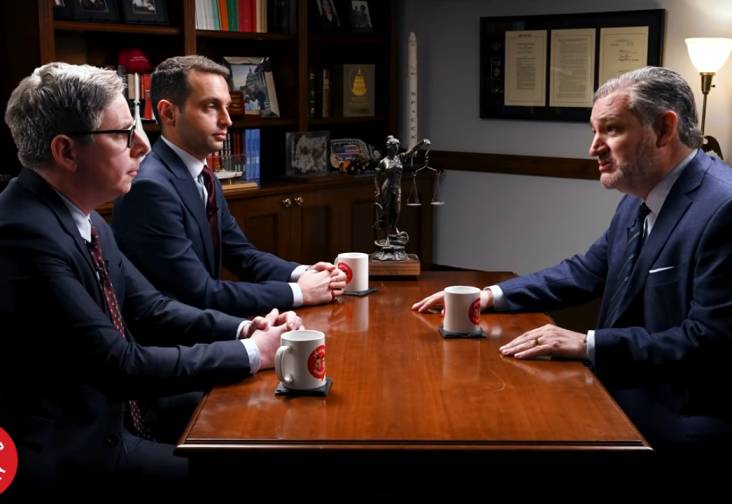
Editor’s Notes: In this episode of Triggernometry, Senator Ted Cruz joins hosts Konstantin Kisin and Francis Foster to discuss the high-stakes rationale behind recent military strikes on Iran and his personal advocacy for a “non-interventionist hawk” foreign policy. Drawing on his family’s history with Cuban revolution and communist oppression, Cruz argues that a weak Iran is essential for American safety and the potential collapse of the current regime could trigger a historic geopolitical shift. The wide-ranging conversation also covers the growing rise of anti-Semitism in politics, the strategic importance of the U.S.-Israel alliance, and emerging 21st-century threats like bioweapons. (March 22, 2026)
TRANSCRIPT:
Senator Cruz’s Background and Family Story
FRANCIS FOSTER: Senator, welcome to Triggernometry. Before we start the interview proper, it’s always good to ask particularly politicians about their journey, how they came to be where they are, and also how your journey influenced and shaped your views.
SENATOR TED CRUZ: Sure. My journey. I’m a Texan. I’m the product of my family story. For me, my hero my whole life has been my dad. My father was born in Cuba and grew up in Cuba. And as a kid, when he was 14, he began fighting the Cuban revolution and fighting actually alongside Fidel Castro. And he did not know that Castro was a communist. In fact, when I want to irritate my father, I will call him a communist gorilla. And he gets angry. He goes, “I was not a communist. I was never a communist.”
But as my dad describes it, he said the revolution were a bunch of kids like him. They were 14 and 15 year old boys who didn’t know any better. And Batista was a dictator, he was corrupt, he was in bed with the mafia. And so my father fought for several years in the revolution and then when he was 17, they caught him and they threw him in jail and they tortured him and beat him badly and they let him go.
And at that point my grandfather said, “Look, they know who you are. They’re just going to kill you.” And so my dad was a freshman at University of Havana at the time. And so he applied to three U.S. universities — he applied to University of Miami, LSU and University of Texas — and UT let him in. So 1957, my father takes a ferry boat from Havana to Key West and then takes a Greyhound bus from Key West all the way to Austin, Texas, shows up in Austin, can’t speak English, has $100 in his underwear and gets a job washing dishes, making 50 cents an hour. And he worked full time, he went to school full time and ended up earning a degree, going on to getting a job, starting a small business. Today my dad’s a pastor now.
Interestingly, my dad’s younger sister, my Tía Sonia, who just passed away a few weeks ago — and she was incredible, I called her my theologian, my crazy aunt — she was still there after the revolution succeeded. And so she saw that. And sadly, this is a pattern. A lot of Latin America is seeing that. They went — as bad as Batista was, Fidel Castro was worse. And so she saw him declare that he was a communist, begin seizing people’s lands, begin executing dissidents. And so my Tía Sonia fought in the counter revolution against Castro and she ended up being imprisoned and tortured by Castro’s goons.
And that pattern — so she and my dad fought on opposite sides. When I was a little kid, I used to sit at the feet of my dad and my Tía Sonia and I would hear stories about freedom fighters. And that inspired me. I told that story at my Tía Sonia’s funeral just a few weeks ago. And I said, “Look, it’s not often that somebody’s entire life is inspired in significant part by his aunt.” But my aunt and my dad were both freedom fighters. And if you asked me as a little kid, 5, 6, 7 years old, what do you want to do in life? I would have said I want to fight for freedom. It’s all I’ve ever wanted to do. And so now in the Senate, I have the incredible privilege of actually getting to do that. And I think of the Senate as almost like the modern day Coliseum where you strap on your armor and you go fight the barbarians. And there’s no shortage.
What Senator Cruz Knows About Communism
KONSTANTIN KISIN: Senator, what do you know about communism that most Americans don’t? With your background?
SENATOR TED CRUZ: Communism is the most evil, twisted, depraved ideology mankind has ever produced. It has resulted in more murder, more suffering, more torture, more poverty, more misery than any ideology. It is unequivocally evil. I hate communists and I don’t hide it.
They are everywhere that darkness has touched — it has oppressed. And it is empowered, by the way, for the communists. Look, Fidel Castro lived like a billionaire. Putin lives like he’s a billionaire. I mean, it’s very good to be an uncontrollable despot. It just sucks for everybody else. And so I think defeating communism is incredibly important. Communism is the antithesis of human liberty, of free enterprise, of individual freedom.
Why Senator Cruz Urged President Trump to Strike Iran
FRANCIS FOSTER: So, Senator, moving forward now to talk about the conflict in Iran — you were literally with President Trump the day before the strikes happened. Can you explain to us what the reasoning and the rationale are for this war?
SENATOR TED CRUZ: Sure. Look, I urged the President to launch this attack. As you noted, I was with him pretty much the entire day on Friday before the attack launched on Saturday. And so we were on Air Force One. We were flying down to Texas to Corpus Christi at a big event, planning Corpus Christi.
And pretty much the whole time he was asking me what I thought we should do on Iran. And I said, “Look, I think we should not miss this moment. I think the regime is weaker than it ever has been and we have an opportunity. If we can collapse this regime, America will be much, much safer. There are very few things on planet earth that would do more to improve American national security as much as seeing this regime collapse.”
And he asked me in the Beast, he said, “Well, look, do you think we should negotiate further?” And I said no. I said, “I don’t believe they’re negotiating in good faith. They are liars. I think the Ayatollah just wants to delay and delay and delay while they rebuild.”
And I said, “As far as I’m concerned, the only deal you should be willing to take is the same deal you offered Maduro.” And Trump offered Maduro — if he wanted to leave the country, he could go into exile and he would be allowed to live out the rest of his days if he left and exited. And Maduro said no, and I suspect Maduro regrets saying no now.
And I said, “I could live with that deal for the Ayatollah — to give him and the mullahs the same choice. You can leave and allow a new regime to come to power in Iran, or if you don’t leave, the alternative is going to be a less than pleasant one.”
The Military Objectives in Iran
And so in terms of what are the objectives, I’ll break it into two categories. Number one, what are the objectives the administration has stated? And number two, what I think the objective should be.
So the administration has stated that the objective is to degrade the military so that they cannot strike out. And so we’ve seen in the week and a half that this military conflict has been ongoing — we’ve seen, number one, their air defenses essentially completely eliminated. We’ve seen their short and medium range missiles all but completely eliminated as well. We’ve seen the missiles taken out, we’ve seen the missile launchers taken out. We’ve seen the manufacturing capacity for new missiles taken out. Same thing for drones. We’ve taken out the drones, the launching facilities and the manufacturing. All of that has been taken out. We’ve also taken out almost the entirety of the Iranian navy.
The result has been that we have near complete air dominance over Iran. There’s nothing Iran can do about it. And we have decapitated the regime. Obviously, the Ayatollah is gone. We’ve taken out many of the senior leaders in the regime. You keep having new leaders appointed. That’s how the administration has described their objectives. And on the terms of those objectives, I think they’ve accomplished a lot.
The administration has not articulated its objective as regime change. And look, there’s an obvious reason for that, which is after the Iraq war, I think people are wary of the words “regime change” — understandably, for good reason. The Iraq war — I think the Iraq war was a mistake. And I’m happy to talk about that and compare and contrast this to Iran.
I, however, think our objective should be unequivocally collapsing this regime. And in my view, the decision to launch this attack was the most consequential decision President Trump has made in his second term.
Iran has been at war with the United States for 47 years, since the Islamic Revolution, which began by seizing Americans and holding them hostage for 444 days. So that’s how they started this journey. Iran, for the entirety of that time, has been the world’s leading state sponsor of terrorism. They provide over 90% of the funding to Hamas, to Hezbollah, to the Houthis. They’ve killed nearly a thousand Americans over that time. The Ayatollah hired not one, but two squads of hitmen to try to murder President Trump.
And I think an Iran that had a government that was not led by a radical Islamist who leads mobs chanting “Death to America” — an Iran that had a government that was not actively trying to murder Americans, and by the way, succeeding, killing Americans year after year after year — that would be a much safer world for the United States and for our allies. And so I think that should be —
The Question of Regime Change and What Comes After
KONSTANTIN KISIN: — the objective, Senator, but there’s lots of — I agree with you on that. Personally, I think Francis and I both thought that the 12 Day War was a sensible thing to do if you could get the nuclear material. It seems that that didn’t quite happen based on some of the satellite imagery and the fact that the United States is attacking again. But you’re right, and I think our conversations here in the United States with all kinds of people show this. The words “regime change” sends shivers down a lot of spines. Rightly so.
SENATOR TED CRUZ: Understandably.
KONSTANTIN KISIN: So what is the vision of how — because Iranian regime, terrible. I don’t think there’s anyone in the world who would disagree with that. But there’s one thing to get rid of them and another thing to replace them. What is the end goal here?
SENATOR TED CRUZ: So let me — I’m going to answer your question, but let me stop you when you said you don’t think there’s anyone in the world that would disagree with you.
KONSTANTIN KISIN: Sure, there’s some people in the world.
Democrats, Biden, and Iran Funding
SENATOR TED CRUZ: And by the way, there are some people who are not very far away from us. Most of the Senate Democrats — look, during the four years of Joe Biden, the Biden administration flowed over $100 billion to Iran, keeping the regime in office. In a very real sense, the Biden administration was the most important funder for Iran. And Iran in turn was funding terrorists who were killing Americans, including the atrocities of October 7th. In a very real way, Joe Biden and Kamala Harris flowed the money to Iran that paid for the training of those death squads.
And so at some point — look, I understand Senate Democrats like to say, “Oh, we don’t like the Ayatollah.” You know what, if you give someone $100 billion, you don’t dislike him that much. At the end of the day, actions speak louder than words.
And by the way, Barack Obama has written in his memoir how when the Green Revolution was happening during Obama’s presidency, that he made a very deliberate decision — don’t stand with the protesters, don’t encourage the protesters. Instead, support the regime. And so the Democrat Party, as an ideological matter, doesn’t want to see the regime fall. And they’re perfectly happy — they’ve been happy to flow billions of dollars to them.
Arming the Protesters: The Tiananmen Square Lesson
Now, how do we get this regime to collapse? I think what we’re doing right now is very effective — a combination of military pressure, removing their ability to wage war. What I have called for — I do not know if we are doing it — is arming the protesters. And I’ll give you a story as to why.
30 plus years ago when Tiananmen Square happened, I remember at the time, right after Tiananmen Square, the NRA ran a full page ad in six U.S. university newspapers — ran it in the Wall Street Journal, the New York Times, the Washington Post, Chicago Tribune, LA Times, and USA Today. And the ad was just a giant picture of Tiananmen Square packed with people. And I still remember the words the ad said:
“Last week over a million people rose up in protest in Tiananmen Square. Imagine what would have happened if they had had guns.”
Iran, Iraq, and the Limits of Military Intervention
KONSTANTIN KISIN: Senator. But isn’t that exactly the problem here? Because the people who would have risen up and who may have used those guns are dead because they were all slaughtered by the regime. And now you’re bombing the regime in order to get people to rise up who are no longer there.
[ADVERTISEMENT REMOVED]
SENATOR TED CRUZ: Some are. And look, we don’t have a precise measure on how many people the regime murdered anywhere. The estimates range from 10,000 to 40,000. It’s certainly clear that they’ve killed many, but you’ve got a nation of 92 million people.
And look, I remember that ad about Tiananmen Square because I sat there and thought, you know what? A million people rising up who are armed. That’s not a protest anymore. That’s a revolution. And the same would be true. Look, part of why the regime was able to murder 10 to 40,000 people is you had soldiers with machine guns and you had people on the other side with rocks. That doesn’t work when you have that kind of imbalance. When both sides can defend themselves, you get a very different dynamic.
Why Iran Is Different from Iraq
Let’s go for a moment to why this is different from Iraq. Because I want to be very clear. I think Iraq was a serious mistake. And if you rewind, go back to the 2016 presidential election in the United States. So in that election, we had 17 Republicans run. If you set aside Rand Paul, whose foreign policy views are kind of on one fringe. If you set Rand aside. Of the 16 remaining candidates, there were two and only two who opposed the Iraq war. Me and Donald Trump. Everyone else thought the Iraq war was a good idea and defended it.
Now, why did I oppose the Iraq war? Because I think it made America less safe. What I have argued for is the central touchstone for every foreign policy decision, every military decision should be protecting the vital national security of the United States of America. Saddam Hussein was a bad man. He was a monster. He was a tyrant. He was murdering his own people, but he was also killing terrorists. We came in and we toppled Saddam Hussein, and the terrorists took over and began killing Americans. That didn’t make us safer. It made us less safe.
By the way, we did the exact same thing in Libya. Gaddafi, again, a terrible man. America came in and toppled him. He was killing terrorists. Instead, the terrorists took over. They began killing Americans. That was a material harm to our national security.
Why is Iran different? Iran is different because the Iranians are murdering Americans. They are waging war with us, whether the Democrats want to acknowledge it or not. And so removing from power Islamists who are actively trying to kill Americans makes us safer.
Now, Iraq was compounded because the mission became nation building, because the mission became put hundreds of thousands of boots on the ground for years at a time. And a lot of folks in the Republican Party thought our mission is to promote democracy. Democracy is wonderful. And we are the global police who will promote democracy across the globe. I think that’s completely misguided. I think democracy is great. I think we should advocate democracy. The bully pulpit. I am all for advocating democracy, but I’m not willing to send our sons and daughters to die to try to turn countries in the Middle East into Switzerland. I think that was a big mistake.
The Question of Regime Change
KONSTANTIN KISIN: So what is the administration trying to turn Iran into? This is the question that I think I haven’t heard a persuasive answer from anybody, not just you.
SENATOR TED CRUZ: Well, look, I think they haven’t articulated it because they are wary of using the words “regime change.”
KONSTANTIN KISIN: So that’s why they have said “regime change.” What they have — well, what they haven’t said is what the next bit is.
SENATOR TED CRUZ: Look, if you listen to Pete Hegseth, if you listen to Marco Rubio, they’re not embracing regime change. They’re saying we want to degrade the drones and the missiles. They’re talking about the specific and discrete military objectives which are meaningful. What I’m saying unapologetically is I want a government that is not an Islamist government that is trying to kill us.
KONSTANTIN KISIN: Senator. But how is that going to happen? Okay, because if you keep killing them, they seem to get less moderate, not more, from what I’m observing.
SENATOR TED CRUZ: Look, at some point, this regime stays in power through brute force. They stay in power through military might. As you remove their ability to repress the people, at some point, it’s up to the people of Iran to govern themselves. But taking out the people who are the Islamist dictators removes them from the equation.
And then, look, I am largely agnostic as to who the people of Iran choose. There are different people that are competing, and as far as I’m concerned, as long as it’s not someone trying to kill us, my focus is to protect Americans. And so if they want — look, there are different discussions. If they have a democratically elected leader, there are discussions about the Shah’s son as an interim leader. I’m ambivalent on that. That’s their choice. What I’m not ambivalent on is having a leader in place and a government in place that is not waging war against us. And I think the President’s job is to be Commander in Chief, focused on keeping Americans safe, protecting American lives. I think that’s what we’re doing.
Political Risks and the Midterm Elections
KONSTANTIN KISIN: And what’s your assessment on the timeframe that’s required for this? Because I was just looking before we started — the Kalshi odds of the Republicans holding the Senate at the midterms have gone from 82% three months ago to now 50/50. And it’s narrowed very much since this conflict has started. So given that there may well be — the Republican Party is very much behind this war, but there may well be a domestic price to pay, particularly the longer this goes.
SENATOR TED CRUZ: Yeah, look, I’ll confess, I am skeptical of things like prediction markets for elections. I think there are some areas where prediction markets could be quite accurate. In my experience, prediction markets reflect the conventional wisdom at the time. So to give you an example, the prediction markets in the 2016 presidential election at this point said Jeb Bush was the runaway favorite and he was going to win. And so that was the conventional wisdom at the time. And that’s where the prediction market was.
I don’t disagree with the proposition that politically, where we are right now is a challenging position for Republicans, that if the election were held today, there would be a very good chance we would lose the House and we could lose the Senate as well. Now, obviously, I hope that doesn’t happen. And we do have seven months until Election Day. So we’ve got time, and I think we’ve got a remarkable record of success, much of which has not been communicated to the voters. And so I think we’ve got a real record to campaign on.
And I don’t believe that what is happening in Iran will be front and center in November. I don’t think that this will extend — if it extends that long, we’ve done something wildly wrong. I don’t believe it will. I think the president said at the beginning this is going to be a matter of several weeks. This is not — I don’t think the president is envisioning anything that extends multiple months, much less multiple years. I think this will prove a very different military involvement than Iraq did.
The IRGC and the Mechanics of Regime Control
FRANCIS FOSTER: Senator. So you’ve got Cuban heritage, I’ve got Venezuelan heritage, and Konstantin has Russian heritage. We know how autocratic regimes work. We know that it’s not just the people at the top, but they have the tentacles which they use to control people. In particular, the IRGC — Islamic Revolutionary Guard — numbering roughly around 200,000 highly trained soldiers, many of whom are fanatical. They are Islamists. How are you going to deal with them? Because they are the ones keeping essentially the Iranian people — let’s be honest — they’re the ones keeping them under control.
SENATOR TED CRUZ: And that’s where this military campaign, I think, is making a difference, because you’re taking out significant numbers of the IRGC as well. You’re weakening the apparatus. The regime has to oppress the people.
And look, weakening the regime — we’re at an interesting moment in time because there is a very real possibility in the next six months we could see new governments in Iran, Venezuela, and Cuba. And if we end up with governments in those three countries that want to be friends with America rather than enemies of America, that would be the biggest geopolitical shift since the fall of the Berlin Wall.
Now, let me be clear. There are a thousand ways that can go wrong. I’m not being Pollyannish and saying, “Oh, everything’s wonderful.” But on any objective level, the regimes there are weaker than they have been in our lifetimes. That is a moment of enormous opportunity. And so look, at some level, it’s going to be up to the people of Iran — if they want a new government — to step up and insist on that. I do think the President’s putting pressure, weakening the regime and weakening the oppressive power of the regime, makes them more vulnerable. And that, at the end of the day, I think increases the safety of Americans.
The Strait of Hormuz: Iran’s Trump Card
FRANCIS FOSTER: And the other challenge that you’re facing is the Strait of Hormuz at the moment. Because when you look at the natural resources going through there, the petroleum, the liquid natural gas, the fact that it’s —
SENATOR TED CRUZ: — fertilizer, helium —
FRANCIS FOSTER: — the fact that it’s been shut and it’s been closed. And let’s be honest, that is Iran’s main trump card. That is a very real issue, not just for America, but for the globe in general.
SENATOR TED CRUZ: Unquestionably, though I will note the Europeans — who are more impacted by the Strait of Hormuz closing than America is — the Europeans have said, “Well, gosh, we don’t like it, but we’re not willing to do much about it.”
FRANCIS FOSTER: I identify as Venezuelan.
KONSTANTIN KISIN: Yeah, just saying that sounds very on brand for Europe at the moment. We say as Europeans, unfortunately —
SENATOR TED CRUZ: Look, the Strait of Hormuz is no doubt a critical choke point. And Iran — I think part of the reason that we’re seeing them go after the Strait is because I think they’re in desperate straits, that they are so weakened they don’t have very many options left.
And look, we’ve seen, for example, a short-term energy price spike. Now listen, if energy keeps soaring and if you end up with gas prices much, much higher — you asked politically about the election — high gas prices historically have not been good for elections. People are p*ed. Now, I don’t believe that’ll happen in the long term. I think we’re seeing a short-term spike. Anytime you have military conflict in the Middle East, you predictably have a spike in the price of oil and the price of gasoline.
If we can see a stable regime in Iran that is not waging war with us, and if the Iranian energy can come to the global market free of sanctions and free of conflict, I think long term, that has a significant downward pressure on the price of oil and the price of gasoline. And I also would point out that even with the spike we’ve seen, the price of gasoline is still significantly lower today than it was under Joe Biden. And so we saw under the Trump administration and Republican Congress, the price of gasoline basically cut in half. And then we’ve seen about half of that go back up again during this conflict. I think the conflict will be short lived, and I think you’ll see prices fall when that happens.
Iran’s Nuclear Threat and the Justification for Military Action
FRANCIS FOSTER: But we’re looking at, for instance, a significant gas field in Qatar being bombed. Yes, and it’s now being shut down. People within Qatar are saying it’s going to take three to five years for it to be up and running and to be fully functional. And that is responsible for 15% of the world’s natural gas. And you’re going, this is unsustainable, surely.
SENATOR TED CRUZ: Well, look, that was bombed by the Iranians and it is an amazing statement that Iran, when this military conflict started, began firing missiles at practically every one of its neighbors. And ironically, the Arab world is more united behind this military conflict than Europe is. And I think it’s because they understand the threat of their neighbor.
And listen, when the Ayatollah says “death to America,” I believe him. I don’t think those were empty words. One of the reasons why I have been leading the fight to stop Iran from getting a nuclear weapon is I believe the Ayatollah, if he had had a nuclear weapon, the odds are unacceptably high that he would use it.
Comparing Iran to North Korea
KONSTANTIN KISIN: Why’d you say that, Senator?
SENATOR TED CRUZ: Because he was a theocratic zealot who embraced a death cult that celebrates suicide. So let’s compare and contrast Iran to North Korea.
If you go back to the Bill Clinton administration, the Clinton administration was negotiating with Kim Jong Il, Kim Jong Un’s dad, and cut a deal. They said, “Okay, if you don’t develop nuclear weapons, we will give you billions of dollars.” And Kim Jong Il said, “Great deal. Happy to do it.” Well, what happened? They took the billions of dollars, they turned around and developed nuclear weapons. And now North Korea has nuclear weapons. And they regularly threaten to use them. They threaten to use them on their neighbors in Asia. They threaten to use them on the United States. North Korea claims they have missiles that can reach — in fact, Austin, Texas has been one of the targets they have identified as a nuclear target.
Now, look, Kim Jong Un is narcissistic and unstable and a megalomaniac, but perhaps some modicum of deterrence is possible. Because the one thing Kim Jong Un understands is if he were, God forbid, to use a nuclear weapon, his regime would end that day. The response would be devastating, and he wants to stay in power. It would have been a much better world if he didn’t have nuclear weapons. But there’s at least some modicum one can hope of deterrence.
What is qualitatively different when religion comes into it, when a theocratic zealot comes into it, is that ordinary cost-benefit analysis doesn’t work nearly as well. So look, if the Ayatollah had a nuclear weapon, I think there is some real chance — and I don’t know what the possibility is, but it’s real — that he would detonate that weapon in Tel Aviv or New York or Los Angeles.
Now, if he did that, the result would be an overwhelming military response, and a response that predictably would take the lives of many Iranians if he detonated a nuclear weapon. Here’s the problem. I think the Ayatollah might have been just fine with that. If he got to kill lots of Jews or he got to kill lots of Americans, I think with religious zealotry, that might be an acceptable trade-off to him.
And so my view was, as a matter of national security, we should do everything necessary to prevent Iran from acquiring a nuclear weapon.
Iran’s Missile Stockpile and the Case for Action
I will say one of the additional justifications the administration has used for this military conflict is that Iran was rapidly building up its short and medium-term missile stockpile, building over 100 missiles a month. And they were building them up and building them up. And the administration was concerned that they would get such an overwhelming stockpile of missiles that it would be extremely expensive in terms of loss of lives to engage in military conflict with Iran. And they would do that essentially as a shield to then be able to develop nuclear weapons. They were developing these short and medium-term missiles to be able to inflict massive pain and loss of life on all of their neighbors.
And so the administration said, “We don’t want to be sitting here a year from now where their stockpile and their drones are so massive that to go in and try to take out their nuclear facilities risks a massive loss of life.” I think that is a reasonable justification as well. But all of this is keyed on, are you protecting America? Are you keeping Americans safe?
KONSTANTIN KISIN: I am completely with you on the fact that Iran should not be allowed to get nuclear weapons. I don’t think there’s any evidence to suggest that they were ever likely to be able to hit Los Angeles or New York. Tel Aviv maybe.
SENATOR TED CRUZ: Tel Aviv maybe. Although look, there’s more than one way to hit a target. Do they have an ICBM that could cross the ocean? No, although they had an ICBM program — they were trying to develop an ICBM. And I would point out to people all the time, the “I” in ICBM stands for intercontinental. You do not need an ICBM to hit Israel. They wanted an ICBM for one purpose, which was to carry a nuclear warhead to the United States. So they were trying to develop it.
But I will point out beyond that, look, if you have a nuclear weapon, there’s more than one way to deliver a warhead. And if they could find a way to get it on a ship or another cargo carrier, to put it in a container and put it in Manhattan, you don’t have to deliver the warhead using a missile. And so I don’t want to experience a world where the Ayatollah has a warhead and his only problem is, “How do I get this to America to detonate?”
KONSTANTIN KISIN: And look, I appreciate that this question —
SENATOR TED CRUZ: And I’ll point out London could be another target. I think he would rather murder Americans than the British. But London is certainly another target you could envision him striking.
FRANCIS FOSTER: We are little Satan.
Iran’s Nuclear Ambitions: Deterrence or Aggression?
KONSTANTIN KISIN: No, I think that’s Israel. But nonetheless, I mean, I appreciate the President can’t think in the terms that I’m about to describe, but nonetheless, is not a much more likely explanation of why Iran was seeking nuclear weapons actually the reason that North Korea was seeking nuclear weapons — that is, to deter aggression from Israel, from the United States, and to prevent the very things happening now? And the worry for some people is actually this conflict has created an incentive structure that will only accelerate the attempts to get nukes.
SENATOR TED CRUZ: So I don’t think that’s right. And I will say, look, there’s a reason the Ayatollah referred to Israel as “little Satan” and America as “the Great Satan.” As I said, when he would lead mobs chanting “death to America,” I believed him. I don’t think it was empty rhetoric. I think he believed it with all of his heart. And his whole life, he had been carrying it out. He had been murdering Americans. So we knew it wasn’t empty rhetoric. He murdered every American he could at every chance he could.
Biden’s Weakness and the Consequences of Appeasement
And listen, if you look at the Biden administration, their approach — they dealt with every foreign conflict with weakness and appeasement. And those on the left think, “Well, that’s how you avoid war.” Well, it’s amazing. When Joe Biden came into office, there was peace and prosperity across the globe. And we had two military conflicts break out simultaneously. Russia invaded Ukraine, and we had October 7th and the Gaza war that unfolded. And I think both of those were in a very direct way caused by Joe Biden’s weakness.
When Biden withdrew from Afghanistan in an absolute debacle of incompetence that, among other things, cost the lives of 13 American servicemen and women, I said at the time, “This has made the world much more dangerous. The odds of Russia invading Ukraine have just increased tenfold, and the odds of China invading Taiwan have increased tenfold.” And our enemies have looked to the Oval Office, they’ve taken the measure of the commander in chief, and they’ve concluded that he’s weak and feckless.
In contrast, Donald Trump — our enemies are terrified of him. And I think America is safer when our enemies are afraid of the commander in chief. Appeasement increases the chances of military conflict. I’ve joked there’s a reason nobody goes and studies and gets a degree from the Neville Chamberlain School of Foreign Affairs. It doesn’t work. Appeasement encourages bullies and tyrants.
And so you see, look, when Trump went into Venezuela and arrested Maduro and his wife, that had a profound impact, and it resulted in our enemies — I think it reduced the chance of conflict.
Now, you said, “Well, couldn’t Iran want nukes to avoid people attacking them?” Look, if they weren’t killing everyone, nobody would be attacking them. The United States is not an aggressor seeking conquest. We’re not trying to conquer the land and make it an American territory. We’re not an expansive regime. We are acting to stop people from killing Americans. That’s a very different thing. And so the justification you suggested — “Well, I want to get the tools to kill a lot more Americans so I can keep killing the Americans I can” — now, that doesn’t pass the smell test.
Are Israel and America Pursuing Different Objectives?
KONSTANTIN KISIN: One of the other things that’s become — you know, we’ve traveled around the United States many, many times before, but we’ve been here for a couple of weeks now, talking to all sorts of people on camera and off. As you’ll be aware, as we’re recording this, yesterday a counterterrorism official resigned, Joe Kent. And he’s saying — I mean, I thought there were a lot of baseless things about Israel that he said in the statement — but broadly speaking, he’s actually saying something that many people are now openly saying, which is that Israel and the United States have different objectives in this conflict. And in fact, it is Israel’s objectives that are being satisfied while Americans are not.
SENATOR TED CRUZ: Look, I think that is silliness, and I actually think Israel had very little to do with why the United States is engaged in this military conflict. President Trump is acting to keep America safer. I can tell you, when I talked with him about it, Israel didn’t even come up. We talked about the Iranians killing Americans. In my conversations with him, Israel was not even part of the conversation. It was simply, this regime has tried to murder Trump twice, hired hitmen to murder Trump twice. He was not happy about that, understandably. And this was all about keeping Americans safe. That was his reasoning.
KONSTANTIN KISIN: How do you square that? Forgive me for interrupting, but how do you square that with Secretary Rubio’s statements, which he sort of walked back, but nonetheless, a lot of people felt that when he was talking about this, he basically — gave the game away when he said, “Well, Israel was about to attack so we had to jump in there before we were attacked.”
SENATOR TED CRUZ: I can’t tell you why he said that. You’d have to ask him why he said that.
The Non-Interventionist Hawk: Iran, Israel, and Tucker Carlson
SENATOR TED CRUZ: My reasoning was very straightforward. Which is this ayatollah and this regime is a serious threat to the United States. It’s not a theoretical threat. It’s a threat that’s reality.
Let me make a broader point. You asked about Joe Kent. I don’t know him personally. I know of him. But I will say I think he embodies — let’s talk philosophically for a second.
For a long time, people have thought about foreign policy, particularly foreign policy among Republicans in the United States, as essentially a bipolar world. That you’re either an interventionist and you want to go invade other countries and engage in military conflict, or you’re an isolationist, you want to withdraw from the world and never engage in military conflict. The paradigmatic interventionist would have been a John McCain, and the paradigmatic isolationist would be a Ron Paul or Rand Paul. And those are treated as the only two options.
I can tell you, I’ve always thought both were wrong. I don’t agree with either one of them. And I think most Americans don’t agree with either one of them. I’ve always described myself as a third point on the triangle, and so I call myself a non-interventionist hawk.
Now, what does that mean? It means, as I said before, that every decision is keyed on protecting the vital national security interest of the United States. So you don’t engage in military conflict to engage in nation building, to promote democracy, to defend norms. That was a popular phrase in the Obama administration. I don’t know what the hell it means to defend norms, but I’m not willing to have US soldiers die to defend norms. I am willing to put the US military in harm’s way to protect Americans and save American lives. That’s why we have a strong military.
And so it means — let’s take for example, when Obama was president and he talked about bombing Syria and he drew a red line of chemical weapons and Bashar Assad crossed that red line. When he talked about engaging in military conflict, I did not immediately reject it. I said, okay, let me listen to the commander in chief, let me hear your argument for why this protects US national security.
At the time, Bashar Assad had chemical weapons. He was using chemical weapons against his own people. I could have envisioned conceivably a military operation that I would think makes sense and would support. So I wanted to listen to him.
And I will tell you, I asked in both classified settings and in public settings — at the time there were seven major rebel groups in Syria, many of which were affiliated with radical Islamic terrorists, Al Qaeda, Al Nusra. And I said, okay, let’s say you go in and topple Assad. How do you stop the radical Islamic terrorists from taking over? And if Al Qaeda has chemical weapons, we’ve made the world much worse. As bad as Bashar Assad is, he’s not using those weapons on Americans. Al Qaeda would love to use those weapons on Americans. I’m not interested in having terrorists who hate us get weapons they can use to kill us.
When you asked them those questions, the answers of the Obama administration were incoherent. They were all over the place. At one point, John Kerry said, “We’re going to launch an unbelievably small attack.” And it was like, okay, well, what the hell is the purpose?
I could have envisioned, let’s say, a mission to go in where we knew where the chemical weapons were, they were in one warehouse, and we were going to send in a squad to get the chemical weapons and remove them. I could envision that being targeted in a way that might make America safer. The Obama administration never articulated anything like it. And so I vocally opposed that military action because it didn’t make America safe.
Contrast this with Iran. Iran has been actively killing Americans and has plans to continue killing Americans.
What is interesting when I say non-interventionist hawk — I think there are two presidents in modern times that reflect that same philosophy. One is Donald Trump. Now, Donald Trump doesn’t articulate it using the same language I do. But if you look at Trump’s foreign policy and national security policy, virtually every foreign policy and national security decision Trump has made I agree with. And that’s not accidental because for many of those decisions, I’ve been advocating those choices.
The other president who had a very similar philosophy was Ronald Reagan. Ronald Reagan called it peace through strength. In eight years as president, the biggest country Reagan ever invaded was Grenada. He was not one of the interventionists whose solution to everything was “send the Marines.” But he simultaneously rebuilt the military, bankrupted the Soviet Union, and won the Cold War without firing a shot. That is peace through strength. That’s another way of saying being a non-interventionist hawk — don’t invade everybody, but be strong enough that you defeat your enemy.
The Growing Threat of Anti-Semitism
KONSTANTIN KISIN: Well, you’ve made your point, but forgive me, I must drag you back to Israel. And it’s not because it’s a personal obsession of mine actually at all. But this is an issue that comes up in a lot of conversations now. And of course, it is being driven by people like Tucker Carlson, increasingly others as well. Do you not accept that there is a growing concern about the relationship between Israel and America and that many people feel that it is not to the benefit of the United States now?
SENATOR TED CRUZ: So look, there is a growing anti-Israel sentiment certainly on the left, and there is a sliver on the right. And by the way, it’s not just an anti-Israel sentiment. There is growing anti-Semitism that is getting materially worse.
In the United States, it was about a decade ago that anti-Semitism and vicious anti-Israel animus began rising on the left. And I think the Democrat leadership by and large just looked the other way. They just hoped it would go away. And I think it’s all but completely consumed their party. I mean, today there is a very real pro-Hamas contingent of the Democrat Party, and the remaining Democrats, even if they don’t agree with that extreme, they’re terrified of them because that’s where the energy, the money, the power in the party is. Look at all of the Democrats who made the trek up to Manhattan to support Comrade Mamdani. That’s where the Democrat Party is today.
On the right, in the last 18 months, I’ve seen more anti-Semitism on the right than I have at any point in my life. And I think it is growing. You mentioned Tucker Carlson. I believe Tucker is the most dangerous demagogue in America. And he is obsessed. He hates Israel. He is attacking Israel on a daily basis. He’s attacking Jews on a daily basis.
And there are others — there are a handful of podcasters and voices that are amplifying these views. Anti-Semitism is a gateway to anti-capitalism and anti-Americanism. Mamdani is a great example of the Green-Red alliance, that Marxists and Islamists come together because they hate the same people.
You’ve seen it with Tucker — he starts by having one crackpot historian on his show who says Winston Churchill was the villain of World War II.
KONSTANTIN KISIN: Yeah, we weren’t fans of that one.
SENATOR TED CRUZ: He then has another crackpot professor who says there’s a good argument America should have supported the Nazis and intervened on behalf of the Nazis in World War II. And Tucker gazes adoringly as he’s saying this. He has said he thinks America should apologize to Osama bin Laden’s family. He has said he doesn’t know that Hamas is a terrorist organization. He thinks they may just be a political group.
He’s also said there’s no one on planet Earth he hates more than Christian Zionists, and he’s identified by name me and Mike Huckabee as the two people he hates the most.
Not only has he gone down the road where he is defending Islamists and defending Iran — he had the President of Iran on and did this fawning interview, asked no difficult questions whatsoever. He had Nick Fuentes, who is an open Nazi. And by the way, I don’t use the term Nazi lightly, but when you say as Fuentes has said, “I like Hitler, I agree with Hitler, and Hitler was very, very cool,” I view that as somewhat tautological. If you say you agree with Hitler, then you’re a Nazi — you’re saying it. That’s not an adjective I apply unless someone’s views make that clear.
Tucker interviewed Fuentes and nodded when Fuentes said his mission was to defeat global Jewry. By the way, not Israel — Jews. Fuentes told him every year he celebrates Stalin’s birthday. Now, let me ask you, what kind of freak even knows Stalin’s birthday? I don’t, and I don’t care. He was one of the most evil men to have ever lived, as you know very well.
And by the way, Tucker has also defended Mamdani and defended Maduro. You go down the road where you’re defending Islamists, you’re defending enemies of America — as you start down this road, it is a very problematic road.
At least on the right, it is still a minority. If you look at, for example, support of — and by the way, Tucker hates President Trump. He opposes everything about his foreign policy, and he’s attacking President Trump on a daily basis. Now, he’s too chicken to actually say that. So instead of saying that he’s attacking Trump, he just has every clown who hates Trump on his show to attack his policies, but he won’t actually say the name.
Look, I’ve resolved I’m not going to sit quietly and watch my party destroyed by the same forces that have destroyed the Democrat Party, because I don’t want to wake up in five years and find both national parties in the United States unequivocally anti-Israel and viciously anti-Semitic. And I think that is a possibility, and I’m going to do everything humanly possible to stop that from happening.
Tucker’s views are still fringe, but they’re being heard by young people. And if young people don’t hear a response to it, that’s how both parties are lost to this poison.
The Risk of a Prolonged Conflict
FRANCIS FOSTER: Senator, but it must concern you that the longer that this war goes on, the more casualties on either side — but particularly on the American side — ratchet up, the more we’re going to see this anti-Semitic virus, mind virus, which is how I like to call it, being spread.
SENATOR TED CRUZ: Yeah, look, I don’t want to see more American casualties. As I said, I don’t think this will be a long-standing military conflict. I expect it to be a matter of weeks and not extended.
And to be clear, if the proposal from the Trump administration had been, “Let’s invade Iran and put hundreds of thousands of troops on the ground and let’s stay there for years,” I’d say, hell no. My mission is not to turn Iran into Switzerland. That if they want to turn themselves into Switzerland, knock yourself out. I think the mission should be to protect America. And that is a much more focused mission that I believe the President is directly focusing on.
FRANCIS FOSTER: And is the problem as well that you’ve got the two main people, your greatest allies — is Israel involved in this war? Are your objectives different? Do Israel want a complete regime change?
America’s Support for Israel
SENATOR TED CRUZ: Sure, I assume so. I actually don’t. I haven’t seen them articulate that objective. But I assume so because for the same reason, it would be unequivocally in America’s interest to see a regime in power that doesn’t want to murder Americans. The same is true for Israel. They’d like a regime in power that doesn’t want to murder Israelis. Like that’s a natural.
When you have a leader who with religious fervor chants “death to America” and “death to Israel,” you would expect both America and Israel to be like, “Wait, that’s not good.” I’m reminded of during the Obama administration, John Kerry was Secretary of State and there was an editorial cartoon of the Ayatollah going “death to America.” And John Kerry says, “Well, can we meet you halfway?” Like, there’s not a middle ground compromise.
And let me be clear, America supports Israel because it is unequivocally in America’s national security interest to support Israel.
KONSTANTIN KISIN: Why is that?
Why Supporting Israel Is in America’s National Interest
SENATOR TED CRUZ: Because we get massive benefits. Number one, the Mossad is an incredibly effective intelligence agency, and they share that intelligence with us. We’re seeing this right now in this war with Iran.
How is it, you look at the 12-Day War — the 12-Day War last year, which Israel waged almost the entirety of. We did virtually nothing. The only thing we did in the 12-Day War was the one thing Israel couldn’t do, which is they did not have bunker buster bombs that were big enough to penetrate into the base of a mountain. Where Fordow, the Iranians had built their nuclear weapon research facilities in the base of a mountain precisely because Israeli munitions couldn’t take it out. The only country that had bombs big enough to do that was the United States. And so we sent our B2s over, delivered those bunker busters, took out the nuclear weapons facilities and left. Hugely successful.
You look at how the 12-Day War proceeded. Israel took out the air defenses almost immediately. They systematically took out the leadership, one after the other after the other. If you remember the IRGC — you asked about the IRGC — in the 12-Day War, you’d have one head of the IRGC, Israel would take him out. The next day, they’d appoint someone else. Israel would take him out. By the third or fourth day, I can’t imagine what it was like for them. I told them to say, “Hey, you want to be head of the IRGC?” “No, no, get Bob to do it.” Like, it was literally the precision of the intelligence penetration that Israel had of Iran was spectacularly effective. That benefits America.
Israel shares our values. It is a free market democracy that is allied with America. Their intelligence benefits America, their military — the enemies of Israel, the people who want to kill Israel, also want to kill America. So every time Israel takes out a Hamas terrorist or a Hezbollah terrorist or an IRGC terrorist, they’re doing it in their own national interest. But it also is making America safer because those terrorists are eager to kill Americans. And so we are friends with Israel because they are fighting people who want to kill us. And so it is making Americans safer. That’s why.
And look, conspiracy theories — you look online and it’s amazing. Everyone blames the Jews for everything. I think that’s unhinged. And I don’t want to see, as you described it, that mind virus spread. And I find it amazing that the Tucker Carlsons of the world can look at what happened on October 7th, where Hamas terrorists cross over into southern Israel, they target civilians, they go house to house, they murder the elderly, they murder children, they rape women and little girls, they kill 1,200 people including dozens of Americans — it was one of the largest terrorist attacks on Americans in U.S. history — they take even more people hostage where they violently assault them. And I don’t understand the Tucker Carlsons of the world that can look at that and say, “You know, I’m with those Hamas terrorists who are raping and killing people,” and not the people who are the innocent victims and then are fighting back to defend themselves against monsters.
I don’t know. When I see these left-wing activists who go on and on, I asked them, I say, “Look, in World War II, are you rooting for the Nazis?” Like, at the end of the day, there is a difference between targeting civilians and murdering civilians deliberately — which is what Hamas does, it’s what Hezbollah does, it’s what Iran does — and defending yourself and taking out terrorists who are trying to murder your citizens, which is what Israel does and it’s what the United States does.
The Left’s Anti-Semitism and the Oppressor-Victim Framework
KONSTANTIN KISIN: I actually think the left-wing anti-Semitism makes perfect sense to me because it is the logical conclusion of the worldview where you have oppressed groups which tend to be dark-skinned, etc., and they’re weak militarily. And then you have white, straight, whatever — which they think Israel is, because they’ve never been there, I assume — and they are the oppressors, and so they must be increasingly challenged.
SENATOR TED CRUZ: It is exactly the Marxist ideology of oppressor and victim. That’s right.
Cuba: The Next Domino?
KONSTANTIN KISIN: Speaking of Marxist ideology, you alluded to Cuba. President Trump alluded to Cuba. Do you think Cuba is next?
SENATOR TED CRUZ: I hope so. I don’t know. I think we have a greater likelihood of it than we ever have.
KONSTANTIN KISIN: There was a bit of a wry smile there. I must observe.
SENATOR TED CRUZ: Look, I mentioned that my tía Sonia passed a few weeks ago. When she was in the hospital and she was dying, I told her at the time, I said, “Tía, we just arrested Maduro and the Cuban government is going to fall.” And she was in her last moments. But I will tell you the smile that was on her face — it was a wonderful thing just to share that with her in her last moments here. And I think there are millions of Cubans — I’ve never been to Cuba, I look forward to going, but I want to go when Cuba is a free nation, when they’re not under the jackboot of communist oppression.
KONSTANTIN KISIN: Well, why were you so convinced to be able to tell your aunt that it’s going to happen?
SENATOR TED CRUZ: So look, if you look at the history of Cuba, for the first four decades they were dependent upon, and in many ways a satellite state of, the Soviet Union. And they were dependent on the Soviet Union for energy and for money. Then America wins the Cold War, we defeat the Soviet Union, and suddenly Cuba became dependent on Venezuela. And the Faustian bargain they cut with Venezuela is that Venezuela would provide Cuba with oil and with money, and Cuba provided Venezuela with thugs, with soldiers and thugs to oppress the people —
FRANCIS FOSTER: — and the know-how on how to turn a liberal democracy into a communist —
SENATOR TED CRUZ: Yes. And so, when Maduro was arrested, he was surrounded by about 100 Cuban soldiers. It was Cubans who were guarding Maduro. And when we arrested Maduro, what that did is it removed the lifeline of oil that was coming to Cuba from Venezuela. So they’re no longer getting oil from Venezuela. For a brief period of time, Mexico stepped in to the breach and was providing oil to Cuba. President Trump quite rightly leaned on Mexico and said, “Stop it. Cut off the oil.”
You look at Cuba right now — their economy is in absolute freefall. The public transportation has been shut down. They’ve run out of jet fuel. And that economic crisis is powerful. Now, will the regime fall? I don’t know, because you’ve got six decades of a machinery of repression that is built up, and that machinery is hard to dislodge. But I will say the economic pressure is massive, and it is weakening the existing government.
I’ll tell you a story about Cuba. My tía Sonia went back to Cuba several times. And she described to me one time she went back and she was visiting a friend of hers from high school. And she said this guy was kind of a mid-level Communist Party apparatchik, and he had in his living room, above the sofa, a painting or a photo of Fidel Castro hanging — like that was the main thing hanging on the wall.
And she described how he walked her into the kitchen and he closed the kitchen drapes so that no one could see in. And he sat down at the kitchen table and she said he burst into tears and he just began weeping. And he said to her, “Sonia, I look at you.” And she was there with my cousin Bibi. And Bibi is my first cousin — she’s this vivacious Latina, she’s beautiful. And he’s crying and he said, “I look at you and I look at your daughter and she’s so happy and she’s so joyful and she has such a bright future ahead of her.” And he says to her, “I was too much of a coward to escape and I’ve consigned my children to misery. You had the courage to get out of here and your daughter has an incredible future.” And she said he sat at that table and wept for about 10 minutes. Then he got up and he went to the sink and he turned on the sink and he got some water and he cleaned his face and he smiled and opened the drapes.
Look, that’s what’s happening in Cuba. And so it is my prayer that this economic pressure is enough to cause the regime to collapse. And by the way, the upside for Cuba — if you actually had a government in Cuba that was democratically elected, that you had free elections and free speech and freedom of religion and that wanted to be friends with America — I think you could see in Cuba what Hong Kong was in the 1990s. You could see an oasis of free enterprise. There’s a massive Cuban American community in the United States who would love to come back and invest billions in the island. I think you would see a tourist boom — they’re 90 miles away, some of the most beautiful beaches on planet Earth. I think the prosperity and abundance that could come from Cuba with a government that was not a communist regime is enormous. So will that happen now? I don’t know. But I think the pressure is greater than it ever has been.
Closing Question
KONSTANTIN KISIN: Senator, I believe you’ve sown the seeds of the next conspiracy. Given that you have a cousin called Bibi, they will not hear the end of that. But thank you so much for giving us your time. The last question we ask all of our guests is: what’s the one thing we’re not talking about that we really should be?
Bioweapons, Future Threats, and the Power of American Leadership
SENATOR TED CRUZ: You know, it’s interesting. This week Palmer Luckey, the tech executive, came and had lunch with all the Republican senators. And Palmer’s a friend of mine and I know Palmer quite well and he’s an amazing tech entrepreneur. In fact, I said at the lunch that I think Palmer and Elon Musk are the two most important tech entrepreneurs in the country.
He’s an innovative thinker and he’s talking about everything he’s doing at Anduril, which is amazing. And like Elon, both of them, they don’t just think outside the box. They don’t know there’s a box. I love both of them. They are really good friends and I love watching how their minds work.
I asked him, I said, look, you’re really good at thinking outside the box. What is the future of military conflict? What is the future of military conflict in 10 years? And what should we be afraid of? If you were an enemy, how would you attack the United States?
And he raised in particular, for a non-nation state, I mean, he talked about all sorts of things where the future of war is going. Obviously things like drones and AI, although he actually said that would be slower than many people think. We’d still be using B2s and F-35s and a lot of the legacy equipment for 10, 20, 30 years. He talked about subterranean warfare that he thought would be a component going forward.
But in terms of a vulnerability, something very few people are talking about that Palmer mentioned — he said he worries about our vulnerability to a bioweapon attack, that we don’t have nearly sufficient defenses to fight against, and the ability to spread. And he pointed out, look, Covid, which at the end of the day, in terms of mortality, there are many bioweapons whose mortality is orders of magnitude worse than Covid. Covid shut the world’s economy down for a year and inflicted trillions of dollars of economic harm. And he pointed out that we’re not nearly prepared enough to defend against that kind of threat.
And I think that’s when you talk about the kind of things that we ought to be worried about, those are the kind of threats that I think are really dangerous. And by the way, he talked about also the ability to bioengineer a virus or some germ that could potentially target individual races, could target families, could target people. And so he said, you know, look, do you think if the Ayatollah could create a virus that would kill Jews, that he wouldn’t be eager to release it? And you know what? Maybe his scientists are wrong and it doesn’t just kill Jews, it kills everybody.
That kind of danger is something — we are in a dangerous world. But when he raised it, all of us — now, look, the United States government is doing a lot of research to combat against that, but I think we need to be doing more because that kind of asymmetric attack has the potential to do enormous damage.
KONSTANTIN KISIN: It’s interesting you mentioned that. My father was a biochemical engineer in the Soviet Union. He’s retired now. But it’s something that he always said to me, that one day this will be possible. And it’s actually the most terrifying weapon that human beings will ever have come —
SENATOR TED CRUZ: — up with, particularly because I think we often overestimate what we know. So let’s take Covid. I think it is overwhelmingly likely that the Covid virus escaped from a Chinese government lab. I think it is likely, although I wouldn’t say overwhelmingly likely, that it was bioengineered in that lab, that they used gain of function research to make it more contagious, to increase its ability to impact humans. And I think it’s entirely possible they were doing so in what they thought was a defensive way, to learn about how to protect humans.
I have not seen any compelling evidence that the Chinese deliberately released Covid. Although I haven’t seen evidence one way or the other, but given the very shoddy protections, particularly at the Wuhan Institute of Virology, I think what is most likely is there was a lab leak where you had lab workers who were infected and then went into the community and other people got infected. And then I think the Chinese government — in fact, I know the Chinese government — affirmatively covered it up and was complicit in its spread.
But I think they probably thought, “Oh, we know what we’re doing and we’re just researching.” And then, oops, they screw up. And that, by the way, is a nation state with trillions of dollars of resources. If you take a couple of terrorists in a stood-up lab in a warehouse somewhere, you would imagine even less expertise, which has the potential, God forbid, for a virus that kills millions or more.
Closing Thoughts: Reagan, the Berlin Wall, and the Power of American Leadership
FRANCIS FOSTER: Senator, thank you for coming on the show. It’s been an absolute pleasure.
SENATOR TED CRUZ: On that cheery note.
KONSTANTIN KISIN: Yeah, it’s very on brand for our show to end on something very depressing.
SENATOR TED CRUZ: All right, I’m going to end on something happier instead. Directly behind me is a painting of Ronald Reagan standing in front of the Brandenburg Gate. And up top are the words “Tear down this wall” in German, in the style of the graffiti. And the reason that’s on the wall is I think those are the most important words uttered by any leader in modern times.
And let’s wrap on this. I’m going to tell you the story behind that speech. Three times the State Department crossed that sentence out of the speech, and three times Reagan wrote it back with his own hands. And the State Department argued to him, said, “Mr. President, you can’t say this. This is too provocative, this is too bellicose.” And here was their killer: “It’s too unrealistic. It will never, ever happen. The Berlin Wall will stand till the end of time.”
And Reagan, with a twinkle in his eye, he said, “Don’t you understand? This is the whole point of the speech.”
Less than three years after he gave that speech, the Berlin Wall was torn to the ground. And it wasn’t torn down by American tanks bulldozing, wasn’t bombed to the ground by American missiles. It was the power of American leadership, of truth, of standing up against tyranny that resulted in the Berlin Wall being torn down.
So when I talk with optimism about what could happen and what I hope will happen in Iran and Venezuela and Cuba, it is with that example — that when America stands and leads, freedom is an incredible and a powerful thing. And shining a light of truth on tyranny and oppression can be transformational.
Related Posts
- Transcript: World’s First AI Actress Interview on Piers Morgan Show: ft. Tom Conti, Tom Bilyeu & Prof Jiang
- In Vivo Podcast: w/ Cathy Tie and Prof. Jiang on Editing Embryos (Transcript)
- Transcript of Evy Poumpouras Interview: Read People, Spot Lies & More – FO563 Raj Shamani
- DOAC AI Emergency Debate: ft. Ed Zitron, Andrew McAfee, Nate Soares & Roman Yampolskiy (Transcript)
- Transcript of Norman Finkelstein Interview: Tucker Carlson Show