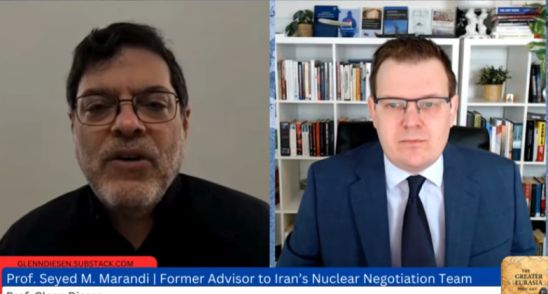
Editor’s Notes: In this urgent geopolitical analysis, Glenn Diesen speaks with Professor Seyed Mohammad Marandi about the rapidly escalating hostilities between Iran, Israel, and the United States. The discussion dives into the alarming shift toward “total war,” specifically examining recent attacks on nuclear facilities and the potential for a global economic collapse. Professor Marandi outlines Iran’s strategy of “escalation dominance” and the severe implications of recent ultimatums concerning the Strait of Hormuz. This interview provides a critical assessment of the high-stakes military and political maneuvers currently threatening global stability. (Mar 22, 2026)
TRANSCRIPT:
Introduction
GLENN DIESEN: Welcome back. We are joined again by Professor Seyed Mohammad Marandi, a professor at Tehran University and also a former advisor to Iran’s nuclear negotiation team. Thank you as always for coming on the program.
We see that this is quite troubling times. Israel has attacked the nuclear power plants at Bushehr and Natanz, and Iran has retaliated against the city of Dimona where the Israelis have their own nuclear plants. This was not an attack on the nuclear plant, apparently, but nearby in terms of hitting the city. So it does seem that we could be moving to a de facto nuclear war if this is the new trend — that is, attacking nuclear facilities with the possibility of nuclear fallout.
And making matters worse, we see that Trump gave Iran this ultimatum of 48 hours to open the Strait of Hormuz, essentially capitulate, otherwise they would start hitting Iran’s largest energy fields. And we see that the Iranian military headquarters, if I get this right, warned that if the US would carry through on these threats, then they would knock out the energy facilities and desalination plants across the Gulf states — which would essentially be the end of this, well, this state.
So we’re looking almost towards total war here. I was wondering if you can give me your assessment of what is happening, because this seems like uncontrolled escalation at this point.
Iran’s Retaliation and the Logic of Deterrence
SEYED M. MARANDI: Well, thank you very much for inviting me, Glenn. It’s always a pleasure being on your show.
Yes, but we have to keep in mind, of course — and I know your audience knows this, but Western media for some reason pretends as if this were not the case — the war began with US-Israeli aggression like eight, nine months ago. And every attack was met with a response. In other words, the Iranians are retaliating. They’re not initiating anything.
So the attack last night on the Israeli regime and on buildings linked to their nuclear program was in response to their strike on Iranian nuclear facilities. And Iran’s response to escalation has already been seen by all of us. When the Israeli regime, with US coordination — there’s no doubt about that — when they struck Iran’s vital gas installation in the south, the South Pars gas field, the Iranians swiftly responded and destroyed significant parts of Qatar’s gas field facilities and its LNG facilities in particular, and so the Emirati energy facilities as well.
And the reason why Iran did that was to make sure that the United States didn’t go further. And then we saw Trump post on social media that the Israeli regime won’t do this again. Of course, he then made threats against Iran, but that was to cover basically this retreat — the fact that he wanted to back down.
But of course, Trump is Trump, and he says one thing now, and then literally an hour later, he’ll say something very different. So his promise that the Israeli regime will not strike again doesn’t mean anything to the Iranians. They will always, when it comes to the United States, plan for the worst, and especially when it’s Trump.
You recall before the war, we had this discussion about whether there will be a war. I always said that Iran is planning for the worst. It doesn’t care what Trump says. The same is true now.
Trump’s Threats and the Risk of Global Economic Catastrophe
SEYED M. MARANDI: So now Trump is making another threat, and that is that he will destroy Iran’s vital infrastructure and target its electrical power plants. He already made that threat before. And Dr. Larijani tweeted that if that happens, as you pointed out earlier, there will be massive retaliation. And nothing happened back then.
After Iran’s response to the attack on the South Pars gas field, it’s clear what Iran is going to do if the United States does carry out this threat. And that would mean that the world will head towards a global economic catastrophe — something that I’ve been saying for many years.
Before Corona, I actually had an interview on Press TV that went viral back then. I said exactly what we are now seeing. If Iran’s vital infrastructure is destroyed, Iran will destroy everything on the other side of the Persian Gulf. Because these regimes are all engaged in warfare against Iran. They’ve allowed the United States to use the airspace, they’ve allowed the United States to use bases, they’ve allowed the United States to use their land outside the bases. They not only allow jets to fly over to bomb Iran, but they allow tankers to refuel those jets. They do everything necessary to kill Iranians, so they are fully complicit.
And a strike targeting Iran’s key or vital infrastructure is a strike to target the Iranian nation — and of course, a major crime against humanity, which in the West doesn’t mean anything. Because after Trump’s rant last night, we didn’t see any Western media say that this is outrageous, or that this is a threat against over 90 million people. No, because Western media collectively — they are Epstein-class controlled. So it doesn’t matter if it’s the Guardian or Breitbart, they’re all the same when it comes to empire.
The Consequences of Destroying Gulf Infrastructure
SEYED M.
MARANDI: So this means if he carries out this attack, that the energy crisis will be permanent, that the global economy will collapse, and that will have implications that are beyond my imagination. I can think of horrible things — hundreds of millions of people on the move, starvation, the collapse of industry. I can think of many, many things, but it will be because of Trump.
And if Iran is forced to destroy that key infrastructure, then it doesn’t matter if there’s an end to the hostilities and Iran allows the Strait of Hormuz to be open, because there will be no oil or gas to go through it and no tankers to take that energy or petrochemicals or anything else.
So we are where we are. But I just want to stress that Iran didn’t push us here. Iran’s threats are being made so that the United States doesn’t do anything stupid. I mean, this whole war is stupid. It is barbaric, it is inhumane, and it is fully supported by the West and its regional proxies — as we saw with Erdogan and Sisi and Abdullah of Jordan.
And these regimes in the Persian Gulf condemned Iran for retaliation against US assets in the Persian Gulf, and they didn’t even mention the Israeli and American war of aggression on Iran, because they’re in the American camp. The UN Security Council too condemned Iran and refused to even acknowledge this assault on the country.
So Iran is on its own. It has to carry out its threats of retaliation. Otherwise the United States will bomb Iran and destroy asset after asset — vital infrastructure throughout the country will be destroyed. The only way to stop it is to have deterrence, and for that deterrence to be used after credible warnings are given. And that is where we are right now.
The G7, Escalation Dominance, and the Nuclear Threshold
GLENN DIESEN: Also saw the G7 came out with a statement condemning Iran for retaliating. And as you said, no mention of the second surprise attack, the destruction of Iran’s energy and civilian infrastructure, or any reference to international law. It was just condemning Iran for retaliating.
And I saw you also made a comment that it would have been — if the situation was reversed — how absurd it would be. That is, if China was putting its missiles in Canada and launching them at the United States, and somehow then Canada declares neutrality thereafter. I mean, it doesn’t really make much sense at all.
And nonetheless, Iran can’t strike the mainland in the US, and the rules appear to be that Iran isn’t allowed, according to its rules, to attack the ones who are actually attacking Iran. So it is an interesting effort to dictate the rules of this war, but as you suggest, it’s not actually working.
But is this an accidental escalation which is out of control, or do you see this being deliberate on Trump’s side — that he’s saying, essentially, “Listen, Iran, either you capitulate,” which is essentially a ceasefire, “or we’re going to go up the escalation ladder”? Because the whole assumption is premised on the notion that the US has escalation dominance — that means the US can bring it up to a certain amount of pain in which Iran would have to be the one who folds first.
But where do you see this going? Because we’re not at the end stop, obviously — we’re rushing up quite quickly. And the nuclear power plants — I found this to be just extraordinary — because what would happen if Israel and the US would then destroy a nuclear plant, a reactor, and there would be some nuclear fallout like Chernobyl? How is this essentially the top of the escalation ladder? Or how would Iran, I guess, do a tit for tat if this were to happen?
Iran’s Escalation Dominance and Strategic Options
SEYED M. MARANDI: The Iranians believe that if there’s escalation, they will be the ones who have control because there are far more assets on the other side of the Persian Gulf free run to destroy. And the implications for the west would be far greater than what they can do to Iran. Iran has been sanctioned for decades, and it will slowly rebuild the vital infrastructure that is destroyed. But when the global economy collapses and the US economy collapses, I think that will be an unprecedented situation for the American people, and I think that will destabilize the United States and bring Trump’s presidency to an end.
But in any case, that’s all, you know, that’s a hypothetical. Right now, what I think is probably going to happen is that, well, the Iranians, as we’ve discussed, have no faith in international bodies. We also saw that during the 12 Day War where Iran was condemned by the west when it was attacked and the UN Security Council refused to take any action.
But let’s say that the Israeli regime strikes the nuclear power plant in Bushehr alongside the Persian Gulf. That radioactivity would contaminate the Persian Gulf and thus it would contaminate oil and gas. And so the Israeli regime itself will be. Or the Americans would be destroying the global economy with that single move. And as I said, if the global economy collapses, that’s the end of the US Empire. And the world will blame the United States and Zionism, first and foremost, for this catastrophe.
The Israeli regime will not benefit in the long term either. It will also be devastated by the collapse of the global economy, but more importantly by the collapse of their sponsor. The regime that enables the Israeli regime to behave in this manner would be severely damaged. And already across the west and in the United States in particular, animosity towards the Israeli regime is rising. We see the resignation of Joe Kent and his subsequent interviews. We see the polling and the rising anger towards the Israeli regime.
And if, of course, this war continues and the energy costs continue to rise, anger towards Trump, Netanyahu, and the Israeli regime will rise with it, because Americans will know who to blame. They started the war. It was unprovoked, especially since Trump campaigned on ending the forever wars. Of course, he campaigned on a lot of other things too, and he didn’t carry out any of them, almost — the Epstein files and so on.
So I don’t see a situation where the United States can have escalation dominance. I think the Iranians have that escalation dominance. And more importantly, if we have escalation and Iran destroys the assets on the other side of the Persian Gulf, those regimes will fall. That will be the end of these regimes.
And we still haven’t seen the axis of resistance escalate either. We see Hezbollah fighting very effectively in southern Lebanon and hitting the Israeli regime very hard. But the resistance in Iraq is still striking at US assets, but it still is not showing its hand. And of course, in Yemen, they said they’re going to enter, but they haven’t yet. And Iranians, they have much more up their sleeves than what they’ve shown so far. And I think the very fact that all US estimates being wrong about the number of missiles and drones that Iran has and so on, I think that shows that they really have no idea what Iran can do.
And simultaneously, we have to keep into account the fact that the Iranian people are fully supportive of the war. Every night, huge crowds gather across the country. These people don’t get tired. They go out every single night on the streets, during the day, on the streets, during Eid prayers, under airstrikes, missile strikes, under rain and snow. They’ve shown how steadfast they are. This is not a country that the United States can defeat.
And the circumstances where the world’s energy markets are fully dependent on energy coming from the Persian Gulf and the Caucasus — because if the war expands, have no doubt that oil and gas assets in the Republic of Azerbaijan will be destroyed too. Have zero doubt they will be finished. Because the regime in Azerbaijan, another family dictatorship, is allied to the Israeli regime in the United States. So it is antagonistic towards the Iranian people. We’ll have to add that to everything else. This is not a winnable war for the United States.
So will Trump escalate or will he back down? I don’t think anyone knows. I mean, I don’t think he’s predictable. I don’t think even Trump knows. I don’t think anyone around him knows. He can go either way, and then either way that he goes, again, he could do a U-turn, but the damage will be done. So if he strikes, let’s say an Iranian electrical power plant, Iran will probably do much greater damage to the other side because it has to make sure that the message is received. Then he may back down. Or maybe he won’t even attack, or then maybe he will further escalate. Who knows what he will do?
But regardless of what happens, I think things are going to get worse. And then we have the added issue of the US preparing itself for invading Iranian territory. And I think that will be also equally disastrous, because if the United States takes Iranian territory, that would be an escalation, and that would be damage to Iran’s vital infrastructure. And thus Iran will also have to retaliate against those Arab dictatorships and US assets there and other assets, because those regimes are complicit in the war.
So as we move forward, all I can see is escalation. Unless the Trump regime declares victory and walks away, like with Yemen. But even then, Glenn, even then, a lot of damage has already been done, and each day that goes by, there will be further damage. But even if Trump walks away, Iran is not going to accept the ceasefire. The facts on the ground will have to change. Iran will ensure it will make sure that regional, neighboring countries will no longer be a threat to Iran. It’ll make sure it will get compensation, either through using the Strait of Hormuz oil directly, force these regimes to pay for all the damage that they’ve done to the Iranian people and all the deaths that they’ve caused through their complicity.
I have no doubt that walking away will not be a simple solution either. It’s not as if the United States declares a ceasefire and Iran will then immediately open the ceasefire, open the Strait of Hormuz. That’s not going to happen.
Trump’s Contradictions and the Strait of Hormuz
GLENN DIESEN: Well, Trump going back and forth — one example would be the Strait of Hormuz, because he did indicate that, well, it’s not our problem. We’ll walk away. You know, it’s countries of the region. We should take care of this. We’re already done. And then of course, the following day he now makes this threat of what is essentially total war. That is, either open it 48 hours or we destroy everything.
I mean, as you say, it’s a bit all over the place. This happens within a few hours in between. Those are completely different positions. But when he came with that first tweet, I thought again, it’s very strange. This is how wars are declared now, by tweets. But I thought that this was an off-ramp. That is, as you suggest, if the US wants to get out of this, it can simply declare victory and go home as it did in Yemen.
But the problem of course is just the Strait of Hormuz, because, well, as you said, this won’t be opened. You know, this will take on a very different format. And so I thought when Trump tweeted that, well, this is not our problem, you know, the countries of the region should worry about it. Doesn’t really work that way either, because as you suggest, now Iran can, well, it’s already setting up, it seems like selective access, or essentially nationalizing the strait. That is, conditioning who can transit.
And as you suggest, it could have different functions for different countries. It could be a way of compelling the Gulf states to pay reparations for the damage they’ve done to Iran in this attack. It can be compelling them to expel the US bases so this again won’t happen again. Some have suggested as well that it could demand countries stop trading their oil in the US dollar, which would then dismantle the petrodollar system that links US military to the region.
So there’s a lot Iran can do, but this is all requiring Iran to have this selective access to the Strait of Hormuz to end this decades-long campaign against Iran. So it doesn’t seem clear to me where the US will actually go from here. But one of the things they will do, it appears, is sending troops to the region. We see now the 82nd Airborne apparently being on the way, and we’re seeing B-52 bombers with the bunker busters on their way. So what is it that you expect now over the next two days?
The Impossibility of a US Ground War
SEYED M. MARANDI: Well, the United States has been using bunker busters regularly and it’s been bombing Iran for 22 days now. And there’s nothing more that they can really do. And as I said earlier, Iran has escalation dominance. Iran still hasn’t shown its hand, nor has the axis of resistance collectively shown their hands, its members.
The United States can attempt to take territory, but Iran will destroy assets on the other side of the Persian Gulf. But more importantly, Glenn, the armed forces in the resistance in Yemen, in Iraq, and of course in Iran, they’re far greater in number and far more competent than the military forces in the US camp. I mean, Qatar doesn’t have a real standing army, nor does Bahrain, nor does the Emirates, nor does Kuwait. And Saudi Arabia has already shown its incompetence.
So what if the United States uses ground forces? Then what about ground forces entering Kuwait and moving into Saudi Arabia from the north, and from Yemen to the south, west, towards the north and towards the east? Who’s going to stop them? And then simultaneously, you’ll have Iranians striking all those key oil and gas installations and the vital infrastructure in retaliation. How is the United States ever going to win that? It’s an impossible scenario for the United States, and it will be a colossal defeat.
What we’re seeing right now is a president in the United States that has completely discredited the country because he has lied so many times and he’s been deceptive so many times, and he’s contradicted himself so many times. Nothing that he says means anything anymore to anyone. Not that the United States was an honest entity before Trump. I mean, we signed a nuclear deal with Obama, and he violated the deal from day one. And it was systematic. And progressively the violations grew until Trump became president and ultimately tore up the deal.
But Trump is in a class of his own. And so even if Trump signs a piece of paper saying, “Okay, we’re finished and we’ll go, we’ll walk away, the war is over,” that will mean nothing to Iran. The facts on the ground will have to change before Iran moves in a different direction. Because Trump has zero credibility.
Unknown Variables and Iran’s Remaining Cards
GLENN DIESEN: Well, regarding what you said, we don’t know yet the cards that Iran has to play. There’s a lot of uncertainty. Again, this is why many countries, or many people, irrespective of their feeling towards Iran, warned against this war. It’s too many unknown variables. You know, it’s not like previous wars of America. They can’t control all of these variables.
But one of them, of course, will be the missile range. We don’t know much about the missile range of Iran. This could be problematic if the Europeans deepen their involvement in this war. As you said, this axis of resistance — we don’t know if Yemen will come online and shut down the Red Sea. We see that Iraq is being, well, the European troops are withdrawing from Iraq, which is interesting because the Iraqi parliament has previously voted for foreign troops to leave. Well, they wouldn’t leave. But so it begs the question whether or not they would actually be allowed to return after this whole thing is over. I’m doubtful.
But also, if Iran hits the desalination plants in the Gulf states, as has been suggested, what are the consequences, especially of the desalination plants? Or if this ends up with nuclear targets? Or is there any other cards? Because you mentioned Azerbaijan — I hadn’t, to be honest, I hadn’t really entered my mind yet that this could also start. Well, I know that the relations are antagonistic. I know they’re an important energy hub, especially for the Europeans to skirt both the Iranians and the Russians. But what other cards do you think Iran may play as we continue up this escalation ladder?
The Looming Global Economic Catastrophe
SEYED M. MARANDI: Well, the Aliyev regime in Baku is sandwiched between Iran and Russia and he doesn’t have many friends in Moscow or in Tehran. So of course that is not good news in Iraq. The Iraqi resistance will, if I’m guessing that we move towards escalation, it will take northern Iraq and end the Kurdish local government there permanently because they’ve been so closely associated with Mossad and the CIA for all these years.
And the Iraqi resistance can easily move into the Arabian Peninsula. Iran would be able to destroy the vital infrastructure in retaliation to any escalation due to their role in this. And then there’s Yemen, that they can shut the Red Sea, they can permanently end the remaining Saudi oil exports and they can also move towards the Persian Gulf region and Iran can destroy these regimes as they advance. So you will no longer see any of these ruling families in any of these countries.
And I think that that would coincide with the global economic collapse like no other. It will be far worse than 1929. And if Europeans and the right wing Europeans and MAGA people in the United States are unhappy about immigration, then I think they should be aware that the number of people that will be coming, moving in their direction from Africa, Latin America and Asia will probably be 20, 30 fold. And at a time when their own economies will be collapsing, the only reason why people will be moving in that direction will be because that’s the traditional direction that they’ve been moving towards all these years because of all these wars and all the crimes that have been committed across these different continents.
So it looks very dark. No doubt about it. There’s no way to make this look non-catastrophic. Even if Trump is reigned in, even if he is removed from power before he takes the final step of targeting Iranian vital infrastructure, the damage already that has been inflicted on the world is very significant and it will play out.
Even if it ends today, which it won’t, Iran will not accept a ceasefire. As I said, the facts on the ground will have to change. But even if hypothetically, miraculously, Trump had a heart attack now, and the Vice President took over and said, “Okay, we’re ending this,” a lot of damage has been done. Iran’s demands will have to be met. The global economy will suffer. And every day that the war continues, even at the current level, the catastrophe for the global economy is growing. And of course, any escalation will make it far worse.
So there’s no good news on any front. And since Trump is a lunatic, he’s abnormal, he’s unstable. As long as he’s president, no one can predict tomorrow.
The Refugee Crisis and the Question of Proxies
GLENN DIESEN: Yeah, I always, regarding the refugee issue, I always hear the argument that why don’t Muslim countries accept Muslim refugees? Why do none of them do so? Why do they always only go to Western countries? I think it’s lost on many people that the country in the world that takes the most refugees is Iran. I hear this so often, it kind of blows my mind. I think Turkey is in second place. But still, this is almost presented as an inconvenient fact. It’s very strange. I don’t know where the perceptions come from.
But of course, if this whole region blows up, then Iran is not in a position to host refugees from this. If anything, you might have Iranian refugees as well. So it’s all just, you can see the problems piling up. And the same people who always warn against more refugees are the ones who always cause them. So it’s very strange. They cheered on the destruction of Libya and Syria, and then they cry out when all these refugees come into Europe.
But my last question, though, is about another arena, or area, that the Americans could escalate, which is to bring in their proxies. They pushed very hard. We see now some reports that Saudi Arabia is considering joining more directly. But of course, they’ve been pressured very heavily. You’ve seen Lindsey Graham more or less threatening Saudi Arabia, that if they don’t fall in line and join in, then this will have consequences for them. We saw the Kurdish proxy thing fall apart. The Azerbaijanis didn’t join.
But in this latest tweet, because Trump sends a lot of them, he warned the Europeans that why aren’t you sending your soldiers and your ships? And then essentially, indirectly threatening NATO, saying, “Well, this is just a paper tiger.” Then he comes with also his next threat, which is a very direct ultimatum, where he essentially writes, “Either you send your troops to fight Iran or we will take Greenland.” This is, you know, an alliance of values. But it is interesting. Do you see it likely the Europeans, for example, joining in, or the Saudis, or how do you see this playing out?
Iran’s Resolve and the Collapse of American Options
SEYED M. MARANDI: Well, before that, I should also point out the petrochemical and fertilizer crisis that is looming, that is no less significant than oil or LNG, if not more, especially if there’s a global economic collapse and agriculture becomes much more important than even now for the survival of billions of people.
Literally, as you were explaining the recent writings of Trump, I was thinking about the last days of Hitler and his rantings and his ravings. It’s not all that dissimilar. I think basically what we’re seeing is an empire collapsing and there’s really no room for maneuver for Iran. We cannot show the flexibility that we showed in the past. And we were very flexible.
When the Israeli regime bombed our embassy, our response was not that severe. And yet the Europeans and the West condemned us or supported the Israelis for bombing our embassy. When General Soleimani was murdered in Iraq as he was going to meet the Prime Minister of Iraq with an official invitation, the Iranian response was there, but it was not equal to what the United States did or what the Qataris did, because those drones came from Doha.
And during the 12-Day War, which was a victory for Iran, Iran accepted a halt in hostilities. Some thought that Iran should have continued. I personally think that Iran did the right thing because immediately, as we discussed earlier, Iran prepared for a bigger war. They knew something bigger was happening and they wanted to swiftly change things. And that’s why I can say this to you — I don’t think it’s a problem. The number of launchers that Iran has lost in the last 22 days is far, far less than what it lost during the 12 days. And it has been a huge achievement. That’s just one change.
A lot of the strikes on Iran basically hit empty buildings because Iran was prepared. A lot of changes were made. So I think that Iran did the right thing. But in any case, in all those previous instances — the murder of Martyr Ismail Haniyeh and the other atrocities carried out in Lebanon and Iran by the Israeli regime — the Iranian response has always been, I think, mild and aimed at preventing escalation.
But now there’s no room for maneuver anymore. The Iranians will go all the way. This is a fight for survival. We’ve been flexible as much as possible, but here there’s no more room for flexibility. So we will go toe to toe with the Americans. And as we go up the escalation ladder, I think there’s no doubt that the Trump regime will fail to keep up. And with the collapse, I think Trump’s presidency will end.
So I don’t believe that the Americans can use the prosecution of Kurds. If they try that, the Kurdish terrorists — Iranian Kurds — don’t support the United States. Mossad and the Israeli regime and the Iraqi resistance in Iran will take that area. If they could, they would have done it already. As for Azerbaijan, if they get pushed too hard — I mean, if you look at the rallies and the demonstrations across Tabriz and in Azeri cities — they will just walk right over Aliyev’s regime. They’ll just take it.
So I don’t see the US really having any options that will work well for the United States. And ultimately, Glenn, Iran is very happy with its current borders. But if the United States tries to change the borders, I’m quite confident that Iran will grow larger in size and it will take new territory, and that’s how the war will end. So it would be smart for the United States not to move in that direction either.
And all while this is happening and the United States is calling on the Europeans — they’ve obliterated Iran, but they’re threatening the Europeans and the world and Iran about the Strait of Hormuz. But Europe is already losing the war in Ukraine. And as the situation in our region grows more dangerous and as the price of energy rises, Russia is more empowered and Europe is weaker. So the Russians will be able to push more swiftly into the territories and probably take Odessa as well and dictate the terms. So the Europeans are not in a position to do much about the Israeli regime and Trump’s demands.
At the end of the day, Trump is willing to sacrifice everything — the world — for Zionism and for the Israeli regime. Now, is it because he’s done horrible things to little girls? Is it because of the hold that the Adelsons have over him? Is it because of a host of different issues? Is it because of his son-in-law and his daughter? Or maybe he’s been convinced that he has some sort of mission. Being a person who has no morality, near the end of his life, as he’s growing very old and increasingly erratic, maybe he believes that he has been given some mission in life. Who knows what this somewhat insane person wants to do. But Iran is, as I said earlier, preparing itself for worst-case scenarios.
The Spiral Toward World War
GLENN DIESEN: It does appear though that we are in the early stages now of a third world war, because this has to spread somehow. If these escalations, which now seem impossible to avoid, are forthcoming — you see now the desperation is setting in Europe. Zelensky has announced that he’s discussing with the Europeans about confiscating Russian oil on ships. So not just seizing the ships, but then taking the oil, because this is used for war. Well, one doesn’t have to get into this, but this is how this kind of insecurity and escalation is happening.
At a time when Russia itself is reconsidering everything, there is an immense pressure in Moscow now after the attack on Iran, where they’re saying, “Why aren’t we behaving more like Iran? We should have — the British don’t think twice about launching Storm Shadow missiles into Russian cities. They would never dare this if we took a page out of Iran’s book.” That is, to actually have a proper deterrence — to make countries fear attacking Russia again.
So it appears that at the same time as the Europeans plan for another round of escalation, there’s so much pressure on Russia to say, “No, this is where we have to now draw the line and push back in a big way.” I don’t think Putin, no matter how popular he would be, has that much ability to push back against the pressure building up. So you can see things getting really out of hand here in Europe as well.
And as we mentioned, we talk a lot about desalination plants — that is the water, the energy fields, which is of course everything — but also the fertilizers, because the Europeans block the fertilizers from Russia and Belarus from hitting world markets. And now, of course, with the entire Middle Eastern region shutting down, this is going to be a huge food crisis.
If you would predict how conflicts would spread and be cautious about these unknown variables, there’s no way anymore to predict where this is going to go, because this will impact every corner of the planet. When energy is short, when food is short, every sensitive region of the world could then descend into chaos. It’s so irresponsible.
And yet when you look at the media, they still hold on to the narrative that, “Well, we’re there to liberate Iranians.” No one questions why the Epstein class, as you call them, why they are endowed with this mission to liberate little girls. It is insane. But where do you look? To us, the main concern of where this can really spiral out of control on the global scale —
The West’s Loss of Influence and Iran’s Regional Support
SEYED M. MARANDI: I don’t think the West really recognizes, nor does Western media recognize, how discredited they are and how widespread support for Iran is across the region and across the world. In Arab countries, they are cheering Iran on as Iran bombs these Arab family dictatorships, as it bombs US bases or US assets. People across the region are cheering, and across the world people are supporting Iran.
The West has lost its influence. It’s only able to maintain control, mind control, over its own parts, parts of its own population, mostly older people. But it’s difficult. I mean, it’s impossible to say because each of these variables are very big. They have huge consequences. Whether it’s oil, whether it’s gas, whether it’s natural gas, whether it is Russian oil — each of these elements can create their own global catastrophe. And now we have a combination of all these, and we have an insane and highly unpredictable person in the White House.
The only thing that I think — the thing that can lead us to disaster, the world towards disaster — is the arrogance of the West. And that how still, even though the fear is beginning to show, that Eurocentric, that American exceptionalist — very similar to Zionism — that, you know, we are above everyone else. What was it that Madeleine Albright once said? “We stand taller and look further than anyone else?” Something like that.
That arrogance prevents them from still contemplating the fact that they are on the verge of collapse and that everything is on the verge of coming to an end. Everything as we knew it. But if that realization kicks in, perhaps the worst can be prevented from happening. But it’s not something — I’m not a betting man, but it’s not something that I’d bet on if I were.
Closing Thoughts: Dark Days and Hope for the Future
GLENN DIESEN: Well, I guess over the next few days, two, three days probably, it looks as if much of the future of global stability will be decided. So I also, yeah, not too optimistic. I wish we had leaders who had a bit of common sense and ideally also a spine and some moral compass before they take us down this path. But no, it’s — yeah, unfortunately, I share your pessimism, but thank you as always for taking the time, and yeah, stay safe.
SEYED M. MARANDI: Thank you very much. Although I should add that I am optimistic about the future, but these are very dark days and they can become very much darker. But in order to end this evil empire and this ethno-supremacism, there has to be resistance. And I think ultimately it will bear fruit. Who knows if I will live to see that, or others will.
I mean, I already have a bounty on my head, as you know, on X, and they refuse to remove it. And what is extraordinary about it is that there’s hate — what do you call it — participation or something like that. But I’m optimistic. I think that at the end of this dark tunnel, there is light. All empires are evil, no doubt. And this evil empire, when it falls, it will create hope for the future.
But sadly, since empires are brutal and lash out and they fail to accept their decline, it will be painful for people across the world and across our region and across the West.
Related Posts