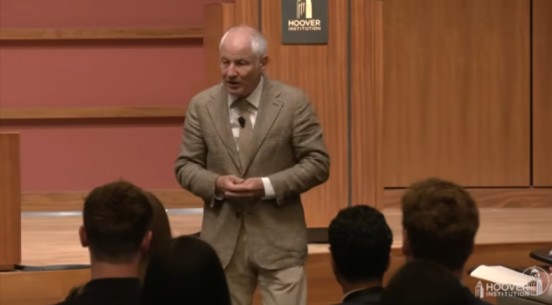
Editor’s Notes: In this thought-provoking lecture at the Hoover Institution, renowned historian Stephen Kotkin explores the paradoxical challenges arising from the United States’ immense global influence. He argues that current international crises are often a byproduct of the very successes achieved by the US-led order over the past 50 years. By comparing the geopolitical landscape of 1975 to 2025, Kotkin provides a deep dive into the evolution of power, the complexities of dual-use technology, and the future of global equilibrium. (Mar 20, 2026)
TRANSCRIPT:
Introduction
STEPHEN KOTKIN: I’m thinking about why there’s a sense of crisis now when American power is so vast across every single dimension, and there’s never been a power in recorded history like America. So believe it or not, I’m going to explain to you why the problem is our success, and why success is usually a much bigger problem than anything else. It’s a little counterintuitive, but we succeeded beyond our wildest dreams, and as a result, we’re in trouble. That’s going to be the main point of today’s, whatever you want to call it, performance, failure. Good shoes there, dude.
America Then and Now: A Fifty-Year Comparison
Okay, here we go. So let’s imagine that you fell asleep in 1975. Of course, you weren’t there in 1975, I was. But let’s imagine you fell asleep and you had a really good long rest and you woke up in 2025. So you had a nice fifty year rest.
And what would you have noticed if you were an analyst of geopolitics and international affairs? What if anything had changed in those fifty years when you were asleep?
Well, when you went to sleep in ‘seventy five, American power was at a low ebb. We lost the war in Vietnam. We had the Watergate scandal, and a president resigned. We had the oil shock in 1973, which ripped the country apart also. Our international standing was really low as a result of all of this, and there was a lot of talk of the end of America or American decline.
And if you woke up fifty years later, you’d be saying, wow. This country is unbelievably powerful and successful. The GDP is still twenty five percent of the global economy as it has been since 1880. Hundred and fifty years of twenty five percent of global GDP with five percent of the population, you’d say, my god.
The US is an energy superpower again, which it wasn’t in 1975. That was part of our problem, but which we had been for most of our history prior to that. And here we are again, an energy superpower.
A military superpower? We lost that war in Vietnam, and we’ve lost wars subsequently. And yet we’re still fifty percent of global military. That’s right, five percent of global population, twenty five percent of global GDP, and fifty percent of global military.
We’re also, besides an energy, military, and economic superpower, we are also, yes, a science, tech, and innovation superpower. And here we are at Stanford University, Silicon Valley being a spin off of Stanford University, and it’s just awesome what goes on on this campus in these laboratories. Awesome. Yeah. Blows you away. Innovation tech superpower. Across the board.
We’re also a cultural superpower. We got people speaking our language and imitating our culture without coercion. Across the globe. Yes, anti-Americanism is the most powerful ideology in the world in some ways. Again, as Secretary of State said, because nobody likes anybody who’s too powerful.
So if you go to an American embassy abroad, anyone, pick one, you go to it, there are two things that are always true. One, there’s an anti-American demonstration outside, and they got a lot of legitimate grievances. And the other, the longest line for visas you’ve ever seen.
So here we are. Who would have thought it in ‘seventy five? Pretty impressive. So is America in decline? That’s got to be the funniest question of the day. Just ridiculous. Okay. Facts are interesting. Really interesting. Measure of power is really interesting.
The Geopolitical Landscape: Familiar Rivals, Shifting Roles
Alright. Let’s do some more. ‘Seventy five to 2025. If you were alive in ‘seventy five, you would have seen America and its allies, the maritime powers based on limited government, trade, and navies, in a struggle to the death with a giant landmass Eurasian power, which was autocratic, repressed its own people, and banged around abroad the same way it treated its own people at home.
Yes. In ‘seventy five, that was the Soviet Union, and China was a subordinate version of that in ‘seventy five. And today, China is the version of that, and Russia is the subordinate version. Well, if you study history, that wouldn’t surprise you that China was the top dog, and Russia was now the vassal almost of China. Back then, the Soviet Union was at the height of power, and China was more like the junior partner there.
But a struggle against a landmass autocratic, different system, Eurasian based power, ancient empire, ancient civilization, the maritime power and alliances of the United States — that looks really the same to me despite the fact that Russia and China have changed places. Very similar. So the geopolitics hasn’t changed that much.
Yes. Iran flipped from one side to the other. Yes. In ‘seventy five, Iran was our puppet, was the United States’ partner under the Shah. And after the 1979 Islamic revolution, Iran flipped. We’ll see how long that lasts. It’s lasted so far this much time in global history. A pinch. 1979 till today. We’ll see if it lasts any longer. Maybe Iran flips back the other way.
But in any case, Iran is less consequential. It fits into this Eurasian land based autocratic ancient civilization power, arrayed against the United States and its maritime power model. Okay.
So if I’m waking up in 2025 after that long rest, I’m looking at a world that looks really similar to the one that I fell asleep in, except that American power is vaster.
As vast as it was in ‘seventy five, it’s even vaster now.
The Disinformation Problem
So that wouldn’t necessarily be what you would be thinking or what you’d be hearing. Some of you are really smart, and yet you still read the news. It’s astonishing to me that you do that, not just because of the time waste, but because of the detox that’s necessary for you to understand the world after absorbing all those lies and falsehoods.
For example, did you hear about the peace treaty that President Trump presided over that was signed between Armenia and Azerbaijan? Yeah. No. No treaty was signed. It didn’t happen. They signed nothing. You can go read the document. Nothing was signed. It was a photo op, and you fell for it. No more. Stop. No more. Don’t do that. Be smarter. Don’t use your phone to gather information. It’s disinformation.
What Has Actually Changed: Interconnectedness and Dual Use
Okay, that’s going to be a point we get to now. So I’m waking up in the world and it doesn’t look that different to me. So what if anything is different from ‘seventy five when I fell asleep? I’ll give you a couple of things.
One, everything is interconnected. In 1975, nothing was interconnected. Now, I’m in trouble at home. There’s danger at home because my refrigerator is conducting surveillance on me. And somebody your age or half your age can hack into my refrigerator just for fun. And my refrigerator is now a point of vulnerability because it’s called a smart refrigerator.
It’s just unbelievable that some kid I’ve never met in a basement in some country whose language I don’t know can conduct surveillance on me through my refrigerator. That was not true in 1975. It’s astonishing that everything is interconnected. It’s a point of tremendous power and empowerment, but also tremendous vulnerability.
The other thing is that everything is dual use. Everything is dual use. What does that mean, dual use? Wasn’t true in ‘seventy five. In ‘seventy five, there was this thing called the military industrial complex, and it was a place. It was laboratories and weapons facilities.
Neil, are you able to monetize this yet or not? Neil Ferguson, who is one of the biggest stars at the Hoover Institution, evidently can’t get into his office. He’s locked out, so he’s sitting here in the chair. Neil gives Scotland a good name. In ‘seventy five, Scottish football was a thing. That’s another thing that’s not the same. You Highlanders.
Okay. So now everything is dual use. What does that mean? Well, back in ‘seventy five, there was this military industrial complex, and they were laboratories. So if some Soviet scientist came here to study on an academic exchange and they went to Caltech, which is where I would have gone in ‘seventy five if I were a Soviet scientist, or MIT, there were laboratories there that they wouldn’t let them into because they were off limits, military industrial complex. And then there were factories in Southern California and elsewhere that they also couldn’t visit. They were kind of behind barbed wire, these huge facilities. And so you could keep them out.
It wasn’t easy. Sometimes people on the inside turned and became spies. Of course, they couldn’t download everything and send it on a little thumb drive to somebody else. But nonetheless, there was some espionage, but it was secure, more or less.
But now this is the military industrial complex. It’s software. Everything that’s for you, for consumers, for ordinary people is also military applications, dual use. How do you keep your adversaries out of this? You can’t. You can’t keep them out of this.
So everything is dual use. There is no military industrial complex that’s separated, and that’s a big, big problem now in 2025 that you didn’t have in ‘seventy five. Everything is connected. Everything is dual use. Good luck. Yeah.
So you’re just messing around, making an app to deliver food, and it turns out that some of the stuff you’re working on can be used by the military to locate people, to kill people as soon as you locate them using this? Yeah. That’s right.
The Dual-Use Reality: Social Media and Targeted Killing
You know how the Israelis were able to kill all the Iranians that they killed who were in the regime? You know how they did that? The kids of the Iranian officials have Facebook pages and TikTok accounts. And those kids were posting images of the family’s house, sometimes with the address. Sometimes the wife or the spouse was also using Facebook or other social media to talk to their friends. And so the Israelis could follow the kids all the way to the house and then kill them in the bedroom. Kill the nuclear scientist or the Islamic Revolutionary Guard figure. Yeah. Because the kids were on social media.
And then when the Israelis wanted to kill those twenty people at that high level meeting where they killed twenty people, the Israelis called the meeting. Israel got on the phone and called everybody and said there was a meeting called by the Supreme Leader. You gotta come. And they all came, and there were twenty of them and only nineteen showed up. And the Israelis waited till the twentieth came in the room, and then they bombed the room. Yeah. That’s right.
Everything is connected. Everything is dual use. It’s not your 1975 world.
The Geopolitical Constants and the New Vulnerabilities
So it’s not geopolitics that’s changed. Geopolitics is very similar. It’s this Eurasian landmass autocratic regime that claims to be an ancient civilization, an ancient empire that’s mad. It’s mad because who said that Condoleezza Rice is in charge of the world? Who said that eighty years ago, the Americans should build a world order? This upstart America, which is barely two hundred and fifty years old. And we’re China. We’re Russia, and we’re a thousand years old or two thousand or five thousand years old. I mean, who are these people, these upstarts, who decided that they’re in charge? We’re an ancient civilization. We’re better.
Okay. So the geopolitical stuff, similar despite some differences. But this stuff, very, very different. Very, very different. Yep. So, go figure this out now. Go deal with this. Go deal with your adversary when your refrigerator is conducting surveillance on you. And when you have a phone and the Israelis can kill you only because you have a phone, otherwise you would be untouchable. Yeah. This is your problem now. It’s not my problem anymore. I’m too old. I’m finished.
That’s why I’m between all of the big personalities and speakers. I’m done. But it’s your world now. We screwed up, me and Neil. Scott and — well, Josh is also young. He’s — we don’t know what he’s going to be when he grows up. Josh is next generation. He’s the hope for the future. Scott, I think you and I are closer in generation, although you still are younger in spirit and physically and mentally.
The Manufacturing Problem: Shipping and China
Alright. Here we go. So now what else? Okay. Well, there’s this other thing that’s different, and that’s we shipped all of our manufacturing capability to China, and they turned out to be really good at this.
So for example, the world is water. The world is an ocean, and we don’t have any shipbuilding capability. Yeah. That’s good. Right? That’s really good. That was clever. Who thought of that? Let’s eliminate our shipbuilding. Yeah. It wasn’t you. Like I said, it’s your problem now. It was people of my generation that thought of this.
Let’s have the Chinese have all the shipbuilding capability. Okay. Let’s have some of our allies also build ships, but let’s put them in theater, like in South Korea and Japan, where they’re within reach of Chinese missiles. That’s really clever, right? Who thought of that? Geniuses. Geniuses.
It’s like when you go to a reception and there’s only one table, and there’s ten thousand people in the line at the reception trying to get the food because there’s only one table. That’s called a bottleneck. Only engineers can create bottlenecks like that. Right? Instead of twenty tables where there’s no line. Yeah. So we did that.
And so all the manufacturing was evacuated to China, and they turned out to be very good at this, and still are. And so if you want things, some things it’s okay if you don’t make them. Like, for example, some of those — I don’t want to say. I’ve just realized I might insult people here. Maybe your father or mother owns the company. You gotta be careful. You just forget where you are sometimes.
Okay, let’s get back on track here. So there’s really important stuff like shipbuilding that we can’t do that’s a problem. And so what might be the answer to that?
Closing Remarks
So there are tremendous differences from ‘seventy five to 2025. Huge differences, but they’re not the differences that you think. Alright. How are we doing for time here? We’re getting close to questions, it looks like. Is that correct?
The Paradox of American Success
STEPHEN KOTKIN: All right. I’m really just warming up. As you can tell. Yeah. Can you believe I do this for a living?
I know. I don’t do it that well, but it’s better than what I did when I was your age. I worked in an embroidery factory. My father was a night manager at an embroidery factory, and I worked there every weekend. Those now they sell for a fortune.
Those Romanian embroidered shirts that you buy at the airport or duty free? Yeah. Back then, they were cheap. But then, you know, globalization makes everything more expensive. I know. That’s another paradox.
Alright. Let’s try to get back on track here. We’re losing our momentum. I had you for a second.
The Crisis of American Power
So I’m thinking about the world, and I’m thinking about what happened. I’m thinking about why there’s a sense of crisis now when American power is so vast across every single dimension, and there’s never been a power in recorded history like America. There’s never been this much power any single country ever in this many dimensions. Ever, ever, ever.
And yet we feel that we’re in crisis, that there’s world disorder. Sure. There’s the interconnectivity that’s destabilizing. There’s the dual use technology stuff, which is related. That’s destabilizing. Yeah. China makes all the most important things like ships that we used to make. That’s also destabilizing. But still, we are vastly superior to China in almost all ways. And yet we feel China’s an amazing story. Don’t get me wrong. Tremendous success, impressive beyond words. But we feel like we’re under duress, like we’re going down, like the world is getting out of control. So what happened?
Succeeding Beyond Our Wildest Dreams
Well, pretty simple what happened. Again, we succeeded beyond our wildest dreams. The goal of the US led order founded eighty years ago, of which Secretary Rice has got to be the epitome, one of the best examples, was that not only America would succeed, but that others would succeed. That we would create an open, voluntary international order that was based on opportunity for others to succeed if they wanted to join our world order. So not just America would grow, but everybody would grow.
Certainly, the Soviet Union was contained and friends or satellites, as we call them properly, of the Soviet Union were on the receiving end of this rather than invited onto the inside. But the idea was that those countries that were not communist, that were anti-communist, could join this voluntarily, be part of it, and share in the success.
And it worked. Back when George Shultz, as the treasury secretary under Richard Nixon, founded the G5, which became the G7, in response to the oil shock of ’73 — they had their first meetings in 1973, 1974, 1975, when they formalized it and eventually it became the G7. At its height, the G7 was more than sixty percent, close to seventy-five percent of global GDP, just seven countries. Today, the G7 is well under forty percent of global GDP.
Is it because the G7 is in decline? No. All those countries are still rich. In fact, they’re richer now than they were when they were nearly at least two thirds of the global economy. And now they’re closer to one third. They’re still above one third, but they’re closer to one third than they are to two thirds. And they’re all still really rich, and they’re richer than they were before.
But the reason they’re now under forty percent is because other places got richer. That was the plan. That was the goal. That was the point of the US led international order.
The Consequences of Global Success
Well, as countries get richer, as they succeed, guess what? They want to have a say. They don’t want to just be on the receiving end of your world order. They want to shape it. Whether they’re Brazil or South Africa or India or, yes, China or Indonesia or Mexico. If you help them grow and if they succeed through their own hard work and ingenuity in your US led order, they want to have more power, more say, more votes, more impact, which is completely logical, and we weren’t ready for that.
Not only were we unready for our success when we became less than forty percent of global GDP with our G7 allies. Remember, America’s not in decline. America’s still twenty-five percent of global GDP. Europe is seventeen percent of global GDP, with seven percent of the world population. US five percent of the world population, twenty-five percent of global GDP, fifty percent of global military. Europe — seven percent of the people, seventeen percent of the economy, and fifty percent of global social spending. Yeah. Seven percent of the world accounts for about forty-five, forty-six percent of global social spend. So they’re living large.
But they’re a smaller percentage of the global GDP. Europe was thirty percent of global GDP not that long ago. You want to talk about decline? That’s what you’re looking at. European decline, lack of competitiveness, etcetera.
From Containment to Enlargement
My point being is that we succeeded beyond our wildest dreams and weren’t ready for the success. Not only were we not ready to manage the new expectations of these successful countries, but in addition, we decided that, hey, the Soviet Union fell. Let’s move from containment to enlargement. That famous speech by the Clinton National Security Advisor, Anthony Lake, in 1993 — enlargement, from containment to enlargement. It’s a singular moment.
Forget about all the great stuff that Samuel Huntington was writing in Foreign Affairs about needing to match capabilities with commitments. And if your commitments exceed your capabilities, you’re going to be in trouble. Let’s just go for the whole world. We had most of the world before the Soviet Union collapsed. Let’s now do the whole thing. Let’s pull the whole thing into the American led order. After all, how can we exclude anybody? Our order is so amazing. It succeeded. Let’s open it to everybody.
And so this is what we did after 1993, to Russia, to China — not to Iran. We didn’t manage that one. North Korea, another tough one. But Russia and China, we gave it a shot. And it was going to work because, look, we did it in South Korea. We did it in Taiwan. Right? We did it first in Japan and West Germany, former enemies, and look — they became our partners.
So sure. This was going to work. We were going to pull them into the global economy, make them market economy partners with us, and therefore they would have a stake in the system, and they would evolve in our direction politically. Maybe not all the way, but part of the way, and therefore enlargement. The whole world was our oyster. We succeeded. Let’s go for the whole shebang, the planet.
Why Enlargement Failed
Okay. And it didn’t work. It didn’t work because Russia and China are not West Germany and Japan, South Korea and Taiwan. They are instead these autocratic land-based powers that have a different history, a different self-conception, a different trajectory, and they weren’t coming our way.
And so we became victims of our own success, not being able to manage the success even as we tried to extend the success to the whole planet. And not everybody thought that was going to work. But it was the consensus view. Let’s try it. Let’s see what happens.
And so we admitted countries — Russia was the G8, it got admitted to the G7, it was part of the G8. And, of course, China got admitted into the WTO despite everyone knowing that they did not qualify based upon the criteria of admission. We suspended all the rules and let them in.
Hide and Bide: China’s Unchanged Trajectory
And now we think that Xi Jinping has changed China’s trajectory. So Deng Xiaoping’s slogan was “hide and bide.” Hide what you’re doing and bide your time. That was the slogan — we all repeated it, “hide and bide.” And we say Xi Jinping changed that. He’s no longer hiding or biding.
Okay. But what are you hiding and biding? It’s the same trajectory. One is hiding and biding, and the other is not hiding and not biding. But the trajectory didn’t change, did it? I mean, what’s the point of hiding? If you say “hide and bide,” are you hiding that we’re going to transform ourselves politically to become more like the West? That wasn’t what they were hiding. That wasn’t what they were biding.
“Hide and bide.” So the China trajectory changed only on our side, not on their side. Otherwise, don’t say “hide and bide.” You just say let it rip, which is what they’re doing now. God bless. They’ve been doing what they’ve been saying.
Toward a New Equilibrium
Okay. So let me conclude this and we’ll see if we can do some questions. So now we’re in a situation that’s very confusing. Again, if you’re on your phone with the news feed and all that kind of stuff, it could be unbelievably confusing. But the point being is, where is this going?
Can this eighty year experiment that got too big for its britches — where is it going? Is there a new equilibrium coming down the road, and how might we shape that new equilibrium? How might we get to a better place where we restabilize some version of an international order that’s open and voluntary, based on cooperation and win-win, where there are some adversaries as there always will be, but they are contained and there’s no hot war between the superpowers.
Because cold war is terrible, except hot war is a lot worse. And the whole point of cold war is it’s not hot war. So it’s a really good thing because hot war is really bad.
So how do we imagine this new trajectory, this new equilibrium, this new version of where we’re going to be, and how do we shape that as the people in this room who are going to do the shaping? That is the big question in front of your generation, and maybe the generation after you. Or you may solve it in the meantime.
It’s not going to be a new equilibrium now. What’s happening now is not a version of a new equilibrium emerging. It’s going to take a lot of hard work, just as it was in the forties to put this thing together. Remember, you have this massive destructive war against Hitler and imperial Japan, and they become your allies and friends and partners in a new world order. Think about that. Yesterday, they were Nazis and war criminals in Japan. And today, they’re your allies and friends. It’s astonishing, that flip.
Not everybody benefited from that eighty year US led order, and there were a lot of problems and downsides with it, including proxy wars. You can ask the people in Vietnam about the American led order. You can ask the people in the Congo or the people in Afghanistan. Lot of downsides to Cold War and that American led order, but a lot of upsides as well.
What’s it going to look like? Who’s going to shape it? What can be done now? What’s more long term? What are the trends? Those are the questions that should be uppermost in your mind. And as I said, not me. I’m not answering that, but you’re going to answer that.
All right, let’s do Q&A if there’s any questions.
Related Posts