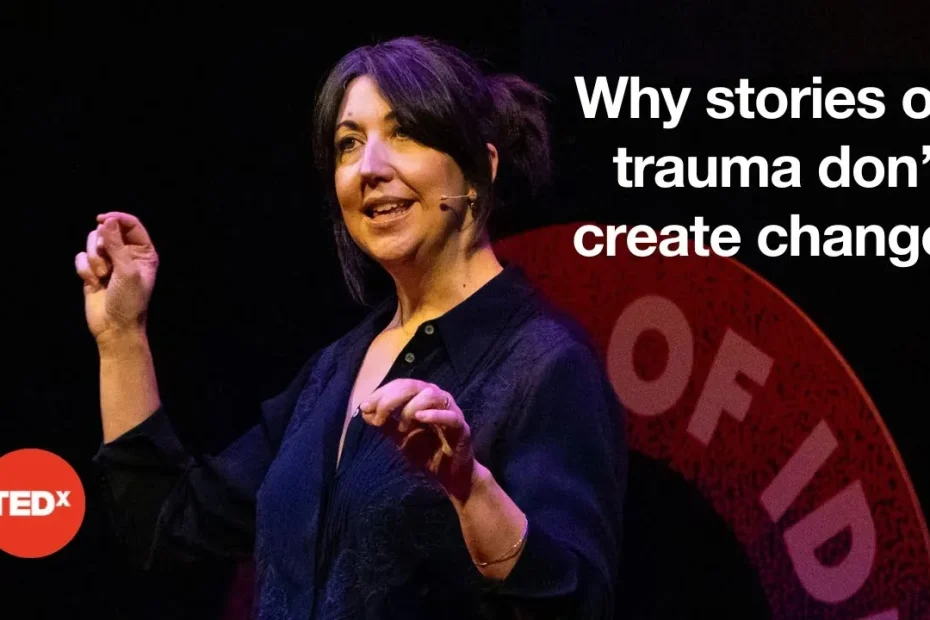
Read the full transcript of Nathalie McDermott’s talk titled “Why Stories of Trauma Don’t Create Change” at TEDxLondon (Mar 11, 2025). Nathalie is the Founder and Co-CEO of Heard, a charity that works with people and the media to inspire content and communication that changes hearts and minds.
Listen to the audio version here:
TRANSCRIPT:
The Superman Dream and Media Reality
[NATHALIE MCDERMOTT:] Growing up in the 80s, I was obsessed with the Superman movies. I just wanted to be Lois Lane so much. So you can imagine how excited I was when I got my first real job in the media working for a national news program here in London. And to be a good journalist, I knew I had to channel my inner Lois. I had to work really fast, I had to work really well under intense pressure, and I had to be ruthless when chasing a story. And I discovered that I was really bad at all of those things.
So I didn’t last too long in the newsroom, but I did get a brilliant insight into how the media works. When we would cover issues like poverty, stories of pain and trauma were always more likely to make it on air. That’s because they grabbed people’s attention. And when I moved to campaigning for journalism, I realized that we campaigners are just as hooked on those stories as our journalists are, because they are very effective at creating awareness.
But here’s the catch. As campaigners, we don’t just want awareness, we want change. And all those stories of pain, they move us. They, over time, leave us feeling hopeless and stuck. And that’s what I want to talk to you about today. Why is it that we communicators are so hooked on these stories? Is it because they drive engagement, or is it because there’s something deeper going on with us?
And these are the questions that have really guided my work over the last 20 years, as I’ve explored different ways of telling stories that don’t just create awareness, but that inspire action and hope.
The F-Word of Communications: Fatalism
Right now, in terms of all of the media that we consume, and I know you’re going to relate to this, we are swimming in what I think should be the F word of communications. Can you guess? Fatalism.
Fatalism makes us think like nothing will change and there’s no point even trying. In 2012, the NSPCC commissioned some research, that’s the UK’s leading child abuse prevention charity, and it showed that the majority of us in the UK are aware of how widespread and horrific child abuse is, largely due to the way that campaigns have told stories over the years, but it showed that we are hopeless. We are overwhelmed by the magnitude of the issue and we don’t really feel like anything can be done to change it.
And fatalism is a big problem for us as campaigners, because if the public feels hopeless about an issue, there just isn’t the energy or the appetite to push for change.
Realizing My Work Was Part of the Problem
And it was about 12 years ago that I realised, I think my work is actually a part of the problem. I had set up a charity called H.E.R.D. in 2008, which now takes an issue like climate and works with TV producers and campaigners to make sure that stories land in a way that audiences feel change is possible.
But in the early days, one of our first projects was working with survivors of sexual abuse. And I remember this moment so clearly. We were doing some media training and we were working with a campaigner called Jane, who was and is still pushing for greater transparency in how the church handles reporting of abuse.
And we were doing media training and our media training did have a real focus on pastoral care and boundaries and safety, but we relied on the same approach that I had learned in journalism, which was we lead with a focus on what happens, because we knew journalists would lead with that, that’s what they’d want to ask.
So we asked that question of Jane and she told her story and it was incredibly powerful and moving. But by the time she got to her call for change, she was feeling emotionally drained and we were all feeling it with her. In terms of our emotional experience with her audience, it was the detail of her trauma that stuck with us, whereas her insight and her ideas and her solutions sort of got lost.
And I thought to myself, this is how we audiences feel all the time, you know, when we’re scrolling or watching the news. And so it was a negative experience for Jane, but also her message wasn’t even landing in the way that she wanted to, so we tried something different.
A Different Approach to Storytelling
And we asked her, let’s do this interview again, but this time acknowledge your experience as you did before, but then pivot quickly to the broader picture to get the audience’s focus on where you want this interview to go. And I’m going to play you a short clip to show you what that initial response sounded like.
[NATHALIE MCDERMOTT:] Jane, could you tell us a little bit about what happened to you?
[JANE:] Well, I’m a survivor of abuse by a member of the clergy. And what I realised when I’ve met with other survivors of clerical abuse is that doesn’t just affect you as a person, it affects your beliefs, and particularly your belief in God and your trust in the church. And I think that’s the same as with other institutions. You know, so you go to the doctor and you expect that you will be helped and that they’ll keep you safe, and you send your child to school and you expect that the teacher will look after them.
And if something bad happens, then you lose trust in that institution. And we need to trust our institutions because they’re there to look after us.
[NATHALIE MCDERMOTT:] So Jane does three things here which are really important. She acknowledges her experience. Then she zooms out and refers to other survivors. So emotionally, her audience can’t dismiss this as a one-off, which is what we do to protect ourselves. Then she makes it relatable to anyone listening by referring to schools and doctors. We still know and care about her suffering. This is not sugarcoating. This is about focus. Jane now has our focus on where she wants us to go. In this case, this is about the steps that institutions need to take in order to regain our trust. And it feels much better for Jane.
Now, this shift from leading with pain to leading with universal relevance made me rethink our approach to storytelling and campaigning. And it also made me wonder, why is it that given the research that’s out there, like the NSPCC report, and there are many other studies that show the same thing on all sorts of issues, that trauma-focused campaigning does not work in the way that we think it does. Why then do we keep focusing on trauma in our communications?
The Drama Triangle
What’s making us pull our campaigns, our campaigners like Jane, and our audiences into what’s known as the drama triangle? I think understanding more about ourselves is really key here.
Karpman’s drama triangle, some of you will be familiar with this. It’s a very popular idea used in psychotherapy to understand unhealthy communication dynamics in our personal relationships and our work relationships. We all do it. And there are three roles. Karpman describes them as victim, rescuer, and persecutor. I’m using an adapted version that I think works better in this context.
Now, these roles, we can all assume them usually at times of anxiety and stress. When we are in sufferer mode, we are problem-focused, right? We feel like something is happening to us and we can’t solve, we can’t get out of the situation. When we are in rescuer mode, we feel like other people are in need of our help, whether that’s true or not, and we need to go in and sort everything out. That’s our job, that’s our role. I can sense the nods in the room. I know this audience.
And the third role is blamer mode. So, no judgment. I’m pretty sure I was in blamer mode this morning because I couldn’t find my charger on the way here. And blamer mode is you’re mobilized by anger if someone else is at fault and you want to control the situation.
So, none of these roles, none of them are inherently bad. We all bounce between them, even in the same conversation. But the thing is, if we’re consistently having conversations in the drama triangle, we’re trapped in anxiety and we can’t get out.
Now, this is helpful to understand more about ourselves, but I think it’s really interesting if we look at our communication strategies through this lens. And here’s why. When we create a campaign, whether we’re a journalist or a fundraiser or a campaigner, and when we work with a campaigner like Jane, and when we lead with a focus on what happened to her, the detail of her trauma, we are essentially casting Jane and her message in the sufferer role, even
NATHALIE MCDERMOTT: Though she wants to be talking about solutions. Sufferer role is problem focused. The same applies if we create a message about how bad the climate crisis is and we lead with a focus on how awful things are. It’s in the sufferer role. And so, I think our audiences, we are dragging them into the drama triangle, too, by leading with this information. We do it intentionally because we think it’s going to move people. We have good intentions. But faced with a message that makes you feel fearful or anxious, as the audience, you’ve got limited options here.
You might feel like the rescuer, like, “Oh, how awful those poor people are, how terrible.” It’s a pity that’s in rescuer mode. Or you might get angry and overwhelmed by what you’re hearing, like, “Whose fault is this?” Or “That wouldn’t happen to me. I wouldn’t have done that.” You’re mobilized by anger.
The Empowerment Dynamic
But what if we could escape the drama triangle in our communications? David Emerald designed the empowerment dynamic, in his words, as a place to go if you want to get out of drama in your relationships. And I think this is interesting. Instead of the sufferer role, he has the creator role. This is where Jane was in the clip that I just showed you.
When we are in creator, and this is Jane, you acknowledge the problem. Yeah, we’re not sugarcoating anything. We acknowledge it, but we lead with solutions. When we’re in creator, we know how to speak in a way that people can hear us. Not necessarily that they’ll agree with our solutions. This isn’t about consensus. This is about dialogue.
And so, in response to a creator in a conversation, you might respond creatively, too. Or you might respond as coach. So, not rescuer. You’re not swooping in to solve things. Coach Emerald describes as supportive and curious. Or we might respond as challenger. Not mobilized by anger, like Blamer. Challenger is analytical, open-minded, inquisitive. Challenger can push, but it’s constructive.
There is positive energy here in the empowerment dynamic. And when we look at our communication strategies through this lens, I think that audiences can receive messages like climate. They don’t feel like this unstoppable disaster that we have no control over. But instead, we can see them as challenges. I mean, these are big challenges, but we can engage with them because we can actually hear what’s required.
And I also think that campaigners like Jane, and I’ve met hundreds of them, campaigners like Jane are no longer seen solely through the lens of injustice. They’re seen for the experts that they are with insight, ideas, solutions, creativity. Their trauma isn’t mined for clicks. And the emotions of our audiences aren’t being manipulated for clicks. Instead, we’re able to engage and feel a sense of what’s possible.
Success Stories of the Empowerment Approach
And I’ve seen this approach work again and again. A recent example that I absolutely love is Breast Cancer Now’s Gallery of Hope campaign. In this campaign, they show beautiful photography of women with incurable cancer and generated by AI. They show photographs of them in the future that they hope to have because of the research that’s happening right now.
And these interviews with these women, these are still personal stories. They still get the hairs on the back of your neck standing up and the tears in your eyes. But this time, it’s not because you’re so overwhelmed with how awful, it’s because you are moved by what’s possible, by the future that we all want.
Another example of escape from the drama triangle that resulted in a change in legislation was Ireland’s Equal Marriage campaign. I met the campaigners there. They got together and they made a conscious decision that instead of spotlighting trauma and injustice, they would focus on sharing stories of acceptance. For example, they had grannies and granddads across the country share videos about their grandchildren. They just wanted them to have the same rights to marriage as they had.
Moving from Awareness to Change
The NSTCC research and many other studies like it, they show that stories of pain, whether they’re personal stories or whether they’re vivid depictions of a problem, they’re very good at creating awareness. But they’re highly likely to leave audiences emotionally reaching for their coats, even if they donate, even if they’re now more aware of the problem than they were before.
But when we treat our audiences and don’t traumatize them, we leave them engaged, leaning in, ready to learn. So, here’s my invitation to you. The next time you craft a campaign or a newsletter or the next time you have a challenging conversation with a loved one or a colleague, ask yourself, which triangle am I in? Drama or empowerment? Am I leaving my intended audience feeling defensive and anxious or am I leaving them feeling curious and engaged?
Because if you, like me, are passionate about creating a healthier and more just future, we can’t just be in the business of awareness. We have to be in the business of change. Thank you so much.