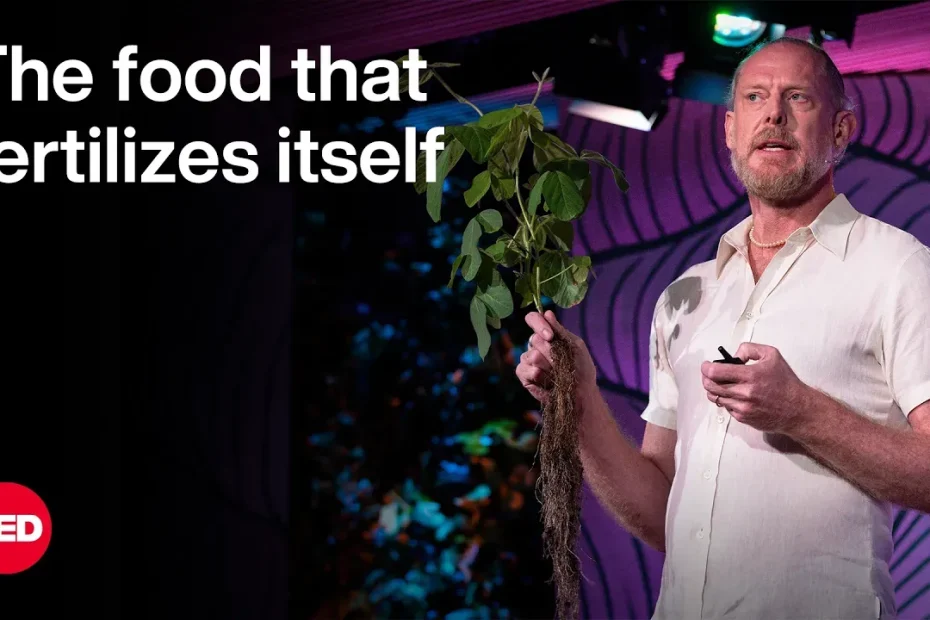
Read the full transcript of plant scientist Giles E.D. Oldroyd’s talk titled “The Food That Fertilizes Itself” at TED Countdown Dilemma Series: Food on June 6, 2024.
Listen to the audio version here:
TRANSCRIPT:
Introduction to Nature’s Fertilization System
GILES E.D. OLDROYD: I believe this soybean plant is a prototype for sustainable food production on this planet. Let me show you why I say that. On the roots of this soybean plant are nodules, and these nodules do an amazing thing. They harbor millions of bacteria inside the cells of the nodules, and those bacteria are able to capture nitrogen out of the atmosphere and feed it to this soybean plant.
All plants require a source of nitrogen. They need it so they can make DNA, RNA, and proteins, but plants can’t access the most prevalent form of nitrogen on the planet, the 78% of the air that you’re currently breathing, that is molecular dinitrogen. Any bacteria that possess the enzyme nitrogenase can convert this very inert form of nitrogen and convert it into ammonia, a reactive form of nitrogen that bacteria and plants can use to make their DNA, RNA, and proteins.
So, the bacteria inside the nodules of this soybean plant are fixing nitrogen out of the air, converting it into ammonia, and then feeding that ammonia to this soybean plant. In return, the soybean plant is feeding the bacteria with a source of carbon in the form of sugars derived from photosynthesis in the leaves. This is what we call a mutualistic symbiosis. It’s beneficial to the soybean plant, but it’s also beneficial to the bacteria inside those nodules.
The Dual Symbiotic Systems
Now, the roots of the soybean plant are doing a second amazing thing, and to see that we have to look under a microscope. The roots are heavily infested with a beneficial fungus called mycorrhizal fungi, and these fungi are heavily colonizing the soil and make a much greater contact with the soil surface than the plant root alone is able to achieve. In so doing, they create a much more efficient platform for the uptake of nutrients, nutrients such as phosphates, nitrates, potassium, and water.
The fungus isn’t only out there in the soil, it’s also colonizing the roots of this soybean plant, where it makes these highly branched fungal intrusions into the cells of the root that we call arbuscules. So the fungus is out there in the soil, capturing nutrients from the soil, and it feeds those nutrients to this soybean plant through these arbuscular intrusions. In return, the soybean is feeding the fungus with carbon from photosynthesis. Again, it’s a mutualistic symbiosis.
This soybean plant can get almost all of its phosphate and the totality of its nitrogen needs met through these beneficial microbial associations, and that provides a free and sustainable means to support its crop production. And out in nature, most plants are engaging with one or more of these beneficial microorganisms to help them capture these limiting nutrients from the environment.
The Problem with Modern Agriculture
But in agriculture, it’s a really different situation. Here we’re applying these nutrients at high concentrations in the form of inorganic fertilizers to support our crop production. And while inorganic fertilizers have underpinned global food security for the last 60 years, they cause significant environmental pollution, they cause significant greenhouse gas emissions, they contribute to a lot of the cost in our crop production, and at the other end of the spectrum, smallholder farmers lack access to those fertilizers and their productivity suffers as a result.
For all of these reasons, myself and my colleagues in the ENSA project are working to eradicate or at least greatly reduce our reliance on inorganic fertilizers. To do that, we want to make all of our crop plants, particularly our cereal crops, behave like this soybean plant, able to get their nutrients through these beneficial microbial associations.
Enhancing Mycorrhizal Fungi Associations
Now the fungal symbiosis is not limited to legumes like that soybean. It’s actually pretty widespread within the plant kingdom and it’s already present in our cereal crops. However, when we fertilize our fields, the crop doesn’t engage with the fungus. Why pay the fungus with carbon if the nutrients are not limiting? So while soils in natural ecosystems are packed full of a complex network of these mycorrhizal fungi fed by their host plants, our agricultural soils are greatly depleted for these beneficial fungi.
If we want to really maximize the utilization of this fungal symbiosis in agriculture, then we need to get our crop plants to engage with the fungus much more proactively and even when we fertilize our fields. If we can do that, then we can reduce the levels of fertilizers we use and we’ll lose less of those nutrients out into the environment.
So to achieve that, we set about identifying the genetic regulators that control when the plant engages with these beneficial fungi. We discovered that these protonaceous regulators are only present when the plant is starved for nutrients. We were able to rewire that system so that now the plant engages with the fungus much more proactively and even when the plant is fertilized.
In our field trials, we find that these rewired barley plants get 10 times as much fungus inside their roots. That’s a lot more fungus in the crop, but it’s also a lot more fungus out there in the field. So now we can control when the plant engages with these beneficial fungi. The next step for us is to test, does that mean we can lower the fertilizer levels and still maintain good production?
I believe this is the first step to really getting that fungal association working for us much more proactively in agriculture, and that’s going to be really important, especially for how much phosphates we have to apply to our fields.
Engineering Nitrogen Fixation in Cereals
But if we’re going to really cure our addiction to inorganic fertilizers, we also need the nitrogen-fixing bacterial symbiosis.