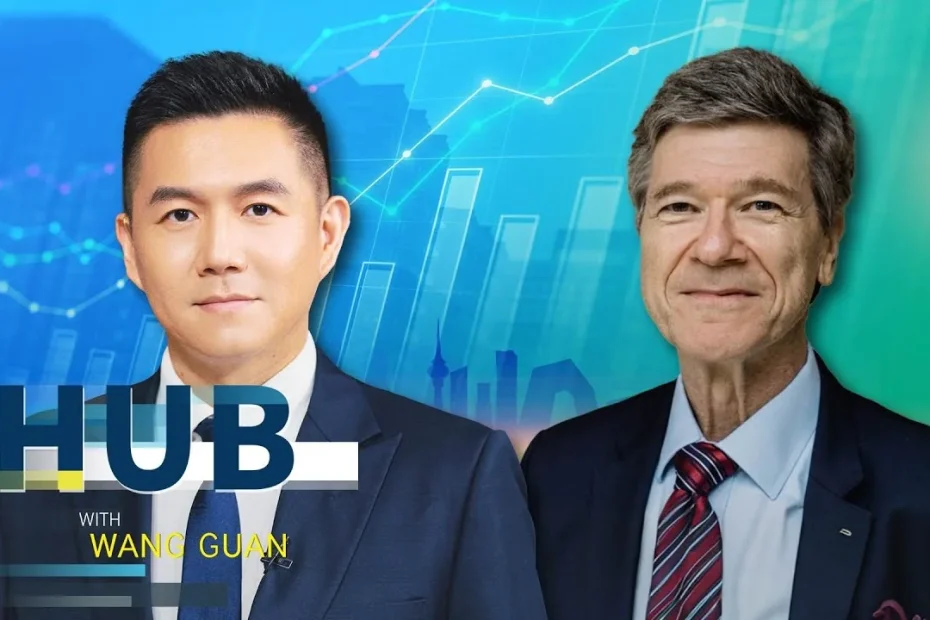
Read the full transcript of CGTN’s Wang Guan interviewing Columbia University Professor Jeffrey Sachs, on “Protectionism Will Backfire On The U.S.”, [Mar 25, 2025].
TRANSCRIPT:
# Introduction
WANG GUAN: Welcome to this edition of the Hub on CGTN. I’m Wang Guan in Beijing. Greetings from the China Development Forum here at the Diaoyutai State guest housing in Western Beijing. This year’s event convenes over 700 government officials, corporate representatives and thought leaders from around the world. On the sidelines of this year’s event we caught up with Professor Jeffrey Sachs, professor of Columbia University. We discussed his recent speech to the European Parliament, China-Europe and China-U.S. relations, and of course the future of the world order given the disruptions coming from some corners of the world.
Professor Sachs, thank you for doing this again and welcome back to our program on CGTN. Let’s begin with the Chinese economy. There are a lot of underreported facts about the Chinese economy. For example, China unilaterally gave visa-free treatment to much of the Western world and it is making foreign investment easier in more sectors. And a series of stimulus measures to boost the Chinese domestic economy knowing that it is a shortcoming in the past few months and years. Where do you think the Chinese economy is right now? Your assessment please?
# China’s Economic Position
PROFESSOR JEFFREY SACHS: China is in a strong position. It’s in a strong position because it is the low cost producer of the cutting edge technologies that the world most needs. It is the low cost producer of AI now not only Deep Seq but especially Deep Seq. It is the low cost producer of electric vehicles, BYD. It is the low cost producer of 5.5G, Huawei and others. It is highly innovative. It’s producing the green and digital technology of the future. And the rest of the world is seeing this and wants to be part of it.
It wants to be part of it both in supply chains, in other words, having production in China. It wants to be part of it in the Chinese market. It wants to be part of it as a trade partner with China in the developing world so that those countries can achieve rapid economic development. If you’re in Africa or if you’re in ASEAN or if you’re in West Asia, you say my ticket to fast growth is green and digital technologies. Where can I find that? Well, with partnership with China. So this puts China in a strong position.
Ironically, Donald Trump is strengthening the Chinese economy because American protectionism is not being well received around the world. It’s being received with hostility and anger in the Western hemisphere in Canada, in Mexico, in Latin America. It’s being received with very great annoyance in Europe. It’s being received with great concern in Africa and in ASEAN, in Japan, in Korea. So countries are reassessing. If the United States is not a reliable partner, well, we need China as our reliable partner.
So I think Donald Trump is actually a very self-defeating approach for the United States by being aggressive vis-a-vis the rest of the world. China says, we’re here, we’re open, we’re cooperative, come partner with us. And the world’s hearing that and talking.
# U.S. Policy Toward China
WANG GUAN: About Donald Trump’s tariffs and other restrictions and embargoes towards China trade, investment and technology. There’s an interesting data I want to share with you. With China’s semiconductor self-sufficiency rates projected to reach 70% by the year 2030 and of course, with the Deep Seq coming of age and you use the word, you know, defeating the purpose or self-defeating, how would you evaluate Donald Trump’s policy so far vis-a-vis China? Especially of course, which is largely a continuation of Joe Biden’s policy, which you call one of the worst presidential policies towards China and its foreign partners in general.
PROFESSOR JEFFREY SACHS: The idea of the United States that it would remain the lead country indisputably or the unipolar country by somehow containing China was nonsensical. But that was the approach adopted already back by Obama in 2015 and 2016. It was extended by Trump in his first term. It was then carried forward by Biden in his term. Now it is being carried forward once again by Trump in his second term. It doesn’t make sense.
If they would actually understand economics a little bit, they would understand that this is not going to work. It’s not going to work geopolitically. The US isn’t going to isolate China. The US might isolate itself the way that it’s going. So it might create enemies all over the world of the United States because of this kind of aggressiveness that Trump is showing. And economically, it’s not going to pull other parts of the world away from China. It probably will push other parts of the world towards China.
It’s just a mistake in my opinion. But it’s a mistake that I think is going to be with us for a while. Trump isn’t going to change his mind because this is first of all a policy fairly widely subscribed to in the American political class. Second, Trump ideologically really is a protectionist. It seems it’s one of the few things that he’s consistent on. It’s a wrong policy in my approach, but he’s consistently wrong on it, not intermittently wrong on it. So I don’t think it’s likely to reverse in the next few years. It’s to the detriment of the United States.
# Trump’s Endgame with China
WANG GUAN: However, what would be Donald Trump’s endgame vis-a-vis China? Because there seems to be some diverging forces at play within the Beltway and within Donald Trump’s administration. Of course, Trump himself being someone who hates defeats. But the deep states, the beltway policy elites and strategists want to bring China down, contain China. Like you said, since the pivot to Asia policy back in the 2010s. Will that eventually lead to a showdown between the establishment with a deep state at its core versus Donald Trump, who may be pragmatic, showing some level of flexibility and pragmatism to start with, eventually, you know, merging his interests or abandoning to the deep state to some extent.
PROFESSOR JEFFREY SACHS: I think it is probably true, though nobody really can say for sure that there are two different strands of Trump’s thinking.
One strand is about protectionism as an economic strategy. He seems to believe in that. I think that’s likely to continue.
At the same time, there is a kind of view of Trump that the US is one of a few great powers and better that we don’t go to war with each other. This is the positive side that Trump gives some inkling of. For example, in his dealings with Vladimir Putin and Russia, the US Deep state has been deeply anti-Russian. But Trump is not. Trump is more divide the world. Russia, you take your part, we’ll take our part.
Trump’s aggression seems to be more manifested in the Western hemisphere. Trump really would like Canada because he wants that Arctic coast and he wants Canada’s resources. Of course, I think it’s a crazy idea, but he seems serious about it. He wants Greenland, he wants Panama.
So he doesn’t care too much about Ukraine, which is fine because when America cared, quote, too much about Ukraine, it got Ukraine into a war. Maybe Trump won’t care too much about Taiwan. That would be safe for Taiwan and good for US-China relations. We don’t know what the policy will be. Right now. My own advice is stop sending armaments to Taiwan. Maybe Trump would come around to that view the same way he came around to the view of not sending armaments to Ukraine. We don’t know yet.
# Advice for Trump Administration
WANG GUAN: Well, on a skiing slope, you got a call with Jake Sullivan according to your own testimony to the European Parliament, a speech to the European Parliament, rather advising him about what Joe Biden should and shouldn’t do vis-a-vis Russia. Of course he didn’t listen to you. And if you had the chance to call someone within the Trump administration, be the national security adviser or J.D. Vance or someone close to Trump and his thought process, what would you advise him, you know, when it comes to his policy vis-a-vis China, what is the right thing to do at this point?
PROFESSOR JEFFREY SACHS: Again, my own view is that the world is not a zero-sum world. So the whole idea of who’s on top is the wrong approach to begin with. Open relations are a win-win proposition for the United States and for China, for Russia, I don’t see any reason for conflict among the major powers.
As a practical matter, the two things I would advise most simply are not to go protectionist because this will harm the U.S. economy and U.S. society. It will isolate the U.S. from the rest of the world, not strengthen the U.S. and I would strongly suggest that the U.S. stop sending armaments to Taiwan, period.
Because I don’t want Taiwan caught in a proxy war. I don’t want politicians in some mistaken way to think, oh, the US will protect us. I told the Ukrainians over and over again, do not think the US will protect you. The US will get you into a lot of trouble. And I would say the same thing to Taiwan politicians also, to keep Taiwan safe, deal with Beijing, go to negotiation. Do not expect the US to save you or to help you or to make you more secure. And sending armaments from the United States to Taiwan is simply a provocation. It’s not a means to safety. It’s a means that would raise danger for everybody involved.
So that’s what I’m hoping the United States would do. They don’t listen to me all that often, but anyway, that’s my advice.
# China as a Success Story
WANG GUAN: You also said that during that European Parliament speech. China is not an enemy. China is just a success story. That is why it is the enemy of the United States, because it’s a bigger economy than that of the United States.
PROFESSOR JEFFREY SACHS: And China has a key characteristic. It’s got 1.4 billion people. The United States has 335 million people. China is therefore roughly four times the population. China is not going to remain below one fourth of the US size per person. Therefore, it’s going to be a bigger economy. This is arithmetic. This is the logic of China’s success.
So the United States has to get used to the fact that China has a bigger economy already, far bigger when measured at purchasing power prices. And it will be a bigger economy measured at market prices and exchange rates. That’s because there are 1.4 billion people. In per capita terms, the United States is still ahead and will be for some time.
In fact, China is not a threat. China is not a danger. The world is not a zero-sum struggle. And trade with the US and China during the past 40 years and especially since the 1990s has been mutually beneficial. China’s rise has helped the United States to advance. The US has helped China to advance. This has been mutually beneficial in trade.
When certain sectors or places do get hurt by trade and that happens, then they should be helped by regional policy or by redistributional policy, by social support. This is how a normal economy behaves. You don’t stop the benefits of trade because some small parts of the economy suffer relative to others. You rather help those parts to make sure that the benefits are widely shared.
I can say in a different context in China. When China opened up the economy, it was the eastern part of the country on the coastal areas that benefited the most. And the Chinese leader said the western China development is lagging behind the eastern China development. So they created very creative ways to promote Western China development so that the benefits of development would also be shared in central and western China. That was a regional development policy that has been quite successful.
The United States doesn’t have such a policy. So if our industrial Midwest lagged behind, we don’t have an industrial policy to say we need a Midwest development program. If we were as clever as China in its management of such issues, we would be much less protectionist. Trump is appealing to protectionism for particular parts of the American economy, neglecting the fact that the overall US Economy is a big beneficiary of US-China open trade.
# America’s Game Theory Approach
WANG GUAN: Professor Sachs, talking about America’s grand strategy. Game theory is taught widely across American classrooms. The game theory that you think is not originating or derived from practical analyses, you know, logical analysis, but rather very often coming from presumptions, presuming that your enemies or your rivals would act in a certain way, you know, treating them as a black box, lacking of empathy and sympathy towards how they would think. And internally, the dynamics over there. You said America’s game theory is not a negotiation theory, it’s not a peacemaking theory, but a unilateral theory and a, you know, a non-cooperative theory. And can you elaborate on that?
PROFESSOR JEFFREY SACHS: When American policymakers say, what should we do with China? They think they know what China’s going to do. They think China is going to do some particular thing no matter whether there are negotiations or not. So they say, no reason to negotiate. Our policy should be the following. And this is a huge mistake even in everything we know about actual game theory.
We know that if the two sides in a strategic relationship don’t communicate, they’re much more likely to end up in a bad situation than if they do communicate. So the biggest problem, in my view is we don’t have appropriate, mutually respectful communications between the United States and Russia, the United States and China.
And the presumption that Americans in Washington have about the outside world is very narrow, not well informed, not based on personal experience, not based on negotiation. It’s either very arrogant, we know and we’re going to do it, or very defensive, China’s out to conquer the world, or some silly idea. But if they talked to their counterparts, understood, spent time in diplomacy, spent time in visiting other countries, we’d have a much safer world.
Europe’s Relationship with China and Strategic Autonomy
WANG GUAN: Yeah, I can’t remember last time Ted Cruz or Marco Rubio visited China, for that matter. Talking about Europe, you said the European foreign policy should not be one that is Russia phobic. That should not be the hallmark of everything that Europe embraces. And in that light, what do you think should be Europe’s China policy?
PROFESSOR JEFFREY SACHS: Of course, Europe and China are naturally cooperative countries. First, they share the two ends of Eurasia, and that means that there is an absolute complementarity. China has a Belt and Road initiative. Europe has had, but it doesn’t implement properly, something they call the Global Gateway. They’re both connectivity initiatives.
If China and Europe said, “Wow, we each have a connectivity initiative, the Global Gateway should invest towards the east and the Belt and Road should invest towards the West. And we’ll meet, I say, in Samarkand, for example, in Uzbekistan, Azerbaijan in the south Caucasus. We’ll make corridors across Eurasia.” This would be so beneficial for both sides. It would be so beneficial for the energy transformation, for the digital transformation, for tourism, for culture, for all good things.
You know, Marco Polo took so many years to reach China. Now we can reach China instantaneously on 5G. We can reach China within the day obviously in air travel. We should be so interconnected with mutual benefit. And that is the natural position for Europe and China.
And interestingly, maybe Donald Trump, in his inadvertent way, will help bring this about. Because during the Biden period, which I regarded as a very failed administration, Biden was saying the Western world must defend against China. And Europe was in the tendency to go with the US. Now with Trump, Europe is not in the tendency to go with the U.S. They see the U.S. as weird, unstable. So ironically, Trump could help to bring Europe and China together.
WANG GUAN: Yeah, you talk about European strategic autonomy beginning in earnest and for real this time around. Instead of having this division.
The Need for European Unity
PROFESSOR JEFFREY SACHS: Europe is not a unified continent. It was at war within Europe for basically a thousand years. Now, the European Union is trying to be a peaceful unity, but it’s a very weak unity so far. It is peaceful, but there’s no foreign policy. There’s no strategic policy.
Up until now, Europe, 27 separate countries, have relied on the United States to give the coherence. My argument is no, the US can’t give Europe the coherence. Europe needs its own coherence. That means a stronger European Union.
That’s a little bit tricky because many in Europe say, “Oh, the European Union, it’s a failure. Why should it be stronger? We need it weaker even.” But I say, no, it’s a failure. It should be improved, it should be fixed. If Europe is going to deal with China, it’s good if Europe is more unified. If Europe is going to deal with Russia, it’s good if Europe is more unified. If Europe is going to deal with the United States, Europe needs to be unified.
Europe is threatened by the United States, by the way, directly threatened. Donald Trump is talking about taking Greenland, that’s part of Denmark now, seriously, a NATO country seriously. That’s not an idle statement. That is a real security threat from the United States. Europe should respond as Europe. They’re not capable of that yet.
So this is part of what I mean by strategic autonomy is not only a change of mindset, but also a change of institutions so that there’s a real European Union, not only a very, very weak European Union.
The Future of NATO
WANG GUAN: And, professor, you said Europe is not NATO. It shouldn’t be. And you even called for a dissolution of NATO, which should have happened, you said, in the early 1990s. Yes, well, it’s unlikely to happen given the constraints realities, as some would say. But you think that could be a choice, a thought for some of the more liberal thinkers and policymakers to entertain themselves with?
PROFESSOR JEFFREY SACHS: I think that there’s a real chance, depending on how U.S. policy evolves under the Trump administration, that NATO will actually end within the next 10 years. Whether the United States under Trump says we continue to honor Article 5, which is the mutual defense part of NATO, is an open question.
Actually, it’s pretty clear that Europe is moving towards more military autonomy and security autonomy. I want Europe to do it not in preparation for war. That’s suicide. I want them to do it for peace and deterrence. So I don’t want Europe to just build a military to prepare for war with Russia. That would be insane. I want Europe to have its own strategic autonomy and not to depend on the United States.
I think that this is actually possible. The first steps are being taken right now, which is expanding the military component of Europe’s budget. And interestingly, and I think correctly, in my view, the Europeans are saying when we build up our military equipment, it will be European-built systems.
Because that does actually three things. One, it’s a boost for the economy in straightforward demand terms. Europe needs that, actually. Second, if you only buy US equipment, the US can turn it on and off. You’re still pretty dependent on whether those systems are going to work, how they’re going to be maintained. You’re still under US control. And third, it’s actually the case, strangely enough, that investments in the military actually have a lot of technology spillovers for the whole economy. I don’t champion that as the way to get those spillovers, but that will accelerate the European capacities.
The Dangers of AI
WANG GUAN: You said “I must serve humanity, not replace it.” And you said there is a real danger where AI is helping centralize powers to the corporate elites, to the policymakers. Can you elaborate on that?
PROFESSOR JEFFREY SACHS: AI is clearly a very powerful technology and it can improve human well-being across every part of our lives. Every part of the economy can be benefited by AI. But we know there are real risks as well. Non-stop surveillance, concentration of power among a few private companies, militarization of AI, autonomous weapons systems, even the potential fears that AI-driven systems escape human control, for example, on the battlefield, and actually provoke war or escalation or something quite disastrous.
All of the bad side becomes possible as well. This is something true about technology pretty much from the human discovery of fire onward, which is that there’s a good side to it and there’s a dangerous side to it.
WANG GUAN: And what do you think of the hostility displayed by the Trump administration towards DeepSea, banning the government officials from using it right now, which could extend to all sectors of US society potentially?
PROFESSOR JEFFREY SACHS: We have a lot of companies very close into the Trump administration that are getting mega contracts from the CIA, from the Pentagon, from the National Security Agency and from others that are creating a strong symbiosis of the security state and Silicon Valley.
This is quite unhealthy, quite dangerous, also rather obscure from the public point of view. It’s happening very quickly, it’s happening below the surface. People don’t know. Congress barely exists anymore. This is a one-person show in the United States at this point. So we don’t really know what Mr. Musk and his friends are doing exactly in this area. But we have a good sense that a lot of potentially dangerous developments are taking shape quite quickly.
WANG GUAN: Professor Sachs, thank you so much.
PROFESSOR JEFFREY SACHS: Good to be with you. Thank you.
WANG GUAN: And that will do it for this edition of the Hub on CGTN. I’m Wang Guan at the Diaoyutai State Guest House in Beijing. Thank you so much for tuning in. I’ll see you again soon.
Related Posts