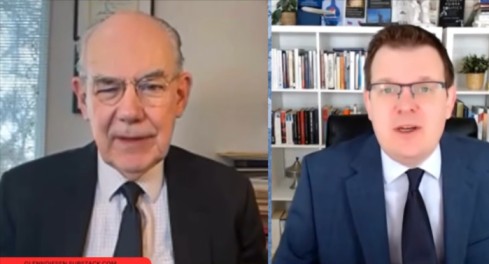
Editor’s Notes: In this compelling discussion, Glenn Diesen and Professor John Mearsheimer analyze the strategic challenges facing the United States following the outbreak of a protracted conflict with Iran. Mearsheimer argues that the U.S. has fallen into a “quagmire” after a failed attempt at a quick victory, leaving the administration without a clear exit strategy as Iran gains leverage over global oil markets. The conversation explores the potential for catastrophic economic consequences and the dangers of a foreign policy driven by personal advisors rather than institutional expertise. This interview provides a sobering look at how the current path of escalation could lead to a major geopolitical and economic defeat for the West. (March 27, 2026)
TRANSCRIPT:
Trump’s Foreign Policy: Early Optimism and Shifting Expectations
GLENN DIESEN: Welcome back. We are joined again by Professor John Mearsheimer. So thank you very much for coming on the program.
I was hoping today we can maybe first take a step back and look at the wider strategy of the United States under Trump, because I was quite optimistic about his re-election. That is, he seemed to be capable of breaking from narratives and ideologies which I think the political west followed blindly over the past decades. And this seemed to be a requirement to navigate or adjust at least to the new realities of the world, which was that the unipolar distribution of power was gone.
So he recognized the US couldn’t be everywhere. So he more or less suggested, we have to go to the Western Hemisphere and East Asia, which means we have to pivot out of the Middle East and Europe, and that meant ending the war with Russia. This trapped US resources in Europe, and it pushed the Russians towards China. And also in the Middle East, he was quite consistent on ending the forever war.
So overall, what I’m trying to say is, although he’s a man who’s not very civilized in his demeanor, what he said was a lot more rational than what I heard from other politicians. So that’s why I wanted to hear from you. What do you make of his direction now? What’s going to happen to the pivot to Asia and this wider strategy which we saw outlined in the national security strategy of December 25th?
From Optimism to Disillusionment: The Iran Trap
PROFESSOR JOHN MEARSHEIMER: I think, Glenn, the best evidence of what you’re talking about regarding how people like us thought about Trump initially in terms of foreign policy, and what people think now, is reflected in the lineup of people on Judging Freedom, Judge Napolitano’s show. And of course, both you and I are regulars on the judge’s show.
I think if you go back to the first, maybe six, seven months after President Trump was elected, virtually everybody who appeared on that show was quite optimistic that Trump would represent positive movement in terms of American foreign policy — that there would be no more forever wars, he wouldn’t start any new wars, period, and there would be much, much less emphasis on a militarized foreign policy. And I think most importantly at the time, I think we all thought that there was a reasonable chance he would shut down the Ukraine-Russia war. So there was a lot of optimism about him. And of course, a lot of the people on the show — the Americans — didn’t vote for Trump. Some did, but everybody, I think, was generally pretty enthusiastic about the direction that he was going to take the United States.
I think now, if you watch Judging Freedom, almost everybody on that show is — and I’m choosing my words carefully here — very critical of President Trump. He is seen to have blown it, to have missed a terrific opportunity to change the direction that American foreign policy was going in. And if anything, he’s on the old path.
I think the key issue today is the Iran war. And all I can say is it’s truly remarkable that he allowed himself to fall into this trap. This is much worse than Afghanistan, much worse than Iraq. I mean, if you think about the Iraq war in 2003, at least in the initial stages, George W. Bush could land on the aircraft carrier and effectively declare “mission accomplished,” which is another way of saying, “We won.” Trump can’t do that. It’s been clear almost from the beginning that this is a lost cause.
But more importantly, the potential for really serious damage here is enormous. And here we’re talking mainly about the international economy, but not only the international economy. So he’s entered a war that he can’t win, and one could argue is likely to have catastrophic consequences for the world — not just for him and his presidency.
So it’s really quite remarkable when you think about it, where he has ended up in quite a short period of time. He was put in office January 20th of 2025, and the war started against Iran on February 28th, 2026. That’s effectively 13 months after he’s in office. So he starts off looking like he has a winning strategy, but 13 months later, he’s jumped into a huge quagmire that he can’t get out of. Truly amazing.
Trump’s Demands and the Question of Iranian Capitulation
GLENN DIESEN: Well, regarding the optimism, though, I wouldn’t say that it was rooted in being naive, because if you look, he did have a first term, and unlike all his predecessors going back to World War II, he didn’t start any new war. So he seemed to follow through on his rhetoric. So that’s why this has come as a bit of a surprise — how his foreign policy in the second time around went down this path.
But how do you make sense of the demands he’s making now? Because you said he can’t really get out of this.
So how do you make sense of it? Because the demands he put to the Iranians — it was essentially full capitulation. It was no nuclear enrichment, no ballistic missiles, no partnership with regional allies. Capitulation, I think, would be a good description.
Unconditional Surrender and the Illusion of Victory
PROFESSOR JOHN MEARSHEIMER: Well, I think the words that he used that always stick in my head, Glenn, are “unconditional surrender.” And by the way, if you look at the 15-point plan that he’s now putting forward to the Iranians as the basis for working out a deal, it looks like unconditional surrender. And when I first saw the 15-point plan, I thought it was a joke. I thought this was disinformation that the Iranians or the Israelis had put out. I couldn’t believe this was a serious plan.
But as you know, some days President Trump thinks that we’ve won a great victory, that the war is over and we just have to sign the documents of surrender. Other days, you can tell he’s quite desperate, and he understands that he has made a huge mistake and that he’s got to find an exit strategy — and he really can’t. So he goes back and forth. His rhetoric just changes all the time. It’s quite remarkable.
But the fact is, Glenn, he is — and we are — in profound trouble.
Why Iran Holds All the Cards
Now, what’s going on here? We started this war thinking that we would win a quick and decisive victory. When I say “we,” I’m talking about the Trump administration, because people like us, of course, understood that this was a cockamamie strategy from the get-go. But the United States and Israel started this war thinking that they could employ a shock-and-awe strategy built around decapitation. We decapitate the regime, we shock and awe the Iranians, people would rise up in the streets, they’d overthrow the regime, and we would live happily ever after. This was the basic strategy. We had to win a quick and decisive victory for this to work, and it failed.
And by the way, anybody who has a basic understanding of international relations should have understood that this would fail from the get-go. It was just not going to work. And it didn’t work. But then we found ourselves in a protracted war. Here we are.
And I don’t think most people fully realize it, but the Iranians hold almost all the cards in a protracted war.
First of all, there’s no real good exit strategy for Trump. And if he goes up the escalation ladder — which is the other alternative — the Iranians beat him at almost every step of the ladder. I think it’s very hard for most Americans to understand this, especially people who watch Fox News and are loyal supporters of the president. They think that we’re winning. They listen to him say that we’ve already won. Why haven’t the Iranians signed the surrender papers?
But if you look carefully at what’s going on here and you have a basic understanding of military history and military strategy, you see very quickly that we are in terrible shape as you go up the escalation ladder.
So, again, the point I’m making to you is he has no exit strategy. He can’t find the exit ramp now. And if he thinks about going up the escalation ladder, he gets stymied on every rung.
The Economic and Military Consequences of Escalation
Now, why do I say that? First of all, Iran can wreck the international economy. And one could argue that we’re sort of heading in that direction. I like to say there’s an iceberg out there in the water and we’re heading towards that iceberg — we are the Titanic. And I think President Trump basically understands that, and I think his advisors understand that, and they’re trying to turn the ship so that we don’t hit the iceberg.
But my first point is that Iran can wreck the international economy.
Furthermore, it can destroy — literally destroy — most of the Gulf states, because those states depend on desalination plants and they depend on oil infrastructure. And those targets are easy for the Iranians to hit. If the Iranians decided that they were going to go after a country like Saudi Arabia and take out all their desalination plants and take out their oil and energy infrastructure, they basically wreck Saudi Arabia as a functioning society.
Then there’s the whole question of Israel. The Israelis are running out of defensive missiles. The Iranians obviously have lots of missiles. They can do enormous damage to Israel. I don’t think they can do to Israel what they could do to countries like Saudi Arabia or the UAE. But there’s no question that they can do enormous damage to Israel.
Then there’s the whole question of ground forces. We don’t have any serious ground forces option. This is a joke, right? There’s just no ground forces option there. And in fact, if we go down that road, we’re just going to make a bad situation even worse.
Then, to take it a step further, what President Trump has to do to avoid a catastrophe in the international economy is make sure there’s a lot of oil out there in the global market. This is why he took economic sanctions off of the Russians — just think about that. We have taken sanctions off the Russians so that their oil can get out into the market.
More importantly for what we’re talking about here, we’ve taken sanctions off the Iranians and we’re allowing — just think about this — we’re allowing Iranian ships to go through the Strait of Hormuz because we want that Iranian oil out there in the global market.
So what’s happening here is, although we are bombing Iranians and doing significant damage to their country and murdering innocent people, at the same time the Iranians are not suffering economically. So what this tells you is that President Trump has to be extremely careful that he doesn’t go up the escalation ladder, because if he does, the end result is that the Iranians will win and we will lose in a truly serious way. So we’re in deep, deep trouble.
Is There Any Way Out? The Search for a Political Settlement
GLENN DIESEN: Yeah, it’s a good point with the escalation ladder, because the Iranians have a lot of cards to play here — not just to shut down the Strait of Hormuz, but if they use Yemen to shut down the Red Sea, as you mentioned with Saudi Arabia, they’re cut off from all access. If you destroy their desalination plants, no water. Hit their energy fields, no energy. And in places like Qatar, where 85 to 90% of the population are foreigners, they would begin to leave, and it would only be a desert left, which is how they found it. So it’s probably one of the most vulnerable countries in the world, that state.
But you would have thought they would have considered this before going into this war, because the Iranians were quite open about what they could do and what they would likely do. I know Trump said, “Who would have ever thought that they would strike US bases around the region?” They kept saying, though, “This is what we’re going to do. We’re going to shut down the Strait of Hormuz. We’re going to attack your bases.” And even now in Iraq, I’m not sure if there are Americans left, but the Europeans are pretty much all out. After 23 years, they seem to be able to, at least so far, achieve some of the objectives they set out.
But you often made the point that in Ukraine, a political settlement is unlikely because the different sides are too far apart — there’s nothing to agree on. But in this instance, even if this will only be Trump’s opening position, demanding full unconditional surrender, the Iranians also have their own conditions, which makes it very difficult even for Trump to declare victory and go home.
So how do you see this playing out? Is there any solution to this war at all? Can Trump go home?
Iran’s Leverage and the Limits of Trump’s Options
PROFESSOR JOHN MEARSHEIMER: Here’s the problem, I think, Glenn, it’s twofold. First of all, as you noted, the two sides are miles apart in terms of their demands. There’s no bargaining space here. And of course, you and I have made this same argument regarding the Ukrainians and the West on one side and the Russians on the other side. There’s just no bargaining space. The demands of each side are so at odds with the demands of the other side. You just kind of can’t see how you get a deal. That’s point number one.
The second point I’d make is that if you’re playing Iran’s hand, you have no interest in cutting a deal now. You have huge leverage now for the reasons I described before. And the longer the war goes on, the more leverage you have. The longer the war goes on, the more desperate President Trump is going to get. He has to — the Titanic is heading toward the iceberg and you have got to start changing course now, otherwise you’re going to hit the iceberg. That’s where we are.
All you have to look at is the yields on 10-year treasury bonds in the United States, which many people view as being in a danger zone and in a situation where it’s only going to get worse. This is really potentially disastrous. We have to do something to fix this problem.
This is why President Trump said on Monday that he was not going to attack Iran that evening. Remember, he had promised that he was going to attack Monday evening. I think that was the 23rd, March 23rd, and the day of March 23rd, in the morning he called it off and he said, “I’ll give him five days.” And he just said, “Now I’ll give them 10 days.” What’s going on here?
It would be suicidal for President Trump to launch an all-out attack on Iranian energy infrastructure. This would be nuts. Again, as I said before, we have a deep-seated interest in making sure there’s as much Iranian oil out in global markets as possible.
By the way, just parenthetically, there’s all this talk about us conquering Kharg Island and people say, “You want to understand that 90% of Iranian oil goes through Kharg and we can conquer it.” I don’t think we can conquer it, but let’s assume we conquer it — what are we going to do? Conquer Kharg Island and cut off the flow of oil into global markets? We’re not going to do that.
You remember when President Trump said that we bombed Kharg Island, he emphasized very clearly that he only hit military targets. Why did he do that? Because he understands again that you have to get that Iranian oil and you have to get that Russian oil. You have to get all the oil you can out into global markets.
Because if you look at what’s happening in the Strait, remember, about 20% of the world’s oil comes through the Strait. I would argue that today it’s been reduced. What comes through the Strait has been reduced to about 5% of what it was before February 28th. Just think about that. 20% of the world’s oil comes through the Strait — and we’re not even talking about fertilizers here, which is another huge problem — but just oil. 20% comes through the Strait and at this point in time, only 5% of what was going through the Strait on February 27th is now going through the Strait. This is a huge problem.
So this tells you that we cannot go after Iranian oil and wreck their energy infrastructure. And that means the Iranians have huge leverage over us. And the longer this goes on — when you think about the consequences for the world’s food supply of all these fertilizers not making it through the Strait, and then you think about the consequences of only 5% of the pre-war flow of tankers through the Strait now taking place — you see that the potential for disaster is huge.
And the Iranians have a vested interest in stringing this out, because the more they string it out, the more desperate President Trump gets, and the more desperate President Trump gets, the more leverage they have. What’s really going to cause President Trump to cave in a major way is when he comes to understand that if he doesn’t shift course, the Titanic is going to hit the iceberg. And the pressure is already there — again, that is why I believe he did not attack this past Monday, gave them five more days, and has now given them 10 more days.
And what happens at the end of 10 days if the Iranians don’t cave to his preposterous, preposterous 15-point plan? Is he going to bomb Iran? Is he going to bomb their energy infrastructure? I don’t think so. He has no option here.
Just getting back to your original point about five minutes ago — to how we got into this situation, how we could have allowed ourselves to be put in such a vulnerable position. The fact is, again, Glenn, they thought they were going to win a quick and decisive victory. I’ve studied a lot of military history. You see this in so many cases — countries go to war and they go to war because they’re optimistic about their chances. It makes perfect sense. You don’t go to war if you think you’re going to lose.
President Trump didn’t go to war thinking he was going to end up in the situation that he is in now. He went to war thinking he was going to do another Venezuela operation — float like a butterfly, sting like a bee, bring the Iranians down, be able to proclaim victory, have a parade in New York or something like that. That’s what he thought. But once that doesn’t happen and you’re in a war of attrition, you are in deep trouble. And you are especially in deep trouble in this case because the Iranians hold so many of the cards.
And again, the point I’m making to you is we want a deal now. Trump wants a deal, but he wants a deal on his terms, but he can’t get a deal on his terms. And in fact, again, just to repeat myself, because I think it’s such an important point, the Iranians have a vested interest in just letting this one go. And at some point down the road, when they have much more leverage than they do now, then trying to work out a deal that’s favorable to them.
What Can Trump Actually Offer?
GLENN DIESEN: I think that’s an important point which people also need to understand — the idea that time is on the Iranian side. Because if you look at the military component, the Iranians can continue to just pump out these very cheap drones. It’s easy to manufacture, they’re cheap, the industrial potential can remain. And these $5,000 drones are sent and the US has to use million-dollar interceptor missiles, so they can continue to pump out drones while the US diminishes its potential. So again, time is on their side.
And also, as you suggested, in the economic arena, they’re actually making more money now that the prices are going up. So while the US is going somewhere very dark and dangerous — I can see if you were advising the Iranians, you would say you’re not in a rush to wrap this one up, especially when these are the deals or the terms they’re putting on the table.
But I was wondering — when he started this countdown, first 48 hours, then five days, then 10 days — it reminded me a little bit about what he did with the Russians. He was also putting, I think, 50 days, then he went down to 12 days. When the countdown was over, Russia was going to be hit by the toughest sanctions ever. And when the clock finally ran out, instead he called Putin, and they agreed to meet in Alaska. And so it just pushed the whole thing aside.
But is this something similar that can happen here? Because I guess the difference is that the Russians really wanted a deal. But for the Iranians, it’s unclear what Trump can actually deliver, because if they hold on to Hormuz, they can essentially put up a toll booth. They can get reparations from the Gulf states for this attack. They can demand that they expel the US bases, which have already been, many of them, blown up. And they can even compel them to ditch the dollar in their energy trade, which links the US financially to the region. So they can get everything they want with military means, which means Trump really has to have something else to offer if he wants to get them to the table.
I’m just wondering — what is it again? If Trump calls you, how does he avoid the iceberg? How do we get out of here? What can he do at this point in time?
The Trap of Escalation: No Easy Exit
PROFESSOR JOHN MEARSHEIMER: The truth is he is going to have to make major concessions to the Iranians, and it will be clear when he makes those major concessions that the Iranians won a clear victory. It will be a humiliating defeat for the United States if he wants to end this. Given what you and I have been saying about what happens is you go up the escalation ladder and the fact that there is no easy exit strategy here, he really has no choice, in the final analysis, but to cave in to most of Iran’s demands and accept a humiliating defeat.
And that will be extremely hard to do, and it’ll be extremely hard to do, in part because of Israel. The Israelis will not want us to make any concessions. The Israelis will want us to continue the war. But I think this will be a case where we will be so desperate to avoid a global catastrophe that Trump will ignore the Israelis and do what he has to do.
Now, he may not do that, right? He may feel that he just can’t make the necessary concessions, that the Iranian demands are just too outrageous. And those Iranian demands would be hard for anyone to swallow, anybody in the White House, whether it’s President Trump, President George H.W. Bush, Ronald Reagan, Franklin D. Roosevelt, the demands that the Iranians are making are really quite amazing. So even if you accept only 75% of them or even 50% of them, that would be very difficult to do. And this is the enormous problem that he faces.
And one can imagine him not accepting a deal and just thinking that he can stick it out. And the end result is we’ll basically go off a cliff economically. I think a lot of people don’t see that as a serious possibility at this point in time. But I think if you look at newspapers like the Financial Times and the Wall Street Journal carefully, you look at the business section, the articles that are written about the economy and about fertilizers and food and so forth and so on, you see that we could very easily go off a cliff here. We’re talking about a serious situation. And it’s not clear what President Trump will do.
The Danger of Desperation: The Lesson of Pearl Harbor
As I like to say, Glenn, I think that when you study international history, there are these handful of cases that stand out where policymakers get into desperate situations. And when policymakers get into desperate situations, they sometimes roll the dice. They do things that lead to catastrophe. And my favorite example here is the Japanese decision making process that led to Pearl Harbor.
The United States was squeezing Japan economically between, actually between the summer of 1940 and Pearl Harbor, which was December 7, 1941. And we really began to squeeze starting July 25, 1941. This is shortly after the Germans invaded the Soviet Union. And we were really putting pressure on Japan after that. And the Japanese were desperate because they were heavily dependent on the United States. They were remarkably dependent on the United States for oil, scrap iron and scrap steel. And we had basically made it impossible for them to import those things from the United States. We had frozen their assets, their economic assets, and they were just desperate.
And they understood full well that attacking the United States at Pearl Harbor was likely to end in catastrophe. It’s very important to understand this. The Japanese understood that they were attacking Godzilla and that it was likely to end in disaster, but they did it anyway because they were desperate. And when the level of desperation reaches a certain point, states, countries, leaders sometimes do remarkably foolish things that end up with catastrophic consequences. And this, of course, is what happened with the Japanese.
So the question you have to ask yourself is, what is President Trump going to do as his level of desperation increases? And by the way, you catch glimpses of how desperate he is on occasion when you sort of watch his body language and you watch what he’s saying about the war against Iran. He understands full well that he’s in deep trouble. And I’m sure his advisors are telling him that if we don’t shut this one down, we could go off a cliff.
His advisors, especially his economic advisors, are not fools. They understand what’s going on here and they’re looking for an exit ramp and they can’t find one. And they understand full well that the Iranians are playing hardball with them. And I’m sure they understand full well that the Iranians have powerful cards to play.
And what’s happening behind closed doors, I’m sure that behind closed doors the level of desperation is increasing every day and they’re searching, they’re looking for a solution here. But as you and I were saying before, where is the solution? Where’s the exit strategy?
A number of my friends who I talked to about this say what President Trump should do is declare victory and get out. He can’t do that. Who’s going to believe that he achieved a victory? Furthermore, the other side gets a vote in this one and the other side’s not going to quit. They’re going to continue to put pressure on the United States and they’re going to continue to put pressure on Israel. Even if we say we won, they want us completely out of the Middle East.
This is truly remarkable. One of their demands is they just want us to go home. Is President Trump going to declare victory and go home? I don’t think so. He may declare victory, but he’s going to stay there militarily, maybe not employ military force against Iran, but we’ll be there and the Iranians will continue to attack us. So declaring victory and getting out, so to speak, where does that leave you? Nowhere.
So he’s got to figure out a way to shut this one down. And that means reaching some sort of modus vivendi with Iran. How does that happen? Again, this goes back to our earlier discussion of that 15-point plan that Trump put forward and then the various demands that the Iranians are putting forward. How do you find some bargaining space there? And again, I don’t see how you do it. The Iranians have no incentive.
Iran’s Leverage: Sanctions, Strikes, and the Strait of Hormuz
GLENN DIESEN: Well, the Iranian demands, they seem excessive. However, they’re also achievable, it appears, because not only can they strike the bases, but as I mentioned, as long as they control the Strait of Hormuz, they can squeeze the Gulf states to decouple in terms of either not rebuilding the bases or hosting the troops. They can decouple from the petrodollar. There are a lot of things they can do which they can continue to do even if Trump goes home and declares victory. So it is a difficult position.
But in terms of the pressure, though, I think this is also a problem with all the pressure which has been put on Iran because not only do they have a lot of cards to play if they decide to go up the escalation ladder, but also they can’t really afford to go back to the status quo either. I mean, they’ve been living decades under these crippling sanctions. They had two surprise attacks on their country within a few months in between. They don’t want another one. And also, even if they get an agreement saying, “Oh, we promise not to attack you,” it was just these surprise attacks happened during negotiations. There’s no trust anymore.
So I think they are in a position where not only do they have a lot of cards to play, but they’re willing to absorb an immense amount of pain in order to put a final end to this, which, as you said, would be to expel the US bases. And again, it sounds excessive, but they’re already pulling out of Iraq and this after 23 years. So it’s not inconceivable. Again, as you said, they can shut down the Gulf states as well if they don’t fall in line. So it’s just hard to see, except if he’s reaching for a nuclear weapon, what else he can possibly do to push this one back. But sorry, you were saying.
The Houthis, the Red Sea, and Iran’s Existential Stakes
PROFESSOR JOHN MEARSHEIMER: Yeah, I just want to make two points just to piggyback on what you said. One thing we haven’t talked about, which is enormously important, is the Houthis. The Houthis and the Iranians together can shut down the Red Sea. About 20% of the world’s oil and gas comes through the Persian Gulf and through the Strait of Hormuz, but another 12% comes through the Red Sea. And if the Houthis join in with the Iranians, which is a serious possibility, and they shut down the Red Sea as well, that will further exacerbate the situation. So we don’t want to lose sight of that.
But also, Glenn, just building on what you said a minute ago, and of course I agree completely with what you said, it is important to emphasize that Iran is dealing with an existential threat here. The Israelis especially, but also the Americans, want to wreck their state. They talk about regime change, but the Israelis are interested in more than regime change. They want to destroy Iran. They want to do to Iran what happened to Syria. They want to break it into pieces. They want to make Iran a number of states or one single state that is remarkably weak. This is an existential threat.
And when you face an existential threat, and as you pointed out, they’ve faced this existential threat for a long period of time, they know they can’t trust the Americans and the Israelis. Given that dimension of the equation, they have a deep-seated interest in continuing this war and pushing the Americans and the Israelis to make huge concessions to them.
So if you look at their incentives and you marry that to their capabilities going up the escalation ladder, which we’ve talked about and which you were just talking about, again, you just say to yourself, how do you end this one quickly? It just doesn’t make sense from an Iranian point of view. And given that they get a vote, you can’t get a deal.
All or Nothing: The Rhetoric Problem and the Risk of Doubling Down
GLENN DIESEN: Well, this is why it’s so dangerous when a strategic situation boils down to all or nothing. This is when countries are willing to do a lot of crazy things. But it seems if there was a possibility, though. For example, if the US realizes it can’t dislodge Iran from Hormuz, if it realizes the difficult position, if there was a situation where Trump could offer the Iranians, “You can co-manage the Strait of Hormuz with the Gulf states. In return, we remove the sanctions.” Trump can say, “I’m bringing our troops home from the Middle East according to our grand strategy.” The Iranians now have peace with the Gulf states. He solved the Shia-Sunni problem. It could come as a victory, but it seems hard to achieve now that he keeps doubling down on this very dangerous rhetoric. Even watch Sean Hannity on Fox News arguing that the Iranians should also pay for the war, for all the bombs we had to drop on them. I think his rhetoric’s becoming a key problem, though, by overselling this victory he proclaimed.
PROFESSOR JOHN MEARSHEIMER: If I can just say something very quickly here, Glenn, I think what happens in situations like this is that when the war goes south, the people who got you into the war don’t want to retreat. They don’t want to say we were wrong. Let’s pull back. That’s not their response. Almost always the response is, instead, let’s double down.
So the Wall Street Journal, Sean Hannity, Lindsey Graham, General Jack Keane, that whole crowd that helped produce this disaster, fully understand what’s happened. And they don’t want to retreat now and concede defeat. What they want to do is double down, and they are putting pressure on President Trump to up the ante, and they are making arguments that we can win, we have cards to play, we can go up the escalation ladder.
So the problem that Trump faces is that he and his advisers surely understand that there is a great deal of truth in what people like you, Glenn Diesen, and me, John Mearsheimer, think. They understand that. But at the same time, they have all these people on the other side, and these are their close supporters, these are their compadres who helped get them into this mess, who are telling them that we can get out of it. And they’re, of course, spinning all sorts of stories about how we do it.
And this means that the war will probably go on for a couple more weeks before we’re on the verge of falling off a cliff. And at that point, it may just be too late. So this is why we shouldn’t be too optimistic about President Trump figuring out that he’s in a desperate situation. And in that case, what he ought to do is back off and try to work out a deal.
The Israel Lobby, European NATO Allies, and Escalation Risks
GLENN DIESEN: Well, an important component of this war, though, is, of course, Israel. They’re the ones who launched the first strike here. And you often make the point that if US and Israeli interests and security was completely aligned, then there wouldn’t be a need for the lobby. But again, there is a lobby which suggests that these differences have to be ironed out.
How do you see this being impacted by when the US has to get out of this war? Because the Israelis have been lobbying for this war now for what, 30 plus years for an attack on Iran. They finally got it. If the US leaves now, Iran is going to probably end up in a much, much more favorable position. So do you see a break, or further break at least, in US-Israeli relations as a consequence of this war?
I know it’s not over yet, and it can still take some unknown directions. But what are the risks you think of the US and Israel parting ways to some extent?
PROFESSOR JOHN MEARSHEIMER: Well, as you know, I think that in almost all cases, certainly in the past, when Israel’s interests and America’s interests pointed in opposite directions, the United States always did what was in Israel’s interest, in large part because of the power of the lobby. And I’ve argued, or I should say, Steve Walt and I have argued for a long time, that this is not in America’s national interest, obviously, but it’s also not in Israel’s interest either.
But this could be a very different case, because if we’re in a situation where it looks like the global economy is going to crash, I think that would lead President Trump to just tell the Israelis and to tell the lobby he doesn’t care what they think. He’s going to do everything he can to avoid going off the cliff, this sort of thing. So this could be a different case. This could be a case that, in a sense, contradicts the basic argument that Steve Walt and I lay out in our work on the lobby.
There’s another dimension to this that is worth mentioning. It’s a very sensitive subject. But almost everybody I know believes that Israel and the lobby led us into this war. And if it’s a catastrophe, there is a great danger that people will say that the Jews are responsible for causing this war, which is simply not true, because huge numbers of Jews oppose this war. And the Israel lobby is comprised of Christian Zionists as well as Jews. And by no means do all Jews belong to the lobby. So it’s just very important to understand that.
But nevertheless, there is a real danger here that if this war goes south in a serious way — we go off a cliff, we hit the iceberg, whatever phrase you want to use — and people see it as a war that Israel and the lobby is principally responsible for, that would cause a wave of anti-Semitism, not just in the United States, but outside the United States as well.
And I actually think that a lot of people inside of the lobby, and a lot of Israelis, and certainly a lot of American Jews, understand this danger. So I think if it looks like we’re going off a cliff, the lobby would not put much pressure on Trump to cut a deal with the Iranians, because of the potential threat of a massive increase in anti-Semitism as a result of a lost war — a catastrophic war that’s blamed on Israel and the lobby.
The European Position and the Future of NATO
GLENN DIESEN: I think you’re probably correct in this. But it also has to be said that a lot of the leading critics within the US of Israel are American Jews. And a lot of the hardcore Zionists are actually Christians. So to just say everything Israel does is comparable to Judaism, I think would be the wrong direction to take. But of course, the racists are rarely purely rational in their rhetoric. But no, I see that danger as well.
How do you see the Europeans in this? Because they played a very strange role. Initially, they weren’t invited, and then they suggested that they would send weapons. Trump didn’t want their weapons because he already won. Now he wants them to open up the Strait of Hormuz. They don’t want to because it’s too late.
I think, since you used the iceberg and the Titanic metaphor, I think it was a French general who said that the Titanic already hit the iceberg, and now Trump invites us to join — like he says he should have invited us before. At least this is more or less the argument.
How do you explain the European position on this? And how, to widen it further, do you think this would affect NATO? Because Trump already on more than one occasion argued NATO is now a paper tiger. Mark my words, because you’ll remember this in a few months’ time. We will remember you betrayed us. You didn’t come to help us. We do everything for NATO. Marco Rubio said Ukraine is not America’s war, it’s Europe’s war, and we helped you, and you don’t help us. So it looks like they’re building up a case against the Europeans and against NATO. How do you see this dimension of the war?
PROFESSOR JOHN MEARSHEIMER: Yeah, there are a lot of points to be made here. One thing that gets lost in the discourse today — because the focus is laser-like on Iran — is the Ukraine war. And if the Ukraine war were to go south this summer, if the Ukrainian military were to start losing in a serious way on the battlefield, this would have disastrous consequences for Trump, for NATO, and for transatlantic relations. So we want to keep in the back of our mind that there is this other, I would say, impending disaster out there that could make a bad situation worse.
But just focusing on the Iran situation — here we are again with the Americans doing something, not consulting the Europeans, getting into trouble, and then asking the Europeans for help. And the Europeans, of course, understand full well that this is a lost cause and they don’t want to get involved.
The idea that European countries should send their navies to join the American navy as they try to push through the Strait of Hormuz with naval power alone — this is crazy. The American Navy, the most powerful navy in the world, won’t even go near the Strait of Hormuz, for fear that Iranian cruise missiles will sink those American naval vessels. The idea that the French navy or the British Navy is going to be this huge force multiplier that allows our navy plus their navies to forge through the strait is kind of crazy. Who believes that?
We’re talking about 1915 all over again, when the British Navy tried to push its way through the Dardanelles and ran into mines and had to turn around. It’s just not going to happen. And there’s all this talk about maybe using ground forces — this is not a serious argument. European ground forces, few in number. Do you really think the European armies are ready to invade Iran, or conquer Kharg Island, or any other island? This is just not in the cards.
And of course, what’s happening here is Trump is desperate, and now he’s blaming the Europeans. He understands he’s going to lose, and he’s got to blame somebody else. It can’t be him. After all, he’s a genius, right? He’s one of the great strategists of all time. So this disaster can’t be his fault. So whose fault is it? Well, it has to be the Europeans’ fault. “All we needed was for them to come into the fight and we would have won. But they didn’t come into the fight because they’re useless. They’re just free riders, and that’s why we lost. It wasn’t my fault.” So that’s what’s going on here.
And the Europeans play right into his hands, because the Europeans hardly ever stand up to him. And as the Iranians, the North Koreans, the Chinese, and the Russians have demonstrated, there’s only one way you deal with President Trump, and that is you stand up to him. If you behave like Mark Rutte, he’s going to walk all over you. He’s a classic bully. Everybody should have figured that out by now. If you show weakness, as the Europeans consistently do — with the exception of the Spanish prime minister — if you show weakness, if you behave like Mark Rutte, President Trump is just going to slap you around and continue to slap you around, because again, he’s a bully.
The Escalation Ladder: Is There a Final Solution?
GLENN DIESEN: So I guess the US will blame Europeans for Iran, and the Europeans seemingly plan to blame the US for Ukraine. So there will be a big blame game going around. But it is an interesting dynamic, because as you suggest, there’s the Iran war, which can’t be contained and is spreading everywhere. If that was the only thing, it would be one thing. But there are so many other variables at play which won’t stay constant at any point. We could have an unraveling global economy, the Ukraine war can go spiraling into a collapse. So it’s very difficult to bet on wider strategic stability as things in Iran go terribly wrong.
But at this point, do you see any final — if Trump decides to go up the escalation ladder — is there any possible final solution he can go to? You were dismissive of the ground operation, sending in boots on the ground, because this appears to be — no matter how foolish it is — and leaders often double down on foolishness. But the troops are on their way, thousands of US soldiers. It’s unclear how they’re going to use them.
I thought the way that would make most sense would be to invade Yemen or something, to make sure that the Red Sea wouldn’t be closed off. But anything else — and that as well, by the way, sounds like a disaster. What do you see the possibility of using these troops for?
The Folly of Ground Forces: Lessons from Desert Storm and Iraq
PROFESSOR JOHN MEARSHEIMER: I would just point out to you that when we did Desert Storm back in 1991, remember, we invaded — or we attacked with ground forces on February 24th of 1991. The attacking forces comprised about 700,000 troops. And of that 700,000 troops, 540,000 were American, 540,000. And a lot of those forces were mechanized infantry divisions, armored divisions.
Then in 2003, when we invaded Iraq, the total force was about 300,000. I would estimate about 190,000 were US troops and probably about 45,000 or so were British troops. And again, many of those units that went into Iraq in 2003, like in 1991, were mechanized infantry and armored divisions.
And as you know, Iraq is a much smaller country than Iran geographically, and it has a much smaller population. What are we talking about here? We’re talking about sending a couple thousand troops, maybe 10,000 at the most. I don’t think the number’s 10,000. I think all total at this point, we’re more or less committed to sending probably about 5 or 6,000.
When you look at what we’re actually doing — and just don’t listen to the rhetoric — but even if it’s 10,000, they’re light infantry, 10,000. Just think about those numbers that I was giving you for Desert Storm in ’91 and for the second Gulf War in 2003. What are you going to do with light infantry then?
Where Would These Troops Even Go?
The question is, where are you going to put them? We have about 13 bases in the Middle East. Almost all those bases have been evacuated because the Iranians have slammed those bases. They’ve done great destruction to American military bases in the region. This tells you that our bases are vulnerable. So where are we going to put these troops so that they don’t get hit like the bases got hit? What bases are we going to put them on?
And what kind of equipment are they going to use to go into places like Kharg Island or the Iranian mainland or what have you? And what’s going to happen when they get there? Are the Iranians just going to say this is a fait accompli, there’s nothing we can do about it? Or do you think the Iranians are going to fight back? I mean, we know the Iranians are going to fight back. So what are you going to do with a handful of troops?
And they talk about taking these small islands in the Strait of Hormuz. There are three of them. One is bigger than the other two. I don’t think that that’s going to work out very well. The Iranians will go to great lengths to defend those islands. And if we take the islands, they’ll pummel the troops on the islands. And furthermore, they’ve told the UAE that if that happens and they cooperate with the Americans — and the UAE is bent on cooperating with the Americans — they’re going to basically wreck the UAE.
The Strait of Hormuz: A Shooting Gallery
So what are we going to gain by taking those small islands? Well, people might say we can open the Strait of Hormuz. I don’t think that’s true at all. First of all, if you’re on the verge — if the Americans are on the verge of opening the strait — they’ll mine the strait. And mines are deadly effective ways of preventing ships from coming through the strait.
But let’s assume that I’m wrong and the ships come in to the Persian Gulf, they can make their way into the Persian Gulf. It’ll be like a shooting gallery, right? Those ships are in a narrow body of water. The Iranians will be on one side of the Gulf facing this target-rich environment. They have huge numbers of cruise missiles. They have all these fast boats. They have additional mines they can lay in the Persian Gulf. They can wreak havoc.
The Kharg Island Fantasy
But let’s assume I’m wrong. Then we go to Kharg Island, right? We have an amphibious assault on Kharg Island. To put it in Lindsey Graham’s terms, we have Iwo Jima 2. What are we going to do then?
As I said before, are we going to cut off the flow of oil out of Kharg Island? No, we’re not. Not if we’re smart, because we’re letting all of this Iranian oil out on the market now because we need it. So invading Kharg Island and cutting off 90% of the flow of Iranian oil into global markets makes no sense at all.
And furthermore, once you take Kharg Island — let’s say you take it — do you think the Iranians are going to sit there and just leave you alone? They’re not going to do that. They’re going to bomb the island. They’re going to bomb your troops with ballistic missiles, with drones, and make life miserable for you.
And furthermore, what’s the story as to how taking Kharg Island or taking those three islands in the strait actually produces a lasting settlement here? Again, the Iranians — you don’t want to forget — are facing an existential threat. And when you’re facing an existential threat, you have to fight to the death. That’s the way this works.
Iran Holds the Cards in a War of Attrition
You’re dealing with an existential threat, and they have lots of cards to play. Again, we were prepared to win a quick and decisive victory. We had this cockamamie strategy that didn’t work out. We ended up in a war of attrition. And once you’re in a war of attrition, they hold — I would argue — almost all the cards. And if you don’t think they hold almost all the cards, they hold many cards, and they have the ability to cause enormous trouble, as we’ve talked about on the show here.
So the ground forces option — I don’t know what people are talking about. And by the way, Glenn, just to beat a dead horse here, you remember how long we prepared the troops for Desert Storm? When did Saddam invade Iraq? I think it was August 2nd of 1990. August 2nd of 1990. And when did we launch those ground troops against the Iraqi Army? It was February 24, 1991. So you went from August of ’90, early August of ’90, to late February of 1991. That was the time it took to build up the force, train the force, and then launch the offensive. That’s a long time. And as I said before, it was a huge army, 540,000 troops.
And the same thing is true with the 2003 offensive. We just didn’t do that overnight. President Trump made no preparations for a ground war for February 28th. This is something that he and his advisors have recently invented as a way to deal with this problem. They just sort of pulled it out of their back pocket. “Oh, we’ll do ground forces. Let’s see what we can do to invade Iranian-held territory.” So that’s what they’re talking about doing now. There was no planning for this. There’s no strategy there. We’re basically screwed.
GLENN DIESEN: And as I said, Iran is about four times as large as Iraq. It’s mountainous, it’s facing down on the other Gulf states, which are essentially flat deserts. They have the whole coastline. I mean, it’s a fortress, and populated by more than 90 million people. And they’ve been preparing for this ever since Bush called them — put them in the axis of evil.
So you’re right. To put together a few thousand troops and ship them down there and make up the plan as you sail down there — it does sound very cartoonish. Not the way one fights a war. And yeah, it’s not reassuring, though, when you have this kind of desperation, this much at stake. And it seems like someone’s going to do something very rash when things start to go very wrong. I just pray that no one’s reaching for the nuclear weapons for a quick fix. But that’s another chapter we can look at a different time. Do you have any final thoughts before we wrap up?
The Danger of Ignoring Expertise: Trump’s Fatal Flaw
PROFESSOR JOHN MEARSHEIMER: Just one final thought. People like us are frequently critical of the deep state, and people on both sides of the political spectrum are critical of the deep state. But the reason that you have a powerful state — the reason you have powerful institutions like the CIA and the Pentagon and analogous institutions in Russia, China, and so forth — is because you need a lot of expertise. You need a lot of people who can help you staff problems.
In other words, if you decide that you’re going to invade Iraq in 2003, you just can’t do it by yourself. If you’re the president with a handful of advisors, you have to have lots of experts. You have to have lots of help thinking about how to deal with the problem and how to execute the right strategy and so forth and so on.
And the problem with President Trump is he doesn’t have any respect whatsoever for institutions, and certainly not for the deep state, which he views as a mortal enemy, because he thinks the deep state opposed him in all sorts of ways during his first term. So you have this actually very interesting situation where he does not rely on experts at all. He relies on Steve Witkoff and Jared Kushner and Lindsey Graham. These people are not serious strategists. These are not people who are capable of thinking through how to deal with major foreign policy issues or questions of war and peace. They can’t do that.
And again, the reason that you have a deep state is because inside that deep state is all sorts of expertise. I don’t want to paint too rosy a picture of the deep state here, but there is an upside to having a deep state.
The Deep State Was Right to Be Skeptical
And, Glenn, it is very important to understand that all of the evidence that’s in the public record now says that the deep state was at least very doubtful as to whether this would work — this war — and maybe was even opposed to it. If you listen to what General Caine, the chairman of the Joint Chiefs of Staff, was saying before the war and what he’s been saying since the war started, and you listen to what the Pentagon was saying — absent Pete Hegseth, of course — and you look at what the intelligence community was saying, especially the National Intelligence Council, it’s quite clear that the deep state was highly skeptical of this operation, and for good reason.
Because as you and I know, anybody who understands basic military history knows that the idea that you’re going to get regime change with air power alone is a delusional perspective. So the deep state in this case was not consulted, did not provide any expertise. And instead, what President Trump did was he relied on himself because, of course, he thinks he’s a genius. And to the extent he relied on anybody, he relied on people like Jared Kushner and Steve Witkoff and Lindsey Graham and Rupert Murdoch, who was calling him all the time, and people on Fox News, and you name it.
But you don’t go to war relying on people like that. You need experts. You have to really think these things through. As we know very well, you and I, when you go to war, the potential for disaster is great. It is the realm of unintended consequences. This is one of the central messages in Clausewitz. For anybody who’s read Clausewitz, you understand very quickly that going to war is in many ways a giant crapshoot. And you want to do everything you can to maximize the chances that you’ll be successful.
And the way you do that is you rely on smart people. You tell smart people to turn their critical faculties on and to think about what’s the best strategy for pursuing a particular goal. And ask people at the same time, is this goal worthwhile pursuing? Can we come up with a strategy that will allow us to achieve the goal? And so forth and so on.
But he just had none of that — President Trump — in his decision making that led up to the war that’s now ongoing. And on top of all that, not to get too carried away here, but he relied on the Israelis, who were selling him a bill of goods. Really quite remarkable. He was bamboozled by Prime Minister Netanyahu.
So here we are. And again, I just want to say one more time: what happened here was foreseeable. It was foreseeable. You did not have to be a strategic genius to understand what was going to happen. And again, the deep state, I believe, understood this.
GLENN DIESEN: I understand why Trump would have been distrustful, though, of the intelligence agencies and the permanent bureaucracy due to the whole Russia Gate affair in his first presidential term. But again, I couldn’t agree with you more. That being said, you still need those guys. And the idea that you can replace them with a crew of people you trust — which consists of your friends from the real estate business, your family members, some people from the media, from Fox News — and that this will be the replacement, I mean, that sets up a whole new category of problems.
No, it’s a real mess. Whenever we talk about the Ukraine war, it ends on a very dark note. I don’t think there’s any positive spin one can put on this war. It’s going to be a real mess. So thank you very much for taking the time.
PROFESSOR JOHN MEARSHEIMER: Welcome, Glenn. All I will say is I hope that before I die, you and I have a conversation where we can have an optimistic conclusion to what we say over the course of the show. It does seem like we’re a long way from that point, however.
GLENN DIESEN: Yeah, I look forward to that, hopefully that opportunity. So thanks.
PROFESSOR JOHN MEARSHEIMER: You’re welcome.
Related Posts
- Transcript: President Trump Hosts a Cabinet Meeting, Jul. 31, 2026
- Transcript: President Trump’s Remarks at Sen. Lindsey Graham’s Funeral
- Transcript: Trump’s Michigan Rally Speech Ahead of Midterm Elections
- Transcript of Nick Fuentes Interview ft. Hunter Biden – Channel 5
- Transcript: Trump Remarks at White House Correspondents’ Association Dinner