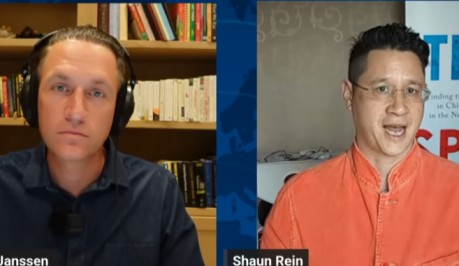
Editor’s Notes: In this insightful interview, host Cyrus Janssen speaks with Shaun Rein, CEO of the China Market Research Group, to explore how the conflict with Iran is reshaping global power dynamics. Rein highlights China’s strategic energy independence through massive investments in solar and wind power, positioning the nation to weather global economic instability better than its Western counterparts. The discussion also examines the accelerated shift toward a multipolar world as international allies increasingly seek to “de-risk” from the United States. Finally, Rein offers a unique insider’s perspective on why a military conflict over Taiwan remains unlikely, focusing instead on Beijing’s long-term strategy of economic integration. (Mar 27, 2026)
TRANSCRIPT:
Introduction
CYRUS JANSSEN: Well, everyone, we’re very honored to welcome back into the studio a longtime guest and a very close friend of mine, Mr. Shaun Rein, who is the CEO of the China Market Research Group. He is also a best selling author of many books about China. This is his latest one called The Split. If you are interested in learning more about China, Shaun is absolutely one of the best insiders that you can listen to. Shaun, welcome back to the show.
SHAUN REIN: Well, it’s great to be here, Cyrus. I don’t think I’ve been back since Trump launches trade war against China and the rest of the world and caused havoc for the world economically. So it’s good to be here and talk a little bit about what’s happening in China and what’s happening in geopolitics.
China’s Position in the Middle East Conflict
CYRUS JANSSEN: Absolutely. Well, Shaun, again, you’re one of the best sources of information that I often listen to. I love your books, I love your tweets on X and everything that you’re doing. And again, I wanted to bring you in because we’ve got a new conflict with Donald Trump. Of course, that is the war in the Middle East. And I thought for today’s episode we can try to bring in China here and try to get your expertise and really what China’s thinking about this. What is the greater play here? Because a lot of people here, Shaun, say that this is an entire Middle East conflict. But how should we understand this from the Chinese perspective?
SHAUN REIN: Well, it’s not just the Middle East conflict. This could spiral out throughout the entire world and could end up hurting the economics of not just the Middle East, but America, China and everyone for the next 10 years.
Cyrus, when you take a look at 1973, the oil embargo lasted for five months, but it took 10 years of stagflation, inflation, poor economic growth for the whole world to be able to start to grow again during the Ronald Reagan, Paul Volcker 1980s go-go days. So I think investors and analysts are underestimating the havoc that the closure of the Strait of Hormuz could cause on the entire world.
Unless Trump backs down and backs down quickly, because we’re already at a month. If this goes on for another three, four months, that could cause a collapse of the economy and the equity markets.
Now, for China’s case, they’re in a much better position short term than other nations. Why? Because China has installed 1.2 terawatts of solar and wind power in the last year. So about 20% of their energy needs now comes from solar and from wind. So they’re able to de-risk from the Middle East. A full 84% of their energy needs are based on oil. They have 28 billion barrels of oil in China, and so they are not as at risk as other countries.
You see right now in Thailand, there’s gas shortages where they’re limiting the amount of gasoline that taxi drivers can pump into their cars. The Philippines under Bang Bang Marcos just called a state of emergency, and you’ve seen it in Las Vegas, prices have gone up 20 to 30%. So China is better off than the rest of the world in the short term from the economic tension.
Now, here’s the problem, though, Cyrus. Eventually this is going to hit China too. Right now there’s probably a lot of petroleum products that are under stockpiling of about 40 days, maybe four months in some sectors. But I was talking with the head of one of China’s largest coating companies or paint companies, and he’s in panic mode right now. He only has enough petroleum products stockpiled to last for 40 days. He’s not sure after 40 days if he’s going to be able to continue to produce coatings.
And so when people look at it, we think of just gas at the pump, but oil goes into fertilizer, it goes even into textiles and apparel and the clothes that we make, and into paint and coatings. This will have an impact on China’s economy if it continues to grow. And China accounts for 30% of the world’s manufacturing. So if China’s manufacturing stalls, the rest of the world is going to get hit very hard, Cyrus.
China’s Domestic Energy Production
CYRUS JANSSEN: Yeah, that’s a really good insight, and I appreciate you bringing in the other angles because we typically only think of it as gas at the pump and thinking about petroleum for that usage. But I love that you brought in China, that it is responsible for 30% of manufacturing. And I could really understand the spillover effect. What do you think about oil production inside of China? For example, in the western regions where Xinjiang is, is China also producing its own oil that it’s domestically using?
SHAUN REIN: Yes. So right now, aside from wind and solar power, which account for 20% of China’s energy needs, China has about 28 billion barrels of oil sitting in the ground in the northeast and in the Xinjiang region. So that’s why it’s better able to handle the shortages from the Middle East right now, because it is largely energy independent.
Again, about 84% of China’s own energy needs comes from China itself.
But clearly there’s still going to be a spillover effect. And that’s why some people say that China should have been supporting Iran more, and they’re surprised that China isn’t sending military support to Iran or to Venezuela.
But here’s the thing, Cyrus. I don’t view a cartoon-like “Axis of Evil” as George W. Bush called Iran, North Korea and China. China has good relations with Iran. They’ve been Iran’s lifeline for the last five to 10 years economically, by buying most of their oil. And Iran’s oil accounts for about 20% of China’s overall energy needs.
But China, don’t forget, also has very strong economic relations with Saudi Arabia, the UAE and Qatar. So it’s cartoonish to say that China is going to send military help to Iran or dual-use help to Venezuela. I think you have to look at it through a bigger global geopolitical lens. China wants good relations not just with Iran, but also throughout the Middle East. I was just in Saudi Arabia, and when you go there, there’s Alibaba and Huawei signs and buildings all over the place.
So I don’t think China is going to support Iran militarily. It’s supporting Iran because it wants oil, and most importantly, I think because the Americans and the Europeans have been trying to destabilize and take out China. And so what China’s had to do by getting close to Iran and Venezuela and Russia, it’s a matter of survival. It’s not an axis. They’re being forced to come together because if they don’t, they’re worried that they’re going to be toppled.
I actually don’t think China is as close to Iran and Russia as most Americans think. When you look at it, Cyrus, most Chinese, including government officials, have more of a natural affinity towards the United States than they do Russia. I’ll give one data point. None of the leaders or the leaders’ kids in China since the 1980s went to the Soviet Union or Russia to study. They all went to the United States. Deng Xiaoping’s family went to Duke for graduate school. Hu Yaobang’s family went to Yale for college and for law school. Jiang Zemin’s grandson went to Harvard, and even Xi Jinping’s daughter went to Harvard.
So I think the thing is, geopolitically, we have a lot of ignorant people in the cabinet. Marco Rubio has never been to China. We have a lot of ignorant people who are advisors to the president, people like Peter Navarro. And so if they really understood what was happening, they would understand that China is not a military threat, they’re not going to send military use to Iran. And they actually truly feel betrayed by American elites over the last 10 years and want to get closer to China and America relations again, because that’s where they sent their kids and grandkids to school.
Is the Iran War Ultimately a China Play?
CYRUS JANSSEN: Yeah, that’s a really good point. And I think anybody who studies China knows that it does have this non-intervention type of foreign policy, as you had mentioned already earlier, is that it’s mainly focused on trade. And that’s why China is doing significant trade deals around the world. It’s a top trading partner to over 120 countries around the world. And I think Chinese are just very savvy. They’re very much like, “We are going to do this deal for this, we’ll do A for B and let’s just keep it at that. We’re certainly not going to get involved in your government.”
But Shaun, I want to bring it to the Iran war here because in the United States we’ve heard a narrative that this war is not about Israel, it’s not about the Middle East, it’s not even about Iran. It’s just about containing China’s growth. And ultimately if we can topple Iran, this is going to be our way to stop China’s rise. And so there’s a bigger narrative here, or at least this is a theory that is being published right now in the United States, is that this is ultimately a China play. Do you see any truth to that conspiracy theory?
China’s Strategic Position: Geopolitical Gains vs. Economic Concerns
SHAUN REIN: I mean, perhaps it was a China play. If it was something where Trump felt that he was able to take Maduro out very quickly in Venezuela, it was if he felt he could take out the Ayatollah Khomeini very quickly. But obviously if this was the strategy, if this was a plan, it’s failed.
The current Ayatollah, think about it. If you’ve killed his parents, if you’ve killed his wife, you’ve killed his kids, if you’ve maimed him and injured him for life, do you think he’s going to very easily set up a deal with Trump? I mean, he’s angry. You also have sort of that religious backing of the Shiite Islam. So I think it’s a very different situation than what you have with Venezuela right now, where I think the Iranians are going to dig in and push back a lot harder because the Khomeini, the current one, has nothing to lose. He lost his entire family. This is very different from Delsey and Venezuela.
Now, when it comes to China, do the Chinese like this? I think there’s two schools of thought and I think both thoughts are correct partially. The first thought is that China wants this war to continue because the longer it continues, the more they benefit. But then a second thought says China wants the war to end because they need to get the economy up and going. And I think both lines of thought are correct.
So what do I mean by this? Before 2001 and 9/11, you used to hear the United States criticize China heavily for human rights and politically. But after 9/11, because George W. invaded Iraq and Afghanistan, you basically had an eight year period where the United States didn’t focus on China’s rise anymore and they didn’t try to contain China. Now part of that was Bush was a lot less sinophobic than current leaders and was more open to allowing China’s rise. But I think part of it was America put all of their resources, all of their money, all of their thinking processes on how to deal with the Middle East and Afghanistan. So in many ways the best thing ever to happen for China’s growth was 9/11. I think there is some truth to that right now.
The United States is spending all of its military power in Iran right now. You see that they’re sending the 82nd Airborne Division to the Middle East, several thousand of our troops. They’ve sent 2,500 troops, I believe from Asia, and they’ve taken away THAAD missiles from South Korea against what the president of South Korea wanted. So Trump has made, I think, a lot of our allies feel a lot less secure in Asia. I think if you are a South Korean right now, you would be fearful against North Korea because you no longer have THAAD missiles.
And what we’ve seen, Cyrus, is in the last few months, because of the chaos, all of Western Europe’s leaders have sort of made that pilgrimage to China to say we need to pivot back to China and regain relations with the Chinese. For eight years, the British, the French, the Canadian leaders didn’t come. But in the last two months, Starmer from the UK, Carney from Canada, Mertz from Germany, Macron from France, all sort of came almost as supplicants to Xi Jinping and said, “We need to get close to you because we need to build up our economies again.”
So you have this side, which from a geopolitical side is China would want to have Trump and the United States embroiled in yet another Middle East mess. That’s one argument, and I think there is some truth to that because there are geopolitical benefits.
However, in the short term and I think in the medium term, from an economic standpoint, I think clearly China wants to end this. They’re getting 20% of their oil needs from the Middle East and Iran that goes through the Strait of Hormuz. China’s dealing with a 13, 14% youth unemployment rate. There’s a lot more underemployment. Real estate is still down 30 to 40%. So even though we expect 4.2 to 4.5% GDP growth in 2026, we have to be honest, the economy is still weak.
So I think for planners in the Ministry of Finance who are more focused on economic growth, they want this tension to end because again, if the tension continues, at some point, it’s going to hit China’s economy and the manufacturing sector. Because without petroleum based products, you can’t make the clothes that people like to buy, you can’t have the fertilizer that grows the crops, and you can’t have the paint that covers all the cars and the boats.
So I think you have both sides sort of within China saying, “Let’s end the war.” But other people more on the national security side are saying, “This is yet another gift — Americans hating Muslims, Americans being warlike and getting bogged down in yet another religious crusade in the Middle East.”
Taiwan, Geopolitical Shifts, and China’s Growing Influence
CYRUS JANSSEN: Yeah, I definitely agree with both of those statements as well, because I do think that over the last 14 months, with Donald Trump coming back into office, there’s been a lot of mistakes from the Trump administration that has certainly handed China a lot of big geopolitical wins. I think 2025 was a big year for them.
And like you had just mentioned, you have a lot of the United States’ closest allies that have made that pilgrimage to Beijing for the first time in eight years. The biggest one was obviously Mark Carney from Canada, who gave a speech at Davos and basically said, “It’s time for the middle powers to unite. It is time for us to actually seek out better trade deals and more trade deals.” And then, of course, went directly to Beijing to sign a very large trade deal, opening up tourism for Canadians and Chinese to both countries.
So I think there is some geopolitical wins there. But like you had said, I think for the Chinese economy, that is not in a very strong position at the moment. It is certainly very worrying. You’re one client there that is worried about only having about 40 days of petroleum left for that factory to produce those products.
Shaun, I’d like to know a little bit about something. Another theory that we’ve heard is that potentially this opens the door for Taiwan. I think this is obviously the most crucial question. When we talk about United States and China relations, Taiwan is always the number one topic at discussion. But we’re seeing a theory as well that saying, look, the United States is bogged down still with Russia and Ukraine. We’re looking at Venezuela, we’re threatening Greenland, we’re saying Canada’s the 51st state. Now we’ve got a new war in the Middle East that has certainly escalated to a point where I think a lot of people have underestimated. Does this open the door for China to make a move on Taiwan? I’d like to get your thoughts on that.
Why a Chinese Invasion of Taiwan Is Unlikely
SHAUN REIN: So for your audience who don’t know me, I’m actually American, but I’ve been in China for most of the last 29 years. And one of the ways that I’ve made a lot of money, Cyrus, frankly, is every six months, somebody hires me ever since the late 90s, saying, “This is the perfect time for Taiwan to be invaded and taken over by mainland China.” And so every six months for the last 29 years, I’ve been giving speeches, keynotes, workshop sessions, because I don’t think that’s going to happen anytime soon.
I remember in 2022, at the height of COVID, the Chinese economy was probably in a recession. Even though the official figures didn’t say that, people were miserable. That would have been a great time for the CPC to invade Taiwan to distract people from the overhang of COVID as well as from the weak economy.
There are a number of reasons why, Cyrus, that I don’t view a military invasion to be imminent. The first, and this is a little bit more touchy, but you got to remember there are nine people on the Central Military Commission. This is the highest military commission in China. Seven of the nine have been arrested or publicly investigated in the last year and a half for corruption. Now, I don’t know if it’s factional fighting or if it’s truly corruption. It could truly be corruption because the military was rotten to the core over the last several decades. But what it means is when you take out seven of the nine top military leaders and you only have two left, and one of them is Xi Jinping himself, who’s obviously not a military leader, I’m not sure that you have the military leadership in place to launch something like a Taiwan invasion. That’s the first point.
The second point is China, I think, likes to do more of a “buy by influence” approach. Now, what do I mean by this? In Xinjiang and Tibet, these two regions did have a lot of ethnic unrest 10, 15 years ago. We have to be honest about that. So what did China do? Well, they launched huge programs to build up the medical care sectors, to build up the education sectors and build up infrastructure. They invested billions, if not hundreds of billions of dollars into Tibet and Xinjiang. Essentially, their idea was make the life of these minorities better and gain the support from the elites in these regions to support the CPC. And it’s worked fantastically, as we’ve talked about in the past.
I’ve been to Tibet and Xinjiang three times, and probably the most optimistic consumers in China are actually the ethnic minorities, the Tibetans and the Uyghurs in these two provinces, because now they have a good quality of life.
Now, what has China done? They’ve done the same thing with Hong Kong. When they took over Hong Kong from the British in 1997, instead of calling it a governor, instead of calling it a mayor, they called the head of Hong Kong the chief executive, because they wanted to show the people of Hong Kong that they were pro business still. Now, here’s what China did — they gave the tycoons like Li Ka Shing, the Quok family, the Chung family, the best property locations in China and helped them make a lot of money. If you look at Huaihai Road or Wangfujing in Beijing, the best prime locations are all controlled by Hong Kong tycoons because basically China wanted to buy their support.
Now it was a lot harder to work in Hong Kong because Hong Kong per capita GDP is higher than mainland China’s, because there’s a lot of Christianity and Cardinal Zen, who was the Catholic cardinal there, was very anti-CPC and would be one of the harshest critics. So it was very hard to buy the support of the Hong Kong people, which is why you saw the protests in 2014 with the umbrella protests and then the terrorism and rioting in 2019.
So China now, though, has been slowly able to succeed in buying the support of Hong Kongers who’ve stayed in Hong Kong by integrating Hong Kong with Greater Bay. I’ve spent a lot of time in Hong Kong in the last six months and Stephen Roach was wrong, 100%. Hong Kong is not dead. It’s booming again. It was the largest IPO market in 2025. It’s electric because China was trying to help the people of Hong Kong through economic benefits.
So that was kind of a long winded answer. But let’s go back to Taiwan.
China’s Strategy Toward Taiwan: Economic Incentives Over Military Force
SHAUN REIN: When it comes to Taiwan, Cyrus, I view that China is trying to give a lot of economic incentives to the people of Taiwan. So in Fujian Province, the province that’s closest to Taiwan, they’ve given housing, education and medical benefits to any Taiwanese compatriots who decide to move to Fujian.
Now, most importantly, you need to look at Taiwan’s political system, which is really divided into two — the DPP, who are currently in charge, and the current president has another five year term. But when you look at the KMT or the Guomindang, they actually have really good relations with the CPC right now. The new chairwoman of the KMT actually earlier this week said she would like to come and meet with Xi Jinping himself. The Vice Chairman of the KMT over the last couple of years has been to China and has been treated like a hero. And even more importantly, Cyrus, is President Ma — the former President of Taiwan — who has come into mainland China, been treated like a hero and met with Xi Jinping himself.
So it’s a long winded answer. But what I expect to happen is China is going to try to dole out more and more economic incentives to the Taiwanese to gain their support like they did in Tibet, Xinjiang, and starting to get in Hong Kong. And they’re going to wait and see. Will the KMT win the presidency in several years? Because then you might be able to get a one country, two systems integration in Taiwan if the KMT is in charge, in the same way that China was able to do it with Hong Kong.
At the end of the day, Cyrus, the Chinese are not warmongering like the Americans. They view that the Taiwanese are their cousins and they don’t want to see any death. So I’m not concerned. Now, you can ask me this in six months and I’m sure some investment banks will do that. And I’ll write that $50,000 check again for a keynote.
A Multipolar World: The Future of Global Power
CYRUS JANSSEN: Right. No, I appreciate that. And that’s my, I have to share the same sentiments. And I think that’s also a really important point I want to drive home to our audience is that we have to remember, Chinese people look at Taiwanese as their cousins or their brothers or sisters. There’s not an intention there to say, “Hey, we need to invade and we need to start bombing them and we need to get the military ready and we’re going to have this bloody conflict over a disputed territory.”
I think that anybody who understands China really understands that point. I think that’s the most crucial point. And also the simple thing is that there is a tremendous amount of trade with mainland China and Taiwan. And this is just, going back to that non-intervention and seeking win-win trade deals, win-win deals that can benefit both parties, is going to be really good.
Shaun, I want to come back to the Iran war because I want to know that I believe that this conflict will go on for a while now. I don’t think that it’s going to be coming to a conclusion anytime soon. I think that unfortunately for the United States, I think we’ve opened Pandora’s box. We don’t have a way to close this anytime soon. It is going to really affect the global economy here.
But do you think that this would potentially shift our global economy into more of a multipolar world? Are we already in the multipolar world, or is this Iran conflict really going to shift this even further into a multipolar world?
China’s Rising Influence and the Decline of American Prestige
SHAUN REIN: It’s moving more and more into a multipolar world with different poles and tents of economic power. I think Trump has lost American standing and prestige. Can you trust anything that he says? You see that John Brennan, the former CIA director, on TV yesterday said that he trusts what the Iranian government says more than what Trump says.
Part of the thing that scares me is I actually don’t think Trump is a liar. I think he actually believes what he says, which might be even scarier if he’s that deluded into what’s happening in the world.
But I think it’s going to shift commerce. A year and a half ago, China was in a very scared, anxious, depressed state because America and the Western European powers were really putting a dragnet around China and they were preventing China from being able to grow. They couldn’t buy lithograph EUV machines from ASML. Because of sanctions, they weren’t able to build up their companies without getting sanctioned or having export controls.
But what you’re seeing now is the rest of the world feels that it’s not about de-risking from China, it’s about de-risking from the United States. Right now, as you said, Carney has come to China and is doing a lot of trade. I think the Chinese are going to buy more canola oil from the Canadians, which is a several billion dollar a year business. They’re going to buy regular oil and they’ve gone visa-free for Canadians. So I think you’re seeing China is becoming a new power.
I was talking with an investment bank recently and they said that their commissions had doubled from about $700,000 per day in Hong Kong to US$1.2–$1.4 million per day, because so many global investors are moving away from the United States because they’re worried about Trump, they’re worried about our $39 trillion of debt. And so they’re moving towards China.
The Rise of Tent Poles: A More Dangerous World
SHAUN REIN: But I don’t think China is going to be the global hegemon. I don’t think that they’re going to be the number one power that is undisputed, like a Mike Tyson undisputed heavyweight champ. I think what you’re going to see is more tent poles. So you have the United States, you’re going to see China, you’re going to see India, you’re going to see Southeast Asia, Europe, and Africa. I think it’s a multipolar world.
I actually think this is healthier, this is better than having one single global hegemon that in my mind oppresses other nations. But it also means that there might be more friction over the next 10, 20 years, as different powers argue over trade and as they might get into border conflicts.
I think the world is going to be a lot more dangerous over the next 10, 20 years, Cyrus, than when I was born in the 70s in the United States. And while parts of the world were dangerous, Americans lived a fairly safe world for 20 or 30 years. I think that world is over.
So unfortunately, I think investors should be looking at buying weapon companies now. I wouldn’t do it from a moral standpoint, but I think the Palantirs, the Raytheons, the Lockheed Martins, the Norincos are going to make a lot of money over the coming 10, 20 years, because we are in a multipolar world. There’s a power vacuum from the United States and everyone’s going to try to fill it.
It’s just like when oil starts getting back — you still have 10 years of potential economic stagnation once Trump leaves. Still, no one’s going to believe the United States again. It’s going to take 10, 20, 30 years, if ever, for the United States to regain the standing and trust with its partners that it once had.
What to Watch for in China in 2026
CYRUS JANSSEN: Yeah, that’s really well said, Shaun. I’m going to come to the end of our interview here, Shaun, with one final question, because your expertise, of course, is China. And I’d like to just know, what are some of the trends that you’re really noticing for 2026, or maybe some of the bigger stories? If someone were to ask you, “Shaun, what should we be looking for from China in 2026?” what would that be?
SHAUN REIN: Let me go on to the consumer side, because that’s where my real area of expertise is, because we help consumer companies like KFC, like Apple, develop their China strategies.
I think on the good side, what we’ve seen in the last six months is the wealthy 10% — they’re starting to get more optimistic. They are at the forefront of being able to close deals with Western Europe again. They’re at the forefront of being able to make money again. So they’re seeing opportunities for trade with Spain, with Germany. They’re also the ones that are launching their companies going abroad into Southeast Asia, Africa, and they’re making a lot of money.
So over the next six to 12 months, I think that the wealthy Chinese are going to outperform expectations on buying premium and luxury brands. A couple of the brands that I really like would be Ralph Lauren. Ralph Lauren is hot, hot, hot right now. It’s sort of that college preppy atmosphere that does very well for the Chinese consumer.
I really like Adidas — 65% of their products now are designed in China for China, so they’re growing about 14%. And I was going to wear their new hot clothes, but I wanted to be a little bit more dressy for you today. But they’re booming.
And then I think you’re going to see some of the rise of Chinese companies like Amalga Ping and Cosmetics, which is more on the premium side, and they’re going to take away market share from the Estée Lauders of the world. So 2026 investors should be buying consumer stocks that are on the cheap, that are focused on the premium luxury consumer in China.
Closing Remarks
CYRUS JANSSEN: Nice. That’s fantastic, Shaun. Well, I wanted to say thank you so much for all the hard work that you do and it’s so good to reconnect with you. And we’ll have to have you back to the podcast more often. I don’t want to wait a year before our interview because they’re so informative and I know that our audience here loves learning more about China.
Everybody, this is Shaun’s book, The Split. It is one of the best books that you can read about the United States and China relationship. And Shaun, I’ll give you the final word, but if you could, if you want to let our audience know where they can find you, where they can follow you, or anything that you want to do to help promote yourself.
SHAUN REIN: Well, I hope that I’ll see you when you’re in China in a couple months, Cyrus, and meet you and the family. People can find me on Twitter or on LinkedIn, but the best place to find me is if you call me up for a keynote. I travel to several dozen countries a year to give keynotes at investment conferences and multinational conferences. So catch me at a conference near you.
CYRUS JANSSEN: That’s awesome. Well, everyone, I want to thank you for making it to this point of the video. And we are going to drop the links to Shaun’s information, his books, and everything down in the description below. My name is Cyrus. Thanks for spending time with us and we look forward to seeing you in our next episode soon.
Related Posts