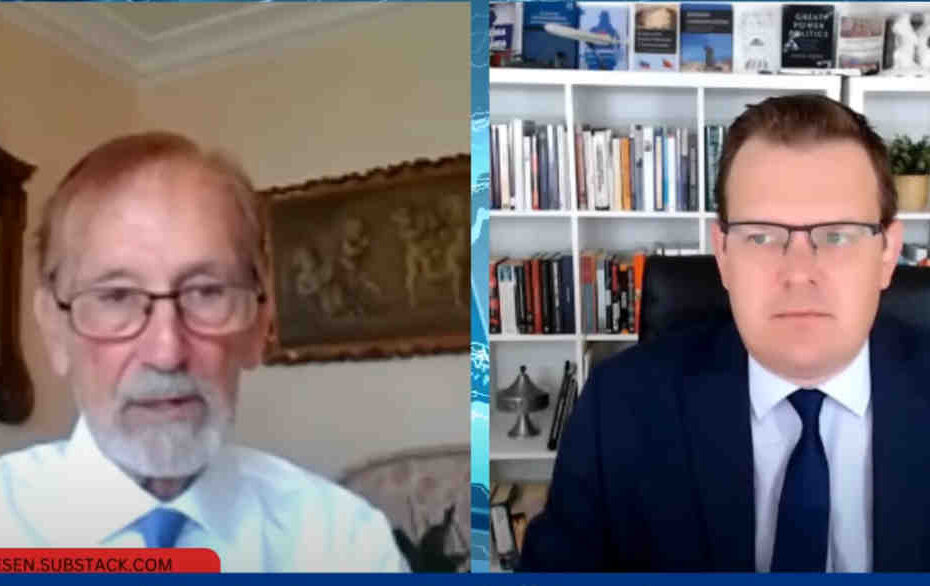
Read the full transcript of historian and international affairs analyst Gilbert Doctorow in conversation with political scientist Prof. Glenn Diesen on “Russia Calls U.S. Peace Plan Acceptable, Trump-Putin Meeting Is Confirmed”, August 9, 2025.
Initial Optimism Despite Past Deceptions
GLENN DIESEN: Hi everyone and welcome back. We are joined today by Gilbert Doctorow, a historian, international affairs analyst and also author of books such as “The War Diaries: The Russia Ukraine War.”
So I tend to be more pessimistic than you in terms of the future of this war, the ability to reach some peaceful settlement. But I was struck a bit by some optimism now with this recent meeting – that is Witkoff going to Moscow.
And again, anyone familiar with the NATO-Russia relation over the past 30 years are probably aware that deception has been a key component. But what we saw is the deadline expired. That is what began as a 50-day, then became a 10-day deadline. And instead of sending weapons and sanctions, at least for now, Witkoff went to Moscow and his peace, we’re getting a meeting between Putin and Trump.
What are you reading into this quick development? You see something which has happened behind the scenes or is this just noise?
Behind-the-Scenes Developments and Concerns
GILBERT DOCTOROW: Well, a lot of things clearly have happened behind the scenes. And for that reason it’s difficult to judge the degree of agreement that Witkoff reached with his Russian counterparts – Putin and others. And who else was there? Akira Dmitriev?
Look, in my recent interviews, I look at comments, one of them was, “Oh, Doctorow has become really an apologist for Trump.” I consider this progress because before six months ago they would have said Doctorow was an apologist for Putin. So we’re getting there. I try not to be an apologist for anybody. And if Trump is doing something stupid, I will not hesitate to say that. If what he’s doing is unlikely to succeed, to my knowledge, I will also say that.
There is one troubling note here in the brief information that has been sent out as to what was discussed and how preparations are being made for the Trump-Putin meeting in the near future, meaning possibly in the coming week. What I find disturbing is the notion that Zelensky would have been invited, because that goes contrary to what I understood was the hopeful sign coming out of the Witkoff-Putin talks.
Beyond Ukraine: Strategic Cooperation Discussions
The hopeful sign being that the discussions would go far beyond the particulars of the Ukraine crisis – the territories of each side would retain or have to give up, the question of Ukraine and NATO and the rest of it. And they were talking about bigger issues, constructive discussion they had. I think Ushakov said there was the probability likelihood of discussing strategic cooperation.
Well, yes, that would definitely interest the Russians and would bring Mr. Putin together with Mr. Trump, but Mr. Zelensky doesn’t fit into that at all. And so if indeed Zelensky were to be invited, that puts in question the first point: are they discussing only Ukraine and only the terms of the ceasefire, or are they discussing the issues which the Russians really want to talk about now?
What are the issues the Russians want to talk about? One of your recent guests put out some ideas and he is well informed. I’d say he’s probably a centrist person within the American foreign policy establishment. And he was saying, yes, they would talk about cooperation in the Arctic and they would talk about ending the sanctions and reintegrating Russia into the greater world, the Western world, because as he said, Russians in general consider themselves to be Europeans, to be part of Western civilization. And they are very disappointed that they are excluded from that context, from that place where they believe they belong, by the sanctions which are caused by the war here.
Russia’s Transformation: No Return to the Past
I disagree completely. Five years ago, yes, that would have been an accurate statement. As I have been saying for some time, and this is not just my own observation, the Russians have been talking about it with great insistence. The war has brought forward new elites. The war has made, even among the intellectuals who are almost by definition not supporters of the Putin regime, so to speak, that they have become patriotic and that they were less concerned that they couldn’t spend a summer vacation in Paris or elsewhere in Western Europe or even visit the States so they could come back with a lot of stories to discuss with their friends. That’s over.
Russia may not feel comfortable with Chinese cars. That’s now being discussed – how these cars are being accepted or rejected by Russian consumers. They may not feel comfortable with spending a summer vacation on North Korea’s latest tourist beaches. But they certainly will not exchange the loss in treasure and in life of the last three years for the sake of going back to the status quo ante and being integrated into Western economy and society. That’s gone, that is over and it will not come back.
There will be some accommodation with the west, but not in the sense that existed before. No one talks about it, but I’ll say it right here now: Russia had a big inferiority complex across the board. Anyone you spoke to, other than a handful of super patriots before this war, the predominant feeling in Russia was “we can’t make anything.”
This takes me back to the late 1990s. I remember a very smart taxi driver was taking my wife and me around downtown Petersburg and he remarked, “We Russians, we make very cute babies, but we’re lousy at making cars.” Now that was a widespread belief.
Russia’s Industrial Renaissance
And I think that the last three years and the re-industrialization of Russia and the import substitution in Russia and the takeover of Western companies by Russian entrepreneurs or the Russian state producing virtually the same products under a different name – that’s changed it all.
Russia didn’t produce any cheese before.
Ridiculous. They didn’t produce cheese. In 1912, Russia was supplying butter to Denmark. This is not my guess. I have a yearbook on my library shelf – a 1912 yearbook published in UK. They’re describing all the trade relations between Russia and UK and the west. And they were exporting butter to Denmark. Well, they weren’t making any cheese. Well, they’re making all kinds of cheeses now.
As I said before, what Mr. Trump wants to do with his tariffs is to imitate what the Russians have done thanks to Western sanctions – to re-industrialize. So the game has changed.
What Could Bring Putin to the Table?
The idea that this could be an issue for discussion that would bring Mr. Putin, Mr. Ushakov, Dmitriev to the table and – “Yeah, well, let’s get on with it. We’ll have an immediate ceasefire and you’ll put us back into the Russian, into the European and American markets” – that’s gone.
So what could they talk about? What is the big issue that would have persuaded Mr. Putin and his close advisors that they should meet with Trump now? What could Mr. Witkoff have brought with him?
Well, I think he had to have addressed the core issues. What he could have done to make the whole thing palatable to all sides, meaning also the Ukrainians if they are strong-armed, and the Europeans, is to speak about phasing in what is essentially the Russian solution and presenting it in such a way that it would not look like what it is, which is virtual surrender.
Trump’s Need for Face-Saving Measures
Virtual surrender is not acceptable to NATO, is not acceptable to the United States. Mr. Trump will be pilloried if he does nothing to sweeten the settlement and to make it seem as though he’s in control. All the news we see on every possible subject these weeks has one newsmaker, and his name is Donald Trump. It gives you the sense that he’s in control of things even if he absolutely is not. And he is certainly not in control of how this war will end. But he has to have the appearance of that.
And so he has decided that he should meet with Mr. Putin and Mr. Putin has responded favorably. If you read yesterday – it is in today’s Financial Times. Oh, no, sorry. If you listen to the BBC this morning, you would understand that Putin was eagerly pursuing Trump for a meeting because that will restore his prestige as an international player. That’s how they turn everything on its head.
A Phased Approach to Russian Demands
Well, coming back to this answer to your question – I’ve been a bit long-winded. But the answer to your question: the Americans probably brought a phasing in – stage one, stage two, stage three – which makes it possible to sit and negotiate. The end result will be very much in accordance with the Russians’ demands, which are not maximalist. They haven’t changed one iota from where they were in June 2024.
But Mr. Putin reiterated what he first said in February 2022 – what Russia’s ambition is, although he put it more clearly and in easier to understand terms but essentially came to the same thing. What is this denazification? Well, that’s regime change. The demilitarization? Well, the Ukrainian army goes, but mostly it’s evaporating in front of our eyes.
So these things are being achieved and now they want to codify it, but they cannot do it in one session – that will be too awful for the West. So I think the issue to discuss is how to phase this in in a way that leaves Mr. Trump at least with an off-ramp that’s respectable. And the Europeans can go to hell. They’ll have to accommodate to whatever the Americans and the Russians agree because they will have no weapons to supply to Ukraine and Ukraine will sink.
So that is what I see coming – discussion of the timetable for arriving at the Russians’ requirements for a peace treaty.
Zelensky’s Changing Position
GLENN DIESEN: Yeah, I was told by a credible American source that not only was Washington becoming much more eager to find a settlement because of the disaster happening on the front – that is, it looks like a total collapse could happen within the next few months – but was also told that Zelensky had apparently changed a bit as well.
That while in the past he viewed himself as being this new Churchill who will bring back the glory of Ukraine and defeat Russia, all of this has now begun to fade away. And if the Americans put something in front of him and pressured him, he would likely sign.
So again, it’s not a certainty and indeed the Russians are asking for a lot. But now this Kremlin adviser Yuri Ushakov – he was in the news arguing that the Americans had put forth a proposal which is said was seemingly acceptable to Moscow. This is – I never heard this language before.
Significant Shifts in Negotiations
And given how far apart the two different sides have been, it seems as if something significant must have shifted because my first impression was perhaps this Witkoff going to Moscow but talking about a Trump-Putin meeting is just a way to get Trump to save face after he made this silly 10-day deadline, which I don’t understand. But there seems to actually be some substance in place here.
But did you read the comments by Ushakov the same way? And if so, what do you think such a deal must include? Because again, the Russians aren’t going to – after 30 years of struggling over the European security architecture, more than three years of losing men on the front lines, now finally at the cusp of victory – just throw it away.
I assume that there’s a reason why they’re able to put these harsh demands. So what do you think might be in this deal that Ushakov is referring to?
Arms Control as the Foundation for Peace
GILBERT DOCTOROW: I’m not quite sure. But there are sticking points here. Again, to address that question of being an apologist for Trump, I have no illusions about the humanitarian motives that are absent from his peace seeking. Nor do I accept the notion that the man is so vain that he’s doing everything for the sake of getting the Nobel Peace Prize.
I don’t think even Mr. Trump is that vain to put aside national interests of the United States and the lives of all the other parties to this conflict for the sake of his getting that piece of paper or that little award which Obama received for doing nothing whatsoever, just for not being Bush. I think there’s much more to it, but it’s in conflict in my mind what exactly the overall overarching concept could be.
Separate the Russians from the Chinese so we can proceed with taking on China? However, that falls flat. There is no way conceivable that Russia is going to trade China. When I said the other day that Mr. Witkoff could have been talking to Dmitriev about getting access to Russian produced rare earth metals as the point for negotiation or preparing for negotiation with the Chinese in the coming week or two, where the Chinese are withholding those urgently needed materials to frustrate any plans of punishing tariffs or any limitations on export of technology to China by Mr. Trump.
It is inconceivable that Mr. Putin will give free access to Russian rare earth metals to spite China. That is off the table. So what exactly Mr. Trump hopes to achieve considering that Russia and China are inseparable, I’m not quite sure.
So we really have to look a little bit further and I’m not sure that Mr. Trump and his advisors are blind to that reality. I also have mentioned the timing – coming back to why 10 days or 50 days, because September 3rd is inconvenient. It’s too close to the convening of the end of The Pacific War for World War II, the 80th anniversary celebrations will be in Beijing, to which Mr. Trump presumably is desperate to be invited.
That is possible. It suggests that the Putin-Trump meeting that we all thought might possibly happen when Moscow celebrated the 80th anniversary of the end of the European war and didn’t happen, maybe would happen now in the Pacific, in Beijing. It’s possible. As I’ve said recently, I don’t have a microphone under Mr. Putin’s pillow. We really don’t have a microphone under Mr. Trump’s.
And there are contradictory objectives when you look at what he says and even what he does to complicate our reading of these tea leaves, our attempting to make sense out of it all. It could be that they still have some illusions or delusions with respect to separating Russia from China. I find it hard to believe, but Americans can be peculiar.
What else could be going through their minds? What else they could be using to reach quick accommodation with Mr. Putin without looking like they lost the war? And I think Putin will be very amenable to helping them with the off ramp. He’s certainly smart enough. He did that with Obama with respect to the bombing of Syria over the alleged use of chemical weapons. So he knows how to let his opponents off the hook, getting what he wants without embarrassing them to the point where he’s got enemies. But for me, right now, it’s a bit hard to say just how this will be, how this trick will be done.
Trump’s Contradictory Messaging
GLENN DIESEN: Yeah, I would have been more reassured if I heard some talks about the actual European security architecture, because so far there’s been too much reference to an unconditional ceasefire. And Trump still, in his language – I mean, there’s a contradiction. His language still refers to this as if it would be a war between Ukraine and Russia, which is problematic for the peace efforts if it takes NATO and America’s role out of this.
On the other hand, he calls the war “Biden’s war,” which Biden began by pushing NATO. So it’s not very consistent. If it’s Biden’s war, how is it only limited between Ukraine and Russia? But again, with Trump, you never know what is the noise and what does he actually know?
I was wondering, though, how you read his – if you think Trump is misinformed, either deliberately or just out of ignorance by his advisors. Because from Trump, we hear these comments, such as, I think he said there’s 20,000 Russians dying a month, which doesn’t make any sense in any way. It’s quite outlandish.
And also when he was asked about what’s happening in Ukraine, people, elderly people being dragged to the front, and he said, “Oh, I don’t know anything about that.” And now of course, putting this deadline to begin with, the 10 day deadline – if he knows that Russia considers this to be an existential threat, they’re willing to fight this all the way, why would he think that they would capitulate now? In other words, accept freezing the front lines and allowing NATO to revive the conflict in the future if they would need to put pressure on Russia?
I mean, it doesn’t make any sense. This was always ridiculous that the Russians would accept this. Is this misinformed or is it just talking to his own base or what is he – I have a very hard time understanding some of the strange information and decisions which are coming out.
The Strategic Complexity Behind Trump’s Statements
GILBERT DOCTOROW: Well, don’t confuse the other side, but don’t confuse yourself. I would take as an operating assumption that he is not confused and that all of these oftentimes very bizarre statements that come out of him are intended, are a demonstration of his contempt for the press and for his opponents, who are the most vocal elements of society at large. The silent majority doesn’t say much. His opponents say a lot and are heard a lot and what they say is kicked up by media.
There are contradictions here and I think it’s much too early for us to present with clarity what is going to happen when they meet and what is the intended outcome, why the Russians would have agreed to this meeting when it goes against all of their rules.
Russian television is informing us that, yes, contrary to the general rule of preparing in great detail and over considerable time for summit meetings, the Russians are prepared this time to make an exception and to hold this very quickly. And they’re working like mad and Americans are working like mad to observe this shortened schedule.
Supposedly it’s about agreeing a ceasefire, but I don’t believe that. There’s no way that the Russians can accept a ceasefire when the Europeans are not present to this. The Americans by definition are not going to be supplying further weapons to Ukraine, the Europeans are. And the Russians do not accept under any condition that a ceasefire will take place while weapons are being dispatched into Ukraine. So that is a non-starter.
There’s something else going on in Ukraine, we don’t know it, but I think it’s best not to assume that people are ill informed. There’s some maliciousness at work – the advisors to Trump, or I should say even to Putin. One very well known former economist at a high level in American politics is insisting that Mr. Putin is being deceived and misled by his advisors.
I think it would be safe just to hold back and let’s see what happens at this meeting. But there are definite contradictions in the structure of a meeting which I just called out. Now, how can you agree on a ceasefire when Europeans aren’t present?
The only person who’s called out the need for Europeans has been Orban, who came out yesterday with a statement that Merz and Macron should go to Moscow now or after the meeting that Trump has with Putin and present the European position to Moscow because the EU institutions are totally incapable of doing that. Well, I agree with him on that point. But whether or not much will be achieved by Macron and Merz going to Moscow – well, better to talk than not to talk.
I can’t see a solution on ceasefire without the Europeans being brought in. But obviously not at the first meeting. Just as it’s senseless to have Zelensky there when the only thing that could have motivated the Russians to agree to a meeting has nothing to do directly with the Ukraine conflict. It has to do, as you said, with revising the security architecture of Europe for which Mr. Zelensky has no place at the table.
So there are confusing signals that you and I have detected, and I suppose others as well, which make it difficult to predict what the outcome of this meeting would be.
The Changing Russian Perspective on Europe
GLENN DIESEN: I got that impression both from some Americans and Russians, that they need to first get the big pieces in place, that is the European security order, which effectively means the relationship between the Americans and the Russians. And then once this is in order, then the Ukrainian issue can be resolved. So you want to deal with it in the right order.
And I also been told that they have the same, both Moscow and Washington, the same views of the Europeans, that yes, they have to be brought in, but first after the decisions have been made. And then if you can get Washington and Moscow and then get Kiev to sign under, then the Europeans will just be a formality, I guess.
But let’s say this, I wonder what the post-war settlement might look like when the war is done. Because in terms of the wider European order, if you thought about this, let’s say next week they hash out the deal. I’m not so optimistic and the war can come to an end within a few weeks.
The Russians make the point that they have to deal with the Americans because they have to. America remains a very important part of the international system. And also if you want the world to function and have stability, Russia and America always have to work together.
But as you suggested before, there is this longing to return to Europe. It seems to be gone. Indeed, when you talk to migrants from Russia in Europe, many said that they were initially surprised. They knew that Russia was always a bit mocked for being an economic mess, but they were surprised about how much hatred there is towards Russians.
But now, of course, this inferiority complex is more or less gone. I guess this is what happens when you defeat NATO on the battlefield. But it’s also the sense of admiration for Europe which is gone. I mean, throughout the Cold War, yes, there was some animosity towards Western governments, as you would, but overall there was some admiration for the way society was organized, the economies we had, the social systems, the technologies. There seemed to be some moral values.
But now, of course, a lot of this is seen as decaying and indeed the culture wars we’re having where everything have to be deconstructed. This has become a source of mockery in the Russian media. What do you think or your sense, what kind of relationship do you think the Russians want with Europe once this war is actually over?
Arms Control: The Key to Breaking the Deadlock
GILBERT DOCTOROW: Well, I think they would be very happy to go back to their position as very close economic partners of Europe without taking it to the embarrassing extreme that Macron described several years ago. Russia was a big supplier of raw materials – I think that notion is not satisfactory or sufficient for restoring economic ties with Europe.
But let’s make an attempt. What could they possibly have said to President Putin, what Witkoff could have brought with him that would be considered constructive and could justify this meeting? And let’s put it in historical context. What do the Americans and Russians who disliked one another, who didn’t necessarily respect one another, always put forward as the first topic for discussion? Arms control. Arms control.
That is the most value neutral thing that they could discuss next week, which would set the tone for solving all the other issues which would receive the undeserved acclaim in Europe and the United States if they were to discuss restoring the intermediate and short range missile agreement in a new form and preventing or removing the advanced positioned Russian missiles and the plans for stationing American missiles in Germany next year. That would be hailed by everybody.
And from that good atmosphere, they could proceed to the really tough and miserable discussions about concluding the Ukraine war. So there might be something to say that’s completely off the table, but nobody’s talking about because it’s been kept very highly secret from all of us, as it should be, till now.
So I wouldn’t eliminate the possibility some concrete, positive and promising could come out of a meeting between Putin and Trump in a week’s time, one which has no need whatsoever for Mr. Zelensky or for the Europeans to be present. And that could set the tone for dealing with the really tough questions of resolving the Ukraine war and also revising European architecture.
If you take off the table this five minute long delivery time or strike times of missiles within the European theater, life gets a lot easier. You can breathe much easier. And the tension over European security would be toned down considerably. So that could be it. But it’s a guess. It’s nothing more than a guess.
The Future of NATO and European Security
GLENN DIESEN: Well, yeah, no, well, this is a problem when all, when the diplomacy, of course, is behind the closed doors. Just my last question though is if this peace agreement goes through, if they actually deal with the European security architecture, what happens to NATO?
Again, I think that one of the reasons why the Europeans are or seems to prefer keeping the war going is as long as you have a conflict, then NATO will still have a purpose and it will keep the Americans on the continent. You and I discussed before that the fear of the Europeans is once the Americans get to leave Ukraine, they will also likely leave Europe to a large extent, both resource priorities and everything going to Asia. So do you think peace in Ukraine could destroy NATO?
GILBERT DOCTOROW: Again, if it’s taken by itself, yes. If it’s put in a broader context, such as I just mentioned on the arms control or also with regard to new technologies and putting a lid on drone warfare, putting a lid on AI warfare, robotics, putting a lid on these new technologies, which are awesome, frightening and drive the anxiety on all sides.
Then these other issues, the traditional issues of territory and language rights and the rest of it become much easier to deal with. And NATO’s fading away is almost an afterthought rather than the first urgent concern, which it is today for Europeans.
So I don’t know how smart these people are. I don’t know how wide broad their perspective is, whether they’ve taken it in the sense that I just presented it or not. But I would give them the benefit of doubt. I don’t think, unlike Craig Roberts, I don’t think Mr. Putin is being managed by his advisors who are all lovers of the Mediterranean Coast.
I think that there are some serious people on the Russian side. I hope they’re equally serious people. I don’t consider Vitkov to be anything but a very serious man and I don’t think he would have wasted his time on this mission if he saw it as hopeless. I’m being an optimist. I don’t deny the right pessimists to also claim the same territory.
The Challenge of Polarized Discourse
GLENN DIESEN: Well, this week at least I’m much closer to your optimism. Yeah, there seems to be some movement which you have suggested in the past as well that there are things happening in the background.
But yeah, well, as you said before, you used to be referred to as a “Putin apologist.” Now you’re a “Trump apologist.” I do think this is one of the wider problems we’re having though, is always during wars, you see that if you’re not sufficiently, for example, anti-Russian, then you can be accused of being pro-Russian. So everything is so polarized. It’s either black or white and all gray is just eliminated. So this is one of the things I’m most fearful of now in the west as well, the inability to…
GILBERT DOCTOROW: Yeah.
GLENN DIESEN: To consider the security concerns of opponents. I always make this comment that the media, the politicians, I never hear anyone talk about the Russian security concerns, the Iranian, the Chinese. It’s always colored in the language of just being belligerent and evil. Essentially. I think this makes it much more difficult to understand our opponents. But unfortunately, if you try to understand Trump, that label fits as well. Then you’re “Trump apologists.”
GILBERT DOCTOROW: Yeah. Well, to be… As we gather today, the tea hasn’t even been poured one week from today. We can reach healings.
GLENN DIESEN: Well, as always, thank you so much for your insights and have a great weekend.
GILBERT DOCTOROW: Well, you too. Thanks.
Related Posts