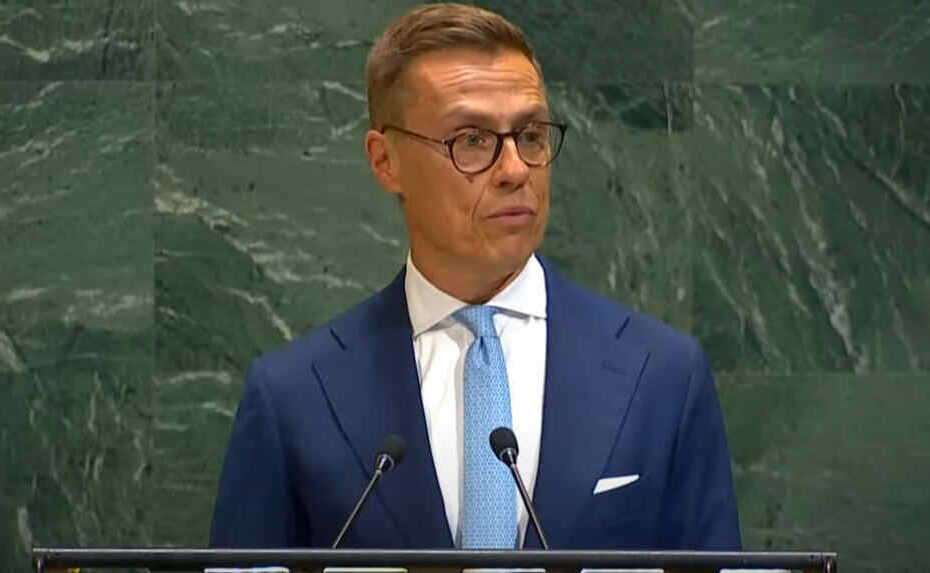
Read the full transcript of Finland’s President Alexander Stubb’s speech at UN General Assembly (UNGA 80), September 24, 2025.
Listen to the audio version here:
The Foundation of Foreign Policy: Values, Interests, and Power
ALEXANDER STUBB: Mr. President, Excellencies, ladies and gentlemen, in its simplest form, foreign policy is really about three things: about values, interests and power. I come from a relatively small country, Finland, and our toolkit is mainly about two of those three things. It’s about values and interests. Power, hard or soft, is usually the luxury of bigger players.
The power of a smaller country arises from its capacity to cooperate with others. Smart diplomacy gives a smaller player at least relative influence. The UN is of course case in point. Big players have power through their permanent membership in the UN Security Council. But we, the smaller players, can influence the ebb and flow of international relations by being active in the corridors of diplomacy.
The End of the Post-Cold War Order
Now, most of the speeches that we’ve heard here today have highlighted the fact that the world order, balance and dynamics are changing, much like they did after World War II when the UN was founded. I actually think that the post-Cold War order is over, but we don’t know what the new order is going to look like. It will take at least five to ten years for things to settle.
And my message to this assembly today is that regardless of the size, each and every member state of the United Nations has agency, a say in how the new world order will look like. It is important that we all use this power wisely and responsibly.
Now, I fully appreciate that our interests differ depending on our geographical location, history, state of development or culture. But fundamental values are something we should all share. We have commonly defined some of the most essential of them in the UN Charter.
Today, I want to do two things. First, analyze where we are, and second, give my proposals on what we might want to do together.
Multilateralism Versus Multipolarity
To understand what’s currently happening in the world, I’d like to raise three different but yet related developments. First, it seems to me that there’s a growing tension between multilateralism, in other words, an order based on the rule of law, and those that speak the language of multipolarity or transactionalism. So, a difference between multilateralism and multipolarity.
Now, I can understand the temptation and the rationale of the proponents of multipolarity and transactionalism. But can they solve the world’s biggest challenges such as climate change or sustainable development?
Today, I see many states, both big and small, pursuing transactional or multi-vectorial foreign policies. In essence, their aim is to diversify their relations with multiple actors rather than aligning with any one particular block. Now, this can be opportunistic, but it may also be justified and reasonable. This depends on political choices.
A transactional or multi-vectorial foreign policy is dominated by interests. Interests drive practical choices of states, and this is entirely legitimate. This kind of foreign policy is based on a realistic understanding of power. Power defines the limits of what is possible for each state.
However, values should actually underpin everything we do. Even transactional or multi-vectorial foreign policy should rest on a core of fundamental values. Without them, foreign policy will ultimately run into a war. If you set aside values for unhindered pursuit of power and interests, you will eventually find before you the very same problems you wanted to overlook.
The Rise of the Global South
Second, the balance of power in the New World Order is shifting towards the South and the East. Many countries, especially in Africa, Asia, Latin America, are becoming or have become key players in determining the direction of the New World Order. To put it simply, they have both agency and power.
They are not only an expanding economic force, but their demographic growth is inexorable. This will also turn them into a political and cultural force. It will yield them both hard power and soft power, and they will use it to promote their interests as they should.
Upholding Fundamental Values
The 193 members of the United Nations do not have to agree on every minute detail of values, but we have to have a common understanding of fundamentals. They include the sovereignty and territorial integrity of states. They include the prohibition of the use of force and the respect for human rights and fundamental freedoms. These values are the building blocks of who we are and what we stand for as the United Nations. The broad international community has overwhelmingly an interest to uphold them.
Let me be clear. Russia has no right to continue its aggression on Ukraine. Israel has no right to violate international law in Palestine. States have no right to use Sudanese or Congolese territories to fight proxy wars for their economic or strategic self-interests. I urge us all to heed this message of the international community and act accordingly.
War is always a failure of humanity. It is a collective failure of our fundamental values. It is a failure of us as human beings.
The State of the United Nations
Thirdly, I would like to say a few words about the state of the United Nations, the institution where we are. The UN was created to maintain and promote peace, stability, development, and friendly relations among nations. In order to achieve this, the balance between the three elements was required. The power at the highest level was represented by the UN Security Council. The interests of the wider membership were reconciled here in the General Assembly, and the values were enshrined in the Charter and consolidated as rules of international law.
Now, unfortunately, today the UN is struggling to fulfill its central promise of delivering peace and stability.
We can always blame each other, but at the end of the day it’s a collective decision. Countries have increasingly taken the liberty to break the rules of international law and to use force against other people’s territories and suppress other nations. The United Nations of today does not sufficiently reflect the realities of the balance of power. All too often it fails to serve as a forum for the coordination of interests, and the values at its core are too often not respected in good faith.
We all want to have the freedom to make choices and a possibility to influence the world around us. Today, many countries are seeking answers in multipolarity or transactionalism. If the UN fails to deliver, this trend will accelerate.
So, let me sum up in the terms of the three pillars: values, interests and power. Our values can divide us. Fundamentally, however, they should unite us around the basic principles of humanity, the rule of law and the prohibition of aggression. Our interests differ, and it’s only right that we promote them. However, our choices have consequences. Opportunism will eventually be forced to confront the problems it tried to ignore. Power will constantly seek a new balance. We must adapt to change. Nevertheless, we should not allow the rise of hard power to blind us. The power of legitimacy, integrity and rules will remain strong.
From Problems to Solutions
So, let me get to my second part, from the situation to possible solutions or things that we could do together. Never before in history has humankind had such means of innovations at its disposal to solve the world’s most pressing problems. However, the current direction is wrong in so many ways. There are more wars than at any time since World War II. The world is becoming increasingly divided. And so are our societies, and the measures to deal with climate change and sustainable development are lagging behind. In different parts of the world, we’re witnessing immense civilian suffering and blatant disrespect for humanitarian principles.
For me as a Finn, Russia’s war of aggression in Ukraine not only reminds me of our past, but is directly linked to the security of the part of the world where I live. On the other hand, there is aggression and total disregard for civilian life, and an attempt to undermine the fundamental principles on which the international order is based. On the other hand, there’s a bastion of freedom that is defending its right to exist and to make its own choices.
The battle for what consequences we will draw from this aggression is not yet over. Recently, there’s been serious attempts at diplomatic solutions of the war on the initiative of the United States. There are no perfect solutions to wars. At the same time, we know that any decision made in these matters will have far-reaching consequences in Ukraine and beyond. There can hardly be a stronger unifying interest among the UN’s broad membership than our opposition to the wars of conquest. Aggression must not be rewarded. Accountability for the most serious international crimes must be pursued.
The Crisis in the Middle East
In the Middle East, civilians in Gaza are experiencing immense suffering. The deepening humanitarian crisis has reached unbearable levels and represents a failure of the international system. At the same time, Hamas continues to hold the hostages it has taken and many have already lost their lives. An immediate ceasefire is needed in Gaza. That has been reiterated from this podium many times today and yesterday. Humanitarian aid must be granted, safe and unhindered access. The hostages must be released.
I commend the efforts led by France and Saudi Arabia to advance the two-state solution. The negotiations must meet the Israeli and Palestinian security needs and Palestinian right to self-determination, its legitimate aspiration for statehood and sovereignty. The occupation that began in 1967 must end and all permanent status issues must be resolved. Correspondingly, the countries that have not recognized Israel must do so.
Supporting Palestinian Authority and Addressing Global Conflicts
At the same time, the international community must support and strengthen the Palestinian Authority for it to govern the entire Palestinian territory effectively. This is the only viable option for achieving a two-state solution. A stable Palestine will also significantly benefit the security of Israel.
In many parts of the world, conflicts are raging, causing immense suffering locally, instability regionally and reverberations globally. We’ve witnessed particularly brutal violence in Sudan, in the Democratic Republic of Congo, in Haiti, Myanmar and Mali, among others. Civilian populations continue to face famine and displacement at a large scale.
Sometimes I feel that we end up looking at conflicts only that are near to us, but I think the job of the UN is to look at all of them with equal determination. I praise all those who in good faith continue to work for peace despite the daunting task.
In June, a peace agreement was reached for the conflict in the Eastern Democratic Republic of Congo. The true test, like with all peace agreements, lies in its implementation. Does it stick? There is a humanitarian crisis of alarming proportions that compels us, all of us, to respond.
Peace processes should not be transactional. They must be guided by international law. All countries and stakeholders in the region must be engaged and committed to achieve sustainable peace. The presence and involvement of the UN is essential.
I would also like to stress the crucial work carried out by journalists amid conflicts and in other difficult circumstances. Attacks on members of the media are unacceptable. Media freedom is the basis for democracy. It is the prerequisite for an open society. The ability of the press to carry out its work is important for all of us.
UN Security Council Reform
Ladies and gentlemen, the composition of the UN still largely reflects the world of 1945. As the world has changed drastically, so should the decision-making at the UN. Last year, in this very hall, I argued for a reformed Security Council, a council where currently underrepresented regions would have a stronger voice through permanent seats at the table.
The number of permanent members should be increased in the UN Security Council. At least there should be two new seats for Asia, two for Africa. I think I’m going to say this every year because that’s the only place where I get applause. No single state should have a veto power. And if a member of the Security Council violates the UN Charter, its voting rights should be suspended.
I believe that these changes at the top of the UN are necessary in order to maintain the UN’s central role in international relations. At the same time, a more comprehensive reform of the UN is needed. I commend the Secretary General for his UNAT initiative and I encourage him to take bold and ambitious action.
Finland’s Support for UN Reform
So Finland strongly supports the UN and wants it to succeed. Therefore, we stress the need for true reform to enhance the organization’s credibility, relevance and efficiency. This will ensure that the UN can act. The UN needs to focus its efforts on its most important goals: ending and preventing wars, protecting human rights and acting as a catalyst for sustainable development.
And also, we need to get the UN back into peace mediation. I would argue that one of the reasons that we have so many wars right now is that the UN is absent from peace mediation. No other organization can offer the legitimacy comparable to that of the UN. If the UN is absent, conflicts are not resolved without it, which is not in our common interests. The UN is needed as a mediator and the member states should support it at this endeavor.
Finland’s UN Security Council Bid
Finally, Finland is strongly engaged in the work of the UN and will remain so. Therefore, we are also standing for election to the Security Council for the term of 2029 to 2030. Should we be elected, Finland pledges to be a principled and pragmatic partner for peace. We are principled in our commitment to international law with the Charter at its core. We are pragmatic in seeking solutions that truly advance international peace and security, recognizing that progress is often incremental.
At the outset of my speech, I said that each and every one of us has agency. I say how the new world order will look like. We want to be able to make our own choices and have an impact on the world around us. Nelson Mandela saw truth and reconciliation as the only hope for nations that are bitterly divided. The same applies to relations between states. We should learn from history, but always look to the future, bearing in mind that our decisions will shape it.