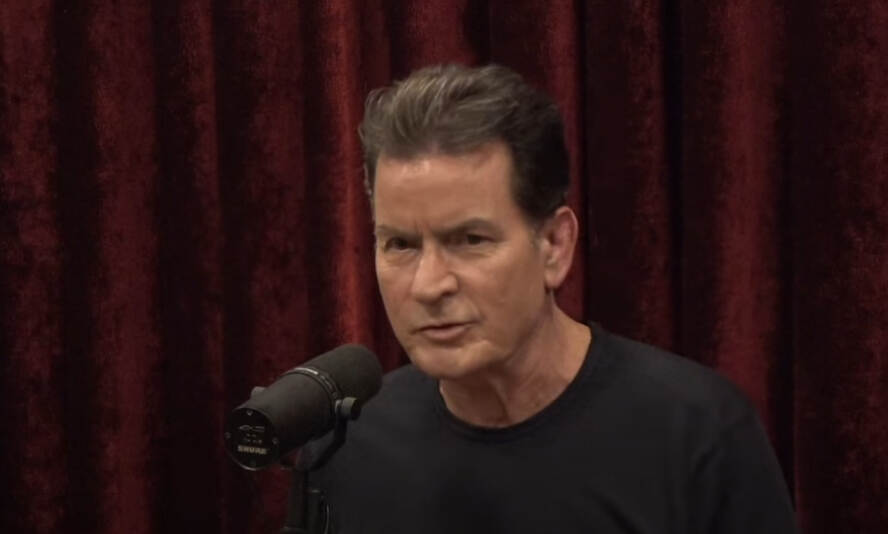
Read the full transcript of actor Charlie Sheen’s interview on The Joe Rogan Experience #2378, September 11, 2025.
First Meeting and Red Carpet Aversion
JOE ROGAN: Great to finally meet you, man.
CHARLIE SHEEN: It’s great to meet you. It’s a trip and, you know, walking in and I’m thinking, how is it possible that our paths didn’t cross all those years? I mean, it’s conceivable we were in the same venue or the same building or at the same party or probably something.
JOE ROGAN: I kind of avoided parties. I avoid basically everything. I avoided parties. I avoided premieres.
CHARLIE SHEEN: Any.
JOE ROGAN: Anything where there’s a red carpet. Like, even if I was in a movie, I wouldn’t go on the red carpet. I’d go in through the back door.
CHARLIE SHEEN: Seriously? Yeah.
JOE ROGAN: I don’t like it.
CHARLIE SHEEN: Wow.
JOE ROGAN: I don’t like all that fucking “look over here, look over here.” That is just too fake for me. It just… whatever allergy I have to that flares and I’m like, I’m going in through the back door. Fuck this.
CHARLIE SHEEN: Yeah, no, I don’t blame you. I don’t blame you. They stopped showing me where the back door was because I support a similar entrance thing.
JOE ROGAN: It’s just too weird.
CHARLIE SHEEN: But it’s that… it’s “look over here, look over here.” It’s that thing. Something happens in that moment.
JOE ROGAN: Yeah.
CHARLIE SHEEN: I think it’s like it brings you as close to possibly sterilization as you can get without surgery.
JOE ROGAN: I think it’s bad for you.
CHARLIE SHEEN: Yeah.
JOE ROGAN: I think it’s like radiation. Like you could take a little bit of it, but you don’t want to be working the X-ray machine your whole life.
CHARLIE SHEEN: No, no. And then there’s always that one lady who keeps calling you back to her.
JOE ROGAN: “Charlie, Charlie.”
CHARLIE SHEEN: Right, right, right. “Far left, far left, far left.” And you’ve looked at her like seven times already. And then I’m out there thinking, if it took me this many takes to get a scene right, nobody would ever hire me. You wouldn’t get past the first day.
JOE ROGAN: Well, they want to get a million pictures just to get that perfect one where there’s a little bit of side eye to you. Just a little something, a little purse of the lips. Little something responding to something. Yeah, that’s the one.
CHARLIE SHEEN: Yeah. But then they choose which one do they always choose? The one that’s absolute dog shit.
JOE ROGAN: Yeah, the one with your mouth open.
CHARLIE SHEEN: Exactly. Yeah. Yeah.
The Trappings of Fame
JOE ROGAN: What I really don’t like is the people who like it. Not that I don’t like them. Is that I don’t want to ever see that in myself. And so when I’d be around them, I would just go, oh, I got to get out of here.
CHARLIE SHEEN: Right.
JOE ROGAN: Freak me out. The trappings. The trappings.
CHARLIE SHEEN: Yeah, yeah, yeah. I mean, is there… because it’s… it feels like that system’s been in place for over 100 years. Right. Is there another way to do it?
JOE ROGAN: Probably not. People like it, photographers like it. The press likes it. It’s a big thing. There’s a lot of people. There’s a lot of lights flashing. It seems legit.
CHARLIE SHEEN: Right, Right, right. I just… I can never feel relaxed when everybody’s yelling. Right. You know?
JOE ROGAN: Totally unnatural.
CHARLIE SHEEN: It’s completely unnatural.
JOE ROGAN: The only way that would be happening in real life is if, like, you were, you know, like you were being paraded in front of a bunch of people. “Jim, there he is.”
CHARLIE SHEEN: “Look over here.”
JOE ROGAN: You know, it’s odd.
CHARLIE SHEEN: Yeah.
JOE ROGAN: Very odd.
CHARLIE SHEEN: Yeah. It’s almost… it’s a form of a perp walk, isn’t it?
JOE ROGAN: A little bit of a perp walk and just a little bit of a mental illness exhibition.
CHARLIE SHEEN: Right.
JOE ROGAN: You know?
CHARLIE SHEEN: Yeah. I just had it for the first time, like, last… it would have been last Thursday.
JOE ROGAN: The first time ever.
CHARLIE SHEEN: No, for the first time in, like, in like, maybe over a decade. At the Netflix premiere.
JOE ROGAN: For the…
CHARLIE SHEEN: It was kind of cool. Like, the first, you know, 34 seconds, I was like, okay, I remember this. And then it was like, yeah, I fucking remember this. Wow. Damn. And then I… like, I’m in the right… the sun just beating right on my floor, and it’s just… I could feel myself start to sweat.
Now I’m questioning the whole outfit, you know, the underwear choice, all of it. It’s just, like, every decision I leading up to that was completely wrong. And it’s all being documented, you know?
The 2011 Tweet and Early Podcast Days
JOE ROGAN: It’s so odd. Yeah, it’s really funny. When you first walked into the studio, you brought up a tweet that I had sent in 2011. I think this is when you were going crazy.
CHARLIE SHEEN: Yeah.
JOE ROGAN: And I think this is also when my friend Russell Peters was doing those tours with you.
CHARLIE SHEEN: Oh, that’s right.
JOE ROGAN: “I need to get Charlie Sheen on my podcast. I know it’s a long shot, but a boy could dream, but everybody knows him. Help me hook it up.”
CHARLIE SHEEN: Well, here we are 14 years later. You know, it takes when it takes, right?
JOE ROGAN: Yeah. It’s funny because back then, I don’t think I had no guests. I think I had… Anthony Bourdain was the only, like, real guest that I had.
CHARLIE SHEEN: Had. Seriously?
JOE ROGAN: Yeah. He was 2011 as well.
CHARLIE SHEEN: And how many shows had you done by then?
JOE ROGAN: Not that many by then. I don’t know.
CHARLIE SHEEN: So were you just doing solo shows, just, like, covering topics?
JOE ROGAN: I would do it mostly with my friends, mostly with other comics.
CHARLIE SHEEN: Okay.
JOE ROGAN: We just sit and talk shit.
CHARLIE SHEEN: Your house?
JOE ROGAN: Yeah, I was at my house back then.
CHARLIE SHEEN: Okay. It looked nothing like this.
JOE ROGAN: No, no, no. It slowly had to get out. It’s like I had too many weirdos that I had to bring by my house. And I have young kids at the time. They were really young. I was like, this is just too strange. Bring these weirdos. And, you know, it was just too odd. I was like, maybe some people shouldn’t know exactly where I sleep. Right, right. Yeah.
CHARLIE SHEEN: And it’s interesting because driving here, I was buried in my phone just, you know, for… for the right reasons. So I have no idea where we are.
JOE ROGAN: Good.
CHARLIE SHEEN: So it was kind of like a version of being blindfolded with a sack over my head, you know?
JOE ROGAN: Yeah. That’s probably how we should do it.
CHARLIE SHEEN: Can you imagine then, like, I’m the guy they’re blaming for introducing this.
JOE ROGAN: Just put everybody in a blindfold and put them in the back of an SUV and drive to an undisclosed location.
CHARLIE SHEEN: And make the guy drive a few circles around in, like, some neighborhood right over there.
The 2011 Meltdown and Public Spectacle
JOE ROGAN: Yeah, yeah, yeah. But we did it. We’re here. Those things that you did with Russell Peters were so fascinating. The whole thing was so fascinating. I watched the Netflix thing. I watched the first episode, and the whole experience of watching the guy from Platoon, the guy that everybody knows is like, this gigantic, super cool movie star hot shots. All these different things to watch.
You just not just go off the rails with drugs, but, like, be super open about it. You were, like, the first guy super open about it, you know, and everybody just embraced it. Instead of it being like, “oh, Charlie Sheen’s doing drugs. That’s so sad.” It was like, “we love him.”
CHARLIE SHEEN: Keep going.
JOE ROGAN: It was kind of crazy, all the Tiger Blood stuff and winning. Everybody was saying winning all the time. And it… what was that like for you? Was that, like… was it the worst kind of reinforcement or what? Or did it let you, like, were you surprised by it?
CHARLIE SHEEN: That’s a great way to describe it. It was… it is… yeah. The worst kind of reinforcement. Yeah. It was like, unintentionally or otherwise celebrating a guy’s demise.
JOE ROGAN: Right.
CHARLIE SHEEN: You know, and I guess the train wreck was so spectacular. There was such a spectacle that they couldn’t turn away but they were also being invited in to follow it down the tracks.
JOE ROGAN: Yeah.
CHARLIE SHEEN: You know, and somebody asked me about it and, you know, I don’t know if I was the conductor, if I was riding the caboose, or both simultaneously. It was a trip. Because thinking back on it, it’s, you know, some of it just kind of exists in just Polaroid snapshots that kind of drift past through the mist. You know, other… other moments are in high def, but kind of seen through a tunnel vision, like in it.
And it’s… it was… there was an energy or there was an energy I tapped into that felt like I was playing a role. But I couldn’t figure out if, you know, what the move, what the plot was, who my co stars were. Where’s somebody, you know, somebody show up with like a page one rewrite? Right, that’s what we fucking need, you know, and it got away from me. And had it not been encouraged, I think it could have been curtailed. It could have been shut down a lot sooner.
Captured by the Image and Bullying Behavior
JOE ROGAN: You become kind of captured to the image.
CHARLIE SHEEN: Yes. And there was something that… and just recently something I stumbled onto. It’s… I was, in some way, I was being a bully. It had a bullying kind of energy about it, you know, and I’ve never been that guy.
JOE ROGAN: How so? How so?
CHARLIE SHEEN: The way I was attacking people and the way I was challenging people. I was a tough guy on the block and had all these soldiers. I had this cold cadre behind me and it was like, you know, inviting people into the ring. I’ve never been in the ring. What are we doing?
JOE ROGAN: You know, you’re on cocaine. Total cocaine behavior.
CHARLIE SHEEN: Among other things.
JOE ROGAN: Yeah.
Testosterone and Dangerous Combinations
CHARLIE SHEEN: And I think there was a whole testosterone component as well that was just out of control because there’s, you know, what do they recommend, like a quarter size dollop and like every other day? And no, there’s a line in the book where I say I was… I was slathering that… that shit on like a fucking Ponds commercial.
JOE ROGAN: Oh, so you using the cream?
CHARLIE SHEEN: Yeah, yeah, yeah. Which is hard to measure.
JOE ROGAN: It’s not just hard to measure, it gets on other people.
CHARLIE SHEEN: Oh.
JOE ROGAN: I read this story about this guy who is on TRT cream and his child started like showing signs of premature development.
CHARLIE SHEEN: Oh.
JOE ROGAN: And they realized that this kid’s testosterone level was through the roof because it’s through the dermis.
CHARLIE SHEEN: Right.
JOE ROGAN: It’s through the skin. So he’s getting it on his arms and then he’s hugging his child and the kid is getting juiced.
CHARLIE SHEEN: Like, what were the kids’ numbers? Do we know?
JOE ROGAN: We don’t know. I don’t think they released that, but they said that it probably permanently affected the kid’s development.
CHARLIE SHEEN: Oh, wow.
JOE ROGAN: Yeah, because this kid is, like, experiencing puberty at 3. You know, you’re getting bombarded with testosterone while your dad is holding you.
CHARLIE SHEEN: Insane. Insane. Is that part of the reason they recommend, like, an inner thigh application?
JOE ROGAN: I guess then the only person would get it is the person you’re having sex with.
CHARLIE SHEEN: Exactly. Exactly. Or your horse.
JOE ROGAN: Right.
CHARLIE SHEEN: Probably good for the horse. Right.
JOE ROGAN: So there was testosterone and cocaine together at the same time. That sounds like a combination of hubris.
CHARLIE SHEEN: And a lot of rage.
JOE ROGAN: And a lot of rage.
The Weight of Personal Struggles
CHARLIE SHEEN: A lot of rage. But the rage. I think it’s interesting because when you finally get some distance from something, you start to realize that it wasn’t really so much about what you said. It was about in the moment. And I’m really realizing it wasn’t about the job, wasn’t about Chuck. It was about all the stuff in my personal life.
It was about trying to just be a certain guy at work, be a certain guy at home, and then just never having the time to be a certain guy with me. And I just couldn’t find any place to find any refuge or solace or any type of. Just a moment to breathe, just to decompress.
JOE ROGAN: That’s so important.
CHARLIE SHEEN: Yeah. And I. There was a. It’s not in the book. Because I can’t really. I don’t remember it well enough to put it in the book. And that was kind of how I decided what’s in there and what’s not right. Or if something just isn’t true. It’s not in the book.
And so. But it. You know, I was. I was. I was trying to just kind of, you know, like, you know, I. I went through two divorces and had four children during. During that run of eight years, you know, and so that’s crazy. It’s insane. Yeah. And. And they both, you know, they. They fell apart for. For married reasons and whatever. And. And. But there wasn’t time to heal the last one before the next one kicked off. And. But that’s all on me. You know what I’m saying? That’s all on me making those decisions.
Yeah, that’s one of the through lines in the book, is that it, like, really comes down to really being all about choices, you know? But then. Yeah, and. But it’s just for it to be just talking about the bullying stuff, you know, for it to be so directed at a guy who let’s, like, if you really break it down, what did he really do to me? He created this environment with the dream character in an amazing show. So people tell me, right? That was the toast of the town, right?
And all he asked for me was to just, like, you know, just show up, be responsible, know your lines, hit your marks, do your fucking job. You know, Those were the only demands, essentially, the stuff I told him before I took the job that I was going to do.
JOE ROGAN: So.
CHARLIE SHEEN: And then I turn it into that. You know, it’s really difficult to really look back on that and figure out why it got that far, how it got that far.
JOE ROGAN: I can help you out.
CHARLIE SHEEN: Okay.
JOE ROGAN: Testosterone and cocaine.
CHARLIE SHEEN: Testosterone and cocaine.
JOE ROGAN: Having all kinds of conversations with people in your head that’ll tell you exactly what’s happening. What you’re doing is correct.
CHARLIE SHEEN: Right, sorry.
JOE ROGAN: Did you ever talk to Chuck? Did you ever. Sorry.
Making Amends with Chuck Lorre
CHARLIE SHEEN: Yeah, no, it was. Yeah, no, that was. I was really grateful we were able to do that.
JOE ROGAN: Oh, that’s nice.
CHARLIE SHEEN: Yeah, it’s carrying that around for too long.
JOE ROGAN: Yeah.
CHARLIE SHEEN: He hired me for a show he had a few years ago called “Bookie” with Sebastian Maniscalco. Right?
JOE ROGAN: Oh, yeah, that’s right.
CHARLIE SHEEN: So I came in and did. I played myself, did a few scenes, did a cameo, you know, did some fun stuff, and just back on a set with Chuck, and it was like. It was. It just felt like it. Like it. Like it. Like it did in the. In the early parts.
JOE ROGAN: Oh, that’s. Well, good on him for not holding a grudge, too.
CHARLIE SHEEN: Yeah, that’s.
JOE ROGAN: That’s awesome.
CHARLIE SHEEN: Sorry, I lost that thought earlier.
JOE ROGAN: No, no.
CHARLIE SHEEN: Where the hell was I going?
The Alien World of Celebrity
JOE ROGAN: It’s a complicated thing to think about. Like, why did I go off the rails? You know, it’s like. And it’s very reasonable. Here’s the thing. I don’t think anybody but Charlie Sheen knows what it’s like to be Charlie Sheen. And in my estimation, there are a scant few people that have become massive superstars at a young age and came through it sane. I don’t know anybody.
Everybody. I know people that have regained equilibrium and got their footing back and now they’re on the right track, but no one gets through without a hiccup. Everyone kind of goes crazy because you’re living in this completely alien world that no one can help you navigate, even.
CHARLIE SHEEN: If you’ve watched the people closest to you go through it most of your life. And, like, just, like, right over there.
JOE ROGAN: Yes.
CHARLIE SHEEN: Like, in the next room.
JOE ROGAN: Right. Right now.
CHARLIE SHEEN: Or in the same room.
JOE ROGAN: Right. And A bunch of your friends.
CHARLIE SHEEN: Yes.
JOE ROGAN: It doesn’t matter. Bananas. It’s still an alien world that you live in that no one that you run into during the day except the people like that can understand.
CHARLIE SHEEN: Right.
JOE ROGAN: Which is like, people are always like, why do celebrities hang out with. With each other? Well, because to them, they’re the only people that are normal.
CHARLIE SHEEN: Yeah.
JOE ROGAN: They’re the only people that, like, I get it. I can’t go to the supermarket either. I get it. Yeah. I get fucking TMZ’d at the airport as well. It’s like, it’s normal for them because everybody else is like, “whoa, it’s Charlie Sheen.” And they’re just captivated. Like, you kind of need to be around people that understand what that life is like. But the problem is they’re all going crazy too, right?
CHARLIE SHEEN: Yeah. Yeah. It’s not. I mean, it’s a great support group to a degree.
JOE ROGAN: You know what I’m saying?
CHARLIE SHEEN: I think you can rely on them for the things that you have in common, but maybe take the more complicated shit just right across the street to the experts.
JOE ROGAN: Yeah. You can’t rely on them for everything.
CHARLIE SHEEN: No.
JOE ROGAN: Because they’re going through it, too.
CHARLIE SHEEN: Can I just get a tissue?
JOE ROGAN: Yeah, sure, sure, sure. Jimmy, you got a box?
CHARLIE SHEEN: Thank you. Sorry.
JOE ROGAN: No worries. Getting sweaty. Is it hot in here? Turn the AC on.
CHARLIE SHEEN: No, I’ll tell you exactly what happened. I got. I lost that thought. And then I tried to cover, and I realized this is. He’s not buying this. And then I started sweating and I started fucking sweating. So I’m just going to. Losing.
JOE ROGAN: It’s normal, man. Just say you lost your thought. It’s all good. Yeah, it happens all the time. It happens to me, too.
The Unreliable Nature of Memory
CHARLIE SHEEN: Why is that, though? Is our brain already trying to figure out the next thing that’s going to attach to it, and by doing so, it took that, the main thing, and just dismissed it, Perhaps. Okay.
JOE ROGAN: It’s also. Brains are just not that good.
CHARLIE SHEEN: Huh?
JOE ROGAN: You know, they’re pretty good compared to chimpanzees and dogs and stuff like that. But, you know, they have a lot of issues.
CHARLIE SHEEN: Okay.
JOE ROGAN: Just like we were talking about your memories. Like, my memories of my whole life are like a series of blurry snapshots that I can go, “oh, yeah, Then we went there. Oh, yeah, that happened.”
CHARLIE SHEEN: Oh, yeah.
JOE ROGAN: There’s very few memories that I have that are like, rock solid memories.
CHARLIE SHEEN: Right. Yeah, I totally get that. And there’s a little thing in the book where I talk about. Memories are tricky. And is it. Is it a Story someone told me. Is it me in that moment or is it a creased photo I saw on an old album in the 70s or 80s? Was the memory given to me or did I create it? Right.
JOE ROGAN: Yeah. And there’s also the real possibility that you have false memories. And people do that all the time. And they’ve even shown that they can introduce memories into people’s minds and then with enough sort of encouragement or revisiting it, that person will accept it as.
CHARLIE SHEEN: A pure memory actually happened to them. Yeah.
JOE ROGAN: And they’ll talk about it like outside of that, and they’ll have no knowledge that it was a false memory.
CHARLIE SHEEN: Wow.
JOE ROGAN: Yeah. Because it’s just not a good system. It’s a system designed to keep you away from scary things. Like “there’s the wolf. Oh, get away from the wolf. You know, wolves are bad. I remember.”
CHARLIE SHEEN: I remember. Wolves are bad.
JOE ROGAN: “That’s the spider that’s poisoned. Get away from that spider. That spider is poison.” But like day to day, everyday normal shit. It’s like how much of a memory does it really need to keep? It’s just your brain’s just not that good.
CHARLIE SHEEN: And then. And then even. And then. So do certain, certain memories then get overlaid with a newer version of that? Okay.
JOE ROGAN: Yeah. They get narratives and you start repeating the memory and your memory becomes of you repeating the memory.
CHARLIE SHEEN: Wow.
JOE ROGAN: So it’s like you don’t even really have the memory anymore. You know how to say it.
The Unabomber Case and Memory Corruption
CHARLIE SHEEN: Okay. Didn’t that happen with that one witness?
JOE ROGAN: Did it with a Unabomber witness?
CHARLIE SHEEN: Yes.
JOE ROGAN: Interesting.
CHARLIE SHEEN: Yeah. Because that’s why the first composite that was put out really ultimately wound up looking nothing like the actual guy.
JOE ROGAN: Oh, interesting.
CHARLIE SHEEN: Yeah, there was a thing that. Yeah, there was a thing where her memory was corrupted by a different description from somebody else.
JOE ROGAN: Well, there’s also the factor that the Unabomber was such a traumatic event that this person was probably super freaked out, which is when your memory is the worst.
CHARLIE SHEEN: Interesting.
JOE ROGAN: Yeah. That’s why eyewitness accounts of like murders and chaos. They’re really bad, right? They’re really bad. Very unreliable.
CHARLIE SHEEN: There’s some really, really awful percentage about even when they wind up in a courtroom.
JOE ROGAN: Yeah.
CHARLIE SHEEN: Like the determining. Yeah. You like the final nail from the person. “That guy.” That it’s like sometimes it’s as high as like 60% that they’re just wrong.
JOE ROGAN: Yeah. And then they’ll convince themselves that they’re right because they’ve already said it. So then the ego gets involved and then, you know, it’s just traumatic events leave you. You’re in a high state of anxiety and you’re not thinking clearly. You’re freaked out.
And you know, like when, when they have events like, like, say like 9/11, if you were anywhere near that and you saw like people jump off the buildings and fall to their deaths or like your memories of that are probably really clear because it was fucking crazy. But your memories of people that you might have saw that were running away or maybe you saw a guy in a van and he looked fishy or maybe this or maybe that.
And then a few days go by and you probably haven’t slept well, you’re all freaked out. Your memory is probably a mess. It’s probably filled with the news now. And then there’s other people’s eyewitness accounts and, you know, you don’t know what the fuck happened.
CHARLIE SHEEN: Right.
Memory and Technology
JOE ROGAN: You see someone die, you see someone jump off a building, you remember that. But there’s some stuff that it’s just, this is one of the scariest things about transhumanism is that it’s really appealing in the idea that they give you a little hard drive in your brain. And now from now on, every time you want a memory, you can go just like you look on your phone like your iPhone “on this day in 2017,” you’re like, “oh, look at us. That’s cool.” You’re going to be able to do that in your brain. And the way that we’re going to buy into it is because our memory sucks.
CHARLIE SHEEN: That’s how they’re going to sell it to us. Yeah. Interesting.
JOE ROGAN: Yeah. Do you remember your phone number when you were a kid?
CHARLIE SHEEN: No, but I remember my address because it rhymed.
JOE ROGAN: That’s nice.
CHARLIE SHEEN: Yeah. It was 7212 Birdview Avenue, Malibu.
JOE ROGAN: You used to remember your phone number. What happened? It goes away because your memory sucks.
CHARLIE SHEEN: Right? I know my parents number because they still have a landline.
JOE ROGAN: Oh, they’re still rocking the landline.
CHARLIE SHEEN: Yeah, they are. Yeah. And they have an answering machine.
JOE ROGAN: Whoa.
CHARLIE SHEEN: Yeah. During dinner they haven’t really turned it. Oh.
JOE ROGAN: Now people start talking in the background.
CHARLIE SHEEN: Yeah. But it’s just part of it. It’s part of the experience.
JOE ROGAN: They’re rocking a landline with an answer machine in 2025.
CHARLIE SHEEN: That is.
JOE ROGAN: Yeah, it’s probably the way to do it. I used to love the answer machine. Would you come home, the light would be flashing like, “someone likes me. Somebody called.”
CHARLIE SHEEN: Yeah, yeah, yeah.
JOE ROGAN: It was cool. It’s like you had a dog coming home to wait to visit you. When you came home, like, “oh, look.”
CHARLIE SHEEN: It’s like induced Bigelow when it’s like he’s at his lowest point. The thing in the light is never blinking.
JOE ROGAN: I forgot about that.
CHARLIE SHEEN: “You have no new messages.”
Fame Before the Internet
JOE ROGAN: Yeah, that was a wild time where you could get phone calls. That’s another thing, is you got famous before the Internet too, which is a different world. It’s a different world because there’s not that many of you. There’s way less famous people. There’s way more famous people now. Yeah, you got famous like super duper famous at 21 years old with no Internet trip out.
CHARLIE SHEEN: Yeah, I know.
JOE ROGAN: How does anybody expect you to come out normal? Jesus Christ.
CHARLIE SHEEN: And you try. You can’t really even explain to someone that wasn’t around during all that. You can’t really explain what it felt like because they look at it as the things that were missing and there wasn’t anything missing.
JOE ROGAN: Right.
CHARLIE SHEEN: It was about having to really be engaged in everything you were doing. You had to show up to, to gain. To get a. You had to enter the building.
JOE ROGAN: Right, Right.
CHARLIE SHEEN: You had to go to. On a talk show, you had to attend to junket. And you could. And nobody knew. Nobody knew what the behind the scenes of your movie looked like until years later on the DVD feature or the VHS feature that they finally.
JOE ROGAN: Saw some of that stuff.
CHARLIE SHEEN: Yeah, it wasn’t. It wasn’t. All access 24/7, 365.
JOE ROGAN: And for some people, they can’t leave it alone. They have to live stream during the day. They’re live streaming from their trailer. They’re live streaming in their car on the way home.
CHARLIE SHEEN: They’re like, yeah, what is that about?
JOE ROGAN: They’re nuts. They’re just locked into this weird new world that we’re living in.
CHARLIE SHEEN: But is it. I mean, is it because there’s genuinely people that are tuning in with enthusiasm, that are looking forward to that livestream in the car ride home, or because the person. Or is it a combination?
JOE ROGAN: I think it’s those things. And it’s also that thing that you said that you didn’t ever get. They’re scared of you didn’t ever get alone.
CHARLIE SHEEN: Time.
JOE ROGAN: Just. Just time to decompress and think. Just be by yourself. No phone, no TV. Just sit on the couch and just catch your breath, right? And they don’t want that.
CHARLIE SHEEN: That’s.
JOE ROGAN: They’re scared of that. I like just constantly engaged with something.
CHARLIE SHEEN: I like entire days of that.
JOE ROGAN: Ooh, that’s nice.
CHARLIE SHEEN: Alone on the couch. Yeah. Watching TV.
JOE ROGAN: It’s nice to just shut off, right? It really is. It’s all work, no play. Not good.
CHARLIE SHEEN: Not good at all.
JOE ROGAN: Not good. Bad for you. And bad for your work too, because it makes you just kind of. It gets dreary. You don’t. You don’t have the same enthusiasm for it anymore. You know, it’s like you need discipline, but you also need enthusiasm.
CHARLIE SHEEN: You know what I was going to say earlier. Thanks. Okay. All right. The memory just, dropped another token in the slot. Is that now, it doesn’t even connect.
JOE ROGAN: It doesn’t. Let’s find out.
CHARLIE SHEEN: Well, no, then I actually forgot it again. How about that? Is that nuts?
JOE ROGAN: It’s normal. It’s normal.
Making Platoon
JOE ROGAN: When you first got Platoon, did you have any idea what was going to happen?
CHARLIE SHEEN: I didn’t. I didn’t.
JOE ROGAN: For people today to understand how big that movie was, because it was. It was one of the very first realistic war movies. And I think very importantly, it was done by Oliver Stone, who was actually a veteran of the Vietnam War. You remembering what you wrote down? What you just.
CHARLIE SHEEN: That piece. Yeah. I’m not going to forget it again. Okay. Pardon?
JOE ROGAN: Sorry. But that. It was. It was a different kind of war movie.
CHARLIE SHEEN: Yeah.
JOE ROGAN: It much in the lines of your dad’s movie.
CHARLIE SHEEN: Yeah.
JOE ROGAN: And that. That was a very different kind of war movie as well.
CHARLIE SHEEN: Yeah. Apocalypse Now, Platoon, boots on.
JOE ROGAN: The Ground.
CHARLIE SHEEN: The script didn’t read like it was going to be a masterpiece. The script read like a kind of like a docudrama sort of movie of the week. It didn’t read that script and say, “oh, wow, okay, yeah, this is the one. People are going to really. Wow. They’re going to worship this thing.” It didn’t. The dialogue was very clipped and very, very specific. It. You kind of never really knew where you were in the script, in the scene descriptions. The script was so lean. I think it was barely a hundred pages. Really? Yeah.
So. But I didn’t realize sort of what we were doing until we were actually doing it. Usually I can read a scene and get a sense of what my responsibilities are going to be or how we’re going to break it down or at least how I’m going to see it on the screen. And I couldn’t do that with Platoon, because all the terrain, all the scenes, everything kind of felt the very similar. Really? Yeah. And the original title was “The Platoon.” You think it’s as big a hit if he keeps the “the”?
JOE ROGAN: Yeah, I don’t think it matters. It’s a great movie.
CHARLIE SHEEN: Thank you. Thank you.
JOE ROGAN: Great movie. It doesn’t matter.
CHARLIE SHEEN: But we started to feel it as. As we got deeper into it, and. And. And Oliver did something brilliant where he. He decided to film it in continuity, like from page one, day one, all the way to the final day was the final page. And that. And that gave us a chance that when something was finished, you were done with it, and. And you didn’t have to know how you were going to react or how you already reacted to something that hadn’t happened yet.
JOE ROGAN: Right.
CHARLIE SHEEN: And when people died in the movie, they got sent home. They were just the next day they were just gone. I guess he wanted us to feel that sense of just someone gone, that lost, that sadness.
JOE ROGAN: Yeah.
CHARLIE SHEEN: I’m not saying that I would know how that felt in the real thing, but we bonded. Really. Pretty. Pretty. Yeah. We were bonded in a way that. Because we were the only people that we had in the middle of that country, in the middle of that jungle, in the middle of that movie. So you really missed somebody when they were suddenly gone.
Oliver Stone’s Memory
JOE ROGAN: I would love to ask. I mean, I’ve had Oliver on a couple times, but I would love to ask him what it’s like to make a movie about a war that he was starring in and what kind of bizarre mental conflicts.
CHARLIE SHEEN: Yeah. He didn’t get into any of that stuff when he was.
JOE ROGAN: Not really. I mean, he talked a little bit about his experience in Vietnam, but I don’t think we really talked about. Did we ever talk about the making of Platoon? We got so heavy into the JFK assassination, we hardly covered anything else.
CHARLIE SHEEN: Oh, got it.
JOE ROGAN: Especially the last time he was on. The last time he was on was when they were doing that Showtime JFK documentary. It was a Showtime thing, right, wasn’t it?
CHARLIE SHEEN: I think it was, yeah.
JOE ROGAN: Where there was a multi. Part.
CHARLIE SHEEN: Yeah.
JOE ROGAN: He put together.
CHARLIE SHEEN: Saw it. Yeah.
JOE ROGAN: His recall is insane. It’s insane.
CHARLIE SHEEN: It is.
JOE ROGAN: You have a conversation with him, he’s pulling up dates. He’s got no book. I mean, how old is Oliver at this point in time?
CHARLIE SHEEN: Upper 70s. I just turned 60.
JOE ROGAN: So if he was 78.
CHARLIE SHEEN: He’s 78.
JOE ROGAN: 78 years old. Rock solid memory. I mean, rock solid.
CHARLIE SHEEN: Wow.
JOE ROGAN: The dude was just pulling up dates and names. And Allen Dulles did this and wow, Harry. It was just like the entire Warren Commission Report, he’s citing different passages in it. It’s bananas.
JFK Assassination
CHARLIE SHEEN: That’s deep. Yeah. Wow. Has he landed on what can he. Can he point to? Or is it.
JOE ROGAN: Is it. Several factors can point to. But there was a lot of people that wanted him dead. And for sure, there was a lot of fuckery going on with the Warren Commission. For sure. There’s a lot of nonsense with the autopsies. There’s a lot of nonsense with the single bullet going through both him and Connolly and leaving more bullet fragments in Connolly’s wrist than that magic bullet was missing, the one they found. It’s bullshit. The story’s filled with bullshit.
And no one really knew how much bullshit it was until they had that video that they played of the Zapruder film on the Geraldo Rivera show.
CHARLIE SHEEN: Yeah.
JOE ROGAN: When Dick Gregory came on and who was a comedian, which was pretty wild, came on and had the footage of the Kennedy assassination. Everybody sees Kennedy’s head go back into the left, Right. What happened there?
CHARLIE SHEEN: And you immediately apply just simple common physics to it. Yeah. Especially anybody who’s ever fired a weapon.
JOE ROGAN: Also, it clearly looks like he got shot in the chest, too. When he grabs his neck.
CHARLIE SHEEN: Right.
JOE ROGAN: Clearly he got shot right there.
CHARLIE SHEEN: And there’s always that talk about doing a trach.
JOE ROGAN: But there’s two different autopsies. There’s the autopsy in Dallas that says it’s an entry wound. And then there’s the autopsy in Bethesda, Maryland, that says it’s tracheotomy.
CHARLIE SHEEN: Interesting.
JOE ROGAN: Yeah, two different autopsies.
CHARLIE SHEEN: Make up your mind.
JOE ROGAN: Yeah. And it also looks like by the time they got to Bethesda, they kind of glued his head back together again, or at least put the pieces back to take a photo of it. It’s like more was missing from what they were talking about in Dallas than the Bethesda.
The JFK Assassination Investigation
CHARLIE SHEEN: That’s the shot where the gloved hand looks like it’s pointing.
JOE ROGAN: Right. There’s a great book called “Best Evidence” by David Lifton. And he was an accountant, and he had some sort of assignment involving the Warren Commission Report. And so what he decided to do is read the entire thing. And so in the reading of the entire thing, he finds so many contradictions, so many things that don’t make any sense, that he starts becoming obsessed.
And then he finds out how many people who are witnesses to the assassination wind up dying mysteriously. Right?
CHARLIE SHEEN: Right. Off the charts.
JOE ROGAN: Yeah, off the charts.
CHARLIE SHEEN: Like 95% of all those people that were hanging around, like a giant ton of them, died in car accidents. Weird.
JOE ROGAN: Who was the guy in the train tower? Guy named Bowers. Right.
CHARLIE SHEEN: He was the guy that saw Badge Man. He saw people behind the knoll, the exchange of the rifle. He saw shit. He died. I think he had a heart attack on a train track. And then, of course, also got hit by the train. I could be wrong, but it was one of those type of things.
JOE ROGAN: But of course. Yeah.
CHARLIE SHEEN: And then. But wasn’t it. What was the. Who’s the guy who’s standing at the. When the curb explodes, near the underpass?
JOE ROGAN: Oh, yeah. That’s the reason why they had to come up with the magic bullet theory. Is that Teague?
CHARLIE SHEEN: No. What’s his name?
JOE ROGAN: I don’t remember. Did he die weird?
CHARLIE SHEEN: Probably.
JOE ROGAN: I don’t know if he died weird, but he was hit with a ricochet.
CHARLIE SHEEN: Right?
JOE ROGAN: Because they knew that the overpass. That’s why they had. That adds a bullet. Yes, they had to add that. And they were.
CHARLIE SHEEN: Okay.
JOE ROGAN: How do we fix this?
CHARLIE SHEEN: Right.
JOE ROGAN: What about you said only one guy did it. It’s only three shots. So how do we come up with a reasonable excuse? And they came up with the magic bullet.
CHARLIE SHEEN: Yeah. Yeah. And I think the architect of that was Specter.
JOE ROGAN: I think it was Arlen Specter. Yeah, I think it was his idea. They just bullshitted people. But back then, you can get away with that, right? You know, it was pretty easy to just bullshit people.
The Zapruder Film and Missing Evidence
CHARLIE SHEEN: And you see all the additional cameras, like Babushka lady, for instance. Right. And all that stuff just confiscated.
JOE ROGAN: Never. Yeah, well, they had the Zapruder film for a long time. I think Time Life had it and then somehow or another Dick Gregory got it.
CHARLIE SHEEN: Was it ever released with missing frames? Wasn’t there the jump cut when he goes behind the sign and then it jumps because they didn’t they take out the fatal head hit at some point and then tried to sell that.
JOE ROGAN: Perhaps they probably did at one point in time. But now obviously you could see the whole thing. And then it’s also been AI enhanced. I don’t know if you’ve seen the AI enhanced one.
CHARLIE SHEEN: I haven’t, no.
JOE ROGAN: It’s grisly.
CHARLIE SHEEN: It’s even more gruesome.
JOE ROGAN: It’s gruesome. I mean, I think he was shot from multiple angles simultaneously. That’s what I think. I think he was shot both from the back and from the front. And I think Lee Harvey Oswald, if he wasn’t involved, he certainly wasn’t innocent. He was probably the guy they were going to frame it on.
CHARLIE SHEEN: Right.
JOE ROGAN: But I think he was in on the whole thing anyway. I think he killed a cop afterwards as well.
CHARLIE SHEEN: Tippett? No.
JOE ROGAN: Once you see him.
CHARLIE SHEEN: Yeah, yeah, yeah. Have you ever read that thing about. Because Tippett’s nickname back at the precinct was JFK. Ever read this thing? Then they show the side by side of how much they really look like each other.
JOE ROGAN: Oh, really?
CHARLIE SHEEN: So they’re saying he was the body they used for the transfer when they flew with the empty coffin. You know, all that stuff. Yeah, it’s. I mean, it is so. There’s so many just, you know, warrens to travel down, and there’s so many angles to explore.
JOE ROGAN: There’s too many. There’s so many rabbit holes to go down.
CHARLIE SHEEN: We were introduced to it as kids because dad played both Kennedys, So we were seeing documentaries at, I would have been 10 or 11. Amelia was 13 or 14. And so we’ve been involved in this thing for a lot longer than we should have been.
JOE ROGAN: Wow.
CHARLIE SHEEN: Yeah. We had access to this stuff and.
JOE ROGAN: So was just nuts that no one was brought to justice. And we know for sure more people were involved than Jack Ruby and Lee Harvey Oswald. There was more people involved, and no one was brought to justice. And they got away with it. We don’t want to think that they get away with things like killing the.
CHARLIE SHEEN: President, but they did in broad daylight.
JOE ROGAN: Yeah. And blaming it on a lone gunman, a lone nut.
CHARLIE SHEEN: Yeah. Yeah. Who they already had a full description and raption rundown and everything about printed.
JOE ROGAN: Articles about him before it was even over. And then the Jack Ruby thing where Jack Ruby goes completely insane in jail after he’s visited by Jolly West, who is the head of MK Ultra, who is, routinely dosing people with acid.
CHARLIE SHEEN: Yeah.
JOE ROGAN: Jolly West cooked Jack Ruby’s brain in jail and just left him insane.
The Manson Connection and MK Ultra
CHARLIE SHEEN: He’s the guy from. What’s the book that. “Chaos.” Yeah. I actually read “Chaos” before it got all the attention. Really? Yeah. Friend of mine gave it to me, and I was, all right, I’ll read a couple pages. And I was, oh, yeah, okay. This is.
JOE ROGAN: Yeah, this is one of the best books.
CHARLIE SHEEN: Different take.
JOE ROGAN: Yeah.
CHARLIE SHEEN: But I’m curious how you felt about the documentary they did about it.
JOE ROGAN: I didn’t watch it.
CHARLIE SHEEN: Okay.
JOE ROGAN: I thought it was going to be too quick. 90 minutes, I didn’t think was enough time. It’s only 90 minutes.
CHARLIE SHEEN: Right. I thought it was the first episode.
JOE ROGAN: Oh, you.
CHARLIE SHEEN: So I watched it. Sort of like a data gathering thing that you usually do with the first episode. And kind of just seeing where the. What the director’s doing and what kind of stuff they’re laying out early.
JOE ROGAN: Yeah.
CHARLIE SHEEN: So. And then when it ended and I didn’t see that second episode with the timer. Right. And I was. Oh, that’s. And I thought it was a complete. I thought it radically underserved the book.
JOE ROGAN: Yeah. Maybe they could try again. They need to. That needs to be an eight part, two hour apiece series.
CHARLIE SHEEN: Thank you. Yeah, thank you.
JOE ROGAN: Yeah. Because it’s so nuts. The story is so nuts. Just the provable actual facts are so nuts that very likely Charles Manson was a CIA asset. Very likely. They had groomed him when he was in prison and taught him mind control techniques when people were high on acid, taught him how to be sober but pretend he’s on acid and how to interact with these people on acid and shape their mind and even get them to commit murder. All of which is fact.
CHARLIE SHEEN: Yeah. No, it’s. I would say it’s insane, but so much of it is. I don’t want to say provable, but has enough supporting evidence to make a compelling case. And I love that the guy starts out just kind of a normal celebrity assignment for Premier magazine. Right. Yeah. I’ve been on that magazine. I had that cover twice. My story didn’t wind up like that.
JOE ROGAN: I think it was a story for a magazine and it was just about the anniversary of the murder.
CHARLIE SHEEN: Exactly.
JOE ROGAN: That’s it.
CHARLIE SHEEN: That’s what it was. Yeah.
JOE ROGAN: You know, just give us peace, you know, so people go, “Wow, crazy 25 years later. Wow.”
CHARLIE SHEEN: Right?
JOE ROGAN: And then he gets obsessed and he starts realizing, “Well, this guy was full of shit and that guy was corrupted. Oh, my God, look at this. And hold on. Who’s Jolly West? You know, what’s MK Ultra?” This is real. Freedom of Information Act. Get the documents. “Oh, my God. Operation Midnight Climax. The government was running whorehouses. They were running whorehouses and using two way mirrors and dosing johns and filming them.” And this has to do with Manson. What the fuck was going on?
CHARLIE SHEEN: Yeah.
The Government’s War on Cultural Change
JOE ROGAN: And then you realize that it was all a psyop to try to demonize the peace, love and stop war movement. And that what they really wanted to do was stop the anti war movement and do something to curb the cultural change that was happening. And so their strategy was to turn hippies into murderers.
CHARLIE SHEEN: It kind of worked.
JOE ROGAN: It kind of worked. Yeah, it kind of worked.
CHARLIE SHEEN: Yeah. I mean, it’s a long way to go, but I think it had the effect they were looking for.
JOE ROGAN: Imagine if they didn’t do that. What kind of cultural change would have taken place? Because if you think about what happened between 1950 and 1960, it’s like the world becomes a different place. In 10 years between 1960 and 1970, it’s like, “What? This world is crazy. The music is crazy, the culture is crazy, the movies are nuts, Everything is wild. It’s very psychedelic.”
And then Nixon comes along in 1970, passes this sweeping schedule. One act makes all mushrooms and LSD makes everything illegal. All to stop the Civil War, the civil rights movement and the anti war movement at the same time when they’re doing this Manson stuff. So it was a concerted effort across the board to stop the anti war movement and to stop the civil rights movement. They were like, “We’re losing control and power.”
And so, I mean, it was an evil thing to do. But you kind of got to give them credit because it was pretty brilliant. They actually pulled it off. You think of serial killer, you think of Manson, you think of the family. “Oh my God, these hippies are murderous. A bunch of murderous freaks on drugs cutting women’s babies out of their stomachs and writing pig on the wall.” This is nuts.
CHARLIE SHEEN: Yeah, and they brought the Beatles into it.
JOE ROGAN: And our own goddamn government engineered it. They engineered. They stopped what was probably one of the most beautiful cultural shifts in this country’s history that would have organically still kept evolving into other things that would have. Would have blossomed out of it.
CHARLIE SHEEN: That would have organically still kept evolving into other things that would have. Would have blossomed out of it.
The Death of the 60s Movement
JOE ROGAN: Yeah, we probably would have rethought government. We probably would have rethought the type of people that we want as leaders. We’d have rethought our involvement in foreign wars. There would be no support for it. We would have rethought what psychedelic drugs can do for you versus the bad aspects of them. We would have rethought everything. We would have. The music would have been a lot better. Music took a big dip.
CHARLIE SHEEN: Yeah, it did.
JOE ROGAN: Music took a big dip after they got rid of the drugs that were good and brought in the coke.
CHARLIE SHEEN: But people do point to the death of the 60s occurred up at Cielo Drive.
JOE ROGAN: Yeah, it was effective.
CHARLIE SHEEN: Yeah.
JOE ROGAN: I mean, that completely demonized any peace, love and any of that kind of movement. Those people became a real problem now because you’re now connected to Manson.
CHARLIE SHEEN: It was instantly zero tolerance, like overnight.
Government Engineering of Society
JOE ROGAN: Kind of nuts that it was really all engineered by the government. That in itself is a terrible crime that they sort of engineered society to their benefit so that they could maintain control. And the way they did it is by getting a horrible con who had been in and out of jail his whole life and teaching him how to run a cult.
CHARLIE SHEEN: Right, right.
JOE ROGAN: A murderous cult.
CHARLIE SHEEN: And setting up at a free clinic.
JOE ROGAN: In the Haight where my wife’s mom went. My wife’s mom was a hippie.
CHARLIE SHEEN: You have a connection to this?
JOE ROGAN: Yes. My wife’s mom went. She was a hippie in Haight Ashbury, and she went to the Haight Ashbury Free Clinic.
CHARLIE SHEEN: Treated at that clinic.
JOE ROGAN: Yes.
CHARLIE SHEEN: Wow.
JOE ROGAN: That clinic didn’t shut down until after Tom O’Neill’s book came out. That clinic would have been running for over 50 years.
CHARLIE SHEEN: So it ran till, like, 20…
JOE ROGAN: When did it close? It closed shortly after that book came out.
CHARLIE SHEEN: Let’s get out of here. I could have gone there while I was reading the book.
JOE ROGAN: Yes. The CIA was running…
CHARLIE SHEEN: Not for any treatment clinic. What a trip.
The CIA Connection
JOE ROGAN: That is so nuts. And that clinic also connected to Jolly West. That clinic also connected to all sorts of other marijuana experience. San Francisco is where they were doing Operation Midnight Climax. That’s where they had a brothel.
CHARLIE SHEEN: These are the people that are supposed…
JOE ROGAN: To be like, protect and serve. Look out for your best interest. These motherfuckers are creating Manson and completely shifting society and turning people into whatever the fuck we became in the 70s and the 80s. The book came out June 25, 2019. Yeah. And the clinic closed July 2019.
CHARLIE SHEEN: Seriously?
JOE ROGAN: Yeah. Like, “Fuck. We got busted.”
CHARLIE SHEEN: That dude read the foreword and was like, “Guys, we got a problem.”
JOE ROGAN: Yeah. That’s probably how long it took them just to clear the building out.
CHARLIE SHEEN: Yeah, exactly.
JOE ROGAN: Trying to figure out whether they’re going to kill Tom O’Neill.
CHARLIE SHEEN: Right, right. Has he been on the show?
JOE ROGAN: Yes.
CHARLIE SHEEN: What’s he like?
JOE ROGAN: He’s great. He’s actually my good friend, Greg Fitzsimmons. He was his neighbor in New York when he first started working on this. And then he became his neighbor also in Venice. Like, he’s been his neighbor for like 20 years. So Greg’s followed him from this entire journey. And Greg had been telling me about it for years. I’m like, “When’s your friend going to get that fucking book done?” And then finally he tells me the whole story how it took so long. He’s like, “You got to have him on. The book is insane.” I’m like, “Let’s go.”
CHARLIE SHEEN: Wow.
JOE ROGAN: So we had him on. And it was… First of all, I listened to the book first. Before I had him on, I listened to the audio version. I was like, “This is nuts. This is nuts. If this is all true, this is fucking insane.” And it’s all true. So they really did engineer a murderous…
CHARLIE SHEEN: Cult of hippies and almost used the clinic as a casting couch, as an audition process for which girls they thought would be the most moldable, vulnerable.
JOE ROGAN: Yeah, crazy.
CHARLIE SHEEN: Yeah.
JOE ROGAN: Crazy that the CIA was doing that.
CHARLIE SHEEN: It’s just… I thought they were supposed to just operate on foreign soil.
Public Skepticism and Conspiracy Theories
JOE ROGAN: I know they were, but sometimes things get messy. But it’s like they… You talk to your average boomer who just watches cable news and reads the newspaper. They never believe this in a million years.
CHARLIE SHEEN: And they’ll hear us talking about it, thinking, “Come on, guys.”
JOE ROGAN: “Oh, you’re out of your mind.”
CHARLIE SHEEN: But they also will never read the book.
JOE ROGAN: No, never read the book. And then when things get proven, they never apologize.
CHARLIE SHEEN: Imagine that.
JOE ROGAN: Never apologize for your baseless conspiracy theories that all turned out to be true.
CHARLIE SHEEN: Yeah.
JOE ROGAN: Because conspiracies are fucking real. Okay? This conspiracy theory pejorative that they really started foisting on the American public during the Kennedy assassination was for that very reason. They wanted to make it ridiculous for…
CHARLIE SHEEN: You to be interested. That’s where the term was coined.
JOE ROGAN: That’s where the term became popularized. Apparently the term existed before that. We researched this.
CHARLIE SHEEN: Right.
The Kennedy Assassination
JOE ROGAN: Didn’t we Google the original term of conspiracy theorists? It’s quite a bit earlier, but it was never like a thing in the public zeitgeist. It became a thing during the Kennedy assassination because a lot of people were questioning it, because it looked weird. Everything. Even the people that hadn’t seen the Zapruder film, everything just seemed off. It seemed off. And there was rumblings amongst people that were there. The big one was the shots from the grassy knoll. Many people talked about gunshots.
CHARLIE SHEEN: And that one photo where there’s like 15 people pointing to the same spot.
JOE ROGAN: Can you see smoke near where the bushes are? And it’s not a good photo, but it’s good enough that you go… It’s just too… It was too uniform. People were… They all were pointing. “We heard shots from back there.” There is a thing that does happen, especially if you look at Dealey Plaza. Have you ever driven through?
CHARLIE SHEEN: I have, yeah. I’ve walked the whole crime scene. Yeah.
JOE ROGAN: It’s weird to be so little.
CHARLIE SHEEN: It’s… You can’t believe how close everything is.
JOE ROGAN: It’s real little.
CHARLIE SHEEN: And that they… but that they sent him into that tight turn and put him into that convertible pickle jar.
JOE ROGAN: I mean… Yeah, completely planned.
CHARLIE SHEEN: And you watch the motorcycle cops drop back.
JOE ROGAN: Huh?
CHARLIE SHEEN: Just drop back.
JOE ROGAN: Which is…
CHARLIE SHEEN: There’s something I read. Did you ever read “The Man Who Killed Kennedy”? I think it’s Jim Marrs. Do you remember Jim Marrs?
JOE ROGAN: Yes.
CHARLIE SHEEN: Yeah. Did you ever have him on?
JOE ROGAN: No, I didn’t.
CHARLIE SHEEN: Okay. He’s… Didn’t he pass? I think so, yeah. Yeah. He wrote “Psi Spies,” which was all about remote viewing. He’s a trip. He was deep into everything.
JOE ROGAN: I go back and forth on that remote viewing.
CHARLIE SHEEN: I do, too. I do, too. But there’s something in one of his books, and I’ve never been able to find it anywhere else. It’s almost like this little detail was scrubbed from the Internet that the… The Morse code signal for victory right after the fatal headshot went out over every Dallas police radio. Have you ever heard that?
JOE ROGAN: No.
CHARLIE SHEEN: Okay, I read that. This is disclaimer. I’m not coming up with this. This is not my original data. But yeah, when I read that, that was… That was just… That was creepy.
JOE ROGAN: That’s crazy.
CHARLIE SHEEN: And I don’t know that he would have just added that for color. That’s not something you just throw out there.
Kennedy’s Enemies and the Bay of Pigs
JOE ROGAN: Yeah, that’s a weird thing to add. Victory. Well, a lot of people hated Kennedy back then. It’s hard for us to reconcile now today because we think of him as like one of our greatest presidents. Of course, because he got murdered, we always love him. After they get shot, sure. But when he was alive, this was like half the country fucking hated him.
And then there was the Bay of Pigs disaster, where we lost a lot of people because Kennedy didn’t give him air support. He wasn’t told about the invasion until like last moment. And air support was crucial to its success. He denied air support. A bunch of people died that weren’t going to die, right? And so those guys on the ground, my friend Evan has a theory. My friend Evan, who owns Black Rifle Coffee, who was a Ranger himself, I met him. He’s the best.
CHARLIE SHEEN: I love him.
JOE ROGAN: Good dude. I love him to death. But he said, like, those guys, those are hard nosed killers. And if they think that they lost their brothers because this fucking piece of shit didn’t give them the air support that they deserved. It was Kennedy’s idea. And you tell them that you want to get that guy killed, like, “Oh, fucking sign me up.” Those guys would do it.
CHARLIE SHEEN: Interesting.
JOE ROGAN: He’s like, those would be the type of guys you would have do something like that. And they would probably tell you this would be a perfect place to do it.
CHARLIE SHEEN: Right? Right.
The Oswald Question
JOE ROGAN: Tight little turn. Anybody who says, by the way, because conspiracies get… Everybody gets binary on this one way or another. “I believe this” or “I believe that.” Anybody says that Lee Harvey Oswald couldn’t make that shot, has never shot a rifle. You’re full of shit. If the rifle’s on, it was not that far. I’m not saying he could do it 100 times out of 100.
CHARLIE SHEEN: Right.
JOE ROGAN: But the possibility of him having that rifle ready, he’s got a scope, he’s got a rest, the car comes into view, you roll the sight onto his back, you squeeze off around, squeeze off around, and you get a headshot in there. That’s 100% possible.
CHARLIE SHEEN: Sure.
JOE ROGAN: I just don’t buy it.
CHARLIE SHEEN: Right.
JOE ROGAN: I don’t buy it. I don’t think he acted alone. If he did do it, he might have done it. He might have shot at him. He might have even hit him once. There was other people. He was the patsy. And I think when he said, “I’m just a patsy,” the way he said it was not like a guy who murdered somebody. The way he said it was like, “I can’t believe they set me up.”
CHARLIE SHEEN: Exactly. Like, exactly.
JOE ROGAN: So I think he was in on a bunch of it.
CHARLIE SHEEN: Sure.
JOE ROGAN: I just don’t think he pulled the trigger.
CHARLIE SHEEN: Right.
JOE ROGAN: Or if he did pull the trigger, he was one of many people that pulled the trigger. That’s what I think.
CHARLIE SHEEN: Yeah.
JOE ROGAN: But there was a lot of other people saying, “Oh, he couldn’t have made those shots because the rifle scope was off.” That’s… You don’t know what the fuck you’re talking about. Because I could get your rifle scope to be off in five seconds. Okay. If your rifle scopes perfect, is it zeroed in?
CHARLIE SHEEN: Bang.
JOE ROGAN: I drop it on the ground. Try it again.
CHARLIE SHEEN: Yeah. It’ll be off by misaligned inches at 200 yards. Yeah, yeah.
JOE ROGAN: You’re going to leave that thing. It’s fragile. They require micro adjustments with little Allen wrenches and hex keys and… People. They don’t torque them too much. You get it dialed in perfect.
CHARLIE SHEEN: On a… On a 37.
JOE ROGAN: On a rifle from 1963.
CHARLIE SHEEN: From the back of a magazine.
The Magic Bullet Theory
JOE ROGAN: Yeah. Of course, that thing could get knocked off easy, like almost instantly. You can knock that thing off.
CHARLIE SHEEN: There is a thing about the tree, though.
JOE ROGAN: What about the tree?
CHARLIE SHEEN: That he had to shoot through a tree. Because what they’ve done and a lot of the reenactments supporting that he was the lone gunman. They did cut out part of the tree that Kennedy’s behind.
JOE ROGAN: They cut it out for the reenactment.
CHARLIE SHEEN: Yeah. So he would have a clear field of view.
JOE ROGAN: But he had a clear field of view for at least a brief amount of time.
CHARLIE SHEEN: Sure.
JOE ROGAN: And that’s all you need. That’s all you need if you were good and if you practice. And I’m assuming that if you’re going to go shoot the President, you probably get used to firing off a few rounds. You probably set up a target. You’re not going to just hope that your accuracy is still there on three years ago.
CHARLIE SHEEN: Yeah.
JOE ROGAN: You’re going to practice. So if you’re going to practice, you’re going to be even quicker at wrapping a new round.
CHARLIE SHEEN: Sure.
JOE ROGAN: He could have done it. I just don’t buy it. None of the evidence seems to point in that direction, including all the evidence that they try to fabricate. Like the magic bullet one is nuts. Anybody who’s ever shot anything with a bullet, who looks at that and believes that went through two people and broke bones.
CHARLIE SHEEN: Yeah.
JOE ROGAN: That looks like it.
CHARLIE SHEEN: Shot.
JOE ROGAN: Got sent into a swimming pool.
CHARLIE SHEEN: Yeah.
JOE ROGAN: It doesn’t look like it ever hit anything.
CHARLIE SHEEN: No. And I’ve had people debate me and taking the side of the magic bullet.
JOE ROGAN: They’re not there.
CHARLIE SHEEN: And look me right in the eyes and believe it. And I’m just like, “Okay, well, cool. This is where we have to just…”
JOE ROGAN: They’re out of their mind.
CHARLIE SHEEN: Yeah. We have to walk away.
JOE ROGAN: They’re out of their mind. They don’t know. I could show them, like, “Let’s go. Let’s go take a bone from a cow. Let’s set up a bone from a cow, and I’ll shoot it at a hundred yards.”
CHARLIE SHEEN: One bone.
JOE ROGAN: Yeah, just one. Just one bone. And let’s take a look at that bullet.
CHARLIE SHEEN: Right? Yeah.
JOE ROGAN: It’s not going to look anything like that. It’s going to be all fucked up. And there’s the fragments. There’s missing fragments from the bullet that are in Connolly’s wrist that are more fragments that are missing from the actual bullet. They’re attributing to the wound.
CHARLIE SHEEN: You can’t.
JOE ROGAN: Yeah, but they did it. That’s what’s nuts. Which. We can’t talk about it till the cows come home.
The Palm Print Evidence
CHARLIE SHEEN: You know about the palm print, though?
JOE ROGAN: No.
CHARLIE SHEEN: Oh, that. That they linked the rifle to Oswald because of a palm print on the…
JOE ROGAN: Stock when they went to visit him in the morgue.
CHARLIE SHEEN: Yeah. They didn’t get it till after the autopsy. Yeah. It wasn’t there. And then surprise.
JOE ROGAN: How convenient.
CHARLIE SHEEN: Yeah.
JOE ROGAN: Yeah. And also, says who? Says who? His fingerprint was on it. You could just say that back then, 1963, pound the finger. But Oswald doesn’t have a lawyer. No one’s representing him. He’s dead.
CHARLIE SHEEN: Yeah.
JOE ROGAN: You know, no one’s going to say “My client is innocent.” He’s fucking dead. Okay. Pin it on him. Nobody gives a shit. And everybody just mourned the fact that the president was dead. And then, you know, all of a sudden, you got Lyndon Johnson full steam ahead with Vietnam War.
CHARLIE SHEEN: Yeah.
JOE ROGAN: It’s nuts.
The Aftermath of Kennedy’s Death
CHARLIE SHEEN: Yeah. If you look what. Look at what happens after the major event, it’s…
JOE ROGAN: Things got very different.
CHARLIE SHEEN: Yeah.
JOE ROGAN: They got very different.
CHARLIE SHEEN: That’s when you really start to see, “Okay, yeah, Kennedy was trying to…”
JOE ROGAN: Be a real president, and they were like, “None of that.”
CHARLIE SHEEN: Yeah. It was the Federal Reserve. It was Vietnam. It was all these big, really important things.
JOE ROGAN: Big things. He wanted to get us out of the. He wanted to kill the CIA. He wanted to do a lot of things.
CHARLIE SHEEN: Yeah.
JOE ROGAN: And they were like, “Not today, sir.” Then that’s. The real argument is that we haven’t really had a president since Kennedy. Everything after that has been. The President’s more of a speaker.
CHARLIE SHEEN: Interesting.
JOE ROGAN: And the giant machine behind it continues to run exactly as it always has.
CHARLIE SHEEN: Yeah. I mean, and just from where I sit, there’s not a lot you can do about it.
JOE ROGAN: There’s nothing you can do about it. You can talk, but look, if they haven’t done anything about the Kennedy assassination, you can’t do shit.
CHARLIE SHEEN: No.
JOE ROGAN: You could put pressure on people, and you definitely can hurt their chances of getting reelected if people find out that they’re very disappointed in you for not supporting this or not telling us about that or lying about this or. You were involved in that. Yeah. But other than that, there’s not much. Not much you can do.
CHARLIE SHEEN: Yeah. That’s why I don’t really weigh in anymore.
JOE ROGAN: Good.
CHARLIE SHEEN: You know, just. It feels like. I don’t know. It’s wasted energy.
JOE ROGAN: It definitely is a lot of that. But it’s also like a show. You know, you could watch the show. “Hey, have you heard the. Watch the latest episode of the Epstein Files? Like, what’s going on?”
CHARLIE SHEEN: Yeah.
JOE ROGAN: You know?
CHARLIE SHEEN: Yeah. It turns into. Turns into a parlor game also, you know? Right.
JOE ROGAN: That’s.
CHARLIE SHEEN: That’s how my dad described the O.J. case. “This is like the greatest parlor game ever.”
The O.J. Simpson Verdict
JOE ROGAN: Right. You know, Boy, I Remember watching that verdict on TV live in my apartment with this girl I was dating. She was a really sweet girl and she couldn’t believe that he was innocent.
CHARLIE SHEEN: Yeah.
JOE ROGAN: She didn’t understand it. She was so confused.
CHARLIE SHEEN: Yeah. It didn’t lie.
JOE ROGAN: She’s like, “No, no. How…” She’s kept saying. She kept putting her hands on her face. “No, no.”
CHARLIE SHEEN: It completely torqued her, her whole reality. Yeah, yeah. I was on a. On a mountaintop in Mexico doing a kind of a, you know, low rent sci fi film called “The Arrival.”
JOE ROGAN: I love that movie. Don’t say that was a low rap movie. I love that movie. You know who turned me out of that movie? Dave. Dave Foley, who’s a good friend of mine from Newsradio.
CHARLIE SHEEN: Okay.
JOE ROGAN: When we were on Newsradio together, he fucking loved that movie because “This is a so underrated sci fi movie.” I’m like, “Okay, cool.” And I checked it out. It was great. I loved it.
CHARLIE SHEEN: Thank you, thank you. It was the first film that actually incorporated a mashup of puppets and CGI at the same time. Because at that point it was either one or the other and the other hadn’t fully really arrived yet.
JOE ROGAN: Right.
CHARLIE SHEEN: Yeah. So that was kind of cool. But no, we were. I was so hoping for the day off to be back at the hotel because everybody knew the night before that the verdict was coming, Right. So we had to shoot this scene and there was a prop man and he had the only. This is ’95, right? He had the only cell phone and it had half a bar. And it’s. Then it’s starting to rain and he’s got his ear and his buddy’s got his phone in LA up to the TV when they’re about to read the verdict.
So we all gather around the prop man and we’re watching him and he’s kind of leaning to keep the signal, to keep it, to kind of keep, you know, connected. And then we can see when he hears it, he slumps a little bit, right? Takes the phone from his ear and slams it into the mud and screams, “That motherfucker got away with murder twice.” Like, echoed through the mist. It was gnarly.
JOE ROGAN: That’s a wild scene.
CHARLIE SHEEN: That’s how I learned about the OJ Verdict.
JOE ROGAN: Yeah, wow.
CHARLIE SHEEN: Yeah, wow. Dave Anderson was there with me. He’s a buddy I grew up with. He’s in the book. He’s a two time Oscar winning FX makeup artist. Artist, you know. And so, yeah, if you ever run across Dave the Rave Anderson, ask him about the OJ Verdict.
JOE ROGAN: That’s a crazy. Just a crazy scene. Imagine a guy reacting like that.
CHARLIE SHEEN: He was our only connection to it. Yeah. And everybody was so invested in this thing, and it was really hard to go. And that was like. Do you remember time of day that might have happened? Kind of late morning, sort of. Or was it in the afternoon?
JOE ROGAN: I don’t remember at all.
CHARLIE SHEEN: We still had a pretty sizable day to shoot, and it was really hard to regain focus.
JOE ROGAN: Yeah.
CHARLIE SHEEN: Feel like what we were doing still mattered.
JOE ROGAN: Yeah.
CHARLIE SHEEN: Because there was a. There was a giant just. There was like a murmur in the universe at that point, you know, like something. It felt like something had been taken from us, you know? Yeah.
JOE ROGAN: Yeah. Civility.
O.J. Simpson Documentaries
CHARLIE SHEEN: Did you see the last or the most recent OJ Documentary? No, it’s. It’s “Murder, Mayhem and Blood.” I think it’s got three.
JOE ROGAN: “Murder, Mayhem and Blood.”
CHARLIE SHEEN: Something. “Murder, Mayhem and Lies.” Something. I’m probably way off with that title. No, no, it’s actually.
JOE ROGAN: But it’s the latest O.J. documentary.
CHARLIE SHEEN: Well, I guess “Manhunt” will be the latest. Yeah, this is the one that was before that. And it’s broken down at the crime scene by two expert, veteran recreationists. Yeah, it’s a trip. Do you watch any OJ stuff that comes out?
JOE ROGAN: No, I try not to because it’s just too weird.
CHARLIE SHEEN: Okay. Do you think there was something else there?
JOE ROGAN: No, I think he killed his wife.
CHARLIE SHEEN: Yeah.
JOE ROGAN: And he killed Ron Goldman and he got away with it.
CHARLIE SHEEN: Yeah.
JOE ROGAN: And it’s just nuts. It’s just, you know, it’s weird. You watch him on “Naked Gun” and you’re like, “That guy.”
CHARLIE SHEEN: Yeah.
JOE ROGAN: That guy murdered his wife with a knife. Like, what? And then he got away with it and he’s just golfing.
CHARLIE SHEEN: Yeah. It was a follow up part that didn’t really support anything about what he had claimed.
JOE ROGAN: Remember when he was a rapper? Do you remember “The Juice is Loose”? You remember that?
CHARLIE SHEEN: Oh, gosh, I think. I think I just willed that one out of my.
JOE ROGAN: He had a king’s robe on and it was a bunch of hot ladies around him.
CHARLIE SHEEN: Okay, it’s coming back to me. Yeah.
JOE ROGAN: He made a rap song.
CHARLIE SHEEN: Wow. Wow.
JOE ROGAN: Yeah. He was embracing the heel role at one point in time after the. The guilty verdict or the not guilty verdict.
CHARLIE SHEEN: Right, right, right.
JOE ROGAN: And so he. He got into rap.
CHARLIE SHEEN: I mean, probably just. Just for. Just for a monetary grab, I would imagine.
JOE ROGAN: Let me watch. Play It. Play “The Juices Loose.” It’s so bad. It’s. It’s. Is it off of YouTube. That would be hilarious. He had. It was part of a TV show. He had. I saw another clip. Oh, that’s right. He was like a prank show. He was trying to prank people. It’s probably pretty jackass. Yeah. But I’m trying to think of the thing they had on MTV that they did with all the celebrities. Oh, punk.
The North Hollywood Shootout
CHARLIE SHEEN: Punk. Yeah. Got it.
JOE ROGAN: O.J. was doing that. Everybody would just run away training people.
CHARLIE SHEEN: Yeah. A lady walked up to her.
JOE ROGAN: Hotel room with a knife. Oh, my God. That was one of his scenes. Jesus Christ. “You got Juice” is what it was called. You got juice.
CHARLIE SHEEN: You got juice. Yeah, but I don’t understand.
JOE ROGAN: Also, the music video had a bunch of naked ladies.
CHARLIE SHEEN: Yeah.
JOE ROGAN: It was aired on Pay per View, the Spice Channel or something.
CHARLIE SHEEN: Huh?
JOE ROGAN: Spike, remember the Spice Channel? Yeah. But that whole thing going from that verdict to trying to go back to work picture. It’s not the video.
CHARLIE SHEEN: Oh, my. Yeah, look at that.
JOE ROGAN: The musical.
CHARLIE SHEEN: Look at that.
JOE ROGAN: I remember one time we were filming News Radio. It was in the middle of that North Hollywood shootout. Do you remember that?
CHARLIE SHEEN: I do. Yeah.
JOE ROGAN: We were watching it live on TV while trying to do a sitcom, and we were like, “We probably should take some time off here. There’s a fucking war going on in the middle of North Hollywood.”
CHARLIE SHEEN: Wow. Yeah.
JOE ROGAN: I think that involved a lot of cocaine and steroids, too.
CHARLIE SHEEN: From the brothers.
JOE ROGAN: From the guys.
CHARLIE SHEEN: Yeah.
JOE ROGAN: I know they were definitely on steroids, but I think there was probably some meth, something like that.
CHARLIE SHEEN: Yeah, I think meth would have kept them there for a lot longer.
JOE ROGAN: For people who don’t know the story, these guys robbed a bank. Is that what they did?
CHARLIE SHEEN: Yeah. But they could have driven away, could have left with all the money.
JOE ROGAN: All the dough, and they decided to get in a shootout with the cops.
CHARLIE SHEEN: Yeah.
JOE ROGAN: And killed cops, right?
CHARLIE SHEEN: Yes.
JOE ROGAN: And they got killed. A bunch of cops got hit, and the cops were horribly outgunned.
CHARLIE SHEEN: Oh, yeah.
JOE ROGAN: The cops had their 9 millimeter pistols. And these guys have fucking machine guns and bulletproof vests.
CHARLIE SHEEN: Yeah. Kevlar helmets. And they had face masks.
JOE ROGAN: Yeah.
CHARLIE SHEEN: Now, do you support that when the dude finally kills himself that it was a simultaneous sniper shot at the same time?
JOE ROGAN: I never even looked into that. Is that one of the theories?
CHARLIE SHEEN: Well, it’s just one thing.
JOE ROGAN: That they claim that he got shot and shot himself at the exact same time?
CHARLIE SHEEN: The exact same time.
JOE ROGAN: It’s possible.
CHARLIE SHEEN: But why would they? What does that serve?
JOE ROGAN: Maybe they were already going to shoot him and he shot himself, and they didn’t think he was going to shoot himself, and they pulled the trigger right when he did.
CHARLIE SHEEN: Got it.
JOE ROGAN: That’s what I would guess, if that’s the case.
CHARLIE SHEEN: But it’s not like they have to be let off the hook, because at that point, that dude has to be put down.
JOE ROGAN: I mean, one of the guys had already been shot, and he was shot in the leg, and they didn’t get him any medical help. They knew he was going to bleed out. I think he got shot in his femoral artery. The first guy died by suicide via gunshot to the head from his handgun, simultaneously being hit by rifle fire from LAPD officers with one round striking and severing his spine. The other guy got shot over 29 times and died from blood loss.
CHARLIE SHEEN: Wow. I mean, what are the odds of that?
JOE ROGAN: It’s crazy. It sounds like there were a lot of bullets flying in his direction. Over 2,000 rounds were fired. Jesus.
CHARLIE SHEEN: 3,000. What does that weigh? If you’re carting that around and you’ve got a whole duffel of cash.
JOE ROGAN: Yeah. You must have a heavy trunk.
CHARLIE SHEEN: Yeah.
JOE ROGAN: That is bananas. Half was the police, but still, imagine being in that neighborhood. A thousand rounds are flying in both directions.
CHARLIE SHEEN: Well, the cops went to a gun store, right, didn’t they? I think they did, right when it started. And they were like, “Whatever you got, give us your biggest bore rifle. Whatever you got, we’ll take it. How much ammo you got?”
JOE ROGAN: How long did that go on for?
CHARLIE SHEEN: About an hour.
JOE ROGAN: Wow. They had homemade body armor. SWAT team wasn’t ready for that. They had to commandeer an armored vehicle to evacuate wounded people. That kind of sparked the debate for police to get more power.
CHARLIE SHEEN: Geez. Yeah, that was a turning point moment.
Conspiracy Theories and Misinformation
JOE ROGAN: Now, if you’re a real conspiracy theorist, then you say, “Oh, MK Ultra. Trick those guys into doing that so that the cops can get militarized.”
CHARLIE SHEEN: Yeah, yeah, yeah. Well, they…
JOE ROGAN: This is the problem with conspiracies. People attribute them to everything.
CHARLIE SHEEN: Right.
JOE ROGAN: Really get down the rabbit hole. Everything’s a conspiracy.
CHARLIE SHEEN: Yeah, yeah. But then when they do that, they kind of harm the credibility of the ones that can really be considered for how we know them to be.
JOE ROGAN: Yeah, no doubt.
CHARLIE SHEEN: After all the extensive research.
JOE ROGAN: Yeah, no doubt. There’s real ones, but I think that’s also part of the reason why some really silly conspiracy theories get pushed. I think they get pushed by bots, and I think they get pushed by paid accounts to water down the real ones.
CHARLIE SHEEN: Yeah.
JOE ROGAN: To make them look stupid. And they attach a really stupid conspiracy to one that’s legitimate.
CHARLIE SHEEN: Right.
JOE ROGAN: And then it discredits the legitimate one.
CHARLIE SHEEN: Yeah. It’s almost like, not to introduce this, but just from afar, it’s almost like a lot of the QAnon stuff kind of had that effect. I didn’t dig deep into that and only know just the basic talking points about it. But one thing I did see that felt like a constant was that anytime they’d mention something that was just completely screwy, it was followed up with the ones that we believe to be real. It’s just kind of this big thing to put them all in the same category.
JOE ROGAN: Right.
CHARLIE SHEEN: Just stirred that cauldron.
JOE ROGAN: Yeah. A stew of good stuff and bullshit.
CHARLIE SHEEN: Exactly.
JOE ROGAN: Yeah. That’s a very convenient way to bury truth. The QAnon documentary on HBO was great. “Into the Storm” it was called.
CHARLIE SHEEN: I didn’t see it.
JOE ROGAN: “Into the Storm.” It’s really good.
CHARLIE SHEEN: Is it?
JOE ROGAN: It’s a multi-part thing on all the people that were involved in 4chan and the creation of QAnon, who they think the original guy was, and they think another guy took it over after a while and took over the account.
CHARLIE SHEEN: Got it.
JOE ROGAN: And it seems like they were just kind of fucking around at first, but it’s not definitive. He’s got some really good evidence that points in that direction, but it’s just hard to know. Everyone always thought that it was someone inside the White House. There was some secret person inside the White House. It doesn’t seem like this documentary believes that. The guy who made this documentary pins it on one guy in particular that’s a tech nerd that seems to have all of the attributes of someone who could pull off a QAnon type deal.
CHARLIE SHEEN: Checks every box.
JOE ROGAN: Yeah. A super smart Internet shit poster running 4chan. That’s the whole thing over there. It’s like, get people to do stuff that’s stupid. They got women to free bleed. They started pushing this idea that the patriarchy is making you wear a tampon and your menstrual cycle should just flow in your pants and who cares? And this is a sign of your strong femininity. It was just them being crazy, and then a bunch of women just adopted it. Not for long.
CHARLIE SHEEN: It’s gross.
JOE ROGAN: They were like, “This is stupid.”
CHARLIE SHEEN: Yeah.
JOE ROGAN: Probably lasted a couple weeks, but a bunch of women did it. That’s how susceptible people are. You could get people to do that. Not everybody.
CHARLIE SHEEN: Right.
JOE ROGAN: But it’s just like the Haight Ashbury Free Clinic thing. Not everybody’s going to enjoy your call.
CHARLIE SHEEN: Right.
JOE ROGAN: But if you open up a free clinic, you’re going to get enough lost children that come in through your doors.
CHARLIE SHEEN: Well, they’re going to need your legit services to start with.
JOE ROGAN: Exactly.
CHARLIE SHEEN: Yeah.
Government Power and Celebrity Culture
JOE ROGAN: You got to sort it out. It’s just nuts that that’s our government. That’s our daddies. Our government daddies, the people that we’re supposed to be looking to, to help us lead a prosperous life and secure our standing in the world and make sure we grow financially. And these motherfuckers did all that?
CHARLIE SHEEN: Yeah. Yeah. Well, ultimate power, right?
JOE ROGAN: Yeah, yeah, yeah. In any form. Well, they bring it back to stardom. That’s a weird power to give somebody. Especially when you’re 21 years old. Weird power. Weird amount of freedom. Weird amount of people expecting you to be kind of wild.
CHARLIE SHEEN: Sure. Yeah. And again, that thing you talked about where you watch it happen to others, and then suddenly it’s you. It’s a lot more intoxicating. And then I would always think, “Okay, so why? How were they able to control it? Why didn’t I see them enjoying it at this level?”
And it wasn’t about, “I’m going to show them the way they should have been doing it.” It was just about, “Hey, guys. Okay, cool. It finally made its way over here, and it can go to 11 and not burn the whole house down.” When it was still fun, when it was still creative and productive on some level, because it wasn’t about… it was still having to show up, and it was still carving out enough time for the party, but also reserving enough energy for the job.
JOE ROGAN: Right. That’s the balance.
CHARLIE SHEEN: That’s the balance.
JOE ROGAN: And some people pull it off. Some people are really disciplined. And they pull off the work and then they pull off the partying.
CHARLIE SHEEN: Right, right. And I was able to maintain that for a long time. And even when it flamed out like those early rehabs, there was always a job, like the day I got out.
JOE ROGAN: Wow.
CHARLIE SHEEN: Scripts showing up in rehab and it’s like they just want you to get well. They want you to get better. But as soon as you’re out of here, we got some good stuff for you to look at.
JOE ROGAN: There’s also, unfortunately, a romantic notion of a guy getting out of rehab.
CHARLIE SHEEN: Interesting, right? Interesting.
The Comeback Story
JOE ROGAN: How many cop shows start with a guy who’s down on his dumps putting a pizza in a blender for breakfast, you know what I mean? Like really, like at his lowest of low points, drinking. And then maybe his daughter cries and he throws the bottles into the trash can and he’s like, “I’m done.” And now he’s back. And there’s a romantic thing of getting your shit together.
CHARLIE SHEEN: Sure. Yeah, yeah, yeah.
JOE ROGAN: Like, “Charlie’s back better than ever,” you know?
CHARLIE SHEEN: Yeah. And it’s, you know, everybody’s rooting for you again. You know, and they’re expecting the guy to deliver.
JOE ROGAN: With passion. Now, real life experience. Drug addict.
CHARLIE SHEEN: Exactly. Yeah.
JOE ROGAN: Look at Robert Downey Jr. Now.
CHARLIE SHEEN: Right. Yeah.
JOE ROGAN: People love that. They love that.
CHARLIE SHEEN: But the same thing was happening to Downey when he was in rehab or maybe when he was even in the pen when they, what people were bringing him. I think he was. I think they brought him Ally McBeal when he was still in jail. And I don’t think. I think he still got high after that, you know, and my dad would always be like, yelling at the television. It’s like, “Stop rewarding his. This behavior. Stop rewarding him. Let him, let him, let him sit in those consequences.” Not out of judgment or out of punishment or, you know, just out of.
JOE ROGAN: Love, you know, to help him get his shit together.
CHARLIE SHEEN: Yeah.
JOE ROGAN: Keep letting them fuck up over and over again, they’ll continue to fuck up.
CHARLIE SHEEN: Yeah, yeah. But if there’s always a carrot the day you walk out, you know, something. Something to chase and a soft landing. Yeah. You know, that’s what was really interesting about this, you know, this decades, decade long timeout that I got, that I got put into, you know, which, you know, at some point, the punishment has to sort of fit the crime. Right?
And, yeah, it felt like it was a little bit longer than it should have been. Yeah. Yeah. I don’t remember any murder charges, you know, but at the same time, there’s not a chance that I could have done the two projects that I. That, wow, the book came out yesterday and the doc comes out today. You know, I couldn’t have done either unless I had the kind of perspective and distance from all of that that I was able to get to find, you know.
Seven Years Sober
JOE ROGAN: You’ve been sober for how long? Seven years.
CHARLIE SHEEN: Coming up on eight.
JOE ROGAN: Eight years?
CHARLIE SHEEN: Yeah, In December.
JOE ROGAN: That probably helped a lot to be away from everything for you to achieve that.
CHARLIE SHEEN: Absolutely. Yeah. Yeah. I mean, I was still doing things to, you know, just kind of stay in the mix a little bit. And, you know, I do signings, I do speaking engagements, do stuff like that. But it was also so, like. It’s like as soon as I quit drinking, all my kids started showing up again.
And, you know, Sam and Lola were living there, and then they’d cycle back with Denise, and then Bob and Max would show up, and then they’d. Brooke would come back and, like, “Okay, so he’s going to be here.” And then Lola would show back up. So my house was kind of like this. It was like a clubhouse, you know, And I write in the book that my vacancy sign, you know, for those children always. Always hangs facing out, you know, so it was, you know, being. Being called to a. To a much more responsible and complicated set of responsibilities and order, you know, and just having to do stuff that they. They didn’t care about.
You know, a writing of a show or response to a movie or any popularity or IMDb, you know, stuff. They. They were just like, you know, with the basic needs and getting to school and help with this. And so it was really cool to like, suddenly just be that that’s the only stuff that. That. That. That mattered to the people that mattered the most. And so. And. And, yeah, but you’re right that. That none of that could have happened if I was away on location or having to be at a studio every week or.
JOE ROGAN: Right.
CHARLIE SHEEN: But, yeah, I think it’s. It was about the time that it. That it created. You know, so. And. And it’s interesting that I’m not. I’m not like, I’m not looking at this as a comeback, you know, It’s. It’s. I think it’s a reset. I think it’s a reset, you know, And I didn’t. I didn’t. I didn’t rely on anything that I’d done before, never written a book, never done a documentary, you know, but to come back with two projects that everybody seems to be really excited about.
JOE ROGAN: Documentary is very entertaining.
CHARLIE SHEEN: Awesome. Thank you.
JOE ROGAN: It’s very entertaining.
CHARLIE SHEEN: Thank you.
JOE ROGAN: It’s really well done, like, the way it’s put together and it’s just so. The stories are fucking bananas. It’s so bananas as it’s. The whole thing was just so nuts. But, you know, like I said, everybody loves a story of someone getting their shit together, and that’s a great accomplishment of being sober for almost eight years. It really is.
CHARLIE SHEEN: Thank you. Thank you.
JOE ROGAN: Yeah.
Going It Alone
CHARLIE SHEEN: Yeah. And, you know, it’s. People are going to yell at me because of how I deal with the AA in the book, and that’s fine. I just speak to my personal experiences.
JOE ROGAN: How do you deal with it?
CHARLIE SHEEN: That I tried it for a long time. I. For a combined 21 years and just decided that I had to give this a go on my own.
JOE ROGAN: So you just do it completely on your own? You don’t have any person you call or any.
CHARLIE SHEEN: I mean, there’s people that are sober that I still talk to and see.
JOE ROGAN: You don’t have a sponsor or something like that?
CHARLIE SHEEN: I don’t. I don’t. No. No.
JOE ROGAN: I know it does help some people, of course.
CHARLIE SHEEN: And that’s why I don’t want to say that It’s. I’m not recommending that. This is another.
JOE ROGAN: I’m just saying your truth. This is how you do it. I had a very good friend who was an alcoholic who quit one day. He crashed his car, ran from the cops on foot, got arrested, and then he’s like, “What am I doing with my life? I’m done.” He quit, like, that day that there. Never had a drink again. I knew him for 20 years after that.
CHARLIE SHEEN: It happens. It can happen. Yeah. Yeah, yeah. But. But I. I think that I. That I do have the experience of all of that time in and around the rooms, you know, And. And. And that’s not to say that I don’t still remember a couple of nuggets, a couple of things that still stuck with me that I still thought you still see as valuable.
JOE ROGAN: Right.
CHARLIE SHEEN: You know, but it’s there. There’s There’s a line in the book that it’s hard to ask for help when somebody else has raised your hand for you interventions, pulled into a thing. All you’re doing is just counting the days.
The First Intervention
JOE ROGAN: Yeah. That’s the part of the documentary, too, when the first intervention, when you got brought into a room and everybody’s sitting there waiting for you. You thought it was a party?
CHARLIE SHEEN: Well, yeah, I mean I was a little suspicious because it’s 9am why is dad having a 9am birthday party unless we’re going to Magic Mountain. Right. That’s usually the time you leave.
JOE ROGAN: Right?
CHARLIE SHEEN: That’s easy for a 7 year old. Right?
JOE ROGAN: Right.
CHARLIE SHEEN: Yeah. No, that was wild. That is something that I can still see as it happened on the day really turning that corner in the hallway into my parents living room and like. And my brain is still trying to turn it into a birthday party. My brain insisted that’s what we’re there for. You know, that’s funny. And it just. When it starts to dawn on you, like, have you ever taken a sip of something that was in the wrong bottle but your brain saw the label and so it takes your body like.
JOE ROGAN: A half a second.
CHARLIE SHEEN: Yeah. To catch up to. That’s not. Those don’t match. Those don’t match. Yeah, yeah, I have a story about that but I probably shouldn’t tell it on. But yeah.
JOE ROGAN: So that one didn’t work. It didn’t work that way. You had to do it on your own.
CHARLIE SHEEN: It worked for a year. It worked for a year. But then like as is in the, in the dock, I’m at Cage’s house and I on, on the anniversary on the one year I find that beer in his fridge, I’m like, “Well, that’s there for a reason. It’s caused to celebrate. That’s not an accident.” Yeah. And just didn’t even think twice.
JOE ROGAN: Wow.
CHARLIE SHEEN: This was like, “Ah, finally. Boom.”
JOE ROGAN: And now we’re off to the races.
CHARLIE SHEEN: We’re off to the races. Yeah. Wow.
The Final Decision
JOE ROGAN: How did you get sober this time?
CHARLIE SHEEN: I’d gotten off the drugs. Gotten off the dope. When I say dope, that’s always coke, never heroin, never a heroin guy. I’d been off that, geez, probably over 10 years, you know, and so, I mean, more than 10 years like sitting here today. So I had, I hadn’t fucked around with any of that shit for a few years. I was just, I was just committed to drinking, you know, and then found that to be like the most unmanageable drug that I’ve ever tried to navigate. Drinking. Drinking. Yeah. Drinking more than cocaine. Yeah.
Because there’s never a time when you can’t get it, you know, and, and when I had made the decision that I okay, I’m just going to drink, I treated it like, like I did drugs, you know. But it, it’s, it’s, it’s, it’s it’s really kind of. It’s very acceptable and it’s very socially ingrained. Yeah. It’s always Miller time.
JOE ROGAN: Yeah. You want to smoke a joint in front of someone, they might be like.
CHARLIE SHEEN: Hey, what’s going on here?
JOE ROGAN: You want to have a drink in front of someone completely normal? Everyone does it.
CHARLIE SHEEN: Sure. Yeah. But. So I knew the way my body was starting to react and the way I was starting to feel and just. I couldn’t feel it how I used to, even at really powerful doses. I just couldn’t. That got depressing. That wasn’t like, “I’ll just drink twice as much now.” That was like, “Damn. The thing I relied on is now just, like, told me, yeah, no, you’re.”
JOE ROGAN: Too much of a tolerance.
CHARLIE SHEEN: Our relationship is now different. Yeah. And so there was a day, and it’s. It’s. It’s in the book. And. And I. I, you know, I was a morning drinker. I loved, you know, spiking my coffee. That’s like. For me, it was, like, the best time to drink. I mean, you’re not going to get shit done the rest of the day. But that’s when I felt it. That’s when I could still feel it was in the morning, you know?
So I’m on, like, my third Macallan coffee or whatever, and. And my daughter Sam, like, calls from. She’s at the house and calls and says, “Hey, what time are we leaving to go where?” She had a hair appointment. And it was a Sunday, I think, or a Saturday. And I’ve never, ever mixed the cups and the wheel, ever. I’ve never had a DUI. How about that?
JOE ROGAN: That’s awesome.
CHARLIE SHEEN: That’s pretty good, right? That’s very good. I just decided, like, a long time ago, like, when I was, like, 17.
JOE ROGAN: Very smart.
CHARLIE SHEEN: Never going to happen.
JOE ROGAN: Good for you.
CHARLIE SHEEN: And I was living in a limo back then. There was, you know, the occasional cab. But these days. These days, to get busted drinking and driving with the available transportation that is literally 15 choices in your hand. There’s no excuse.
JOE ROGAN: Right.
A Father’s Moment of Clarity
CHARLIE SHEEN: And so I call. I called Tony. I said, “Tony, you know, I can’t drive. You got to help me get Sam to this thing.” And so he was like, “I’ll be right there in 20 minutes.” We got her to the appointment. It went great.
And there was a moment in the car driving back, and I describe it in the book, you know. And I could see her in two mirrors, the visor and the side view. And she was just kind of sitting back there, and I’m not saying that I know exactly what she was thinking, but I could feel what I’m pretty sure she was. And it was just this thing about, you know, why it’s cool that dad did this, but why isn’t dad driving again?
JOE ROGAN: Right.
CHARLIE SHEEN: You know, why is there always disappointment? And it’s not nothing with Tony. You know, he’s been around forever and it was so we got back from that and it was something that I couldn’t shake. It was something that stayed with me. Just the images of her, this little 13-year-old kid in the backseat and her dad can’t even take her to like a basic, just like up the highway to a hair appointment like that. That got complicated, you know.
JOE ROGAN: Yeah.
CHARLIE SHEEN: And I was like, “What am I doing?” And then I just sat inside. I sat inside of that for a while because it didn’t feel good. And I thought, “Okay, what can I do to not stop feeling like this?” The math is pretty simple at that point, you know.
And you know, I wasn’t going to do rehab. I wasn’t going to do a big dramatic life turnaround or I was just going to just make a decision and stick to it. And you know, I took a few Valium, drank a few beers and then the next day just woke up and said, “I’m done.” And didn’t care. I made a decision. I wasn’t going to care how I felt physically. Was just going to grit and bear it.
JOE ROGAN: How long did it take before you felt okay?
CHARLIE SHEEN: About three days. The story I had written that was going to be a month was just like, that was fake and it was. And so then it just coincidentally it happened to be my oldest daughter Cassandra’s birthday when I quit. December 12th, you know, it was just like, “Okay, that’s all aligned.”
And then something else happened after that because everybody’s going to get a little squirrely. Like it can put the problem with a guy like me is that people like me is you’re able to put things back together really quickly.
JOE ROGAN: Right, right.
CHARLIE SHEEN: And kind of just kind of reassemble.
JOE ROGAN: The pieces so you’re not as scared to go off the rails.
A New Medical Opportunity
CHARLIE SHEEN: Right, right, right. And so then I got a call, this is the post. You know, already had HIV for several years at this point. I get a call that there’s a new medicine. Right. This is about a month after the Sam thing. Right. And they’re like, “Look, we want you to try this thing because it’s a much smaller cocktail. It’s much less toxicity and no, very few side effects. We think you’re going to do great on it.” Right?
They said, “But you can’t drink on it.” The other one, you could drink your face off. Like, you could drink like a pirate on the other one. Which they shouldn’t have told me that you can, you know, and so I said, “Okay, great.” So I tried that one and it was working great. But they said, “Okay, if you can just stay off the booze, it’s going to keep working the light like it is,” you know, so that this other thing showed up in addition to that, like, just in concert with it.
So now I had a couple things going on, you know, let’s keep this thing, this evil stowaway is what I like to call it. Let’s keep that thing at bay, and let’s rebuild every relationship that matters in your life while you’re still here.
Understanding the Why Behind Addiction
JOE ROGAN: Did you have a revelation after a while, after you were sober for a while, where you stop and think, like, “Why was I getting so fucked up? Like, what was I trying to avoid? Or what was I trying to enhance or what was the purpose? Like, what bothered me so much that I couldn’t be sober?”
CHARLIE SHEEN: Interesting. Yeah, I think it was more a void earlier, like, earlier in life, like, avoid the pressures of fame, avoid fears of commitment, relationship, or being exposed as a fraud at some point. You know, I think that was earlier, and I think enhance came later that trying to just make situations just feel more exciting or cooler or more sexier or, you know what I’m saying? Like. But it’s interesting that you presented both sides of that, you know, avoid, enhance. Yeah, I relate to both, you know.
JOE ROGAN: Yeah, I think that’s a good thing to tell people too, because everybody wants to hear the drugs. Like, Bill Hicks had a great joke about nobody ever hears great drug stories, right? You know, you only hear the bad ones, you know, and it is true. But the reason why people do it is because it’s fun. Like, it can ruin your life, but it’s also really fun. That’s why people do it.
CHARLIE SHEEN: Sure.
JOE ROGAN: This is important for people to know because you don’t want them to think you’re lying to them, you know, and for them to hear you sober and happy and go, “Okay, that’s possible. You can get there because this guy is admitting what getting high was.” You know, like, there’s a scene in the documentary where you’re talking about the first time you smoke crack where this girl’s giving you a blowjob while you’re smoking crack. It was like, the greatest feeling of all time.
CHARLIE SHEEN: Yeah.
JOE ROGAN: Yeah. Like, I think that’s important to say.
CHARLIE SHEEN: That hasn’t been topped. I probably shouldn’t say that. I don’t care. I don’t care. Yeah, that hasn’t been topped.
The Allure of Crack
JOE ROGAN: Have you ever heard Hunter Biden talk about crack?
CHARLIE SHEEN: Crack? I haven’t, no.
JOE ROGAN: He was on that Channel 5 show, and he gives this ode to crack that made me want to immediately go smoke crack.
CHARLIE SHEEN: Seriously? Yeah.
JOE ROGAN: Because Hunter Biden’s a very smart guy. I don’t think people think of him that way because of the laptop thing. But he’s very intelligent and very articulate. So when he’s explaining, like, the effects of crack and how different it is and how incredible it is and the euphoria of it, and it’s like he’s literally saying that he’s getting the itch while he sitting there sober, talking, you know, working on his sobriety, trying to keep it together after all, publicly shamed for being out of control and talent. Talking about crack like a lover that you lost in a drowning accident. Wow. It’s crazy.
CHARLIE SHEEN: I get that. I get that. That makes sense.
JOE ROGAN: I bet you do.
CHARLIE SHEEN: There’s a moment in the dock.
JOE ROGAN: Yeah.
CHARLIE SHEEN: I tell this the Sandy story. Yeah. And I say, “Wow, that one actually got me kind of.” Yeah, I could feel that. Yeah. Yeah.
JOE ROGAN: That’s the problem. The problem is.
CHARLIE SHEEN: That’s the problem. Yeah. The problem is, did you know you don’t have to. Did you ever try it, or.
JOE ROGAN: No, No, I never even did coke.
CHARLIE SHEEN: Oh, you never.
JOE ROGAN: Oh, no.
CHARLIE SHEEN: Okay.
Joe’s Cocaine Avoidance
JOE ROGAN: No. When I was in high school, I have a good buddy of mine, and his cousin was selling coke, and his cousin, who was super normal, I knew him forever. Great guy, super cool guy. All of a sudden, he became weird and pale and lost all this weight, and it was like he got bit by a vampire. And him and his girlfriend were selling coke, and they would just watch TV and do coke, and they had, like, this attic apartment, and it was like he had gotten bit by a vampire. That’s how it felt like to me. I was like, “He’s just lost his whole life to coke.”
And then I saw some other kids that had coke problems around me where they were just dying to get coke. And I was like, “This is a bad drug.” And back then, I think it was actually coke, you know, I don’t even know.
CHARLIE SHEEN: At least ate, like, 80% of it. Yeah.
JOE ROGAN: In the 1980s. I don’t know if they were cutting it with anything, but I made a decision at one point in time in my life. No, I don’t want to have nothing to do with that one. That one seems to rob people’s lives.
CHARLIE SHEEN: You just stuck to that.
JOE ROGAN: Yeah, it just seemed to me like that one could make you a loser.
CHARLIE SHEEN: And then did you roll in circles over the years where it was prevalent or.
JOE ROGAN: I knew some people that did coke. It never worked out. Well, I didn’t know anybody who did coke who, like, kept their life together. Everybody who did coke was, like, barely together, barely hanging on, always off the rails.
The Jack Nicholson Exception
CHARLIE SHEEN: I think there’s, like, one guy.
JOE ROGAN: One guy out there, some superhero.
CHARLIE SHEEN: Well, they maintained it all those years. Where was Jack Nicholson?
JOE ROGAN: Oh, yeah.
CHARLIE SHEEN: I think he’s the only guy. Right? I mean, do we know of anybody else?
JOE ROGAN: Well, they might not be public about it.
CHARLIE SHEEN: Right. You know, but what about the rumors that Jack always traveled with, like, a doctor? Have you ever heard this? Have you heard these stories?
JOE ROGAN: No, no, no.
CHARLIE SHEEN: Oh, yeah. That he had a doctor that carried his coke or distributed.
JOE ROGAN: That’s amazing.
CHARLIE SHEEN: And only gave him just what he needed. Oh, yeah. No, I don’t know.
JOE ROGAN: I mean, right there.
CHARLIE SHEEN: Exactly.
JOE ROGAN: You get a doctor with a leather satchel to carry your coke around.
CHARLIE SHEEN: Yeah. And it’s just. He’s just close.
JOE ROGAN: I’d make him wear a stethoscope. Everywhere you go, bro. You need to have a stethoscope on. Everybody’s got to know you’re legit.
CHARLIE SHEEN: Yeah, but that’s like. That’s one of the great, like, ’80s rumors about Jack.
JOE ROGAN: I never heard that rumors.
CHARLIE SHEEN: Some guy.
JOE ROGAN: That makes sense.
CHARLIE SHEEN: But then you’d be around Jack. I was only around him a few times, but then, you know, he was cool as hell. And you’re always kind of looking like, “All right, who’s the bag man? Who’s this guy? Where is he?” You know? Or who’s the bag man for that night? You know? Yeah. Like, was it a team of doctors.
JOE ROGAN: That rotated Dangerfield party till the end? He.
CHARLIE SHEEN: Yeah, he did.
JOE ROGAN: He kept that traitor rolling.
Living with Rodney Dangerfield
CHARLIE SHEEN: Yeah, he did. We lived in the same building for a while.
JOE ROGAN: You in Dangerfield?
CHARLIE SHEEN: Yeah.
JOE ROGAN: No way.
CHARLIE SHEEN: It’s that building in the book called the Wilshire. On Wilshire.
JOE ROGAN: Oh, wow.
CHARLIE SHEEN: I gosh, I maybe saw him twice. I got in the elevator with him one time and we’d seen each other out, but never really had, like, an elevator moment, you know? And he goes, “Hey, kid, how you doing? You look great.” He’s like. He goes, “Hey, hey. What?”
JOE ROGAN: He goes, “Look at that.”
CHARLIE SHEEN: Yeah.
JOE ROGAN: Wow. But in the elevator, look at Rod. He looks funny. Just in his photo.
CHARLIE SHEEN: Just.
JOE ROGAN: Yeah, just in the photo.
CHARLIE SHEEN: You start laughing, doing nothing.
JOE ROGAN: He was so good, dude.
CHARLIE SHEEN: I can’t tell you what happened that night. I don’t know where we were, but it looks like the jacket is definitely a circa ’89, ’90. That looks like a backstage something. That’s on my jacket, right? Yeah.
JOE ROGAN: Probably at a Poison concert or something, perhaps.
Rodney Dangerfield’s Elevator Wisdom
CHARLIE SHEEN: So we’re in the elevator. He says, “Hey, kid, what are you. What are you, Puerto Rican?” Right? And I said, “No, I’m Spanish Irish.” And he says, “Ah, you don’t know whether to start a parade or start a war.” And it’s like doors open and he just walks out. He just had that on standby or built it in the moment?
JOE ROGAN: He probably built it in the moment. Yeah.
CHARLIE SHEEN: Yeah. And I was just like. So I can’t really ever describe my heritage without hearing his voice, you know, “start a parade or start a war.”
JOE ROGAN: That’s funny.
CHARLIE SHEEN: Just like, wow. Just left me with that gold, you know?
JOE ROGAN: We have his handwritten notes at our comedy club in the room. Yeah. For one of his Tonight Show appearances. So we have his handwritten notes framed, all the stuff he’s going to talk about.
CHARLIE SHEEN: Okay.
JOE ROGAN: It’s pretty cool.
CHARLIE SHEEN: Wow. Would he stick to it?
JOE ROGAN: Yeah, yeah. It’s like, his jokes, and he had, like, the punchlines, like, accented, bold letters.
CHARLIE SHEEN: Oh, seriously?
JOE ROGAN: Yeah. He wrote it all out darker.
CHARLIE SHEEN: He was, like, super organized.
The Comeback Story
JOE ROGAN: Yeah. Super organized. Well, he stopped doing stand up for a long time, and he was selling aluminum siding. And then he made it again when he was much older in life. He came back, and the thing that happened was from the time he stopped doing stand up to when he went back to having a regular job, he never stopped writing jokes. Like, his brain just worked that way, so he was just always writing jokes.
CHARLIE SHEEN: So when he came back. So he was sitting on a treasure trove. Yeah.
JOE ROGAN: Wow. Yes. And he just stormed the gates. When he came back, everybody’s like, “Where’s this guy been?”
CHARLIE SHEEN: That’s amazing.
JOE ROGAN: Yeah.
CHARLIE SHEEN: Wow.
JOE ROGAN: And then he became huge. Back to School and the Rodney Dangerfield HBO comedy specials and it’s epic.
CHARLIE SHEEN: Yeah.
JOE ROGAN: Oh, he’s one of the all time favorites.
CHARLIE SHEEN: So he came back doing stand up.
JOE ROGAN: I think he was in his 40s.
CHARLIE SHEEN: Got some heat again. And that activated the films.
JOE ROGAN: Yeah, well, the standup, he didn’t have any heat before, but when he quit, you know, he was just like, kind of like getting by, doing all right and got a job. Quit. I think he might have quit for 10 years.
CHARLIE SHEEN: Wow.
JOE ROGAN: Yeah. And then the whole time he’s writing and then he’s like, “Fuck it, I got to do this.” And then got back into comedy.
CHARLIE SHEEN: Wow.
JOE ROGAN: I hope I’m not messing that story up, but I think I’m accurate with that. See if you can find it. Make sure that’s true. I’m 90% sure that’s true, but I know that he didn’t make it until he was in his 40s. And I told this the other day, but I’ll tell it again. I used to work at Great Woods Center for the Performing Arts in Mansfield, Massachusetts. I was a security guy there. And I was backstage by the outside of the backstage and Rodney Dangerfield would go on stage completely naked with a bathrobe on. That’s what he would wear. And he was wearing a bathrobe backstage with slippers and just walking around. I was like, “This guy’s wild.” Wow. And they’re like, “He goes on stage like that.” I’m like, “Shut the fuck up.”
CHARLIE SHEEN: Was it partially closed at least, or it was just wild? Yeah, it was closed.
JOE ROGAN: He wouldn’t let everybody see his dick. But if you went in the green room, you were seeing his dick because he’s sitting there. He would just sit there. His dick would be hanging out. He didn’t care. He struggled financially for nine years, one performing as a singing waiter until he was fired before taking a job selling aluminum siding in the mid-50s to support his wife and family. He later equipped. So in the 1960s he started reviving his career.
CHARLIE SHEEN: Oh, damn.
JOE ROGAN: Yeah. So somewhere close to 10 years. Still working as a salesman by day, he returned to the stage, performing at hotels in the Catskills mountains, but still finding minimal success. He fell into debt. About $20,000, by his own estimate, could get booked. Dangerfield came to realize what he lacked was an image, a well defined on stage persona that the audience could relate to. One that would distinguish him from other comics. After being shunned by some premier comedy venues, he returned home where he began developing a character for whom nothing goes right. Isn’t that crazy?
CHARLIE SHEEN: Wow.
JOE ROGAN: Wow.
CHARLIE SHEEN: Damn.
JOE ROGAN: Oh, look at this. During Roy’s comeback bid. Who’s Roy? When he was 19, he was Jack Roy.
CHARLIE SHEEN: Oh.
JOE ROGAN: He had to become Rodney Dangerfield. Oh. People recognize him.
CHARLIE SHEEN: I want to use that. Checking in at hotels from now on.
JOE ROGAN: Wanting to distinguish himself from longtime patrons who might have remembered him from the 1940s, Roy asked club owner George McFadden to change his name. He came up with Rodney Dangerfield.
CHARLIE SHEEN: Wow.
JOE ROGAN: He didn’t want people to remember him as Jack Roy from back in the day. He didn’t like his old act.
CHARLIE SHEEN: Wow.
JOE ROGAN: Wow. He said. I don’t know where it came from. McFadden may have taken it from the Jack Benny program on NBC radio, which first used Rodney Dangerfield as the character’s name in 1941. Ricky Nelson also used the pseudonym in a 1962 episode of the Adventures of Ozzie and Harriet. Wow. That’s crazy. Sullivan Show, 1967. Wow. That’s when he popped again.
CHARLIE SHEEN: That’s amazing.
JOE ROGAN: That’s nuts.
CHARLIE SHEEN: Wow. Go get him.
JOE ROGAN: Yeah.
CHARLIE SHEEN: Maybe he didn’t know whether to start a parade or start a war.
JOE ROGAN: He was a fun guy. I knew a lot of people who knew him. I didn’t get a chance to meet him. I saw him once at the Laugh Factory. I ran into him. I said hi, but that was it. I never really got a chance to talk.
CHARLIE SHEEN: So you did have a moment?
JOE ROGAN: He had one moment.
CHARLIE SHEEN: Okay.
JOE ROGAN: Yeah.
CHARLIE SHEEN: Okay.
JOE ROGAN: He was just leaving the stage. He was outside, and he had some hot MILF with him.
CHARLIE SHEEN: Awesome. Thank you.
JOE ROGAN: I was like, “You go, Rodney.”
CHARLIE SHEEN: Why not? Why not?
JOE ROGAN: It was probably his wife. His wife who donated us these handwritten notes and also the photograph of them, too. It’s pretty cool. There’s a few guys like that that, you know, without them, you always wonder, like, where would comedy be? Like, where would it ever turn up? Like, so many people like Pryor and him and Lenny Bruce. So many people that just changed everything.
CHARLIE SHEEN: Carlin.
JOE ROGAN: Carlin, yeah. So many people just changed Kinison.
CHARLIE SHEEN: Sure.
JOE ROGAN: They just changed the whole thing. But Dangerfield was one of the rare ones that introduced new comics to people like those. That’s where everybody found out about Kinison. So everybody found out about Dice Clay, Don Marrera, Lenny Clark, all these guys. Robert Schimmel. They all started out on the Rodney Dangerfield HBO comedy specials.
CHARLIE SHEEN: Wow. Yeah. So he would have, like.
JOE ROGAN: He would have his favorite comedians. He would just have a show where he would introduce his favorite comedians, but he’d have to scout them at the clubs.
CHARLIE SHEEN: He would go see them. So he’d just go out and he had his own club in New York City, Dangerfield’s.
JOE ROGAN: Okay.
CHARLIE SHEEN: Yeah.
JOE ROGAN: Wow.
CHARLIE SHEEN: But he was, you know, he was interested in promoting comedy too, you know, just an amazing guy. That’s such a cool moment you had with him.
CHARLIE SHEEN: I can still. I can see it. I mean, it’s like, it’s. There’s nothing tricky about that memory, you know.
Apocalypse Now: A Child’s Perspective
JOE ROGAN: What was it like being with your dad while he’s filming Apocalypse Now?
CHARLIE SHEEN: It was. There’s a lot of that in the book.
JOE ROGAN: How old were you?
CHARLIE SHEEN: I went there as a 10 year old. Yeah. I had my 11th birthday there. Spent a combined total of eight or nine months there. And that was going back and forth. It wasn’t just another country, it was another planet. We’d seen, you know, different parts of the world traveling with him, you know, Mexico, Italy, Switzerland, Germany, places like that, you know. But then you get to the Philippines and it was just. You just got a sense that, wow, this is all going on at the same time that we’ve been in Malibu, like, right. Kind of, you know, having fun and just doing cool shit.
And so you visit a place like that and get in the middle of it and engage in this entirely. Just a new, such a surreal reality. And then, oh, wait a minute. They’re here to make a movie. And it’s about a film that. It’s a film about a war that barely ended like a year ago, right? Yeah, 14 months ago. When did Saigon fall is 75, right?
JOE ROGAN: I think so, yeah.
CHARLIE SHEEN: And they’re. I mean, it was like right at the tail end of it. And so, yeah, it was. We, you know, we were able to do enough stuff, like, recreationally. You know, there was a lake and you could water ski, you could fish, you could do those kind of things if you didn’t want to go to the set with dad. But once you went and saw the set where dad was, you didn’t give a fuck about water sports or fish or anything.
Because what they built and what they were trying to create was mind blowing because, you know, Coppola built Kurtz’s compound out of practical materials. It wasn’t like, you know, like plaster covered chicken wire and rebar. These were like, you know, two ton boulders they brought in and started stacking in the jungle. And, you know, and then a lot of it would start sinking. Couldn’t build a foundation in a riverbank. Right, right. But then just the mix of people and the talent and Dennis Hopper and Brando and Duvall and just it was every day felt completely unique. There was not. There was no. You’d go to the set and you were going to see something completely different than what you saw the day before. It was wild.
JOE ROGAN: Wow.
CHARLIE SHEEN: Yeah. And I gravitated towards this gentleman named Fred Blau, who I mentioned in the book. He was the key makeup artist, you know, FX guy. And so he was building all the prosthetics for all the carnage you see in the movie. You know, so I’d walk into a shop and there’s the arms and legs and heads and. But I knew it was all fake. You know, as a 10 year old, when you start seeing how it’s made and, you know, so gore, I think I write in the book, was never gore in movies, was never emotional. It was technical, you know, but still kept me really curious about how it was done and just the artisans behind it that could create those effects. How long were you over there for a total of eight months.
JOE ROGAN: Wow.
CHARLIE SHEEN: Maybe nine. Yeah. And it was three. 10 years old. Yeah, it was three at first and then maybe four at first. And then we went back and then dad has the heart attack and then we went back and stayed for another four months. Yeah. So, yeah, it was. And people say so, you know, growing up on sets, you must have dreamed about being an actor. I’m like, yeah, until I got to the set that almost killed my dad. You know, that’s not a job you’re just going to wrap your arms around and say, “When can I start?” You know?
JOE ROGAN: Yeah.
CHARLIE SHEEN: But it also just. The scope of the filmmaking was really exciting and I didn’t really understand it as a 10 or 11 year old, but I knew there was something about it that required a much closer look. And I had a very keen interest in just what would it take to build this reality, this fake reality. Oh, but wait, the subject is based in reality, but everything else around it is fake.
JOE ROGAN: That’s a very strange experience for a 10 year old.
CHARLIE SHEEN: It is, yes.
on such a grand scale.
CHARLIE SHEEN: Exactly.
JOE ROGAN: When it becomes what Apocalypse Now became. Because it was like a culturally defining moment.
CHARLIE SHEEN: Yeah.
JOE ROGAN: I mean, it’s a movie that kind of eclipses all other war movies.
CHARLIE SHEEN: It does.
JOE ROGAN: It really does.
CHARLIE SHEEN: Yeah. I don’t think there’s been a film like it before or since.
JOE ROGAN: No, it’s a true masterpiece.
CHARLIE SHEEN: It really is. Yeah. And there’s no computers. There’s nothing generated. It’s all had to be there on the day. And when you watch that, when Kilgore takes the beachhead. That chopper assault. I mean, when you look at just what they had, what they committed to, to bring that to the screen, it’s just impossible.
And then you see some of the documentary stuff about. He was like, those were on loan from the Philippine Army. And then like midday, they had to go fight the rebels somewhere else. And they told Francis, “We got to leave with the choppers.” And he’s like, “I have 18 cameras set up. The whole river is filled with bombs. Where are you going? We’ll see you tomorrow.”
JOE ROGAN: Wow.
CHARLIE SHEEN: Stuff like that. Yeah.
JOE ROGAN: Wow.
CHARLIE SHEEN: Pretty wild.
From Apocalypse Now to Platoon
JOE ROGAN: Yeah. But that must have, for you, to eventually become an actor in Platoon, that had to be kind of surreal. How does that happen?
CHARLIE SHEEN: How does that happen?
JOE ROGAN: How does that happen 11 years later?
CHARLIE SHEEN: Yeah, yeah. Or 10. Yeah, yeah. Because I did Platoon at 20. Right, yeah. So how do I go back to the same country 10 years later with the same subject. Right, right. Narrate the fucking thing. And then it’s elevated to be on par with the one.
JOE ROGAN: Yeah. How does only films that gets mentioned in the same breath as Apocalypse Now when it comes to war films.
CHARLIE SHEEN: Yeah, yeah. I’m a much bigger fan of Apocalypse than Platoon. And that is primarily about just the scope and the complication and just what, difficulty factor. Difficulty factor. It took forever. Yeah.
JOE ROGAN: How many years did it take? It was like eight or nine years. Right.
CHARLIE SHEEN: I don’t know when Francis conceived. Came out in 79. I think it did come out in August of 79.
JOE ROGAN: How many. Let’s just Google how many years? How many years did it take to make Apocalypse Now? I think it went way over budget.
CHARLIE SHEEN: Oh, it did. Oh, yeah. And by today’s standards, that’s like a Fox Searchlight budget. And Laurence Fishburne was like, what. How old was he at the time?
JOE ROGAN: He started the film at 14.
Started March of 76 and it came out in 79. Originally due to be released on Coppola’s 38th birthday of April 77. So it took two extra years. Wow.
CHARLIE SHEEN: And imagine.
JOE ROGAN: So when did the project start? I mean, varying times of discussions. Casting started 2-26-76 is when Steve McQueen dropped out. So it’s not as many years as I thought it was.
CHARLIE SHEEN: They shot with Harvey Keitel for a few weeks as Willard.
JOE ROGAN: Did you know that?
CHARLIE SHEEN: Really?
JOE ROGAN: No.
CHARLIE SHEEN: Yeah. Yeah. And then Francis. It just was. He made the wrong choice. Harvey was doing it, whatever he could. But Francis just saw it differently and had met dad during the Godfather auditions and said, “Let me meet with Marty.”
JOE ROGAN: Wow.
CHARLIE SHEEN: You can tell people that don’t really know my dad that well call him Marty. I run into people on the street and they’re like, “Hey, give Marty my best.” And I’m like, “Who the fuck is Marty?” People call him Martin. No, they know I’m better.
JOE ROGAN: Well, people that pretend to know someone always like to throw a Y on the end of it, make sure you’re tight.
CHARLIE SHEEN: Interesting. Yeah. So I would be like, Chucky, you’re still Charlie. Right? Right.
JOE ROGAN: But I would be like Joey.
CHARLIE SHEEN: Joey. Yeah. I could never think of you as a Joey.
JOE ROGAN: Yeah, no, but.
The Wait for Apocalypse Now
CHARLIE SHEEN: But imagine this with Apocalypse that. So I spend that much time, there’s all that shit that happened. I even brought home props and things, severed hands and if a gow jewelry and all this cool shit. Right. And all these great stories and then didn’t have anything tangible to back any of it. I mean, mom took a lot of photos, but nobody could go to the theater and then see. “Oh, yeah, Charlie talked about that. Oh, yeah, he talked. He was there that day.”
Everybody had to wait. When you’re that age, waiting two or three years, like waiting a decade. Right. So that was kind of a trip. But when I saw it at the center of the dome, 70 millimeter, and it’s like, man, when those choppers, when you hear them, hear just. They’re all around you. A film will never open like that again and have that kind of an impact. I mean, did you see it at the Dome when you first saw it?
JOE ROGAN: No, no, I don’t remember where I first saw it. I first saw it, I think, on a regular TV at home.
CHARLIE SHEEN: Oh, shit. Okay.
JOE ROGAN: Because I was too little to watch it in 79. Is that what it was? Maybe I saw it when it came out on HBO or something like that for the first time. But when I really got into it was when I got a home theater and I got surround sound and I got Apocalypse. Redo. Apocalypse Now. Redo the newly mastered one.
CHARLIE SHEEN: Got it. Okay.
JOE ROGAN: It’s fucking sensational.
CHARLIE SHEEN: So you finally had that experience?
JOE ROGAN: Oh, my God, it was so good. I was like, this movie is wild. It’s so well done, and it’s just so epic. For you to have been there live while they were putting that together, and then to see it all pieced together, I mean, that had to be an insane experience.
CHARLIE SHEEN: Well, and a lot of it was a surprise seeing it on the screen because, I talk about in the book, not so much in the doc. It was hard to get close to the action on a podcast, Apocalypse, because the way the sets were constructed, because of the way Francis had everything lit, it was super claustrophobic, in Kurtz’s temple and compound and places like that. And it was also fucking dangerous to be on that set.
JOE ROGAN: Right.
CHARLIE SHEEN: Snakes and shit and just a lot of weird people. And so, yeah, Francis was just like, “Come one, come all.” But yeah, so then it’s like I wasn’t there for any of the Chopper Assault. I could see Hopper at a distance in that outfit with those cameras, walking with that. I couldn’t hear what he was saying. So to then see that scene where dad first steps off the boat at the compound and Hopper has an incredible monologue.
JOE ROGAN: Yeah.
CHARLIE SHEEN: “You got the cigarettes. That’s what I’ve been dreaming about.” And it’s just. So to have that. To have been there that long and still be a completely fresh cinematic experience was a trip.
Imposter Syndrome and Acting
JOE ROGAN: Did you ever get imposter syndrome? When you were doing Platoon, did you ever get, how the. Am I here? Because it’s so quick between you being 10, right, being in the jungle while they’re filming Apocalypse Now to you starring in Platoon. Had you settled into that? Or were you ever like, “How the fuck do I deserve this?” One of the things that Jon Cryer says in the documentary, he might be around.
CHARLIE SHEEN: Very insightful. Yeah, it’s very insightful.
JOE ROGAN: Yeah. He said that you probably feel like you don’t deserve all this, so you fuck it all up.
CHARLIE SHEEN: Sure. He’s not wrong. He’s not wrong. But. And then I had a comment, some interview the other day, and I said, “Well, what the fuck, John? You kind of laid that on me a couple decades sooner, man. Great advice. However, a little late.” Yeah.
JOE ROGAN: Yeah, but you can’t tell anybody that. They have to kind of figure it out.
CHARLIE SHEEN: They do. But the thing about Platoon and when it happened, the good news is that I had done enough film work, not super memorable films, except maybe parts of Red Dawn, I think are pretty memorable. Just what the film kind of, what it stood for, what it was about. I think parts of Bueller were kind of memorable. First. Bueller. Right, sure.
But yeah, so. So was just sort of getting more comfortable in front of a camera. More comfortable. Sort of being able to think on film and actually breathe on film. I know that sounds kind of like actor schmactory, but it’s actually a thing because you only talk about controlling your breath in every other area of life.
JOE ROGAN: Sure.
CHARLIE SHEEN: Right. The same is true as an actor. Yeah, for sure. Even doing the show. Even doing Two and a Half for that first scene, I was usually off. I was usually about to make an entrance from somewhere and I’d be back there and chain smoking Marlboro Reds and just trying to figure out the first scene.
But then when you’d hear the. You’d hear the stage go quiet. Right. Someone yells, “Speeding sound market.” And then if I could get that last breath to go to the bottom, I knew this first take was going to be awesome. When the breath stopped about the sternum.
JOE ROGAN: I was fucked. Shallow breath.
CHARLIE SHEEN: Yeah, yeah. Then you can’t. Then you’re cha. And then the thing. And then. Yeah, and then that first take is just a pancake, which sucks because that’s the first time the audience is going to see it. You kind of want that one to be, if there’s a cute girl in the crowd, that’s the one you want her watching. Yeah. Not the second one where she’s already heard the fucking jokes and now you’re just doing whatever.
JOE ROGAN: Right now you’re like, “Oh, this show sucks.”
CHARLIE SHEEN: Exactly.
The Evolution of Sitcoms
JOE ROGAN: Yeah. The live performance thing is weird because they don’t really do it anymore. I mean, I don’t think there’s very many shows that still do that kind of a sitcom in front of a live audience. Cameras.
CHARLIE SHEEN: There’s very few. I think Tim Allen’s show still does.
JOE ROGAN: What is that on? Is that on Fox?
CHARLIE SHEEN: I think it’s ABC. Yeah.
JOE ROGAN: So he still does a traditional multi camera.
CHARLIE SHEEN: Yeah. Because of live audio. Guy I worked with, friend of mine is on that writing staff.
JOE ROGAN: God, they used to be all over the television.
CHARLIE SHEEN: I know.
JOE ROGAN: There used to be tons of them.
CHARLIE SHEEN: Oh, I think Chuck’s new show on Netflix, it’s called Leanne Lorraine. Shit. Leanne. Yeah. I think that that’s a live audience.
JOE ROGAN: Okay, so they’re still doing some of them.
CHARLIE SHEEN: Yeah, they’re fun.
JOE ROGAN: It’s fun when. When it works. Yeah, it’s. It’s a missing genre in today’s culture.
CHARLIE SHEEN: You’re right.
JOE ROGAN: Most of what was on late at night, at nighttime. Right. When you got done having dinner.
CHARLIE SHEEN: Yeah.
JOE ROGAN: Sit down and watch Friends or you would sit down and watch Seinfeld or Two and a Half Men or Comfort View. Yeah, yeah, sure. Yeah. We, my family binge watched Big Bang Theory. I never watched it when it was on the air. We binge watched it.
CHARLIE SHEEN: Seriously.
JOE ROGAN: It’s a good fucking show. Yeah, they were funny show. I dismissed it. I was like, “Ah, it’s a corny sitcom.” Bullshit. It’s a good show.
CHARLIE SHEEN: Right on.
JOE ROGAN: Solid show.
Reflecting on Complex Dialogue and Autism Representation
CHARLIE SHEEN: Right on. Yeah. That kid, that young man, Jim, had some of the most complicated dialogue that anybody’s ever been saddled with, ever.
JOE ROGAN: Yeah, he’s the first autistic star of an action or of a sitcom.
CHARLIE SHEEN: There you go. Yeah, yeah.
JOE ROGAN: Where you’re kind of celebrating his emotional disconnection.
CHARLIE SHEEN: Yeah. But delivering it like rainbow, you know, and just with laser precision. Yeah, yeah.
JOE ROGAN: It’s a really well written show. It’s very funny. That guy Chuck Lorre’s had how many hits? That guy’s had a ton of hits.
CHARLIE SHEEN: Yeah.
JOE ROGAN: Maybe more than anybody. Probably sitcom world.
CHARLIE SHEEN: Probably. Yeah, yeah, yeah.
Reconciliation and Contract Negotiations
JOE ROGAN: You guys are friends again.
CHARLIE SHEEN: Yeah. So am I. So am I. No, that sucked having that out there, you know, I did finally actually remember that thing. And I’m not going to, I’m not going to. Yeah, it’s the other component to that tour, to that meltdown, to that thing.
There was a moment when I was only in rehab for like, I don’t know, three weeks or a month. It wasn’t like one of those extended stays. It was just like a quick little spin drive, whatever they call it. And I got the call. “We want to renegotiate the giant contract for season eight and nine,” you know.
And I was on the phone, I said, “I don’t think so.” And then I’m like, “What, you don’t think you’re going to get paid?” I’m like, “No, I don’t think we should do it. I’m not. I think seven is like, you know, mantle war seven, some other cool sevens, you know, I think seven is like plenty. I think we’ve told all the stories that we can mine from that Malibu house on the beach with those people.”
They’re like, “No, no, you don’t understand, man. This is when it all, like, this is when it turns into, like, a legacy place for your kids and their kids and…” And then the part they always leave out is “and our cut.”
JOE ROGAN: Yeah, that’s a big part.
CHARLIE SHEEN: Yeah, yeah. And I said on the phone, and Mark and I have talked about that. Talked to me on Mark Berg, my manager. I said, “Mark, if I go back there, man, it’s going to go really bad. I just know it.” He’s like, “Well, you’re projecting that.” I said, “I’m not projecting shit, man. I’m just smart enough to know how I feel about it now. Got a little bit of clarity in this month. I’m in the thing.” I said if I go back there, I just got a bad feeling.
JOE ROGAN: Mark, why going back to work would send you off the rails?
CHARLIE SHEEN: Just that I had run up against the thing, that I had lost passion for the show. I’d lost passion for the process.
JOE ROGAN: Okay, so that if you went and just did it just for the money, you would find some ways to stimulate yourself.
CHARLIE SHEEN: Exactly. Oh, yeah, yeah, yeah. That I would have to do something to enhance.
The Trap of Golden Handcuffs
JOE ROGAN: I said that about a lot of guys that got caught on shows that sucked. I knew a lot of guys who got caught on shows where they were getting paid, but they did not like the show. And it was like a bad sitcom, and those guys all went crazy.
Those guys all started doing a lot of drugs or they started spending too much money or something. They did something to distract themselves because they did not like what they were doing and they didn’t feel satisfied, right? But they were getting so much money, right? So, like, what am I going to do? I’m getting a hundred thousand dollars a week, right?
CHARLIE SHEEN: Yeah.
JOE ROGAN: I would do.
CHARLIE SHEEN: You can’t quit. I was making $54,000 an hour. That’s pre taxes.
JOE ROGAN: So was I. I said no to season eight and nine. I’d be like, do I dress right? What do I have to do?
CHARLIE SHEEN: I wore Dangerfield’s robe at that point.
JOE ROGAN: Let’s go.
CHARLIE SHEEN: No, but that was after I got kind of crowbarred into it, you know? Well, not crowbarred. I had to ultimately say yes. I got to own that, you know? But it was just I was just the wrong guy in that moment, in that pocket of time to give that much money to man, right? You know, and I’d buy a bunch of cars and then invite a bunch of girls over and then just say, “Pick one.” And then you did.
The Anger Management Deal
JOE ROGAN: That other thing where you had that other show after that that you got paid like a ton of money in advance for, right?
CHARLIE SHEEN: You talking about Anger Management?
JOE ROGAN: Yes.
CHARLIE SHEEN: No, I was supposed to get. It was called a 10/90.
JOE ROGAN: Yeah. It was a crazy scenario.
CHARLIE SHEEN: How do they suck you into that? They say, “Look, you’re not going to get a ton on the front side, but you’re going to own a third of the show or like 40, 37, 38% of the show in perpetuity. So we’re going to do 100 episodes. And it’s the South Park model that was the first 10/90 that really just blew it up and everybody got rich.”
So you do these 10 episodes, you do a 10 episode pilot and then if you hit, if the average number of those 10 episodes comes in at like a 4 or like a 51 or something that is like a share, right, then it activates the next 90. And so then you’re doing those 90 to have a sellable syndication package that will just go all over the world and do what syndicated sitcoms do.
And so you’ve done it, you know. And you know when you say not a lot on the front side, you’re still getting a buck 50 an app, you know, 200. That’s pretty good money. Right, but it’s not. But you kind of eat it on that side, knowing that it’s an investment for the other thing to pay gangbusters.
JOE ROGAN: So you did, you guys, you did the 10 episodes and then you got to do all of them.
CHARLIE SHEEN: Yes.
JOE ROGAN: So you wound up doing 100.
CHARLIE SHEEN: Yes.
JOE ROGAN: So you did them in a short, a short period of time.
CHARLIE SHEEN: Two and a half years. That’s crazy. I know, I know. Yeah. I was not ready to go back to work. Yeah. And that’s the thing I talk about in the book. The only reason I did because I wanted to show those guys across town that I was hirable again, you know.
JOE ROGAN: Right, right, right.
CHARLIE SHEEN: And that is not any way to any mindset to lead the troops. And it, you know, again, it started pretty cool. I did the 10, I was great, you know, doing some pretty good work and the shows were smart and funny. And then we got into that 90 and it was about, it was about 20. No, what am I saying? It’s probably like nine or 11 into it. I started feeling exactly the same shit.
JOE ROGAN: That I felt on Two and a Half.
CHARLIE SHEEN: Going past that point. I knew my enthusiasm and passion had an expiration date.
JOE ROGAN: You couldn’t manufacture it.
CHARLIE SHEEN: I tried, but I couldn’t. I didn’t like the show enough. You know, I loved the people I was working with, you know, from the writers through to the actors. They were terrific.
JOE ROGAN: You didn’t like the final product?
The Destructive Cycle
CHARLIE SHEEN: I didn’t. Yeah. And I didn’t. I stopped caring. But I still had enough dough to keep the lifestyle and all that other fun shit going on and just stayed way too high to really engage in this thing.
I mean, I was doing this thing, Joe, where I was partying, you know, hitting the pipe. Either girls or porn or both or, you know, whoever showed up. Yeah. “Hey, come on in, come on in. There’s plenty to go around.” And then there’s this thing. I think I felt like I was time traveling from like 1am to like 7. Felt like 11, I don’t know, 15 minutes. Whereas, you know, nine to midnight felt normal. We had plenty of time to do everything. And then the hours I really needed to settle in and enjoy those just vanished.
JOE ROGAN: And then you’re back to work.
CHARLIE SHEEN: No, I got someone banging on my door, “Dude, you’re late. What the fuck?” And I’m still sideways.
JOE ROGAN: Wow.
CHARLIE SHEEN: So I’d pop a couple shots or like half a Xanax or something, and I said, I just need. And I would literally do this thing. It was a 15 minute, 20 minute nap where I would just hit the pillow. I’d try to meditate with a body just vibrating from crack all night, trying to meditate. At that point, I’m trying to time travel. I’m trying to levitate, right.
But I could feel, okay, I’ve generated some calmness. And then I would hit the shower and I would, I’d be in the shower and I’d say, “Okay, I only have to navigate from this shower to the next shower.” And that’s about 11, maybe 12 hours. Shower to shower. Remember that commercial, like in the 70s? Wasn’t there a deodorant?
JOE ROGAN: Or a. Yeah, something. Shower to shower.
CHARLIE SHEEN: Something called shower to shower. Yeah.
JOE ROGAN: Like it lasted from one shower to the next.
CHARLIE SHEEN: Yeah. So I’m trying to last from one shower to the next, man. No shit. And then. But I’d get to work and then have that midday drop off and I wasn’t hitting the pipe at work. But I needed to keep some fuel in the engine, so I’d be, you know, I start drinking and then, man, people look at sitcoms like, “Oh, they’re out there having a fun time, man.” It is super complicated. Well, you’ve done them.
JOE ROGAN: Yeah, right?
The Complexity of Performance While Impaired
CHARLIE SHEEN: It’s like a dance, isn’t it? It’s like a choreographed thing. And so it is hard enough to do and to do well, completely focused and with all your shit intact, right? You start getting over here and trying to be that specific. Just with marks, with jokes, with timing, with other people. And then a lot of my energy is going to trying to disguise the condition I’m really in, you know, and trying to make excuses, right?
“Oh, I had a med mix up today.” Med mix up. I’m on two pills or the same thing at the same time every day. There’s no med mix up. You know, it’s like, what are we doing? And so, yeah, and then that turns into that thing where you just. Then they start getting behind and I would just be like, “I’ll just. Sorry for the overtime. I’ll just pay for it.”
And, you know, they should have not taken the money. They should have said, “We’re shutting down. You need to go get well, or go get just a little better than what you’re showing up as.” And so that show kind of never really had a chance to be anything really anything special, you know, because I didn’t really care about it.
And the thing that sucks about that, looking back, it’s like, think about all the energy and the hard work that all those other people put into it and committed to it. Because I said yes, right?
Public Perception and Career Resilience
JOE ROGAN: You know, and there’s also. There’s a bunch of people that were rooting for you because they saw what happened with Two and a Half Men. Big public disaster. You leave, is his career ruined. “Oh, no, look, he’s got another show. Oh, Charlie’s back.”
CHARLIE SHEEN: But did anybody even say, “Okay, so hold on, what did he do between that, you know, after that last swan dive into the volcano that we all watched. And then he’s on the. He’s back, he’s on another show.” Like, what did he do between then and there?
JOE ROGAN: Well, the narrative on you was as an outsider was that you were one of the rare guys who could party like that but still pull it off and have a career.
CHARLIE SHEEN: Right?
JOE ROGAN: And I think your ex wife had said, that. That she never worried about you. You would always land on your feet.
CHARLIE SHEEN: Feet.
The Tiger Blood Interview Origins
JOE ROGAN: Because you were very talented and you were also very loved, you know.
CHARLIE SHEEN: Thank you. Thank you.
JOE ROGAN: Which is one of the reasons why people embraced you when you were talking about how much crack you were doing, you know, when you were saying all that people there was, they weren’t mad at you. They’re like, “he’s fucking partying.” You know, it was a very odd time where so many people who don’t admit that they party, you know, because of their job or because of whatever, they try to keep it hidden under wraps.
And you were doing a live interview with this lady and you’re talking to her about smoking rocks, and she was flabbergasted. You could tell.
CHARLIE SHEEN: Yeah.
JOE ROGAN: She did not expect that kind of candor with discussion of illicit drugs.
CHARLIE SHEEN: Right.
JOE ROGAN: It was just like, nobody ever done that before.
CHARLIE SHEEN: Well, she asked. I mean.
JOE ROGAN: Right. But nobody ever embraced it. Everybody else is like, “well, you know, it’s a terrible time in my life. I was. I got so low. I was doing crack cocaine.”
CHARLIE SHEEN: Right, right, right. Comes from a place of shame.
JOE ROGAN: Yeah, yeah, yeah. And you didn’t have any shame?
CHARLIE SHEEN: I didn’t, no. Because I’d watched something a couple days before I sat down with Andrea Canning, and it was this old interview with Charlie Gibson on some special they did for ABC. I don’t even think it wasn’t a GMA piece. It was more in depth, one of those exposes they do, you know, and it was me coming out of rehab and I remember watching myself and just being such a… I was like, “that guy’s a fucking sissy, man. That guy’s a fucking pussy. What’s wrong with him? Look at him.” All that shame, all that embarrassment, like, no, no, no, we’re not doing that anymore.
JOE ROGAN: So that…
CHARLIE SHEEN: That got locked in. Oh, yeah. I remember how I felt watching me doing it their way.
JOE ROGAN: Yeah.
CHARLIE SHEEN: And then, you know, I got all… I got the brain full of fucking nuclear crazy cream that I’m covering myself in. And that’s what, two Ks. That’s like the donuts, right? And yeah, man. And you know where the material came from, right? Those slogans and all that stuff?
JOE ROGAN: No, was Brian Wilson from the Beach Boys.
CHARLIE SHEEN: No, the Brian Wilson pitcher for the Giants. The guy they called the Beard.
JOE ROGAN: Oh, yeah.
The Brian Wilson Connection
CHARLIE SHEEN: I was on the phone with him the day… a couple days before that, because Tony and I… Tony, Todd and I were watching baseball highlights. I was like, “wow, this guy looks… this guy’s a fucking trip. Tony, get him on the phone,” right? The next day, I’m on the phone with him. I think he was just trying to give me a pep talk.
He was like, “hey, man, just know that guys like us, you know, we’re not like everybody else, you know, we’re different, man. We got tiger blood running through our veins. We got fucking Adonis DNA. We got, you know, we don’t know how to lose, man, because we’re always fucking winning,” right?
So I hear all this, and he’s probably thinking, “cool, man. I just kind of inspired him maybe just to get to the next moment,” you know, that stuff went in there, man, and it stayed on a fucking loop. And I sat down, and the interview doesn’t start like that, which is a trip. I’m trying to keep it together. I’m trying to give her the stuff she needs to… I don’t even know what was the thrust of that story? Being fired or some shit.
JOE ROGAN: I don’t remember.
CHARLIE SHEEN: So… but there’s a moment that’s not on film. And Andrea can’t deny this. She makes a crack about these two girlfriends that I’m living with, right? And expects me to just brush it off and then answer her next question. And I said, “hold on a second.” I said, “that was really rude.” She’s like, “which part?” I’m like, “well, how you just address them? You owe them an apology.” And she was like, “okay,” I’m paraphrasing some of this, right? But this is the tone of it.
JOE ROGAN: And so how did she address them?
CHARLIE SHEEN: I felt that they were dismissed as just porn chicks, you know, because one was a porn chick, the other was not calling natty. So she kind of got rolled into that, right? Unfairly, you know? And so then they, you know, she… Andrew’s like, “oh, my God. Okay, you know, I’m sorry. I didn’t mean anything by that,” you know, But I’m over here with the thing, and I’m not letting it go. I asked you to apologize. We should have been past it. Now I’m stewing.
JOE ROGAN: Ramped up now.
CHARLIE SHEEN: Yeah. Yeah. And that’s when it turned into… and then I start hearing Brian’s stuff, and I’m like, “I don’t know. Man, I have tiger blood.” And then it all just… and then it got away from me, and I couldn’t pull it back.
JOE ROGAN: Wow.
The Viral Explosion
CHARLIE SHEEN: And then everybody’s like, “okay, well, that was different. I mean, it’s kind of interesting and unique and whatever, man. Well, let’s just have a quiet night and we’ll see how that plays out,” you know, And I wake up not… not the world I said good night to six hours earlier, and my friends are banging on the door. People are sending me videos and stuff. And he’s like, “dude, the fucking world’s on fire with your shit, man.” I’m like, “all right, what does that mean?”
And there’s folk songs and rap songs, people marching in the streets, and there’s already T-shirts, and there’s this… it has just gone… it exploded.
JOE ROGAN: Yeah.
CHARLIE SHEEN: And so it’s not like I could jump on my roof with a bullhorn and say, “all right, everybody. Okay, let’s just…”
JOE ROGAN: You know, UFC fighters were saying they had tiger blood. They were joking around about it.
CHARLIE SHEEN: See? Yeah. I mean, it got… it got…
JOE ROGAN: It got away from you.
CHARLIE SHEEN: It penetrated me. Yeah.
JOE ROGAN: Yeah.
CHARLIE SHEEN: It achieved penetration.
JOE ROGAN: Well, no one had ever done an interview like that before.
CHARLIE SHEEN: I didn’t… yeah, I wasn’t thinking about that in the moment. I was just pissed. And I wasn’t going to be Sissy Charles, right, from the 90s, you know, it was like this whole convergence of all these elements and all these emotions and all these feelings and also the resentment I had in myself, you know, and just like, “all right, I’m going to pick some targets,” you know, would have been nice had it been sort of… if I could have just sort of been herded away from it, you know?
Reflecting on the Alternate Timeline
JOE ROGAN: Have you ever thought of what your life would be like if you didn’t do that interview?
CHARLIE SHEEN: I’ve started to… no, I’ve started to try to walk into that village. Right. But as soon as I take a look around, none of it really makes sense because it’s… I can’t really imagine it, you know, what do you think it would… I mean, what would… it’s hard to kind of even put those pieces together.
JOE ROGAN: I wonder if you had ever would have gotten sober.
CHARLIE SHEEN: Interesting. You mean today’s sober?
JOE ROGAN: Sober, yeah, today’s sober.
CHARLIE SHEEN: So you…
JOE ROGAN: You might have had to have that complete chaos, tailspin, free fall, crash.
CHARLIE SHEEN: Right.
JOE ROGAN: Publicly.
CHARLIE SHEEN: Right.
JOE ROGAN: To just eventually gather your shit together.
CHARLIE SHEEN: Okay. Right.
JOE ROGAN: All right. Time to learn and grow.
CHARLIE SHEEN: Right.
JOE ROGAN: Obviously, that wasn’t smart. Let’s do it differently.
CHARLIE SHEEN: Right?
JOE ROGAN: Let’s get it together and step by step, day by day. And look, here you are almost nine years later, almost eight years later.
CHARLIE SHEEN: Yeah, yeah, yeah.
JOE ROGAN: That’s… you always wonder, maybe you have to have… that was your rock bottom moment, and it was public, you know, the whole world got to see it.
CHARLIE SHEEN: Like a full cleanse. Yeah. Wow.
JOE ROGAN: Just a purging of all of it. And, you know, and still you have to battle with this reinforcement, because now everybody is loving the fact that you’re winning and that you’re talking about how much crack you smoke and how crazy it is, and you got all these hot girls, and everybody’s like, “he’s winning, he’s winning.” And so now there’s no incentive at all to get healthy.
CHARLIE SHEEN: Right.
JOE ROGAN: Which is kind of nuts. And not only that, financially, you’re kind of… it kind of helps you to be a little off the rails. And so you’re kind of known for that, you know, and then you have this big tour, and everybody’s coming out to see you.
CHARLIE SHEEN: Right? Yeah.
JOE ROGAN: Which was crazy for you to do. The first one where you did it without comedians was just bananas.
CHARLIE SHEEN: Yeah. I went… it was a complete train wreck. Yeah. It was a disaster.
The Tour Recovery
JOE ROGAN: But you guys pulled it together, and that was the story of your career. When things have fallen apart, people want you to pull it together. So even though you had that disaster show and everybody knew it was a disaster show in Detroit, people were still coming out to see the other ones.
CHARLIE SHEEN: Right, right, right. Yeah. I had the option after the Detroit massacre of flying to Chicago or taking the bus, the tour bus. Right. And I said, “I need those seven or eight hours on the bus.” And they’re like, “why?” I said, “because I’m going to rewrite the entire show.”
And I think Natty was on that trip. I think maybe Rick. I know Shady was on anyway. And I just… there was a place, you know, room in the back, and I just kind of barricaded myself with a pad of paper and a pen and just went to town and just sort of started trying to reshape it.
And when I got to Chicago, they were expecting all this, all the special effects we needed from that garbage, you know, all that garbage. And I said, “we traveled with none of it. Here’s the new show.” They’re like, “you sure about this?” I’m like, “just trust me.”
And that… and unfortunately, that’s the night where it got applauded and kept the train on the tracks was Chicago. You know, but isn’t that weird? I had the wherewithal in the middle of all that, and they still had enough… enough something. Enough of that thing to just… you know, maybe that’s just pride at that point.
JOE ROGAN: Certainly it’s also… that’s the impact of public humiliation.
CHARLIE SHEEN: Thank you. Yeah.
JOE ROGAN: Enough.
CHARLIE SHEEN: How about that?
JOE ROGAN: Time to get this thing back on track.
CHARLIE SHEEN: Yeah. And it was… it was just… it was… the curtain comes up and there’s two chairs, and I have a moderator, and it’s just a conversation. Imagine that. Yeah. Didn’t reinvent anything.
JOE ROGAN: No.
CHARLIE SHEEN: You know, and I… oh… oh… I wrote a letter is what it was. “Dear Chicago.” And it’s like this whole thing, you know, including them. And yeah. So I got them… I kind of got them back on my side, and then we sat down.
JOE ROGAN: Yeah. People realized also you were figuring this tour thing out on the fly.
CHARLIE SHEEN: Yeah. It was essentially… it was 21 cities in 24 days with no act. That’s what it was, man.
JOE ROGAN: So I know you had Jeff Ross.
CHARLIE SHEEN: Jeff Ross, yeah.
JOE ROGAN: Who’s great at that. Master at off the cuff.
CHARLIE SHEEN: Wow. He showed up and really…
JOE ROGAN: Oh, yeah. Yeah. Perfect guy for that.
CHARLIE SHEEN: Put a shape on it.
JOE ROGAN: Yes. And then you had Russell on some of them, too, right?
CHARLIE SHEEN: Yes.
The Canadian Tour Incident
JOE ROGAN: Who’s also a master at off the cuff.
CHARLIE SHEEN: Yes. And he was so relieved that the two chairs had shown up, because that’s when he joined us in Canada. Yeah. No, he was terrific.
JOE ROGAN: Yeah. Russell’s awesome.
CHARLIE SHEEN: Yeah. The first night, sitting with him, some dude like, what’s the Canadian version of a quarter? What’s their dollar? A loony. Okay. But that’s a dollar.
JOE ROGAN: I think so.
CHARLIE SHEEN: Okay. Is that the heavy one?
JOE ROGAN: Yeah. Someone threw it at him.
CHARLIE SHEEN: No, at me. We’re in the chair for maybe five minutes, and I get hit from the balcony right here. And it just felt like getting punched by someone with a skinny metal hand. I had to pause into that, and they got the guy thrown out. But I just thought, wow, I could have lost an eye.
JOE ROGAN: Yeah.
CHARLIE SHEEN: Russell could have lost an eye. And it was just like, wow. All right.
JOE ROGAN: Also, pretty good shot.
CHARLIE SHEEN: Really good shot.
JOE ROGAN: Guy throws a looney from the balcony and hits it in the head. That’s impressive.
CHARLIE SHEEN: It is.
JOE ROGAN: Because that’s not an aerodynamic thing.
CHARLIE SHEEN: It’s not? No. You have to kind of factor in.
JOE ROGAN: Yeah, there’s a lot of flipping in the air.
CHARLIE SHEEN: Yeah, yeah, yeah. It’s kind of like a boomerang or something.
JOE ROGAN: Yeah, it’s a Frisbee. It’s a little tiny Frisbee.
CHARLIE SHEEN: Yeah. So anyway, there were just moments like that. I guess just little cosmic reminders that not everybody was on my side.
JOE ROGAN: Right, Right.
CHARLIE SHEEN: Yeah. Yeah.
JOE ROGAN: Which is important, too.
CHARLIE SHEEN: Hey, can I hit the bathroom?
JOE ROGAN: We couldn’t actually wrap it up. We’re getting close.
CHARLIE SHEEN: Okay.
JOE ROGAN: You want to wrap it up?
CHARLIE SHEEN: Can we just touch on a couple things before we do come back?
JOE ROGAN: Okay, cool.
Breaking News: Charlie Kirk Shooting
JOE ROGAN: Should we bring this up? I guess we have to. This just happened. We just found out that Charlie Kirk got shot.
CHARLIE SHEEN: It’s fucking awful.
JOE ROGAN: And is he dead? No, I don’t think so.
CHARLIE SHEEN: That’s what was just said in the lobby.
JOE ROGAN: I was looking. I’ve been looking. I haven’t seen anything that said confirmed. Whoa.
CHARLIE SHEEN: Murder. For having a different opinion from somebody else. Different ideology from somebody else.
JOE ROGAN: Yeah.
CHARLIE SHEEN: Yeah. I mean, I don’t know. Beliefs that didn’t align. Yeah. I’m sorry. Yeah. Rest in peace. Jesus. 27 years old, maybe 30, even have a suspect.
JOE ROGAN: I don’t know. That’s why I don’t. I’m literally trying it all on Twitter, and it’s all.
CHARLIE SHEEN: Nobody deserves that. He doesn’t deserve that. Nobody deserves that.
Media Response and Commentary
JOE ROGAN: So were you saying that MSNBC had a crazy take on it? What was their take? I’m literally just reading Twitter, so I didn’t see the video. I just saw people talking about tweets of it. I’ll pull it up, though. And even now, they could have taken it down. It was a tweet or a video.
CHARLIE SHEEN: I don’t.
JOE ROGAN: That’s why I don’t. I’m doing the show while I’m trying to figure. Right. No, I understand. I think they were live on the air and people clipped what they were talking about. It’s not a tweet. It’s not on their Twitter account or anything. So it’s someone’s hot take. Live in the moment. Yeah. That’s a crazy take. Crazy take. Is that. What was the take, that they deserved it. That’s why I didn’t want to pair.
CHARLIE SHEEN: Right. Here you go.
JOE ROGAN: Dave Portnoy, Reposted this. You found it.
CHARLIE SHEEN: All right.
JOE ROGAN: Here, put it.
CHARLIE SHEEN: It’s only 10 seconds shooting like this happens.
JOE ROGAN: You can put the headphones on it.
CHARLIE SHEEN: Yeah. Again, I emphasize what you just emphasized. We don’t know any full details of this, that we don’t know if this was the supporter shooting their gun off in celebration or so we have no idea.
JOE ROGAN: But that’s what the crazy thing was. Oh, that’s it.
CHARLIE SHEEN: Yeah.
JOE ROGAN: If it was a supporter shooting their gun off in celebration.
CHARLIE SHEEN: What?
JOE ROGAN: Someone shot their gun off in celebration and killed him?
CHARLIE SHEEN: Yeah. You shoot celebration guns in the air.
JOE ROGAN: Just what a crazy take. Like it might not have been someone assassinating someone for the wrong opinion.
CHARLIE SHEEN: Huh?
JOE ROGAN: Fuck.
CHARLIE SHEEN: Why does something like that have to be spun?
JOE ROGAN: Their ideology.
CHARLIE SHEEN: No, I know, but I’m just saying, it’s like, I mean, they want to try to pin it on a Trump supporter with a crazy Trump supporter with a gun.
JOE ROGAN: Right. Going wacky. We don’t know if it was a supporter shooting off a gun in celebration because, you know, they do. A lot of folks are just constantly out there shooting off guns at large gatherings in celebration.
CHARLIE SHEEN: Right, right, right. Yeah. Fourth of July. You can’t leave your house.
JOE ROGAN: What the fuck?
CHARLIE SHEEN: No, that is. That. That. That’s a. Wow.
Reflecting on Violence and Discourse
JOE ROGAN: There’s going to be a lot of people celebrating this. It’s so scary. It’s so dangerous, too, to celebrate or to in any way encourage this kind of behavior from human beings. He’s not a violent guy who’s talking. Talking to people on college campuses wasn’t even particularly rude. He’s tried to be pretty reasonable with people.
CHARLIE SHEEN: Everything I saw seemed reasonable.
JOE ROGAN: He’s a very intelligent guy.
CHARLIE SHEEN: Yeah.
JOE ROGAN: Whether you agree with him or don’t. And there’s a lot of stuff that I didn’t agree with him on. That’s fine. You’re allowed to disagree with people without celebrating the fact they got shot.
CHARLIE SHEEN: You can’t disrespect his passion.
JOE ROGAN: Well, what you’re supposed to do with a guy like that if you’re opposing him, is debate him.
CHARLIE SHEEN: Right.
JOE ROGAN: Have a conversation where your argument is more compelling than his.
CHARLIE SHEEN: Sure.
JOE ROGAN: That’s what people should be celebrating. Discourse. We used to do that.
CHARLIE SHEEN: Do some homework and bring it to the table.
JOE ROGAN: Yeah.
CHARLIE SHEEN: It’s horrible.
JOE ROGAN: It’s horrible. This podcast has been a lot about violence, man.
CHARLIE SHEEN: It has. But not this kind.
JOE ROGAN: No.
CHARLIE SHEEN: I’m sorry. Not something so in the moment right now from someone this current that we see and are aware of daily. Right.
JOE ROGAN: Yeah. I mean, he’s one of those young influencers. Right this time from the right, who is all over social media always doing these various shows and debating people and talking to people and giving speeches. Sure, yeah. No one deserves this, folks. No one that has different opinions. No one deserves that.
CHARLIE SHEEN: No.
JOE ROGAN: This is horrible.
CHARLIE SHEEN: No.
The Chilling Effect on Public Discourse
JOE ROGAN: But I know people are going to celebrate it. Cause this is a fucked up time and people have really fallen into this trap of us against them.
CHARLIE SHEEN: But it’s also going to make people not want to be as courageous or not want to be as forthright with the things they believe. It’s going to put people on guard.
JOE ROGAN: It could. It also could.
CHARLIE SHEEN: It could do the opposite. I get that. But there’s also going to be that sort of ingrained thing now.
JOE ROGAN: You’re correct. Yeah.
CHARLIE SHEEN: And going through the whole New York thing, I just, sometimes there’s a crowd and it’s all love. It’s all love. And all they want is your signature or a photo or this and that. But there’s so much of those moments where you’re spent looking down. You’re looking down the entire time. And I don’t think anybody wants to shoot me. I don’t think that that’s kind of out in the world, right? No, but it just. It’s the type of shit that just lives in the back of one’s mind. Because how could it not?
JOE ROGAN: How could it not?
CHARLIE SHEEN: And then a thing like today, and you’re like, okay, that’s why it’s in the back of our minds.
JOE ROGAN: Yeah.
CHARLIE SHEEN: You know.
The Surreal Nature of Current Events
JOE ROGAN: Well, when we were talking about assassinations earlier, whether it’s Kennedy or RFK, you think of him in the past, you think of them like. You don’t. When something happens in the current, like right now with this one with Charlie Kirk, it doesn’t seem real. No, it seems very surreal.
CHARLIE SHEEN: It does.
JOE ROGAN: It seems like it does. It’s going to take a long time before we reference this as something that happened. Like he. Oh, remember he got shot and killed? Oh, yeah. Like right now, it just doesn’t seem real. It seems. It seems so crazy that just. It’s not registering. It’s not.
CHARLIE SHEEN: No. Is he a friend?
JOE ROGAN: No, I met him once. I met him once at a gun range, of all places.
CHARLIE SHEEN: Wow. Wow.
Division and Its Consequences
JOE ROGAN: Yeah. He was a nice guy when I met him. It’s a fucked up time. People are so divided in this country. So divided. And there’s so many people that love it. They love that we’re divided and they profit off that division and they stoke the fires and they do it for their own profit. And it’s so gross. It’s so gross. And to encourage this kind of thing is really one of the most horrific things that you could do after someone dies horribly. Like this is celebrate. It should be a wake up call for everybody.
CHARLIE SHEEN: Like, this is nuts.
JOE ROGAN: This is nuts.
CHARLIE SHEEN: No, it’s unforgivable that. To spend things like that because the people they’re never thinking about is that person’s family.
JOE ROGAN: I think they just. That’s just like default with those. They gaslight you by default.
CHARLIE SHEEN: Right.
JOE ROGAN: So immediately they try to find some reason why whatever the thing is that’s in the news is someone else’s fault.
CHARLIE SHEEN: Right. Of course.
JOE ROGAN: It’s just all gaslighting and that’s what they’re paid to do. They’re paid propagandists masquerading as the news. So weird.
CHARLIE SHEEN: Fuck. No. This is a. It’s a. It’s a dark day.
Potential for Escalation
JOE ROGAN: Yeah, it is. Well, one of things. Two things is going to happen. Either people are going to realize how fucking insane this is and we have to have a conversation about being able to have conversations.
CHARLIE SHEEN: Right.
JOE ROGAN: Or it’s going to get a lot worse. That’s what’s scary.
CHARLIE SHEEN: Scary.
JOE ROGAN: This could spark off some kind of a real violent conflict. That guy had a lot of fans.
CHARLIE SHEEN: Yeah.
JOE ROGAN: People love that guy.
CHARLIE SHEEN: Yeah, I know.
JOE ROGAN: And if they find out that he got killed for something that they vehemently oppose in the first place, it could send people over the edge.
CHARLIE SHEEN: It could. It could. Yeah. There’s always that flashpoint moment in any, in any. In previous times like this.
JOE ROGAN: Yeah.
CHARLIE SHEEN: It’s. There’s always that tipping point moment like.
JOE ROGAN: Like the Rodney King film.
Perspective on Luck and Fate
CHARLIE SHEEN: Yeah. You know, this also highlights just a little bit of perspective, like how lucky Trump was.
JOE ROGAN: Oh, yeah.
CHARLIE SHEEN: You know, and it’s just like Charlie didn’t get the benefit of a head turn or a couple of microns or millimeters or, you know, and it’s just like, wow. Who decides that?
JOE ROGAN: Yeah.
CHARLIE SHEEN: What? You know, that is just.
JOE ROGAN: The Trump thing is bananas.
CHARLIE SHEEN: Yeah. But they talk about clips his ear. Yeah. Because he makes a reference to something. Yeah. And then it’s just. Yeah.
JOE ROGAN: And then it clips his ear where if he didn’t turn his head, he’d be dead and it would have been on live on CNN.
CHARLIE SHEEN: How do we know more about an assassination from 1963. Yeah. Than we do from one that about. Yeah. Eight months ago.
Strange Details of the Assassination Attempt
JOE ROGAN: That story’s fucked. There’s a lot of weird stuff in that story. There’s a cell phone that was traveling because the metadata. They know a cell phone was traveling from offices outside of the offices of the FBI in that area all the way to this guy multiple times.
Imagine that he was 20 years old. His apartment was professionally scrubbed. There was no silverware in it. He had no social media presence. He was regularly training with military guys. He was regularly training and shooting. Like, one guy had remembered him from a range.
CHARLIE SHEEN: Right, right.
JOE ROGAN: Like what, he was in a BlackRock commercial.
CHARLIE SHEEN: Interesting.
JOE ROGAN: Two years before.
CHARLIE SHEEN: Right.
JOE ROGAN: Like what?
CHARLIE SHEEN: His chosen rooftop is just kind of between the two quadrants that they’re assigned to cover.
JOE ROGAN: Not only that, it’s just.
CHARLIE SHEEN: It’s just a blind spot.
JOE ROGAN: The excuse for why they didn’t have officers on that rooftop was it was too sloped. The slope was too steep, which made zero sense.
CHARLIE SHEEN: Wow.
JOE ROGAN: Because he climbed up it. He was fine.
CHARLIE SHEEN: Yeah, he did.
JOE ROGAN: What the fuck are you talking about? It didn’t make any sense. Not only at the one where the snipers were perched had a steeper slope. Made no sense. No, it was nuts. They found that guy walking around the grounds a half an hour before the event with a range finder.
CHARLIE SHEEN: Yeah, yeah, yeah. If you’re not on a golf course with a range finder.
JOE ROGAN: Yeah. Then you know you’re going to shoot something.
CHARLIE SHEEN: Yeah, yeah, yeah.
JOE ROGAN: That’s what they’re for.
CHARLIE SHEEN: But it’s just, man, it sucks that to say things like, you know, these are the times we currently inhabit, you know, and that there’s nothing that is an absolutely factual statement. And it sucks to have to exist inside of that.
JOE ROGAN: Yeah. You know, it’s very strange, man.
CHARLIE SHEEN: It’s very strange.
JOE ROGAN: Very strange.
CHARLIE SHEEN: Very strange.
Online Manipulation and Bot Farms
JOE ROGAN: It’s very strange. And, you know, we’ve talked about it a bunch of times, but it bears repeating. I think a lot of it is highlighted by bots. A lot of it is people are being inflamed online by people that aren’t even real accounts.
CHARLIE SHEEN: Interesting. See, I don’t study any of that.
JOE ROGAN: Oh, there’s a lot of that going on. I think it’s a giant percentage of all online discourse or people are hating and saying mean things about people’s political beliefs or anti Israel things or anti Palestine things or whatever. I just think a giant ton of that is foreign governments who are running these bot farms.
CHARLIE SHEEN: Wow.
JOE ROGAN: And it’s been proven they know for a fact China actually got caught recently. What was this? The ChatGPT thing? They were using OpenAI software. ChatGPT blocked a bunch of accounts from multiple countries that had suspicious activity. Yeah. And they were commenting on blocking of U.S. aid, money and a bunch of different political subjects.
And what they’re basically doing is just getting people to fight.
CHARLIE SHEEN: Just.
JOE ROGAN: That’s what they want. They want constant fighting. Constant info, constant. Like, we have to take action. We have to. You know, this constantly stoking the flames.
CHARLIE SHEEN: Right, right, right. Wow.
JOE ROGAN: So it’s not even organic. Some of it’s organic for sure, but a lot of it is being enhanced by foreign governments, for sure. And probably some of it by our own government. What they did with the Manson family, you think they stopped there? You think some of that kind of stuff isn’t going on right now that we don’t know about right now? Because there hasn’t been a Tom O’Neill to write a book about it.
CHARLIE SHEEN: Sure, sure. And then we also never know which stuff was the beta test for that specific type of program or that specific type of op to be rolled out.
JOE ROGAN: Yep.
CHARLIE SHEEN: And, like, where, you know. Okay, let’s see. Yeah, yeah, yeah. Oh, hell, yeah. That worked like a charm. Okay. Activate more of those, you know.
JOE ROGAN: Yeah.
CHARLIE SHEEN: Jesus. How do we wrap this up?
JOE ROGAN: On a positive note, I don’t think we can. No, I think it is what it is.
CHARLIE SHEEN: It is what it is.
JOE ROGAN: I think we just have to deal with that.
CHARLIE SHEEN: Yeah.
Wrapping Up the Conversation
JOE ROGAN: Well, listen, man, it was great to finally actually meet you.
CHARLIE SHEEN: This was amazing. A lot of fun. Thank you.
JOE ROGAN: Enjoy talking to you.
CHARLIE SHEEN: Thank you. Yeah. No, I think you’ll notice now I always need a few minutes to get warmed up.
JOE ROGAN: Yeah.
CHARLIE SHEEN: Get settled in.
JOE ROGAN: No, you seem cool right off the bat.
CHARLIE SHEEN: No, thank you.
JOE ROGAN: Great stories, too. Jesus.
CHARLIE SHEEN: Thank you. Sometimes my brain, like we talked about. Yeah. It wants to go somewhere else when I was trying to.
JOE ROGAN: It’s amazing your brain works as good as it does considering all the things you’ve done to it.
CHARLIE SHEEN: Oh, that’s awesome.
JOE ROGAN: Thank you. If you think about it. Thank you.
CHARLIE SHEEN: Yeah. Yeah, there’s that part. Yeah, there’s that part. Because people are like, you know, “Hey, man, you should get some laser work on your face.” I’m like, “Dude, I’m lucky this thing is still attached.” Yeah. So go yourself.
JOE ROGAN: You actually look way better than you’ve looked in a long time. All right. Thank you. The sobriety suits you.
CHARLIE SHEEN: Thank you.
JOE ROGAN: You look really healthy.
Sauna Blankets and Health Routines
CHARLIE SHEEN: You know, I took a page out of your book, a very specific page, and even if it’s a rumor, it worked. I use a sauna blanket, right. This thing called Higher Dose. And I’m not sponsored by them. I just bought one and I fucking love it. I use it at home and then I hear, “Hey, man, fucking Joe travels with his.” Right.
JOE ROGAN: I have one of those sauna blankets.
CHARLIE SHEEN: But do you travel with it?
JOE ROGAN: I do if I know that there’s not going to be a sauna.
CHARLIE SHEEN: Okay. Okay.
JOE ROGAN: So I times. I’ll just try to find a place that has a sauna.
CHARLIE SHEEN: Okay.
JOE ROGAN: Yeah.
CHARLIE SHEEN: I was like, well, fuck it.
JOE ROGAN: If he’s traveling with him definitely can, though. It’s good. They’re great.
CHARLIE SHEEN: I’m going to travel with mine.
JOE ROGAN: Yeah.
CHARLIE SHEEN: So I’ve had it on this trip I traveled with. It’s a pain in the ass. I’m lugging this rolling duffel and shit. Who cares? But so. So thank you.
JOE ROGAN: It’s worth it, though.
CHARLIE SHEEN: Thank you for the idea. Yeah.
JOE ROGAN: Those are great because those sauna blankets are great because they’re portable and you could always just get it in. Right, Right. I really genuinely prefer a real sauna if you have one because I like to stretch out in the sauna. Sure, it’s the best time ever to stretch.
Hot Yoga and Bikram
CHARLIE SHEEN: But as far as time with the portable blanket is like. I tell people it’s like a Bikram class without all the yelling and pain. Right. Well, do you get drenched in that?
JOE ROGAN: Oh, sure. That’s a lot of what Bikram is. You know, a lot of his height. Shock therapy. It’s also the yoga and the exercises, which are great. And also the fact that you’re more pliable when you’re really warm and heated up like that, which really helps.
But a lot of what they’re. There was actually a study that they were doing at Harvard. I don’t know if they completed it, but they were doing it a couple years back about the benefits of hot yoga and whether they’re comparable to the known medical benefits of sauna, which are pretty well documented.
CHARLIE SHEEN: And what was the conclusion?
JOE ROGAN: I don’t know. I have to think it’s got to be similar because I’ve been in both. I’ve been in a lot of hot saunas and I’ve done a lot of hot yoga. And because of the exercise, I think you reach very similar body temperatures.
CHARLIE SHEEN: Got it.
JOE ROGAN: And your heart rate jacks up. Because you’re so hot, you could barely cool yourself off with a glass of water when they let you have a sip. Right in between things, you’re allowed to take a sip of water. Yeah, but it’s real similar and it’s 90 minutes, you know, which is brutal.
CHARLIE SHEEN: Yeah.
JOE ROGAN: You can get through a real good Bikram hot yoga class at the end of that. Man.
CHARLIE SHEEN: You’re good. You’re. Yeah, you’re going to have it. You have a different day in front of you.
JOE ROGAN: 100%. Yeah, we all did that every day. It was like how everyone started their day.
CHARLIE SHEEN: Yeah.
JOE ROGAN: The world be so much more peaceful.
CHARLIE SHEEN: Yeah, no, you’re right, it really would. Yeah, it really would.
JOE ROGAN: It’d be a much, much, much better place. And you don’t have to fucking do anything hard in the gym. You don’t have to lift weights, you don’t have to punch the bag. All those things are great. But just do a hot yoga class for 90 minutes every day. You will live in a different world.
CHARLIE SHEEN: Yep. 13 up, 13 down. Right. Yeah.
JOE ROGAN: You’ll live in a world of kindness and sweet people and “hello, friend.”
CHARLIE SHEEN: Right. Because you’ve already. You’ve already put yourself through something that nobody else can deliver. The rest of the day. They can’t deliver that kind of pain you just inflicted on yourself.
JOE ROGAN: And it’s a constant battle to see if you can use 100% effort.
CHARLIE SHEEN: Exactly.
JOE ROGAN: You’re constantly battling.
CHARLIE SHEEN: Can I hold this pose? Yes.
JOE ROGAN: 15 more seconds.
CHARLIE SHEEN: Yeah. And there’s no cheat zone.
JOE ROGAN: Exactly.
CHARLIE SHEEN: There’s no, you can’t because you’re always.
JOE ROGAN: Doing it 100% of what you can do.
CHARLIE SHEEN: Right, right, right. Yeah, yeah. No, I was going to his studio on Rexford in the early 80s.
JOE ROGAN: Oh, wow.
CHARLIE SHEEN: Yeah, man. We were with that original crew.
JOE ROGAN: Wow.
Witnessing Musical History in the Making
CHARLIE SHEEN: Yeah. There’s one thing that was really cool. Kareem was in there and, you know, a lot of the stuff with the arms above the head, he could only go about here because the ceiling. Yeah. I would come in late sometimes and Kareem would already be in there. And so his shoes would be like, next to his locker. So I would put my… Still wearing my shoes inside his shoes just because I just had to. I mean, it’s cool as fuck. It’s Kareem. Right.
And so… But then Quincy Jones is also in there. Right. And so the mirror, you could see the front desk where you check in behind you. Like, you could see it, but it was behind us. We’re all facing forward.
And for about a six month period, you know, Quincy’s in a little Speedos. He’s giving, you know, he’s giving it his all. He’d be in the middle of like the standing bow or the head to knee or something like a triangle or something really complicated. And he’d stop and he’d leave the class. But you’d see him going to the desk and writing shit down. Sweating in his Speedo. Right? He’s writing shit down. He’s sweating all over the paper. He’d come back and try to, you know, resume what he was doing.
And then this went on for a while and we came to find out later. Guess what he was working on. If you think about the year, if you think about like what that how his mind was being expanded. Right. He was producing “Thriller.” Whoa. Yeah. And he’s getting inspired during the yoga, during the Bikram yoga. So we were kind of watching in the mirror the best, I think the largest selling album ever perhaps. Right? Probably. Yeah. It’s got to be up there being built behind us.
JOE ROGAN: Wow.
CHARLIE SHEEN: Kind of a trip, right? Yeah.
JOE ROGAN: Wow. That shows you how hyper dialed in he is.
CHARLIE SHEEN: Yeah.
JOE ROGAN: Even in the middle of a yoga class run out. He’s probably thinking about it with every pose.
CHARLIE SHEEN: Exactly. Yeah. Or some.
JOE ROGAN: And just how to write it down.
CHARLIE SHEEN: How to write it down. Wow.
JOE ROGAN: Because most people aren’t allowed to leave the class, but Quincy Jones has to write some shit down for “Thriller.” You got to let him leave.
CHARLIE SHEEN: Yeah, yeah. He gets that pass, doesn’t he?
JOE ROGAN: Yeah, he gets the pass. Yeah, he gets the pass.
Wrapping Up
CHARLIE SHEEN: All right, brother, this is an absolute pleasure. Thank you.
JOE ROGAN: An honor.
CHARLIE SHEEN: Thank you. Thank you for being here. Thank you.
JOE ROGAN: Best of luck to you in everything.
CHARLIE SHEEN: Thank you. Thank you.
JOE ROGAN: All right, bye everybody.
Related Posts
- Bialik’s Breakdown: w/ Channeler Lee Harris -Part 2 (Transcript)
- Scott Ritter: Russia Threatens Strike on Finland & Baltic States (Transcript)
- PBD Podcast #778: Who Is Sadhguru? (Transcript)
- Larry Johnson: Trump’s Naval Blockade & Ceasefire Collapse (Transcript)
- Prof. Mohammad Marandi: What Really Happened in Islamabad (Transcript)