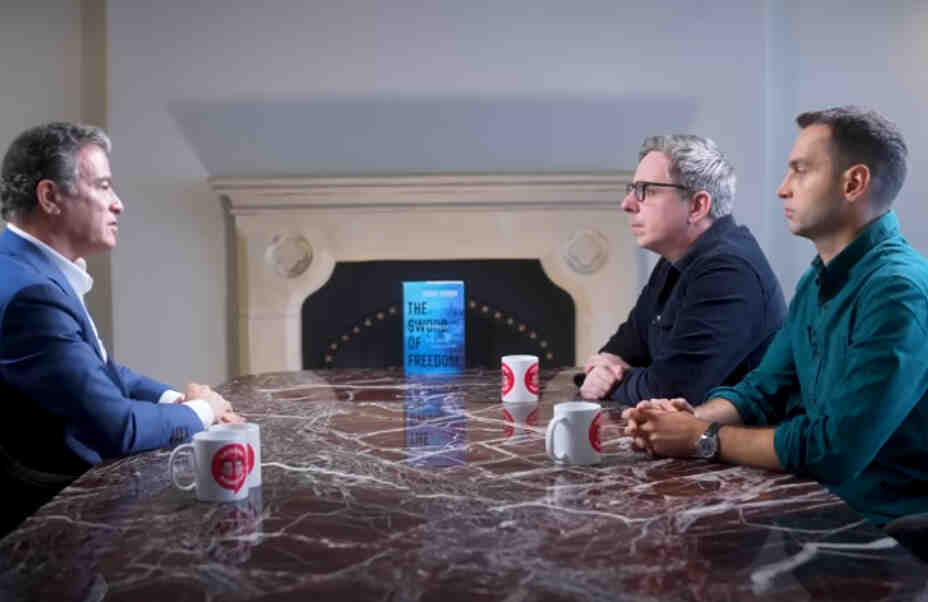
Read the full transcript of Ex Mossad Director Yossi Cohen’s interview on TRIGGERnometry Podcast with hosts Konstantin Kisin and Francis Foster, “How We Got Iran’s Nuclear Secrets”, Oct 1, 2025.
Introduction
KONSTANTIN KISIN: Yossi Cohen, welcome to TRIGGERnometry.
YOSSI COHEN: Thank you very much for having me.
KONSTANTIN KISIN: Yeah. You’re the former director of Mossad. Your book is called Sword of Freedom. It’s good to have you on the show.
YOSSI COHEN: Thank you very much.
What is Mossad?
KONSTANTIN KISIN: For our audience who may be less familiar with the world of the Secret Service and so on, what is Mossad?
YOSSI COHEN: Well, Mossad is an intelligence service working outside of the state of Israel. In comparison to the other organizations that you may know, the MI6 in the British version of the James Bond, as we call it, or the CIA. These are the equivalents of the Mossad in intelligence organizations.
Quite a big one. In comparison with the others, the quantity of the people, the quality of the people is amazing. And we operate outside of the state of Israel, behind the enemy lines, as we call it. We don’t do anything inside the country.
KONSTANTIN KISIN: Your foreign intelligence service.
YOSSI COHEN: Absolutely.
Israel’s Intelligence Infrastructure
KONSTANTIN KISIN: And can you explain the intelligence infrastructure of Israel? There are other organizations that do other things. Shin Bet and others. How does it work? Who handles what?
YOSSI COHEN: Okay. It’s very, very easy to define. Like in the UK, there is the internal service, which is the Shin Bet, the Shabak, as we call them today. They do internally, they do whatever is connected to our local security from within. It is like terrorism, local terrorism, counter espionage against others that are trying to spy inside the country, inside the State of Israel security, physical security of MPs, Prime Minister and our embassies abroad. All official entities of Israel as a state outside of the country. This is the Shin Bet.
Beside all that, there are a few military bodies, intelligence military bodies that are working together simultaneously with us. The one which is very famous now, 8200, we call it in Hebrew, very well known one, working on signal intelligence. This is a monster of signal intelligence. They do what we have to do to intercept, to listen, to hack, sorry to say. The enemy is playing for us. And this is part of the military intelligence, of course. We all work together.
And the third one would be the military intelligence as a part of it. It’s like above Shmone Matay, the 8200, of course, the signal intelligence. But there is a kind of a military intelligence that is like seeing everything, reading everything, being involved in collecting materials from all of us and somehow directs our missions, even Mossad’s mission abroad to their national needs.
So these are the main, I would say three bodies. 8200, I’ve mentioned that separately because they’re good and they’re very important to our resilience, I believe, in the country.
Criticism of Israeli Military Intelligence
KONSTANTIN KISIN: And you mentioned military intelligence. One of the things that really stands out in your book is you’re very, very critical of the Israeli military when it comes to October 7th.
YOSSI COHEN: Correct.
KONSTANTIN KISIN: What do you think were the key failings that caused that to happen?
YOSSI COHEN: Well, I think on the national level, when I was national security advisor, you had to realize that there is a country to guard, that there is a country to preserve, that there is a country to make sure that they will exist the next day. Right?
And you do have on a national level, you do have two lines of defense that has to be emphasized by us Israelis. The one, by the way, it applies to every other country too. It’s good to do that, the same thing, the same structure in all countries, UK and others.
The first line of defense is the intelligence line, which is the one that you don’t see. This intelligence line is all of us, as described before, are working to know what the enemy is planning for us, what’s his plans, what does he have in his mind? What do the Iranians, what do they want to do? What are the plans of terror attacks? Either Iranians or other terror activity or terror organizations are planning for us.
And this is something that has to be conducting by intelligence forces to make sure that we know every day, every morning, every time, every minute, what are the enemy plans. That is enemy, each one of them that I’ve mentioned before, it could be Hezbollah, Iran, Syrians at the time, or Hamas.
This line unfortunately collapsed. When I say collapse, I don’t say that we didn’t have intelligence at all, but we didn’t have a significant meaningful intelligence to tell us or to give us the alert that the enemy is about to come.
The Intelligence Gap in Gaza
KONSTANTIN KISIN: Why didn’t you have that information?
YOSSI COHEN: Because I believe that we didn’t invest enough in Gaza Strip. I believe that for years we’re not there, we’re not physically there and it’s worthwhile explaining a little bit.
When we have disengaged from Gaza, what we call the Hitnatkut in Hebrew, we left the 365 square kilometers for the Gaza people themselves. That was a one-sided decision made by former Prime Minister Ariel Sharon. I’m sure you remember the time. And we’ve left Gaza Strip completely.
When you leave the territory, okay, you’re losing part of your intelligence holding on the ground. You see less people that they can recruit. You engage with less Gazan people that can be recruited or Hamas people, of course that can be recruited. And I think that we missed all that.
Okay, so the deterioration of the holding in Gaza was imminent.
Unfortunately I realized that because Mossad is not dealing with the Palestinian thing abroad. Yes, but Gaza and Judea and Samaria, we do not, we’re not involved in that since we are working behind the enemy lines abroad.
Problem is that Gaza behaves like it is abroad. Gaza behaves like it is a foreign country. You can’t go with your either military forces, you can’t go with your Shabak, whatever 4×4 armored vehicles. You can’t go arrest someone inside his house in Gaza Strip cities, which is super different than territories like others, other territories like Judea and Samaria or whatever, East Jerusalem or even inside the country.
And that creates a kind of a gap in between what we knew and what they have planned. And that gap actually created this disastrous activity, horrifying activity in October 7th.
I have alerted that when I returned to the Mossad in 2016. I offered, let’s put it that way, I volunteered and I offered my services to the country. And I said, my perspective is that the Gaza level of intelligence is not sufficient. It will never be sufficient if we will not participate in that, because we have the ability to work under cover. We have the ability to work differently inside difficult territories, like difficult territories like this one, like we do in Hezbollah in Iran and other places that you have been, of course, aware of recently.
And for reasons that would be kept with them, I was rejected. The Mossad was rejected to intensively help in that.
KONSTANTIN KISIN: Intelligence war inside Gaza by the Prime Minister.
YOSSI COHEN: Prime Minister didn’t give the order to do that, but I was rejected by my counterparts in military intelligence and Shabak altogether.
So first line of defense has collapsed. This is what has happened, meaning is that if you don’t have the right alarm and we didn’t have it, this is what’s happening.
What Israel Knew and Didn’t Know
KONSTANTIN KISIN: But did you know that, you know, Israel, did you not know they’re building terror tunnels? Did you not know they’re stockpiling weapons? Did you not know that they’re training? Did you not know that they’re scoping out the defense barrier, etc. Do you not know any of this?
YOSSI COHEN: We did, but we didn’t know enough. To my understanding, we did, and we knew that these things are happening. And by the way, it’s a very interesting question because in 2014-15, the major thing that we were worried about are the penetrative tunnels. This is what we’re looking for.
KONSTANTIN KISIN: You were worried they dig under.
YOSSI COHEN: They did. They dig under. We knew that. By the way, they kidnapped a soldier, Gilad Shalit at the time being, coming into our territory under the famous fence, and we didn’t know where they are.
Okay, imagine it’s a huge territory, by the way. 365 square kilometers, six times more than whatever Manhattan, the island, right, which is less than 60 square kilometers. So it’s a big territory.
Imagine all this being penetrated by other tunnels, 1.2 meters wide and very, very, very long ones, starting at the end of the world, close to the sea and penetrating all the way down under the state of Israel. We had to know that and we did not.
That was the reason for us to crash, I think part of the borderline in 2014 and 15 and ongoing. So we knew all that.
And by the way, there is another thing that I refer to which is should the state of Israel be or not proactive to defeat our enemies? And I found myself often more, I would say proactive than the others. Not alone. Others from these organizations were cooperating beautifully with this kind of thesis that says “rise until first” as we all believe in.
But at the same time, things that have happened as to your description were not being eventually crushed or disrupted or disabled inside Gaza. Because the thing I believe was, is to maintain the Gazan territory quiet. It applies, by the way, the same for Iran. It applies the way we have behaved in Israel with Hezbollah too.
So that’s why you don’t see many operations happening in this kind of territories beside targeted assassination operations. But you don’t have the absolute ones unless we feel that there is a must do and we are conducting this kind of rounds in order to disrupt the enemy’s capability.
The Military Response Delay
KONSTANTIN KISIN: So come back to October 7th, there was the intelligence failure that you’ve just described. One of the other questions a lot of people have is why it took so long for the military response, why it took so long for troops to get into the area where the enemy were.
YOSSI COHEN: I don’t know. This is a question I can’t really answer. I’m not part of the army. I was never, yeah, when I was 18, but since then, not much. I don’t really know.
This is a very tough question that has to be answered, I believe, by the National Investigating Committee that will have to be eventually formed in a given time. I think that we really need it right now. But I…
KONSTANTIN KISIN: Why hasn’t it been formed so far?
The Need for Investigation
YOSSI COHEN: I’m not sure yet. I mean, there are many questions about that. I know that most of the people of Israel, I mean, interviewed Israelis. Most of them would have told you that this is the actual thing to do. And more than that, I believe that we need this committee to investigate what went wrong, not who went wrong. And it’s a big difference. I mean, I’m not looking to hang people, you know, say who. He’s the one to be blamed. I mean, he’s the one. We know them all, right? I mean, we know the generals. We know that the people have been working in the different divisions inside the different intelligence body in the army themselves.
Part of them took responsibility in what they did, right? They took open responsibility like Chief of Staff Herzi Halevi and Chief of Shabak Ronen Bar, but they took responsibility. They said, we are responsible. I mean, the failure is on us. But the investigation committee should investigate what went wrong. Why is it that we didn’t know enough?
For example, should we in the coming future look differently in Gaza given that the territory will be territory that we will have to be securing? I mean, we’ll have to make sure that the Gazan people or the Gazan Hamas, will not, if they will still be there, hopefully not. But if they’re still there, we have to make sure that this is not happening again. Right.
Reforming Intelligence Structures
And more than that, I think that it needs maybe kind of a reform in our way of thinking. What is Shabak territory? What is military intelligence territory? What is Mossad territory? And this is something that has to be thought of and reformed because things are maybe different than they were after ’67. Right. And it’s a mixture of conflicts in between us and the Palestinian Authority and the people living in territories A, B and C that’s part of the Judean Samaria area. And if you go back to Gaza, Gaza is not part of the Palestinian Authority. Officially, it’s theirs, but it’s a… So all this map, which is a kind of a cocktail of troubles, has to be reformed.
And in order to reform that, I think that you need a body from above to tell you you went wrong there and there and there. We better change it that manner into that manner so we will have the intelligence needed and defense needed. That’s the first line of defense.
It’s a very big question that I have: why did it happen? Or as I think I described it in my book, and I said, I’m not surprised, but I’m shocked. I’m not surprised that we didn’t have enough intelligence. I said that blindly. I’m shocked that level of teacher was so poor, unfortunately. So we didn’t see, you know, it’s not a lone wolf that I have to find when he’s driving on his scooter from Baghdad, cutting into Syria, going all the way into Turkey to conduct a terror activity or here into London in London itself. I have to see that one. It’s 1,500 terrorists altogether. Simultaneously.
I mean, imagine I’m trying to, the size of the people supporting this 1,500. How many people knew about that secret? Right. Logistics, training, technical support, telecommunication. I mean, all that. Think about all the… I mean, it’s you. I know.
The Failure to Infiltrate
FRANCIS FOSTER: And just to interrupt you as a complete layman, I’m listening to what you’re saying. You’re making great point after great point after great point about this. And I’m going, well, why have Israeli secret services not infiltrated Hamas? Why isn’t there a guy there going, “Hey, they’re going to launch an attack. You best get…” Why didn’t that happen?
YOSSI COHEN: That’s the same question. I mean, what went wrong? I mean, everything went wrong. If you don’t know what the enemy is planning for you, all right, you’re not doing your job. My job is to tell you. I mean, not you only, but you know what? You too. I mean, my best. One of our best partners here in the UK, and we’ll refer to that because I’m sure that they’re going to ask about the amazing and important declaration of Prime Minister Starmer about the Palestinian future, whatever Palestinian state.
But at that time that I was conducting this intelligence bureau of mine, or the Mossad, one of our best partners was the MI5. Your local security here. And local security has to be informed by all others. Who’s going to do something against your own kingdom? All right? So if you knew that, you have passed your job with distinction. If you failed, you know nothing.
You know what knowing nothing means? That there is a terror attack in the streets of London. Knowing nothing is, where is the Iranian nuclear sites? Knowing nothing is, what is Hezbollah planning for us? This is knowing nothing. So you have to invest a lot in order to know. All right, so if you haven’t penetrated them correctly by all means, I’m not saying only human. Human intelligence is my professional right. How to recruit people from within the enemy, whatever bodies and entities. If you don’t do that, it means you know nothing. I mean, I think that knowing significantly is the right version. You may know, but did not know enough. And we didn’t know enough.
The Mindset of an Operative
FRANCIS FOSTER: One of the things that I really enjoyed Yossi about your book is you talked about the mindset of an operative who goes behind enemy lines, who gets to know the enemy and the way that you frame it. Can you talk a little bit about that? Because the psychology of that is fascinating.
YOSSI COHEN: Yeah, it’s all about mindset, I think. Well, to be an operative, I mean you have to fit the job, right? I’m not sure that I can be a great country or whatever interview guy. I mean, you have to have a different mindset for every single job that there is, I believe around the globe, right? I mean everybody has his own profession and that’s a profession, that’s a very important profession, I think, for the sake of all countries.
But in order to be an operative inside this huge profession that we call espionage, I mean you have to have special qualities, let’s put it that way, that fits or that would fit in the job. And what is it that we need? All right. I mean we need first, I think humbly saying, I think that is to be a brave guy. I mean in a way you have to know how to go and to penetrate behind enemy lines. I mean you have to go and travel and to know who you are undercover. You have to work a lot undercover. You have to present something else which is not your truth, a true identity. And this is something that has to be worked upon.
The mindset that you have referred to is something that you wear every time that you leave the country. Every time that you’re out of Israel. There is a kind of a mindset that says, I’m not who I am anymore. I’m not Yossi Cohen anymore. Now I am whatever Michael, Richard or not David. That is not good. But other names I refer to Gabriel, but not a good one too. But never mind. I mean, you used to be Muhammad or Masoud or whatever.
And this kind of shield is the only one that protects you in front of the enemy. This is what he sees. You want him to see that and that only. So you have to be a kind of an actor on a stage. So the espionage arena is a kind of a huge stage, the world stage, that you go in wearing this kind of, not physical, but cover stories mask. You have to play it, and you have to play it right. You have to be whatever you want to do in front of your given audience. They may be Iranians or Europeans or South Africans or South Americans or whatever. I mean, you have to go places that will have to. And you have to play your own character by yourself.
And each one of us has to play his own character by himself. And they’re changing characters. I mean, they’re not all the time the same. You have different characters, like an actor on stage again. I mean, you can play, what is it, Phantom of the Opera and the next day you get the Book of Mormon. I mean, these are the shows that I’ve…
FRANCIS FOSTER: You’ve seen here. Absolutely.
YOSSI COHEN: So it still reflects. I mean, you don’t do ABBA Voyage, because that’s a different thing. It’s all…
FRANCIS FOSTER: Yeah, absolutely.
The Story of Abdullah
But the one you describe it beautifully in the book is when you talk about the character of Abdullah. And that is very interesting because what it does is we are fed a lot of nonsense, I would say, about spies, and you say in the book as well, about what it is to be a spy. But with the story of Abdullah, you actually explain espionage as it truly is. And I know that there’s millions of people out there who would be fascinated by that. So let’s talk about that story and how it was that you made that particular case work.
The Art of Intelligence Operations
YOSSI COHEN: Well, in this kind of case or like other cases, you have to know what the target is. You have to know what you want to achieve. Generally speaking, there is a map of targets in front of us. We know what we have to achieve as the state of Israel. Of course, at the Mossad, we do know what are the targets that we have to know.
Assume that we need to know something about the Iranian nuclear stuff. How do we map our targets in order to make sure that we will engage the targets that we need, that they are there? And you have to build a kind of an arm of intelligence that will study who are the targets inside. These are the intelligence officers at the back office. They gather what we have as for now and we say, okay, now we know, let’s say 20% of the picture. We have to know 80%, 100% of what they do.
These are the targets that has to be achieved. Part of them are physical, part of them are visual. Part of them are by recruiting people from within the entities or from within the Iranian or the Hezbollah group. And each one of us, or each group of us, gets its proper targets. It’s not that everyone is doing everything. Some of us are doing some. And we do have a line of targets that has to be engaged by us.
When Abdullah’s case, like many others, I refer to that probably because this is the one I remember and we’re writing the book. But there are so many other, thousands of stories that I can reveal or thousands of covert stories that I can reveal. I’m referring to this twin flame thing that has to happen in between the target and me or the target and us. This is something that has to be conducted beautifully, smoothly, without anyone knowing that you are there, without anyone knowing that you have arrived, without anyone knowing what is your proper reason for being there. And without him or her suspecting that he is a target. While we know everything about him already.
So there is a huge advantage on our side that we know what the enemy or where the enemy is, what he does. On their side, of course there are some cases that they’ve suspected or there are some cases that they believe that we’re not who we are and who we present we are. And we had some problems to explain that. Sometimes you have to run away or to escape from the espionage arena as we probably call it.
But this is something that refers to a given operation or to any operation. It will, I believe, be conducted in a very different manner. So each one of them has probably the same fundamental capabilities and abilities, either organizational ones or private ones or personal ones. And then it has to be conducted towards the target. And I hope I answered your question.
Understanding Human Weaknesses
FRANCIS FOSTER: No, no, you did answer the question. But the thing that I found fascinating is you were talking about weaknesses of character in the book and you were saying that every side, their side, and you said that there are things that people crave deep down that motivate them. For some people it’s money. For some people it’s sex. So explain that when you’re targeting someone because you want something out, whether it be information or something else.
YOSSI COHEN: I think that what we’re trying to do is first to know the target very well. If anyone is the target and I know him, but I know him by whatever, either listening to him or following him or knowing his friends or recruiting him in his entourage. People that are around him are already speaking about him. Doesn’t really give me the real character, who he really is. And this is true for anyone in any human contact in between any one of us. There are always layers that have been seen and layers that you don’t see.
Our mission is to be his best friend in order to know who he really is. You have to really be his best friend. You really have to believe, he has to believe that you are his best friend or an ally or a colleague or someone that can serve his interests. And each one of us has different interests, but most of them are common.
I’m not sure about you guys. I’m, you know, target, of course, but thinking about yourselves as someone that has kind of an interest. Who would you be interested to speaking to tomorrow? Who would be the one? That’s what I’m looking for. Would you love to be in a different place? Do you want to move to a different country, different city? Do you want to have a different profession? Do you want to move higher in your organization? Do you want to be rich? Do you want to save yourself from poverty? Do you want to move ahead with your family life, kids, wife, so forth? Or do you hate enough your regime? So to help me helping you saving yourself from becoming regime?
This is, by the way, I think that John le Carré phrased it beautifully. A good source has to hate someone and love someone, and this is very much the truth. Because when you are engaging with these kind of targets, with this kind of objects, as we call them, you really have to know where are they?
Building Trust with Targets
YOSSI COHEN: Take Hezbollah, for example. Are they with Nasrallah? Rest in peace. Are they with him? Do they believe in Hezbollah’s agenda? Or they counter that? Or are they part of the Iranian nuclear thing? Because that’s the proper job. But they don’t have an alternative. But they do not support that. Or do they support it? Do they like the Iranian regime to stay? Or they want a change of regime?
Currently, it’s a big thing to know for an Iranian guy or Hezbollah terrorist to tell you I don’t like what I do, and I counter what they do inside my country. It’s a big thing because who are you? It needs a super thick level of trust. So they will tell you, they reveal the secrets. And they said, I don’t like them. Can I tell you that it’s a risky thing to say. Super risky thing to say. Not only in Iran, in all these dictatorships and autocrats. All these countries that are eventually forcing you not only to work upon a given target or a given vision, it could be the Iranian regime or other terror organization, but they force you to accept what they offer unless you be fired.
And it’s very risky job. Not our side, only theirs too. In order to agree to open your heart to someone that you’ve just met maybe a few weeks ago, maybe a few months ago, but someone that you’ve just met and telling you, hey, who are you? And we know. Oh, interesting to know. And then you go into this kind of relationship, you have to be super tight with him. The level of trust should be super tight, that he will reveal his secrets and he will reveal his heart. He’ll open his heart to you. And then when you have a friend on the other side, when there is a trust with your object, you can do much more.
KONSTANTIN KISIN: And are there people that, are there many people that can’t be turned?
YOSSI COHEN: That cannot be? Yeah, I can assume that. In our workflow, there are many objects. And of course, some of them, or maybe many of them have rejected all that. They said, no, we can’t. Or to probably say, I don’t need that. I’m not interested or many versions of many ways to leave your agent or to leave your operative. Many ways to say no, but there are many ways to say yes, and they’re more than that.
I think that not everyone is capable to recruit. Not everyone. Put yourself in these shoes. Try to see, how would I do that? Do I have the capacity, capabilities to do that? To play and to go and to say and to keep cover story and to give arguments with the other part, to the person in front of me telling him, okay, trust me, I’m your best friend.
And more than that, I have to assume that everybody, everyone can be recruited. I have to assume that. I know it doesn’t sound realistic because not all of them are recruitable, you can say, but if that’s a target, I will have to try. And by the way, sometimes we surprise ourselves. Sometimes you go to someone that you see openly, that is enchanting and conducting the best way that the regime wants him to do. He speaks openly for the regime, he’s so much in favor.
But we see other layers. We do see other layers. We see his other layers. We want to go in. But when you engage with him and after a few weeks or a few months, this is the only way really to know who he is, where his heart is. Is this the guy I see on television, on public, on his arena, local stadium, singing the regime song? Or do I see the real one that I need? And there’s a huge gap in between who they are publicly and who they are secretly, or in between friends and family.
FRANCIS FOSTER: You, the Trigonometry audience, understand how vital free speech is. That’s why we’re proud to reintroduce you to our long standing partners, GiveSendGo. We caught up with their founders at Jordan Peterson’s Alliance for Responsible Citizenship conference this year. And it was clear they are not just running a crowdfunding site, they’re defending a principle. Take one of the most powerful examples, Daniel Penny. He stepped in during a dangerous subway incident in New York and was later charged with homicide. His GiveSendGo campaign raised $3 million, allowing him to mount a strong legal defense as his case moves through the courts. That case made headlines, but the biggest story was this. While other platforms shut campaigns like his down, GiveSendGo stood firm. So if you want to support causes that matter or raise funds yourself, whether it’s for free speech and helping a friend in need or disaster relief, visit givesendgo.com and use the code trigger for a special 2.5% processing rate. That’s givesendgo.com, the platform that doesn’t just talk about free speech, it protects it.
The Iranian Nuclear Archive Operation
KONSTANTIN KISIN: That makes sense. So that takes us nicely into Iran. I mean, the biggest coup of your career as Director Mossad, that we know about at least, was stealing Iran’s nuclear secrets.
YOSSI COHEN: Yeah.
KONSTANTIN KISIN: What, how did that happen? And more importantly, what did you find? Because actually, it’s interesting now, Israel wasn’t really much in the news until two years ago, and I think for Israel…
YOSSI COHEN: Was not much in the news. He was not in the UK?
KONSTANTIN KISIN: Not in the West.
YOSSI COHEN: Really? Yeah.
FRANCIS FOSTER: No.
KONSTANTIN KISIN: I’ll be honest with you, I might be unpleasant for Israelis to hear, but no one really cared about Israel until October. But now it’s obviously become a bigger conversation.
YOSSI COHEN: Oh, you were dealing with your Brexit and stuff, right? I mean, that was more important.
KONSTANTIN KISIN: We’ve got a lot of problems.
YOSSI COHEN: Yes, I know.
KONSTANTIN KISIN: Immigration. Let’s not get into that because we’re going to start crying. So your coup, stealing Iran’s nuclear secrets happened before October 7, significantly before. What did you find? First of all, because this was a big point of contention when Trump and Netanyahu went to the nuclear facilities.
YOSSI COHEN: Okay, I will, if you fast forward your question into June 2025, this is the full answer and I will go backwards. If you permit me. In 2016, after a few months, the JCPOA was already signed. It was signed in July 2015 by the P5 plus 1, UK included. England, France, Germany, USA, China and Russia. It’s weird to think that all of these have worked together. All right, now, they’re split and the P5 plus one assigned the what we call the JCPOA, the nuclear deal. It’s not deal eventually. It’s a plan of action. JCPOA, Joint Comprehensive Plan of Action. That was a plan of action. When it was signed, we didn’t like it.
KONSTANTIN KISIN: Wait, Israel, we didn’t like. Very briefly.
Why Israel Opposed the Iran Nuclear Deal
YOSSI COHEN: Why? Because we felt that the agreement is a terrible agreement that leaves Iran with a lot of capabilities and capacities and we wanted them to go to zero. No enrichment, no sites, no nuclear sites, no scientists, no this group, what we call the Weapon Group. We wanted all that to be eventually dismissed, dismantled, whatever. I mean, to zero.
KONSTANTIN KISIN: Whereas it gave them some leeway.
YOSSI COHEN: It gives them a lot of leeway. I mean, till the sunset. I mean, not only that, the Iranians eventually kept their capabilities and other problem. It is true that if you go – I mean, we’re not going to do a nuclear seminar – but the one thing that bothered us above it all, that they’ve kept capabilities of the bunkers alive.
That means that they can not only enrich uranium in the bunkers, they can even improve the enrichment. What they did eventually, this is exactly what worried us. And more than that, there is a sunset clause, as we call it, which is something that says that in a given time the agreement eventually will be dismissed or will be canceled or will be eventually abolished or abandoned.
KONSTANTIN KISIN: It’s not permanent.
YOSSI COHEN: Not. Yeah, not anymore. And we didn’t like that. We thought that Iran should be very low kept by the level of enrichment, if at all. And that all nuclear sites, including the scientific work that they conducted, should be completely closed and shut down. That was one of the main arguments. All that was very well opened and kept by Iran according to that agreement. That’s why we opposed that dramatically.
I was one of the negotiators. I mean at the time I was the prime negotiator for the State of Israel for the nuclear deal. I had conducted this kind of relationship with the UK, French, all the others. And we said – I mean, because every country received the kind of a vertical to deal with inside their agreement, headed by the USA, of course. The Foreign Minister and the Secretary of State and his team at the time, John Kerry, Wendy Sherman and the others.
So we didn’t like it that much. And we have told them that in our perspective, everything that Iran is doing is under one vision. That means they’re heading to the bomb. I mean, they’re trying to pave their way to the bomb. And this is something that they have declared again and again and again from within the system that they’re doing.
They said, “Yeah, of course because of that we need an agreement.” And we said we have to attack the sites. If they don’t stop, we have to attack the gap. That was not fulfilled till June 13 this year.
Discovery of the Secret Archive
But in 2016, after the agreement was signed, we saw something very weird happening in Iran, which is under Ministry of Defense and Dr. Mohsen Fakhrizadeh, rest in peace. They have started to collect this kind of materials from all over the country under a very discreet manner. Super secret thing that’s happening in Iran itself says you will bring us everything that you have – hardware, software, discs, papers, documents. Everything that we have done under this nuclear secret activity into one site.
That alerted me. That was the thing that said something wrong’s happening there. I don’t know what it is yet, but I want to know it. What’s there. Two years later, that was the archive. And we said two things at the beginning. One, don’t lose your eye on the ball. Make sure that we know everything that he is doing or they’re doing because there were few who knew about that in Iran itself.
And number two, when we see it lands somewhere in Iran, it has to be, by the way, a site that is not recognized as an official site because of the agreement. Because the IAEA, the agency, I mean the nuclear agency, atomic agency in Vienna under the agreement could visit any site. So they say if the site is not on the official list, I mean, they don’t even know how to ask where to visit.
KONSTANTIN KISIN: You can’t inspect the site.
YOSSI COHEN: You can’t inspect something you don’t know about. Yeah, exactly.
KONSTANTIN KISIN: Okay.
YOSSI COHEN: And this one, they placed it in a kind of a warehouse inside Iran in a kind of an industrial area. We found out that this is what they do. That raises our suspicions even higher. And then I’ve instructed my teams: Bring it home. I want to know what’s in it. I think that they are hiding the filthiest secrets of Iran. Bring it home.
Two years later, we did. It took us long time to conduct this kind of operation. I mean, a lot of troubles on the way. We’d been in Iran hundreds of times. I mean, collecting information, recruiting people from within. I mean, know exactly what’s happening in this kind of warehouse.
When we brought the archive in January 2018, we’ve operated, but it took us a few months to get it out. It was not FedEx.
KONSTANTIN KISIN: Well, you talk about – it was half a ton of materials.
YOSSI COHEN: Half a ton of material. True. We didn’t bring the hardware in, but we brought a lot of documents and discs, a lot of videos and hard disks. I mean, amazing stuff. We’ve been surprised ourselves.
What the Archive Revealed
KONSTANTIN KISIN: So what did you find?
YOSSI COHEN: We found out that there was and there is still massive activity that is in light of a nuclear bomb. Not like Iran has ever declared before. They have denied ever doing anything like the path or paving the path towards a nuclear bomb. This is what they did. But we found out that they did. And now we have absolute evidence. A lot of evidence that show that this what they did.
KONSTANTIN KISIN: Can you give us some specifics on what they did?
YOSSI COHEN: Absolutely. I mean, in nuclear activity, if you want to hide it, I mean, according to the Iranians, you don’t have and you can’t work under any inspection of the IAEA. And we found out that they have done a lot of work. Many sites that we had found out were not known to anyone, never declared, but a lot of activity is happening there.
And we did find many, many, many new sites that were conducting an actual and physical nuclear work without declaring it to the IAEA. So in one hand, Iran is conducting kind of negotiations with the West or with the West, East and Russia, and signing an agreement saying our intention is not, of course, for a nuclear bomb. I mean, this is all clean.
On the other hand, now we see the reality. Iran is conducting kind of a discrete alternative job or nuclear job that eventually create the path to the bomb. And this could not be allowed. That was the reason for us to go out with it. Because in the intelligence philosophy, there is – the use of intelligence will always be more valuable than the intelligence itself.
Meaning if you know something, it’s okay. If you use it, it’s so much better. If you know that there is a terrorist coming, it’s okay. If you use it and you disrupt the terrorist activity, that’s very useful. Same goes for the Iranian thing. So this is what we did.
KONSTANTIN KISIN: We have…
Sharing the Evidence
YOSSI COHEN: I mean, the Prime Minister did. Prime Minister Netanyahu had a very important press conference, and he revealed that we have that. I mean, it didn’t show everything, but that was a kind of a shocking thing to all negotiators.
What we did, I did personally, is that I have ordered to copy it bit by bit, all of it, all the archive, and give it one by one to the head of the CIA at the time, to the head of the MI6 at the time, to the head of the DGSE at the time, the French Mossad at the time, every one of them, and to the Russians, Chinese, and partially to the Germans and to the IAEA and telling them, “Okay, this is the archive. We tell you nothing about that. Do you tell us what’s in it first? Do you endorse it, or do you think we faked it, as the Iranian would claim?”
Everyone endorsed it, including the IAEA. And this is the most important part, by the way. A few weeks later, President Trump exits the agreement saying Israel has just provided us with new materials that shows that Iran lied all the way to the agreement. And now we understand their truth or what they’re really doing and not the reality they were trying to create for us.
And number two, everybody, everyone, all services, including the IAEA endorsed completely what was in it and said this is a problematic issue that has to be declared or not declared, cleaned or cleared in between us and Iran.
The June 2025 Strikes
KONSTANTIN KISIN: Which brings us very rapidly to June of this year.
YOSSI COHEN: Exactly.
KONSTANTIN KISIN: Because you just used a phrase that I found very interesting saying “and is still.” Are you saying that the strikes that were conducted on Iran have not fully destroyed…
YOSSI COHEN: I do. I think, I mean fully destroyed is a very big word. I think…
KONSTANTIN KISIN: They still have nuclear sites that they’re operating.
YOSSI COHEN: I think that they have – we have to understand that Iran hasn’t given its motivation or agenda to reach a nuclear bomb. I do not believe them at all. Not the Supreme Leader’s, as we falsely call him, declarations that he says we’re not interested in the bomb. No, of course not. So what is that, sir? And if not, let us visit it.
Because the sequence was before 13th of June is that the IAEA had this board of governors, I mean, describing why Iran is violating all the inspectors or the inspection activity inside Iran. And that was a very important decision that gave the green light to that attack because President Trump said openly at the White House with the Prime Minister sitting next to him, he said the three things that I do: I give negotiations a chance and I give it 60 days for the Iranians to negotiate with us. If an agreement will be achieved my way, we have an agreement. If not, we will attack. Israel would lead the attack.
And these three things eventually happened. Iran did not come clean to the IAEA demands. They never did, by the way, till today. Sites that were destroyed, the attack that we knew that they’re conducting military kind of military activity or military to the bomb activity that we had to take over. I mean this kind of strike.
And more than that, they said since you don’t come clean with all evidence that we’d found at the archive, we’re coming to get you now. If it was fully destroyed, to my knowledge, enrichment is not happening anymore in Iran right now. We may miss something. As I told you, you don’t know what you don’t know.
So they may hide more than what we have. There may be another site that we don’t see. Maybe there is another activity that we don’t know of. We know what we have destroyed. We know the people that we took away. Unfortunately, we know what we’ve stopped. But we don’t know what we don’t.
So what we know is that we have to conduct more penetrative operations inside Iran to make sure that we know more about their current activity. And if we find any new activity or these activities that were never ceased because of the attack, Iran do understand something very well now. Yes. That we can – it’s an important sentence – that we can come again. Not only that. Some of the B-2s of the Americans can come again too.
Iran’s Nuclear Ambitions
KONSTANTIN KISIN: Well, I think that message is probably quite clear to them now. I would think a question I was going to ask you is based on your time as director of Mossad, based on your intelligence, based on what you know, why does Iran want a nuclear bomb?
YOSSI COHEN: I think that they want to be immune from the region, maybe from the State of Israel or others. I mean there are in a consistent conflict with their neighbors all the time.
KONSTANTIN KISIN: What does that mean?
The Nuclear Threat and Regional Dynamics
YOSSI COHEN: Two very close neighbors do have nuclear bombs. Pakistan and India, very close countries. I mean physically, I mean to Iran and Israel. I don’t know about that. I don’t know about that. But about Pakistan and India, I do know. I mean that they do have nuclear military capabilities.
And since they are Shiites and not Sunni, all right, they are in a constant conflict with the region too. So they’re very much worried about that. And this is number one.
Number two is to be immune. When you are passive, it’s one thing, but to be immune when you are so aggressive in the region is a different thing. Because the Iranian vision is the Shiite crescent. If you have the map of the northern part of the Middle East, I mean there is a kind of a cut through Iraq, I mean from Iran into Iraq, and then into Syria, go down to Lebanon, okay, to create a vision, what we call the Shiite crescent. And there are many Shia there.
And I think that Iran is trying to create this kind of Shiite crescent, if declared or not. And by the way, they’ve done that beautifully in Iraq by Qasem Soleimani at the time. Hashd al-Shaabi there was like a kind of a local Shiite force working for him, for them, under an absolute supervision of the Iranians. They kept the Assad regime alive while conquering part of the country or the regime itself. And of course they’ve dominated Lebanon through the Hezbollah and other Shiite organizations.
So I believe that all that map that you see creates a kind of a need to be immune or telling the world, “You can’t touch me anymore. Now I have nuclear and you don’t mess up with me.” And I believe that for these two reasons, I mean, Iran has eventually conducted this kind of activity.
Mossad’s Cooperation with British Intelligence
FRANCIS FOSTER: And it’s really interesting in the book where you talk about how you actually, how Mossad, because people have got this image of Mossad, which is obviously incorrect, but you help, incorrectly incorrect in many ways. You know, there’s conspiracy theories. We don’t need to go into them because they’re boring and tedious as far as I’m concerned.
But you work a lot with British intelligence, helping Brits on the street, Brits in London, where we are now, remain safe. Can you explain that a little bit?
YOSSI COHEN: Of course. I mean, the time was ISIS time, Daesh, as we call it in Arabic. ISIS was all over. And under the coalition, you had a kind of 74 countries that were working together, I mean, to defeat Daesh, to defeat ISIS. That was the right thing to do.
By the way, numbers, okay. I mean, the size of Daesh presumably was in between 40 to 60,000 terrorists. Same size of Hamas. We’re doing it alone. You did it with 74 countries or even more. The coalition that was formed by President Obama at the time was trying to do the right stuff. Was Daesh defeated completely? I’m not sure. But this will be said sometime in the future.
Nevertheless, I mean, Daesh or ISIS kept a very important international body that they call international body, the International Daesh. There was a kind of a branch inside Daesh in Iraq itself and connected to Syria that was conducting terror activity outside of the Levant. Right. ISIS is part of the Levant. Right. ISIL, remember they call this ISIL because of the Levant, the Islamic State inside the Levant.
They were trying to conduct operations outside of the Levant, meaning cutting out of Syria into Turkey. And now they are in a kind of a very, very pleasant or much more comfortable arena for them to operate. And then going all the way down from Syria into Europe till the end of Europe. I mean, it could be either Lisbon, London, or anywhere else.
What I have understood is that there is this kind of international body that we can provide much more intelligence to our counterparts around the world, even if the terror activity is not really directed to either Israeli entities or the Jewish community. By the way, that was happening too, of course, in Turkey, in Istanbul, against our synagogue and the rabbi and more than that.
And then I have created a kind of a team that was working intensively to create intelligence, to create intelligence together with 8200, of course, and to bring it over, to bring it over to my counterparts in the places that we see, I mean, ISIS has been interested in operating. And that have created kind of a super strong bonding between me and the MI5 at the time. Of course, the MI6 too. I mean, both directors, I mean, for both organizations were super good allies and super good friends and super good counterparts.
And we did understand together that there is a kind of a common enemy that we have to fight together. And I think that I can quote the former head of MI5 who told us, the Mossad, in one of the visits here and in his headquarters, that we deserve the Oscar for the, I mean, he said, “We don’t have Oscar for intelligence work, but you deserve the Oscar for what you have done to disrupt terror activity inside England, inside the UK.”
And this is something very important, very meaningful. And this is what we did, I mean, for a long, long, long time.
The Ongoing Terror Threat to the UK
FRANCIS FOSTER: And that being the case, how severe are the threats to the UK from these terror cells? How severe are the threats to the UK from these terror cells?
YOSSI COHEN: I think that they’re all the time there, I mean, being part of the West, okay, like not being part of the radicalist Islam is a kind of a thing that has to be all the time taken care of. You are not acceptable. We are not acceptable. We’re Jewish, you’re Christians, whatever. We’re not acceptable by these radicalists. I mean, they think that we do not have the right to exist. I mean, not only as a country, but as human beings.
And therefore, I mean, you see a lot of this activity happening all the time. I think that currently I’m not aware of the level of the risk or the level of the threat currently, I mean, these days in whatever, I mean, September 25th. But I think that the level of threats are always there and has to be very, very well looked upon to make sure that they will not, do not enter the country, will not enter the houses.
I think that their activity is still vivid. It’s not the thing that died. It didn’t die in Iran, by the way. The only country that I’m aware of that is conducting terror activity as a state. We know organizations, but we do not know many countries that are conducting their activity outside of the country. So it can go against anyone. And they did that, right? They did that all over, I mean all over Europe, I mean all over Latin America or even in the USA itself. And we helped to disrupt these ones as well.
So I think that the level of threat is still there, either from terror groups that are not liking what you do. I think that England or the UK should be looking at these, because now when you’re dealing so openly and maybe in a different manner with legal immigration or illegal immigration, and you eventually target different, some countries, I mean, this could create kind of hate crimes coming your direction. This is happening in the USA right now. I mean, you see what happened unfortunately, I mean, to Charlie Kirk, I mean, a few days ago, I mean, in the USA. This is because of maybe opinions and maybe other threats.
But I truly believe that in order to counter all that, you need a super high level of intelligence internationally. I’m not sure that the threats will come always on the streets of Manchester, Liverpool or whatever, I mean, Glasgow. I mean, I think it could come from all over the world, I mean, inside your own country. It needs to be worked upon very intensively, to my understanding.
A More Dangerous World?
FRANCIS FOSTER: It’s because, Yossi, as we look at the world now, and you’re probably going to push back against this, but to a lot of people the world looks ever more unstable. It looks ever more dangerous. We’ve gone from a unipolar world to a multipolar world. Do you think that we’ve become more unsafe in terms of terrorism, in terms of those types of threats with the world as it is now, as opposed to how it used to be?
The Rising Threat of Lone Wolf Terrorism
YOSSI COHEN: And also that I will counter that I think that the world is getting crazy. I mean, in simple words, I see a different translation of hatred or hate crimes. Right? And again, I mean, going to Charlie Kirk, what is it? Okay, it’s a young killer. I mean, 22 years of age that is taking an own decision. He does not belong to an organization. He does not belong to a country.
I mean, it’s not like he’s being recruited by Hamas, Hezbollah or Iran or any whatever it is. I mean, he is working for his own, by his own, as far as I can understand it today. So this kind of the instability or these kind of hate crimes, I mean, can happen all over.
And I think that, yes, we, if I may, as adults, I mean, we have to make sure that our kids and youngsters are not being fed by this kind of stupidity and hate and hatred. I mean, through the social media, I mean, social media become to be kind of a tool, I mean, to recruit people without being part of any organization anymore.
I mean, you don’t have to be, you don’t have a salary, you don’t have a card, you don’t have a union. You just say, “I believe in what they say and I will act.” And this is kind of a new threat that is being, I think, placed in our cities, in our region, in Israel.
The Path Forward After the War
I think that when the war will be ended, and I hope that the war will be ended soon, I listen very carefully to what they say. The USA Today, right, Witkoff has just announced that we may have, we may be, have a kind of a solution soon. I mean, to end the war in Gaza. I hope that the war in Gaza will be ended when all these hostages will be eventually returned fully to the state of Israel. And this may be kind of a declaration, I mean, to the end of the war in Gaza.
Meanwhile, we are defeating a lot of terrorists in our region. Meanwhile, we’re defeating a lot of the Iranian capabilities in their territories. Meanwhile, the army, the Syrian army does not exist anymore. Meanwhile, we conduct, I would say quietly, maybe a kind of a potential peace treaties with the other neighbors in the region, that is Syria, that is Saudi Arabia, sometime in the future.
So in the end of the war, our territory. I believe our region will be safer from these huge organizations. It is differently translated, I mean to Europe or to the USA or even inside Israel. When you see this kind of less safe environment because of people do not like the others, rather than being part of terror organization.
The Global Rise of Polarization
The polarization as you correctly said, is huge. I mean, you see that. I mean polarized all over. I mean it is polarized in Israel. Unfortunately right now it is super polarized in the UK. I believe right now it is super polarized in the USA and in France and in Hungary and in Germany and all over. I mean, you see movements that are taking extreme. I mean either to the right or to the left and I see more to the right.
And maybe because of that and because of as I said, the wrongly activity inside this social media, we feel less safe. I mean last holidays, I mean our New Year’s just ended and I’ve been to your synagogue here in London. I spent the holidays here in London and the rabbi of the synagogue gave a lecture and said “extreme times that we are now facing and the level of antisemitism is the highest since the World War II.”
That was his declaration. That’s the way Jewish people feel now in the UK and they’re worried about themselves living among the UK for hundreds of years, being part of your everything, integrating into the culture, the music, the history, the leadership, with even a Jewish Prime Minister in England one day.
FRANCIS FOSTER: Benjamin Disraeli.
The Question of Safety in Modern Democracies
YOSSI COHEN: Absolutely. I mean I was there, the audience listening to the rabbi saying that or declaring that. I think this is something that we have to think about. Why is it actually the Jewish people in 2025 when UK is declaring itself one of the strongest democracies on earth? Okay, feel that way. Why is it, is it organized terrorism? I don’t think so. So what is it?
And I think that is the sense or that is the sentiment when the people do feel less safe all over the world. It is exactly the same spirit or the same sentiment that people do believe that. Maybe my neighbor doesn’t like what I think. Maybe he believes that I belong to the different sector and therefore he’s able to either create in hate crime.
We see that a lot. I’m working a lot with other countries, I mean to counter not only terrorism, but antisemitism and we see that rising all the time. What is it all about? Yes, I would say it’s about the war in Gaza. I would say it’s not really connected only to that. I mean, there are other elements that are happening around us, in our society that are breaching our life.
And I think that it needs a either a national or global thinking, I mean, to counter all that and to tell the people openly, yeah, we may be different, we may think differently, we may have different thoughts about different issues that may be even super important for you or to you, but we’re not your enemies.
The Power of Conversation Over Conflict
KONSTANTIN KISIN: Well, we’ve been trying to make that point on this show for some time now. And I think Charlie Kirk’s assassination really focused the mind for a lot of people on that because, as you say, a lot of young people have been badly, badly miseducated when it comes to these issues. And the idea that people who disagree can have a conversation and that’s the way to adjudicate these disagreements.
YOSSI COHEN: Absolutely.
KONSTANTIN KISIN: We saw this since Charlie’s assassination. There was a guy who shot at an ICE facility in America, killed three people. He was allegedly trying to defend detainees in the facility. And it’s one of the things that makes, I think, people extra feel extra unsafe is that. And I had this realization the other day that all of this was possible. Always the sniper rifles or a rifle with a scope.
YOSSI COHEN: They’ve been there for 200 years.
KONSTANTIN KISIN: 200 years. So anyone could have been doing this every day for the last 200 years. And the only reason they haven’t is we didn’t have the culture and the technology and whatever else is going on to allow people to be brainwashed in this way and then to go and act themselves. Because the physical ability to do this has always been there.
YOSSI COHEN: Correct.
KONSTANTIN KISIN: And will be there if, you know, provided the United States has the same rules around guns that it does now.
The Role of Media in Shaping Young Minds
YOSSI COHEN: Absolutely. As I totally agree with you and I cherish what you do here in your show, and I think that the one and a half million subscribers that you have here, and inshallah, you’ll have more. I mean, 2 million and more than that. I think that the messaging that you are providing the world is super important. I wish that everybody will do the same that you do.
Why is it? Because it’s super important for the youngsters to listen to you. I mean, they have abundant, I believe, like proper, I mean, conservative TV channels which is not using the same methods as the social media, but you in between, I think that you can make the corrections needed and they’re needed, and they need it so badly. I mean, you see it all over.
And yeah, the bad influence is not behind the corner, it’s in your living room. And when you are not controlling your youngsters and you are not controlling the kids and you are not like forbidden something from happening or to being transmitted because everything is in the open. You can do everything. I mean in the Web, I mean ChatGPT or any other questions they want to ask. I mean you can do and you can go into different directions and everything that has to be controlled should or must be controlled. Even better these days. I totally believe in it and I’m together with you. I’m absolutely worried about it.
Remembering Charlie Kirk: A Father First
FRANCIS FOSTER: I think it’s very important. On the final note, because people when they talk about Charlie Kirk, understandably he was a political figure, he was a huge figure on social media. But let’s put all of that to one side. Charlie was a father of two. He was a 31 year old man. His wife is pregnant with their third child and he was murdered in front of her. That’s, that is the most important thing.
YOSSI COHEN: I didn’t know that.
FRANCIS FOSTER: That is the most important thing. It’s not politics, it’s not social media, it’s not left right or anything else.
YOSSI COHEN: I listened to her twice. I totally agree with you. And I listened to her twice. Very impressive woman. The first time she said “Charlie’s words will be echoed even higher now.” Number one, which is super important because he was trying to make a conversation and not a conflict and this is the only way to solve things even if we are different.
And number two is she said “I forgive the killer.” That needs a lot. I mean from within that shows who they are. Exactly. And I mean sending her my best condolences and to strengthen what she is doing, I would be very happy to help. Exactly. Messaging all that, saying that we need to correct all that with open conversation and not conflicting.
The Role of Politicians in Polarization
And by the way, politicians all over the world, I mean not all of them, but part of them are part of it. Of course they’re trying, they’re trying to polarize us so to win the next elections. Okay, if I’m telling you that he’s so bad, I mean you will never vote for him even if he thought that he’s not that bad. But now they are presenting you as whatever, I mean the worst person on earth and no one will eventually dare voting for you.
And this is something that has to be stopped as well. I mean I referred to that in one of the podcasts in Israel recently, and I said that this, the thing that we believe that in order to win the other side’s hearts, okay, to bring people from one side to our side, to our direction is to polarize us one against the other is super wrong.
And I think that it can create more than different thoughts. It can create hate and then crime and then hatred on a certain level and then crime again. So it’s a kind of a closed circle that will eventually, I mean, it doesn’t let the youngsters or the others to go away from this circle because this is only what they consume.
And this consumption, I mean, should be eventually corrected and stopped in a way. I’m not sure if I have the entire method to do that, but I think that you have.
KONSTANTIN KISIN: No one knows how.
YOSSI COHEN: Yeah.
The Most Important Conversation We’re Not Having
KONSTANTIN KISIN: But anyway, yes, it’s been great talking to you. We’re going to ask you questions from our supporters in a second. Before we do, what is the one thing that we are not talking about at the global level, at the society level that we should be?
YOSSI COHEN: I think that we have to talk about unity. And I think that what we enlightened, what we have discussed just recently, I mean, this is one thing that we have to be discussing in length and in depth is unity. I think that we are much more similar than it seems. I think that we have much more in common than it looks like. And I think that we have to prefer our unification rather than polarization. And this is something that we don’t discuss enough. Not in Israel, not outside of the state of Israel.
KONSTANTIN KISIN: Yes, you can’t. Thank you very much. Head on over to Substack where we ask Yossi your questions. Did Mossad think that Saddam Hussein had a weapon of mass destruction before the invasion in 2000?
Related Posts
- TRIGGERnometry: w/ Sir Antony Beevor on Russian Mindset (Transcript)
- Transcript of John Kiriakou’s Interview: This Past Weekend #661
- PBD #812: w/ Mehdi Hasan – Iran War, Qatar/China DARK Money (Transcript)
- SRS #310: w/ Josh Duhamel – Survival Skills, Off-Grid Living, Billionaires Building Bunkers (Transcript)
- Diary Of A CEO: w/ Mathematician John Lennox – June 4, 2026 (Transcript)