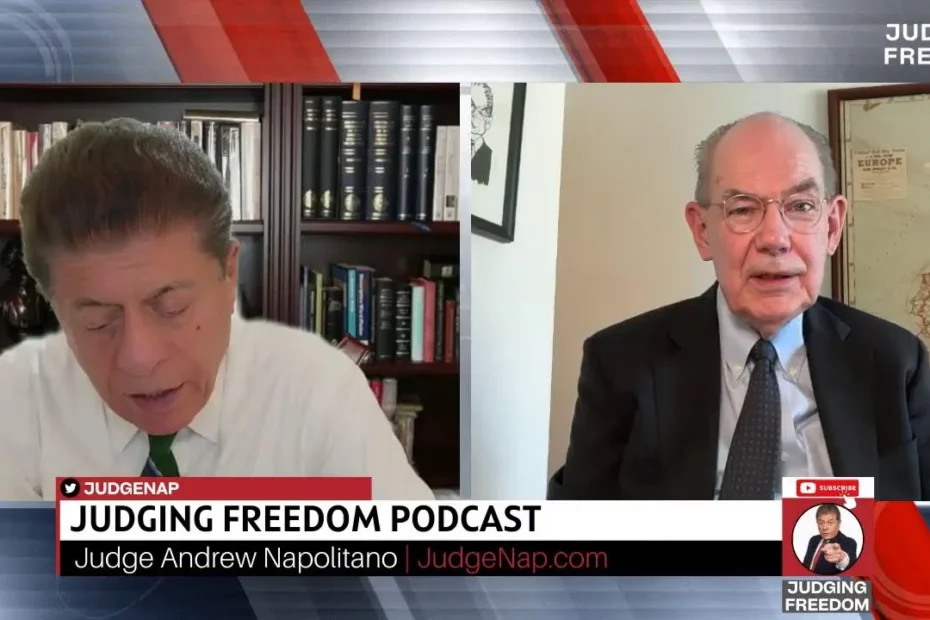
Read the full transcript of international relations scholar Prof. John Mearsheimer’s interview on Judging Freedom Podcast with host Judge Napolitano on “Trump’s Flawed Gaza Plans”, October 2, 2025.
Russia as a “Paper Tiger”
JUDGE NAPOLITANO: Hi everyone. Judge Andrew Napolitano here for Judging Freedom. Today is Thursday, October 2, 2025. Professor John Mearsheimer will be here with us in just a moment on the Donald Trump, Steve Witkoff, Jared Kushner, Benjamin Netanyahu, deeply flawed Gaza plan.
Professor Mearsheimer, thank you for joining us today. Thank you for accommodating my schedule. Before we get to your analysis of what I know you have called this flawed so-called Gaza peace proposal, what is your take on President Trump’s public reference to Russia as a “paper tiger”? Do you think this was a slip of the tongue, something he just thought of off the top of his head, or as part of some sophisticated effort to negotiate with President Putin?
PROF. JOHN MEARSHEIMER: No, I think it was a slip of the tongue and he’s walked it back. He understood shortly after making that comment that it did not make sense to argue that the Russians are a paper tiger. He wishes the Russians were a paper tiger. Then he’d have his peace agreement. But they’re anything but a paper tiger.
JUDGE NAPOLITANO: The day before he made the paper tiger comment, he rather ostentatiously authorized the American intelligence community, civilian and military—so CIA and DIA and whatever else there is—to aid the Ukrainian military in aiming American weapons to reach deep inside Russia. I would think normally a finding or an authorization like this wouldn’t be made public, but he made it public. Is the United States at war with Russia?
An “Almost War” with Russia
PROF. JOHN MEARSHEIMER: It’s what I call an “almost war.” I mean, we’re obviously not doing the actual fighting. We don’t have trigger pullers out there on the ground, but we’re about as close as you can get to participating in this war without formally being in it. The Russians basically think we’re at war with them.
But anyway, back to providing intelligence for missiles to hit inside of Russia—for that to really matter, we have to give the Ukrainians missiles and then we have to give them permission to use those missiles. And just to take the famous ATACMS, which we once gave to the Ukrainians, Trump stopped giving the Ukrainians ATACMS and he’s not giving them permission to use those ATACMS.
So today when we talk about giving intelligence to the Ukrainians, we think about it in the context of giving the Ukrainians Tomahawk missiles. Trump has made no decision to give them Tomahawk missiles. And even if he does give them Tomahawk missiles, it’s not clear that he’ll give them certainly blanket permission to use them. But even in selected instances, it’s probably going to be the case that he won’t let them use the Tomahawks.
So I think that there is escalatory potential here if he were to give the Ukrainians lots of Tomahawks and give them blanket use. But I just don’t think that’s going to happen.
The Risk of Nuclear Escalation
JUDGE NAPOLITANO: So if he gives the Tomahawks and one of our guests—who’s not a military person but is a very, very astute journalist—said, “Okay, you’re a Russian lieutenant looking at a radar screen. The colonel is a few rows behind you and you go, ‘Colonel, there’s some Tomahawks coming at Moscow. I don’t know if they have nuclear warheads on them. What do we do, Colonel?'” Is that realistic?
PROF. JOHN MEARSHEIMER: It is realistic. There’s no question about that. I mean, you have all sorts of weapons in the inventories of countries like the United States, China and Russia that have a dual-use capability. They can be used conventionally or they can be used with a nuclear warhead on them.
A good example of this, by the way, is when people talk about fighting a possible war between the United States and China and the United States starts attacking Chinese military equipment and weaponry. The problem that you run into is a lot of the missiles and planes that you think you’re destroying, that you think are conventional weapons, may have nuclear warheads on them. And the command and control systems that the Chinese have are used for both nuclear war fighting and conventional war fighting.
So if you start tearing those command and control systems apart, it influences the nuclear balance, not just the conventional balance. So you run into the risk of inadvertent nuclear escalation, which would be a disaster. And then if we go back to the Russian case, if you’re the Russians and you see a Tomahawk missile coming at you and you know they can have either a conventional warhead or a nuclear warhead, there will be at least a few people who think worst case and think it may be a nuclear warhead on that missile.
JUDGE NAPOLITANO: So if President Trump is not sending ATACMS anymore or the Tomahawks, without getting too technical, have we given the Ukrainians weapons that can reach inside of Russia—weapons which, either for practical or national security purposes, need to be armed and aimed by American personnel?
PROF. JOHN MEARSHEIMER: Well, there’s no question of that. I mean, you saw it with the ATACMS that we have given them. But the question is, how many weapons do you give them? And I think in an important way, the key issue is how effective those weapons are.
For example, if we were to give the Ukrainians, let’s say, 25 Tomahawk missiles and the Russians were able to just shoot them down routinely, it wouldn’t matter that much. But if you give them 250 Tomahawks and those are deadly effective weapons that they simply can’t shoot down, that’s a very different story. The potential for escalation in that second story is much greater than it is in the first story.
So I think even if Trump were to give the Ukrainians Tomahawks, my guess would be that he would really limit when they could use those Tomahawks, and he would limit how many they could use, because Trump, like Biden before him, understands that we are always flirting with the possibility of nuclear war when we up the ante vis-à-vis the Russians.
Secretary Hegseth’s Lecture: A Lack of Gravitas
JUDGE NAPOLITANO: In your undergraduate years at West Point and your time in the US Army and in your time in the United States Air Force, did you ever receive a lecture the likes of which Secretary Hegseth gave to 800 generals and admirals the other day at Quantico, Virginia?
PROF.
JOHN MEARSHEIMER: No, I’ve never seen anything quite like it. And when I was watching Secretary Hegseth talk, I kept thinking about two words, maybe three words. One was “command presence,” and the other word was “gravitas.”
And what you expect from the Secretary of Defense, what you would expect from a general officer, and I would argue from even colonels and majors and captains, is command presence. And you would also expect those individuals, especially the higher you go up the chain of command, to include civilians like the Secretary of Defense, to have gravitas—to look like they’re adults, to look like they’re your parents or your grandparents. You know, these are responsible people. These are people who have the fate of the country in their hands.
And I would just say when you watch Secretary of Defense Hegseth, you see none of that. This is a man who has zero gravitas and zero command presence. And he’s actually kind of funny. I mean, the substance of what he says is not funny, and certainly the substance of what President Trump said is for the most part not funny. But with regard to Secretary of Defense Hegseth, it’s actually kind of funny. And I’ve watched some of the late night shows doing parodies of him, and he provides abundant material for them for all the obvious reasons.
American Cities as Military Training Grounds
JUDGE NAPOLITANO: Here’s a part of what President Trump said which troubled me the most. My column this week is called “Who Will Protect Us from the Protectors?” And it argues aggressively against troops in the streets and against the militarization and federalization of police. Not always an issue we talk about, but because the president alluded to this and then got very direct about it before all these admirals and generals. By the way, Colonel Wilkerson said it cost $100 million to fly all of them in from the four corners of the earth in the short time period they were given. Anyway, here’s President Trump, I believe, making the worst comment of the day.
VIDEO CLIP BEGINS:
PRESIDENT TRUMP: San Francisco, Chicago, New York, Los Angeles—they’re very unsafe places, and we’re going to straighten them out one by one. And this is going to be a major part for some of the people in this room. That’s a war, too. It’s a war from within.
Controlling the physical territory of our border is essential to national security. We can’t let these people in. We’re under invasion from within. No different than a foreign enemy, but more difficult in many ways because they don’t wear uniforms. At least when they’re wearing a uniform, you can take them out. These people don’t have uniforms.
I told Pete we should use some of these dangerous cities as training grounds for our military National Guard. But military.
VIDEO CLIP ENDS:
JUDGE NAPOLITANO: American cities as training ground for the military. Madison, Jefferson, flipping in their graves.
PROF. JOHN MEARSHEIMER: I would imagine that almost every general and admiral agrees completely with what you just said. I don’t believe they were pleased at all to hear what President Trump was saying. And I think they understand that what he was saying is a threat to liberal democracy.
The idea that you’re going to use—you’re going to go to war against the enemy inside of cities like Chicago, where I’m sitting—you’re going to use that as a way of training the US Military for fighting wars overseas is, first of all, ludicrous, but it’s also just fundamentally dangerous.
We go to great lengths to use the US Military as sparingly as possible inside American cities. Sometimes they have to be used, but you try not to do that. And when you do it, you do it carefully, and you do everything you can to rely more on the local police force than on the American military. So I think that this is just very, very dangerous.
The other thing is talking about the “enemy from within” and, you know, oftentimes making the argument that that’s the left and that’s reflected in the Biden administration. It’s just something he should not be doing. You do not want to politicize the military. The military is supposed to be apolitical. These folks are supposed to support Joe Biden every bit as much as they support President Trump. He is the commander in chief, and Joe Biden, when he was president, was the commander in chief.
And we can’t have an effective military if they don’t abide by what the president says, whether he or she is a Democrat or a Republican. And all these generals fully understand that.
Targeting Black Officers and Women
The other thing is, you know, it’s quite clear that what President Trump is doing is he’s putting the crosshairs on black officers at the top and on women. If you look at the people that they fired, and this is hardly surprising, I would be willing to bet a lot of money that virtually every general in that audience and every admiral in that audience thinks that this is a categorically bad idea.
Anybody who’s been in the American military understands it is a remarkably heterogeneous group of people. It’s not just filled with white people. It’s filled with people of all different kinds. And anybody who’s going to be a commander in that military has to be accepting of that fact.
And furthermore, the more you go along, you come to realize that there are women who are very talented, more talented than a lot of guys. And the same thing is true if you want to look at it from a black-white or Hispanic-white perspective, whatever. And these generals and admirals surely understand that Trump is going to cause unending trouble if he continues down these various roads he’s been headed down.
Who Are the “Enemies Within”?
JUDGE NAPOLITANO: So who are the enemy within? A guy who overstayed his visa, but has an American wife and American children, and runs a small business and employs people, but is technically here illegally. He’s law-abiding and pays taxes.
The superintendent of a school who maybe was a little wild when he was a kid and got here illegally, but went to college, has a PhD and now runs one of the largest school systems in the country.
An American born here, but who speaks with a Hispanic accent, who’s been arrested twice and didn’t believe the masked men who arrested him that he’s an American.
Who are the enemies within?
Trump’s Immigration Rhetoric and the “Enemy Within”
PROF. JOHN MEARSHEIMER: Well, the problem is that he’s not clear. And it also includes people on the left. I mean, he’s out to get people who have left-wing political views. And this is just a no-no.
But the other thing is, let’s just take illegal immigrants. I think lots of people, me included, think that Joe Biden made a fundamental mistake letting all these illegal immigrants in. And Trump has decided that he’s going to get as many of those illegal immigrants out of the country as possible. Okay, but these people are not the enemy within. The rhetoric is just terrible. The enemy within.
These are people who came to the United States for the same reason your relatives and my relatives came. They came because they saw this as the land of opportunity. Our relatives got in legally. These people got in illegally. And we can’t have illegal immigration. Biden made a huge mistake. But these are not bad people. These are not the enemy in the sense that you’re dealing with Nazis or communists who want to overthrow the government. These are people who want to be Americans.
JUDGE NAPOLITANO: Right. So before we transition over to the Gaza plan, one last question. I never thought I’d be asking you this, Professor Mearsheimer, have the troops arrived in Chicago yet?
PROF. JOHN MEARSHEIMER: I think they’re small numbers, but I haven’t seen any. And I was actually downtown yesterday looking for them, didn’t see any of them. So if they’re here, they’re few in number.
JUDGE NAPOLITANO: This is crazy that we’re talking about this, but we have to because this is what he’s thrust upon us.
PROF. JOHN MEARSHEIMER: But you also just want to remember the crime rate in Chicago has been going down. The idea that this is a crime-infested city where you can’t walk anywhere bears little resemblance to reality. Yes, we have neighborhoods where there’s a lot of crime, and it’s inside those neighborhoods where people kill each other or rob each other for the most part.
But huge chunks of the city are remarkably safe. And huge chunks of the city are very safe or quite safe. Central cities in the United States are not the safest place in the world. We all agree on that. But the idea that this is one big teeming jungle and everybody’s out there killing each other in a Hobbesian type way bears zero resemblance to reality.
The Gaza Peace Plan: A Neocolonial Approach
JUDGE NAPOLITANO: The Donald Trump, Steve Witkoff, Jared Kushner, Benjamin Netanyahu Gaza peace plan with Tony Blair as the neocolonial Governor General of—I realize I’m putting a little spin on this—Governor General of Gaza. I mean, you couldn’t make this up with a cast of characters. How is this going to play out beyond the announcement the other day?
PROF. JOHN MEARSHEIMER: Well, it’s a terrible plan. I mean, that’s the first thing that we should emphasize. Basically what happened here is that the Trump administration came up with a plan and then the Israelis vetted it. Netanyahu himself and Ron Dermer, who was one of his principal assistants, worked with two super Zionists, Jared Kushner and Steve Witkoff, to fashion the plan so that it would be satisfactory to Benjamin Netanyahu so that he could say after his meeting with the president that he was on board.
He was on board, of course, because he helped write the plan. It was an Israeli-American plan. And of course, what role did Hamas play in crafting this 20-point plan? The answer is zero. And they were presented with a fait accompli. And President Trump told them they had three or four days to make up their mind or all hell would break loose.
So if you just look at the whole process, you sort of wonder, is this really the way to design and execute a peace process? And the answer is almost certainly no.
Then you look at the deal, just a number of points here. First of all, the Palestinians have to give up all 48 of the hostages. Quite a few of them are dead, by the way. But they have to give up all the hostages within the first 72 hours. And everybody knows the hostages are the only leverage that the Hamas fighters have. So they have to give up their only leverage in the first 72 hours.
Then they have to completely disarm. Hamas has to completely disarm to the point where it even destroys all of its tunnels, so it’s defenseless. Then the Israelis don’t withdraw immediately. They withdraw in phases. And that means that they’ll stop probably at phase two, certainly at phase three. But even in the end, if they do withdraw, they don’t withdraw completely from Gaza. They’re on the perimeter. So those are the first three points that favor the Israelis.
But then you get to the really important stuff, which is the politics. First of all, there’s no end game here. There’s no horizon. And the 20th point, if you look at it carefully—remember it’s a 20-point document—the 20th point talks about the political horizon, says there’s no political horizon, and says that we’re going to have discussion on what the political horizon is. This means the Palestinians are not going to get a state of their own. And of course, Netanyahu has made it clear after his meeting with Trump they’re not getting a state of their own.
Well, if they’re not getting a state of their own, what are they getting? There’s no answer there. And then there’s the whole question of political control, self-determination. What happens inside of Gaza once the shooting stops? Who’s in control? And the answer is not the Palestinians.
The answer is that you’re going to bring in some Arab armies and Tony Blair and so forth and so on. And President Trump himself, he’s going to be the head of the so-called Board of Peace and they’re going to run Gaza. And then at some point after they finish training the Palestinian Authority, the Palestinian Authority can take control. This is the first time the Palestinians get to control their own fate. And it’s somewhere in the distant future.
But notice who is determining which Palestinians will run the place. We are. We’ve determined it’s the Palestinian Authority, which has zero legitimacy among the Palestinian population. And we’re going to train it up so it does what we want and then it is going to be put in charge. This is neocolonialism.
JUDGE NAPOLITANO: So Tony Blair, who used to live at number 10 Downing Street, is he now going to live in Gaza City?
PROF. JOHN MEARSHEIMER: I wouldn’t be surprised if he has a place in Gaza City. Probably won’t spend much time there. He’ll be flitting around the world doing this and that.
Netanyahu’s Post-Meeting Claims
JUDGE NAPOLITANO: Here’s Prime Minister Netanyahu immediately upon landing in Tel Aviv. So he flew from Dulles, he went from the White House to Dulles to Tel Aviv. Here’s the first interview he had, not on Israeli television, but on the journalist’s mobile phone. And not in English, in Hebrew, but of course we have the translations.
VIDEO CLIP BEGINS:
BENJAMIN NETANYAHU: Instead of Hamas isolating us, we turned the tables and isolated Hamas. Now the whole world, including the Arab and Muslim world, is pressuring Hamas to accept the conditions we set, together with President Trump, to release all our hostages, both the living and the fallen, while the IDF remains in most of the Gaza Strip.
Who would have believed this? After all, everyone kept saying, “You have to accept Hamas’s terms to withdraw. Everyone, the IDF needs to withdraw and Hamas can recover and also rehabilitate the Strip.” No way. That’s not happening. On the contrary. And President Trump added that if Hamas refuses, he will give Israel full backing to complete the military operation to eliminate it. And that’s why I think from every perspective, this was an excellent visit.
Many in the government, there’s a question being asked, “Did you agree to a Palestinian state?” Absolutely not. It’s also not written in the agreement. But one thing we did say is that we will strongly oppose a Palestinian state. President Trump also said that. He said he understands that. He also said at the UN that it would be a huge reward for terror and a danger to the state of Israel.
VIDEO CLIP ENDS:
JUDGE NAPOLITANO: IDF remains in most of the Gaza Strip. The agreement does not provide for a Palestinian state. He didn’t add this, but he meant in the future. What did he do, change the terms between the time he left Trump and the time he landed in Tel Aviv?
PROF. JOHN MEARSHEIMER: Well, if you read the document carefully, it comes very close to saying what he said. This is why the document is a disaster. By the way, when various proposals were floating around before this 20-point plan came out, there was a 21-point plan. And the 21st point that disappeared had to do with annexation of the West Bank, where it said in the document that Israel would not annex the West Bank, which of course is a point that President Trump likes to make. But I would note to you, you see no reference to that in the 20-point plan that was issued this past Monday.
Trump’s Leverage and the Lobby’s Influence
JUDGE NAPOLITANO: You know, Trump said he would stop Netanyahu from annexing the West Bank. How can he do that?
PROF. JOHN MEARSHEIMER: Well, I don’t know. I mean, he certainly has it within his power. But when you look at what the lobby can do to him, it seems to me that Israel and the lobby have something on him. He has zero maneuver room.
JUDGE NAPOLITANO: Well, what can they do to him since he doesn’t have to and can’t run for re-election?
PROF. JOHN MEARSHEIMER: They may have very embarrassing material on him that he just absolutely does not want in the public domain. I mean, think about the Jeffrey Epstein files. Don’t you find it quite remarkable the extent to which the Trump administration and before that, the Biden administration went to allow these files out into the open. There has to be lots of material in there that’s very damning for a lot of very important people.
JUDGE NAPOLITANO: If there are pictures of Donald Trump doing something that would be unanswerable if the public saw it, wouldn’t the Biden people have gotten that out during the election to help Kamala Harris?
PROF. JOHN MEARSHEIMER: No, because there are probably pictures as well of Democrats who would be devastated or destroyed if the tapes of them were released as well. Again, you want to realize that the Biden administration had zero interest in letting the Epstein files out, and the Trump administration has followed suit.
JUDGE NAPOLITANO: Would the donor class destroy Trump? He’s their best friend they’ve ever had in the White House.
PROF. JOHN MEARSHEIMER: If Trump turned on Israel, they’d go to enormous lengths to destroy him. I find it hard to believe that you even asked that question. That’s the way they operate. They’re incredibly ruthless and they believe that Israel’s survival is at stake here.
It’s very important to understand that certainly in the immediate aftermath of October 7th, but even running up to now, I think Israel’s supporters outside of Israel and Israel itself is profoundly worried about Israel’s future. I mean, its reputation has been destroyed. If you look at public opinion polls, you know, the New York Times has just done a big public opinion poll gauging where the American public is on Israel. And these have to be frightening numbers for the Israelis and for their supporters.
And they’ll go to great lengths to do whatever is necessary to protect Israel. So I think if Trump turns on Israel, they’ll go after him.
JUDGE NAPOLITANO: I asked you that question just to get under your skin a little bit.
PROF. JOHN MEARSHEIMER: That’s your job.
JUDGE NAPOLITANO: As fond as I am of you and grateful as I am for all the incredible knowledge you have that you share with the audience. Professor Mearsheimer, a pleasure. My goodness, the 30 minutes went by like that. But thank you very much for your time as always, and we look forward to seeing you next week, my dear friend.
PROF. JOHN MEARSHEIMER: I look forward to it. I look forward to it as well, Judge.
JUDGE NAPOLITANO: Thank you, Professor. Coming up with that, six shows for you today. We’ll take a little break till tomorrow. Tomorrow, Friday at 4:30 in the afternoon, we will summarize all of this with Larry Johnson and Ray McGovern in the Intelligence Community Roundtable. Judge Napolitano for Judging Freedom.
Related Posts