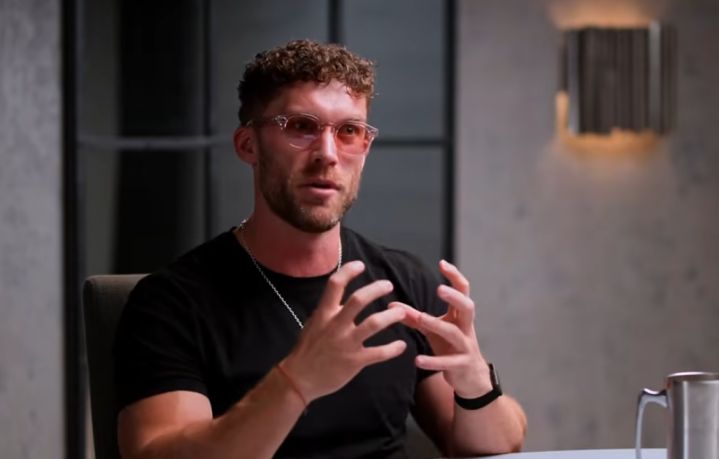
Here is the full transcript of podcaster and YouTuber Chris Williamson’s interview on The Diary Of A CEO Podcast with host Steven Bartlett, December 29, 2025.
Brief Notes: In this deeply personal and highly practical episode of The Diary Of A CEO, Steven Bartlett reunites with Chris Williamson to help you design a transformative 2026. Chris shares his blueprint for turning vague aspirations into concrete results, using frameworks like the “Lonely Chapter” and “Region Beta Paradox” to explain why growth often feels like a crisis. Beyond the productivity hacks, Chris opens up about his own “broken” year—a silent battle with toxic mold poisoning that stripped away his energy and cognition, forcing him to find joy in “boring victories”. From mastering the art of the annual review to understanding why “suppression isn’t strength”, this conversation is a masterclass in resilience and the pursuit of a life that feels as good on the inside as it looks on the outside.
Does This Time of Year Actually Matter?
STEVEN BARTLETT: Chris, my audience care a lot about changing their life for the better. And I think at this time of year, change is front of mind for everybody. Everybody’s thinking about New Year’s resolutions, who I want to become in 2026. But when you look at the stats, 23% of people quit by the end of the first week of January, their New Year’s resolution, the thing they aimed at. Roughly half of people will quit their New Year’s resolution, the change they sought by the end of January. And only about 9% of people will keep their New Year’s resolution for the full year.
So I guess my opening question to you is, does this time of year matter at all? Is it a useful, productive time to be thinking about change in your point of view?
CHRIS WILLIAMSON: I think the world is split into two camps. One camp says there is no difference between January 1 and December 31. Why wait? It’s December 10. Just do it now. And the other camp likes the idea of there being a culturally appropriate moment to stop doing something and start doing something else.
Most people need to realize that they’re already spending tons of time worrying about the future and the past. They’re going back to this thing that they regret. I wish I’d done this differently. Oh, I have rumination about something that occurred. I have a sense of wistfulness for something that I’ve maybe missed. I have grief for something that I’ve lost.
And then they’re concerned about the future. They think, I’m certain about this thing that’s going to happen. I could plan. I could try and come up with a solution for this. So you’re already worrying about the past. You’re already doing reflection and planning just in a very unstructured way where you don’t get to choose when it hits you in the face.
This is a culturally appropriate moment, like a scheduling appropriate moment for you to just step in and think, okay, in between Christmas and New Year, people that work in retail, God bless you, people that have got to go back to work and do that thing. But usually there’s a bit of downtime, it’s a little bit slower. It’s Boxing Day, chilling out on the couch, and you’re kind of thinking, wow, I was here again at mom and dad’s house or with the in-laws or whatever. What was I doing last year? What was it like last year?
You’re already in a little bit of a reflective mode. There is no special magic super secret squirrel source in January 1st. But it is a good moment to check in because life tends to slow down a little bit. Work time is a little bit more slow and you’re already doing this. You’re already thinking about the past and the future. And this is just a good structured opportunity to check in and do it.
What Should I Aim At?
STEVEN BARTLETT: I guess the question that everybody should be asking themselves is, what should I aim at? And is there such a thing as aiming at too many things? What is a good goal for change? When you think about all the people you’ve interviewed and the change you’ve seen in your own life, what does a productive New Year’s resolution or productive goal sound like? And how do I get there?
CHRIS WILLIAMSON: Yeah, it’s very overwhelming. If you realize, wow, I can do anything I want. I could look at my entire life. That’s terrifying. That’s absolutely terrifying.
One thing I would say, this is your opportunity to change anything behaviorally. You can change anything you want, not everything you want. Right? That’s the problem. You can become anything you want behaviorally, but you can’t be everything you want. So you need to pick a small number.
The single best question to work out what you should be doing next year: “What would have to happen by the end of 2026 for me to look back on 2026 and consider it a success?” I think that really helps to just give you a bit more perspective. And it usually comes down to only a few things. You don’t usually have so much in your mind when you do that.
Setting the bar unrealistically high does not increase your performance. Imagine this. Imagine that you went into a buffet and you made your plate as big as possible. You said, I want all of these things. I’m going to put all of this stuff on my plate and my stomach is going to expand to be able to fit it. That’s not the way that our stomachs work and that is not the way that our workloads work.
So first rule, in order to pick something up, you have to put something down. Don’t assume that just because you’ve loaded more onto your workload plate, your work capacity will expand to be able to fit it into your stomach. That’s not the way that it works.
Assume, make the assumption I can do no more than I’m doing now.
That’s a really important thing because at the moment it’s December 29th and I’m full of gusto and motivation and I can’t wait. I’m going to crush it. And yeah, for the first week maybe you’ve got that. But if you’re using motivation and enthusiasm to work yourself through your goals, your goals are predicated largely on a fuel source that you don’t have control over. Don’t have a massive amount of control over your motivation over a long amount of time. It comes and then it goes. You want something that’s a little bit more rigid. So in order to pick something up, you have to put something down.
The Addition and Subtraction Framework
STEVEN BARTLETT: I think that’s a really important point because when we think about the goals we’ll start setting at this time of the year, all of them are asking for more time or more energy. Pretty much all of them ask for, I want to start running, I want to start going to the gym. Whereas as you say, that means I’m going to have to take something off the plate.
And we don’t think about subtraction at this time of the year. Typically we don’t think, I’m going to spend less time with my friends, I’m going to cut out Netflix. We think of addition, but logically there’s still just the 24 hours in a day and the finite amount of body budget that we have in terms of energy. So you saying that I have to create both an addition and subtraction list and make sure that they equal out, they net out to zero.
CHRIS WILLIAMSON: That would be optimal. I think one question that you really should be asking yourself. Let’s go through a bunch of uncomfortable questions people can ask themselves. That could be cool.
Okay, how would I spend my day if I wanted to make 85-year-old me as miserable as possible? What is it that I did over the last year that made me right now feel this constriction?
STEVEN BARTLETT: Okay.
CHRIS WILLIAMSON: I don’t like my relationship with my phone. I spend a lot of time on my phone. I don’t like how my mornings aren’t very productive. I’ve noticed that when I’m with my friends, I’m not very present. I’ve noticed that I spend a lot of time on my own. I tend to isolate when things get difficult.
I’ve noticed that I’ve got into the habit of not telling the truth when people ask me a question. I’ve noticed that I’ve got into the habit of not advocating for my needs when I should do. I don’t hold my boundaries sufficiently well. This is why the reflection part’s really important.
So what would I do to make 85-year-old me as miserable as possible? How would I spend my day and in what ways am I already doing that? Well, a lot of those are going to cross over. That Venn diagram is not going to be as far apart as you might think it is.
The Movie Question
STEVEN BARTLETT: I heard you ask the question before about if someone was watching this and it was a movie.
CHRIS WILLIAMSON: Yeah, I mean, this question is so fantastic. If your life was a movie and the audience were watching up to this point, what would they be screaming at the screen telling you to do with your life? They would be, it is obvious, leave the relationship. The job is not working for you, the killer’s hiding in the cupboard. What would the audience be screaming at the screen telling you to do with your life?
STEVEN BARTLETT: So you’ve asked three questions and I’m going to ask you those three questions.
CHRIS WILLIAMSON: Okay.
STEVEN BARTLETT: So the first question you asked was about what would have to happen at the end of next year to look back and consider this year a success.
CHRIS WILLIAMSON: So for you personally, I want to spend more time thinking about ideas and less time caught up doing admin. Admin is a drainage on me. I don’t enjoy emails, I don’t enjoy the operations of that sort of stuff.
STEVEN BARTLETT: Spend time making or…
CHRIS WILLIAMSON: Yeah, I want to be in maker mode, not manager mode would be a way to put it. I want to spend more time with my friends. I’ve been solopreneur grind set, you know, pick it up and lift it type thing a lot for the last forever. More time with my friends, more time connecting with people.
So that’s two things. If I can do that, spend more time with my friends and less time doing admin. Now one of the problems that you have is, and I want to lose 20 pounds and I want to get my bench press up to 200 kilos and I want to do this. It’s like really, do you really, really, really want that? Because when I think about it, I have much more gentle goals, have much broader goals, and that’s the stuff that I think is important to me.
STEVEN BARTLETT: And if we think about your subtraction framework, what are you going to have to subtract?
CHRIS WILLIAMSON: What’s interesting about those is that actually those aren’t necessarily additions. The friends thing is an addition, but the executive functioning thing, the admin burden, is not. So actually that’s nice because I want to do less of that thing, which should hopefully open up a little bit of time.
What would I need to get rid of? I’d realistically need to get rid of some time sat in front of my computer doing boring admin stuff. I’d probably need to spend less time scrolling on my phone, less time on social media. I would maybe need to make some sacrifices in training as well. If I’m going to go out with my friends a little bit more in an evening, I’m going to have to get up a bit later. So there’s some of the trades that we’re have to make.
STEVEN BARTLETT: The other question was around, if this was a movie and the audience was screaming at you, what would they be screaming?
You’re Already Doing Enough
CHRIS WILLIAMSON: You’re already doing enough. You’re already doing enough. Stop whipping yourself into submission thinking that your happiness sits on the other side of the next set of goals that you’re going to achieve. You’ve already achieved goals that you said would make you happy. So if you haven’t made it now, if this isn’t when life is going to begin, then when are you going to start?
There’s this wonderful idea of the deferred life hypothesis. Deferred life hypothesis is basically the sort of common belief that our life hasn’t yet begun, that what’s happening now is a sort of prelude. It’s an intro to our life truly beginning. And upon reflection, what a lot of people realize is that this prelude that they run through was a mirage that sort of faded as they approached. And they were actually just running toward the end of their life. They’re permanently putting things off.
I get it. People have got realistic structural monetary requirements. They’ve got to get up, they’ve got to go to work, they’ve got to f* change their nappy, they’ve got to walk the dog. They’ve got things that they need to do. That’s not what I’m talking about.
My point is everybody thinks, a lot of people think in one form or another, that my life will begin when. They’re holding the happiness hostage. They’re in a holding pattern, like a plane that can’t land for some reason. It’s like, what if that never changes? What if your problems in life are never, ever going to go away? What if problems are always going to be there?
What then? Oh, wow, well, I’m never going to arrive. That means I need to start living now. And I think for me, there’s definitely a lot of I will get there when. Once the tasks of today are completed, once the problems are gotten through, there’ll never be a time when there’s no problems in life. Problems are a feature, not a bug.
The Curse of Human Striving
STEVEN BARTLETT: I sometimes wonder if this is a trait of just human evolution. Like, it makes survival sense for it to be hardwired into my genetic code to strive, to basically continue to strive, like, to continue to conquer, to continue to build. And in fact, maybe if my ancestors didn’t have that, we wouldn’t be sat in a room now with all these lights and fancy cameras and such, because this is the consequence of a species that strive.
And so I wonder if this is like the curse of being human, which is we just endlessly strive and then we die because we did, our offspring have a higher rate of survival. And when I speak to people from, you know, like, East Asian traditions and stuff, they talk about being at peace and being at one and being satisfied and all these things. But it seems so alien to me to be satisfied.
I think I live in a dichotomy where I’m well aware nothing will change my happiness. And then at the same time, I’m completely striving as if it would.
CHRIS WILLIAMSON: Of course, that’s a human condition. We habituate in both directions. So if your ancestors had been satisfied when they got to a cave, when their family grew and they needed a bigger cave, you don’t just go and find one bush, you find a ton of bushes, and then you expand and that gives you additional security.
But unfortunately, in the modern world, that causes us with an infinite amount of things that we can do and can chase after. We sacrifice the important for the urgent. The urgent’s always in front of us. The email, the next meeting.
STEVEN BARTLETT: Yeah.
CHRIS WILLIAMSON: And this is again, why should anybody care about doing an annual review? Should anybody care about the New Year? Well, you’re busy living your life for almost the entirety of the year. And this is one moment where the urgent can just take a tiny bit of a backseat and the important can come through.
Who have I been over the last year? What do I want from next year? Every single year is a chapter of your life for next year. It’s chapter 38 for me. What do I want that chapter to be about?
Rewriting Your Internal Code
STEVEN BARTLETT: Do you think there’s a single change you could make to your life that would yield the greatest return on happiness? Like if you could go into your own hardware and rewrite the code a little bit?
CHRIS WILLIAMSON: I think less striving would actually make me happier. I think that a lot of striving and a desire for success comes from a sense of insufficiency. If only the world recognized my brilliance, then I will be validated. And it takes a long time to realize that you don’t fix internal voids with external accolades.
The problem with that is it’s an unteachable lesson. You try and tell people that money won’t fix your happiness problem or fame won’t fix your self worth problem. You should see your parents. More time in a hammock is never wasted. You don’t love that pretty girl. She’s just hot and difficult to get.
Like all of these things are only lessons that you can learn once you got there. And people who haven’t yet gotten there think, well, that’s easy for you to say. And then when they arrive, for some reason, they seem to evangelize the same insights, like somebody that’s just gone through religious revelation.
So either one of two things is true. People who achieve a thing are lying about the fact that that thing didn’t fix their problems. Their internal void with external accolades because of they’re part of some cartel that’s trying to pull the ladder up after they’ve just gotten in. Or it’s the truth, but it’s an unteachable lesson.
You will not understand that that thing outside won’t fix your internal void until you get there. And I actually think it’s a Naval quote. It’s far easier to achieve our material desires than to renounce them. Like, if you want a Ferrari, it’s much easier to actually work real hard and try and get some nice car, whatever it is, so that you learn that the car isn’t the thing that you want than it is to rid yourself of the desire for the car overall.
And that’s not to say that getting a Ferrari is easy. It’s to say that getting rid of the desire is essentially impossible.
The Internal Void
STEVEN BARTLETT: I think me and you are probably two guys that at some deep level had some kind of internal void. Is that accurate statement?
CHRIS WILLIAMSON: Of course. Are you speaking in the past tense?
STEVEN BARTLETT: Have. Have.
CHRIS WILLIAMSON: Yeah, yeah.
STEVEN BARTLETT: You’ve now accomplished so much. You’re like one of the biggest podcasters on planet Earth. You’re famous, people know who you are.
CHRIS WILLIAMSON: The biggest in the world talking to second biggest in the world. Congratulation.
STEVEN BARTLETT: But people know who you are. You’ve got, you know, money, you’ve got freedom now. You can go wherever you want, do whatever you want. People know who you are. You get restaurant reservation tables. You did it. Is it what you expected? And has it actually changed that internal void?
CHRIS WILLIAMSON: The interesting thing is I never actually thought I was going to amount to much. I was just really interested in what I was doing, what was in front of me. I didn’t think this is going to lead to me being some, achieving something or living in America or whatever. Each different step got me there.
But no, of course not. Of course the unteachable lesson has smashed me in the face, which is, fame won’t fix your self worth. Money won’t make you happy. You should see your parents more. You can take a day off. All of these lessons, you have to live them to learn them, unfortunately.
STEVEN BARTLETT: And my last question on this is, when I asked about the change to your code that you’d make, you talked about fixing the striving. What’s been the downside of the striving?
CHRIS WILLIAMSON: There’s a common sense of not enoughness. Like I will be enough when. Right. Because you can either run away from something you want or run towards something. Run away from something you fear or run towards something you want.
STEVEN BARTLETT: And what’s the consequence of that not enoughness?
CHRIS WILLIAMSON: It’s a sense of lack. It’s also a provisional life. It’s putting life off. I will be happy, satisfied, peaceful, when.
STEVEN BARTLETT: And is that a thought you have?
CHRIS WILLIAMSON: It’s more like an embodied sense. Yeah, I very much feel it. It’s this striving, it’s this pull, it’s this sort of magnetism moving forward. But yeah, dude, if your life was a movie and the audience were watching up to this point, what would they be screaming at the screen telling you to do? It’s usually a very reliable indicator of where you should be putting your attention.
Defining Success For Yourself
STEVEN BARTLETT: So as we think about next year, the things one should aim at. What I’ve heard you, I think you said on the High Performance podcast, you said you’re really obsessed with understanding what success actually is. So I also, just before we go into the more practical things. If someone sat at home, and I know people come up to you on your tours and ask you questions like this a lot. They’re sat at home trying to figure out what success actually is for them.
Is there a framework or a principle or a method to figure out what it might mean for them? I’ve heard you talk about two ideas which I love, which is the region beta paradox, but also the parable of the Mexican fisherman, which I think both stayed with me in a profound way.
CHRIS WILLIAMSON: Yeah. So three things. Success, region beta, Mexican fishermen. What success looks like for any individual person is going to be different for you. Knowing that you really want a family. There’s people out there that are like, I’m not that fast. I don’t think that that’s on the cards for me. And that’s fine. Other people might really, really want to put the workload down and step off and go and do the dad or the mum thing.
Unfortunately, you can’t take somebody else’s purpose or success. Like that’s, you can’t wear it as a suit. It’s a bad idea. Right. Because it’s going to not fit. And wonderful line, let go or be dragged. If something doesn’t fit, eventually it’s going to hurt wearing it.
And that means if you’re not careful with how you design what it is that you chase after, you can spend your entire life realizing that you climbed a huge f*ing ladder, a very, very long ladder that was leaning up against the wrong wall. And you need to ensure that you don’t do that. And this is why we need to just sit with ourselves, sit with a little bit of reflection. And that’s why this time in between Christmas and New Year, I think is a really wonderful time to do this.
So how do you work out what it is that you want to do? The big picture goals are going to be hard for you to get to. But if you just think one year ahead, what do I want over the next 12 months? I think that usually helps you. And maybe you want to be in a relationship. I want to be in a committed relationship with someone who really loves me. Okay, now we can start to talk about plan to do that.
But you need to have a little bit of silence. It’s like a problem with permanently being busy. Stops you from being able to listen to fleeting thoughts that are in the back of your mind. And that quiet voice is usually the really powerful one. But there’s a wonderful line. “The answers you seek are in the silence you’re avoiding.” The answers that you seek are in the silence you’re avoiding.
Finding Silence and Meditation
STEVEN BARTLETT: Do you meditate?
CHRIS WILLIAMSON: Of course.
STEVEN BARTLETT: You do.
CHRIS WILLIAMSON: Yes. Yeah. Do you?
STEVEN BARTLETT: No.
CHRIS WILLIAMSON: Do you wish you did?
STEVEN BARTLETT: I think the definition of meditation is quite blurry because for me, when I’m, I will have a shower for like, 30 minutes, and all I’m doing in there is thinking. I’m not cleaning. Like, I’m clean after five minutes.
CHRIS WILLIAMSON: I was going to say it suggests that you come out of the shower not clean, but with great ideas.
STEVEN BARTLETT: Exactly. No, but I mean, you get clean in like, five minutes. But then I spend the other 25 minutes because there’s something about the water falling and the alone time that drops me into a spiral of thinking, which I think is my version of meditation. Then treadmills and the stepper at the gym.
CHRIS WILLIAMSON: Treadmills are great. Yeah.
STEVEN BARTLETT: My version of meditation.
CHRIS WILLIAMSON: Shower thoughts are overrated. Toilet thoughts are underrated.
Observable Versus Hidden Metrics
STEVEN BARTLETT: The other thing that I love that you talk about is when we talk about metrics of success, you talk about observable metrics and hidden metrics of success.
CHRIS WILLIAMSON: Yeah. So a lot of the time we’ll trade a hidden metric for an observable metric. Something that’s observable would be your job title, what your salary is per year, how many people know you, your bank balance, the size of your house, the car that you drive, things people can see. Yeah. Of course, the only way that your success can be judged is outwardly. So naturally we trade something which people can’t see for something that they can see.
For instance, lots of people would trade a longer commute for a higher salary or a better job title. One of the problems that you encounter with that is that the length of your commute is one of the most correlated stats with your happiness. Longer commutes reliably make people more miserable.
And what’s the hidden metric that you’ve lost by doing that? Well, that’s less time with your family, with maybe your kids that are growing up with your wife to connect. That’s less time to pursue your own passions, even if your job is your passion.
So what about a more stressful career, going to move into a different industry? That’s way more stressful, but it pays more. Observable metric. What’s the hidden metric? What about the peace of mind that you have as you go to sleep at night? What about what that does to your health and the quality of your relationships and your ability to be present on a weekend so you’re not able to turn your phone off because your last job was 9 to 5. But this one is 24/7.
Well, it’s difficult to say because you’re like, people want and need real resources. I want to improve the quality of my family. That’s a noble thing to do. But after a while, you have to admit, if you already live a comfortable quality of life and you trade it, you trade your happiness or your peace in order to get more, you’re making a bad choice because you’re going to sacrifice something that you want, which is happiness, peace, connection, for something that’s supposed to get the thing that you want, which is money, job title, bigger car.
STEVEN BARTLETT: Which I think links to the story of the Mexican fisher.
The Parable of the Mexican Fisherman
CHRIS WILLIAMSON: Yeah. Parable of the Mexican Fisherman. An American businessman was away on holiday in Mexico and he got taken out by a fisherman. He asked the fisherman, “So, what do you do each day?”
The fisherman said, “I spend each morning out on the water. I fish a little, I catch some food, I take it home, and I sit in my house with my wife and my family, and we eat what I’ve caught for the day.”
The American says, “That’s stupid. That’s a stupid idea. What you should do is you should get a bigger boat and then you could catch more fish, and then you could go sell it at the market.”
The fisherman said, “Why would I do that?”
“So, well, once you’ve sold at the market, you could buy some more boats and you could get your friends to come and work for you, and then they could catch more fish and you could start to sell it wholesale.”
Fisherman said, “Why would I do that?”
“So then you could create a canning factory and you could export it back to the UK and you could have a huge business.”
Fisherman said, “Why would I do that?”
“So, well, then you would be able to retire and fish a little on the morning, catch some fish, and then spend the afternoon with your family.”
And it’s the same lesson as Paulo Coelho’s The Alchemist, which is, this young boy goes on a huge, big journey and he finds out the thing that he was looking for was in the back garden all along. But that’s an unteachable lesson.
And the big lesson behind The Alchemist is going on a massive journey to end up back where you started is not the same as having never left. And this is what an unteachable lesson is. You have to go to the top of the mountain to get up there and go, “Damn it. Damn it. I thought that was going to be the answer, but now that it’s not, I can rid myself of that. I’ve crossed it off.”
And it’s so unpopular, it’s so unpopular to talk about this online because everybody that doesn’t have a thing assumes that the thing will fix their problems and that the people who have got there, achieved it and say that it didn’t are ungrateful. Like, “Oh my God, the thing that I want. And they’re just casting it away, how dare you? How dare you say that the thing that I know I want isn’t the answer to my problems.”
And yet, reliably, everybody that gets there says it’s not the answer.
STEVEN BARTLETT: It’s very true. Thinking back to all the goals that I wrote in my diary at 18 years old. And then it’s no surprise that I have none of those things now. They’re all material things and outcomes I was looking for.
The Power of Reflection
CHRIS WILLIAMSON: But let me give you another one, a great question to reflect on. Knowing what I know now, what advice would I give myself 12 months ago?
STEVEN BARTLETT: Do you know what mine would be? Mine would be around, it would be around prioritization. It would really be around saying no. We don’t really teach, it goes back to what you’re saying about adding and subtracting. But my life would be much better if I was even 10% better at saying no to things.
It would be so much better. I’d be so much more successful. The upside isn’t 10% upside, it’s 50, 100% upside because the compounding force of focus.
CHRIS WILLIAMSON: Okay, so that’s what advice you would have given yourself 12 months ago. Knowing what you know now.
STEVEN BARTLETT: Yeah.
CHRIS WILLIAMSON: Guess what? What? Almost certainly what you need to hear right now. The big problems are the big problems in the same way that you’ve got the feet that you had a decade ago. The big drivers psychologically for you tend to be the same throughout your life.
I put other people’s happiness ahead of mine. Maybe that showed up when I was a child and I didn’t speak up to Mum when I felt upset because I was worried that it would upset her. Maybe that happened when I got into my first job and I didn’t advocate for myself when my boss was treating me poorly. Maybe that happens when I get into a relationship and I’m scared of making my needs known to my partner because I’m worried that they’re going to reject me or think lesser of me.
When it comes to my child, I’m terrified to discipline them because I need their love and I don’t want them to make them upset. This is a single trend that’s occurring throughout your life. And all of the time, one of the most common questions that people ask is, “What would you tell yourself 10 years ago?”
Great question to ask. Not because it’s trite, but because it is almost always the very same thing that you need to hear right now.
STEVEN BARTLETT: What would you have said 12 months ago?
CHRIS WILLIAMSON: Stop working so hard. Stop working so hard. Take a day off. Take a day off. Take a day off per week. Put your phone down. Put your phone down. Go outside, touch some grass. And it’s the same thing now. It’s the exact same thing now.
STEVEN BARTLETT: Do you think you’re going to accomplish it?
CHRIS WILLIAMSON: I don’t know. I don’t know, man. I mean, you know, I’m trying. I’m trying, but behavioral design, I’ve got better. The one thing that I can say and the beautiful thing about the end of year review, there are some resolutions which I decided on a decade ago that I still do now, and I think that’s really cool.
So when I’m faced with the opportunity to plan because I gave myself a little bit of space, right? And it never happened. Very few of the habits that randomly appeared in the middle of July are ones that I’ve stuck with. And I really care about bad ones maybe, maybe accumulated bad habits in the middle of July. But most of the ones that I really love that are very conscious, that are aligned with where I want to go, they’re ones that I consciously designed, right? They’re ones that were done purposefully, and that’s always been around a review period.
So, yeah, end of the year is not special. But when else you going to do it, right? When else are you going to do it? But, yeah, 12 months ago and 10 years ago, I was doing the same thing, different industry, running nightclubs. Chill out, take a day off.
The Annual Review Template
STEVEN BARTLETT: So what is this annual review template that I have in front of me?
CHRIS WILLIAMSON: At the end of each year, you need to have some sort of a format. If anyone wants to go and download it, they can go to ChrisWillX.com/review. It’s totally free. They can just copy and paste it into their notes app of choice and then fill it in.
I realized that this big question of it’s the end of the year and I need to look back on it. I want to reflect on what went well and badly, and I want to plan my goals. Without a structure, you’re just cast out, adrift, freewheeling everywhere, and you have no idea what to do.
So there’s a bunch of questions. Stuff like, how has this year gone? What went well, what went badly and why? What lessons did I learn? What habit or system accounted for most of my success? What are the most valuable ways that I spend my time? How can I find more time for this?
There’s a section for memories. What was the best surprise? Best meal? Coolest new experience? My favorite new city? My favorite new friend? What was my favorite day or my most intense day? What was the best sex I had? What’s my favorite quote and song and artist?
And then there’s a plan. What would I do this year if I wanted to make 85-year-old me miserable? What are the things I do to make my day go great? What do I think is productive that isn’t? What is productive that I don’t realize? Those are two big ones.
And then there’s some final thoughts. What would have had to have happened by the end of next year to look back and consider it a success? Who do I need to become for the next chapter of my life to go the way that I want? Knowing what I know now, what advice would I give myself 12 months ago?
So for the people that are frantically taking notes, they can just go to ChrisWillX.com/review and this is available for free.
High ROI Resolutions
STEVEN BARTLETT: You mentioned there that goals you set 10 years ago are still some of your most important today. What are those goals that you cherish the most?
CHRIS WILLIAMSON: Habits.
STEVEN BARTLETT: Habits. Goals that you cherish the most that you set out to accomplish 10 years ago.
CHRIS WILLIAMSON: So I reflected last year on the highest ROI resolutions that I’ve ever done. And what I think would be cool would be if people put the single best return on investment resolution that they’ve ever done in the comments. Because that will create maybe the biggest repository of the highest value New Year’s resolutions that anybody’s ever had. And the best ones will get uploaded and the bad ones will be heavily criticized in the replies. So that could be kind of cool.
STEVEN BARTLETT: Okay, so that was an instruction, which means if you’re listening right now, leave a comment below with the resolution you set yourself at any point in the past that returned the most for you in any area of your life.
CHRIS WILLIAMSON: You love it the most.
STEVEN BARTLETT: And if you agree with someone’s, please hit the like button on their comment too. And this should create, as Chris says, a repository of the most impactful highest ROI resolution.
CHRIS WILLIAMSON: I think that’s cool, dude. I want to do it. I want to know what everyone else’s big resolutions are. So I’ll give you mine. No phone in the bedroom at night. Charge it outside.
STEVEN BARTLETT: Interesting.
No Phone in the Bedroom
CHRIS WILLIAMSON: It’s an instant 15% quality of life increase. Why? Because when you start your day, if you use your phone as your alarm, you roll over, you turn the alarm off and immediately you’re looking at your phone. You haven’t got up, you haven’t got moving, you’re not hydrated, you’re not seeing sunlight in your eyes.
You are hit in the face by the world telling you what’s happening, as opposed to you having a tiny little microcosm of peace, this little oasis for you. I get it. People that have got young kids are hit in the face by the children, not by the phone. But even if you do, adding the phone and the scroll and everything else on top, that means you’re not present with the kids. So even if the kids are a problem, you don’t need to have the phone in there.
You wake up, it means that you’re always on the other side. The world is happening to you. You’re not happening to the world. When you go to bed on a nighttime, you’re going to be using your phone before you go to sleep, which means that you’re going to cut into your sleep time. You’re going to be in an environment digitally that’s going to make yourself feel horrendous. It’s not good. It’s not good for sleep.
Whether it’s the blue light, there’s a little bit of research that seems to say that it’s not the blue light so much as it is the scroll sort of dopamine trigger adrenal intermittent schedule reward thing. That that’s the main issue of what’s going on. But it also means if you can’t sleep, you know, you can just roll over and pick your phone up and now you’re two hours into a YouTube scroll hole.
That’s who you truly are, by the way. People think that who you are is, you know, your journal entries, your diary entries. No, no. Who you truly are are the videos that you watch on YouTube between 10pm and 12pm at night when you can’t sleep. That’s who you really are.
So getting your phone and putting it outside of the bedroom is no cost. There’s no reason to not do it. The only reason to not do it is somebody needs to ring you or something like that. I get it. Maybe you’ve got kids that are out late and you need to make sure that they’re okay in case some sort of catastrophe occurs. But really there are very few excuses to not have it outside.
Radio alarm clocks have existed for forever. Buy a radio alarm clock. Take your phone cable now and put it in the kitchen or put it in the living room or something. Or put it on the other side of the room, right? So you don’t wake up with no charge on your phone.
It’s the single biggest improves quality of sleep. It means that your mornings are better. It means that your nights are better. It means you’re less distracted. It means you spend less time on your phone. You’re forced to do something even tiny bit more productive like watch Netflix or read a book or talk to your partner.
STEVEN BARTLETT: It’s interesting because I was thinking about this through a four quadrant graph, drawn a diagram. I’ll throw it up on the screen, please, and make it look better. Editing team, because nobody’s going to be able, this is not coherent. But on one axis you’ve got things that are low effort and on the other axis you’ve got things that are high return. And this is right up in the top right. Which is very low effort, high return. Habit. Yeah. Which is probably where one should aim most. But I imagine a lot of us are aiming at high effort, low return.
CHRIS WILLIAMSON: Morning walk every day. Okay.
The Power of Morning Routines and Habit Formation
STEVEN BARTLETT: Slightly higher effort.
CHRIS WILLIAMSON: The research around this is fantastic. Humans obviously push this a lot. Morning sunlight in your eyes. Even if you don’t have the sun, even if you’re somewhere dark and cold and wet, it doesn’t matter. Getting up and doing ambulation. So walking through an environment while your eyes scan left and right seems to tune down your fear response. It makes your amygdala just a little bit more calm.
So regardless of whether if there’s sunlight. Fantastic. That’d be even better. Five minutes, 10 minutes. And I know people have got structural limitations. This is me assuming that you’ve got like 20 minutes on a morning that you could slot this into. And if you’re not waking up with your phone in your hand, that probably is the 20 minutes. Right. Little walk, bit of fresh air. Just get up, put your shoes on, get going. Just get moving. You don’t need to think, you don’t need to do anything at all. Don’t need to brush your teeth, get up and go. Probably need to get the bathroom. Actually get up and go.
No caffeine within 90 minutes of waking. Just push your caffeine a little bit later. It seems like the adenosine system isn’t dominant during the first 90 minutes of the day. Your adrenal system is.
STEVEN BARTLETT: So adenosine is the receptors that deal with caffeine and tiredness.
CHRIS WILLIAMSON: Correct. And tiredness. Exactly. And Caffeine binds to it and it stops you from feeling tired. Salt acts on your adrenal system, so if you use some sort of electrolyte drink first thing in the morning, that will help to get that moving.
But the main reason for this, regardless of the research, most people have a 1pm slump, feel a little bit tired, and I think if you just push that caffeine a little bit later, just see if you can hold on. When you wake up, you should be okay. Ish. Just the natural cortisol. You’ve gone for your little walk. You know, you’re here we are, the day’s begun. Do you really need a coffee within 20 minutes of waking? That’s what most people’s first thing is. Just see what happens, test it, see what happens if you push it back by 90 minutes and see how you feel. At least for me, I know that that works.
Well, no alcohol for six months. This is a big one. This is much more high effort for a lot of people, even people that don’t drink that much, because a lot of the parties and things that you attend are not superbly fun. And some people use alcohol in order to make their family or the wedding or the birthday a little bit more comfortable.
STEVEN BARTLETT: Social lubricant, correct?
CHRIS WILLIAMSON: Yeah, of course. But if you take alcohol out for about six months, what it forces you to do is think, I really want to go to that party. I’m actually having to anesthetize myself of the people that I’m around. Like, if you can only bear to be around your friends when you’re drinking, that’s probably not a good indication. And if your friends only want you to be around them when you’re drinking, they’re not friends, they’re drinking partners.
So I think alcohol is a big quite. I just like it. It just makes me have more fun. Hey, I get it. But I think if people look at it closely, they realize that they’re using alcohol as a bit of a crutch. They’re using it to bolster themselves in a way.
The Hidden Cost of Alcohol
STEVEN BARTLETT: What’s interesting is it’s one of those areas where you don’t understand the hidden cost until you really give it up for a while. And I think about my relationship with drinking, and I stopped drinking at 30 years old. I’m now 33. And I had just drank because I just drank. I’d never run the experiment of just giving it up for a while.
And I. And then, like, maybe I was at 31. I thought, you know, I’ll have a drink again because now I could really A B test it. I had a year of not drinking, decided to have a drink again. It ruined three days of my life. I had a couple of glasses of wine, didn’t get drunk. It ruined three days of my life because of the domino effect it caused.
So it meant that I got worse sleep that night, and then because I got worse sleep that night, I more poorly the next day because my dopamine system or whatever, the cortisol system was all messed up.
CHRIS WILLIAMSON: Resilience.
STEVEN BARTLETT: And then I podcasted worse. I didn’t go to the gym the day after that day or the day after because of that. Because I felt really bad. I then slept worse. And I could track all of this on my week. Hashtag ad, hashtag sponsor, hashtag investor, whatever. Yeah. And I was like, oh, my God. Three glasses of wine had this hidden domino effect that I must have been living with for my whole life.
CHRIS WILLIAMSON: Dude. So many people want to build habits. They want to build meditation routine. They want to go to the gym more consistently. They want to improve their eating habits. They don’t realize that the thing that’s stopping them from doing that is sat at the bottom of the glass of wine that they have four nights a week.
It’s tough. Some people are able to do it and they don’t mind. The cost benefit ratio for some people is great. I’m just saying, try, just try, try. Six months. The reason you need to put an end date on it is that you have. It’s like running a race where you know that there’s a finish line. There’s no finish line. It’s really hard to run the race. How are you motivating yourself to get there?
I think that 90 days would be the absolute minimum. 30 days isn’t long enough. You need longer. Right. And especially given that the hardest bit is the start, which means that you’ve paid all of the pain at the very beginning to not actually get any of the benefits of this being my new habit.
Do it with an accountability buddy. Do it with your partner. Say, hey, I listen to those two British idiots talk about how not drinking might be a good idea. Why don’t we do that? Why don’t we try going sober until July? You haven’t missed the summer, right? The summer’s just about to kick in. So if you think, oh, I can’t wait to get back to drinking, you can have a beer in a beer garden.
A huge proportion of people will not want to go back to drinking. They’ll do it, take time off get into it and realize I actually don’t like this. I love the fact I got more reward from building good habits from now, having a meditation practice from now, getting up on time, from being able to go to the gym more. I’ve become more dependent on that than I ever was on the alcohol.
The Domino Effect of Foundational Habits
STEVEN BARTLETT: This is an idea. When we talk about habits and when we read these habit books, we’re often aiming at, like, the ninth domino in a set of dominoes. And I was just thinking then, like, the conversation probably needs to start with what are, like, the foundational things. What is the first domino?
Because we know from science that what I choose to eat is heavily impacted by my hormone balance today, and my hormone balance is impacted by my sleep, my emotional regulation, all these things. So a lot of people aim at domino number nine and think, I will change that one, having no idea that actually this is downstream from a set of other foundational decisions.
And, you know, even as someone that sits here with scientists and experts all the time, if my, like, core state isn’t good, the chance that I’m going to pick the right thing or go to the gym is extremely low.
CHRIS WILLIAMSON: Being smart is basically pointless unless you’re at peace. Like, any amount of intelligence can be overridden by ego or insecurity or immorality or bad incentives or impatience or poor sleep.
Yeah, Sleep is, as far as I can see, just. It’s the pebble at the top of the avalanche. It’s the gateway drug to everything else being horrendous. Your caffeine use is impacting your sleep. Your phone use is impacting your sleep. Your alcohol in an evening time is impacting your sleep. If you think that you drink in order to go to sleep, you’re not sleeping. You’re sedating yourself.
Okay, so if we can sort the sleep out, how many other things open up but you don’t sort the sleep out. You sort the caffeine intake out, and you sort the nighttime phone use out, and you sort the drinking out. And then, oh, my God, I’ve got all of this extra willpower. The thing that I thought was the issue, which was I kind of always feel a bit tired and sluggish in the morning. I always want to eat salty foods around midday. Or I always, you know, I always just can’t think too straight for the first couple of hours. It’s like the problem might be hiding at the bottom of the glass.
STEVEN BARTLETT: We think the cause is actually a symptom. I just noticed this because, you know, when I changed a couple of core foundational things like exercise and sleep, everything became. Everything was lubricated.
CHRIS WILLIAMSON: What’s your highest ROI New Year’s resolutions?
STEVEN BARTLETT: Oh, my highest ROI New Year’s resolution was actually a change in a previous resolution. So my previous resolution in 2017 was I’m going to go to the gym every day. Ended up being a terrible resolution.
CHRIS WILLIAMSON: It’s a horrendous resolution.
STEVEN BARTLETT: Yeah, yeah. So 2017, it was go to the gym every day, and I got about four or five months in. I missed a day. The resolution’s done because it was a. It was a completable resolution in an area of my life where I didn’t. I need an incomplete resolution.
So 2018, my resolution became consistency in the gym. And this is when everything changed. Because consistency is a goal I get a shot at every day, irrespective of what happened yesterday.
Never Miss Two Days in a Row
CHRIS WILLIAMSON: And I’ve got the rule. I’ve got the rule. Let me give you the rule. Okay. This is from all of the habits stuff. James Clear’s been on my show. I think he’s been on your show too.
STEVEN BARTLETT: Yep, he has.
CHRIS WILLIAMSON: Yeah. Best habit book of all time. Atomic habits. Of all of the things, there’s only two that have really, really, really stuck. This is the best rule when it comes to habits. Never miss two days in a row.
Like, you are not going to be able to go to the gym every day. There will be one day when an absolute catastrophe occurs. You ate some dodgy sushi last night. You can’t go. But what you have is one miss day is an error. Two missed days is the start of a new habit.
And it alleviates this all or nothing mentality that we all have. If you put a packet of biscuits in front of me and you, we say you can have none of them or you can have all of them. Easy. Tell me to have two of them. F* you, dude. I’m not going to have two. No one has two biscuits, right? You have all of the biscuits or you have none of the biscuits.
And that’s kind of. Humans are absolute creatures, like thinking extremes. Going to be super, super dialed in on my diet, and it’s going to be great. And I’m going to get up and do my meditation and do the rest or I’m going to go full D gen mode and I’m partying in a Tabitha and so on and so forth. Like, there is no middle ground really, with this.
And that means that small errors can snowball into complete demolitions of the habit. But if you just think, okay, at some point this year, I’m going to miss it. And the rule is, if I missed it yesterday, I have to do it today. And that alleviates your issue, which was I cranked it for the first couple of months and then one day came in and I thought. And then the second day and then I thought, well, this is just me.
STEVEN BARTLETT: Now, the other trap that I’ve noticed in that is one of my friends had great success with a new habit with going to the gym for like three or four months. He messages us in the group chat. He says, I finally cracked it. I finally figured out how to do this.
And I said to him at the time, I said, listen, mate, like the best thought I’ve ever had that’s made my habits be consistent is the realization that you never crack it. And actually thinking about the day when I fall off the horse and what my strategy is for getting back on the horse, like being really, really cognizant of the fact that at some point I’m going to eat the sushi and it’s going to f* up my belly or I’m going to be on a flight from Australia and I’m going to land and it’s going to be midnight.
And having a strategy to get back on the horse and this just deep belief that you never crack any habit and has been the single most important thing for me being consistent. Because when it happens and I feel unmotivated and that guilt can creep in and say, you f*ed it. I have a. I was expecting this.
CHRIS WILLIAMSON: Yes, of course. It’s not a bug, it’s a feature.
STEVEN BARTLETT: Yeah.
CHRIS WILLIAMSON: This was the price of entry. It’s the cost of doing business, of trying to do behavior change, that it’s not always going to work. Another one. Another great resolution. 10 minute walk after every meal.
STEVEN BARTLETT: Interesting.
The Power of Post-Meal Walks
CHRIS WILLIAMSON: Huge, huge ROI. Dude. Crazy. So it’s called a postprandial walk. And what it does is it helps to regulate glucose. It gets your blood sugar moving your stomach, because of the contralateral movement of how your arms and your legs work, the muscles actually cross across your stomach, which helps you to digest food.
You know that you have a huge big meal, you have a great conversation and you sit there and you’re like, I mean, this conversation is so great, but I feel like awful. This sucks. You just, after you go out for dinner, if you’ve got a lunch break from work, eat your food. 10 minute little walk.
Again, I challenge people to do it and not say that it makes them feel really good. You go for dinner, you’re with a friend, you’re out with a partner, you’re meeting somebody for the first time. Hey, Jonah, why don’t we have a little stroll sometimes? Can be freezing outside. Whatever, you know, do what you can. Let’s go for a little stroll. Makes a huge difference. Huge difference.
Productivity Dysmorphia: The Inability to See Your Own Success
STEVEN BARTLETT: What about matters of productivity? Do you think much about this? Because again, this time of year, people are thinking about procrastination, productivity. They’re trying to get more done. They’re trying not to doom scroll so much, be on Netflix, waste time. And I think a lot of the guilt does come from feeling like we’re unproductive.
CHRIS WILLIAMSON: Absolutely. Yeah. There’s a wonderful idea called productivity dysmorphia. So it’s the inability to see your own success. It’s like to acknowledge the volume of your own output. So it sits at the intersection of burnout, imposter syndrome, and anxiety. You think of it like ambition’s alter ego.
Basically, like the pursuit of productivity spurs us to do more while robbing us of the ability to savor any of the successes that we achieve along the way. So, first off, people are not particularly good judges of how productive they are. I think so many people are whipping themselves into submission saying, “you’re not doing enough,” because in the past that motivated them to do more. Yeah.
And after a while, you have to accept, I’m doing quite a lot. And if you were an athlete on a sports team and your coach only ever pointed at you when you made a bad play, you wouldn’t feel particularly motivated by that. But a lot of people have this sense of productivity debt. They wake up every day feeling as if they’re already behind.
And only if they dominate their entire day perfectly can they drag themselves back up to some minimum level of acceptable output. And only then can they go to sleep that night without feeling like a loser. This means that you, your set point is loss. And the best thing that you can do if you crush the day is get to a draw. You never win.
And then there’s this sort of weird drill sergeant in the back of your mind that’s saying, “all right, you can have a little bit of a break now, but just so you know, as soon as you wake up in the morning, it’s all going to happen again.” And, you know, I’m speaking to a very particular type of mindset here, that there is a huge cohort of people on the Internet who do need David Goggins screaming in their face, telling them to go harder and sort their life out. The sort of people that listen to your show and listen to modern wisdom are probably not in that camp.
STEVEN BARTLETT: Do you know what’s surprising? I am in that camp. I’m in the camp of productivity dysmorphia.
CHRIS WILLIAMSON: Of course you are. Why is that surprising? Look at what you’ve built. How could you not do that with if you were seeing how much you did?
STEVEN BARTLETT: I can’t really think of many days and just for context, when I wake up in the morning till, you know, 2:00am at night, I’m working. But I can’t think of many days or really none, none come to mind where I’ve got in bed and thought you were productive today.
CHRIS WILLIAMSON: Crushed it.
STEVEN BARTLETT: You met the standard productivity debt. Yeah.
CHRIS WILLIAMSON: You woke up feeling like you’re already.
STEVEN BARTLETT: Behind 100% because of yesterday and the week before and the month before and the to do list.
The Curse of Big Dreams
CHRIS WILLIAMSON: You see your own shortfalls from a front row seat. Right. And this is one of the curses of people who have big dreams goals for themselves. The size of their goals is always greater than their ability to deliver them. And we assume that by having very, very, very high standards for ourselves that that’s what is it. Shoot for the stars. And even if you don’t get it, you’ll end up on the moon, something like that.
STEVEN BARTLETT: Clouds.
CHRIS WILLIAMSON: Yeah, whatever. That’s great for a while and it’s very good at the beginning of your journey. But after a while I think you just need to give yourself a f*ing break, dude. Like people are destroying themselves in this perpetual sense of not enoughness. They’re always chasing the next thing.
So that’s all of that is for me to say that people want productivity, desire, productivity. I’m just trying to say you’re probably working real hard as it is. That being said, how much do I think about productivity and how can we like twist the knife a little bit more to give people some tools?
Best question to ask yourself. If I could only achieve one thing today, start of every day. If I could only achieve one thing today, what would that be? You’re only allowed to do one thing and it’s the big thing. It’s usually the scary thing. It’s usually the thing that you probably don’t want to do.
How many times does someone go and clean the cupboard in the kitchen that hasn’t been touched for six months? Rearrange. I’ll rearrange all of the plates because they don’t have that conversation with their boss because they don’t want to face that particular piece of work, which is like big and scary. And I don’t really know how to tackle it, how to begin.
You will do everything that doesn’t need to be done in order to avoid the one thing that does. It’s because it’s a big scary task. People will endure months, years, decades of misery to avoid a couple of days of pain. And that makes sense. It’s a good trade in some ways. But over time, you’re going to accumulate an awful lot of discomfort.
Procrastination as the Avoidance of Discomfort
STEVEN BARTLETT: Reminds me of what Nir Eyal said when I interviewed him about procrastination is the avoidance of discomfort. And he really said that most of human motivation is just the avoidance of discomfort. Because I tried to test his idea, I was like, what about having sex? That’s surely the pursuit of pleasure.
He was like, no, you get horny, which is a form of discomfort, and in order to alleviate it, you go and have sex where you pursue. He said, all of our behavior is driven by discomfort. So in your example of I’ve got a big, I’ve got to start the manuscript for my new book, but I end up cleaning the house. It’s because.
CHRIS WILLIAMSON: Sounds like a personal example.
STEVEN BARTLETT: No, but it is. It’s like, you know, I remember how long I procrastinated on starting my new book because it’s like being stood at the foot of Mount Everest starting a book.
CHRIS WILLIAMSON: It’s huge.
STEVEN BARTLETT: When you think about procrastination, which is part of product becoming more productive, what in your mind are the causes of me avoiding the thing that I should be doing?
The Two Main Reasons for Procrastination
CHRIS WILLIAMSON: As far as I can see, there’s two main reasons for procrastination. The first one is you don’t know what to do. So you have this big book in front of you, but nobody’s ever written a book. They’ve written a sentence and then that sentence has accumulated over time into pages and paragraphs. And then a book appears.
Or you’ve reviewed a book, you’ve looked at the edit, you’ve made a decision about the color for the front cover. But you do what’s called a next action from Getting Things Done. David Allen’s productivity strategy. People want a really, really great productivity strategy. Getting Things Done by David Allen is about as good as you can get.
You do a next action. So I’m procrastinating over a task. What is the next physical action that I can do that pushes me toward that goal? I need to write an email. Well, you better go and open your email client, right? If you don’t have your email client open, it is impossible for you to send the email.
Well, actually, before that, I need to sit down at my desk. Actually, before that, I might need to put my pants on. Okay, pants are on. Hooray. I’m moving. I’m down at the desk. All right, there we go. I opened Instagram. F*. Okay, close Instagram. Email client. That’s the next action.
So, any bit. What is it like? A completing a marathon is just a ton of steps, one in front of the other. It’s just one foot in front of the other. Do this really, really big thing by breaking it down in small chunks. That’s the first reason, in my opinion, for procrastination.
The Embarrassingly Small First Steps
STEVEN BARTLETT: Before we move on to the second thing, it reminds me of something Jordan Peterson said to me about why people don’t change their life. He said, “people don’t change their life because the first steps to doing so are so small that it’s like embarrassing.” Correct.
And he told me the story of a guy who he was trying to get to change his life. This person wouldn’t leave their bedroom. Plates stacked to the ceiling, messy bedroom. And on day one, he walks in, they put a vacuum cleaner in there. They do nothing else. Day two, they come back, they plug it in. Nothing else. Day three, they come back, they turn it on. Nothing else.
And by the end of the 30 days, this guy is out of his bedroom, his room is clean, and he’s out and out in the world, which he was scared of. And it always made me think, like, the first step to real change isn’t some great leap, which is going to cause huge cognitive dissonance and discomfort. It is often so embarrassingly small that we don’t think it’s consequential.
CHRIS WILLIAMSON: Yeah.
STEVEN BARTLETT: And I think about that with my life all the time. I’m like, actually, maybe the first step here is just like buying, buying a notepad, you know, to start writing my book.
CHRIS WILLIAMSON: There is definitely a sense that focusing our attention on a small step kind of reveals the smallness of our lives. That, like, oh, my God, I said that. I sat down at my desk, like, how pitiful is this? Really? How small I’ve become? I should have this big cathedral of achievements and monumental stuff.
You go, well, yeah, but how do you get there? I got to lay the first brick, so humility, being humble and compassionate to yourself. Okay, I did a thing today. I went for a walk, felt like crap. I ate this bad sushi last night. And I, you know, I did one thing. Did one thing. One small thing that moved me toward my goal. So anyway, maybe that’s because we never.
STEVEN BARTLETT: Get to see that first small step. We get to see the outcome. So if I’m thinking about becoming a podcaster and following in your footsteps. I see you’ve got this f*ing digital screen with where you’ve got Matthew McConaughey sat in the set of his movie, and I’m thinking, God, that’s a long way to go.
CHRIS WILLIAMSON: Well, the beautiful thing about a lot of stuff on the Internet is that it is archived for the rest of time. So you can go back and watch my first ever episode, which is me in my old office for the nightclub stuff that I did, and my business partner yelled at me. Afterwards, I kicked everybody out so that I could record.
And he’s like, “you can’t keep doing this. It’s not your studio. It’s our office.” And it’s a single iPhone and a blue Yeti USB mic that looks like a big white dildo. And it’s up and over the top of the desk, and it’s me and a friend from the gym talking about how we might row the Atlantic one day.
STEVEN BARTLETT: Embarrassing to start there. For someone that’s watching you do Matthew McConaughey in a digital screen.
CHRIS WILLIAMSON: It’s embarrassing, but also not because that was the first step. But that wasn’t the first step. The first step was deciding what name it was going to be and then driving to Gateshead to buy the yeti secondhand from some dude on eBay.
And that yeti went on to do 500 episodes of my podcast, and then we changed to nicer microphones or something. So everybody’s journey begins embarrassingly small. And I think just having a little bit of compassion for yourself, having the humility to go, the first step that I do is going to be so small that it almost wouldn’t register on the ledger of accomplishments. It would be minute going, okay, that’s still a win.
First thing, you don’t know what to do. Second thing, you know what to do, but you don’t know how to do it. So you can sit down in front of the spreadsheet and you know that you’ve got to do a Vlookup on this spreadsheet. We have no idea how to do a Vlookup.
STEVEN BARTLETT: What’s a Vlookup?
The Two Causes of Procrastination
CHRIS WILLIAMSON: Some Excel thing that Excel nerds will know. ChatGPT, Google, ring a boss, ring a friend that is an expert in Excel. So for me, when I look at my procrastination, it occurs due to usually one of two things.
Poorly defined next physical action. I don’t know exactly what the next smallest step is that moves me toward my goal. I do know that. And I sit down, I don’t know how to do it. Like, how do I—if you don’t know how to open a file, you don’t know how to unzip a file. Doesn’t matter how many files you’ve got in front of you, if you can’t unzip them, you can’t see them.
So, okay, I need to learn. “Hey, dude, I got this zip file. Where do I go to get it?” “Oh, oh, okay. Thank you.” And then we’ve got moving. So it’s either an action issue or a skill issue. And both of those are usually pretty simply fixed.
STEVEN BARTLETT: I was reading your newsletter. You talk about how some people procrastinate because they’re scared of what they’ll find out about themselves if they try the thing. And I thought, that’s so true.
CHRIS WILLIAMSON: Yeah, I mean, if you—the upside of never trying is never having to feel the pain of failure.
STEVEN BARTLETT: Right.
The Comfort of Never Trying
CHRIS WILLIAMSON: If you never face that discomfort, like if I tell myself that all women are terrible, then I’m excused of ever having to talk to a woman and as a result I never have to feel the pain of rejection. If I tell myself that everything is shit or that things will never get better, I’m excused of ever having to try anything.
It’s more comfortable to get fatalistic and call it pragmatism. Like the cope is framing hope as pathetic and embarrassing and optimism as delusion. This is cynicism. Right, cynicism. And the opposite of that is enthusiasm.
Since moving to America, I’ve been surrounded by very enthusiastic people. Americans kind of have permanent first line cocaine energy. And I like enthusiasm. I wish I could export some of it back to the UK.
You know, I was really disappointed by me and you featured in an article recently in a very well known British paper. Maybe this came across your desk and maybe not.
STEVEN BARTLETT: No, I have no idea.
CHRIS WILLIAMSON: Okay, so it was the same week that the Spotify wrapped came out.
STEVEN BARTLETT: Yeah.
The UK Press and Tall Poppy Syndrome
CHRIS WILLIAMSON: And in the top 10 in the world, there’s me, you and Jay Shetty. There’s three Brits. I think we’re punching above our weight with regards to this lady who wrote this article. She basically said it was a rejection of our patriotic inheritance, that we were trying to do self improvement at scale, that “Whatever happened to the British stiff upper lipness where we sort of feel stoically satisfied in our own loneliness and misery.” That’s like an almost exact quote really.
Yeah, it was really—it really made me sad. And it made me sad for a few reasons. First off, the UK is not exactly showering itself in glory at the moment. There is an entire content bucket of American streamers reacting to news from the UK and going, “Oh, the downfall of the UK” with the whatever. Whether that’s true or not, the optics aren’t great coming out of the UK at the moment.
And you’ve got three people who have done it. I don’t know whether Jay is from working class, but I’m from as working class as working class can be. I know that you’re even lower than me somehow. Congratulations. And wherever Jay’s from, you’ve managed to get these three guys who are genuinely trying to make the world a better place, really working hard at it.
And your main takeaway was not during a time where the UK is kind of eating shit on the global stage, “Congratulations to three people who can show young entrepreneurs, people that want to do personal development, improve their own lives, that maybe you can do it too.” And maybe we all got lucky, I don’t know.
But it made me real sad to read that. And this isn’t just that I was like, it would have been nice if the UK press had backed us and said, “Good on you guys.” But on top of that, it just reminded me of a mindset in the UK that kind of has Stockholm syndrome for their own sad moments, for their own zero sum, tall poppy thing. And I really don’t like the tall poppy syndrome in the UK and it made me sad to read that.
Lifting People Up
STEVEN BARTLETT: If I had one wish for people in the UK, and if you’re listening now, there’s a high possibility you’re in the UK, is lift people up and be positive. Clap for strangers if someone does something. If someone falls flat on their face in the pursuit of a big goal, clap for them. Go, “That was amazing. At least you tried.”
Because their success paves the way for us all to fail and fall flat on our face. But right now there’s a bit of an inversion of that. I was in San Francisco last week and I swear to you, one woman came up to me. She told me three times she had failed at her startup, she’s now back living with her mum, and she wore it like a credential and a badge of honor, because in that room it is. But back home, that’s a hit piece. That’s a hit piece.
CHRIS WILLIAMSON: “Look at this stupid, delusional woman who tried to do this thing. It’s evidently not going to work. How embarrassing.”
STEVEN BARTLETT: Oh, yeah, “Her employees have been let go. She owes this much.” All these things it would be framed as a negative.
And actually, when I read the thing that—the Spotify top 10 thing—yes, we’re all doing self improvement stuff, but for me, that’s kind of beside the point. We built media businesses and there’s not a lot of—in terms of competing with America and competing with the rest of the world, it’s crazy that three British entrepreneurs managed to contend with the United States, the home of media. More capital, more brand partners, more access to talent. Everything is here, it seems.
And for three Brits to do that, I was so proud. And I actually don’t need anyone to tell me, to be like, “I was so proud of you.” I was so proud of Jay. Because that is—it’s a real underdog thing. And many of us started a lot later than the people.
The Indiana Jones Moment
CHRIS WILLIAMSON: You know the Indiana Jones movie where he’s running and the big door’s coming down, the big stone door and it’s coming down real slow and he’s running, running, running, running, running. He slides underneath and he grabs his hat as he comes in. I kind of feel like that was us in the podcasting world. We just got in before this sort of explosion. And, you know, we rode the increase in platform size.
But yeah, look, dude, having people around you that genuinely are prepared to watch you take big swings is something I wish I could give to the UK. But the way that I would put it is Americans want you to succeed in case you take them with you on the journey, and the worst parts of British culture don’t want you to succeed in case you leave them behind.
And I know that there are so many people that this is just a mimetic issue, that if you had one key mover within a group, that that would start to spread and spread and spread. But to the people in the UK that are doers and are builders and are actually making stuff happen, like, you have one of the hardest jobs in the world because not only have you got to get over the lonely chapter, the challenge, the difficulty, the procrastination, the getting up early. “I’ve got to stop drinking caffeine 90 minutes after waking. Holy f*, that’s so much on my plate.”
You have this additional gravity of a culture that doesn’t tend to celebrate success and risk taking in quite the same way. So if that’s you, I think, power to you. I really do. And there is a community of people out there, even if it feels lonely.
Is the UK Really Doomed?
STEVEN BARTLETT: Now, what do you think of the UK versus US conversations generally? Do you think it’s really as bad as you hear on X or on social media? Do you think the UK is really as doomed?
CHRIS WILLIAMSON: I don’t know, man. I mean, I hesitate. I don’t like to throw a ton of shade at the country that I left three, four years ago now because it does feel a bit like pulling the ladder up after I got the last lifeboat off the Titanic and me going like, “Sorry.”
I had my problems while I was there. I had my criticisms of the UK while I was still in the UK. I wish that people were more positive. I wish that there was less tall poppy syndrome. I wish that risk was more celebrated.
You know, we have the same number of universities in the top 10 in the world as America, but we produce 80% fewer entrepreneurs. And what is entrepreneurialism? It’s vision, it’s risk taking, it’s being prepared to do something that hasn’t been done before.
And maybe there’s something else I’m not seeing that’s a part of the—maybe it’s the weather, maybe it’s the fact that we’re a waterlocked island or that the population density is 10 times that of the US. But there’s something, I feel like bottom up that’s putting a bit of a restriction on people.
And yeah, it was a shame. It was a shame to see that the UK press was just living out the exact cultural script that I assumed that they would. Shame, shame.
STEVEN BARTLETT: Do you know something I’ve noticed? Most commercial teams aren’t tested by their targets. They’re tested by the weight of the admin that comes with every client. All the follow ups, all the meetings, all the notes, the timelines that never, ever stop. These were a constant source of friction in my commercial team until I introduced our sponsor, Pipedrive.
If you’re not familiar, Pipedrive is a simple but powerful sales CRM that gives you visibility on any deals through a sales pipeline. It also automates a lot of the tedious, repetitive and time consuming tasks that come with the sales process. I’ve used it across my investments for almost a decade now, even when I was at Social Chain. And it’s so effective in part because it’s customizable. We’ve been able to tailor it for different teams depending on how they work.
Pipedrive also scales with your business and you can also link it to over 500 different apps. It is hand down my favorite CRM tool. Try it right now for free for 30 days. No credit card or payment required. Just using my link below. Or you can go to pipedrive.com/CEO to get started. That’s pipedrive.com/CEO.
Self Belief Is Overrated
STEVEN BARTLETT: Productivity. Have we closed off the book of things that really—one of the things I’ve read in your newsletter as well as relates to productivity is just this idea that a lack of confidence kills more dreams than a lack of skill. And confidence I think is maybe one of those big foundational things that sits at the very top of the stack of dominoes to be able to do anything, which is like, do I actually believe I’ll be able to?
CHRIS WILLIAMSON: Well, let me give you this. I think a lot of people assume that self belief is kind of the answer to what it is that they’re looking to do. You can just do things. You can just do it anyway. You can do it tired. You can do it with no self belief. You can do it when you don’t want to. You can do it when you think it’s not going to work. You can just do things.
And I’ve learned that you can have no self esteem and show up anyway. You can have no self belief and things still go well. Ryan Holiday says “Self belief is overrated. Generate evidence.” F* yeah. I want evidence on an undeniable stack of proof that I am who I say I am.
I’m the poster boy for imposter syndrome, dude. I never assumed that I would amount to really anything. But I’m pretty stubborn. And being stubborn has meant that I’ve just kept showing up and that stubbornness feels even more in reach than consistency.
Consistency is pretty in reach, right? Don’t miss two days in a row. All right, well write—write 500 words a week. Start a Substack and write 500 words a week. You can probably do that and probably find 500 words a week. It’ll take you half an hour. 500 words a week. After a year, you’re a writer. Congratulations, you’re a writer. You have the license to be able to call yourself a writer. How fantastic.
And then who knows, in four years time you’ve got Penguin came knocking. Maybe there’s a book deal for you. How fantastic. Now I’m a published author with Penguin. How fantastic’s that? But it starts by just going, “I’m going to see what happens if I do this little thing.”
STEVEN BARTLETT: So interesting as you said that I thought, you know what, when I started, I had no evidence, definitely didn’t have belief that I could do what I’ve done over the last sort of 10, 15 years of my life. But I also had no choice. Because of that internal void, I had no evidence, but no choice.
The Region Beta Paradox: When Worse is Better Than Mediocre
CHRIS WILLIAMSON: Well, that’s the region beta thing that you mentioned earlier on. So the region beta paradox. Imagine that if you were going to travel less than a mile, you’d walk it. If you’re going to travel a mile or more, you would drive it. Paradoxically, you would travel two miles quicker than you would travel one mile to jump in the car.
And what this suggests is that if we only act when things cross a certain threshold of badness, worse things can be better than better things. So, for instance, the person who lives in an apartment and it’s in a kind of a sketchy area of town, and there’s a little bit of mold on the ceiling, and the housemates kind of a bit weird, but it’s really cheap and they quite like the bed and it’s not too far from their work.
Someone’s in a relationship and their partner’s not abusive or mean to them, but not really that fired up and don’t really see that much of a future with them or the person who’s got a job and their boss is a bit of a dick and it doesn’t pay that well, but it’s really cushy and they don’t actually have to work that hard.
All of these people would be better off if their situations were worse because it would galvanize them to go and do something. And this zone of comfortable complacency that people get into is where they can sit for a very long time, and it’s a really dangerous one. Things aren’t bad enough to be bad, but they’re nowhere near good enough to be good.
And this sort of gray zone, this liminal space, this sort of productivity purgatory that you sit in, just sort of allows you to keep moving forward. You’re not moving toward what you want, but there’s not enough discomfort to get you to do it. One of the most spicy questions that’s been asked at one of my live talks about this was, “Should I purposefully make my life worse so that it kicks me out the bottom of region Beta?” I’m like, it’s a high risk strategy. I wouldn’t recommend it, but it is a difficulty.
Choosing Certain Misery Over Uncertain Possibility
STEVEN BARTLETT: As you were saying that, I was thinking about how our relationship with that uncertainty is going to define our lives, and that a lot of people are choosing certain misery over the uncertainty that you’ll encounter as you go in search for more.
And I always almost imagine it as being stood on the edge of a cliff. And the part of the cliff I’m on is illuminated. I know it. It’s not great, but I know it. And then I look off into the abyss and I’ve got to jump into this uncertainty. I don’t know if there’s land there. I don’t know what’s in there.
And I think people’s relationship with uncertainty defines their entire life. Can you quit when it’s meh? And I look back on my life and go, if there is one defining skill, maybe because of this sort of internal void, it’s been not overstaying my welcome by many days.
CHRIS WILLIAMSON: In a situation, I think, that pushes back against your “I say yes too much.” It seems like you do have the capacity to be able to quit when—
STEVEN BARTLETT: Oh, yeah, but it’s—I mean, so these are big life decisions. And what I’m talking about when I say I don’t say no enough is gradual clutter. Gradual clutter being, you start starting a newsletter when I have no time to write, whereas when I’m thinking about this uncertainty, it’s like, went to university, lasted a day, never went back. Walked in, thought, this is like school where I failed, never went back.
Built a company, was going well, raising investment, very successful. Quit out of the blue. Started this other company called Social Chain. Did that up until the age of 27. Ten days before we’re about to go on this IPO roadshow for the company, swap this to a new stock market, reached this point where I’m like, even though my entire identity is this Social Chain guy, and even though we’re about to raise this money and the company would eventually rally up to being worth 4 or 500 million on the Frankfurt Stock Exchange, I’m going to jump off into nothingness.
I’m going to leave it all with no plan B. And that’s when I reflect on my life and go, oh, in the big moments, I’ve not required—I’ve not needed certainty. What I’ve needed is that realization that this certain misery is not what I want.
CHRIS WILLIAMSON: That’s brave.
The 51% Rule: How Much Certainty Do You Need?
STEVEN BARTLETT: Do you know what I’m saying? I look at people’s decisioning and their life story through this lens, which is, how much conviction do you need that you’re in the wrong place?
Obama said on stage when I spoke at this event that he spoke at many years ago that on his big decisions in life, he gets to 51% certainty and then makes the decision with the peace of mind that he made the decision with the best available evidence. He talked about getting Osama bin Laden in that compound in Pakistan. He had never seen that he was there, but he risked two Apache helicopters of lives.
And what percentage of certainty do you need to make a big decision? I think is a determinant for the long term success you’ll have in your life. Some people need to get to 95% and you never get there in most things.
CHRIS WILLIAMSON: Yeah, it’s the difference in behavioral economics between maximizing and satisficing. It’s the two terms, what’s your threshold for conviction?
You know the Paradox of Choice by Barry Schwartz? Do you know this? Okay, so Barry Schwartz uses this wonderful example of people buying jeans 50 years ago. Going into the jeans store, you go in and there is one type of jeans, there’s maybe different sizes maybe. And you go in, you buy the pair of jeans, you leave. Maybe they’re not the perfect genes you wanted, but you had no other choice, right? So you’ve got them. So you’re okay with your decision. Would have been happier if there was others, but there wasn’t. So your decision regret is basically zero.
Roll the clock forward, it’s 2025. You go into the jeans store. Do you want skinny or stretch? Do you want boot cut? Do you want ripped? Do you want bleach? Do you want gray, blue, black? If you walk out of the jean store with a suboptimal pair of jeans, this is no longer because of restriction from the environment. This is because of your inability to make the right choice.
And this causes people to fear making choices. They project the potential regret they’re fearful of in the future down into the present. And it causes decision paralysis. So they don’t do anything. They think, oh, there’s so many different options here.
And this is one of the paradoxes where you think, well, lots of choice allows you to maximize what you want. You get the perfect pair of genes. So why is it that firstly, people tend to be less satisfied with their decisions when they’re given more options and secondly, why so many people struggle to make decisions in the first place? Or because they’re paralyzed by the over analysis they have of all of the different optionality that’s in front of them.
Type One and Type Two Doors: The Reversibility Test
STEVEN BARTLETT: Over analysis paralysis. Jeff Bezos, Amazon thing about type one, type two doors is really useful here because when kids come up to me at the tours and stuff that I’ve done, most of the time the question they’re asking me can be answered with a rebuttal, which is if you’re wrong, could you go back?
If you’re wrong about quitting that job at Citibank, would Citibank have you back? Or Santander or whoever. But you’ve been there for three or four years. You’re a high performer. You’re killing it. You could do with your eyes closed. Of course they’re going to have you back. In fact, you probably get pay rise to go to their competitor.
So in such a scenario, go be the violinist in Peru and do the cupcake thing, start the cupcake store. Because if you’re wrong, you can always go back and that—honestly, when I say that to kids, it’s almost the most common rebuttal I give them, which is, if you’re wrong about this dream you have, would you be welcome back to your current life?
CHRIS WILLIAMSON: Well, think about this. If you’re succeeding at a job that you hate, imagine how great you’d be at one that you loved. If you’re not fired up about the thing that you’re doing today and you’re still winning, what could happen if you actually enjoyed—you were fired up when you woke up in the morning? Imagine that.
STEVEN BARTLETT: Some people have never experienced to know that it’s possible.
What Thoughts Plagued You This Year?
CHRIS WILLIAMSON: It’s tough, man. And lots of people have got real world restrictions, which f*ing blows. But there’s always something that you can do that’s little. Another question people can ask themselves and reflecting on last year: What are some of the thoughts that you repeated too many times this year? What are the things that came up over and over? That little voice in the back of your head, that conversation that you need to have.
STEVEN BARTLETT: What are the thoughts you repeated too many times this year to the point that it caused harm or distraction?
CHRIS WILLIAMSON: It plagued you. There’s this thing that’s there. F*. That thing that my partner said to me 18 months ago over dinner is still in the back of my mind. And I’m ashamed to bring it up to them. I’m even more ashamed to bring it up to them now because they’re probably not even going to remember. But they said this thing or they looked at the waiter that way or—or my boss mentioned something in an email that made me feel like they really don’t value me. And I really—and it’s just over and over.
Or I need to—I need to sort my diet out. I need to sort my diet out. I should sort my diet. I can’t sort my diet out. I’m going to sort my diet. I should. So I can’t. Over and over and over again.
What are the thoughts that plagued you this year? What are the ones that kept on happening over and over and over and over again? And typically from that there is a conversation that you need to have or there is an emotion that you’re unprepared to feel.
So another great question: What are the emotions that you’re unprepared to feel? If fear comes up, do you run away from it? You distract yourself away from it, you drink yourself away from it, you lift yourself away from it. What are the emotions you’re unprepared to feel? And you’re safe to feel these emotions. You can just sit there.
What Would 85-Year-Old You Want?
STEVEN BARTLETT: It’s interesting because as you said that I thought about how the framing of 85 year old me was actually such a wonderful way to understand this, because I know the question we asked earlier was what would 85 year old you really be annoyed that you did today? But the inverse of that is 85 year old Stephen is just going to wish I took care of my body more.
It’s just—it’s not going to care about the money. It’s going to go, you can’t walk up a f*ing hill, my guy. Your glutes have blown out and you don’t have flexibility and you’re hunched over and you lose respiratory. You can’t walk upstairs without being out of breath.
And it’s so interesting. I feel like 85 year old me is going to be so pissed off that I didn’t take care of my body more.
CHRIS WILLIAMSON: Even as someone that seems to take care of their body quite a bit, but still, yeah, you’re making trades. I’d love—what would I do to make 85 year old me miserable? And what would 85 year old me want me to do more of? Great frames.
Six Lessons About Problems and Stress
Let me give you a couple on problems and stress. So one of the issues that people come up against is you’ve got the start of the year this wide eyed blue sky vision for what’s going to happen. And even though you know that stuff’s going to come and sort of get in the way, it always feels unfair when it does. It shouldn’t be this way. We sort of rail against the road bumps that we have along the way.
So six lessons about problems and stress. Number one, problems are a feature of life, not a bug. There will never come a time when you have no problems. What did you—you think you were going to wake up one day and there’d be no more problems? Like completing a video game level and going to a map where there’s nothing there? Right. Things are always going to incur problems. Your problems will change. But having problems is going nowhere.
Number two, whatever negativity is consuming your thoughts probably won’t matter in three months time. In three months, you won’t remember the corrosive texture of your own mind or the boring, repetitive things that you thought or maybe even what you worried about. Think what were you worrying about three months ago? Right now, probably can’t remember, but all of the time that you spent worrying will have passed.
So you’re sacrificing your joy and your presence in the moment for a problem that you won’t even be able to recall in the future. So immortality would kind of be the only life where so much flippancy with the time that we have would be acceptable.
Learning comes from the edges. Number three, change is uncomfortable, and it rarely occurs without a lot of stress.
STEVEN BARTLETT: Learning comes from the edges.
CHRIS WILLIAMSON: From the edges, yeah. Proximate zone of development.
STEVEN BARTLETT: What does that mean?
The Gift of Discomfort
CHRIS WILLIAMSON: You pushing yourself just beyond what you’re comfortable with. And sometimes this can be emotional pain, too. Leaving the job happens when you get pushed out of region beta on the bottom end. Or growth happens when you overextend yourself the right amount. Not so much that you get injured, but so much that you’re challenged that this is a new zone for you to get into. I’m clawing up. Wow.
And it expands your potential, your idea of what you’re able to do. And it’s like it pushes you so that your system becomes more resilient on the other side. Many of the periods of radical, important change that you have had in your life have only occurred because of severe challenges you faced.
Like, look back. Almost all of the big periods of growth in your life have germinated from your lowest points in retrospect. Would you have avoided them if you could? Probably not. So, yeah. This challenge is a gift. You can lean into discomfort as if you invited it through the door. It’s like, oh, there we are. Hello. It’s good to see you.
STEVEN BARTLETT: What thoughts did you repeat too many times this year?
CHRIS WILLIAMSON: You’re working too much.
STEVEN BARTLETT: Okay. So this is a recurring theme here, of course.
CHRIS WILLIAMSON: Yeah. Again, the big questions. The big problems are the big problems.
STEVEN BARTLETT: And you want to orientate your life towards just having bigger gaps of emptiness.
CHRIS WILLIAMSON: But probably filling it with other stuff. Family. Same as you. I can’t wait to be a dad. Dog. I should have a dog. I should have a dog. How many times have I thought the thought, I should have a dog. Get a golden retriever.
The Podcaster Population Crisis
STEVEN BARTLETT: I saw a tweet which has kind of haunted me for 12 months. The tweet said, why do all the big male podcasters not have kids or the big male podcasters not have kids? They all talk about the population crisis and this, that, and the other. And then it was like, Chris Williamson, Huberman, Lex, Stephen. None of them.
CHRIS WILLIAMSON: Jay got kids.
STEVEN BARTLETT: Jay Shetty.
CHRIS WILLIAMSON: Yeah. No. Okay. Yeah. But then also, Tucker Carlson’s breeding a lot. He was number 10. Rogan’s got, like, three daughters. I think three or four daughters.
STEVEN BARTLETT: So Rogan’s the only one that. But think about it as well. There’s a generational difference here. Like, Tucker and Rogan are of the same generation, and this younger generation of like.
CHRIS WILLIAMSON: Very flattering for Andrew Huberman in his fift.
STEVEN BARTLETT: Oh, yeah, sure. Yeah.
CHRIS WILLIAMSON: But why.
STEVEN BARTLETT: Why is that? Why don’t we have kids?
CHRIS WILLIAMSON: I mean, it’s a great question for me. I spent a lot of time in my 20s really trying to work out who I was. I had my head up my own a, I think. I’m happy to say that I had a slow development psychologically in terms of becoming the person I wanted to, in terms of realizing how important different things were to me. Like, how long have you known, felt it? I should have kids.
The Leap Into Fatherhood
STEVEN BARTLETT: I’ve always wanted kids, but I’ve not put steps in place to make that happen up until the last two years. And you know what’s crazy? I’m completely unprepared. My life as it is now is not ready for kids. I fly too much. I’m too busy. I have so many other priorities in.
CHRIS WILLIAMSON: Order to pick something up. Yeah, but I’m Something down.
STEVEN BARTLETT: But I have this sort of meta view, which is the big step up in meaning in my life will probably come from that. So even though there’s no emotion in my body that’s telling me that this is a good idea, close my eyes and do it. And I will adjust. I will adjust to the responsibility as I always have.
There was no room in my life for a podcast when I started this podcast, but I adjusted. And so it goes against every inclination that I have to have children right now as a man that has freedom, who is 33 years old, who can go wherever he wants, whenever he wants, and doesn’t really have to answer to any major responsibilities outside of my.
CHRIS WILLIAMSON: Do you like that? Do you like the fact that you don’t have dependence in that way?
STEVEN BARTLETT: If you ask this brain? Yes, I like freedom. I like the fact that I. After this conversation, I can work on my business, go to the gym, go wherever I want, fly somewhere, go to Hawaii. I like the freedom.
However, there’s this, like, meta brain that is my regret brain, and it lives 50 years from now. And it’s been inspired by all the conversations I’ve had on the podcast. And it says to me that actually the most meaningful thing you can do is increase the amount of dependence and responsibility that you have.
CHRIS WILLIAMSON: This is an unteachable lesson, dude, that you should probably have kids now, right? That could be a lesson perhaps, that you will never feel ready. That could be an unteachable lesson.
STEVEN BARTLETT: We have this population decline situation going on, and is it. It’s. Is it not a function of, or a consequence of the fact that we have more freedom, more control? We’re, like, more nihilistic. We. It’s more like, me, me, me, me, me. Now there’s like, a subtle narcissism which is bred in society.
And look, I. I ain’t got kids, but just so you know, lads that are watching, I’m doing everything in my power. Some things that I can’t actually tell you about, but I’m doing everything in my power to have kids as soon as possible. Okay, so I. I imagine that I’ll be a father.
CHRIS WILLIAMSON: That just sounds like shagging all the time.
STEVEN BARTLETT: Well, yeah, okay. But I think I’ll be a dad within the next 12 months.
CHRIS WILLIAMSON: Amazing.
STEVEN BARTLETT: And I. And I. I have to say this again, because it’s so important. Like, there’s no part of me in this moment of time that’s like, oh, I really, really want to be a dad. I can see the cost, but the benefit is unknown. I have to take other people’s words for it.
Why We’re Not Having Kids
CHRIS WILLIAMSON: Crazy, dude. It’s a painful realization. And I’ve had some of the best demographers in the world on Lyman Stone from the Institute for Family Studies. Stephen Jay Shaw, who did the Birth Gap documentary. These people know what’s going on, and it’s a function of a lot of things.
It’s a function of people having other stuff to do. There are so many other things to do than have kids. Reliable contraception. That means that you can choose to put it off and continue to push it off for as long as you want.
Specifically, women’s socioeconomic emancipation into the workforce and in higher education means that at 18, the first thing you do isn’t get married. Oh, I’m going to go to university. I’ve just put three or four years into university. I’m going to now go and get a job. And I’ve committed to the job. I’m going to maybe climb the corporate ladder, let’s push the vitality curve back. It’s made it later rather than being earlier.
And another problem is because there is such a multiplicity of different life directions that people can go down, the likelihood of you being ready at 22 and you meeting someone else who’s also ready at 22 is actually quite low.
So if you think that you could have a graph like this vitality curve, it’s called by Stephen Shaw, and previously it would have been very short and sharp and spiky, and that would be like when people want to have kids, it’s like, you know, from 18 to 24, let’s say. If you meet anybody within that age range, it’s likely that they’re at the same life situation as you.
As you flatten that curve, make it longer, and you also push it a little bit later. You’re now 35 to meet somebody that’s also 35 and ready to have kids. You meet some not because there’s too much area under the curve that’s flat, as opposed to everybody kind of dancing to the same tune. They’re all dancing to different tunes. So that contributes to it.
I certainly think that there is a anti family message that comes about that there’s a girl with the list on TikTok, which I think is this girl who wrote 350 Reasons to Not have Kids. It’s like eight pages, nine pages long, and it went super viral. And it’s everything from literally a parasite growing inside of your body to can’t wear cute heels with the girls will have to miss brunch, all of the different issues that can occur during childbirth.
And then I think there was a list of things for kids and it was like maybe a page, a half a page long that she’d written. And she is open to seeing the world as she wishes. I think by the sounds of things, it is a really good idea that she’s not a mother. And I’m glad that she’s choosing to not have kids.
But that tone, that sentiment is, like, prevalent because people see this is what I have to sacrifice now. Pain, discomfort, lack of freedom for something that I have no idea about whether or not it’s going to make me satisfied in future. And yeah, maybe people say it’s the most important thing or whatever, but it’s easy to excuse away when there are so many other things I can do with my life.
I can travel around Bali and I can watch Netflix and I can build a business and I could start a substack or I could build a YouTube channel and do a podcast. All of these things that you could do. Pushing off, pushing off, pushing off. It’s no surprise.
And the final point is, I think having kids is mimetic.
STEVEN BARTLETT: What does that mean?
The Mimetic Nature of Parenthood
CHRIS WILLIAMSON: You model the behavior of the people that are around you and the people that you see. So good example of this. South Korea, it’s got one of the worst birth rates in the world. For every hundred South Koreans, there will be four great grandchildren. A 96% reduction over the next century. It’s insane. There are entire classrooms, whole schools in South Korea that are unoccupied now.
And there are many, many reasons. The 4B’s movement, the increasing of women’s acceptance into education, and then when they got into the workforce, they were still being prejudiced against, which meant that they swore off a lot of the things that they were promised, like lots and lots and lots of different reasons.
But one of the big ones, culturally, which is really fascinating is K Pop. K Pop was this export that Korea was going to put to the world. We have this ability to construct like the perfect boy band or girl band. We’re going to export it to the world and this is going to be a representation for us.
One of the things that K Pop stars have to say is that they will be celibate while they’re in the band. So not only does this mean that they can’t be in a relationship. So the most popular cultural influences in South Korea aren’t showing up pro relationship narrative. They also obviously can’t be mothers or fathers because they can’t be in a relationship.
The converse of this cultural intervention in the country of Georgia, very religious. And there’s this superstar pastor guy, very religious country. This, this pastor that’s kind of like a really rock star sort of dude. He said, I will personally baptize the third child of any family in the country. So now these parents are speedrunning having kids so that their child can be baptized by the equivalent, you know, the goat. He’s like the like f*ing Avicii of pastors.
K Pop did the exact opposite. They had a cultural intervention which showed a non pro family influence, whereas Georgia had this one that was a pro family influence. So a cultural intervention that South Korea could easily implement would be to say the only way that you can become a K pop star is to already have had a kid. Like, we’re only going to create boy bands and girl bands out of people who have already had families.
Modeling Masculinity
STEVEN BARTLETT: This kind of brings the conversation to me and you because there’s a lot of men that listen to your show. There’s a lot of men that listen to my show. And I do think in many respects, we’re modeling to some respects, to some people what it is to be a good man by what we choose to do.
You know, you have a lot of influence. I’ve watched the videos of people coming to you after. After your tours, and they say to you that you’re their friend. They’re like, they thank you for the fact that you have been their big brother or their friend to look up to.
And so I actually, I think about this a lot, which is like, what am I modeling as a podcaster? We’re both in the top 10 list of the global podcasts, according to Spotify. So do you think about what you model? Do you think about what a good man is? Do you think about what you want your audience to think of? A man’s responsibility is.
The Lonely Chapter and Personal Growth
CHRIS WILLIAMSON: Yeah, very much so. That being said, I’ve never claimed to be some shining example of what people should do. I certainly know that I try my best to be the sort of guy that I would want to be friends with. A guy quite like me. I quite like me.
And I’ve worked really hard. I didn’t like me, and I worked really, really hard to form myself into a shape, a construction. I feel big emotions, for instance, and for a long time, I was very ashamed of them. And I wouldn’t get below the neck, and I would use intellect to protect myself from feeling my feelings.
And on stage, anybody that’s come to see my live show, I get teary. Every night, I get teary telling the same story. Okay, well, I think that’s a good thing. I think it’s a good thing for guys who feel their emotions to show that they feel their emotions. Right. Suppression isn’t the same thing as strength. And I’ve stopped suppressing wonderful.
I think that there is wonderful upside in trying to conquer and trying to achieve mastery, trying to really drive yourself to go and do stuff. But I’m not like, “f* your feelings. Just hustle and grind until your eyes bleed” either. So I’m trying to show balance. I think mindfulness is really important. I think that a physical practice is really important.
All of this stuff kind of appears in the exterior. Remember what I said before? What’s the conversation we’re prepared to have? What’s the one thing that you should be doing? It’s usually the big thing. The big thing is probably going to be something to do with, have a f*ing family, dude. Like, it’s time for you to have a family, but it’s a…
STEVEN BARTLETT: Is that scary for you? Be honest.
CHRIS WILLIAMSON: To have a family? No.
STEVEN BARTLETT: But the sacrifice and commitment, it used to be.
CHRIS WILLIAMSON: It used to be, yeah, of course.
STEVEN BARTLETT: When did that change?
CHRIS WILLIAMSON: Two years ago.
STEVEN BARTLETT: Really?
Growing Up and Changing Perspectives
CHRIS WILLIAMSON: Two or three years ago? Yeah, yeah, yeah. And again, we are products of our environment. Like all of the cornucopia of different things that we can do. Look at this panoply of options that I could spend my life doing. You sort of get shiny object syndrome and you chase after things and isn’t it going to be exciting? And then you get to where you thought you wanted to be and you go, that might not be the answer.
That’s why having a bit of time to reflect, having a little bit of time for quiet, fleeting thoughts to come up, like a busy calendar is a hedge against existential loneliness. If you are always needed by somebody, you don’t have to sit with your quiet thoughts. You don’t have to think, “oh, f* that deep question that’s been in the back of my mind.” It’s easy to push off.
If people want me or I move from caffeine fueled meeting to evening dinner, I actually have to listen to that. But if you sit with your thoughts for a little bit, and this is why a lot of people don’t like sitting with their thoughts, this stuff comes up. And that’s why the question, “what emotions are you unprepared to feel” is so good.
STEVEN BARTLETT: What changed two years ago that made you change your perspective?
CHRIS WILLIAMSON: I don’t know. I grew up. I just… I guess that’s what growing up is called. Like it wasn’t some moment where the skies opened and things changed. I noticed. I used to think, I used to think that kids were super annoying.
My business partner had his first son when he was 25. So I would have been 25, 26 maybe. And I remember thinking, “f*, like you just can’t come out with me anymore.” He’s busy, he’s got all this stuff to do. And then each kid that he had, it was about two years apart. Each one I noticed my relationship to the child was different. I was like, “okay, well, you know, they’re kind of cute or whatever.” And then another one came along. I’m like, “okay, that’s really nice.”
So I saw this sort of sedimentary rock, this archaeological dig of myself change, and now I’m godfather to my best friend’s daughter. Beautiful daughter who’s like four months old. Five months old and I love going around and seeing her and. Yeah, I don’t know, it’s just growing up, dude. Growing up’s weird because something changes and you kind of didn’t choose it. Do you know what I mean? Like, did you choose?
STEVEN BARTLETT: No. F* me, no. It’s weird, man. It’s weird.
CHRIS WILLIAMSON: This belief climbs inside of you and sort of wears you a little bit.
STEVEN BARTLETT: Yeah.
CHRIS WILLIAMSON: And a lot of the time we’re scared of that. And I understand why, but like, resisting the fact that that’s there, like, I don’t know, it’s kind of a denial of this beautiful thing that’s just been given to you. There you go. There’s like something new and exciting that you can move into. And I think a lot of friction is in the resistance.
STEVEN BARTLETT: Right.
CHRIS WILLIAMSON: Suffering is in the resistance of the thing.
Understanding the Lonely Chapter
STEVEN BARTLETT: You know, every once in a while you come across a product that has such a huge impact on your life that you’d probably describe as a game changer. You mentioned a word earlier on. You talked about the lonely chapter. You said the word briefly. I guess this lonely chapter idea is a consequence of what will happen when you go in pursuit of a big goal. You want to start the business, you want to quit the job, whatever. Explain to me what the lonely chapter is.
CHRIS WILLIAMSON: The lonely chapter describes a time in your life where you’re so developed that you can’t really resonate with your old set of friends. But you’re not yet sufficiently developed that you’ve built a new set of friends.
STEVEN BARTLETT: Give me an example.
The Lonely Chapter: Why Personal Growth Requires Isolation
CHRIS WILLIAMSON: You have decided to stop drinking. Your New Year’s resolution is six months. I’m going to stop drinking. You can go out with your friends that want to go to the pub on an evening time, but you feel a little bit ostracized. They’re having digs at you and jibes at you. “Oh, come on, mate. Only one be all. Who do you think you are?”
So your change is creating some friction between you and them. Your friends like to play Xbox on an evening time, and that’s how they hang out. But you want to start going to the gym, but your friends don’t go to the gym. And then when you do hang out with them, you’re talking about the gym because that’s your new thing. And they’re still talking about Xbox.
So there is a friction that happens as you try to grow, because if your friends don’t grow at the same pace as you, you don’t speak the same language. A friend referred to it as “changing your dialect”, so much so that over time, you and your friends don’t even speak the same language anymore.
And it’s very uncomfortable because it’s tempting to go back to the old life that you’re used to. The old patterns, the old routines, the old friend groups, the old everything. And you have to stop doing the things that you know bring you validation in the moment to start doing things that you have no idea about whether it’ll actually work.
Like you’re going to tell me that I’m not going to go out with my friends this weekend because I’m going to keep my meditation streak going. Who even knows if meditation works right? It’s so much easier to just stay in the routine that you were previously doing the same sorts of things.
For you to pull away from that, you’re going to have to do stuff. Usually that makes you more different, more easy to be mocked and more alone. And the initial sad reality is that on your journey of personal growth, at some point you may need to leave a group of friends behind who aren’t growing at the same pace as you.
The really sad reality is that if you do a lot, you may have to do this multiple times throughout your life. And it’s not a value judgment about who’s better or who’s worse. It’s just a stark reality of what happens when you start to make changes in your life.
And for instance, I met a million people on the front door of nightclubs. A million people in person, had a handful of friends, I worked with half of them. A million people, handful of friends in Internet marketing speak, my friendship conversion funnel ratio was not very good. A million people, handful of friends.
And the only way that I could work out who I was was to kind of follow my own instincts and do some of the personal development stuff. Like a thousand days sober, 500 days without caffeine, which is f*ing miserable. Nine gratitude meditation journals with no idea if any of it was going to work.
The Myth of Unwavering Self-Belief
And this is the really important thing, and it’s a bit that all origin stories miss. I wish that they paid more attention to. It seems to me that on every hero’s journey, as soon as they make the commitment to go from where they are to where they want to be, their self belief never wavers. Sure, there’s ups and downs in the journey and the progress, but their conviction doesn’t slip.
It’s like at that moment the clouds parted and I was sure I was going to become a UFC fighter, I was going to become a businessman, I was going to get off drugs, change my mindset, whatever. In my experience, that’s not the way it is at all.
Like your entire journey of personal growth is just steeped in doubt and self pity and uncertainty and it tarnishes the whole experience. It’s not sexy, it’s not cool. You’re like, “This is supposed to be my rocky cutscene. It’s three and a half minutes in the movies. But it’s been four years for me. What’s going on?” There’s not even the promise that there’s any glory on the other side of it.
And this is exactly why it’s so much easier to just go back to your old patterns, why it’s easier to just go back to doing the old things that you used to do. People make small changes, they do little things, lose five pounds or they change companies. But how many people do you know that have really changed their mindset or lost 50 or 100 pounds or changed careers or moved from the city that they grew up in? It’s rarer.
And I think the reason that I love this “Lonely Chapter” idea is that it names something that a lot of people feel is a bug, not a feature of personal growth, which is this discordance with their old patterns and their old friend groups and the fact that they don’t know whether the uncomfortability is supposed to be there.
Is this discomfort right? Is my self doubt? Surely I should just believe and see it, believe it, achieve it? Am I not supposed to just be, you know, single mindedly going toward my goal? This doubt is supposed to be there. I can promise you that every single person who has gone from a place where they didn’t want to be to one where they did has had to go through this lonely chapter and deal with all of this.
And I think it resonates with people because the sort of people who listen to Modern Wisdom and your show are the sort of people that this is about. It’s the kind of people who live in the UK and want to do something themselves, who want to build a business, do something that there isn’t a particularly good role model for.
That’s presumably because they want to do something, they want to become better, they feel like they’re built for more. And this is what I meant when I said before you can just do things, just do it anyway, do it tired, do it sad, do it lonely, do it without a role model. Because if you’re waiting for somebody to come along and give you that helping hand, sometimes you’re going to be waiting too long.
Resisting the Equilibrium
STEVEN BARTLETT: It reminds me so much of Jeff Bezos’ shareholder letter where he talks about resisting the equilibrium in his final 2020 shareholder letter said “Differentiation is survival and the universe wants you to be typical.” And the way that this stuff tells into what you’ve said is your environment is very, very much holding you in place.
And actually in every facet of life, every organism is currently expending a huge amount of energy just to resist the pull to be typical.
CHRIS WILLIAMSON: Regression to the mean.
STEVEN BARTLETT: Exactly. So if you were to like leave your friendship group now, the amount of energy it’s going to take to stay untypical is tremendous. And he says, “This is my last annual shareholder letter as the CEO of Amazon. And I have one last thing of utmost importance. I feel compelled to teach. I hope all Amazonians take it to heart.”
Here is a passage from Richard Dawkins’ book “The Blind Watchmaker”. It’s about a basic fact of biology. “Staving off death is a thing that you have to work at left to itself, and that is what it is. When it dies, the body tends to revert to a state of equilibrium with its environment. If you measure some quantity, such as the temperature, the acidity, the water content, or the electrical potential of a living body, you will typically find that it is markedly different from the corresponding measure in its surroundings.
Our bodies, for instance, are usually hotter than our surroundings. And in cold climates they have to work hard to maintain that differential. When we die, the work stops, the temperature differential starts to disappear, and we end up the same temperature as our surroundings. Not all animals have to work so hard to avoid coming into equilibrium with their surrounding temperature. But all animals do some comparable work.
For instance, in a dry country, animals and plants work to maintain the fluid content in their cells. They work against a natural tendency for water to flow from them into the dry outside world. If they fail, they die. More generally, if living things didn’t work actively to prevent it, they would eventually merge into their surroundings and cease to exist as autonomous beings. This is what happens when they die.”
And what he’s talking about here is that to be different in any context or environment, work is being done, like to stay atypical. And I think about this as we come into the New Year, which is, if you’re planning to be different, quit the job, go and be the violinist in Peru, start the cupcake business. It’s going to cost you so much energy to resist the equilibrium that you better, going back to what you said about subtracting things, you better save energy somewhere else.
Because, you know, I had a neuroscientist on the podcast that was the neuroscientist that discovered we have a biological budget of energy, literally like a bank account. And what tends to happen, I think, and why the New Year stats are so horrific in terms of the amount of people that stick to their goals is we go in search of a new state, a new life that’s going to cost us even more energy to resist the current environment without budgeting for it by saving elsewhere.
And I think about this through the lens as a business owner, because as a company, The Diary of a CEO will become like the mean. The minute we stop the fight, the minute we stop experimenting, the minute we stop pushing the boundaries, the minute you stop doing the big digital screens, the minute you give up the fight, you…
CHRIS WILLIAMSON: Will become every other show. That’s what I meant when I said problems are a feature of life, not a bug. Like, there will be no day when you don’t have any problems and railing against it. Why is the flight delayed? Because flights get delayed. Because flights get delayed, that’s why.
And did you think that there’s going to be a day when no flights were delayed, that you’re going to reach some escape velocity where this was no longer an issue? I love this analogy using escape velocity. Imagine that we’ve got a rocket ship here. So when this is taking off on the launch pad is when it needs the most energy. The inertia is the highest, the resistance is the most.
So that’s when you need to use whatever fuel you’ve got. Use the chip on your shoulder from the kids that bullied you in school. Use your desperate desire to be seen by that girl out there. Use your need for validation from your parents, whatever it is.
And then what happens is the old school style rockets, not the new Falcon 9 ones. What happens when this takes off, this fuel source switches off and then the booster rockets come on. That’s as you get to a different level of altitude and now you’re using a different sort of fuel source. And then this falls away, the bottom falls off and it keeps on going and then it gets into escape velocity.
Use what you have at the start. And at the start, most people have way more discontent than they do love.
Focusing Your Energy: The Annual Review
STEVEN BARTLETT: I mean, even this ties right back to New Year’s resolutions. Because if I am going to make a change and reach escape velocity, then I’m going to need to focus all my energy and therefore save leakage, like save wasted energy in this moment of time. And I’ve heard you talk about this when you do your annual review that again, it goes back to what we’re saying. Like, you do need to cut some shit. And you can’t have it all at the same time if you are going to change your life.
CHRIS WILLIAMSON: This is one of the problems of overcooking your goals for the next 12 months. I think you can probably do two big things in 2026. Two big things you could probably lose 20 pounds and get a boyfriend that you really, really love. You can’t do that and move cities and start a new business and learn to play the piano. No.
And that again is why don’t go into a buffet and assume that however much food you put on the plate, your stomach will just expand to fit it in. Because what you’re going to guarantee is that you fail next year. You can almost guarantee that you fail at doing this thing.
Is it great to set your sights high? Yeah, that’s real cool. And maybe you’ve got lots of things that you want to do, but just what would have to happen by the end of next year for you to look back on it and consider it a success? And what if you created a rank ordered list and okay, I need to kill one of these and you left yourself with one or two. What’s left?
You’d only do one thing next year. Cross that off, cross that off, cross that. What am I left with? I really want to lose the weight. There we go. Now we can break that down into individual steps. I need to get a gym membership. I need to get some cool gym wear that makes me feel good as I go to the gym.
Finding a Partner: The Importance of Psychological Stability
STEVEN BARTLETT: I’ve heard you talk. You mentioned getting a boyfriend next year. One of the resolutions a lot of people will have, even if it’s not directly, is to find a partner. And I heard you referencing psychological stability as the thing we should be looking for in a partner.
CHRIS WILLIAMSON: Yeah, yeah, yeah, yeah.
STEVEN BARTLETT: What do you mean by psychological stability?
CHRIS WILLIAMSON: After some sort of emotional perturbment, after something happens, how long does it take for them to get back to baseline?
STEVEN BARTLETT: Oh, okay. So I’m looking for someone who is just emotionally stable or they returned.
The Emotional Stability Factor
CHRIS WILLIAMSON: They returned to their emotional equilibrium, right? So let’s say that we’re going on holiday and the flight is canceled and it’s a big deal because their family’s going out there. Is that the sort of thing that happens and then there is a reversion to baseline within a few hours? Or is that the sort of thing that blows up the entire trip of the holiday with their family?
Something occurs that causes emotions to be impacted. How long does it take to get back to baseline? That’s emotional stability. And it’s very predictive of relationship outcomes.
Some other stuff: conscientiousness, person’s thoughtful, they think a lot about you specifically, and they care. Agreeableness, someone who’s moderately agreeable. You want somebody who, when you propose plans is a yes and person.
And finally, you want someone who’s moderately open in openness personality trait. So it’s three: conscientiousness, agreeableness, openness to experience. You want someone who’s moderately open so that they’re prepared to go and do new things. As soon as you get into high openness, that’s when wandering eyes come in.
This isn’t to say that personality traits are destiny. But based on Tai Chiro’s work, this is pretty reliable. I also like the psychological stability thing. I think that’s really lovely.
You want somebody who feels like home. You want a relationship that feels like a safe harbor, that you can wall yourself off against all of the ills of the world. Your business can fall apart, your health can decay, your friends can abandon you. But you know that at home there’s someone who loves you for who you are, not for what you do. And they’ve always got your back. And I think aiming for a relationship that feels like a safe harbor is a really good idea.
The Modern Dating Landscape
STEVEN BARTLETT: It’s rough at the moment, isn’t it? I’m so glad that I’m not single because when I look out at the dating landscape of dating apps and all this stuff, I’m so glad that I’m not out there in that war zone.
And when you, you know, there’s a lot of single people that follow you, men and women. When you think about if you were 30 year old Chris, and you’re a single guy, you’re not doing the podcast, people don’t know who you are. If you were trying to solve the love problem in your life, where would you aim at first?
CHRIS WILLIAMSON: The first thing you need to do is say, am I the sort of person who the sort of person I want to date wants to date? If not, it’s obvious where you need to work. Work on yourself.
STEVEN BARTLETT: That’s such an important question that requires such honesty.
Becoming the Person You Want to Attract
CHRIS WILLIAMSON: And this again is why some time away from the urgent and the important, some time to reflect, some time to listen to your fleeting thoughts. You know that your wardrobe sucks. You know that your wardrobe sucks and you hate fashion and you’ve excused it. It’s like, I don’t need to do that or I’m not interested or whatever.
Hey, dude, I’m sorry. Chicks care about how you look. Shock, horror. They care about what you wear. Probably need to go and update the wardrobe. You got a female friend. You watch a few YouTube videos online? Maybe that’s where you need to start.
I’m a bit overweight. I’m a bit skinny fat. The gym is one of the most reliable ways to increase your attractiveness. One of the most reliable ways as a man to increase your attractiveness. You need to be a real super chad to not need to have any physical practice at all and still be able to get the sort of woman that you want.
So, okay, maybe you’re going to start to go to the gym, but let’s assume that you have reached the level that you need to be at in order to be attractive to the sort of person that you are. So that’s the first one, right? Because if you’re not, you’re permanently condemning yourself to always pine after partners that aren’t going to want you back.
STEVEN BARTLETT: Next step.
Finding Your People
CHRIS WILLIAMSON: Where do partners, the sort of person that you want to date, hang out? Where do they go? If you love dance music, it’s probably a bad idea to go to a breathwork class. Why not just go to parties that have got dance DJs on?
Or if you’re really into lectures and philosophy, go to an Alex O’Connor live event or something and hang around outside. Or talk to the girl that’s next to you. If you really love sport, obviously, go to the gym, pick up pickleball. Start doing that.
Where are the sorts of places inhabited by the sort of person that you want to be? There’s bonus points if you can go and do a thing that you have a little bit of a competitive advantage at, especially as a guy.
If you used to play tennis in high school and you’ve got a bit of hand eye coordination, you can probably be one of the best pickleball players at recreational court pretty quickly. And you’re going to be that new guy who’s seen, I want to play with him. He always wins or whatever. It might be, not being manipulative. You’re just playing to your strengths.
The Most Attractive Decision
STEVEN BARTLETT: What decision did you make in your life that made you more attractive than any other decision?
CHRIS WILLIAMSON: Go to the gym. Go to the gym. I started training when I was 18 at the Center for Sporting Excellence at Newcastle University. Had no idea what I was doing and was taking blueberry extract, an unflavored hydrolyzed whey, in a desperate attempt to see if I could gain some size. And I just didn’t stop.
And I like it. It makes me healthier, it makes me feel powerful. It added to my frame. I had real hard gain. It took fing ages to put weight. I remember when I was 20 and I broke 70 kilos for the first time. I was like, I am fing huge. And I just didn’t stop.
And I think not only is it something that’s great for me, it’s something that really, very reliably makes you more attractive to women.
STEVEN BARTLETT: What about for women? What do you think in your POV would make?
Advice for Women
CHRIS WILLIAMSON: Look, I would be tempted to go for the gym thing too. And the reason that I like it is that you benefit on multiple levels. Even what you don’t want to do is do something that makes your life feel like a performance for your future partner. You want something that even if that doesn’t come along, you’re still glad you did it.
And how many people say, I went to the gym in an attempt to get better legs because the guy that I want to attract is kind of into girls that have got good legs and I want to wear nice dresses and look cute in them and all the rest of it. I really hated the way that my boyfriend didn’t come along and what I was. I broke myself trying to do. I lost myself trying to do that.
No, you made yourself. You won independently of whether or not that person came along. And how wonderful is that for you? So, I mean, this is just me shamelessly shilling for everybody to go to the gym and get dragged. I think that would be good.
One other thing, I think that is maybe a slightly unusual strategy that women can cultivate is receptiveness. So I think, especially in a post MeToo world, a lot of guys are very scared approaching. Guys have always been scared of approaching women. But in a post MeToo world, they’ve been taught that anything short of a hell yeah is a no. Get away from me so that you don’t make the girl feel uncomfortable.
Guys already were quite nervous going up and talking to you. So you have to treat a man and his interest kind of like slightly inexperienced golden retriever. It needs to be very loud, very obvious signals of interest from you.
So in the Middle Ages or aristocratic Middle Ages, ladies would drop a handkerchief in front of a gentleman. In 2025 in New York, there are women stealing finance bros’ salads, finding their names from the salad on Instagram, and then messaging them and saying, sorry, I accidentally took your salad. That’s the 2025 equivalent of dropping the handkerchief.
But receptiveness I think is important. Hey, ladies, if you like that guy and he’s not approaching you, maybe assume that he doesn’t know that you like him and apply a little bit more receptiveness.
And another, the other side of this is if a guy does come up to you and you’re not into him, don’t mock him or make it uncomfortable to his face because you are ruining the next girl’s chances who really does want him by making him feel not enough for doing it.
It’s taken a superhuman amount of strength to come up and say, hello, I just wanted to say I thought you looked really lovely today. What’s your name? That was the most terrifying thing that that guy has done that day. And if you’re not receptive, even if you don’t want it, it kind of creates this culture of men feeling broken and they shouldn’t do that more. So, yeah, there’s some.
Stop Taking Life So Seriously
STEVEN BARTLETT: What is the most important things we haven’t talked about that we should have talked about, Chris? As it relates to this time of year, the strivers who want to make change, become someone else.
CHRIS WILLIAMSON: Stop taking life so seriously. No one is getting out of this game alive. Literally, in three generations, no one will even remember your name. And if that doesn’t give you liberation to just drop your f*ing problems for a moment and find some joy, I don’t know what will.
Life is inherently ridiculous and guaranteed to end sooner or later, so you might as well enjoy the ride.
STEVEN BARTLETT: Do you know your great granddad’s name?
CHRIS WILLIAMSON: Nope.
STEVEN BARTLETT: Do you? No.
The Provisional Life
CHRIS WILLIAMSON: People don’t like that idea. And I get it. Maybe you will be remembered for generations to come. But just assume that you don’t. This is this deferred happiness syndrome thing, dude. Don’t wait. Life really is happening right now.
There is this belief that once life’s duties are out of the way, then you can finally start doing the thing you want to and fully living your life. It’s called the provisional life. This sort of strange feeling that you’re not yet in your real life. For now, you’re doing this thing or that. But there’s always the fantasy that at some point in future the real thing will come about.
There is a kind of urgency that I think we could all do with. And that’s not to put pressure on people so that they feel like a failure if they fall short. It’s not to deny the fact that people have got real legitimate resource and time constraints that mean that they can’t do a thing but don’t wait. Life really is happening right now.
STEVEN BARTLETT: And.
CHRIS WILLIAMSON: I can’t think of many times when you’re going to regret trying, trying to make something happen. Now, I guess one other thing. The sort of people that have made it this deep into the episode are the ones that this is about. I think Type A people have a Type B problem. So insecure overachievers.
STEVEN BARTLETT: Is that Type A?
The Burden of Type A Problems
CHRIS WILLIAMSON: Yep. Need to learn how to chill out and relax. And lazy people need to learn how to be motivated and work harder. But given that someone is two hours into a podcast between me and you, I’m going to guess that they’re probably type A, some version of a walking anxiety disorder harnessed for productivity, as Andrew Wilkinson says.
And here’s the thing that you may have already realized, which is Type A people with Type B problems often get very little sympathy because a miserable but outwardly successful person always appears to be in a much more preferential position than a content being lazy but on the verge of bankruptcy. One feels like a limitation and the other feels like a choice. One is a systemic imposition and the other is like a bourgeois luxury.
Right? “I need someone to teach me how to work harder and be disciplined” feels upward aiming, noble, charitable. “I need someone to teach me how to switch off and relax” feels dopaminergic, transactional, opulent.
Every underdog movie ever has a scene of some person down on their luck learning how to work harder and pull themselves up by their bootstraps. None include a scene of a guy learning how to log out of Slack at 6pm or finally enjoy a beach holiday.
And like I said before, maybe more people do need David Goggins screaming in their face to go harder than need Eckhart Tolle whispering in their ear that they’re enough already. But for a perhaps minority of people, they actually need to hear the opposite message. We need a parasympathetic Goggins who’s going to carry the TV remote and the Cheetos hashtag rest harder than me. We need to teach people to give themselves a f*ing break.
And this is an odd thing to hold in both our hands at the same time. You do not want to have a victim mindset. You want to have agency on the world. You want to enact stuff that’s going on. You want to make it, and you’re going to have to try really hard. And also you need to give yourself a break. You have to know that if you nailed your day, you don’t just make it back to zero. You got to plus 10. There’s no arbitrary minimum level of productivity you have to achieve every day in order to be worthwhile.
Religion, Belonging, and the Luxury of Existential Crisis
STEVEN BARTLETT: Are you religious? And I ask this because you talked about the idea of death and pursuit and you don’t know how long you’ve got left. And I think it probably has to be framed in the context of what you think happens thereafter.
CHRIS WILLIAMSON: No, I wouldn’t call myself religious. Are you?
STEVEN BARTLETT: The way that I look at it is if you look at our evolutionary history, we’re meant to be part of something. But if you look at the narrative of the last 20 years that’s given rise because of social media, it’s all about be your own boss, remote work. I mean, we talked about the whole kids thing, people having less kids. So we’re actually swinging away from dependency to independence and freedom. And it appears to me that freedom and total independence will make you sick. So naturally our Maslovian is going, this doesn’t feel right. I need to belong somewhere.
CHRIS WILLIAMSON: Think about this. Maslow’s hierarchy of needs. An existential crisis. You asking yourself the question. Anybody that goes through this review process. Chriswillex.com review. Anyone that goes through that and thinks, “I don’t know what to do with my life.” Think about how few people throughout human history have ever had to ask themselves that question day to day, desperately just trying to cling on to existence, unsure whether or not the cold snap tomorrow is going to come into the cave and kill them all.
An existential crisis is a luxurious position to be in and it feels horrendous. How do you hold those two things in your mind at one time? Like you’re telling me I’m blessed because I’m asking myself questions that make me doubt the meaning of my life.
STEVEN BARTLETT: Yeah.
CHRIS WILLIAMSON: And maybe that’s where religion is stepping in now to try and give people some guidance on that sort of stuff.
The Shame of Small Fears
STEVEN BARTLETT: I saw a tweet that said my parents had the problem of survival and I have the problem of self actualization. And I think sometimes, I got to be careful what I say here. But I’m saying, you know, they both come with their own challenges, I should say.
CHRIS WILLIAMSON: Absolutely. I mean, and there’s this idea I had the other day of the shame of small fears, which is what this is about. So imagine explaining small fears to a caveman. Say, Grok. “I worry about sending this message.” And Grok would respond. “Will the enemy try and see the message?” No. “Will a saber toothed tiger smell the message?”
STEVEN BARTLETT: No.
CHRIS WILLIAMSON: “Will it be etched on the wall for the rest of time?” No. It’s a little small rectangle. Or “why are you worried in case somebody doesn’t like me or like what I say or I hurt their feelings?” He just laughs in your face.
And we have to accept the fact that the sort of fears we have in the modern world are both smaller and more complex at the same time. Yes, they’re not about life and death, but another system has been repurposed from bears to boundaries, and it does not know the difference. It feels like you saying your truth, saying, “I don’t think that this job’s working for me.” Or “you said something that doesn’t land with me.” And you crossed a line that feels like you’re about to be rejected from the tribe, even if the tribe is now just a WhatsApp chat.
And this repurposing of our nervous system gives us the additional complexity of the shame, because now we feel shame. Who am I to have this problem? Do I not know that across the grand expanse of history this is nothing my ancestors would have dreamed to have had the opportunity to have dealt with this problem instead of the one that they do? And yet you can’t deny the way that you feel.
It’s like one of the biggest lessons I’ve taken away from this year is my emotions are legitimate. Like the way that I feel is the way that I feel. And denying myself that is not helping anything at all. It’s like you feel scared before you go out on stage to go and give this talk in front of a few thousand people. You shouldn’t be scared. No one’s going to come and kill you. And you start shaming yourself for your fear. And then you become anxious about your shame, about your fear, and then bitter about your anxiousness about your shame, about your fear.
You’ve got this infinite regress of mean emotions. Like, huh, the first one wasn’t me. The first one was the situation. The second one was me, the third one, the fourth one. And now I’m complicit in my own suffering. I made myself. I made myself suffer unnecessarily.
And this is why the spit and sawdust and caffeine and big dreams, really, really important. But it has to be married with some self love. And maybe not in the beginning. Maybe if you’re trying to get the rocket ship off the launch pad, use what you have, including your self hatred and your need for validation from people and that chip on your shoulder from the kids in school. But after a while you need to accept that that is a toxic fuel if you use it for too long. But when inertia is at its greatest, I think you have to use what you have.
Working Hard to Be Happy
STEVEN BARTLETT: I’m going to ask you a question, and this is, I just want to try an experiment here. Can you think out loud when you hear this question?
CHRIS WILLIAMSON: Okay.
STEVEN BARTLETT: So I’m going to ask you immediately. Think out loud.
CHRIS WILLIAMSON: Okay.
STEVEN BARTLETT: Are you happy?
CHRIS WILLIAMSON: Complex question. I have to work hard to be in a good mood sometimes. And I don’t like the fact that I have to work hard to be in a good mood. It feels to me like I need to stack the deck in my favor in order to be able to do that. And I wish that I didn’t. And yet I’m really proud of all of the things that I’ve done in order to be able to make my happiness increase. I have a set point. I had depression in my 20s. I’ve had a lot of anxiety as well. And I’m really proud of what I’ve done to overcome that.
STEVEN BARTLETT: You have to work hard to be in a good mood?
CHRIS WILLIAMSON: Yes.
STEVEN BARTLETT: Can you talk me through that? I’ve never heard this before from you.
A Year of Survival: The Battle with Toxic Mold
CHRIS WILLIAMSON: Okay. Well, this year has been a particularly difficult one for me because I got kicked in the nuts by health. America’s a wonderful country, but everything’s trying to kill you. The food system, the municipal water, the building materials, the air quality. And I lived in a house that had toxic molds. I got mold poisoning, which a lot of people in America have. And it’s so brutal. A ton of other stuff.
And I spent a long time, best part of two years with two jobs. One was the show. The other was trying to fix my health. So after all of this, all this big modern wisdom review thing, all I did, my only two goals for this year, at the start of this year were don’t let the show drop and fix my health. That was it. That was all I wanted. Nothing else. Don’t let the show drop and fix my health.
So I really was humbled. Like kicked in the nuts so many times that they were two dimensional, they disappeared. If you looked at them from the side, it felt like a cosmic joke. It felt so unfair. Like working so hard to just operate, going to bed at seven o’clock at night for six months, unable to sleep because I was wired, but tired because my cortisol was inverted. Cortisol was higher at night than it was in the morning. So no matter how long I slept, I was never able to feel rested in the morning.
And then dealing with it alone, dealing with it on my own, and trying to go through complex environmental illness, doctors and treatments and all of this stuff that really made me face a lot of the fears of insufficiency that I’ve had. I think every man knows reflection money is at his lowest. And I’ve been at some of my lowest points over the last 12 months.
So for me, the happiness thing has been like, I just need to get through today. I just want to perform well on the show. I can’t really think about the mood that I’m in when I do it, because the mood that I’m in is just swimming in melancholy. I don’t feel very good. It felt like my better self was slipping through my fingers, like it was being ripped away from me due to something that I hadn’t done. It felt so unfair, so karmically unfair. I got literally like a personal curse that had been hit at me, and it was specifically on the thing that I care about the most.
The mold does typically lots of things, but three things. Energy, mood, and cognition. So it makes you tired all the time, it makes you low mood, and it makes you forgetful. So there was a day when I looked down and I forgot how to tie my shoes. Couldn’t remember how to put my shoelaces together in order to tie my shoes. I was forgetting words. I was forgetting the names of people that I’d known, getting names of like, friends, dogs, and stuff that I’d spent time with.
And yeah, this year has not been a year where I’ve been trying to maximize my happiness. It’s one where I’ve been trying to sort of survive. And I did it pretty much silently. I did a video about it in maybe October time, something like that. But again, my “I want to keep my private life private” thing was important to me because I didn’t want to have other people being ill.
Anybody that is dealing with an illness will know this. Talking about your illness is kind of like having a birthday. That what you get is inundated with lots of messages from people who are all, really, well wishing. But what it results in is just a ton of admin and a load of guilt if you don’t reply.
So I didn’t. I knew that if I started talking about all of the stuff that I was going through, it would be great because it would make other people that were dealing with it feel less alone. But it would also be an additional burden on me while I’m trying to fix myself of trying to sift through all of my friend knows how to do a parasite cleanse using goat milk. And you can, you know, pray to the full moon. Like, dude, I really appreciate you caring about me so much that you’ve tried to link me in with this person.
And sure enough, this documentary that I put on the channel that people can go and watch came out and that happened. Mercifully, I was a little bit further through the journey. But yeah, man, like, how do I optimize my happiness is a luxury that a lot of people aren’t in a position to do. And that was me this year. I didn’t have the spare capacity to optimize my happiness.
STEVEN BARTLETT: And you still try hard to be. You still have to put significant effort in to be content. Happy.
The Impact of Uncertainty on Happiness
CHRIS WILLIAMSON: Yeah, at the moment, yeah, I’ve been working hard on it. You know, happiness really only exists when uncertainty isn’t there. It’s very difficult to be uncertain and happy at the same time. You’d even make the argument that humans never chase happiness directly. They always chase certainty first.
Because if you don’t know how the future is going to pan out, how are you able to be? Especially if it’s like chronic uncertainty, like, you know, severe uncertainty, not just, I don’t know who’s going to win the sports game tomorrow.
And for me, I didn’t know if I was going to get escape velocity to get out of this health stuff. And if that’s the case, where am I deriving my happiness from? All I see is this endless stretch of work and discomfort and fatigue and tiredness and solitude.
And I feel bad for the guy that had to go through that this year. Like I feel for him, because it wasn’t easy and it was lonely. And I’m really proud. I’m really, really proud that I kept showing up. I didn’t give up on myself. I hit dead ends with regards to treatment, with regards to testing. It was like months where I was going to bed at 7pm, waking up at 8am, still tired, sleeping straight through.
STEVEN BARTLETT: There’s something interesting here because the three areas that you said mold impacts are also the three areas that everybody kind of knows you for. Correct.
CHRIS WILLIAMSON: And that’s kind of why I said personal curse. It felt like somebody had designed a pathology just for me and it would hit at all of the places that I took my self worth from.
STEVEN BARTLETT: Does it leave a question then, which is, if you take everything I value now, that gives me self worth. What remains?
CHRIS WILLIAMSON: Well, that was a question I had to ask myself this year.
STEVEN BARTLETT: And what did remain?
Finding Worth Beyond Achievement
CHRIS WILLIAMSON: Somebody who’s kind, somebody who’s genuinely kind and sensitive. And I always thought that sensitivity was a weakness, but it’s not. At least not for me.
Somebody who is resilient in a very normal way. Some boring victories, something that I’ve had to learn to take pleasure from this year. You know, is today the grandest accomplishment of your entire life? No. But you went for a walk, or you were kind to that person at the supermarket, or you were gentle with yourself when you became frustrated.
And I had to get over the shame of small pleasures. That somehow me feeling proud about the way that I showed up in a tiny minute way that nobody else saw was sort of a comment of the smallness of my life. Oh, you must not have a lot going on. Like, how feeble, how weak, how minuscule must your life be that seeing that golden retriever was the best part of your morning?
And yet I realized that that was worth being happy about and that denying myself the opportunity to be happy about something small is basically me holding my happiness hostage. Like, until the bank deposit is sufficiently large, the ledger doesn’t kick in. Like, I can’t pick up pennies. I can only pick up hundred dollar bills.
And it really f*ing humbled me, dude. Especially if you’re flying high. You know, two years ago, the show is just vertical. And it, you know, numerically, it still is now, but it really, really felt like something had just come in to bring my feet back down to earth.
And I feel different to the person I was last year, but I’m much more connected, I think, to a sort of truth. Alain de Botton says the best men are those who have been broken. And this year has definitely broken me.
STEVEN BARTLETT: Are you doing better now?
CHRIS WILLIAMSON: I am, yeah. I am. It’s, if I was at 3 twelve months ago, I’m probably at a 7 to an 8 now. So don’t let the show drop and fix my health. Like, I got close to doing both of those.
Closing Thoughts: Avoiding a Toothless Life
STEVEN BARTLETT: We’ve got to wrap up now, but I wanted to give you the chance to end this with any closing thoughts that you might have for the listener that’s gotten this far in this conversation and who is really at, you know, the foothills of potentially a new version of themselves. And is there anything else, Chris, that you wanted to say?
CHRIS WILLIAMSON: Well, first off, congratulations for making it through all of this. There’s a lot of uncomfortable things to face with conversations like this. It really forces you to reckon with parts of your direction. Like, f*, I really don’t want to have to have that conversation. I really don’t want to face that thing.
There’s a great quote from John Paul Sartre. He said, “I’ve led a toothless life. I have never bitten into anything. I was waiting, I was reserving myself for later on and I’ve just noticed that my teeth have gone.”
This idea of being shunted to the side of your own life, of being an NPC, a non playable character when you should have been the main character. You can be in service of other people, but you can still have some sort of action that you take into the world. This deferred life thing, waiting for life to begin. It’s a great time of year to question that assumption.
What would have to happen by the end of next year for you to look back on it and consider it a success? What would I do to make 85 year old me miserable? What would 85 year old me wish that I did more of? What are the emotions I’m unprepared to feel? What are the thoughts that I thought too many times last year?
If this was a movie and the audience was watching, what would they be screaming at the screen telling me to do with my life? They’re cool questions and they certainly help me. They helped me find direction. So I hope they’ve helped everyone else as well.
The Importance of Agency
STEVEN BARTLETT: We have a closing tradition where the last guest leaves a question for the next, not knowing who they’re leaving it for. And the question left for you is quite relevant. What is the most important component of human joy and endeavor that you believe must be preserved in priority?
CHRIS WILLIAMSON: Oh, wonderful. I think agency. I think the belief that you have the ability to impact your surroundings because the opposite of agency is you basically holding your hands up and saying, I am at the mercy of the world. You happen to life. Life doesn’t happen to you.
STEVEN BARTLETT: Chris, thank you. You are going on tour and you’re going on tour next year in March, I believe. And you’re going on tour in an area where I know we have lots of listeners, Australia, New Zealand, Bali. So I’m going to link below a link to anyone that wants to come see you on tour, but also highly recommend people go download the Modern Wisdom annual review template. So I’m going to link that below as well. Look in the description. It’s all there. Is there anything else that if people, you know, your channel, people should go subscribe to your channel if they’ve liked what they’ve heard today. Is there anything else?
CHRIS WILLIAMSON: I had a conversation with Naval Ravikant.
STEVEN BARTLETT: Oh my God, I love that.
CHRIS WILLIAMSON: It’s the people always ask like, what’s the best conversation you’ve ever had? And I say it’s like trying to choose between a thousand children. That was really special. And the people who know him, you should watch it again. For people who don’t know him should go and check it out so we can link that below. I highly recommend that.
Yeah, honestly, the Modern Wisdom annual review template. It’s free. Copy it, use it, and that’ll put you on my mailing list for a once a week newsletter, which is a lot of the thoughts, a lot of the ideas that we’ve gone through today.
A Moment of Gratitude
I wanted to say something to you before we finished up as well. No, it’s a thank you. So I think people often wonder about what’s going on behind the scenes or what somebody’s like behind the scenes. And I had a, I needed some advice from you, so I messaged you on a Saturday afternoon on WhatsApp and within 30 seconds you rang me and then put me in a group with like the guy that was able to help with this thing and then basically sort of carried us through this process for the next couple of weeks and kept checking in with me.
That was very, very meaningful and you didn’t need to do it. And I very much appreciate having you. I mean, you in my phone book is like a f*ing hidden weapon. You’re kind of like the joker willing to be able to get stuff sorted. But I just wanted to say thank you for that because it was really, really kind. And yeah, it’s awesome to feel like people have got your back and that made me feel like that.
STEVEN BARTLETT: I appreciate that. Yeah, you’ve earned that because you’ve done so much for so many other people and you’ve been so selfless in a way that I aspire to be. Like, I’m not very good at like staying in touch and connecting and replying and stuff like that. But in those particular moments, you know, I think we are a team. So I appreciate that. Thank you so much.
CHRIS WILLIAMSON: Thank you, mate.
Related Posts
- How Elon Achieves the Impossible w/ Eric Jorgenson (Transcript)
- Michael Singer: How to Let Go of Everything That’s Hurting You (Transcript)
- Dr. Gabor Maté: Link Between Your Childhood and Why You’re Addicted to Approval (Transcript)
- Bialik’s Breakdown: w/ Holistic Psychologist Dr. Nicole LePera (Transcript)
- RiseGuide: Cancel vs Unsubscribe vs Delete (What Each One Does)