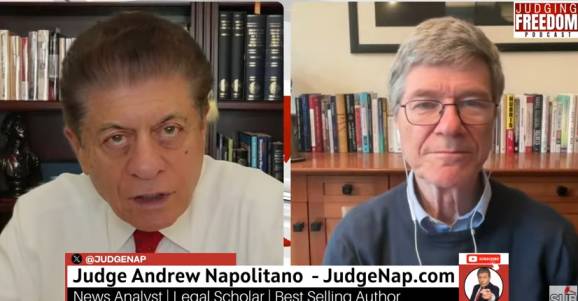
Editor’s Notes: In this episode of Judging Freedom, Judge Andrew Napolitano is joined by Professor Jeffrey Sachs to examine the profound strategic risks of a U.S.-led conflict with Iran. Professor Sachs offers a candid critique of modern American diplomacy, highlighting the consequences of repudiating international agreements like the JCPOA and failing to uphold the UN Charter. The discussion also explores the ongoing war in Ukraine and the domestic influences that Sachs argues are steering U.S. foreign policy toward global instability. Ultimately, this interview provides a compelling analysis of the urgent need for competent leadership and a return to principled negotiations to avoid a potential nuclear catastrophe. (Feb 18, 2026)
TRANSCRIPT:
“Undeclared wars are commonplace. Tragically, our government engages in preemptive war, otherwise known as aggression, with no complaints from the American people. Sadly, we have become accustomed to living with the illegitimate use of force by government. To develop a truly free society, the issue of initiating force must be understood and rejected.”
JUDGE ANDREW NAPOLITANO: What if sometimes to love your country, you had to alter or abolish the government? What if Jefferson was right? What if that government is best which governs least? What if it is dangerous to be right when the government is wrong? What if it is better to perish fighting for freedom than to live as a slave? What if freedom’s greatest hour of danger is now?
Hi, everyone. Judge Andrew Napolitano here for Judging Freedom. Today is Wednesday, February 18, 2026. Professor Jeffrey Sachs joins us now. Professor Sachs, thank you very much.
Before we get to an extraordinary letter that you’ve just written to the United Nations Security Council, one or two questions about Iran, one or two questions about Russia, if I could — is it your view that the United States-Russia-Ukraine negotiations are serious, or just an act?
—
Are the US-Russia-Ukraine Negotiations Serious?
PROFESSOR JEFFREY SACHS: Well, they are serious in a way, in that I think the Trump administration actually would like this war to end. But they are not consequential because they’re not competently managed by the US side.
Trump, we know, is an unstable, mercurial, short-sighted person. And what we have is not real diplomacy or negotiations, but a very haphazard, weird process in which Trump wants to look good at any moment. That means that there’s just great improvisation in the day-to-day actions.
One day Trump says, “Yes, we’re going to end the war and we agree with the Russian position, and the agreements were reached in Anchorage, Alaska.” Then the Europeans come, or Lindsey Graham pipes up, “No, no, Putin’s evil. We must do something.” “Yes, Putin’s evil. We’re going to punish those who deal with Russia.” And it just is so inconsequential.
Trump is, of course, not competent enough to explain anything to the American people. He’s not able to explain what is the American engagement, what is America’s interest, how did this war start, how can it end? And therefore, because Zelensky and his gang rule by decree in a massively corrupt setup, they don’t want to end the war. And Trump doesn’t seem to understand, or know enough, or be consistent enough, or have an attention span long enough, to actually carry through what would be good for him politically.
So if you ask me, are they serious? Well, there is a way for this war to end. There actually are specific issues and specific ways for this war to end. And if we had a president that was competent, the president would explain this.
There’s the issue of NATO enlargement. NATO enlargement was a bad idea, and we are ending that idea because it meant insecurity for the Russian side. This is simple to say. There’s the issue about what kind of security is needed. And the security obviously needs to be security for Ukraine and security for Russia, so that we don’t have a tripwire of another war.
That can be explained. And then one can come to the question of territory, and we can discuss the history of this territorial dispute and understand — if there was honesty by a president who could explain something to the public — that the reason there’s a territorial dispute is that when there was an attempt, not at territorial exchange of eastern Ukraine, but at political autonomy as a way to make peace, called the Minsk II Agreement, the United States undermined an agreement that was reached and ratified by the UN Security Council.
What I’m saying, Judge, is that a consequent, knowledgeable, capable president could end this war by explaining the parameters, the conditions, the American perspective, and the terms on which this conflict should end. And when there are the lies and all the other pressures — which are everywhere, from the military-industrial complex, or Silicon Valley that wants to test its drones more, or Zelensky, or whatever it is — a capable president could explain, “No, we are the backers of this. It’s going to end because we need peace.”
Trump, I think, even believes that, and it would be good for him politically. But so far he hasn’t shown the competence to be able to accomplish this.
—
Do the Russians Trust the Americans?
JUDGE ANDREW NAPOLITANO: Do you assign any significance to the arrival — in the same trilateral negotiations about which you’ve been speaking — of the deputy Russian Foreign Minister as the senior negotiator? And do the Russians trust the Americans?
PROFESSOR JEFFREY SACHS: Nobody trusts anybody because nobody speaks very clearly. The Europeans are hopeless in this. Zelensky is not only a not-funny comedian, way over his head, but he’s on top of a cabal that probably could do him in — or try to do him in — if he tried to do anything else, like actually sign an agreement he agreed to back in March 2022, that the United States stopped at that point.
In other words, it’s not a situation of trust because there isn’t maturity in this process. There aren’t the conditions for trust.
Trust is: you put issues clearly on the table. You explain to your own publics what these issues are about. You explain how we got into this mess.
Which, if Trump really didn’t want to own the war, he had grounds for explaining — it was Obama who did so much to make the coup in February 2014, and very unwisely backed the coup that put in this whole rabidly pro-NATO group that created the conditions of war, and that failed to implement the Minsk Agreements.
Trump had his way, but we’re just not at the level of sophistication in a complicated mess like this for them to find their way out. So I don’t think that it’s purely vested interests or lies that are keeping this going. I think it’s incompetence.
—
Does the United States Respect the UN Charter?
JUDGE ANDREW NAPOLITANO: Does the United States respect the UN Charter that it wrote?
PROFESSOR JEFFREY SACHS: Of course not. Not at all. In fact, Mr. Stephen Miller, who’s called “the brains of the White House” under some bizarre definition, says openly, “Those are niceties. That doesn’t matter. The UN Charter means nothing. It’s only power that counts.” That’s the language of fascism. That’s not the language of democracy, which depends on the rule of law.
And the idea that there is an international rule of law would come as a big surprise to most American presidents over more than two centuries — excuse me — who understood about treaties and cared about treaties. The UN Charter is a treaty which the United States Senate ratified in July 1945. It’s not just something that was waived in front of us. It was written — first draft — by the United States under President Franklin Roosevelt’s leadership. It was negotiated by the founding member states of the UN, and then it was ratified by the United States Senate. And that makes it the law of the land under the US Constitution.
But does the United States respect the UN Charter? No. Not for one moment.
—
Trump’s Withdrawal from the JCPOA
JUDGE ANDREW NAPOLITANO: How destructive an act was Trump’s withdrawal of the United States from the JCPOA?
PROFESSOR JEFFREY SACHS: There have been issues about the concern of Iran getting a nuclear weapon, and those concerns go back decades. And the Iranians have said repeatedly that on religious grounds alone, on the Supreme Leader’s command, they are not aiming for a nuclear weapon. And they have held that consistently for more than 30 years.
Israel has claimed — and this is especially Benjamin Netanyahu — that the breakout to nuclear weapons would happen within a week, a month, a year. And he’s been saying that since 1996. Benjamin Netanyahu is absolutely one of the most obnoxious liars in the world and one of the most destructive leaders in the world, who has pulled the United States into more terrible misadventures than anybody. And he’s been wrong on this issue for decades.
But it has been Israel’s purpose to overthrow the Iranian government for decades now. The JCPOA — the Joint Comprehensive Plan of Action — was a negotiated agreement between Iran and the permanent five members of the UN Security Council and Germany, so it’s called the P5+1, reached in 2015. It would have put Iran’s nuclear program under the strictest surveillance of the International Atomic Energy Agency and the Treaty on the Non-Proliferation of Nuclear Weapons. And it was ratified, a few days after the signing, by the P5+1, unanimously, by the UN Security Council.
In other words, Iran negotiated. The negotiations were successful. An agreement was reached. The International Atomic Energy Agency was monitoring this — and then Trump ripped it up. That’s the basic story.
That’s the story with so much of our problem in the world. The United States can’t take yes for an answer. The United States couldn’t take yes for an answer after 1991 with Russia. It demanded subservience of Russia. It overthrew governments in Russia’s neighborhood. It tried NATO expansion contrary to promises. And the United States could not take yes for an answer with regard to Iran.
Why is that? Well, the Zionist lobby is the overwhelming reason. In other words, Israel said, “No, do not negotiate, do not have diplomacy with Iran. We want to overthrow the government of Iran.” And Trump, backed financially by this lobby, ripped up the JCPOA in 2018.
And the United States whines all the time: “The Iranians don’t negotiate. The Iranians don’t negotiate.” The United States does not honestly negotiate. When it succeeds in negotiating an agreement, it then repudiates its own agreement — whether it’s no NATO enlargement, whether it’s the Anti-Ballistic Missile Treaty, whether it was an agreement reached on February 21, 2014 with Yanukovych that he would remain in power and that on that basis there would be elections in Ukraine in 2015 — and then Obama repudiated that the very next day.
So the problem isn’t Iran not negotiating. The problem is the United States not only does not believe in the UN Charter, it doesn’t even believe in its own word, which is pretty much worthless. The US repudiates its own negotiations.
—
The Strategic Risks of War with Iran
JUDGE ANDREW NAPOLITANO: What are the strategic risks of fighting a war with Iran — an American-Israeli war against Iran?
PROFESSOR JEFFREY SACHS: Well, one is a nuclear Armageddon. That’s simple. If Iran wanted to make a dash for nuclear weapons, it probably could do so. That’s a starting point. It has not wanted to do so. But if it were in existential danger of being crushed by the United States and Israel, who knows what they would do? Or it could get a bomb from somewhere else, because they’re not in short supply, by the way.
And so the whole point is, it’s unbelievable that Trump thinks that he can say Iran’s not serious about negotiating, when he ripped up the agreement. And then last year, when they were negotiating and Mr. Witkoff and others said, “Yes, we’re making progress,” the United States bombed — and Israel bombed — Iran two days before what was supposed to be the sixth round of negotiations.
So what is the implication of this? The implication is that Iran, which is a country of nearly 100 million people with hypersonic missiles and enriched uranium — anything could happen. We shouldn’t play with global nuclear suicide, and we should negotiate. But we don’t seem to be able to have the grown-up manners of real negotiations.
—
The Iranian Foreign Minister Speaks at Geneva
JUDGE ANDREW NAPOLITANO: Here is the Iranian Foreign Minister — whom I know you know — on Tuesday, after the second day of their Geneva conferences.
VIDEO CLIP BEGINS:
IRANIAN FOREIGN MINISTER: Why do the United States and certain European countries turn a blind eye to the threats posed by the Israeli regime to international peace and security, including its nuclear weapons capabilities? They continue to portray Iran’s peaceful nuclear program as a threat to international peace and security.
The Israeli regime has been committing the most atrocious crimes for the past eight decades with full impunity. Unfortunately, in less than two years, it has attacked seven countries in the region. While more than 70,000 people have been massacred in Gaza as part of its colonial genocide, there is no crime it has not committed and no red line it has not crossed.
Mr. President, the United States and some European states persist in the imposition of unlawful sanctions, military threats, the engagement in force posturing, and the issuance of explicit references to the possible use of force by the United States, including significant military deployments in the region. Such actions constitute a continuing violation of the prohibition of the threat of, or use of, force as enshrined in Article 2, Paragraph 4 of the Charter of the United Nations, and must be brought to an immediate and unconditional end.
VIDEO CLIP ENDS:
JUDGE ANDREW NAPOLITANO: Isn’t he 100% correct?
The UN Charter, Economic Warfare, and Iran’s Nuclear Red Line
PROFESSOR JEFFREY SACHS: Yes, every word is correct. And for viewers who could look online at the UN Charter, if you go to Article 2, paragraph 4, it says that no member state of the United Nations may use the threat of force or force against the sovereignty of another state. The threat of force.
Every time Trump posts on Truth Social, “They better watch out. I’ve got carrier task force groups coming to Iran. They know what will happen. They know what our attack last year meant.” Those are in absolute, direct, crude violation of the UN Charter. Those are threats of force.
We know that. It, of course, goes beyond threats of force — they bombed Iran last year. And then our own Treasury Secretary explained in a speech in Davos, an interview actually in Davos with Fox Business on January 20, just last month, that the United States deliberately crushed the economy, squeezed Iran, brought the currency down by using US sanctions to stop the flow of dollars into the Iranian economy.
Those who buy oil don’t pay for it right now because they can’t use the banking mechanisms to transfer dollars to Iran because of the threats of US sanctions. And so there is a dollar shortage. The currency therefore collapsed, imports collapsed, living standards collapsed, and people went out onto the streets to protest or to try to overthrow the government.
And we know two things about that. One is that there was heavy infiltration by the CIA and Mossad in those street eruptions. Second, Bessent, the US Treasury Secretary, said that was the US plan. And when he talked about the protests because of the collapse of the economy, Bessent said, “Things are going very well here.”
So we should understand that this is not diplomacy. This is war. Whether it’s economic war or bombing or bringing aircraft carriers to the Iranian neighborhood with threats of renewed war. This is all grotesquely dangerous, contrary to the UN Charter, and completely unnecessary — completely — if our interest is in peaceful diplomacy, which is not what Israel wants.
Israel wants the US to be in a war. And if we do get in a war, thank Israel for that, for the mess that we will get.
—
The American Media Drumbeat on Iran
JUDGE ANDREW NAPOLITANO: Here is the cheerleader of the American drumbeat, which, as you know — I know you do a lot of traveling, so maybe you don’t know — this is ubiquitous in the American media as we speak about how dangerous Iran is. This is absurd for me even to say it, but I’m quoting somebody else, as a national security threat to the United States. Watch this.
VIDEO CLIP BEGINS:
UNIDENTIFIED SPEAKER: I think it’s very important for the American people to appreciate it’s one of the most hostile and also one of the most irrational regimes in the world. You can’t have people like that have the most dangerous weapon known to man. It would be awful for our security, would be awful for the future of our children.
That is the goal of the President of the United States. And he’s got a lot of options and a lot of tools to make sure that doesn’t happen. Everything is on the table. We certainly want Iran to stop being a state sponsor of terrorism. They’re one of the world’s largest state sponsors of terrorism. There are a lot of ways in which they endanger America’s national security. But the most important way they could is if they acquired a nuclear weapon. And that is the red line the President of the United States has consistently set.
Yes, of course, the Iranians say that they’re not interested in a nuclear weapon. We know, in fact, that’s not true. They have shown a number of things that make it clear that they’re interested in acquiring a nuclear weapon. Our goal is to make sure that doesn’t happen. And again, the President has a lot of tools in the toolkit to make sure that doesn’t happen.
VIDEO CLIP ENDS:
—
The Lesson of North Korea and the Failure of Maximum Pressure
PROFESSOR JEFFREY SACHS: I just want people to understand how incredibly stupid American leadership is, because we seem never to be able to think through how to get what we say we want. This reminds me so much of the debacle with North Korea, because back in the 1990s, North Korea was ostensibly aiming towards a nuclear weapon. But they said, “We’ll negotiate with the United States,” and negotiations were going on and we actually made some promises to North Korea about peaceful nuclear energy and so forth.
And when George Bush Jr. came in and his advisor John Bolton, they said, “Now we’re not going to do any of this. You can’t trust them. We’re going to put maximum pressure.” Of course, the result was completely the opposite of what they wanted. North Korea became a significant nuclear power and diplomacy was ripped up.
And here these people are talking about the red line — no nuclear weapons. Yeah, fine, you had that. That’s what the JCPOA was. That’s what Iran accepts every day. That’s not a tough red line to negotiate. It is not a tough red line to negotiate.
It would take an extreme amount of incompetence — but I’m not ruling it out — to fail to negotiate that. The problem is there’s a significant group in the US Government and in the Israeli leadership that does not want negotiations. They want regime change and they want Israeli military hegemony over the Middle East. That’s different.
If you want successful negotiations with the red line, that’s not even hard, because the Iranians agree with you.
—
What Happens If the US and Iran Agree but Netanyahu Doesn’t?
JUDGE ANDREW NAPOLITANO: What happens if there is a successful negotiation, the United States and Iran do agree, and Netanyahu disagrees?
PROFESSOR JEFFREY SACHS: Well, look, if we actually had an America First foreign policy — which means not in the hands of Miriam Adelson and the Zionist lobby — if we actually had that, Netanyahu couldn’t do anything about it. Because Israel, with its 8 to 10 million people, cannot fight Iran with its 100 million people without the United States. It can’t even refuel its jets without the United States. It doesn’t have the intelligence capacity without the United States, the targeting capacity, the Iron Dome — it can’t do anything without the United States.
So if we had an American government that said it’s in our interest that Iran not get nuclear weapons — and that’s what the Nuclear Non-Proliferation Treaty is about, that’s why there is an International Atomic Energy Agency to monitor all of this, that’s why steps are going to be taken to make sure that Iran does not have the capacity to do this under rigorous monitoring — first, that can absolutely be achieved, and second, Netanyahu couldn’t do anything about it at all if we were consequent.
Except — and I’ll mention one terrible truth which may be absolutely circumstantial — in 1963, President Kennedy knew that Israel was making a dash for nuclear weapons and he tried to stop it very hard. And he was opposed not only by Ben-Gurion and by the Israelis, who lied repeatedly to President Kennedy, but Kennedy was also opposed by the CIA and by the Chief of Counterintelligence, James Angleton. And Angleton was working with Mossad and subverting the US policy itself that was laid down by President John F. Kennedy. And there are many who say that Angleton’s role in the tragedy that followed was not a small one.
So I think the only point is this: a President needs to be able to have decisions that are for American security, that could be reached with Iran immediately, and has to be able to carry through. And by the way, that means making sure that our CIA and security apparatus behaves itself.
—
Closing Remarks
JUDGE ANDREW NAPOLITANO: Professor Sachs, thank you very much. I know you just arrived from a long trip and I deeply appreciate your time and all of your analysis, my dear friend. We’ll look forward to seeing you next week.
PROFESSOR JEFFREY SACHS: Great. See you next week. Thanks a lot.
JUDGE ANDREW NAPOLITANO: Thank you. Bye-bye.
Related Posts