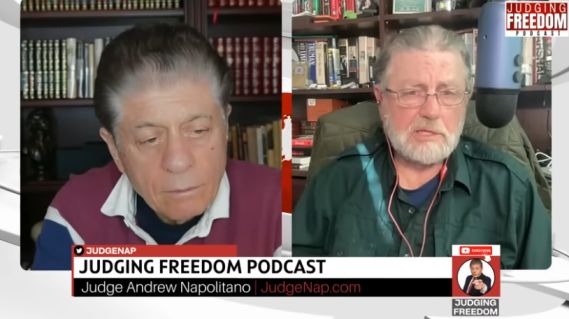
Editor’s Notes: In this episode of Judging Freedom, host Judge Andrew Napolitano and former CIA analyst Larry Johnson discuss what they describe as a “colossal mistake” by President Trump: the recent undeclared military strikes against Iran. Johnson argues that these actions have united the Iranian people and triggered retaliatory attacks on U.S. bases throughout the region. The conversation explores the severe logistical challenges facing the U.S. Navy and the potential for a global economic crisis if the Strait of Hormuz remains closed. (Mar 1, 2026)
TRANSCRIPT:
“Undeclared wars are commonplace. Tragically, our government engages in preemptive war, otherwise known as aggression, with no complaints from the American people. Sadly, we have become accustomed to living with the illegitimate use of force by government. To develop a truly free society, the issue of initiating force must be understood and rejected.”
JUDGE ANDREW NAPOLITANO: What if sometimes to love your country, you had to alter or abolish the government? What if Jefferson was right? What if that government is best which governs least? What if it is dangerous to be right when the government is wrong? What if it is better to perish fighting for freedom than to live as a slave? What if freedom’s greatest hour of danger is now?
Hi, everyone. Judge Andrew Napolitano here for Judging Freedom. Today is Saturday, February 28, 2026. Welcome to this special edition of Judging Freedom with our dear friend and regular colleague, Larry Johnson. Larry, of course, welcome here. Thank you for disturbing your Saturday afternoon. It’s afternoon here on the east coast of the United States.
We have much to discuss. Before we get granular, let’s look at the big picture. What happened today? What did the United States and Israel attempt to do?
The Strike That Started a War They Cannot Win
LARRY JOHNSON: The United States and Israel started a fight that they can’t win, that they’re going to lose, and they don’t have an easy out. They convinced themselves that all they had to do was launch this massive strike because Trump foolishly, foolishly believes his own nonsense about it. “Oh, there’s no better, bigger, more powerful military in the world than us — maybe Israel is a close second, but we are the best and we can do anything.”
And so they fully intended to try a repeat of what happened on June 13th of 2025 — to do a decapitation strike, take out the upper political and military leadership. Well, they’ve been gesturing for now more than two months that they were going to do this. The Iranians had no doubt that they were going to do it, and the Iranians were taking preparations. If the Ayatollah Khamenei died, he’d already designated successors. They all said, “Hey, if I go, you’re in charge.” They were planning for this.
So here’s Israel — they top it off. And we saw from a recent article from Seymour Hersh that, whether his source was US Intelligence or Israeli intelligence, this source told him, “Oh yeah, we decimated the Iranian ballistic missile program last year. They don’t have anything.”
So within an hour and a half of this surprise attack yesterday morning — it was Saturday morning in Iran — Iran was firing back. And this time, what’s different compared to what happened in June of 2025? At that time, Iran confined itself to attacking only Israeli targets, focusing primarily on economic and military targets. This time is different — way different. They’re going after US bases and installations throughout the Persian Gulf and into Iraq. And the United States is suffering significant material losses. I don’t know about human losses at this point.
The NBC Correspondent’s Question and the Iranian Foreign Minister’s Response
JUDGE ANDREW NAPOLITANO: Here’s one of the dopiest questions I ever heard asked, and I think the Iranian foreign minister agreed when an NBC correspondent — I don’t know who it is — asked him, “Why is attacking US military bases abroad justified?”
VIDEO CLIP BEGINS:
UNIDENTIFIED SPEAKER: But because they are — they are attacking us. They are US military installations, facilities, bases who are attacking us.
We are under attack. Why don’t you recognize this fact? We are under attack by US forces in the region. So we have every right to defend ourselves. And how to defend ourselves? We attacked the US bases. This is obvious. This is a very simple fact. And I hope that — and I’m sure that — people would understand that we are not the ones who attacked Americans. We are only defending ourselves.
VIDEO CLIP ENDS:
American Vulnerabilities in the Persian Gulf
JUDGE ANDREW NAPOLITANO: Are American troops and installations in the Middle East vulnerable to the long-range offensive capabilities of the Iranian military?
LARRY JOHNSON: What’s happened right now, for example — they made a big point of attacking the Fifth Fleet facility in Bahrain. It’s a naval port. That port is critical for providing service to US destroyers. Remember, these destroyers come equipped with 96 missile slots — I think they’ve got 50 up front and 46 astern in their vertical launch system. So when they launch either Tomahawk cruise missiles or Aegis air defense missiles out of those tubes, the only way to replace them is to sail to a port. Previously they could sail into Bahrain. Not now.
Iran has closed the Strait of Hormuz. You’ve got several US Navy ships that are now basically trapped inside the Persian Gulf, and Iran’s got the anti-ship missiles to take those out. I don’t know if they have yet, but I think they will.
So now this means the United States, when it’s in a fight — with the Abraham Lincoln carrier in the Arabian Sea, accompanied by three destroyers, maybe up to four — once they’re run out of missiles, the nearest port is three and a half days away at Diego Garcia.
JUDGE ANDREW NAPOLITANO: Wow.
LARRY JOHNSON: So what we have right now is a situation that we cannot sustain — a naval attack from the south with just the one aircraft carrier, because there’s no nearby port they can sail to to get reloaded.
Three days out, three days back — that’s a week.
Can the US Sustain the Attack?
JUDGE ANDREW NAPOLITANO: How sustained is the American attack? Is it regular, consistent, and systematic without a break, or does it go for a couple of hours and then they stop and come back?
LARRY JOHNSON: They can’t sustain it continuously, because they’re using land-based planes flying out and dropping air-guided missiles — air-to-ground missiles. And again, the same applies to the destroyers firing off Tomahawk cruise missiles. Once they fire, they’re done. They’ll have to wait until they can go reload.
I do understand that Iran has fired some missiles and drones at the carrier strike force. I don’t know what the effect has been. We do know that in Bahrain they hit the facility that housed US naval officers — it’s on fire. So there’s a possibility that they have killed some US naval personnel. You’ve got Bahrainis cheering as Iranian missiles are slamming into this US naval facility.
But at the same time, Saudi Arabia has now declared war on Iran. I’m sure Qatar and the United Arab Emirates are going to follow suit. Fine. Up to this point, Iran has targeted only US military targets in these countries. But if those countries want to start getting into it with Iran, Iran will take out their oil — and Iran very well can do that. That’ll be especially true if the West tries to attack Iranian oil facilities and oil fields. They will then in turn light up the entire Persian Gulf and say goodbye to 25% of the world’s petroleum.
The Economic Fallout: Oil Prices and the Strait of Hormuz
JUDGE ANDREW NAPOLITANO: Put your economics hat on, in which I know you are well schooled. What is going to happen to the price of oil and gasoline once the Strait of Hormuz is closed for more than just a few hours?
LARRY JOHNSON: It’s going to go up. People have estimated the price of oil could go up $100 to $120 a barrel. Right now, Brent — last I checked — was at around $70 to $72. So it’s headed up, and it’s going to go up dramatically.
Now, it appears that China had an inkling about this, because they started loading up on oil big time over the last four weeks. They’ve increased their reserves. The same can’t be said, though, for Japan, Indonesia, or Malaysia.
Iran is playing a deliberate hardball game here — they’re not going to stop like they did last June. Last June, there was a deal cut with the United States. “Let us bomb these nuclear sites and we’ll let you hit Al Udeid, and then you can continue selling oil to China and we’ll walk away and call it even.” And Iran went, “All right.” And Pezeshkian received some criticism for that.
Well, that’s not going to happen this time. There is no deal. There is no deal the United States can offer them short of saying, “Yes, we will remove all sanctions immediately.” And Iran is saying, “We’re going to continue bombing until those sanctions are off. Remove the sanctions, and you are free to develop and enrich uranium however you want.” Iran is not going to be compelled to back down.
The Attack on a Girls’ School: 105 Children Killed
JUDGE ANDREW NAPOLITANO: How did it happen that the Americans or the Israelis — I don’t know who did this — attacked a school for little girls, which killed 105 of them?
LARRY JOHNSON: They have more faith in the accuracy of their weapons systems than is warranted — they don’t always work. And this is killing children. You remember, Judge, the kind of reaction we had in the United States on 9/11, 2001.
JUDGE ANDREW NAPOLITANO: Sure.
LARRY JOHNSON: On September 12, 2001, the political differences that had existed in the country on September 10th disappeared — largely disappeared overnight. All of a sudden, we were all Americans. We weren’t Republican or Democrat or Independent. We were Americans. We had been attacked, and we were, by God, going to make those who attacked us pay.
Well, guess what? That’s exactly what’s going on today in Iran. And they’ve got the bodies of 105 little girls to stand there and look at. They had trusted us again.
JUDGE ANDREW NAPOLITANO: Right.
LARRY JOHNSON: We said we were having peace talks. They were willing to make concessions. On Thursday, they said, “We made progress. We look forward to Monday.” And then Trump — he’s worse than Adolf Hitler. He did exactly what Hitler did on September 1, 1939: attacked a country that had not attacked us.
Iranian Unity and the Vulnerability of Israel
JUDGE ANDREW NAPOLITANO: Mohammad Marandi, your and my longtime friend, told us the same thing about the unity of the Iranian people as a result of the attack. It’s like Americans on December 8, 1941.
LARRY JOHNSON: Yeah, exactly. Right.
JUDGE ANDREW NAPOLITANO: How vulnerable is Israel?
LARRY JOHNSON: Very vulnerable. What they didn’t learn — and they should have — was that in June, we’re told they went to the United States and said, “Hey, get us out of this. We’re running out of missiles.” They had not been able to resupply and restock the Iron Dome. The missiles they fire are just like what is fired out of the Patriots. The annual production of those in the United States was estimated at 700 a year. And yet, every time there’s an inbound target, they’re going to fire at least two. Let’s say that so far Iran has fired 50 at Israel — well, there’s 100 gone. That’s like 15% of annual production in one day.
We’ve already seen images of missiles penetrating Israel’s so-called Iron Dome air defense system — a direct strike in Tel Aviv about an hour ago. Iran is just going to pick them apart. I think Iran will opt to do more of its strikes at night, again targeting government facilities, military headquarters, intelligence headquarters, and industrial sites, to minimize loss of civilian life. Because unlike the Israelis, the Iranians are not into seeing how many civilians they can kill.
Iran’s Military Warning: “We’ve Been Keeping Things in Reserve”
JUDGE ANDREW NAPOLITANO: We don’t know who he is or what his rank is — we just know he’s an Iranian military official. He’s making some very interesting statements.
VIDEO CLIP BEGINS:
UNIDENTIFIED SPEAKER: Trump should know that we are equipped with the most advanced capabilities today to fight with you for years. At the start of the war, we’ll use whatever we have in storage. But as it goes on, we’ll launch our most powerful missiles. The things we haven’t revealed yet — the ones we Iranians say we’ve been keeping in reserve — we will unveil those in these days as well.
VIDEO CLIP ENDS:
JUDGE ANDREW NAPOLITANO: Same thing that Scott Ritter told us this morning.
Iran’s Missile Capabilities and the U.S. Military’s Limitations
LARRY JOHNSON: Yeah, well, we’ve got Alistair Crook, Professor Morandi, Max Blumenthal, they all were in Iran about a year ago now and they all saw several of the ballistic missiles in the different stages. What Iran has developed and got some sense, so these are, the Iranians are very serious people on this. This guy is not a gas bag just mouthing off to be mouthing off. He’s actually telling the truth.
And when you see the, there are videos online, you can see them on YouTube of these, they call them missile cities. These are enormous underground passageways where you can drive trucks, like a full semi trailer. And they got the mobile launchers and they’ve got the missiles after. As far as you can see, we’re not talking about 10 or 12. I mean, we’re talking about literally, you can see hundreds in one passageway. Well, I’m guessing they’ve got lots of those.
And so it’s not like you’ve got fixed launchers and people run out and like Cape Canaveral and put the missile out and fire, because that’s easy to destroy. What Iran has are mobile missile launchers which are extremely, almost impossible for the US to detect and very difficult to destroy.
JUDGE ANDREW NAPOLITANO: This is an Iranian missile striking in downtown Tel Aviv. This just released a moment ago. 10:39 Tel Aviv time. So that’s about 45 minutes ago.
LARRY JOHNSON: Yeah, yeah, yeah. See, nowhere defense.
JUDGE ANDREW NAPOLITANO: Right.
Iran’s Sustained Missile Campaign and U.S. Supply Chain Vulnerabilities
LARRY JOHNSON: And they’re going to continue doing this. Iran will do this until they run out of missiles. But the other thing they’ve got going for them is they’ve got the ability to produce underground. So they will continue building underground. They’ve got supply chains in place with China and Russia.
And here’s the problem. The United States has some of these air defense missiles, I’m sure, that include rare earth minerals that are no longer being exported to the United States that China is withholding. And so you’re going to run into a situation where the ability of the United States to sustain an air campaign is going to be extremely limited.
One reason is they started off at these bases in Saudi Arabia at Prince Sultan, and in Jordan, Muwafik Al Salti. And now Iran is attacking those. And again, the Patriot missiles aren’t working. They’re not preventing the missiles from getting through. So they’re going to have to relocate those assets. To where? Well, somewhere farther away. Turkey said not using us. So it means they probably go out to Cyprus.
JUDGE ANDREW NAPOLITANO: Wow.
LARRY JOHNSON: And then they take off from there and they got a long flight and multiple air refuelers. So it really creates some logistical problems for the United States that in the past they could fly out of Jordan, fly out of Saudi Arabia, and Iran wasn’t bothering them. Not now. Iran’s taking out every US base that’s there and making it unusable.
Trump’s Negotiations and the Breakdown of Trust
JUDGE ANDREW NAPOLITANO: Well, what does the fact that this is the second time that Trump has lulled Iran into a false sense of security and attacked Iran in the midst of negotiations — literally when a negotiation session was scheduled in the next 24 or 48 hours — what does this do to the Russia-US negotiations?
LARRY JOHNSON: I think it kills it. Now, you know the old saying, “Fool me once, shame on you. Fool me twice, shame on me.” Well, shame on Iran. They took the bait again. When Charlie Brown would try to kick the football and Lucy had pulled it away, they did it for the second time. Now Putin’s had that done to him with the Minsk too. He got played as well.
I think the only thing you can conclude is not a word that comes out of Steve Witkoff’s mouth can be trusted, because he’s supposed to say, “Okay, yeah, we made some good progress. We’ll have talks again on Monday,” with no intent whatsoever to have those talks on Monday. He’s just a tool and he’s playing the same role with Russia.
So I would not be surprised the next time Witkoff tries to call up Vladimir Putin and says, “I’d like to stop by, we can chat,” Putin’s going to say, “Sorry, we don’t have time for you. We’re too busy at home.”
How Long Can the U.S. Sustain This Campaign?
JUDGE ANDREW NAPOLITANO: How long can the United States sustain this? Given the difficulties you’ve described about refueling, targeting, and all those problems attendant upon planes taking off from ships.
LARRY JOHNSON: Probably no more than eight weeks. And I based that upon what we saw last March, remember, when Trump, with great fanfare, announced, “Oh, we got Operation Rough Rider,” that Operation Prosperity Guardian that the wimpy Biden administration tried. “We’re now going to show those Houthis who’s boss.” And so we put two aircraft carriers in the Red Sea, at one point we had five destroyers at least. And we tried for seven weeks.
And in that seven week period, in the previous 15 months, the Houthis had shot down one Predator drone. A month after Donald Trump started Operation Rough Rider, they were shooting down one a week. And at the end of seven weeks, we had lost three FA-18 helicopters, we’d had two Navy SEALs drown. The total was almost $800 million worth of drones gone in the previous 15 months, with $220 million of that in just seven weeks.
So I use that as a benchmark. What did we do? We declared victory and left. And the Red Sea remained closed to traffic for Israel. Now what we’re going to see in the next day or two are the Houthis — they’re climbing back in the saddle. They’re going to be firing missiles into Israel and I believe Hezbollah will respond as well. This is going — the Shia movement throughout the Middle East, I believe, is now going to take the fight not just to Israel but to the United States.
U.S. Bases Under Attack
JUDGE ANDREW NAPOLITANO: Our friend and colleague Colonel Douglas MacGregor will be on with me tomorrow at 5:30 in the afternoon. He has just informed us that the US base in Saudi Arabia is under attack. You’re not surprised to hear that?
LARRY JOHNSON: Oh no, not at all. And that’s like I said, Iran’s making a point. They’re going to crush and destroy, make unlivable all these bases where the United States has operated for years. And frankly you’re going to get the destruction of those bases. You’re going to get a lot of Saudis cheering it. Not the royal family, not those whores, but the average Saudi is going to be cheering it. And you got 20% of Saudi Arabia’s population that is Shia Muslim. They’re going to be cheering it.
Russia and China’s Role
JUDGE ANDREW NAPOLITANO: What do you expect Russia and China might do that they haven’t already done, in light of the sustainability and frequency of the American attack?
LARRY JOHNSON: Well, I think they’ll do everything they can quietly behind the scenes to complicate problems for America, and they may send additional naval assets to assist Iran in closing the Strait of Hormuz. Perhaps they are continuing to supply intelligence, and they will continue to supply critical minerals that Iran needs to continue building and maintaining its ballistic missile force.
They recognize, I think China in particular, that this regime change had nothing to do with Iran’s so-called quest for a nuclear weapon that they weren’t trying to build or trying to get. And that’s a point that our friend Ray has made over and over and over. And he’s exactly right. This is about regime change. And the reason we want to change this regime is to stop BRICS, to stop the development of this alternative financial future that does not include the United States, or at least doesn’t give the United States the control where it can tell everybody what to do. And then if you don’t do what we tell you, we seize your money, we threaten, we make it impossible for you to do international trade.
Those days are over in Iran. Iran now is seeing a way to break free of that. And so that’s where this is — this is to destroy Iran and ultimately destroy Russia and China. That’s the U.S. goal.
The Endgame: How Long Will This Last?
JUDGE ANDREW NAPOLITANO: The other U.S. goal is to comply with Netanyahu’s wishes to break apart Iran like they did Syria. How long before we go — Larry, how long do you think? It’s hard to predict, but you’re the military guy. How long do you think this will go on?
LARRY JOHNSON: I think it’ll go on for at least a good month, if not more. There’s going to be significant economic fallout. The US does not have the ability to bring an end to it militarily. We keep thinking that we do, but we don’t. Neither does Israel.
What Iran has is this enormous ballistic missile capability that I believe is largely untapped because they’ve kept so much of it underground, and we’ve not really had a good measure of what was there. But we’re going to see within two weeks, Israel is going to be pleading for help, and they may resort to trying to use a nuke on what they think is a missile site. And then that adds a whole new layer of danger, because at that point you could see not only Russia and China getting involved, but also North Korea coming to the aid of Iran, and they have nukes.
JUDGE ANDREW NAPOLITANO: Oh, good Lord. You know, it might have been George Patton who said, “Fighting a war is like opening a door in a strange house with a pitch black room behind the door. You have no idea what’s there, and if you go in, you have no idea how you’re going to get out.”
Defining Objectives and the Consequences of Failure
LARRY JOHNSON: Yeah, it’s always best to define your objectives clearly and then put the assets and resources together to achieve those objectives. With Operation Rough Rider, to the credit of the military planners, they specified, they laid out very clearly our goal. Number one, restore freedom of navigation. How do we do that? Well, to restore freedom of navigation, we’ve got to stop the Houthis from firing ballistic missiles. We’ve got to take out their ballistic missile capability. So that was our goal. I’m not saying it was doable, but at least it was a well-defined goal.
And we tried for seven weeks where our aircraft had full run of the air, where we weren’t having to worry about getting shot down necessarily. And at seven weeks, we couldn’t do it. We couldn’t stop the Houthis. We couldn’t reestablish freedom of navigation.
So you step back and say, “Okay, what’s the objective here and now with respect to Iran?” Well, apparently regime change, and our goal is we’ll see if we can kill enough of the top leadership that the people will rise up and throw them out. Except our tactics, by killing little girls at school, is having the exact opposite effect. Instead of enraging the population against the Islamic Republic, it’s building support for it.
And it’s going to create a division in the Persian Gulf — Gulf allies of the United States are going to be targeted. And those countries could very well be easily destabilized because they are these rich oligarchs who really don’t care much about their public. And you’ve got enough Shia Muslims in some of those countries that they can wreak havoc.
So we’re looking for sustained instability. And depending on how long the Strait of Hormuz stays shut down, Iran is going to keep it shut until it gets an agreement from the rest of the world that, “Okay, this has got to stop. We can’t keep being attacked unjustly, illegally, and nobody says a thing. So you’re all going to suffer with us until this stops.” And it’s going to leave the United States isolated.
Trump Acknowledges Potential U.S. Casualties
JUDGE ANDREW NAPOLITANO: I was surprised to hear the president — now this is at three in the morning, I didn’t hear him live — talk about the potential for U.S. deaths.
LARRY JOHNSON: Chris.
JUDGE ANDREW NAPOLITANO: I think it’s our new cut number two, President Trump on U.S. deaths.
VIDEO CLIP BEGINS:
DONALD TRUMP: The lives of courageous American heroes may be lost and we may have casualties, that often happens in war, but we’re doing this not for now, we’re doing this for the future. And it is a noble mission. We pray for every service member as they selflessly risk their lives to ensure that Americans and our children will never be threatened by a nuclear armed Iran. We ask God to protect all of our heroes in harm’s way. And we trust that with his help, the men and women of the armed forces will prevail.
VIDEO CLIP ENDS:
JUDGE ANDREW NAPOLITANO: What is noble about this mission? Nothing.
The Danger of Hubris and the Cost of War
LARRY JOHNSON: Yeah, nothing. Well, Trump stupidly did not learn the lesson of George H.W. Bush. Remember, “Read my lips, no new taxes.” See, my lips said it. No new taxes. And what happened to Bush? That destroyed public support for him and he lost the election to Bill Clinton, an election that he should have easily won having just won the war in Iraq — the first Gulf War.
Well, here’s Donald Trump, who ran on what? “We’re tired of these needless, senseless wars in the Middle East, and we’re not going to do it.” And now he’s done it. And he tries to trot out this lie that Iran was desperate to build a nuke. They’re not — at least weren’t and hadn’t. And they had offered a deal: “Come inspect.” And Trump rejected it because, as you said, he’s controlled by Bibi Netanyahu and other wealthy Zionists, and he’s unwilling to challenge him.
And so what he’s done is he has now put America in genuine danger. Our economy will suffer from this and our standing in the world is going to suffer dramatically. Because, you know, imagine you got a kid — a skinny kid — and he’s not seen as really a good fighter, or is perceived as not a good fighter. And he gets in the ring with an aging Mike Tyson and he survives three rounds. Guess what? That kid comes out with respect. Now he’s proved he could go toe to toe with a guy that once was a super heavyweight champion.
Now, the United States at one time was a heavyweight champion, but we’ve gotten old, we’ve gotten fat, we’ve gotten slow. And with that we’ve gotten so arrogant and so uncaring of the rights of others, and that kind of hubris is going to lead us to destruction.
JUDGE ANDREW NAPOLITANO: Larry, I have to tell you, just as an aside, at this moment, you have a truly enormous live audience. Enormous. And I’m going to ask this enormous live audience to like and subscribe. Like and subscribe. We’re trying to hit 750,000 subscriptions this year, so forgive the sort of self-promotion there.
LARRY JOHNSON: Oh, no, absolutely. The more — look, the more people that watch and get informed about the reality, because again, the lies that are being told, not just by Donald Trump, but by J.D. Vance.
“A Tremendous Victory” — What Are They Talking About?
JUDGE ANDREW NAPOLITANO: Larry, my friends and former colleagues where I worked for 21 years at Fox News have said “a tremendous victory for the United States.” What the hell are they talking about?
LARRY JOHNSON: Well, that may be how we get out of this. We declare victory and leave. “Hey, we won. We’ve done everything we promised to do. We gave the Iranians a chance to overthrow the mullahs on them. Now we’re out. See you guys later.” I don’t think that’s going to happen.
And Iran, if they sink a ship or two — here’s what’s going to do to Donald Trump. I think this marks the end of his presidency, candidly, because when body bags start coming home, and let’s say we get like 2,000 casualties — well, that’s more than we suffered in like 10 years in Iraq. So this could really go south and sour fast for Trump. And you know what? He could be impeached for taking the United States to war without congressional approval.
JUDGE ANDREW NAPOLITANO: No request to the Congress, no debate in the Congress, no recognition of the fact that Congress declares war. Look, when he kidnapped Maduro, he claimed it was a law enforcement procedure — “We’re going after a guy, a fugitive from justice. We don’t have to involve Congress.” He can’t claim that now. He’s open about his wish to decapitate, to destroy the state. That’s called war.
Iran’s History and America’s Role
LARRY JOHNSON: Yes. And he’s liable on that front. It would be one thing if there was actually a genuine threat from Iran. Over, you know, since the establishment of the Islamic Republic in 1979, Iran has not directly attacked us. Now they’ll say, “Well, Iran was behind the bombing of the Marine barracks in October of ’83.” No, it actually wasn’t. That was Amal. And Alister Crooke can talk at length about that. Amal was a Lebanese Shia group that developed, set up, and started organizing back in 1972 — seven years before there was an Islamic Republic in Iran.
But what we do know for sure is that the United States encouraged Saddam Hussein to attack Iran back in 1980, and then provided the chemical precursors used to make chemical weapons, which killed a minimum — a minimum — of 250,000 Iranians. And then Americans sit there and wonder, “Why do they chant ‘Death to America’? Why don’t they like us?” Because we’ve killed a quarter of a million Iranians. Folks, wake up. That’s why.
Closing Remarks
JUDGE ANDREW NAPOLITANO: Larry, thank you very much, my dear friend. On a slightly lighter note — a much lighter note — have you collected on your bet from Ray McGovern yet?
LARRY JOHNSON: Ray sent a very generous, kind note saying, “I’ll get you your $2.” I said, “Keep it.” Because I sincerely wish Ray had been right.
JUDGE ANDREW NAPOLITANO: Same here.
LARRY JOHNSON: Because Larry will—
JUDGE ANDREW NAPOLITANO: We’ll see you Monday morning. Thank you.
LARRY JOHNSON: Yes, sir. Thank you. All the best. Bye bye.
JUDGE ANDREW NAPOLITANO: Bye bye. Thank you for watching, all of you. Tomorrow, Sunday, March 15, 5:30 in the afternoon — Colonel Douglas MacGregor — Judge Napolitano for Judging Freedom.
Related Posts