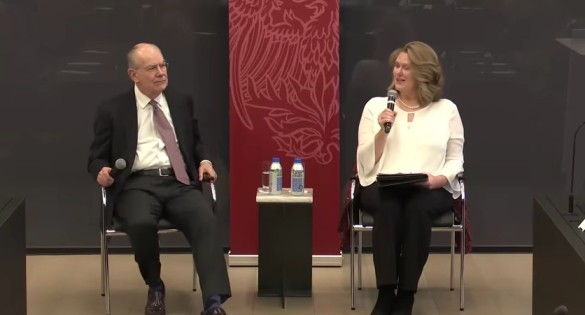
Editor’s Notes: In this wide-ranging discussion hosted by the University of Chicago Graham School, renowned international relations theorist Prof. John Mearsheimer explores 250 years of American foreign policy through the lens of political realism. From the dual nature of the Declaration of Independence to the strategic evolution of regional hegemony, Mearsheimer breaks down the core “isms”—liberalism, nationalism, and realism—that have shaped the nation’s global trajectory. The conversation also addresses modern geopolitical flashpoints, including the return of multipolarity, the containment of China, and the ongoing complexities of conflicts in Ukraine and the Middle East. By challenging traditional narratives of American exceptionalism, Mearsheimer provides a provocative framework for understanding how survival and security competition remain the primary drivers of international statecraft. (Mar 6, 2026)
TRANSCRIPT:
Introduction
JENNIFER LIND: Thank you, everyone, for joining us tonight. It’s a huge joy to see so many familiar faces, also to have this opportunity to make new friends, bring new friends into our community. And thank you most of all, John, for your time and insights this evening, tonight, especially at a time when you are in high demand. So we are truly grateful. Thank you.
So we’ve come together tonight in celebration, really, of our 250th anniversary of the Declaration of Independence. So we are trying, we aim to take, sort of have a historical program, widen the lens, as Seth said. So let’s dive right in and start with the Declaration.
So the Declaration, it’s heralded as an idealist, liberal document. How do you see it? Is Jefferson’s glowing prose about “all men are created equal, endowed by their creator with unalienable rights” — is that just cover for self interest?
Liberalism vs. Nationalism in the Declaration of Independence
PROF. JOHN MEARSHEIMER: Before I answer Jennifer’s question, let me just thank Seth for the kind introduction and for inviting me here. And I’m thrilled to be here with my good friend Jennifer and fellow IR theorist. And I thank all of you for coming out to hear us go back and forth. I actually love doing these things, and I look forward to the Q and A as much as I look forward to talking with Jennifer.
So the question has to do with the Declaration of Independence. The way I look at the Declaration of Independence is that there are two broad themes in it that are somewhat at odds with each other. One is the liberal theme, the universalistic theme that Jennifer referred to. This is the whole idea that “all men are created equal” and that we all have inalienable, or natural rights. And if you talk about inalienable or natural rights, that means that everybody on the planet has those same rights. So you can see the universalism built into that. And that’s actually the liberal strand of the Declaration.
But there’s another strand which I think actually gets more attention than the liberal strand, and that’s the nationalist strand. This is very much a nationalist document. It’s all about the creation of the American nation state. And nationalism is a peculiar particularistic ideology. Liberalism is a universalistic ideology. And basically what nationalism is all about is saying, sort of, “we people, we Americans, have had it with this sovereign state called Britain, and we’re breaking away and we’re creating our own sovereign state.” In other words, what we’re doing is we’re creating our own nation state. Nation state is the embodiment of nationalism, and that’s a particularistic ideology.
And actually, if you read the literature on the origins of nationalism, it’s usually a toss up as to where nationalism first gets started on the planet, whether it’s in France in association with the French Revolution or whether it’s in the United States. So what you see in that document is both of these isms — liberalism and nationalism.
The final point I would make to you: I once had a three hour, one on one conversation with Viktor Orbán, who, as you all know, is the Prime Minister of Hungary and a very controversial figure and a very, very smart guy. But for a good chunk of that conversation, what we argued about was whether nationalism and liberalism can go together. And Orbán hates liberalism. He views it as acid that tears apart the roots of the foundation of the Hungarian nation state. So he doesn’t believe they can go together. And I, as an American, said I did not believe that was the case, although I fully understand that there are two ideologies that are at odds because one is universalistic, as I said, and the other is particularistic. But anyway, we went back and forth for much of the three hours talking about that. I’m not going to say I won because I certainly didn’t convince him.
The Founders’ Vision: Expansionism and Manifest Destiny
JENNIFER LIND: Well, we could certainly talk about those great isms all night long. Anyone interested in more of sort of disentangling these great isms — John’s 2018 book, The Great Delusion, looks at how realism, liberalism and nationalism are all sort of wrapped up together. But we’re not here to talk about that book.
My next question, moving on sort of chronologically in our 250 years: what was the vision of our founders for relations beyond our borders, relations for this fragile republic of thirteen colonies strung out along the Atlantic seaboard?
PROF. JOHN MEARSHEIMER: Very important to understand that even before the United States was created in 1776, the colonists had an expansionist impulse. They wanted to move westward from the get go. And in fact there was a huge disagreement between the colonists and the British government back in London on this very issue. Because if you expand westward, you end up fighting wars against Native Americans and fighting wars against the French, and fighting wars cost money. And the British government had a limited amount of money and didn’t want to spend all of that money, or a big chunk of that money, on fighting wars as the colonists moved westward.
And of course, once the United States is created, we get our independence in 1783. We’re free to roam across the continent. And this is what Manifest Destiny is all about. We march all the way to the Pacific Ocean. You all know we invade Canada in 1812, and the principal reason is we wanted to conquer Canada and make it part of the United States. The reason that Ottawa is the capital of Canada and Toronto is not is because the Canadian slash British expected us to pay a return visit.
The entire Caribbean would all be part of the United States today, except for the fact that slavery as an issue got in the way. There were huge numbers of slaves in the Caribbean because that’s where sugar cane was, and sugar is an especially labor intensive crop. And as a result, northerners, people from the northern states, understood that if you brought those Caribbean islands into the United States, you’d be bringing more slaveholding states into the United States. So that was prevented.
But what I’m saying to you is Manifest Destiny was not simply an east to west phenomenon. It was also a north to south phenomenon. And by the way, bringing Canada back into the story, it was a south to north phenomenon. And really the only thing that stopped us was the Pacific Ocean. If the Pacific Ocean had been land, we would have just kept going. And we eventually did, by the way, with Alaska and we did eventually with Hawaii. And if you listen to Donald Trump talk, we’re eventually going to make Canada the 51st state and we’re going to take Greenland to boot.
The United States as a Regional Hegemon
JENNIFER LIND: Well, that’s a lot to think about there. It kind of heads us towards Frederick Jackson Turner. And once we took the continent, the world was ours to take. Well, you often talk about how by the turn of the 20th century, the US had become a regional hegemon for the first time in modern history. What is a regional hegemon? How did that happen and why did that happen?
PROF. JOHN MEARSHEIMER: My argument is, just to start, that you have to distinguish between a global hegemon and a regional hegemon. And there’s no country in the world ever that could be a global hegemon. The planet’s just too big, number one. And number two, there’s just too much water, and projecting power across water is very difficult. So the ideal situation for any country is to be a regional hegemon. And there’s only one regional hegemon in recorded history, and that’s the United States of America.
Our principal goal for much of our history was to achieve regional hegemony and then to make sure that we kept it, and to make sure that there is no other regional hegemon on the planet. There were four potential regional hegemons in the 20th century: Imperial Germany, Imperial Japan, Nazi Germany, and the Soviet Union. We put all four of them on the scrap heap of history. And now there’s one on the horizon. It’s called China. And we have our gun sights on China. The Chinese, wisely from their point of view, want to be a regional hegemon in East Asia. From our point of view, that’s unacceptable. We’re not going to let that happen. We’re going to contain China, and that’s going to be the principal source of conflict across the planet for the rest of this century.
Now, Jennifer asked me, what exactly is a regional hegemon? A regional hegemon is a country that, in its region of the world — that region could be Europe, it could be East Asia, could be the Persian Gulf — you are the most powerful state in the region. First of all, you’re the only great power. And as you all know, just talking about the United States, we’re the only great power in the Western hemisphere. And furthermore, you’re in a situation where the difference between how much power you have and every other power in the region is so great that you can basically dictate what the other states’ foreign policy is.
There are no other great powers in the Western hemisphere, and there is no country in the Western hemisphere that would violate the Monroe Doctrine. And that’s a way of saying they understand full well that there are limits on what their foreign policy can be, and if they violate those limits, we will crush them. As you all know, the United States is an incredibly ruthless great power. We don’t teach that in school, but that’s the way the world works. We gussy it up with all this liberal ideology about how noble we are and so forth and so on. But you know better than to believe that.
So in the Western hemisphere, we have the Monroe Doctrine. And the Monroe Doctrine says that no country in this hemisphere is allowed to form a military alliance with a distant great power. Nor is any country in this hemisphere allowed to invite a distant great power to put military forces in the Western hemisphere. And many of us in the audience are old enough to remember the Cuban missile crisis. The Soviets put missiles in Cuba and JFK told them that was categorically unacceptable. Those missiles had to be taken out. We do not tolerate that. That’s the Monroe Doctrine.
So a hegemon is by far the most powerful state in its region of the world. And the problem that a country like Imperial Germany has — which I told you before was a potential hegemon in its region — it had other great powers like France, Britain, Russia, and so forth and so on. We have a very different situation here.
Now, you ask me, why do you want to be a regional hegemon? It’s very simple. There is no better way to maximize your security, to enhance your chances of survival, than to be a regional hegemon. How many of you go to bed at night worrying about anybody in this hemisphere attacking us? The answer is, nobody does. Who do you worry about? Mexico, Guatemala, Canada — are they going to attack us? No. And then on our eastern border and our western border, we have fish. Does it get any better than this? No, it doesn’t get any better than this.
You want to be a regional hegemon? This is my point to the Chinese. As I often say, if I were Xi Jinping’s national security adviser, I’d tell him that we want to dominate East Asia. We want to drive the Americans out. We have a Monroe Doctrine — why shouldn’t they have a Monroe Doctrine? What’s good for the goose is good for the gander. They should want to push the Americans out beyond the first island chain, then the second island chain. They should want to dominate East Asia. But we don’t want them to do that, of course. We want to be the only regional hegemon on the planet.
And just very quickly, after we got our independence in 1783, we achieved regional hegemony with two policies. One is Manifest Destiny, which I explained to you before, had a real strategic logic to it. We marched across the continent, we created this super powerful state, and then we imported all these people from Europe — all these hyphenated Europeans who came in. I’m a descendant of some of them who came in the middle of the 19th century. Huge numbers of people came to fill up the country. Then the Industrial Revolution hits and we bring in more people because we need workers to make the Industrial Revolution go. And that makes us not only a big country in terms of population, but makes us a very wealthy country, and we dominate the hemisphere. So that’s my basic rap on regional hegemony.
American Exceptionalism, the Civil War, and the Path to Hegemony
JENNIFER LIND: Well, your basic rap is very interesting and very compelling, but aren’t you forgetting — I guess I think of a couple of things. Number two, the Civil War. Where does that fit into our story? But number one, backing up: whenever I think of Manifest Destiny, I always think of something that comes before. Tell me why I’m wrong. But I think before Manifest Destiny, I think of the belief, the myth, or as Reinhold Niebuhr would say, the sin of American exceptionalism. “Model for Christian Charity” from 1630. Where does American exceptionalism fit into this before Manifest Destiny? And second, how does the Civil War fit into this story and us becoming a regional hegemon?
The Civil War and American Nation-Building
PROF. JOHN MEARSHEIMER: Okay, I’ll answer them in reverse order just on the Civil War. The Civil War is very fascinating because what is really going on there is that you finally have this nation state coming together to form one whole. If you go back to when this all started, in 1776 or 1783, pick your date. The United States was a series of colonies, and then it became a group of loosely allied states. This is reflected in the Articles of Confederation. And they went from the Articles of Confederation to the Constitution because they wanted to create a more powerful central state. They wanted to do more to mold this country into a unified nation state. But they failed. And it was mainly because of the slavery issue. And it wasn’t until the Civil War where that issue was in large part settled and the north won.
So I think that when you go back to the theme of nationalism that you see reflected in the Declaration of Independence and the fact that we were interested in creating a nation state, what happened in the Civil War was of enormous importance. When I often talk about what made the Americans great in the 19th century, and I did this before in my previous answer, I talked about Manifest Destiny. I talked about industrialization. I talked about the Monroe Doctrine. But as Jennifer correctly pointed out, I left out the Civil War. And the Civil War is of enormous importance because it plays a central role, as horrible as that conflict was, in bringing the north and south together.
You all understand, just on the point of regional hegemony, that had the south won the war, had Lincoln conceded, we would have had two great powers in the Western Hemisphere, and we would not have had regional hegemony. And you will not be surprised to hear that the British actually wanted the south to win because the British did not want a regional hegemon. But as Jennifer and I have often talked about in private conversation, this was a fundamental mistake on the part of the British because we pulled their chestnuts out of the fire in World War I and then again in World War II. So in the final analysis, the British were actually lucky that the north won the Civil War, that we became a regional hegemon, that we became remarkably powerful. And as we’ve talked about, we’re in a position to rescue Britain.
And by the way, I don’t have time to make this argument, but if I did, if we hadn’t come in at the end of World War I, the Germans would have won World War I. We tipped it at the last moment. So it really mattered what happened in the Civil War.
American Exceptionalism and the Myth of the Noble Nation
JENNIFER LIND: And as Reinhold Niebuhr brings up this concept of American exceptionalism, is it this dangerous defect in our Puritan heritage that Niebuhr argues, or how do you see it, American exceptionalism?
PROF. JOHN MEARSHEIMER: Well, you can define American exceptionalism in a lot of different ways. And the way most people, most Americans define it is that America is a noble country. It’s the “city on the hill” and so forth and so on. And for somebody who studies foreign policy and does realism, it’s hard to see the United States in those terms. As I said to you before, I think that we are an incredibly ruthless country. The amount of murder and mayhem that we’ve created around the world is just unbelievable.
I was looking at a study the other day put out by Lancet, which is a scientific journal. This was put out — you can see it on the Internet — it was put out in November of 2025. And what the article did was it looked at sanctions, American sanctions from 1971 to 2021. And it asked what were the consequences of those sanctions? And we murdered 38 million people. 38 million people.
The amount of havoc we have wrought on the Middle East in recent years is just stunning. If you think about the consequences of the Iraq War, what we do in places like Venezuela, Cuba, Iran — you understand we’re using this tremendous economic leverage we have to basically starve people, to make them suffer, to inflict great punishment on them so that they’ll rise up against their government. You understand that this is what we’re doing in Venezuela. This is what we’re doing in Iran. We’re inflicting massive punishment on these people.
Given all that, I find it very difficult to talk about the United States as a noble country. I just don’t think that we are exceptionally virtuous when it comes to foreign policy. The one thing I will say, and I often say this — this is what I said to Viktor Orbán — I thank my lucky stars I was born in liberal America. I love liberalism. In fact, I love the fact that I live in a liberal democracy, and that’s a wonderful thing, but I don’t think that necessarily makes us exceptional.
The World Wars: Why America Stayed on the Sidelines
JENNIFER LIND: Got it. Well, let’s move to the 20th century. Moving on to the 20th century with World Wars I and II, the US tried to stay on the sidelines of both those wars. Wilson was reelected on a slogan, on a promise to stay out of the war, which by then in 1916 was raging into its third year. After World War I, the US was a thoroughly isolationist country. Why did the US want to stay on the sidelines of both world wars and why did it fail to do so?
PROF. JOHN MEARSHEIMER: Just quickly on the dates here, World War I breaks out August 1, 1914, and we declare war in April 1917. So we’re on the sidelines for probably three years. And World War II in Europe, and really in general, breaks out September 1, 1939. That’s when the Wehrmacht invades Poland, September 1, 1939. It’s the fall of France in 1940 that really spooks us. And then a year later, June 22, 1941, is when the Wehrmacht invades the Soviet Union, which really spooks us. And we don’t get in until December of 1941 with Pearl Harbor. We’re attacked on December 7, 1941, and then Hitler does us an enormous favor and declares war against us on December 11, 1941.
But apropos of what Jennifer was saying, we stayed out a long time before World War I. We joined World War I, and we stayed out for quite a while before we joined World War II. And in both cases, very important to emphasize, we did hardly anything before those wars broke out to prevent those wars.
Now, the reason that you stay out, if you’re the United States, is that you want other countries to do the heavy lifting when it comes to defeating the single power that threatens to dominate all of Europe. It’s Imperial Germany in World War I and it’s Nazi Germany in World War II. Let’s just talk about World War II because I think it illustrates the point very well.
To defeat Imperial Germany in World War I was a Herculean task. The French, the British and the Russians suffered enormously. You know lots of stories about World War I on the Western Front. So when World War I is over with, the question is, when Nazi Germany comes to the fore, who’s going to pay the blood price to defeat Nazi Germany? This is the calculation everybody understands. Once Hitler begins to rearm and creates the Wehrmacht — here we go again. And the Germans, as you know, are really good at fighting wars. And to defeat them, somebody’s going to have to pay a huge blood price.
And by the way, you know who does pay that blood price? It’s the Soviet Union. 27 million people. That’s the number that’s officially used these days. 27 million Soviet people die. They paid the blood price. We paid much less of a blood price. We don’t land at Normandy until June 6, 1944. The war is over with May 8, 1945. So 11 months before the war is over, we land at Normandy. Stalin had been screaming bloody murder, saying, “When are you going to engage the Wehrmacht on the European continent?” We were in Italy, but that was not enough to satisfy Stalin. He wanted us to land at the beaches in France.
When we land on the beaches in France, June 6, 1944, 11 months before the war ends, at that point 93% of German casualties are on the Eastern Front. The Soviets are principally responsible for winning World War II. Well, if you’re an American leader, that’s an ideal situation because you don’t want 27 million of your people to die fighting against the Wehrmacht. You’d rather the Soviets do that. It’s not that we were glad the Soviets were paying that blood price, we just didn’t want to pay that blood price.
One more dimension to this that’s worth thinking about. One of the reasons that Hitler is almost impossible to stop until he invades the Soviet Union is the British and the French are trying to get the Soviets to do the dirty work. The Soviets are trying to get the British and the French to do the dirty work. And the British are staying on the sidelines and trying to get the French, because they’re physically located on the European continent, to do the dirty work. So everybody’s buck passing and we’re staying on the sidelines. And this is what allows Hitler to pick off his adversaries one at a time.
He takes Poland, with the help of the Soviet Union, in 1939. He gets a free shot at France in 1940 because the Soviets are allied with him. And then he finishes off the French and the British and he turns against the Soviet Union. He gets a one-on-one shot at the Soviet Union. This is all the end result of people not wanting to pay the blood price of defeating the Third Reich. And this basic logic applies to the United States. And we have the luxury of having a giant ocean between us and Europe. So we can sit back and we can tell the British, “Oh, you do it, we’ll give you Lend-Lease and so forth and so on. We’ll give the Russians some help, or the Soviets some help here and there.” So they do the heavy lifting.
But what happens in both of those wars is it looks like the bad guys are going to win. When France falls in 1940, you cannot underestimate the extent to which FDR is spooked. And then when the Germans invade the Soviet Union in the summer of 1941, Stalin has purged the Red Army at the top — in fact, decapitates the Red Army. The Red Army had performed very poorly in Finland, and of course the Wehrmacht looked like it was unstoppable. Roosevelt thought that the Red Army was going to be defeated and Germany was going to end up dominating all of Europe. And he did everything he could to get us in the war. That’s another whole story.
And the same thing happened with Wilson. As I said to you before, I could tell you a story of how we won that war in the sense that we tipped the balance at the very end. But you all remember the Germans took on the French, the British and the Russians all at once, and they knocked the Russians out of the war in 1917. This is the October Revolution. This is when the Soviet Union is created — it’s in the middle of the war. The French Army mutinies in May 1917. It’s going down the tubes. And the British are beginning to get cold feet. Lloyd George is saying, “Maybe I don’t want to send more troops over there.” And the German army, once the Russians drop out, have a huge number of forces against the French and the British. And then we come in and we make the difference at the very end.
But anyway, this is a long-winded way of just saying our basic policy, when you’re dealing with a rival great power, is to let the locals, the neighbors, defeat that great power. And if we do have to come in, come in at the last moment and win the victory — mission accomplished.
The Cold War: Security Competition or Ideological Conflict?
JENNIFER LIND: Thank you. So moving ahead in our 250 years of US foreign policy, immediately — or really before World War II was over — there’s a new war called the Cold War. Was the Cold War a security conflict or an ideological conflict?
PROF. JOHN MEARSHEIMER: Great question. I think the Cold War was both an ideological conflict and a security competition. By the way, World War I — there was no ideological conflict. It was pure security. World War II, it’s ideological plus security. It’s fascism, i.e. Nazism, versus communism, i.e. the Soviets. And the ideological dimension in World War II between the Germans and the Soviets is not to be underestimated. And even with regard to the British and the French and the Americans, where you had liberalism — these two liberal countries had to jump in bed with a communist country to defeat this fascist country.
So I think World War II, and then the Cold War as you point out, Jennifer, is heavily laden with an ideological competition. As a realist, I believe that security competition always trumps ideological competition because security competition is all about survival, and survival has to be your number one goal. And therefore, if you look at any of these competitions — this is even true with regard to Hitler — he was driven mainly by security concerns. He was a murderer of the first order, driven by this completely heinous ideology, no question about that. And that ideology infused his thinking, but he was ultimately driven by strategic concerns.
And I think that was certainly true of Stalin as well. There are all sorts of articles and books on Stalin as the realist. It’s very easy to make the case that Stalin was not driven that much by ideology, but was driven more by security.
International Relations Theory and Its Role in Policy
JENNIFER LIND: Okay, that leads right into actually what I was going to ask next. When you mentioned realism and always trumping sort of idealism or liberalism, switching gears a little bit from historical sort of view here. You are an international relations theorist. What does that mean? What are international relations theories and how, if at all, do they inform policy?
PROF. JOHN MEARSHEIMER: I believe that we are all theoretical human beings, that we need theories to navigate the world. I refer to us all as Homo theoreticus. In business school and in the economics department they talk about Homo economicus and in the psychology department they talk about Homo heuristicus. They’re second class citizens compared to Homo theoreticus. I’m just joking.
But my view is that the world is incredibly complicated. And to make sense of the world and to navigate through that world, you need theories in your head. You need simple theories to make sense of that world. And if you do international relations like I do, you have to have theories to help you think about the world.
And there are a body of liberal theories. I’ll tell you about one of them. And then there are a body of realist theories. And of course I fit in that tribe. But the liberals, these liberal IR theorists believe in one particular theory called democratic peace theory. And the argument is not that democracies are more peaceful than non democracies. That’s not the argument. The argument is that democracies do not fight other democracies, right? So if you can create a world that’s filled with all democracies, it’ll be a peaceful world because those democracies won’t fight other democracies. It’s a very simple and elegant theory.
And you need a simple and elegant theory like that to sort of make sense of the world. And if President Trump calls you up and he says he’s thinking about invading Iran, and he asks you what you think, you have to have a theory or two in your head that predicts what’s going to happen when he invades Iran or doesn’t invade Iran, so that you can advise him. And that theory has to have an underlying logic to it, what I call causal logic. And it has to be an empirically sound theory. What does that mean? That means that there has to be a good deal of evidence in the historical record that your theory has explanatory power. You can’t be making an argument or laying out a theory that’s never worked before and has failed in a whole slew of cases.
But again, there’s just no way you can advise President Trump without a theory. There’s no way you could navigate your way through life — forget IR — without theories in your head. As I often like to say to students, when it comes to raising children, you have to have theories in your head about how to deal with children. For example, when they misbehave, do you spank them, do you give them a timeout, do you ignore them? And you have theories in your head about how to deal with your children, and you’re constantly running those theories up against the evidence. If you’re giving your kids timeouts and that’s failing and they’re misbehaving more and more, you’ll adopt another strategy. If somebody tells you another strategy works better for them. So, again, I think we’re theoretical human beings, and I just happen to be an IR theorist because for some reason, I fell in love with IR way back when.
JENNIFER LIND: Way back when. Well, child rearing is certainly something we can all relate to. Those theories change, right? You put a toddler in timeout, and that might work. And you put a teenager, you tell them they’re in a timeout, they have to go spend some time in their room. That’s a gift to that teenager. So those theories change, right, as life changes.
AI Deepfakes and the Mearsheimer Phenomenon
PROF. JOHN MEARSHEIMER: Well, my theory never changes. That’s why I have a problem with AI. I have a huge problem with AI fakes. I can’t tell you how big the problem is. And David Sachs is a good friend of mine who’s actually Trump’s czar for AI and crypto. He says to me that I’m the ideal person for AI fakes, because I say the same thing over and over to so many audiences and that it’s very easy for these AI models to pick up my views on particular subjects.
In fact, one of my graduate students says that I’m going to die, and in 10 years after I die, there’s going to be a big cataclysmic event in the world, and AI videos of me commenting on that event are going to appear. And I’m frightened to say I think that’s probably true.
JENNIFER LIND: I saw — it was obviously a fake of you the other day because you were speaking Spanish.
PROF. JOHN MEARSHEIMER: Yeah, some woman journalist in Spain sends me a very nice email and she says she’s a journalist at this newspaper, but she’s also the newspaper’s fact checker and she was fact checking something on me and she discovered there were like 15 platforms, each of which had over 100 videos of me speaking Spanish. Now, I want to tell you, I speak about four words of Spanish. When I was in high school, when I went to West Point, I was a total failure with foreign languages. It’s embarrassing how bad I am. And you can hear me speaking Spanish. And if you see the videos, Jennifer can attest to this, I look like I’m fluid and fluent.
And by the way, I have the same problem in China, right, where there are all these videos of me speaking Chinese and there I don’t even speak one word.
JENNIFER LIND: Although you’re among your people in China, you often say.
PROF. JOHN MEARSHEIMER: Yeah, the Chinese are realists. I’m actually a real rock star in China. It’s quite amazing. But I always — usually when I go to China — start my talks by saying it’s good to be back among my people, even though culturally I’m a complete fish out of water.
From the Unipolar Moment to Multipolarity: A Changing Reception
JENNIFER LIND: Well, I really only have one more question for you because we’d like to get to all of your questions and have a good Q&A. But actually, I want to mention one more thing that came to mind as you were talking just now. I was in Washington, D.C. recently. As you know, I love Washington, D.C. I feel very much at home there, where I went to school and lived and worked at Foggy Bottom. And I was in Georgetown. I was near campus, and I walked by a townhouse — not official student housing, but townhouses where students live. And in the window in front, right on O or P Street, there was a poster size enlarged photo of you. I’d say it was about 20 years ago, a younger photo, but it was the size of a poster. Someone clearly had found — I guess it’s a meme of you online and printed it into a poster, and above your head it said, “I studied Mearsheimer since before it was cool.”
So I guess throwing in an extra question before I get to my final question — these last few years, I’m not —
PROF. JOHN MEARSHEIMER: Taking too much time, am I?
JENNIFER LIND: You talk too long. Never.
PROF. JOHN MEARSHEIMER: I want to make sure we have questions.
JENNIFER LIND: We want to get to all your questions, but just briefly. It does seem like your argument, your presence, your views, how you’re received both here in the US and globally, is it taking kind of a different turn these last few years, to the point that people studied you “since before it was cool?”
PROF. JOHN MEARSHEIMER: During the unipolar moment, when I made certain arguments, people would say, “John’s very interesting, he’s very entertaining, but he’s basically crazy,” right? Because when China was rising in the late 1990s and early 2000s, I made the argument that China could not rise peacefully, that we would be in the situation we’re now in today. And I was dismissed out of hand. And it was really quite remarkable. And it’s because in the unipolar moment, the United States was just so powerful. There was no real great power politics. And in terms of the business world, people in the business world had no interest in what I had to say because geopolitics didn’t matter for business people all around the world.
But around 2017, China becomes a great power, and Putin brings Russia back from the dead, and it becomes a great power. So roughly around 2017 up to the present, we move from unipolarity into multipolarity. And that means great power politics is back on the table. And you have the Ukraine war, you have the US-China competition in East Asia, and of course, you have what’s going on in the Middle East now. And what this means for me is that people are deeply interested in what I have to say. And some of my predictions turn out to be right. Regrettably. China did not rise peacefully. And everybody now understands that. We have to work hard to make sure we don’t have a shooting war, because we’re definitely going to have a cold war.
But people are more interested in what I have to say because we’re in a multipolar world. And then one other thing — it’s very different during the Cold War, when I came of age, right. The competition between the United States and the Soviet Union was almost purely strategic, and it did not have an economic dimension to it. The world that we’re now in involving China and the United States, the United States and Russia, Russia and China, it has an economic and military dimension to it. So people in the financial world, people who run hedge funds want to talk to me because they don’t know geopolitics. They don’t know what to make of X, Y and Z. And it’s not that I’m a genius and am right about everything, but they just want to hear what my take is on particular issues so they can figure out for themselves where they should invest their money.
So I actually find these days there are lots of people in the financial world who are very interested in talking to me, which was certainly not the case in unipolarity. And because there was not much economic intercourse with the Soviet Union, was not the case during the Cold War either.
So it’s a very different world that we’re in today. Just one other point on this. The Cold War was very simple. You had two gorillas, right? They were eyeball to eyeball in places like Central Europe and places like East Asia. It was a very simple system, and countries around the world were basically either aligned with the Soviet Union or aligned with the United States. We knew what it looked like.
The world today is really hard to figure out because there are three gorillas in the system, right? And then you have a lot of countries like India that are hard to pinpoint and are free floaters of a sort and so forth and so on. So it’s just a much more complicated world. And I find myself spending much more time just trying to keep up with the news every day than was the case during the Cold War, when it was just a much simpler world.
Three Visions of International Politics: Fukuyama, Huntington, and Mearsheimer
JENNIFER LIND: Well, last question from me, because we definitely want to get to all of your questions as well. So actually, this kind of leads right to my last question. As you know, a few years ago I taught a course. We called it “Three Visions of International Politics.” We looked at three seminal works that were published in the immediate aftermath of the Cold War. Francis Fukuyama’s End of History, Samuel Huntington’s Clash of Civilizations, and your “Why We Will Soon Miss the Cold War” or Tragedy of Great Power Politics. So what were these three visions and who was right, in your unbiased opinion?
PROF. JOHN MEARSHEIMER: Very interesting. Frank Fukuyama wrote what I think is the most famous article that’s ever been written on American foreign policy. George Kennan’s X article from Foreign Affairs in 1947 comes close. But Frank’s article was an incredibly important article. And it was actually a talk he gave in Social Science 122. I sat in the front row when Frank delivered that talk.
JENNIFER LIND: February 1989.
PROF. JOHN MEARSHEIMER: Yes, 1989. Right before the Cold War ended. And it’s called “The End of History,” as I’m sure many of you know. And Frank’s argument was that we had defeated fascism in the first half of the 20th century, we had defeated communism in the second half of the 20th century, and the wave of the future was liberalism. Every state was going to become a liberal democracy. We had the wind at our back. And it has a lot of democratic peace theory in it and so forth and so on. As I described it to you before, it was wild-eyed optimism.
And Frank, by the way, said — given that democracies were going to spread all over the planet — literally at the end of the piece that the biggest problem we’re going to face moving forward is boredom.
Now let me just very quickly say Frank’s article had real cachet throughout the 1990s. It was the heyday of the unipolar moment. We were so enthusiastic about the direction we were headed in. So everybody thought that Frank had found the magic formula. Okay, that’s Frank. Obviously, once you get deep into the 2000s and today, Frank doesn’t look good. You wouldn’t want to have to defend his article today.
JENNIFER LIND: Huntington.
The Clash of Civilizations and the Return of Multipolarity
PROF. JOHN MEARSHEIMER: He looked good then. Huntington. Sam Huntington, “Clash of Civilizations.” Now, you remember I told you about nationalism in nation states? Sam has a very different argument. He says the world is based on civilizations, not nation states. Civilizations are the highest political or social entity that people are profoundly attached to.
I knew him well. I loved him dearly. I told him this was nonsense. Nationalism is the most powerful political ideology on the planet. This talk about civilizations is not a very powerful argument.
However, the civilizations that he focused on were Islam and China on one side and us on the other side. And after 9/11, a lot of people thought this is a case of Islam versus the West. They hate us because of who we are. We hate them because of who they are. And therefore Sam looked like he was in the driver’s seat after 9/11.
So you get Frank from 1989 up to 9/11 and then Sam for a few years after that, I’d say up to about 2017. Then you go to multipolarity. And you’re back in balance of power politics in a balance of power politics world. So John looks like he’s right from 2017 up to the present. But I think you can make a case that all three of those theories held real cachet at different periods since the Cold War ended.
JENNIFER LIND: I’ll be teaching your book “Tragedy of Great Power Politics” this coming autumn. We’ll see. Well, maybe we’ll take a vote at the end of the class and see.
PROF. JOHN MEARSHEIMER: Well, I think I win. Now, I wanted to be fair to my fellow political scientists.
JENNIFER LIND: Well, thank you, John. Let’s move to your questions. In the interest of maximizing everyone’s chance to pipe up and engage with John, we’ll try to keep them nice and concise and short. Just raise your hands. Anybody a question to ask. Jerry, nice to see you.
Q&A: Containing China
PROF. JOHN MEARSHEIMER: Yes, I’m here. Thank you. And Jerry, can you use your microphone just so people online hear you? Just press the green button. It’s green, so I assume it’s working.
Turn to China as its goal, become a regional hegemon. What do you think our options to thwart it? Is there somebody else out there who might be doing some of the heavy lifting?
With regard to China, the Japanese, the Australians, the Filipinos, the South Koreans, maybe the Vietnamese and the Indonesians at some point, the Taiwanese for sure — those are our allies. So there is a balancing coalition there, but there is no great power in the region that can do the heavy lifting. We have to be there.
It’s like the Cold War. We had to be in Europe to contain the Soviet Union. We could not stay offshore and let the locals contain the Soviet Union. Germany had been destroyed. France had been wrecked. In effect, Britain was too weak. So we did the heavy lifting against the Soviet Union. We’ll have to do it against China.
Now, your question is, is that possible? I think the competition takes two forms. One is security or military, and the other is economic. The military competition, I think, is doable for the foreseeable future. We have to have lots of forces deployed forward. We have to work with the Japanese, the Australians and others to make sure we have enough military might in the region to discourage the Chinese from trying to take Taiwan, trying to conquer the South China Sea and the East China Sea. The South China Sea, East China Sea and Taiwan — those are the big flashpoints.
And I think we’re not talking about the United States having enough military capability for us to go on the offensive, attack China or anything like that, but to defend those regions, I think we have the capability to deter the Chinese for the foreseeable future.
Then there’s the economic dimension. And you want to understand that many people believe the most intense part of the competition between the United States and China is not military. It’s economic and it’s cutting edge technologies. It’s things like AI, quantum computing, and so forth and so on. And you talk to people in the Pentagon or people in the national security community — they all understand that there is an incredibly important race taking place to see who is on the cutting edge of developing sophisticated technologies.
So the question you have to ask yourself is, are we going to win that race? Will we hang in that race with the Chinese to the point where nobody will win, or will the Chinese win that race? And I think we’ll do quite well in that race. I’m not sure we’ll win the race in a decided way. I think one could make the argument at this point in time that maybe the best we can do is just hang in there and stay abreast of the Chinese, because they’re just so good at developing sophisticated technologies these days. But I think we have the capability to contain China and prevent China from becoming a regional hegemon.
JENNIFER LIND: Gail?
Q&A: The Sunni-Shia Divide in the Middle East
AUDIENCE QUESTION: I’m sure everybody wants to hear what you have to say about what’s happening this week, but particularly what’s so interesting is the conflict between the Muslim countries — the Shia Muslim and Sunni Muslim. And what do you foresee is going to happen? And is this just a blip or is this really breaking down the structure of what was the Middle East?
PROF. JOHN MEARSHEIMER: You want me to talk about the Sunni-Shia split? Yeah, this is a really wicked problem. As I’m sure most of you know, Iran is a Shia country. And most of the other Gulf states are run by Sunnis. But actually, when you look carefully, it’s very complicated, because Bahrain — where we have that big naval base, the Fifth Fleet is at Bahrain, right in the Persian Gulf — in fact, the Iranians have been bombarding the naval base in Bahrain. But Bahrain is run by Sunnis, even though 65 to 70% of the population is Shia. And there were reports on the news today that Saudi Arabia, which is Sunni, is sending troops into Bahrain to help the Sunni majority that runs Bahrain keep the Shia in Bahrain at bay. So you really begin to see how complicated this is.
Now, to take this a step further, there’s no question that Saudi Arabia especially, but the other Gulf states as well, fear Iran. They really fear Iran and they’ve been close to the United States in recent years. But the Sunni states in the Gulf have begun to distance themselves from the United States because they see the United States and Israel as a tag team that is ultimately interested in dominating the entire Middle East and is therefore a threat to them.
It used to be when we talked about the Abraham Accords that Israel was seen as moving closer and closer to the Gulf states. But after what’s happened since October 7, the Gulf states have begun to move away from the United States. And they’re more independent.
Now what’s also happening is that the Shia country of Iran is bombing on a daily basis all these Sunni dominated countries. So the question you have to ask yourself, can these Sunni dominated countries move away from the United States? Is this going to just push us closer together, or are the Sunnis going to say, when this is all over with the Gulf states, “We’re done being so close to the United States, because not only do we have to fear the United States and Israel, but it created a situation where the Iranians are attacking us.” This is verboten. Can’t be.
So I’m telling you a very complicated story because it’s not clear where this is headed. I think you definitely identify one of the key fault lines at play here, but how this one plays out at this point in time is very hard to say.
JENNIFER LIND: Thank you., Howard?
Q&A: Middle Powers and Mark Carney’s Vision
AUDIENCE QUESTION: Thanks. Professor Mearsheimer, Mark Carney laid out in Davos a view for middle powers. I know that isn’t your field, but could you give us an idea of what you think Carney’s view might evolve into? Is it going to be successful? No, and I’ll —
JENNIFER LIND: Did everybody hear the question? Maybe repeat the question. It was kind of quiet.
PROF. JOHN MEARSHEIMER: You want me to repeat it?
JENNIFER LIND: Some people are asking.
PROF. JOHN MEARSHEIMER: Yeah, okay. His point was that Mark Carney, after the big kerfuffle in Europe involving Greenland and the anger with Donald Trump, began to talk. Mark Carney, the Prime Minister of Canada, began to talk about the middle powers taking matters into their own hands, creating their own international institutions, fostering international law, and having a much bigger impact on the world stage. Okay, is that a fair representation of your question? Yeah.
Let me just say a little bit more about what’s going on here. Trump is a unilateralist like we have never seen before. He hates multilateral institutions and the rules that go with those institutions. And he hates international law. He also hates domestic law. He hates the Constitution. But we’re talking about IR. He hates international institutions because institutions are rules, and rules are used by the Lilliputians to tie down Gulliver, and that’s no good for him. He wants to dominate. He wants to be free to make decisions. He doesn’t want rules, laws, institutions getting in the way. So the word multilateralism is anathema to him.
Now, this is a remarkably foolish policy from an American perspective. You want to understand, we created these institutions. We wrote the rules, we wrote international law, and we wrote it in ways that played to our advantage. And every one of his predecessors understood the importance of these institutions and these laws. So he is an anomaly, and it’s just an indicator of what a radical he is.
But he is what he is. So Mark Carney says the United States is not going to do the job right. It’s trashing institutions, not nourishing them or building them. So we middle powers should get together and build alternative institutions. We should have more sway.
It’s just not the way the world works. The great powers basically run the system. The great powers build institutions, whether you’re China, Russia, or the United States. And the fact is that Canada just doesn’t have the weight to really create institutions and act in an independent way that makes the United States unhappy.
And you want to remember that Carney, shortly after he had this blowout with Trump, went to China and he played kissy face with the Chinese, and he’s talking about forming a nice trading alliance with the Chinese. And Trump told him in no uncertain terms that if you go too far down this road, “I’ll choke you to death.” You just can’t do that.
And what you want to understand is the United States is an incredibly powerful country, not simply because of its military might — and in fact, I would argue mainly because of its economic might. Let me just tell you a quick story which I think is very important and very relevant here.
During the unipolar moment, when the liberal IR theorists were in charge, they created this highly interdependent global economy. And the belief was that it would foster peace, love, and prosperity because everybody would be hooked in to this highly interdependent economy. We’d all be getting rich, we’d all be getting prosperous. Nobody would ever start a war. And it was one of the principal theories — this is economic interdependence theory — it was one of the principal theories that informed US thinking during the unipolar moment.
Well, the unipolar moment went away. We moved into this multipolar world. And what you end up with is this tightly integrated network, this economic network, this big web. And who’s sitting at the middle of the web? Uncle Sam. And everybody else, in a very important way, is dependent on Uncle Sam. And Uncle Sam quickly comes to understand that that economic leverage that it has can be used against every country on the planet.
Just think about — I could go through this chapter and verse, but I won’t. Just quickly: Ukraine. The Biden administration was enthusiastic about the Ukraine war. They did not try to avoid that war. And the reason is they thought they could use economic sanctions to throttle the Russians. Biden understood, Trump understands — we have tremendous leverage because we operate in this highly integrated world economy.
JENNIFER LIND: Let’s get to a few more questions. Thank you. Over here. We had first you, sir, and then in the back. Go ahead.
The Ukraine War and NATO Expansion
AUDIENCE QUESTION: Going back to Ukraine, based on the idea you want other people to fight for you, you find more aid, more support to Ukraine.
PROF. JOHN MEARSHEIMER: Ukraine is a really good example of this. And a number of European leaders have basically said we should fight to the last Ukrainian, which I find kind of morally sickening. I mean, this is actually what we’re doing. The Ukrainians are going to lose this war. I could lay that out for you. They should have quit a long time ago for their own good.
The language that’s used to describe the demographic situation in Ukraine is that it’s in a demographic death spiral. It’s in a demographic death spiral and we’re encouraging them to throw bodies into the meat grinder when they’re going to lose anyway. God, morally reprehensible. But people make that argument. And it is. As you correctly point out, that’s the buck passing argument. You don’t see these Europeans fighting and dying over there. The British, French and German leaders, they’re really enthusiastic about continuing the war, but that’s because their people are not dying.
Your question is, should we give them more assistance? Truth is, we didn’t have more assistance to give them. This is the big problem that Trump is going to run into in the Middle East. This is what General Kaine told him — he told them that we did not have the inventories of weaponry. This is all a result of the unipolar moment. We don’t have the weaponry. And from a Ukrainian point of view, at this point in time, the amount of armament that we’re now using, plus all the stuff we gave to Israel before we went into Iran, and they’re now using — we’re going to have to replace. It’s not a bottomless pit.
But the other thing is, you could have given them more weaponry. It wouldn’t have mattered. The Russians have more people and the Russians have a highly potent industrial base. They did not run down their industrial base. We did. By the way, if you look at the scenarios on a war against China in East Asia — this somewhat contradicts what I said before — we do very well for the first month, then we begin to run out of weapons. And the Chinese, like the Russians, have a huge manufacturing base. They can pump out huge numbers of weapons.
Just getting back to this gentleman’s question about whether we should have given more weapons, more assistance to the Ukrainians. There’s a certain element of truth to that, in the sense that you just burn through weapons at a remarkably rapid pace. Just Tomahawk missiles — in the Iran war, we have 4,000 Tomahawk missiles total. You can burn through 4,000 Tomahawk missiles in two weeks. Again, this is what General Caine told Trump. Trump thought he was going to end this one quickly. You don’t end this one quickly, it begins to drag on. Big trouble.
JENNIFER LIND: Sir, in the back.
Russia’s Reasons for the Invasion of Ukraine
AUDIENCE QUESTION: Yes, thank you. Dr. Mearsheimer, quick question. On February 22, 2022, Russia started its military incursion against Ukraine. Can you give three reasons from the Russian perspective as to why they had this military incursion and how you assess the validity of each of them?
PROF. JOHN MEARSHEIMER: Well, Jennifer will be pleased to hear this, but I only have one reason, and that is that this was a preventive war because of NATO expansion. In April of 2008, NATO announced that it was going to bring Ukraine into the alliance. The Russians went ballistic, and Putin told us in no uncertain terms this is never going to happen.
Bill Burns, who was Joe Biden’s CIA head, who was at that point in time the US ambassador in Moscow, wrote a famous memorandum to Condoleezza Rice in April 2008 where he said that he had talked to everyone in the Russian national security elite, including the knuckle draggers in the depths of the Kremlin, and had never met anybody who doesn’t view Ukraine in NATO as an existential threat.
Nevertheless, the United States thought that it could shove NATO expansion into Ukraine down the Russians’ throat, just as we had shoved NATO expansion into Poland, Hungary and Czechoslovakia — or the Czech Republic — in 1999, and we had shoved another big wave of expansion down their throat in 2004. When they protested in 2008, we said, “Too bad, we’re going to shove it down your throat.” And we kept pushing and pushing and pushing. And the Russians said, “Not going to happen. Ukraine is not going to become a part of NATO.” And by February 2022, it was becoming a de facto member of NATO and the Russians invaded.
AUDIENCE QUESTION: How would you assess the February putsch against Yanukovych as a reason — one of the reasons — for the Ukraine war in 2014 and continuing on until February of 2022?
PROF. JOHN MEARSHEIMER: Okay, just a little bit of background here. As I said, first big expansion of NATO: 1999. Second big expansion: 2004. Then April 2008 is when we announced that Ukraine will become a member of NATO. This gentleman is talking about what happened in 2014. 2014 is when the crisis in Ukraine breaks out, not the big war — as he pointed out, 2022 is when the war breaks out. February 24, 2022, that’s the war. That’s when the Russian army invades.
February 2014 is when we helped overthrow the democratically elected leader of Ukraine. And that’s when the crisis starts. We don’t call it a war because not that many people were killed to categorize it as a war. But 2014 is when the trouble starts. And the putsch, as you described it, when Yanukovych is overthrown, is the source of big trouble. That’s when the Russians take the Crimean Peninsula, 2014. And that’s when the civil war in eastern Ukraine in the famous Donbass breaks out. That’s 2014. Then eight years later is when the war breaks out.
And there’s, I think, no question that in 2014, the putsch — as you put it — where Yanukovych was overthrown mattered greatly to the Russians, because the Russians saw this as NATO expansion into Europe becoming a really serious threat.
JENNIFER LIND: Thank you. Was there anyone on this? No. Yep. And just one more question. Anyone? I think — John Snyder. I thought I saw your hand up. Nice to see you.
The Russian Threat to Eastern Europe and NATO’s Article 5
AUDIENCE QUESTION: [Inaudible] And blood price. What U.S. foreign policy action would motivate the Russians to move militarily into Eastern Europe, either via the Suwalki Gap or the road directly through Lithuania? And should that happen, who’s going to pay the blood price to stop this? It’s going to be the Germans, it’s going to be the U.S., it’s going to be NATO, it’s going to be the Lithuanians, or nobody?
PROF. JOHN MEARSHEIMER: Let me make a couple of points on this. First of all, there is a widespread belief — contrary to my view — that Putin invaded Ukraine because he wanted to conquer all of Ukraine and make it part of a greater Russia. And many people believe this is certainly true in Europe today. Many people believe that he will eventually take all of Ukraine and then he will conquer countries in Eastern Europe, reestablish the Soviet empire in effect, and threaten Western Europe as well. And I believe this argument is completely wrong.
I think Putin has no interest in taking all of Ukraine. And the reason gets back to my point about nationalism. If you look at the ethnic distribution in Ukraine, the eastern two-fifths of Ukraine are filled with Russian speakers and ethnic Russians. The western three-fifths of Ukraine is filled with ethnic Ukrainians. And Putin surely understands that that would be jumping into a hornet’s nest. As I like to say, Putin invading Western Ukraine would be like trying to swallow a porcupine. It would be remarkably foolish.
Let me make a couple more points about this. A lot of people think that he’s interested in conquering all of Europe. The Soviets dominated Eastern Europe — a huge swath of Europe, as most of us in this room know — during the Cold War. It was actually a nightmare. They had to put down a rebellion in East Germany in 1953, they had to invade Hungary in 1956, they had to invade Czechoslovakia in 1968, they almost had to invade Poland three times. And then they had to deal with the Albanians and the Romanians. And you all know what happened with the Yugoslavs. This is nationalism.
The idea that the Soviets or the Russians want to occupy a huge swath of territory and run the politics of that country — this is why Donald Trump doesn’t put boots on the ground. You know what happens when you put boots on the ground? The locals rise up. I learned this during the Vietnam War. I was in the American military from 1965 to 1975. The principal lesson I took away from that conflict is stay out of places like that. We thought we were fighting communism in Vietnam. We weren’t fighting communism. We were fighting nationalism. The Vietnamese didn’t want us coming in and telling them what color toilet paper they could use. They wanted to run their own life, and I don’t blame them one bit. So you want to stay out of these places. The Russians have figured this out.
Furthermore, as you’ve surely noticed, the Russians have had a devil of a time conquering the eastern 20% — or the eastern one-fifth — of Ukraine. This is not the Wehrmacht, right? This is not Heinz Guderian’s army that’s primed to run to the beaches at Dunkirk. They can’t even conquer all of Ukraine. And again, they’d be nuts to do that. So I don’t see a real threat from the Russians.
However, I do think you raise a very important point, and that is that you have this area called Kaliningrad, which the Russians can’t get directly to even if they come out of Belarus. And they have to go through that gap. And the question is, what if Kaliningrad is threatened or attacked and the Russians feel they have to go into Kaliningrad to protect those people —
AUDIENCE QUESTION: Or that they stimulate a situation which they then justify?
PROF. JOHN MEARSHEIMER: Okay, that’s a possibility too. And then, as you surely know, another scenario which is relevant to what you’re talking about is where, let’s say, the Russian minority runs into problems in one of the Baltic states like Latvia or Estonia. And there’s some perceived persecution of the Russian minority, and the Russians feel that they have a responsibility to go in and take care of those people. I think the general problem that you’re identifying — which is different than the one I started with, the big Russian push toward Dunkirk, throwing that out — the problem that you identify in the Baltic states is a very real problem. It’s a very dangerous situation.
And your question is, who’s going to go in there and stop them? Because as you all know, those three Baltic states are all in NATO. Lithuania, Latvia and Estonia are all in NATO. And they all have, therefore, an Article 5 guarantee. An Article 5 guarantee means if they get attacked by the Russians, we basically have a responsibility — we, meaning the United States and all the other members of NATO — to do something about it. But if that happens, I think we’re really going to at least hesitate.
And by the way, this all gets back to the Iran business. Given the situation in Iran, if we get bogged down in Iran, and let’s say there’s a crisis in East Asia over Taiwan — we’re stretched remarkably thin here. Just to take it a step further, you all understand that President Trump has decided to reintroduce old-style colonialism or old-style imperialism in the Western Hemisphere. Venezuela — he’s going to run Venezuela. Can you believe that? He thinks their oil is our oil. He’s going to run Cuba, run Nicaragua. He’s fooling around with Greenland and Canada. So we’re deeply involved in the politics of the Western Hemisphere in ways that we haven’t been in the past. And remember, he had that giant armada that’s now in the Middle East — it was in the Caribbean before it went there.
So you’ve got the Western Hemisphere, you’ve got the Middle East. God knows when we’ll get out of Iran and how that one will end. Then you’ve got Ukraine, and then you have East Asia. And as I said before, if you look at our manufacturing base and you start looking at the assets that we have available — this is General Caine telling Trump: you want to think long and hard before you jump into this quagmire. But anyway, I think the question you’re asking is a great question, and I do not have a clear answer as to what will happen. It will probably depend on the circumstances at the time.
JENNIFER LIND: Well, thank you. I would just say, if we had world enough and time, we could talk all evening. But thank you, John. Thank you.
Related Posts
- Transcript: Why AI CEOs Are Building Bunkers – Tristan Harris
- Tucker Carlson Show: w/ Jeffrey Sachs on Iran War Origins (Transcript)
- Great Books #1: Secrets of the Universe w/ Professor Jiang (Transcript)
- Transcript: Will The West Collapse Like Rome w/ Freddie New
- Transcript: Game Theory #21 – World War Trump – Professor Jiang