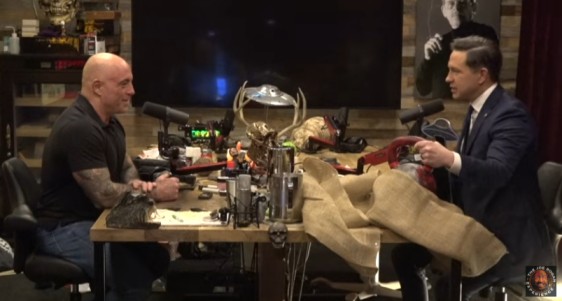
Editor’s Notes: In this episode of The Joe Rogan Experience #2470, Joe sits down with Pierre Poilievre, the leader of the Conservative Party of Canada, for an expansive and thought-provoking conversation. Poilievre shares his personal journey—from being adopted and growing up in Calgary to developing a political philosophy rooted in maximizing personal, financial, and religious freedom. The duo dives deep into the pressing issues facing Canada today, discussing everything from controversial social policies and trade tariffs to the fundamental need for simplicity in government. It is a compelling look at the vision of a prominent political figure and his perspective on restoring common sense and liberty to the national stage. (Mar 19, 2026)
TRANSCRIPT:
Introduction and the Kettlebell Gift
JOE ROGAN: How are you, sir? Pleasure to meet you.
PIERRE POILIEVRE: It’s great to be here. Thanks for having me. Great to be back in Texas.
JOE ROGAN: I’m glad we finally did this.
PIERRE POILIEVRE: Yes, me too.
JOE ROGAN: I wanted to do it the first go around.
PIERRE POILIEVRE: Yeah, I know. Well, when I got the invitation, we were in the middle of the election, and we just don’t leave the country during election campaigns. I get it. And the problem we’ve had is we can’t get you to come to Canada. And so we’ve actually hatched a full strategy to get you into Canada because we think it’s going to do big things for our tourism numbers. So do you mind if I present you with something right out of the gate?
JOE ROGAN: Sure.
PIERRE POILIEVRE: All right, this is. This is from a gunsmith and machinist in Calgary, Alberta. His name is Jay, and he’s designed. Look at this kettlebell. Guess what the weight is.
JOE ROGAN: 70 pounds.
PIERRE POILIEVRE: 70 pounds. That’s the weight you have. And it says on the front here, Jamie. It says here on the front. Jamie, pull it up.
JOE ROGAN: We’ve got.
PIERRE POILIEVRE: You see here some other stuff for a stand.
JOE ROGAN: Oh, wow, that’s really cool.
PIERRE POILIEVRE: Look at this stand here. So we’ve got “seeing is believing,” which I think was the slogan of the first UFC that you were the commentator for. I think it was number 13.
JOE ROGAN: 12.
PIERRE POILIEVRE: Number 12. And then we’ve got here your favorite quote from. What’s his name? The Japanese martial arts. Yes. And it says, “If you know the way broadly, you will see it in everything.” Yeah, so that’s here. And then Morse code. There’s a thank you letter for you. You’ve got your flying saucer, and we’ve got your logo here too. So. But most important of all, we’ve got a subliminal message, which is the Canadian Maple Leaf.
JOE ROGAN: Oh, cool.
PIERRE POILIEVRE: Every time you do a kettlebell swing, you do a snatch, you do a clean, you’re going to be seeing that maple leaf, and you’re going to be reminding yourself that you need to come back to Canada. All right, all right, all right. Present that to you there.
JOE ROGAN: Thank you very much. Very cool. Is that in the way? Jamie, we’ll.
The History of Kettlebells
PIERRE POILIEVRE: So I saw your. I saw your interview with Pavel, and I’m a big kettlebell freak.
JOE ROGAN: Are you really?
PIERRE POILIEVRE: Yeah, absolutely. And I started researching him after you had him on, and I was trying to. I love history. So I was thinking, why did the Russians come up with this? And it turns out they used it as a counterweight at the farmer markets. So they would say, you know, you come in, you have to say, this is how much potatoes you’re buying. But instead of trying to do it by eyeball, they would put what is now a kettlebell on one side of the scale and then the produce on the other.
And then at the farmers expeditions, you had these big Russian farmers who wanted to show how strong they were, so they would pick them up and do all kinds of displays with them. And then the Russian army took it on, the Soviet army took it on, and then that’s where Pavel picked it up and then brought it over the Atlantic and introduced it to America.
JOE ROGAN: Wow, that’s crazy. So it was just accidental that they made this very functional tool for fitness.
PIERRE POILIEVRE: Yeah, it was just. You’d go to a farmer’s market, you want to buy some barley or some potatoes, but you don’t know if you’re actually getting the real weight. So they’d have a scale, a balancing scale, and they’d put the kettlebell on one side and the produce on the other. And then you knew you got the right amount.
And then, of course, they had these big farmers, farm fares and. And they’re showing off their horses and their cattle and stuff, and they’d want to do strength displays. So these farmers are throwing these things around. And the Russian military picked it up, and then the Soviets, of course, took over, and they took it on. And then Pavel, I think he was Belarussian, though, if I’m not mistaken. Pavel, I’m not sure. And he brought it over to North America, but the ancient Chinese did it as well.
JOE ROGAN: Really?
PIERRE POILIEVRE: Yeah, the ancient Chinese, the Shaolin monks have used them, but they didn’t do it with cast iron. They had. Theirs were sort of a concrete block, and they did it for strength training as well.
JOE ROGAN: Oh, wow. Little history.
PIERRE POILIEVRE: Yeah. So I’m a big kettlebell freak. I love it. And I really. I started to study what Pavel’s teaching. I wanted. I think he has an accreditation or something. If I ever get time, I might take it.
JOE ROGAN: Yeah. Strong First. Yeah. That’s his organization.
PIERRE POILIEVRE: And you’re doing. You have a whole program. I think you do clean and press, and then.
JOE ROGAN: Yeah, I do a bunch of different things.
PIERRE POILIEVRE: Watch with overhead squat and all that.
JOE ROGAN: It’s a great functional tool just for your whole body.
PIERRE POILIEVRE: Right.
PIERRE POILIEVRE: Yeah. I think he calls it a cannonball on a handle. And the thing I like about it is the. It’s like a catapult. Like it. All of the lift is in that instant where it flips over your hand.
JOE ROGAN: And the original ones. Wow, that’s crazy. That’s so interesting. So the handle was just to pick it up and carry it around.
PIERRE POILIEVRE: Yeah.
JOE ROGAN: Wow.
PIERRE POILIEVRE: That had a real functional use.
JOE ROGAN: Well, it’s just amazing how good it is for a piece of exercise equipment that was accidentally designed that way.
PIERRE POILIEVRE: Absolutely. And I think it’s far superior to a dumbbell exercise, because there’s no. A dumbbell. You get a consistent lift, but that’s not real life. If you’re in a fight or you have to pick something up heavy, it doesn’t lift consistently. It’s explosive in that small range. And when you’re doing a snatch, by the time you get up to your shoulder, the thing’s weightless because the catapult effect has taken over. And now it’s actually negative weight, lifting your hand up in the air if you’re doing it right.
But if you’re in a fight or if you’re in a wrestling match or you’re trying to push really hard against a heavy object, it’s all about explosive power. And that’s what kettlebells give, rather than just this sort of freeze and contract thing that you do with dumbbells.
Getting Into Politics Through a Sports Injury
JOE ROGAN: Have you always been a work—
PIERRE POILIEVRE: Yeah, look, I was big into sports until my mid teens. I was on the wrestling team. I wasn’t great. I was good, but I wasn’t great. Then I got a wicked tendonitis in my shoulder and it ended my athleticism for, like, four years. And that’s how I got into politics. I was so bored, I got home from school. I had nothing to do, so I told my mother.
JOE ROGAN: Tendonitis got you into politics?
PIERRE POILIEVRE: Yeah, that’s what it was. I just couldn’t get rid of it. Every time I thought I had it beat, I’d go in and I train and it would be full of inflammation. No one could do anything about it. And so I was, like, bored out of my mind. And I said to my mom, you know, you go to these local meetings with the Conservative association, take me to that because I’m going crazy.
JOE ROGAN: That’s nuts. Yeah. So what were you interested in when you first went there? Like, you just didn’t like the way things were running. Like, what was it about it that got you so curious?
PIERRE POILIEVRE: Well, I grew up in a suburban neighborhood in the south end of Calgary. My folks were teachers. I was adopted. My mom was a 16 year old. She was obviously a single mom. She put me up for adoption with two school teachers. There were electricians and oil workers and police officers who lived on our street. Normal, hard working, good folks.
And I always grew up with the impression they were getting screwed over and that the government didn’t listen to people like them. Didn’t listen to people who grew up on streets like ours. And living in western Canada, there was a greater sense of that. We called it western alienation at the time. And there was this guy, kind of a quirky guy, but a really brilliant guy named Preston Manning. And I saw this billboard of him and he had his fist up and it said “enough.” And I said, yeah, I like that guy.
So I got involved in politics and I started reading about different things. I read a lot. Biography on Fidel Castro. And then I read Justin’s dad. No, not Justin. Right? No, no, no, no. His dad was Pierre. His dad was Pierre. His dad was Pierre. I had issues with Pierre Trudeau too.
JOE ROGAN: It’s a great conspiracy theory though.
PIERRE POILIEVRE: Well, it is a hell of a. I don’t think it’s a true one though. His dad is unfortunate. His dad was very controversial while I grew up because he did a lot of damage to the oil sector and we’re from oil country and so that was one of the things that I felt kind of resentful government. And one of the reasons I got involved is because the west deserved a fairer deal.
But I read a lot of books like, Milton Friedman’s Capitalism and Freedom. And I came to develop a philosophy based on just maximizing personal financial, religious freedom. Let people make their own decisions. And that animated me to get involved in politics and fight for that. And I’ve been doing it ever since.
JOE ROGAN: Wow, that’s a fascinating transition from wrestling and tendonitis.
PIERRE POILIEVRE: Yeah.
JOE ROGAN: Deeply involved in politics.
PIERRE POILIEVRE: Yeah, I mean, you’re a sports guy. If you had suffered an injury that took you out of taekwondo when you were young and you simply couldn’t compete at anything, you’d probably be looking for some other adventure.
JOE ROGAN: Yeah, that’s how it was. Well, we’re lucky that stem cells weren’t around back then or you never would have gotten into politics.
PIERRE POILIEVRE: That’s right. I would have been a wrestler. I don’t know if I would have won any awards. But yeah, that was how I got started. And I got very active very quickly. I got my first internship making 600 bucks a month when I was 16 or 17 years old and would, take two trains and a bus and an hour and 45 minutes each way. But I was so thrilled. My dad bought me a used suit and a used pair of shoes. And I thought, this is so incredible. I’m an important guy. I wear dress shoes. I wear a tie. Didn’t matter that the tie was bad, bought from some dead guy whose family had sold it to a used store. But that was my start, and I loved it.
Canada Under Trudeau and Joe’s Love for the Country
JOE ROGAN: Well, I’m really excited to have you in here because I’ve seen you speak multiple times, and you’re a very reasonable, intelligent person that makes a lot of sense. And that is a rare thing in politics. And I love Canada. I just say I don’t go up there anymore, but it’s because I think the government went horribly wrong over the last, X amount of years.
But the people are amazing. It’s like, I have always said that Canada has, like. It’s like America with, like, 20% less assholes. Like, every time I would go up there, people are so nice. They’re the nicest people. And I think that’s part of what went wrong for Canada is that people are rule followers and, they’re trusting and kind people. And, this wolf in sheep’s clothing snuck in and was pretending he was a sweet guy and passing all these crazy laws.
And just when we saw what happened with COVID, with what happened with the truckers and people’s accounts getting shut down for donating to the truckers. Like, the whole thing was so concerning because. Sorry, Canada was like a part of America almost. I mean, you’re a different country, but it’s like, you used to be able to go over there with just a driver’s license. It was such a cool place. I started going to the Montreal Comedy Festival in, like, 1993. I loved it up there. It’s, like, one of my favorite places.
PIERRE POILIEVRE: Just for Laughs.
JOE ROGAN: Yeah.
PIERRE POILIEVRE: Good. How’s your French?
JOE ROGAN: Not good.
PIERRE POILIEVRE: Okay, we’ll work on that. We’ll get you some French lessons.
Assisted Suicide and Mental Health in Canada
JOE ROGAN: It’s terrible. I don’t know any French words. My wife is learning French, though. It’s interesting. She’s got this app that she’s learning French. But it’s just an amazing place. It’s a great country, and to see it go the way it’s been going and sliding the way it’s been happening over the last X amount of years. There’s just so many things that concern me. One of the things that really concerns me is this assisted suicide thing. One in 20 deaths in Canada is now assisted suicide. That’s insane.
PIERRE POILIEVRE: Well, listen, my view is that people should have the choice, but the concern we have is the suggestion that it would be offered to kids or offered to people whose only condition is mental illness.
JOE ROGAN: Right.
PIERRE POILIEVRE: I don’t agree with that.
JOE ROGAN: My concern as well. I mean, if someone’s got a terminal illness — a good friend of mine went to Oregon to end his life because he had ALS.
PIERRE POILIEVRE: Okay.
JOE ROGAN: But I mean, he was gone. I mean, he could barely talk at the end of his life. His name is Michael Lehrer. He was a regular guest on Kill Tony. Great guy.
PIERRE POILIEVRE: Right.
JOE ROGAN: And it was horrible. I mean, watching him fade away. And he wanted to go out on his own terms. So he went to Oregon for assisted suicide. There’s a place for it.
PIERRE POILIEVRE: Yeah.
JOE ROGAN: But I mean, there was a kid recently in Canada, and he did it for seasonal depression. I’m sure you’re aware of that case. Who allowed that to happen? Who didn’t counsel this young guy, who didn’t give him a hug, who didn’t tell him about diet and exercise and changing your surroundings, your lifestyle, and just do something right to give you some hope and happiness? Like seasonal depression — really? You’re going to end your life, this beautiful life on this planet, for seasonal depression?
PIERRE POILIEVRE: And that’s why we have to do more to give people hope when they’re suffering with mental illness. Give people the sense that they can take back control of their lives. I think we do have to promote fitness more, because it gives people — it turns them into a subject that controls their surroundings rather than an object being controlled. It teaches people that hardship is temporary and that the aftermath is positive.
And we have to reinstill people with a sense of meaning when they’re going through hardship, rather than to say that it’s all over. I think our system needs to be geared towards giving people all the best options to live on, rather than just suggesting MAID as the easy, as the automatic path for the system to impose on people.
So one of the things our party is pushing for is to make clear that public servants who are getting phone calls from people who are in need of help — for something they shouldn’t be offering — should not be offering MAID. People can seek it out if they want, but when you’re calling up saying, “I’m poor,” or “I’m struggling,” or “I’m having a mental illness,” or “I’ve got an injury,” we shouldn’t have a government worker saying, “Well, consider MAID.”
JOE ROGAN: Well, the unfortunate thing is that any organization that gets formed wants to grow, and you get financial incentives, and then you hire more people, and then it gets bigger. And then what do you have to do? Well, you have to keep doing what you’re doing.
PIERRE POILIEVRE: Exactly.
JOE ROGAN: What are you doing? You’re killing people. So you’re going to kill more people because you’re actually financially incentivized to put more people through this program and end their lives. That’s very sad.
PIERRE POILIEVRE: I think we have to get to a point where people have the freedom to make their own decisions, but they also have hope that there is an option for them to live.
The Power of Fitness and Meaning
JOE ROGAN: And the exercise thing — it’s not just giving them control of their life. It makes them happier. There’s been studies that show it’s much more effective than antidepressants.
PIERRE POILIEVRE: Absolutely. Well, first of all, there’s the physiological side, which affects the brain, but it’s also the sensation of discomfort that you push through, knowing that you have to focus on the thing you have to do. And I think it helps us in anything we’re encountering, whether you’re going through a divorce or a bankruptcy or an injury or an illness. If you know that pushing through to the other side — because you’ve got a meaning there — that can give people hope for a better life.
My favorite psychologist is Viktor Frankl, and he developed this Logos treatment, which was basically giving people a sense of meaning. He survived the Holocaust in the concentration camp because he had a sense of meaning. His book was stolen from him in the concentration camp — about this theory — and he wanted to live on so he could survive and write that book.
And then he found in his teaching that it wasn’t so much people’s circumstances that determined their happiness. It was whether they had a meaning in life. And he tells this incredible story of a group therapy session where he had this very rich woman who was married to a very rich man. And he had next to him another lady who was living in terrible poverty. She’d lost a son and had a second severely disabled son.
And he said to both of them, “What will your life look like when you’re 80 years old and you’re on your deathbed?” And the wealthier lady said, “Well, I will look back and think that I had some fun and enjoyed the luxuries of being very wealthy and having an easy life, that there wasn’t a lot of meaning to it.” Whereas the mother who was struggling with a disabled child and had lost another one said, “Well, I gave my first child a great life — a short one, but a great one. I struggled to give my disabled child a good, dignified existence. And I leave this world satisfied and happy that my life had purpose and meaning.”
And the lesson I take from that is that it is not about whether you have a gazillion dollars or whether your life is easy. It’s whether you have some meaning to invest your life into. And I think we have to infuse people’s lives with meaning so that they can live a good life.
Canada’s Political Slide Under Trudeau
JOE ROGAN: Well, that’s a great message. And I think it’s one of the most important parts of being a leader — having a great message and having a great philosophy and having a great perspective. And that’s what disturbed me the most about when Trudeau was running the country. I felt like he was manipulating people with woke politics and ideology, and that it was just this weird slippery slope that people were falling down where they’re losing rights and losing their ability to express themselves.
It just really disturbed me because I always felt that Canada was like one of the freest places and one of the most open-minded places. And I didn’t understand how it could fall so quickly.
Parliament, Opposition, and the Role of Government
PIERRE POILIEVRE: We still are a free country and we are a democracy. We have preserved that. I had this funny moment when Joe Biden came to Parliament Hill. And I said, “Mr. President, I’m Pierre Poilievre, I’m the leader of His Majesty’s Loyal Opposition.” And he said, “Loyal opposition? How can you be loyal and opposition at the same time?” It’s like, what the hell are you talking about?
Because you guys have a system based on a republic, whereas ours is the British system. And in our system, the opposition is an act of loyalty. It means that if you are opposing the government, you are doing it out of loyalty to the good of the people.
In your Congress, you have a half circle. In our Parliament, it’s two sides — two and a half sword lengths apart — because they used to literally kill each other in the old English days. But the idea is the opposition is to prosecute the hell out of the government, make the mighty low. The most powerful people in the country are supposed to tremble every time they walk in that place, because every mistake they made, every abuse of power, every corruption they might have done can be exposed in front of all eyes.
So our system is really designed to constrain the power of government through what we call Parliament. I don’t work for government, I work for Parliament. And Parliament works for the people. We call it the House of Commons because it’s the House of the common people. It’s green in there because they used to meet in the fields of England.
So I really view the role of our Parliament as to limit the power of government, to maximize the power of the people. Make people bigger, stronger, and more fulfilled by having the government narrowly focus on the things it’s supposed to do — roads, military, basic social safety net, borders, police, et cetera — but then leave people alone to live their lives. If I were to start a political party from scratch, it would be the “Mind Your Own Damn Business” party. Just get the government to do its job well, do four or five things really well, and then let people live their lives.
JOE ROGAN: Well, that sounds very reasonable.
PIERRE POILIEVRE: Yeah, yeah.
JOE ROGAN: I mean, anybody that doesn’t go along with that, anybody that’s opposed to that — that doesn’t even make sense.
PIERRE POILIEVRE: No. Look, the way I grew up and everything I’ve seen ever since — when I talk to farmers or factory workers, electricians — I find they know just as much or more than the so-called experts I encounter on Parliament Hill.
Like, back during COVID, when all these governments were printing money and all the politicians and bankers said, “Oh, this is great, look at all this money we get to spend,” I’d walk around communities and have mechanics say, “You know, we’re going to have inflation.” And I would say, “Yeah, it makes sense to me.” And I’d go back to Parliament Hill and the experts would all say, “No, no, there’s not going to be.” And sure enough, all that money filtered into the economy, bid up all the goods we buy, and everybody got smoked with higher prices.
But the point is that it was the common people — who don’t study this stuff for a living, who don’t read endless reports and studies — who could just figure out that if there’s money pouring into the economy that’s not matched by goods and services, it’s going to bid up the cost of everything. So that’s my experience, and my ideology is that the common guy knows how to make his own decisions. We need to empower him to do that.
JOE ROGAN: Yeah, just stay out of people’s lives.
PIERRE POILIEVRE: Exactly.
Trump’s “51st State” Comments and Canadian Sovereignty
JOE ROGAN: So there’s a narrative in America, and the narrative is that you were about to win and your party was about to win, but then Trump came along and said he was going to turn Canada into the 51st state, and everybody went crazy. Is that accurate?
PIERRE POILIEVRE: I wouldn’t say they went crazy. I mean, they got very upset. They should be upset, though.
JOE ROGAN: Well, it’s a crazy thing to say.
PIERRE POILIEVRE: It is a crazy thing to say. Canada’s not for sale. We’re never going to be the 51st state. We love Americans as neighbors and friends, but we want to be uniquely and sovereignly Canadian. It’s our country. It’s where we grow up. You’re a patriot as an American, I’m a patriot as a Canadian. It’s where my grandfather arrived. It’s where our collective ancestors put on military uniforms and sailed to fight wars. It’s where our grandkids are going to live. We’re very proudly Canadian, so we’re never going to be the 51st state. And I just wish he’d knock that s* off so that we can get back to talking about the things that we can do as two separate countries that are actually friends.
JOE ROGAN: Did that really have that much of an effect up there? Like, did people take him seriously?
PIERRE POILIEVRE: I think at first, everyone thought it was a joke, because we’ve always had these jokes — like, “One day we’re going to take over Vermont,” and “Detroit should be part of Canada,” and all that stuff. But then he kept saying it and saying it, and it became — a lot of people got upset about it. And I think understandably so.
Canada-US Relations: Tariffs, Trade, and Mutual Benefits
JOE ROGAN: I mean, it’s a crazy thing to say.
PIERRE POILIEVRE: It’s a crazy thing to say.
JOE ROGAN: I talked about it. It was so funny. It’s like, at first I was joking, but then people were like, it’s a good idea. That’s not a good idea.
PIERRE POILIEVRE: He’s saying that. I can assure him of that. But the tariffs aren’t a good idea either. We should get the tariffs out because there’s so much we could be doing together as neighbors and partners if we got rid of those tariffs.
What are the biggest problems in America today? Affordability. Security. And we can help with both. We knock the tariffs down. Let’s look at affordability. We have the fourth biggest supply of oil anywhere on earth. You guys pay a huge price discount for our oil because we’re effectively — all our infrastructure to ship it is north-south, and it’s a very unique heavy oil. So we accept, unfortunately, and for now, a price discount on the oil we send you, which can translate into more jobs and paychecks, but also lower energy prices. You’ve got $5 a gallon right now in lots of places in America. I want to produce more so we can sell 2 million more barrels of Canadian oil into the US market.
And then there’s housing. You’ve got huge housing pressures on young people. They can’t afford a place to live. We’re the biggest supplier of lumber for home building of any country that exports to the United States. We’ve got very low cost but high quality softwood lumber.
The best selling truck in America for 45 years now is the Ford F-Series. It’s aluminum. It’s a military grade aluminum body. You guys can’t make enough aluminum here. You don’t have enough bauxite or electricity to convert it into alumina and aluminum. You get your aluminum from us. A tariff does not bring the production to America. It raises the price of the aluminum and therefore the F-Series truck. Get rid of that tariff, you lower the cost of an F-Series truck for the miner in Appalachia or the electrician in Ohio.
And that’s just on the affordability side. There’s a lot we can do with our minerals to make the continent a hell of a lot safer as well. So I think it’s in America’s interest to come towards a tariff free deal and trade freely as friends. And that will be good for both of us.
Conversations with Trump and the Canadian Election System
JOE ROGAN: Have you had conversations with Trump about this?
PIERRE POILIEVRE: No, I believe in the rule of one Prime Minister at a time. So I fought like hell to win. I didn’t win. We came very close. So I said, listen, I’ll leave it to the Prime Minister to do the negotiating. And I’ve said I’ll support him any way I can. Even in my visit down here, I’m sending him text messages to tell him what’s going on, to try and support his work. Because what we want — we both want what’s best for Canada.
JOE ROGAN: Where are your elections now? When do you have the next elections?
PIERRE POILIEVRE: That’s a strangely hard question to answer because —
JOE ROGAN: I know you have a weird system. Yeah, it’s weird in comparison to ours.
PIERRE POILIEVRE: Right. Yours are fixed. As you know, ours — we have technically fixed election dates, but the government can fall at any time. It’s very simple. The rule is that if the opposition parties bind up and they can vote down the government — that is to say, the majority of MPs in the House say, “We’ve lost confidence in the government” — the election is now. Or if the Prime Minister decides he wants an election, he can call it, and the election is now. But it has to be sometime in the next roughly three years.
JOE ROGAN: Oh, so you have a deadline. Where does it take place?
PIERRE POILIEVRE: Yeah, that’s right.
JOE ROGAN: But it could happen tomorrow.
PIERRE POILIEVRE: It wouldn’t necessarily be tomorrow, but in the next few weeks, if there were a non-confidence vote and the government lost it, then they go to an election. So it’s kind of like the British system.
JOE ROGAN: Interesting.
PIERRE POILIEVRE: Yeah, well, it is the British system really. We adopted the British system almost identically.
The Role of Opposition Leader
JOE ROGAN: So when you’re campaigning, you’re essentially — this is like a long game.
PIERRE POILIEVRE: Yeah.
JOE ROGAN: You’re just laying out your strategy, laying out what you would do to make Canada a better place.
PIERRE POILIEVRE: Yeah, well, we have two roles. I’m the leader of the opposition, but I’m also Prime Minister in waiting. So the notion is that the Canadian people should not only have a government, but they should have an alternative. And that alternative has two functions. Official Opposition — it’s actually called that, I think it’s a proper noun, capital O, Official, capital O, Opposition — and also government in waiting.
So you have to be prosecuting the government, but you have to present yourself to people in a way where they say, “Yeah, that guy or that team could actually be the government.” Those are the dual roles that I have to carry out.
JOE ROGAN: Interesting. And how long have you been attempting to become Prime Minister? How long has this been going on?
PIERRE POILIEVRE: For almost exactly four years, because I launched my campaign in February of 2022.
JOE ROGAN: Was this something that you had always had in the back of your mind, or —
PIERRE POILIEVRE: I’d say in the back of my mind, but it wasn’t something I was set on. I thought maybe, when I’m in my 50s or 60s, I would try it, but I was in no rush to do that.
JOE ROGAN: How old are you now?
PIERRE POILIEVRE: I’m now 46.
JOE ROGAN: And so what motivated you to do it?
Running on Freedom: Post-COVID Economic Concerns
PIERRE POILIEVRE: Well, after COVID, as COVID was unfolding, it wasn’t just the COVID policies themselves, it was the economic policies. Because I’ve been very focused on economics in my parliamentary career, and I was seeing the size and cost of government — not just in Canada, but all around the world — growing so much, and that inflation was just destroying the working class people, and that it was going to get a lot worse.
And so I ran on the platform of making Canada the freest country on earth. We had a tradition of freedom in Canada. One of our earliest prime ministers, Wilfrid Laurier, was asked, “What’s Canada’s nationality?” And he couldn’t actually list an ethnicity or a religion because we were already mixed up even 100 years ago. We had Scots and Irish and First Peoples. So he said, look — French, most of all French and English and First Nations. So he said, “Canada is free and freedom is its nationality.”
And I wanted to reinstate that idea. I wanted it to be the freest country anywhere on earth. And so I ran on that platform and won the leadership, and then ran in the last election and stayed on after that election. So that’s kind of the last four years of my journey.
How the Canadian Parliamentary System Works
JOE ROGAN: And so the way your elections work now — you’re essentially just stating your case, going around and talking about what policies you would implement and how you would do things differently, and just waiting to see how it all plays out.
PIERRE POILIEVRE: See, our Prime Minister is different than the President. He’s actually part of the legislative branch. So he comes in to the House of Commons and we debate multiple times a week, he and I. So it’s not just — in your system, the Republican and Democrat hold like four debates right before the election. In our system, we’re always debating.
So he comes in, he’s on one side, I come in, I’m on the other side, and I ask him like six consecutive questions and then he answers and we go back and forth. That’s called Question Period. Then we have these committees where we prosecute and propose on finance, natural resources, healthcare, you name it. So we’re constantly prosecuting the government, also proposing better ideas at the same time.
Like the other day I proposed to bring back the Auto Pact between Canada and the US to have tariff free trade going both ways across the border. So that’s an example of how I’m in a position to actually offer solutions even though I’m not in the government. And then hopefully the government actually steals my ideas. And I’ve been encouraging them to steal my ideas.
George St-Pierre, MMA, and Canadian Martial Arts
JOE ROGAN: So what is this coffee, by the way?
PIERRE POILIEVRE: I need some caffeine. Some caffeine there. I’m a terrible caffeine addict.
JOE ROGAN: Me too. Cheers.
PIERRE POILIEVRE: Cheers.
JOE ROGAN: Oh, and shout out to George St-Pierre for hooking this up.
PIERRE POILIEVRE: Yes. George is a good man. He’s the best, great guy. He said he’s going to have me do some pad work with him at some point.
JOE ROGAN: Oh, really?
PIERRE POILIEVRE: That’s pretty dangerous.
JOE ROGAN: Oh, that’s awesome. He’s here all the time.
PIERRE POILIEVRE: He’s a fantastic guy.
JOE ROGAN: He’s the best. He’s one of the best representatives of martial arts you could ever hope to meet.
PIERRE POILIEVRE: He’s got humility. I remember he came to Parliament Hill years ago and I thought — because he’s — I thought he’d be cocky and swagger, but he was so down to earth.
JOE ROGAN: So much humility for what he’s accomplished in MMA. I’ve introduced him to people and they have no idea who he is. And then I go, “That is one of the greatest fighters that ever walked the face of the earth.” “Absolutely no way. He’s so nice.”
PIERRE POILIEVRE: And that’s the Canadian way though. Soft spoken and gentle and kind, but don’t piss us off.
JOE ROGAN: Yeah, but tough. Yeah, that’s where Trump f*ed up. I wonder what would have happened if he didn’t go along with that 51st state nonsense. I mean, that is the narrative in this country. Like I said, if he didn’t do that, that you would have won.
PIERRE POILIEVRE: Well, you never know. But I try not to cry over spilled milk. I focus on what I have to do and live in the present. But this new guy, Milott — have you followed him? Mike Milott?
JOE ROGAN: Oh sure, I know Mike.
PIERRE POILIEVRE: He’s going to be fighting in Winnipeg. I think he’s the next GSP.
JOE ROGAN: He’s very good.
PIERRE POILIEVRE: You like him?
JOE ROGAN: Yeah, he’s excellent.
PIERRE POILIEVRE: Yeah, he did a great job in Montreal, if you saw him there.
JOE ROGAN: Yeah, I’ve called a bunch of his fights.
PIERRE POILIEVRE: Is that right?
JOE ROGAN: Yeah, he’s excellent.
PIERRE POILIEVRE: Yeah, his trainer is my buddy — Cruellen Amalgam in Hamilton. He’s a Hamilton Steeltown guy. And we’re hoping that he has a big win in Winnipeg.
JOE ROGAN: Well, you guys have one of the best gyms in the world — TriStar in Montreal. Is that right? For Firas Zahabi?
PIERRE POILIEVRE: Okay.
JOE ROGAN: There are like maybe a handful of great masterminds in MMA as far as coaches, and Firas is at the top of the list.
PIERRE POILIEVRE: Is that right? And what’s his —
JOE ROGAN: He trained GSP.
PIERRE POILIEVRE: Is his discipline karate or kickboxing? Muay Thai?
JOE ROGAN: He’s a true mixed martial artist — black belt in jiu-jitsu, kickboxing. He can do everything. And TriStar is a place where a lot of people from America go up there for their camps.
PIERRE POILIEVRE: Interesting. Yeah, I have to drop in and see those guys.
JOE ROGAN: Oh, it’s phenomenal. Like I said, GSP trained up there a lot. A lot of fighters trained up there. And he also had a great working relationship with a lot of people in America. So he would come down and they would exchange fighters back and forth and train with each other.
PIERRE POILIEVRE: Yeah, well, we have a great martial arts tradition in Canada. I don’t know if you know Mike Miles — he brought Muay Thai from Thailand to Calgary back in the 70s or 80s, and he still has a great gym there.
JOE ROGAN: And do you know who Johnny Terrio is?
PIERRE POILIEVRE: Yes, he’s a buddy of mine. From Ottawa. Yeah.
JOE ROGAN: Oh, no kidding.
PIERRE POILIEVRE: Yeah, he —
JOE ROGAN: He was a hero of mine when I was a kid.
PIERRE POILIEVRE: Yeah, he’s incredible.
JOE ROGAN: When I was kickboxing, he was like my idol.
PIERRE POILIEVRE: Really?
JOE ROGAN: Yeah.
Canada’s Resources, COVID Mandates, and Economic Vision
PIERRE POILIEVRE: Does he know that I never talked to him. Well, he’s going to see this book. Yeah, I bought his book.
JOE ROGAN: I started running stairs because of his book, because he’s talking about how it increased his leg muscles and his kicking power.
PIERRE POILIEVRE: I remember that it was in one of his documentaries or something. He said his kicks weren’t strong enough, so he would do stairs. But I went and trained at his dojo a few times. It’s in South Ottawa.
JOE ROGAN: He was incredible. He was one of the truly elite kickboxers of his time.
PIERRE POILIEVRE: He was a great boxer. Like, I know he never competed as a boxer, but his hands were fantastic.
JOE ROGAN: Well, that’s really what separated him from a lot of other people was his accuracy and his technique was pristine.
PIERRE POILIEVRE: He told me that he would spend hours studying the distances that your limbs would have to travel depending on how you move. He was kind of like a scientist in the way he learned and studied. And he was all about simplicity and removing anything unnecessary. I think Bruce Lee said that. He said simplicity, hack away at the unnecessary. And how do you — what’s the shortest distance to hit the strike?
And he’s got a great — he’s a really good heart too. He has a jujitsu club as well. And when I went in there, there was a blind fellow who was into jiu-jitsu, which you can do as a blind person because it’s so much about feel. But with COVID he couldn’t do jiu-jitsu anymore. They disallowed that kind of up close contact. So he actually found a way to train this guy with focus mitts even though he was blind. It was really incredible.
JOE ROGAN: Oh, wow.
PIERRE POILIEVRE: Yeah, it was just — it was an incredible amount of patience he had invested in making sure this young man could keep doing his physical activity throughout COVID.
JOE ROGAN: Wait a minute. So they allowed pad work, but they didn’t allow jiu-jitsu?
PIERRE POILIEVRE: I don’t know if it was a government policy or if it was just a policy at the gym because, you know, you’re just so wrapped up and sweating and —
JOE ROGAN: Gyms in America, everybody just kept going, kept going. They would put foil over the windows and hide, or come in through the back door. A lot of the gyms in LA, that’s what they did.
PIERRE POILIEVRE: They just plowed ahead.
JOE ROGAN: They just figured out a way to not get in trouble.
PIERRE POILIEVRE: Right.
JOE ROGAN: And some people did get caught and get in trouble and nothing ever came of it, because it’s pretty unconstitutional to tell people that they can’t work out together. Like, the government really didn’t have the right to tell people that they couldn’t do what they wanted to do — that was a legal thing that you can do.
Like, all of a sudden there’s this mandate, there’s this law or rule being passed down, or at least it’s being promoted, that you’re not allowed to go to a gym and work out with other people. But those are the healthiest people. Those are the people that are the least likely to get sick. This is crazy to say. And if you’re sick, and if you just have a good gym with good people, say, “Hey, don’t show up if you’re sick.” Everybody should be okay. These are the people you should worry about the least.
Pushing Back Against Government Overreach
PIERRE POILIEVRE: We need to have common sense again. Too many governments in the Western world have gone way too bossy. They’re just looking for every excuse to boss people around, and that’s what we have to push back against. Whether it’s EV mandates, excessive control of the Internet, or the massive increase in the cost of government — which is really like appropriating the private voluntary economy into the coercive government economy — that’s what we’re seeing across Europe, in the UK, parts of the United States, as well as back home. So we need to reverse that trend and get people back in charge of their lives.
JOE ROGAN: Well, the narrative has always been that rights lost are never regained, or are very, very difficult to regain. So how could you reverse that?
PIERRE POILIEVRE: Well, you have to keep fighting. I mean, we did regain our rights after COVID, and the people have to look at the history of it.
JOE ROGAN: Which rights did you regain?
PIERRE POILIEVRE: Well, all the mandates are gone now.
JOE ROGAN: Of course, but those were ridiculous anyway.
PIERRE POILIEVRE: Yeah, they were ridiculous, but —
JOE ROGAN: And they also ruined businesses. They ruined people’s lives, social lives.
PIERRE POILIEVRE: But freedom has always had to be taken. Our tradition goes back to 1215 with the Magna Carta, the Great Charter. And most of the freedoms we have today were in that original document — right to a jury trial, no arrest without charge, no confiscation without compensation, no taxation without representation. All comes from that one document, the Magna Carta.
And it was because King John was taken aside by the barons, and they said, “Listen, pal, this is the choice. Either you sign this and follow it, or we overthrow you.” And as a result, we got the Magna Carta. And when you guys had your Boston Tea Party and said, “You can’t tax our tea because we don’t elect you,” that was an appeal. As Englishmen, you were saying, “We’re Englishmen, we have the right not to be taxed unless we vote for it, and we’re going to throw you out otherwise.” But that came out of the fields of Runnymede in England in 1215.
So it’s a long march towards freedom. And it’s never actually done. There’s no permanent victories or defeats. You just have to keep going forward.
Unlocking Canada’s Resources
JOE ROGAN: So if you were elected — let’s say you get in right now, what’s one of the first things you would do?
PIERRE POILIEVRE: I would unblock our resources. We have the most resources of any country in the world, per capita, bar none. We need to make it happen, though. We need to have the fastest permits anywhere in the world and the lowest taxes on producing those resources.
We’re fourth in oil, number one in uranium, number one in potash for fertilizer. We have the fifth biggest supplier of natural gas. We have the longest oceanic coastline. We have 10 of 12 of NATO’s defined defense minerals. You had Palmer Luckey on — I don’t think he can make his stuff without Canadian minerals. Maybe I’m wrong, maybe he’ll correct me. But night vision technology needs germanium. You need gallium to make semiconductors and radar. You need aluminum for armored vehicles and airplanes. You need cobalt for heat resistant alloys and fighter jets. You need tungsten for armor piercing ammunition. We have it all.
And what I want to do is unblock those resources, produce them in abundance for ourselves and our allies, make $200,000 paychecks for our trades workers, build up an enormous strategic stockpile so that we have tons of leverage in international relations. And if, God forbid, there is ever a global conflict, we would have all the resources necessary to win it. But we need to get rid of a lot of laws that are blocking progress and replace them with laws that have fast permitting so that we can produce this stuff on scale very quickly.
JOE ROGAN: So is the concern the environmental impact of extracting these things? Is that what’s holding it up?
PIERRE POILIEVRE: That is the ostensible reason. But I just think across the Western world — Europe, UK, parts of the US and Canada — there’s a problem with bureaucracy just growing way too damn big.
The First Nations in our country are incredibly forward looking. The Squamish built 6,000 units of housing on 10 acres of land — you can believe it — in the city of Vancouver, where it’s very hard to get a permit to do anything, because it was their land. So they did it. They’re now building an LNG liquefaction plant where they replaced an old brownfield. They cleaned it up and put an LNG plant there. But the federal government took 14 years to give them a permit.
So we need to think like they’re thinking, which is entrepreneurial — speed of business, get it done quickly. That’s how you develop. We have this community in my district called Hardesty, 600 people. They manage $100 billion of oil in a town of 600 people. Why is it there? Because their municipality offers a permit in one week with one page. And I wanted to tell this story, so I called them and I said, “Can I have someone come and do a video with me?” And they said, “We don’t have anyone here. We don’t have bureaucrats that can help you. They’re all out on their farms right now. They come in, they stamp the permit and they go back to their farm.”
Well, that’s why we have $100 billion of energy moving through the area — which is bigger than the GDP of many countries — because they have fast permits. And that’s what we need in Canada. We need to be the fastest place to get things done.
JOE ROGAN: But don’t you think you need some safeguards to protect the environment? And how do you balance that out?
PIERRE POILIEVRE: Protect it quickly. We can figure out whether a project is damaging to the environment in weeks and months rather than decades. There’s nothing you’re going to learn in year 14 of the review that you couldn’t have learned in month 14.
When the Germans had to break their dependence on Russia after it invaded Ukraine, they approved an LNG import terminal in 60 days. They completed the whole thing in less than 200 days. And guess what? No environmental problems. They got their engineers to sit down and figure out how to do it quickly. And that’s the mentality that we need to get in Canada.
JOE ROGAN: So what would you be able to do to bypass all this bureaucracy? How could that be done legally?
PIERRE POILIEVRE: Well, you slim it down to one project, one environmental review instead of 20 or 30. You have a fixed timeline that the bureaucrats have to give an answer — six months rather than just as long as they want to drag it on for.
And the other thing I would do is study areas where they’re perfectly situated to have a project like a pipeline, or a mine, or an LNG export terminal, or a port expansion. And I would pre-permit it. I would say to our officials, “Go in, study, make sure that the environmental aspects are all in good order. I’ll issue a pre-permit. And then anybody who comes along and wants to build it, as long as they follow the terms and act responsibly, has a guaranteed permit before they even apply for it.” And I think we would have a roaring economy if we did that.
The Alberta Oil Sands Debate
JOE ROGAN: That sounds awesome. But the great fear is that if you do have an impact on the environment, that impact is often permanent and that it’s devastating. And I’ve seen some of the oil extraction that they’ve done up in Alberta, where you look at the area, it looks like scorched earth.
PIERRE POILIEVRE: No, no, no, no, no, no, no, no, no. It’s the most responsible oil extraction in the world.
JOE ROGAN: But when you see these — what is that one area that often gets criticized?
PIERRE POILIEVRE: Fort Mac.
JOE ROGAN: Is that what it is?
PIERRE POILIEVRE: Yeah, they’re open pit mines. You open up a mine, you take out the bitumen, you separate the sand from the oil, you make it less viscous by putting diluent in it, and you ship it off. And then after the mining is done, they resurface it. And you wouldn’t even know there was a mine there.
JOE ROGAN: And there’s no impact to groundwater, no impact to the environment?
PIERRE POILIEVRE: I mean, there’s an impact no matter what you do. But at the end of the day, the people who live there are very healthy and very happy, and they’re the strongest supporters of the expansion of the oil sands. It’s an incredible —
JOE ROGAN: Because economically —
Canada’s Oil Sands, Housing Crisis, and Economic Policy
PIERRE POILIEVRE: Oh, it’s incredible. It’s the best resource in the world. So it’s like there’s no decline rate. You guys have shale here, but, you know, as the years go by, you get less and less out of a shale reservoir. We have very little decline. We can keep producing and producing.
We have what’s called in situ, where there’s an entire oil sands operation under your feet. You could be out in a forest hunting and you wouldn’t even know that under your feet, they’re extracting it through a whole system of pipes where they inject just steam, steam vapor that loosens up the oil. It sinks down, it goes into another pipe, comes up to the top, and you can have beautiful, pristine nature. The bears, the deer, the birds, they don’t even know that there’s extraction happening under their feet.
So we have the best industry, the most responsible industry anywhere in the world. It’s been a really disgusting PR campaign by extremist environmentalists and, frankly, some of our competitors to try and make our industry look bad. But it’s the best industry in the world.
JOE ROGAN: Yeah, they got me. Yeah, I saw some videos on it and I was like, oh my God, what are they doing to the ground? What are they doing to the earth? It looks horrible.
PIERRE POILIEVRE: It’s all bullshit. We have the —
JOE ROGAN: It looks horrible.
PIERRE POILIEVRE: Yeah, but I mean, that’s just a superficial look at it. I’ll take you for a tour in the oil sands. You’ll be amazed. We have the best engineers in the world.
And by the way, the First Nations people absolutely love it because it’s lifting their people out of poverty. They’re getting enormous job opportunities out of it. One of our MPs, as a former chief, where they took 18% unemployment, brought it down to 3, balanced their budget. Another one of my members of Parliament in northern British Columbia negotiated a $40 billion LNG plant on the Haisla territory. It’s completely eliminating poverty for the First Nations there.
And by exporting clean Canadian natural gas, which we can liquefy 25% cheaper because it’s cold as hell in Canada, they actually displace dirty coal overseas. So instead of Asia burning coal, they’re burning clean Canadian gas that’s delivered by First Nations partnership. So this is the best way to do it. Makes everybody richer and makes our entire continent better off.
JOE ROGAN: What seems so simple the way you’re laying it out. I don’t understand why this hasn’t been implemented.
PIERRE POILIEVRE: Yeah, this is the story of my life.
JOE ROGAN: It’s frustrating, but is it that simple? Is it really? This is what’s holding everything up — the bureaucracy and the time it takes for permits and —
Bureaucracy, Housing, and the Permit Problem
PIERRE POILIEVRE: Yeah, like a lot of things, regulations. We have the same thing in housing. And so do you. Like, if you look at California, California is terrible. Like, why is there such a housing shortage in California? It’s because it takes forever to get a permit and there’s always bureaucracy standing in the way. And it totally screws over the working class youth who can’t find a place to live because they’re not being built.
We have that challenge in Canada as well. That’s why I’ve proposed ideas to cut the bureaucracy and the taxes so that we can build affordable homes for our youth. Because right now we have a whole generation that can’t afford homes. And that was one of the biggest issues I ran on.
Homeownership is necessary for family formation, for civil peace in society where everybody feels like they have a piece of the pie. We need to expand home ownership. But to do that, you’ve got to get the government gatekeepers out of the way, speed up the permits, free up the land, cut the development taxes.
JOE ROGAN: So let’s assume that you got in office. How much time would it take to start implementing these things and how quickly would that impact be felt by the Canadian people?
PIERRE POILIEVRE: Look, I think a lot of them can move very quickly. There are a lot of projects that investors are sitting on, but they don’t have certainty and permits. So I would unblock that. And I think in the first year you would start to see immediate benefits for the working people who would be getting these jobs. Some of it would take more time, like a medium term.
The second thing I would go after is just the inflationary spending, which is a big problem all over the Western world. Like, people just can’t afford to live. I don’t know if you encounter that around here.
JOE ROGAN: Oh yeah, yeah. I mean, inflation’s crazy. I mean, the national debt in America just went up to $39 trillion, right?
PIERRE POILIEVRE: Which is bigger than your GDP.
JOE ROGAN: It’s a lot of money.
The Inflation Problem and the Destruction of Working-Class Wealth
PIERRE POILIEVRE: So explain this to me. Fifty years ago, a barber and a waitress could buy a house with a big yard for a dog and raise four kids. Meat and potatoes on the dinner table every night. And now an accountant and a lawyer can’t do that. Why is that?
JOE ROGAN: Well, there’s a lot of spending and a lot of making money. A lot of just turning, you know, just making dollar bills with nothing behind it, nothing to back it.
PIERRE POILIEVRE: This is the biggest fraud perpetrated on the working class people in the last hundred years.
JOE ROGAN: Printing money is just insane. The idea you just print more money, it’s like — and people go, okay, well, it looks —
PIERRE POILIEVRE: Painless at first, but if you have an economy with 10 apples and $10, it’s a buck an apple. You double the number of dollars to 20, but you still only have 10 apples. Well, all of a sudden it’s 2 bucks an apple. It’s not that the cost of apples has gone up. It still costs the same resources to grow and pick the apples. It’s that the price has gone up because the value of the money has gone down.
So in America, over the last 55 years, you’ve doubled the number of homes in America from 70 million to 150 million. You know how much the money supply has grown? 30 times. So you have twice the homes, but 30 times the cash. So what’s happened? Housing costs have gone up 15 fold in 55 years. And now an entire generation of kids can’t afford homes. We have exactly the same problem in Canada.
This is the biggest wealth transfer from the working class to the elites — from, I say, the have-nots to the have-yachts. And Washington and Wall Street love it, by the way, because it inflates the stock market, inflates the bureaucracy. Politicians get to spend, CEOs get their stocks inflated, but it destroys the working people.
And we need to get back to hard money. Everything should be getting cheaper, by the way. You know, it takes 60 to 80% less resources to grow food. We grow four times the food on the same acre, get four times as much milk from the same cow. We use 80% less water and fertilizer. So why isn’t food less expensive? It’s because all of those gains are being erased by monetary inflation. So it’s not that food is more costly, it’s that the value of the money we use to buy it has less purchasing power.
And we need to do what the Swiss do, which is they don’t print money. They have balanced budgets, they have almost no deficit and they have almost zero inflation. In Switzerland, they have the strongest money in the world, the Swiss franc. And we would all be better if we operated like the Swiss when it comes to our money.
JOE ROGAN: So in a real world scenario, like you take over Canada, how would you go about implementing this?
Cutting Spending, Debt, and Fake Refugees
PIERRE POILIEVRE: You’ve got to cut bureaucracy, consultants, which consume, by the way, $26 billion of spending.
JOE ROGAN: How big is your debt in Canada?
PIERRE POILIEVRE: 1.3-ish trillion.
JOE ROGAN: Oh, that’s baby debt.
PIERRE POILIEVRE: Compared to you, you guys are —
JOE ROGAN: We’re ridiculous. Wild.
PIERRE POILIEVRE: But you know, you’ve gotten away with it because the American dollar is the reserve currency. So all these countries prop up the value of the US dollar by keeping it on reserve. Better hope that doesn’t change. We don’t have that luxury. But we do have a lot of debt, and we have provinces too. They’re quite indebted.
But I would cut the bureaucracy. I would cut consultants, foreign aid. I’d cut way back on foreign aid. We give corporate welfare, these checks to corporations. I believe business should make money rather than take money. So I would get rid of that. We’re giving a lot of money to fake refugees — people who come in and don’t actually, they’re not actually fleeing danger. Like, I love real refugees. My wife was a refugee, but I have no time for people who are pretending they’re not really.
JOE ROGAN: And what do you mean by pretending to be a refugee? How are they doing this?
PIERRE POILIEVRE: Well, they’re not actually endangered in their home country. So they’ve come, declared themselves as students and then, wanting to stay, declaring refugee status.
JOE ROGAN: Oh, and this is common?
PIERRE POILIEVRE: Yeah, it happens. And I mean, they just want to have a better life. So I don’t begrudge them as people, but we can’t spend money on enhanced social services, advanced programs that we as Canadians don’t get, for people who are not paying into the system.
JOE ROGAN: So you’re not opposed to them being there? You’re opposed to them getting Canadian —
PIERRE POILIEVRE: Well, I’m opposed to them — if they’re not real refugees, they shouldn’t be brought in as refugees. I think we have to distinguish between those people who are actually in danger in their home country, which is the definition of a refugee, and someone who just wants to come in excess of their proper immigration stream.
JOE ROGAN: Is this that common that it’s actually affecting the economy right now?
PIERRE POILIEVRE: It’s a challenge because we had a big number of international students and temporary foreign workers that came in in very large numbers in like two or three years. We were bringing in about a million people a year, which in America’s terms would be 10 million, like just if you’re doing per capita. And it really caused a housing shortage — like some places where you have 26 of these students living in one basement. So we’re trying to unwind that now.
JOE ROGAN: And how do you do that?
PIERRE POILIEVRE: Well, when their work permit and their visitor visa runs out, then we have to encourage them to head back lawfully.
JOE ROGAN: Right, but you don’t want to do it ICE style?
PIERRE POILIEVRE: No, no, I don’t think we need to do that. I just think we have to be orderly and lawful about it.
JOE ROGAN: And is that supported by the Canadian people?
PIERRE POILIEVRE: Yes, because we’re a very welcoming country. We’re a nation of immigrants, but we’re also a nation of laws. And there’s a general consensus across the spectrum in Canada that the population growth was too fast for like four or five years. And so we’re trying to unwind that now.
Balancing the Budget: The Pay-Go Principle
JOE ROGAN: What are the other things that you would have to do to drop your debt and sort of balance your budget and begin to turn things around?
PIERRE POILIEVRE: Well, in addition — so I like this idea that, believe it or not, Bill Clinton and the Republicans did in the 90s in the US. It was called the Pay-Go law. It was a very simple principle. Every time the administration wanted to bring in a new dollar of spending, they had to match it with a dollar of savings. So there was no extra net spending for like eight years. And that’s when your government balanced its budget and paid off $400 billion of debt.
That law elapsed in 2002, and immediately after that, America went back into deficits and you haven’t emerged. You’ve been in deficit now for 25 years.
This is about internalizing scarcity. Every creature in the universe, every bird in the trees, every fish in the seas has to live with scarcity, maximizing use of scarce resources. The only creature who doesn’t do that is the politician, because he’s always using someone else’s money. It’s like, “Oh, I’ll just print it or borrow it or tax it. It’s not my money.” And so they routinely show up to their cabinet meetings and say, “Well, I’ve got a new idea. It’s $100 million.” “Where are you going to get it?” “I don’t know. We’ll print it, we’ll borrow it, we’ll tax it. Not my money.”
But if you had a law saying you can’t actually bring a proposal to Cabinet unless you have matching savings to pay for it, well, then you’d have these politicians walking up and down the hallways in their departments looking for waste and rooting it out. So instead of making the single mom, the senior, or the small business owner live with scarcity, I want the politicians and bureaucrats to live with scarcity. And that’s what I would impose by law on my government.
JOE ROGAN: Well, it’s just a rational way to deal with the problem. Like, don’t spend money unless you could save money.
PIERRE POILIEVRE: Exactly.
Balancing Budgets and Free Markets
JOE ROGAN: That’s how you balance things out. I mean, Clinton did balance the budget. He did during his time. And people forget that because we’ve always assumed that there’s always been this extraordinary debt. But that’s not the case during the 1990s. I mean, he did a fantastic job at that.
PIERRE POILIEVRE: Yeah, it was that Congress was very disciplined as well. And the American people just got fed up and said, “We’re not tolerating these debts, deficits anymore.” And they imposed scarcity from the center. And by the way, the economy boomed because the government was restrained, and the free market economy could just roar.
And that’s another part of the equation, by the way, is unlock the power of free enterprise. Like, this is the 250th anniversary, not just of the Declaration of Independence, but also of Adam Smith’s Wealth of Nations, where he basically, for the first time in human history, described the free market system. And that was starting to flourish in the States and in parts of Europe.
And that system basically started to come into place after the late 1770s. The growth since the free market system has come into place in the world has been 200 times faster than it was before, because it is the most powerful system for generating material benefit for the people. And that’s what we need to restore in Canada. I want to make it the freest economy in the world.
How Did You Lose the Election?
JOE ROGAN: Well, that all sounds amazing. How the hell did you lose? How can a rational person not vote for that? I mean, you’re not saying anything that’s restrictive. You’re not saying anything that is in any way infringing on people’s rights or liberties. It just sounds like it’s just 100% positive for Canada.
PIERRE POILIEVRE: That’s what I think. That’s my mission, and I think it will be positive and we’ll get there. Canadians do things through evolution, not revolution. So I’m just going to keep pushing my ideas, and I think overwhelmingly, we’ll win the next election.
JOE ROGAN: Well, it sounds like I just can’t see how someone would listen to what you’re saying and say, “I find fault in this.” Other than, like, the potential environmental impact of extracting resources. I could see how a lot of the greenies would get really upset and get their panties in a bunch about that, and be very incredulous to the idea that you’re going to protect the environment while you’re extracting all these resources.
But if you could lay it all out and also lay out this enormous economic impact and how it would uplift impoverished communities, how it would completely change the economic landscape of the country, it just only makes sense. That’s why I’m baffled.
PIERRE POILIEVRE: Well, listen, the people render their judgment, but it means I have to do a better job of processing.
JOE ROGAN: Well, what were the criticisms of you? Like, what did your opponent say that resonated with people? What were they trying to say?
PIERRE POILIEVRE: It was funny because they all disagreed with my ideas, and they said, “These are all very scary ideas.”
JOE ROGAN: Scary.
PIERRE POILIEVRE: And then they said, first of all, they said that I had no policies. Then they said they’re scary policies. And then they stole my policies right before the election. But hey, listen, if the government that’s in power now steals all my ideas and does the things I want to do, then I’ve won, because that’s why I came here. I didn’t just do it so that I could have my name on the door. So I keep saying to the prime minister, “Steal my ideas.”
JOE ROGAN: Right. But he doesn’t want to.
PIERRE POILIEVRE: Well, I won’t criticize him on foreign soil, but good for you. I mean, we have a mutual—
JOE ROGAN: That’s such a Canadian thing to do.
PIERRE POILIEVRE: That is a very Canadian thing to do.
JOE ROGAN: So polite. You know, upset about Canadians. They’re so polite.
The Canadian Apology Act
PIERRE POILIEVRE: It’s funny. Your security guy was talking about the Canadian standoff, when you get to a door. “You go first.” “No, you go first.” “No, you go first.” You can stay there all day.
I actually looked this up the other day. Ontario actually has an apology act. It’s a law that defines the apology, because we always say sorry in Canada. So they wanted to clarify that sorry is not a legal admission of guilt. So, like, we get into a car accident, I say, “Oh, sorry, man. It’s terrible. Your bumper.” It doesn’t mean that I’m guilty. So it’s actually in law.
JOE ROGAN: Somebody else screwed up, you say sorry. That’s funny. That’s so Canadian.
PIERRE POILIEVRE: But, you know, the great thing about Canada is we’ve always sorted our sh out peacefully. Like, the Protestants and Catholics tore each other’s eyeballs out in Europe for hundreds of years. And then we came to Canada and just got along. And that’s the great thing about Canada — you can come, Muslims and Jews, Christians, Protestants and Catholics, Hindus and Sikhs, they come to Canada and they just get along. They live on the same streets. Eventually, we all start intermarrying. And it’s a great thing about Canada.
JOE ROGAN: Well, it really is a great melting pot.
Family Life and Canadian Multiculturalism
PIERRE POILIEVRE: Yeah. And folks get to keep their cultures at the same time as blending into the Canadian identity. Like, my wife’s from Venezuela, and so oftentimes I’m in the house and there’s like 16 Latinos, and they’re all speaking Spanish. I have no idea what the hell’s going on. They have this food, it’s called a jackass. And I said, when they start cooking this stuff, I said to my wife, “Did your mom just call me a jackass?” Because that’s what it sounded like. I don’t speak any Spanish.
JOE ROGAN: But you should probably learn.
PIERRE POILIEVRE: I should.
JOE ROGAN: Now they’re yapping in your house.
PIERRE POILIEVRE: You know what they’re planning. My kids are starting to learn Spanish, so I’m going to be outnumbered.
JOE ROGAN: Yeah, you better learn it.
PIERRE POILIEVRE: Yeah.
Fixing Canada’s Justice System
JOE ROGAN: So what else is an issue in Canada that you would like to fix?
PIERRE POILIEVRE: We got to toughen up our justice system. It got way too soft. Basically bail. I mean, we all believe in the basic principle that you’re innocent until proven guilty. But if someone has, like, 150 prior convictions, and they’re newly arrested on their latest crime, I don’t think we should be releasing them onto the streets.
So we got too lax on bail. There’s now a consensus in Canada that you should have severe restrictions on repeat offenders. Like in Vancouver, they had to arrest the same 40 guys 6,000 times in one year. 40 guys, 6,000 arrests. So they’re basically being released within hours of their latest arrest.
So we now built a bipartisan, multipartisan consensus to fix that. And we’re pushing to toughen the bail system and ensure that the repeat offenders — a tiny group — we don’t have a lot of criminals in Canada, but they do a tremendous amount of crime. So you take them off the street, you put them in prison, you can basically reduce the crime rate dramatically.
JOE ROGAN: Well, we probably have more crime percentage wise in America, but it’s still a small percentage of the population that commits the crime. But it’s the same issue, like in New York City. It’s extraordinary the amount of people that are repeat offenders.
PIERRE POILIEVRE: Yeah.
JOE ROGAN: And they just let them go. In California, no cash bail, let them go. It’s bananas and it doesn’t make any sense and it doesn’t help anybody. I understand you want to be empathetic and I understand these narratives that the prison system is racist and the justice system is racist and these people have never been given a great shake in life.
Well, if you want to fix that, start in these impoverished neighborhoods, establish community centers, establish better education, fund that. But don’t let hardened criminals back on the street when they’re habitual. If you’ve been arrested 40, 50 times, it doesn’t seem like you’re getting any better. So whatever rehabilitation process they have going on there, that’s not working. So keep doing the same thing over and over again. And unless you like crime, I don’t understand why you would do that.
PIERRE POILIEVRE: This has been imposed by these so-called experts. They say, “Oh, we’ve done all these studies that show that the soft-on-crime policies work,” but everywhere it’s been tried, it’s been an absolute disaster. Anywhere in the western world.
We have a town called Penticton. There’s one guy who the police can tell by looking at the crime rate whether he’s been in jail or not. He comes out of jail, the crime rate for the entire town actually goes up.
JOE ROGAN: That’s so crazy.
PIERRE POILIEVRE: But you just keep them in prison though.
The Famous Apple Interview
JOE ROGAN: That seems so simple to solve. It’s like there’s so many of these problems with government that it’s just like — rational thinking. One of the great interviews that I loved about you, you were eating an apple and you were talking to this guy who was being completely ridiculous. You were asking him to define the issues that he had. And it was so funny. It was like, this is what happens when a rational person meets a person with empty narratives.
PIERRE POILIEVRE: It was such a weird moment because—
JOE ROGAN: You just kept eating that apple.
PIERRE POILIEVRE: It was such a good apple. It was so good.
JOE ROGAN: That’s the thing.
PIERRE POILIEVRE: And the thing is, I didn’t even realize I was being taped. I thought it was a print interview.
JOE ROGAN: Oh, that’s hilarious.
PIERRE POILIEVRE: That’s why I think I was so relaxed. So I’m in the most beautiful place in the world. If you haven’t been to the Okanagan, it’s unbelievable. Like, it’s lakes, it’s mountains, it’s nice dry weather, and there’s orchards and vineyards there. You’d love it.
So I’m in an apple orchard and I’m walking around just talking with people. And my staff says, “This reporter wants to do an interview,” and I’m enjoying the apple. He comes up, starts asking questions. Nobody who was there thought this was a moment. We thought nothing of it. We dumped the whole thing. My staff, unbeknownst to me, was recording my whole walk. We dumped this 15-minute video on the Internet. No one noticed it.
And like three weeks later, my phone blows up and people say, “Hey, how about that apple?” I’m like, what are they talking about? This apple thing. And then within three days, everybody’s talking to me about this damn apple that I had almost forgotten about eating. So it was one of those weird things.
JOE ROGAN: Well, that conversation sort of embodied this issue. It really did. Because you have rational thinking and empty narratives colliding, right while you’re eating an apple. Like, you’re so casual about it, you’re actually eating an apple, which was so perfect. I mean, if you had a PR team and they said, “I think you should be eating an apple,” they’d be like, “Oh, I like it. So he’s casual, he’s eating fruit. It’s healthy.”
PIERRE POILIEVRE: It was totally coincidence. Like, out of nowhere, not planned and not even noticed. Like I said, no one there thought this was going to be a moment. We just totally forgot about it.
JOE ROGAN: Well, it made it in America. It was viral in America. And we were like, “How come that guy’s not the prime minister? What the hell’s going on?”
PIERRE POILIEVRE: Well, in the meantime, you can buy Ambrosia apples from the South Okanagan. I’m really plugging a lot of sales for the Canadian economy today.
Canadian Maple Syrup: A Superfood?
JOE ROGAN: You know what I found out about Canadian maple syrup?
PIERRE POILIEVRE: What’s that?
JOE ROGAN: It is actually a superfood and it is actually better for you than honey.
PIERRE POILIEVRE: Is that right?
JOE ROGAN: Yeah. It contains a bunch of polyphenols and a bunch of healthy nutrients. I always thought maple syrup was just a guilty pleasure you poured on pancakes.
PIERRE POILIEVRE: No, it’s a totally Canadian thing.
JOE ROGAN: Really good for you.
PIERRE POILIEVRE: So you take it before your workout?
JOE ROGAN: No, no. I just watched an Instagram video yesterday. Somebody sent it to me and I was like, “What is this?”
PIERRE POILIEVRE: We’ll have to send you a bunch of maple syrup from Canada.
JOE ROGAN: Oh, I’ve got a bunch. I’ve had a bunch of—
PIERRE POILIEVRE: We actually have a maple syrup reserve in Canada. Like a reserve of excess stockpiles.
JOE ROGAN: Like an oil reserve.
PIERRE POILIEVRE: Well, we don’t have an oil reserve. This is something I want to change. I want to have an oil reserve, but I also want to keep the maple syrup reserve, because we’re Canadians, after all. There’s nothing more Canadian than that.
Maple Syrup, Healthy Eating, and Fitness
JOE ROGAN: Well, it’s so delicious. I can’t believe it’s good for you. Make sure that’s true. I mean, in what way is it true? Are there nutrients? Let’s put it into Perplexity, our sponsor.
PIERRE POILIEVRE: I compared it versus honey. I’ll give you what it showed. That’s not saying it’s better.
JOE ROGAN: Maple syrup and honey are both sugary, but maple syrup is slightly lower in calories. Glycemic index has more minerals like magnesium, manganese, and calcium. While honey is a bit higher in calories, has a slightly stronger impact on blood sugar. Well, this guy on Instagram was very convincing. I wish I saved it.
PIERRE POILIEVRE: I think it’s convincing. I think you should go with it.
JOE ROGAN: I’m in it. I’m done.
PIERRE POILIEVRE: Stick with it.
JOE ROGAN: Tastes better, too.
PIERRE POILIEVRE: Yeah, it’s the best. It’s fantastic. Put that with a little bit of Greek yogurt. You eat your protein. That’s what I do.
JOE ROGAN: Greek yogurt and maple syrup trend. Because everybody uses honey on their yogurt.
PIERRE POILIEVRE: No, maple syrup from Canada, because if it’s not from Canada, it’s not the real deal.
JOE ROGAN: Well, there’s a lot of fake syrup, right?
PIERRE POILIEVRE: There’s a lot of junk out there. When you go to a pancake house and they have that stuff in the little plastic cups.
JOE ROGAN: Corn syrup crap.
PIERRE POILIEVRE: Yeah, you don’t want to have that. That’s manufactured crap.
JOE ROGAN: Well, that’s the case with honey as well. I had a woman in here once. It was a beekeeper, and she was explaining to us that a lot of honey is not actually honey. They water it down with corn syrup.
PIERRE POILIEVRE: There’s so much shed in our food these days. Yes, I believe in eating clean 100%.
The Problem with Processed Food and Dyes
JOE ROGAN: Well, I mean, that was one of the primary factors for me supporting this administration was RFK Jr. in this Make America Healthy Again initiative. Because I think, I had my friend Brigham Bueller yesterday from Ways to Well on. And we hammered this many times over and over again, but people need to hear it. We spend more money on health care, and we’re sicker than we’ve ever been before, and we have more chronic illness, and we have more money. None of it makes any sense. It’s completely ridiculous.
And it’s obvious that people are eating the wrong things. And there was so much outrage of him implementing all these healthy choices and trying to get rid of dyes that are illegal in Canada. Like the same cereals that the same factory sells in Canada, they sell with natural dyes. And in America, we demand them to be more colorful, so we put poison in them.
PIERRE POILIEVRE: Really?
JOE ROGAN: Yeah.
PIERRE POILIEVRE: Is that. You know, what do you think are the dietary habits that are making people in the Western world sick right now? Like, is it the dyes? Is it the sugars? Is it the carbs? Like, what’s getting people?
JOE ROGAN: There’s a lot of things. First of all, it’s processed foods. Processed foods is an enormous percentage of a lot of Americans’ diets. Things with massive amounts of preservatives in them. And that’s like, if you want a general guideline, eat real food. Eat real eggs, real vegetables, real meat, real fish. You’ll be healthier.
As soon as you start having things that can sit on a shelf forever — except things like rice and normal beans, like things that are dried, that makes sense, they could sit there — but if something can just sit on a shelf for a long period of time and you consume it, how is it just not rotting?
PIERRE POILIEVRE: Exactly.
JOE ROGAN: I’m sure you’ve seen where they’ve taken a McDonald’s Big Mac and they’ve just let it sit. A cheeseburger in a box, and the guy pulls it out like 10 years later. It looks exactly the same. That’s not food.
PIERRE POILIEVRE: The bacteria didn’t want to eat it. They looked at it. They were like, “I’m not eating that.”
JOE ROGAN: If bacteria doesn’t eat it, if mold doesn’t eat it, that’s crazy. Why are you eating it? Like, there’s something in it preventing the mold from growing. What is that? Well, that stuff f*s with your gut bacteria. It’s terrible for your body and empty calories.
And we consume an enormous amount of processed food in this country. And if you want to be a healthier person, eat real fruit, eat real food, eat real vegetables, eat real meat. Is that simple? Just that — that would fix 90% of our problems when it comes to people’s diets.
PIERRE POILIEVRE: And when my wife once looked at some of the baby formula we had, she said, she looked on it, she said, “There’s no expiry date on this. This never goes bad.”
JOE ROGAN: That’s crazy.
PIERRE POILIEVRE: That can’t be a good thing, right?
JOE ROGAN: Meanwhile, breast milk, you have to freeze, right?
PIERRE POILIEVRE: Exactly.
Getting People Active: The Power of Community
PIERRE POILIEVRE: So, and then what about on the fitness side? What do you think we can do? I mean, beyond — you’ve done a lot just talking about it, with the size of your audience, you’ve probably got a lot of people off the couch. But what policies do you think we could push that would get people physically active, working out, moving again?
JOE ROGAN: Well, the real important thing is community. The easiest way to get fit is to get around a bunch of other people that are also involved in the same endeavor, right? If you have a bunch of friends that are unhappy with the way their life is, just go walk together. Say, “Hey guys, let’s all go for a walk after dinner together.” All decide, as a neighborhood, to go walk. Just walk for a half an hour after your meals. It’ll lower your glycemic index, it’ll change your body, it’ll make you healthier, you’ll feel better. It just does so much for you, just movement and activity.
And if you’re involved with a group of people that are also inclined in the same direction — they’re also trying to get better, trying to get fit — then you feed off of your atmosphere, right? People imitate the people that are around them, and you get support from the people around them. Make it a little healthy competition. Who can do the most exercise? Whatever it is, whether it’s a sport or whether it’s a game or whether it’s just something that you enjoy doing that’s physically taxing slightly.
It doesn’t have to be a crazy kettlebell workout or a jiu jitsu class. Just take a walk. Just, if the United States or Canada or anybody that’s got problems with their health just decided to start walking every day for 20 minutes, it’ll change your life. And then add things to it. Add some body weight squats, add some push ups, skip a little rope, do something, take a yoga class. It’ll change your life, right?
PIERRE POILIEVRE: Absolutely.
JOE ROGAN: You need activity. The human body has needs. And when those needs are not met, your biological requirements aren’t met. You develop anxiety, you get overweight, your muscles atrophy, your bone density decreases, you can’t open up a jar anymore. There’s all these problems that can be solved with just simple movement and activity.
You don’t have to become a fitness nut, you don’t have to become a gym rat. You just do something. And then change what you eat, drink more water, stop drinking soda, stop drinking so much alcohol, stop eating processed food. If we just slowly but surely get this in people’s heads — for the longest time, people didn’t think there was anything wrong with eating processed food. They thought sugar just gave you extra calories. That’s it. They didn’t realize the catastrophic health consequences of consuming all this sugar, the increase in type 2 diabetes, all these problems that people are having because of poor diet.
Why Did People Shift to Processed Food?
PIERRE POILIEVRE: So what’s your theory on how that happened? Why did millions of people shift their diets away from good, wholesome, real food towards the processed garbage?
JOE ROGAN: Well, first of all, marketing, right. And availability, right. They always say the center of the grocery store is what you should avoid, because the center is all the stuff that doesn’t need to be refrigerated. Everything on the outskirts — all the vegetables and the fruit, the meats, the milk — that’s all the stuff that’s healthy because it has to be refrigerated. Because if it’s not, it goes bad.
Things that can just sit on a shelf forever — those are the things that are the easiest to profit from because you don’t have to worry about storage, you don’t have to worry about refrigeration when you’re processing or transporting them. Education is the most important thing because there’s a lot of people that don’t know how much their diet impacts them.
And then there’s also the problems that happened in this country where the sugar industry literally bribes scientists to pass the blame on saturated fat and pretend that this was the cause of all these heart issues that people were having and all the obesity — that it was just fat. So then people started eating all these seed oil rich foods like margarine and corn oil and canola oil.
PIERRE POILIEVRE: All this when it’s better just to have tallow or butter.
JOE ROGAN: Yes. It’s like natural food. Your body knows what to do with it.
PIERRE POILIEVRE: Beef is like a superfood. A nice fatty piece of beef. Best thing you can eat.
JOE ROGAN: It’s so good for you.
PIERRE POILIEVRE: You’ve got iron, you’ve got fat, you’ve got protein and creatine. It’s all packed in that one superfood.
The Case for Beef and Cutting Carbs
JOE ROGAN: It is. And there’s a lot of people that live very healthily off a carnivore diet. And that astounds people. They don’t understand it because they’ve been pushed into this idea. Well, one of the things they did in America that’s great is they reversed the food pyramid. Our food pyramid was all grains at the bottom — all wheat and grains — which is like, there’s nothing wrong with eating that as long as you’re being smart about it and you don’t eat too much of it. But if that’s your primary diet, guess what? Your insulin’s going to spike, you’re going to be hungry all the time, you’re going to get fat. It’s just not good to eat.
PIERRE POILIEVRE: When I cut the carbs out and I went basically into ketosis, I felt great. Because instead of having all the ups and downs when my blood sugar was down, when you’re in ketosis, you basically live off your fat stores.
JOE ROGAN: Yes.
PIERRE POILIEVRE: You have a consistent flow of energy whenever you need it. Because I’ve obviously got some here. And so I feel lighter. I have to sleep less now. I don’t have to sleep as much because I don’t eat the big heavy carbs anyway. I cheat once in a while. But the big heavy carbs that your body breaks down, you’ve got to sleep more to work through all those heavy carbs.
JOE ROGAN: I feel it when you eat them. I love carbs. Don’t get me wrong. I’m Italian. I love spaghetti.
PIERRE POILIEVRE: Right.
JOE ROGAN: I love pizza. I love Italian subs. I love them, but I eat them sparingly. And when I eat them, I feel it. It’s amazing while you’re eating it and then you’re hit with a tranquilizer dart. It’s just not good for you.
If I eat a steak, I feel great. I don’t feel in any way tired after I’m done. I don’t feel exhausted. Also, they have a high satiety rate. Like if you eat just steak, you’re only going to eat what you need. Your body knows when to stop. But if there’s mashed potatoes next to the steak and spaghetti next to the steak and bread and all these other things, you’re just going to keep eating.
PIERRE POILIEVRE: Exactly.
JOE ROGAN: Cake and ice cream and all this other stuff — you’re going to keep eating and you’re going to consume excess calories.
PIERRE POILIEVRE: But beef is really expensive now. Like, it gets really hard to put a steak on your plate for the average guy. It’s insane. It’s twice as expensive as pork in Canada right now.
The Opioid Crisis and Food Systems
JOE ROGAN: Well, there’s also this dumb narrative that cows are responsible for climate change, which is just absolutely insane. And whoever started promoting that needs to go to jail because it’s, you’ve done a terrible disservice to people. Especially regenerative farming. That’s actually sequesters carbon.
PIERRE POILIEVRE: Absolutely.
JOE ROGAN: And it’s healthy for you.
PIERRE POILIEVRE: No, the farming, the ranchers in my area are fantastic. They produce an incredible product. We’ve got. North America has the smallest cattle herd since 1951 this year.
JOE ROGAN: That’s nuts.
PIERRE POILIEVRE: Very small herd. And that’s why it’s so hard to get beef.
JOE ROGAN: Why is that?
PIERRE POILIEVRE: I think there’s been a demand spike in the last couple of years. Beef prices were low for long, so a lot of ranchers got out of it. They just said, “We can’t, I can’t stay in this business losing money every year.” And then all of a sudden prices started to go up and moods have changed a lot on beef even in the last three, four years. So now they’re trying to keep up with the demand.
But I’m happy to see the ranchers doing well. But I’d sure like to see middle class families to be able to afford to have beef again. But my theory on one of the reasons why the marketing has shifted towards alternative this processed crap, and this goes back to my obsession, which is inflation, because instead of just raising the prices they downgrade the quality of the food, they strip out the nutrients, and they inject garbage into our food.
The companies do that is ultimately less nutritious. But the price tag doesn’t necessarily look like it’s changing. So it’s one of the more insidious ways that the system is able to charge you to pass inflationary costs on without you seeing it in that the price tag that’s underneath the product.
JOE ROGAN: They also engineer food to be compulsive. Like, you’re more compulsively overeat. Yeah, sure. Especially chips and stuff like that.
Glyphosate and the Food System
PIERRE POILIEVRE: In America, what country do you think does nutrition the best around the world?
JOE ROGAN: Well, that’s a good question. Well, Japan has one of the lowest obesity rates. Right. And when you look at Japanese food, like, what is it? It’s like fish and rice and vegetables, and they don’t use glyphosate, I don’t think. I think the way they process their wheat is very different than ours. We have higher glycemic. We have higher gluten in our wheat because we have more complex glutens in our wheat, so we have higher yield.
And then on top of that, they dry all the wheat out with glyphosate at the end, which is f*ing terrible for you. And they were trying to ban that in America, but then Trump passed an executive order stopping it. So this is one of the things that Kennedy kind of ran on, is that he wanted to stop the ubiquitous use of glyphosate.
PIERRE POILIEVRE: Okay.
JOE ROGAN: And especially glyphosate used with wheat to dry it out. So it’s not used as an herbicide. It’s used to dry out the wheat at the end so that it doesn’t get molded, which is crazy. You’re spraying poison on wheat. And most Americans, if you test them, have glyphosate in their blood. And the apologist will say, “Oh, but it’s at safe levels.” Well, we don’t even really know what that means. You were talking about decades and decades of consuming this stuff. That can’t be good. I mean, it literally kills plants. It destroys gut bacteria. It can’t be good.
It would be better. When you eat overseas, like, if I eat pasta or bread in Italy, you feel better. It doesn’t kill you like it does in America. It doesn’t, like, you don’t get that same feeling.
PIERRE POILIEVRE: Interesting. I didn’t know. I don’t know anything about glyphosate. But one of the things I—
JOE ROGAN: Do you guys use glyphosate in Canada?
PIERRE POILIEVRE: I don’t know anything about it. I feel bad saying that, but I should do my homework on that one.
JOE ROGAN: Well, we have corn that’s engineered to survive glyphosate. We have Roundup ready corn. So that you could spray glyphosate on the corn that kills all the other things that you don’t want growing. Okay, but how can that be good? Like most amer. Like, they did a test of California wines, and what was the number? It was like some preposterous number of California wines tested positive for glyphosate in the high 90s, I think.
PIERRE POILIEVRE: Okay.
JOE ROGAN: Which is just nuts.
PIERRE POILIEVRE: Yeah. I don’t know anything about glyphosate, I have to admit. Admit my research, you’ve piqued my curiosity.
JOE ROGAN: The problem is, in America, our food system is entirely dependent on it at this point. They want to change it. And so there’s a lot of strategies. One of them is they have these machines that use lasers. And these lasers go over a field and actually target the weeds. So instead of spraying poison on them, they just zap these weeds and they can identify the difference between the weed and the crop.
PIERRE POILIEVRE: Really?
JOE ROGAN: Yeah.
PIERRE POILIEVRE: That’s incredible. Yeah. The wine was 10 out of 10—
JOE ROGAN: Tested, but 10 out of 10. I was looking at the Japanese obesity thing. They have an interesting law that they—
PIERRE POILIEVRE: —put in place in 2008 where I believe it says workplaces have to measure—
JOE ROGAN: —people’s waist of adults over 40 to find out if they’re potentially overweight. Wow.
PIERRE POILIEVRE: Those people don’t get fined.
JOE ROGAN: The companies get fined.
PIERRE POILIEVRE: So they have to then provide them counseling, diet advice, exercise guides. Wow.
JOE ROGAN: And they also use a lower BMI than we do. Theirs—
PIERRE POILIEVRE: —it starts at 25. It says it’s because they have a higher risk in Asian populations for obesity.
JOE ROGAN: Interesting. I wonder why that is. I wonder if that’s because of a lot of rice consumption.
PIERRE POILIEVRE: Way lower. 4.6. 4.4 to 6% compared to 42%.
JOE ROGAN: Wow. That’s crazy. Their obesity rates are 4 to 6%. And we’re 42. 42 is nuts. 42 is so crazy.
PIERRE POILIEVRE: Find out what the Japanese are doing. My next stop has got to be Tokyo.
JOE ROGAN: Yeah, well, they eat healthy food. But that does make sense. I mean, implementing something like that. It sounds very restrictive. I mean, I don’t want to tell a guy he can’t have a gut. Like, I have a lot of friends that are fat. And I love them to death. I’d like them to be healthy, but I wouldn’t. And I don’t believe you should have that kind of control over people. I think you should encourage healthy behavior. I don’t think you should mandate it.
PIERRE POILIEVRE: Yeah, we need carrots, not sticks. Yeah, carrots. Literally.
JOE ROGAN: Literally.
The Opioid Epidemic
PIERRE POILIEVRE: But the system is like, I think of the opioid thing. That’s an incredible story. Really.
JOE ROGAN: That’s a horrible story. That’s a horrible story. And the fact that no one’s going to jail for that is infuriating. What they did and what the deception that they use to pretend that that stuff is not addictive, that it’s not the same as heroin, is just absolutely atrocious. And the fact that they got away with it and that the Sackler family, just that one family. I don’t know if you’ve ever seen the Netflix docu drama series. Yeah, Painkiller. Or was it called Painkiller?
PIERRE POILIEVRE: They’re the guys from Purdue, right? Purdue Pharma. Yes, I think they were. Purdue Pharma, if I’m not mistaken.
JOE ROGAN: I mean, how many lives were destroyed by that?
PIERRE POILIEVRE: Well, half a million ended in the U.S. Yeah. At least 50,000 in Canada. We lost more people in the last 10 years to opioid overdoses than we lost fighting in the Second World War.
JOE ROGAN: And that’s so crazy.
PIERRE POILIEVRE: And we, these companies, I mean, it started in the States with Purdue and a number of others where they basically started lying to the system and paying. They actually paid bonuses to distributors for every overdose they caused. They actually tracked the overdoses and then paid bonuses to distributors because that was an indicator of how successfully they were pushing the drugs onto doctors and pharmacists and the system.
It all came out in the court because there was a huge lawsuit, and the companies had to pay $50 billion because of an American government lawsuit against them, but they actually paid bonuses for overdose rates.
JOE ROGAN: That’s true. That’s insane.
PIERRE POILIEVRE: It’s wild. And they basically. They were very, very strategic. They said, “We’re going to go to working class neighborhoods where there’s huge unemployment.” So, in the Rust Belt of America, where people were out of work and they obviously had some minor industrial injuries and said, “You know, this will solve every ache and pain. Take OxyContin.” And it felt great when they first started taking it.
And then it spread into Canada as well. And then it mutated from OxyContin into fentanyl, which is a hundred times more powerful than heroin. It can stop your lungs in 15 seconds. Just absolutely deadly. And we, these companies, these dirtbag companies should be paying hundreds of billions of dollars to cover the treatment and recovery of the people whose lives have been ruined by this.
JOE ROGAN: Well, it’s just insane that they only had to pay a percentage of the amount of money that they profited.
PIERRE POILIEVRE: It is insane. They should have gone to jail.
JOE ROGAN: They should have gone to jail. They should have had to pay, first of all, give all the money back.
PIERRE POILIEVRE: Yeah.
JOE ROGAN: I mean, what you did was unbelievably evil.
PIERRE POILIEVRE: Absolutely.
JOE ROGAN: And you were allowed to profit from it, which is crazy.
PIERRE POILIEVRE: For years.
JOE ROGAN: Even the Sackler family, the amount that they got fined was a small percentage of what they actually made.
PIERRE POILIEVRE: I don’t know how people live with themselves when they do that.
JOE ROGAN: They’re sociopaths. They have to be.
Treatment, Recovery, and Hope
PIERRE POILIEVRE: They basically got into the entire system, the healthcare system, the medical community, and they pushed these over prescriptions. And then they got this crazy idea that they pushed in places like Portland and Seattle and San Francisco that the government should start giving out opioids that are safer than the ones that are on the street as an alternative to keep people from having contaminated drugs, which made the problem even worse because the addicts would sell those to kids so that they could buy the harder stuff off the street. And it expanded it even more.
So one of the things we’re focused on, my plan is massive treatment and recovery programs to get people off drugs. Abstinence based treatment is incredible. Like, it’s very successful and we’re saving lives now in Canada, you get them in, you get them counseling, group therapy, treatment, sweat lodges. For first nations, people’s physical exercise is a big part of it.
I went to one treatment center in Saskatchewan and they actually bought these rusted out, wake up. And they had the guys like lifting weights. And the bureaucrats are saying, “Well, why are you spending money on weights? What does that have to do with it?” He says, “Well, it’s been the best thing we had. These guys started to see their biceps grow and they’re like, I want to look like this and if I take drugs, I’m not going to look like this.” So it was one of the best things they did.
Then you get them into jobs and treatment. And there’s one guy that I met in BC, he was going to kill himself. He drove his car into a brick wall because he was so ruined by his addiction. But he didn’t die, he didn’t pull it off. So he actually went into treatment, turned his life around, started a business, he’s got six employees, and now he’s going out on the street and helping, pulling guys off the street and bringing them in and saving their lives.
So it’s actually a really hopeful ending to the story if we can get to shift all our resources over to treatment and recovery services, which is one of my big objectives.
JOE ROGAN: Are you aware of ibogaine?
PIERRE POILIEVRE: No.
Ibogaine and the Opioid Crisis
JOE ROGAN: So former Republican governor of Texas Rick Perry is involved in this ibogaine initiative here in Texas. And one of the things that they found, you know, he works very closely with veterans. And, you know, obviously a lot of these guys, they come back from the war, they have PTSD, they have a lot of pain, they get addicted to pills, and then they have an incredibly difficult time getting off of it.
And there is a treatment called ibogaine. And ibogaine comes from the iboga tree. It’s like a natural psychedelic that has no recreational use whatsoever. It’s not fun, and it’s apparently a brutal 24 hour experience, but it rewires the brain, stops the pathways of addiction. And just one ibogaine treatment, one session, the amount of people that never go back to using those drugs is in the 80%. Really, when they do two sessions, it’s in the 90s.
PIERRE POILIEVRE: Wow.
JOE ROGAN: It’s incredible. So they’re implementing it here and Rick Perry, who was like a staunch anti drug, hardline Republican guy, great guy, but realized from talking to these veterans, maybe you have to have an open mind. And look at this. We have this blanket term that we use for drugs and we say, oh, ibogaine’s a drug. You don’t want to take drugs. But this psychedelic, this ibogaine, apparently it’s like a 24 hour review of your life that in some way, some chemical way rewires your system and stops the pathways of addiction.
PIERRE POILIEVRE: It’s like a factory reset.
JOE ROGAN: Yes.
PIERRE POILIEVRE: Wow.
JOE ROGAN: Yes.
PIERRE POILIEVRE: That’s crazy.
JOE ROGAN: And so they’re starting to implement it here in Texas and they’re going to use it, studied this.
PIERRE POILIEVRE: Have they done? And they’ve done. Is it approved, like as a treatment or what?
JOE ROGAN: Well, it’s being approved here in Texas and they’re trying to do it in other places. And I know a friend of mine, my friend Ed Clay, he started a center down in Mexico. And the reason why he did it was because he got hooked on pills, he hurt his back, he got hooked on pills, he had to figure out how to get off of it. And he did one ibogaine session, got clean, really, and was like, “I need to educate people and help people with this.” And we start this system and, you know, it’s very successful. I know multiple people that have done it, and especially veterans that have done it and had profound changes in their life because of this.
PIERRE POILIEVRE: Amazing.
JOE ROGAN: Yeah. And again, there’s no recreational use for this. There’s no chance of abusing it.
PIERRE POILIEVRE: Okay.
JOE ROGAN: It’s not fun. Like, to get people to do it twice is very hard. But even doing it once, if you do it, it’s incredibly effective. Much more effective than any other form of therapy.
PIERRE POILIEVRE: Really?
JOE ROGAN: Yes.
PIERRE POILIEVRE: Okay, well, I’ll have to look out for that one because we need it. We still have a challenge up in Canada.
JOE ROGAN: I can connect you with Rick Perry. Him and Brian Hubbard are incredible with the advocacy and the promotion of this. What they’ve done is really amazing.
PIERRE POILIEVRE: Yeah, we got to get people off these drugs and, you know, we’re making some good progress in Canada. Our biggest challenges are just the long term aftermath of the opioid problem like you have had down here. But I think we can overcome it. And we have to try some new things in order to get people off these things, because when you’re doing Fentanyl, it’s Russian roulette. You might not have more than a day to live if you’re still taking that stuff.
The Fentanyl Epidemic
JOE ROGAN: It’s so dangerous and it’s in everything. It’s in so many different street versions of pills that people think are safe. Like Xanax. There’s like illegal Xanax, like street Xanax. And there’s Fentanyl in them. People take it and they die, right?
PIERRE POILIEVRE: Absolutely. I’ve met so many mothers. They just come up to me at my rallies and things and they tell me the story and they show me a picture. And you say, man, it’s a beautiful child. That child looks healthy and smart. And she went to a party and they were handing the sh out.
JOE ROGAN: And there’s a high school kid here in town that took a street Adderall and had Fentanyl in it and he died.
PIERRE POILIEVRE: Is that right?
JOE ROGAN: Yeah. Somebody sold him what he thought was Adderall. Look, that’s what killed Prince. That’s what killed Tom Petty.
PIERRE POILIEVRE: Adderall.
JOE ROGAN: No, no, Fentanyl.
PIERRE POILIEVRE: Fentanyl.
JOE ROGAN: They got street drugs from someone. Like, they’re both in pain and they became addicted to the pills. And then they got like a pill from a roadie.
PIERRE POILIEVRE: I didn’t know that.
JOE ROGAN: And took it and died.
PIERRE POILIEVRE: I didn’t know that. Petty, did he sing “Last Dance?”
JOE ROGAN: “Last Chance for Mary Jane.” Right.
PIERRE POILIEVRE: That’s really sad.
JOE ROGAN: Oh, he sung a bunch of amazing songs. “American Girl.” I mean, Tom Petty was a legend and died because of Fentanyl. Prince, one of the great musical geniuses of human history.
PIERRE POILIEVRE: And Fentanyl got him too.
JOE ROGAN: Died from Fentanyl and hip pain. He needed a hip replacement, his hip was blown out and he was in agony all the time. So he started taking pills and then next thing you know, you’re hooked. I mean, I’ve had family members that got hooked on it.
PIERRE POILIEVRE: Is that right?
JOE ROGAN: Yeah.
PIERRE POILIEVRE: Did they get through it?
JOE ROGAN: One of them didn’t. Yeah. I mean, he hurt his back doing construction and started taking pills and now he’s a waste.
PIERRE POILIEVRE: That’s the sad thing. That’s the sad thing. They’re good people and they’re not law breaking people. Often it’s folks who work in physically demanding jobs. They get an injury. And it’s easy to judge. But when you’re in excruciating pain and you find something that makes it go away, it’s understandable.
JOE ROGAN: Also, if you’re not educated in these subjects and you just trust the doctor. You go to a doctor and the doctor says you need pain medication and then all of a sudden you’re on it.
PIERRE POILIEVRE: It’s easy to see how people get locked into that and then they can’t break loose.
JOE ROGAN: Well, the pathway to physical addiction is so well known and studied. It’s very, very addictive, which is why it’s so horrific that they actually promoted the fact that these things are not addictive. When they were promoting them, they knew
PIERRE POILIEVRE: exactly what they were doing. They were absolute crooks. And I’m hoping we get big settlements out of them the way you did down here. And I want to put all that money into treatment and recovery, get people off these drugs and rescue them. I think we can save these lives. Treatment, it works, it’s tough. Like, the people who go through it, they say it was the worst experience of my life to go through that withdrawal. But it can be done and you come out stronger on the other side.
JOE ROGAN: It can be done. And I think the most important thing is prevention and education and letting kids know, like, hey, this is not what you want to get involved with. You want to have a happy, successful life. This is going to stop that. This might kill you and it’s definitely going to ruin you.
Sports, Fitness, and Keeping Youth on the Right Path
PIERRE POILIEVRE: Yeah, but you’re right about fitness though, because when I was young, I hung around with a lot of people who got into a lot of trouble and I could have ended up there. The reason I didn’t, frankly, is sports. I had something else to drive me. So it’s one of the reasons why we need to get our young people active in sporting activities when they’re in that age group. Because if you’re not giving them an outlet, then they’ll end up down that scary path.
JOE ROGAN: Oh, 100%. And also, you realize that if you want to be effective in sports, you can’t party.
PIERRE POILIEVRE: Exactly.
JOE ROGAN: It’s like it’ll rob you of your vitality.
PIERRE POILIEVRE: Exactly.
JOE ROGAN: Of your performance.
PIERRE POILIEVRE: No, when I played hockey and I showed up a few times hungover and was just sh. Like, it was terrible. But you learn pretty quick that you got to be on your game. So we’ve got to promote more of the fitness at the youth level as well.
And is that happening here? It’s funny, I remember when I came down here as a 16 year old, I haven’t been here in 30 years. We got into town and the people who were hosting us were driving us to their home and we saw this stadium and there’s like 20,000 people. And it was in Houston. And I said, “Is that the Cowboys playing?” And they said, “No, no, that’s a high school league.” It’s like, okay, in Canada we don’t have high school leagues with 20,000 people coming out. But the sports are so massive here.
JOE ROGAN: Football is gigantic here. It’s a religion.
PIERRE POILIEVRE: Yeah. It’s incredible.
JOE ROGAN: It’s crazy. Who do you cheer for, by the way, in Texas?
PIERRE POILIEVRE: Yeah. You personally?
JOE ROGAN: Well, I’ve got into UT football.
PIERRE POILIEVRE: Okay.
JOE ROGAN: I really love going to the UT games. It’s so fun and they’re so enthusiastic. They just love it. It’s like when you’re a part of it, when the touchdowns get scored and everybody’s cheering, it’s so contagious. It’s really amazing. And it’s just like the enthusiasm they have for it. You’re like, wow. Like, this is great. These people love this here. But I’ve been to high school football games and it’s the same thing. Like packed stadiums for high school football games. And you’re like, this is nuts, man. These people love their sports.
PIERRE POILIEVRE: We’re like that for hockey in Canada.
JOE ROGAN: Oh, yeah.
PIERRE POILIEVRE: Serious, serious. Like, parents are very fixated. And I think it’s actually a good thing. Some people say, oh, it’s terrible. I think it’s great to have parents that are competitive because they’re pushing their kids to be better and more excellent. And even if they don’t end up as NHL hockey players, it gives them that competitive edge. And I want us to be a more competitive society.
Meeting Bobby Orr
JOE ROGAN: Well, when I was a kid, I worked at the Boston Athletic Club, and one of the people that I — I was a fitness instructor when I was 19, and one of the people that I worked with was Bobby Orr.
PIERRE POILIEVRE: Oh, really?
JOE ROGAN: Yeah. Bobby Orr used to come there and train. We used to have to help him get on the VersaClimber machine because his body was so wrecked. He had so many surgeries. His knees were so destroyed. He had scars all up and down his knee. Because he had knee surgery back when they were just experimenting, you know, they didn’t really know how to fix knees. They just cut you open, screwed things back together again, then it would blow apart again, and then you’d wind up having another surgery. So he had many, many knee surgeries, and he could barely walk, but he
PIERRE POILIEVRE: was still doing some kind of physical activity?
JOE ROGAN: Oh, yeah, he was playing racquetball.
PIERRE POILIEVRE: How old was he at the time?
JOE ROGAN: This was 1986. So, I mean, geez, that’s like, what,
PIERRE POILIEVRE: 40 years ago, huh?
JOE ROGAN: Yeah. So he was probably in his 40s or 50s. But he could barely walk. I mean, his knees didn’t straighten out.
PIERRE POILIEVRE: Really.
JOE ROGAN: They were always, like, slightly bent, and they only bent that much. His range of motion was very small, so you had to help him get on machines. But the nicest guy, right? A legend. Like, you couldn’t believe he was really there. Like, he would walk into the gym, and you’re like, oh, my God, really? Yeah. I was 19. I never met a famous person, and I was like, that’s Bobby Orr. This is nuts.
PIERRE POILIEVRE: Absolutely.
JOE ROGAN: But it also made me realize, like, boy, knee surgery is no joke. Like, this guy was an incredible athlete, and now he can’t even straighten his leg out.
PIERRE POILIEVRE: Yeah, it’s all temporary. You got to take care of yourself.
JOE ROGAN: Yes.
PIERRE POILIEVRE: Do you have, like, residual injuries from fighting back in the day?
Martial Arts, Fighting, and Combat Sports
JOE ROGAN: Oh, yeah, yeah. I’ve had three knee surgeries, two reconstructions.
PIERRE POILIEVRE: Was that from taekwondo?
JOE ROGAN: Yeah, and Jiu-Jitsu. One of my ACL injuries was from Jiu-Jitsu.
PIERRE POILIEVRE: And what, like, what injuries are the most common in Jiu-Jitsu?
JOE ROGAN: Knees, backs, necks, shoulders. Those are the big ones. Elbows.
PIERRE POILIEVRE: Is that because of the arm bars and all that stuff?
JOE ROGAN: Yeah. Not tapping. That’s a big one. A lot of guys get hurt just because of their ego, because they don’t want to tap.
PIERRE POILIEVRE: And you don’t strike me as the type of guy who taps very quickly.
JOE ROGAN: Well, when I was younger, I was really stupid, and I wasn’t into tapping. But as I got older, I got a lot smarter. Fortunately, I got a lot better. So I wasn’t, like, in a situation where I had to tap a lot, but if I did, I did. I just tapped, and that’s the smart thing to do.
And I would tell people, treat it like you’re playing basketball. Don’t treat it like it’s life or death. The game is if a guy gets you in an arm bar, he’s essentially breaking your arm. If he breaks your arm, he can kill you. That’s the game. But don’t treat it like that. Treat it like you can tap and keep going, or you cannot tap and your arm’s going to be destroyed maybe for the rest of your life.
And I’ve seen that happen with people where their forearm snaps and they have to have plates in it, and then it’s a chronic injury for the rest of their life.
PIERRE POILIEVRE: Right, yeah, no, I can imagine that. And what about in Taekwondo? You told the story once about how you really clocked a guy. I think it was a real kick or something, and that freaked you out.
JOE ROGAN: That changed my whole outlook on fighting, because I realized that could happen to me. And I had knocked people out before, but I’d never knocked anybody out where they didn’t get up. Like, usually they get up and they’re wobbly, and the medics take care of them. And after a while, they’re walking around. But this guy never got up. And I never really got over that. I never had the same lust for hurting people, because it was just — I was young, I was 19. And when you’re 19, you think you’re invincible, or you don’t think about the consequences. I knew I could get hurt. I’ve been hurt before. I’ve been kicked really hard and punched really hard before. I knew I was vulnerable, but I didn’t think there was going to be anything permanent.
PIERRE POILIEVRE: Did the guy ever get out of the hospital?
JOE ROGAN: I don’t know.
PIERRE POILIEVRE: Really?
JOE ROGAN: I don’t know what happened to him. Well, maybe — I don’t know what happened.
PIERRE POILIEVRE: Maybe he’ll hear this show and give you a call and say that he’s all right.
JOE ROGAN: Oh, no, no. He probably don’t want to talk to me.
GSP, Jon Jones, and the Spinning Back Kick
PIERRE POILIEVRE: Well, your spinning back kick is incredible. I saw you and GSP doing that video where you were showing him how to do the back kick.
JOE ROGAN: Yeah.
PIERRE POILIEVRE: Did he ever use that in a fight?
JOE ROGAN: Yeah, he did. Yeah, he did.
PIERRE POILIEVRE: He landed it.
JOE ROGAN: Yeah, he used it a lot. It’s a thing that — you have to almost grow up doing it. Unless — Jon Jones developed it later in his career.
PIERRE POILIEVRE: I saw that. He’s a wizard. But he kind of started implementing it, like, sort of two thirds through his career. Did you teach him how to do that?
JOE ROGAN: No, no, I did not. He worked with a taekwondo coach in Albuquerque. And he just really worked on that one technique specifically when he went up to heavyweight, because the guys would be, first of all, less agile and mobile. And also it was the kind of technique where you could stop a guy with one shot.
And when you’re a guy who’s smaller than most heavyweights — which Jon is, because he was a light heavyweight, so he’s fighting at 205 most of his career, and just as a challenge, decided to go up to heavyweight — he’s so intelligent. He realized, like, I need a one shot that I could put people away. So he spent hours and hours every week just going over the spinning back kick.
PIERRE POILIEVRE: Really? To the body or the head?
JOE ROGAN: Yeah, the body. It’s like getting hit by a car. You get so much power. Like, a wheel kick to the head is really difficult to develop. It’s a fast twitch thing. It’s almost like your body has to evolve and grow doing that to really develop the kind of speed that you could pull it off on a skilled opponent.
PIERRE POILIEVRE: And the accuracy — to try and time all that must be incredible.
JOE ROGAN: I mean, there are freak athletes that could pick it up later in life. There are some people that are just really good at everything. They just have amazing dexterity and coordination. But for most people, I learned it when I was a kid, so my body matured doing those things. My body matured kicking, and it became a part of just my average, normal movement of life.
PIERRE POILIEVRE: Right. That’s amazing. And the spinning back kick, though — is it typically a body kick you throw with that?
JOE ROGAN: Yes. I’ve thrown it to the face, too. Especially a jump spinning back kick to the face.
PIERRE POILIEVRE: But the Taekwondo — wasn’t it really the Koreans that developed it so they could actually kick a man off a horse in war? Is that why the kicks are so high?
JOE ROGAN: I don’t think so. I think it was just because they’re smaller in stature and they realized that you had to have more powerful kicks. Because your legs are always carrying your body around, there’s a lot more mass to your muscles in your leg, and there’s a lot more force you can generate with your kicks.
Rick Rufus, Muay Thai, and the Evolution of Kickboxing
PIERRE POILIEVRE: Did you ever see the fight between Rick Rufus and that Muay Thai guy?
JOE ROGAN: Oh, yeah.
PIERRE POILIEVRE: Wasn’t that incredible?
JOE ROGAN: Yeah. That changed kickboxing. We’ve showed that fight a hundred times on this podcast.
PIERRE POILIEVRE: It’s amazing because it was like Americans versus Thai.
JOE ROGAN: Well, we didn’t really understand leg kicks. And I found this out later because of Benny Urquitas, who came on the podcast. He told me that the reason why they didn’t allow leg kicks in PKA Karate was because of Bill Wallace. So Bill “Superfoot” Wallace famously had one leg that he kicked with. It was because his other leg — he had a bad knee. And he didn’t want anybody kicking his legs.
PIERRE POILIEVRE: Interesting.
JOE ROGAN: So he promoted this idea that only above the waist kicks were allowed. And that’s what we had in America. Like, that’s what Johnny Viterio fought — most people did.
PIERRE POILIEVRE: That’s right. He did. He fought Rufus himself, actually.
JOE ROGAN: Yes.
PIERRE POILIEVRE: Yeah. No, that was incredible. Because if you looked at the art form, Rufus was so much more beautiful to watch than the Thai guy. He came in, he broke the guy’s jaw in the first round. I think he knocked him down a few times. Was it once or twice?
JOE ROGAN: He knocked him down a couple times, I believe, but it was —
PIERRE POILIEVRE: And the guy just kept chopping his leg. And then I think he went out on a stretcher because his leg was busted in, like, nine places.
JOE ROGAN: He didn’t know what to do. He didn’t understand it. What was really interesting is his brother Duke became a Muay Thai world champion after that fight.
PIERRE POILIEVRE: Was that the guy who was at the fight commenting after the fight was done? Yes, I remember that. He was saying —
JOE ROGAN: “It doesn’t take any —”
PIERRE POILIEVRE: “There’s no skill.” Yes, I remember that.
JOE ROGAN: Well, he was embarrassed by that later in his life because he became one of the top MMA trainers. He became a Muay Thai world champion. And he developed Rufus Sport, which is a great gym in Milwaukee — a top gym that developed world champions like Anthony Pettis. So he was a pioneer. He was one of the guys that had to figure it out. He spent time in Thailand. They all learned it. They had to learn because it was —
PIERRE POILIEVRE: The best place in Thailand to go — is it Phuket? Is it Bangkok? Like, where are you?
JOE ROGAN: There’s so many good places. Thailand’s the real motherland of Muay Thai, obviously. Phuket’s amazing, Bangkok’s amazing. There are so many amazing gyms in Thailand.
PIERRE POILIEVRE: They’re tough guys. There’s whole strips in Phuket. My wife and I were there on vacation once and we just stumbled on this whole street, and you could do — there was sort of American style boxing, there was a CrossFit type thing, then there was Tiger Muay Thai and a bunch of other Muay Thai facilities. And then there were street vendors that were cooking meals specifically for people who were there training. Like, you could buy beautiful hard boiled eggs and avocado and chicken strips. This is like high protein, just catered to the people who come from around the world to train for like five, six weeks in a clinic.
JOE ROGAN: And there are people that do it just recreationally. My friend Mark — he’s a businessman, he’s in his 60s — he went over to Thailand.
PIERRE POILIEVRE: Did he survive?
JOE ROGAN: Yeah, he spars all the time. I saw him the other day, he had a black eye. He’s in his 60s. I’m like, what are you doing, man?
Wrestling, MMA, and the Best Fighters Today
PIERRE POILIEVRE: So if you were starting from scratch and you wanted to be an MMA fighter, would you go to Thailand and do like two months there and then go to Dagestan to learn how to wrestle? Is that the best combo?
JOE ROGAN: If you’re starting out, if you’re a kid, I would say wrestling — wrestling’s number one. That’s the most important thing to learn, because if a guy can take you down, he can do whatever he wants to. If he can take you down and hold you down and beat you up, and you don’t know how to wrestle, you can’t fight. You need at least to learn wrestling. Just understand wrestling, takedown defense.
PIERRE POILIEVRE: But you did Jiu-Jitsu later in life, didn’t you?
JOE ROGAN: Yes.
PIERRE POILIEVRE: Right.
JOE ROGAN: I didn’t start Jiu-Jitsu till I was 29.
PIERRE POILIEVRE: And who do you like right now? Who do you think is the most interesting fighter to watch these days?
JOE ROGAN: Oh, there’s so many, it’s impossible to say the most interesting. There’s a guy from Spain, Ilya —
PIERRE POILIEVRE: Yeah, I really like Topuria.
JOE ROGAN: He’s what David Goggins calls “uncommon amongst uncommon men.”
PIERRE POILIEVRE: Want some more coffee?
JOE ROGAN: No, no, thank you. I’m good, thank you. He’s a freak. I mean, he’s just incredibly talented, weirdly talented. Like, his last three fights, he knocked out three all-time greats.
PIERRE POILIEVRE: Holloway.
JOE ROGAN: Yeah, Holloway, Volkanovski, and Charles Oliveira. So that’s crazy. Volkanovski, who’s like one of the greatest featherweights of all time — knocked him out. Knocked out Max Holloway, another one of the greatest featherweights of all time. And then Charles Oliveira, one of the greatest lightweights of all time. Knocks out three guys in three fights. No one has a resume like that.
PIERRE POILIEVRE: And he’s not like — as I understand, he was a Greco-Roman guy, right? And he became a boxer later on.
JOE ROGAN: He just —
MMA, UFC, and the Gracie Legacy
PIERRE POILIEVRE: How do you describe it? How do you describe, like. So I’m not knowledgeable in this area, but the way he almost looks like he has a Philly shell. Is that a Philly shell, what he does with a little bit of that?
JOE ROGAN: Well, he has amazing defense. It’s just amazing awareness. Pattern recognition technique. He’s like a combination of all things, right? Incredible confidence, incredible intelligence, insane discipline, work ethic, but just great training methods. Like he does everything right and then insane confidence. Like his confidence is insane.
He, when he fought Charles Oliveira for the lightweight title, he celebrated his victory the night before. He had a party to celebrate the night before the fight and then went out and knocked Charles out in the first round and said he was going to knock Charles out in the first round.
PIERRE POILIEVRE: That’s incredible.
JOE ROGAN: Incredible. One punch, boom.
PIERRE POILIEVRE: But you know what impresses me most about him is how he got up after that kick to the head he took.
JOE ROGAN: I know, that was incredible. Yeah.
PIERRE POILIEVRE: And you know who else did that was GSP. Remember when GSP took that Carlos kick and he went down, but he recovered quickly. And he was talking to me about how, because I said to him, like in politics, you get hit, you get hit, right? And not physically, if you’re lucky, but you have to be able to get up quickly and react to it.
I asked him, how did you do it? How did you, like, how does your brain go from taking that kind of hit to getting back in the fight and turning it around? And he said, like it’s two very deep breaths through the nose and then out through the mouth and get some oxygen back into your system and focus your mind. I thought that was an incredible lesson.
JOE ROGAN: Well, I mean, it’s all in how you get kicked, because you could just get knocked out and then it’s over. There’s nothing you could do if you get shut off. You get shut off. Certain people get shut off. It’s, you just get kicked. You can get kicked and it kind of glances off of you, or you can get kicked and it just slams right into the side of your neck and the lights go dark.
PIERRE POILIEVRE: Right. But if you’re still able to recover and think quickly, it’s incredible to have that kind of pre-programming to ready you for a moment like that.
JOE ROGAN: Well, I mean, that’s a big part of his, what I was talking about, the camp that he comes from. I mean, for us, the hobby is like one of the most intelligent and one of the most brilliant trainers in the sport.
PIERRE POILIEVRE: Who’s this?
JOE ROGAN: Firas Zahabi. He’s the guy from Montreal, Tristar.
PIERRE POILIEVRE: So he’s the guy who trains—
JOE ROGAN: Yes, trains GSP.
PIERRE POILIEVRE: Oh, GSP. Okay. Yes. Okay.
JOE ROGAN: And I mean, I think that is a big part of why GSP was able to recover. Like, they prepare for everything, right? You know, it’s like there’s nothing left to chance. Like, he hires people to try to knock George out in training. That was one of the things he did. He would give them more money if they could knock him out. So he would be like, fully prepared when he was fighting. Like, they leave no stone uncovered.
PIERRE POILIEVRE: Don’t you have to, like, budget, though, the number of headshots?
JOE ROGAN: Yeah, 100%. But he was pretty confident that George, I mean, it wasn’t like he was doing this with a beginner. He was doing this with a world champion, one of the greatest of all time. He wanted George to be in danger, so George had to fight like he was going to fight inside the octagon. In danger.
PIERRE POILIEVRE: Because Jon Jones said somewhere that he had, like, every time he gets hit hard in camp, he said, like, that’s part of my brain budget that’s been taken away.
JOE ROGAN: Well, that’s why Jon’s so smart. He recognized that there’s a lot of people that don’t think that way. Jon also famously won’t take a fight on short notice.
PIERRE POILIEVRE: Is that right?
JOE ROGAN: He wants to be fully prepared. For a fighter, even a guy like when he fought Chael Sonnen, they offered him a Chael Sonnen fight on short notice, and he said no. There is not a time, no disrespect to Chael, he’s a great fighter, no, there’s not a time on this life in this earth where Chael Sonnen is going to beat Jon Jones. It’s just not going to happen. He could have taken that fight on one day’s notice and still beat Chael Sonnen. He’s that much better than him. But he still wouldn’t take it. He’s like, “No, I want to be fully 100% prepared.”
PIERRE POILIEVRE: That’s smart, though.
JOE ROGAN: Also, he hated chips, and so he wanted to make sure that there was not a chance that Chael could do anything to him that he would have been able to, wouldn’t have been able to do if he was trained.
PIERRE POILIEVRE: Do these guys hate each other?
JOE ROGAN: Sometimes.
PIERRE POILIEVRE: But most of them, do they respect, or is it, it depends on the fight?
JOE ROGAN: It really depends. Like, when Ilia Topuria fought Charles Oliveira, he actually apologized to him before the fight. He said, “I’m sorry it has to be you. I really like you.” Kind of crazy.
PIERRE POILIEVRE: He’s got to be careful, though. Pride precedes the fall.
JOE ROGAN: He’s hated people, too. He’s hated people he fought, too. I mean, there’s some people that just rub you the wrong way. There’s some people, there’s strategies to get inside your head and f* with you and for you to fight with emotion.
PIERRE POILIEVRE: Well, with Conor McGregor, he really hated McGregor. He wasn’t going to, almost didn’t let go when the tap happened. Oh yeah, yeah, that was something else. Is Conor ever going to come back, do you think?
JOE ROGAN: Only Conor knows. I mean, if he’s going to, he has to do it soon. I mean, I think he’s 30. How old is he now? 37.
PIERRE POILIEVRE: He’s jacked now, eh?
JOE ROGAN: Yes.
PIERRE POILIEVRE: Oh, he came back down.
JOE ROGAN: He was on the Mexican supplements for a while.
PIERRE POILIEVRE: Okay.
JOE ROGAN: Because he was trying to recover from his leg break. So when he fought Dustin Poirier, I remember that he got on some stuff to try to recover for that. I don’t know what he got on, but clearly it helped.
PIERRE POILIEVRE: Helped.
JOE ROGAN: He got huge. He got super jacked. The problem with getting super jacked like that is then you get addicted to what got you super jacked. Because if you’re on steroids, you feel like Superman. You feel like you could just run through walls and then you get off of it. And now your endocrine system has to kind of catch up to the fact that you’ve been giving it exogenous testosterone for all these months. And so that takes a long time for you to get back to a normal, healthy level. So it’s hard for these guys to get off of steroids.
PIERRE POILIEVRE: Right. I can imagine you get addicted to being, I’ve never done it. I don’t plan on it.
JOE ROGAN: How old is he? 37. Almost 38.
PIERRE POILIEVRE: That’s getting up there. Who’s the oldest fighter that’s ever been in the Octagon? Like, who’s a serious competitor?
JOE ROGAN: Probably Randy Couture. I think Randy won the world title, the world heavyweight title in his 40s.
PIERRE POILIEVRE: Wow.
JOE ROGAN: Yeah. But Randy, he didn’t even start his mixed martial arts career. I think I was there at his first fight in 1997, and I think he was 34 or 35 before he ever had an MMA fight. He was just an elite wrestler who made his way into MMA because there’s no real professional outlet for actual amateur wrestling.
The Early Days of UFC and the Gracie Family
PIERRE POILIEVRE: Did you ever interact with the Gracies? Because I remember way back in, like, I remember MMA or UFC 2. It was the second one. That was when it really kicked, because the first one was a little bit strange. That big fat guy whose tooth went flying out. But number two was the one with Shamrock and Gracie and Dan Severn. Was he in number two? Dan Severn the wrestler?
JOE ROGAN: I think he was later.
PIERRE POILIEVRE: He might have been three or four, but that was kind of the first generation of big names.
JOE ROGAN: Oh, Hoyce Gracie changed the world.
PIERRE POILIEVRE: Yeah. With his, he was a slow style, though, man. Like, you had to have patience to watch him, because he’d just lie on his back and wait, wait, wait.
JOE ROGAN: Well, with Dan Severn, he did, because he had to catch him in a triangle, right? He eventually tapped him, and no one even understood what was going on. Like, why is he, he’s got his legs wrapped around him. What the hell is going on? And then all of a sudden, Dan Severn’s tapping out. You’re like, this is crazy. So a man who weighed literally a hundred pounds more than him, or close to it, right on top of him, and Hoyce beat him.
PIERRE POILIEVRE: Well, that Dan Severn didn’t appear to have any finishing moves. Like, he’s thinking, I got you on your back. I’ve pinned you. I’ve won the wrestling match.
JOE ROGAN: Give you little noogies, sandwiches.
PIERRE POILIEVRE: But then, of course, eventually, that anaconda comes in and either chokes you out or takes your arm.
JOE ROGAN: Well, no one understood Jiu-Jitsu until Hoyce came around. His dad—
PIERRE POILIEVRE: Wasn’t it his dad that introduced it to the family?
JOE ROGAN: His dad and his uncle. So it was Carlos Gracie and Helio Gracie who are the real founders of Brazilian Jiu-Jitsu, and then Carlson Gracie. And those guys were the pioneers, and they were having no rules fights in the 1930s and 40s. Wow. Yeah.
PIERRE POILIEVRE: And did they bring it over from Japan?
JOE ROGAN: Maeda brought it over from Japan and they taught the Gracies. And then, Helio Gracie famously had a match with Kimura, who was a Japanese judoka, who broke Helio’s arm with a kimura. And that’s how that technique, that’s why it’s called a kimura.
PIERRE POILIEVRE: Really?
JOE ROGAN: Yeah. In catch wrestling, they call it a double wrist lock. But we call it a kimura because Kimura broke Helio Gracie’s arm with this. Helio just refused to tap, and eventually it snapped his arm.
PIERRE POILIEVRE: Wow, that’s incredible.
JOE ROGAN: They’re having these long, no rules fights in Brazil long before anybody had any idea what MMA was in America. And then Hoyce, his brother Rickson, who was the best out of all of them. Rickson was fighting people when he was 18 in, like, these big arenas. Really? In Brazil? Yeah.
PIERRE POILIEVRE: Unbelievable. And then they, then I guess Dana White brought it in with UFC.
JOE ROGAN: No, it wasn’t Dana. There was another organization before Zuffa owned the UFC and this other organization, they started it with Rorion Gracie. So Rorion Gracie was the guy who founded the UFC.
PIERRE POILIEVRE: Okay.
JOE ROGAN: And originally they were talking about putting, like, a moat around the cage and having crocodiles in it and shit. They wanted it to be, like, completely insane. Because what it was for Rorion, Rorion’s a brilliant man, and what for him, what he wanted was to promote Jiu-Jitsu. And he’s like, “This is going to be the best way to open up schools all over the country and to show this art that my father had created.”
PIERRE POILIEVRE: Right.
Martial Arts, UFC, and the Evolution of Fighting Styles
JOE ROGAN: So they had really taken some of the ground techniques of judo and really refined them to a razor sharp edge. And also, one of the things that helped a lot was that Elio was a small man. He was only like 145 pounds. And so he had to use only technique and leverage. He couldn’t rely on brute strength.
And so it was one of the best sort of advertisements is to have Hoist, who’s also fairly small. He’s only 175 pounds. Beat all these big, giant muscle bound guys with pure technique because they didn’t understand what he was doing. And he was like, “This is going to be brilliant.” And it worked. I mean, the name Gracie and
PIERRE POILIEVRE: Jiu Jitsu, it’s everywhere now. Like, we even have them in Canada where these schools will have the Gracie name. And obviously they have no attachment to the Brazilian Gracies. But everybody wants to learn the Gracie style.
JOE ROGAN: Well, they probably do have a, like Gracie Baja, which is a huge affiliate of gyms. They’re all over the country.
PIERRE POILIEVRE: Okay.
JOE ROGAN: They’re everywhere.
PIERRE POILIEVRE: Are they good?
JOE ROGAN: Oh, yeah. Yeah. There’s like, it’s very difficult to have a bad Jiu Jitsu gym today.
PIERRE POILIEVRE: Why is that? Because they’re so competitive.
JOE ROGAN: It’s too competitive. There’s too many good people, there’s too many good gyms. Like in Austin alone, there are like 10 amazing Jiu Jitsu schools.
PIERRE POILIEVRE: Is that right?
JOE ROGAN: Oh, yeah.
PIERRE POILIEVRE: Do you go, do you enroll quite often?
JOE ROGAN: There’s a place right up the street, 10th Planet Jiu Jitsu, which is the school that I started with. In California. Well, I started with the Machado. Well, I actually started with Hicks and Gracie, and then I went to Carlson Gracie. And that was just because I didn’t know there was any difference in the Gracies. Carlson Gracie was closer to my house. I’m like, “Oh, go to this Gracie place. It’s closer.” This is when I was a white belt. I didn’t know anything.
And then when that gym closed, I went to Jean Jacques Machado’s. I started training there in 1998. And that was in the Valley, in California. But then one of Jean Jacques’ black belts, my best friend Eddie Bravo, he started 10th Planet Jiu Jitsu and then I trained there as well.
PIERRE POILIEVRE: Okay. And in Canada, we see a lot of places where they do Muay Thai and Jiu Jitsu. So you get your striking and your grappling all in one.
JOE ROGAN: 10th Planet here has a Muay Thai program.
PIERRE POILIEVRE: Oh, is that right?
JOE ROGAN: So a lot of those gyms have that.
PIERRE POILIEVRE: And you went to your first event as a commentator, you did it for free, didn’t you?
JOE ROGAN: No, no, I got paid in the early days, in the 90s, in 1997, but it wasn’t much. I was losing money. But when the UFC was purchased by Zuffa in 2001, that was when I was on Fear Factor and I met Dana White, and I became friends with him, and he asked me, as a favor, to do commentary on this one show that they had, UFC 37 and a Half. It was on Fox Sports, whatever it was. There was a cable channel, so it was Best Damn Sports Show, Period. Had this UFC show. And he said, “Would you do me a favor and just do commentary on this one event?”
PIERRE POILIEVRE: Right.
JOE ROGAN: And I said, “Okay, I’ll do it for this one.” Then he’s like, “I want you to do it again.” And I was like, “Okay.” I just wanted to do it for fun. For me, it’s like, I like going to the fights, and I like going with my friends and having a good time. And I did like the first 15 of them for free. I knew they were hemorrhaging money, and I didn’t need any money.
PIERRE POILIEVRE: But you loved it. You loved being there. You were like a kid in a candy store.
JOE ROGAN: Well, also, I was very happy to try to promote this thing because for me, it was the ultimate expression of martial arts. Like, we need to find out what’s the best style.
PIERRE POILIEVRE: Right.
JOE ROGAN: And I’d kind of been so engrossed in that world in Japan with Pride and all these other organizations that they had over there.
PIERRE POILIEVRE: It’s like, what happens if an alligator fights with a tiger? What happens if a lion fights with a bear? We’ve got to match them up and find out.
JOE ROGAN: Well, it’s humans versus humans, so it’s just style. Muay Thai versus karate. You don’t want to waste your time doing something that didn’t work. And there was a lot of people that wasted their time doing stuff that didn’t work. And we didn’t really know what that was until the UFC came along. And then we’re like, “Oh.” And now the evolution of martial arts, from 1993, when the UFC started, to 2026 — in those years, martial arts have evolved more than they have in the last 30,000 years.
PIERRE POILIEVRE: Right. Well, it’s like the gap between theory and practice.
JOE ROGAN: Yes.
PIERRE POILIEVRE: And like Bruce Lee, when he started with Wing Chun, he said that a lot of it was just ornamental, and he called it “dry land swimming.” It’s like, you wouldn’t actually do that in a fight. And then he got into a lot of contention with the scholars of the art form. It’s a very beautiful art form, Wing Chun, but I can’t imagine it works that well
JOE ROGAN: in a fist fight. Well, Wing Chun is effective. There’s a lot of technical — if you got into a fist fight
PIERRE POILIEVRE: between, like, a Muay Thai guy and a Wing Chun guy, who would come
JOE ROGAN: out on top? The Muay Thai guy.
PIERRE POILIEVRE: Yeah.
JOE ROGAN: But it doesn’t mean that Wing Chun’s not effective. And you could use Wing Chun in Muay Thai or in an MMA fight, but you have to know everything. That’s the reality of it. It’s like Taekwondo. Taekwondo is not effective by itself in an MMA fight. But if you know MMA and you know Taekwondo, then you could do, like, what Edson Barboza did to Terry Etim and knock him out with a wheel kick in spectacular fashion.
PIERRE POILIEVRE: Right. It’s like a big blend, right? He has some Muay Thai, some karate, some —
JOE ROGAN: Yes, that’s what MMA is — mixed martial arts. You take all — and that’s Bruce Lee’s philosophy. “Absorb what’s useful.”
PIERRE POILIEVRE: Right.
JOE ROGAN: He was the real first mixed martial artist. And it was very dangerous to do that, because people hated him. I mean, they would attack him. He would have to have fights with people because they thought that he was disrespecting their art.
PIERRE POILIEVRE: Right.
JOE ROGAN: And he combined Western boxing and wrestling. He learned judo from Gene LeBell. He learned things from everybody. He learned karate, savate. He learned all these different martial arts and was absorbing what’s useful and putting his own spin on it. So Jeet Kune Do, his style, was really the first mixed martial arts style.
PIERRE POILIEVRE: Is that right? Yeah. Do people use it anymore?
JOE ROGAN: Well, yeah, there’s Jeet Kune Do schools, sure. I mean, a lot of what Krav Maga is — the Israeli martial art — is like a combination of things along the same lines of the way Bruce Lee did it.
PIERRE POILIEVRE: Is Krav Maga a good, effective martial arts system?
JOE ROGAN: Every martial art system is effective if you have a great instructor. But on their own, the best styles are the really strong styles like Jiu Jitsu, Muay Thai, wrestling — those are the best styles. Western boxing — those are the best styles on their own.
PIERRE POILIEVRE: Okay.
JOE ROGAN: But what Krav Maga is, is a combination of all those styles. And so if you have a great instructor in Krav Maga, yeah, you’ll learn great Muay Thai, you’ll learn great Jiu Jitsu. It’s essentially mixed martial arts, but with a lot of emphasis on real world applications, street fights, dirty stuff like eye gouging, poking people in the eye, kicking them in the nuts.
PIERRE POILIEVRE: Yikes.
JOE ROGAN: Stuff that works. And you see it in an MMA fight all the time. A guy gets poked in the eyes like, “Hey, hang on.” And he has to stop.
PIERRE POILIEVRE: Isn’t that against the rules?
JOE ROGAN: It’s against the rules. So this guy’s getting punched and kicked. And look, Tom Aspinall — he was in the heavyweight title fight and he got eye poked in the first round. He’s had to have two surgeries since then on his eyes and he hasn’t been able to fight. They had to stop the fight in the first round from an eye poke. It’s very effective. But in Krav Maga they’re like, “Go for the eye.” Because in a real world, fight for your life scenario, if you’re in a
PIERRE POILIEVRE: war — it’s for the Israeli military, I think.
JOE ROGAN: Exactly.
PIERRE POILIEVRE: So they have to prepare for unusual situations.
JOE ROGAN: Yeah.
PIERRE POILIEVRE: Where you’re trying to survive in a situation where your weapon has been removed and you’re just trying to fight for your life.
JOE ROGAN: Exactly. Well, just in a situation with hand to hand combat, you need to know everything. If a guy takes you down, you can’t be lost. You have to be able to fight on the ground. And that’s the idea of it. Incorporate Jiu Jitsu, incorporate leg kicks, Muay Thai, Western boxing, even Jeet Kune Do techniques, even Wing Chun techniques. There’s a lot of hand trapping and things in Wing Chun that can be very —
PIERRE POILIEVRE: It looks really cool what they do with that wooden dummy.
JOE ROGAN: Yeah, it looks exactly — I’ve never really got into that. But if you do get into that, you’ll learn blocking techniques and you’ll —
PIERRE POILIEVRE: That actually work.
JOE ROGAN: Yeah, sure.
PIERRE POILIEVRE: Okay.
JOE ROGAN: But they’ll work if you know the other stuff. They won’t work if a guy just shoots a double on you and takes you down and starts pounding you. You don’t know what to do when you’re on the bottom.
PIERRE POILIEVRE: Right.
JOE ROGAN: You have to know how to — and this is what MMA has really taught the world. It’s like, you have to be able to defend yourself everywhere, standing up, on the ground. You have to be effective in all the realms.
PIERRE POILIEVRE: Right.
JOE ROGAN: But still, we have a lot of people that are pure specialists that do really well in mixed martial arts because they’re so good in one area. Like Alex Pereira, who is the middleweight champion, light heavyweight champion, and now he’s going up to heavyweight. He’s going to be fighting at the White House card. Alex Pereira is one of the greatest kickboxers of all time. He’s a two division world champion in kickboxing, but his style is all kickboxing. But he just developed takedown defense.
PIERRE POILIEVRE: He can do it all.
JOE ROGAN: He can do it all, but he doesn’t submit anybody. If you’re fighting him, you’re going to get — it’s going to be a stand up fight. Unless you could take him down. He’s not going to try to take you down. He’s going to try to f* you up. He’s going to try to knock you into another dimension.
Jon Jones and a Case of Mistaken Identity
PIERRE POILIEVRE: Thanks for the warning. I’ll try to avoid the guy if I see him on the street. The funniest thing I ever saw was there’s this video of Jon Jones on the street somewhere and he bumped into — he was talking and he leaned on some guy’s motorcycle. I think he might have been in Asia or something. The guy had no idea who he was. And he started screaming at him. And Jon said, “I’m very, very sorry.” And he turned around and ran away. Like he was terrified.
JOE ROGAN: And it was —
PIERRE POILIEVRE: Obviously he wasn’t in any danger, but it was so hilarious that this guy had no idea who he was making a fight with.
JOE ROGAN: That’s hilarious. The guy has no idea. His life flashed before his eyes.
PIERRE POILIEVRE: But he took it well because he was like, I don’t have anything to prove.
JOE ROGAN: Yeah, John’s not the type of guy that would do anything. Also, what, a lawsuit, you know.
PIERRE POILIEVRE: Oh, yeah. Your hands are weapons.
JOE ROGAN: His whole body’s a weapon. Yeah, but most of those guys are really nice guys in real life.
PIERRE POILIEVRE: Is that right?
JOE ROGAN: Yeah, because they get all their aggression out. They don’t have anything to prove. They’re not the type of person — they know what they can do. They don’t have to prove it to anybody.
PIERRE POILIEVRE: Well, you should come to Winnipeg. They have a fight coming up. I think it’s in April.
JOE ROGAN: UFC in Winnipeg. Yeah, I’ve avoided UFCs in Canada.
PIERRE POILIEVRE: Well, come on up.
JOE ROGAN: I’ve avoided it just because of the government. Just because of what was going on as a protest. I was like, this is so…
PIERRE POILIEVRE: Well, we’ll come back up and…
JOE ROGAN: Well, if you win, I’ll go up there. How about that? We should catch you up before prime minister. I promise I’ll do all the UFC events that they have in Canada.
PIERRE POILIEVRE: We need you up in Canada. Come do one of your comedy shows. It would be great for Canadian tours.
JOE ROGAN: I used to love going up there. I used to love going to Massey Hall. I used to love Toronto. Yeah, I love performing there.
PIERRE POILIEVRE: You used to do Montreal — how old were you when you were in Montreal?
JOE ROGAN: I started — I think the first time I was up there, I was like 25.
PIERRE POILIEVRE: Such a beautiful city.
JOE ROGAN: Yeah, it’s gorgeous there. I loved it.
PIERRE POILIEVRE: Quebec is lovely.
JOE ROGAN: It’s amazing. Beautiful province, amazing food. Shout out to Joe Beef, one of my favorite restaurants in the world.
PIERRE POILIEVRE: That’s in Montreal. Yeah. Montreal is a great place. And you should come up to the prairies too. Go to the Calgary Stampede.
JOE ROGAN: I’ve heard that’s awesome.
PIERRE POILIEVRE: Oh, it’s amazing.
JOE ROGAN: I’ve been to Edmonton. I’ve been to Alberta.
PIERRE POILIEVRE: Yeah.
JOE ROGAN: Yeah. I performed in Edmonton a few times and I’ve hunted in Alberta.
PIERRE POILIEVRE: Where?
JOE ROGAN: Well, my friends John and Jen Rivet — they have a guide. They guide people up in northern Alberta. It’s all black bear hunting.
PIERRE POILIEVRE: Yeah.
JOE ROGAN: So there’s a lot of great…
PIERRE POILIEVRE: I don’t hunt myself, but there’s a ton of great hunting and a lot of hunters in Alberta.
JOE ROGAN: Oh, yeah. Well, there’s talk about Alberta separating.
PIERRE POILIEVRE: That won’t happen.
JOE ROGAN: What was that about?
PIERRE POILIEVRE: It won’t happen. Some people are frustrated, and there are some legitimate frustrations. But at the end of the day, Canada’s going to be united. And Albertans — I’m born and raised Alberta — Albertans are seriously patriotic.
JOE ROGAN: Very patriotic.
PIERRE POILIEVRE: Yeah. They’re great people. Hard working.
JOE ROGAN: Some of the nicest people you ever met.
PIERRE POILIEVRE: They are great people.
JOE ROGAN: Hardy.
PIERRE POILIEVRE: They are a hardy people.
JOE ROGAN: Cold up there.
PIERRE POILIEVRE: It is cold. Exactly. You got to be tough to survive the cold in Canada. Carve a country like we have out of that cold weather on that big open land. But people just keep on going. And Alberta’s got a real kind of rugged individualism. People love their agriculture. Great ranches in Alberta, beautiful grasslands in Saskatchewan.
JOE ROGAN: Doesn’t Brock Lesnar have a place up there?
PIERRE POILIEVRE: I didn’t know that.
JOE ROGAN: I think Brock Lesnar bought land in Alberta. I think he owns a ranch up there.
PIERRE POILIEVRE: Really? I had heard that from somebody. I’ve never seen him.
JOE ROGAN: He fell in love with it. Well, he’s a big hunter as well. He fell in love with it up there because it’s just so magnificent. It’s so gorgeous.
PIERRE POILIEVRE: It’s a great country.
JOE ROGAN: And the woods are so dense and beautiful, and you got wolves and bears and moose and everything up there. It’s amazing country.
PIERRE POILIEVRE: The Canadian Rockies are spectacular as well. They’re a worldwide attraction. You go to Lake Louise, it looks like a tropical lake because it’s all this runoff from the mountain melt. You’d think you were in the tropics because it’s this turquoise green. That’s where I grew up. I love Calgary. I love southern Alberta. That’s really my home. And so you got to come to the Stampede. Greatest outdoor show on earth. A lot of Texans go up for the Stampede because it’s a rodeo. It’s a huge rodeo.
JOE ROGAN: People don’t think Cowboy Canada. They don’t think of that.
PIERRE POILIEVRE: But yeah, Calgary — they’ve got some serious cowboys there.
JOE ROGAN: No, they really do. Look, I love Canada. I just…
PIERRE POILIEVRE: If you did your comedy show in Calgary, you’d get a massive turnout.
JOE ROGAN: It would be great.
PIERRE POILIEVRE: Think it over.
JOE ROGAN: I was supposed to be up there before COVID. I was supposed to do a show up there for 4/20, for April 20th. I was going to do it in Vancouver.
PIERRE POILIEVRE: That’s another great city.
JOE ROGAN: Every year I would do these 4/20 shows — 4/20 is the marijuana number — and Canada, now you guys have legal marijuana too.
PIERRE POILIEVRE: It’s been legal for 10 years, which…
JOE ROGAN: They should have it in America. It’s so ridiculous. They just recently decided to make it Schedule 3.
PIERRE POILIEVRE: Is it state by state?
JOE ROGAN: Yes, it’s legal in a lot of states, but it’s still not legal federally. It’s goofy. If alcohol is legal, marijuana is far safer. It should be legal. It’s ridiculous. It’s also a personal freedom thing. Leave people alone. No one’s robbing banks smoking weed, f*ing killing their neighbors. It’s crazy.
PIERRE POILIEVRE: That’s a personal choice thing.
JOE ROGAN: It’s not heroin. It’s not opiates. Maybe you shouldn’t do it if you have mental health problems. But there’s a lot of people that just take a pot gummy and go to bed, and it makes them sleep better. Leave them alone. Let people have a glass of whiskey. Let people have a glass of wine with dinner. Leave them alone. Stop coming up with laws where you can impose your values and your morals and your judgments on other people. Let them make their own personal choices. Look, if you want to eat a f*ing cheeseburger, eat a cheeseburger. If you want to go and have five Big Macs, you should be able to. I don’t think you should do it, but I don’t think there should be a law stopping it. And I think that should apply to a lot of things in life, and we’d be a lot better off.
On Freedom, Humility, and the Role of Government
PIERRE POILIEVRE: Well, the bottom line is, if you cannot trust a man to govern himself, how can you trust him to govern for others? If you think that human nature is so flawed that people cannot make decisions for themselves, then how could you possibly trust human nature to make decisions for other people, to impose decisions on their lives?
Who watches the Watchmen? We’re constantly told we need to be guided by these people from ivory towers. But who are these angels anyway? They’re just human beings like everyone else. So when you give them more power — when you give them the power to impose their will on people — then that ultimately gets abused.
You’re right. Even when somebody is doing something that I don’t agree with, and I would think it would be better for all of us if they didn’t do it, the harm that is done by giving me the power to impose my decision making on them is worse than the benefit of trying to direct them towards a better decision.
JOE ROGAN: Well said.
PIERRE POILIEVRE: That’s my philosophy.
JOE ROGAN: That’s why I like you.
PIERRE POILIEVRE: Well, that’s where I come from.
JOE ROGAN: You make a lot of sense.
PIERRE POILIEVRE: It’s pretty simple. I think all the best things in life are simple. We over complicate things. Government is way too complicated. We need to get back to simplicity. The greatest speech in the English language was Abraham Lincoln’s Gettysburg Address — 271 words. Einstein compressed mass and energy into a five character equation. Bruce Lee was an advocate of simplicity. Simplicity is a virtue. And I think we have to get back to simplicity, especially in government. Simpler, clearer, easier to manage. That’s the kind of philosophical take I pursue.
JOE ROGAN: Well, I appreciate that, and I think that philosophy and that perspective from a leader is what we need in this world.
PIERRE POILIEVRE: Well, I think leaders have to have humility. Because the problem is, if you are an egomaniac and you’re in power anywhere in the world, then you’re going to want to continually impose new rules and laws to make yourself bigger. Whereas if you believe in freedom, then you have to be able to say to yourself, “I don’t know better for this other person — he knows better what’s for him.”
It’s hard, but politicians have to think that way. They have to trust the people. Nobody wants “he left people alone” on their gravestone. They want to think, “Oh, he built this. He imposed that. He made this grand initiative that he imposed on the people in order to have a legacy.” My legacy is just to let other people build their legacies in their own lives.
JOE ROGAN: I think the idea of forging a legacy based on controlling people and imposing your will is ludicrous.
PIERRE POILIEVRE: Exactly. And the problem is, history is…
JOE ROGAN: …littered with people like that.
PIERRE POILIEVRE: Absolutely.
JOE ROGAN: Alexander the Great, Genghis Khan. There are so many people that imposed their will and left a legacy. But is that good?
PIERRE POILIEVRE: I don’t think it is.
JOE ROGAN: It’s also — they’re dead.
PIERRE POILIEVRE: Exactly.
JOE ROGAN: It doesn’t matter.
PIERRE POILIEVRE: Nobody walked by one of those magnificent tombs in Petra and said, “Boy, I’d really like to be inside there.”
JOE ROGAN: Exactly. What is happening while you’re alive is what’s really significant and the most impactful thing. Do well, do good for the people. And I think your message resonates with me.
PIERRE POILIEVRE: Thank you.
JOE ROGAN: If I was a Canadian, I would vote for you 100%.
PIERRE POILIEVRE: Thank you. Thank you for that. Well, it’s a privilege to do this work, and I consider it very humbling. I’m very proud to be Canadian and to take the message of Canada here to our American friends.
Closing Remarks
JOE ROGAN: Well, I’m glad you’re here doing that. And I think this is going to have a big impact. I really hope it moves the needle up in Canada.
PIERRE POILIEVRE: Absolutely. And down here, we got to get these tariffs gone. Get the tariffs gone.
JOE ROGAN: Yeah. Well, let’s work it out.
PIERRE POILIEVRE: Right on.
JOE ROGAN: Work it out. And if you win, I’m coming up there. I promise.
PIERRE POILIEVRE: Well, we’re going to try to get you up there earlier. I’m going to keep working on you. And you look at that maple leaf on your new kettlebell every day. Eventually we’re going to work subliminally into your subconscious and get you up there.
JOE ROGAN: Look, like I said, you don’t have to sell me on Canada. I love Canada, and I love that gift. So thank you so much.
PIERRE POILIEVRE: I really appreciate it.
JOE ROGAN: Thank you for being here. It was awesome. Thank you.
PIERRE POILIEVRE: Thank you. All right, buddy.
Related Posts
- Diary Of A CEO: UFO Roundtable w/ Dr. Hal Puthoff & Dan Farah (Transcript)
- TRIGGERnometry: w/ Ex-Climate Activist Lucy Biggers (Transcript)
- Tucker Carlson Show: w/ Kevin O’Leary on Dystopian AI Future (Transcript)
- The Basement: Luigi Vendittelli – Why Bob Lazar Skipped Congress to Film in Montreal (Transcript)
- PBD Podcast #795: w/ Robert Pape – ‘NATO Is DEAD’ (Transcript)