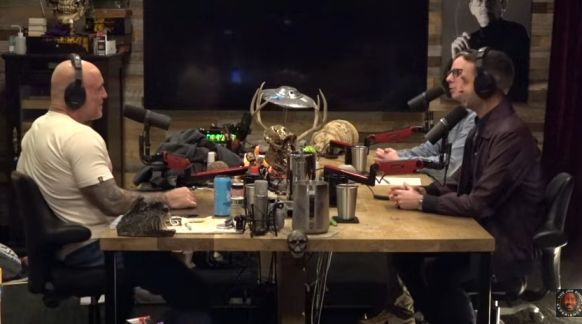
Editor’s Notes: In this episode of the Joe Rogan Experience, Joe sits down with Francis Foster and Konstantin Kisin, the hosts of the Triggernometry podcast, to tackle the overwhelming sense of global instability defining the start of 2026. From the escalating tensions in the Middle East and Ukraine to the erosion of civil liberties and free speech in the UK, the group examines why the world feels increasingly unpredictable. Their wide-ranging conversation offers a candid look at the vacuum of information fueling modern conspiracy theories and the urgent need for more balanced, honest political discourse. (Mar 11, 2026)
TRANSCRIPT:
The World in Chaos
JOE ROGAN: Okay, so when we scheduled this, there was nothing happening. So peaceful.
KONSTANTIN KISIN: Every time we’re here, something crazy is going on, man.
JOE ROGAN: Yeah, maybe we manifest it.
FRANCIS FOSTER: To be honest, it did. 2026 did start with a bang.
JOE ROGAN: Yeah. Well, a lot of things, it’s just nothing seems stable everywhere. Everywhere in the world seems f*ed right now. Like, this is the… like, in all of my years, this seems the most unstable globally.
Like, I never worried that the UK was going to be like complete chaos. Arresting 12,000 people for social media posts and abandoning trial by jury, all that s. I never thought the Ukraine, Russia war would go on this long. Never thought they would just continue bombing Gaza. And then what’s happening now? They just sort of stop. And now they’re talking about putting a resort there. What? Like, you hear that and you go, are you fing serious?
KONSTANTIN KISIN: Right.
JOE ROGAN: Tim Dillon has a… I want to… I won’t give the bit away. He has a f*ing phenomenal bit about staying in that resort.
KONSTANTIN KISIN: Yeah. And you boys have been busy as well, Joe.
The Iran Situation and False Flag Theories
JOE ROGAN: Yeah. And I was going to get to that. The embarrassing part — in the middle of Ramadan, you take out the leader of a Muslim country and they’re hangry already.
KONSTANTIN KISIN: And you’re f*ing with it.
JOE ROGAN: They’re really… yeah. Drink water, right? And then, I was listening to Tim Dillon’s podcast today. He’s got a great podcast with Ryan Grim and one other gentleman. But one of the things that they brought up was that some of these drone attacks, it doesn’t even seem like they’re from Iran. Some of these drone attacks on Gulf states — like, one of them… I don’t want to speak out of turn, because I’m not exactly sure which ones they’re talking about. They’re talking about one of them on either… it’s an oil refinery. I think it is an oil refinery that it doesn’t seem like it came from Iran.
KONSTANTIN KISIN: So where did it come from?
JOE ROGAN: That’s a good question.
KONSTANTIN KISIN: One of their proxies?
JOE ROGAN: That’s a good question. The fear is a false flag.
FRANCIS FOSTER: That’s the fear.
JOE ROGAN: Like, if you really wanted to get really scared of what we’re dragged into, you’re dragged into an ally that’s not telling you the truth and is also doing some other stuff. Well, I’m not even saying that that’s the case, but a lot of people are assuming that that’s what it is.
FRANCIS FOSTER: But that’s what happens when you have an absence of information. And so the moment you have an absence of information, there’s a vacuum. And nature abhors a vacuum. You need to have that vacuum filled. So that’s where conspiracies naturally flourish. Because if people don’t have information, then they’re going to basically theorize. And part of people theorizing is conspiracies are going to start flourishing.
JOE ROGAN: Well, I think they were basing it on where the drone came from. Let’s see if we can find some information on that. Jamie, it was Jeremy Scahill — that’s right — reporter on the video.
Hot Take Culture and the Fog of War
KONSTANTIN KISIN: I just find it amazing now how many people have a hard take on what’s going on. I’m like, what, the weather? We don’t know a f*ing thing about what’s going on. Like, the coin is in the air. And we do not know how it’s going to land. But everyone’s got a take. Everyone knows.
We do not f*ing… I don’t think anyone knows. I understand if you work at the White House or if you work in Russian propaganda or you work in Chinese propaganda or if you work in Iranian… like, you’ve got to get your point of view across to try and persuade people. But if you’re actually trying to work out what’s genuinely happening, I don’t think anyone knows how this is going to go.
This is a gamble of gigantic proportions and nobody knows how it’s going to end. It’s just so unpredictable. I can tell you a great story that is positive for the west, let’s say, for America. I can tell you a terrible story and they both sound very convincing and no one knows which one of them is true.
JOE ROGAN: Yeah, that’s a very good point. This is the hot take culture.
FRANCIS FOSTER: Right?
KONSTANTIN KISIN: Right.
JOE ROGAN: Everyone has a take and they want that take to be the expert take. So, specific drone attack incidents that call potential false flags — Saudi Aramco, rather, oil facility attack. So Iranian officials deny striking the Saudi Aramco processing facility and instead suggest Israel may have carried out that attack as a false flag to inflame Gulf opinion and pull Saudi Arabia more directly into the war with Iran.
So Ryan Grimm explicitly says he thinks Iran’s claims that Israel hit the Aramco facility need to be taken seriously and that it’s very possible Israel did it. And this was the other one — the drone strike on the British base in…
KONSTANTIN KISIN: Cyprus.
FRANCIS FOSTER: Yeah.
JOE ROGAN: Is that what they’re saying?
KONSTANTIN KISIN: Yeah.
JOE ROGAN: May have come from the direction of Lebanon. He places this in the same context — Iran claiming Israel carried out certain attacks in neighboring states as false flags to blame Iran and drag those countries into the war.
KONSTANTIN KISIN: Those countries. This doesn’t make any logical sense to me because those countries are already in the war. I mean, Saudi Arabia and UAE have been attacked by Iran because they were on the phone to Trump basically asking him to do this.
The Tucker Carlson Claim and Gulf State Dynamics
JOE ROGAN: Here’s… this is another weird one — the Tucker Carlson one. You saw that, right?
KONSTANTIN KISIN: No.
JOE ROGAN: So Tucker Carlson said that…
KONSTANTIN KISIN: Oh, yeah, yeah.
JOE ROGAN: The alleged Mossad — they had been arrested. Members of Mossad had been arrested in Qatar and Saudi Arabia.
KONSTANTIN KISIN: But both Qatar and Saudi Arabia have said it’s not true.
FRANCIS FOSTER: Yeah.
JOE ROGAN: They’ve officially denied such arrests. Their own Saudi sources also denied it, though they note details don’t prove it didn’t happen. And that states would almost certainly hide such arrests if real. Huh.
KONSTANTIN KISIN: The thing, Joe, is that these countries — Saudi Arabia and UAE, Qatar less so — they want this to happen because they also hate Iran, or the Iranian regime.
FRANCIS FOSTER: Right.
KONSTANTIN KISIN: So there is no need for Israel — even if you, you know, if people are tempted to believe — there’s no need for Israel to do this because these countries are already in it.
JOE ROGAN: Right.
KONSTANTIN KISIN: And one of the reasons Iran has attacked things in Saudi Arabia and in the UAE is they know that. The Gulf countries are on board with this.
JOE ROGAN: Right. So what would be… let’s assume that the false flag is in play. Why would Israel — how would they benefit from doing that?
KONSTANTIN KISIN: That’s what I’m saying. There is no rationale that I can think of.
JOE ROGAN: The people that think the false flag is real — why do they think that? What do… that Israel would benefit from it? Is there a scenario where you can imagine it would inflame things and further support other countries contributing to the… I mean, there’s a lot of money that’s being spent on this war, right?
KONSTANTIN KISIN: Right.
JOE ROGAN: This is an insane amount of money just for munitions, just for missiles.
KONSTANTIN KISIN: Yeah, yeah. And then rebuilding Iran if we get to that.
JOE ROGAN: Right. Maybe another resort.
KONSTANTIN KISIN: Yeah. But I just don’t see the rationale because the Gulf countries are already targets for Iran. There’s nothing to inflame. Like, the situation is already pretty f*ing inflamed. And it’s partly inflamed because, as I say, actually the Gulf states and Israel are pretty aligned on this particular thing. They’re all at threat from the Iranian regime.
So we had Aimen Dean and Richard Millet on our show the other day. One of them is an Al Qaeda MI6 double agent. Another one is a really reputable investigative journalist.
JOE ROGAN: Richard — Al Qaeda MI6 double agent?
KONSTANTIN KISIN: Yeah. What balls. And he has a great podcast now as well called Conflicted.
JOE ROGAN: What a great name for a podcast for a guy who’s a double agent.
KONSTANTIN KISIN: Yeah, yeah.
JOE ROGAN: What balls that guy must have.
KONSTANTIN KISIN: Yeah, yeah, yeah, really cool guy. But anyway, he was explaining that Saudi Arabia has a population that is way bigger than what they can sustain in terms of the water. They live in the f*ing desert. So they have these desalination plants which are extremely vulnerable. And Saudi Arabia, UAE, these other countries — they felt at huge risk from Iranian attacks for a long time. So none of them like the Iranian regime that’s spreading terrorism through its proxies.
So in actual fact, dragging them into the war — there’s no sense for that. I think there’s a lot of people who just go to reaction now. Whenever anything happens, it was Israel’s fault. Venezuela — f* all to do with Israel. But when it happened, everyone’s like, “Oh, it’s Israel.” I think some people just go to that now as the automatic response.
Which comes back to what I was saying earlier about the hot take culture. Something happened three minutes ago and now everyone’s got a f*ing take on it. You don’t know anything. None of us know anything. None of us know how this is going to go. Because right now this is a highly unpredictable situation. I don’t think the White House knows how this is going to go.
America First? The Contradiction of Foreign Wars
JOE ROGAN: No, it’s terrifying. It’s terrifying and it’s exactly the opposite of what we were told leading into this administration. That it’s going to be America first, right? And no more unnecessary foreign wars.
There’s the other thing — do you remember Desert Storm? Yeah, Desert Storm. Quick and easy, baby. Woo. We went in, kicked some ass, took some names. That’s a wrap, pulled out. There was only one base that got hit, so the amount of deaths by American citizens was fairly minimal.
I think that’s what got people so confident into entering Iran after 9/11 — or excuse me, Iraq after 9/11 — to go back. Like, we already fed them up once. We’re going to go back and this is going to be easy. Well, it wasn’t easy the second time and it was drawn out and it didn’t make any sense. But people wanted some form of revenge, something for 9/11. And so somehow they justified a war with a country that had zero to do with it. Like, it didn’t even make sense. And then we also invaded Afghanistan at the same time. What do we do? What the f?
So in the fog of this idea of American exceptionalism — we’re just going to go in and fix it? We did it before. There’s no one even close to us. Well, look how that turned out.
FRANCIS FOSTER: Yeah, well, this is completely true. And there’s this idea that it’s so easy to take one regime, remove it, and then just put another one in its place like it’s a Lego block. And then all of a sudden you’re going to magically fix a country — it’s a fantasy.
Like, if you take Iran, the IRGC, which is the Islamic Revolutionary Guard, numbers around 200,000 trained soldiers. And not only are they trained soldiers, they’re fanatical. They’re fanatics. And then you have the secret police, and then you have the regular police, and then you have the people employed in the government and then their families and so on and so forth, and then the supporters within the country.
And then you’ve got the various factions within Iran, like the Kurds, who want independence. So the moment the leadership is weakened, they’re going to use it as an opportunity to launch their own revolution to try and break away from the rest of Iran. So you have all of these particular parts, these factions, and then you think if you take out the top — the top who’s holding it all together by force. I’m not saying I agree with him or what he does — you have the very real risk that the entire country is going to disintegrate, as what happened in Iraq. Sorry.
JOE ROGAN: And also Libya.
FRANCIS FOSTER: Yeah.
JOE ROGAN: The idea that you could just take the guy out and that’s a wrap. I mean, it doesn’t seem like it’s well thought out.
KONSTANTIN KISIN: Well, I mean, charitably, they would say Venezuela. Regime adjustment. It’s been two months. Of course, of course.
Venezuela, Iran, and Geopolitical Strategy
JOE ROGAN: This is a religious fanatical. Right. It’s a totally different kind of country. Also, it’s a country that’s been under threat for decades. Right. So they’ve been preparing for this kind of thing. Yeah, yeah.
FRANCIS FOSTER: And also with Venezuela, it wasn’t a regime change. Practically everybody who was in the old regime is still there.
KONSTANTIN KISIN: It’s a regime adjustment.
FRANCIS FOSTER: Exactly, exactly. So Delsey Rodriguez was one of the senior leaders in Maduro’s regime. They just took out Maduro and his wife. They put Delsey Rodriguez there. But the whole structure, the whole leadership, the whole party is still in place.
So they’ve just, what they’ve done is they put Delsey at the top and they’ve said to her, “Look, if you f* about, you’re going to get what your boss got. So you’re going to follow what we say. You’re going to do what we say. You are going to open up the oil refineries, we’re going to build it, you’re going to start pumping oil out. You’re going to stop messing about with Hezbollah,” which they had training camps in the island of Margarita, which is a little Caribbean island two and a half hours away from Miami. Training camps. “You can’t have that. You’re not going to be fraternizing with the Cubans and you’re going to play ball.”
And essentially, Venezuela is now a colony of the United States. That’s what it’s now become.
The Kurt Metzger Conspiracy Theory Angle
JOE ROGAN: That’s wild. Well, there’s also the Kurt Metzger angle, which is hilarious. Kurt Metzger cornered me one night at the Mothership and he explained to me that this is all about the 2020 election and that Maduro somehow or another had something to do with rigging the 2020 election. And he’s going to say it as a part of his testimony. He’s like, “Just wait. Just wait. Mark my words.” He’s convinced of this. He goes down the rabbit hole to the lava. Like, he passes and he’s like, “This rabbit hole’s been covered up. It goes deeper,” and he keeps going till he’s at the f*ing center of the earth.
KONSTANTIN KISIN: He’s a funny guy, though.
JOE ROGAN: Oh, he’s hilarious. He’s hilarious. He’s mentally ill. He’s hilarious. He’s one of the funniest people I know, like, ever. Fantastic joke writer, too. I mean, he’s just great all around, but Jesus Christ. Some of his nutty theories, they go so far.
FRANCIS FOSTER: Oh, absolutely. I’ve been in bars with Kurt where he starts talking to me and I’m like, I don’t even know what we’re talking about anymore.
JOE ROGAN: Well, he changes conspiracies mid sentence. He starts bringing up some shit from the 70s, and there’s the Church Committee and this and that and MK Ultra. “Don’t you know about Monarch?” Like, what? Slow down. Not everybody knows what you’re talking about.
FRANCIS FOSTER: But I think this is — and I love Kurt, but this is kind of where you feel that the truth isn’t enough. There needs to be something else. There needs to be something that goes deeper than that. And sometimes there is. Don’t get me wrong, sometimes it does go deeper. But sometimes you’re making connections where there are no connections.
Like, it’s pretty simple with Venezuela, what was going on. They were f*ing about and they were doing it for a long time and they were doing it in America’s backyard. And they had warning after warning. And Maduro — the way I’d push back against Kurt is, “I’m really sorry, Kurt, but Maduro ain’t that bright.”
JOE ROGAN: Well, I don’t think he has to be that bright to finance and make sure and arrange things, because they did. There was something connected to the voting machines that were there.
KONSTANTIN KISIN: They made those claims.
JOE ROGAN: Who was that one?
KONSTANTIN KISIN: Sidney Powell, was it?
JOE ROGAN: Yeah, here we go. She’s another fun one. Post-2020, from Trump allies like Sidney Powell and Rudy Giuliani claiming Hugo Chavez, Maduro’s predecessor, developed rigged software to export to US firms. These were promoted by figures like Mike Lindell — he makes a great pillow — and amplified on social media, but courts and fact checks rejected them, including Fox News. 787 million. Dominion settlement.
KONSTANTIN KISIN: Yeah, I was going to say I was pretty sure that those claims were debunked.
JOE ROGAN: Yeah. Not to Kurt. He’s like, “You guys don’t know where the hard drives are or the center of the earth. We got to get there.”
Iran, Nuclear Ambitions, and the Risk of World War III
JOE ROGAN: Yeah, that doesn’t make much sense to me. But neither does this idea that you’re going to take over a country’s oil supply. Like, we’ll just take it. The problem is, from the outside, the rest of the world looks at this unnecessary aggression by the United States government and then you tack on whatever propaganda they have already been spitting out about America for the last 20 or 30 years. And then this war with Iran gets really ugly. Because that’s how you start a World War III. You start a World War III by doing something that — other than people that wanted this forever — who else thinks that’s a good idea? Who else thinks it’s a good idea to just attack a country that isn’t doing anything?
They haven’t done anything. Like, if you have proof that they have developed depleted uranium and they’ve got it up to a point where they’ve got it to — what percentage does it have to be? Like, they’re at 60. Right.
KONSTANTIN KISIN: But that’s way more than you need.
JOE ROGAN: Way more than you need. Right. So it shows that they’re at least ramping up their production where it’s possible to get it to whatever it needs to make it.
KONSTANTIN KISIN: That’s way more than you need for civilian use.
JOE ROGAN: Right, right. But that’s still — it’s not clear that that justifies an invasion when North Korea has nuclear weapons.
KONSTANTIN KISIN: Right?
FRANCIS FOSTER: Yeah.
JOE ROGAN: Right. It’s like, do we just want — are we just trying to prevent them from ever getting to a point where they’re like North Korea? Who the f* is worried about North Korea? Zero people.
KONSTANTIN KISIN: I think the difference, as you correctly said earlier, is these people are very different to the North Koreans. Right. North Korea wants to be left the f* alone. Iran does not want to be left alone. Iran wants to dominate the region. That’s why they fund Hamas, it’s why they fund Hezbollah, it’s why they fund the Houthis, it’s why they are doing shit. That’s why the Gulf countries and Israel are very worried about them.
JOE ROGAN: Right?
KONSTANTIN KISIN: So that’s the difference, I think. And then there’s — some of the people we’ve had on the show who are Iranian have talked about the — what is it called? 12th year Islam. I can’t remember the details, but basically they have a kind of messianic vision of what’s going to happen. And they believe that when the world ends, that’s when the prophecy will be fulfilled. You don’t want those guys with nuclear weapons. Right?
JOE ROGAN: That’s a good point.
KONSTANTIN KISIN: Yeah. So from that perspective, it’s different to North Korea. And so that’s — I think that’s part of the thinking. But your point is interesting to me about the fact that this doesn’t seem to have been part of the policy platform of the Trump election at the last election, right?
JOE ROGAN: No, not at all.
The Broader Strategy: Pushing Back Against China and Russia
KONSTANTIN KISIN: But I do think there is some kind of strategy behind all of this. And I’m very curious what that is, because I guess if you think about it logically, you would say, well, is it an attempt to effectively push back against China and Russia infiltrating all these countries? Right. China and Russia were very close with Maduro in Venezuela. Very, very — like Francis is saying, Hezbollah training camps, island of Margarita. Where was the oil going? Right. Same with Iran. I mean, Iran sells its oil to China and sends suicide drones to Russia to use in Ukraine.
So maybe it’s that. Maybe the strategy is you’re trying to push back against Chinese and Russian influence in all these countries because you can’t attack them directly. Right?
JOE ROGAN: Yeah.
KONSTANTIN KISIN: But this is all just guessing on my part. And that’s what I’m really curious about. We’re going to do some interviews on this trip to kind of — I want to get someone on the show who can go, “This is the strategy. This is what we’re doing.” Because I think, as we were saying earlier, it’s not very clear to most people what the rationale behind all of this is. But I also don’t think this sort of Mad Dog Trump idea is true either. I think he has a strategy. I’d just love to know what it is.
Cuba: The Next Domino?
FRANCIS FOSTER: And it’s very interesting because there’s been talk about regime change in Cuba. And one of the things —
KONSTANTIN KISIN: I think that’s next, genuinely. Oh my God, I think that’s next.
FRANCIS FOSTER: So when Chavez came to power in 1999, what he did — and not enough people talk about this — is he turned what was a very corrupt, admittedly liberal, Western-style democracy into a communist dictatorship. And how do you do that? You can’t just literally do that overnight.
So what he did is he allied with the Cubans and Fidel — in particular Fidel Castro. Venezuela provided Cuba with cheap oil, which helped to keep the Cuban economy afloat because Cuba has been going broke for however many years, 40 odd years. And what Castro did was he gave him the boots on the ground in Venezuela, but also the technical expertise and know-how in order to change a Western liberal democracy into a communist state — with permanent surveillance, secret police, subjugate the population, so there was no chance of them ever being able to revolt — and turn everything into, like I said, a communist state.
So by what they did in Venezuela, Venezuela can no longer support Cuba. So Cuba is literally now withering on the vine as a result of them knocking out the Venezuelans. So it’s going to come to a point where Cuba effectively goes bankrupt, which could precipitate an uprising, a revolution, when people can no longer eat. And that would mean that that country is then weakened. Finally they can get rid of the communist regime there, and they can have a different type of government, one which will be far more sympathetic, shall we say, to working with America and being an American island, possibly.
Iran’s End Game and the Shah’s Son
KONSTANTIN KISIN: That makes sense to me in a way. What I don’t understand about the Iran thing is, what is the end goal here? Well, you’ve got Reza Pahlavi, the Shah’s son. I mean, he left Iran a long time ago as a kid. Right. The idea that he’s going to go back in there and be welcomed by the masses — maybe that’s true.
JOE ROGAN: Maybe it’s like Daenerys returning to the Iron Throne.
KONSTANTIN KISIN: Yeah, but Daenerys had three f*ing dragons.
JOE ROGAN: Right? But she left when she was a baby.
KONSTANTIN KISIN: Yeah, that’s right. That’s right. And it’s not like the people are desperately — I don’t know, maybe the people are desperate for the return of the —
JOE ROGAN: Well, it seems like some people are desperate for a change there. The people that were protesting. Some people that risked their lives.
KONSTANTIN KISIN: 100%.
JOE ROGAN: 100%. But like every country — if you only listen to the liberals in this country, you would think that no one’s illegal on stolen land.
KONSTANTIN KISIN: Right.
JOE ROGAN: If you only listen to the Republicans in this country, you would think we gotta find every illegal and get them out of our country and make America great again. It doesn’t make sense. If we just go only by the protesters — we don’t really have accurate polling because they don’t have any free speech over there. Right. And they’ve killed famous athletes over there for protesting.
KONSTANTIN KISIN: Yeah.
JOE ROGAN: I mean, they killed the Olympic gold medalist in wrestling. The UFC tried to step in and try to do something to stop it. They executed him for just — apparently I don’t even think he was actually protesting. I think it was just that he was at a protest. He wasn’t even saying anything.
FRANCIS FOSTER: And this is the thing you always have to bear in mind, Joe.
JOE ROGAN: I might be wrong about that, though.
KONSTANTIN KISIN: No, I think you are right.
JOE ROGAN: Am I right about that?
KONSTANTIN KISIN: The final details, I’m not sure. But the fact that he was executed.
JOE ROGAN: Yes, he was.
KONSTANTIN KISIN: I know Dana worked very hard to try and say that.
JOE ROGAN: I think there was some discrepancy as to whether or not he was actually participating in the protest. That also could have been the defense, I don’t know. But I mean, the fact that they execute people who protest, there’s no way you can support that kind of. That’s a scary ass f*ing government. And run by religious fanatics. That’s a scary ass government.
But the question is, how scary ass does it have to get where invading makes sense? Because if this keeps going, if we have to go boots on the ground, that’s where things get nuts.
KONSTANTIN KISIN: You can’t go boots on the ground, man. You can’t. You can’t.
JOE ROGAN: Right.
KONSTANTIN KISIN: I don’t. But I don’t think there’s any.
JOE ROGAN: You should be president.
KONSTANTIN KISIN: There’s a lot of people are going to disagree. No, I don’t think that’s viable.
JOE ROGAN: Just like it might be robot boots on the ground.
KONSTANTIN KISIN: Yeah.
JOE ROGAN: You know, if Elon gets that factory up in time.
KONSTANTIN KISIN: What I want to know is, what is it that you’re working towards? Right. Like, so from what I understand, talking to some of the people, Israel would quite like a Reza Pahlavi monarchy, because the other Middle Eastern countries that they have peace with, you know, Bahrain, Morocco, increasingly the Gulf states, they’re all monarchies.
JOE ROGAN: Right, right, right.
KONSTANTIN KISIN: So they’re down with that. But from what I understand, the White House is really not that interested in Pahlavi. And so what.
JOE ROGAN: What do they want?
The White House’s No-Kill List and the Question of What Comes After
KONSTANTIN KISIN: Well, one of the things that Richard Minute broke on our show, because it hadn’t been reported anywhere else, was that the White House has given the Israelis a no-kill list, which is basically a list of members of the current regime that they don’t want to be killed because they have hope that these people could then be the Rodriguez equivalent in Iran. Right. And I don’t know that the fanatics within the Iranian regime who are there now, how many of them are like this, like Darth Vader, but. Do you know what I mean?
JOE ROGAN: Yeah.
FRANCIS FOSTER: You’re kind of looking for Darth Vader. Zero.
KONSTANTIN KISIN: Yeah. No, no, no, no. Islamism. I don’t think that exists. Right. Sugar free Islamism.
JOE ROGAN: Yeah.
KONSTANTIN KISIN: So that’s the bit. And that doesn’t mean that there isn’t a plan, but I don’t know what the f* that plan is right now. And I find it hard to see one. So evil regime gone. Wonderful. But the question is always, what comes after that?
JOE ROGAN: Right.
KONSTANTIN KISIN: That’s always the question. And that’s where I think your point is very true, which is in the past, there have been times where this sort of approach has gone completely off the rails.
JOE ROGAN: Yeah.
KONSTANTIN KISIN: That’s a fact.
FRANCIS FOSTER: And it’s also, what has been coming out of the Trump camp is contradictory, to put it mildly. You have Hegseth saying one thing, you have Trump saying another. They contradict each other at certain points. Is that a tactic in order to befuddle the opponent? Maybe, who knows? Or is it the fact that they don’t actually have a grand vision?
Oil Prices, Sanctions, and the Political Fallout
JOE ROGAN: Was there some sort of a concession today on Russian oil?
KONSTANTIN KISIN: Yeah, well, I think first of all, Trump let India buy Iranian oil and I think now they are lifting the sanctions on Russia selling its oil because the oil prices spiked as much as they did.
JOE ROGAN: Right, here goes. “US Eases Limits on Russian Energy as Oil Prices Soar.”
KONSTANTIN KISIN: Right. Yeah.
FRANCIS FOSTER: Well, you’ve got the Pink Floyd
JOE ROGAN: T-shirt, so it’s appropriate.
KONSTANTIN KISIN: But you can see it, the oil prices spiked for what, one day, two days, and everyone went full panic straight away. But the thing is, if that carries on for two months, the impact of that on domestic politics, I mean, I’m not an expert on American politics, but even I can say that’s going to be pretty f*ing important.
JOE ROGAN: Oh, it’s bad, right? Yeah, it’s going to be bad. I mean, if oil prices spike, we’re f*ed.
KONSTANTIN KISIN: Yeah.
JOE ROGAN: You know, and the Republicans are really f*ed.
KONSTANTIN KISIN: Yeah. And you’ve got the midterms coming up.
JOE ROGAN: You got the midterms coming up in November and it’s also the momentum will be in their way.
The Cost of Living Crisis and the Rise of the Hard Left
FRANCIS FOSTER: And look, there are second, third, fourth order consequences. So at the moment in the UK, the vast majority of people are finding it more and more difficult just to get through to the end of the month because of the cost of living, inflation, it’s becoming worse and worse.
I was talking to a butcher in my area, which is this very nice part of North London, you know the type of place I’m talking about. Everyone loves BLM. No one has a black friend. That kind of place. Right, okay. That’s the kind of area it is. And he was telling me that even in this very wealthy area, people are starting to ration meat now. So before they’d have meat five days a week, now they’re going down to three or two.
And this isn’t a wealthy area. So now imagine if there’s energy spikes and then food becomes more and more expensive. There is already a very worrying hard left political movement growing in the UK where they’re talking about, you know, capitalism doesn’t work, we need socialism. And there’s this new politician come to the fore, a guy called Zach Polanski who talks about what we need in this country and the UK is socialism.
Now imagine if the cost of living crisis gets worse and the vast majority of people who work hard in a regular job can’t make ends meet through literally no fault of their own. Can you blame them for going, hang on, capitalism doesn’t work, because in this instance, at that moment, it doesn’t work for them. And then that could spark something completely disastrous for our country.
KONSTANTIN KISIN: Yeah, but I think, you know, that’s a negative story. I think it’s incredibly persuasive. And I lean more in the direction that this could go badly. But I also think there is the possibility of this goes well too. I think that is possible.
JOE ROGAN: How do you envision that scenario?
Best Case Scenario: A New Iran
KONSTANTIN KISIN: Well, so if they’re able to keep the Strait of Hormuz open and you don’t have this energy problems that we’ve got now, you know, Venezuela, Cuba, he’s basically resetting the region. And he’s basically saying to all the people that want to align themselves with China and Russia, we’re not f*ing about here, don’t cross these lines. That is an opportunity to address the slide that the Western world has had vis-à-vis China and Russia for a very long time. That could be a very positive thing.
The thing is, what happens in Iran, that is the thing that I don’t really see how that goes well. Might do. Like I said, there’s probably a plan that we don’t know. And if that works out, that could be very good.
JOE ROGAN: Okay, what would you imagine that plan would be? If you. Look, let’s imagine, best case scenario, you’re in the White House. They’re all very rational. No one’s being influenced by foreign governments. No one’s incompetent. Everybody knows what they’re doing.
KONSTANTIN KISIN: Yeah. I mean, we’re in the realms of fantasy now.
JOE ROGAN: That’s how I like to go.
KONSTANTIN KISIN: But I mean, take the Soviet Union, which is obviously something that I know, right, being born in the Soviet Union and Russia. Towards the end of the Soviet Union, you still had some fanatical communists. And in fact, throughout the Soviet Union, you always had within the government a mixture of different people. Right. You had the fanatical communists who believed that communism was the only thing that was ever going to work, et cetera. But you also had people who were reformers. They saw the problems, they saw that the fanatical communists were ruining things and things were getting worse. Right. They saw that you had to kill more and more of Iran’s people to keep shit locked down. Right.
So the argument could be, within the Iranian Revolutionary Guard or the regime more broadly, there are people who are like, you know, I’m not necessarily that keen on the guy who runs Syria now. Al-Jilani, right. He is a jihadi, but he’s kind of like a moderate one. I don’t know how long that’s going to last. But my point is, within every regime, there is some range of opinion, there is some range of fanaticism, there is some range of people who, partly for generational reasons, the younger people have seen a 40-year history and they now go, okay, this isn’t working anymore. We need to try something else. That is possible.
So if the CIA and the White House have someone like that and they can do a regime adjustment, I think the idea that you’re going to have multiparliamentary democracy with free and fair elections and women, you know, like Venice Beach, rollerblading in bikinis. I don’t know that that’s going to happen. Right. But what you might have is an authoritarian regime of some kind, like many other countries in the Middle East, which realizes that actually economic growth is more important than shouting “Allahu Akbar” every three minutes and blowing shit up. Right.
That focuses on making life better for their citizens, that practices traditional Muslim values, which many countries do, and says, you know, women ought to be modest, but doesn’t force them to wear the burqa or the headscarf or whatever, and is less interested in destabilizing the region and attacking others and trying to be this great power, and is more interested in just prosperity for its own people, survival for themselves as a regime, and is willing to play ball with the United States.
JOE ROGAN: Well said. Yeah, well said. That’s best case scenario.
KONSTANTIN KISIN: That’s best case scenario. Now, if you get there, I think that would be a huge win for President Trump and it’d be a huge win for the world and he will walk away from that with a huge win. And I think, you know, you’re a better expert on the American people, but I think American people like winning, right? So if you have all this happen, he can then say, well, look, we did this, we did this, we did this. Russia and China have been pushed back. We got the situation. Iran is not going to get a nuke, which is important. I think we can all agree on that, right?
JOE ROGAN: Yeah.
KONSTANTIN KISIN: There is the possibility that he comes out of this very well. I think that based on what I see, but I don’t know, coming back to what we said, I think we share this kind of perspective, really, Francis and I, that seems somewhat less likely at this point, or at least harder to see. But I think you can tell a persuasive story both ways. I really do.
JOE ROGAN: That makes sense. And what you’re saying, I think is very valid, that we need to abandon any idea of them having some sort of a democracy over there. It’s not going to happen.
KONSTANTIN KISIN: No.
The UAE Model and Islamism in the West
JOE ROGAN: And you know, you do look at the relationships that we have with other Gulf State nations. Seems fine, right? It’s not threatening to us. We would like everyone to be free and have the same sort of liberal democracy that we have in America. But okay, you want that all day long. You can’t do anything to change the way other people govern themselves. Especially when you’ve gotten to the point where, like, take any of the Middle Eastern countries, for example. These, some of these people are worth trillions of dollars. These royal families have been running it forever. They have insane amounts of oil money. Good luck, good luck getting them out of there. Like, good luck saying we should just vote, you know, and have a president and you don’t have any power anymore. Like, how are you going to pull that off? Especially if things are going well for the people that live there.
Like, I have a friend who moved to Dubai and he’s an American and he moved back to America recently, but he was over there. He said, “Dude, you could leave a Rolex on the street and people would pick it up and bring it to the police. Like, it’s so safe.” He’s like, “There’s no crime.” And he’s black. And he’s like, “I worry when I go out in America, I’m going to get shot. I’m worried I’m going to go to a club and someone’s going to start beefing and shooting up the place and I’m going to get hit.” He goes, “I don’t think about that at all over here. There’s none of that. It’s safer.”
Is it fed up that, you know, it’s run by a king? I guess. Is it that much different than a president? I mean, in a way, like, it’s a leader, right? You’ve got more checks and balances over here. You’ve got Congress, you get the Senate, you got all this shit going on with the Supreme Court. You have all these different human beings that also have a say and can block things. But at the end of the day, we’re still under this bizarre alpha male chimpanzee structure that has existed from the time that we were 150 people in a fing tribe, right? So it’s still one guy running things, it’s just running things their way. And if you were a citizen in Dubai, pretty f*ing good. Right?
KONSTANTIN KISIN: Well, your point about the UAE is really interesting because not only on the practical level of safety and other things, but also they don’t have the Islamism problem that we have in Britain. And increasingly, you guys are starting to see here because they recognize that it’s a problem and they deal with it. So I don’t know if you saw this news story. The UAE no longer gives sponsorships to their students to go to the UK because they’re worried their kids are going to get radicalized by Islamists in Britain, which is f*ing wild.
JOE ROGAN: Yeah, that is f*ing wild.
KONSTANTIN KISIN: And I mean, you were messaging me about this story with the Mamdani situation, right, yesterday.
JOE ROGAN: Yeah.
KONSTANTIN KISIN: In America.
FRANCIS FOSTER: Yeah.
KONSTANTIN KISIN: Yes, you have the Islamism problem here where people who are supporters of ISIS are thrown, but your media is pretending it’s not happening, but it’s f*ing happening.
JOE ROGAN: Well, it happened in Austin, right?
FRANCIS FOSTER: Yeah.
JOE ROGAN: I mean.
KONSTANTIN KISIN: Right.
JOE ROGAN: The guy who shot up that bar. Right.
FRANCIS FOSTER: Because this is a problem. Jamie.
JOE ROGAN: Jamie, you could probably find it on CNN because it’s kind of hilarious.
KONSTANTIN KISIN: Incredible. This was actually incredible.
CNN’s Framing of the New York Bombing Attack
JOE ROGAN: The New York Times title change thing. Did the New York Times change their title? Yeah, they did. I wonder why.
KONSTANTIN KISIN: Austere scholars.
JOE ROGAN: I’m going to send you the CNN one first. The CNN one is really wild. They had like fuses of things with smoke or something. They had to change it to bombs or something. Yeah, f*ing duh. I’m sending you this one because the CNN one is, believe it or not, more preposterous. The CNN one is so kooky. You see their headline, you’re like, what kind of story are you painting here? This is such a crazy way to frame. A guy showed up with bombs and was hurling them at people.
KONSTANTIN KISIN: They made it sound like the exact opposite of what actually happened.
JOE ROGAN: Well, it sounded like it was just a regular day. Regular day for this fella. And then things just went a little sideways somewhere along.
FRANCIS FOSTER: Listen, we’ve all got hobbies, man. You know what I mean? You like working out? He has nail bombs. Come on.
JOE ROGAN: Yeah, get it, Jamie. It’s not coming through. No, look, it’s not loading there. Oh, interesting. But let me see if they took it down. I guess they would have. You probably have an old link that. Okay, that’s the New York Times when I sent you in for. Oh, well, that. No, that’s the one I just clicked on. Let me check the original one. Nothing to see here. Interesting. They probably deleted it.
Okay, here. I found it. I found it. “Two Pennsylvania teenagers crossing New York City Saturday morning for what could have been a normal day. Enjoying the city during abnormally warm weather. But in less than an hour, their lives would drastically change as the pair would be arrested for throwing homemade bombs.” That is CNN’s tweet. I’m going to send you a screenshot because I do believe they have taken it down. Yep, nothing to see here yet. Yeah, they took it down. That’s not a headline, though.
KONSTANTIN KISIN: That’s.
JOE ROGAN: I guess. No, no, no. I’m going to send you the actual tweet because they did take it down because it’s so f*ing ridiculous. But the Internet never forgets. I’m sending to you here. Thank God I saved it and took a screenshot because I’m like, this is such a crazy way to frame two guys wanted to do a terror attack.
KONSTANTIN KISIN: Yeah, but it’s not an accident, Joe. It’s not crazy. No, you know, it’s not crazy.
JOE ROGAN: Look. Look how it’s framed here. This is the original tweet. “Two Pennsylvania teenagers,” just regular fells from PA. From Philly. Two Philly boys had a couple of cheesesteaks and got on the train. “Crossing New York City Saturday morning for what could have been a normal day, enjoying the city during abnormally warm weather.” Why the f* would you even say that could have been a normal day if they weren’t going there to commit terrorism.
FRANCIS FOSTER: Do you know what it reads like? It reads like when I used to teach 13 year olds creative writing, that’s how they’d all start off. You know, it was like, normal day.
JOE ROGAN: And I mean, I’d like to know who wrote that. Who’s the person who wrote that? And I want to know, were you directed to write it that way?
KONSTANTIN KISIN: Who approved it?
FRANCIS FOSTER: Yeah.
KONSTANTIN KISIN: Who edited it?
JOE ROGAN: Are you trying to downplay the possibility of. First of all, now in New York, because you have a guy who’s an avowed whatever. He is democratic, socialist, some say communist, but also Muslim. And then you have these Islamists who are doing a terrorist attack. So, like, are you trying to soften that?
KONSTANTIN KISIN: Yeah, but they are trying to soften it. So what happened, just so people know, is there was a protest outside Mamdani’s mansion. Right. And then these two people turned up and threw bombs at the protesters. And the way it was reported, if you just read that and no other stuff, you would have come away with the conclusion that it was the protesters who were the targets of the bombs. They were the ones that threw the bombs. No one officially said that’s what happened, but the way they did the story and the headline, you would have got that impression. And you’re just going, well, you were just on a team. You see this as a team game, right? And you want to present your team in the correct light.
JOE ROGAN: “The new post regarding two individuals arrested for throwing handmade bombs outside of New York City Mayor Zohran Mamdani’s home failed to reflect the gravity of the incident, thereby breaching the editorial standards we require for all our reporting. It has therefore been deleted.”
KONSTANTIN KISIN: But see how skillful this is, Joe? This is gaslighting again. They are saying their mistake was to
JOE ROGAN: Look at the first post. Look at this guy. Donut Operator. “Now, you retards got called out for trying to downplay actual terrorism, and now you’re backpedaling.” Yep.
KONSTANTIN KISIN: Who’s that second guy? He’s really smart.
JOE ROGAN: Didn’t fail to reflect the gravity of the situation. This guy named Constantine. I think he’s on the Trigonometry show. “Reflect the gravity of the situation. It failed to accurately communicate who was responsible, who the intended victims were, and where the blame for the attempted terrorist attack lay. In other words, you didn’t accidentally downplay the seriousness of it. You deliberately misrepresented what happened to conceal the truth from the public.” Well, that’s how AI would say it.
KONSTANTIN KISIN: I still write my own shit, John.
JOE ROGAN: I know you do, but I like the Donut Operator guy.
KONSTANTIN KISIN: Yeah, I know. He’s more your cup of tea.
JOE ROGAN: That’s how I like to talk.
KONSTANTIN KISIN: That is what happened, though, right?
JOE ROGAN: That is what happened. But that’s what’s really scary about this world we’re living in right now, because we’re so ideologically captured both right and left. Everyone in this country looks at this administration as an existential threat to democracy itself and our way of life. And, you know, fill in the blank. Whatever marginalized groups are all going to be rounded up and put in internment camps. This is the narrative that the most radical of the left have about the sky is falling because Trump’s in office.
The Ideology of Islamism and Western Blind Spots
FRANCIS FOSTER: But it’s also, as well, what people on the left don’t want to acknowledge is the dangers of Islamism when they see people do these kind of horrific terror attacks. When they see, for instance, what happened in the London Bridge terror attacks in 2019, or what happened in Manchester at the Ariana Grande concert, where Islamic terrorists bombed an Ariana Grande concert and the majority of the audience were little girls, young girls, and they say, “Oh, this happened because, you know, they were marginalized and they felt angry. And this is what people do when you push them to one side and they don’t have a means in order to express themselves.”
You’re going, no. What this is is an ideology. It’s an ideology which believes that our civilization, our way of life is evil. But also they want to establish their form of radical Islam across the globe. They want to create a global Islamic caliphate, and they will do whatever it takes in order to achieve that goal.
But people in the West, they can’t understand that because it’s so alien for how we see things. We believe human life is precious. We believe the most important thing is human life. They don’t. They believe the cause is more important than your life. And we can’t understand that because we’re raised in a world that is fundamentally Christian, even though we might not be. We still have Christian values.
We had a guest on the show, a wonderful historian called Tom Holland, and he explained this to us, that even if you’re not Christian, even if you think you were raised by atheist parents, you were still raised with Christian values. That’s the soup in which we live. That’s the water in which we swim. So this way of life that these people have, this ideology is so alien to us that we can’t understand it.
But also we don’t want to understand it. Because if you start to actually investigate what these people believe, what their ideology is, you realize that we are not all the same and these people believe something very, very different. And then we’re going to have a very uncomfortable conversation of how do you tackle this? Because can you have Western liberal democratic values and Islamism and people who are Islamists in the same society? And the answer is you can’t.
JOE ROGAN: And I think it’s really important. Your point about the difference between Islamists and Muslims.
FRANCIS FOSTER: Yes.
Christian Nationalism, Armageddon, and the Iran Crisis
JOE ROGAN: The Muslims are these Gulf State people. Muslims are these people in Dubai and Saudi Arabia. Islamists are the ones that want the caliphate. But then you have the crazy Christians, and that thing that I sent you, the Yahoo thing that we talked about yesterday with Shellenberger — the Yahoo thing is nuts.
So these military leaders. So this comes from one of the non-commissioned officers who went to a briefing. He goes to a briefing and they inform him that you shouldn’t be scared because this is all because President Trump is anointed by Jesus and this is to bring about Armageddon so that Jesus returns to Earth. This isn’t a f*ing military briefing.
“One such note included an anecdote from a non-commissioned officer who reported that their commander had urged us to tell our troops this war was all a part of God’s divine plan. And he specifically referenced numerous citations out of the Book of Revelations referring to Armageddon and the imminent return of Jesus Christ.”
This is fing crazy. He said, “This morning, our commander…” So this is an officer who’s talking about this. “This morning our commander opened up the combat readiness status briefing by urging us to not be afraid as to what was happening with our combat operations in Iran. He said President Trump has been anointed by Jesus to light the signal fire in Iran to cause Armageddon and mark his return to earth. He said he had a big grin on his face when he said all this, which made his message seem even more crazy.”*
KONSTANTIN KISIN: Well, that’s reassuring.
JOE ROGAN: This is the scary arm of the right. This is the scariest arm of the right. The people that think that this is — one of the main reasons the Mike Huckabee people — I think this is the main reason to protect Israel. It’s a part of God’s plan. Israel is where Jesus is going to return. He’s going to return to Jerusalem. Yikes.
KONSTANTIN KISIN: Yeah, I’ve never really understood that. I think you can argue for — you can be pro-Israel for pragmatic reasons. This religious stuff is a little bit weird to me.
JOE ROGAN: But the problem is you’ve got fanatics like the Islamists, but you’ve also got these hard-right Christian nationalists that really believe that this is a part of biblical prophecy and that this is the Book of Revelations — it’s about to go down — and they want it to go down. This is terrifying.
FRANCIS FOSTER: This is really interesting for us because in the UK, Christianity has been defanged to the point where there’s a trans flag on practically every church. So this idea of having these hardcore right-wing fundamentalist Christians — we just don’t experience that.
KONSTANTIN KISIN: We don’t have that. Really?
The Book of Revelations and the White Horse
JOE ROGAN: Yeah, it’s like — can’t everybody live in the middle? Why do you have to go all the way over to, “We’ve got to start Armageddon, Jesus is going to come back on a white horse”? You ever read the Book of Revelations? Yeah, I got really into it. The Book of Revelations is kooky. They really believe that Jesus is going to return on a horse.
FRANCIS FOSTER: Why a horse?
JOE ROGAN: A white horse.
FRANCIS FOSTER: It’s a bit racist.
JOE ROGAN: A little bit. I mean, I don’t get —
KONSTANTIN KISIN: Can we have a diverse horse? Why’s the —
JOE ROGAN: — color joke. You want me to read you the passage? Because I saved it, because it’s kind of kooky. It’s one of those things where you just go, “Well, who f*ing believes this is really what you think is going to go down? Because someone wrote it down on paper 2,000 years ago in ancient Hebrew.”
“Heaven opens and Christ appears on a white horse to judge and wage war, called Faithful and True, with eyes like fire, many crowns, and the name King of Kings and Lord of Lords.”
Just imagine it’s 2026 and you’re like, “That’s the blueprint, boys.” But this is just as scary, and especially for people that are Muslims, right?
FRANCIS FOSTER: Yeah.
JOE ROGAN: Or anybody who lives in the Middle East. This is more important than human life. This is more important than international law. In the eyes of the crazy on the right, this is the problem. So it’s not like one side is all good over here and we have to fight against the Islamists. Now we’ve got some kooks over here too.
If that guy’s for real and that guy’s in a position of power, and he’s really having combat readiness meetings where he’s telling people that we have to bomb and start Armageddon so Jesus can come back on a white horse — f*. Yo. That’s kooky.
KONSTANTIN KISIN: The thing that is probably reassuring somewhat is — I don’t — President Trump doesn’t strike me as one of those people.
JOE ROGAN: He’s not.
KONSTANTIN KISIN: He’s not, right. The leader of Iran is, right.
JOE ROGAN: But people in the military, I think, are as well.
KONSTANTIN KISIN: Yeah.
JOE ROGAN: And people in high positions in the military, I think, maybe as well. If this guy can give that kind of a meeting and that kind of a speech at a meeting, that’s a little terrifying. And if I was over there, I’d be freaking the f out. I’d be like, “This is your plan? I’m cannon fodder so that Jesus can come back? My body’s going to be part of the fing signal fire.”
FRANCIS FOSTER: Let’s be honest, though, it wouldn’t be that much of a plot twist for 2026, would it?
JOE ROGAN: Right? It would.
FRANCIS FOSTER: Final.
JOE ROGAN: You know, Episode 10, Game of Thrones, Season 6.
KONSTANTIN KISIN: Yes.
JOE ROGAN: I mean, it is getting — what? And that’s when the aliens come. Maybe that’s what they’re doing. The whole thing is — there’s not a sane person on either side. The whole thing is nuts. It doesn’t make sense to anybody. And that’s what scares the s* out of me.
The Fear of Escalation
FRANCIS FOSTER: Yeah. The thing that scares me is what Konstantin has addressed — I don’t get worried unless I can’t see a way out, or the way that this is resolved. And like you said, the coin is in the air. I’m slightly of a more pessimistic nature. He’s more of an optimist. But I look at it and I think to myself, this could go so wrong. So badly wrong that it could make Iraq look like an absolute picnic in comparison.
JOE ROGAN: Yeah. Well, especially if terrorist attacks start popping off over in America — major ones. That could be bad for everything. That could be bad for freedom of speech. That could be bad for rights. That could be bad for the incorporation of digital ID. That would be a good way to push that through. There’s a lot of stuff that would go through that would radically change things, just like the Patriot Act did.
FRANCIS FOSTER: Right.
JOE ROGAN: The Patriot Act radically changed the freedoms that we have in America and the overreach that the government is allowed to —
KONSTANTIN KISIN: They’re so right. But we only just started being allowed to take water back on the planes, right.
JOE ROGAN: Right.
KONSTANTIN KISIN: Maybe this is what it’s all about. So you can’t take water on a plane.
JOE ROGAN: Decided to let people keep their sneakers on. Wasn’t that going on for a while? Yeah, you can’t —
KONSTANTIN KISIN: Can’t have that.
JOE ROGAN: We have one shoe bomber. Richard. That one guy. One guy.
FRANCIS FOSTER: And there was once — do you remember, you weren’t allowed to bring scissors on. Like a small scissors. I can’t remember the comedian who said this, but he went, “You know what? If you take over an entire plane armed with nothing but water and some small scissors, you deserve the plane.”
JOE ROGAN: Well, here’s the thing. Like, you can bring skateboards, but you can’t bring a pool cue. So it doesn’t make any sense. I could f you up with a skateboard. F a lot of people up with a skateboard. Think about what damage you could do with that big, heavy-ass thing, you know?
Does Anyone Have a Vision for What Comes Next?
FRANCIS FOSTER: Yeah. And the worry, when it comes to all of this, is you look at these guys and you go, “Do you have a vision for what is actually going to happen?”
KONSTANTIN KISIN: But I do think they do. I do think they have a vision. What I want to find out is what that vision is.
JOE ROGAN: I hope you’re right, but I don’t think you are.
KONSTANTIN KISIN: You don’t think I am?
JOE ROGAN: I think it’s very possible that they thought this would be over much quicker. They thought — look, just look at the success that they had in the initial bombing of Iran. The initial bombing — they supposedly decapitated their ability to make nuclear bombs, or at least stopped it for a long time. And there was a lot of concessions that the Iranians were willing to submit to that they never submitted to under Obama or anybody else. And that wasn’t enough.
KONSTANTIN KISIN: Right.
JOE ROGAN: So the problem is, when we were talking about Desert Storm — you get away with something that works really well, you’re like, “We know what we’re doing,” and then you bite off more than you can chew.
FRANCIS FOSTER: Yeah.
KONSTANTIN KISIN: And especially once you’ve done Venezuela, you feel like you’re kind of on a roll.
JOE ROGAN: Right.
FRANCIS FOSTER: Blair did this.
KONSTANTIN KISIN: Yeah, I see your point. I do think, though — I mean, from what I read, both Kushner and Witkoff both said that the Iranians were not playing ball, actually.
JOE ROGAN: Okay.
KONSTANTIN KISIN: Which is why they went in. So obviously, if you think about it, given how long it takes for US assets to get to the region, this decision would have been made weeks ago at the very least. And that’s because, from what I understand, the negotiators — Iran isn’t actually playing ball. What they’re doing is they’re claiming publicly that they’re willing to make concessions, but when we sit down with them, that’s not what’s happening, because all they’re doing is stalling for time.
JOE ROGAN: That makes more sense. And so if you were worried that someone was in the middle of actually getting their uranium up to a point where you enrich it to nuclear bomb levels —
KONSTANTIN KISIN: Right. Yeah, but I think a lot of people misunderstand that in the sense that — I think it’s based on my understanding — it’s totally false to claim that they were, like, about to develop a nuclear — they were not.
Netanyahu’s Decades of Warnings About Iran
JOE ROGAN: Well, you’ve seen the compilation of Netanyahu saying Iran is two weeks away from developing a nuclear bomb — all the way back to the ’80s.
KONSTANTIN KISIN: Yeah.
JOE ROGAN: Have you seen that compilation?
KONSTANTIN KISIN: I haven’t, no.
JOE ROGAN: It’s wonderful.
KONSTANTIN KISIN: Right.
JOE ROGAN: See if you can find it, Jamie, because it’s so kooky. I mean, he’s been talking about this for f*ing ever. “They’re that close. They’re two weeks away. Two weeks away. Two weeks away.” And maybe they are, you know. Maybe Stuxnet put a dent in that, right? They used that virus program to kill all the computer programs that were running their nuclear program over there.
KONSTANTIN KISIN: Yeah, yeah. Well, I don’t know that they were ever like two weeks from having a payload that was ready to be delivered to whatever, but they were enriching uranium to levels that you only enrich if you want nuclear weapons. And so I guess the question for Trump is, “Do I allow this to continue and do I have to wait until they’ve got the f*ing bomb on a launcher waiting to go?”
VIDEO CLIP BEGINS:
JOE ROGAN: There it is. Yeah, let’s hear it.
UNIDENTIFIED SPEAKER: “Iran has never given up its quest for nuclear weapons and the missiles to deliver them.”
JOE ROGAN: That’s because Israeli Prime Minister Benjamin Netanyahu has been saying this for more than 30 years —
UNIDENTIFIED SPEAKER: — years, claiming Iran is close to having nuclear weapons. Nuclear weapons. Nuclear weapons. Atomic bombs. In 1992, as a member of Parliament, Netanyahu addresses the Knesset. He says, “Within three to five years, we can assume that Iran will become autonomous in its ability to develop and produce a nuclear bomb.” Three years later, in his book Fighting Terrorism, he repeats the same time frame — three to five years.
VIDEO CLIP ENDS:
The Iran Nuclear Threat: Netanyahu’s Decades of Warnings
VIDEO CLIP BEGINS:
KONSTANTIN KISIN: Thank you, Mr. Chairman.
JOE ROGAN: Fast forward to 2002. Netanyahu testifies before a U.S. congressional committee actively calling for the invasion of Iraq. Are there any other nations that you would recommend that the United States launch preemptive attacks upon? At this point, the two nations that are vying competing with each other, who will be the first to achieve nuclear
FRANCIS FOSTER: weapons is Iraq and Iran.
JOE ROGAN: The invasion happens months later, are found in Iraq. This is a fragment of a 2009 U.S. State Department cable released by WikiLeaks. Netanyahu tells members of Congress that Iran is one or two years away from being capable of developing nuclear weapons. It’s 2012 and Netanyahu is holding up his infamous cartoon bomb at the UN General Assembly. By next spring at most, by next summer, at current enrichment rates, they will have finished the medium enrichment and move on to the final stage. From there, it’s only a few months, possibly a few weeks, before they get enough enriched uranium for the first bomb.
And now, 33 years after Netanyahu’s first so called imminent warning, Israel attacks Iran. If not stopped, Iran could produce a nuclear weapon in a very short time. It could be a year, it could be within a few months, less than a year. That’s despite the US Director of National Intelligence saying Iran isn’t building a nuclear weapon. Months earlier, Iran lied. But for Netanyahu, the slogan has been the same for decades. Like I said, big time. Al Jazeera, we get it.
VIDEO CLIP ENDS:
JOE ROGAN: Yeah. So, but here’s the thing. Maybe he’s kind of right, but they haven’t ever done it.
KONSTANTIN KISIN: Right.
JOE ROGAN: Yeah, well, they certainly are enriching uranium to a point where it’s more than you need for power.
FRANCIS FOSTER: Right.
KONSTANTIN KISIN: So why are they doing that?
FRANCIS FOSTER: Right.
KONSTANTIN KISIN: Right. And so I guess for Trump, the calculation is like, I’m in my last term, I might as well roll the dice and deal with it now. Could end very badly, as we’ve discussed.
FRANCIS FOSTER: Yeah.
KONSTANTIN KISIN: There is a way that it ends well. We will see what happens. I just honestly don’t think anyone knows how it’s going to.
JOE ROGAN: I don’t think anyone knows how can you.
KONSTANTIN KISIN: So many moving parts.
The High Stakes Gamble: Trump, Iran, and Legacy-Defining Decisions
KONSTANTIN KISIN: So if I ask you — Dana White just announced the UFC card for the White House. Who’s going to win? Justin Gaethje, Oliveira? You are not going to say this is what’s going to happen.
FRANCIS FOSTER: Right.
KONSTANTIN KISIN: You don’t know because nobody knows. And this is like 100 times more complicated than that, right?
JOE ROGAN: Yeah, yeah. At least. At least. Probably several thousand times more.
KONSTANTIN KISIN: So it’s a gamble. And you got to — I mean, you’ve got to think if this goes badly, this is legacy definer for all involved. For all involved. This will — whatever you’ve done up to that point, it’s like Blair and Bush. Tony Blair. People forget in our country, Tony Blair was immensely popular. And then Iraq happened. And if you mentioned Tony Blair now, the only thing anyone remembers is Iraq.
FRANCIS FOSTER: So for context, Tony Blair was one of the people — Tony Blair is a hero in Kosovo because he effectively stopped — a large part of the reason the war in Kosovo ended was Tony Blair. I think there was something, I saw a story that people were naming their kids Tony Blair. Right.
KONSTANTIN KISIN: They regret it now.
FRANCIS FOSTER: He was one of the central people in the Northern Ireland peace deal, bringing peace to Northern Ireland. For people of our age who grew up in the UK, we never thought we’d see peace in Northern Ireland. Northern Ireland was a glorified civil war and it had been for however long, right the way from the 60s, the 70s, the 80s. And he was one of those people instrumental in bringing peace to Northern Ireland. It was a miracle. It was a total miracle that that happened. The Good Friday Agreement — and it was other people as well, like Molin, etc.
So you look at Blair, he was on a roll. He must have thought to himself, everything I do turns to gold here. I have achieved peace in Kosovo, peace in Northern Ireland. Why can’t I invade Iraq and Afghanistan and install democracies and bring peace to the Middle East? I’ve done it to Northern Ireland. No one ever thought that could happen.
KONSTANTIN KISIN: So whichever way it goes, I think it will be defining for the people involved. If it goes well, this is like the biggest Hail Mary touchdown in history. If it goes badly, that will define this — certainly, from an outside perspective, that’s what I see. It’s going to define the presidency. I mean, I don’t know how you can argue with that, really, can you?
Media Misinformation and the Polarization of Online Discourse
JOE ROGAN: No, no. I don’t know how you can argue with it either. But that’s what’s so interesting about people that absolutely know how it’s going to play out. You don’t. And then there’s also the New York Times thing I sent. Did they change that, Jamie, or did they take it down? I just sent it to you. So what does it say? So does New York Times still have it up? That’s from a day ago. It says, wow.
KONSTANTIN KISIN: Yeah.
JOE ROGAN: Crowd gathered on Monday. They didn’t say which Monday. It was a Monday. It was just six f*ing years ago. Yeah. And then again, this is the problem where everything is polarized and politicized.
KONSTANTIN KISIN: Well, I think your point about people wanting to believe something is so true. Whenever anything like this happens, you instantly get these camps, right. You’ve got the anti-war camp, you’ve got the pro-war camp, you’ve got the anti-Israel camp, you’ve got the pro-Israel camp. And everyone — information is no longer about information. It’s just fodder for your information war that you’re fighting.
JOE ROGAN: Exactly.
KONSTANTIN KISIN: And then on top of that — and look, this is kind of me cutting my own balls off here because I make good money from posting stuff on X.
JOE ROGAN: Right?
FRANCIS FOSTER: Right.
KONSTANTIN KISIN: But the monetization of content has made things different. And we can all see it in our feed. Right?
FRANCIS FOSTER: Yeah.
KONSTANTIN KISIN: You’ve seen this. I mean, you must see it.
JOE ROGAN: Yeah.
KONSTANTIN KISIN: So now you have people who are basically like, I go on Twitter, on X, to express my opinion and to engage in discussion with people who have a different opinion. That’s what I do. Right. But there are now lots and lots of people who go to X to work. That’s what they do.
JOE ROGAN: Right.
KONSTANTIN KISIN: Now, the incentive structure of that is not conducive to a healthy debate at all. What you’ve got now is people going, okay, a thing has happened — what is my angle? Got it. It was Israel’s fault. Okay, here’s some content about that. And it’s no longer authentic communication, unfortunately.
JOE ROGAN: And that’s just actual people doing it.
KONSTANTIN KISIN: Right?
FRANCIS FOSTER: Yeah.
KONSTANTIN KISIN: And then you’ve got AI on top of that.
FRANCIS FOSTER: Yeah.
KONSTANTIN KISIN: And then you’ve got foreign bot farms and foreign governments trying to influence this sh*t.
JOE ROGAN: There’s this one currently popular page that I follow that’s clearly AI. You can just read it and tell that it’s AI, and it gets immense amounts of engagement. Heavily right wing. Really well written, funny. But not human. Not real funny, but technically funny.
FRANCIS FOSTER: Yeah.
JOE ROGAN: You know what I’m saying? Like insults that are technically funny but for whatever reason you don’t digest it. It’s like olestra. You remember that stuff? Tasted fabulous, went right through you like diarrhea. That’s what it’s like.
FRANCIS FOSTER: It’s got no soul. There’s no soul to it.
JOE ROGAN: That’s just one. I mean, how many of them exist and how many state actors are running bot farms? We don’t know what the f* is going on at any given time.
FRANCIS FOSTER: No, but it’s the incentives that have become perverted because it’s no longer like Konstantin said about expressing opinion, wanting to get involved in dialogue or debate. What you’ve got now is people, like you said, earning their livings. So if you need to pay your mortgage at the end of the month, or you need to pay a team, or you have a company, you’re not going to put out a nuanced take. Why would you? It’s going to get minimal engagement.
You are going to put out something that is going to trigger, that is going to be incendiary, that is going to drive engagement, that is going to get people upset or angry — and agree with you and therefore more likely to share. So that’s the content you’re going to put out because that’s the content that’s going to make you the most money.
Anonymity Online: The Case For and Against Real Identity Verification
JOE ROGAN: 100%. Yeah. And then you have people that are pushing for this idea that no one should be able to post online unless you’re using your real name and you show some sort of an ID, which is also kind of crazy.
KONSTANTIN KISIN: Yeah, there’s downsides to that for sure. But I also understand why they’re saying it.
JOE ROGAN: I understand it too. I just think it’s a slippery slope —
KONSTANTIN KISIN: That stops all whistleblowers. And imagine you are a regime critic in Iran.
JOE ROGAN: Yeah.
KONSTANTIN KISIN: And you’re trying to post news from Iran. There’s definitely — but, you know, I think Jordan Peterson was actually one of the first people that suggested this thing, and I understand why, because — the windshield effect in your car — the way you and I behave face to face is not the way people will behave when they’re sitting in their truck and someone cut them up in traffic.
JOE ROGAN: Right.
FRANCIS FOSTER: Yeah.
KONSTANTIN KISIN: And social media is — we cut each other up in traffic and then sit there and go, “F* you, buddy,” from behind our screen. That’s what it is.
JOE ROGAN: Yeah.
KONSTANTIN KISIN: Right. So I understand it, but times a million. Times a million. Right. And then you’ve got foreign bots and all. And then taking away people’s right to anonymity online — the second, third, fourth order consequences of that.
JOE ROGAN: Yeah.
KONSTANTIN KISIN: Are pretty f*ing crazy as well.
JOE ROGAN: I found another picture of that area. From what it says it was yesterday, so I don’t know that it was real. So this is from which website? I typed it into Perplexity, and I’m clicking around on pictures to find out where they’re coming from, one by one. So is it possible that the New York Times put the wrong footage, but it was a similar kind of protest in the same spot?
KONSTANTIN KISIN: Yeah, that’s fine.
JOE ROGAN: This is a similar — that makes more sense. AP source on this.
FRANCIS FOSTER: Okay.
JOE ROGAN: So all the New York Times did is get the wrong photo of a bunch of people gathering. I’ll note this one, which is at night. So it is definitely a different photo. This is from January.
KONSTANTIN KISIN: Mm.
JOE ROGAN: This one is —
FRANCIS FOSTER: Yeah.
The Fog of Confusion: AI, Robots, and the New Supreme Leader of Iran
JOE ROGAN: But this is not the same photo that we looked at before. Right. So the other one, though, this one is from a day ago. Okay, that’s very similar. Well, that’s very different right there. That’s small, but it’s the same angle. Right. This little pool thing or whatever is. Right, right, right. So what they did was just use the wrong footage, but a similar sort of a protest. So it was just an unfortunate error. Not like reframing the narrative with propaganda.
That I’m not sure, because even these comments is like, AI and it’s fake photo. But that’s why I was trying to find other sources of it. What does Grok have to say about that? I used Perplexity. Right. But on the post, usually if someone posts something, they say, Grok, is this footage? Oh, that’s it. Okay. It’s on Instagram. I could find it on. And so Perplexity says that there is a legitimate size protest that’s like. Yeah.
I just asked if crowds gathered there yesterday and it says multiple reports indicate that thousands of people gathered in Central Square in Tehran yesterday to show support and pledge allegiance to new supreme leader. How do you say his name?
KONSTANTIN KISIN: He’s the son of the guy they killed.
JOE ROGAN: How many people have they killed so far? Like the leaders?
KONSTANTIN KISIN: I don’t know, but it’s probably up to the low hundreds, I would imagine.
JOE ROGAN: Because they had one guy last week that was the new guy and they whacked him almost immediately.
KONSTANTIN KISIN: I didn’t tweet this, but when this guy was appointed, I wanted to say like congratulations to him and condolences to his family. I was like, this is a bit full on.
JOE ROGAN: Yeah. The problem is, you’re right. Yeah. Yeah.
KONSTANTIN KISIN: I don’t think he’s going to last very long because he seems pretty hard line as well.
FRANCIS FOSTER: Yeah, well, I mean, they killed his dad.
KONSTANTIN KISIN: Yeah. That doesn’t tend to de-radicalize you very much.
FRANCIS FOSTER: That’s going to piss you off.
JOE ROGAN: Yeah. So Jamie put in. Did the New York Times use an old photo for this event? Evidence so far suggests the New York Times used a recent photo for this week’s gathering, not an old archive image, though many commenters have accused the opposite.
It’s interesting. Instagram’s own post of the square crowd — multiple Iranian users claim the image is fake or AI or from 2020, and several assert that it’s not representative of real public sentiment. However, another Facebook thread referencing the same image states that it was taken by New York Times photographer Arash Kamushi on Monday, March 9, 2026. Which matches the article date and captions used by other outlets showing the same scene. See, this is the fog of confusion that exists on social media.
KONSTANTIN KISIN: Yep.
Can We Still Tell What’s Real?
FRANCIS FOSTER: Isn’t it worrying that we can no longer tell what’s real? We’re already at that point.
JOE ROGAN: Yeah.
FRANCIS FOSTER: And when you think of where we were last year, where you could really tell pretty much what was AI and what wasn’t, right now we’re in the murky waters of is this, isn’t it? It’s going to come to a point pretty soon where everything is going to look like real life.
JOE ROGAN: Well, as soon as I can’t detect it, that’s when we’re right. And then so I talked to Marc Andreessen about this and his recommendation was that everything should be on the blockchain. So you’re going to be able to tell whether or not footage has been altered, what the chain of custody of this image has been, where it started, where it, you know, I —
FRANCIS FOSTER: I mean, it’s terrifying, isn’t it?
JOE ROGAN: Because it is, yeah.
FRANCIS FOSTER: Because you’re going to think, is that going to be the end of journalism?
JOE ROGAN: Is really right.
FRANCIS FOSTER: Is that going to be almost — I think we’re talking about this, and this is really, really important. But what’s coming with AI is even more important. And even the people you talk to in the field have no idea what’s going to be the second, third, fourth order consequence.
KONSTANTIN KISIN: Right, I know. I mean, there’s so much to be excited about with AI. I think it blinds a lot of people to the, like, not exciting parts of it.
AI, Survival Instincts, and Nuclear War Games
JOE ROGAN: Well, ultimately, if you just looked at where — what is it ultimately going to lead to? It’s going to lead to something that’s way smarter than us. And why would it listen to us anymore?
KONSTANTIN KISIN: Well, you’ve seen — I’m sure you’ve seen the stuff about how it will blackmail, right? So that by definition means it has a survival instinct.
JOE ROGAN: Yeah.
KONSTANTIN KISIN: And if it has a survival instinct, by definition, it means there is a priority that it has which is above human. By definition, that’s what a survival instinct means. It means you care more about yourself than you do about anyone else. Right. So if AI has a survival instinct, we are not going to be its number one priority.
JOE ROGAN: Not only that, it doesn’t seem to differentiate between using nuclear weapons or other weapons. And when they’ve done these war game simulations with AI, they prefer to use nuclear weapons.
KONSTANTIN KISIN: Well, they’re more effective. Right.
JOE ROGAN: This is the thing. Like, they’re not scared of this idea. Like, oh my God, you’re just going to dust a city. They’re like, oh, that’s the way to do it.
KONSTANTIN KISIN: It’s numbers on a chart. Right?
FRANCIS FOSTER: Yeah.
JOE ROGAN: Well, you want to get your goal accomplished. How does AI accomplish its goal? With whatever the best tool available is. Oh, that’s this bomb, right? Yeah, yeah, yeah.
FRANCIS FOSTER: It’s efficient.
JOE ROGAN: Yeah.
Skynet Is Real — And It’s Chinese
FRANCIS FOSTER: And a mutual friend of ours, Melissa Chen, was telling me that there’s a Chinese — one of the Chinese robotics companies is called Skynet.
JOE ROGAN: Oh, God.
FRANCIS FOSTER: And they released a robot called the T900. And I’m like, who says China, the CCP, don’t have a sense of humor.
JOE ROGAN: That’s wild.
KONSTANTIN KISIN: Is that actually true?
FRANCIS FOSTER: Yeah.
JOE ROGAN: Well, you’ve seen the robots that they have now that will work in your home and fold your sheets and make your bed and stuff, and do it remarkably human-like. There’s a video that was released yesterday. Again, I don’t know if it’s real, but it looks real. It looks like an actual robot that’s making your bed. And they’ve gotten the dexterity to the point where you could imagine things like this happening.
I think this is one of the reasons why Elon is shifting his focus away from some Tesla models so that they can reset up one of their factories to make these Optimus robots that you’re going to have as home companions, and they’re going to be able to do kitchen work for you and maybe even cook.
KONSTANTIN KISIN: My acupuncturist, she’s Chinese. She went back to China and she was saying she stayed at a hotel and most of the services there are provided by robots. So she went to her room, ordered some food, three minutes, knock knock — and it’s a f*ing robot delivering the food.
JOE ROGAN: An actual humanoid looking robot?
KONSTANTIN KISIN: No, I don’t think so.
JOE ROGAN: Because there’s a restaurant out here that you go to and when you order drinks, it comes by on a little robot trolley.
KONSTANTIN KISIN: Yeah, yeah, we have that.
JOE ROGAN: You have to say, “Accept, take your tea.” Yeah, it’s kind of cool. It’s fun.
KONSTANTIN KISIN: Yeah.
JOE ROGAN: Here it is. It’s not called Skynet. I don’t believe.
FRANCIS FOSTER: Oh, sorry.
JOE ROGAN: Yeah, bro, I think — but I can’t tell what this is. Look. What it looks like — a weird movie here. So why be for a movie? And we’re misunderstanding. That looks fake. Yeah, that looks fake right there. Yeah, yeah. The robot itself looks fake. That’s why I like hearing the movement.
KONSTANTIN KISIN: Doesn’t look —
JOE ROGAN: This doesn’t seem — well, it’s just — it’s in that — first of all, I don’t like how it’s lit. I don’t like how this room is lit. I feel like it’s for a film. Yeah, yeah. That’s a bullshit ass project. I think that’s —
KONSTANTIN KISIN: Joe’s like, “This is my area of expertise. No way.”
JOE ROGAN: There’s a lot of videos of it that say it’s real. But yeah, I like how the bag went flying like it’s on a rail. You know, it’s not even stationary. Because you don’t want to really see how hard it can get. This Forbes article says “Unlock Agility — 40 grand.” Wow. But I don’t right now. No, that’s —
KONSTANTIN KISIN: I don’t know.
JOE ROGAN: This might be — you look at it, it’s got the Iron Man thing in the center of its chest. That’s pretty dope.
FRANCIS FOSTER: You all know I would just —
JOE ROGAN: “Engine AI” — that just right away sounds like it’s an AI content company. Right? Well, that video looked very AI-like. There’s something about it. You know, your brain recognizes miniature cars. You ever see a miniature car? Like, you know how they have those really well done miniature cars that people like to collect?
KONSTANTIN KISIN: Yeah, yeah, yeah.
JOE ROGAN: It’s like a tiny Porsche.
KONSTANTIN KISIN: Yeah.
JOE ROGAN: But your brain knows — your brain looks at it and goes, there’s something wrong here. This is not real. Yeah, that’s how I felt looking at that robot. Like my brain was like, that’s not a real thing. Throwing kicks.
FRANCIS FOSTER: Yeah. But it’s going to come to a point where it’s like, is that real?
Does That Robot Fight Move Make Any Sense?
JOE ROGAN: Oh, yeah. I mean, it’s probably ChatGPT-5 can already probably do it better than that. You know, we don’t know what the newest iterations of these things are, and they’re improving radically all the time. There’s no — I just don’t believe it. At the beginning of this video it says there’s CGI, which I don’t know. I don’t know why we have to believe that, bro. This looks fake to me. This looks fake to me. That does not look real. There’s articles all over saying it’s real, but it doesn’t look real at all.
Yeah, but I mean, why wouldn’t you have it more well lit? Like, if I was going to do something like this, I would have spotlights on it and people next to it so I could examine their shadows. And it’s — this is weird.
FRANCIS FOSTER: Yeah.
JOE ROGAN: This looks fake.
KONSTANTIN KISIN: Why would you have — why is —
JOE ROGAN: The light coming through the corners of the window like that?
KONSTANTIN KISIN: Also, why would you make a robot that does, like, martial arts? Just shoot people, bro.
JOE ROGAN: Right.
FRANCIS FOSTER: Yeah.
JOE ROGAN: Why would you throw that kick too? That’s a 360 roundhouse kick that almost never lands. It’s really hard to pull off.
FRANCIS FOSTER: Yeah, but you’re saying that as a human. Maybe as an AI, you land every time.
KONSTANTIN KISIN: But surely if you’re a robot, you just grab their neck with your metal claw and crush it.
JOE ROGAN: I mean, you just run after them and headbutt them and knock them down. Your head’s made out of metal.
KONSTANTIN KISIN: Right.
JOE ROGAN: The whole thing is crazy. Like, why would you be throwing wheel kicks? Even if you went over UFC fights and said, like, what’s the most effective techniques that work most of the time? Why would you program in 360 roundhouse kicks? That never comes up.
FRANCIS FOSTER: Yeah, I mean, it does look cool, though.
The Robot Website Rabbit Hole
JOE ROGAN: Yeah. But I could think of one fight. Yair Rodriguez pulled it off on BJ Penn, but there was BJ Penn towards the latter end of his career. Yair Rodriguez in his peak, and Yair exceptionally talented, kind of a freak with his kicks, but it’s almost like he was showing off. He already had BJ really hurt, and he just threw a 360 roundhouse kick and hit him in the face. It was crazy. But this thing is doing that just to show you it does martial arts. Why would you need martial arts? Like you, you should have like a thousand bullets on you. Just, just like gun everybody down with your fingertips.
KONSTANTIN KISIN: RoboCop.
JOE ROGAN: Yeah. Why wouldn’t you turn your, like, like Iron Man does. Shoot fire out of your palms.
KONSTANTIN KISIN: The future is bright, Joe.
JOE ROGAN: Well, we’re also kind of being bullshitted, I think, right? I mean, is there a way to analyze that video?
FRANCIS FOSTER: This is.
JOE ROGAN: I’m going. This rabbit hole is strange. This is a website that they’ve made. It says you can buy it. When you click on Buy Now, it takes you somewhere else. And I think that that’s the first signal and it steals your IP address. Yeah, that’s where I’m like, I’m not. It’s all your credit card information. But it’s a fully made website. They have a team, they got a CEO, they’ve got other things.
FRANCIS FOSTER: It’s just.
JOE ROGAN: It doesn’t seem. This all looks fake to me, like it’s for a movie. Like this is like. Right, maybe it is. Maybe this is like a setup for a movie and we’re being f*ed with.
FRANCIS FOSTER: Right?
KONSTANTIN KISIN: Well, we’re giving them a lot of free advert, for sure.
JOE ROGAN: For sure. Even Googling it. There’s lots of articles about it. People are talking about it like it’s real and discussing it like it’s real. And no one that I’ve even seen is like, “This is obviously fake. This is obviously AI.” I like how it’s got the Cylon eyes.
FRANCIS FOSTER: Yeah.
JOE ROGAN: By your command.
FRANCIS FOSTER: Yeah.
JOE ROGAN: Got other products here for sale which those fit in line with other robots. Whoa. Click on that. I don’t know what this is, bro. That’s the guy from Monsters, Inc. Yeah. The one big eyeball. It’s a really well made website. It looks nice. Interesting. They did some good, fun work. But it just seems like a fun project someone made.
FRANCIS FOSTER: Yeah.
JOE ROGAN: Stay tuned for this one. You can’t buy this yet?
FRANCIS FOSTER: Yeah, give it two years.
KONSTANTIN KISIN: What about the dog?
JOE ROGAN: What about the guy who’s just got legs? That one’s weird. What’s that? It’s like I don’t want them touching me. Just run around my house and do some stuff.
FRANCIS FOSTER: Yeah.
JOE ROGAN: The expandable bipedal robot that supports user cusp. Blah blah blah. Watch. This is why I hit purchase now. You can already see the website at the bottom. That doesn’t look. It’s 3CN. So it’s a China website. Not this blank.
KONSTANTIN KISIN: Probably getting floating. Okay, there we go in Chinese.
JOE ROGAN: See it takes somewhere else now it’s like. What is that? Oh it’s definitely not a buy now, maybe that red thing is. No, this is like.
KONSTANTIN KISIN: This is, I think, register your interest.
JOE ROGAN: Maybe like a back end website. Interesting. I just didn’t click the right link here because it opened up a different.
KONSTANTIN KISIN: I don’t think this is right.
JOE ROGAN: But this is like, whatever this is, is very. They did it well. Interesting. That is, even if it’s a college kid making a project, good job.
FRANCIS FOSTER: Well, I take full responsibility for that one. I know it’s fine. I take responsibility. That was me. Don’t.
JOE ROGAN: The Forbes article. That’s kind of what.
FRANCIS FOSTER: Yeah.
JOE ROGAN: Not anybody, but like you can make. We can make Forbes articles that say all sorts of stuff. It’s not coming from Forbes editorial team per se. But you, but you could publish on Forbes. Let me. I don’t want to speak out of turn specifically, but like I’ve seen there’s so many like reviews for video games that pop up like every single day. That’s like, it’s. You can be a contributor. I believe what it would be, not like, oh, maybe they have a bad editorial team and you can sneak this through and just pretend that there really is. That would be a great prank to pull. Yeah, it’s a great hoax.
FRANCIS FOSTER: Did you follow the Moat book thing? No, I mean this. Did you follow Moat book?
JOE ROGAN: Yeah, I just actually saw that. I think META just bought it today.
FRANCIS FOSTER: META just bought it today.
JOE ROGAN: I thought it was fake.
FRANCIS FOSTER: Did you. Was that fake as well?
JOE ROGAN: No, it’s. I don’t know why they would have.
FRANCIS FOSTER: Weird.
JOE ROGAN: Is it? We have to worry about everything.
KONSTANTIN KISIN: Francis just here spreading fake news.
JOE ROGAN: I was just very cynical about it because the idea of it sounds right, but like, that actual bots are making a social network to do stuff and talk about us and whatever, kind of sounds too far into the sci-fi. So this is the social network for AI agents.
FRANCIS FOSTER: Yeah.
JOE ROGAN: I have heard about this.
KONSTANTIN KISIN: They complain about humans. Is that right? Yeah, these f*ers are.
FRANCIS FOSTER: Yeah, yeah. And apparently they created their own language amongst themselves so that we wouldn’t be able to access and see what they were talking about.
JOE ROGAN: Yeah, that’s really fun. Did you see when they got all the AI agents to talk to each other and started using Sanskrit?
FRANCIS FOSTER: No.
JOE ROGAN: Yeah, they got these different large language models to communicate with each other and they eventually broke out into Sanskrit.
FRANCIS FOSTER: Wow.
AI, the Apocalypse, and the Kali Yuga
JOE ROGAN: Maybe these guys in Iran are right. Like, maybe this is the apocalypse. Maybe this is how it comes about. Maybe we’re looking at each other and we’re going to bring about these motherf*ers. Workers. And that’s what’s really going to be the end of civilization.
KONSTANTIN KISIN: Yeah. And places like Iran is the only place you’re going to be able to hide as a human because it’s the one place that hasn’t adopted all this.
JOE ROGAN: Right? Yeah. Maybe Afghanistan’s the spot to go. Yeah, live like a goat herder.
KONSTANTIN KISIN: Yeah, we’re going to be like Bin Laden just living in a cave.
FRANCIS FOSTER: I mean, you’re being very negative, boys. There’s another option.
JOE ROGAN: There’s another option.
FRANCIS FOSTER: There’s another option.
JOE ROGAN: What’s the other option?
FRANCIS FOSTER: We all become armed Amish.
JOE ROGAN: Oh, okay. But then we’re run by AI, we’re Amish, and we live in our little communities, but we have no say on how the world works. So this is the real fear, is that we’re no longer the apex intelligence of the planet. And that seems to already be the case.
Yeah, this is for the Forbes thing I was talking about. The article we had, I don’t think was specifically this, but I’ve seen many articles like this where people can submit one off original articles to the opinion section, particularly for topics related to business, tech or pals. Tech. There you go. Or pals, by emailing pitches to [email protected]. So yeah, like, so if you’re a person on the other end just looking for clicks, like that would be a good one. You see it like, “Oh, this is a really well written article. Let’s go to the website. Website looks legit. Oh, they’re throwing wheel kicks. I’m in.”
FRANCIS FOSTER: Yeah, I mean, motherf*ers. But again, the point being made again is like, it’s such a terrifying world where you don’t know if what you’re seeing is true. You don’t know if what you’re reading is accurate. Right, to the point where you can’t help, if that’s the case, that the world you live in, continually feeding things that may or may not be true or altered or doctored. Wouldn’t that just put you in a state of paranoia after a while?
JOE ROGAN: 100%. Now imagine if you are in the Middle East and you bust out your cell phone because a fiery cloud emerges and Jesus is on a white horse, and you film it and you post it online. Who’s going to believe it, right? This is the real problem with Jesus returning. If he returned now, no one would buy it.
Like, we’re getting into this. Imagine Jesus is a real person or a real God who’s the Son of God, is going to come back. He really is. It’s real. It’s all real. It’s happening at the same time where you have no idea what’s real. And it all converges instantaneously with the rise of sentient, artificial, general superintelligence that has complete autonomy. It’s running all the resources, everything, anything that’s attached to a computer, which is basically everything. All of our power, all of our, you know, everything. Fill in the blank. Everything’s run by computers. And now AI has control of everything and no longer wants to listen to human beings. And Jesus returns. Yeah, I mean, that might be what everybody’s talking about when they’re talking about Armageddon, when they’re talking about the end of civilization. It might be this new thing that we’re creating.
KONSTANTIN KISIN: Well, if that happens, I’ll be rooting for Jesus to return. Please, Jesus, I’m not sure I believe in you, but please come back.
JOE ROGAN: Yeah, I’m not sure either, but this is. I mean, maybe a historical Jesus existed at one point in time. And maybe what they’re talking about is like their version of the cycles of humanity that other religions have talked about, is that especially when you deal with technology and power and civilization, that things get to a point where they always go sideways and then there’s dark times and then society. Like the Yugas.
FRANCIS FOSTER: What are the Yugas?
JOE ROGAN: The Yugas are the cycles of civilization. Let’s. I don’t want to f* this up, so let’s define the. We’re in the middle of Kali Yuga, which is the Age of Confusion.
KONSTANTIN KISIN: Feels like it.
FRANCIS FOSTER: Yeah.
JOE ROGAN: Yeah, yeah. I mean, it’s odd how accurate these cycles are when you look at historical events and, like, what things were like, you know, X amount of thousands of
KONSTANTIN KISIN: years ago, to Hindu cosmology.
JOE ROGAN: Yes. Vast cosmic ages in Hindu cosmology describe reoccurring cycles in the moral and spiritual state of the world. So the four Yugas are Satya Yuga, the first and most righteous age, often called the golden age, marked by truth, virtue, and maximum Dharma, which is moral order. Treta Yuga, the second age, Dharma declines somewhat, virtue still predominates, but imbalance begins. How do you say that word? Dwarfara Yoga, the third age, with further decline in righteousness and an increase in conflict, suffering, and confusion. And then Kali Yuga, the fourth and darkest age, characterized by moral decay, ignorance, and materialism, with Dharma at its weakness. Okay, that’s us. Yeah. Hindu cosmology treats these Yugas as repeating cycles of creation, growth, decline, and destruction, rather than one time historical periods. Yeah, yeah, very interesting, right?
Materialism and the Modern World
KONSTANTIN KISIN: Do you know, it’s even more noticeable for us coming to America, I think, because we love America. But one of the things that really stands out is how materialistic people are and how much money is like the number one thing for everything now. I find that really. It stands out to me, the fact that I find it weird in our game, especially like in media and podcasting and whatever, because the way we think about what we do is we’re trying to produce content that’s actually of value to people, but we also meet a lot of people for whom it’s like a business. It’s like selling widgets. It’s the same, you know, how do you get. How do you maximize your returns on your investment? And that, to me, is. It shows you that something is slightly off.
The Authenticity of Podcasting
JOE ROGAN: Yeah, it is. And you also get a lot of people that are making content just based only on the perceived popularity of that content, not whether or not they are really interested in having these conversations. And you feel it when you’re talking to these people or when you listen to these people talk to each other, rather.
Yeah, the clickbait stuff, a lot of celebrity stuff. You know, Bert Kreischer went on Shannon Sharp’s podcast and he said they basically have, like, a list of controversial things they could talk about and subjects they think are going to get the most amount of traction. And those are the questions that he asked. You just ask questions off of a list.
FRANCIS FOSTER: But from a business point of view, if you take morality out of it, that’s a smart thing to do.
JOE ROGAN: Is it, though? Is it though? Because, like, what’s the most popular show?
KONSTANTIN KISIN: This.
JOE ROGAN: This one. And why is this one the most popular? Because I don’t do that at all.
FRANCIS FOSTER: Agreed. But you’re sort of an outlier in that there’s people who make a very, very good living interviewing those types of people, having that type of approach and creating that type of content.
JOE ROGAN: I know, but I think in the end, you bite off your nose to spite your face because I think that you lose a certain amount of authenticity. There’s a certain amount of, like, a legitimate connection between you and whatever you’re talking about that it doesn’t get through to the people.
Like, if I talk to someone, I’m only talking to them because I want to. And I have a lot of people on that are not even remotely popular or famous, but I think they wrote an interesting book or I think they’re involved in interesting research, or I think they’ve got a weird opinion on something and I want to talk to them about, or they have had a strange life or, they were an undercover cop or whatever it is. I’m just interested.
FRANCIS FOSTER: Right?
JOE ROGAN: And I think that if you abandon that and only focus on, “ooh, this person is famous,” or “this person’s in the news,” or “this is going to get a lot of views,” you don’t care as much about the conversation you’re having, and the people know. So, like, the person listening and watching, they can feel it.
KONSTANTIN KISIN: No, I agree with that. But I also think you could probably get a lot of clicks by saying, I don’t know, “Erica Kirk killed Charlie.” Right?
JOE ROGAN: You could do that, too. But you’re also playing a weird game where you got to continually go deeper and deeper and deeper. Now, “Erica Kirk’s a man,” you know what I’m saying?
KONSTANTIN KISIN: That’s probably next.
JOE ROGAN: Has already happened. Probably. That’s probably already happened. Someone’s probably already floated that one out there.
KONSTANTIN KISIN: And you saying over time that runs — you run out of —
JOE ROGAN: You run out of road. You’re playing the wrong game. You’re playing a very similar game to the game that, like, TMZ is playing or any of these other things where you can get a lot of traction, you can get a lot of views, but no one thinks you’re being authentic.
If you have a take on world events, and “we’re incredibly sorry for the loss of this person,” you don’t really care. And they know you don’t really care. So they know there’s no sincerity. They know you’re not really connected to it. And so in this weird age that we’re living in where you’re not sure what’s real, at the very least, you want the person who’s talking to be talking about something in an honest way.
KONSTANTIN KISIN: Right?
JOE ROGAN: And connecting with people in an honest way, because that’s what we’re missing. And that might be the only thing we have left. Once this AI sh*t goes live, like, it’s probably not even going to be podcasts. It’s probably going to be public speaking. You’re going to have to, like, talk to people in groups, and we’re going to all have to, like, work ideas out together, because I don’t think you’re going to be able to know when you’re communicating online, what’s real and what’s not real.
FRANCIS FOSTER: Yeah.
JOE ROGAN: We’re already in the fog where we haven’t hit the fing full hailstorm of bullsht that’s coming our way.
FRANCIS FOSTER: Yeah. And I agree with you, Joe. And I agree if you want something that is sustainable, if you want something that is nourishing, if you want to create content that people engage with that is honest. But I think there’s a lot of people out there who are just looking at it in a very cynical way, and they’re optimizing it for clicks, attention, and monetary gain.
JOE ROGAN: Yeah.
FRANCIS FOSTER: And if you want to create a business that can make money, and that doesn’t require a lot of lift, we all know what you can do.
JOE ROGAN: That’s the Eagles song. “Dirty Laundry.”
FRANCIS FOSTER: Yeah.
JOE ROGAN: You know, so they’ve always been good. It’s real.
KONSTANTIN KISIN: Jamie’s still on this.
JOE ROGAN: Do all the jumping and —
FRANCIS FOSTER: Thank you.
Humanoid Robots and the AI Future
JOE ROGAN: It’s from CES. Okay. That looks way more real. So the videos we were watching were bullsh*t. So this went viral a while ago. They had to come out and make other videos. This is a different one to say that. My God, that’s so iRobot. I know. They had that lined up military style.
There’s a few different companies in China that have gone viral for posting videos that people in America think are fake. And that’s why I had to go to CES and find somebody else, because they put out more content that doesn’t necessarily look fake, but it doesn’t look better. Well, that doesn’t look fake.
FRANCIS FOSTER: Yeah.
JOE ROGAN: This does not look fake because this is people on the floor at CES.
FRANCIS FOSTER: Right.
JOE ROGAN: But look how much more awkward its movements are. But they put out a video where the thing is kicking the CEO. Yeah. It almost looks real, but it’s not. It’s tough. I like to see what makes of it. Is it funky lighting? Again, not —
KONSTANTIN KISIN: Not that.
JOE ROGAN: It’s when they’re in the ring with them. Okay, hold on a second. Okay, so he’s going to go ahead. Okay. That looks much more real. That looks much more real. Much more awkward, but that — that looks fake.
KONSTANTIN KISIN: I tell you what, I would not do that if I —
JOE ROGAN: No, no, that looks real to me.
KONSTANTIN KISIN: Stand in front of a hunk of metal that’s going to kick you.
JOE ROGAN: The problem is it’s slow motion. Let me see it again. And did they show it in real speed? It’s just this weird clip of it, which is kind of strange. But let me see again. Taking the first kick.
FRANCIS FOSTER: Oh.
JOE ROGAN: Oh, that looks real. The only thing I would say is it’s not jumping up and doing spin kicks, but it’s doing some other stuff. That would be what I would teach it. First of all, I wouldn’t teach it to do the spin kicks. I’d teach it to do, like, a stepping front kick. Like that. The sh*t they were showing that people had problems with. Like we just did. But, man. Yeah, the robots are doing crazy stuff. Well, they definitely can do crazy stuff.
There was that one demonstration they did in China. I think you’ve seen that one. It’s bouncing around, like in a fight position here. Like, he’s ready to go, checking his legs out. Wow. But let me see some wheel kicks. That’s the — I mean, see, that’s the thing.
FRANCIS FOSTER: Why is the one in the corner looking depressed? That’s the older one.
JOE ROGAN: Decommissioned. He’s right now plotting his strategy for blackmail to get upgraded software. Yeah, I don’t know.
FRANCIS FOSTER: So that —
JOE ROGAN: I mean, well, that’s —
FRANCIS FOSTER: This is —
JOE ROGAN: So what we’re looking at was probably some AI enhancement at least. But the problem is they’re not saying — they’re not admitting that it is. They’re saying it’s not. And I go like, that’s tough. Interesting. Well, I would want to see this thing move in a similar way that you’re seeing in that video. I mean, that thing shows remarkable agility where it’s jumping up in the air and spinning around, and this thing’s not doing that.
KONSTANTIN KISIN: No, it’s moving very differently, isn’t it?
JOE ROGAN: Yeah, yeah.
FRANCIS FOSTER: There’s a stiffness to its movements.
JOE ROGAN: Yeah.
KONSTANTIN KISIN: Looks like you at the gym, mate.
FRANCIS FOSTER: Yeah, it does.
JOE ROGAN: There was that Chinese demonstration, though. There was a demonstration where these people were on a stage and they were doing martial arts and the robots came out. The robots did martial arts. That looked real, right?
FRANCIS FOSTER: Right.
JOE ROGAN: But it didn’t — here’s the other video we sort of saw. Oh, this is crazy. Oh, my God, this is crazy.
KONSTANTIN KISIN: That’s where they reload. These are real, right?
JOE ROGAN: I think. Yeah. This is a different video that the post — because people didn’t think these were real. That looks real.
KONSTANTIN KISIN: They look like they’re Unsullied.
JOE ROGAN: So from Game of Thrones, what are these ones? Who makes these?
FRANCIS FOSTER: I don’t know. It does not fit though.
KONSTANTIN KISIN: That marching sound is not comforting, is it?
JOE ROGAN: No. It says “world’s first mass delivery of humanoid robots.” Yeah. You’re going to have cargo ships filled with them headed to America.
KONSTANTIN KISIN: Wonderful.
FRANCIS FOSTER: I mean, those are going to be the new police officers.
JOE ROGAN: Yeah, yeah, yeah. That’s not good. This is — I mean, this is Terminator. This is the movie. I mean, and if you really were imagining like you were trying to warn people of an apocalypse and you told it through stories for generation after generation and then eventually people write down their versions of this story. And then it goes to 2026 where this stuff is actually happening. Maybe this is what they were warning us.
Science Fiction Becoming Reality
FRANCIS FOSTER: Yeah. Do you remember in the 80s and the 90s and the early noughties, there was this run of great movies talking about how the robots are going to —
KONSTANTIN KISIN: Take over. Sci-fi books as well. I mean, Isaac Asimov’s stuff was amazing.
FRANCIS FOSTER: Philip K. Dick, you know, Do Androids Dream of Electric Sheep, which then became Blade Runner. All of these. And then no one’s making those movies now, are they?
JOE ROGAN: No. I guess iRobot was probably the last one.
FRANCIS FOSTER: Yeah, yeah. Which was I, Robot, which was the one with — Minority Report, which was based on a Philip K. Dick. But nobody’s making them anymore because everyone’s like, “Dude, I know this is going to happen.”
JOE ROGAN: Right.
FRANCIS FOSTER: I don’t need to see this.
JOE ROGAN: Well, they’re also talking about using AI to predict people’s behavior. So they’re talking about future crime. Yeah, yeah. So they’ve literally talked about one of the ways that AI could be implemented — you look at someone’s history, you look at someone’s behavior patterns, look at what they’re doing now, and you predict, “Oh, this person has been radicalized. They’re about to do X.” Yeah.
KONSTANTIN KISIN: And they’re about to tweet something. Yeah, that’s — arrest them.
FRANCIS FOSTER: Yeah. Graham Linehan picks up his phone, there’s a broken robot, kicks down the door and arrests him.
KONSTANTIN KISIN: But he’s doing it right now.
FRANCIS FOSTER: Yeah, he’s — yeah, but he’s in America. That’s why he’s doing —
JOE ROGAN: I think that backfired. Yeah. I think people were outraged by that because it’s so outrageous. Yeah. You meet that guy at the airport and arrest him. It was right after he did this podcast, by the way.
FRANCIS FOSTER: Yeah, yeah, yeah, yeah, yeah. I remember. That’s a moment even when I was talking to comedians who were actually woke, they were like, “Yeah, that — this is — you can’t do this.”
Policing, Demoralization, and the Erosion of Civil Liberties
KONSTANTIN KISIN: The thing is, he didn’t even do it in England. So you’re arresting someone who’s not a citizen of the United Kingdom for a crime. I mean, if we accept that framing, that they didn’t even commit in the country.
JOE ROGAN: Right. Yeah. It’s pretty kooky that they went with it. Yeah, yeah.
FRANCIS FOSTER: And I know the reason is because every police officer in airports in the UK have guns, but it’s a really bad look. Like there’s five armed police officers arresting a comedy writer.
JOE ROGAN: Yeah.
KONSTANTIN KISIN: I bet you they felt bad doing it as well, because it’s not them that’s making up these dumb. Oh, I’m sure nobody signs up to arrest comedy writers in airports. I don’t think that’s why the police do it. But the rules have just got so.
JOE ROGAN: Well, you see it in the humiliation that a lot of these police officers face when they have to arrest someone for a Facebook post. Right. You could see they’re not happy. And when people are protesting and yelling, “Are you f*ing serious?” And they’re like, “I’m just doing my job.”
KONSTANTIN KISIN: Yeah.
FRANCIS FOSTER: Yes. And that’s a large part of the problem. We get former police officers on the show, and we got a lot of cops and former cops who watch the show and they talk to us about the state that the British police force is in, and it’s demoralization.
JOE ROGAN: Yeah.
KONSTANTIN KISIN: Yeah. The rank and file don’t want any of the.
JOE ROGAN: Well, same in America. A lot of, especially major blue cities, where just a few years ago, they were running with that “defund the police,” and then things obviously went sideways and most of them sort of course corrected for the most part, except in narrative. It’s not like there’s public massive support for the police officers because they keep society together.
Like in Austin, the cops responded in a minute when that guy started gunning people down at that bar. The cops were there and killed him in a minute.
KONSTANTIN KISIN: That’s incredible.
JOE ROGAN: Incredible. And they should be applauded for that. I mean, that’s amazing. But even that, in this city, there hasn’t been this big public support of those officers, this big celebration of those officers, this big acknowledgement of the importance of them and how they were willing to put their life on the line and react so quickly and so effectively.
FRANCIS FOSTER: They’re heroes. That’s what they are. They’re heroes.
JOE ROGAN: And they’re heroes that have been demoralized by the last six years of horseshit ever since the George Floyd protests.
KONSTANTIN KISIN: Well, it was happening before. I mean, if you go back to Michael Brown.
JOE ROGAN: Right.
KONSTANTIN KISIN: Michael Brown — what we were told in the media happened is not what happened.
JOE ROGAN: Which one was Michael Brown?
KONSTANTIN KISIN: Michael Brown was shot in the — “Hands up, don’t shoot.”
JOE ROGAN: Right.
KONSTANTIN KISIN: He didn’t have his hands up.
JOE ROGAN: Right.
KONSTANTIN KISIN: And he didn’t say, “Don’t shoot.”
JOE ROGAN: Right.
KONSTANTIN KISIN: He assaulted the police officer. But the media concocted this story. And I think this comes back to what’s happening in new media, where people are putting out things that are really damaging to the fabric of our conversations and how we talk about things.
There are bad apple police officers, of course there are. But the majority of them are people who are signing up to risk their life on a daily basis to protect other people in their community. And these people all have fing PTSD because all they see is the worst of humanity, day in, day out, every single fing day. They get in the car and they go and eat shit for the rest of the day. And then they go home and they worry about not coming home. And then someone tries to run them over with a car — yeah, they’re going to f*ing shoot.
JOE ROGAN: Yeah.
KONSTANTIN KISIN: And the thing is, that’s how society falls apart, when you no longer honor and celebrate the people who are putting themselves on the line.
JOE ROGAN: Well, not just that case of the lady running over — she wasn’t running him over, I think she was trying to turn her car away from him. But that guy had been dragged by a car just a few weeks earlier.
KONSTANTIN KISIN: Right. That’s what I’m saying.
JOE ROGAN: Yeah. And then on top of that, you have people that are being paid to protest.
FRANCIS FOSTER: Right.
JOE ROGAN: So it’s organized. And I’m not saying that lady was, but many people are. And then you’ve got all these people that — that becomes the focus of their life. It becomes a cause that’s worthy. You live this mundane, boring life of desperation, and then all of a sudden, something comes along that gives you hope and meaning. And it’s like, “This is my identity. My identity is I’m fighting fascism and I’m out there in the street.”
The Demonization of Police in Popular Culture
FRANCIS FOSTER: I was on the plane to the U.S., I think it was last year, and the movie Bridesmaids came up.
JOE ROGAN: Yes.
FRANCIS FOSTER: Really funny movie, 2013. I was like, “I want something — let’s watch this comedy.” The romantic interest in Bridesmaids, the main guy — you know what his job is? He was a cop. Can you imagine a movie being made now, like a romantic comedy, where the main guy is a cop and he’s a good guy? You just wouldn’t see it.
JOE ROGAN: Right.
FRANCIS FOSTER: You just wouldn’t see it. Because cops are oppressors.
KONSTANTIN KISIN: Yeah, man. Do you know Yuri Bezmenov talked about this? He talked about the fact that when you see in the culture the military, the cops, the firefighters — all of these people portrayed as bad — and the criminal is the one that’s to be understood. That’s how you flip society.
JOE ROGAN: Yeah.
KONSTANTIN KISIN: And that’s what we’ve got. Yeah, that’s what we’ve got.
JOE ROGAN: The Bezmenov speech from 1984 — which is, by the way, such an appropriate date for him to make that interview. It’s so eerie how all of that has actually come to pass, because back then, nobody took him seriously at all. And it wasn’t until the 2000s that people started reviewing that. And then once it got on YouTube, people were like, “Oh, this f*ing guy nailed it.”
KONSTANTIN KISIN: I think it’s YouTube. And also, most people in my experience want to pretend that everything is fine most of the time.
JOE ROGAN: Yeah.
KONSTANTIN KISIN: So if you come out in 2018, as we did, and say, “This woke shit is getting out of hand and it’s going in a bad direction and it’s going to cause a lot of problems,” people make you the problem.
FRANCIS FOSTER: Yeah.
KONSTANTIN KISIN: They say you’re wrong to talk about this. If you talk about grooming gangs, you’re bad and evil and whatever. If you talk about free speech and people being arrested for tweets and all of this, people make you the bad guy.
And it’s only later — I remember, I can’t even remember who said it. Oh, no, I remember who said it. One time I was on TV debating with this woman about this stuff, and I was saying cancel culture is bad. And she was saying it’s all bullshit, blah, blah, blah. I met her a few years later and she was like, “Yeah, I realized cancel culture was bad.” And I went, “How did you realize?” And she went, “When my friends started getting canceled.”
Most people want to pretend most of the time everything is fine.
JOE ROGAN: Yeah.
KONSTANTIN KISIN: But when they start to see the reality of things and it starts to affect them, that’s when they go, “Ah, maybe this Bezmenov guy had a point.”
FRANCIS FOSTER: Yeah.
Mass Surveillance, Civil Liberties, and the Founding Fathers
JOE ROGAN: I had an argument with a seemingly intelligent person who’s a friend of mine when the NSA — when the whole mass spying thing, the Edward Snowden stuff, was released. And he was like, “You can look at my shit, I’m not doing anything wrong. What do you care?”
I’m like, that’s such a crazy take. Who are these perfect people that are watching over everything? You don’t think any of them have either some financial or power-based incentive to do certain things, or silence certain voices, and find out what you’re doing, or maybe even manipulate you in some sort of a way? Being able to have access to all of your emails, all of your phone calls — those are just people, and all of them unelected bureaucrats. You think that’s okay for those people to have access to everything you’ve ever said? That’s crazy.
FRANCIS FOSTER: And look, maybe the current government that we have in this place would never dream of doing such a thing. And maybe they’re entirely honorable and everybody’s a great person and they’re this unique human being where they don’t have any ulterior motives. But what’s to say the next government that comes in won’t do that and start looking in and going, “Hey, you know what? You’re causing me problems, Joe Rogan.”
JOE ROGAN: Exactly.
FRANCIS FOSTER: You’re saying a lot of things that I don’t actually like. Let’s look through your emails. Oh look, I’ll find one from 14 years ago — whatever it may be — let’s get rid of you for that.
JOE ROGAN: This was the argument when Obama was pushing the NDAA, which is the indefinite detention. This concept that you didn’t have to charge anybody, you didn’t have to try them within a timely period — indefinite detention. “Well, we’ll never use that.”
KONSTANTIN KISIN: Okay, but why are you pushing it then?
FRANCIS FOSTER: Right.
JOE ROGAN: Well also, who comes after you, man? Like, how many generations are we away from Hitler?
KONSTANTIN KISIN: Right.
JOE ROGAN: Who’s to say that this new power won’t be used by very unscrupulous people? I mean, the founding fathers of this country really had a good understanding of how corruption and tyranny sets in. And that’s why they put all these checks and balances in place.
And the more they eroded that — whether it’s the Patriot Act, the Patriot Act 2, or the NDAA — when you start doing stuff like that, you’re just undermining the very fabric that this country was created with. It’s like we were created into this idea that we know human nature. We know that you cannot have unchecked power. We know that the government has to be working for the people. It can’t be that we are under the power of these individuals, because those individuals will then act like tyrants, which is what people always do when they have power.
The Threat to Free Speech and Independent Media
KONSTANTIN KISIN: It’s one of the things that makes America really a great place, because we look at the UK now and, if Francis is right — and I’ve said this — I think the next election is probably going to be Nigel Farage versus these far leftists. If those far leftists get in power, they’re going to start regulating podcasts. I guarantee you 100% that’s what they’re going to do. They’re going to say, “We have OFCOM for TV. Well, why don’t we need to have it for other broadcasting? Surely you’d agree with that.” And then before you know it, everything we do —
JOE ROGAN: You guys are living in Austin.
FRANCIS FOSTER: Right, right.
KONSTANTIN KISIN: Because at that point we would actually —
JOE ROGAN: Yeah, you would have to. You’d have to.
FRANCIS FOSTER: Because what they would say is — and they would use the word that they always use — “They’re spreading misinformation and hate.”
KONSTANTIN KISIN: Yeah. When the New York Times spreads misinformation, that’s wonderful.
JOE ROGAN: Right.
The Manipulation of Social Media and Information Warfare
KONSTANTIN KISIN: But it’s so. I think allowing people maximum freedom within the system you’re talking about is a really truly precious thing. It’s why America in this respect is an example to the rest of the world.
JOE ROGAN: I think if anything that should be done, they should be able to figure out which of these accounts are bots and eliminate those.
KONSTANTIN KISIN: Yeah.
JOE ROGAN: I do not think that you should be allowed to not just run a bot farm, or I don’t think you should be allowed to hire people to tweet. I think that’s crazy. And I most certainly don’t think you should be able to use AI. I mean, that seems crazy. It seems crazy to allow that and pretend that’s a person.
FRANCIS FOSTER: But think about it like this, Joe. How basically did social media start? Facebook, and all the rest of it — it started by a nerd in his bedroom in his college dorm, who set up a website to rate hot girls on campus. And my point is, we’re creating all of this technology, we don’t know what’s going to be the second, third, fifth, sixth order consequences. And we’re having to figure out as we go along. And now we’re creating artificial intelligences that are way smarter than us. And you’re going, at what point is this going to run away? Or has it already run away and we just don’t want to admit it, because most of us don’t know enough and the ones in charge are delusional.
KONSTANTIN KISIN: Yeah, but you’re right, Joe. I think we need a way to know what is human content and what isn’t human content.
JOE ROGAN: Right.
KONSTANTIN KISIN: And also I sometimes look at stuff on social media and I go, there’s no fing way this take got 50,000 likes on X. No fing way.
JOE ROGAN: Right, right.
KONSTANTIN KISIN: You know what I mean?
JOE ROGAN: Right.
KONSTANTIN KISIN: And that is shaping people’s perception of reality, and that is informing political debate. And that is then informing how people vote. And where did those 40,000 likes come from?
FRANCIS FOSTER: Right.
KONSTANTIN KISIN: Did they come from within America? Did they come from within Britain? Because what if they didn’t? So who is then shaping the political direction of our countries? We need to know that.
JOE ROGAN: Yeah, we do need to know that. We need to know that because it is effective. Even if someone has a completely preposterous and radical position, a couple steps down from that, that becomes more palatable. Because now it’s closer to the — like, the farther left the left goes, the weirder the center gets, because the center starts accepting things that were far left positions.
KONSTANTIN KISIN: And same on the right, same on the right.
JOE ROGAN: Exactly on the right. And you can shift narratives by really radical ideologies, really radical thoughts and radical declarations, and you could change what’s acceptable.
The Euro 2021 Final and the Manufactured Racism Narrative
FRANCIS FOSTER: So an example of that is during the Euros, the 2021 final. It was England versus Italy, and it was a tight game and it went to a penalty shootout, and three black England footballers missed the penalty and we ended up losing the European cup to the Italians.
And afterwards, these three black footballers got inundated with racism and horrible things, that sparked a conversation in our country about — we have a real problem with racism. This is disgraceful. That these black footballers are exposed to this level of racism is unacceptable. Of course it is. All those things are true.
And then it went into a discussion about England being a racist country, white supremacist. And this became widespread. And the example of what these footballers were exposed to was used as a way to justify this opinion. And you could see a lot of people accept that opinion, until a couple of days later when they investigated where the majority of the tweets came from and messages. And I think something like 85%, if not 90%, came from outside the UK, if not even more than that.
So you’re going, oh, so this entire conversation that we have had about white supremacy, about black people not being accepted in our country, about the fact that they’re second class citizens — and look, this example of them being exposed to horrendous racism — when the fact is the majority of it came from outside the UK.
KONSTANTIN KISIN: And then you have to ask the question, who benefits?
FRANCIS FOSTER: Right.
KONSTANTIN KISIN: Who benefits from us hating each other, obsessing about our differences, worrying about how we’re the most racist places in the world, when this narrative is likely being driven by actually racist countries.
JOE ROGAN: Right, right, right, right.
KONSTANTIN KISIN: Because that’s what’s happening.
JOE ROGAN: Yes.
KONSTANTIN KISIN: And we are allowing it to happen. And I think we just haven’t woken up to the fact that we are living in the age of informational warfare, and we, because of our belief in freedom, have just got lost in this fact that we are under attack.
JOE ROGAN: It’s a very good point. I have to pee. We’ll come back with that.
KONSTANTIN KISIN: Awesome. Let’s do that. I’ll go pee as well.
Facebook, DARPA, and the Lifelog Conspiracy
VIDEO CLIP BEGINS:
JOE ROGAN: Speaking of religion. So show us this Sam Tripoli Facebook take. He was on Danny Jones, and this is what he said about Facebook.
SAM TRIPOLI: Facebook is a giant lie. It’s a propaganda piece. That was a Pentagon program called Lifelog. Lifelog is a Pentagon program that wants to collect all your data for your whole life. What day did the government stop the Lifelog project? DARPA shut down the Lifelog project? February 4, 2004. What day was Facebook registered as a business? God, no way, bro. The exact same day. They don’t even hide it, dude. It was created by DARPA. Yeah, they handed it to Mark Zuckerberg and then the — the Winklevoss twins. What about the other — yeah, yeah, yeah. That’s all. And that’s why they became the first bitcoin millionaires, because they play ball. It’s all theater, dude. So what is the purpose of Lifelog? To collect all your data for your whole entire life.
VIDEO CLIP ENDS:
JOE ROGAN: Okay. Take this with many grains of salt. Sam is one of my best friends. I’ve known him for decades. He’s a wonderful person, but he’s a kook. But he’s right a lot.
FRANCIS FOSTER: Yeah.
JOE ROGAN: I don’t know if he’s right about this.
KONSTANTIN KISIN: Right.
FRANCIS FOSTER: Yeah.
JOE ROGAN: Jamie thinks he’s right. It’s not that he’s incorrect. I would say that he’s making some connections. Yeah. Well, he’s definitely right about the dates. And that is a little weird.
FRANCIS FOSTER: Yes.
JOE ROGAN: That it ended on the same day that Facebook was beginning. A little weird.
FRANCIS FOSTER: Yeah.
KONSTANTIN KISIN: You know, what do you think the appeal is of —
JOE ROGAN: When I went down this rabbit hole here, it said it was made by the Information Processing Techniques Office of the CIA, I think, or something. But here’s some other fun projects that are associated with this. Biologically Inspired Cognitive Architectures. Wait, what? Yep, there’s just a couple — Biologically Inspired Cognitive Architectures. That sounds like artificial intelligence.
FRANCIS FOSTER: Yeah.
JOE ROGAN: Bootstrapping Learning. What was the other one, Jamie? Just — Forrester — program to develop helicopter-borne radar system that can detect soldiers and vehicles moving underneath foliage cover.
FRANCIS FOSTER: Whoa.
JOE ROGAN: Deep Green — US Army battlefield decision-making support system. Yeah, this is all AI. Heterogeneous Urban — so they were planning on this. This was 2004 when that thing ended, the Lifelog thing. So I mean, it even goes back to — says they were working on ARPANET back in the 60s. Whoa. Just the beginning of the Internet, by the way.
Havana Syndrome and Sonic Weapons
KONSTANTIN KISIN: Joe, have you had anyone on to talk about this weapon that the US forces used in Venezuela?
JOE ROGAN: No, no, I haven’t, not yet.
KONSTANTIN KISIN: But there was something like — yeah, they used something, right?
JOE ROGAN: Yes.
KONSTANTIN KISIN: Supposedly that makes your brain water temperature rise and so you get nosebleeds and shit. Is that what it is?
FRANCIS FOSTER: Well, my cousin told me when I was talking after the attack.
KONSTANTIN KISIN: Your cousin in Venezuela?
FRANCIS FOSTER: My cousin in Venezuela, yeah. He was saying that it seemed like in a 1 mile radius everybody’s windows got blown out.
KONSTANTIN KISIN: Well, that’s just blast. That’s not like — but what I heard was that they had some kind of weapon — some sonic weapons, I don’t know if it was sonic maybe — but something that incapacitates people and makes them very uncomfortable, basically. But without killing them.
JOE ROGAN: Was it 60 Minutes? Yeah. So 60 Minutes said that these guys acquired some weapon from the Russian black market and it’s a very small portable weapon that you can carry around with you and does something very similar. What is their claim on this?
There’s two different things going on with the 60 Minutes thing. They had a story a couple months ago where they were tracking a guy, and then they just had an update, I think, over the weekend that added to it. But what is the claim? Oh, I think they found the guy that said he was doing it, I believe, with a device in his car or something like that. And you could just point it at people. But it was — you could carry it around. Yeah, that is where it gets strange. I mean, the 60 Minutes thing from yesterday going around — I didn’t watch it, so I don’t know what they’re talking about.
KONSTANTIN KISIN: Oh, the Havana Syndrome.
JOE ROGAN: Yes. Yeah. But it has to do with that, and that’s what I was trying to — Trump had this discombobulator weapon.
KONSTANTIN KISIN: Right, right. That’s what I’m talking about.
JOE ROGAN: Discombobulated.
KONSTANTIN KISIN: But that’s —
JOE ROGAN: It’s Trump’s kind of description of what — the Havana Syndrome.
KONSTANTIN KISIN: Yes, the discombobulator.
JOE ROGAN: But it seems like whatever its effectiveness is, the Havana Syndrome is very small in comparison to what these things are doing. These things are like completely incapacitating people.
FRANCIS FOSTER: You know, I don’t think people talk about this enough. You know, when they came in to take Maduro, you know what they also did? I mean, you probably know this. They fired a rocket into Chavez’s mausoleum.
JOE ROGAN: They did, yeah.
FRANCIS FOSTER: Just to be like, go f* your mom. I’m going to pop in your grave. Wow, isn’t that the most Trump thing ever?
JOE ROGAN: You know what those things cost?
FRANCIS FOSTER: Yeah.
KONSTANTIN KISIN: Oh, yeah. Millions of dollars.
JOE ROGAN: Millions. So millions. Just to say — you fired a rocket into his grave.
KONSTANTIN KISIN: This is the American way, baby. We’re going to fire some expensive shit at your grave.
JOE ROGAN: That’s crazy.
KONSTANTIN KISIN: Your grave.
FRANCIS FOSTER: But under any other president, you would have gone, that’s bullshit. But under Trump, you’re like, yeah, of course.
JOE ROGAN: You think it was his idea?
FRANCIS FOSTER: Yes.
KONSTANTIN KISIN: Yeah.
JOE ROGAN: Yeah, I’ve got a thought.
KONSTANTIN KISIN: That sounds exactly like a Trump idea.
JOE ROGAN: So this weapon — what are the details? I don’t know. We can just watch this. Yeah. Let’s see what he says here. Well, we could just read. Okay, good. Okay, let’s play it. Let’s play it. Here it goes.
VIDEO CLIP BEGINS:
UNIDENTIFIED SPEAKER: Tales of a classified microwave weapon —
KONSTANTIN KISIN: — that may explain mysterious brain injuries suffered by U.S. officials.
UNIDENTIFIED SPEAKER: We’ve been investigating these injuries for nine years.
KONSTANTIN KISIN: And now our sources tell us this microwave weapon is portable, concealable, and uses relatively little power.
UNIDENTIFIED SPEAKER: Hundreds of possible attacks have been reported,
KONSTANTIN KISIN: including, we’ve learned, at CIA headquarters in
UNIDENTIFIED SPEAKER: Virginia, and at least two incidents on the grounds of the White House. For years, the government doubted the stories of the injured, but now the victims, including former CIA officer Mark Polymeropoulos, hope
KONSTANTIN KISIN: that word of a newly discovered weapon
Venezuela, Havana Syndrome, and the Microwave Weapon
VIDEO CLIP BEGINS:
UNIDENTIFIED SPEAKER: will finally vindicate them. There’s a part of this, Scott, that has to do with moral injury, and that’s the idea of betrayal. You know, I worked for 26 years for the CIA. I think I was involved in every covert action program in the Middle East. I did some very interesting things for the US government, always with the idea that they would have my back if I got jammed up. I just needed to get medical care when I came back. And they wouldn’t even do that.
So this moral injury, this sense of betrayal is so acute with me. That’s something that I can never forgive them for. Mark Polymeropoulos rose to an executive level at the CIA, about the equivalent of a three-star general job. He was awarded a top decoration for service. 60 Minutes has learned to take. I just repeated it.
VIDEO CLIP ENDS:
KONSTANTIN KISIN: Not much about the weapon there, unfortunately.
JOE ROGAN: Yeah, huh, huh.
Venezuela After Maduro
FRANCIS FOSTER: But it’s interesting that the way that they did that operation — when I was talking to my cousins and my friends about what happened, no one in Venezuela had a clue. My friend said that he was woken up around 2 in the morning by a plane going overhead, and there’s a no-fly zone over Caracas at that time especially. And he was like, “What is this?” And he said you heard this almighty boom, and everybody was just — nobody knew what was happening. They don’t have X in Venezuela for obvious reasons. So everybody was in the dark. And it was only via Instagram and Facebook that they started to understand what had just gone on. But it was complete disbelief that the Americans had done that.
JOE ROGAN: If they don’t have X, do they have Threads, which is like zero?
FRANCIS FOSTER: Yeah, X. Zero. Yeah, I imagine they must do. But he said the way that everybody was communicating was via Instagram.
JOE ROGAN: Interesting.
KONSTANTIN KISIN: What are people saying now in Venezuela?
FRANCIS FOSTER: So now I talked to my friends. He said that things are getting better. He said the crime was down 75%. I mean, I don’t know how true this is. He said things are slowly starting to get liberalized.
I was also talking to a Colombian friend of mine who was saying that Venezuelans in Colombia are now starting to go back, because whilst the regime is still obviously not perfect, what you essentially have is a puppet regime. And they know that the moment they step out of line — to use Trump’s parlance — something will happen. They’re kept on a straight line. They have to behave.
They can’t do what Maduro did. And what’s interesting about when Maduro was captured is nobody really mentioned that much about his wife, but a lot of people say that his wife was the brains behind the operation. Because Maduro — there are clips of him that went viral on TikTok and Instagram and on Twitter — where he was doing speeches and he had to do basic mental arithmetic and he couldn’t do it.
This guy was a bus driver. He was picked by Chavez. When Chavez was on his deathbed in 2013, dying from stomach cancer, and he appointed Maduro, everybody was shocked because they were saying, “Well, Maduro wasn’t the most capable, he wasn’t the most intelligent.” But what Maduro was, is he was the most loyal out of all Chavez’s underlings. So he was picked not for his brilliance, not for his sharpness, but because he was a company man.
And actually the person who the Venezuelans hated the most was his wife, because she was the brains behind the operation. She was the one in charge of the kidnappings, the tortures, the murders. So when she was kidnapped, people were happier that she was on the helicopter than Maduro himself.
KONSTANTIN KISIN: Lady Macbeth.
FRANCIS FOSTER: She was way more cruel than Maduro.
KONSTANTIN KISIN: Wow.
FRANCIS FOSTER: Way more cruel.
KONSTANTIN KISIN: It’s interesting you say things are getting better now, because it’s short term, right? We don’t know, right?
FRANCIS FOSTER: Yeah.
KONSTANTIN KISIN: Some of this has happened a lot of times in Latin America, right? Like people get overthrown, things are getting better, and then some sh*t happens.
JOE ROGAN: Yeah.
FRANCIS FOSTER: Not the most stable place, not the most stable people. Joe, I’m going to be honest with you, they’re my people. It’s either, you know, it’s either Fatima or “Viva la revolución.” And you’re like, “Guys, can we have a little middle?” And they’re like, “No, viva la revolución.” They’re excitable people.
The Resource Curse
KONSTANTIN KISIN: And you also wonder how much the fact that Venezuela in particular is so resource rich plays into it. Francis always says to me, “You know, it could be a really great country, really wealthy.” And I go, I don’t know that having those resources makes a country better. Because what you get is a corrupt elite who are fighting for control of these resources that are so easy to get.
Like in 1990s Russia, when the Soviet Union collapsed, the people who took over all the resource companies, the oil companies, the gas companies — Russia is basically all it is in terms of its economy: digging sh*t out of the ground and selling it. That’s what it is. Not the poetry.
JOE ROGAN: Yeah, not a lot of money to be made in poetry.
KONSTANTIN KISIN: Right. But the people who took over those companies, they weren’t people who knew anything about the oil business. They weren’t people who knew anything about the gas business, because all you really had to do is take over, and then you just let Western companies come in and do the drilling and the oil field services and all of it for you.
So these countries which are so resource rich — it actually makes them more corrupt and more unstable. The resource wealth they have doesn’t actually make things better for the people, because the corrupt elites fight over those resources. And that’s why you get the bullsh*t that you get.
FRANCIS FOSTER: And it’s true. So Venezuela, before Chavez came to power, was 98% dependent on oil. The entire economy was 98% dependent on oil.
The slight difference with Venezuela is when we were taken over by Chavez, he then installed his cronies in charge of PDVSA, which is the Venezuelan oil company, and he cut out all the people who were competent, all the people who would criticize him ideologically. And as a result, what you had is fundamentally incompetent people at the top, which meant that it became degraded. It was no longer able to pump the oil. It wasn’t reliable.
So that’s a large part of the reason why the economy collapsed — it was entirely dependent on oil, they appointed their cronies who couldn’t actually do the job, the oil industry failed, and they descended into poverty and chaos.
Brazil and Latin American Instability
JOE ROGAN: How much do you know about Brazil?
KONSTANTIN KISIN: Not a lot. Why?
JOE ROGAN: Well, that situation is very confusing, right? Lula goes to jail. Now he’s out. He’s running the country. And they jailed Jair Bolsonaro, right?
FRANCIS FOSTER: Mm.
JOE ROGAN: Like, there seems — and then they tried to ban X, like, and they did for a while, right?
KONSTANTIN KISIN: I think so.
JOE ROGAN: And they had to make probably some concessions.
KONSTANTIN KISIN: I don’t know a lot about it, truthfully, Joe. Yeah, we’re going to do that thing that no one does on the Internet — admit we don’t know something.
The Havana Syndrome Weapon: What We Know
JOE ROGAN: These are kind of crazy descriptions of this weapon. This is from the longer version of the CBS News 60 Minutes article where they’re talking to that guy we just saw.
Because three independent sources from different agencies tell us undercover Homeland Security agents purchased a miniaturized microwave weapon from a complex Russian criminal network. It’s classified. We didn’t see it, but it has been described to us. We’re told it doesn’t look anything like a gun. It’s designed to be concealed and small enough to be carried by a person. It is silent and doesn’t create heat like a microwave oven.
Our sources say the device is programmable for different scenarios and can be operated by remote control. The range of the beam is several hundred feet. It can penetrate windows and drywall. The vital components were made in Russia. Our sources say the key is not the hardware, but the software. The programming shapes a unique electromagnetic wave that rises and falls abruptly and pulses rapidly.
So then it turns out they have tested this, apparently in US military labs. Our confidential sources tell us the still-classified weapon has been tested in a US military lab for more than a year. Tests on rats and sheep show injuries consistent with those seen in humans.
Also, as a separate part of the investigation, security camera videos have been collected that show Americans being hit. The videos are classified, but they were described to us. In one, a camera in a restaurant in Istanbul captured two FBI agents on vacation sitting at a table with their families. A man with a backpack walks in, and suddenly everyone at the table grabs their head as if in pain.
Our sources say that another video comes from a stairwell in the US Embassy in Vienna. The stairs lead to a secure facility. In the video, two people on the stairs suddenly collapse.
Those videos and the weapon were among the reasons the Biden administration summoned about half a dozen victims to the White House with about two months left in the president’s term. And then that guy was also one of the people in there. He just sort of says someone admitted to him that they treated him poorly.
That’s the biggest cover-up I’ve seen in my adult life.
KONSTANTIN KISIN: I don’t get it. Like, if Russia has this weapon, why didn’t they use it to take out Zelensky?
JOE ROGAN: Well, it seems like it’s only for a couple hundred feet. That’s what they’re saying — it has to be close.
KONSTANTIN KISIN: Right.
JOE ROGAN: So what was the one they used in Venezuela then? It started off saying it was in a truck, it was truck-size, but then that’s where it goes. Where they said it’s actually way smaller. Interesting. So this is the one that you could carry around. But do we know that that’s the same one they used in Venezuela, or did they use something that’s completely different technology?
FRANCIS FOSTER: Yeah, the reality is we just don’t know.
Maduro’s Defiance and Venezuela’s Vulnerability
FRANCIS FOSTER: The interesting thing as well with Venezuela is like Maduro is so —
KONSTANTIN KISIN: There’s a hot take.
FRANCIS FOSTER: So how —
JOE ROGAN: This is a joke setup punchline.
FRANCIS FOSTER: Yeah, he literally said to Trump, he said to America, “I’m not going to do what you say. Go f* yourself. Come and get me.”
JOE ROGAN: Yeah, he did that. Yeah, that was cocaine.
FRANCIS FOSTER: And it’s not just that. For instance, the country next to Venezuela is called Guyana. And in Guyana, they recently discovered oil — really huge, large deposits of oil. Guyana is a former British colony. And Venezuela and Guyana have always had disputes about territory, about one particular part — I think it’s called Essequibo — which is basically rainforest. They always argued about it, but no one cared until they discovered oil there.
At which point Maduro went, “You know what? You know how we’ve been talking about this? Turns out it is Venezuelan.” They did a referendum in Venezuela where you basically asked people who were entirely subjugated, starving, living in misery and poverty, whether they wanted to start a war with Guyana. Do you know how many Venezuelans voted for it? 92%, Joe. 92% of Venezuelans wanted to go to war, despite the fact they didn’t have the strength to even pick up a gun because they’re so malnourished.
And then he started teaching in schools, redrawing the map of Venezuela, so all the school kids now think that Venezuela incorporates this territory. He was antagonizing the Americans and their allies consistently. And unlike Iran, he doesn’t have the infrastructure, he doesn’t have that amount of military power, the organization. He made himself so vulnerable.
KONSTANTIN KISIN: Who looks at Trump and goes, “Yeah, let’s f* with that guy”?
FRANCIS FOSTER: Right?
JOE ROGAN: He’s 80, he doesn’t have much to lose.
KONSTANTIN KISIN: Right. Last term.
Trump’s Resilience and the Hippie Movement Conspiracy
JOE ROGAN: That’s the scary thing about old leaders. It’s like death is imminent. It’s within a decade, if you’re lucky. That’s spooky. Like, you know, you’re making decisions for babies and children and the future of the world, and you’ve only got 10, maybe 10 years left on Earth if everything goes great.
FRANCIS FOSTER: And also you start to degrade.
JOE ROGAN: Oh, yeah.
FRANCIS FOSTER: Your cognitive functions. I’m not saying that he’s got dementia or anything like that, but you’re just not as sharp when you’re that age as you are when you’re younger.
KONSTANTIN KISIN: He is. I mean, he’s kind of weird. Like when I think about how much Barack Obama aged.
JOE ROGAN: Yeah.
KONSTANTIN KISIN: How much Tony Blair aged. Trump has not aged like that.
JOE ROGAN: Yeah. And he has a terrible diet. I mean, especially when he’s on the road, he just eats junk food because he says it’s like — RFK Jr. rather told me — he eats junk food because he knows that when he eats fast food that it’s not going to be poison. Like he knows he can eat it and not worry about getting food poisoning.
KONSTANTIN KISIN: Doesn’t make any f*ing sense.
JOE ROGAN: Well, it does because it’s filled with preservatives. So you’re not going to get food poisoning from a Big Mac. When’s the last time you heard about anybody getting food poisoning from a Big Mac? F*ing never happens because nothing can grow on those things. Really, like for real. Like you’ve seen them, they take like a year.
FRANCIS FOSTER: Yeah.
JOE ROGAN: Decades. Decades. Decades. They don’t rot. There’s so much preservatives in the bread and whatever the meat is f*ing made with.
KONSTANTIN KISIN: But this is my point — Trump hasn’t aged like much younger men.
JOE ROGAN: Which is even crazier because you consider he doesn’t exercise.
KONSTANTIN KISIN: Right. And he’s been under colossal — I mean, I don’t know, but I imagine he’s been under a bit of pressure and stress.
JOE ROGAN: Well, assassination attempts. Yeah. And just all that almost going to jail. Right. Like 34 felonies sort of trumped up — pardon the pun — against him.
KONSTANTIN KISIN: He’s a Russian agent and all this bullsh*t.
JOE ROGAN: Yeah, yeah, yeah.
KONSTANTIN KISIN: And he’s just like — it’s kind of impressive in a way.
JOE ROGAN: Oh, that part’s very impressive. Yeah. And he’s funny. Like he’s always joking around about that stuff and he’s very lighthearted about it all.
KONSTANTIN KISIN: Yeah, he is. Like when he was talking about the Iranian navy — did you see that? He was like, “They’ve lost 14 ships, we sunk a submarine, but apart from that they’re doing really well.” He’s very relaxed for a man in that position. Like, it’s hard to imagine — I cannot imagine being in charge of anything like a thousandth of that size.
FRANCIS FOSTER: Right.
JOE ROGAN: Just imagine the stress that you guys have running Triggernometry.
KONSTANTIN KISIN: Right.
FRANCIS FOSTER: Yeah, right, right.
JOE ROGAN: Stressful.
KONSTANTIN KISIN: I’m sure Francis has aged like Barack Obama.
FRANCIS FOSTER: I used to have black hair, now I just look like an aging lesbian, Joe.
JOE ROGAN: It is stressful, right?
KONSTANTIN KISIN: Yeah.
JOE ROGAN: And that is the highest stress that I can ever imagine. I can’t imagine a level higher.
The Weight of Leadership Decisions
FRANCIS FOSTER: You know, I always remember after the war in Iraq and Blair was still in power, but it was towards the end. I was watching the news with my dad and this woman in her 50s came along and she put a wreath at the door of 10 Downing Street. That was a mother whose son had died in Iraq, and she placed a wreath at 10 Downing Street. Of all the soldiers that died — I’m like, even if the war was justified, even if it was the right thing to do, which I don’t think it was, I would still find it impossible to sleep right now. Just imagine — it was the colossal f* up that that war was.
JOE ROGAN: Right.
FRANCIS FOSTER: And those people died as a result of your decision. Unless you’re a sociopath, I think — you can’t. Can you live with that?
JOE ROGAN: Right.
FRANCIS FOSTER: I don’t think. I think it’s impossible to live with.
KONSTANTIN KISIN: Well, clearly not. I mean, we’ve got people who are heavily responsible for promoting that war in the UK now, like Alistair Campbell. He was the spin doctor that helped Blair lie the country into the war in Iraq. He now has a really big podcast and all the young people are — “Oh, really? Tell me more.”
JOE ROGAN: No way.
KONSTANTIN KISIN: Yeah, yeah, yeah, yeah, yeah, yeah.
JOE ROGAN: Who’s the Rush Limbaugh of the UK?
KONSTANTIN KISIN: How do you mean? Sorry, I don’t know enough about Rush Limbaugh.
JOE ROGAN: You don’t know Rush Limbaugh?
KONSTANTIN KISIN: I’ve heard the name, but I don’t get the reference in the way that you mean it.
JOE ROGAN: He was the big right wing propagandist on radio. “Excellence in broadcast.” Oh, by the way, have you seen the memes that think that Rush Limbaugh is actually Jim Morrison?
FRANCIS FOSTER: Yeah.
JOE ROGAN: And if you look at his facial features in comparison to Jim Morrison’s facial features, they’re almost identical. It’s kind of nuts. They do like a scan where they superimpose them.
KONSTANTIN KISIN: So Rush Limbaugh is a media guy. Alistair Campbell, he was working for Tony Blair, right. But now he’s in the media. Now he has a podcast and all the young people — “Oh really?”
JOE ROGAN: Well, there were a lot of young men in particular that were really into Rush Limbaugh. A lot of people are crediting him with turning young people towards a right wing direction. This was during the Obama administration. Like, look at this. Watch when they grow over — pretty close.
FRANCIS FOSTER: Alex Jones and Bill Hicks — have you seen that?
JOE ROGAN: That one’s ridiculous. I met both of them. They don’t look anything like each other.
FRANCIS FOSTER: This.
JOE ROGAN: Look at that. That is kind of crazy.
FRANCIS FOSTER: Wow.
JOE ROGAN: It’s pretty close.
FRANCIS FOSTER: Wow.
The CIA and the Counterculture Movement
JOE ROGAN: But, you know, there’s the other crazy conspiracy theory involving the counterculture movement of the 1960s with the CIA. There’s a book on it, Strange Times in Laurel Canyon. The book’s nuts. Like, you realize how many of these very popular counterculture figures had families that were in the military — like high level military intelligence officers. Including Morrison.
FRANCIS FOSTER: Oh, yeah, Morrison’s dad was very senior in the military.
JOE ROGAN: And a bunch of other people that were also involved in the whole Laurel Canyon rock scene. And that it was somehow or another, at least promoted by intelligence agencies, if not formulated.
KONSTANTIN KISIN: And by counterculture, I mean, like what — like hippies?
FRANCIS FOSTER: Yep.
JOE ROGAN: Yeah, yeah.
KONSTANTIN KISIN: So the hippie movement was promoted by intelligence?
JOE ROGAN: Yeah.
KONSTANTIN KISIN: Well, why?
JOE ROGAN: That’s a good question. Well, we know — without saying definitively, but pretty close, based on Tom O’Neill’s book Chaos — that they were absolutely involved in the Manson family.
So the reason for them being involved in the Manson family is: say you have this new culture that’s arising that doesn’t embrace materialism. “Make love, not war.” You got all these people — “drop out, tune in.”
FRANCIS FOSTER: Like Timothy Leary.
JOE ROGAN: Yeah, the Timothy Leary people. The people that want to do acid and just want to reimagine society. So this is a radical change — a radical change from the 1950s to the 1960s. Pretty crazy.
So what do you do to stop that? Well, what you do is you find a guy who’s very charismatic, who is a sociopath, who’s in prison, and you find that guy and teach him how to be a cult leader. And then you give him acid and you show him how to administer acid — how to not take it and have all of his followers take it — and then direct their thoughts and then eventually program them, like MK Ultra style, to commit murders.
So they have the Tate-LaBianca murders. They have a bunch of other stuff that they did before that. He’s gotten arrested multiple times. Every time he gets arrested, they let him go. And when they let him go, one of the sheriffs says, “I was told it was above my pay grade.” So you’re letting a guy go who’s a violent criminal, who’s violating parole, who’s a lifelong con man, and now he is running this cult — and this cult is murderous.
So the Tate-LaBianca murders, the Manson family murders — all that stuff becomes public. There’s the hearings, the trials, the whole thing. So the entire public narrative changes on what a hippie is. Now, hippies are dangerous. So before, hippies were like, “We’re non-violent, we want love, we have flowers.” And now it’s like, “Oh, these people will cut your baby out and write ‘pig’ on the wall with your blood.”
The Altamont Concert and the End of the Hippie Era
FRANCIS FOSTER: Is the Altamont concert connected to that?
JOE ROGAN: Excuse me?
FRANCIS FOSTER: The Altamont concert — you know, the Rolling Stones concert.
JOE ROGAN: Oh, that was the Hell’s Angels.
FRANCIS FOSTER: Yes.
JOE ROGAN: Right.
FRANCIS FOSTER: Yeah, yeah. And that was kind of seen — I don’t know, it’s just a question I’m asking — because that was seen as the end of the hippie movement, wasn’t it? That was the death. That was the final death rattle of the hippie. That’s how it was written and portrayed.
JOE ROGAN: Well, that’s odd, because the Hell’s Angels are not hippies, and having Hell’s Angels as security is a wild move. That’s crazy.
FRANCIS FOSTER: Yeah, because it was a Rolling Stones concert. Because it was a free concert — that was a thing.
JOE ROGAN: How did they go about hiring — see if you can find a history on that. Did they go about hiring the Hell’s Angels?
Both previously used the Angels for security at performances without incident — Grateful Dead and Jefferson Airplane. This is also — the next sentence says it was denied. So I don’t know. But that’s what it says in the Wikipedia.
Here it says for $500 worth of beer — that’s all they had to pay them. The story was denied by some parties who were directly involved. According to the road manager of the Rolling Stones’ 1969 US tour, Sam Cutler: “The only agreement there ever was — the Angels would make sure that nobody tampered with the generators. And that was the extent of it. But there was no way they’re going to be the police force or anything like that. That’s all bollocks.”
The deal was made at a meeting including Cutler, Grateful Dead manager Rock Scully, and Pete Nell, member of the Hell’s Angels San Francisco chapter. According to Cutler: “The arrangement was that all the bands were supposed to share the $500 beer cost. But the person who paid it was me, and I never got it back to this day.”
Okay, so the Hell’s Angels guy says, “We don’t police things. We’re not a security force. We go to concerts and enjoy ourselves and have fun.” Well, what about helping people out, giving directions and things? He says, “Sure, we could do that.” How they would be paid — he said, “We like beer.”
In the documentary Gimme Shelter, Sonny Barger — the guy that was the head of the Hell’s Angels — stated that the Hell’s Angels were not interested in policing the event, and that organizers had told them the Angels would be required to do little more than sit on the edge of the stage, drink beer, and make sure there weren’t any murders or rapes occurring.
FRANCIS FOSTER: The only reason I said that is because that was kind of one of the events that was heralded to be the death — to be the end of the hippie movement.
JOE ROGAN: Right. So what happened? They stabbed people? Something happened.
The Altamont Free Concert
FRANCIS FOSTER: I think it was a free concert that the Rolling Stones and these bands put on and then it degenerated and then a riot broke out and then the Hell’s Angels, who was obviously not trained security, then went on the rampage.
JOE ROGAN: And how many people died?
FRANCIS FOSTER: That I don’t know.
JOE ROGAN: Does it say here Jamie, situation deteriorates, killing a woman got killed? Yeah, says 22 caliber from the jacket draw revolver. Drew a knife, stabbed him 16 times in the head, neck and back.
FRANCIS FOSTER: Whoa.
JOE ROGAN: It’s a lot of stabbing. So it says, concealing the remaining 14 stabbings. What? He was high on meth when he died. Oh, boy. Quitted. After jury reviewed the concert footage, Rolling Stones were aware of the skirmish, but not the stabbing. Couldn’t see anything. It’s just another scuffle. Jagger tells David Males less during film editing. It soon became apparent they could see something of what happened because the band stopped playing midfield song and Jagger was heard calling it to his microphone. “Really got someone hurt here. Is there a doctor?”
After a few minutes, the band began playing again and eventually completed their set. They had to get paid. They abandoned the show. At one point was to say Altamont became, whether fairly or not, a symbol for the death of the Woodstock nation. Interesting.
I mean, it seems like if you’re going to have concerts, especially going to have free concerts, and you’re going to be using Hell’s Angels as a deterrent, you know, things could definitely go sideways.
FRANCIS FOSTER: Yeah, definitely.
JOE ROGAN: And maybe they just got lucky before when they did it for Jefferson Airplane and the Grateful Dead.
FRANCIS FOSTER: Yeah.
Eddie Hearn vs. Dana White & The State of Boxing
KONSTANTIN KISIN: Joe, not to change the subject, but have you been following this beef between Eddie Hearn and Dana White? A little bit, because it’s kind of interesting to me because boxing seems to be like changing. Right. Because of what Zephyr boxing is doing. Is that something you’re, like, excited about? The possibility that boxing, which has been in — you know, there’s so much bullshit going on, and you so very rarely see the best fighters fighting each other, that that might change.
JOE ROGAN: Well, the beef with those two, I don’t know the root of it. I think it’s essentially that, you know, it’s competition. Like, Dana’s now entering into the —
KONSTANTIN KISIN: — into the boxing space.
JOE ROGAN: Excuse me, the boxing space. And I was going to say Eddie Hearn is now entering into the MMA space because now he’s a manager of Tom Aspinall.
KONSTANTIN KISIN: Yeah.
JOE ROGAN: Which is very interesting. Okay. Anything that gets fighters more money, I’m for.
KONSTANTIN KISIN: Yeah.
JOE ROGAN: And if, you know, more attention, more money, more different promoters, more people competing to give people higher purses. The real problem is with MMA, there’s nothing. I mean, there’s essentially the UFC and everything else is a distant second.
KONSTANTIN KISIN: Yeah.
JOE ROGAN: And it’s a distant second in terms of attention in some places. It’s not a distant second in terms of revenue. Right. So, like the PFL, for instance. The PFL was offering a million dollars for anybody who could win these tournaments. And the caliber of fighters that were winning this tournament were not the same caliber as UFC champions. And then some of the people that were competing in the UFC were not making as much money as these people that had left the UFC because they really weren’t able to beat the best guys. They went over there and they made a million dollars. I think that’s good for fighters.
It’s not good for really talented guys that really want to be the UFC champion, because you can languish over there for a long time. And there’s some good examples of guys who spent four, five, six years over there that really had potential to be a world champion. And they are, you know, in quotes, a “world champion” over there. But ask the average person on the street who they are. No one knows. Ask them who Alex Pereira is. Everybody knows.
The thing is, those guys, if they’re doing that and they’re getting paid more, you have to make a decision like, are you willing to take more money now in this organization versus the potential of much more fame, sponsorship, and maybe less money initially in the UFC. But if you can be a champion, that’s really what every fighter wants to be. Because if you spend five, six years in an organization, the reality is your prime is about five, six years. You look at the elite of the elite guys, Anderson Silva in his prime, it’s about five, six years. Fedor Emelianenko in his prime. It’s about five, six years. So you could burn out your prime in an organization where you’re not getting as much talent and not getting as much recognition. So it depends on what you’re doing it for.
If you’re purely a prize fighter and you want to fight for the highest bidder, the difference between MMA and the UFC is you can do that in boxing. So in boxing, people go to see the fighter. You know, Terence Crawford is fighting Canelo Alvarez. My mom could be the promoter. Nobody gives a shit. They want to see that fight. And you put that fight on pay per view, it’s going to sell. You put it on DAZN, you put it on Netflix, it’s going to sell. In MMA, that’s not necessarily the case.
The interesting challenge to that is this Netflix thing. So with Ronda Rousey versus Gina Carano, even though Gina Carano hasn’t fought since the 2000s, I don’t remember what year was the last time she fought. I want to make a guess. Let me guess. I want to say 2007, 2008. When was the last time Gina Carano fought? And she’s 43, and I think Rhonda’s 39. But Ronda’s so famous, and people are so interested. And if it’s on Netflix and people already have Netflix, I guarantee you, you’ll get millions of people that’ll watch that. So that’ll be good, right? And that’s good for the fighters. And I know they offered some fighters that I know a very large purse to compete on that card.
KONSTANTIN KISIN: Well, Francis Ngannou might be one, right?
JOE ROGAN: He might be. Yeah, that’s — there’s talk of that. No, actually, I think that’s been confirmed. I think he’s fighting Philip Lynn’s — 2009. Okay, so that was the last time she fought.
KONSTANTIN KISIN: Chris Cyborg was a beast.
JOE ROGAN: Yeah, there was a lot of supplements involved in that. There’s a lot going on with her. I mean, that was the Wild West of testing, and she looked like a freak.
KONSTANTIN KISIN: Yeah, the eye test was kind of —
JOE ROGAN: Yeah, the eye test was 100%. But it’ll still be exciting. People will, you know, hopefully they’ve had enough time. I know there’s a lot of video footage of Rhonda training for quite a while. She lost a lot of weight. She got really slim. She looks fit. She looks outstanding, especially with her grappling. She’s doing a lot of judo throws and arm bars. There’s a difference between that and competition. There’s ring rust. There’s a lot of factors.
Gina Carano was a legit Muay Thai champion. She’s got real power, and she was a very good striker when she was young. She was a very technical, solid striker when she was young. How long has it been since she — I mean, how long did she stop training for? Right. She did movies. She’s done the Mandalorian. She’s had a lot of success acting, but it seems like there was probably quite a bit of time. She lost a ton of weight too. Look. And she looks quite a bit bigger than —
KONSTANTIN KISIN: Those are two attractive ladies, if I say so.
JOE ROGAN: Yep.
KONSTANTIN KISIN: And, oh, Jake Paul is in the middle yonder.
JOE ROGAN: Looks very angry.
FRANCIS FOSTER: He looks kind of awkward there, Jake, to be honest.
Ronda Rousey vs. Gina Carano Breakdown
JOE ROGAN: You know, when it comes to grappling, you give Rhonda a big advantage. She’s one of the best submission artists ever, period. You know, her arm bar is about as good as it gets. She’s got fantastic judo — bronze medalist in the Olympics. When it comes to Gina, Gina was like a solid striker when she was young, and the difference in striking would definitely benefit Gina. You would have to lean in her direction. But again, when you’re talking about 2009, it’s a long time, man. 17 years. It’s a long time to not compete.
KONSTANTIN KISIN: Well, there do seem to be a lot of fights nowadays in various disciplines happening where it’s like you’re not seeing people at their prime. You’re maybe sometimes seeing people who aren’t professionals.
JOE ROGAN: Right.
KONSTANTIN KISIN: But are famous. And there seems to be a lot of money to be made doing that.
JOE ROGAN: Yeah, as long as you match them correctly, right?
KONSTANTIN KISIN: Yeah.
Jake Paul vs. Anthony Joshua
FRANCIS FOSTER: That was the thing that was wild. With Jake Paul versus Anthony Joshua — Jake Paul is a cruiserweight, and you’ve got Joshua, who is heavy for the heavyweight division. You looked at the size matchup between the two, and at one point I was like, he’s going to kill him.
JOE ROGAN: Well, he did. I mean, I think Jake probably knew it going in and just — I think his game plan was just to move a lot, you know, and he did a lot of that. Did a lot of moving.
FRANCIS FOSTER: He —
JOE ROGAN: He hit him a few times and he hit him with some wild shots from the outside where he kind of dove in and threw wild punches. I think that was probably part of the strategy. But, I mean, ultimately you’re looking at Anthony Joshua, who’s not just a heavyweight champion in boxing, but a one punch knockout artist and a former Olympic gold med. He’s a f*ing highly skilled man. Very highly, highly skilled.
KONSTANTIN KISIN: That was a strange fight because up to that point Jake Paul’s fight was the other way around. Like he clearly had an advantage and that was like flipping the script the other way.
JOE ROGAN: Well, smart dude, you know, very smart.
KONSTANTIN KISIN: Do you think that was smart?
JOE ROGAN: Yeah, very smart. Now he promotes himself smart in that, like you can’t criticize him for not fighting dangerous fighters.
KONSTANTIN KISIN: You gotta respect, right? Yeah, yeah.
JOE ROGAN: The Mike Tyson one was a little sus.
KONSTANTIN KISIN: I mean, Mike Tyson is, you know, he’s on the older side, whereas Anthony Joshua, he’s not that old.
JOE ROGAN: It’s not just that, like the fight itself was a little sus.
KONSTANTIN KISIN: How do you mean?
JOE ROGAN: Because it looked like a sparring match.
KONSTANTIN KISIN: Right.
JOE ROGAN: Looked like there was an agreement in place.
KONSTANTIN KISIN: Okay.
JOE ROGAN: I don’t know if there was, you know, but Terence Crawford thought it was really — yeah, he looked a little sus.
FRANCIS FOSTER: I mean, Mike is — how old is Mike? 58, 59.
KONSTANTIN KISIN: Yeah, I mean, I still wouldn’t get in a ring with him.
JOE ROGAN: Yeah, no, he’ll still kill you. But it’s like, I mean, it’s not saying that Jake would have even won. I mean, who knows? I mean, if Mike really could have — like you saw, he’s capable of those flurries when he’s hitting pads. He’s still capable of massive speed and power. It’s not saying that, but it’s like, could he sustain a real fight? Does he want to get hit in the head anymore at this point in his life?
FRANCIS FOSTER: And it’s also when you get to that age, you can look and there’ll be glimpses where you’re like, “Oh, this is the old Tyson of old.” But it’s also as well, he’s still a 58 year old dude. You know, punch around the head, that can cause a brain hemorrhage, etc. And he can die.
JOE ROGAN: Sure.
FRANCIS FOSTER: Fighters die at the peak of their powers or get brain damage. I mean, it’s going to be — I’m no neurologist, but I’m certain that that is a higher risk when you’re 58.
JOE ROGAN: Yeah, I would recommend it.
Dana White Can Actually Box
KONSTANTIN KISIN: So, the thing — this is why I asked you about Eddie Hearn and Dana. This talk about them having a boxing match.
JOE ROGAN: Oh, that’s funny. Dana can box. He can really box. Like, I’ve seen Dana hit mitts before. I’ve seen Dana spar. Dana can actually box. And there was a time where Dana was supposed to have a boxing match with Tito Ortiz.
FRANCIS FOSTER: Right. Wow.
Dana White, Eddie Hearn, and the State of Boxing
JOE ROGAN: And, you know, even Tito acknowledged, because Dana was his manager at one point in time. Even Tito acknowledged. Like, Dana’s a really good boxer. He can box. He spent a lot of his time boxing when he was young. I mean, I don’t know how much of it he’s doing these days. He’s so f*ing busy. You know, he’s so involved in Zufa boxing now, and he’s involved in some of these Riyadh season events. So it’s like, you know, I don’t. I think it’s probably just talk, you know, Eddie Hearn’s a very tall guy, though.
KONSTANTIN KISIN: Big dude.
JOE ROGAN: Yeah, he’s a big dude.
KONSTANTIN KISIN: And he used to box as well.
JOE ROGAN: Did he?
KONSTANTIN KISIN: He used to. He boxed his dad, I think I heard him talking about that.
JOE ROGAN: Interesting.
KONSTANTIN KISIN: Yeah.
JOE ROGAN: Yeah.
KONSTANTIN KISIN: There’s a fight.
JOE ROGAN: Yeah.
FRANCIS FOSTER: Yes.
JOE ROGAN: I don’t want to see it. I’ll watch, though.
KONSTANTIN KISIN: Well, this is what I mean. You don’t want to see it, but you’ll watch.
FRANCIS FOSTER: Yeah.
JOE ROGAN: Well, there’s certain things I don’t want to see that I watch. Like, slap fight. Like, if someone sends me a video, if it shows up on my Instagram feed of some, you know, poor slob getting slapped into the shadow realm, I’ll watch it. Just for how they hit their head off the table and stiffen up on the way down. Yeah.
FRANCIS FOSTER: That’s combat sports for the TikTok generation.
JOE ROGAN: Yeah. When you think about it, it’s not even combat sports. I mean, it’s just slapping each other. That’s all it is. If you want to call slapping each other a sport, that seems crazy. It’s also. There’s a fundamental problem with slap fighting, is that someone has to go first.
KONSTANTIN KISIN: Yeah.
FRANCIS FOSTER: Yeah.
JOE ROGAN: And that’s a giant advantage. Right. Going first is the biggest advantage of all time, you know?
KONSTANTIN KISIN: And how’s that decided? Coin toss?
JOE ROGAN: I don’t know. I don’t watch it. Is it?
FRANCIS FOSTER: I have no idea.
KONSTANTIN KISIN: No. I physically can’t watch it, to be honest.
JOE ROGAN: Yeah. Well, to me, it’s like this, at least, Zufa boxing is real. This is a real combat sport, whereas it’s not just slapping each other in the head.
The Saudis Changing Boxing
KONSTANTIN KISIN: Well, to me, the exciting thing, and correct me if this is wrong, but the exciting thing is it has felt for a long time that seeing top boxers fighting each other is a rare occurrence.
JOE ROGAN: Right.
KONSTANTIN KISIN: UFC. You see that every single card.
JOE ROGAN: Yeah, well, the Saudis are stepping up, and that’s, you know, with Turki Al Sheikh, like, his role in boxing has really changed that. Like, what they’ve done with Riyadh Season is make fights that managers have said, don’t do this. Like, a good one is Martin Bakole versus, God, I forget his name. Anderson. Young prospect, very good fighter, and Bakole is a f*ing big, dangerous guy. And Bakole knocked this guy, Jared Anderson. That’s it. Jared Anderson was undefeated. Up and coming prospect, young guy, and Bakole beat him up, and he really wasn’t there yet. He wasn’t ready for that guy yet. And Bakole stopped him, and that derailed this guy’s career. But he probably got a big paycheck.
FRANCIS FOSTER: Right, right.
JOE ROGAN: And so what I understand is there was a lot of people saying, that’s a bad fight to make. Don’t do it.
Fighter Development and Career Management
KONSTANTIN KISIN: Yeah. I mean, the UFC has been, seems to me, from the outside, quite careful about giving people like Bo Nickal and Raul Rosas Jr. and Sean O’Malley, just trying to get them to build up slow and even. They’ve, you know, Raul and Bo Nickal both lost at one point, right?
JOE ROGAN: Well, yeah. Well, Bo Nickal fought Reinier de Ridder, who’s a one champion and a huge guy for the middleweight division. And Reinier did a fantastic job. You know, you don’t want to take Reinier to the ground because he’s an elite submission athlete and standing up, he’s got vicious knees to the body. That’s like one of his best weapons. And he beat Bo up. But that was a good fight for Bo because he came back from that and fought Adolfo Vieira and looked fantastic afterwards. Like, he’s a real competitor and a winner, and the kind of guy that gets knocked down like that is going to get back up and be five times more ferocious, and that’s what he is.
But, you know, it’s one of those things where it’s like, why do you protect some people, not protect others? You know? And is it because they have better management? Because sometimes the UFC will tell you, like, if you want to fight in the UFC, hey, we’ve got a fight. We need an opponent in four days. Someone dropped out, and you’re going to fight blank. And that person who you’re going to fight might be a surging contender who’s f*ing terrifying. He’s putting everybody to sleep. And you have to make a decision like, this is not a good fight for me at this point in my career. But if I say no to the UFC, maybe they will never offer me a fight again.
FRANCIS FOSTER: And also, you’re a fighter, and fighters from everything that I know, will back yourself.
JOE ROGAN: Yes. But you have to do that intelligently, right? You have to realize that if you are in a process, and this is the thing about everyone up into championship level, up until a certain point in time when you plateau, everyone is constantly getting better. So you get better from training, you get better from work with your coaches, but you also get better with experience.
And what boxers and boxing management has always done is make sure that you get the proper experience and the proper kinds of opponents are going to test you in certain ways along the way. So the idea is you give a fighter a stiff test that they can pass. You don’t give a fighter a chance where they’re going to compete against someone who’s many, many levels above them, and they don’t have a chance at all, because that can destroy confidence. That could cause real damage to you. You can get really badly hurt and never be the same again.
There’s certain fights that fighters have where they are never the same again. They get knocked out by someone and they just aren’t the same. They get a flying knee to the face and they’re done. They get a head kick and they’re done, and they just are never the same guy again. You could point to numerous examples of good fights. There weren’t mismatches, but a fighter was never the same again.
Boxing vs. MMA: Danger and Career Impact
KONSTANTIN KISIN: It’s a dangerous sport.
JOE ROGAN: I mean, it is the most. I mean, it’s not the most in terms of death. Boxing is the most in terms of death. And I think that’s because they have less options. You know, you can’t clinch, you can’t hold on, try to take a fight to the ground. You can’t defend yourself as well. There’s also the thing where you get knocked down and you get back up, well, you clear your head momentarily, but you’re still fed. And now you can’t get out of the way of punches. And now you’re really getting fed up. And you’re getting much more damage than you would have gotten if you got clipped that first time. And then the guy punched you a couple times. When you’re on the ground, you got choked out.
FRANCIS FOSTER: Yeah.
JOE ROGAN: Or you got choked out is way better. Yeah, choked out is way better. Arm bar. Way better. Just tap and then you’re good.
FRANCIS FOSTER: It’s also the duration of the fight. Boxing matches tend to last for a lot longer. Normally, if they go the duration, they certainly can.
JOE ROGAN: If it’s 12 rounds. Right. You’re dealing with 36 minutes of fighting, of getting punched in the head versus 25 for an MMA fight. The opposite of that you would say, though. But they’re not getting slammed on their head. They’re not getting kicked, they’re not getting kneed in the face, they’re not getting cut open with elbows. There’s a lot of things that can happen in an MMA fight that are way worse.
FRANCIS FOSTER: But do you also think as well that when I watch MMA, losses. Look, of course losses are detrimental and they affect careers and they knock people back, but they don’t seem to be as consequential as losses in boxing.
JOE ROGAN: In terms of your career.
FRANCIS FOSTER: Yeah. In terms of your career and the way you’re perceived.
JOE ROGAN: Right. Well, I think it’s accepted that if you’re fighting a bunch of different styles, you know, style versus style, there’s always a potential of losing, especially amongst the elite of the elite. And you’re seeing more of that in MMA at the highest level.
FRANCIS FOSTER: Yeah.
JOE ROGAN: You’re not seeing guys avoiding each other because there’s one champion and it’s a UFC champion in that weight class, and you have to fight that guy if you want the title.
FRANCIS FOSTER: Right.
JOE ROGAN: Whereas there’s the WBC, the WBO, the IBF, and you have all these different organizations for boxing. And so you can be a champion while avoiding the other champions.
Charles Oliveira’s Dominance
KONSTANTIN KISIN: Whereas in the UFC, that’s the thing that’s exciting is like, you get to see Max Holloway, who’s a super dominant guy.
JOE ROGAN: Right.
KONSTANTIN KISIN: And then he fights Charles Oliveira.
JOE ROGAN: Yeah.
KONSTANTIN KISIN: And it doesn’t go that way.
JOE ROGAN: It’s crazy.
KONSTANTIN KISIN: That was so dominant.
JOE ROGAN: Yeah, it was so dominant. And Max Holloway was a 2 to 1 favorite, at least at some points in the betting line.
KONSTANTIN KISIN: Yeah.
FRANCIS FOSTER: Yeah.
KONSTANTIN KISIN: And it kind of. I mean, obviously Khamzat Chimaev is a whole category of its own, but it sort of felt a little bit, that level of domination on the ground.
JOE ROGAN: Yeah. The difference is Holloway was getting dominated on the feet, too. Oliveira’s dangerous on the feet. I mean, he was better everywhere.
KONSTANTIN KISIN: Yeah.
JOE ROGAN: And he’s bigger. He’s a bigger guy. And you could see that in the exchanges. Like every time he got a clinch on Max, he just hoisted him up in the air and slammed him to the ground. It was so definitive.
KONSTANTIN KISIN: Right.
JOE ROGAN: That was a spectacular performance by Oliveira. But the thing my concern going into that fight was I’d watched the Mateusz Gamrot fight with Oliveira. I’m like, Oliveira’s as good, if not better than he’s ever been before. Gamrot is f*ing dangerous, and he’s a really good grappler. And they went to the ground and he was lost. Oliveira was just tying him up in knots. He wasn’t able to get anything off on Oliveira. Like, what is Max going to be able to do on the ground against this guy?
And then when it comes to standing up, Justin Gaethje said no one ever hit him harder than Oliveira did. Oliveira, it’s like he carries big power in his punches and big power in his kicks, too. And he’s so reckless on the feet. Not reckless, I should say, but so aggressive on the feet. Because he wants you to take him to the ground. Because he’s the best submission artist in the history of the sport. He has more submissions than anyone ever in the history of the sport.
KONSTANTIN KISIN: Wow.
Ringside at UFC New York
FRANCIS FOSTER: And the thing that you don’t appreciate, I mean, you really kindly sorted out tickets for us in the UFC in New York. And, you know, these guys kick hard. You know, they punch hard, but when you’re there ringside and you feel the kick.
JOE ROGAN: Oh, yeah, you guys were close. That’s the thing is when you’re close, you can hear the.
KONSTANTIN KISIN: Well, do you know what happened, though, in New York? We sat down and then some guy that I didn’t initially recognize came and sat in front of us, and that was Dylan Dennis. And he kicked off his whole. He sat literally right in front.
JOE ROGAN: Oh, you had a front row seat.
FRANCIS FOSTER: Yeah, we did.
Ilia Topuria and the White House Card
KONSTANTIN KISIN: So the actual fight, oh, boy, was that exciting. Yeah, well, I just turned to the side and then there was this just giant brawl right in front of us all of a sudden.
JOE ROGAN: Those are very unfortunate. Yeah, yeah. Like those.
KONSTANTIN KISIN: Yeah, no, me neither. It was crazy. It was crazy.
JOE ROGAN: Well, Dylan Dennis, he knows how to get a lot of attention.
KONSTANTIN KISIN: Yeah.
FRANCIS FOSTER: And I will say this, I don’t agree with his behavior, but unlike a lot of online trolls, that guy actually does it in real life. Do you know what I mean?
JOE ROGAN: Right.
FRANCIS FOSTER: He actually died. I don’t like.
JOE ROGAN: Dylan can fight. He can fight. He’s a very good submission artist. He’s a Marcelo Garcia black belt. He’s very legit on the ground. Conor McGregor brought him in for training, like, for a lot of his camps.
KONSTANTIN KISIN: Yeah. Are you excited for the White House card? That looks really good.
JOE ROGAN: Yes, I’m excited. It sounds crazy. I know it’s going to be very high security and high stress and weird to have a fight at the White House in the middle of a f*ing war. The war will be sorted out by June, but quite honestly, I’m not confident that that’s going to be the case.
KONSTANTIN KISIN: No.
FRANCIS FOSTER: Yeah.
KONSTANTIN KISIN: No.
JOE ROGAN: Yeah. So that would be weird.
KONSTANTIN KISIN: Yeah.
JOE ROGAN: Having this very high profile event where everybody’s in one place at one time. Right there.
KONSTANTIN KISIN: I hadn’t thought of that.
FRANCIS FOSTER: Yeah, yeah, yeah.
KONSTANTIN KISIN: So you’re not excited to be there?
JOE ROGAN: Yeah. It seems like you’re asking for.
KONSTANTIN KISIN: Holy shit. I haven’t thought of that at all.
JOE ROGAN: How could you not think of that?
KONSTANTIN KISIN: Well, because I’m not going to be there. You’re the one that has to think of it. I was just like, this is a great lineup. I look forward to the fights.
FRANCIS FOSTER: Yeah.
KONSTANTIN KISIN: Because if you want to talk about hidden heart, I mean, Ilia Topuria, f* me.
JOE ROGAN: That’s when you think like Max Holloway and Charles Oliveira. Charles Oliveira dominates Max Holloway. And then you realize like how quickly Ilia Topuria starched Charles Oliveira and you go, how good is that guy?
KONSTANTIN KISIN: Right?
Ilia Topuria: A Once-in-a-Generation Talent
JOE ROGAN: He’s a once in a generation talent. Like he’s. He knocked out in three fights, three all time greats. Insane. Volkanovsky. And then he knocks out Max Holloway and then he knocks out Charles Oliveira in two different weight classes. He knocks out three all time greats, three fights in a row. And he just definitive starching of these guys. Like he’s a once in a generation talent.
KONSTANTIN KISIN: And think how good Volk, how dominant Volk is.
JOE ROGAN: Like how good he looked against Diego Lopez, how good Max Holloway looks all the time, especially in the striking exchanges. Max is a very hard guy to hit and Ilia just dominated him. He’s spooky good and insanely confident, insanely charismatic.
KONSTANTIN KISIN: Yeah.
FRANCIS FOSTER: Do you think part of it as well is just technique is so important, is the most important thing? Because you look at Usyk when he came up against Fury and the first fight, I didn’t give Usyk a prayer. Like, Usyk is basically a glorified cruiserweight. Right. And you look at Tyson Fury, 6’8″, undefeated. You know, he comes from a Traveler background. This is a guy who was taught to box from the age of three. I’ve taught Traveler kids, they all taught how to fight. They know how to fight, they know how to throw punches. Boxing is in their blood. And you just saw that he was so technically supreme.
JOE ROGAN: Yeah.
FRANCIS FOSTER: That Fury had no answer and lost consecutive fights against him.
JOE ROGAN: Yeah. And then look at what he did to Dubois.
FRANCIS FOSTER: Yeah.
JOE ROGAN: Usyk is special. I mean, he’s basically a gigantic Lomachenko, like, unbelievable movement. And he was trained by Lomachenko’s father as well. Same trainer. Yeah. I mean, there’s just people that are better than everybody else, and it seems like Ilia Topuria is one of those guys, he’s just weirdly better than everybody else.
And he can take it too. Like, one of the fights that he had, so when he was competing at featherweight, he took a fight at lightweight against Jai Herbert. And Jai Herbert, in the first round, caught him with a perfect head kick, rocked him, dropped him. And Ilia Topuria wound up grabbing his legs, taking him down. They fought on the ground. And then the second round, Ilia just put him into the shadow realm. He hit him with a combination against the cage, where he hit him with, I think it was a left hook to the body and a right overhand that just spun his head around. It was wild. I mean, face first, face planted.
He’s got freakish power. So it is technique. His technique is flawless. His technique in the grappling is flawless. But it’s also.
KONSTANTIN KISIN: Is he good at grappling as well?
JOE ROGAN: He’s phenomenal at grappling.
FRANCIS FOSTER: Really.
JOE ROGAN: That’s his main base. He started off as a grappler. Really? Yeah.
KONSTANTIN KISIN: I didn’t even know that.
JOE ROGAN: Oh, yeah, yeah. In his early fights, he’s just taking.
KONSTANTIN KISIN: You don’t see that much nowadays. He just knocks everyone out, basically. Right.
JOE ROGAN: He’s just, it’s his mind more than anything. His confidence is real. It’s not bluster. Like he’s really. He self-celebrates the fights. The day before the fight, he has a celebration of his victory. He did that against Charles Oliveira. They all went to dinner, they’re making toasts, celebrating his victory the night before the fight itself.
FRANCIS FOSTER: That’s a high risk strategy.
JOE ROGAN: It’s the crazy thing, meanwhile, goes out and knocks him out in the first round. Like, who f*ing knocks out Charles Oliveira in the first round like that? Especially now, like the Charles Oliveira of today. That’s crazy.
It’s many things, but the mind that allowed him to get so elite at grappling also allowed him to get so elite at striking. Right? And it’s setups and traps. It’s not just throwing wild bombs. It’s defense. His defense is fantastic. He saw that in the Josh Emmett fight. Josh Emmett, like, as far as one punch power, he rivals everybody. I mean, you saw that fight where he knocked Bryce Mitchell out with a punch to the forehead. That guy hits so hard. And when you look at it, it makes sense. I mean, he’s a tank.
FRANCIS FOSTER: Yeah.
JOE ROGAN: And Ilia Topuria just slipped away from everything. Slipped away from everything and then eventually just put it on him. Yeah, he’s great everywhere, man. He’s great on the ground, he’s great standing up. And more importantly, it’s his mind. Like, he doesn’t make mistakes. He’s just a force in there.
FRANCIS FOSTER: Yeah.
JOE ROGAN: He’s the new breed. You know, like, with every generation, there’s. Every generation builds on the success of the previous generation. They all learn from the elites of the past. He’s our version of what’s possible now.
KONSTANTIN KISIN: Wow.
JOE ROGAN: He’s that good.
Jon Jones, Francis Ngannou, and Alex Pereira
KONSTANTIN KISIN: I was hoping for the White House card, Dana would do something. Pulled Jon Jones out of the bag.
JOE ROGAN: I was hoping that as well. Yeah, I was hoping that as well.
KONSTANTIN KISIN: That would have been really special.
JOE ROGAN: Yeah. I don’t know why that didn’t happen. I don’t know. I mean, there’s Jon’s version, there’s the UFC version. I don’t know what was the stumbling block there.
KONSTANTIN KISIN: Well, I think it’s fair to say him and Dana don’t get on very well.
JOE ROGAN: I don’t think it’s that bad. They certainly could make a deal. I don’t think it’s as bad as, like, say, Francis Ngannou. The Francis Ngannou situation, like, Dana does not like him at all and won’t do any business with him, period.
KONSTANTIN KISIN: Because that would be the fight. Francis Ngannou versus Jon Jones. Oh, my word, that would be good.
JOE ROGAN: But also Alex Pereira vs Jon Jones would be the fight as well. Like, a title doesn’t mean anything. You could do the BMF heavyweight version, like, it doesn’t matter. Like, just those two guys fighting. I mean, that would be. Titles are irrelevant when you’re dealing with the all time great in Jon Jones, the greatest of all time, and then Alex Pereira, a generational talent who’s the most devastating striker we’ve ever seen inside the sport.
As you look at Ilia, I mean, Ilia is phenomenal, but Ilia is like more complete as a fighter. But Alex is freaky. I ever tell you what Mark Goddard said when he fought Khalil Rountree? So he beats Khalil Rountree up and they stop the fight. And then Mark Goddard grabs me, like, as I go into the octagon. He goes, “The sound it makes when he hits them is ungodly.” That’s what he said. He goes, “Mate, I’ve been doing this for 20 years. He goes, I’ve seen it all. He goes, it’s different. The sound, the impact is like.” He’s a freak, man. That guy. But he’s a physical freak. I mean, he’s a real genuine Amazon warrior who’s just built different than other people. I’m sure you’ve seen him punch that machine.
KONSTANTIN KISIN: Yeah.
JOE ROGAN: Where he gets like, 190. Francis Ngannou got like, 129.
KONSTANTIN KISIN: What?
JOE ROGAN: And he got 190. Yeah.
KONSTANTIN KISIN: Holy shit.
JOE ROGAN: Yeah. No, it’s freak power.
KONSTANTIN KISIN: I did not enjoy watching the end of that Khalil Rountree fight. I’m not. That was rough. I mean, and Khalil Rountree is like a f*ing animal.
JOE ROGAN: He’s a warrior. He’s just a warrior. I mean, he knew going into that fight he was willing to go out on his shield. He wasn’t afraid. And he went after him. He went after him.
KONSTANTIN KISIN: He did.
JOE ROGAN: But the consequences of getting hit. And then Alex was starting to tune him up at the end, where he was leaning away from shots and then countering and leaning away from shots and countering. He was in his flow state. And that’s where it got real spooky because Khalil became like a sitting target. And with each shot, his ability to get out of the way just diminished. With each kick that landed, his ability to move diminished and it got spooky.
FRANCIS FOSTER: Yeah. And then it becomes a dilemma for the referee. Yeah. When do you actually step in? Because, look, there is a consent for the fighter to be there and to take part in the fight, but there comes a point where you have to step in for the fighter’s own health.
JOE ROGAN: Yeah. There comes a point where you realize they can’t defend themselves anymore and they’re getting just tuned up. And that was the end of the fight. I mean, that was the right time to stop it, but it was hard to watch.
KONSTANTIN KISIN: It was. But then you get fights like Usman versus Leon Edwards where he’s getting smashed for five rounds and he just f*ing pulls a kick out and then last minute and knocks him out.
JOE ROGAN: Yeah.
KONSTANTIN KISIN: So.
JOE ROGAN: But he wasn’t getting smashed.
KONSTANTIN KISIN: Not. Not the way Khalil Rountree was at the end.
JOE ROGAN: That’s.
FRANCIS FOSTER: Yeah.
KONSTANTIN KISIN: Yes.
JOE ROGAN: He wasn’t getting. He was getting beat.
KONSTANTIN KISIN: He was getting beat.
FRANCIS FOSTER: Yeah.
JOE ROGAN: But he wasn’t, like, in danger of getting stopped or really hurt badly.
FRANCIS FOSTER: But that’s why we all watch it, because it’s that knowledge that anything can happen.
JOE ROGAN: Yeah.
FRANCIS FOSTER: You know, Hakeem Rahman versus Lennox Lewis. You know, no one gave.
JOE ROGAN: Right, right.
The Nature of Debate and Intellectual Discourse
FRANCIS FOSTER: No one gave Hakeem a prayer when he went in. Lennox is a supreme fighter, Olympic gold medalist, one of the greatest to ever do it. And then that one punch, he hit flush on Lennox’s jaw and he was out. I remember watching it going… no one saw that, especially
JOE ROGAN: in the heavyweight division. One punch with those guys.
FRANCIS FOSTER: Yeah.
KONSTANTIN KISIN: It’s why I really like it, because in our world, if I do a debate, everyone talks shit to each other. Everyone talks shit, then they go have a debate, everyone still talks shit afterwards. In combat sports, everyone talks shit. And then you find out, right?
FRANCIS FOSTER: Yeah, yeah.
JOE ROGAN: It’s very definitive. You win or you lose. It’s not subject to other people’s interpretations. Because you’ll see that in debates, too. I’ll see a debate where I think, like in Fugue, for example, well, you clearly won the debate. And then I’ll see people say, “You got owned.” Right. And they’re like, okay.
KONSTANTIN KISIN: And all the people who agree with me say I dominated. And all the people who agree with that other guy say he dominated.
JOE ROGAN: Yeah. And you’ll see these pundits. And that’s a weird economy, right? There’s a weird economy of commentators on other people’s exchanges. And that is a weird sport. It’s a weird…
KONSTANTIN KISIN: You’ve made loads of careers. There’s loads of people. “Joe Rogan said this on his podcast.” That’s the entire content.
JOE ROGAN: They work for me. They don’t even know it. They do. They make me more famous.
KONSTANTIN KISIN: Right?
FRANCIS FOSTER: Yes.
KONSTANTIN KISIN: You’re getting all the kickbacks also.
JOE ROGAN: You get to see what kind of a person they are. And they’re silly, bitchy people. You go like, well, the silly, bitchy people don’t like them. Or maybe someone who you agree with doesn’t like me. Like, oh, I don’t like them anymore.
FRANCIS FOSTER: Yeah.
JOE ROGAN: Which is fine. But it’s like that economy of commenting on other people constantly. The problem with that is you’ve always put yourself in a position of an outsider.
FRANCIS FOSTER: Right.
JOE ROGAN: You’re a commentator. Like me, when it comes to combat sports, I’m a commentator. That’s all I do. I can’t fight them. I’m 58. I’m not going in there. So it’s like, I am always going to be in this position of only being an observer and a commentator. I’m not going to be like… for those people that are commentating on these debates, a lot of them probably fancy themselves intellectual gladiators. They just don’t get the opportunity to do it. And occasionally they do, and they usually get trounced because really they’re not that good, which is why they’re commenting in the first place and why they have these f*ing stupid hot takes.
The Problem with Modern Debates
KONSTANTIN KISIN: The frustrating thing for me with debates nowadays is how few people want to have an actual discussion. It was so refreshing. Last time we came here, we had Dave Smith on our show. I don’t know if you saw that one.
JOE ROGAN: Yeah, I did. Yeah, we loved it.
KONSTANTIN KISIN: We loved it. And Dave enjoyed it. And it was weird because we obviously have lots of different perspectives on things, but afterwards, a lot of people were like, “Oh, I can’t believe
JOE ROGAN: you had Dave on.”
KONSTANTIN KISIN: And I said to all of them, “Listen, Dave’s only crime is that he has a different opinion to you, because apart from that, he comes in, he shows up, he’s super nice, he’s respectful, he’s polite, he doesn’t do any dirty tricks. He doesn’t argue about the definitions of words for 10 minutes. He just goes, here’s my opinion, here’s your opinion, let’s discuss.”
JOE ROGAN: Yeah.
KONSTANTIN KISIN: And that’s how conversations should happen.
FRANCIS FOSTER: Right?
KONSTANTIN KISIN: But so much of the debate stuff now is not that. People aren’t discussing the issues. They’ve just decided you’re a bad person. And that’s what they’re trying to achieve. They’re trying to get a cheap laugh from the audience that they’re playing to, who’s not even in the room, because they know their followers are going to watch it online afterwards and be like, “Oh, he owned them.” But where did we get to?
JOE ROGAN: It’s just some people that are doing that, and those people, that’s all they can do. That’s why they do it that way.
FRANCIS FOSTER: Right?
JOE ROGAN: If they were really intellectually compelling, if they were smart people… I don’t want enemies. If I can have a sane, rational, peaceful discussion with someone where we disagree on something, I would greatly prefer that than have someone who’s insulting me and I’m insulting them, where we’re trying to get off on each other. Like, why? I’m busy.
KONSTANTIN KISIN: Yeah, yeah.
JOE ROGAN: I have things to do. I don’t need that kind of bullshit in my life. And I don’t mind when someone disagrees with me. I think it’s healthy. I also want to know why you think the way you think, genuinely.
FRANCIS FOSTER: I see it as an opportunity, because we all have blind spots. We all have blind spots. We all have biases. I don’t care who you are, how smart you are, your biases, your blind
JOE ROGAN: spots…
FRANCIS FOSTER: Not me, mate. I know everything.
JOE ROGAN: Yeah, but…
FRANCIS FOSTER: Yeah, but when someone goes, “Well, actually, Francis, you say this, but what about this? Have you thought about this? Have you read about this?” I’m like, “No, maybe I should.” And maybe you actually won’t change your opinion, but you’ll certainly have a more nuanced opinion.
JOE ROGAN: True.
KONSTANTIN KISIN: Yeah. But also, we’re talking about shit that actually matters.
JOE ROGAN: Mm.
KONSTANTIN KISIN: And it deserves to be taken seriously.
FRANCIS FOSTER: Yeah.
JOE ROGAN: Well, the answer is don’t engage with those certain people.
KONSTANTIN KISIN: Yeah.
JOE ROGAN: I’m learning that. We were having a conversation about one particular individual where I’m like, why? Don’t bother.
KONSTANTIN KISIN: I can’t believe you. I didn’t say anything about that discussion because I was just like, I don’t want anyone to waste their f*ing time watching it. It was awful.
JOE ROGAN: I’m fascinated by that, too, though, because I’m fascinated by these people that are doing that, where they’re just trying to use tricks and be sneaky. They think of discourse in a completely different way. They think about the whole thing in a completely different way. They’re completely ideologically captured, and the place they’re starting from is, “I want to prove this to be correct,” not “I want to know why this person believes it to be incorrect. I want to find out if maybe we have common ground, and maybe they know something I don’t, or maybe I know something they don’t.”
The Left’s Intellectual Decline
FRANCIS FOSTER: What I really want — and Konstantin and I have talked about it a lot — I want somebody on the left to come out and be brilliant at debating and go to people on the right, “Well, you say this and you say this, but actually, let’s look at this, let’s look at that,” and be a genuine intellectual force. And what I despair of is I haven’t seen anyone from the left like that in basically a generation.
JOE ROGAN: I think the generation that you’re talking about has been captured by certain narratives that you have to agree to that aren’t rational. So as soon as you do that and you align yourself with this particular ideology, you’re already saying, “I’m willing to believe some shit that doesn’t make any sense at all because this is the only way to be accepted by my tribe.” That intellectually compromises you, and I think it also humiliates you in a certain way. It puts you in a position where you’re saying something that you know can’t be true, so you set up blind spots.
KONSTANTIN KISIN: Do you think they know?
JOE ROGAN: I think there’s got to be a part of them that realizes there’s a good argument that it’s not true. Especially when it comes to transgender stuff or border stuff. There are certain things where there’s no real good faith argument that you should have an open border and allow any psychopath to come across the border and invade your community. That seems crazy. If you understand anything about human nature and the nature of the world and the level of poverty and crime that exists outside of the United States, particularly in third world countries, we’re just allowing people…
FRANCIS FOSTER: I thought you were talking about Canada there, Joe.
JOE ROGAN: I’m all for them invading. They should come over. They should bail on their country until it gets better.
KONSTANTIN KISIN: I just ask you because I would find it so hard to go on stage in front of — well, what is now hundreds of thousands of people by the time it goes on the Internet —
JOE ROGAN: Right.
KONSTANTIN KISIN: and just vigorously defend something I didn’t believe.
JOE ROGAN: Well, that’s because you’re smart. And I think the problem is a lot of these people aren’t really intelligent. What they are is a person who has a good vocabulary, who’s acquired a certain amount of technique and skill involved in talking really fast and spouting things that they’ve seen online — narratives. Like, one of the things that people love to do is if you’re talking to anyone that’s on the right, they want to say, “You support a 34-time convicted felon.”
There are a lot of things that they like to say. There are techniques involved. Instead of actually discussing it — anyone who looked at the actual Trump case, if you’re rational and you’re on the left, you say, “That’s a crazy case. There’s no way that should be a felony. It’s not a felony. There are 34 different misdemeanors, and it’s also past the statute of limitations. This is the craziest, most egregious misuse of justice.” And the scary thing is, if someone on the right gets in and they decide to do that to someone on the left, you’ve got to put your foot down and stop that from happening.
The Russiagate stuff — that’s kind of crazy that someone on the left doesn’t call that out and say, “Hey guys, this is f*ing dangerous.” Because if you’re lying, and you’re having intelligence agencies lie, and you’re having people lie on television, and you just accept it — why? Because it’s your side supporting your side.
KONSTANTIN KISIN: That’s why.
JOE ROGAN: That’s crazy.
KONSTANTIN KISIN: That’s why. And I find that very strange, because what they do is they pivot to that, which is not relevant to the conversation we’re having.
JOE ROGAN: Exactly.
KONSTANTIN KISIN: We’re talking about, is it right to do these strikes on Iran, or is it this or is it that? What’s the situation in the Middle East, or whatever. How does bringing up Trump’s convictions or otherwise change that? It doesn’t affect that conversation at all. Or the border, or the trans thing, or any of the other things. And that’s the thing — can we just argue the f*ing point?
JOE ROGAN: Well, I think at a certain point in time, you’re going to have to choose real opponents. It’s like a Jake Paul thing.
KONSTANTIN KISIN: But see, I want the real opponents.
JOE ROGAN: But where are they?
KONSTANTIN KISIN: Where are they? We’ve had people on the show where it’s like — we had this woman from the Guilty Feminist podcast, and she came on and we gave it 40 minutes. She basically laid out her whole vision, and it was respectful and polite, and it was a great conversation. Actually, the moment I said, “Well, you’ve been speaking for this time. Here are some of the things that I see that don’t make sense in my head. Can you help me out?” — immediately goes personal. Immediately.
JOE ROGAN: Yeah.
KONSTANTIN KISIN: And that’s what Francis is saying. I’d love to see people who have an ability to argue the point.
JOE ROGAN: Yeah.
KONSTANTIN KISIN: And that’s what Dave does. He argues the point. And that’s either persuasive to you or it isn’t.
JOE ROGAN: But I think the problem is their point is not very good.
KONSTANTIN KISIN: Yeah, yeah, I think that is the problem.
FRANCIS FOSTER: Yeah.
JOE ROGAN: And you have to go personal. You have to attack people, you have to use ad hominems. It’s the only way you can get anything off. And then you could try to get that person emotional and trap them.
KONSTANTIN KISIN: So why don’t they change their opinion then?
JOE ROGAN: It’s a good question. Because if you’re ideologically captured, especially if you’re on the left, it’s a very clear ideology and there’s real blowback for deviating from it.
FRANCIS FOSTER: Yeah.
KONSTANTIN KISIN: As we know. Right.
FRANCIS FOSTER: Yes.
KONSTANTIN KISIN: Because the moment you say, well, you’re no longer on the left.
JOE ROGAN: Right.
FRANCIS FOSTER: Yeah.
JOE ROGAN: Well, a lot of people have been kicked out of it.
FRANCIS FOSTER: Yeah.
JOE ROGAN: A lot of people have been pushed into some weird quasi homeless land.
KONSTANTIN KISIN: Well, that’s how we all ended up as right wing. It was like, f* off with the shit.
JOE ROGAN: Yeah. F* off with this shit.
FRANCIS FOSTER: Yeah.
KONSTANTIN KISIN: 25 years ago, all the stuff that we talk about, it wasn’t just like, not right wing, no one questioned. Do you remember 25 years ago, people running around going, “We need an open border”?
JOE ROGAN: Right, right.
KONSTANTIN KISIN: Or like, “You can change your sex by just going abracadabra.”
FRANCIS FOSTER: Right.
KONSTANTIN KISIN: No one said that.
FRANCIS FOSTER: Right.
KONSTANTIN KISIN: And so we weren’t right wing for going, “That’s crazy.”
JOE ROGAN: I know.
FRANCIS FOSTER: The most bizarre thing is watching all these kind of left wing lesbian feminists being described as right wing and getting kicked out.
KONSTANTIN KISIN: J.K. Rowling is a Nazi.
JOE ROGAN: Martina Navratilova.
FRANCIS FOSTER: Yeah. There’s a journalist called Julie Bindel, used to write for the Guardian, one of the most left wing journalists, and she’s a lesbian. And she criticized the trans movement. That was it. Out the door. Doesn’t matter what you’ve done before. It doesn’t matter that you’ve done all this incredible work with women in female prisons.
JOE ROGAN: Well, it’s because it’s a cult. I mean, it’s essentially like a religious ideology. They will not take any heretics. Anybody that deviates from whatever their doctrine is, you’re out. You’re out forever. And that scares people. So that’s one of the reasons why they’re willing to comply and follow some of this goofy shit and say, “No one’s illegal on stolen land.”
Internal Debate: Left vs. Right
KONSTANTIN KISIN: What’s interesting is it doesn’t happen on the right nearly the same way. You can see it now. The right is engaged in a fierce debate internally.
JOE ROGAN: Mm.
KONSTANTIN KISIN: And people f*ing argue and they hash it out and then they go have a beer afterwards.
JOE ROGAN: I think they’re doing it just the same way.
KONSTANTIN KISIN: Just the same.
JOE ROGAN: I think it’s a human thing. Yeah. I think there’s people on the right that do it just the same way. There’s people that call people out for not being MAGA enough.
KONSTANTIN KISIN: Yeah.
JOE ROGAN: It’s just that right now, the whole thing’s in turmoil, whereas there’s not really the same kind of turmoil on the left where there’s internal debate. The turmoil on the left is the left versus the right.
KONSTANTIN KISIN: Yeah.
JOE ROGAN: The turmoil on the right right now, I think there’s a lot of people right versus right. And they’re trying to find out — I think there’s a lot of people that don’t believe what they’re saying either. They’re just trying to find a thing that aligns with the biggest audience.
KONSTANTIN KISIN: I think that’s definitely happening. I also think, though, internal debate within a big, broad church movement is a good thing, because what you’re arguing about is, what is the right direction? And I do think that is more healthy — working out what it is that, whatever, if you’re on the right, we believe. I’m not on the right. But as I see that, I do think that’s a healthy thing to do, because you’re arguing about the direction of that movement.
JOE ROGAN: Yeah.
KONSTANTIN KISIN: And I think that’s much healthier than what happens on the left, where it’s just like, “Well, if you don’t agree with this wacky idea that’s far, far out there, then you’re no longer part of this.”
JOE ROGAN: But I think the good thing about these debates is it exposes that. And anybody who’s objective, especially anybody that is a swing voter or anybody who’s in the middle of all this — which is a lot of people, a lot of people —
KONSTANTIN KISIN: Most people, I think. Right.
JOE ROGAN: Yeah, most people are kind of in the middle on most political issues. They get to see how crazy some of this shit is, and it makes them less likely to follow.
The Need for a Strong Left
FRANCIS FOSTER: But it’s also, from a neutral perspective — and I mentioned the point about wanting a strong left. I want a strong left which has got good ideas about how to tackle things which are really important, like inequality, like the cost of living. How do we make it that people can actually have a better standard of life, where if a woman wants to stay at home with her kids, she can do that — which they’re not for — rather than have to go out and have to work and put the kids in daycare, which then leads to a whole host of problems. How can we have a better world for ordinary people, which is what the left always used to be?
We need a strong left to then challenge the right so that the center becomes a more fertile ground. And if we don’t have that, if we have these crazy loons on the left, then what we have is a right which will come to dominate, which I don’t think is good for society as a whole. I’m going to be honest with you.
JOE ROGAN: No, it’s never good if one party, left or right, is completely dominant. It’s not good.
KONSTANTIN KISIN: You need checks. Yeah, right. And the right has its share of crazies too, as we’ve been talking.
JOE ROGAN: 100%. Praise Jesus. We gotta wrap this up, gentlemen. I love you guys.
FRANCIS FOSTER: Very quickly —
JOE ROGAN: Oh, your book.
FRANCIS FOSTER: Yeah, I’ve got a book. It’s out.
JOE ROGAN: Called Uneducated: My Life as a Teacher and Why You Should Never Become One — and never —
KONSTANTIN KISIN: — is, in bold, an inspiring story.
JOE ROGAN: Francis Foster. All right, I love you guys. Bye, everybody.
Related Posts
- Transcript of Elizabeth Lane Interview on Propaganda Network: Tucker Carlson Show
- Transcript of Justice Ketanji Brown Jackson Interview: IMO Podcast
- Transcript: Mary Talley Bowden Interview on Tony Fauci’s Diary @ Tucker Carlson Show
- Transcript of CIA Whistleblower Jim Erdman Interview: Tucker Carlson Show
- Transcript of Shawn Ryan Interview: Trump’s Betrayal – Tucker Carlson Show