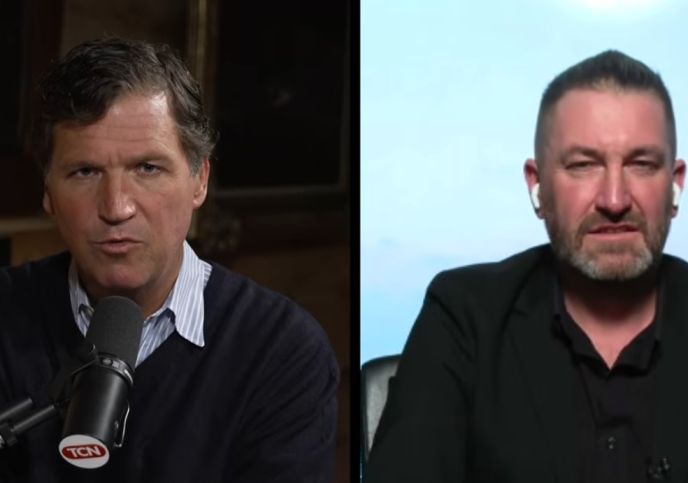
Editor’s Notes: In this episode, Tucker Carlson sits down with Steve Sweeney, a British journalist working for RT who recently survived a targeted Israeli missile strike while reporting from a bridge in southern Lebanon. Sweeney provides a harrowing first-hand account of the assassination attempt and discusses what he describes as a systematic “land grab” and ethnic cleansing operation occurring under the cover of regional conflict. The conversation also delves into Sweeney’s perspective on media censorship, explaining why he chose to work for Russian state television to maintain his journalistic independence from Western narratives. Together, they explore the broader geopolitical implications of the war, including the destruction of ancient Christian holy sites and the role of Western-supplied weapons in the ongoing devastation. (April 10, 2026)
TRANSCRIPT:
Tucker Introduces Steve Sweeney
TUCKER CARLSON: Last month, about 2 weeks ago, a British journalist called Steve Sweeney, who lives and works in Beirut, Lebanon, was in southern Lebanon attempting with a cameraman to document what the Israeli military is doing to the southern part of that country, which is leveling it, moving people wholesale out, including Christian villages across the area.
And as he was preparing his report, he was targeted by an Israeli-owned, American-made aircraft that fired a missile at him in an attempted assassination. Here’s what it looked like.
VIDEO CLIP BEGINS:
STEVE SWEENEY: Further rocket attacks were reported against Nahariya and a minute— Fing hell. F.
VIDEO CLIP ENDS:
TUCKER CARLSON: That wasn’t an accident. It was intentional. The jet that fired it had flown over his position attempting to assassinate him as the Israeli government has assassinated on purpose, not accidentally assassinated, murdered so many journalists, including Western journalists trying to cover its atrocities.
Atrocities that are spreading even now under the cover of the Iran War, a massive land grab across the region, killing of Christians, desecration of Christian holy sites. That’s all happening. It’s all real. And one of the reasons you may not know about it is because the people trying to record it, to chronicle it, have been assassinated.
But Steve Sweeney was not assassinated by luck or the grace of God. By a quirk of the landing of that missile, he survived. He joins us now to explain what happened. Steve, thanks very much for doing this. I’m grateful you’re alive. We just played the tape of the moment where you were almost killed. Can you add context to that and describe what was happening?
Steve Sweeney Describes the Attack
STEVE SWEENEY: Well, yeah, you’ve seen the footage. We were incredibly lucky to come out of that situation alive. It was only purely by luck that the missile ended up, as you’ve seen on the footage, it went through the hole and the bridge had already been destroyed.
So just to give you some context of why we were there, Israel had issued these evacuation orders. It said that it was going to bomb every single bridge in South Lebanon. So the bridges that cross the Litani River, this connects the south of Lebanon to the rest of the country. So this was a hugely important news story. This is essentially cutting off a whole swathe of the country. And they’d started the bombing the night before. It was a Thursday when we went to the bridge. On the Wednesday evening and into the early hours of the morning, they’d started targeting the bridges. So, as a journalist and as a war correspondent, we were there to report on this huge news story.
So we drove down, this is in Sur district or Tyre district as other people will probably better know it. And as we approached, the Lebanese Army have a base there, just ahead of the bridge. So we approached them and we said to them, “Okay, is it safe to film?” And they assured us it was perfectly safe for us to go on that bridge. And they would know because if Israel is about to bomb a bridge, which they had already bombed it the night before, then they would get a message to the Lebanese Army via UNIFIL, the United Nations Peacekeepers. They don’t have direct communication. So there was no pre-warning that this bridge was about to be struck again. There was no military objective in striking the bridge again. It was already destroyed. You could barely even walk across it, let alone take a vehicle across it.
So this was the Kazmiya Bridge. This was the smaller bridge. These kind of link villages and settlements in South Lebanon together. So okay, we approached the bridge, we set up our camera, we started filming. There were fighter jets roaring overhead. And again, this isn’t uncommon in the South of Lebanon, but we knew that the fighter jets were flying away from us. So they were roaring overhead, but they were heading further south, and they were bombing what they would describe as Hezbollah positions around that area. So we weren’t still unduly concerned and we went onto the bridge and we started filming.
So it wasn’t live. Some people have said it was live. It was what we call an as-live. So we were filming that. Ali Urida, who is my colleague, was at the moment we arrived on the bridge, I was doing my piece to camera. He went to film some B-roll. He went to film in the hole where the bridge had been struck.
And I mean, we talk about luck, and we talk about chance, and we talk about God’s will, but as he was filming, there was a gust of wind on the camera, and the tripod was shaking. So I called him over, and I said, “Ali, yalla, yalla, please come. The camera’s shaking. I need you to steady it.” As he came over, I guess around 15 seconds later, then we heard this tremendous roar and the Israelis struck the bridge again.
And I mean, the immediate aftermath, I remember just thinking, “God, we’re dead.” That was it.
This was a very heavy munition that they’d used, a GBU-38 missile that we believe was used. It was fired from an F-16 fighter jet.
Targeting of Medical Workers and Ambulances
STEVE SWEENEY: So after the Lebanese Army put these tourniquets on and gave us some water, then they called an ambulance. And the ambulance came and they put me on a stretcher and off they took me. And I should note really that the paramedics and the emergency workers and the doctors and the nurses and all of the medical team that attended to us are the real heroes of this story.
As we were traveling from the bridge to the hospital, I’m not sure the distance, maybe about 10 minutes, probably less than that, but they had the blue lights on. Now, in any normal country anywhere in the world, having the blue lights on and being transported somewhere by ambulance, you would be safe, right? Not in Lebanon, because the Israelis are now targeting medical staff. More than 50 have been killed. Hospitals, including the one we attended, the Jabal Amr Hospital, part of that has been destroyed in Israeli airstrikes.
And we’ve been working in the field for many years now. We’re very experienced journalists and we take safety very seriously. We’ve spoken to a lot of medical workers and they told us that the logo on the top of the ambulances, which is supposed to give them protection under international law, under the Geneva Conventions and this kind of thing, instead of giving them protection, it now places them at risk. So many of them have removed those logos from their emergency vehicles.
Now, barely a day goes by when we don’t hear of a medical worker being struck. The IDF, the Israeli Defense Force, soon after they carried out a massacre of 12 emergency workers in the south targeting their station, they put out a statement saying that Hezbollah is using medical facilities and ambulances for military purposes. Now, of course, they didn’t back that with any kind of evidence. This is a statement that they’ve reissued again quite recently.
But yeah, we’ve been on the ground, we’ve been in the back of the ambulances, we’ve been in the hospitals, we’ve met the civil defense workers, we’ve met the paramedics, and we’ve been to these stations. And all that you can see there are the kind of things that you would find in any hospital, in any medical station, in any ambulance anywhere in the world. These are medical facilities there, and they should be protected under international law. Of course, targeting these deliberately is a war crime, but it’s just one of many that we’re seeing here on the ground in Lebanon.
Steve Sweeney’s Background and Life in Lebanon
TUCKER CARLSON: So you’re a Westerner. By your accent, you sound Irish. You live and work in Lebanon. How long have you been there?
STEVE SWEENEY: I came to Lebanon in October 2024. So this was during the period we call the 66-Day War. So it was a week or so after the assassination of Sayyid Hassan Nasrallah, the former Secretary General of Hezbollah. So I came then. We quite often joke and say that if Steve Sweeney arrives in your country, then it’s not good news. But I came during that period.
Now, Lebanon, as you know, and I think I’ve heard you say, Tucker, it’s a beautiful country. The most wonderful place. You know, you look at the rich culture, tradition, and history of this country, even in the south now, which is the area coming under bombed out. And this is the area of Jesus. Cana is where Jesus performed what I believe was his first miracle, turning water into wine.
There’s the tomb of Shimon HaSaphar. This is Peter Simon, Saint Peter, who for many Catholics, they believe that he was the first pope. Some Christians believe that that’s his burial site. Of course, this has been destroyed by Israel. They bombed it. This is an important site, actually, Shimon HaSaphar, for both Muslims and Christians. So that’s been bombed. So I would—
Destruction of Christian and Muslim Holy Sites
TUCKER CARLSON: May I ask you to stop for a second? I’m ashamed by my ignorance as usual. The Israeli military bombed Saint Peter’s burial site?
STEVE SWEENEY: Yes.
TUCKER CARLSON: When?
STEVE SWEENEY: They did. Yeah. This was back in 2024. I mean, this wasn’t an accidental bombing. The Shimon HaSaphar, I think it’s protected under World Heritage law as well. And it’s a very important site. Of course, the burial place of Saint Peter. It’s also a holy site for Muslims.
What they did during that period was they brought in an Israeli, what they call a researcher. The Israeli Defense Force brought him in. And the purpose of that really was to reinvent history. And the aim of it was to say, “Well, this is a Jewish holy site and this land belongs to Israel.” This was the kind of narrative that they were trying to spin. That researcher, who was actually a very well-known settler activist, was killed during that time.
So we went, we visited the site in early 2025 after the ceasefire period, and missiles have gone through the domes. The whole area was destroyed, bullet marks across all of the buildings there, including the area of the shrine of Saint Peter himself. So it wasn’t accidentally targeted. It wasn’t kind of collateral damage. This was a deliberately targeted attack on the tomb of Saint Peter.
It’s not the only church or religious building that has been attacked. Of course, we were in a place called Deragaya and this is a Greek Catholic church. And again, that was destroyed during the 66-Day War. They killed 8 people that had taken shelter inside there. A lot of those were emergency workers, the civil defense team, and they’d taken shelter in there and they bombed it to oblivion. It was completely destroyed.
And again, in Yaron, this is another border town. And there are two buildings there. There’s the Imam Ali Mosque, which is a very well-known mosque in the south of Lebanon. But there was also the Church of St. George. And St. George, of course, the patron saint of England. And this was a Catholic church. And they’re very close by each other. And you may have seen the footage circulating on social media, but there’s footage of an Israeli soldier, I guess, with a body cam or something, a helmet cam, destroying the statue there to St. George. But both of those were completely destroyed.
Has Hezbollah Targeted Christian Sites?
TUCKER CARLSON: So what’s interesting is that—
STEVE SWEENEY: And across the south of Lebanon, Hezbollah is—
TUCKER CARLSON: And I’m not defending Hezbollah, it’s not my fight, but they’re designated, I believe, by the US government as a terror group. They’ve controlled big parts of Lebanon for many, many years, more than 20 years. And has Hezbollah blown up Christian holy sites? Has Hezbollah targeted ambulances? I mean, maybe they have. You live there, you tell me.
Targeting Journalists and Western Complicity
STEVE SWEENEY: No, they haven’t. In fact, the opposite. And again, there’s plenty of footage on all this that people can check for themselves online. But Hezbollah was in fact protecting the Christian churches and protecting these kind of symbolic areas of religious importance to Christians. There’s footage of them going into churches and cleaning up and tidying up and standing around, protecting the Christian faith. If you listen to the speeches of Hassan Nasrallah, he said Hezbollah are the main defenders of the Christian faith in Lebanon. So no, they’re not. They’re not destroying ambulances. They’re not destroying churches. They’re not destroying mosques. They’re not destroying people’s homes. But Israel is. And it’s doing it with American and Western-supplied weapons as well.
TUCKER CARLSON: And it’s happening without anybody, pretty much anybody in the United States even noticing. I think people’s attention is drawn to what’s happening in Iran and the unfolding disaster there, and they don’t even know that this is happening. So back to what happened to you specifically, you said that the missile that almost killed you and your cameraman was launched from an American aircraft, an Israeli-owned American aircraft.
STEVE SWEENEY: Yeah.
TUCKER CARLSON: Do you believe— was that one of the planes that had flown over you? Do you think it was targeting you?
A Deliberate Assassination Attempt
STEVE SWEENEY: Undoubtedly, we believe it was targeting us. There could be no other explanation for what happened. Now, of course, because people have asked this question — why were you on the bridge and were you deliberately targeted? — we’re unequivocal about that. This was an assassination attempt by Israel to silence the voices on the ground, to silence the truth.
Now, the reason we say that is because, like I said, we’ve been working in the field for the last 2 years. So our vehicle is very well known in the south of Lebanon. We were in a clearly identified press vehicle. We had, as you can see in the footage, we had our press jackets on. Israel has the most advanced military technology anywhere in the world. It has the most advanced surveillance technology anywhere in the world. It knows everything that happens in the south of Lebanon. It knows every vehicle, it knows every number plate. It reads our messages. It listens to our conversations. This is why we say it was deliberate, because there’s no doubt that they knew we were there.
And the other issue has been raised by the Russian Foreign Ministry. Maria Zakharova said that this can’t have been accidental. There was no military objective in targeting that bridge. It was already destroyed. So we believe it was a deliberate assassination attempt, absolutely. And it’s only by luck really that we survived. There was a lot going in our favour that day, let’s say.
Had the missile not entered the hole in the bridge, had it exploded on the bridge — we’ve spoken to military experts, weapons experts who have told us that if it had been maybe a few inches or a foot the other way, then there wouldn’t have even been bodies to recover. They would have just been incinerated. These are incredibly powerful munitions that they were using. And there was no military objective, as I’ve said, in targeting the bridge. So we say that we were deliberately targeted by the Israelis, without a doubt.
Recourse for a Western Journalist Under Fire
TUCKER CARLSON: So what — I mean, because you are a Westerner, you do have a certain advantage. I mean, you’re an English-speaking Westerner from the British Isles. And you’re on television, so you’re the subject of an assassination attempt by a supposedly Western government, one that’s armed by Western governments. What’s your recourse? What do you do after they try and kill you but they fail?
STEVE SWEENEY: Well, that’s a very good question. Obviously, I am an English-speaking white Westerner, which gives me a certain advantage, a certain privilege. I mean, I have to say that just over a week after our very close shave, our dear colleagues and friends in the field weren’t so lucky. Fatima Fatouni, Ali Shoaib, and Mohammed Fatouni were killed in a targeted strike by the Israelis just after they’d been reporting in the south. So this is the kind of conditions that journalists are working in on the ground.
In terms of the recourse, well, I work for Russian state television, which of course means that my own government, the British government, don’t like me. In fact, they have already — instead of supporting me, they’ve persecuted me. I was detained on a family visit last July at Heathrow Airport. I was met by counter-terror police off the aeroplane. They took me away for interrogation. They quizzed me over my relations to Russia, the Russian state, working for Russian state television, also about my work here in Lebanon, my associations or connections to Hezbollah, my connections to Ansar Allah in Yemen because I reported from Yemen, Hashd al-Shaabi, and my work in Donbas. I spent 2 years in the field in Donbas on the Russian side. So they were very interested in that. And they’re still now currently investigating me for potential terrorist activity based on my journalism.
So I don’t expect anything from them. And some friends of mine at Declassified UK, a British media organization, they inquired. They asked the British government for comment after this assassination attempt, and they just simply said — and I’m summarizing here, paraphrasing — something along the lines of, “The Foreign Secretary has given Britain’s position on the Middle East in a statement to the Commons on Tuesday.” That was all they said. They didn’t address the specifics of my case. They haven’t commented on it. They haven’t offered any kind of support whatsoever. Even the British Embassy here in Lebanon hasn’t contacted me.
The only support that I’ve had — I’ve had lots of love and well wishes from individuals and organizations across the world, for which we’re incredibly grateful and thankful. But the only people, the only country that’s actually given me strong and solid support has been Russia.
TUCKER CARLSON: Are you a British passport holder?
STEVE SWEENEY: I’m a British passport holder, yes.
TUCKER CARLSON: So you’re a British subject. So this is — even though you don’t live there most of the time, you have family there, you are a citizen — but the British government is taking the side of the Israeli military over its own citizens?
Britain’s Role in the Supply Chain
STEVE SWEENEY: Well, that’s how it seems to me, yes. Not only taking the side of the Israelis, but they’re helping provide the weapons and the ammunition and the political and military support to carry out such strikes. So somewhere along that chain — I mean, we know it was an F-16 and a GBU-38, American-made, American-supplied — but Britain is well involved in that supply chain. So some of the add-on equipment that enabled them to carry out that strike against me is almost certainly provided by the British government. Without a doubt.
TUCKER CARLSON: How does that — I don’t understand since both Britain and the United States fought against the Nazis and lost hundreds of thousands of their own men doing it. I don’t really see where the moral culpability is here. Why would Britain and the United States have some duty to become subjects of the Israeli government? Where does that come from?
The Greater Israel Project and Lebanon’s Destruction
STEVE SWEENEY: Well, there’s a long history of the two biggest supporters of Israel having traditionally been the United States and Britain. You can trace this back to the formation of the state of Israel. Now, of course, they have their own interests in the region. They use Israel as a proxy force for its colonialist imperialist expansion, for plans for the region.
If you look at what’s happening on the ground now, the reason that we reported on the bridges is that what you’re seeing now is the forced expulsion of 1.2 million Lebanese people that have been forced from their land, forced from their homes, and they’re now forcibly displaced. We describe this in Lebanon, we talk about it as an ethnic cleansing operation on a scale far larger than the Nakba. That’s, of course, the hundreds of thousands of Palestinians that were forced from their homes on the creation of the state of Israel.
So the situation here is simply astonishing. 370,000 of those forcibly displaced are children. But behind that is this attempt by Israel to grab that land. Not only are they forcing people out of that area south of the Litani River, they’ve extended that now to south of the Zerani River. So we’re talking some 40 kilometers from the Israeli border that they’ve pushed people out of that area.
Now, the Israelis have been very open. Israel Katz, the defense secretary, has said that they want the land. They’ve said that they want to create a security buffer zone, or whatever terminology they use to describe it. But these plans have been long in the making.
The Greater Israel Project and the Trump Economic Zone
You go back in history, and Israel has invaded and tried to take that area. They think it’s their biblical right. We’re talking about the Greater Israel Project, which I know you know full well about after your conversation with Ambassador Huckabee. And it kind of reappears in different guises over the years. The most latest was the Trump Economic Zone. This was announced back in, I think, August last year, around that time.
Tom Barrack, the US envoy, arrived here in Lebanon. And you might remember this soundbite from him because he spoke at the presidential palace to a group of journalists and there was a bit of a melee and he described them as animalistic. And he was condemned for this. This was seen as an incredibly racist comment to make towards Lebanese journalists who were doing their job in the field, holding people to account, questioning him.
But behind that, he laid out this plan for a Trump economic zone, which meant that hundreds of thousands of people would be forced from their homes permanently. Now, it was dressed up as a regeneration project. We’re going to create new homes, we’re going to create jobs, we’re going to create roads, we’re going to create infrastructure, we’re going to make the area safe. But it meant that people that have lived on this land for generations — these are their homes. These are not just dots on a map. These are homes where people have lived on that land for generations, and they’re going to be turfed out. And nobody really paid attention to it at the time. Of course, we did as journalists on the ground.
The Gaza Model Coming to Lebanon
People talk about the Gaza model now coming to Lebanon. I think Smotrich said, “We’re going to turn Dahieh, the southern suburbs of Beirut, into Khan Yunis.” And then they’ve used Beit Hanoun and Rafah. Israel Katz said that they’re going to destroy all of these villages that they call frontline villages. And I can tell you now, we’ve been here for 2 years. Those villages are largely already destroyed. The south of Lebanon already looks like Gaza. Whole villages completely lie in ruins, no reconstruction plan.
And over the last 15 months, we’ve seen Israel break that ceasefire. And we talk about a ceasefire from November 2024, but there was never a ceasefire. You can’t have a ceasefire when only one side stops firing. More than 15,000 violations over the last 15 months. And this included the rigging and destroying of homes, the drone strikes, targeted assassinations, the use of chemical spray to destroy crops.
We’ve witnessed and filmed all this — the use of white phosphorus. There’s a place called Bleida, a village very close to the border. During olive harvesting season, we went to make a film there. The Israelis refused to allow the farmers to tend to their land unless they gave them all of the contact details and the names of who was going into the fields. While we were there, they started bulldozing the olive groves. These are olive groves that are older than the state of Israel. So this isn’t something new. This is what we’re seeing now. The escalation on March 2nd has been going on for a very, very long time.
Britain and the United States as Enablers
Now, you asked me why Britain and the United States would support that. Well, they use Israel as their proxy force in the area they refer to as the Middle East. We call it West Asia here. And they use it to grab the land. The Greater Israel Project suits Israel, but it suits Britain and the United States because this is a land of great wealth and resources, and they want to extract that wealth. They want to extract the resources and use it for their own gain. And of course, they want strategic control across the whole of the region.
We’ve seen that with what happened in Syria. We can see now with the bombing of Iran. We can see what happened in Gaza. All of these have taken place not just with the connivance of the United States and Britain, but with their active involvement. You can see signs along the airport road here in Beirut that say “Made in the United States,” “Made in the USA.” And that’s how they see the bombs that are falling on them here. They’re made in the United States, they’re made in Britain, and they’re the root cause of the death and destruction that’s taking place across this region. Israel fires the bullets, but the guns were truly loaded by Britain and the United States.
TUCKER CARLSON: Since you mentioned it, I have to ask you about a small point that has bothered me for many years, and that’s the Israeli policy of cutting down olive trees, some of which are hundreds and hundreds, up to 1,000 years old. And of course, they’re central to the ancient economy of the Levant, but they’re also beautiful and they’re revered almost by the people who are actually from there — not the ones from Poland who pretend they’re from there, but the people who actually are there. Why would the Israeli government chainsaw or bulldoze olive trees? That seems evil to me. I don’t understand the explanation for it.
Destroying the Lifeblood of Lebanon
STEVE SWEENEY: Well, that’s the only way to look at it. Of course it’s evil. These olive groves, like you said, some of them are thousands of years old. I think the oldest in Lebanon is something like 6,000 years old, but it’s the lifeblood of Lebanon. It’s a symbol of Lebanese cultural heritage, identity. And the people here are very, very connected to their land. They’re deeply connected to their land.
This is the lifeblood, not just for the south of Lebanon where the farmers will harvest their olive groves. Tobacco is a huge crop here, but this is the lifeblood for all of Lebanon. Now, if you can disconnect people from their land and their culture, then of course you can take it over. And that’s what they’ve been doing, not just by bulldozing it, bombing it, but by spraying these chemicals that will make sure that these crops will never be able to grow on the land again, and they can just brush them aside. They can build houses, they can build settlements there, just like they did on the formation of the state of Israel. They’re building these illegal settlements everywhere. And that’s exactly what they want to do in Lebanon.
TUCKER CARLSON: They’re building settlements.
Settlers, Scripture, and Sovereign Territory
STEVE SWEENEY: Well, they want to. That’s their aim. I mean, you look at the Greater Israel Project itself. Now, I mentioned Yaroun earlier. This is the place where the mosque and the church were destroyed. Now, earlier this year, a few months before the escalation on March 2nd, this group of settlers came in across the border into, or very close to, Yaroun, and they planted trees. And the message was this — I can’t remember the exact terminology that they used — but this was them planting their roots in Lebanese territory. And they believe that Lebanese territory biblically belongs to them.
Now, you look back a few years ago and this could have been seen as a conspiracy theory or a fringe kind of movement. But this is now right at the heart of the Israeli government. Smotrich and Ben-Gvir are advocates of the Greater Israel Project. Benjamin Netanyahu himself is a supporter of the Greater Israel Project. This isn’t a fantasy. This is happening now. It’s unfolding in real time in front of our very eyes.
And they have some rabbis in Israel that justify this religiously as well. They will say that this is the land that belongs to them according to Holy Scripture. And this is why we’re seeing this whole-scale destruction. That’s what it was about over the last 15 months. They say it was about destroying Hezbollah, but it’s not. You’re seeing whole settlements lying under rubble. My beloved is from a village in the south, and her entire village has pretty much been reduced to rubble. Her family home rebuilt, destroyed, rebuilt, destroyed so many times. And this is very common for the people in that part of the world.
Israel’s Military Bases Inside Lebanese Territory
Again, Israel has occupied Lebanon and after the ceasefire in November 2024, it built 5 military bases inside Lebanese sovereign territory. We filmed them. And rather than scaling them back, Israel was expanding the construction of those military posts illegally, in breach of UN Resolution 1701, in breach of international law. The Lebanese government asked them to leave Lebanese sovereign territory, and of course they simply refused and they pushed further and further into Lebanese sovereign territory.
Now, the interesting thing — and I don’t know whether your viewers will be aware of this, many people don’t know — but there isn’t really an official border between Israel and Lebanon. There’s no officially agreed border. We have the Blue Line, which was established by the United Nations. This was after Israel was forced out in 2000. And this line is supposed to be the demarcation point that Israel is not supposed to encroach further across.
So Israel sees a lot of this land as belonging to them. There was the 1923 mandate line when it was the British mandate of Palestine. There was a kind of border drawn up then, which Israel inherited in 1948, but has never really agreed to. The armistice in 1949 didn’t again agree those borders. So Israel sees fit to push forward at will, and it’s done so with total impunity, of course.
A Failure of the Major Media Organizations
There’s no international outcry about the destruction of these villages and settlements, or the use of chemical weapons, the use of white phosphorus, or the assassination of individuals in drone strikes, or the killing of paramedics, the murder of journalists. All of these things have been happening for many, many years.
The world is maybe paying more attention to it now. We’ve had the Western journalists arriving in the country since March 2nd. Of course, the major news networks have arrived and they’re kind of surprised at what they’re seeing. They’re seeing this for the first time. But this has been going on for a very, very long time. And I say this is a bit of a failing of the major media organizations, because had they been on the ground in Lebanon for the past 15 months, they would have seen this unfolding. And maybe the situation would be very different from what it is now. As it is, they weren’t there and the Lebanese journalists were reporting. The people that live on that land were crying for help and nobody was listening.
TUCKER CARLSON: I have to ask, so you are covering this on the ground in Lebanon, living and working at the center of all this, and as noted, almost got killed for it, but you’re working for a Russian news agency. You’ve clearly been a journalist a long time. You look over 40, so probably a long time. How did you wind up working for a Russian news agency? Why aren’t you a BBC reporter? What was your path?
How Steve Sweeney Ended Up at RT
STEVE SWEENEY: The MI5 would never claim to work for BBC. No, they wouldn’t. Oh, it’s true. There’s no chance. No chance. I mean, I wouldn’t work for the BBC on a personal level. We’ve met some BBC journalists here and they’ve been very pleasant, very nice. And I have all the journalists from the major networks as individual journalists, I have no problem with them.
But how I ended up working for RT, for Russia Today, is I was working for a newspaper before I entered the world of broadcast journalism. I was the international editor of a national daily newspaper in Britain for many years. When the Ukraine conflict started, the special military operation, I was covering that. And I went to the western part of Ukraine to pick up, there was a couple of stories I was chasing there. I ended up in Lviv. The Ukrainians tried to kidnap me and I managed to make my escape from there back out through Poland and then to Germany.
TUCKER CARLSON: Wait, I’m going to ask you to pause. Why did they do that? Why did they try to kidnap you, the Ukrainians?
The Most Propagandized War in History
STEVE SWEENEY: Well, simply because I was a journalist that wasn’t towing their narrative. And Ukraine, the Ukraine conflict is the most propagandized war in history, in my view. I mean, you look at what happened, even the Iraq War, there was kind of that space within the media field to criticize your government’s policy.
When it came to Ukraine, that window or that gap narrowed to the point where it was impossible because there was no space to offer anything that was different from the narrative of the Western governments, the British government, the Ukrainian government. So if you were going there to actually do some proper journalism, and I say that because, with all due respect to those organizations, the BBC, CNN, Sky News, The Times, The Telegraph, Channel 4, they were doing these— they were all saying the exact same thing. They were taking it in turns to stand on the top of the same hotel roof in Kiev or Lviv and repeat the line, repeat the line. But they weren’t actually seeing what was the reality on the ground. They were just stenographers, essentially these kind of copy and paste reports.
And it reached kind of insane levels in Britain. I’m sure it was the same in the United States, but Britain was, they started demonizing Vladimir Putin. One of the craziest reports I saw was that Vladimir Putin has an assistant that follows him around with a briefcase, and every time he goes to the toilet, they collect his feces and urine so his opponents can’t run any kind of tests on them. I mean, it got to completely insane levels.
Reporting the Truth in Donbas
And anytime you were reporting— so I ended up at Russia Today after that because I saw that my independence as a journalist and my ability to report on the truth had completely disappeared. It was impossible. The only way to do that was to go to Russia and work for RT. Now we have one of our logos, “Question More,” and that’s what we do. And I always say, yeah, question more, question us. That’s the role of a journalist.
I ended up working for RT. I ended up working for 2 years in Donbas on the Russian side, and I was seeing something completely different from the narrative that was being played out in the West. I was seeing war crimes committed daily by the Ukrainians against a civilian population. When I was there, they called it Donetsk roulette. You never know when a missile might strike you.
And I was seeing attacks on marketplaces, for example, 27 people killed, body parts everywhere. These were like babushkas, dadushkas, old men, old women, the poorest people in that part of the city selling homemade fruit and vegetables from their home, just obliterated, arms and legs everywhere. I was seeing hospitals that were struck, bus stops that were being attacked.
I spoke about it at the United Nations Security Council. I gave testimony of what I’d seen in the failures of Minsk I and Minsk II and the path to peace. So what we’re seeing, and what I always say, is what we were seeing in that part in Donbas is the same playbook that we’re seeing in Gaza, the same playbook that we’re seeing here in Lebanon. These are the most powerful countries in the world, waging war using the most sophisticated technology, the most powerful weapons against some of the poorest, most vulnerable people in the world. They can’t fight back. They don’t have the arms, they don’t have the weapons.
The people of Gaza, the people of Lebanon, they weren’t sent HIMARS or Storm Shadows or these advanced weapons. These were sent to their oppressors to massacre them. This is what’s happening, and it’s the very same forces.
A People That Wanted Peace
In Donbas, it was very simple for me as a journalist. It was a people that wanted peace, a people that wanted to be able to speak their own language, Russian, people that wanted to be able to practice their own culture and traditions if they identified as Russian. And pretty much that was it. You could put it as really as simply as that.
But then the Ukrainian government decided to wage a war against its own people. I know for some this went back to the start of the SMO, but this has a much, much longer history starting way back in 2014, the Maidan coup. All of these things people forget about now conveniently, including the media. The media has actually made them forget about it because one day there was a neo-Nazi problem in Ukraine. The Azov and the Right Sector were carrying out these horrific actions, these horrific killings. They were terrorizing the people. And the next day, all of a sudden, Ukraine is a paragon of liberal democracy. It’s incredible. But people aren’t getting the truth.
So this is why I ended up at RT, because the space to do proper journalism just wasn’t afforded to me anywhere else. None of the British press— like I said, I kind of semi-joked, but MI5 would never allow me to work for the BBC or for any of the other major news organizations.
And I have to say, with Russia Today, with RT, I have complete freedom to report exactly what I want, and nobody tells me what to say. Nobody tells me where I can film. Nobody tells me who I can speak to, who I should speak to. I have total journalistic freedom. And I’m very happy working for RT. I’m very proud to work for RT.
And we always say that here on the ground, because obviously I came, kind of sprung into the limelight after what happened to me. But it’s not about me. Journalists should never become the story. Unwittingly, I did. But we always say that our job is to raise the voices of the people of this land. And we always say that our mic is a tribune for the people. It will continue to be a tribune for the people as long as we remain in the field.
More Freedom at RT Than at a British Newspaper
TUCKER CARLSON: It must be such a strange experience for you since you’ve been in the British— It sounds like you’re in the British media for a long time, conventional media, a newspaper in a country that reads newspapers famously. All of a sudden to have this perspective where you have more freedom to do journalism, to straightforward journalism, at Russia Today than you had at a British newspaper. I mean, what is that as someone who— I assume you were raised in the UK, right? Yeah. What is that like?
STEVE SWEENEY: Well, the media field in Britain, and I think it’s not just in Britain, but I think if you look at the Western countries, it’s very concentrated. It’s owned by a very small group of people who own and control the media. They control what you say. They control the narrative.
But I think that the change was that the owners of these media organizations are now more and more forcefully pushing their view and their narrative. And you see it permeating through every word that’s spoken on British television. You see it written in every single word in every single newspaper. There’s no divergence. They’re all uniform.
Russia: Far From the Authoritarian Dictatorship the West Portrays
So, people in the West think that Russia is some kind of authoritarian dictatorship, that we’re living under the jackboot of Vladimir Putin. But you’ve been to Moscow, you know. Anything but the truth. It couldn’t be further from the truth. You see people— I mean, there are very educated people. They have a rich— again, we were talking about Lebanon earlier having this rich culture and history. I mean, Russia, come on. I don’t know any other nation on Earth that has such a rich culture and history. Shostakovich, Dostoevsky, Prokofiev, Yuri Gagarin— they put the first human being in space. Mendeleev, the founder of the table of the elements, these huge figures in the field of science, of literature, of art, of music.
And you go to any bar in Moscow and you can sit down there, within 5 minutes, you’ve had one of the most intelligent political or cultural conversations that you’ve ever had sitting over a cold pint of Guinness. And for those that think that people are too afraid to criticize Putin, let me tell you, they’re not. They’re not. I’ve heard it myself. And the same kind of criticisms you hear in every country anywhere in the world, they’re not afraid to express those views.
They don’t necessarily hold them. Vladimir Putin is incredibly popular and he’s incredibly popular for a very good reason, is that people remember the days before Putin became the president and they remember it was a very, very dark time in the country. And after the collapse of the Soviet Union up until Vladimir Putin came to power, there wasn’t really that kind of national stability.
I mean, Russia is obviously a huge country, 11 time zones I think it is. So to hold it together is incredibly difficult. But Vladimir Putin brought that stability. He made Russia into what it is today. And this is a strong, economically thriving, independent country that is actually, despite what the West says, it still has these good relations with other countries on the world stage. It’s not isolated by any stretch of the imagination. It’s only isolated if you think the world is the Western powers.
So there is this freedom to criticize, but of course, he’s hugely popular. And I think people in the West find that very difficult to understand, just how popular Putin is in Russia.
TUCKER CARLSON: Everything you’re saying is true.
The BBC Operates Freely in Russia — But RT Is Banned in Britain
STEVE SWEENEY: I’ve seen it multiple times. Even, for example, RT is banned in the United States. It’s banned in Europe. In Russia, you’ve probably seen, but Vladimir Putin holds a— every year he holds a Q&A for journalists, for members of the public. Every year the BBC is there. Steve Rosenberg asks a question. He tries to get a gotcha. Every year he fails, every year, but he keeps giving it a go. But the BBC is allowed to operate freely inside Russia. I couldn’t do the same in Britain. They’d try and arrest me.
TUCKER CARLSON: They would arrest you if you practiced what you’re doing now in your home country?
STEVE SWEENEY: Yes. If I took an RT microphone into London and started trying to interview people, or if I stood in front of a camera with an RT microphone and started trying to give a report, I would be arrested. We’re banned. We’re treated as, I don’t know, like foreign agents. So it would be unlawful for us to work there. We could be jailed, sanctioned, a whole host of things could happen. So we don’t have that freedom to operate inside Britain.
Press Freedom — A Western Illusion
This is something that always amazes me because Russian state television was banned in Europe and America because we’re propagandists or whatever, the Kremlin media machine, or these kind of tired old tropes that we hear, which is deeply rooted in Russophobia. But what they’re really saying is the people of Europe and America are stupid. People are able to disseminate fact from fiction. They’re able to watch a news report and decide whether it’s propaganda or whether it’s true. They can make that decision themselves, and they should be able to make that decision themselves in a free and democratic country that operates with freedom of speech and freedom of the press.
So it always strikes me as quite bizarre that they keep saying, “Well, we uphold freedom of the press.” Well, in fact, the European Union has sanctioned a journalist, someone I know, Hussein Doru, who is a journalist for Red Media. They sanctioned him because of his work. They said he’s closed doors. I think they accused him of something to do with the Russian state, but it was because of his reporting on Palestine. So there’s no way that they uphold freedom of the press.
I myself am being investigated for potential terrorist activities based on my journalism, nothing else. That’s it, for my journalistic reports. So where’s the press freedom? Can I walk into the United States? Can I freely walk around and start interviewing people? Can I interview Donald Trump? Can I sit down and speak to the people on the ground? Of course not, we’re banned. It’s an absurdity. It is an absurdity. But press freedom is alive and kicking.
The Criminalization of Criticism and the Role of Western Media
Tucker Carlson: And it’s also a little bit bewildering. It’s surprising for me, and it’s an ominous sign, I would say, as an American, to see people arrested in Britain for criticizing Israel. Why would it be illegal for a Briton to criticize Israel? What does Israel have to do with the UK? And by the way, it was Israeli terror groups who murdered British citizens, British soldiers, British diplomats.
Steve Sweeney: Exactly. The King David Hotel. That’s exactly.
Tucker Carlson: And many others. Yeah, for sure. And they murdered a lot of Brits. Murdered them with their hands slowly, in some cases blew them up with bombs, but true terrorist acts. And the guy who did it later became the Prime Minister, Menachem Begin. So actually, Israel owes a great debt to the UK, which is responsible for its formation in the first place, as you know. So why in the world would British citizens be banned from criticizing Israel? They owe nothing to Israel. What is this?
Steve Sweeney: Well, it’s a bizarre dystopian situation. You’ve probably seen, but in Britain, I guess maybe 6 months ago, the government moved to ban a group called Palestine Action. And these were protesters that were throwing paint at airplanes or whatever. They were trying to stop a genocide. And Britain prescribed it as a terrorist organization, I think against all the legal advice that they were given. They ignored that and they went ahead. And it became illegal to even support or hold up placards saying, “I support Palestine Action.” So they were arresting like 80, 90-year-old women. They were dragging them away and charging them as terrorists under terrorism offenses.
So I mean, Britain has obviously invested in Israel, heavily invested in Israel, clearly, because it was Britain really that was behind the formation of the state of Israel in the first place. You can trace it back to the Balfour Declaration where they drew a line in the sand and gave a land that didn’t belong to them to another people whose land. And it wasn’t, they gave away the land that belonged to the people indigenous to that land.
So I think they talk about this historical debt owed to Israel. Now, of course, you can go to Germany and some of the European countries, and of course they talk about the Holocaust and they bear a heavy burden and responsibility for that, or they feel that. And again, there’s this kind of historical debt that they feel. But in Britain now, it’s kind of moved way beyond that. And like you said, they were in the early days in the formation of the state of Israel, they were attacking Brits, killing Brits, blowing up hotels.
So this kind of unraveled support where you can’t even criticize Israel. There’s no space. Any criticism of Israel is now deemed either antisemitic, an act of terror, unlawful. And it means that you’re ostracized from society. You’re labeled an anti-Semite, you’re labeled a racist. And I mean, Britain’s objective is, I mean, Israel is an outpost for Anglo-American imperialist, you know, what they want to gain out of the region. So it acts as this kind of Anglo-imperialist outpost, and it will back Israel militarily to the hilt. It will back them politically to the hilt.
But of course, you know, they’re using it to strategically control the entire of the Middle East. I mean, this is their historical mess. I mean, yes, everything that happens in this region is because of the historical mess of the British and the French. You know, back in the time of the Sykes-Picot and carving up of that part of the world, just arbitrarily drawing lines. Okay, you can have this part, you can have this part. And the legacy of that lives on today.
Which is in fact why, as a British journalist, I say of Irish origin, but certainly as a Western journalist, I have a historical debt to the people of this land because of what my country has inflicted upon them. And I see that as part of my duty as a journalist, not to just fall in line behind my own government, not to be a stenographer for power, but to expose to the world what’s happening here on the ground in Lebanon and in other countries.
And for every bomb that falls on Lebanon, and there have been many of them, I can tell you, for every bomb that falls on Lebanon is a bomb that is supplied by the United States. A bomb that is supplied by Britain. Israel just simply fires the bullets that they’re supplied. And it’s been carrying out these actions with the support and complicity of Britain and the United States and other Western countries.
Shame, Narrative Control, and the Western Media Machine
Tucker Carlson: Do your former colleagues in the British media feel shame as they continue their stenography and see you speaking freely and risking your life to do it?
Steve Sweeney: They should do. Yeah, they should feel a great sense of shame. But I don’t know whether they do. Like I said, on a personal level, I’ve met the individual journalists from the major news organizations and they’ve been very, very gracious and very pleasant as individuals. But they all fall in line with the same narrative.
Even the journalists that are coming here, they’ll describe Dahieh, which is the southern suburbs of Beirut. That entire area has been evacuated. We’re talking an area between 500,000 and 800,000 people. And that whole area has been evacuated. It’s bombed every single day without fail, fighter jets roaring overhead, drones overhead. Civilian buildings being destroyed. Now, for them, this is the southern suburbs of Beirut. They call it a Hezbollah stronghold.
Now, that use of language is not an accident. It’s deliberate. They call it a Hezbollah stronghold because it justifies the bombing of that area. But this isn’t a Hezbollah stronghold. This is where we live. These are the coffee shops where we meet our friends. These are the places we go shopping. This is an area vibrant, full of life. People’s homes, this kind of thing.
And the Western media play a very pernicious role, in fact, in what I believe is this manufacturing of consent. Because outside of that, Dahieh is just a place on a map that gets bombed. Lebanon is a war zone. That’s how they describe it. Lebanon isn’t a war zone, as we already discussed. Lebanon is a land of rich culture, rich tradition, rich history, full of the most amazing people you could ever meet anywhere in the world.
The same with the south of Lebanon. They say, well, all these areas south of the Litani, they’re all Hezbollah supporters. I mean, of course there’s strong support for Hezbollah in those areas because they see them as the only organization that is standing up and fighting against Israel, that is defending their land, their territory. Hezbollah was only born in the mid-1980s. Now, the people of Lebanon don’t have a predisposition to using weapons and guns. It’s not that they enjoy going around shooting people. They were formed as an armed militia exactly to defend their land, the same as in Ireland, the same as in any country that’s come under attack from the Western powers, from Israel, from their neighbors. That’s the origins of these organizations.
But to call it Hezbollah land, which is some of the description that we’re finding, this is, as we said, the land that Jesus walked in. It’s a land rich in culture and history. But the Western journalists are seeing it, or speaking about it or writing about it, very much in those terms. We hear the same kind of dog-whistled trigger words: “Iran-backed,” “the Iranian-backed militia,” “the Hezbollah strongholds.” The terminology that they use is absolutely deliberate to justify Israel bombing those lands. That’s all it is.
So whether they’re embarrassed about writing that or not, I don’t know. I think it’s very difficult to get a job in the British media if you don’t write those kind of lines or you don’t speak them into a camera. Now, Noam Chomsky, who back in the ’90s was interviewing a British journalist, Andrew Marr, I think he hit the nail on the head when he said, “I’m not necessarily saying you don’t believe what you’re saying, but if you didn’t believe what you said, you wouldn’t be sitting where you are now.”
I think that’s true, right? I mean, you’re not going to get a job unless you believe those things, unless you’re prepared to say them or write them. So whether they’re embarrassed or not, I don’t know. And to be honest, I don’t care very much.
Staying the Course: No Intention of Leaving Lebanon
Tucker Carlson: They may not be capable of it. So my last question, I know you don’t like talking about yourself, but it is about you. So Israel tried to assassinate you. They failed. Just barely. I can’t imagine interviews like this make them less inclined to assassinate you, to try again. Are you going to stay in Lebanon?
Steve Sweeney: Absolutely. 100%. Without doubt, I’ll stay in Lebanon. Lebanon is my home. My beloved is here in Lebanon. My life is here in Lebanon. I always say, look, Lebanon isn’t my country, but Lebanon and the Lebanese people belong in my heart. And I’ll forever be in the service of the Lebanese people. They’ve been good enough to host me in their country, and I hope that my journalism does them justice, and I hope my presence does them justice.
I always remember, and it’s always important to remember, that I’m a guest in this land. So no, I have no intention of leaving. I have no intention of stopping reporting. We’ve already been back to the front line just 2 days after the attack. We made sure that we went out because we’re not going to be silenced. And if they think that we’re going to be leaving the field, then they’re very much mistaken.
Tucker Carlson: What a remarkable conversation. It is one of the great countries and most beautiful countries in the world. Top 5, in my opinion, top 3. So I’m grateful you’re there to chronicle what’s being done in our name with our weapons. It’s really evil. So anyway, Steve Sweeney, thank you very much for doing this. I appreciate it.
Steve Sweeney: My pleasure. Thank you.
Related Posts
- Peter McCormack Show: AI’s Five Kings and Their 8 Billion Tenants w/ Liberman’s (Transcript)
- TRIGGERnometry: w/ Sir Antony Beevor on Russian Mindset (Transcript)
- Transcript of John Kiriakou’s Interview: This Past Weekend #661
- PBD #812: w/ Mehdi Hasan – Iran War, Qatar/China DARK Money (Transcript)
- SRS #310: w/ Josh Duhamel – Survival Skills, Off-Grid Living, Billionaires Building Bunkers (Transcript)