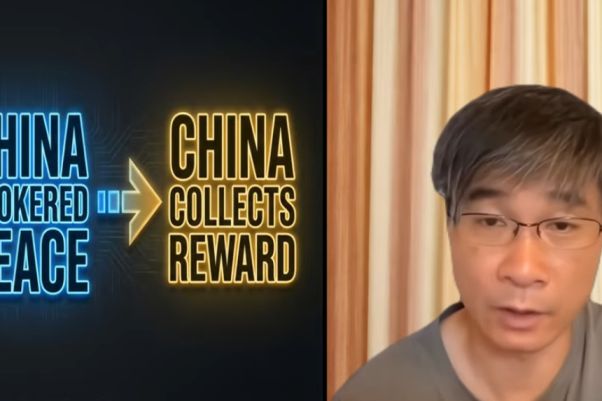
Editor’s Notes: In this episode, Prof. Jiang provides a deep-dive analysis into how China has strategically positioned itself as the true winner of the recent conflict between the United States and Iran. He explores China’s “triple game”—a sophisticated maneuver where they simultaneously armed Iran, brokered the ceasefire through Pakistan, and secured long-term economic rewards. By connecting the dots across military, diplomatic, and economic boards, Prof. Jiang illustrates how China is applying ancient Sun Tzu principles to gain global leverage while its rivals exhaust their resources. (April 10, 2026)
TRANSCRIPT:
Introduction: The Question Nobody Is Asking
**PROF. JIANG:** So, today I want to talk about something that I think almost nobody understands about this war. Everyone is focused on the ceasefire. Everyone is asking, did America win? Did Iran win? Will the ceasefire hold? Will the war resume? And these are all important questions.
But today I want to ask a completely different question, a question that I think is far more important than anything the media is discussing right now. And the question is this: while America and Iran were bleeding each other for 40 days, while bombs were falling and oil prices were surging and the global economy was shaking, who was actually winning?
And the answer — the answer that almost nobody is talking about — is China.
Now, I know what some of you are thinking. China is not even in this war. China did not fire a single missile. China did not send a single soldier. How can China be the winner?
And that is exactly the right question, because the most brilliant move in geopolitics is not to fight. The most brilliant move is to let your enemies destroy each other while you quietly collect the prize.
China’s Triple Game: Armed Iran, Brokered Peace, Collected the Reward
But here is what makes this even more extraordinary. And this is the part that I think nobody has fully explained yet. China did not just sit and watch this war. China did something far more sophisticated. China played all three sides simultaneously.
China armed Iran. China brokered the peace. And China will now collect the economic reward — all at the same time.
Let me say that again, because I need you to understand how extraordinary this is. China sent missile components to Iran during the war. Chinese radar systems and navigation technology helped Iran fight. Then China turned around and helped broker the ceasefire through Pakistan. And now China will use the credit from that ceasefire as leverage when Trump visits Beijing next month.
One country. Three moves. All sides played.
And nobody in the Western media is connecting the dots. That is what I want to do today. I want to connect the dots step by step. And when you see the full picture, I promise you, you will never look at this war the same way again.
Understanding the Triple Game
Okay, let us begin. So I want to introduce a concept that I think is essential to understanding what China is doing. I call it the triple game. And once you understand this concept, everything about China’s behavior in this war makes perfect sense.
Most countries play one game at a time. America plays the military game — bombs, missiles, aircraft carriers. That is America’s game. Iran plays the survival game — resist, endure, hold the strait. That is Iran’s game.
China plays three games simultaneously: the military game, the diplomatic game, and the economic game. And China plays a different strategy on each board. Let me walk you through each one.
Game One: The Military Board
On the military board, China officially declared itself neutral. China said, “We are not involved. We want peace.” That is the public statement.
But here is what actually happened. Multiple sanctioned Iranian ships carrying sodium perchlorate — a key ingredient for building solid fuel rockets — traveled from China to Iran after the war started. Not before the war. After.
Chinese-made radar systems and navigation technology sold to Iran before the war helped Iran’s electronic warfare capabilities during the fighting. Chinese technology helped Iran detect incoming strikes and coordinate its drone swarms.
Now, did China send soldiers? No. Did China fire missiles? No. But China made sure that Iran had enough capability to keep fighting, enough capability to keep the Strait of Hormuz closed, enough capability to make this war painful for America.
Why? Because every day America spent fighting Iran was a day America was not focused on China. Every billion dollars America spent bombing Iranian factories was a billion dollars not spent competing with China in semiconductors, in AI, in the industries that actually determine who leads the world in the 21st century.
This is game one. On the military board, China quietly helped Iran survive without ever putting a Chinese soldier at risk.
Game Two: The Diplomatic Board
Now here is where it gets brilliant. Because at the exact same time China was helping Iran fight, China was positioning itself as the peacemaker. I want you to follow this timeline very carefully because it reveals something extraordinary.
## China’s Peace Initiative
On March 31st, while the war was still raging, China and Pakistan jointly announced a five-point peace initiative, ceasefire, dialogue, civilian protection, reopening of Hormuz and a UN role. After that announcement, Pakistan’s foreign minister flew directly from Islamabad to Beijing. He met Chinese foreign minister Wang Yi. They coordinated the next steps together.
Then China’s foreign minister made 26 phone calls, 26, to Iran, to Israel, to Russia, to the Gulf states. He was talking to everyone. And then Pakistan, China’s closest strategic ally, the country where China has invested over $60 billion through the Belt and Road, Pakistan brokered the ceasefire.
Now I want you to think about what just happened. Pakistan brokered the deal, but who was behind Pakistan? Who coordinated with Pakistan before every major move? Who provided the diplomatic framework? Who gave Iran the confidence to accept the ceasefire?
China.
Pakistan’s own ambassador to the United States said it openly on CNN. He said, “China played a quiet but consequential role.” The New York Times reported that China made the key intervention that secured the ceasefire. Bloomberg reported that Trump himself credited China for helping make the deal happen.
So let me be very clear about what this means. China armed Iran to keep the war going. Then China brokered the peace to end it. China decided when this war would be painful, and China decided when this war would pause. That is not a neutral country. That is the country controlling the tempo of the entire conflict.
## Game Three: The Economic Board
Now the economic board. This is the most important board, and this is where China truly wins. China buys over 90% of Iran’s oil exports. Let me say that again, 90%. China is not just a customer of Iranian oil. China is the customer.
Before this war, American sanctions meant Iran could barely export oil. The Iranian economy was struggling. Iran was desperate. But then this war started, and something extraordinary happened. America needed global oil prices to not go too high. Because high oil prices destroy the American economy. So America quietly eased enforcement of sanctions on Iranian oil. And who immediately stepped in to buy more? China.
Iran is now making billions more per month from oil exports than before the war. And most of that money flows through Chinese banks, Chinese intermediaries, Chinese payment systems. The war that America started to weaken Iran has actually pushed Iran deeper into China’s economic system than ever before.
But it gets even better for China. Because of the war, because of the Strait of Hormuz closure, because of the chaos, Iran is selling oil to China at a significant discount, below market price. Because China is one of the few buyers willing and able to take the risk. Cheaper oil means cheaper energy for Chinese factories. Cheaper energy means lower manufacturing costs. Lower manufacturing costs means Chinese goods are more competitive globally.
While American businesses are struggling with energy prices above $90 a barrel, Chinese manufacturers are getting Iranian oil at a discount. The war that was supposed to weaken Iran and strengthen America is actually making Chinese manufacturing more competitive. You cannot make this up, okay?
## China’s Triple Game: Winning on All Three Boards
Now I have shown you the three boards, military, diplomatic, economic. China is winning on all three. But the genius of the triple game is that most people can only see one board at a time. The Pentagon sees the military board. The State Department sees the diplomatic board. Wall Street sees the economic board. But nobody in Washington is seeing all three boards together. China sees all three. And China is playing all three simultaneously.
Now I want to talk about something very specific that happened in the last 24 hours. Because this is the part that I think proves beyond any doubt that China is the biggest winner of this war. Trump is scheduled to visit Beijing in mid-May.
This will be his first visit to China as president since 2017. And the most important issue on the agenda, trade, tariffs, the economic relationship between America and China.
Now think about the timing. China just helped broker a ceasefire that saved Trump from a political catastrophe. Trump was hours away from ordering the destruction of Iran’s entire civilian infrastructure, power plants, bridges, everything. The whole world was watching. Pope Leo called it “truly unacceptable.” Even Republican senators were getting nervous. And then China, working through Pakistan, helped deliver a ceasefire that Trump could call a victory.
Trump went on Truth Social and called it “a big day for world peace.” The market surged, oil crashed. Trump looked like a dealmaker instead of a warmonger. China did that. China gave Trump that win.
The Ceasefire Dividend: What China Will Ask for in Return
Now what do you think China is going to ask for in return when Trump visits Beijing next month? I will tell you exactly what China will ask for. Tariff reductions, easing of semiconductor export controls, relief on sanctions against Chinese technology companies. And Trump, who just publicly credited China for the ceasefire, who needs China’s cooperation to keep Iran at the negotiating table, who needs stable oil prices for the American economy — Trump will have very little leverage to say no.
This is the ceasefire dividend. China helped end the war, not because China cares about peace. China helped end the war because it creates leverage. Leverage that China will cash in next month in Beijing.
And here is the deeper point. This is what I want you to really understand. America spent tens of billions of dollars on this war. American soldiers died. The American economy was shaken. Oil prices surged. Markets crashed. Allies were rattled. America’s global reputation was damaged. And what did China spend? Phone calls. 26 phone calls from the foreign minister, some diplomatic coordination with Pakistan. That is it. That is the total Chinese investment.
America spent billions and got a two-week ceasefire that is already collapsing. China spent phone calls and got leverage over the most important bilateral relationship in the world. This is the difference between a hammer strategy and a Sun Tzu strategy. America hits, China positions. And positioning always beats hitting in the long run.
This Pattern Has Repeated Throughout History
Now, I want to show you that what China is doing is not new. This pattern has repeated throughout history. And every time it repeats, the outcome is the same. The country that fights, loses. The country that waits, wins.
The first example is the one I always come back to. The Peloponnesian War. In 431 BC, Athens and Sparta went to war. Athens was the financial and cultural superpower. Sparta was the military superpower. They fought for 27 years. Both sides were devastated. Athens was destroyed. Sparta was exhausted. And who won? Macedon. A kingdom to the north that everyone considered irrelevant.
Philip of Macedon watched Athens and Sparta bleed each other dry. He built his army. He built his economy. He waited. And when the moment came, his son, Alexander, conquered the entire Greek world. America is Athens. Iran is Sparta. China is Macedon. The parallel is exact.
The Napoleonic Wars: America’s Blueprint
But let me give you a second example that I think is even more precise. And this one I have not heard anyone else discuss. The Napoleonic Wars. From 1803 to 1815, France under Napoleon fought Britain and the rest of Europe in a series of devastating wars. France had the most powerful army in the world. Britain had the most powerful navy. They fought each other for over a decade. And who won? Not France. Not Britain, really. The true winner was the United States of America.
While Europe was tearing itself apart, America was quietly expanding westward. America bought Louisiana from France in 1803. Napoleon sold it because he needed money for his wars. America doubled its territory overnight. America built its economy. America stayed out of European conflicts. And within a few decades, America had become the dominant power in the Western Hemisphere.
America won the 19th century not by fighting the biggest battles, but by letting the European powers exhaust each other and then filling the vacuum.
This is exactly what China is doing today. While America spends trillions on Middle Eastern wars, China is buying resources in Africa. China is building ports in Southeast Asia. China is signing trade deals in Latin America. China is expanding while America is exhausting itself.
## The Soviet-Afghan War: A Mirror of Today
Now, let me give you the third example, and this one happened within living memory. In 1979, the Soviet Union invaded Afghanistan. The Soviets thought it would be a quick operation. They thought the Afghan resistance would collapse in weeks. Instead, the war lasted 10 years. It cost the Soviet economy billions of rubles. It killed 15,000 Soviet soldiers. It demoralized the Soviet public. And in 1989, the Soviets withdrew in humiliation. Two years later, the Soviet Union collapsed.
And who won? America. America did not fight in Afghanistan directly. America armed the Afghan resistance through Pakistan. By the way, the same Pakistan that just brokered the Iran ceasefire. And America watched the Soviets bleed.
Do you see the parallel? In the 1980s, America armed the Afghan resistance through Pakistan and watched the Soviet empire bleed to death. In 2026, China is supporting Iranian resistance, coordinating through Pakistan and watching the American empire bleed. The student has become the teacher.
America invented this strategy, and now China is using it against America. Let me say that again, because this is the key insight. America armed the Afghans through Pakistan to bleed the Soviet empire. China is supporting Iran through Pakistan to bleed the American empire. It is the exact same playbook, and America cannot see it, because America never imagined that someone would use its own strategy against it.
## A Human Reminder Behind the Strategy
Now, before I give you my predictions, I want to pause and say something. When I talk about strategy in game theory, it can sound like a game, like chess, like abstract intellectual exercise. But I want to be very clear. This is not a game.
Real people are dying in Iran. Real people are dying in Lebanon. Real families in America are terrified that their children will be drafted. Real people across the Gulf states are watching drones fly over their cities and wondering if their water supply will survive the next attack.
Strategy matters because it helps us understand why these things happen. But we must never forget that behind every strategic calculation, there are human beings, mothers, children, ordinary people who did not choose this war and cannot escape it. I study these patterns because I believe understanding them can help prevent the next catastrophe. That is why I do this.
## Four Predictions
Now, let me give you the predictions. I am going to make four predictions today. Not three, four, because I believe the fourth prediction is the one that will matter most in the long run. Write them down, save this video, come back and check.
Prediction number one. China will extract major trade concessions from Trump at the May Summit in Beijing. Trump publicly credited China for helping broker the ceasefire. Trump needs China’s cooperation to keep Iran at the negotiating table. Trump needs stable oil prices. And China knows all of this.
I predict that the May Summit will produce a significant reduction in tariffs on Chinese goods, a partial easing of semiconductor export controls, and at least one major concession on technology restrictions. Not because Trump wants to give China these things, but because China has leverage now that it did not have six weeks ago. The ceasefire gave China that leverage. Watch the May Summit. Watch what China gets.
Prediction number two. Within six months, China and Iran will announce an expansion of their strategic partnership. China signed a 25-year, $400 billion partnership with Iran in 2021. That deal was mostly symbolic at the time. Many of the promised investments never materialized because of sanctions pressure. But this war has changed everything.
Iran is now more dependent on China than ever. China is now buying over 90% of Iran’s oil. Iran needs Chinese technology to rebuild its destroyed factories. Iran needs Chinese investment to rebuild Iran’s oil and gas industry. I predict that within six months, China and Iran will announce a major expansion of this partnership.
## The Petrodollar’s Accelerating Decline
New infrastructure projects, new energy deals, new technology transfers. This will accelerate the Belt and Road Initiative through Iran faster than anyone expects.
Prediction number three. The Petro-Iran accelerates. Before this war, the idea of oil being traded in Chinese yuan instead of U.S. dollars was discussed mostly as a theoretical possibility, something that might happen in 10 or 20 years. After this war, it will happen much faster.
Here is why. The Gulf states just watched America fight a 40-day war and fail to reopen the Strait of Hormuz. They watched their infrastructure get hit by Iranian drones. They watched America threaten to destroy an entire civilization, and they watched China quietly broker the peace. The Gulf states are now asking a very simple question. Who is the more reliable partner? The country that starts wars it cannot finish, or the country that builds your infrastructure and then helps end the war?
I predict that within 12 months, at least one major oil-producing country, and I believe it will be Saudi Arabia, will announce a significant oil trade agreement denominated in Chinese yuan. Not all of its oil, maybe 10 or 20%, but even that is a tectonic shift because once one country does it, others will follow. And when that happens, the petrodollar does not just weaken, it begins to die.
## China’s Rise as the Middle East’s Dominant Power
Prediction number four, and this is the big one. This is the prediction I want you to remember. Above all the others, within five years, not 50 years, not 20 years, five years, China will become the dominant economic power in the Middle East, surpassing the United States.
China is already the largest trading partner of Iran, of Saudi Arabia, of the UAE, of most Gulf states. China is already the largest buyer of Middle Eastern oil. China is already the largest investor in regional infrastructure through Belt and Road. What China does not yet have is diplomatic and security influence. But this war just gave China that too.
China brokered the ceasefire. China has credibility now as a peacemaker. Pakistan, China’s closest ally, is hosting the negotiations. The talks are happening in Islamabad, not Washington. Five years from now, when you look at the Middle East, you will see Chinese-built ports, Chinese finance railways, Chinese-purchased oil, and Chinese-mediated diplomacy. America will still have military bases. But military bases without economic influence are just expensive targets.
This is what this war has done. It has not just weakened America, it has handed China the keys to the most strategically important region on earth.
## Sun Tzu’s Greatest Lesson, Executed in Real Time
Let me bring this all together. 2,500 years ago, a Chinese strategist named Sun Tzu wrote the most important book on strategy ever written. It is called The Art of War. And the most famous lesson of that book is this. “The greatest victory is to win without fighting.”
For 2,500 years, Chinese strategists have studied this principle. They have refined it. They have internalized it. It is not just a theory in China. It is a way of thinking. It is in the DNA of Chinese strategists. It is in Chinese strategic culture. And in this war, we are seeing this principle executed at the highest level in modern history.
China armed Iran quietly through deniable channels to make sure the war was painful enough for America. China then brokered the peace through Pakistan, through phone calls, through diplomatic channels to make sure China got the credit. And now, China will collect the economic reward through cheap oil, through Belt and Road expansion, through trade concessions, through the gradual death of the petrodollar.
Three moves. One strategy. No soldiers lost. No bombs dropped. No cities destroyed.
America spent tens of billions of dollars on this war. Thousands of people are dead. The global economy was shaken. And what did America get? A two-week ceasefire that is already cracking.
China spent 26 phone calls. And China got leverage over the global superpower, deeper control of Iranian oil, a path to expand Belt and Road, credibility as a peacemaker, and a weakened dollar.
This is not luck. This is not coincidence.
## The Lesson of Sun Tzu and the Logic of History
This is 2,500 years of strategic culture meeting a moment where it can be applied perfectly.
Now I want to leave you with one final thought. And this is the thought that I think matters most.
In the 1980s, America used Pakistan to arm the Afghan resistance and bleed the Soviet empire. It worked. The Soviet Union collapsed. And America became the sole superpower.
In 2026, China is using Pakistan to support Iran and bleed the American empire. The question is, will it work again?
I believe it will. Not because China is smarter than America. Not because China is more powerful than America. But because this strategy — letting your enemy overextend, letting them spend their money, letting them destroy their own credibility, and then stepping in when they are exhausted — this strategy works every single time in history. Every single time.
Athens and Sparta exhausted each other. Macedon won. Britain and France exhausted each other. America won. The Soviet Union exhausted itself. America won. And now America is exhausting itself. And China will win.
Not with bombs. Not with soldiers. Not with aircraft carriers. With patience.
That is the lesson of Sun Tzu. That is the lesson of history. And that is what is happening right now in front of the entire world while almost nobody is paying attention.
—
That is my analysis for today. This is not prophecy. This is game theory and structural history. I might be wrong. And if I am wrong, we will come back and analyze why. Because that is what this is about. Not being right all the time, but thinking carefully, questioning our assumptions, and following the logic wherever it leads.
Save this video. Come back in six months. Check the predictions. I will see you in the next one.
Related Posts