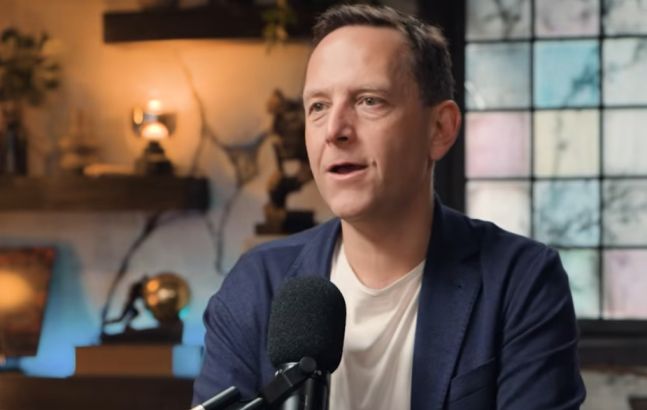
Editor’s Notes: In this episode of Modern Wisdom, host Chris Williamson sits down with David Friedberg to explore why, despite a cultural shift toward pessimism, the future of humanity is looking remarkably bright. Friedberg explains how rapid advancements in AI, robotics, and energy are set to collapse the costs of living, potentially unlocking a new era of abundance where food, housing, and energy become cheaper than ever. The conversation dives into the “diffusion” of technology, the potential for moon-based manufacturing, and why shifting our mindset from fear to optimism is the key to navigating the massive changes ahead. (April 13, 2026)
TRANSCRIPT:
The Future is Epic: Why Optimism Makes Sense
CHRIS WILLIAMSON: You’ve said the future’s going to be epic. You’re really optimistic about it when a lot of people are pretty worried. How come?
DAVID FRIEDBERG: I think people have had a tendency to be worried about the future because humans are programmed to be that way. We always were worried about some predator coming around the corner and eating us. We’re tuned to survive, right? So we’re tuned to always — there’s always some existential threat to humanity.
This goes back to kind of biblical eras thousands of years ago. It was the great flood that was about to come. There was the plague. “The plague’s going to wipe us all out.” There’s starvation. The late 19th century population was outstripping food supply, and there was this big belief that we were going to run out of food.
There was this kind of rush to — and the primary reason was all the world’s fertilizer actually came from these guano fields off of the South American coast. So these giant islands covered in poop, and they would — the clipper ships would go down, they’d get all this poop and they’d bring it back to Europe and they’d use it as fertilizer to farm. If you don’t have fertilizer, you get less yield, less calories. So the islands were kind of diminishing and there was this big call to action. “We’re going to run out of fertilizer. The world’s going to starve. We’re going to die.”
And then there was this invention called the Haber-Bosch process where they figured out how to take nitrogen from the atmosphere, compress it and make fertilizer. Boom. Suddenly population skyrocketed.
Every generation has these existential threats: climate change, COVID. There’s always — and now it’s AI. I think fundamentally AI is one of these most kind of mind-numbing, sort of unbelievable to understand kind of technologies. And when these kind of things happen that we don’t fully grasp, that seems so overwhelming, like a plague, like running out of food, like COVID, we have a tendency to be very existential about it.
Now, you compare that to the facts on the ground. The facts on the ground, people are living longer, they’re living healthier, they’re living better lives across the board, across populations. And people can argue all day long about relative prosperity. “Hey, some people in America have gotten really far ahead. They’re doing really well. The rest of us feel left behind.” But if you look at some of the metrics of like, “Hey, everyone has a home, everyone has a car,” like everyone has some of these things that we take for granted today that we didn’t have 100 years ago, that were really things to struggle to get.
Now, separate to that, there’s an extraordinary compounding effect happening in technology generally. Digitization of the physical world and then our ability to kind of make predictions about the future and engineer a different future because of the tools that we call AI today. But it’s really a long history of these sorts of tools where we take data and we use that to better understand the world and then say, “Hey, we could do this or we could do this. We could make this molecule to solve this cancer. We could do this thing.” And suddenly it turns out we’re right. “We could build this machine that could get us to the moon.” Oh yeah, we’re right. We could do that.
All of these fundamental tools start to compound and we’re in this kind of exponential curve right now that I think — and we can talk about some of the things that I think are most exciting — but that are really going to kind of transform the trajectory for humanity.
So I think there’s a risk of too much change too fast, which is perhaps the thing that breaks social order. And that’s probably the phase that we’re in right now. Like, how much is the social order going to break? How hard is it going to be for people to adapt? How much of a dislocation will there be in social systems and economic systems? And people’s expectations, when they shift too much and they have to kind of rethink, “What do I have to do?” — they want to put a brake on things.
And I think that’s kind of a moment that we’re in in the West right now. In the East, it’s a little bit different. You go to China, they’re very much embracing these technologies because there’s so much more to gain than there is to lose. In the West, we have so much more to lose than there is to gain.
A Victim of Your Own Success
CHRIS WILLIAMSON: Oh, that’s interesting. A victim of your own success so far.
DAVID FRIEDBERG: Yeah.
CHRIS WILLIAMSON: Because it feels like you’ve climbed pretty high and if you fall, that could be bad.
DAVID FRIEDBERG: You have more to lose.
CHRIS WILLIAMSON: Yeah.
DAVID FRIEDBERG: We could pontificate on this for a while, but you could go back to FDR in the United States and we kind of came out of the war with this big effort where we said, “Hey, we can aggregate all our resources, we can win World War II.” And then we said by aggregating our resources, we could do the extraordinary.
And that became this kind of trajectory we’ve been on in terms of making promises for tomorrow and then having the government kind of deliver the promises, right? And that’s been a big thing that’s gone on for the last, call it almost 100 years, particularly in the West.
At some point, you can only promise so much. There’s a system where everyone had this sort of expectation setting that was made. “Okay, everyone gets a home. That’s the American dream. Everyone goes to college and then they get a job.” Some of those things may not necessarily be the right things from a free market perspective, in which case you’re making these promises and then people feel like the promises aren’t being delivered, they’re not being met, and that’s all they care about and that’s all that they want.
In the West, we have that problem right now. And so there’s a lot of these things that we’ve set expectations around. “If you go to college, you get a good degree, no matter how much it costs, you will have a good job and you’ll be able to buy a home and live a good life.” And that’s not true anymore.
And so these are the sorts of things that I think make us more fearful of the changes ahead. Whereas in the East, those promises weren’t necessarily made. In China, GDP per capita skyrocketed from $3,000 to $30,000 in just a couple of years. I mean, imagine seeing the average person’s income in a country go up by 10x and everyone’s moving from farms to villages to cities. And the cities are like the future. It’s been an extraordinary trajectory.
So there’s a lot of embracing of the future that’s happening in one set of social systems in the world today. And then a bunch of this like, “Oh my God, tomorrow is scary. It’s going to break everything,” on the other side. And I think we have that very dangerous kind of choice to make.
AI Doomerism vs. AI Optimism
CHRIS WILLIAMSON: I think the concern is that AI is a difference of kind, not just a difference of degree, that there is a centralizing of power amongst potential $5 trillion class people on the planet and what sort of control do they have? How much displacement is there of work that didn’t happen in the same way as when horses were killed because the automobile came along, or because manual labor needed to turn into driving JCBs instead of digging holes? That this is a difference of kind, not just a difference of degree. What’s your perspective when it comes to AI doomerism, AI optimism?
DAVID FRIEDBERG: All technology shifts go through a phase of diffusion, meaning they have to start somewhere. It’s not like we turn on a switch and suddenly everyone can build an Etsy store or a Shopify store. That’s not how the internet started, with everyone suddenly benefiting from being able to be an entrepreneur online. It took a couple of generations of technology diffusion before the idea of Shopify and the high-speed internet all over the country got everywhere and people could actually stand up a Shopify store and run it.
The first people on the internet, the first businesses that stood up, did very well. And so the technology started centrally, but then, initially people were like, “Oh my God, Cisco’s going to dominate the world, right? Cisco’s got the switches that make the internet switch. That’s the technology that’s going to — those guys that own Cisco, those guys are going to run the world. This is not fair. They’re going to control everything. This is crazy.”
Nowadays it’s NVIDIA to some degree, it’s Google, but eventually every technology commoditizes. That’s what’s so amazing about technology — it’s always diffusing. This new innovation finds its way out.
We’ve already seen in just the last couple of weeks this insane shift in AI, where people don’t have to run models in the cloud anymore. They can run models on their desktop at home. So there’s no longer a dependency on Google or a dependency on, pick your favorite hosted model provider. I can download an open source model — and there’s plenty of great models — I can run it on a Mac computer in my house.
And if you saw recently, there’s this auto research thing that went viral on Twitter this weekend, where Andrej Karpathy turned on auto research and he ran all of these agents on his computer and they were just asked a bunch of questions to solve, to make better LLMs, and they just ran 30 of them talking to each other and they just kept scoring the improvements they were each making to the LLM, to the underlying AI model. And they made a better LLM model than what ChatGPT had not too very long ago — in like a weekend. On a computer at home. That’s how quickly it’s diffused.
And so I think there’s a — and this whole thing of like, “Oh, data centers need to be stopped.” I actually don’t think that data centers are going to have much to do with the benefits we’re going to realize. So much of AI is going to sit at the edge, it’s going to sit in embedded devices, it’s going to sit on your desktop computer, it’s going to sit on your iPhone, it’s going to be ubiquitous, it’s going to be everywhere. And I think everyone just doesn’t see the benefit yet. And so it’s very hard to envision why I should do this.
We can talk a lot about some of those benefits that could arise. But over time, all technologies have this central feature where someone’s making a bunch of money early on, and then eventually everyone’s like, “Oh my God, everyone’s life has gotten better because of this thing.”
The CAR-T Therapy Analogy
DAVID FRIEDBERG: Like when the first CAR-T therapies came out — these are T-cell — I totally jumped ship there. But CAR-T therapy is this amazing technology that was developed where we could take T-cells, immune cells out of the human body, program them to find a specific protein, put them back in your body, and then they go and find that protein and kill it and kill that cell. And it was used for cancer. So we could take a T-cell out of the body, program it to go attack a cancer cell, put it back in the body, it attacks the cancer cell and destroys it.
When that first came out, it was like, “Oh my God, this is incredible.” And a couple of companies made a couple billion dollars selling the first generation of those technologies. But to get that therapy is like millions of dollars initially. You have to take all these cells out, isolate them, make sure they’re clean, engineer them, put them back in, make sure the person doesn’t die. So it became this very expensive initial process.
And now CAR-T therapy is making its way into more and more cancer treatments. And it is almost 100% success rate in blood cancers when it works. And so it’s becoming this thing that goes from millions of dollars to $1 million to $500,000, and pretty soon to $50,000, $20,000, and eventually $5,000. And that ends that disease. That whole class of diseases goes away.
So all of these technologies start up with this aggregation of value. A small number of people get it, a small number of people get value, but eventually all technologies diffuse. And so I’m less concerned about there being a monopoly. We’re already seeing every single model company getting disrupted by something else the next week. We’re already seeing this idea of data centers being the requisite breaking apart.
There’s a bunch of startups right now that are making technology that reduces the token cost by 1,000x. So for every token produced — which is a measure of output from AI — it used to be $10, or pick your number, $1, $0.50, $0.10. It’s coming down by a thousandfold because they’re figuring out better ways to architect the underlying models, to make distributed smaller models, to use new chip architecture, to use new systems of balancing energy across the different chips that you’re using, et cetera, et cetera, et cetera. And these all compound.
So suddenly it’s like, are the people that are going to build all these data centers really going to have a monopoly? I don’t know. This will allow anyone to stand up a small data center and run a bunch of AI stuff. So you don’t really need a big $100 billion data center.
So I think there’s a lot that’s changing very quickly and every step of the way it’s happening so fast, people just have all these reasons to have concern. But I’m pretty optimistic, with history being a predictor here, that the diffusion of these technologies will unlock value for every human on Earth. And it’s really just a function of at what point and at what level of value.
CHRIS WILLIAMSON: I’ve heard you talking about the moon a lot. What’s happening with the moon?
The Robot Revolution and Human Agency
DAVID FRIEDBERG: The moon, I think, so one of the things that I think AI unlocks is the ability to do really complex projects. People think about AI as like, hey, I’m going to replace labor. Like the accountant’s job is going to go away and we’re all kind of swirling our heads around, what are we going to do with the accountant’s job going away?
We could use the automobile and the horse buggy driver analogy. People were worried about the horse buggy jobs going away and who’s going to breed the horses, who’s going to take care of the horses, all the horse stables are going to go away. And then when the car came around, there was auto mechanics and there were the highway system and then motels popped up and then gas stations popped up and then coffee houses popped up on the highways and new towns emerged on the highways because you could get to them.
And suddenly the automobile unlocked industries we didn’t contemplate, right? It’s several degrees away, several steps away from the initial problem that you’re thinking about, which is the horse companies dying and the horse jobs going away.
So I think that’s kind of like an important thing to note. And before I get to the moon, I’ll just say this one point. I think physical AI or robotics is really going to be an unlock for people. People think it’s like the companies, the corporations will have all the robots and the corporations will replace all the people. But why can’t everyone have a robot? Meaning why can’t someone put a robot in their garage and this robot can do anything, it works 24 hours a day. That robot’s now your employee.
And you can say to the robot in the garage, “Hey, I want to make a bicycle shop. I want to make custom bicycles that are really cool. They’re like chrome and people can kind of tweak them online and make all these different versions of bicycles.” And then the robot will build the bicycle. So you can stand up a Shopify store or an Etsy store or whatever, make, buy, sell bicycles, and your robot will make them for you. You don’t even have to know how to make bicycles. The robot will order all the parts, it’ll order all the machinery it needs, it’ll run the robot bike shop in your garage, it’ll make bikes, it’ll package them up and ship them out for you.
When you think about it in that context, which is that this diffusion of technology enables everyone to get value from it, so everyone will have a robot, everyone will be able to have a small business. It’s like, imagine back in the day, 20, 30 years ago, if you told people, “Hey, everyone can have an Etsy store now, all of the knitting you’re doing at home, you can sell and you can make $50 grand a year,” no one would’ve believed you. But it’s like, now you can do that.
CHRIS WILLIAMSON: Have you seen these arm farms?
DAVID FRIEDBERG: No.
CHRIS WILLIAMSON: In India?
DAVID FRIEDBERG: No.
CHRIS WILLIAMSON: Jared, pull up that video I sent you about robots needing a human body. “Inside the race to train AI robots how to act human in the real world. I traveled to southern India to document the rise of AI arm farms where young engineers strap GoPros to their foreheads and fold laundry or pack boxes to teach humanoid robots how to do chores.” So people are getting paid to do normal shit. Here it is.
DAVID FRIEDBERG: And then the robot learns?
CHRIS WILLIAMSON: Yeah. So this is the same thing that happened with Tesla’s Full Self-Driving.
DAVID FRIEDBERG: Right.
CHRIS WILLIAMSON: That they take the best — I mean, this doesn’t strike me as the best folding I’ve ever seen — but they take the best drivers on Tesla and they use that to train the model on.
DAVID FRIEDBERG: It would be a good hack to mess with the robots and fold incorrectly over and over again.
CHRIS WILLIAMSON: Just downstream, loads of people with creased t-shirts.
DAVID FRIEDBERG: Just mess it all up.
CHRIS WILLIAMSON: This is my way to destroy the t-shirt folding industry.
DAVID FRIEDBERG: Like suddenly in the future, everything you buy is completely broken because everyone trained the robot.
CHRIS WILLIAMSON: But this is everything. This is for everything. This is for making a cup of tea. What’s that famous robotics challenge they have? Cracking an egg. The delicacy to hold it and the speed to hit it and the precision to whatever. But yeah, this is the future. Hey, look, if you need extra cash, let it watch you fold your pants.
AI, Regulation, and Human Agency
DAVID FRIEDBERG: And this is obviously transitory. So this is the training phase of the robotics. The real question is what are people individually going to do? So I know you asked about the moon, we’ll get back to this.
CHRIS WILLIAMSON: That’s fine. Because there was also that Anthropic report that just got released, right? Looking at which jobs are going to be popped first by AI. And that doesn’t even include robots.
DAVID FRIEDBERG: Yeah. So I don’t think that there’s going to be a successful organized government system to solve this problem. To come in and be like, “Hey, we’re going to stop these industries.” And they’re going to try. I mean, New York just passed a law making medical advice, legal advice, all these other things illegal through AI tools, which by the way, you gotta ask yourself the question, are they really going to be able to do that? Because if all the models are open sourced and they’re all available and I can run them locally, why wouldn’t I just download a model, put it on my computer, and I can ask it legal questions?
CHRIS WILLIAMSON: Someone’s going to burst through the door and say, “David, what is that?”
DAVID FRIEDBERG: Yeah.
CHRIS WILLIAMSON: What have you got on your computer there? Exactly. You better not be looking at your health reports.
DAVID FRIEDBERG: All of these legal efforts and government efforts to try and stall and stop technology. Historically, it’s never worked. It’s just not going to work, except when you have a limited resource like uranium, for like nuclear fuel or something like that. But for something like this, which is self-replicating, it’s software, it can go anywhere, it can be anywhere, it can fill any space, it’s knowledge work. It’s going to be very hard to stop it.
So the real question — and this is going to be transitory for now — is going to be which of the humans that are folding t-shirts today are going to have the spark in their brain that’s going to say, “I should buy 5 robots and run my own t-shirt folding business.” That’s the challenge that I think humanity faces in this next evolution. We can talk about transhumanism too, which I think is going to be a forced adaptation, but particularly it’s about agency, taking ownership for how do you engage the future versus waiting for someone to tell you what to do next.
CHRIS WILLIAMSON: That’s going to be a change of kind, not just a difference of degree. I think that previously, if you were someone who was mucking the horses in the streets of Manhattan, that job goes away, but there’s a new business that comes up and your friend decides to go and work there. The agency of “I am enough of a self-starter with the sovereignty and the determination to go and do this thing” — that does feel like the bar is being raised and some people are going to fall below that bar.
DAVID FRIEDBERG: I don’t know if that’s true because I do think every human has a degree of innate agency. It’s programmed into us as humans. It’s just generally been turned off because we’ve created social systems that have told us, “Here’s what you’re going to get next, and here’s what you’re going to get next, and here’s what you’re going to get next.”
Since we’re children, we’ve been programmed by our education, by college, by the work system, by the economy, by the taxes, by the fact that the government’s supposed to give me all this stuff. Every step of the way I’m being told, “Do this, you’ll get this. Do this, you’ll get this.” You’ve never been given the freedom as a human to operate.
And I think this is fundamentally true with social systems. We’ve created government systems, financial systems, everything. We’ve been very severely limited as people. I think one example that speaks positively to my point is what’s happened with people making money on TikTok and Instagram and Shopify and Etsy.
If you told someone — pick the timeframe, 15 years ago — that X number of millions of Americans would be making on average tens of thousands of dollars a year doing the things they’re doing, posting photos of themselves in bikinis and at historic monuments on Instagram with a sports drink or whatever next to them. Or people were making money podcasting with the scale that they are today. You’re the prime example. Or people were making money selling home goods and making $300 grand a year selling their custom cat blankets. You would’ve never believed it, but every person has that in them. Every person has that capacity in them to do something unique, to do something special, to take agency if they’re given the right space to do it and they’re not told that they can’t do it.
CHRIS WILLIAMSON: Interesting point on that. I wonder how many people are going to have their agency diminish because of their reliance on AI. So I wonder if the very thing that’s going to enable them is also going to be something challenging that reduces their capacity to enact it. You’re right. And I think that that’s one of the concerns. Anyway, the moon.
DAVID FRIEDBERG: Yeah.
The Case for Building on the Moon
DAVID FRIEDBERG: Well, so I think that there’s a big discussion, obviously largely led by, pushed by Elon, but many others over time, that we should expand humans beyond Earth and get to Mars, and that’s a good place to set up a colony and yada yada, right? Mars is not very habitable. We need to move a lot of material to Mars.
But I think if you look at the math, it is very likely the case that you can probably reduce your energy cost needs to move material to set up a colony on Mars by probably 100x or more by making most of the material you need for Mars on the moon and shipping it from the moon to Mars.
And the reason is the moon, unlike the Earth, does not have an atmosphere. One of the biggest uses of the energy when you’re moving matter off the Earth is getting away from, through the atmosphere, which drags or pushes the rocket back down, and gravity. So the moon is 1/6 the gravity of the Earth, so it takes much less energy to escape the gravitational pull of the moon than it does the Earth, and there’s no atmosphere pulling you back.
So with AI and robotics, it is theoretically possible. And then if you look at moon dust and moon rock, it has all of the raw materials that we may need to build machines, to build housing units, to build habitation units. What’s it constituted of?
CHRIS WILLIAMSON: What’s the constituent part?
The Moon as an Economic Frontier
DAVID FRIEDBERG: It’s got aluminum, it’s got silicon, it’s got carbon. You can even go up to the poles and you can get hydrogen and oxygen from the ice up there. So you can melt the water at the poles, run electricity through it, break it into hydrogen and oxygen, use the hydrogen and oxygen and the carbon in various chemical reactions. You can theoretically make any substance you need or any metal or any material you need that we can make here on Earth.
So we can and should build very large factories on the moon. And the way that this would work is you basically can use solar power, right? Solar, very deployable on the moon, lots of sunlight, no atmosphere, etc. Good, good continuous energy flow, no clouds. And then you can use kind of battery storage.
But the mechanism for moving material off the moon is not propulsion. It’s actually a mass driver. So electric railgun. Think about like a train track, like these maglev trains. And if you run the calculations, it would take about, call it a 9 kilometer long track to move 1 ton of material off of the moon and get it to Mars.
CHRIS WILLIAMSON: At an angle.
DAVID FRIEDBERG: So here’s the thing. It doesn’t actually even have to be at an angle. It just has to clear any craters or mountains.
CHRIS WILLIAMSON: It’s flat enough and that’s escape velocity completely.
DAVID FRIEDBERG: Just escape velocity.
CHRIS WILLIAMSON: Yeah. Yeah.
DAVID FRIEDBERG: So all you have to do is orient it correctly, put it on the right part of the moon and orient it correctly.
CHRIS WILLIAMSON: Wait for the moon to basically aim.
DAVID FRIEDBERG: That’s right.
CHRIS WILLIAMSON: The moon’s passing around.
DAVID FRIEDBERG: And it would take, yeah, it would take a couple megawatt hours of power to push a ton of material down this rail track. It would take about 4.5 seconds for it to move down the rail track and then hit—
CHRIS WILLIAMSON: 4.5 seconds to move 9 kilometers.
DAVID FRIEDBERG: 9 kilometers. Yeah. So it ends up escaping at roughly, call it 20,000 kilometers an hour. And that’s now, if you’re moving 1 ton of material, you would still need a couple hundred kilograms, call it about 200 kilograms of some sort of propulsion, to slow it down as it approaches the moon.
But here’s the other thing. You could use moon rock as a heat shield for reentry into the Earth’s atmosphere or the Martian atmosphere. So you basically take moon rock, put it on the front, because you don’t care if it burns away and goes away. It can just vaporize. So you need 15 centimeters of moon rock on the front of this parcel. You ship the parcel off this rail track. It goes towards Mars. It can hit 100 Gs of acceleration while it’s accelerating, gets over there. You slow it down a little bit, and then it can actually enter the Martian atmosphere. The moon rock burns away and you’ve just delivered roughly 700 kilograms of material.
And you can run that every hour with solar panels that are roughly 500 meters by 500 meters. So, pretty small kind of solar system, some batteries, some capacitors, and then you’ve got to build the rail. The rail, you need about 9 tons of material. So you’ve got to get a lot of material put out to get this rail built.
But again, the amazing thing about AI is you can think about it being self-replicating in the physical sense as well as the digital sense. You can put robots on the Martian surface with the necessary starting equipment that can make the next robots, that can then make the next robots, that can then go do the mining, that can then go build the factories, that can then go build the rail, that can then go build the propulsion system, and can then do the mining for you.
And there’s a lot of very valuable material on the moon that we could also ship back to Earth. So I actually think the moon is going to be a giant, giant, giant economy. And I think it’s like one of these economies — it’s almost like the East India, like when you get over there, you don’t realize how big it’s going to be until this starts. But once it starts, the value of what you can do and the low-cost nature of it, because of AI now, that you can have robots doing this stuff and you can have AI orchestrate a lot of work and you don’t need to commit millions of people to it and trillions — and you still need some money, but not trillions and trillions and trillions of dollars. I think the moon is probably one of these more underdiscussed in Silicon Valley kind of economic, grand economic opportunities this century.
Is Space the Next Industrial Revolution?
CHRIS WILLIAMSON: Is space the next industrial revolution?
DAVID FRIEDBERG: There’s a lot that could happen on Earth too. I think there’s a couple other big drivers. I think one is dropping energy costs to zero. And I think fusion will have a big role in that this century.
So people don’t want to talk about fusion because everyone’s all about solar all the time and Elon loves solar and blah, blah, blah. So everyone pooh-poohs fusion. I’ll talk about it in a second, but if you get the cost of energy down to 1 cent a kilowatt hour, it absolutely expands every economy. Like everything blows up. Currently in the U.S. we’re paying 15 to 40 cents a kilowatt hour off the grid. Nuclear power, best case scenario, is about 5 cents a kilowatt hour, and that’s amortized when you take the cost of everything you’ve got to build and amortize it out. And then you run your runtime costs, 5 to 10 cents, but they’re going to sell it at like 15.
So imagine if you could take power costs down to 1/100th of what it is today. The cost to make anything drops because now you’ve got robots. Robots can make stuff quickly and with no marginal cost because the electricity is what runs the robots. So you could have a swarm of 100 robots build you a mansion. How much would that cost? Like a 10,000 square foot crazy house. The cost of energy is nothing. So maybe having a crazy house could cost close to nothing.
CHRIS WILLIAMSON: Well, there’s a robot printing machine that’s just launching in Austin at South by Southwest this week.
DAVID FRIEDBERG: Making houses.
CHRIS WILLIAMSON: Just, yeah.
DAVID FRIEDBERG: House.
CHRIS WILLIAMSON: 3D printing houses.
DAVID FRIEDBERG: Gen 1. Now imagine Gen 6, right? And imagine energy cost is like zero. And imagine all that material production can be—
CHRIS WILLIAMSON: How cool of a house do you want? I want to live in Hogwarts. Fine. Get the land.
DAVID FRIEDBERG: I want like a Lake Como, but I want to make my own Lake Como. Like David. Yeah. Like David.
The Promise of Fusion Energy
But energy costs, I think, are going to — this’ll be the era when fusion happens. Fusion is this crazy, fundamental thing that drives the universe. If the sun is run on fusion — fusion is when protons jam together. The sun is so hot because it has so much mass. So when all this mass came together, all the matter starts bumping into each other and that creates kinetic energy. That kinetic energy is heat, and it’s so dense because of the gravity, because of all the mass, that you’ve got this extremely hot, extremely dense plasma. Plasma means that it’s so energetic that the electrons break away.
CHRIS WILLIAMSON: It’s technically a fourth state of matter, right?
DAVID FRIEDBERG: It is, yeah. Arguably 5 states of matter, right? Solid, liquid, gas, plasma, and then Einstein-Bose condensate, which is crazy physics.
CHRIS WILLIAMSON: You always have to one-up me.
DAVID FRIEDBERG: No, but I actually think that one’s more cool is why I said it. But what happens in fusion is when 2 protons have enough energy and they get close enough, they jam together and they stick together. So 1 proton with an electron is hydrogen. 2 protons is helium. Right? And then it’s lithium and then beryllium and so on. So protons jamming together forms a new nucleus, forms a new kind of element, goes from hydrogen to helium all the way up the periodic table of elements. So the more energy you have, the denser these things get. It requires more and more energy to get this to happen.
Now, when you fuse protons together and form a new element less than iron, it actually releases energy in the process. Anything greater than iron requires energy to make it stick together. That’s like a cool feature of physics, which you could get philosophical on why this is the case.
CHRIS WILLIAMSON: Iron’s kind of like an equilibrium state in a weird way.
DAVID FRIEDBERG: It’s actually related to the strength of the strong and weak nuclear forces and how they have a trade-off. There’s a threshold at which the repulsiveness is greater because you have so many more protons. They’re pushing each other apart more than the benefit you get from getting them together. And so you actually have to put energy in to make heavier elements. And all the heavier elements on planet Earth came from a sun that exploded billions of years ago. Crazy.
But fusion is how the sun makes energy. So every time proton and proton get together, they release some energy, and that’s the light that we get from the sun. Constant fusion.
So the challenge has always been, can we do fusion on Earth? Can we just jam protons together and capture that energy? The technology to do it is you basically spin these protons around in a plasma at 100 million degrees Celsius. Some people are using these donut-shaped toroidals. Some people are now using these sort of weird, what are called stellarators. They’ve got crazy shapes. And much of the design of these systems is about how do you get these protons to move fast enough.
The problem is when the protons get close and close together, they push each other apart. So you’ve got to use a magnetic field to squeeze these protons together so that they get closer and closer and then get them to fuse. The problem is, as they get closer, the protons make their own magnetic field that pushes back and f*s up the magnetic field that you’re trying to use to squeeze them together. And so it’s this dynamical equilibrium problem. They just keep breaking and breaking and breaking, and you cannot get a stable plasma at that density.
AI seems to be solving that problem because they’re now using AI to train the control of the magnetic fields in a way that’s working, and they’re now able to hold these magnetic fields for 30 minutes at a time out of China. It went from like 17 seconds to a few seconds, a few longer, to a few minutes, to 30 minutes in literally like the last 2.5, 3 years. Like, that’s how quickly they’re ramping up in the ability to make this happen. There’s about 70 startups doing this.
Just to give you a sense of what this enables, basically you could think about taking water, putting it into this machine, getting the protons to spin around, and then extracting energy from those protons jamming together. That energy turns into electricity. There’s no nuclear explosion. There’s no risk of the whole thing melting down. There’s no nuclear material. Nothing’s radioactive. It’s a very clean way of generating energy. So it’s been this kind of holy grail since the 1950s when people first thought about it.
Fusion Needs a Rebrand
CHRIS WILLIAMSON: It needs a different name.
DAVID FRIEDBERG: Yeah. What would you call it?
CHRIS WILLIAMSON: It can’t have the word nuclear in it.
DAVID FRIEDBERG: Yeah.
CHRIS WILLIAMSON: They can’t.
DAVID FRIEDBERG: Yeah. Maybe some people have said just call it fusion. Some people have said call it L.
CHRIS WILLIAMSON: It’s too close to fission.
DAVID FRIEDBERG: Yeah.
CHRIS WILLIAMSON: People are going to pattern match it already and they’re going to think — even me.
DAVID FRIEDBERG: Let’s come up with a name. What do you think?
CHRIS WILLIAMSON: I think something to do with the electromagnetic energy element of that. That doesn’t feel — that feels kind of green.
DAVID FRIEDBERG: Yeah.
CHRIS WILLIAMSON: That feels quite safe.
DAVID FRIEDBERG: Yeah.
CHRIS WILLIAMSON: I don’t expect that to explode. Yeah.
DAVID FRIEDBERG: Strong power, weak power, protonics, something. We’ll come up with something.
CHRIS WILLIAMSON: Yeah. But anyway, I think that if you have nuclear in it, I think it’s just such a contentious topic.
DAVID FRIEDBERG: Right. Because everyone thinks about nuclear.
CHRIS WILLIAMSON: The worst branding in history.
DAVID FRIEDBERG: Yeah. Like nuclear energy is fission where you’re taking heavy, heavy, heavy elements like uranium, breaking them apart. They’re radioactive.
CHRIS WILLIAMSON: It’s the opposite.
The Economics of Abundance and Space Resources
DAVID FRIEDBERG: And you’re getting energy out because you’re doing the opposite. You’re taking the heavier stuff and grabbing the energy when the heavier stuff becomes lighter, releasing that energy that it took to make it. So this is different. And you could, I did the math on this. Basically, you could use a swimming pool-sized amount of ocean water to make all the electricity needed for an entire year for the planet Earth. That’s what this can do. That’s why it’s so important that we get it done.
Now, when you do this and it works, and we’re very close to having this work at industrial scale. Everyone’s always joked, oh, fusion’s always like a decade away. Maybe it’s a decade away, maybe not, but it’s going to happen. Like we’re progressing up this production curve. It’s going to happen.
CHRIS WILLIAMSON: Are those 30-minute-long runs energy positive, net positive?
DAVID FRIEDBERG: They’re still requiring net energy in because of the setup and so on. But the next phase will be to capture basically the, the current systems aren’t just protons. They put protons with neutrons and the neutrons are what get energized into the wall to heat up the wall. And that’s where they heat up water to turn a steam turbine. Like other people have other ideas that, hey, maybe we shouldn’t be using a steam turbine.
CHRIS WILLIAMSON: Isn’t it mad that of all of the ways, it’s still rotate a thing attached to a dynamo?
DAVID FRIEDBERG: It is crazy.
CHRIS WILLIAMSON: It doesn’t matter what the fanciness that occurs before it.
DAVID FRIEDBERG: Totally.
CHRIS WILLIAMSON: It’s just dynamo and a fan.
DAVID FRIEDBERG: That’s another thing that should likely change this century is the move away from that system, where we can do direct energy capture and conversion into electricity. Because you’re basically, the reason you do that is you’re trying to get electrons to move through a wire. So you wrap a wire with magnets around a coil and you get the magnet thing to spin. The faster it spins, the more it moves the electrons through the wire. So that’s the basis of that system. But there’s other things that people have theorized. So with this energy system, I think you’re going to drop the cost of energy, unleash productivity, unleash economic opportunity. So that’s another kind of technology that I would say is very kind of positive, future positive on what’s around the corner.
Who Owns the Moon? Space Resources and the Earth’s Economy
CHRIS WILLIAMSON: Just rounding out space, two things. Who owns the moon and who owns the resources on the moon? And secondly, if we’re going to start mining asteroids and mining the moon, what does that mean for the Earth’s economy? Because I have to imagine that that’s a pretty big dice roll, or at the very least, you’re adding dice to the game that you were already playing with, and that’s going to make things interesting.
DAVID FRIEDBERG: Economic growth is one of these things that’s very hard to contemplate intuitively. To fully grok intuitively because if you add chips to a game, like we’re playing poker, there’s 8 of us playing poker and we suddenly increase our chip stack by like 10x, we’re still playing poker. But maybe we could tip more, right? Like maybe the amount of money we’re now making gives us the ability to go buy a $100 bottle of wine instead of $2 Coors Lights. Like that’s what ends up happening is as more chips come on the table.
Now the poker analogy is a very bad one, because that’s a zero-sum game. Economic growth comes from, should come from productivity growth, not from money printing. Much of our economic growth over the last couple of decades, one could argue, has come from money printing. We’ve just put more chips on the table. The house has made more chips, put them on the table. But economic growth means that I went outside and I made something. I mined gold. Let’s use gold mining as an example. I mined gold out of the ground. That’s worth something because now people can use it, they can trade it, they can sell it. So I’m being productive with my time. So the more productivity there is in the system, the more chips get made, the more the economy grows, the more everyone gets the ability to buy and sell more stuff. And everyone’s labor, everyone’s time is worth more. And so everything grows. That’s the benefit of true productivity. So productivity is like this best measure, I would say, of technology’s advance on how technology advances social systems. The more productive we are, the more everyone’s going to benefit.
CHRIS WILLIAMSON: It feels like a unique kind of productivity to take raw materials that were maybe rare or at least didn’t exist within what was a closed system. The Earth was a closed system. We weren’t getting anything from off it unless we were hit by an asteroid.
DAVID FRIEDBERG: Right.
CHRIS WILLIAMSON: And then bringing it back in.
DAVID FRIEDBERG: Right.
CHRIS WILLIAMSON: That is what happens to the iron price.
DAVID FRIEDBERG: Right.
CHRIS WILLIAMSON: When we are bringing iron back from outside of what was predicted as a part of that.
DAVID FRIEDBERG: Yeah. I would say think more about availability of iron versus the price, like what it does is it makes iron more available, more abundant to everyone. And same with energy, right? When you increase energy through fusion, you make energy more abundant. The price comes down by 10x, but now everyone can use much, much more energy. Meaning—
CHRIS WILLIAMSON: Because the price is just indicative of the supply and the availability.
DAVID FRIEDBERG: And now everyone gets more access. This is why technology is—
CHRIS WILLIAMSON: I’ve always wanted more iron. I’ve said I don’t have enough.
DAVID FRIEDBERG: You’re like an iron hoard. It’s funny, when we walked in the studio, I was wondering why you had that blanket over that big pile of iron in the—
CHRIS WILLIAMSON: That’s correct.
DAVID FRIEDBERG: Don’t look at that. The parking lot.
CHRIS WILLIAMSON: Don’t look at that. Yeah, you’re like, you’re Iron Horde.
DAVID FRIEDBERG: You’re like a Minecraft.
CHRIS WILLIAMSON: I’m a Schmiegel, but for iron. Yeah.
Abundance, Productivity, and the Future of Work
DAVID FRIEDBERG: But yeah, I mean, abundance is the name of the game, right? Like if we really are moving a productivity curve, energy costs are coming down. We’re able to make more stuff with AI. It’s not that some people are going to get richer faster. That may happen, but I don’t think that’s the problem. I think what really functionally happens is everyone has more abundance.
You can now, instead of working 60 hours a week or 100 hours a week when we all worked, when Americans worked on farms, right? At the turn of the century, it was like 80% of people worked on a farm and now it’s less than 1%. So we don’t have to spend the 100-hour work week working on the farm. In fact, the guy working on the farm is in a John Deere automated tractor with air conditioning. He’s on TikTok while the thing drives itself. Trust me, I work in the industry. Like that’s awesome. They still work their asses off, not to diminish it, but like it’s a very different type of farming. And yes, it is still backbreaking work, but there’s a lot of automation.
And so that created an abundance of food, an abundance of calories, an abundance of availability. And we dropped the number of people globally that live on less than 1,200 calories a day for a year, which is how we define malnourished, from billions of people down to 600 million. It’s come back up recently because of various supply chain issues post-COVID.
CHRIS WILLIAMSON: But the number one type of malnutrition worldwide is now obesity, not starvation.
DAVID FRIEDBERG: That is a problem. Yeah, it’s abundant, it’s excess.
CHRIS WILLIAMSON: There’s twice as many people that are malnourished through their obesity than through their starvation. Final thing, who owns the moon?
DAVID FRIEDBERG: The moon, yeah, so I don’t know. I think that’s going to be—
CHRIS WILLIAMSON: Astropolitics is fast. Do you know anyone that does astropolitics? I want to bring someone on the show.
DAVID FRIEDBERG: Yeah, that’s a good idea.
CHRIS WILLIAMSON: I want to talk about it. I think it’s so cool. Do you own, because geostationary above the net of your country, it’s kind of yours.
DAVID FRIEDBERG: Depends on what the treaties say.
CHRIS WILLIAMSON: Kind of? Kind of yours.
DAVID FRIEDBERG: Because as a country or as an individual, I could say anything I want. If I moved to the moon and put a flag down and said, “F* you guys, I’ve got lasers and I’m going to protect, this is my part of the moon,” who’s going to stop me? I don’t care about being on Earth anymore. You can’t arrest me on Earth anymore. You can’t take my money out of the bank anymore. That’s a frontier.
Space Law, Moon Pirates, and the End of Scarcity Wars
CHRIS WILLIAMSON: Have you ever read Seveneves by Neal Stephenson?
DAVID FRIEDBERG: Love that book.
CHRIS WILLIAMSON: Yeah, f*. One of my most reread fiction books. And in that, they go up to the space station, Izzy, and they need to come up with an entire new form of law. What happens if somebody commits a crime in space? And I never thought about the fact that, well, especially if you’ve got people from multiple different countries, well, the way that we deal with it is X, the way that we deal with it is Y, and this is an entire new environment to work in, so it needs to be built from the ground floor up and people got different priors.
DAVID FRIEDBERG: Right, right, right. Totally. You see that movie Ad Astra? There’s that scene where he’s like, and there’s like the pirates on the moon, they’re like shooting at him and he has to get away. Like that may be what happens. Moon pirates. There’s like a battleground on the moon for who has territorial rights and so on. But look, there’s so much resource availability. That’s the thing about abundance. It’s like maybe wars go away. This is where one of the things I’m—
CHRIS WILLIAMSON: Because scarcity drives wars.
DAVID FRIEDBERG: Do I really need to be fighting with Iran if I don’t care as much about oil and energy availability?
CHRIS WILLIAMSON: Look at what happened during 2020, 2021 when crypto was on a bull run. Everyone was friends. Look at what happens when the price drops. Everyone f*ing hates each other.
DAVID FRIEDBERG: Same with every resource, right? And so as resources become more abundant, lower cost, everyone’s getting what they want. We’re all vacationing in Hawaii, working 10 hours a week. That’s where things go. This is why I mentioned the 100 hours. Like you go 100 to 60 to 40 to 30. In France, they have a law, it’s like 30. Now a lot of the Democrats in the US are like, let’s all work 30 hours a week and let’s drop Fridays and all this sort of stuff.
CHRIS WILLIAMSON: Didn’t a country try a 4-day work week?
DAVID FRIEDBERG: I think France, doesn’t it?
CHRIS WILLIAMSON: Yeah, I think it might’ve been France that tried the 4-day work week. Yeah.
DAVID FRIEDBERG: Yeah. And that’s one of the measures of prosperity is like, how much do you have to work to be able to live a good life? And so if you can take more time with your family and more time to explore your personal interests and you don’t have to do labor, whether it’s on a computer or in a field, that’s a good way to think about like, are we all prospering? Are we being given freedom to do more things rather than being caged into doing the things we don’t want to do?
CHRIS WILLIAMSON: Speaking of prospering, how far off are we from age reversal, do you think?
The Science of Cellular Aging and Yamanaka Factors
DAVID FRIEDBERG: That’s one I’m most excited about. So have you looked at Yamanaka factors or have you talked about this on your show before?
CHRIS WILLIAMSON: David Sinclair’s been on and I know that he’s sort of tangentially associated with it, but assume no, do the 30,000-foot view of the Yamanaka factors.
DAVID FRIEDBERG: So every cell in our body has the same DNA. We know that, and the DNA is in every cell because of a process called mitosis. Every time we make a new cell from the time we’re in the womb to today, we’re making new cells. Our entire DNA gets copied over into every cell, but what makes my eye look and act differently than my skin? If it’s got the same DNA, how’s it different? How’s it different than my brain or my tongue or my feet? Those are different cells. There’s different cells and different organs in the body. Those cells are different because the genes in the DNA are on or off.
So there’s a bunch of switches and the switches are either on or off, and that creates cellular differentiation, which is what makes one cell different from another cell. The eye cell different from the heart cell, different from the skin cell or the lung cell. And the switches that are on or off are these little molecular switches. They’re molecules that sit on top of the DNA and they keep that gene from working. It blocks it off. And then the other gene is open. And when it’s open, that means that your cell is making RNA copies of that gene and turning it into a protein.
CHRIS WILLIAMSON: Zeros and ones.
DAVID FRIEDBERG: Zeros and ones. And each gene makes a unique protein. The proteins that then come out do a bunch of stuff. They’re machines, they’re molecular machines, and they’re constantly doing all this stuff in your cell. And that’s what makes every cell different — what genes are on and what genes are off.
And the complexity of this is astounding. If you were to think about a cell being the size of Manhattan, so imagine a cell is a city the size of Manhattan with 500-story tall buildings. That’s how big it would be. And every person is a protein. There’s 10 billion people living in this 500-story-tall building, island of Manhattan, going in between the buildings, up and down all day long, building stuff together, never sleeping, always working, running into each other, having coffee, making stuff together, breaking stuff together, working. 10 billion of us. Those are the proteins in the cell, in one cell, running around doing stuff for 80 years. That’s one second in one cell. That’s how complex this is.
So the proteins that are on or off matter a lot, and then they make stuff. That’s why the eye cell does totally different stuff than the brain cell, the heart cell.
How Aging Happens at the Cellular Level
As we get older — this is the current science on this — it looks like what happens is we have DNA breaks. DNA gets damaged from radiation and sunlight and bad eating and alcohol and all the other s*. As those DNA breaks happen, your cell actually fixes the DNA. It’s very good at fixing it. There’s a bunch of proteins, they’re the worker proteins that are repair proteins. They go in, they fix the DNA. Every time the DNA gets fixed, there’s a chance that those ones and zeros, those ons and offs, get moved around a little bit. And as they get moved around over time, they get moved to the wrong place.
So what ends up happening over time is that the wrong genes get turned on and the right genes get turned off in a cell. And then that cell stops working right. The eye cell stops doing what it’s supposed to be doing. The heart cell stops getting the right electrical cascade to flow through the other cells. The skin cell becomes a little wrinkled. And eventually, if enough of those cells have those epigenetic errors — epigenetic is what it’s called — you start getting wrinkles, your heart stops beating as well, you go blind. All these sorts of things happen with aging.
It looks like the root of all disease may be aging, and aging is a disease. It is a disease rooted in the fact that the epigenetic factors, these little molecules, move around in the wrong place. That’s what we discovered is basically aging.
The Yamanaka Factor Discovery
In 2006, a guy named Shinya Yamanaka found that he could take 4 proteins and put them on a cell. They would go into the cell and they would move all of those epigenetic markers, those 1s and 0s, to make that cell into a stem cell, which can then be turned into any other cell in the body. So that was the magic thing he won the Nobel Prize for.
In 2016, another scientist published a series of papers showing that instead of putting a lot of those 4 proteins on the cell, you could put a small amount. And if you put a small amount, instead of resetting all those molecular markers and making that cell back into a stem cell, what it actually does is it just moves those markers back to where they’re supposed to be to make it a young cell. And suddenly that retinal cell becomes like a young retinal cell. The skin cell becomes a young skin cell. The heart cell becomes a young heart cell. All of these cells get reset.
And they did this in mice and they made the mice age to like 250+ years old. They put it in monkeys, the wrinkles went away, and they’ve done it in specifically applying it to retinal cells in the eye and reversed blindness.
CHRIS WILLIAMSON: This is Sinclair’s stuff, right?
DAVID FRIEDBERG: Sinclair has one of these companies that’s in clinical trials now, and there’s dozens of others. Altos Labs is like one of the most funded startups in history that no one talks about. They’ve raised close to probably $10 billion at this point to pursue these technologies.
The Future of Age Reversal Technology
But basically what this means is we are now discovering not just the 4 proteins, but a whole bunch of other little molecules that we can put into a cocktail. Either we’re going to drink it, take it as a shot, or take it as a pill. It will get into our cells and it will reset the epigenetic of that cell to make it young again.
They’re starting with targeting diseases like blindness or glaucoma in the eye, or rheumatoid arthritis or some other heart issue. And they’re applying these factors to the cells in that tissue only. Locally. But over time what’ll end up happening is this becomes a systemic treatment, and they’re already doing it in animal models.
And then you can either do it continuously, or what I think will end up happening is we’ll probably have a system whereby these factors will be continued. When I say the word factor, I mean protein. These proteins can be continuously made and released inside our body as they’re needed. So we maintain our youth and we will live theoretically for as long as we want. That’s where this is headed. And the technology shows now that we can do this in animals. We can redose them and keep them young.
CHRIS WILLIAMSON: Has it been done systemically yet?
DAVID FRIEDBERG: Yeah. This is the mouse model where they made these mice the equivalent of like having someone live like 200+ years old. And this is so early — they haven’t even optimized the molecules. They haven’t optimized how you deliver the molecules. They haven’t optimized the dosing. They haven’t optimized the method of the dose. There’s all these techniques that are going to be developed on top of this.
For every 1 year we can extend average human lifespan, we’re adding tens of trillions of dollars to GDP. So this is also another big economic driver. But it’s not just how long people live, it’s how healthy they are and how energetic they are and how happy they can be. And they can now go out and not feel all the pain and have the disease.
Theoretically, this can lead to a reversal in rates of cancer proliferation or reversal in diabetes or reversal in many of these other diseases that are fundamentally rooted in this kind of failure of your epigenome, the markers that turn your genes on and off.
Compounding Effects on Human Potential
So this is a technology category that I think is one of these other things that you can think about the compounding effect — free energy, AI automation, infinite labor for people to do all the things they want to do, and potentially living forever. You start to think about how these all kind of compound. That’s why I’m excited about the future. These very quickly become these sort of compounding effects that drive us into a happier tomorrow.
And then again, it becomes a question of abundance. How do you want to spend your time? 100 years ago, I don’t think people would’ve had the job option of being a yoga instructor or being a podcaster or being a wedding photographer. There’s so many things that people have found joy in doing with their time and they can be productive doing it. I think more of that starts to happen tomorrow. And it’s less of the, like, you’ve got to go work the corporate s*ty job on a trading floor in a corporate office at a cubicle, or in a factory, or all the things that maybe we will look back one day and say, hey, that was kind of limiting human potential. Like, maybe humans could do a lot more and maybe they should. And these shifts to more abundance give us that opportunity to do that.
Longevity Escape Velocity
CHRIS WILLIAMSON: How far do you think we’re off from getting to the stage where we can do age reversal? One decade, five decades?
DAVID FRIEDBERG: Way less than that. Way less than that. We are in clinical trials now on several of these cocktails. And there’s always a risk in going from animals to humans, but we’ve done it with human cells in vitro, in a Petri dish, and we see the effect that we are expecting to see. So we have a lot of reasons to believe that over the next 10 to 20 years, more of this starts to proliferate.
CHRIS WILLIAMSON: You’ve heard Peter Diamandis’s idea of longevity escape velocity, right? That you need to stick about — every year that you live means that you’re going to live a little bit longer, but that when you cross a particular threshold, you just need to stick about until this happens, essentially, or whatever the equivalent is, whatever the technology is that allows you to extend lifespan indefinitely.
DAVID FRIEDBERG: I think it’s fair.
CHRIS WILLIAMSON: You just hold on. It’s probably the best long-termist view for looking after your health.
DAVID FRIEDBERG: Yeah.
CHRIS WILLIAMSON: That now is not the time to f* it.
DAVID FRIEDBERG: Right, totally.
CHRIS WILLIAMSON: Because in the past, there wasn’t really any reason to stick about. You’re going to live 80 years, or 70 years or 60 years, but you know, you’re playing around with 5s and 10s. Whereas if the difference is between 80 and 100 or 80 and 120.
DAVID FRIEDBERG: Yeah. You’re like, hey, keep it together. And by the way, the number one thing you can do to fix your epigenome, which you can do without taking these drugs, is exercise.
CHRIS WILLIAMSON: Fasting.
DAVID FRIEDBERG: Well, fasting helps. Fasting does have an effect, but exercise releases molecules that in many cells in your body will go in and start to address the epigenome and make you more youthful. And then there’s other things that you can start to take. Some of this peptide stuff that people are crazy about has shown that it has an effect. I don’t want to be prescriptive on these things, but there’s a lot of ways that you can start to kind of edge your way before all the big clinical stuff is done and the big products come out to market.
The Future of Human Potential and Longevity
CHRIS WILLIAMSON: What do you think happens to careers and retirement and family structures in a world where people live over 120 years?
DAVID FRIEDBERG: It’s hard to say. I mean, I love my kids. I was with my daughters and my wife, we were doing a “what are the 3 wishes?” — if you had a genie come out of a lamp and you had 3 wishes, what would your 3 wishes be? The first thing my daughter said is, “I wish everyone in our family could live forever.” That was her first wish. And I was like, such a sweet wish. But I really do think that there is this incredible human element to this technology. It’s not just technology for technology’s sake.
CHRIS WILLIAMSON: Disembodied, sterile.
DAVID FRIEDBERG: Yeah, it’s not a pharmaceutical drug. It’s an opportunity to give everyone more time to do the things they want to do. I really think this idea that humans don’t reach their potential is a very fundamental truth we’re going to come to at some point. That for a long time, maybe because we had to, we created organized social systems to achieve things as a group, but limited ourselves individually. And I think that’s what maybe changes in the future — that these technologies and this level of abundance gives each of us the ability to achieve outcomes and have things that maybe we didn’t realize we could have. Because we had to make all these trade-offs to make things work in a social system, in a society.
UBI and the Crisis of Meaning
CHRIS WILLIAMSON: Yeah, I wonder just how much of a challenge it’s going to be for people to face more spare time. I know that you guys did really great coverage about a year and a half ago of the two UBI experiments that went on. Is that not an indication that maybe there’s going to be a crisis of meaning when we start to give people — ’cause those weren’t good, right?
DAVID FRIEDBERG: No, I mean, UBI inevitably, like all welfare systems, will fail.
CHRIS WILLIAMSON: Why?
DAVID FRIEDBERG: Two things. One is it creates a system whereby people will always want more. So it becomes this kind of self-fulfilling thing. It makes people feel like there’s a disincentive to go have agency, right? It creates enough of a — if it’s giving you enough — passivity to explore yourself and your potential and engage the world to find your potential. You’re not given that incentive.
But the more fundamental issue is simply inflation. UBI, whether it comes about through giving people money as taxes from other people or whether it comes about from money printing, inevitably leads to an increase in money supply, which makes everything more expensive. So there’s a class of things that everyone that’s getting the UBI check will buy, and those things will all get more expensive. It’s a terrible feature of the economy, of economic principles — those things will get more expensive. So that’s why those things simply don’t work.
But look, I’m optimistic. I keep going back to this idea that there’s this digital universe that we’ve created where people can build — like Twitch streamers, another good example — people going on Patreon, people going on, pick your platform, and they’re finding ways to explore their interests and they can live on it. They can make money doing it because other people value what they’re doing. Massage therapists, yoga instructors, Pilates instructors, dog walkers — I value those people. They’re valuable. And people like doing that work. So I think there’s more to come in terms of what’s next. We always want to look backwards and we don’t want to think about, hey, the path is uncharted. And we should just get on the ocean and we’ll figure out what’s over there.
Transhumanism and the Human-Machine Interface
CHRIS WILLIAMSON: What about transhumanism?
DAVID FRIEDBERG: Okay, so superintelligence I think is a manifestation of AI at scale, meaning that there’s intelligence — features of intelligence — that in isolation or in aggregation exceed human capacity.
CHRIS WILLIAMSON: It’s just not general yet.
DAVID FRIEDBERG: I don’t know if I subscribe to any of the definitions, but what do humans do in a world where the AI anticipates everything you’re going to do next, or knows everything you’re going to think, or has a sense of how to do things better than you do? I think we’re going to be forced to adapt.
This idea that humans living in their natural state should be back to their natural state — it’s such a weird thought because we live in buildings. We don’t live under a tree. Even when you pick berries off a tree and eat the berries from the tree, you’re breaking nature. There’s an aspect of a continuum of — what is nature? What is the human? And what are we doing?
So I don’t love the term transhumanism, but I do like this idea that this superintelligence capacity needs to be harnessed by humans. I think there’s probably two things that happen. The second one I’m going to say is very controversial. The first one is pretty well described, which is this kind of human-machine interface. Elon’s got Neuralink where they put the wires in the brain. But I saw a good presentation from Max Hodak at his company — Science Corporation or whatever. You should have him on. He’s great. He started Neuralink, he was the old CEO at Neuralink. And he’s got this system where they’re putting a digital device in your retina.
CHRIS WILLIAMSON: They put a screen in your eye.
DAVID FRIEDBERG: Yeah. And it works. And so the screen — how’s it powered? It’s solar. He’s got this whole power system in it. It’s incredible.
CHRIS WILLIAMSON: So when your eye is open, it’s powered up.
DAVID FRIEDBERG: It powers up. And then it releases an electrical signal that triggers the neurons on the inside of your retinal cells that then trigger your brain, and it passes the signal and you can suddenly see. And it’s a very thin, paper-thin kind of device that goes under your retina in your eyeball. It’s an outpatient procedure to put it in. He’s in clinical trials on this. Incredible. So it’s restoring blindness.
But you can think about these interfaces that aren’t about sticking a wire into the brain — which I don’t think is going to be where things end up — but I think it’s likely going to end up a little bit more like… and people are going to view this as being extremely dystopian. So I’ll give you the two versions of it. Some people would say Neo in The Matrix, where you kind of connect the digital thing. But the other one is Avatar, where they have that ponytail thing that they connect to. But there’ll probably be some interface where the chip-to-brain interface is just soft neurons — some sort of system that can connect with the brain without going into the brain. You don’t need to go into the neural tissue.
Now, I’m not super optimistic and I don’t get excited about this. Let me be clear. I’m not like, “Oh my God, we all need to connect to — we all need to be like The Matrix.” Don’t think of me as some dystopian crazy technocrat. But I think my point is someone will do it, and then you’ll be able to think, “I want to fly a helicopter,” like Neo did in The Matrix, and you’ll be able to fly a f*ing helicopter. And you’ll want to access information quickly using the superintelligence that exists in the silicon. So you want to solve a physics problem because you’re trying to build something on the moon, and you sort of access that information. You look up and you have the answer you need. You’re not looking at a screen to get the answer.
And so you’re able to tap into — and look, do we all want to be connected all the time? I don’t know. I don’t know if that destroys humanity or if it’s going to be an adaptation of humanity in an era when there’s now a species that might be more intelligent than humanity in aggregate. I don’t know. And so I’m not trying to be too deterministic about this stuff. But I think that human-machine interface outcome is very likely going to happen. And whether or not people want it or embrace it, you’ll have to have the benefits. You’ll have to go through an exercise where it’s lightweight, easy to put on, maybe it sits above your ear and it works and it doesn’t need to be plugged into your physical brain. And maybe it uses a transmission where we can connect it here, and you can start to think things and get information that you want and so on. And suddenly you become super intelligent and you have all of this capacity that you didn’t have before. That’s one path that we might walk.
Transgenic Humans and Genetic Selection
DAVID FRIEDBERG: Another path that we might walk — which is extremely dystopian from most people’s points of view, but may end up becoming a reality because of what we’re seeing happening in China and other places — is transgenic humans, where basically right now you can look at an embryo. And I don’t know if you’ve seen this controversial app where they’ll sequence the DNA of your embryos if you’ve got frozen embryos for IVF, right? Which is a common procedure where you’ve got effectively an embryo that’s frozen. It’s not yet fertilized, but you can sequence the DNA and determine what genetic traits does that embryo have?
CHRIS WILLIAMSON: I’m a big investor in Herasight, who is the most evidence-based one of these.
DAVID FRIEDBERG: Okay.
CHRIS WILLIAMSON: So the ones that have used the Down’s test plus the best geneticist on the planet to fill the gaps in. So you model the genome of mother and dad, then you take the sample from the embryo, and between those they can triangulate with real accuracy what the embryo is. You have — here’s your 10 harvest or your 15 harvest or whatever — and there’s your dashboard. Totally. And we’ve got immune function, we’ve got IQ, we’ve got externalizing behavior. And yeah, Johnny Anomaly and Herasight are the best at this. And I don’t think it’s dystopian at all. I think that — crumbly genome — and if you say that selecting against negative traits is good, then it seems to me to be philosophically consistent to say that selecting for positive traits.
DAVID FRIEDBERG: So everyone’s got a line. The further I walk this conversation, the more people in the audience are going to say you crossed my line. So the first is, should we even be looking at the DNA of embryos?
CHRIS WILLIAMSON: We already do.
DAVID FRIEDBERG: Right.
CHRIS WILLIAMSON: We already do because they — and this was what —
DAVID FRIEDBERG: Prenatal screening.
CHRIS WILLIAMSON: Not only prenatal screening, but let’s say anybody that’s ever done IVF, even if you didn’t know.
DAVID FRIEDBERG: They screen.
CHRIS WILLIAMSON: The doctor gets a microscope and has a look at the embryos and just eyeballs it.
DAVID FRIEDBERG: Yes.
CHRIS WILLIAMSON: And he goes, “Yeah, that one looks like the roundest.”
DAVID FRIEDBERG: Right.
CHRIS WILLIAMSON: And we don’t have a number. “You don’t want number 7.”
DAVID FRIEDBERG: Right.
CHRIS WILLIAMSON: “Number 7, we can’t do number 7. It wouldn’t even take. We know that it wouldn’t take. It’s not going to implant correctly.” So he was already doing it. So I’m like, right, okay, you’re just taking it from some guy. It’s like an umpire in MLB that’s just eyeballing it. And then eventually they’re going to get removed and it’s going to be robots.
DAVID FRIEDBERG: Totally.
CHRIS WILLIAMSON: And you go, “Okay, well, I’m glad that the robot got it accurate 100% of the time.”
DAVID FRIEDBERG: 100%. That is the next line. The next line would be sequencing the DNA and looking at the genome and looking at the genetics and saying, “Hey, I want blue eyes or brown eyes.” And some people say that’s dystopian. That’s in the Black Mirror episode.
CHRIS WILLIAMSON: Well, the eyes thing’s got a bad rap when it comes to selection.
DAVID FRIEDBERG: Right, that’s right. Okay, fair enough. Tall or short? Smart, not smart? Suddenly there’s a line some people are like, “Well, you shouldn’t be doing —”
CHRIS WILLIAMSON: Blind, not blind.
DAVID FRIEDBERG: Blind, not deaf. The next line is what’s going on controversially in China where they’re using gene editing.
CHRIS WILLIAMSON: Yeah, the enhancement stuff.
DAVID FRIEDBERG: Enhance. So they’ll take an existing human trait — a human allele. And so they’ll basically take you from brown eye to blue eye, or they’ll take you from dumb to smart. They’re not creating a foreign gene. They’re just making a tweak to your DNA to give you the trait that you could have randomly gotten in the embryo, but you just didn’t.
CHRIS WILLIAMSON: Is that what the guy did with the twins that turned out to be triplets?
DAVID FRIEDBERG: There was a conversation. I think that’s the guy that got arrested or got in trouble.
CHRIS WILLIAMSON: Correct, yeah, 2019, I think. You know that there was a third one.
The Ethics of Gene Editing and Transhumanism
DAVID FRIEDBERG: I didn’t realize there was a third.
CHRIS WILLIAMSON: I’m pretty sure, Jared, can you just Google, oh, ChatGPT, how many babies were born from the CRISPR editing in China? Was it 2 or 3? Because I swear that there was a third one. So after all of that, I mean, I might eat humble pie here and have completely misremembered it.
DAVID FRIEDBERG: But you can also edit yourself out.
CHRIS WILLIAMSON: So I’ll own my failures. I’ll own my failures. I’ve said worse things on the internet. But yeah, I swear that not only did he do this thing and he couldn’t believe it and it’s the first time this has ever happened and it’s so— and there were two of them and there was a f*ing third one. I swear that there was a third one. Come on, Jared, prove me right here, brother.
DAVID FRIEDBERG: This is like a—
CHRIS WILLIAMSON: Three babies.
DAVID FRIEDBERG: Well, there were three babies. A third gene-edited baby was later confirmed through court documents.
CHRIS WILLIAMSON: F*ing yes. Well, I’m not celebrating the thing. I’m not celebrating the thing. I’m not celebrating the thing.
DAVID FRIEDBERG: Thing.
CHRIS WILLIAMSON: I want him celebrating.
DAVID FRIEDBERG: You’re not a pro gene editing babies.
CHRIS WILLIAMSON: And he edited the embryos using CRISPR-Cas9 to make them resistant to HIV.
DAVID FRIEDBERG: Exactly. Exactly. So the HIV resistant allele, which is the genetic trait, is a known trait. So he just made a couple of changes, confirmed that nothing else was changed, took that forward.
So should we give children, or should we give embryos these enhancements where we’re not introducing new DNA? We’re basically saying, “Hey, randomly you could have gotten this trait and you didn’t, but now we’re just going to make sure you get it.” And then stack this up. And then if you do that, how many traits are we willing to give to an embryo? Should I make every embryo superhuman? Should I have a bunch of kids where I got one that’s really good at sports, one that’s really good at music, one that’s really good at podcasting? I mean, you pick your poison.
CHRIS WILLIAMSON: Yeah. Well, sometimes you can put all three into one person.
DAVID FRIEDBERG: There you go. The super superhero.
CHRIS WILLIAMSON: Yeah. And the British accent.
DAVID FRIEDBERG: And the British accent.
CHRIS WILLIAMSON: I don’t think that’s genetic.
Transgenic Modifications and the X-Men Scenario
DAVID FRIEDBERG: Yeah. Okay, so now, okay, so that might be a line that many people are going to say, “Hey, I don’t want to cross into that.” And you could debate that philosophically. Why would you not want that if you’re willing to do the other things? Like, it’s a spectrum. Why are you going that far? And there’s a lot of philosophical discourse around this.
Now the final one, the final one is transgenic. And this is where you put a gene or a trait into the human that it doesn’t naturally have, that the human would not have been born with. No matter how many sperm or how many egg combinations you put together, you would not have come up with this gene.
CHRIS WILLIAMSON: Regardless of who the parents were?
DAVID FRIEDBERG: Correct. For example, being able to see infrared.
CHRIS WILLIAMSON: Right.
DAVID FRIEDBERG: Okay. And so this is where you make X-Men, right? And the capacity to do this historically was like, “No way, impossible.” But now in many of these, there arguably could be the capacity to do this. And I’m not arguing for it. I’m just saying that it’s likely that this is going to be a limit that’s going to get tested at some point here in the near future.
We are going to have a conversation about how do humans keep up in an era, in a world of superintelligence. And are there certain traits like that, that can enable us to either have a better performance against the superintelligence, either superintelligent humans, or a relationship with the superintelligence via some mechanism that allows us to connect with the superintelligence or control it better, or what have you. Or the digital AI that’s out there, or other tools or techniques, or sorry, other phenotypes, physical characteristics that might allow us to better survive on Mars.
Evolutionary Biology and Surviving on Mars
CHRIS WILLIAMSON: Great conversation. What was the guy’s name? It wasn’t Christopher Mason. That was the guy that was talking about space. Who was the dude that I did the episode with last week that we put out? Scott, somebody, the guy about Mars. I had this f*ing phenomenal—
DAVID FRIEDBERG: Scott Solomon.
CHRIS WILLIAMSON: Yeah, Scott Solomon. Unbelievable evolutionary biologist who’s applied evolutionary biology thinking to what we’re going to need to do to be able to survive on Mars. Radiation, what happens to bone density? But if you’ve got the bone density loss, how do women give birth? You’re going to have to do every child by cesarean C-section.
But over time, if you have C-section, you get narrower hips, you get bigger baby heads, you almost reverse evolution of where we got through. Like, we need to be underground. Because if we’re underground on Mars, then it means that we’re going to be protected naturally by the terrain from the radiation. But if you’re underground, what happens to melanin in the skin and what happens to vitamin D levels? And you’ve got artificial light. And what happens to, what’s the psychological profile of these people?
And I’m like sat there just in a virtual episode and my fing mind was, “This is a sleeper episode.” It was so fing good. Such a sleeper episode. But yeah, can we engineer?
DAVID FRIEDBERG: And so remember, transgenics we use in plants.
CHRIS WILLIAMSON: F*ing word “trans,” dude. Put the word “trans” at the start of anything after about 6 years and it’s going to struggle. Same as nuclear.
DAVID FRIEDBERG: Yeah, well I don’t want to say GMO people because that’s got a worse name. Yeah, like if I say the GMO person, because I used to work at Monsanto, so you know, like that gives me my double evil scientist credibility.
But there’s likely going to be a situation where they’re going to discover this because what we’re now discovering, a lot of the human biology, like we talked about all the genes that are on or off. How do they all work? How do all those proteins work together? I described 80 years of 10 billion proteins interacting in a place the size of Manhattan, 500-story tall, bumping into each other, doing stuff. That’s how we do stuff in a cell for one second. So there’s a regulatory network where all these proteins are doing stuff in a way that we can’t model. We don’t understand today.
CHRIS WILLIAMSON: Isn’t it mad that that just doesn’t switch off one day? Of all of the human— Yeah, it just 404s and you sort of blue screen of death yourself for a bit.
The Universe as a Simulation
DAVID FRIEDBERG: Cold temperatures will do that. That’s why we can freeze biological tissue and then boot it back up. Because it’ll just stop all that activity. Because it’s actually the thermodynamics. It’s the kinetic energy of the proteins. It’s random. The proteins are just bouncing around in the cell and they randomly will bump into stuff and do stuff.
It’s amazing to think about. Like, there’s no way that you could think that, that you can realize that and not think that the universe is a simulation. It’s literally just chaotic ensembles of molecules that randomly do these incredible things that we look at and we’re like, “I can move my finger.” It’s like, it’s the craziest s*.
CHRIS WILLIAMSON: But it’s the same as when you realize that most of matter is empty space. But if I do this, my hand doesn’t pass through the table. F*ing awesome.
DAVID FRIEDBERG: Right. And the fact that it’s all quantum anyway, which means that it could tunnel through anything at any point in time.
CHRIS WILLIAMSON: I’m still waiting for that to happen.
DAVID FRIEDBERG: Well, here’s another f*ed up thing to think about. You’ve heard of quantum entanglement. So you can entangle two particles and move them apart, change the state of one, and the other one will change instantaneously on the other side of the universe, theoretically.
There’s reasons to believe that it might be the case that every particle of a particular type is entangled with every other particle. And I’ll just let that settle for a second, because if that were true, then theoretically, every time any particle changes anywhere in the universe, it’s affecting every other particle in the universe.
CHRIS WILLIAMSON: It’s kind of like a panpsychism, but for connectivity, like a membrane that everybody is a part of.
DAVID FRIEDBERG: Or it might be the case that progression in the universe is actually like a quantum state that’s changing, and then space and time are a manifestation of that change.
CHRIS WILLIAMSON: That’s why entropy exists. That’s why there is a progression in one direction.
DAVID FRIEDBERG: And it might just be that, because space and time are defined by the relationship between particles. And it may be the case that if all the particles are entangled, that there’s just this one thing that just changes, and then all of space and time is a feature.
CHRIS WILLIAMSON: It’s like a universal clock.
DAVID FRIEDBERG: Yeah, it’s a whole other way of thinking about our place in the universe. How do we get here? We were talking about—
Where Is the Ethical Line?
CHRIS WILLIAMSON: Where’s your line?
DAVID FRIEDBERG: Yeah, okay.
CHRIS WILLIAMSON: Is there a line?
DAVID FRIEDBERG: Transhumanist.
CHRIS WILLIAMSON: From GMO people to IVF shouldn’t happen. Do you have an ethical line for that?
DAVID FRIEDBERG: Yeah, I definitely think that we can be very defined around the CRISPR stuff where we can change a gene to make someone healthier or enhanced. And I actually, I don’t have a philosophical disagreement with giving someone the ability to not just turn off disease, but to say, “Hey, I want this person to have the trait that they didn’t randomly get from me or inherit.” I think that’s fine.
CHRIS WILLIAMSON: How do you stop people? I mean, no parents—
DAVID FRIEDBERG: But by the way, I’ll say there’s a whole bunch of therapeutic treatments that we’re doing now that are doing what I described in that final stage. With an adult human.
CHRIS WILLIAMSON: Like follistatin stuff?
DAVID FRIEDBERG: Right.
CHRIS WILLIAMSON: I was in Prospera with the guys when Brian Johnson got that.
DAVID FRIEDBERG: Right. And so you could take, that is a gene that makes a protein that you’re, you know, you could theoretically use mRNA to do it, but it’s short-lived. And you could put a plasmid, a gene, and put it in your body and it will make a protein that gives you strength.
CHRIS WILLIAMSON: Yeah, whatever it is.
DAVID FRIEDBERG: But that is like nursery school. Go to university PhD level, and what we’re learning about all the interaction between all the proteins is we could come up with a set of genes that if I put them into you, they will make you 100 times smarter. Would you get that shot?
CHRIS WILLIAMSON: I would.
DAVID FRIEDBERG: Right.
CHRIS WILLIAMSON: I’m choosing for me. I think what becomes interesting is when parents are choosing for their kids.
DAVID FRIEDBERG: I think that’s right. I think that’s the right philosophical framing. Yeah, yeah.
CHRIS WILLIAMSON: That, look, if you’ve got this technology and it’s available to be elected in the same way as we don’t let people get tattoos before they’re 18 or whatever, then all right.
So for me currently, Johnny from Heresight, who again, I can’t f*ing shout out enough. Like, he’s so good at communicating this stuff and Heresight rules. That line up to embryo selection. So I’m happy. I see no philosophical issue with choosing from the harvest that you’ve already done. IVF’s already been and gone. Perhaps that’s a bit of anchoring bias for me that I might have thought twice about what IVF meant had I been born 100 years ago. But it’s here and I can’t go back. I can’t cognitively take myself out of it.
I think up to the point where “here’s your 15, pick from your 15,” we’re already eyeballing it. That seems to compel me in the direction that this is already being done. When it gets to “we’re going to choose from the genes that you could have had,” then when it gets to “we’re going to change them,” and then when it gets to “we’re going to create them,” that I’m as yet morally unconvinced. So you can pick, but you can’t change yet.
The Overton Window and Genetic Enhancement
DAVID FRIEDBERG: I think that’s probably where we are today. And maybe you’re a little more progressive than most people, I would say. I think most people would still object to that. I think the Overton window changes when if the solution I offered you where I give you a shot that puts a plasmid, which is a gene, in your body or integrates that plasmid into your cells, because I do think that’s ultimately where that age reversal stuff is going to come from.
I think we’re going to end up putting a series of genes in plasmids into our body. They’re going to go into our cells and they’re going to self-regulate those cells to make them live forever. When we end up doing that as a mainstay and everyone’s getting that shot and everyone’s living forever, and that becomes kind of a thing that everyone’s like, yeah, of course we’re boosting our lifespan with these genes. Like, this totally makes sense.
That’s when people say, well, if we’re doing it to ourselves and we’re all doing it, like, why don’t we just do it to every embryo? And that’s when people will start to— and that’s probably many decades from now, but I think that’s where you can start to think about how the Overton window shifts at what point. When it becomes less about this, like, that is crazy because if everyone’s doing it as an adult and it’s totally safe and normal and it extends lifespan, then—
Embryo Selection and the Race to Optimize Children
CHRIS WILLIAMSON: Bring it back down to doing it for the children. Yeah, I get the sense that any ickiness that people have around embryo selection, specifically for positive traits, everybody’s already pretty much on board with embryo selection against negative traits, Huntington’s, et cetera. The Ashkenazi community are already very deep in this because of their genetic profile.
I think very quickly, all of the people who either are blank slatists, deny behavioral genetics, don’t think heritability is a thing, think that embryo selection for IQ is just rebranded eugenics. All of those people typically quite well educated, probably quite liberal and left leaning. They care about the outcomes that their kids get. And if these slightly more right of center f*ing hicks that have managed to cobble $15,000 together to get their IVF done and then a little bit more to get somebody else to do their profiling, if their kids are outstripping theirs in school, and in sports because while their immune function was the best of the ones that were available and there’s lowered rates of autism or there’s lowered rates of ADD or there’s lowered rates of depression, they’ve got a happier, more flourishing life.
I think very quickly parents are going to look at it and go, well, why did I read all of those parenting books? Why did I work so hard to try and give my kids the best future that I could? And I’m now leaving behind the— Jeffrey Miller said this f*ing great quote. It’s like every single parenting book on the planet could be replaced with the power of one behavioral genetics book, that your kids are made up of the raw materials of the person that you make them with.
That is infinitely, not infinitely, sorry, that would be incorrect. 50% of everything you are on average is genetically inherited, including your psychological profile. And for physical traits, significantly more. Like very unlikely you’re going to be born black with two white parents. Therefore, if you just understand the behavioral genetics of the situation, I think that lots of people are going to get on board.
DAVID FRIEDBERG: Yeah, that’s right.
CHRIS WILLIAMSON: And as soon as it becomes a competitive game, this race to the top, not race to the bottom, is going to happen and people are going to go, well, now the thing that’s interesting, I think is cool, two wrinkles that I spoke to Johnny about the last time we sat down.
First one is basically buyer’s remorse from parents, this sense that because I was so consciously involved in the decision to choose this child, if any negative outcomes occur because of that kid, I think that there’s the potential for parents to blame themselves or for the kid to blame the parents if they were to find out.
And the second one that I think is kind of interesting is parents are likely to regress or converge on a small bucket of traits that they think would be optimal to give their— But Spencer Greenberg did this fantastic study, huge big study. IQ is not— it is moderately negatively correlated with life satisfaction. Higher IQ, lower life satisfaction. And you have to assume people with higher IQs are less likely to go to jail, less likely to be addicted, less likely to be homeless, more likely to get married, more likely to complete a high-powered degree. Okay, so all of those things would increase life satisfaction. So the impact of IQ on life satisfaction is so negative that it offsets the objective life improvements that you get from being smarter. So which parent, if you look at this dashboard, all of the things being equal, is not going to choose the smarter kid?
Superintelligence and Humanity’s Role in the Future
DAVID FRIEDBERG: Now, if you had the option to boost the kid’s IQ by 200, because the world is different with superintelligence. So if you have digital superintelligence in the world, it’s a very different world than we live in today. It’s not just competing with each other. It’s about finding a place in the world with the superintelligence, and we’re all going back and forth to Mars and traveling the universe and figuring out quantum shifts in the universe and all the things that I think are pioneering in the next century.
That becomes a different and more important framing at that point, because you don’t want to end up being one of the people, or you don’t want your kids to be disadvantaged in a world where there’s this pervasive superintelligence that everyone’s using and accessing and turning on and turning off as they need it to do the things they want to do in the world. And that’s the right way to think about superintelligence. It’s not controlling us. It’s how do we use it? And you have to have a degree of control over knowing where do you want to go with it? What do you want to do with it?
And I think that’s why there’s this idea that maybe people start to think more about how do we adapt in a world of superintelligence as a species, what is our role? Because there’s a philosophical argument to be made that humans are dying down, making way for the AI.
CHRIS WILLIAMSON: Like, yeah, we’re just bootloaders, right? Flashy bootloaders for the silicon.
DAVID FRIEDBERG: And I don’t like that idea.
CHRIS WILLIAMSON: Oh, so you want to compete?
DAVID FRIEDBERG: I want to use, I want the AI to be a rocket boost for me and everyone else. And I want everyone to have a rocket. And I think that’s what it does is it’s not like a world where I’m competing with the superintelligence. It’s like, dude, you’re my rocket. I can’t do what a rocket can do. I’m a human with two legs. I can’t propel into space. I need the rocket. And similarly, I need the superintelligence to do the crazy next shit that I want to do.
Nutonic, Plants, and Building Businesses You Believe In
CHRIS WILLIAMSON: What are you doing with plants? I’ve heard that you’re spending a lot of time working with seeds.
DAVID FRIEDBERG: Yeah, I run a company, my day job, which— most people that I talk to recognize me from my— this is like a pill. Is that what this is?
CHRIS WILLIAMSON: No, toothpicks. So we managed to find a company that embed flavor and supplements into the wood of toothpicks. So try, try, try. What’s this?
DAVID FRIEDBERG: Maybe I’ll take it with me and try it later.
CHRIS WILLIAMSON: Yeah, yeah. Just take that one, put it in your pocket. It’s really cool.
DAVID FRIEDBERG: Just a different flavor. What is the nootropic?
CHRIS WILLIAMSON: So Cognizin. There’s a 15mg dose of Cognizin in there.
DAVID FRIEDBERG: In one toothpick.
CHRIS WILLIAMSON: Yeah.
DAVID FRIEDBERG: Oh, my brother would do this. Here, try. Holy shit.
CHRIS WILLIAMSON: Yeah, he’s going in 15 minutes. And there’s a little, like, 15 milligrams of caffeine, 50 milligrams of—
DAVID FRIEDBERG: He’ll try anything. He’s like my guinea pig.
CHRIS WILLIAMSON: We’re f*ing about with every delivery mechanism on the planet for these at the moment. So obviously Zyns went absolutely crazy over the last couple of years.
DAVID FRIEDBERG: Is that your nicotine? No.
CHRIS WILLIAMSON: So this is just the same again. It’s more Cognizin, cytocholine, same thing that you get in— similar to the choline that you get in eggs. And we just decided that we would go for pouches the same as Zyns. So degenerate delivery mechanism, but much better for you. So that’s what I’m playing with at the moment. Is it doing well? It’s f*ing crushing. Yeah, we just raised for Nutonic. We just raised on 60 mil. We’re in, going into HEB. We’re in Vitamin Shoppe, GNC, Sainsbury’s, Morrison’s Daily around the UK. We’re just launching in Australia. And then we’ve got these RTDs. It’s a smarter energy drink.
DAVID FRIEDBERG: And I really, the last time that— because that was like my thing was like, I think everyone, we launched a tequila brand for All In, which is great, but you know, tequila is tequila. But I think that’s the whole thing is like you can own your own brand. You can own your own equity.
CHRIS WILLIAMSON: Yeah. Well, look, I’m very much a lifestyle maxi, not a profit maxi. But given that this didn’t exist, it’s cool to have the ability and the contacts and the time and the resources to be able to make something that you want. Yeah. It’s awesome.
This podcast, the reason Modern Wisdom exists is because there was nobody having a conversation that was basically less retarded than comedy, but more retarded than Tim Ferriss. And it sort of sat in this nice middle ground. I really wanted to speak to people a lot about psychology, a lot about human nature, and it wasn’t there. So I decided to do it. And then 1,000 episodes later, we’re here.
Honestly, the best— you must have found this— the best businesses to get into, if you can. I’m sure that when you get to your level, that it’s difficult to always design something for yourself. But the best businesses to get into is designing something that’s a gap in the market that you yourself would use. Especially when you’re at the sort of level that I’m at. So yeah, anyway, you are obviously a burgeoning farmer. Yeah. Hoeing the ground. Hoeing the ground. Milling the, tilling the fields.
Turning Off Meiosis: The Science Behind Ohalo
DAVID FRIEDBERG: I do have a kitchen garden, although it does need to get updated. So my day job is running a company called Ohalo. And what we do at Ohalo is we turn off meiosis in plants.
CHRIS WILLIAMSON: What does that mean? That’s very sexy.
DAVID FRIEDBERG: Yeah, that’s it. So that’s the pitch I give at the bar. And I usually get the blank stare.
So all the cells in our body, we talked about this earlier, are made through a process called mitosis, which copies over all the DNA in your cell. Your DNA is actually packaged up into chromosomes and there’s two sets of chromosomes, side by side in your cell. So those two sets of chromosomes get copied over every time you make a new cell in your body, except for sperm and eggs.
When you make sperm or eggs, you only copy one set of chromosomes, and it’s not just a selection of one of the sets. What happens is the two sets of chromosomes fuse, and they fuse at random places. So you get a random half of a random half of the other chromosome. That’s why every sperm, which has just one set of chromosomes, is genetically different. Every one is unique. And every egg in a female is unique. They’re all genetically different because that fusion event, which is called meiosis, fuses the two chromosomes down to one. Then a sperm and an egg come together and you end up back with two. And that’s the new offspring.
Every offspring looks a little bit different because every sperm is different and every egg is different. That’s why kids all look different even though they come from the same two parents. They get half the genes from the mother, half the genes from the father, and it’s a random half from the mother, random half from the father. And meiosis drives that evolutionary process. That random selection is the source of evolution.
How the Seed Industry Was Built
By turning off meiosis — and this is fundamentally a challenge for farming — most crops, people don’t realize this, you can’t just plant seeds. When farmers plant seed in the ground, the reason they use seed is because they’re going to get the same genetics in the field. You want all the corn to grow at the same time so you can harvest it all at the same time. It’s all going to look the same. You can sell it all to the same person and it’s the same crop. You don’t want to harvest a bunch of tomatoes where some are green, some are yellow, some are red, all different sizes. How are you going to market that? That’s not marketable.
So the seed industry came about about 100 years ago when this guy figured out that you could actually inbreed plants. When you inbreed a plant — and a plant has both male and female parts, unlike animals, most plants will make sperm and egg, and can pollinate itself — if you do that for 7 generations, both chromosomes end up identical. Because remember, the two chromosomes have the same genes, but if the genes are different, you have different alleles. And if the genes are the same, it’s called homozygous, or the same alleles.
So if both chromosomes end up being identical and you make sperm, it doesn’t matter where the fusion happens. Every sperm will look the same because they’re the exact same two chromosomes. Same with egg. So inbreeding is what was developed about 100 years ago where they inbred plants for 7 generations, took the inbreds, crossed them, and now every seed is identical. That’s how they make identical seed in corn, in tomato, in cotton, in canola, in sorghum.
Farmers went to a seed company and they started buying seed for the first time ever, and they put that seed in the ground and they could grow a crop. And every year, it also allows you to improve the yield, because the plant breeder would try and make the two chromosomes from the two backgrounds different. The more different they are, the more complementary they are, the more different genes you’re putting in that plant — the higher the yield, the faster the plant grows.
Plants as Growing Machines
Plants are really interesting because they’re kind of like looking for tools in a tool belt. How many tools do I have? How many different genes do I have that I can use any second of any day to keep growing? Humans and animals, we just grow two arms, five fingers, two eyes, two legs, and we’re done growing. Then our job is to go out and find food and survive.
Plants, their job is to keep growing. They grow roots, they grow branches, they grow leaves. The sun’s over there — I’m going to grow a branch towards the sun, I’m going to make more leaves. The water’s down there — I’m going to grow a root down there. And they just keep growing and growing until they die. So plants are always looking for more genes in the toolbox that they can use to grow.
The Breakthrough: Turning Off Meiosis
So by turning off meiosis, we can take plants that don’t have seed today, put two of them together, and all the seed will now be the same because every sperm is the same and every egg is the same. By turning off meiosis, both chromosomes go into the sperm, both chromosomes go into the egg. And now the offspring has 4 chromosomes instead of 2.
That might sound crazy, but many plants have 4 chromosome versions. It’s called polyploidy — many versions of the chromosome. Modern wheat is hexaploid, it has 6 chromosomes. Modern strawberry is octoploid, it has 8 chromosomes. Modern potato is tetraploid, it has 4 chromosomes. So many modern crops have multiple copies of the chromosome, and you can’t make seed in those crops. So you end up taking the plant, chopping it up, and replanting it. That’s what they do.
By making seed, it actually saves farmers the majority of their expense, which they have to spend money chopping up all the old plants and putting them back in the ground. And it allows us to make better plants every generation because we can make better selections on the ones that are complementary to each other, increasing the genetic diversity in the crop, increasing disease resilience, drought resistance, climate change adaptation — all the things that drive yield and make farmers more profitable, make more food per acre.
And then every year, instead of farming russet Burbank — we’ve been farming russet Burbank for 150 years in the US — we can now bring new potatoes to market every year that are getting better and healthier, more nutritious, more adapted to climate change, making the farmer more money. And the farmer, instead of using 5,000 pounds of chopped up potatoes — like Matt Damon did — and putting them in the ground, he can use 10 grams of seed that fits in the palm of your hand.
CHRIS WILLIAMSON: Wow.
DAVID FRIEDBERG: So it cuts down on his expenses like crazy. He makes more money and we make more food. So that’s the business I run. And we figured out a way to turn off meiosis and do this. We’ve also developed a lot of other technology to make plant breeding more efficient, to increase the rate of yield gain, to increase the adaptation to the climate, to increase all of these things that are going on in agriculture that make it very hard to farm.
Reducing Fertilizer Dependency
CHRIS WILLIAMSON: Can you make it so that you need less fertilizer?
DAVID FRIEDBERG: Yeah, absolutely. So nitrogen utilization is a good phenotype to think about. You’ve got to apply nitrogen to grow most crops. And then there’s also work now — which we don’t do today, but there’s some work being done — some crops like soybeans and legumes can actually suck nitrogen out of the atmosphere and you don’t need fertilizer. It actually refertilizes the soil from the air. And so there are ways to integrate that into crops that don’t have that. So there’s a whole bunch of that sort of technology going on as well.
CHRIS WILLIAMSON: Wow. That is cool.
California’s Exodus: People and Capital Leaving
CHRIS WILLIAMSON: What’s happening with this California flight stuff? Because I was with Palmer over Christmas and a bunch of other guys from that side. I didn’t know about it. I knew that it was going to be brought in before the end of the year. It’s this sort of sticky thing that seems to be following people around, but it’s also going to get worse over time. It seems like there’s more and more rumblings that stuff’s going to keep on. This feels like the sort of core engine of California’s prosperity since the 1800s is now unraveling. I’m in a bunch of group chats.
DAVID FRIEDBERG: I talk to a lot of people. I would say probably a third of people I talk to have already left. You’re asking about people leaving, right? And a survey we did informally in a group, which has been published and talked about, is close to 87% of people are going to leave. These are the core leaders in tech.
And the other thing is I talk to a lot of emerging tech CEOs of startups that are doing really well, that are growing. And they’re all looking to leave. There was one company I was talking to — they were going to move up to Northern California from Southern, and now they’re going to move to Nevada. That’s because they’re worried about what’s next.
The Broken Promise Machine
So California’s in this fundamental sinkhole right now. It goes back to my point about people making promises. In order to get elected, politicians promise people something that they don’t have today. That’s how you get elected. You don’t get elected by saying, “I’m going to take stuff away from you. The government’s going to do less for you.” Show me one politician in the last 100 years who has been elected saying that.
And there’s a fundamental come-to-Jesus moment: can you keep doing these promises? Can you even meet the promises you’ve already made? In California, the answer is no.
California set up a system where we created the highest tax rate in the country because of all the success in Silicon Valley, all the income being generated, all the success and capital gains and whatnot, and used that to fund a bunch of nonsense. The bullet train to nowhere — $30 billion in nothing. They’ve had 6 CEOs, by the way, that have all been fired, or the one guy just got arrested. It’s insane.
It was just published that this homeless program — $220 million was spent on it — and 6 homeless people got themselves out of the cycle of poverty that they were in. You go down the list.
CHRIS WILLIAMSON: What was that thing about the affordable internet?
DAVID FRIEDBERG: Oh, rural broadband.
CHRIS WILLIAMSON: That was it. And for the same amount of money that was spent, I think every American citizen could have got Starlink.
DAVID FRIEDBERG: Yeah. And that one, that’s a federal problem.
CHRIS WILLIAMSON: Yeah, yeah, yeah. But you’re going to get me very emotional.
DAVID FRIEDBERG: I’ve been very unemotional during our talk about science and the future. And then this is the opposite.
CHRIS WILLIAMSON: You seem like an emotional guy.
California’s Pension Crisis
DAVID FRIEDBERG: This is the bullshit, the opposite that happens when social systems become manifestly rotten. It’s a system where people lie to each other in order to keep themselves in power, in order to keep their money flowing, in order to keep this nonsense up and running. People lie to themselves, they lie to their constituents, and the democracy starts to become — what’s the point? Does this even work?
California in particular, we made a bunch of changes to the pension system. We have public pensions for public employees in California. And over the past 12 to 15 years, those changes have resulted in a bunch of guarantees to people on their future retirement benefits that the state simply cannot afford to meet. The estimate currently is that there’s $600 billion to $1 trillion in the hole.
The state then has a question: how are we going to pay for all these people, all the stuff that we promised them? And that’s a big part of it. Then there’s also all the near-term stuff like healthcare costs. We promised them healthcare. We promised our union workers healthcare. We’ve got to figure out a way to fund the healthcare because the promises were made, but the promises were never funded. The promises were never possible to be funded.
And when suddenly it all comes to roost and everyone’s like, “How are we going to make the payments now? How are we going to fill the hole?” — that’s the situation California’s in. California has such a heaping liability problem that you’re seeing all the rats jumping off the ship, or they’re burning the ship, or the people are leaving the ship. I don’t know what the right analogy to use is, but that’s the chaos that’s ensuing in California in this very moment.
The Billionaire Tax and Its Implications
And so we talk a lot about the billionaire tax. The billionaire tax came about because of one union, one guy at one union called SEIU-UHW, who set up a scheme where they would tax you 5% of your net worth if your net worth is over $1 billion — which everyone in this audience is like, “Who cares? Screw the billionaires.” But what it does is it gives the state assembly, the legislature, the ability to in the future change the threshold and the amount. So theoretically, you could take the 5% on billionaires one time and make it 1% on billionaires every year.
The Wealth Tax and Private Property Rights
CHRIS WILLIAMSON: Wasn’t this the case with the original income tax? 1930? It was 1%. Tell people the story of how the original income tax—
DAVID FRIEDBERG: I mean, the original income tax was pitched because we did not have an income tax in the United States. And that was again why this country was founded. It was set up as we know, taxation without representation. There was a huge tax scheme to fund all of the nonsense that was going on in England. Careful now. I mean, at the time, very different. Not to speak to the people, but let’s call it the aristocracy and what we call the elites today.
And by the way, I think about the term the elites, it’s sort of like that Spider-Man meme where like everyone’s, you’re the elite, you’re the elite, you’re the elite. Like the tech guy’s the elite. Like that’s kind of the moment we’re in right now. It’s like the tech guys are the elites, but like the tech guys last year were telling, they were calling out the NGOs as the elites. And then the NGOs, it’s just like everyone’s an elite.
CHRIS WILLIAMSON: Your privilege is more privileged than my privilege. Yeah.
DAVID FRIEDBERG: This is all rooted in Marxist philosophies, by the way. It’s all this like oppressor-oppressed stuff. Again, but all of those philosophies fundamentally distinguish people’s agency. This is so critical for people to understand. When you give people a bunch of stuff or you create a governmental system or economic system that says you do X, you get Y, you’re a slave to that system. You are now oppressed no matter what anyone tells you. You are not getting risen up and pulling other people down doesn’t solve any of your problems. Another conversation for another day.
But in California, so we started out as a one, and so the way they started the income tax in the United States was they’re like, hey, we’ll promise everyone 1% on incomes over whatever it was at the time, I think $10,000 a year. You could probably look it up. And that was it. And then over time it’s like, wait, we had to fund a war. And now we’re going to expand the highway system.
CHRIS WILLIAMSON: So the original income tax was 1%.
DAVID FRIEDBERG: 1% on high net worth people, on high earning people. And that’s it.
CHRIS WILLIAMSON: Jared, Chad this and find out how the income tax progressed over time. I want to see this.
DAVID FRIEDBERG: Right. And you can look at this. And so then it became like suddenly today everyone pays an income tax. In California, I pay 53% income tax. And most people pay an income tax. That’s— and now they’re like creating a whole new tax regime. And I want to talk about this importantly, what they’re trying to do in California. Here you go. It was a temporary wartime tax. And again, leading up to this, we had tariffs to fund the government. The government was small. The government wasn’t meant to be this big system that took care of everyone and did all this stuff. Keep going. Coming out of World War II, and here’s the— the income tax started out as 1% on income over $3,000. Okay. Yep. And then there was like a progression. They added a 7% top rate later. And then you can kind of see here when the thing kind of expanded. Oh wow.
CHRIS WILLIAMSON: 1944 to 1945 in World War II, the top rate was 94%.
DAVID FRIEDBERG: Yeah. They took everyone’s money to fund the war. But that set a precedent because what happened at that point is after they set the precedent and then we had this kind of FDR kind of New Deal expansionism, all this stuff that happened post-World War II in the United States. The United States was like, holy crap, we can get the government to do big stuff. Let’s do big stuff to make our lives better. That you can see that that sound principle, like it makes sense. It sounds good in principle, but this is where it leads us to today. Because every year, once you start thinking about the government as solving your problems and doing things for you, that becomes something that only escalates up. It never goes down.
CHRIS WILLIAMSON: Everything about if 51% can vote themselves, what the 49%— So this is the next thing that happened.
The California Billionaire Tax and the Erosion of Private Property
DAVID FRIEDBERG: So now, that’s income. Let’s say you’ve paid your income tax and you own a bunch of stuff. That’s now your private property. You own this stuff, that’s yours. So now comes along the government or this new bill, the Billionaire Tax Act in California. And for the first time ever in the United States, we’re trying to create a wealth tax.
It doesn’t matter that it’s billionaires and it doesn’t matter that it’s one time or 5%. What you’re saying is that the stuff that you’ve already paid taxes on that you now own, that’s in your backyard, all your iron ore that you’ve stored in the backyard. Correct. Get off of it. Yeah. Or your cool podcast studio. You own these things, you’ve paid taxes, you’ve earned your money and you bought this stuff. But now the government can come in and say, you know what, we want that lamp. We want half your iron ore. We’re going to take all your private property. That’s what a wealth tax does — it taxes people on post-tax earnings. It takes away private property.
If you give the government the ability to do that on even 1% of net worth for billionaires, the next step is 5% of the billionaires or maybe 2% of millionaires. And then maybe it’s 3% on people that have a net worth of $100,000 a year. And by the way, to figure out how much you have, what your assets are, you’ve got to send me a list every year of everything you own. So now the government gets to look into your house, not just see what’s in your bank account, what stocks you own, but what cars do you own? What’s the value of those cars? How much is that art worth? What’s everything here worth?
Private property rights go out the window when you institute a wealth tax, because now the government has the right to assess all your value and to take anything they want from you based on a vote where a bunch of people raise their hand and say, we’ll increase the tax rate to 5%, 2%, 10%, whatever it is. And here’s the threshold and we’ll take it every year. And when you do that, it eventually leads to 51% of people voting to take everything from 49%. That’s the worst case. That’s the end state. It eats itself and that’s socialism.
And so I think that a wealth tax — and look, it’s not going to affect me, this California tax. So don’t think that I’m trying to speak my book or whatever the comments or bullshit are. I think this is a fundamental principled issue that by degrading private property rights, we are setting a precedent in the United States that is the foundation of why the United States was set up in the first place, which is for all of us that came to this country to get away from tyrannical governments outside the United States that took all our sht and controlled everything and told us what to do all the time. And we came here and we get to have private property. Sure, I’ll pay my tax. Here’s my 53%. Thank you very much, government, for all the great stuff you do, for all the services you provide. But f off now. F* off and leave me alone.
And that’s not the case anymore. When this passes, Bernie Sanders, Ro Khanna, all these national politicians, AOC, Elizabeth Warren, they’re all saying we need to have a national wealth tax now. So it’s not just in California. This is going to be the issue between 2026 and 2028. The elites are the billionaires and the tech people. They’re coming after them. And the manifestation of that is to create this wealth tax. And that gives the government the system by which private property rights are gone. And the United States has a very questionable future at that point. That’s the thing I worry about the most.
And I juxtapose that with my optimism about the future and this amazing sht. Think about it — we’re going to have free fing energy. We’re going to live forever. We’re going to have all of this insane stuff that we never imagined. Abundance and resources that we could never contemplate. Happiness, spending time with family, working less hours, robots that build sht for us. Everything is going to get better. Everything is getting better. Everything is getting more amazing. And then we’re like, let’s f ourselves. Like, why not? ‘Cause we’ll just f* ourselves.
And this is this principle of — I don’t like using the term good versus evil, but it’s like, are you thinking about the future optimistically or pessimistically? If you’re thinking about the future as these are control systems, these tech guys are crazy, this is dystopian, blah, blah, blah. The number one most unfavorable thing in the United States right now according to a recent poll is AI. More unfavorable than Donald Trump, more unfavorable than everything. It’s the most unfavorable thing because it is this narrative that everyone’s been instituted in their minds that this is the thing that destroys us, yada yada.
And that’s the choice we have right now — do we want to walk this path of abundance or do we want to lock ourselves up? And I will say the counterbalancing force, and people won’t like hearing this, but the counterbalancing force in the world will be a place like China. Because if the United States walks this path, other countries will not walk this path, and it will glean the benefits therein.
CHRIS WILLIAMSON: And we have to recognize that.
DAVID FRIEDBERG: And then you have to ask the question, wait a second, is there some psychosocial motivation that others might have to see this happen in the United States? And I would argue maybe, maybe there’s influence happening. Maybe there’s a reason why people are spending so much time, why so much foreign money is going into NGOs that are supporting these sorts of causes. For me, it’s so hard to grok why people would be so quick —
CHRIS WILLIAMSON: Ardent about it.
DAVID FRIEDBERG: Yeah, there’s something. Anyway, I don’t want to be too conspiratorial ’cause that discredits a lot of this sh*t, but yeah.
Incentives, Appearances, and the Difference Between Opinions and Deeds
CHRIS WILLIAMSON: I think that you could look at the conspiratorial angle, but just straight incentives for I want to be seen to be standing up for the little person. When we saw how far that pushed a lot of social movements over the last 6, 7 years, and that got people to do some pretty insane things. I think in retrospect, a lot of them regret. And that was, I am here for the righteous. This is dangerous. This is too much. This is xenophobic, misogynistic, misinformation, disinformation, malinformation, unethical, unmedical. There’s a big list of things.
And because everybody is their opinions, not their deeds, right? That’s right. The difference between our opinions and our deeds has never been greater. You’re able to say good whilst doing bad. This was Elon’s thing. I remember 4 or 5 years ago, he was pulled up about what he was doing with Tesla and about his presentation things. And he says, “What I care about is doing good, not the appearance of it.” Totally. There are many people out there who are doing bad whilst appearing good, and I don’t care to be one of them.
DAVID FRIEDBERG: That’s right. And the people that are trying to lead on this have 3 homes. It’s very easy to pull the ladder up. Would they not think—
CHRIS WILLIAMSON: Would they not be looking at themselves? Oh, I suppose that at least at the moment when they’re pointing at the billionaires that are above, right, they’re in this sort of interesting middle ground which is wealthy enough to be wealthy but not so wealthy. They have abundance.
Luxury Beliefs and the Dangers of Socialism
DAVID FRIEDBERG: If you go to Africa and you go visit farmers, you think those guys are complaining about using GMO seed and farming if it’s going to double their income? Their lives changed. There’s all these stories about how technologies, nuclear energy, dropping the cost of energy, making it proliferant in India, been a game changer. These technologies that we shun in the West are luxury beliefs for us to shun them. We have these ideas that we can just shun stuff because we are already well enough off. That’s what happened in Germany.
And Bernie Sanders has 3 homes, so it’s easy for him to tell people, “Hey, the average person has an apartment.” We should go down this path that fundamentally in every record of history that we’ve tried to go down has fed everyone up. It is the worst idea that humans have ever come up with and they keep trying to repeat it. You can only look at Argentina, which has like gotten out of the sht like yesterday, to see how bad of a problem this leads to. Socialism is the worst idea ever.
CHRIS WILLIAMSON: Why did Mamdani get into New York then?
The Government’s Role in Rising Costs
DAVID FRIEDBERG: People want more. People are left behind. This is so important, I think, to recap. We promised people that if they went to college, you would get a good career and you could buy a home. And that turned out to not be true. That was a lie.
The way we promised it to them and the way we gave everyone access to college is through federal education grants, loans, the federal student loan program. Didn’t have a market check. The federal government, as long as you were an accredited university, you could run Trump University, Phoenix University, UCLA, Harvard, MIT. It doesn’t matter. It doesn’t matter what the tuition is, $60,000, and it doesn’t matter what the degree is. You could get a degree in basket weaving or a degree in computer science. The government will loan you the money.
The government basically fueled increases in tuition because why would all these colleges suddenly go from costing 10 grand a year to 60 grand a year? It’s because they could just charge more and there was no one to say no. Because the government just funded the loans every year and the students are like, “I got a student loan, I’m good to go.” No one’s doing the math on, “Can I afford to pay $60,000, $240,000?”
CHRIS WILLIAMSON: Is it true that you can’t default on it as well in the US?
DAVID FRIEDBERG: And you cannot default on it. And so that was the setup. That’s how it got passed in Congress where the government spends trillions of dollars underwriting student loans. So there’s no underwriting process. Any college, any degree, any individual, any price. Those four things. You could be a bad student, I shouldn’t underwrite your loan. You could get a shtty degree, I shouldn’t underwrite your loan. You go to a shtty school, I’m not underwriting your loan. And if it costs a lot, I’m not underwriting your loan. That’s what would normally happen. And that didn’t happen.
CHRIS WILLIAMSON: As a result, if you privatized it.
DAVID FRIEDBERG: And as a result, everyone got stuck with an education. And then it’s like, “Hey, the market’s not there. Rents are high.” And much of the problem with rents being high and all this other sort of stuff — home building, government regulation, government funding. The bigger the government got, the more expensive everything got.
Government Intervention and the Price of Goods
CHRIS WILLIAMSON: What is the chart explaining? Government intervention compared with the price of different goods and services over the last few years.
DAVID FRIEDBERG: This tells you everything you need to know. This is why everything got worse — when moving to New York suddenly cost $6,000 of rent, you couldn’t get a job, food was $18 for a frigging sandwich. A lot of this was rooted in this problem, which is the government got too big.
So the solution is, “I need someone to fix that for me.” And here’s a guy who’s coming along saying he’s going to make everything free. The groceries are going to be free.
All the stuff on the top section — these are things that the government fundamentally has a large role in paying for in the economy. So government dollars are flowing into the cost of things. The people selling those things can basically charge more, and they know they can charge more because the government can just fund it. And the government’s an endless pool of money printing, so it just keeps printing. And eventually they’re like, “Hey, let’s raise taxes or get the money to pay for this stuff once they realize.”
But all of these things are services that the government’s gotten involved in — college education, healthcare through Medicare and Medicaid — because there’s no negotiation on these programs. Everything below is where the government doesn’t have a role. The cost of a car, the cost of clothing, the cost of television, the cost of internet, the cost of software — these are all private industries where the government is not funding the purchase of these things for the consumer in some way or distorting the market in some way.
CHRIS WILLIAMSON: You know who I first showed this chart to? Bernie Sanders. What did he say?
DAVID FRIEDBERG: Did you have him on this?
CHRIS WILLIAMSON: Yeah. Last year. It was interesting.
DAVID FRIEDBERG: What did he say to this?
CHRIS WILLIAMSON: In fact, Jared, let’s see if we can pull it up. We should react to that.
The Failure of Socialism
DAVID FRIEDBERG: If you look at it — what’s frustrating to me is you can read textbooks, you can go on the internet, you can watch YouTube, and you can see exactly what happens with socialism and socialist policies around the world. When the government runs a grocery store, when the government decides to offer everyone healthcare, it’s great in principle. I would love for that to work. I would love for everyone to have healthcare. I’m not opposed to that idea.
But if you’re going to have a government with no accountability and there’s no one there that has any skin in the game, be responsible for giving me my healthcare, I know it’s going to get f*ed up. And I’ve seen that happen time and time again around the world. It’s just not the right system.
What frustrates me is people are ignorant. They put their blinders on. They don’t want to see it. I saw an interview with a guy during the protests in LA, when the guy went on camera in America, and he’s like, “What are you here for?” And he’s like, “I’m here for socialism. We need socialism in America.” And the interviewer is like, “But you know socialism’s never worked anywhere else ever before.” And he’s like, “Well, that’s bad socialism. That’s socialism that doesn’t work. I want good socialism. I want socialism done the right way, and we’re going to do it the right way in America.”
This is the story in every generation of socialist movements that have happened around the world. And they all start, by the way, where you have this kind of inept or explosive government system that drives people to say, “I’m not getting what I want and everything’s costing more, I need socialism.”
CHRIS WILLIAMSON: And also that’s super sexy, right? Because it allows you to be able to promise something that people are going to love. And what was that point around? It involves promising people something that they don’t have.
DAVID FRIEDBERG: I always used to say the kid that gets elected for middle school president is the kid that promises to make the vending machines free. Everyone’s got a story about this at their school. There’s always the kid who said, “Hey guys, what I’m going to promise you is I’m going to make the vending machines free.” And that’s what we deal with every day.
Price Changes Over 25 Years
CHRIS WILLIAMSON: Consumer goods and services over the last 25 years. Broadly speaking, prices have increased by about 74% since 2000, but the actual numbers vary wildly depending on what type of good or service it is. Consumer goods like toys and TVs have gotten over 50% cheaper. TVs are nearly 100% cheaper. But critical categories like healthcare and education have skyrocketed by 200%. Housing is in there too.
One potential interpretation is that the less legislation that you apply to an industry, the more the free market is allowed to take over, the cheaper the things become. Even new cars haven’t got that much more expensive. And you can see as you basically get to the top, there’s more legislation put in, and down to the bottom less. What do you make of that?
When I look at the economy, I look at what does a family need to do well? Let’s just go through what are the basic needs of life. Everybody — rich, poor, young, old — needs healthcare, correct? In America, by the way, we probably spend 3 times more per person on healthcare than you do in the UK.
DAVID FRIEDBERG: Do you think he got trained as a hypnotist?
CHRIS WILLIAMSON: Look, I was proud of me sitting down with someone who’s been in office for nearly twice as long as I’ve been alive and grabbing him and not letting go too much without, I think, being too cantankerous. It was a real sort of strategic learning interesting experience for me. But yeah, look, that’s the game that is played. There is a question that gets asked and what is answered is what I wanted to hear.
Empathy, Desperation, and the Limits of Government
DAVID FRIEDBERG: I think that it’s very hard to deny the value and the importance of the empathy. One of the things that the other side gets wrong is the failure to empathize. He’s extraordinary, and so is AOC and so are others, at speaking to people that are feeling desperate and in need. And it is true that there are tens of millions of people in the United States. I think it’s 63% of people are living paycheck to paycheck or living on less than $500 of total savings.
CHRIS WILLIAMSON: If there was one catastrophe, they would need to go into debt for it.
DAVID FRIEDBERG: But I’ll go back to this point — I think that the more government you create to help those people, I worry that over time it hurts more than it helps. The price of things go up and you can’t offer the same thing.
I’ll give you one anecdote. In 2013 or ’12, when they passed the temporary tax hikes in California, they raised an incremental $100 billion since then in California. And $80 billion of that went — it was supposed to go to increasing schools and healthcare services. 80% of it went to increasing public retirement benefits. $80 billion.
I can’t sit here and bemoan public employees. I’m not going to say negative things about public employees. But the system whereby there’s a voter bloc that says, “Hey, we need to get more,” and then the system is created that doesn’t actually solve the problems that need to be solved, and the people that asked for more get the benefit — I think it’s very inherent in democracy. Over a period of time, you could argue that democracy eats itself.
CHRIS WILLIAMSON: Isn’t it crazy that nobody ever pulls these people up? Each cycle, false promises are made, not capped. Bigger promises need to be made in order to get ahead of where the previous ones were. The people who didn’t deliver on the promises previously don’t get held to account in the right way. It’s kayfabe.
The Food Stamp Program
DAVID FRIEDBERG: It’s like WWE. By the way, you can look at the food stamp program. If you type in food stamp program spending per year over time, watch what happened in 2019. Blow your mind.
Today I would argue — if you take the number of people that work for the federal government, state government, or local government, city government, plus the number of people that work for contractors — so here’s the food stamp program as an example. You could argue, “Hey, people were in crisis. We needed to increase spending.” So we drove up the food stamp program. It’s $100 billion a year now. And that’s the SNAP program.
CHRIS WILLIAMSON: Doubled from 2010. And roughly—
DAVID FRIEDBERG: Holy sh*t.
CHRIS WILLIAMSON: SNAP spending increased 60x from 1969 to 2022. And it’s $100 billion per year, or roughly 1.4% of total federal spending.
DAVID FRIEDBERG: So 60 to 70% of people on the food stamp program, which costs $100 billion a year, are obese, clinically obese.
CHRIS WILLIAMSON: That are on the food stamp program.
DAVID FRIEDBERG: That are on the food stamp program. And close to $20 billion of the $100 billion a year is spent on soda.
CHRIS WILLIAMSON: F*ing hell. That’s one-fifth. One-fifth of the money is going to Coca-Cola and Pepsi.
DAVID FRIEDBERG: So it starts from a good place. It actually started during the Great Depression.
CHRIS WILLIAMSON: Actually, that’d be a great way to raise the valuation of the company. That’d be f*ing fantastic.
The Tipping Point of Government Dependency
DAVID FRIEDBERG: But it started as an emergency program, much like the emergency 1% income tax. It started as an emergency program to help people during the Great Depression that were actually starving. And it was like, let’s give them bread, give them milk, give them eggs, help them survive.
What’s that? I think it’s a— Oh, and sorry, I’ll give you my statistic. Today, if you add up federal, state, local government employees, plus all the contractors for the government, plus all the people that live off of a retirement check or a welfare support check. So all the people that are living off government checks, it’s about nearly half the US population.
CHRIS WILLIAMSON: Either working for or being supported by. Wow.
DAVID FRIEDBERG: So we may be too far gone. That’s kind of where democracy is like everyone gets one. And now, so now think about that person. If you’re, and I’m not saying that person, like if you’re collecting a check every month from the government, you will never vote to have that check go down. You’re living on those.
So we’re now, so this is how it maybe eats itself a little bit, right? So you’re now in a system where like, will people actually want to say, so you ask why Mom Donny got elected. Like, I think that you reach a tipping point where this becomes like a wave. And that’s how socialism, you know, could manifest in this cycle. I think ’26 to ’28 is going to be the big cycle. And my money’s on AOC being president. Why? I think this is the wave we’re in.
And tech is, AI is the boogeyman right now, right? Like, so there’s also this, like, you always got to pick a fear, like the Japanese are coming, the Russians are coming, climate change is coming. There’s always something coming. AI is coming. That’s the fear. And it works. And you know, Bernie Sanders, like pounding the table saying data centers need to be stopped. We got to stop all data centers this week.
So, you know, yeah. I think we have a choice. I still believe in agency. I still believe everyone can look in the mirror and look at the situation and realize that more government is not going to stop the problem created by too much government. And this is just such a crazy juxtaposition while we’re in this exponential technology curve and this abundance curve that we’re on. Yeah.
Optimism vs. Fear: A Shift in Public Perception
CHRIS WILLIAMSON: Do you feel a little bit like there’s a schism going on between what’s happening in the real world and the way that it’s being perceived? It’s crazy.
DAVID FRIEDBERG: I mean, I think that it’s so sad that so many people are so negative. I think like people talk about, yes, certainly a lot of people can be struggling, but I think, you know, in the mid-century coming out of World War II, we were so optimistic as a people. We were so positive about tomorrow. All of our conversations about tomorrow were all about, we’re going to go to the moon, we’re all going to move around in, you know, electric trams. We’re all going to have a microwave in our kitchen.
You know, I always tell people the analogy, if you pull up, I’ll do this for your audience. If you pull up the Disney History Institute YouTube channel, and there’s an episode on Tomorrowland. When they opened up Tomorrowland in 1955, it was all about this optimism of tomorrow. And it was like every ride was all about tomorrow being incredible. It’s like, we’re all going to go to the moon. There was a ride called the Rocket to the Moon. You go to the moon and back. You move around. And then they had Inside the House of Tomorrow, where everyone had a microwave so you could cook your dinner in 30 seconds. It was like the future and people were like, mind blown. That’s so cool.
And then I think we kind of, so then in the video they say like in the 1970s, they changed over every ride to make it all about the fear of tomorrow. It was like Star Tours was a robot that made the mistake. It’s a navigator robot, and of course the navigator robot has to screw up. So you veer off course and nearly crash in an asteroid. They took out the Rocket to the Moon and replaced it with Space Mountain, which is a rocket ship that veers off course and spins violently through the galaxy. Captain EO was Michael Jackson coming back to planet Earth and he’s like, “Hey, we’re going to destroy the robots that took over the Earth,” and him and his organic band destroy all the robots.
And so like, you know, we’ve kind of gotten into this very pessimistic view and I think like if we can change people’s aperture a bit and get them to be optimistic instead of pessimistic and see how promising tomorrow is and not need to feel sheltered and taken care of and fundamentally creating a burden to these bigger social systems, these governmental type systems, people I think might change their view.
I’m hopeful. That’s why we’re having this conversation. But like, that’s the sort of thing that I think we need to be doing is like showing people all the amazing sh that’s happening and how much it’s going to benefit you and how crazy awesome it is. And like, you’re going to be able to spend more time with your kids. The cost of food’s going down. The cost of energy is going to go down. Like, we’re all going to have robots that can build stuff for us and you’re going to be able to spend more time with your family, like on and on and on. Like housing needs to get cheap. But like fighting against these things is just so crazy that we would do that.
Like, you know, there’s this whole story about Germany fought against nuclear energy and then their energy costs spiked and now they have to buy natural gas from Russia and just put carbon into the atmosphere, which is what they were trying to fight against in the first place.
Fear-Based Voting and Political Tribalism
CHRIS WILLIAMSON: Yeah. I wonder whether people being more hopeful would mean that they would vote in a less fear-based way. That’s right. And that anybody that’s talking about hope, if you feel fearful, sounds like they’re dismissive of the problems that you’re facing. Yeah. That seems like the dynamic that’s going on. Yeah, that’s right.
DAVID FRIEDBERG: It’s like, I’m not empathizing with your pain. Yeah. And if I—
CHRIS WILLIAMSON: And a lot of the time—
DAVID FRIEDBERG: And by the way, if I empathize with your pain, we have to figure out an enemy responsible for your pain. Them.
CHRIS WILLIAMSON: Them. I think it was 2012 that votes went from voting for the party you like to voting against the party that you don’t.
DAVID FRIEDBERG: Yeah. I mean, there’s all these videos now. We don’t need to pull these up, but obviously like all the people that were like, “We gotta go attack Iran, we gotta attack Iran.” And then when Trump did it, or “We gotta go get Maduro,” Trump does it. It’s like, well, Trump did it. We gotta all be against it. Like, I don’t know what happened.
CHRIS WILLIAMSON: We saw the flip-flop with the vaccine. Yeah. When it was Trump’s vaccine or it was Sanders’ vaccine and each side was like, “I’m for, wait, no, I’m not.” And I don’t know when we got, there was a flippening happening.
DAVID FRIEDBERG: Yeah, when people went from like, “Hey, there’s a set of things we agree on and a bunch of stuff we disagree on,” to like, “Anything that you do or say I disagree with.” Yeah.
CHRIS WILLIAMSON: And that’s politics, regardless of whether it’s good or bad. Yeah. Okay. Yeah. David Friedberg. Yeah. Thank you, gentlemen. You’re great.
DAVID FRIEDBERG: I appreciate all the work you do. I appreciate it, bro. Thank you for having me.
CHRIS WILLIAMSON: F* yeah. It was great. Goodbye, everybody.
DAVID FRIEDBERG: Dude. Yes. Great. Thank you. Good sh. So good. Have a good flight.
Related Posts
- Modern Wisdom: w/ Alex Petkas – The Rise of History’s Greatest Emperor (Transcript)
- Diary Of A CEO: w/ Ian Bremmer on 2026 Top Risks Report (Transcript)
- Transcript: How America Recovers From All This – Yale Conversations w/ David Brooks
- Transcript: Tucker on the New Religion of Trump’s America @ Tucker Carlson Show
- StarTalk: w/ Andy Weir on the Science of Project Hail Mary (Transcript)