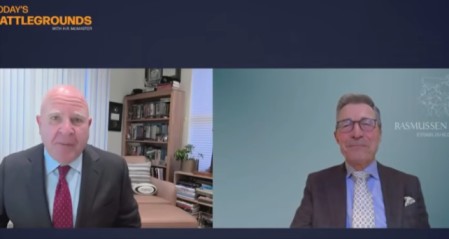
Editor’s Notes: In this episode of Today’s Battlegrounds, former Danish Prime Minister and 12th NATO Secretary General Anders Fogh Rasmussen joins the Hoover Institution to discuss the evolving landscape of Western security. Rasmussen addresses the critical need for a unified “Alliance of Democracies” to counter the growing “axis of aggressors,” specifically citing Russia’s ongoing war in Ukraine and China’s economic coercion. The discussion also explores the future of the U.S.-Denmark relationship, the strategic importance of Greenland, and the imperative for European nations to bolster their own defense industries. Highlighting the current challenges within the transatlantic partnership, Rasmussen calls for strong American leadership and renewed cooperation among the world’s democratic powers to ensure long-term stability and freedom. (April 15, 2026)
TRANSCRIPT:
H.R. MCMASTER: Today’s Battlegrounds features discussions with leaders from around the world, considering how history produced the present, and how we can work together to overcome obstacles to progress, seize opportunities, and build a better tomorrow.
Introduction
FEMALE SPEAKER: On this episode of Today’s Battlegrounds, our focus is on Denmark. Our guest is Anders Fogh Rasmussen, who served as Prime Minister of Denmark from 2001 to 2009 and as the 12th Secretary General of the North Atlantic Treaty Organization (NATO) from 2009 to 2014. Rasmussen became Denmark’s youngest member of parliament at age 25, and he was named Minister of Economic Affairs in 1990.
In June 2022, Ukrainian President Volodymyr Zelensky asked Rasmussen to co-chair an international task force on security guarantees for Ukraine. The resulting Kyiv Security Compact became the basis for a web of security guarantees negotiated between Ukraine and NATO allies that was formalized in a new Ukraine Compact at the 2024 NATO Summit in Washington.
Denmark’s history reflects its position at the crossroads of European power politics and maritime trade. The Danish Kingdom emerged in the early medieval period and during the Viking Age projected influence across the North Atlantic and into the British Isles. In the late 14th century, Denmark became a composite monarchy that included Norway and territories in the North Atlantic, but military defeats in the following centuries reduced its territory. Denmark established itself as a constitutional monarchy in 1849. During World War II, Denmark maintained neutrality until Nazi Germany occupied the country in 1940. Denmark became a founding member of NATO in 1949.
Denmark established colonial control over Greenland in the early 18th century and gradually integrated the territory into the Danish state. In 1941, during Nazi Germany’s occupation of Denmark, Denmark signed an agreement granting the United States responsibility for Greenland’s defense. That agreement began a permanent U.S. presence on the island, which was formalized in 1951 and enabled the construction of Thule Air Base, now called Pituffik Space Base, which became a central node in missile warning and space surveillance during the Cold War. The 2009 Self-Governance Act expanded Greenland’s autonomy and affirmed the right of its people to determine their future.
As concerns about missile defense and Russian and Chinese encroachment in the Arctic grow, Greenland is even more important to European and North American security. In 2025 and 2026, the Trump administration’s expressed interest in acquiring Greenland created friction with Denmark and raised questions about U.S. respect for sovereignty within an alliance built on trust. Denmark has made clear its position that any decision on Greenland’s future rests with its people.
We welcome Secretary General Rasmussen back to Today’s Battlegrounds to discuss international security, the prospects for the US-Danish relationship, and the health of the NATO and transatlantic relationship as wars continue in Ukraine and the Middle East.
Welcome and Opening Remarks
H.R. MCMASTER: Prime Minister Anders Fogh Rasmussen, welcome back to Today’s Battlegrounds. Thank you for making time for me and for our international audience. Great to see you.
ANDERS FOGH RASMUSSEN: Thank you for having me once again. There is a lot to discuss.
The War in Ukraine: Prospects for Peace
H.R. MCMASTER: There certainly is. You’ve been deeply involved in supporting Ukraine in its defense against the Russian aggression there, especially since the massive reinvasion of Ukraine, which occurred right after we talked the last time. And you recently co-chaired the task force that led to the Kyiv Security Compact in 2024. You’ve argued for ironclad security guarantees as a way to at least bring this war to a temporary end of the fighting, and work on a longer-term solution that restores Ukrainian sovereignty. But I’d just love to hear your assessment of the war in Ukraine and what you think the prospects are for restoring peace in Europe.
ANDERS FOGH RASMUSSEN: The prospects are quite bleak because of our hesitation actually to help Ukraine doing what is necessary. And I find it quite embarrassing that the Western community, that the transatlantic community as such, is not able to push back against the Russian aggression.
The fact is the following. As long as President Putin believes that he can win on the battlefield, he has no incentive whatsoever to engage constructively in a peace process. So the road to peace goes through a rearmament of Ukraine. It goes through increased economic pressure on Russia. We have to change Putin’s calculus through increased pressure militarily and economically on Russia.
Russia’s Shadow War Against Europe
H.R. MCMASTER: I could not agree with you more. I think what provokes Putin is the perception of weakness. And not only does he think he can continue to make gains on the battlefield, which he’s paying, I think, an unsustainably high cost for, but also he’s waging a broader shadow war against Europe — blowing up rail lines and warehouses, putting out assassination contracts on European business leaders, cutting undersea cables, a sustained campaign of political subversion.
Could you share with our viewers your perspective on European security? I mean, how serious is the threat to broader European security?
ANDERS FOGH RASMUSSEN: Actually, it is European security at large that is at stake. If Putin gets any success in Ukraine, he won’t stop in Ukraine. He will continue. He’s already present with a Russian occupation of a part of Moldova in Transnistria. He’s present in Georgia, where he occupied Abkhazia and South Ossetia some years ago.
And I wouldn’t exclude the possibility that he would put pressure on the three Baltic states.
It may not be a direct attack because they are members of NATO and that might provoke an activation of the famous NATO Article 5. But he can launch other kinds of pressures, in particular on Lithuania, because Lithuania today hosts a transit link from Mother Russia to the Russian enclave Kaliningrad.
So it is about European security. If Putin gets success in Ukraine, he will continue. And by the end of this decade, he’s able to attack even a NATO ally in Europe.
Putin’s Campaign of Political Subversion in Europe
H.R. MCMASTER: You know, Prime Minister, I think his ambitions are quite high, despite really his destruction of his own economy, taking over a million casualties, dead and severely wounded in Ukraine. But I think what he’s hoping for is to break Europe apart, break up the EU, break up the NATO alliance, rend the transatlantic relationship.
To pursue that effort, he’s engaged in a sustained campaign of political subversion, support for extreme parties on the far left and the far right. Could you give your assessment of how successful he’s being? What’s your assessment of politics in Europe?
We’re talking just after the election in Hungary where the opposition candidate handily defeated Viktor Orbán, who has been really an advocate for Putin and almost a puppet for Putin in Europe. So that seems to bode well. But what is your overall assessment of politics in Europe in relation to what Putin would like to achieve, which is to rend these relationships within the EU, within NATO, and the transatlantic relationship?
ANDERS FOGH RASMUSSEN: Well, Putin has got some success, but you’re quite right that the recent elections in Hungary are a setback for Putin, because he has now lost a good friend in Hungary.
But if you look at other European countries, he has had some success. At least he has some supporters in other European countries. Take France as an example, where Rassemblement National, Marine Le Pen’s party, is running high in the opinion polls before the presidential election next year. And they are more pro-Russian and anti-Ukraine than the current French government. Take the UK, where Farage, leader of the UK Reform Party, is running high in the opinion polls. He is also more pro-Russian and anti-Ukraine than the current government. Take Germany, where you have seen a rise in the support for Alternative für Deutschland, which is clearly pro-Russian.
So in a few years’ time, you may be in a situation where the three biggest European countries are under heavy influence from political forces supporting Putin. So in that respect, he has had success.
Countering Populism and Strengthening European Leadership
H.R. MCMASTER: So, Prime Minister, what is your prescription for that? What can European leaders do? How do you convince your citizens that Russia is being successful in dividing your societies and pitting people against each other, infringing on your sovereignty? What more can be done to counter this dynamic, which has its roots, I think, in anger over migration and anger over economic issues? What do you recommend?
ANDERS FOGH RASMUSSEN: So you’re right. This is not just about our relationship with Russia or our approach to Russia. It’s much broader. You’re right in pointing to immigration as an example.
My clear answer to your question is we need stronger European leadership, and we need to address the real concerns of ordinary people, including when it comes to illegal immigration. We need a tougher approach to countering illegal immigration to Europe. But we also need clear leadership when it comes to telling the European people that we cannot continue to rely on an outdated societal model in which we have relied on a combination of cheap energy from Russia, cheap goods from China, and cheap security from the United States. We have to be able to stand on our own feet.
The Transatlantic Relationship Under Strain
H.R. MCMASTER: Prime Minister, that’s a really strong prescription. Of course, NATO and the EU came out of the lessons of the two destructive world wars of the 20th century. And you have been at the forefront of NATO leadership as Secretary General. But even before that, Prime Minister, you came to the aid of the United States after the mass murder attacks of 9/11 as the Prime Minister of Denmark. Your forces — I fought alongside them — they fought with great distinction. You had a very capable, courageous battle group in Helmand Province. And Denmark took more casualties per capita than any other NATO nation in defense, I would say, of all civilized people in the fight against the Taliban and al-Qaeda in Afghanistan.
Lately, the transatlantic relationship and NATO have come under duress, in part because of President Trump’s persistent, deep skepticism of the alliance. And I would say what I would call gratuitous insults to European leaders — whether it’s the support for Orbán, most recently the Davos speech in which he strung together a number of grievances and insults, and then insulting those who did come to the aid of the United States, Denmark directly, with the threat to invade Greenland. It’s been a really rocky road in terms of the transatlantic relationship, and I think this has put greater strain on NATO.
We just had Secretary General Rutte visit here in Washington. His public statement was not that reassuring. We haven’t seen a rending of the alliance, but what’s your assessment of what can we do to maybe reverse this trend of erosion of trust and tension and lack of confidence in the alliance?
ANDERS FOGH RASMUSSEN: I think, to speak very honestly about it, that the best instrument to restore confidence and trust would be if the American administration would repeat exactly the words you used. I thank you very much for your comments on the Danish troops’ efforts alongside American and British troops in Afghanistan, and by the way, also in Iraq.
I can tell you that Denmark used to be, I think, one of the most pro-American countries in Europe.
H.R. MCMASTER: And the polls showed that, absolutely, yes.
ANDERS FOGH RASMUSSEN: Yes. And recently, a new poll showed that the mood has changed. Now 60% of the Danish people considers the US an adversary. For me, that’s a very painful development. Since childhood, I have admired the United States. I have considered the United States a natural leader of the free world. And as prime minister, I worked closely with President George W. Bush. As NATO Secretary General, I worked closely with President Obama. Irrespective of party affiliation, they strongly believed in American global leadership. I hope to see the United States return to that clear position.
Having said all that, I still consider NATO the cornerstone of European and North Atlantic security. But we have to reform NATO. We have to give NATO a stronger European face. And the first step was taken at the last NATO summit, where all NATO Allies committed to reaching the goal of investing at least 5% of GDP in defence. That was an important step. But we also need stronger commitment from, in particular, European Allies to invest and to develop a European defense industry so that we are able to stand on our own feet.
The Middle East Conflict and Its Impact on NATO
H.R. MCMASTER: You know, Prime Minister, I think there is an opportunity here because President Trump, even if he did it in a way that could diminish confidence in the alliance, he did get that commitment. And I get a sense that he’s almost fighting a rearguard against phantoms because he got really what he wanted, which is greater responsibility sharing in defense, for example. So I’m hoping things can improve.
But now we’re seeing, Prime Minister, this additional strain on the alliance based on the war in the Middle East. President Trump, of course, really not bringing any of our European allies along with us before the war, then asking for assistance, then insulting European allies again. So I think this war has put another strain on NATO and the transatlantic relationship.
Can you maybe just share with our viewers the view of the war in the Middle East from the perspective of Europe, and what you see the implications of that war? And I’m talking about obviously the war centered on Iran, but the broader conflict that involves Israeli actions, for example, against Hezbollah in Lebanon, and Iran’s broader use of proxies across the region?
The Axis of Aggressors and the Case for Democratic Unity
ANDERS FOGH RASMUSSEN: First of all, I shed no tears by the decapitation of the Iranian leadership. On the contrary, I share the view that we need regime change in Iran to stabilize the whole region.
But I would say the way this war was started and has been conducted has exposed President Trump to what I would say self-inflicted problems and wounds, because you cannot expect NATO allies to come and clean up your mess if you do not engage your NATO allies right from the beginning. If President Trump had wanted this to become a NATO operation, then he would have followed the traditional procedure in NATO. We have a meeting in the NATO Council. We decided by unanimity to launch a war or whatever it might be. And then we’re in this together, in solidarity.
But you cannot launch a war on your own and then expect your allies just to come and clean up the mess afterwards. So, obviously, I share the view that it’s of utmost importance to open up the Hormuz Strait. I also think that European allies should do what they can to help in that respect. But my plea would be that the American administration respects the rules in an alliance as NATO.
H.R. MCMASTER: It’s an important outcome that you just mentioned, because I do think that there is not going to be a really sustained peace in the Middle East until there is just a fundamental shift in the nature of the Iranian government such that it ceases what we have seen as a permanent hostility to the United States, Israel, its Arab neighbors, Europe, the West, broadly.
And I think that highlights that this is a war that we — maybe you could help our viewers understand the context for it. I see Iran as part of a broader axis of aggressors. You’ve already mentioned the economic competition with China, for example. China’s dumping of goods in Europe. We’ve touched a little bit on the Greenland strains — self-inflicted, I think, by the Trump administration. But of course, that’s based in Arctic security.
The conflict in the Middle East highlights the importance of economic security. And you already mentioned our industrial base, our defense industrial base. We have a lot of work to do on the vulnerability of supply chains. So what overall do you think is at stake at this moment? And how does that highlight the importance of working together not only within Europe, but between Europe, the United States, Canada, other allies and like-minded partners?
The Case for a Democracy 7 (D7)
ANDERS FOGH RASMUSSEN: I fully agree with you. We are confronted with an axis of aggressors — Russia, China, North Korea, Iran — you could mention other aggressors as well, and they are increasingly working together. We have seen how North Korea and Iran directly have helped Russia against Ukraine.
So I think our conclusion should be that the world’s democracies should work closer together. Unfortunately, seen from my perspective, the United States has withdrawn from the leadership of the free world. So I have suggested to create what I call Democracy 7, D7, consisting of the European Union, the UK, Canada, Australia, New Zealand, Japan, and South Korea. D7, not G7, but D7. That could be a call.
And if those democratic countries work closer together, agree on free trade agreements, investment agreements, react collectively if we are exposed to economic coercion — be it from Beijing or, for that sake, from the United States — we could secure the supply chain of critical minerals, etc. The D7 could be the core around which we could include other countries.
And I would warmly welcome the United States into this club, an alliance of democracies, once the United States wants to resume its natural place as the leader of the free world. But when the leader of the free world is on retirement, others will have to take over. And that’s why I suggest to create a D7.
H.R. MCMASTER: Prime Minister, I think this could have a positive impact, as well as just convincing — and I think the vast majority of Americans already understand the importance of multinational cooperation, especially with our allies and partners in Europe and, as you mentioned, across the free world. Because our agendas should be common in terms of supply chain resilience, invigorating our industrial base, energy security — especially in relation to AI and the compute power and energy demands associated with that — and the economic promise for that, as well as national security, international security, the need to address what has been underinvestment in defense modernization, defense capacity, Arctic security, missile defense, drone defense.
It sounds like a common agenda to me. So could you lay out what is your optimistic vision for this? How do we get over the tensions and what I would say the self-defeating behavior that we’ve seen in recent years and months?
Free Trade as a Response to Economic Coercion
ANDERS FOGH RASMUSSEN: Basically, I see some positives. Obviously, it was negative when President Trump declared the Liberation Day on the 2nd of April last year, exposing friends and foes alike to high tariffs. To declare a trade war against the whole world doesn’t make sense. There are no winners in a trade war. There are only losers, including the American people.
But as a consequence of this declaration of a trade war, I have seen progress when it comes to the conclusion of free trade agreements. For instance, the European Union has concluded a free trade agreement with a number of countries in Latin America called Mercosur, including Brazil. We have concluded a free trade agreement with India. We have concluded a free trade agreement with Australia. We have seen how Prime Minister Carney has traveled to Southeast Asia to mobilize support for new agreements among what he called the middle-sized countries.
So I see some positives, namely that provoked by the trade war, we have seen how democracies have agreed on a number of free trade arrangements, to demonstrate to China and to the United States that free markets still pay.
Assessing the Overreach of the Axis of Aggressors
H.R. MCMASTER: Well, Prime Minister, I think that’s a great message. And I do think we should be more confident. You mentioned this axis of aggressors — I think that all of them have overextended. I’d like you to give your assessment of Russia, China, Iran, and North Korea.
From my perspective, they saw Europe, the United States, the West broadly, as weak, decadent, and divided. And as a result, they all overextended — Russia in Ukraine, Iran with its attacks on Israel, the October 7th horrible attacks, the direct attacks in 2024. China has overextended economically, in my view, in the race to surpass us. So what is your assessment of the broader geostrategic competition? I think we should be more confident in our future and recognize some of these self-inflicted weaknesses by the axis of aggressors.
ANDERS FOGH RASMUSSEN: I couldn’t agree more. As I mentioned earlier, I find it embarrassing that we are not able to push back against the Russian aggression against Ukraine. Let’s think about it — the size of the Russian economy is equivalent to Italy, Italy in Europe.
H.R. MCMASTER: Sure.
ANDERS FOGH RASMUSSEN: So I think the only reason why Putin has some success in acting as a regional spoiler is our divisions in Europe and trying across the Atlantic. If we act together, then we represent a formidable force that can push back against aggression from Russia, from China, from Iran, from elsewhere. The dictators are profiting from our disunity.
That’s why I’m speaking about creating an alliance of democracies. If we take all the world’s democracies together, including the US, then we represent 60% of the global economy. If we could work together instead of fighting each other, then we could easily handle the dictators of the world. So that’s what I’m encouraging — the American administration to resume its natural place as a leader of the free world.
Closing Remarks
H.R. MCMASTER: Well, at the Hoover Institution and on Today’s Battlegrounds, we’ll do everything we can to amplify your voice. I consider you one of the greatest statesmen in the world today. I can’t thank you enough for joining us. I’d like to give you just one final word for our audience.
ANDERS FOGH RASMUSSEN: Since I was a child, I have admired the United States and considered the United States a natural leader of the free world. And to that end, to make the United States great, you need friends, you need partners, you need allies. And one thing is for sure — you cannot make America great by threatening allies to grasp their land by force. On the contrary, we need to work together, to raise our voice, to strengthen our efforts against the advancing autocracies.
H.R. MCMASTER: Well, Prime Minister Anders Fogh Rasmussen, I cannot thank you enough for joining us on Today’s Battlegrounds. And I wish you the best as you continue to send a positive message, not only to Europe, but across the free world. Thank you for joining us.
ANDERS FOGH RASMUSSEN: Thank you very much for having me. And thank you for your efforts to amplify the words on the need for strengthened cooperation among the world’s democracies.
H.R. MCMASTER: Thank you, Prime Minister. Battlegrounds is a production of the Hoover Institution, where we generate and promote ideas advancing freedom. For more information about our work, to hear more of our podcasts, or view our video content, please visit hoover.org.
Related Posts