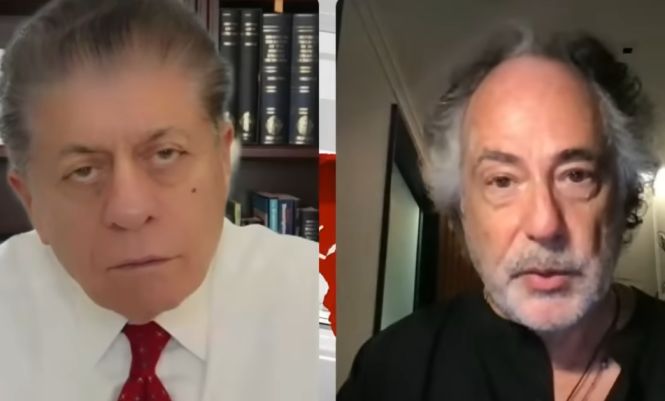
Editor’s Notes: In this episode of Judging Freedom, Judge Andrew Napolitano welcomes geopolitical analyst Pepe Escobar to discuss the critical role of Iran as a hub for Eurasian connectivity and trade. Escobar details how major powers like Russia, China, and India are deeply invested in a functional Iranian state, highlighting the strategic “War of Connectivity Corridors” that spans from East to West. The conversation also delves into the legal and military implications of U.S. blockades in the Strait of Hormuz and the Strait of Malacca, warning of the potential for a global conflict as the “Empire of Blockades” expands. (April 22, 2026)
TRANSCRIPT:
What to Expect From China with Pepe Escobar
JUDGE ANDREW NAPOLITANO: Hi everyone, Judge Andrew Napolitano here for Judging Freedom. Today is Wednesday, April 22nd, 2026. The great Pepe Escobar joins us now. Pepe, always a pleasure. Where did we find you? Where are you, Pepe?
PEPE ESCOBAR: Cheers from Buddhist peaceful Southeast Asia, Bangkok.
JUDGE ANDREW NAPOLITANO: Buddhist peaceful Southeast Asia. Well, it’s a pleasure, my dear friend. Thank you for accommodating my schedule. You have written extensively about the geographic significance and vitality of Iran as a connector to major powers. Will those three powers, Russia, China, India, allow Iran to fall to the Americans and the Israelis?
Iran as the Crossroads of Eurasia
PEPE ESCOBAR: They can’t, Judge, because Iran, just like in old Persian times when Persian dynasties and, for instance, the Tang Dynasty, they were doing business across Eurasia. There were middlemen. In Sogdiana, meaning Samarkand and Bukhara. But they were trading among themselves for centuries. And today still, Iran is the definitive crossroads of inter-Eurasia trade.
So that’s why these three extra BRICS, apart from Iran, full member of BRICS, Russia, China, and India, they are absolutely involved in having a functional Iranian state and economy because it’s a key trading partner for all of them. And this is what I tried to explain in my latest, relatively long article. The key is— I coined this expression four years ago— the war of connectivity. Corridors, connectivity corridors, because this is the great geoeconomic project for Eurasia. To simplify, it’s a very complex story.
JUDGE ANDREW NAPOLITANO: Chris is putting up a map.
The Silk Road and Connectivity Corridors
PEPE ESCOBAR: Wonderful. East to west, the Chinese New Silk Road, Belt and Road Initiative, they have six or seven different corridors going through from east, from Xinjiang in eastern China, to west. They all go— almost all of them go through Iran. And only a little while ago, they finished the China-Iran Railway, which is part of their East-West Corridor.
There’s another one called Middle Corridor. There’s corridors through the Trans-Siberian, but this one is very, very important because it links Xinjiang in western China through Central Asia, going to Turkmenistan, and then the Turkmenistan-Iranian border, crossing the border across Iran. And the key point is a dry port 20 kilometers only outside of Tehran. Yes, you can see it in the map when you see Tehran.
JUDGE ANDREW NAPOLITANO: That’s a great map, Chris.
PEPE ESCOBAR: So you can see—
JUDGE ANDREW NAPOLITANO: Now you can see how close India is, you could see this route to China. And if the map were just a little higher, you could draw a red line up to Moscow. Am I right?
PEPE ESCOBAR: Of course, Judge, because Iran is at the center of the International North-South Transportation Corridor, INSTC, which is Russia, Iran, and India. That was the documentary that we shot last year in Iran. Which all of you, our audience, you can see it on the Press TV website. It was an immense honor for a foreigner. They gave me full access from the Caspian Sea to Bandar Abbas, to the Persian Gulf, to Chabahar in Sistan-Balochistan, all the way to the Iran-Pakistani border. So this is the first documentary in English explaining to a global audience what is this connectivity corridor.
JUDGE ANDREW NAPOLITANO: This red line is the railroad you’re talking about, is it not?
PEPE ESCOBAR: This red line is basically, let’s say, the classic Silk Road itinerary by rail from Xi’an in the east across Xinjiang. You can see Urumqi here, the capital of Xinjiang. And then it goes through Kazakhstan, Kyrgyzstan, and it gets all the way to Turkmenistan. Ashgabat, capital of Turkmenistan, crosses the border and gets to this dry port that I was talking about, which is 20 kilometers outside of Tehran.
JUDGE ANDREW NAPOLITANO: What is transported on that train line? From everything, China, Iran to Eastern China? What is on there?
PEPE ESCOBAR: Mostly what China exports to Central Asia and Iran, all sorts of manufactured products. Another thing that could start happening soon, and it’s another parallel corridor for Iran, they can export oil through this railway as well. Of course, much less quantities, but it’s also an oil corridor. They can use it as one of their backup oil corridors to China over land, and of course immune to sanctions and immune to American blockades.
Washington’s Ignorance of Eurasian Geoeconomics
JUDGE ANDREW NAPOLITANO: Are the Americans and Israelis aware of this, or not? They care, or do they want to disrupt it?
PEPE ESCOBAR: If you ask anybody in Washington about the INSTC, forget it. They have no clue what this is all about, just like Trump didn’t know what BRICS is all about. The ignorance in deciding circles in the US about everything that has been happening in Eurasia geoeconomically is staggering. They only know that the Russians have the Arctic Silk Road, as the Chinese call it. The Russians call it the Northern route because of course Arctic, Siberia, and the Americas would like to be part of it. But that’s about it. And this is the Russian new connectivity corridor.
This column that I wrote is basically about columns involving Persian Gulf and Iran. And the two most important are east to west horizontally from China to Iran.
And north to south from Moscow to Mumbai, the North-South Corridor, which crosses Iran.
When we were shooting last year, Judge, we crossed Iran on the road. We went to the Caspian and then we came back via Tehran to Qom and Isfahan. We went all the way to Bandar Abbas, the port you can see on the map, and then we flew to Chabahar, which is a 40-minute flight, and then we were on the road again all the way to the Iran-Pakistani border.
And very important for our audience, the Americans bombed the port of Bandar-e-Anzali in the Caspian. They bombed Tehran, they bombed outside of Isfahan, and they bombed a military base in Chabahar Port as well. Not to mention that they bombed a stretch of the Chinese-built and paid railway inside Iran.
Will Russia, China, and India Allow Iran to Fall?
JUDGE ANDREW NAPOLITANO: So I go back to what I asked you earlier. Will Russia, China, and India allow Israel and the US to eviscerate Iran? Doesn’t appear that they have the ability to do it, but this is what they set out to do.
PEPE ESCOBAR: Absolutely not, because this process of Eurasia integration is something that started in the 2000s, picked up speed in the 2010s, and picked up even faster, like driving a Maserati Turbo, in the 2020s. So everybody is involved, these three BRICS, China, Russia, and India, their relationship with Iran, which is excellent, all three of them. Some are strategic partnerships, which is the case of Russia-Iran and China-Iran. And of course, they know what the American design is. The American design is divide and rule in Eurasia so we can get a cut of something. They don’t know exactly what it is.
JUDGE ANDREW NAPOLITANO: Let me ask you about the red line with the dots in it. Going up through Eastern Europe, sort of almost along the Adriatic. Does that exist or is that planned?
PEPE ESCOBAR: It does, Judge, because this is the connection between Tehran and Istanbul, the railway. This already exists. You can branch out to Baku as well. It’s quite possible. You can branch out to Basra in southern Iraq. Also possible. And of course, if you cross Anatolia, if you cross from Turkey, cross Anatolia all the way to Istanbul, then you connect with the European railway grid. And further down from Vienna west all the way to— like the Chinese already do. The trains that, for instance, I was in Chongqing in China earlier this year. I was at the ground zero of the Silk Road. The trains that leave Chongqing, they go all the way to Madrid in Spain.
JUDGE ANDREW NAPOLITANO: Wow.
PEPE ESCOBAR: Some go to Rotterdam, some go to Hamburg. Most of them go to Madrid.
JUDGE ANDREW NAPOLITANO: How long is that train ride? China to Madrid?
PEPE ESCOBAR: 15 days, I think it’s 15 days if I’m not mistaken. And it’s very easy now to leave China and enter Central Asia because the customs procedures are almost automatic. I went to this border a few years ago, the border of Xinjiang and Kazakhstan, and all the trains go through this border and then they enter Central Asia and they keep going west. And now they’re streamlining all the procedures, so you can have a cargo manifesto going through customs everywhere, and it’s homogenized. Extraordinary. All right, another Chinese invention.
Who Controls the Strait of Hormuz?
JUDGE ANDREW NAPOLITANO: I wanted to set the table so the viewing audience would have an understanding of what’s truly at stake here. So now let’s go back to the war. Who presently controls the Strait of Hormuz?
PEPE ESCOBAR: 110%, the IRGC Navy. There’s no question about that.
JUDGE ANDREW NAPOLITANO: Yeah, but wait a minute, according to President Trump, the Navy has been obliterated.
PEPE ESCOBAR: Okay, I prefer not even to comment on that because it’s completely absurd. The IRGC Navy— the problem is the Americans, when they started their illegal, once again, blockade, if you own a tanker, you have to think twice before crossing the Strait of Hormuz.
Number one, you need to clear your passage. This means you need to present all the documents, you pay the toll, which can be in yuan, or in crypto or in cash, if you have cash, they accept cash as well. Then you get a radio, a VHF radio signal so you can leave the Strait of Hormuz.
The problem is you’re going to meet the invincible American armada when you reach the extremity of the Sea of Oman, already in the Arabian Sea, assuming they are there. In fact, most of them are not. Most of them are in the southern Indian Ocean, which is 700-800 kilometers down south, in the Indian Ocean. So they have to calculate, okay, we’re going to pay for that. But what if we are confiscated by the Americans when we try to leave towards the Arabian Sea? So that’s a very complicated calculus. And no wonder the costs for insuring tankers, they shot up 400% in the past few days.
JUDGE ANDREW NAPOLITANO: Would anybody dare send a tanker full of oil in that area without insurance?
The American Blockade and Its Effectiveness
PEPE ESCOBAR: No, you can’t. Absolutely. But the costs, of course, they add to what you’re carrying. The problem— an extra problem, if you are a UAE tanker, the UAE is saying we refuse to pay the toll booths to the Iranians. So nothing is leaving the UAE already. So once again, who pays the price? The global economy.
Saudi Arabia, they are trying to divert everything to the Red Sea. So far, the Red Sea is open. If we enter the escalation trap, the Houthis and Sana’a, the Yemeni armed forces, they will close the Bab al-Mandeb, and then that’s it. No more Saudi oil exports.
So for the moment, we’re having Iranian oil exports. Most of them are going through. In fact, these past few days, over 20 ships went through. It means they went across the American blockade. So we don’t know exactly where the Americans are blocking and what are they blocking.
So they have these Netflix Hollywood flashy operations. “Ah, we intercepted a ship.” Okay, but they intercepted coming from, not leaving the Strait of Hormuz, not leaving Iran, but coming from the port of Guilin, which is in Zhuhai in southern China, not very far from Hong Kong, because in the American scheme of things, “Ah, this is going to be full of sodium perchlorate.” For solid fuel for Iran ballistic missiles.
We don’t know if this is true or not. Trump said that “we found some nasty, interesting stuff” or whatever. We assume that he’s referring to sodium perchlorate, and this was the reason why the Americans boarded this ship. But the ships who are leaving from Iranian ports, they are going through the Strait of Hormuz and the Gulf of Oman, and they keep going. So we don’t know how effective is the American blockade. Nobody really knows.
JUDGE ANDREW NAPOLITANO: What military gear— I’m using the word gear so as to cover everything: armaments, ammunition, systems that send the armaments out— what military gear is China selling to Iran?
PEPE ESCOBAR: Well, essentially, what we really know is sodium perchlorate for solid fuel for Iran ballistic missiles. Apart from that, everything is speculation. There’s no hard evidence from anywhere, much less from the Chinese. For the Chinese, it’s a matter of national security. What we know for sure is satellite info 24/7, but this is— everybody knows since the beginning of the war.
JUDGE ANDREW NAPOLITANO: In fact, the American blockade, or what they call a blockade, is truly out on the high seas. You said yourself 700 to 800 kilometers. That’s about 500 miles.
PEPE ESCOBAR: Yes.
JUDGE ANDREW NAPOLITANO: For those of us in the West that don’t understand kilometers.
PEPE ESCOBAR: Yeah, south of the Iran-Pakistani coastline. Right.
JUDGE ANDREW NAPOLITANO: Isn’t the US blockade by law and by treaty both an act of aggression and a war crime?
China’s Strategic Vulnerability and the Global Blockade
PEPE ESCOBAR: Completely, completely. And let me quote here, Judge, what I — let me see where I put it in my article. Yes, the Article 3C of the UN General Assembly Resolution 3314, which is the definition of aggression essentially. I’m quoting, “the blockade of ports or coasts of a state by the armed forces of another state qualifies as an act of aggression.” So that’s what it is. And this is what Arakchi in his posts on X is being saying again and again.
And the key reason why there was no Islamabad 2 — the Iranians would have gone to Islamabad 2 if there was no American blockade. This was debated at the Security Council at the highest level in Tehran. But with the blockade on, there’s no point in going there. And on top of that, as Arakchi also posted, they are attacking our ships.
So, there’s something extra, Judge, which is very, very important. Back to the Geneva Convention 1958 on territorial sea and contiguous zones, which was amplified by Iranian legislation in 1993. You stress the right of, “innocent passage.” So Iran can invoke the right of non-innocent passage because there are vessels, American vessels, that are threatening Iranian security. So they have the right to regulate the passage across the Strait of Hormuz. Basically qualifying this non-innocent passage of possible American warships coming to the Strait of Hormuz. Of course they won’t, because if they do, they’re going to be incinerated by anti-ship missiles all across the Persian Gulf coastline and the Sea of Oman coastline as well. That’s why they’re so far away.
JUDGE ANDREW NAPOLITANO: Yeah, at the risk of getting too philosophical, does anybody care about war crimes anymore?
PEPE ESCOBAR: No, it’s a very good question, just because — no, this is the empire of piracy by definition. It’s not only chaos, lies, plunder, it’s piracy. And now the empire of blockades. And the blockade — they are already saying it out loud, it’s going to be a global blockade. And it’s not only Iran. That includes Russia. The Russians know how to read the fine print. This is blockade — trying to blockade Russia in the Black Sea, in the Baltics, in the Eastern Mediterranean, and blocking the Iranians, not only Persian Gulf and Sea of Oman and Arabian Sea, but as far as getting close to the Strait of Malacca, which means long-term blockading China out of the Strait of Malacca, which is what the Chinese have been thinking about 24/7 for 25 years.
The Strait of Malacca and Indonesia’s Divided Loyalties
JUDGE ANDREW NAPOLITANO: Well, the Chinese are prepared to assure that the Strait of Malacca is open.
PEPE ESCOBAR: Of course they are, but a desperate empire in — I would say, midterm — they could try to pull off something in the Strait of Malacca. Don’t forget, Judge, this is very, very worrying, and the Indonesians have not explained it at all. This — the military defense deal that their Ministry of Defense signed with the Pentagon in Washington is so fishy that the Ministry of Foreign Relations in Jakarta told their own Ministry of Defense, “What are you doing? We are a BRICS member. Are you thinking of giving overflight rights to the Americans here in the Strait of Malacca, which, by the way, everybody knows is —”
JUDGE ANDREW NAPOLITANO: Looks like we’re frozen for a minute. While you were explaining the significance of the Strait of Malacca and how there’s a dichotomy in the Indonesian government as to whether the United States has air rights over it. Chris, I think we’re probably — oh, here he is. You’re back.
PEPE ESCOBAR: Okay, I got you back.
JUDGE ANDREW NAPOLITANO: Yes, yes, you have your hand in the air.
PEPE ESCOBAR: I’m very near the American Embassy. They are across the street here. They’re building a monster, and obviously they interfere with our podcasts. There’s no question about that.
JUDGE ANDREW NAPOLITANO: Well, we are the resistance.
PEPE ESCOBAR: Exactly.
JUDGE ANDREW NAPOLITANO: What was it you were explaining?
PEPE ESCOBAR: Yes, so this is Malacca, and obviously the Chinese for the past 25 years, their whole diversification strategy in terms of sources of energy — the code name was “Escape from Malacca.” But still, everything that comes from the Persian Gulf to China still goes through the Strait of Malacca and then to the South China Sea. So China is still partially hostage to the Strait of Malacca.
And if the Americans — no, they are already thinking of a global blockade, and the global blockade will be against China. So obviously the number one candidate will be sooner or later the Strait of Malacca.
China’s Next Move — Pepe’s Upcoming Visit
JUDGE ANDREW NAPOLITANO: I guess this means World War III.
PEPE ESCOBAR: Yes, that’s the case. Look, finally, Judge, I decided I’m going to China next month. I was postponing this trip all the time because of the war. And my number one question, which I wonder if I’m going to get an answer, is, “Guys, when are you going to jump out of the fence that you’re in? Because now you are being directly attacked as part of this American global blockade. It’s against you much more than against Iran. Are you going to send a task force to the Arabian Sea in the Gulf of Oman? By any chance? What if they board one of your own tankers and not an Iranian tanker going to China? What if they board a Chinese tanker? What’s going to be Beijing’s response?” So it’s getting more dangerous by the minute.
JUDGE ANDREW NAPOLITANO: Wow, Pepe, thank you very much. Great, terrific analysis as always, my dear friend.
PEPE ESCOBAR: Thanks.
JUDGE ANDREW NAPOLITANO: This really completes the circle of analysis that your colleagues on this show have presented because of your unique knowledge of this part of the world and the commercial as well as the geopolitical and military implications. Thank you, my dear friend.
PEPE ESCOBAR: My neighbors, they’re my neighbors here.
JUDGE ANDREW NAPOLITANO: Right, right, right. Well, I hope your neighbors are peaceful while you’re there, my dear friend.
PEPE ESCOBAR: They are all peaceful, Judge, and the food is fantastic.
JUDGE ANDREW NAPOLITANO: All right, one of these days we’ll share it together. God love you. All the best. Thank you. Thank you so much.
PEPE ESCOBAR: All the best. Thank you so much.
JUDGE ANDREW NAPOLITANO: Thank you. Coming up still at 2 o’clock, Professor Glenn Diesen. At 3 o’clock, the great Phil Giraldi. Judge Napolitano for Judging Freedom.
Related Posts