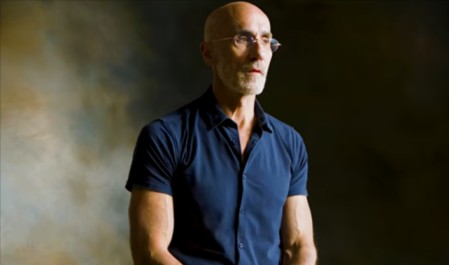
Editor’s Notes: In this thought-provoking episode of Soft White Underbelly, host Mark Laita sits down with Arthur Brooks, a Harvard professor and social scientist specializing in the “science of happiness.” Brooks explores the essential macronutrients of a fulfilling life—enjoyment, satisfaction, and meaning—while examining why modern technology and “hustle culture” often leave us feeling isolated and unhappy. The conversation delves into the transformative power of love, the necessity of suffering for personal growth, and practical habits for finding lasting contentment in an increasingly complex world. (April 22, 2026)
TRANSCRIPT:
The Overlap Between Mark’s Work and the Science of Happiness
MARK LAITA: I think a lot of what you and I do overlaps.
ARTHUR BROOKS: Yeah, totally. Oh yeah.
MARK LAITA: I think—
ARTHUR BROOKS: For sure.
MARK LAITA: Like what I’m doing is kind of exploring how, especially when I’m interviewing a drug addict on Skid Row there, telling me about what they’re doing to escape their unease, their anxiety, their depression, their whatever, and this unhappiness. They’re unhappy.
ARTHUR BROOKS: They’re trying to escape their suffering. Yeah. Most of what I talk about is helping people suffer less. That’s what— I mean, I’m a specialist in the science of happiness, and 90% of what I talk about is unhappiness. Nobody comes to me and says, “I’m super happy. How can I get happier?” People say, no, no, I mean, that’s like, there’s so much air around me. Tell me more about air. You know, my wife is a 9 out of 10 on happiness. She thinks it’s weird that I study happiness. And people who come to me who are a 3 on happiness, like me, which is why I study it.
MARK LAITA: You’re generally happy?
ARTHUR BROOKS: Unhappy.
MARK LAITA: You’re generally unhappy?
ARTHUR BROOKS: Yeah, yeah, sure. It’s been a huge struggle for me. That’s why I study it.
MARK LAITA: Oh, is that right?
ARTHUR BROOKS: As a scientist, I’ve dedicated my work to the study of the thing I want the most. That’s what I want. It’s me search, not research.
Finding Purpose Early: Mark’s Path to Happiness
MARK LAITA: This will be a very interesting conversation.
ARTHUR BROOKS: Yeah.
MARK LAITA: Because I think I’ve thought about this since I was a little kid.
ARTHUR BROOKS: Yeah.
MARK LAITA: Like, what’s going to make me happy?
ARTHUR BROOKS: Because you struggle too.
MARK LAITA: I do, but then I don’t because I figured out super early, like before I was 12 years old, I figured out, figure out what I’m good at, figure out what I love.
ARTHUR BROOKS: Right.
MARK LAITA: Do that with all of my— everything I’ve got.
ARTHUR BROOKS: Right.
MARK LAITA: And that always makes me happy.
ARTHUR BROOKS: You figured out ikigai as a 12-year-old?
MARK LAITA: I don’t know, but I just— I used to be a tennis player and I’d lose in the tournament. And every single time I’d lose, I’d drive home going, “Thank God I’m good at something else.” And that other thing that I was good at was photography or art. Yeah. And that’s what I’ve done ever since.
ARTHUR BROOKS: That’s great. I mean, you’re actually able to do something that’s incredibly interesting.
MARK LAITA: And it makes me happier than anything else I’ve ever seen.
ARTHUR BROOKS: Yeah.
MARK LAITA: Not all the time, not every day. I mean, some days, like yesterday, was an okay day. But every once in a while, I look like a genius. I look like, wow, how did you do that?
ARTHUR BROOKS: Yeah, when you put up one of the Whitakers.
MARK LAITA: Yeah, James Sexton. Yeah, whatever.
ARTHUR BROOKS: You’re like, “How did Mark do that?” Yeah, how do you do that?
MARK LAITA: How do you find these people?
ARTHUR BROOKS: He did it 11,000 times.
MARK LAITA: That’s right, that’s exactly right. So you watch my channel? You told me this. That’s crazy.
ARTHUR BROOKS: I do, I do. And every interview is like, “So where’d you grow up?”
MARK LAITA: That’s right. No, I mean, I roll my eyes at myself sometimes.
ARTHUR BROOKS: No, you’re right. You’re starting at the beginning. Starting at the beginning because you want people to tell you the story because these are human stories which you document aesthetically, but also you’re trying to fill out the aesthetics with the human experience. The mystery and the meaning of their lives actually comes through with their own personal narrative while you look at them in a complete way. You’re trying to see the whole person. That’s the magic of the show.
MARK LAITA: Yeah, it’s almost like I’m on all these blind dates. And here I am stuck in a room with this new person I’ve not met yet. And I’m just like, “Where are you from? How’d you grow up?” And then it all unfolds. Yeah.
The Ethnographic Nature of Soft White Underbelly
ARTHUR BROOKS: No, it’s great. It’s great. It’s really amazing. It’s kind of the ancient ethnograph, like the old school, 100-year-old ethnographic set of studies that anthropologists used to do, sort of Margaret Mead. And they would go and live among a group of people that were not their own and just walk among them.
MARK LAITA: Yeah, that’s kind of what I did on Skid Row for 5 years.
ARTHUR BROOKS: Yeah. There were these guys that would go to— Edward Banfield at Harvard, he went to this village in central Italy in 1950 and just walked around for a year, talked to people, learned the language. It’s the whole thing. And then came back and told all the stories.
MARK LAITA: Yeah, I love that kind of stuff. Yeah, that’s why when I started this project, it was just insane. It was like, “This doesn’t make any sense at all, and I’m going to dump so much money into this project.” I dumped a ton of money the first 3 years I did it.
ARTHUR BROOKS: And worked out.
MARK LAITA: And yeah, it all paid for itself and worked out, and now it’s profitable. But it was just like, it was stupid money I was blowing. Yeah, but what I created was this ability to, as a total square, like I’ve never smoked pot, I can go into Skid Row and everybody kind of treats me with respect. And they’re cooperative and they come to me when they want to do an interview or whatever.
ARTHUR BROOKS: Yeah, it makes sense. Well, a part of it is you establish a reputation, of course, but part of it is that you have a manner that’s very open. Yeah, you’re there to listen.
MARK LAITA: I’ve never, never, never hurt anybody. Anybody who’s interviewed me, who’s in their right mind, will tell you, like, “Oh my God, I would love to do a second or third or fifth interview with Mark because he’s just lovely.” Then sometimes there are those stories that you have of somebody who got it together, and those are beautiful. Those are beautiful.
Suffering, Redemption, and Why Arthur Studies Happiness
ARTHUR BROOKS: Yeah, those are wonderful, the stories, because that’s the redemption story, which is really part of the ethnograph that you want to see. And what that shows is that it can be good. You know, there is tons of suffering. Life is suffering. That’s the first dukkha. That’s the first noble truth of Buddhism. Right? But the truth is that there’s redemption as well. And that’s a beautiful thing about life per se.
That’s why I do my work too. You know, why would I keep doing something where 90— I want to study happiness and 90% of what I talk about is suffering. It’s because there is deliverance, because there are beautiful stories and all of us can actually experience that. I’m completely convinced. My life is fundamentally better than it used to be.
MARK LAITA: You seem happy.
ARTHUR BROOKS: I’m a lot happier than I used to be, for sure. Things have gone well. I mean, I made decisions in my mid-50s to dedicate the rest of my life to love and happiness using science and ideas.
MARK LAITA: There’s nothing better to dedicate your life to.
ARTHUR BROOKS: I know. And it’s like I finally figured out that it’s to live the rest of my life to lift people up and bring them together in bonds of happiness and love using science and ideas. That’s why I believe I learned my craft. It just took me a while to figure that out.
What Science Reveals About Happiness
MARK LAITA: What are some of the most surprising things you’ve learned about happiness or the pursuit of it?
ARTHUR BROOKS: There’s a lot. I mean, to begin with, Mother Nature doesn’t care if you’re happy. Our brains are not designed to make us happy. On the contrary, we have more brain tissue dedicated to unhappiness than to happiness. Everybody wants to be happy, but the truth is that our ancestors passed on their genes because they were grumpy and suspicious and afraid of everything. And a twig snapped behind them and they took off running and asked questions later. It’s called negativity bias. I mean, our limbic systems are way more adroit at bad emotions than good emotions, the truth. And people think, “It’s my birthright to be happy.” No, it’s not. It’s your birthright to have the skills to stay alive, and that requires unhappiness more than happiness. That’s a big one.
Another one is that people think that their happiness is a feeling, and that’s wrong. Happiness isn’t a feeling any more than the smell of the turkey is your Thanksgiving dinner. It’s evidence of happiness. It’s something a lot more tangible than that, which means you’ve got to stop trying to find feelings. You’ve got to stop chasing feelings. Feelings are liars. The emotions are wrong a lot of the time. All they are is signals to you.
I guess the biggest one is that we can be happy. That’s the biggest myth of happiness — is that we can be happy. I mean, we can’t. We can be happier than we were a day before, and we can be less unhappy than we were a day before or a year before. But we’re not going to be cosmically happy because we have negative emotions to keep us alive and negative experiences because we’re walking through the world dealing with other human beings. And understanding those three truths, at least those three truths, really helps a lot.
The Pursuit of Happiness: Problem and Solution
MARK LAITA: Is the pursuit of happiness part of the problem?
ARTHUR BROOKS: The pursuit is part of the problem, but it’s also the solution because the pursuit is everything. We’re not made to arrive. We’re made to make progress. Human beings, Homo sapiens, only get satisfaction when they’re making progress toward a tangible goal, which is why weight loss plans have between an 80% and 95% failure rate, which is to say that people can lose weight on almost any plan, but after about a year, between 80% and 95% will have gained back all the weight and then some.
The reason is because when the scale goes down, you’re like, “It’s totally worth not eating what I like.” But when you get to your target weight, your reward is never getting to eat what you like ever again for the rest of your life. Congratulations. And that’s life. That’s how life works. We’re not made to arrive.
And when we think, it feels so good to make progress, so when I hit my goal, man, it’s going to be awesome. Olympic athletes, they tend to have a clinical depression after winning the gold. The reason is because your limbic system, your brain, isn’t designed to give you happy days for the rest of your life when you hit some sort of worldly goal. That’s just not right. But we don’t know that. Mother Nature lies.
Happiness Is Not a Destination
MARK LAITA: Wow. The thing I learned as a teenager, like, if you’re trying to be happy, like, I’ve taken vacations in my life where I think, “Oh, let’s go have a— let’s take a vacation and go have some good time.” I’m sometimes miserable on that vacation because I’d rather be back at work doing your thing. And what I learned as a teenager was that if you’re pursuing that goal, you’re just magically happy. You’re content.
You know, the great philosopher David Lee Roth of Van Halen said once, “I can be perfectly happy without smiling once.” Yeah. And I think there’s really something insightful about that because I can relate because like I’ve been perfectly happy. I’m not like happy and smiling and laughing. I’m just focused and pushing the boulder uphill.
ARTHUR BROOKS: Yeah, that’s interestingly, you just made a reference to the myth of Sisyphus, which is this, you know, Sisyphus is this in this Greek tragedy. He’s like the gods because of his bad actions require that he push the boulder up the hill. And every day before he gets to the very top, it rolls back down again. And when Albert Camus, you know, the great French Algerian philosopher, he wrote about that. It’s like this exercise in futility and life is so futile. The last line of that book is that we have to conclude that Sisyphus was happy because he had something to do. He was you. That’s what you just said. That’s the whole point.
Did you have good parents?
MARK LAITA: Had great parents.
ARTHUR BROOKS: Yeah. Are they still alive?
MARK LAITA: They just passed. My dad just passed away a few months ago, and my mom passed away like 5 years ago.
ARTHUR BROOKS: Yeah.
MARK LAITA: Yeah.
ARTHUR BROOKS: You had good parents.
MARK LAITA: They were married their whole lives.
ARTHUR BROOKS: Were you excellent as a kid? Did you get good grades?
MARK LAITA: No, I didn’t get good grades. I was a CB student.
ARTHUR BROOKS: But lots of friends.
MARK LAITA: I was a good kid. I never really got in trouble.
The Unhappy Striver
ARTHUR BROOKS: Right. I wasn’t one of these kids where they’re like, yeah, people who are very successful are funny because I tend to specialize in people who are unbelievably successful and very unhappy. That’s what I specialize in, the unhappy striver. These are the people who call me, and these are—
MARK LAITA: I’ve done it all and I’m still miserable.
ARTHUR BROOKS: Yeah, yeah. I mean, it’s like, “I have everything and I feel nothing,” that kind of thing. Very, very successful people, in worldly terms — money, power, fame — they tend to be all a little insane. And by that, I don’t mean that they need to be put into an asylum. Not in a bad way.
MARK LAITA: I’m insane.
ARTHUR BROOKS: Yeah, no, I mean, the insanity is the systematic violation of a cost-benefit analysis where you will impoverish your personal relationships in search of the world’s applause. In some way, they do it again and again and again. And they all have this same kind of pathology that starts from childhood where they’re really good at something when they’re kids. Like they’re good kids or they’re just really good at something. They make great athletes or they get perfect grades. And they learn, because they only get attention and affection from adults when they do something, that love is earned.
MARK LAITA: Yeah.
ARTHUR BROOKS: That’s what all really successful people have in common — they believe that love is earned. And so they’ll go through their lives making more and more and more money trying to earn the love of their spouse, trying to earn God’s love, trying to earn their friends’ love. And the result is they surround themselves with people who will allow them to earn their love, which is to say they don’t love them. They’ll marry women who don’t love them but will allow them to buy them stuff. They’ll have friends who suck up to them. They don’t have anybody who loves them. And then they keep trying to earn and earn and earn and earn and earn. You see the pathology. This is what I see every day.
Can People Change?
MARK LAITA: Yeah. And I’m sure you’ve seen people — have you seen people actually correct their mistakes?
ARTHUR BROOKS: Yeah, for sure. Because what you have to do is treat that pathology the way you would treat any other addiction. If you’ve worked with a lot of alcoholics in your life, a lot of drug addicts in your life, there’s never enough. What you’re doing is you’re trying to fill a hollowness with a substance or a behavior, and you’re using it addictively, and that’s hijacked your dopamine system. We could explain the neuroscience, but it’s not necessary. You’re doing something that you feel you need, and you’ll never have enough. There’s never enough. There’s never enough booze. There’s never enough heroin out there. It can’t be done. There’s not enough slot machines in Vegas for the true gambling addict.
And so the result of it is that they have to get what they actually truly want. People who are deeply addicted to success — life feels gray when they’re not winning. Really successful people, just gray. Just like life feels gray when you’re not drinking if you’re an alcoholic. They need something that will give them the love that they seek. Because all they really want — the hollowness can only be filled with love. It’s the only thing. Maybe it’s God’s love. Maybe it’s a spouse’s love. Maybe it’s their children’s love. Maybe it’s real friends, not people who use them. And when they can understand that, then they can be okay. But it’s hard because they don’t trust. They don’t believe it.
MARK LAITA: And achievement is a thing where it will make you happy. But then if you keep chasing achievement and success — progress.
ARTHUR BROOKS: It’s just progress toward a goal that you can never reach. This is the problem. And then you believe that you’re earning someone’s love, which is the thing that you actually want. You want to feel that thing. You don’t quite feel that thing. And so you keep running, running, running.
The Algorithm for True Behavioral Change
MARK LAITA: Isn’t it almost like you need to think so alternatively from the masses, the rest of the people around us, in order to figure out how to navigate your life to be—
ARTHUR BROOKS: Yeah, for sure. If you’re an addict to anything, generally speaking, you need something that will truly disequilibrate you and your understanding of your own life. This is one of the reasons that 12-step programs are very good — they help you understand yourself in a completely different way. This is why religious conversion can be so incredibly effective for getting people’s lives on track. But just another self-help book — that’s not it.
And it took me a long time to figure out why self-help is so popular and so ineffective, because it’s just an epiphany. It’s not a change of life. So really, if you want to change your life, you’ve got to do 3 things. Fundamentally, you have to understand yourself. And for you, this is exposing people. Many people watch your show and say, “I saw me. I saw a worse version of me. I saw a version of me 20 years into the future.” People who love your show love it because you see people. But you need to understand yourself. I try to do that through science, through neuroscience and behavioral science. You need to understand your brain.
Second, you need to actually change your life. You have to live in a different way. You have to commit yourself to living in a different way. But there’s a third step if you want change to be permanent, which is that you need to teach these things to other people. You won’t be accountable to anything unless you share it, is what it comes down to. So it’s understand, change, share. That’s the algorithm of true behavioral change. That’s how life change works, if it’s going to work. And reading a book on self-help that you got off Amazon and saying, “Well, that’s a good point” — all that is, is just a flash of recognition.
MARK LAITA: I mean, it’s been said a million times, but I think Mark Twain says something like, “The best way to cheer yourself up is to cheer someone else up.”
ARTHUR BROOKS: Yeah, for sure.
MARK LAITA: And it works like a — freaking charming.
ARTHUR BROOKS: Totally, totally. If you want to learn French, I recommend that you teach somebody a little bit of rudimentary French. In the social science world, it’s called the plastic platypus method. Because in the teaching literature, there were experiments with this little plastic platypus — it’s a random thing — and they would make people learning a thing teach it to the plastic platypus, and their brain, their episodic memory in the hippocampus, actually retained the information more effectively.
MARK LAITA: Yeah. And do you still make discoveries about your subject as you’re working?
ARTHUR BROOKS: Every day. I write about 100,000 words a year because I write a book every couple of years, and I have a column that’s about 1,500 words a week. So it’s just going and going and going and going.
MARK LAITA: You teach at Harvard.
ARTHUR BROOKS: Yeah.
MARK LAITA: And then you’re an author. You have books.
ARTHUR BROOKS: Yeah, I have books that come out every couple of years. I have one that came out a week and a half ago — about the meaning of life.
MARK LAITA: What is the meaning of life?
ARTHUR BROOKS: It’s called The Meaning of Your Life, and it talks about what’s the meaning of meaning, and then what actually blocks us from finding it, how does technology screw us up, and then how do you have to live differently, and then how do you go teach it?
Technology and Happiness
MARK LAITA: Do you think all the things that are in our lives — these new things like technology and cell phones and computers and DoorDash and all these things that are just making our life simpler and easier and faster — are actually helping us become happier?
ARTHUR BROOKS: Some are, but they’re fundamentally not giving us what we truly need. So the way to understand the problem that we have with technology is that we have a hemispherically lateralized brain. That’s just a fancy way of saying the right side and the left side do different things. The right side is all the mystery and meaning, all the why of life. Those are the things that your subjects really want. That’s the love. That’s the deep meaning of life — it’s all in the right hemisphere of the brain.
The left side of the brain is all the how-to and what — all the stuff that you do every day, all the quotidian chores and nonsense. How do we get from Santa Monica to Malibu? What’s the traffic looking like? That’s just left side of the brain. The right side is these complex issues that we really, really care about. The left side is hacks and technology and analysis. And that stuff’s important.
The problem is that we’ve been lied to fundamentally in our technologized, engineered society — that all of these right-brain complex needs can be met with complicated left-brain technology. For example, social media, when it was first created in 2008, 2009, 2010, the promise was it was going to wipe out loneliness. Well, loneliness is a complex right-brain phenomenon. The algorithms for Facebook are a left-brain phenomenon. And anytime you take a left-brain solution for a right-brain problem, you’re going to make it worse. So if you’re lonely and you binge social media, you’re going to get lonelier. That’s the bottom line. Anything that you do — going out into the world to get something to fill a hollowness of the love that you actually want — is going to make you worse off. And you’ve seen it approximately 11,000 times?
MARK LAITA: They’re not always drug addicts.
ARTHUR BROOKS: No, I get it.
MARK LAITA: I’ve interviewed more than my share of drug addicts.
ARTHUR BROOKS: But you’ve seen a lot of problems and people doing things that are very suboptimal to solve the problems that they actually have. Generally speaking, it’s because of this mismatch that we see in technology. It’s not just technology — it’s just this engineered life of hustle and grind, and technology is part of it. They explain why people can’t find the meaning of their lives, and that explains the depression and anxiety explosions that we’ve seen since 2008.
The Three Macronutrients of Happiness
MARK LAITA: What’s the difference between enjoyment and meaning, having a meaningful life — there are different forms of happiness, right?
ARTHUR BROOKS: Yeah, well, happiness has 3 macronutrients. So you’re a health guy like me, right? You’re eating right and going to the gym, and that means that your macronutrients are on point, because how old are you?
MARK LAITA: 66 now.
The Three Macronutrients of Happiness
ARTHUR BROOKS: Man, if I had your hair, I could be president of the United States. I’m 61 and I feel better than I was when I was 30. I drank too much, I didn’t take care of myself. And now I’m taking care of my health a lot and I have for quite a long time, for 30 years as a matter of fact.
And one of the things that I know is when I’m feeling out of sorts is because my macronutrient profile is really unbalanced because of my travel or whatever it happens to be. The same thing is true for happiness. When somebody comes to me and their happiness is upside down, it’s not right, one of the first things I’m going to look at is — I’m going to look at pathologies, like if they’re addicted to something for sure, but I want to know about their macronutrient profile as well.
The 3 macronutrients of happiness are enjoyment, satisfaction, and meaning. Those are the 3 macronutrients, and you have to be good at all 3 and know how to get them, just like protein, carbohydrates, and fat. That’s what it comes down to. So I have tests that I give people. I have diagnostic tests to see where they have a deficit.
Strivers, really successful strivers, generally speaking, are very bad at enjoyment. They don’t know how to enjoy their lives. Now, part of the problem is they don’t know the difference between enjoyment and pleasure. Pleasure is a limbic phenomenon. It’s a primordial phenomenon, just tapping parts of the brain like the ventral tegmental area and the ventral striatum. It just makes you go, “Ooh.” But you can get that from somebody saying, “I love you,” or a bump of cocaine. Either way, you’re going to get that.
And that’s not enjoyment. Enjoyment is a conscious phenomenon that takes pleasure and adds people and memory. And when you take pleasure and add people and memory, then it can be managed. Pleasure can be managed so it doesn’t manage you. Addiction is all about your pleasure managing you, not vice versa. And where you can remember it and make it permanent. And that’s what I need to work with, with these strivers, these supercharging strivers. And by the way, that’s my problem too. That’s my problem.
And then I talk to people about satisfaction. Satisfaction is the joy of accomplishment with struggle. And struggle is as important as the accomplishment for getting satisfaction in life, as you well know. You told me about the early years of this thing, of this apostolate, this mission that you’ve got.
MARK LAITA: Mm-hmm.
ARTHUR BROOKS: It was struggle, right? I mean, you were pouring boatloads of money into it and you didn’t know if it would be successful. And that’s part of the satisfaction that comes today, as having had that struggle. And then meaning, of course, this is what I study most because that’s the biggest crisis, especially for people under 35 today.
Negative Emotions as Detours
MARK LAITA: Do people interpret negative emotions as just obstacles and setbacks, or are they actually just detours into another path that can make them even happier? That’s what happened to me.
ARTHUR BROOKS: Of course. It depends on the person.
MARK LAITA: My advertising career imploded. I was like, oh my God, this is a terrible tragedy — turned out to be the best thing that ever happened.
ARTHUR BROOKS: Yeah, interesting.
MARK LAITA: So often in life, the worst things that happen to us end up becoming like the best things that ever happen.
ARTHUR BROOKS: It’s always your teacher. Suffering is your teacher.
MARK LAITA: And vice versa.
ARTHUR BROOKS: Yeah, for sure. So people who — we perpetrated a great injustice with young people today by telling them that their pain in life and their suffering is evidence of a pathology and that they’re broken. And that’s wrong. If you’re suffering, it means you’re still alive, and that’s a good sign. Because life has a lot of suffering in it, because life has negative emotions in it. That’s just really, really normal.
But people who go to campus counseling at colleges all around the country — in many colleges, more than 50% of students are getting psychiatric care — and you go and you say, “I’m feeling sad and anxious,” and they’ll say, “Well, we gotta fix that.” I tell my students, “Look, you’re studying at Harvard. If you’re not sad and anxious, you need therapy, man, because you’re doing a hard thing and you’re doing it on purpose, and it’s going to be a struggle, and it’s going to give you trouble. And it’s good trouble,” is what it comes down to. The trouble is with all of this is that most people, they simply don’t understand suffering. They don’t understand that suffering is the path to the meaning of your life.
Can You Live Meaningfully and Still Feel Unhappy?
MARK LAITA: Can someone live a meaningful life and still feel unhappy?
ARTHUR BROOKS: Yeah, for sure. Absolutely. As a matter of fact, happiness and unhappiness coexist in everybody’s life. The problem is when you’re trying to avoid your unhappiness, you inadvertently avoid your happiness. Because you won’t get any meaning.
Exactly this. I mean, there’s nobody that I talk to who has a deeply meaningful life and I ask them about the source of meaning in their life and they talk about that week at the beach in Ibiza. No. They talk about, my mom got sick when I was a kid and she died. I started a business and went bankrupt. I got tossed out of school. My parents said, you can’t come home. They tell me about really, really hard things that happened to them, really difficult, trying times. They never talk to me about the easy times when they’re talking about the meaning of their life.
So what that means is we need to understand it. Now, suffering — there’s a Buddhist formula for suffering. I’m not a Buddhist, but I’ve worked for the last 12 years with the Dalai Lama, and it’s been very, very enriching and very helpful to me personally, as a Catholic. And part of it is just because this different way of understanding the physics of life.
And case in point, for the Buddhist, suffering equals pain multiplied by resistance to pain. And most people are trying to lower the pain to lower their suffering. What they need to do is to lower their resistance to pain, because pain is inevitable. It means your brain’s working right. Resistance to pain is your choice in a lot of cases.
And when people are in the zone, like the Dalai Lama himself, or people that are really good at life — my mother-in-law, when she was 93 years old and immobile in bed, her pain was unbelievably high, but her suffering was low. And the reason is because she was non-resistant to it. And that’s the secret.
Tolerating Pain and Discomfort
MARK LAITA: Sometimes I feel like when I’m running or working out or even going through something in work or some uncomfortable situation traveling or life, whatever, that I wish my tolerance for discomfort and pain was greater.
ARTHUR BROOKS: Because that’s the secret.
MARK LAITA: If you can tolerate a lot of pain, you’re going to be able to get to where you want to get while leaving everyone else behind.
ARTHUR BROOKS: True in a lot of ways. And I know many people who are incredibly good at resisting physical pain to which they subject themselves, but complete snowflakes emotionally. And that’s one of the things that I have to talk about with my super high achieving, high striving young people in my life — is that they need to treat mental pain and romantic breakups like the gym, right? It’s going to make you stronger. You need to break down the muscle fibers such that you can have muscle protein synthesis — emotional muscle protein synthesis.
You need to stop resisting that, insofar as that will lower suffering while your pain is actually high, and you will come back better, is what it comes down to. And all of these things are the sort of lessons of life. And when people — the people that you deal with, or I deal with — that are anesthetizing themselves again and again and again and again and again, it’s because they’re working on the pain side, not the non-resistance side. And they’ve gotten so good at working at the pain side that they’re in a real sort of emotional or mental cul-de-sac and they don’t know how to get out.
That’s what 12-step programs will do — is get you out of that and say, okay, time to start, time to suck it up. And sucking it up is non-resistance.
Daily Habits With the Highest Return on Happiness
MARK LAITA: Wow. What daily habit has the highest return on happiness that people resist?
ARTHUR BROOKS: So there’s an easy one, which is don’t look at your phone for the first hour of the day. That’s just a basic one. This is good digital hygiene. We’re not going to throw away our phones. We’re just not. I mean, you can’t get into your bank account. I flew out here from Washington, DC. My boarding pass was on that thing. But I have a healthy relationship with my devices because I actually know how they interact with the brain.
And I want the first hour of my day — I want to be in the right hemisphere of the brain where the complex meaning and mystery are actually how I’m going to neurocognitively program my day. The best way to do that is to not spend time doing anything more than, okay, I’m going to check my messages to make sure nothing’s blowing up, and then I’m going to put it away. And I’m not going to use that thing. I’m not going to do any scrolling for the first hour of the day. That’s the easiest thing that people can actually do.
I recommend then, second, is don’t have it while you eat food with people, because of the neurochemistry of the brain while you put pieces of yak meat in your mouth around the campfire. This is how we’re evolved. And the last is the last hour of the day. Just phone hygiene is huge for actually solving a multitude of problems.
Grief, the Gym, and Managing Negative Affect
MARK LAITA: Yeah, I think I’d agree with all that. And going to the gym — for me, I had a girlfriend who passed away, drug overdose, a year ago, and I was really, really —
ARTHUR BROOKS: Were you still together when she passed away?
MARK LAITA: Yeah, found her dead.
ARTHUR BROOKS: Did you know that she was —
MARK LAITA: No, I didn’t know she was using. Yeah, terrible. So I was really down and just struggling, and I found going to the gym 3 times a day, which is what I started doing, really helped me stay kind of — it would work for like 3, 4 hours.
ARTHUR BROOKS: Yeah. So what you’ve just said, and it really follows the science, is that working out hard, picking up heavy things, and running around won’t make you happier. It will make you a lot less unhappy.
MARK LAITA: Yeah.
ARTHUR BROOKS: So this mood management — people who have an unusually high negative affect, either episodically or chronically. And I have chronically high negative affect. I have also very high positive affect, but also have way above average negative affect. So I’m at the 95th percentile in positive affect, which is the happy feelings. I’m at the 90th percentile in negative affect. That’s my problem. And that means that I need to actually have serious science-backed techniques for managing my negative affect.
The single worst ways to manage high negative affect — which virtually everybody who’s on your show has — is drug and alcohol use. It’s horrible for managing negative affect because all it does is it gives you more negative affect. The second worst way is unmanaged internet use, which people do to distract themselves from their feelings, or workaholism.
Okay, what are the two best ways to do it? Picking up heavy things and religion.
Religion, Science, and Daily Practice
MARK LAITA: Are you religious?
ARTHUR BROOKS: Yeah. I go to Mass every day.
MARK LAITA: You do?
ARTHUR BROOKS: Yeah.
MARK LAITA: Every day?
ARTHUR BROOKS: I’m a Catholic. I go to Mass. You grew up Catholic, right?
MARK LAITA: Not really. I guess so.
ARTHUR BROOKS: I mean, Laita, that’s —
MARK LAITA: Neither of my parents went to church. Like my whole family kind of — yeah.
ARTHUR BROOKS: And you’re from Chicago, so you’re sort of ethnically Catholic in a way.
MARK LAITA: Yeah, exactly. That’s what I am. But I never went to church one day in my life.
ARTHUR BROOKS: Yeah. I found in my 30s that something weird happened when I practiced my religion, which was that I was able to manage myself a whole lot better. And then of course I developed a much deeper metaphysical relationship. So this is not just some sort of happiness hack. I mean, it has deep transcendent benefits to me as well, well beyond happiness. But yeah, I go to Mass every day, which is weird for a scientist.
MARK LAITA: Yeah, I know, but that probably — what are the effects that that has on you?
ARTHUR BROOKS: So it’s very, very good for negative affect management.
MARK LAITA: So your highs are super high, your lows are super low.
The Four Types of People: Emotional Affect and Happiness
ARTHUR BROOKS: So it’s not that my lows are low, it’s that my negatives are high too. My positives are high and my negatives are high. So the way to think about this in the world of affect — affect is sort of your persistent mood. And you have 4 kinds of people. You have people who are above average positive emotionality, intensity of emotion, and below average negative. Those are the happy quarter of the population. They’re called cheerleaders, right?
There are some that are high and high. These are really high affect people. They make really good CEOs. They make really good entrepreneurs because they’re just like into life. But life is hard because they’ve got the devil in there all the time. Grrr, that’s me, right? You’ve got people who are really high negative and really low positive. By the way, the high-high, these are called the mad scientists. The really high negative and low positive — these are poets. And their brains are super interesting, the way the poet’s brain works, because fMRI studies show what they’re like. And there’s low-low, really low affect people who make good pilots and surgeons. These are called judges, right? Because they’re sober in the whole thing.
And one of the things that I do — I have a whole battery of tests that I give people that I’m working with and all my students — and we talk about, so what do you need to do? And by the way, people make mistakes all the time. They say, “Well, I want to be happier.” No, you don’t. You need to be less unhappy. You need to work on the unhappiness side of the ledger, which is different — literally physically different parts of the limbic system. Then you need to do different things for it. So all the things that people who are chronically low happiness need to do are not what I need to do. I need to work on the unhappiness side by picking up heavy things, running around, going to church.
Understanding Depression: Brain Chemistry and Grief
MARK LAITA: There are some people who just have — they’re always depressed. What is that all about? Brain chemistry? Or —
ARTHUR BROOKS: Yeah, there’s a lot. I mean, there’s been a ton of research to actually find out how major depressive disorder — how clinical depression actually works. And there’s almost certainly an insufficiency of serotonin in the synapse. There’s kind of 3 brain chemicals that we talk about with major depressive disorder.
One involves serotonin, which gives you ruminative sadness. This involves this part of the limbic system called the ventrolateral prefrontal cortex that makes you ruminate on something. And we have it for a reason. The reason you would ruminate on regret or sadness is so you can learn something from something that happened and not make a mistake again. It’s highly adaptive. Everything is adaptive — biology and evolution are unbelievable. They’re amazing, right? The trouble is they can ruin your life at the same time.
The second is dopamine, which gives you a sense of reward and anticipation of reward. And when that’s low, you have this sense of anhedonia, which means an inability to feel pleasure at things that would give you pleasure. And the last is an insufficiency of norepinephrine, which is a stress hormone that gives you a sense of euphoria. So the result of that is that when you don’t have it, it actually manifests in what they call psychomotor retardation. You mumble and you kind of shuffle.
So there’s some combination of those things that we tend to see physically in people who have major depressive disorder. That’s different than just sadness, melancholy. Melancholy is part of life. Your girlfriend died. Of course you were sad. If you weren’t sad, something’s wrong with you. That’s completely normal.
There’s a part of your brain dedicated to grief that when somebody you love is lost, your brain is evolved to say, “I gotta get her back. I gotta get her back.” Because your brain says, “If I lose my kin, if I lose one of my people, I’m going to walk the frozen tundra and die alone. And so I have to be emotionally averse to losing the people that I love.” And a part of your brain is dedicated to giving you mental pain when you lose somebody. The trouble is when somebody dies, you can’t get them back. And that becomes unremitting for a while, but then it starts to decrease. You probably are still in pain, just not as much.
MARK LAITA: Yeah, probably.
ARTHUR BROOKS: I mean, you think about it every day?
MARK LAITA: No, I don’t anymore.
ARTHUR BROOKS: Mm, after a year, which is great.
MARK LAITA: Yeah, I met somebody else magically. I’ve met somebody else.
ARTHUR BROOKS: Yeah, that helps. That helps a lot.
MARK LAITA: Tremendously.
ARTHUR BROOKS: Yeah, for sure.
MARK LAITA: I mean, it’s like some of my male friends just said, “Dude, just get back on the horse.”
ARTHUR BROOKS: Yeah, right.
MARK LAITA: Like, it’s not so easy if you’re in love.
Grief, Gender, and Getting Over Loss
ARTHUR BROOKS: No, but 10% of people who are experiencing grief from the loss of a soulmate don’t get over it. They have this sort of perma-grief and they really need a lot of help. 90% get over it. Women get over it better than men. Women get better than men. Yeah, a lot better.
MARK LAITA: That’s interesting.
ARTHUR BROOKS: Women are almost certainly evolved to do well with the death of a spouse as opposed to men. Women live longer and they live a long time after menopause, almost certainly because in evolutionary biology they’re going to take care of the next generation. They’re going to be grandma. Men — there’s not that much use for us when we’re old. And so the result of it is that we don’t do well when we lose our mate. We tend to be more foolish in our actions. We tend to fall prey to more natural maladies and we tend to die younger.
But when a very happy couple grows old and she predeceases him, he tends to die relatively quickly. She, when she becomes a widow, she’s mostly recovered after a year.
MARK LAITA: I told my wife that, she’s like, “Huh, you don’t say.” What separates people who grow happier with age from those who grow bitter?
The Seven Patterns for Lifelong Happiness
ARTHUR BROOKS: Yeah, so it’s interesting because after 70, most of the patterns are quite constant with aging and happiness. So most people think they’re going to get happier as they go through midlife because they’re going to get richer and the dreams are going to come true — which they mostly are, by the way. If you’re living a normal lifestyle, if you’re living according to the rules more or less, you’re going to have more money and you’re going to have your family, but you’re going to get unhappier.
So most people actually enjoy their lives less in their 30s than they did in their 20s, and less in their 40s than they did in their 30s. Usually their happiness bottoms out in their early 50s for most people. Then it starts to rise a lot. Most people get happier in their 50s and their 60s. The 60s is a magic decade for most people, unless you’re substance abusing or have clinical depression or anxiety.
And then at 70, the population breaks up into two groups. Around 70, for most people, half the population keeps going up and they become those happy old people, and half the population starts back down again. So that’s really what it comes down to. And researchers have studied that — what are the patterns of how people lived earlier in life that predict the bottom or the upper branch.
It’s not money, it’s not power, it’s not fame. On the contrary, fame is the only one of life’s rewards you can only ever be happy in spite of, never because of. Fame’s a curse because what it is, is you’re trading in your love relationships for the admiration of strangers. It’s a bad trade.
MARK LAITA: Yeah, because you don’t know who actually likes you.
ARTHUR BROOKS: Oh yeah, well, for sure. And also it’s like, who cares? If somebody recognizes you in the airport, but you’re not with your wife — that’s a problem that a lot of people fall prey to.
What really matters — there are 7 things that will get you on that upper branch, that are most likely to get you on the upper branch. This comes from an 85-year longitudinal study by my colleagues at Harvard. It’s called the Harvard Study of Adult Development. It started off with Harvard students in the ’30s. The original sample had JFK in it, right? He didn’t make it to the end, obviously. Then they matched it up with guys who didn’t go to college. That had the Boston Strangler in it. They didn’t know it. He didn’t make it through to the end either. And then it had their spouses and then it had their kids. And so it now is demographically pretty representative of the population.
And what they find is that people who do 7 things in their 40s and 50s and 60s tend to be the happiest people in their 70s and 80s and 90s. Okay, 4 of them are obvious: smoking, drinking, diet, and exercise. Those things are pretty obvious. You can’t eat like an 11-year-old when you’re 70 — you’ll die, right? You have to exercise moderately, not like a maniac. Walking, walking, walking — that’s the big one. Ambulation is the natural human exercise, staying active. But then the other 2 are smoking and drinking. And by drinking, they mean substances, because when they started this study, it’s not like people were smoking a lot of weed, or there was no meth on the street in those days.
MARK LAITA: Smoking cigarettes and drinking alcohol.
ARTHUR BROOKS: Yeah, yeah. And so it was smoking cigarettes, drinking alcohol. But what that basically means is, obviously don’t do something that introduces pathology into you. And the thing about drinking is that moderate drinking can bring a lot of happiness to people, but moderate drinking is usually less than you think it is. And it’s a problem how much people actually drink, and people are kind of getting clued to that.
MARK LAITA: So I got nothing —
ARTHUR BROOKS: I mean, nothing against alcohol. I don’t drink any alcohol because it’s a big problem in my family. I drank a lot. I was a professional musician through my 20s. I drank a lot. But you get a certain number of drinks in your life — you can take them all at once or you can spread them out. I recommend spreading them out and drinking very moderately, if at all.
But then the other 3 are the most interesting — the other 3 of the 7 patterns. One is lifelong learning. Reading, reading, learning, learning, learning, learning. Like you’re doing. You’re a student. You’re learning about people all day long. That’s a huge source of happiness as you get older because your brain — the hippocampus — stores episodic memories like the New York Public Library. Don’t fill it with garbage. Don’t put something stupid in there because that volume is going to take up space.
The next one is actually having a technique that makes you good at dealing with unhappiness. Because unhappiness is going to come to you. Suffering is going to come to you and you need it. Maybe you’re good at therapy. Maybe you’re good at vipassana meditation. Maybe you’re good at Catholicism. You’ve got to have your thing that you’re good at that helps you, and you’ve got to practice it. It can’t be something you come to episodically.
And last but not least — most important of all — is love. You’ve got to have love relationships. You’ve got to have love in your life, which means for the happiest people in their 70s, 80s, and 90s, either a happy marriage or close friendships, and ideally both. But you can work with one or the other.
Preparing for the Loss of Status and Relevance
MARK LAITA: How should someone prepare psychologically for losing status and relevance and all the things that come with that?
ARTHUR BROOKS: Yeah, I coach a lot of people on how to retire, and I’ve given it a little bit of thought myself because at some point you’ve got to stop, right? And it’s fun being the king of the mambo in what you do.
MARK LAITA: You don’t have to quit.
The Psychology of Work, Dignity, and Happiness
ARTHUR BROOKS: I know, except that I’m not going to quit. I know, but sooner or later something’s going to happen. You’re going to have to. You’re going to get sick. You’ll lose enough energy. You’ll become less relevant for whatever reason. You don’t have to retire, but life will retire you at some particular point. And that’s really important to keep in mind.
There’s a CEO study looking at European CEOs, just because that’s the researchers were using that database. And they found that when CEOs voluntarily stepped back from their job, they provoked a clinical depression, probably because— and this is the hypothesis— serotonin levels in the synapse are higher when you’re higher in a natural hierarchy. Jordan Peterson has done a lot of work on that and has written about that a lot. And so when you step back, even if it’s of your own volition, your serotonin levels drop. They can drop by a third, and that will provoke effectively a clinical depression.
So I’ve coached tons of people on how to retire, on how to step back from their powerful jobs. A lot of them hate their jobs, but they’re very, very afraid of how they’re going to feel about themselves when they don’t have those jobs. And so I have to help them build a life that’s going to be really, really satisfying and give them all kinds of enjoyment, but that doesn’t require that they be going into the corner office every day.
MARK LAITA: How much of us are meant to work jobs that we love as opposed to jobs like you just described.
ARTHUR BROOKS: Yeah, well, for really, really successful people, it’s jobs they don’t like but that they love, all kind of wrapped up into one thing. Because the whole sense of self is homo economicus. It’s just the very, very perfect striver. It’s the success-addicted workaholic. And there’s no difference between the working person and the person. That’s a different problem. That’s a huge pathology. That’s an incredibly brittle identity. And that’s going to lead to a catastrophe in almost every case.
But the truth is that I have met people in jobs that are dead-end jobs by all normal weights and measures, people who are doing things that I would hate to do, and they don’t like those jobs, but they get a ton of satisfaction from them nonetheless. And it’s because they dedicate themselves to serving other people.
There’s two things that predict that you’re going to like your work. Number one, you feel like you’re earning your success. Like your hard work and personal responsibility are being rewarded. And the second thing is that you’re serving people who need you. That’s your job, right, Mark? I mean, you’re earning your success. It’s hugely validating that you have lots and lots of people watching.
MARK LAITA: I just gotta read the emails in the morning.
ARTHUR BROOKS: Yeah, totally.
MARK LAITA: I get these beautiful emails.
ARTHUR BROOKS: Oh yeah, me too. It’s unbelievable. 30, 40 a day. It’s like, “Thank you. I read the book. It really helped me.” It’s unbelievable, right?
MARK LAITA: No, it’s like, if you want to feel good, just open up your email.
The Dignity of Work and the Power of Being Needed
ARTHUR BROOKS: And then that you’re serving people, that people actually need this thing that you’re doing. You’re meeting a need. And that’s what I find with people who have even jobs that might seem pointless otherwise.
I was doing some show with a live studio audience, and a guy asked, he said, “I’m in a cube farm doing data entry. I don’t know if it would matter if I didn’t go in. What do I do so I can find some satisfaction?” And I said, well, probably you need to look for a new job, of course. But in the meantime, while that’s impractical, go to the break room at 2 in the afternoon and make a fresh pot of coffee and bring it to the guy in the next cube and say, “You look like you could use a fresh cup of coffee,” and see what that actually does.
The truth is, to be needed is the essence of dignity in life. I think about that with the people that you have interviewed. Somebody asked me at a college lecture one time— I said, the essence of generosity is not just being generous to other people. It’s having the generosity to accept the service of others toward you, because reciprocity is really how love works. It’s an exchange. Generosity will coagulate like blood if it doesn’t circulate. And we know that. And that’s really important.
And a kid in that lecture threw up his hand. He said, “What about people who don’t need anything from me?” I said, “Name one.” He said, “A homeless person.” We were in New York City at that particular lecture. Lots of homeless people. And I was kind of stumped. What does he need from the homeless person that can give dignity to the homeless person?
So I went back and thought about it, and I came up with something, and I designed a little experiment, a human experiment. N equals 1. The next day, I was still in New York, and I was going into a CVS or something, and a homeless guy outside said, “Can you get me something to eat?” I said, “Yep.” So I went in, I got a sandwich or something. I came back out and gave it to him. And I was planning this because I wanted to see. And he said, “Thanks.” I said, “Sure, but can you do something for me?” He said, “What?” I said, “Would you please pray for me and my family? Because you know what, Mark, I need that. My religion says that God hears the cries of the poor.” Is it real? Do I just not believe that?
MARK LAITA: That’s something you value.
ARTHUR BROOKS: Is that just BS? Is that just like, blah, blah, blah? I actually think I need that. He has something infinitely more valuable than a sandwich that he can give me.
MARK LAITA: That’s great.
ARTHUR BROOKS: And he’s like, yeah, man. And he prayed for me. He prayed over me. He was raised in a religious family, obviously. And that’s how it’s supposed to work. That’s the dignity of all work. That guy deserves dignity just as much as I deserve dignity for my job.
MARK LAITA: Absolutely.
ARTHUR BROOKS: Yeah.
MARK LAITA: And it made him happy.
ARTHUR BROOKS: It made him happy for all the same reasons that my job working on the science of human happiness makes me happy. And then talking to people and bringing their stories to the world makes you happy.
Transcendence, Service, and the I-Self
MARK LAITA: One of my favorite— it’s like a quote or a joke that Tina Fey— I heard her say once that Mother Teresa never worries if her thighs touch.
ARTHUR BROOKS: Yeah.
MARK LAITA: Because she’s busy helping people. She doesn’t care what people think about how she looks.
ARTHUR BROOKS: Yeah. No, that’s right. That’s right.
MARK LAITA: And she’s happier than anybody, right?
ARTHUR BROOKS: For sure. And when you are serving others, that’s when you are in a truly transcendent state. So William James, the great father of modern psychology, said that we’re two people. We’re the I-self and the me-self. The I-self is looking out into the world. The me-self is looking inward. You gotta have both. If you’re driving your car, you gotta see what everybody else is doing, but you gotta be aware of what you’re doing, or you’ll crash. Either way, you’re going to crash.
The trouble is that we’re such narcissistic beings. Mother Nature has made us to be in the me-self almost all the time. Me, me, me, me. So boring, Mark. It’s boring. My job, my flight, my breakfast, my money, my television shows. Me, me, me. And the only way for you to transcend yourself so you have a prayer of being happy is to get into the I-self. And that means either standing in awe of something greater than yourself, like beauty or God, or transcending yourself outward by serving somebody else. Just serving somebody else. And that’s the great secret.
Mother Teresa was extremely depressed. And there was a book that was written that recorded her letters to her spiritual director after she died. She would not have put up with it, but it was published nonetheless. And it was all a tale of clinical depression. It’s called “Come Be My Light.” It’s a beautiful book. She suffered and suffered and suffered. She didn’t feel the presence of God for 50 years, but she felt the presence of love because she was doing God’s work by serving other people away from herself. That’s transcendence.
MARK LAITA: Did that help her?
ARTHUR BROOKS: For sure.
MARK LAITA: Oh, it did.
ARTHUR BROOKS: For sure. She’s suffering and suffering, but that’s what she did. To remedy her suffering, to meet her suffering. She met her suffering with service.
MARK LAITA: I love people who figure out— they think for themselves and they figure out solutions to problems on their own.
ARTHUR BROOKS: Yeah.
MARK LAITA: Just experiment and think alternatively and do things to figure out the solution to the problem.
Reframing Problems and Finding Meaning in Struggle
ARTHUR BROOKS: That’s a wonderful thing, to not be told everything. And so that’s the adventure of life. And that’s actually a very important and adroit point that you’re making. One of the great secrets to happiness is to reframe problems as puzzles. Everybody watching who’s got kids, always make their problems into a puzzle. If they’re having trouble with a kid at school, let’s talk about this around the dinner table. Okay, you could do this. Well, what if you did this? Making everything into a puzzle. That’s super interesting and fun. And then you reframe. Cognitive reframing is really important. It’s the same thing you can do with anxiety, by reframing it as excitement. You’re nervous about something? Actually, I’m excited.
MARK LAITA: It’s funny how when we look back at our lives, the times we almost seem to remember with fondness are those times that are the most struggle.
ARTHUR BROOKS: Yeah, for sure.
MARK LAITA: The most difficult.
ARTHUR BROOKS: Of course, because that’s when we actually learned about the meaning of our lives.
MARK LAITA: And you feel alive.
ARTHUR BROOKS: Yeah, completely. My wife often talks about that when, early on when we first got married and we first immigrated to the United States in 1992. We got married in Barcelona. She’s from Barcelona. I’m American, but I was living over there in my 20s. I was playing in a symphony orchestra in those days. And we immigrated back to the United States together. We had no money, man. It was so brutal. And she was trying to get a minimum wage job as somebody who didn’t speak English. And I was teaching music for just— oh, man, it was so bad.
And I remember we were in this apartment. We didn’t have the money yet to get the lights on. And so we were lying in the dark on the first or second night on this mattress. We didn’t have our sheets or anything like that. We had no light. We had no electricity. And we were happy. We were happy because we were together and we were doing it together.
MARK LAITA: That’s beautiful.
ARTHUR BROOKS: It was great. It was great. We still talk about that.
Are We Living in a Uniquely Unhappy Time?
MARK LAITA: That’s great. Are we living in a uniquely unhappy time or are we just more aware of it?
ARTHUR BROOKS: This is unfortunate. I would like to say that there’s nothing new under the sun, and unhappiness is as old as forever, simply because the human brain, once again, is evolved for unhappiness more than it’s evolved for happiness. But right now, we’re passing through a period, at least since we’ve been able to keep data on happiness and unhappiness, that shows that we’ve had an unhappiness epidemic, what we call a psychogenic epidemic. It’s like COVID but without biological origin, which is why I do my work. I want to get to the bottom of it. It’s like this forensic social science to figure out how technology and culture and all this is working together to give us these pretty uniquely unhappy times, especially for people under 35.
MARK LAITA: And what do you think the culprits are? Do you think it’s something like the hormones in the meat or the cell phones, or social media, or whatever. I mean, there’s so many things that could possibly be chemical, or is it just—
The Broken Brain: Technology, Boredom, and the Search for Meaning
ARTHUR BROOKS: I think it largely has to do with the fact that people can’t find the meaning of their lives because their brains are broken. And the reason their brains are broken is because the highly engineered culture, the tip of the spear of which is the way that we misuse and overuse technology, has made us not use the right hemispheres of our brain.
It’s funny because we’re so good at solving problems. And I’ll give you an example of a problem that we solved leading to a happiness catastrophe that’s all part of this. We hate being bored. People hate being bored because it’s boring. It’s just not that fun. But for the longest time, I mean, suck it up, buttercup. You’re going to be bored, right?
It’s not like my great-grandfather, Leroy Brooks in Olathe, Kansas — his life was so interesting behind the mule. But I’ll tell you one thing that he never said to his wife, my great-grandmother Mary Ellen Brooks. He never came home and said, “Honey, I had a panic attack behind a mule today,” because his brain was working right.
The problem is that we solved boredom. My colleague Dan Gilbert at Harvard does these boredom experiments where he brings people into the lab and they’ll sit in a room with nothing to do for 15 minutes. Nothing to do. And for 15 minutes, the only choice that they have is sit there or touch a button on a little key fob and that will self-administer a painful electric shock. And he wants to know, pain or boredom, you choose. A quarter of the women shock themselves. Two-thirds of the dudes shock themselves. All you need to know about men, right? One guy shocks himself 190 times in 15 minutes and he got thrown out of the experiment for effectively liking it. He was like a twisted freak.
But the whole point is that we don’t like boredom. And so we figured out a way to solve boredom — the computer in our pockets. And what that does is it keeps us in the wrong part of our brain, chronically in the wrong part of our brain. And little by little by little, we vacate the sense of the mystery and meaning of our lives. And that’s the problem, because we’re just bad at using our brains correctly because we don’t want to be bored for one second behind the traffic light or in the supermarket line.
The average American checks her or his phone 205 times a day. And that keeps our brain working wrong, is what it comes down to. And that’s just one example of that. The hustle and grind of an engineered culture does this in every single way. This is not the fault of the algorithm builders in Silicon Valley. On the contrary, they’re just responding to the culture.
The Flip Side of Every Advancement
MARK LAITA: Every wonderful advancement or every good thing that happens in our lives, I believe there’s also a flip side of it that is negative.
ARTHUR BROOKS: Of course.
MARK LAITA: You know, if you win the lottery, that seems great. But you’re going to lose possibly — like, you’re not going to know who’s your real friend. Your whole life will change because you didn’t earn your success.
ARTHUR BROOKS: Or classically, you know, if I want to wipe out this back pain, I can take an opioid analgesic. Whoa, that’s a great —
MARK LAITA: There’s so many —
ARTHUR BROOKS: That’s how every bad story starts.
MARK LAITA: So many examples of this. And it’s like, I rarely hear people talk about the negatives with all this wonderful advancement that’s happened in our lives with technology and cell phones and ChatGPT — all these great things that have happened. There are equal negatives with all of them, but we never really talk about them.
ARTHUR BROOKS: Yeah, I think that in many cases we’re in a J-curve where you invent something and then the net well-being goes down before it comes up, and we’re in the bottom of that J when it comes to technology and screens and personal technology right now. And I think that’s what actually explains the happiness depression.
What Arthur Had to Unlearn About Happiness
MARK LAITA: What belief about happiness did you personally have to unlearn?
ARTHUR BROOKS: I personally had to unlearn the idea — it’s sort of based on what we talked about a little bit earlier — that I could actually solve the problem and be happy. That was a big mistake that I made. I actually thought that if I cracked the code and lived in a particular way, I could be happy. Most young people think that, by the way. Most young people think, “When I get older, I’m going to have it figured out, and then I’m going to be happy, like really happy.” And that’s wrong.
The whole point of getting older is recognizing that you want a full life. You want to be fully alive with all of the experiences. And so what we have to recognize — and the way to live right beyond that mistake — is to be able to say in the morning, not just — remember Norman Vincent Peale, The Power of Positive Thinking? He’d say, first thing in the morning, you say this psalm: “This is the day that the Lord has made. I will rejoice and be glad in it.” And just be like, “It’s going to be great.” That’s fine. But add one more thing: “And I’m truly grateful for the problems I’m going to face this day, because those are the sources of my learning and growth.” And that’s the Zen master. And that’s what I’ve learned. And that’s the mistake that I’ve traditionally made and had to get beyond. And when I’m weak, I still fall prey to it.
The Enneagram and the Three Macronutrients of Happiness
MARK LAITA: Are you familiar with the Enneagram?
ARTHUR BROOKS: Yeah.
MARK LAITA: You are?
ARTHUR BROOKS: Yeah, a little. That’s not something I use in my own work. But there are so many things that are like that.
MARK LAITA: Yeah, it’s fascinating. And I’ve seen people like Enneagram 7s who think that just traveling and having fun and partying all the time is going to make them happy. And then there are people like Enneagram 4s who do the exact opposite. They kind of enjoy being sad.
ARTHUR BROOKS: Yeah. So these are people who are differently weighted with respect to these three macronutrients: enjoyment, satisfaction, and meaning. There are some people who are highly weighted toward enjoyment. There are some people who are highly weighted toward meaning. So poets are highly oriented toward meaning, of course, and they have a lot of negative affect for sure, but they want deep feelings. They want more mystery. They want more meaning in their lives. People who are deeply addicted to success, they’re all about satisfaction — the joy of an accomplishment after struggle.
And what I have to help people do is understand that they’re super good at one macronutrient, but that does not make a complete meal. And they can be happier by focusing on the ones that they’re not as attuned to.
MARK LAITA: And that’s what the Enneagram kind of teaches — that you’re supposed to integrate all 9 types to become really —
ARTHUR BROOKS: If you really want to be overall balanced and as successful a person as you can possibly be. And so for me, my sense of meaning is probably a 7 out of 10. My satisfaction in life is 10 out of 10, man. I’m a satisfaction virtuoso.
MARK LAITA: That’s great.
ARTHUR BROOKS: Because — well, I mean, so are you. It’s like I’ve never been happier. But my enjoyment is 3 out of 10. I really struggle. And so I’m going to write a book called How to Enjoy Your Life because I want to figure it out. I don’t enjoy my life very much, Mark. I’m just bad at it.
MARK LAITA: Really?
ARTHUR BROOKS: Yeah.
MARK LAITA: Like, I don’t think I’ve ever been happier than right now.
ARTHUR BROOKS: Yeah, well, that’s different. And part of it is you probably have very high meaning and very high satisfaction. That doesn’t mean you’re high in all 3. And you can be happier by figuring out the one where you’re lagging and get better at it. I mean, look, I’m happy. I’ve got a great life too, but I could be better. And I know where I need to do work. And I’m married to a Spaniard, by the way. They enjoy life.
MARK LAITA: You’re right. You’re married to a Spanish girl. You should be happy, man.
ARTHUR BROOKS: Well, she knows how to enjoy her life. She can take a day off and really, really dig it. Watch the Tour de France, or we go for a hike, or we just sit out on the back deck by the pool. And I’m thinking about work.
Where Arthur’s Own Life Doesn’t Match What He Teaches
MARK LAITA: You spent years studying happiness. Where does your own life still not match what you teach?
ARTHUR BROOKS: I am an absolute success-addicted workaholic. By nature, I am. And so if my wife goes out of town, I’m like, I’m going to work.
MARK LAITA: Join the club.
ARTHUR BROOKS: Yeah, I’m going to work. I’ll work 16 hours a day. I’ll work and I’ll work and I’ll work and I’ll work and I’ll work. I know, that’s just so lame. But that’s not the secret, because you need more balance. You actually need more balance. You need to be paying attention to the parts of life that you need to get better at, as opposed to doubling down on the things you’re already pretty good at. Which makes perfect sense, right? If you say, “I’m getting a lot of protein, so to get healthier, I’m going to get 400 grams of protein a day,” then you’re working at a very flat part of the curve. And so that’s where I’m not living up to it.
The Power of Vulnerability
MARK LAITA: Are there people who have a hard time admitting that they’re unhappy?
ARTHUR BROOKS: For sure. There are a lot of people where it’s really off-brand.
MARK LAITA: It just isn’t something they’re comfortable —
ARTHUR BROOKS: Yeah, they’re not comfortable with it at all. It makes them feel weak. The truth is, however, that we all have unhappiness in our lives, and that’s actually more interesting. So the Apostle Paul in the Christian Bible says, “When I am weak, then I’m strong.” He talks to his followers about the thorn in his flesh. And they all knew what it was. What’s the thorn in his flesh? Maybe it was temporal lobe epilepsy. Maybe it was some sort of grave temptation of the flesh. I don’t know. But the truth is that talking about the ways that you’re weak is how you connect to other people. You get more love in your life by connecting through your weakness.
If I say, “Hey, you can relate to me. I’m a professor at Harvard,” that’s laughably stupid. But if I say, “I really struggle with happiness, and so do you,” we understand each other. It’s like, man, life is short. Go deeper, go home.
MARK LAITA: Everyone can relate.
ARTHUR BROOKS: Yeah. Most people can. But a lot of people don’t want to do that because it seems really vulnerable. That’s a mistake. Being —
MARK LAITA: The ability to be vulnerable is such an important thing.
ARTHUR BROOKS: Yeah. I mean, there’s —
MARK LAITA: That’s what my talks are. I’ve had people come in here, sit in that chair, and they just can’t be vulnerable.
ARTHUR BROOKS: Yeah.
MARK LAITA: I just came back from doing interviews in Appalachia where people have a real hard time being vulnerable and just being open. They’re going to tell you a story, but it just isn’t —
ARTHUR BROOKS: It’s not real.
MARK LAITA: It’s not real.
ARTHUR BROOKS: It’s not real in its own way. I recognize that. Everybody struggles with that because they want to look better than they are. And they think that better than they are is some form of the strongest version of themselves that doesn’t have any weaknesses. But there’s nothing authentic about that. That just means the whole thing is unbelievable.
MARK LAITA: And when somebody opens up and makes themselves vulnerable, man — I mean, some of the most popular videos on my channel are when people do that successfully.
ARTHUR BROOKS: Yeah, for sure. And I recommend that everybody do that in their own lives.
MARK LAITA: It’s great.
ARTHUR BROOKS: You know, when you have a dinner party next time, wait 15, 20 minutes and say to the couples you don’t know very well, “Who here has had a marital dispute so severe that you almost got a divorce?”
MARK LAITA: It’s going to be an interesting party.
Arthur Brooks on Music, Career, and America
ARTHUR BROOKS: I mean, my wife and I, we do that. We’ve moved 20 times or something. And every time we move, we’re always the new people. And so we invite people over to our house and we go deep like that. I mean, it’s like Mr. and Mrs. Intense, but still.
MARK LAITA: It’s not for everybody.
ARTHUR BROOKS: Yeah.
From French Horn to Social Science
MARK LAITA: Is this something you always wanted to do for a career? You were a musician earlier.
ARTHUR BROOKS: Yeah. I mean, what I always wanted — I wanted to be the world’s greatest French horn player since I was 8 years old.
MARK LAITA: Greatest what?
ARTHUR BROOKS: French horn player.
MARK LAITA: French horn.
ARTHUR BROOKS: Since I was 8 years old. Since I picked up a French horn for the first time. And I dreamed about it. And as a kid, I had pictures of the world’s greatest French horn players on my wall. Not baseball players. I like baseball too, but I didn’t play. All I did was play the horn.
And it was heartbreaking when I recognized it wasn’t going to happen. I played professionally from 19 to 31. And then I recognized by the time I was about 22, I didn’t have it. I just didn’t have it. I mean, there was literally no reason to live. And then I met my wife when I was 24, and I realized there was a reason to live, which was love. Love is the reason to live. And she convinced me I could be a real person without it.
But ever since then, I’ve done very, very interesting things, but it’s not been the dream. The first love is what it came down to. And I still dream at night a lot that I’m up on stage and it’s better than it ever was. And I didn’t start going downhill. And I suppose if I could have had anything and left up to my own inclinations, which would’ve led me to make a lot of mistakes, I would be the world’s greatest French horn player.
MARK LAITA: It’s like me with tennis.
ARTHUR BROOKS: Yeah. You saw yourself as winning the US Open.
MARK LAITA: Yeah. I just wanted to be Ivan Lendl so bad when I was a kid.
ARTHUR BROOKS: And there’s not very many Ivan Lendl.
MARK LAITA: No, no. He’s like John McEnroe, Ivan Lendl, Bjorn Borg. That’s kind of it.
ARTHUR BROOKS: And you’re probably really, really good.
MARK LAITA: Whatever. You have fantasies that you think you’re good and they just aren’t reality.
ARTHUR BROOKS: Yeah. I did it for 22 years, 11 professionally. 12 professionally. And it was heartbreaking, but it had to stop.
MARK LAITA: Yeah.
ARTHUR BROOKS: Yeah.
MARK LAITA: But thank God you’re good at something else.
ARTHUR BROOKS: Yeah. No, it turns out it’s funny because I had no idea. I didn’t go to college till I was 28. I went by correspondence.
MARK LAITA: Oh, wow.
ARTHUR BROOKS: Yeah, I went to a year of college that went poorly because all I wanted to do was play. And I left and went pro as a musician. And then when I was 28, I was playing Barcelona and I started studying because I knew I was going to have to have another career. I just started studying by correspondence and I took a degree in economics and it turned out to be unbelievably interesting.
I got so interested in it that I left music and went to graduate school. I wound up here in Santa Monica and started my PhD and then I became a social scientist. Oh, that’s awesome. Oh, life is so great. And by the way, this is why I love America because there’s almost no other place where you’re going to be like, “I’m going to be a French horn player. Correction, I’m going to be a social scientist in my 30s.” And then I did that for 10 years and I quit and I became a CEO for 11 years of a big think tank in Washington, DC. And then I quit that and I started a practice to study the science of happiness for the rest of my life at 55.
MARK LAITA: That’s great.
ARTHUR BROOKS: Where else but America?
MARK LAITA: Yeah. I started this at 59.
ARTHUR BROOKS: It’s unbelievable.
MARK LAITA: And it’s the biggest success I’ve had.
ARTHUR BROOKS: God bless this country. Yeah, no s*. And all the incredible opportunity that we have. And that’s one of the reasons that it annoys me so much when people trash it.
MARK LAITA: Well, I mean, we have some problems, of course, but I love how we are so self-critical.
ARTHUR BROOKS: Totally. Self-critical and entrepreneurial. Yeah, the Laithas didn’t actually get on a boat because they wanted to find some place with a better system of forced income redistribution.
MARK LAITA: No, no, they didn’t.
ARTHUR BROOKS: They just wanted to get out of some godforsaken little town where there was nothing to do.
MARK LAITA: World War II was like — the whole of Europe was imploding at the time.
ARTHUR BROOKS: Yeah.
Love, Relationships, and Happiness
MARK LAITA: We haven’t talked about romantic relationships and how it impacts happiness.
ARTHUR BROOKS: I’ve done a lot on that. That’s the number one most popular topic I teach. So my class is called Leadership and Happiness, and it’s on the basic science of happiness. And my average student is 28. I teach MBA students at the Harvard Business School. These are going to be, masters of the universe effectively. But what they most want to know about is love. That’s what they most want to know about because that’s the currency of happiness in life. Happiness is love. That’s what it comes down to.
And that’s baffling. And so I’ll make them take a little test. I’ll say, “Okay, imagine yourself in 5 years.” They’re average 28. “Imagine you’re 33.” And they’re like, “Oh my God, that’s so old.” I said, “Okay, just wait. And you’re 25% happier than now. Imagine it. Imagine feeling that. Okay, now there are 3 reasons in order — 3 changes from now in order. Put them in order. Now tell me what’s number 1.”
It’s always marriage and kids. Always. It’s family. And I say, “Okay, what’s number 3?” It’s like, “My job.” I say, “What are you thinking about all the time?” “My job.” “Why are you paying attention only to number 3?” And the answer is because nobody taught me how to talk about number 1. So I have a whole module on the science of happiness dedicated to treating your love life like a startup — the same way that you would your business.
MARK LAITA: And what kind of things can people do?
ARTHUR BROOKS: Well, I start by actually explaining what happens in the brain when you’re falling in love, to understand that psychology is fundamentally biology. And so there’s nothing wrong with you when these weird things are happening to you. And then what the goals are that you actually have — what’s the right kind of goal, what’s the wrong kind of goal, why is it that the way that we use dating apps often leads to suboptimal relationships, what should you actually do when you’re in a relationship with somebody else to avoid the biggest pitfalls. And so I look at the science behind it, and that’s very, very useful and interesting. They’d keep me on that subject the whole semester if they could. That’s what they want.
MARK LAITA: Because I’ve seen people who are perfectly happy. And then they get into a relationship, they get their hearts broken, and their world is like upside down.
ARTHUR BROOKS: For a while at least. And there’s a reason for that. Human beings are built for pair bond mating. And we fall and we fall hard, man. And when things go sideways on a relationship, your brain chemistry is going to be real wonky for sure. And the reason for that is that we’re built to bond to each other.
That’s why every religion talks about the concept of a couple being one flesh. It’s really one brain. It’s really one right hemisphere of the brain. The mystery and meaning melds itself. That’s why almost every religion teaches that divine love — there’s an antenna to God’s love, which is your marriage. Every religion. I mean, the Hindus talk about this, the Christians talk about this, the Jews talk about this, the Muslims talk about this. And it’s because this is actually how it feels. And there’s this incredibly powerful, ineffable, unexplainable sensation that people have when they’re falling in love, which is why you feel so much grief when you’re separated from your soulmate.
What Happy Couples Have in Common
MARK LAITA: Are we happier when we’re married or single? Let me ask a two-part question — I’ll ask you the male and the female part.
ARTHUR BROOKS: So yes, the biggest explanatory variable in the happiness of somebody’s life in midlife is a happy marriage. An unhappy marriage is misery. And that’s because the most important relationship of your life, when it’s functioning, is wonderful because that’s how we’re designed. But when it isn’t going well, it’s really terrible. And this is why people do all kinds of crazy terrible things when their marriage is going south. They’ll do things that will hurt somebody they shouldn’t hurt, or they’ll behave in ways that don’t seem rational, because it brings so much misery.
Now, the interesting thing is what all really happy couples have in common. And it’s very important to recognize the differences between biological males and females because we’re evolved to want different things in long-term mating. And we’re kind of taught that this isn’t right, but it’s true. And it makes perfect sense, by the way — that males and females are different and have complementary strengths and gifts. And so we need different things.
So I’ll give you an example, Mark. We all need respect. We all need care, men and women, no difference really. But there’s one big thing that women are evolved to need to be happy in a relationship, and one big thing that men are evolved to need from their mate.
Women require adoration. And the reason is because they have a much bigger investment in caring, in carrying children and the care and feeding of children, which means that they need a mate who will basically say, “I would fight a tiger for you with my hands and only you. You’re everything to me.” Why? Because that’s commitment. That’s the commitment that they actually need. And adoration is a demonstration of that commitment.
Men need admiration. Men need to hear, “That is the biggest gazelle anybody has ever dragged into this cave. You are so big and strong. That’s going to feed our family for 2 weeks.” Why? That’s what they need to actually continue doing what they’re doing, to find the satisfaction in the relationship.
And when I see relationships in midlife in particular going south, it’s because either she doesn’t admire him or he doesn’t adore her, or both. And what generally happens is that a lack of admiration leads to a lack of adoration. And then it goes down and it goes down and it goes down.
MARK LAITA: So men need admiration.
ARTHUR BROOKS: Mm-hmm.
MARK LAITA: Most. And women need adoration.
Relationships, Romance, and Brain Chemistry
ARTHUR BROOKS: Adoration. Now I want to be adored as a husband too, but I really, really, I mean, I’m telling you, I do 150 speeches a year in big audiences and small. But, you know, if I’m— recently I was in Columbus and I was speaking to an audience of 18,000 people and my wife was in the audience. And I’m like, I wonder what she thinks. I wonder if she thinks this is good. I wonder if she thinks I’m doing a good job. 18,000 people, man. There was one person in that audience for me. That’s all I care about.
And all my, you know, my wife, what she likes is that when we’re in a big crowd of people, she’s very beautiful. She’s Spanish. Very beautiful. And when we’re in a crowd of people and everybody’s admiring her and she does a lot of stuff, it’s really, really well. She wants to catch me staring at her. That’s what she wants. That’s what she wants. And it’s like, still, I send her flowers and she likes it because this is this admiration, adoration thing.
And so one of the things that I’ll tell couples that are on the rocks, like guys will come to me, I’m better at giving— I give this advice to men because I’m a man and because I’m reluctant to tell women what to do, for Pete’s sake. But I’ll say, “Dude, you want to improve your marriage? You have two jobs: adore her and be admirable.” What does it mean to be admirable? Work hard, be impeccable to your word, be the kind of person that shows up, be the kind of person that people can count on. Be admirable. We all know what it means to be admirable, right? And we all know what it means to adore somebody.
And then inevitably people say, well, what if I don’t feel it? It’s like, I don’t care. I didn’t say anything about how you feel. Your feelings are liars. That depends on what you’re digesting. Adore her notwithstanding your feelings and be admirable every single day. That is the best you can do as a husband.
MARK LAITA: Can a relationship where one of those components is not firing on all 12 cylinders be built and made stronger?
ARTHUR BROOKS: Yeah, for sure. Absolutely. And the way that we do that is by actually working on that. And as a matter of fact, every relationship can be stronger by building on those principles, other principles as well. I mean, again, there’s table stakes like mutual respect. And if you don’t have that, you’re not even going to get to adoration and admiration. And so there’s a lot of things that can go wrong, and there are a lot of other things that matter. This is not a sort of a comprehensive field theory about how to fix every relationship.
And there’s a lot of technique too. I mean, when I work with couples, when my wife and I work with couples, as a matter of fact, one of the things that we’ll say is that you can recharge the neurochemistry of your relationship by having more eye contact every time you talk. The reason is because of a neuropeptide in the brain called oxytocin that’s excreted between people who are in love when they talk with actual eye contact. Couples, they forget to do that, especially men. Women have 3 times as much oxytocin as men do, circulating blood oxytocin.
Is that right? Yeah. And so guys in a long-term couple, they’ll talk to their wives and they’re kind of doing other stuff and the whole thing. And I say, why are we kind of drifting apart? Okay, here’s what you do. Every time you’re talking to her, you’re staring at her in the eyes and she won’t know why there’s so much greater warmth that she’s feeling. And it’s because you’ve worked her brain chemistry. The way it’s supposed to work.
Now, what she’s supposed to do, she needs to touch you more. Non-sexual touch. Sexual touch is good too, but non-sexual touch. Like every time you’re together, she’s touching you on the arm. She’s touching you, touching you, touching you, because that’s going to make you excrete vasopressin, which is this neuropeptide that men have more than women. And when she touches you in this way, kind of holding onto you, hooking her arm inside yours when you’re walking together, you’re 7 feet tall. And that’s what you need. So there are little things like that that are science-based that really, really help a lot. And so it’s not just one principle.
MARK LAITA: But you can resurrect a fading relationship.
ARTHUR BROOKS: Oh my gosh. Oh my gosh. I mean, there are certain relationships you can’t resurrect.
MARK LAITA: No, of course.
ARTHUR BROOKS: Because of abuse or abandonment or infidelity. Although a lot of infidelity can be remedied too, it turns out. I strongly recommend against infidelity.
MARK LAITA: Yeah. Medics, that’s the way to do it.
ARTHUR BROOKS: It’s hard. I mean, it’s hard for sure, because that’s the antithesis of commitment. When men are unfaithful, emotionally unfaithful, that is to say they don’t adore their wives, that’s the breach. Interestingly, there’s a guy named— have you interviewed David Buss at the University of Texas at Austin?
MARK LAITA: No, who is he?
Jealousy, Infidelity, and What Men and Women Want
ARTHUR BROOKS: He’s fantastic. And he’s done work on jealousy and what men and women are jealous about. Women are completely jealous about emotional infidelity and men about physical infidelity. And so what will drive a man into a rage is the vision of his girlfriend sleeping with somebody else. What will drive a woman into a rage is the image of her boyfriend or husband saying, “I love you,” to another woman. And people don’t understand this, and they get it wrong all the time.
So one of the ways that infidelity can be remedied is the following. By the way, I’m not trying to give anybody coaching advice on how to get over it. Don’t do it. The way to fix it is to not do it in the first place. But when a man says to his wife, typically, “Yeah, yeah, yeah, I slept with her, but it had nothing to do with love at all. But I have needs, and we haven’t slept together in a long time. I want it to be you, but it wasn’t,” she’ll take him back. And if she’s unfaithful and she says, “I didn’t want to sleep with him. That’s gross. I only want to sleep with you. The only reason I did that is because you haven’t told me you love me in a long time.” He’ll take her back.
And, you know, these are basic— I mean, not necessarily take them back, but the whole point is that we’re different. And that’s why it’s awesome.
MARK LAITA: That’s what makes romance so mysterious and interesting.
ARTHUR BROOKS: That’s why it’s so great. That’s what makes it so complex. That’s what makes it into a right-hemispheric experience. And in point of fact, one of the best ways to find the meaning of your life is by giving your heart away and falling in love. You will find the meaning of your life. You’ll ignite activity in the right hemisphere of your brain. You will find social media less interesting all of a sudden.
MARK LAITA: Risk is an important element in all of this, isn’t it?
ARTHUR BROOKS: Yeah, for sure. I mean, it’s an entrepreneurial thing to do is to put your heart at risk, is to give your heart away.
MARK LAITA: A lot of people are so protected that they’re just never going to feel anything.
ARTHUR BROOKS: Yeah, well, when you’re trying to engineer life, that’s a left-hemispheric thing to do, is the engineering. And to say, I’m going to do it all in the apps and I’m going to find a perfect match. By the way, compatibility is a problem. We’re over-compatible and we’re identical in modern dating, which makes us not interesting to each other. Complementarity brings hotness, not compatibility, and certainly not sameness. You have to be compatible enough, but then you have to be really different. That’s what brings hotness.
And part of the reason for that is that Homo sapiens have a— we can sense difference in our potential mates, which is why we don’t want somebody from, you know, you grew up with, certainly not a sibling, that’s gross. And that’s because, for example, the olfactory bulb in the brain is one of the ways that we will, we smell, we can smell somebody’s immunological profile. It’s called a major histocompatibility complex. We can sense if somebody’s really different from us immunologically. So, you know, theoretically, if we had kids, if we’re really different, they have a better repertoire against diseases, which is why we want somebody really different than us. That’s hotness. And if somebody’s, you know, yourself in the mirror, well, that’s definitely not hot.
MARK LAITA: That’s right.
ARTHUR BROOKS: Yeah.
SSRIs, Depression, and Treatment
MARK LAITA: What do you think of SSRIs?
ARTHUR BROOKS: Selective serotonin reuptake inhibitors. Yeah. So the whole idea behind it, remember that there’s 3 sort of chemical paths that physicians, biologists will typically talk about with major depressive disorder. And again, this is not a general field theory of depression. I mean, everything is so up in the air and everything is contested. So I say that with appropriate humility.
One of them, serotonin. One of them is dopamine. One is noradrenaline or norepinephrine. And there are different drugs for different reasons. If you’re really suffering from anhedonia, they’ll give you something that will increase your dopamine. If you’re struggling with mumbling, if it’s one of the things that they notice, they’ll increase your noradrenaline. They’ll give you a selective noradrenaline reuptake inhibitor.
But for most people, it’s because they have ruminative sadness. And that’s this part of your brain, this ventrolateral prefrontal cortex. “Grrr, I’m so stupid. I can’t believe it. I’m sad all the time.” And you gotta get out of that. You gotta get out of that ruminative thing. And one of the ways that they found that does that is by having more serotonin in the synapse of the brain.
And so the two kinds of drugs that do that, one is the reuptake inhibitor. So the serotonin goes into the synapse between, you know, the nerve cells and doesn’t come back for a long time. The other is you just get more serotonin, like you spill more serotonin into the synapse. Either way, more serotonin is correlated in the studies with lower ruminative sadness, which in something like a third or so of patients gives a significant degree of relief from that. And for some people, it’s been really, really helpful. Some people, it’s been extremely helpful.
MARK LAITA: And the doctors seem to just stab in the dark prescribing it.
ARTHUR BROOKS: Because nobody knows. I mean, the brain, it’s a black box. I mean, we don’t know. I mean, nobody actually knows exactly why when you take a reuptake inhibitor for serotonin, why it relieves these symptoms so much. The mechanism of action is just not very well understood. What they know is when they give that particular drug, it tends to relieve symptoms. And so they’re just doing the best that they can is what it comes down to.
Now, what we know is that depression medications in combination with cognitive behavioral therapy is like 8 times as effective. So what you want is actually get behavior therapy to understand how problems are resolved, to understand your cognitive biases and mistakes that you make, in combination with something that gives you a little bit more serotonin. That turns out to be the most effective course of treatment for most people.
MARK LAITA: I mean, why are these drugs being so prescribed now?
ARTHUR BROOKS: Because it’s easier. Because it’s easier. Because, you know, it’s sort of prescribe now, ask questions later. I mean, if you’re in our medical system today, I mean, if you’re a doctor, you got to see a million patients and you don’t have time.
MARK LAITA: Did all these problems exist 50 years ago?
ARTHUR BROOKS: Yeah, sure. I mean, I think that there’s actually more clinical depression today for all the reasons that we’ve talked about in this conversation. But it’s not like it didn’t exist. I mean, my mother was psychotically depressed from the time that she was almost certainly a teenager and was on different medication regimes all the way through her adult life, for sure. And this was in the ’60s, you know, when this was actually happening.
But still, most people are inadequately treated. Most people who have depression are inadequately treated. It was pretty much 100% of the population got no treatment a couple hundred years ago, and now maybe 20% get adequate treatment today, probably less. Andrew Solomon, who wrote a famous book called The Noonday Demon, thinks that only 5% of clinically depressed patients get adequate treatment. Wow. You see all kinds of depressed people.
MARK LAITA: I do.
ARTHUR BROOKS: They’re self-medicating. Yeah. There are a lot of ways to self-medicate. One’s alcohol, one’s drugs, one’s doom-scrolling on Instagram. A lot of people self-treat, you know, with these different ways of distracting themselves, for sure.
MARK LAITA: What percentage of our society, let’s say in the U.S., are normal, happy, functional people?
The Universality of Suffering and the Power of Love
ARTHUR BROOKS: A lot. Most, most, most are happy— is relative. So you wouldn’t say happy, not happy. It’s not a binary. But most people are pretty functional. People are doing pretty well. What we all have in common is suffering, however, and that’s the interesting thing. That’s the interesting part of life, is that suffering is this— is the one thing that we can all count on.
And what— it’s what makes us human and what links us to each other, each— to each other in our humanity. Which is why, besides the aesthetic genius behind what you do, that your show is so popular, is because people can look at somebody who’s on Figueroa working as a prostitute since age 13, and the person watching it is actually a banker and say, “I don’t know why, but I understand myself in that girl.” And the answer is because we’re suffering, the ubiquitousness of the suffering despite different levels of functionality.
MARK LAITA: Interesting. Arthur, let me ask you one last question. What would you say is the most important takeaway people need to understand with happiness?
Love Is the Answer
ARTHUR BROOKS: Yeah, the— we’re all on our own journey, but there’s one thing that we all need, and that’s love. Happiness truly is love, the connection that we have with each other. This is how we’re built. And to the extent that we can be beguiled by money and power and pleasure and fame and distracted by all the drugs and the behaviors of the world, what these do is they pull us away from the thing that we truly want.
When you don’t know what to do, go love someone is what it comes down to. If there’s one concept that the last 30 years of my research can boil down to, it’s that. And if there’s one thing I want to dedicate the rest of my life to, it’s to love and be loved.
MARK LAITA: Hmm. That’s beautiful. Arthur Brooks, thank you so much for sharing your thoughts on happiness.
ARTHUR BROOKS: I’m honored to be with you, and thank you for enriching my life with your work and enriching the lives of a few million of our closest friends as well.
MARK LAITA: Oh, likewise. You do great work too.
ARTHUR BROOKS: Thanks.
MARK LAITA: You have a YouTube channel?
ARTHUR BROOKS: I do called what Arthur Brooks— Arthur C. It’s just Google me, Arthur Brooks. Yeah, they’ll find my YouTube channel for sure.
MARK LAITA: Yeah, yeah, awesome.
ARTHUR BROOKS: Thank you.
MARK LAITA: Let’s do this again one day.
ARTHUR BROOKS: I would love it.
MARK LAITA: Awesome. Thank you.
ARTHUR BROOKS: Thanks.
Related Posts
- How Screens Stole Childhood — and How to Get It Back: Jonathan Haidt (Transcript)
- On Purpose: w/ Bridget Bahl – Choose Your Husband Like Your Life Depends On It (Transcript)
- The Simple Habit for a Happier Social Life – Nicholas Epley (Transcript)
- How Dementia Patients Taught Me To Live With Less Regret – James Lee (Transcript)
- goop Podcast: w/ Esther Perel on AI and Modern Dating (Transcript)