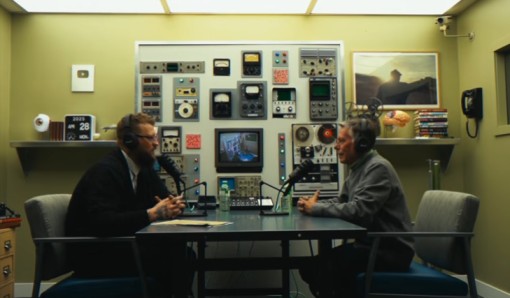
Editor’s Notes: In this episode of Debriefed, Bob Lazar joins the show for a rare and in-depth interview to discuss his experiences at the top-secret S4 facility near Area 51. He details his work on Project Galileo, where he was tasked with reverse-engineering the power and propulsion systems of extraterrestrial craft. Lazar reflects on the ominous atmosphere of working with alien technology and shares intriguing anecdotes, including a story about a hidden camera left behind at the facility. This conversation offers a unique look into the technical challenges of gravity-based flight and Lazar’s enduring quest for answers about how these machines truly function. (April 10, 2026)
TRANSCRIPT:
Introduction and Background
CHRIS RAMSAY: Do you like the sound of your own voice?
BOB LAZAR: Yeah, it’s kind of weird. Yeah. I don’t really like it, but I have to deal with it.
CHRIS RAMSAY: Yeah. No one does. Well, especially after doing this documentary.
BOB LAZAR: Yeah. Yeah.
CHRIS RAMSAY: Do you ever get sick of watching yourself on video?
BOB LAZAR: I can’t tolerate myself on video. It’s just like listening to your voice. Anytime I look at myself, I’m disappointed. I mean, I never meet my own specifications. If I look at a sketch I made, I mean, oh my God, how embarrassing. So yeah, I don’t know. I don’t live up to my own specs.
CHRIS RAMSAY: I think everybody’s their own worst critic.
BOB LAZAR: Mm.
CHRIS RAMSAY: I’ve had to overcome that in the decade long, incessantly filming and hearing myself and then editing myself on top of that. It’s enough to make you never want to do it again, but I have to climb that hurdle every single time.
BOB LAZAR: Yeah.
CHRIS RAMSAY: So we’re in this together. All right. Bob Lazar. Yes. Welcome to the skiff.
BOB LAZAR: Yeah. Thank you. Thank you. Glad to be here. Yeah.
CHRIS RAMSAY: Good to have you here. Thanks for doing this. I really appreciate it. I know that these interviews, I know that you rarely do them. And not because you’re being evasive, but because you feel like you’ve told your story.
BOB LAZAR: Yeah. I really have. It’s, I thought initially I did one story and then I made a videotape. And thought that would be it. And if anybody wanted to know the story, they could just play the tape.
CHRIS RAMSAY: Yeah.
BOB LAZAR: But people had other questions, other things happen. And so I do it. I don’t really like doing any public appearances, but once in a while I stick my head above. Yeah.
Project Gravitaur and the S4 Documentary
CHRIS RAMSAY: Well, I appreciate it. And I’m sure everybody watching, or most people watching, appreciate it. Yeah, this undertaking of doing this project with Luigi’s Project Gravitaur or S4, the Bob Lazar story. I mean, this has been something you’ve been doing for almost 3 years.
BOB LAZAR: Yeah, it was, after doing Jeremy Corbell’s film, I really thought that would be the end and I had really no interest in doing anything further at that point.
CHRIS RAMSAY: Yeah.
BOB LAZAR: And I was contacted by Luigi. I think I kind of skipped taking his phone calls here and there for a little while, but eventually we hooked up and he said, look, I really— it was so motivated and said, just let’s show exactly what you saw. And eventually I relented and said, okay, let’s go for it. I’ll tell you exactly the way everything was. If you want to do graphics, I’ll correct everything to exactly what I saw.
And I mean, to my surprise, he really, really did it. The graphics I’ve seen now, the CGI looks like it was literally downloaded from my brain. It’s impressive. I can’t tell it from reality. It’s exactly like, so I’m anxious to see the upcoming film because from the little clips I’ve seen, it’s what I saw.
CHRIS RAMSAY: That’s an incredible statement and a great testimony to the project. I myself have had the opportunity to see select clips and even try the VR version.
BOB LAZAR: Oh, that’s really cool.
CHRIS RAMSAY: And yeah, the one thing that struck me putting this on for the first time, for someone who’s been following your story, your journey and really trying to dig into this and try to make connections and figure out what’s going on with this project right now — putting this on, putting this mask on and being in that place, I thought I was excited at first and then an overwhelming sense of dread.
Inside the Craft: An Ominous Feeling
BOB LAZAR: See, that’s amazing because that’s exactly how I felt. And for him to be able to present that on film, it’s surprising to me that that can be conveyed that way. Because when I walked in there, people always said, well, how did you feel going in? How did you feel when you first looked at the craft? And I thought, it’s not excitement. It’s an ominous feeling.
And when I showed it to my friend, or Luigi showed it to my friend Gene Huff, who I had confided in at that time, he said, “Wow, it’s really creepy. It’s almost an ominous feeling.” I said, that’s exactly it. How do you get that feeling through that? So to me, that’s what told me Luigi hit the nail on the head.
CHRIS RAMSAY: Yeah.
BOB LAZAR: Because I can’t describe it, but you experienced it too.
CHRIS RAMSAY: Yeah. And I think I’m excited for people to experience that, if that’s even something to get excited about, if people feeling terrified. But it’s almost so strange because you understand the — pardon the pun — but the gravity of this situation, right? When you’re seeing human technology so primitive compared to this pristine, beautiful, perfect vessel that’s just sitting there with wires coming out of it, extension cords.
And there’s just that dichotomy of our tech versus theirs, and the fact that this is hidden in a hillside somewhere, right?
BOB LAZAR: I mean, it also — nothing has any human marks on it. There’s nothing superfluous. There’s nothing extra on the craft. Not a line, not a bump. There’s nothing stylized. Everything there has a specific function.
CHRIS RAMSAY: Yeah.
BOB LAZAR: And there’s really nothing that we make like that. And also everything has different shapes in our world. Everything has sharp corners or round corners, but everything in the craft didn’t. It was all the same material, all the same sheen, all the same radius of curvature on everything. It’s really a weird environment. And even the way light plays itself inside there.
I was talking to Luigi about this when he was trying to get the craft to work because he has it working in an actual physical environment and we can put in spotlights. And the one time I was inside the craft, they had the little tripod halogen lights set up inside. So there were some other guys working and we came in to see the placement of the reactor and the lights were on full brightness, and they didn’t light up the inside. They lit up where they were shining, but it doesn’t refract anywhere.
You can have a light shining straight at a wall here and coming back, trying to work here and you’re working in the dark. And it’s just a really weird environment. But the fact is that happened in Luigi’s simulation, which again really impressed me because I said, apparently you really got it because it’s not the material, apparently it’s the angles.
CHRIS RAMSAY: Yeah. I mean, not only that, it validates what you’re saying at the same time because to say something like that prior to making it, it almost doesn’t make sense.
BOB LAZAR: Right.
CHRIS RAMSAY: Right. So when you say, oh, we put the halogen lights in the craft, but it didn’t get brighter, it stayed dark — you think, well, just turn the brightness up on the lights, right?
BOB LAZAR: Yeah. That’s nonsense. Yeah. But Luigi, I think he said he turned it up to 600% and it still didn’t get brighter. And I said, that’s exactly it.
CHRIS RAMSAY: Yeah.
BOB LAZAR: That’s exactly how it works.
CHRIS RAMSAY: Strange.
BOB LAZAR: Yeah.
CHRIS RAMSAY: And that’s partially because I guess he had the non-reflective sort of matte metal almost that was absorbent, I guess, light absorbent.
BOB LAZAR: Yeah. But it wasn’t that absorbent. It wasn’t, what do they call it? Vantablack or anything like that to suck light in? No, I mean, it was a pewter color. It should, but that’s how it worked.
CHRIS RAMSAY: Just non-reflective really.
BOB LAZAR: Yeah. I mean, the whole craft is just kind of an enigma.
Meeting Edward Teller
CHRIS RAMSAY: So let’s go back into this project. I want to talk a little bit about meeting Edward Teller initially and what that was like for you as a young man. And with the documentary, there’s even proof now that Edward Teller was at Los Alamos University giving a lecture on the day that you said he was there. And there’s proof of that. There’s footage of that.
BOB LAZAR: Yeah. I’ll tell you what happened. I mean, I was working at Los Alamos. It was a slow day. And in the Los Alamos paper, that day just happened to be the day I was on the front page of the paper. I mean, I drove my little Honda car to work every day that I had put a jet engine in, and sometimes I just drove with the jet to Los Alamos. And the security would flip out about that. But it became noticed. And the newspaper did, well, we’ll do a front page thing on this guy.
On that day, Edward Teller was giving a lecture at the lab. In fact, if you flip over the front page, right on there, it’ll say, “Ed Teller giving a lecture at lab about nuclear weapons.” I don’t remember specifically the topic about nuclear weapons, but that’s what it was. And it was kind of a slow day at the lab, and I wanted to go see the lecture. So I left early to go there.
When I got there, Ed Teller was sitting outside on the block wall by the place he was going to speak at. And I walked out and he was reading the paper. So I walked up and introduced myself and said, “Hey, I’m Bob, the guy on the front.” And anyway, we got to talking and it was really cool because he’s a guy out of history.
CHRIS RAMSAY: Oh my God.
BOB LAZAR: Yeah. Big time. So that was really neat. And went in to watch his presentation, so on and so forth.
From Los Alamos to EG&G Special Projects
Time goes on. I eventually leave the lab, start a business on my own and start contracting with the lab instead of working for them. And then move to Las Vegas. And had been out of the scientific community for a while and just kind of started missing it and said, I have to do something else. So I started sending resumes out and sent one to him, getting a few back here and there, and finally got a response from him saying, “I think there’s some people that might be interested in you.” And he gave me a contact at EG&G Special Projects.
So I went down there. They were at that time based at McCarran Airport in Las Vegas. Big building. And I had no idea what EG&G Special Projects was.
CHRIS RAMSAY: We still don’t.
BOB LAZAR: Yeah. Apparently there were special projects.
CHRIS RAMSAY: Yeah.
BOB LAZAR: But I went in there and had an interview, did really well and kind of went home and didn’t hear anything. I thought, well, I guess that didn’t pan out. But eventually they did contact me and said, “There’s another job I think you would be better suited for. Why don’t you come back in?” So I went back in, had a different interview, and anyway, that was the job for S-4.
CHRIS RAMSAY: How different was that interview? Like, can you give us—
BOB LAZAR: It was the same. It was just different people.
CHRIS RAMSAY: Different people?
BOB LAZAR: Yeah, it was just different people.
CHRIS RAMSAY: Were the questions more scientifically oriented or were they personal?
BOB LAZAR: No, the second set of questions were almost exclusively what I did in my spare time. The first one was like all technical stuff. Yeah. What do you do? What do you do when you leave work? What do you do here? Have you built anything? It was all after-the-fact questions.
CHRIS RAMSAY: So did that strike you as a little strange, really, really unusual?
First Day at Area 51
BOB LAZAR: I’ve never run into that before in any interview. It’s just kind of like they were taking the information from the first interview and just adding any kind of personal stuff to it. Do you drink? Do you go out after work? Do you go running around the bars and things? Anyway, answering all that stuff, and went back home, but eventually they called me.
CHRIS RAMSAY: Yeah. And at this point you’re like, cool, got a job. Nice.
BOB LAZAR: Yeah, got a job. Nice. And what they said, it’s advanced propulsion technology. And it was supposed to move into a 2 weeks on, 1 week off thing where I would actually stay out at the test site.
CHRIS RAMSAY: So you were already doing a lot of work on propulsion yourself with like the jet engine, but your passion as well is sort of propulsion. You know, blowing stuff up.
BOB LAZAR: Yeah.
CHRIS RAMSAY: Yeah.
BOB LAZAR: I mean anything to do with a jet or rocket engine.
CHRIS RAMSAY: Yes.
BOB LAZAR: Or anything high energy, you know, microwaves. If it’s just harnessing tremendous amounts of energy and controlling it, I’m on board with that.
CHRIS RAMSAY: And this seems like a perfect fit then.
BOB LAZAR: Yeah, I guess it will. Yeah. As it turned out to be, exactly harnessing tremendous amounts of energy and focusing it the way you need it. Yeah, it was a dream really.
Arriving at the Facility
CHRIS RAMSAY: So you get a call to get this job, to get this position, and can you take us through your first day as you remember it? If you remember sort of the first day, I’m sure like now after all these years, it’s probably a conglomerate of all sorts of memories.
BOB LAZAR: Yeah. But I can do the first day, but I can’t separate the first from the fourth — yeah, because they begin to fuse together after 35 years.
CHRIS RAMSAY: And sorry to interrupt, but just so people understand this as well, because Luigi actually gave me a really great example. He goes to me and he says, have you tried remembering what your third grade classroom looks like? And I go, yeah, sort of. And he’s like, what color were the chairs?
BOB LAZAR: Yeah. Those are questions people ask me. And they get really upset going, “So you can’t remember, can you?”
CHRIS RAMSAY: I went, no, I can’t. Well, obviously this is all made up.
BOB LAZAR: It’s not, but yeah, I mean, give me a break.
CHRIS RAMSAY: Yep.
BOB LAZAR: The first time I went out there, I was called out to, again, EG&G Special Projects. So I went there and like I said, that’s at McCarran Airport. Now you can go out of the back of that and that’s where they had the Janet flights, which were the 737s, 727s — jets with the red stripe on them.
CHRIS RAMSAY: Yeah.
BOB LAZAR: Anyway, they were only used by the government at that time to fly back and forth to Area 51, or to the different test site areas, to Tonopah and back from Las Vegas. So I flew that and it landed at Area 51. That would be my first Area 51 proper. Groom Lake is where we landed. And then I was taken into a room there, and that’s where we went over all the security protocols and what was expected of me, and signed all kinds of security forms, so on and so forth.
CHRIS RAMSAY: You were alone during that portion, during that flight?
BOB LAZAR: Was there other people? No, during that flight, Dennis Mariani, who was my supervisor — very military-looking guy, short hair, looked like he just walked out of the Marines, no sense of humor whatsoever — yeah, just followed me everywhere and he was kind of my shadow at the time.
CHRIS RAMSAY: Yeah.
BOB LAZAR: But yeah.
CHRIS RAMSAY: Did he have a sense of humor at all or anything? Was he just a straight guy?
BOB LAZAR: No, he was dead serious. Nothing was funny to him at all.
CHRIS RAMSAY: Sounds like a fun time.
BOB LAZAR: Yeah. He was a creepy dude to hang out with. So anyway, we’re there. The first day was really just signing that stuff, and that was about it. Yeah.
The Pilot Who Knew Dennis
CHRIS RAMSAY: I want to talk about something that happened recently. I had someone reach out to the channel — and you know this — who was a pilot for one of these planes, who was contracted to EG&G during those years that you were there, and recalls meeting Dennis over a dozen times. So everybody knew that guy. Yeah, sort of developed a relationship with him. And I’ll keep him anonymous. He was actually supposed to come on here.
BOB LAZAR: Oh really? Okay.
CHRIS RAMSAY: Yeah, we had arranged everything, and then he was very nice, a very nice guy, but then all of a sudden just dropped off the face of the earth, blocked my number. And he was verified. So it was the first time, I guess, we were going to get a pilot from one of these planes to come on. But I guess he may have gotten dissuaded at some point, which I don’t think is surprising to you.
BOB LAZAR: No, it’s not. I hear stories like that from George Knapp too much. “Oh, we got a guy that knows you. He’s seen you there,” and so on and so forth. “We’re talking to him tomorrow,” and tomorrow comes and goes, and the next day comes and goes, and then George has some story that connects to that, and now we’re never talking to him again. Yeah, he’s gone.
CHRIS RAMSAY: So, sufficient to say that he places Dennis there — he called him John, like his nickname or his middle name or something. But he places him there. And then so you get there, you fill out these papers. On that first day, is that all you did? Did they bring you to the site on that day, or did you go back home?
BOB LAZAR: I think that was all that happened that day. We went there late. Like I said, a lot of the days fused together. I think we went there late, did the paperwork, and I went home.
CHRIS RAMSAY: Yeah.
BOB LAZAR: And the next time they brought me to the site.
The Bus Ride to S4
CHRIS RAMSAY: So the next time you get in, you land, you go to the waiting room, or some type of compartment where they hold you until the bus comes.
BOB LAZAR: No, not at that time, because the bus — the second time, the bus was there on the tarmac. Okay. Or close to it. And again, I was with Dennis, and we went into a bus, which was a navy-painted school bus with blacked-out windows, and just sat down right at the front seat, right where the big bar is, and Dennis sat across from me. The entire way we’re driving down — there was like a 15, 20-minute drive or something south — Dennis is just staring at me. I just keep looking out the front window. It’s just a weird guy.
CHRIS RAMSAY: So maybe some type of intimidation technique, because that’s something you weren’t a stranger to over there. Like they would regularly check you, almost like a fear tactic. Very military.
BOB LAZAR: Yeah, certainly after that. The security at S4 was like — those guys train all the time and they’re just waiting for something to go wrong so they can do something. It’s like a football player training all the time and never getting to play a game. So as soon as an opportunity comes up, they’re excited.
But then we went past where the hangar doors would be at S4, because I couldn’t see those, and around the side, and we got out of the bus and went into a single door on the side of this hill. I mean, I couldn’t really see anything. It was just a short area that Dennis led me into.
CHRIS RAMSAY: And sort of this unceremonious, unromantic entrance. So there’s just like a random door in a hill.
BOB LAZAR: Dirt and yeah, it was just nothing. It wasn’t well kept or anything, and went in there and there was a small room and a guard desk. Very uneventful.
CHRIS RAMSAY: So while you’re driving, you said you drove past the doors, the hangar doors — you didn’t see them. Was that—
BOB LAZAR: No, not that time. I only realized I passed them because of — in the future, when I saw them. But yeah, once we made the turn, we had already passed those.
Luigi’s Image of the Hangar Doors
CHRIS RAMSAY: And we get to talk about this now because at this point everything will be, I think, available to talk about, but there’s a picture of those doors. So by the time this comes out, that’ll be publicly available. But that picture you’re talking about — Luigi’s image. Yes.
BOB LAZAR: Oh yeah. Or I mean, there’s also a guy that did that on Google Earth.
CHRIS RAMSAY: Yeah.
BOB LAZAR: Yeah, yeah, yeah.
CHRIS RAMSAY: Yeah. But there’s Luigi’s image.
BOB LAZAR: Yeah, that’s perfect. It’s exactly the way it looked. Yeah.
CHRIS RAMSAY: And not only that, he’s had Ron Masters, who is a spectrometry expert, look at the pixels and everything else and deem this to be authentic — that those are indeed anomalous shapes.
BOB LAZAR: Oh, right, right.
CHRIS RAMSAY: They’re not natural.
BOB LAZAR: Mm-hmm.
CHRIS RAMSAY: And you can count 9 doors. Yeah. I mean, that is an incredible piece of vindicating information that completely exonerates that whole story for me. How did that feel when you saw that picture for the first time? What did that stir in you?
BOB LAZAR: I mean, it’s always great to be vindicated to some degree, but to me, I already know that’s the way it is. So it’s hard to impress me about that. “Hey, what you said is right.” Yeah, I know. So I can’t get too excited about it, but it’s nice to see fewer people saying you’re absolutely full of s*, you know?
CHRIS RAMSAY: Yeah. Yeah.
BOB LAZAR: Yeah.
Inside S4: Security, Scanning, and First Days
CHRIS RAMSAY: When I saw that, I mean, it was almost scary. I was like, whoa, that’s crazy. And not to say that I don’t believe your story, that’s not what I’m saying, but it is something else from an onlooker outside looking in, somebody who’s trying to be pragmatic and logical about things.
BOB LAZAR: No, but it’s a fair thing to say. I mean, you can’t believe it. You need enough information. And if I can’t provide that, it’s fair. You can say, hey, what you say might be true, it might be not. And that’s it. But you can’t make a distinction either way. Without more information, you can’t say this is just total nonsense. Look at the facts. And the facts start piling in, it starts leaning my way. And it’s just nice to see that it’s been going that way.
CHRIS RAMSAY: Yeah, it’s been pretty one-sided, actually. It’s been leaning to your side, I think, since the beginning, in my opinion. Okay, so you get into this door, we’re in this room. Is this the room where there’s the scanner to get into the next section?
BOB LAZAR: Yeah, there is.
CHRIS RAMSAY: Mm-hmm.
BOB LAZAR: Now, there’s sometimes a guard in there and sometimes there’s not. I do not remember if this time there was a guard there. I just don’t.
CHRIS RAMSAY: Sure.
BOB LAZAR: But anyway, there’s the hand scanner. And Luigi’s duplicated that. I don’t remember the name of it.
CHRIS RAMSAY: It was the Identimat, the Identimat, like 2000 or something.
BOB LAZAR: Yeah. And I guess it’s a different version of it.
CHRIS RAMSAY: Mm-hmm.
BOB LAZAR: There’s a bright light on top and you put your hand in the scanner and it measures the length of your bones that are supposed to be unique. That was the first time I was putting my hand on there and it recorded it or whatever. And then it stores your badge in it. So when you put your hand on there, your badge comes out. And it’s a badge that has a magnetic stripe on it. And from that point on, you use it to open the doors.
CHRIS RAMSAY: The doors that you’re allowed in. Yeah.
The Badge, the O-Ring, and Oppressive Security
BOB LAZAR: Now you can either clip it on your shirt or your lab coat or whatever and keep taking it off. Or, as I found out later on, Barry had a bunch of giant O-rings you can clip it onto and then you can stretch it and let it snap back. And the reason you do that is because, like I mentioned about the security guards before, they’re waiting for anything to go wrong. If it slips inside your shirt, if you stick it in your pocket by error and it’s not visible, they will throw you against the wall and give you the third degree about procedures.
Did that happen to you? Yeah, yeah, that did. And that’s why I put the rubber O-ring on and clipped my badge on that. So it was always dangling around. I never needed to take it off. I had it clipped on and it slipped behind my lab coat so it wasn’t visible to the world.
CHRIS RAMSAY: They were just waiting.
BOB LAZAR: Yeah, yeah. Look, if I had to go pee in the bathroom, they didn’t just go to the bathroom with you. They stood there and watched you pee. I mean, they had to watch everything you were doing. Security was so tight. It was so oppressive. It actually just destroyed your will to work there.
CHRIS RAMSAY: Oh, understandably. Yeah. That would be a big bummer. Okay, so I’m piecing this together here on an emotional level and a psychological level. First of all, you’re being flown on a plane with one other person. You’re being taken on this bus ride. This guy’s staring you down, this military looking dude. Blacked-out bus driving off-site, going to this place. There’s this weird shady door. You’re scanning your hand like it’s some type of sci-fi movie. Security everywhere. What’s your emotional state like at this point? Do you remember?
Emotional State and First Impressions
BOB LAZAR: Yeah, I do remember. I had the feeling that not everybody wanted me hired there, and that’s why I was kind of getting the third degree. But I tried to do what they wanted and maintain and still be myself. Things worked out, but it was really uncomfortable and just not— you’re not going to make much progress working like that. You can’t have the military in control of anything other than the military.
CHRIS RAMSAY: Yeah.
BOB LAZAR: And yeah, it just doesn’t work there.
CHRIS RAMSAY: Yeah. And as we’ll come to find out, the military is pretty much in control of all of that and still is, to a certain extent. So you get your badge. Do you immediately meet Barry? Do they take you to meet your partner? How long into the process was it — the first week or?
BOB LAZAR: Oh yeah, it was the first couple days.
CHRIS RAMSAY: First couple days.
BOB LAZAR: Yeah.
CHRIS RAMSAY: You get introduced to your lab partner.
Meeting Barry and the Buddy System
BOB LAZAR: Yeah. The first time I went in to the nurse — if you walk in, right off what you want to call the security room — there’s a hallway off to the right that goes to the nurse and they just do a general checkup and then they do an allergen test on your arm. As the only female there, she explains to you that you’re going to be working with a lot of exotic materials that we know nothing about, and we want to know if you’re going to have any allergic reaction to them. So they do a grid on my arm and just poked me with a bunch of different materials. And then I think I had to go back that day after that, and wait like 2 days before I went back looking for it, and nothing swelled up or any of that stuff.
CHRIS RAMSAY: Thank goodness.
BOB LAZAR: Yeah. Right.
CHRIS RAMSAY: Because what’s the cure for that?
BOB LAZAR: Yeah. Who knows? But I went back and then saw her again. And then there was this general — I don’t remember what the hell she said it was — but something for your immune system or something like that. I drank something like a pine color. It reminded me of Pine-Sol. That color, a deep brownish-yellow color.
CHRIS RAMSAY: Yeah.
BOB LAZAR: Opaque? No, no, you could see through it — it was translucent.
CHRIS RAMSAY: Okay.
BOB LAZAR: And then I was free to go. And that day, whatever day that was, that’s when Dennis took me to meet Barry, who was going to be my lab partner. The way it worked was we all worked on the buddy system, they called it. Everybody has a lab partner. You can exchange information and ideas with that one person, and that’s it. There’s no talking to anybody else in any groups and things like that.
When I went in to meet Barry and saw the lab that we were going to be working in, he was super happy to see me, like he had been alone for a while. He showed me around. There’s kind of a whole story there. But yeah, that was the day that I first met him. And then after I was shown a bunch of things, we went back and it was the end of that day. The days were kind of short. As soon as it started getting fairly dark, I would wind up going home.
CHRIS RAMSAY: Do you know why that is? Or was that just the schedule?
BOB LAZAR: I think it was just because the plane was leaving at that time.
CHRIS RAMSAY: Right.
BOB LAZAR: And I wasn’t set up to start staying there. I knew Barry stayed there — not lived there, but you stayed for a few days. I think it was either you stayed there for a week and had 2 weeks off, or you stayed there for 2 weeks and had 1 week off.
CHRIS RAMSAY: Yeah.
BOB LAZAR: Something like that.
CHRIS RAMSAY: Type of rotation.
BOB LAZAR: Yeah. So I wasn’t at that level yet. I was just being introduced to things.
CHRIS RAMSAY: That must’ve been kind of exhausting.
BOB LAZAR: Yeah, it was because it wasn’t a normal work schedule.
The Unpredictable Schedule
CHRIS RAMSAY: Yeah.
BOB LAZAR: The way it would work was they would call me at random times. It could even be on a Saturday. I’m out mowing the lawn or doing something and I come in and they’d say, somebody would call from McCarran Airport or EG&G Special Projects and they’d say the name — “This is Julie from EG&G Special Projects. It is now 4:10. We expect you to be on the tarmac at 6:15.” And okay, thank you, click. So, all right, I guess I’ll put some clothes on and get there and drive there and park my car, and at 6:15 I’d be standing on the tarmac and get on the plane and that’s it. It’s really weird like that and unpredictable. And I don’t know why that was. Maybe that was some kind of test in some way to see if I’d be flexible or what?
CHRIS RAMSAY: Seems like an environment where — I spoke to a guy, a friend of mine, Hakim Isler. He worked at PSYOP for a little bit in the military, and it was something that they had to go through — stress inoculation. They would constantly be like, “Be up in an hour,” oh, never mind, and like this. They’d be sort of dragged along emotionally just to get them used to being under high stress environments. Maybe that was it. Yeah, they were trying to prep you for certain things.
And so, all right, now let’s get back to Project Gravitaur because we’re coming into this place now. Luigi and his team did such an amazing job creating that bus ride, seeing the hangars from the bus, entering that door, getting your hand scanned, and then eventually going into the infirmary. How accurate is that infirmary?
Project Gravitaur: Recreating S4 with 100% Accuracy
BOB LAZAR: It’s 100%.
CHRIS RAMSAY: Really?
BOB LAZAR: The whole thing’s 100%. Even I couldn’t see the bus on the outside.
CHRIS RAMSAY: Yeah.
BOB LAZAR: You’re seeing what I couldn’t see, but that would have been what my eyes saw. Because the hangars looked just like that. The infirmary was just like that. I mean, they spent 3 years working on this, trying to get it exactly perfect, and to my surprise, they did. So it’s right on.
CHRIS RAMSAY: Was there anything that — I know that a few times, especially when we eventually get into the craft and you mentioned the tripod light — this is kind of information that started arising now that the environment had the ability to jog your memory. Because that’s a real thing. If you showed me a picture of my classroom in grade 3, I guarantee you I’d start recalling things that I’d forgotten.
BOB LAZAR: Yeah, that happened with Luigi too. He’d start building the rooms and say, “Look in here,” and I said, “Oh wait, wait, wait, no, no, the desk was there. Oh yeah, wait, there was a whiteboard there.” I mean, it did bring back memories, but how could it not when you start seeing it and it becomes close to reality? There are a couple of things you always forget until you see it.
CHRIS RAMSAY: Sure.
BOB LAZAR: And yeah, that really filled in some blanks, which was pretty cool.
The Briefing Room: Projects Galileo, Sidekick, and Looking Glass
CHRIS RAMSAY: Yeah, that must have been pretty cool. I mean, in any environment, like if you were to go back in grade 3, I’d still like to see my classroom, be like, “Oh wow, this is kind of gnarly that I get to be here.” So in any scenario, but in this specific one, I think a little bit cooler, arguably. So okay, you go to the infirmary, you get these tests, then you meet Barry. Barry’s excited to see you. Is this where Barry breaks the news that the previous person who’d worked there had passed?
BOB LAZAR: Yeah, yeah. Once I get introduced to Barry and everything’s kind of copacetic.
CHRIS RAMSAY: Yeah.
BOB LAZAR: Dennis leaves.
CHRIS RAMSAY: Okay.
BOB LAZAR: And then Barry is excited to show me around the lab and he says, “I am going to show you stuff that’s so awesome.” I’m like, I’m excited, this is great. But wait, I left out a gigantic part here. Before I met Barry, we went to the briefing room where I read all kinds of briefings.
CHRIS RAMSAY: Okay. Let’s pause here for a second.
BOB LAZAR: We left out a major part. Yeah.
CHRIS RAMSAY: Arguably one of my favorite parts.
BOB LAZAR: So yeah. Okay. After the nurse stuff was done, boy, it’s hard to remember what came before the nurse or the briefings. I think the nurse came first, but anyway, I think it was second — the briefings. I go into a room with Dennis. There is literally a stack of blue folders there. And he said, “Here’s a synopsis of the projects going on. We need to get you caught up, or at least familiarized with them until—”
CHRIS RAMSAY: Yeah.
BOB LAZAR: Then we can bring you in. And so I started reading through those, and that’s where I learned there were several projects going on — Project Galileo, Project Sidekick, Project Looking Glass.
Galileo was the project I was involved in that dealt with the power and propulsion system of the craft. And this is where they talked about reverse engineering extraterrestrial equipment. That’s kind of what I thought, but then I also thought, are they just pulling my leg? Is this nonsense? Is this just some kind of test? So I just continued reading through it.
Project Sidekick dealt with the weapon potential of the craft, and Project Looking Glass dealt with the fact that it produced its own gravitational field — if the flow of time can be distorted. And again, I’m not talking about going back in time. I’m talking about just, can you change time by a few milliseconds? Are you able to affect time at all? So there was a lot to go through there, which I did.
CHRIS RAMSAY: Those three projects — the one thing that stands out to anyone who looks into that is that it’s the three potentialities, the three directions you can take: gravity in space with the craft propulsion, time with time dilation, and then weaponization — how to manipulate gravity, how do we maximize the manipulation of gravity. Weapons, time, space. Control that, that’s like the Holy Trinity. You have that, you rule the world, right?
BOB LAZAR: Yeah, yeah. Look, if you can produce gravity, if you can control gravity, you have a machine that makes gravity and you can control its intensity — you already rule the world.
CHRIS RAMSAY: Yeah.
BOB LAZAR: You do. You don’t realize the potential that has because, as I’ve said before, all the stuff you’ve seen in science fiction movies now becomes a reality.
CHRIS RAMSAY: Yeah.
BOB LAZAR: Now you’ve got force fields, now you’ve got time travel, now you’ve got warp drive. Everything hinges on that. And if they have a machine that is producing its own gravitational field, yeah, they really want to know how to make more of those.
CHRIS RAMSAY: Yeah, that would be high priority. It also — I often think of it as a good reason to keep it secret.
BOB LAZAR: Yeah, yeah.
CHRIS RAMSAY: Get that in the wrong hands, you’ve got some type of time dilating weapon or whatever that is, right?
BOB LAZAR: The other side gets that, you lose.
CHRIS RAMSAY: Yeah, exactly. Out of those three projects, which one do you find most fascinating?
BOB LAZAR: I naturally like Propulsion, but I have this real destructive streak in me and I kind of like Sidekick. But on the other hand, all three are interesting — how could you not be interested in interfering with the flow of time?
CHRIS RAMSAY: Looking Glass.
BOB LAZAR: Yeah, that’s the most powerful thing of all. It’s even the most powerful weapon of all — time. But all three of them are incredibly interesting.
The Chronovisor and Project Looking Glass
CHRIS RAMSAY: Have you ever heard of the Chronovisor?
BOB LAZAR: No.
CHRIS RAMSAY: There’s an Italian guy — he was a monk actually. A Benedictine monk. Father Pellegrino Ernetti, in 1950, said to have worked alongside Dr. Fermi and Wernher von Braun on a project involving a machine that was able to peer back in time. A machine that they could look through and take pictures of past events, and that the Vatican ended up confiscating it. It’s this deep conspiracy — is this real? Is it not real? I don’t know, but I just thought it was interesting that in the 1950s this actually came — he first talked about this in the ’70s, I think 1970. And so that came to light with the Chronovisor, which I thought was really interesting. So when you first mentioned Project Looking Glass, I thought, “Whoa, that’s kind of interesting.”
BOB LAZAR: That they would have never heard about that.
CHRIS RAMSAY: Yeah. Either way, I see how all three of those things can be incredibly paradigm shifting for any civilization.
BOB LAZAR: Yeah. And they’re all fascinating to work on.
CHRIS RAMSAY: Did that occur to you then — what you were dealing with was beyond anything else? Did that occur to you in that moment, like when you were reading those documents, that “holy s*, this is a big deal”?
BOB LAZAR: If this was true.
CHRIS RAMSAY: Yep.
BOB LAZAR: Yeah, it did. But I was only about 50% there. I had no idea what these guys were going after. So I just read through the stuff, but I knew Project Galileo is what I was going to be assigned to.
CHRIS RAMSAY: Yeah.
BOB LAZAR: I’m all for it.
The Biological Entities and Zeta Reticuli
CHRIS RAMSAY: There was a whole other section of the documents, which we won’t go deep on because I know how you feel about that section as well. But I have to ask, maybe just on a surface level — you know, there was some hypnotic regression stuff that you did in the past to try and bring some of this memory back on what those documents read. But generally speaking, there were mentions that the owners of the craft were from Zeta Reticuli. That was what the document stated.
BOB LAZAR: Yeah, there was a document that dealt with the bio — they called them biological entities that were on the ground.
CHRIS RAMSAY: Yeah.
BOB LAZAR: And I can’t remember the way they worded it, but they had a couple of drawings of them in there. I think there was one photograph and the rest were drawings, and it just showed the biology of their body where their chest was cut open. And there was one single organ inside their body.
CHRIS RAMSAY: Whoa.
BOB LAZAR: Kind of like if you cut open our bodies and all our organs had grown together as one general purpose thing in there.
CHRIS RAMSAY: Whoa.
BOB LAZAR: And that’s just the way they were inside. It also mentioned that some information was gleaned from the craft that made them think it came from Zeta Reticuli, a different star system, only visible in the southern hemisphere, like 30-some-odd light years away. How they got that information, I’ll never know. Again, it was just in there. Whether or not there were aliens that actually looked like that, I’ll never know.
CHRIS RAMSAY: Sure.
BOB LAZAR: It was just pictures in there.
CHRIS RAMSAY: Yeah.
BOB LAZAR: So I always had to make a distinction between the stuff I actually touched and knew worked that way, and what they claimed. This is also one of the things Barry told me when we got working together. He said, “They put a bunch of crap in there. That way, if information is spread around, the garbage they give different people is different. So if people start spouting stories that you read, they know exactly who to trace it back to.”
CHRIS RAMSAY: Yes.
BOB LAZAR: So yes, I was expecting nonsense in there.
CHRIS RAMSAY: Passage material.
BOB LAZAR: Yeah, I didn’t give everything 100% credibility right off the top.
CHRIS RAMSAY: I think as someone who’s pretty left-brained, somebody who’s logically focused, I think I would also react the same way initially.
BOB LAZAR: Yeah, you have to. And just because people say, “Hey, there’s government documents that say that” — yeah, there’s lots of government documents that say nonsense. It’s intended that way.
CHRIS RAMSAY: Yeah.
BOB LAZAR: So don’t be deceived just because it’s the Pentagon that printed it out, or some other government agency, that it’s 100% true.
CHRIS RAMSAY: Yeah, don’t hang your hat on it, but also shelve it, right?
BOB LAZAR: It could be.
CHRIS RAMSAY: Yeah, right. Because that — prior to the podcast we were talking a little bit and you’d mentioned the Betty and Barney Hill case, and that was the only other time you’d heard that, back in the ’50s or ’60s.
The Betty and Barney Hill Connection
BOB LAZAR: Yeah. Now I don’t follow UFO lore or stories or UFO researchers, but I have heard a few stories. What was interesting is the Betty and Barney Hill story, back in the early ’60s — a mixed-race couple claiming to be abducted by some flying saucer. And apparently Betty was able to talk to the aliens. And before they let her go, she said, “Where did you come from?” And they showed her a map. She remembers the map and during an interview draws it out, and they went, “Yeah, well, that’s Zeta Reticuli.”
And the fact that it said Zeta Reticuli in my paperwork — well, that’s a connection there. And so I pay attention to that. So maybe that story is true. Again, I don’t know for sure, but I do know for sure how the propulsion system works.
CHRIS RAMSAY: Yeah, that’s something you can hang your hat on. What I find really fascinating is that everything that you read about Project Galileo ended up being true, right?
BOB LAZAR: That’s another notch you’ve got to move forward. Everything I read about my project, Project Galileo, was in fact accurate. So just maybe everything else was too.
CHRIS RAMSAY: Yeah, but also, yeah, could just be passage material.
BOB LAZAR: Maybe not. Yeah, you’ve got to be careful there.
Genetic Modifications and Suppressed Consciousness
CHRIS RAMSAY: Yeah. We’ll move past this in a sec. I just want to talk a little bit about some of the memories that came back from that. There was also this general impression that there was some genetic modifications that they were doing to the human race, that they were suppressing consciousness to a certain extent — in these documents, as far as you can remember. Did that ever disturb you going forward, after that? Or did you really just kind of categorize that as “this could be BS”?
BOB LAZAR: Yeah, that really set off the BS alarm.
CHRIS RAMSAY: Okay.
First Encounter with the Craft
BOB LAZAR: I said, there’s — they claim there is, many corrections to the genetic evolution of humans and, just all kinds of other wild claims that had no proof to back them up whatsoever. And I really didn’t put much credence in it at all. So I just brushed it off.
CHRIS RAMSAY: Okay. So now you read these documents, you’re getting a little more prepped. They’re surrounding you with all these guards, these people, they’re giving you documents to read, these strange files.
BOB LAZAR: Yeah, but I still don’t know what I’m really working on. I’m still expecting a very advanced jet fighter at this point. So I don’t — I think they’re just testing me with all this. “What if we gave you information about flying saucers? Would you tell anybody about it?” No, I wouldn’t. I’m staying with the program. And yeah, I’m expecting to be brought in there and seeing the F-32 or something like that. And that’s when they brought me into Barry.
CHRIS RAMSAY: Mm-hmm. So you meet Barry, he gives you a tour prior to seeing the craft, obviously. You get all the propulsion stuff now. You get all the —
Barry’s Demonstration of the Propulsion System
BOB LAZAR: Yeah, he has the part of the propulsion system laid out on all that and really can’t wait to show me. And he says, “You’re going to love this.” And there’s the small reactor, there’s the gravity amplifier and the emitter on another table, and the system is running. He said, “Try to put your hands on the sphere there,” which I did, and when I got close to it, I couldn’t. It pushed off just like the like poles of a magnet, if you ever played with two big magnets, but with my hands. I went, “Oh my God, what is this? It’s a real force field.”
And he said, “No, just try with all your might.” And I did. And you can’t move an inch. The first maybe 2 or 3 inches is somewhat elastic. But after that, you’re not getting anywhere. And the thing — he shut it off. And the reactor is kind of a hemisphere on a plate. And he moved it, and he said, “It’s not connected to the bench,” and turned it on again, and he said, “Push on it.” So I mean, what he was showing me was the force was not being transferred to that — where even if you couldn’t touch it, you would think it would slide away, but it wasn’t. So the force is just going away. It’s not being transferred to the device that’s repelling it.
This stuff was amazing, man. And then he showed me what this is actually doing is powering this emitter here. And then he showed me how that worked. And then he also mentioned, “You’ll notice nothing’s connected together.” Where are we? This is like the Twilight Zone. This was really, really blowing me away. And like, is this what powers the aircraft? And he said, “What did they explain to you?” I said, “Nothing. I just read these briefings.” And so Barry went over everything with me. And this is when I really realized, okay, we are reverse engineering something that some other entities made. And this is where it became real for me.
CHRIS RAMSAY: When Barry went over everything that you had gone through, how long was that little brief that Barry gave you? Was that like a 30-minute spiel or was that like —
BOB LAZAR: No, it was like a couple hours.
CHRIS RAMSAY: A couple hours?
BOB LAZAR: Yeah, because every time Barry would go, “Yeah, and there’s this —” I went, “Stop. What do you mean there’s this?” And we’d have to explain every last bit of what he’s learned from that point. I said, “Okay, now let’s go to here. How come this? How did you turn this off?” So it took a long time of me constantly stopping him.
CHRIS RAMSAY: Yeah. In shock, I bet, just constantly.
BOB LAZAR: Yeah. But it was great because I really felt like I was privy to information that only a few people had and like, we could control the world with this stuff. But we had no idea how it worked. So that was kind of our task.
CHRIS RAMSAY: Wow. That must have been so exciting for Barry, honestly, as well.
BOB LAZAR: Yeah. Yeah.
CHRIS RAMSAY: He was — I’m thinking you’re excited about working alone, possibly just lost his partner. Don’t know how long ago, and then someone new comes along who’s like a puppy.
BOB LAZAR: Yeah. It’s like a guy showing off his new car. “Check this out.” Yeah.
CHRIS RAMSAY: And he, you know, how cool that he gets to be the one —
BOB LAZAR: Yeah.
CHRIS RAMSAY: — to tell you this stuff is real, with certainty and show you. That’s got to be such a cool moment for the both of you to experience. But is this all lighthearted still? Is this all excitement-based, or — initially it was that day?
Getting Down to Work
BOB LAZAR: Yeah. And then quickly things — it seemed like they were in a rush to do anything, to find out anything. So we had to get down to work eventually, quickly. And a lot of it was boring work. It was not exciting. It was making small changes and analyzing different parts — although there were different groups that dealt with like the materials, the metallurgy of the craft and what everything was made of. We dealt more with the interaction of the components and how they actually propelled the craft.
And it was — I think it was another day or two days before I actually got to see the craft, because we had to know if the placement had anything to do with it. And really, they weren’t even anxious to let us look at the craft. But we kind of campaigned for that, going, “Look, it might be — nothing works, there’s no wires anywhere. It might be that placement is critical on this stuff. We have to see how it’s laid out in the craft.” And it was kind of like an, “Okay, you can go in and see it.”
CHRIS RAMSAY: I see.
BOB LAZAR: So that’s when we were actually allowed to see it. And that’s when the world opened up to me. It’s like, Jesus.
CHRIS RAMSAY: Yeah. So now walking into that space for the first time — was Barry with you?
BOB LAZAR: Yep. Right behind me. I walked in first.
CHRIS RAMSAY: Was he like poking you in the ribs and being like, “Wait till you see this?”
BOB LAZAR: No, no. It was just by my back.
CHRIS RAMSAY: No horsing around. Yeah.
BOB LAZAR: He was probably just looking at my reaction.
CHRIS RAMSAY: Yeah. Just watching you light up.
BOB LAZAR: Yeah.
Seeing the Craft for the First Time
CHRIS RAMSAY: So you see this craft. Were you prompted prior to entering the room with anything? Do you remember if they were like, “Hey, keep your head down?” No, nothing. Just walked in?
BOB LAZAR: No, when I — the first time, well, I had actually seen the craft. That’s actually the second time I saw the craft. Yeah, the first time I saw the craft, I came in through a hangar door. And this is where the days kind of get mixed up. I think it was the third day I was there. I came in through, instead of going around the side of the building, the bus stopped at the first hangar door that was open. So that’s when I went out that way.
CHRIS RAMSAY: I see. Yeah.
BOB LAZAR: And Dennis led me in, and that’s the first time I saw the craft. And I slid my hand along the craft as we were walking in, and that’s the first time I was reprimanded by a guard. “Keep your hands down. Your eyes forward and go through the door.” So that’s the first time I saw the craft. When I first came in with Barry from that day was the first time I was allowed in the craft.
CHRIS RAMSAY: And that was the first time you were aware that the craft was extraterrestrial?
BOB LAZAR: Because prior to that, yeah — when I came in and walked in that way, they had where the hatch part was, they had an American flag stuck on there. Reversed, for whatever reason. And so I thought, that’s a fighter.
CHRIS RAMSAY: Yeah, that’s what people are seeing.
BOB LAZAR: Yeah, yeah, yeah. I think I have these days screwed up because it gets confused in my mind. But anyway, so I came in there and still in my mind that was an American-built thing.
CHRIS RAMSAY: Yeah.
BOB LAZAR: But it was again when I was in with Barry and we saw the gravitational propulsion system working, how it repelled, and talking to him — that’s when I realized this is a machine from another entity. And when we came in and walked in the hangar that day, I looked at this completely in a different light.
And we walked up the stairs they made for it. And clearly it wasn’t made for a human to get in, because you had to crawl in and you couldn’t really even stand up until you were almost in the center. But we looked around and saw — he showed me where the reactor is and how you can look down into where the emitters are on the third level in the craft. And that was all very amazing, to say the least.
The Feeling Inside the Craft
CHRIS RAMSAY: Was there a feeling of an alteration of environment when you entered the craft as opposed to when you were outside it? Did you feel like there was a static charge, or like it was colder, or it had a smell to it?
BOB LAZAR: No, it was just an ominous feeling because everything’s the same color. Everything has the same radius of curvature to it. The only sharp edges in the whole thing are the reactor plate that it sits on, but everything else has a curve to it. Everything is the same material and the same color. So it feels otherworldly.
CHRIS RAMSAY: Yeah.
BOB LAZAR: When you’re in there, because human environments are full of different colors, different textures, different angles, but it’s not there. It’s just weird.
CHRIS RAMSAY: And just almost uncanny valley type, like this isn’t — yeah.
BOB LAZAR: Yeah. It’s a really — it’s just automatically uncomfortable. It’s just, we’re so used to something else. People say, “Well, that must have been so cool.” No, it was not cool at all. It’s like, I actually wanted to go back out. It was cool to look at it, but it’s a really creepy feeling in there. It’s really ominous.
CHRIS RAMSAY: Almost like you’re not supposed to be there.
BOB LAZAR: Yeah. Yeah. That’s the actual feeling. I think I said it — I just felt like I shouldn’t be in there.
CHRIS RAMSAY: That’s how I felt when I first put on the goggles.
BOB LAZAR: Oh really?
CHRIS RAMSAY: That’s exactly what I said — like, I feel like I shouldn’t be here.
BOB LAZAR: Yeah. That’s weird that that translates.
CHRIS RAMSAY: Yeah.
BOB LAZAR: To me, that tells me that Luigi got it exactly right.
CHRIS RAMSAY: Yeah.
Recreating the Craft: S4 and Project Gravitaur
CHRIS RAMSAY: You worked with Luigi for 3 years building S4, building the bus, the cafeteria, all these different — like the hallway, all this. But the craft is like, this is the magnum opus. This is the thing that you had to rebuild and you had to make perfect. Now, if I look behind me here, there’s like a little model that you had made — the maker’s model of the UFO, which was 1/48th scale, back in the day. But this was a totally different —
BOB LAZAR: Oh yeah.
CHRIS RAMSAY: You went deep on this with Luigi.
BOB LAZAR: Yeah. This is —
CHRIS RAMSAY: How close is the craft to your memory of the craft when you see it through the eyes of S4: The Bob Lazar Story and Project Gravitaur?
BOB LAZAR: Now let’s, I have to say, I mean, even being conservative, it’s 100%. I mean, we went through it again and again. Now, I may not be recollecting it at 100%, but from what I remember, that is 100%. That’s exactly the way it looked. I mean, there’s some question. Was there another bump onto the black insulating ring?
CHRIS RAMSAY: Yeah, sure.
BOB LAZAR: I don’t remember, but this is what was in my mind. So that’s, like I said, Luigi’s images are like they were downloaded from my brain. They’re exact.
CHRIS RAMSAY: Seeing this thing in Project Gravitaur as well, in the documentary, when the doors open and it starts hovering and it goes outside.
BOB LAZAR: Now, I didn’t see that, right?
CHRIS RAMSAY: But you’ve seen the craft elevate?
The Test Flight
BOB LAZAR: Yeah, I mean, the one time, the one time we were allowed, Barry and I were working in the lab and then Dennis came in and he said, “Hey, there’s a test flight going on, why don’t you guys come out?” And there was one of the doors in the lab led right to the big hangar, so we could open that and we were there. So it was already out on the lakebed. So I don’t know if they hovered it out there or floated it out or what the deal was.
But there was clearly somebody, and this is one of the things that still confuses me to this day, it has a gravity field around it, and you know, that’s going to bend everything from light to electromagnetic waves and all that. Yet there’s a guy on a desk with a conventional HF radio or VHF radio talking to someone inside the craft. Now that should be impossible. It just, it shouldn’t work at all. But it did. So I had a lot of questions about how that was even working and that caught my eye.
Anyway, the craft was out there and some time went by and then the craft began to lift silently off the ground. There was a little bluish purplish glow on the bottom, which was just kind of a corona discharge because the craft produced high voltage on its skin, which, by the way, if you shorted it out, it didn’t do anything different. So it’s just like anything you changed in the craft, it didn’t care about.
So, once it lifted, it just stayed there for a while, and Dennis told me, “Go out and go under the craft.”
CHRIS RAMSAY: Dennis told you that?
BOB LAZAR: Yeah, yeah. And Barry stayed there and I said, “Oh, okay.” So I walked out there, kind of looking up at the craft. And as I walked out, I looked back toward Dennis like, am I doing the right thing? And he pointed up to look at the craft. So I did.
And as I walked out under the craft, I couldn’t see the craft. As I got closer to it, the craft just turned into sky. What I was seeing was the light bending around the craft, which was just incredibly awesome. So I took a step back and I could see the edge of the craft and I went back under it.
But also the other thing that hit me at the time was it’s not transferring its weight to the ground. You know, if you have something and you’re producing a force and pushing on it, it’s just not on a pedestal where it’s taking the weight of the craft and transferring it to the ground. The weight is just gone. So I’m under it. I’m not getting crushed by it. I can walk freely and I can’t see the craft.
CHRIS RAMSAY: No wind, nothing.
BOB LAZAR: No, there’s nothing at all. No sound. And I step back and then I can see the edge of the craft come back into view. And walk back. And I mean, that’s amazing. That’s an imprint in my brain that’ll live forever. So the mass is being canceled out there. It’s not being transferred down. It’s not standing on a pedestal of anti-gravity. It’s just going away.
CHRIS RAMSAY: Yeah, that is so weird to think about because it’s so unnatural and unlike anything you would—
BOB LAZAR: Yeah, but imagine if you could control that, right? You could do— I mean, what you could do. I’m so jealous of their technology.
Project Gravitaur and Reliving the Experience
CHRIS RAMSAY: So yeah, okay, so in the hangar we see this craft. Now in Gravitaur, they’ve recreated the craft, they’ve recreated the flight characteristics of it, they’ve recreated— in Blender and all these other softwares and whatnot, you’re getting to relive this. Is there a point? And I just want to make this point for the audience because I want them to eventually experience this too. And I want them to support the project and go check it out because it will, I think, change a lot of people’s perception one way or another.
If you don’t believe the story, if you believe whatever it is, it’ll change your perception of it because it’ll put you in that space. Did you feel at any point like, “Man, people are going to understand now what I saw?” Like when you were watching this with your own eyes, do you feel like, “Oh, this will help people understand what I saw?”
BOB LAZAR: When I saw Luigi’s graphics. Yeah. Yeah, I did. To some extent.
CHRIS RAMSAY: Does that make you feel—
BOB LAZAR: Yeah, because a lot of people had just wrong ideas of it. I mean, even when Luigi released the first image of it in the hangar, you had a bunch of people come by, “Oh my God.” So that’s, I always thought it had some kind of landing gear in it. And people had all these other preconceived notions that was going on. Some guy said, “Clearly it’s the whole thing’s a lie because from what you said, it’s impossible to see the American flag.” And Luigi did everything exactly to scale and put the camera exactly, and if you walk by, you can see there was the flag exactly where I said.
So I thought, to some extent, it’s certainly going to prove some of the things I said. But you always have the people that just really don’t care. They’re going to— it doesn’t matter. “This is all nonsense.” But I’m fine with that. That’s okay.
The First Time Inside the Craft
CHRIS RAMSAY: So this is the second time you see the craft. The first time you’re allowed entering it. Now, just to back up, the first time you see the craft, was when you were walking by through the hangar and touching it. Was this also the time you saw the officer talking to, quote unquote, “the kid,” or what they called the kids, or this small, whatever it was, whether it’s a doll or whether it’s a— was that at that point or was that later?
BOB LAZAR: I think it was at that point. Yeah. When you were walking through and you kind of like glanced, because yeah, I walked in and then we went straight out. There’s a door. Straight in the back of the hangar to the right side. And then the door across from that, these doors have like a 12-inch wire piece of glass in them. And as I turned the corner, I looked in there and there were just some guys in lab coats looking down at one of the seats.
And I think they had a mannequin or something in there so they could just see, “Well, how big would the creature be if it sat in the chair?” And they were measuring things and looking at it. And I had mentioned that before, and people said, “Oh well, you saw an alien. Aliens are working with them.” I said, “No, no, no, no, no, I think these guys are trying to figure out how big something would be if that was a chair.” So yeah, I don’t believe there was any aliens around there.
CHRIS RAMSAY: Yeah, it didn’t like— didn’t have like a large head and like a blue jumpsuit or anything, did it?
BOB LAZAR: No, no, no, no, no, no.
CHRIS RAMSAY: Okay.
BOB LAZAR: I think they were— yeah, that makes a lot more sense.
The Chairs and the Archway
CHRIS RAMSAY: What’s interesting too is that the chairs have some significance because you’d mentioned while you were in there, the one thing they didn’t allow you to play with was the chairs.
BOB LAZAR: Yeah. And there’s no fooling around with the chairs. Like if they were just chairs— and I say the only reason I think Barry and I call them chairs is because they looked like chairs. But again, I have no information about those. They may not have anything to do with being chairs.
And when you really look at it, look, there’s 3 of them in a triad formation. One of them right in front of it is the waveguide. Why would you ever put a chair? I mean, you’re going to sit there and there’s going to be a pipe in front of your face. So it’s like the worst seat in the saucer. And then there’s 2 other chairs on either side of that. They do all face to one archway.
And when we were in there, Barry and I looking at the reactor on the ground, there was another group of two guys in there that had light shining on the superstructure, which has archways all around it. And whatever they were doing caught my attention because one of those archways became transparent when they were playing around with it. So these seats were aimed towards that. So, was that a window? Could all the archways do that? Were those really seats or is it just a coincidence that they energized that?
CHRIS RAMSAY: Was that also the archway that had the writing?
BOB LAZAR: Yeah. Yeah. After it stayed clear for a bit, it turned blue and then there was writing that looked— I don’t know how to describe it, but if you look at Korean and if you make it italic, it looks something like that.
CHRIS RAMSAY: Can I pull up a picture of some writing and maybe you can tell me if that looks like it? Okay, hold on, because I just want to pull up some writing of another case that— so there’s that.
BOB LAZAR: No, no, different from this.
CHRIS RAMSAY: Yeah, totally different from that.
BOB LAZAR: Yeah, totally different from that.
CHRIS RAMSAY: Okay, and then I have another. I’m taking this time because I think a lot of people would appreciate some either confirmation or whatever, so you can stop speculating about their own alien writing. This is from another sort of leak. I bet I could find it. Nope, nope, not that either, because this one does look a little more like Asian writing, a little bit more like kanji or— not quite it.
BOB LAZAR: No, no, because there is the writing that you guys did on Project Gravitaur.
CHRIS RAMSAY: Yeah, it’s much closer to that.
BOB LAZAR: It’s much closer to that. It’s not— now I’m not saying it’s Korean, it’s not, but there’s lots of circles and lines.
CHRIS RAMSAY: And these shapes were doing this kind of—
BOB LAZAR: Yeah, yeah, also, which is— yeah, that’s so strange. It’s weird in itself.
CHRIS RAMSAY: Very alien, very, very on par.
BOB LAZAR: But remember, they were playing with that system, so maybe that wasn’t the way it was supposed to be.
CHRIS RAMSAY: And at that point, you were drawn to it.
BOB LAZAR: Yeah, yeah, yeah. And then immediately again, “Pay attention to what you’re doing here. That’s not where you should be.”
CHRIS RAMSAY: Was Barry like, “Hey, don’t—”
BOB LAZAR: Yeah, yeah, yeah, yeah, yeah. We were constantly concerned about getting in trouble. It ruined everything because, maybe that had something to do with the power and propulsion system. We need to talk to these guys. There needs to be free discussion for science to move forward. But compartmentalizing everything to keep everything completely secret— you’re tying yourself up.
The Purpose of the Chairs
CHRIS RAMSAY: Do you think the chairs, if they are chairs, which I think they are, by the way, because very well low ceiling— I mean, they’re probably little guys sitting in there, or little genderless aliens, whatever they are. Do you think that those chairs could have something to do with the sort of steering capability of the craft? Maybe. Like, if you were sat there, you had some type of— maybe they were all in action.
The Craft’s Interior and Propulsion
BOB LAZAR: They were all equidistant from the reactor at that point. The fact they were all pointing in one direction — my guess is from the way the craft operated and traveled, if you’re going to sit there, it would only be for a short time. It’s not like you’re going to sit there for an hour to go anywhere. It’s just going to be minutes. So because of the rate of travel, the seats, obviously they’re not padded or anything. It’s just a cutout, a smooth cutout that you sit in. So it’s just like you’re going to sit in, we’re there, and get up again. But maybe that had something — the placement had something to do with controlling the craft.
CHRIS RAMSAY: Yeah, because there are — I mean, you look back at other crashes or alleged crashes that happen, whether it’s Roswell or Aztec or these type of things. And Aztec, actually, they had — there was some symbols in that craft that they —
BOB LAZAR: And I might pull those up and show you those because those might actually, now that I think about it — but it might also have something to do with, if they were living beings and 3 of them, maybe the reactor only puts out a field so big to protect them from inertia. Oh, from getting kind of a splatter. Yeah. So they’re immune to all the effects of the way the crafts operate and they just need to sit there to be protected. Right. So it could just be that, just a place to sit for all the action to take place. And then you can get up and we’re there, everybody disembark. But that’s interesting though.
CHRIS RAMSAY: So it’s like they knew how to fly these things, obviously to maybe a limited capacity, but they did know how to — like the craft that was in the air that you saw was the same craft that you were in. Yeah.
BOB LAZAR: Yeah. Yeah.
CHRIS RAMSAY: So it wasn’t like they needed you to figure out how everything sort of worked together. They had that figured out. Yeah.
BOB LAZAR: And look, we keep trying to put a pilot in there. Maybe there isn’t. I mean, right. Yeah. Look, our cars and just recently developed flying cars and stuff are autonomous. Maybe that is. It has nothing to do with it. They sit in there and just run the program. We’re home, or we’re to Earth, or wherever you’re going. Nobody needs to pilot anything.
CHRIS RAMSAY: Maybe the fact that there were pilots in there doesn’t necessarily rule out the autonomous theory as well. Yeah, they might be part of the craft.
BOB LAZAR: Yeah, that’s true.
Inside the Craft
CHRIS RAMSAY: Just a biological component. Okay, so you got to stand in the craft, which is interesting too — you’d mentioned the tripod lights before and how, when you were recreating the craft with Luigi for the documentary, you got in there, realized, oh, there’s no light. And Luigi’s like, “There’s no light in there. How do we see?” And you’re like, right. They had a tripod light. You went back, you found the exact model that they used, put that, shined it in — turns out it doesn’t really light up the craft much. But one thing that struck me from seeing that, and maybe you also felt this, but you had these stairs, right, that they rolled in to sort of crawl into the craft. But then there’s this orange extension cable.
BOB LAZAR: Yeah, I mean, there were Black & Decker extension cords everywhere, which kind of connected this thing to Earth. You know, made it more real. Tethered it. Yeah. Nothing’s going to work without an extension cord going to it. Yeah. Just to power the lights inside and other tools and things.
CHRIS RAMSAY: Yeah. That was one moment for me seeing this that really cemented this — how far we are from what we’re dealing with here — is that we have this orange cable just dangling outside of this pristine, beautiful, perfect craft. Yeah. This Ferrari of the universe, right? Yeah.
BOB LAZAR: We should — we’re not even worthy to dismantle it. Yeah.
CHRIS RAMSAY: And we have this orange cable being plugged into a wall and they’re like, “Don’t trip on that cable.” Okay. So you get to go in there, you get to play around with things. Now you see the panel go transparent. I’d mentioned to you before the podcast as well, it’s really, really interesting because in the Aztec case — again, I bring back the Aztec case — there was a witness at Wright-Patterson who had also seen the craft go transparent due to an injection of like high voltage. So again, this idea of like high voltage energy — a lot of weird things start happening, and he could see through the craft, but it was like blurry.
BOB LAZAR: Yeah, yeah. I mean, that kind of all fits because first of all, we know there’s high voltage on the craft because it lifts off the ground. You can see it and we can measure it. So there’s a high voltage potential — excuse me — on there. And the craft wasn’t perfectly clear. It was kind of looking like through a shower door to some degree. Not totally like refraction. No, just that milky white, maybe sandblasted look or something like that. Just not translucent, not transparent. Right.
CHRIS RAMSAY: You know, almost camouflage. Yeah.
BOB LAZAR: But I mean, you could see people out there. You just couldn’t really identify them. So, yeah.
CHRIS RAMSAY: Really interesting. Because as someone who’s looking into this stuff, I’m seeing them piecing together all these different things and now I’m like, wait a second.
BOB LAZAR: Yeah, well, you have knowledge of a lot more other UFO info. I don’t really follow any UFO stories or lore researchers. So yeah, you could probably plug more things together than I could for sure. Okay.
The Gravity Experiments: Time Dilation and the Black Hole
CHRIS RAMSAY: So craft out of the way. We’re back in the lab. We’re doing some tests. Now there’s something that I did want to touch on. There were two instances with some of the tests that you did that really, really stood out to me. And I’m sure it stood out to you to a greater degree. One involved time dilation, it would seem, with a candle. Yeah, yeah, yeah. And the other was what I can only describe as like a miniature black hole.
BOB LAZAR: Okay, this is when Barry — we were working in the lab, and when he has the entire system connected together, so the gravity amplifier is emitting — it’s producing its gravitational wave. And he can rotate the emitter and the effect changes the output.
So one thing he showed me was he took a candle and lit it and put it in the focal point of the emitter. And he turned it, and normally the flame is moving to some degree because of convection, and it went out from the heat and the flame stopped. And he said, “That flame is frozen in time.”
And I said, “It can’t be because I can see it. If it was frozen in time, there wouldn’t be photons emitting from it.”
He said, “No, it’s frozen in time. Look at it.” And I went up, inspected it. I couldn’t get my hands in there because he said not to for whatever reason, but clearly the candle was frozen. And he moved or rotated the emitter and it became a candle again.
And he said, “Watch what happens when we go way past that.” And he turned it — now I can see if the emitter is sitting there and you can see across the table, you can see the other wall and our desks and that sort of thing. So he rotates the emitter further than he did before and a little black dot, a little ball forms there.
How big about? About like that. Like a baseball? Yeah. Or maybe a tennis ball, something like that, maybe even a little smaller. And he said, “That’s the light bending away from there.”
So I got right up to it, as close as I could safely come to it. And it was a completely dark spot there. It was like a little black hole, but it wasn’t affecting anything else in there. I mean, if it was a black hole, there’d be books flying and things getting sucked in. But it was just sitting there quietly, only bending light.
And how can you do that even if you had a machine that made gravity? How can you selectively pick photons to distort or move or attract to and nothing else? So I mean, everything was amazing about this.
CHRIS RAMSAY: You had a laser test too that you did with this, didn’t you?
BOB LAZAR: I did that at home.
CHRIS RAMSAY: Oh, yeah, that’s a different story.
BOB LAZAR: Yeah, that I did at home. I see. But yeah, I’m kind of so upset with myself to some degree that things didn’t work out and I didn’t allow him to do that, because I have such a desire to know more about what we had there. And I, to this day, I wonder — it’s been 35 years — what they came up with. Maybe they know everything about it. Maybe they haven’t learned one thing. I mean, I’d like to know. I like to say, “I’m sorry, can I get back into the project?”
CHRIS RAMSAY: Yeah. No, I hear that. Do you think Barry’s still working there?
BOB LAZAR: 35 years? No. Probably not. Probably retired. Yeah, he’d be an old guy.
CHRIS RAMSAY: Yeah, maybe he’s watching this.
BOB LAZAR: That’d be great. That’d be great.
CHRIS RAMSAY: Anything you want to say to Barry?
BOB LAZAR: Give us a call. Yeah, right.
Reflecting on the Impossible
CHRIS RAMSAY: Fair enough. Yeah, those experiments are wild. Seeing a flame stop — it must be so jarring, because I work — I can show you some illusions after this that are kinetic and they will trip your senses. They will absolutely play with your perspective and create anomalous visual perception of events that should be completely impossible. They’ll change even how things move in time. There are certain illusions I have, but those are illusions and I know how they work. Yeah.
So when you have something that you try to look at and you just can’t figure it out and your brain glitches out with how it works — a lot of people experience that with magic tricks when they’re trying to explain it and they just can’t. And then eventually they have to give up and they have to just unwillingly suspend their disbelief because they just can’t figure it out. I mean, that must have felt like a bit of a magic trick to you in the sense that not only did it fool you, but you probably also got disenchanted from it to a certain extent.
BOB LAZAR: Well, yeah, certainly those that I can’t interact with — you can just see those two tests. But things like feeling the field on the reactor where you can interact with it and you can shut it, turn it on and shut it off — that’s not disenchanting, that’s frustrating, because I can touch it and I can see it’s working. And I want to know how to make this work. And again, walking under the craft, I saw this thing in the hangar and I’m looking above it and I can’t see it. And I take a step back and it’s there. I must know how this works. Yeah, it’s just a very driving factor.
CHRIS RAMSAY: I can see that about you as well. As we walked in, I have this shelf filled with knickknacks, puzzles, and just whizzing gadgets. It’s kind of like a toy factory over there, and I have all these little trinkets, and I could see you immediately as you picked one up, and I told you, “Oh, that’s a puzzle.” Yeah, those — it will —
BOB LAZAR: That will kill me. You had to put it away.
CHRIS RAMSAY: Yeah, right. So I think we suffer from the same affliction when it comes to wanting to know how things work, and things will just bug me — yeah, I have to figure it out. And that’s the other thing about magic, is that there is a method for everything, even if it looks impossible, right? There’s a method. As there is for this. So after you got out of there, after you’ve worked with all that stuff, what would be your best educated guess as to how some of that works? What’s your best working theory? I’m sure you’ve thought about it long and hard. What do you gather from all of that? And this is kind of what I have to go to bed with at night.
Element 115 and the Nature of the Propulsion System
BOB LAZAR: That’s kind of hard to say because a lot of it’s just a guess. I mean, the reactor itself appeared to be powered by a super heavy element, element 115. They’ve since synthesized that, but what we had was a stable version of it. And there are isotopes of many elements. Some of them, they’re all the same element, but some are stable and some are unstable. This one was a stable version of element 115.
Clearly, there’s something unique about that because that was in the reactor. And from what we can ascertain from X-raying the reactor, the base plate, it looked like a little accelerator, like a little cyclotron. So it looked like there’s some nuclear manipulation going on there where they’re bombarding the target, the element 115 sample in there, and it’s producing some kind of effect, producing some kind of gravitational effect.
And I’m not even sure it’s gravity. As time goes on, I’m increasingly convinced that there’s another force of nature, that gravity is only the property of mass, where you get enough mass together, it has gravity, little mass, just little gravity.
CHRIS RAMSAY: Gravity A. Yeah, well, gravity. Actually, gravity B. Yeah, or gravity V, right?
BOB LAZAR: Yeah, it’s just on a large scale, you get a whole planet, it can pull rocks towards it and hold people on it, and that thing. It’s not a very strong force. But we call this antigravity because there’s nothing else to call it because it’s just, there’s no other propulsion system and it lifts off ignoring gravity. So we call it antigravity, but I think there’s another force that we haven’t discovered. And that’s what this machine is taking advantage of.
I think we’re just left to discover how it works, or even discover the force itself. But I don’t think it’s actually gravity. I think it’s just another force that repels. So I don’t know where to go with that, but I increasingly believe that’s the case.
CHRIS RAMSAY: So yeah, because it doesn’t behave like gravity should. Like gravity shouldn’t be manipulatable to that extent.
BOB LAZAR: No, no. And there’s no evidence that gravity works that way. So I think there’s a good chance it’s something else that works similar to it.
CHRIS RAMSAY: Or that’s interacting with gravity.
BOB LAZAR: Or interacts with it. Yeah. But we just haven’t stumbled on it yet. Or maybe we have, like I said, 35 years has gone by and there’s been other people tinkering with that stuff and I can only hope so. It’s just I haven’t seen anything flying around that works like that.
CHRIS RAMSAY: Yeah, man, I would give anything to see something flying around that works like that.
Once You Know, the Magic Is Gone
BOB LAZAR: Yeah, well, once you see it, you’ve seen it. I mean, the drive you have to know, and, boy, I’m really into UFOs, I’d like to see that. It’s like really wanting to see a movie. You know, I can’t wait till the next Star Wars comes out, I’m so excited and all that. And after you see it, it’s gone. I mean, once you see how the technology works and all that, people are like, “How come you’re not following this or going to UFO conventions and stuff?” The amazement’s gone. I see what’s going on. I got to touch it. I got to work with it. And the only thing that’s driving you is not knowing. But once you know, it takes the wind out of your sails.
CHRIS RAMSAY: It’s kind of like a magic trick. Yeah, yeah, yeah. There you go.
BOB LAZAR: That’s exactly like a magic trick, really.
CHRIS RAMSAY: Yeah. Well, what I enjoy about magic now is being able to see it in others.
BOB LAZAR: Is that so? That’s why Barry was so excited. Yeah.
CHRIS RAMSAY: Yeah. He was able to show you the magic. And then ruin the magic for you, right?
Underground Facilities and the S4 Hangars
All right, I got a little list of things I just want to get through real quickly about Gravitaur, about all this stuff. We pretty much ran through all of that. There are rumors, just to clear the air type deal, there are rumors that underground facilities at S4 existed. Were you ever aware of that? Was that ever brought up? Did you ever hear of that or see anything?
BOB LAZAR: I heard or saw nothing. No talk about it. Yeah. I can’t say that they weren’t there. I did not see them. I never saw any down staircases. I never heard a person talk about it. So I just don’t know.
CHRIS RAMSAY: There was one time you got to see down the hangars. This is another — again, if you guys are looking to experience some of what Bob experienced, check out Project Gravitaur because there is a point where you walked into the hangar the one time all the hangar doors were open. Yeah. And you quickly got to see down this massive, like, silo. Huge.
BOB LAZAR: The outside doors were closed. Yeah. The inside — they were large inside bay doors for each one. And one time I went in there, all those bay doors were open and I walked in from the lab door, which is directly across them all. And you could see inside every hangar — a part of a craft. I think you could see at least three after that. It was too far away to see, but yeah, you can see there were other crafts and there was obviously a lot more going on than I was being exposed to.
CHRIS RAMSAY: Yeah, there were probably other propulsion teams working simultaneously. No doubt. You saw like this Jell-O mold one.
BOB LAZAR: Yeah, there was a Jell-O mold. There was one that looked like a carnival hat, which was just square, and that was standing up. And had a hole through it like it had been shot with a projectile from underneath and the metal was bent up.
CHRIS RAMSAY: And that one is said to be found in the water too, right? Yeah, yeah, yeah.
BOB LAZAR: The Navy is behind all this stuff. Yeah. I’m just fascinated by what might be going on in the water. I don’t know if it was the ocean, a lake, or whatever, but what has the water got to do with all this stuff and the Navy? I’m fascinated by that.
Transmedium Capability and Underwater Activity
CHRIS RAMSAY: Yeah, you’d think like if a craft like this could have transmedium capability, right? This is what a lot of, you know, what’s coming out right now is that these things are able to travel not only through air frictionless, but through water as well. Yeah, yeah, yeah.
BOB LAZAR: It should present no problem at all.
CHRIS RAMSAY: Then, would that stop at water?
BOB LAZAR: I don’t know. I mean, would they be able to go through solid matter? Maybe there’s a density limit. Maybe liquid falls within that limit that you can penetrate through. Maybe if density increases past there, you cannot go through. Or maybe they could just go through mountains. Who knows? But that would even be crazier. I don’t know if I could think about that.
CHRIS RAMSAY: Yeah, I don’t even know what to make of that. But in the water, it seems like a good place to hide if you were —
BOB LAZAR: Yeah, since the planet’s almost all water. You can hide an entire civilization down there and we’d never know.
CHRIS RAMSAY: Yeah, you wouldn’t have to go to the backside of the moon or to Mars or —
BOB LAZAR: No, especially if they could go deep. They can just hang out down there and they have no chance of running into us.
CHRIS RAMSAY: Yeah, there’s been a lot of talk of that actually being the case. We had Lou Elizondo here on the podcast at one point. I’m sure you’re familiar with Lou. He had said as well that they had footage apparently. This is OSAP or AATIP, or one of these programs, that had footage — crystal clear 4K footage — of a giant round mass traveling at 500 knots. And this is a massive thing, like bigger than — he said the size of a city block, and it was traveling at 500 knots, which is like 500 miles an hour, underwater.
Okay. And this was spotted out by like an oil rig, with multiple witnesses and top-down footage of it. So I’m guessing satellite footage. He didn’t want to divulge that, but I put it together. He said it was round, so I assume it’s from the top, so it’s probably satellite footage. But yeah, this thing traveling. And then also Tim Gallaudet, who is a Navy rear admiral, also said that they had encountered large crafts moving at 400 to 500 knots underwater. That’s unreal. Yeah, that’s unreal.
BOB LAZAR: Yeah, especially something that size. We’re not talking about a pencil moving at 500 knots, but a city block moving at that. Yeah, you’re not doing that without really advanced technology.
CHRIS RAMSAY: Yeah, it seems like that would be the place to look while everyone’s looking up in the sky and into space. Maybe a lot more of the activity —
BOB LAZAR: And that would probably explain why the Navy was so heavily invested. I’m just under the impression they happened onto it at one time and they just had dibs on it. They ran into it in some way and it became theirs.
Travis Walton, Billy Meier, and Craft Similarities
CHRIS RAMSAY: Yeah, because a lot of the, when you came out initially with this, this is the first time people heard about an intact sort of crash retrieval, or retrieval of like a spaceship. Every — I say spaceship, but again, maybe it lived in the ocean. But these things, through stories at least, tended to be debris or wrecks or everything else. So if the Navy finds these intact in the water, it would put them at the front of this whole thing. It’s really interesting.
Okay. Last, I want to just ask you about a few people. Travis Walton — you’re familiar with his story? Yeah, yeah, yeah. So what I find fascinating about Travis, other than his testimony, because I do believe he’s telling the truth as he knows it.
BOB LAZAR: I think he — yeah, Luigi I think knows him well or met him, and yeah, he sounds like an interesting guy to talk to. I hope to at some point in the future get to talk to him.
CHRIS RAMSAY: Yeah. Well, I would be honored to facilitate that event if ever you choose to. I’ll move mountains. I think that would be really interesting because one of the reasons is the craft that he describes — it sounds a lot like the craft that you worked on.
BOB LAZAR: Oh, really?
CHRIS RAMSAY: Yeah. Even so much as sort of the arches. Now with his craft, he saw it — the only time he saw the exterior was he was always under it, but it had those sort of like arches under it, right? When it glowed, it was like glowing. And yeah, so I’ve always thought that you guys should meet and talk about this craft because there might be some similarities.
The second similarity of crafts, and this is where it becomes a little bit more contentious with, I’m sure, a lot of people out there — Billy Meier.
BOB LAZAR: Oh, yeah, yeah, yeah, yeah. You know, I’ve seen Billy Meier images. Yeah. Luigi has a poster of one. I mean, one of them. Come on. It looks exactly like the sport model. Yeah, it looks exactly like it. So you can’t tell me that’s a fake picture. It’s impossible.
CHRIS RAMSAY: Yeah. So that’s where it becomes incredibly confusing with Billy Meier because you look at some of his other photos and I’m sure that you feel this way too.
BOB LAZAR: Yeah. Some of them are not —
CHRIS RAMSAY: You’re like, “What is this?” Yeah.
Billy Meier and the Sport Model Connection
BOB LAZAR: This is almost like— a friend of mine, Gene Huff, called it “UFO researcher syndrome.” You get some of these guys that are really into it and they start bringing some facts forward and begin to get attention. They give lectures and things like that. And then maybe they had some initial sighting or information. They work for the Navy or Air Force or something. And it kind of dies away and they begin missing the attention. And then their story begins to expand a little bit. And, “Oh wait, I forgot to tell you,” and their attention comes back and that keeps increasing. And then, “Also the Martians said,” and then you have some ridiculous thing.
I think my own personal opinion — I think Billy Meier did have some sighting, got some pictures that were authentic. And look, at the time in the ’70s, there was nothing. There was a Polaroid and it’s not like you can fake anything. He got a lot of attention, a lot of press and all that, and he was just a one-arm farmer in Switzerland, if I recall. Just a lonely guy out there, and all of a sudden he’s in all the news and all that. And then that began to fade away.
And I think the same thing happened, or at least possibly that — wait, here’s another flying saucer I forgot to tell you about. Is that — looks like, “K, Billy.” Yeah. Right. And it has golf balls stuck to it and sitting in his driveway with a string attached to it. So yeah, some of them look ridiculous, but I can’t explain the similarity to the sport model. That’s why I’m convinced that’s an actual photograph.
CHRIS RAMSAY: If I pull out — I have a book here. If I pull it out, could you point to the one you’re referring to?
BOB LAZAR: Yeah, sure. Oh, not this one. Yeah, no. Yeah, you’re there. Yeah. All these. Yeah. Yeah. One, 100%.
CHRIS RAMSAY: Yeah, even so much as the — yeah, yeah.
BOB LAZAR: I mean, there’s the underside.
CHRIS RAMSAY: Yeah, he’s got quite a few. Yeah, yeah.
BOB LAZAR: I’m sorry, that’s it. And I even mentioned that I don’t know if I got the amount of humps right. The rings. Sometimes it looks different. Maybe it’s a different — but I mean, that’s it.
CHRIS RAMSAY: The sort of portholes or whatever those are.
BOB LAZAR: Yeah, yeah. I’m 100% behind those. Yeah, 100%. There’s no way Billy could have gotten that without seeing it. Yeah. So he might have seen this, and then as time went on, other things happened and other crafts came into being. Yep. Yeah, right.
CHRIS RAMSAY: But do you think there’s a possibility — and this is purely speculative — that afterwards Billy might have been messed with or something? That’s also a possibility too, because seeing something like that, putting those photos out, that’s a big deal.
BOB LAZAR: Yeah, yeah, especially back then.
CHRIS RAMSAY: Yeah, especially that craft. You know the amount of security that was behind that craft. They did not fly that around willy-nilly.
BOB LAZAR: No, they’re not cruising over Switzerland. Yeah, not at all. Yeah, it’s possible — he’s a single guy in the mountains of Switzerland somewhere. You’re not going to let a guy ruin your security.
CHRIS RAMSAY: Yeah, that’s always stuck out with me too, because you mention Billy Meier in today’s day and age, people automatically —
BOB LAZAR: Yeah, absolutely. And from what I’ve seen, some of the stuff just looks —
CHRIS RAMSAY: Some of the stuff’s ridiculous.
BOB LAZAR: Absolutely ridiculous.
CHRIS RAMSAY: It’s ridiculous. And then there’s the whole Semjase, which again, I don’t know — is it true?
BOB LAZAR: Look at this.
CHRIS RAMSAY: Come on, there’s a hubcap with that nonsense.
BOB LAZAR: Yeah, it’s 100%.
CHRIS RAMSAY: I could build a better UFO. Yeah. But then the original ones are so — and as a photographer, I love photography. I love it. The composition and everything — they were beautiful photos. Yeah, like really, really beautiful photos.
BOB LAZAR: Something changed. Yeah. But I don’t claim to know what’s going on. I just know that that craft looks a lot like the craft that I worked on. I mean, 90, 95%. And how do you explain that? Yeah.
Intern Questions for Bob Lazar
CHRIS RAMSAY: Wow. Incredible. All right, Bob, I got a few questions from some interns. We have this membership and interns can ask questions to the guests. They don’t know that they’re getting to ask you questions, as we’re prerecording this. This is only coming out later when the documentary is released. So they had no idea that I was going to have a podcast with you. But I asked them in our little channel, I was like, “Hey guys, just a fun little question — if you could ask Bob one thing, what would it be?” And people just started chiming in. So I grabbed a few of those questions and I’m going to pull them up here. I have to just go turn this camera on. Give me one sec.
BOB LAZAR: Okay. Aren’t those crazy? Yeah, yeah, yeah.
CHRIS RAMSAY: Like here — some of them are really interesting because if you look at that one, it looks a little sus, but if you look at these ones, there’s one right here. There’s double exposure because the craft moved.
BOB LAZAR: Oh, that’s interesting. I’ve never seen this book.
CHRIS RAMSAY: This is a fascinating book. This was a gift from Luigi, actually.
BOB LAZAR: Really? Yeah. Luigi gave me a picture book. It’s much thinner and has a few — not this many pictures in it — but a few of the sport model.
CHRIS RAMSAY: Yep. Was it — they referred to it as a sport model?
BOB LAZAR: I referred to it. You referred to it? Yeah, everybody picked that up. Really? Yeah, yeah. After that, it was the sport model.
CHRIS RAMSAY: It was a smart model. Does look like a sport model.
BOB LAZAR: Yeah. I mean, that’s — boy, that’s something.
CHRIS RAMSAY: Down to the antenna. That’s like — that’s right there. You see it right there.
BOB LAZAR: Yeah. Even that picture looks weird to me.
CHRIS RAMSAY: Well, I don’t know if that’s a multiple or if it’s long exposure, if it’s bouncing around. I don’t know. Some of them — but again, some of them look real.
BOB LAZAR: Yeah. And some of them look absolutely fabricated.
CHRIS RAMSAY: Yeah, they look completely fabricated. And you know what, he’s still around. It’d be nice to hear from him and to get something — I think Luigi talked to him. Yeah. I would love to see something come from that, to be honest. He’s somebody I think that still needs to be heard, because I think there is something there, obviously with the craft.
All right, I’m going to pull this up. I got to pull my phone out for this. Here’s the first question. This is from a gentleman named Bobski. Probably my favorite question: “How was the food in Asmar?”
BOB LAZAR: It was just — what do you call those machines? Just vending machines. Yeah, it was just vending machines, like sandwiches and stuff.
CHRIS RAMSAY: Yeah. It was like EG&G vending machines or —
BOB LAZAR: No, they were actually old, just generic food vending machines. They had M&Ms and stuff in there, and one that gave you either coffee or this imitation chicken soup or hot chocolate. And they had ones that had some sandwiches in there. I never had a sandwich from there, but I just — what was your go-to? My go-to was the crackers with the peanut butter in them. Oh, that’s it? Yeah.
CHRIS RAMSAY: Yeah. Just crackers and peanut butter. Yeah. Low carb diet. All right. We got another one here. This is from Hara. Hara asks, “If you could have taken one small item from the hangar with you, what would it be?”
BOB LAZAR: That’s a tough one.
CHRIS RAMSAY: From the hangar or from the lab?
BOB LAZAR: That’s kind of a trick question there.
CHRIS RAMSAY: Why is it a trick question?
BOB LAZAR: Boy, I just don’t want to get into that.
CHRIS RAMSAY: All right. Okay. Yeah. Feel free. Yeah, that’s fine. There was a story of a Burger King camera. Okay.
BOB LAZAR: Yeah. There was that. Yeah. But that wasn’t in the hangar.
CHRIS RAMSAY: Oh, that wasn’t in the hangar. Yeah. Okay. Do you want to tell that story?
The Burger King Camera Story
BOB LAZAR: Yeah, sure. I went — at the time, it was later on in there. I went to Burger King in the morning and at that time, there were no iPhones or digital cameras or anything. Everything was on film and they had 110 film cartridges, which were small, about that big, and had a little round area on each side where the film would go. And Burger King had — I think if you bought a Whopper — they had a camera, which is just a very small piece that would just snap onto the 110 cartridge and turn it into a camera. So you could take pictures like that, but it only made it like maybe 2.5 inches long by 3/4 of an inch. So like a rectangle like that, and I knew I could get it into F4.
So, to fast forward a bit, my desk had hollow steel legs on it.
CHRIS RAMSAY: Yeah, kind of like these. Yeah. But with holes in them?
BOB LAZAR: No, no. The bottoms are open because one of them had the little plastic cap missing. So I knew it was hollow. So I actually managed to take a single picture of the craft by opening the door. And I put the camera in the leg — not knowing, because I wanted to see if I could come and go — but I never got to take it out again. So the camera and the picture are still at S4 in that leg.
CHRIS RAMSAY: All right, well, if anybody’s working at S4 right now that’s watching this — do us a favor, grab that camera, upload that picture. Yeah, we want to see it. That would be so wild that the best picture of a UFO would be taken from a little fast food camera or whatever.
BOB LAZAR: I mean, actually, to answer the question — I may have already done that. Okay. Yep. Good enough.
Final Questions
CHRIS RAMSAY: All right. This one’s interesting. A gentleman — “Picture a Secret Tunnel” is his handle — and he asks a great question: “Do you ever wish you could forget what you saw?”
BOB LAZAR: Oh no, not at all. No, no. I want to see it again. I want to know more about everything there. I sleep thinking about that technology.
CHRIS RAMSAY: If you could ask somebody who worked at S4 right now — if you could talk to them right now — what’s something you’d ask?
BOB LAZAR: “What did you find out? Where did we go from there? Tell me anything. Tell me, how was the power generated? How did the components communicate to each other? What range did they work at?” Just tell me anything. Fill in any blank at all. It’s like having a crossword puzzle with nothing in it. Just please put a letter anywhere and I’d be happy. Anything, any word that came out of his mouth, I’d be super happy.
CHRIS RAMSAY: And if you could give advice to somebody on their first day at S4, what would that be?
BOB LAZAR: Just follow the rules. Don’t be a jerk. Just go along with the project, or else you’ll regret it.
CHRIS RAMSAY: Bob Lazar, I appreciate your time. This has been, for me, just one of the greatest experiences of my career getting to speak with you on camera. So I— well, thank you. Yeah, I’m very, very grateful that you were able to do this and that we were able to connect in this way. It means a lot to me, so thank you.
I wish you luck with Project Gravitaur and S4: The Bob Lazar Story. Thank you. I hope that one day you get the answers that you seek. Me too.
BOB LAZAR: Thank you, sir. Thank you.
Related Posts
- Peter McCormack Show: AI’s Five Kings and Their 8 Billion Tenants w/ Liberman’s (Transcript)
- TRIGGERnometry: w/ Sir Antony Beevor on Russian Mindset (Transcript)
- Transcript of John Kiriakou’s Interview: This Past Weekend #661
- PBD #812: w/ Mehdi Hasan – Iran War, Qatar/China DARK Money (Transcript)
- SRS #310: w/ Josh Duhamel – Survival Skills, Off-Grid Living, Billionaires Building Bunkers (Transcript)