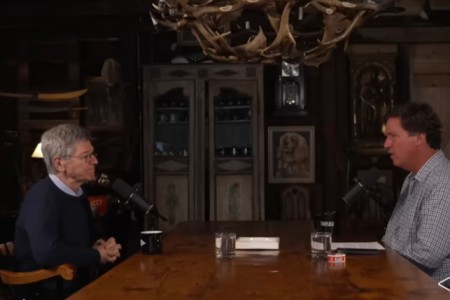
Editor’s Notes: In this episode of The Tucker Carlson Show, economist Jeffrey Sachs joins Tucker to discuss the critical “fork in the road” regarding the escalating conflict with Iran. Sachs argues that current U.S. and Israeli strategies are driven by historical “imperial delusions” and a desire for regional dominance rather than genuine security concerns. He warns that failing to take a diplomatic “off-ramp” could lead to a global economic calamity, including the physical destruction of vital energy infrastructure in the Gulf. Throughout the conversation, Sachs provides deep historical context—from the 1953 CIA-led coup to the 1996 “Clean Break” strategy—to explain why he believes the world is at its most dangerous moment since World War II. (April 24, 2026)
TRANSCRIPT:
The Fork in the Road: Jeffrey Sachs on the Iran War
TUCKER CARLSON: Jeff, thanks a lot for doing this.
JEFFREY SACHS: Great to be with you.
TUCKER CARLSON: Where does it go from here, the war in Iran?
An Unstable Situation
JEFFREY SACHS: We always talk about the fork in the road. We’re really at a decisive moment. There’s an off-ramp. It’s definitely the one that we should be taking. We should be avoiding a return to outright bombing, to renewed military action. That’s a very real possibility. And the other possibility, in my view, is pretty much an uncontrolled escalation into full-blown war that would become a regional war and that could become a world war. I think we’re really at that moment right now.
Maybe that sounds naive because why not next week? Why not the week after? Why not the week after? But the problem is that we’re not in a stable situation where we can choose one or the other. We’re in an unstable situation. As we speak, the world economy is reeling. It’s reeling because, as everybody has learned in their geography in the last few weeks, the Strait of Hormuz is closed. As long as it’s closed, it means that there’s a worldwide economic crisis building.
So time is not permissive right now. We can’t say, well, we’ll decide in another month. We’ll see how things go. We’ll negotiate and see what happens. Right now, there is an ongoing, building, global, serious economic crisis. And that is because a narrow stretch of water through which comes an enormous, extremely important strategic flow of resources — oil and gas, obviously, but also fertilizers and petrochemicals and many, many other key commodities, aluminum and others — is closed.
The Off-Ramp
To simply open it is fine. That’s basically what the off-ramp would allow. It would be the right answer. It would not solve any of the underlying issues that led to this, and it would not solve any of the stated objectives of the United States, much less Israel. I don’t believe those objectives were valid, and therefore I don’t think that they should be the basis of a decision to take or to not take that exit ramp.
But the point is, there’s a way out of this thing that would avoid the escalation to something quite different.
The Other Path: Escalation
So what is that other path? The other path is, well, we’re in this unstable situation. The world economy is reeling because of the Strait of Hormuz being closed, and we have to do something about it. We can’t just sit there for weeks or months, and we refuse to just allow it to reopen and not have those goals met.
So Trump, and his partner in this, Netanyahu, might say the only thing we can do is make the maximal threat. And if that threat does not lead to Iran conceding, then we have to follow through — not with more time and waiting because of this unstable situation — but we have to return to massive bombing, this time even more.
And what we can suspect on that alternative is that the Iranians will, of course, strike back and strike back very hard and very rapidly. And what we have all learned also since February 28th, since the start of this war, is that the entire Gulf region is exposed to missile fire from Iran, as is Israel, in fact, because we also have come to understand that the anti-missile defenses are permeable, limited, even depleted in many areas.
We know that the desalination plants in the Gulf region, the oil and the gas fields, the port facilities are not protected systematically and comprehensively against Iranian attacks. And Iran would completely, totally, understandably respond to what Trump has repeatedly threatened, which is the destruction of Iran.
A Global Calamity
So if we don’t take the exit ramp, I personally don’t see anything realistic less than an all-out war. And while I’m an economist, a simple economist, not a military analyst, having watched this for decades and tried to understand from the military analysts, I think it would be but a few weeks before a very, very large part of the infrastructure of the region was destroyed — in Iran and in the Gulf and a lot in Israel as well.
And the result of that would not be peace followed by some easy recovery. It would be a global calamity brought upon us in a few short weeks.
So to return to the basic question, Trump could say, “We’re not going to go to disaster, we just pull back.” That’s the right answer. If he says instead, “We can’t wait any longer, we’re going to attack,” I believe we will see a different world four weeks from now — a world that is profoundly damaged, the world economy in crisis, the possibility of escalation to a full world war. And I don’t think I’m being hyperbolic or naive to say that we are at that fork in the road right now.
The Right Thing to Do
The problem, once again, is that the right thing to do is not a political victory for Trump.
They weren’t objectives that I supported or support today, or that I believed on February 28th were within reach, or that I believe today are within reach. So the fact that the off-ramp is not a success story doesn’t bother me at all. It’s the right way to save the world.
And it’s the responsibility of grownups to try to save the world — not to save face, not to double down on failed gambles, not to engage in reckless escapades. And that’s why the off-ramp is the right thing to do. It requires grown-up behavior. I don’t associate that term with these two leaders very easily, unfortunately. So I’m not extremely optimistic about what’s going to happen.
Iran’s Leverage
TUCKER CARLSON: I agree with every word you’ve said, but in fairness, they would have to swallow a lot to walk this back because it would mean that Iran is more powerful now, in effect, than it was before the war started at the end of February.
JEFFREY SACHS: That’s correct.
TUCKER CARLSON: We would have to acknowledge they control the strait and 20% of the world’s energy and 30% of its fertilizer. Iran controls that supply chain.
Iran’s History and the Origins of the Conflict
JEFFREY SACHS: That’s essentially correct, except for a couple of important considerations. One is that Iran has suffered very heavily by this attack. Let’s start by recalling the 160 schoolgirls killed on the first day by apparently Palantir’s AI system. Well, as we find out every day when we’re looking at our screen, this is an AI, it can make mistakes. Well, apparently Palantir’s mistake was to kill 160 innocent schoolgirls. This is not definitively known, but it’s what is being widely reported. So we will perhaps someday find out what really happened.
Iran has lost thousands of people. Iran has been devastated. Tens of billions of dollars of damages that will take years and years basically to recover. For me as a development economist whose whole career over half a century is to try to build things, I don’t like to see things knocked down this way. The mindlessness of it, the cruelty of it, the brazen destruction, the glorification of this violence by Hegseth and others, I find completely, completely, totally repulsive.
So first, Iran has suffered a lot. There’s no glory in the off-ramp. There’s just continued bereavement. People still being buried, deaths, deprivation, suffering. So no joy and therefore, in my view, not a humiliation.
Second, it’s weird to say, and I’m sure many people will object to what I’m about to say or not understand it or think I don’t know what I’m talking about, but I do. The Iranian people are really very civilized. They have wanted to negotiate for years. All of this depiction of the evil of Iran that we have been played to since 1979, also mistakes the reality in a fundamental way.
And so when you say that Iran would control the Straits, actually they would not control it in a malevolent way that Americans would be led to expect by hearing that this is the most evil of evil empires. That’s what we’ve been told for decades, that this is the axis of evil, that this is the heart of evil. Netanyahu said that they wanted to annihilate us and so forth. This is not correct at all. It is our nonstop official propaganda narrative.
If you go to Iran, which I have been very lucky to do, if you speak to Iranians, which I do frequently and have done for a very long time, the official narrative that Iran is so evil that we can’t leave it in control of the Strait of Hormuz just gets everything wrong to begin with.
The 1953 Coup and the Roots of U.S.-Iran Hostility
And maybe I’ll just say one quick historical word about this. Where does this hatred and venom come from? With respect to the United States, it’s very simple. In 1953, Iran was a parliamentary democracy. Iran had not invaded or attacked another country for a century and a half. This was a peaceful country. It had been invaded several times. But it was a democracy that didn’t threaten anybody, didn’t want to threaten anybody, hadn’t threatened anybody, hadn’t invaded any place actually since the 1790s in a brawl over who controlled Basra. So in other words, very esoteric things from the 1790s. But since then, Iran had been bothered but had not bothered anybody else.
And in 1953, the Iranian prime minister, elected, respected Prime Minister Mossadegh, had the audacity to say the thing never to be said by this region, which is, “I think the oil under our ground is Iranian, not British.” And when he uttered that thought that maybe Iran’s oil belonged to Iran, immediately the British Empire in the form of MI6 came to the new ascendant American Empire in the guise of the CIA and said, “We gotta overthrow this guy,” which of course they did successfully. Made what today we would call a color revolution. They stirred up protests in the streets, they stirred up unrest, and Mossadegh was chased from power.
And the United States installed what the Persian Empire would’ve called a satrapy, meaning that Iran became a kind of province of the American Empire under ultimately CIA rule. And we put the Shah of Iran as the face of that empire and the police organization, SAVAK, as the enforcers of that empire that lasted 26 years.
The 1979 Revolution and Its Aftermath
In 1979, as the Shah of Iran was dying of cancer, the people led a revolution, an uprising, and threw out SAVAK and the CIA and the Shah. And that’s when Iran had its Islamic Revolution and put in the government that is government until today.
The United States hated that. When you’re an empire as we are, when you have protectorates, when you have places where you have your military, and in the case of Iran, when your major oil companies have investments there that suddenly are lost because what was stolen from Iran is now taken back by Iran, that led to a reputational question. We need to bring Iran back under our control because we’re an empire. If we’re too weak vis-à-vis any piece of our empire, it damages our reputation anywhere. We need to punish these people for what they’ve done.
And there was the hostage taking by the youth radical groups who said, “We’re doing this because we want the Shah to be brought back here to face a trial in Iran for the crimes of the police state over the last 23 years.” And the United States had taken in the Shah. In a very unwise decision by President Carter in 1979 for medical treatment, knowing that you’re suspecting was going to lead to this kind of eruption. They demanded reparations, they demanded an apology, they demanded an end to the US subversion of Iran. All pretty reasonable actually, but of course it became the cause célèbre of the United States in 1979.
And another humiliation for America, which an empire never tolerates. An empire needs to repay any kind of loss of face with some kind of extreme punishment, not only to get that particular recalcitrant place under control, but to signal to all the rest of the empire, “Don’t you dare try this.”
Decades of U.S. Warfare Against Iran
So from 1980 onward, the US has been at war with Iran in various ways. In 1980 onward, we paid, we armed, we supplied Saddam Hussein to invade Iran. A pretty sordid deal. Saddam Hussein used poison gas. With American knowledge at the minimum, and according to some testimonies, American active support. But we engaged in a war in Iran through a proxy, through Iraq, from the very start of this 1979 government.
Donald Trump, already back in 1980, said, “We have to overthrow this government.” So when Trump gives his explanations for the current war, he says, oh, nuclear or this or that. These are convenient current explanations for something that has been on his mind for 46 years as well, because the American Empire suffered a slight. A country got out from under American CIA control, which you don’t allow to happen.
And from 1980, it’s been nonstop war. It’s been an economic war. What our Treasury Secretary, who I increasingly regard to be a thug, basically, not a Treasury Secretary, but someone who delights and gloats in crushing other economies by using financial means or trade sanctions or financial blockages and delights in it, explained in Davos this year in a Fox News interview with Maria Bartiromo that our statecraft destroyed the Iranian economy last year. Well, we’ve been doing that kind of statecraft. What a horrible Orwellian term for destroying another country’s economy. We’ve been doing that for decades.
JEFFREY SACHS: And we have been engaged in assassinations of Iranian leaders. We have been engaged in blowing up their nuclear facilities even when they have been pleading, “Let’s have an agreement that puts us under strict supervision of the International Atomic Energy Agency.” We’ve been using what’s called hybrid warfare, every possible means of subversion, of economic warfare, of direct military action, of covert operations. Donald Trump confirmed that in the protests last year, the US sent weapons to the protesters. That’s not a protest, that’s an insurrection we were creating, that did not work.
But the point I’m making is that we portray Iran as evil because it did something unacceptable to the United States that doesn’t involve nuclear weapons or any of the specific issues, or Hezbollah or Hamas. It goes back to 1979. They escaped from the American empire. They escaped from CIA control. That’s not allowed. That’s simply what you’re not supposed to do. And this war has been going on with various pretexts, various explanations since then.
TUCKER CARLSON: Let me ask you—
The Nuclear Pretext and the JCPOA
JEFFREY SACHS: Oh, if I could just say one more thing, Tucker. Trump’s main argument has been in the last months, “I will stop them from having a nuclear weapon.” Of course, anyone that knows the history of this knows that this is Orwell to the nth power. By that, I mean such bizarre propaganda, you don’t quite even know where to start.
The reason is that the Iranians have not pursued a nuclear weapon. Our own intelligence agencies have said that repeatedly. What they have pursued though, is a treaty with the UN Security Council to confirm that, to put them under strict monitoring, under the Nuclear Nonproliferation Treaty, but in return for ending the US economic warfare on Iran. What Iran has wanted for 15 years is, “You supervise us, you control us, fine, but lift your sanctions. Let us breathe. Let us have a normal economy. Let us trade.”
And by the way, one other thing — let us have our own money back, because the United States has confiscated tens of billions of dollars of Iran’s money. Iran’s money, not our money. Because we do that as an empire. We freeze the money of other countries. We sometimes just overtly take it and use it for something else. It’s rather obnoxious to my point of view and rather self-defeating in the long term for the United States to have the reputation that it just steals other people’s fiscal and financial resources. But we did that with Iran.
So what Iran has wanted is diplomacy. And I come back again, they’re nice people, they’re diplomats. And I sometimes tell them, “You don’t even know who you’re dealing with here, how nasty this is. How difficult this is.” “No, no, no, we want an agreement, Professor Sachs. Do you know who we might speak to about negotiations and so forth?” Very civilized, very nice people.
In 2015, such an agreement was reached, the Joint Comprehensive Plan of Action, the JCPOA. It was reached not only with the United States, but with Britain, with France, with Russia, with China, and with Germany. The 5 permanent members of the UN Security Council plus Germany, called 5+1. Then it went to the UN Security Council where it was unanimously backed.
Israel, the Zionist Lobby, and the Drive for Regional Dominance
Then came the Zionist lobby in the United States. “Oh no, you can’t have an agreement with Iran. They’re the evil empire. You can’t do this.” And so, when Trump was elected in the first term, he ripped up the JCPOA. This is the approach that you don’t want them to have a nuclear weapon when you had the control? No, this is the opposite. This is, we need to change the regime because they humiliated the United States by escaping from our empire. We tried to defeat them in many ways, but they stood up to it. We need to defeat them.
There’s an Israeli version which is not exactly the same, and the Israeli version is, we need to have absolute control over the Middle East so that we can pursue our Greater Israel agenda. This is not exactly the US cause, but there are people in the US that are the backers of that distinct cause. That’s not Israel saying, “You escape from the American empire.” That’s Israel saying, “We control almost all of the Middle East militarily, but Iran we don’t yet control.” So that’s the last big prize. And that’s the other part of this agenda right now and why Israel is even more against the off-ramp than the United States.
Trump is against the off-ramp because he can’t declare victory because he would lose face, because he’d face pressure groups because we have the Israel or the Zionist lobby, I would call it, in the United States. For Israel, the issue is somewhat distinct, but Israel’s main issue is that it wants complete military dominance of West Asia and the Middle East and even into the Horn of Africa and North Africa. And it almost has that. Not that it can easily control all of the territory. No, by no means. But it is able to act with impunity. It’s able to invade Lebanon. It’s able to occupy Syria. It’s able to overthrow other countries’ governments. And that’s what it wants. But it faces an obstacle, and the obstacle is Iran.
The Clean Break Strategy and Israel’s Seven Wars
JEFFREY SACHS: Israel, 30 years ago this year, when Netanyahu first became prime minister, adopted a strategy that was explained in a public paper called the Clean Break Strategy. And the Clean Break strategy said, we will never accept— we being our new government— never accept a state of Palestine. We will occupy all of what had been the British Palestine, British Mandatory Palestine. In other words, we’ll control Gaza, we’ll control the West Bank, we’ll control all of Jerusalem, and we may control other places as well.
We’ll definitely face resistance of militant groups. But what Netanyahu and his colleagues in the United States said was, rather than fighting those militant groups directly, we need to bring down the governments in the Middle East and West Asia that support those groups. And that is what’s called the Clean Break strategy. The Clean Break was the clean break from the peace accords, from the land for peace idea that Israel would return to its borders. There would be a Palestinian state in return for peace. That’s what international law says.
But what Israel says is, we’re never returning. There’s never going to be a state of Palestine. In fact, we’re going to have what we call Greater Israel, which is all of Palestine, including Gaza, West Bank, East Jerusalem, legal Israel, but also expanded parts of the region. And when you interviewed Ambassador Huckabee, the US ambassador to Israel, he put it very clearly that the great zealots, including Huckabee and many of the Israeli leaders, view Greater Israel as control from a big slice of Egypt all the way to Iraq, from what is taken to be even a biblical gift of God to the ancient Israelites, from the River of Egypt to the great river of Mesopotamia, meaning the Euphrates River.
So Israel wants military dominance. The Clean Break idea was when we aim for that, we’ll find resistance. We don’t fight and extinguish the militant groups because we can’t. We have to fight the governments that back them. And that’s where the idea of perpetual war in the Middle East came from, or not perpetual war, but actually, specifically, 7 wars were designated that would overthrow governments supporting Palestinian militancy. And those governments were Libya, Sudan, Somalia, Lebanon, Syria, Iraq, and Iran. And we’ve now been pulled into Israel’s 7 wars.
6 of those wars have led to bloodbaths and disasters— Libya still in civil war, Sudan unbelievably in 2 civil wars because we broke the country apart and each of those 2 parts now has its own civil war. Somalia, there’s not even a government— there is a government, actually, very nice prime minister that I know, but barely governance in the country. Lebanon, we see it’s an invaded, basically destroyed country. Syria, the US and Israel worked for 15 years from Obama until this past year to overthrow the government. That was an active covert regime change operation. Iraq, the 2003 war and the debacle that lasted 4 years after that. And Iran was the last.
So 6 of the 7 places are in chaos. And from Israel’s point of view, great. We like chaos. That means we are the military hegemon for all of that region stretching from Libya to Iraq. Chaos is great. They can’t get their act together. They’re all in civil war. What could be better?
Iran: The Seventh War
The seventh is Iran, and that’s where we’re facing right now. And interestingly, when the war started, Netanyahu tweeted, “This is my dream come true.” For 40 years. And I had to confess, I made a mistake. I always said 30 years because I dated it to Clean Break, 1996. But I didn’t know Netanyahu before he was prime minister. I didn’t know that he had 10 more years of dreaming of this war.
So the off-ramp violates not only the American conditions of defending its imperial strength, but the Israeli dream of full control over the region. And that’s why the off-ramp is so hard.
I have to say one more thing, just because it is a little bit of a complicated picture. It’s not incidental, and I don’t want anyone to think I’m naive in this. When we talk about why the United States wants Iran within the US empire, why it overthrew Mosaddegh in 1953— remember the oil. So I don’t want to forget to mention that that’s not only a 1953 issue that was aimed to ensure that Iran would not take back its oil from British and then American interests.
Trump, absolutely without question, no doubt, 100%, is as strongly beholden to the oil lobby as he is to the Zionist lobby. And he said so vividly, vocally in 2024. He said, “Raise $1 billion for me. It’s a deal. You’ll get all the benefits from this.” What he did in Venezuela, he thought he was about to do in Iran as well.
So this needs to be understood as just one more piece of this. Yes, he wanted to fight with Iran for 46 years, at least since 1980, probably 47 since 1979. But what he thinks he learned from kidnapping the Venezuelan president and then suborning the Venezuelan government is, I can do a decapitation and then own the oil of that country. And so part of the motivation now was revenge, bring Iran back into the empire. But part of the benefit of bringing Iran back into the American empire is you get the oil.
And he thought within one day he’ll get the oil, because just like removing Maduro, he thinks, gave America Venezuela’s oil, he thought killing the Iranian governmental leadership, starting with the religious supreme leader and then the top officials of the government that were meeting that day with the Supreme Leader, he would take the oil.
So that’s the tableau. This is why it’s hard to take the exit ramp, because there were reasons for this war. To my mind, cruel, illegal, delusional. So I don’t abide by any of those reasons, but there were reasons for this war. And taking the off-ramp means that none of those would be fulfilled. From my point of view, fine, none of them was valid. But from the point of view of the two architects of this war, Trump and Netanyahu, that’s quite hard to do. But as I said, the alternative, which is an escalated war, within a few weeks could destroy the world economy.
TUCKER CARLSON: Thank you for that. That was—
JEFFREY SACHS: Sorry to go on so long. I loved it.
TUCKER CARLSON: I loved it. And it’s much needed because there’s always a context. You did this with the Ukraine war once in this room, and I’ve never stopped thinking about it. Thank you for that.
Geoengineering and the Iranian Drought
Couple quick follow-up questions. You talked about the ongoing war against Iran by the United States, now 46 years since 1980, first a proxy war with Iraq, et cetera, et cetera. There are reports that the United States, in addition to all of that, has used geoengineering to evoke a drought in Iran. Is that true?
JEFFREY SACHS: I doubt it. There are enough reasons for drought as a natural condition of an arid and semi-arid region that we don’t have to go there.
In fact, I can tell you— one visit to Tehran, I was in the Gulf region in Saudi, and then I went to Tehran. And in both places, this was many years ago now, there was already drought and it was springtime and there were intense sandstorms. Sandstorms like none of us has ever experienced. If you haven’t been in those places— and in Tehran I was invited to a kind of cocktail party or an evening get-together, very nice, on a top floor of an apartment building. You couldn’t see anything out the window because it was just completely darkened in the afternoon by this sandstorm, basically.
So the point was, it struck me then, these are arid regions. Yes. They are drying under the forces of long-term changes that are underway. And having been in the Gulf and then in Iran, it’s of course exactly the same ecosystem. It’s the same environment. It’s the most natural thing that they should be working together to solve these problems. And you say, where do these lines of division come from? Just because someone drew a political line, it doesn’t change the fact that there’s the sandstorm on one side, the same sandstorm on the other side, and they should be working together.
And so it just struck me— I had this intense visceral feeling then of how artificial these political boundaries are, because this is a region and it’s a region that shares some very intense human problems like how to get enough water to stay alive.
TUCKER CARLSON: Exactly.
JEFFREY SACHS: Day to day. And they should be working together to solve that problem. So I don’t think in this case that you need the United States to geoengineer anything. I think it’s happening by itself.
The US as Israel’s Military Instrument
TUCKER CARLSON: Clean Break in 1996 listed 7 countries whose governments need to be overthrown in order to create room and strategic depth and options for Israel. 6 of those wars have taken place. The US was— and well, now 7— but the US was the instrument of all of those, correct?
JEFFREY SACHS: Yes.
TUCKER CARLSON: Okay, great. So this was Israel’s plan, but the US military was used.
JEFFREY SACHS: The US has spent $5 to $10 trillion on this Israel venture. This is the basic point. Yes, we’ve had our own misguided ideas about this. But it’s just bizarre. Of course, Iraq, we know in detail that this was a concocted war. But Syria has never been understood in as much depth. But it’s the same story. Why suddenly did Barack Obama feel the compulsion to task the CIA with overthrowing Bashar al-Assad?
TUCKER CARLSON: “Assad must go.” Yes, that was on the lips of everyone in one day.
JEFFREY SACHS: Are you kidding? I remember I was on Morning Joe that morning that either Hillary or Obama said “Assad must go,” and Joe turned to me and said, what do you think about that? I said, oh, that’s interesting. How are they going to do that? Well, it took 14 years, hundreds of thousands of deaths, tens of billions of dollars, massive destruction, massive destabilization, refugee crisis, to put a jihadist in charge right now and then exactly clean it up.
TUCKER CARLSON: But of course, to take a secular government that protected religious minorities— Alawites, Christians, everybody— for generations, generationally, father and son did the same, and replace it with a guy we thought we were fighting against.
JEFFREY SACHS: And to destroy, of course, historic sites as they’re doing in Iran right now— cultural sites, I should say, that are human heritage, not only Syrian or Iranian heritage, but world heritage, because they’ve lasted thousands of years. And then our idiocy— we’re destroying them in hours.
Netanyahu’s Worldview and the Absence of Diplomacy
TUCKER CARLSON: Yeah, I would say evil. But yeah, no, that’s okay. So I just want to be clear with that. Third question about the off-ramp. So the United States would have to, the president, but the whole government would have to swallow that. We’ll just have to admit that it didn’t work and Iran is now more powerful. Iran is an economic power, which we didn’t understand, I don’t think, before this war. We thought of them as this emerging military threat. Turns out they’re an economic power because they control the strait.
But from an Israeli perspective, there is this process, which I’ve seen many times, where people talk themselves into believing their own rhetoric. So you start out by saying the real threat from Iran is its nuclear program, but you don’t mean it. You just want to take Iran out because you don’t want Hezbollah and Hamas to hassle you. Got it. But if you say it enough, you start to believe that the main threat to your existence is this government. And I think the Israelis are there. Like, I think they believe that. So could not just Netanyahu, the prime minister, but the whole country, could they live with a strengthened Iran, or would they be forced to do something really radical?
JEFFREY SACHS: Well, Netanyahu said a couple of days ago that “they’re out to annihilate us,” which is not true. And that’s a heavy thing to say, and it shows, I think, a deep part of the psyche of Netanyahu personally and of one strand of Israeli extremism, which is the belief, and it is taught, that they’re out to annihilate us every generation. And the Holocaust is used as the model that we can never tolerate this again, so we must fight preemptively against anyone that would annihilate us.
Well, it leads to, as even Netanyahu said, a Sparta state, a state that is just a war state. They’ve lost the capacity for diplomacy at all. Israel unfortunately has no diplomacy. It has diplomats, but the diplomats rip up the UN Charter or shred the UN Charter or stand in the podium of the UN General Assembly and accuse the whole world of antisemitism and hatred and so forth. It’s not diplomacy at all because one strand of thought is nobody can be trusted. We have to kill them before they kill us. If you live like that, you end up as a killer nonstop.
And this is definitely one tragic reality of the mentality of Netanyahu or others. He’s been killing before they kill us for decades. He’s a killer. He has become a nonstop killer. He kills in the name of self-defense. But he kills in the name of preemptive self-defense. And so if you believe that the others are out to kill you and you must not talk to them and must not try to understand or must not do anything else, you end up as a nonstop killer.
Daniel would say, “Oh, you’re—” I don’t know what he would say to me. Not much nice, but he would say, “You’re so naive.” And what I would say to him is, “But you, sir, have the idea not out of any reason, but you have the idea that you will have a greater Israel and expunge the people that live in your area that are not Israeli Jews. That’s your idea. That for the millions and millions of people there, you will exterminate them or ethnically cleanse them or rule over them in some racially segregated society. And then when others object to that, you say that they’re out to destroy you. Why don’t you show that you have a human reason? That you have a human decency and say that in conditions of peace there would be a Palestine. Yes, of course, because there are 8 million Palestinians. And in a situation of peace, we could have calm with the rest of the region without going to war, subverting governments and so forth.”
But you don’t try to do that. Netanyahu’s position is there’s no possibility of diplomacy. We must kill them before they kill us. But without trying to have any peace, without trying to understand that there are legitimate, deep, moral, legal, and historical reasons for doing something different from Greater Israel that kills, maims, destroys, expropriates the Palestinian people and claims territory seemingly wherever they want in Lebanon or Syria and who knows where else, according to Ambassador Huckabee.
So I don’t give any credence to Netanyahu because his starting point is not only fear, but his starting point is something obnoxious, which is we don’t recognize the people that live among us, that we have expropriated, that we have taken the land, that we have killed by the tens of thousands. That we have denied basic political rights. And without that, how can he think that there could be some kind of solution?
So Netanyahu’s absence of an exit ramp starts from his own radicalism, not only from his fear, but from a complete absence of diplomacy that recognizes that there’s another side that needs to be dealt with as human beings. And where that extremism comes from, I’m not sure. It’s very pathological. You could find it in some religious extremist views that this is our land, God gave it to us, it’s nobody else’s, and everyone else has to get the hell out. I’m not sure exactly what motivates it. But there’s a complete collapse of understanding that there are people to talk to that actually want to make peace.
Danny Danon and the Two Variants of Israeli Extremism
TUCKER CARLSON: So I always thought that it was Netanyahu who was leading this, that he had a particular worldview, and that, I don’t know, through his brilliant political skill, he was able to control the country. Now it seems like there are a lot of people who have even more radical views, and one of them would be Danny Danon, whom I know, I always thought was kind of a reasonable guy. He’s the Israeli ambassador to the United Nations. There was an amazing exchange between you and him at the UN fairly recently that made me think, wow, it’s not just Netanyahu. Can you explain that exchange?
JEFFREY SACHS: Well, I can explain the exchange, and I can also say that there are two variants of Israeli extremism that are not the same. But they are now literally a coalition. I mean, they’re literally a political coalition and they are an ideological coalition as well.
So one is the view, every generation, they’re out to kill us. We have to kill them before they kill us. The preemptive strike, the clean break idea, but again, grounded in this perverse, maybe related idea that there will never be a Palestine alongside an Israel, which is actually what led to Clean Break, led to all these wars, led to the militancy, was the absence of Palestinian political rights alongside Israeli political rights, the so-called two-state solution. And since Netanyahu’s party, Likud, going back to its opening charter in 1977 said there will never be a Palestinian state. Nothing to talk about, no terms, no security arrangements to make it possible. This will all be Israel’s sovereignty from the Jordan River to the Mediterranean. There was never a basis for a diplomatic way out within Israel from Netanyahu’s point of view.
Now, there’s a second variant in Israel which gives a theological interpretation of this. Netanyahu’s interpretation is mainly security and secular, with the only theological twinge being this idea that they’re always out to kill us every generation. And the Holocaust put that into overdrive for completely understandable reasons, but not rational reasons that attend to current realities. So I’d say Netanyahu is basically the security vision. But again, to my mind, irrational, cruel, illegal, self-defeating, disastrous. Not real security for Israel, but security in the phrase, “We kill them before they kill us.”
Then there is a very different variant that is now the coalition partners represented by two now well-known leaders to us. Ben-Gvir and Smotrich, two cabinet ministers who are religious, religious with a very strange idea. And it’s a new form of Judaism which actually attaches to some ancient texts, but was not a real form of Judaism for 2,000 years.
TUCKER CARLSON: It’s not what I grew up with at all.
JEFFREY SACHS: It’s not what I grew up with as a Jew at all. It’s something absolutely late 20th century, early 21st century. One of the parties is called Jewish Power, and it is the idea that—
TUCKER CARLSON: That’s its actual name?
JEFFREY SACHS: Yes. In Hebrew, yes. “We redeem God’s promise to us by becoming Greater Israel.” So the act of this expanded Israel is a religious demand upon us. This is our redemption, is this very political military program that we have. And that is Smotrich and Ben-Gvir, which says on a religious basis, we couldn’t have a state of Palestine next door. God gave us that land. That’s ours. That’s part of the Promised Land. That’s not theirs.
Even though the Palestinian people were living there for well over 1,000 years, probably, incidentally, according to some historical studies and interpretations, perhaps Jews who converted to Islam in the 7th century when Islam swept across the eastern Mediterranean and North Africa in its foundational moments. The Islamic societies, the Omayyad and Abbasid caliphates enabled Jews and Christians to live within the Islamic lands and to live peacefully and to govern themselves primarily, but to pay a tax. And so as a way to avoid taxes, many people converted. We know this, and probably today’s Palestinians, many of them are descendants from across centuries of Jews who were the settlers, who were living there before the 7th century sweep of Islam across the land.
That’s a footnote. Even David Ben-Gurion, the so-called founder of the state of Israel, held that view in the 1930s and ’40s, calling the Palestinians really the original Jews of the land who probably converted and became the Palestinians. But today—
TUCKER CARLSON: Wait, Ben-Gurion said that?
JEFFREY SACHS: Ben-Gurion said that, yes.
Ben-Gurion, Zionism, and the Question of Displacement
TUCKER CARLSON: What was— not to get sidetracked, but Ben-Gurion was secular, I think.
JEFFREY SACHS: Yeah, of course. All of the original Zionists were secular.
TUCKER CARLSON: Yes, from Eastern Europe. So what were— I don’t understand. I know they wanted to leave Europe. I get it. But what was the justification in his mind for displacing millions of people from their land if he acknowledged that they were the actual heirs of Abraham?
JEFFREY SACHS: Yeah, the idea was Jews are, instead of a religion, in their view, these were not religious people, by the way, they didn’t consult with the rabbis, so it’s all very ironic. But in their view, Jews are not a religion, they are a people. And in the ideology of Europe in the late 19th century, a people needs a state. And so the idea was there should be a Jewish state. That was the name of the founder of Jewish Zionism, Theodor Herzl’s first book, The Jewish State.
TUCKER CARLSON: Well, that all makes sense.
The Origins of Zionism and Christian Zionism
JEFFREY SACHS: No, no, no. But he asked, so where? And one option was maybe what is today’s Uganda. It wasn’t the Holy Land. It wasn’t some religious compulsion or a return to this promised land.
In part, and ironically, again, very weird twists. The rabbis had said 1,500 years earlier, “Don’t go back to the Holy Land. Live where you are. Stay peaceful. Someday a messiah will come and there will be again the Holy Land for us. But in the meantime, stay calm, live where you are, behave and obey God’s laws.” That was the idea of the Jewish religion, of the rabbinic Jewish religion.
So the variant on display now — that this is our land God promised to us, we need to redeem it, God will protect us — is a new variant that came in the 20th century with the actual founding of the state of Israel. It was not the original Zionist movement, which was almost completely secular. It had a couple of rabbis which had some modest influence, and then it especially came after the 1967 war and the conquest of the Palestinian territories then, and the occupation of them, and the beginning of the settler movements. And things became radicalized after that.
Some radical rabbis and militarist, violence-preaching rabbis, like Meir Kahane, which is an American rabbi who preached violence for the settler cause in Israel, gained a following. And that group grew with the illegal settlers in the occupied lands. Illegal because you’re not allowed to settle territory conquered in war according to international law. And the UN Security Council said repeatedly, no, you can’t have settlers there.
I started visiting Israel myself 54 years ago, and when I first went in 1972, the first settlements were taking place. And I was a high school kid, so I didn’t understand much of anything about what was going on. But they told me this was making facts on the ground so that this would be ours, we would have our security and so forth. “Facts on the ground” was the famous expression.
When I continued to go back, in the mid-’70s, the late ’70s, suddenly there were groups of young zealots dancing in the streets of Jerusalem, proclaiming God’s will about these settlements, because these were settlements in places mentioned in the Bible. This was suddenly now the redemption of God’s promise. This was something new. This was not traditional Judaism — but I mean traditional from 400 AD to 1970. I’m talking about about 1,600 years or so. This was something brand new.
It was a fervor. It was a zealotry. It was a fundamentalism that emerged that said, “This is ours. No one can interfere with this. More than that, it’s God’s command that we control this land. It’s not about security. It’s not about division. It’s not about where to draw lines. It’s not about treaties. It’s God’s command.” That’s a big part of the Israeli political scene right now. It’s half the motivation. And it’s why all of this is so radicalized and so zealous.
The Christian Zionist Dimension
But as we were talking, it’s extremely important in the U.S. context to understand the Christian Zionist dimension to this, because Zionism did not originate with Judaism, strangely, or with Jews, I should say. Herzl was encouraged in his Zionism by a Christian Zionist, and Christian Zionism was an evangelical belief that the Jews should go back to make a homeland in the Promised Land or the Holy Land. And that has roots hundreds of years before these Jewish secular Zionists started at the end of the 19th century.
A big part of the Christian Zionist movement started in Britain in the first half of the 19th century. These were Christians reading the Bible and reading the Bible in very particular ways — one may say, increasingly with an emphasis on the last book of the Bible, Revelation. So what’s called eschatology, or the end of the world beliefs. And part of that eschatology, preached by a British preacher named Darby with a huge effect subsequently in the United States, was that the Jews should go back to the Holy Land so that the Second Coming can occur, because the Book of Revelation says that the Second Coming of Christ will occur when the Jews are in control of the Holy Land.
It happens, interestingly, that these Christian Zionists were often rather confirmed anti-Semites that wanted the Jews out of their own country. They didn’t want the Jews in Britain. They didn’t want Eastern European Jews migrating to Britain and so forth. So they wanted them conveniently anyway out of Britain and back in the Holy Land.
But the point is, there is a set of non-religious claims: our security depends on this, they’re out to kill us, we need dominance, they’re evil, they have nuclear weapons, or they want — whatever. Those are all the security side. But then there’s this whole strong religious dimension.
And when you had the amazing interview with Ambassador Huckabee, which was, I think, a world eye-opener, he displayed in a way that people all over the world had never seen before this very particular British and American Christian Zionism. It’s very particular. It’s 19th and 20th century. It’s a very specific way of reading a couple of books of the three books of the Bible, I would say. The Genesis, the promise of the land; the Book of Joshua, which says, “Go kill everyone in the land so you can take the land” — it’s a commandment, strange in the Bible, to commit multiple genocides in the name of God to get all the land that has been promised to you; and then the Book of Revelation, which is the final book of the New Testament.
And it’s a very, very particular reading. It’s not at all mainstream Judaism. It’s not at all mainstream Christianity anywhere in the world. But it has its important political base in the United States and more traditionally in Britain.
Israel’s Extremism and the Cost to America
So what we’re seeing in Israel is an extremism that is shocking. And now coming back to my exchange with the ambassador at the UN, I said to him that I thought Israel was, and is, committing suicide. I didn’t accuse Israel of what it’s doing to others. That’s implicit perhaps in what I was saying, but I said it’s committing suicide because it’s taking such a violent extremist course that it’s putting it outside of the bounds of civilization, outside of the bounds of opinion in all parts of the world, putting it outside of international law and relying entirely on the United States to do that, because if Israel did this on its own, it would be immediately suicidal. It wouldn’t stand for a day.
It thinks the United States is going to support this extremism on an unending, unconditional basis. But you and I know that’s not true. Americans are sickened by this extremism. They’re sickened by the tens of thousands of innocent deaths in Gaza. They’re disgusted with this war in Iran. They’re disgusted with the trillions of dollars that the United States has spent for Israel’s clean break. We’re sick of it.
TUCKER CARLSON: Most Americans are just sick of this right now, overwhelmingly, and the polls show that. So I read analysis that says it’s going to take years and years for America to reset its relationship with Israel. I think that’s absurd. If our current system remains in place, which is an open question, but if it does, that’s going to be abrupt. I mean, people aren’t going to get elected if they’re taking AIPAC money.
JEFFREY SACHS: Nobody supports what’s going on right now. And wait 4 weeks if they don’t choose the off-ramp in the next few days. Wait a few weeks — what it’s going to be like when their incomes are decimated, when the world’s economy is in a tailspin because suddenly they realize in 4 weeks half the Gulf has been blown to pieces? What are they going to say then? So how is this going to be sustained when Americans basically don’t want to be the agents of mass murder and mass suffering? And most of us don’t believe that the mass expulsion of people is somehow God’s command. We don’t believe that.
TUCKER CARLSON: Well, no, it’s insane. And by the way, from a Christian perspective, you can only support Christian Zionism if you ignore the Gospels, which are the heart of Christianity. I mean, there’s nothing in there that supports it.
The Sermon on the Mount and the Message of Peace
JEFFREY SACHS: So you would think — by the way, the greatest speech I know of is the Sermon on the Mount. It’s unbelievable for everybody, for the whole world. This is a matter of who believes. But “blessed are the peacemakers,” of course, should resonate. I think it does resonate with people all over the world. The message of Jesus in the Sermon on the Mount is completely the opposite of what we’re doing right now.
TUCKER CARLSON: Of course, the one—
JEFFREY SACHS: And that is not from a Christian or Jewish or any other perspective. That’s from a human perspective because he was speaking about humanity.
TUCKER CARLSON: Yes.
JEFFREY SACHS: About what is decent for human beings, about how human beings should treat other people. They should not kill them. They should not make strangers out of them. The Good Samaritan was the one that rescued the man on the side of the road — the Samaritan who was the outsider. He’s teaching us something. And the part that I love about the teaching, that I think is so important, is: “Why do you point to the mote in the other’s eye when you have the plank in your own eye?” And what Jesus is saying very clearly is, don’t be a hypocrite.
TUCKER CARLSON: Yes.
JEFFREY SACHS: And don’t just say they’re evil without reflecting on yourself. This is so basic. All of that is left out. Because this new version of Judaism or of Christian Zionism is one chapter of Genesis, or maybe two — chapter 15 and chapter 18, God’s promise — the Book of Joshua, which is probably a political tract written during the late 7th century BC during the reign of King Josiah of the state of Judah as a political contract that says murder other people to take the Promised Land, and then the Book of Revelation. The Gospels are not part of that text.
TUCKER CARLSON: No.
JEFFREY SACHS: And it’s clear that they’re not, because the message of the Gospels is completely different.
What Happens If America Withdraws Its Support?
TUCKER CARLSON: Yeah. Jesus is saying, “You’ve been told don’t murder. I tell you, don’t even be angry at someone else.” It’s a message of radical reconciliation and nonviolence. So that’s just what it says. I mean, it’s inconvenient, but it’s true.
So I guess my question is though, if the United States withdraws, under popular pressure, its unconditional support for Israel, and the Iranian regime stays in place — some form of it does — and once again Iran is more powerful than it’s ever been and now has a clear incentive to buy a nuke from Pakistan or somewhere else. What does Israel do at that point? That’s my concern, because now it’s kind of out of options.
Iran’s Role and the Path to Peace
JEFFREY SACHS: Yeah. So here’s what I think. First of all, we should look at Iranian invasions of other countries. As I said, it hasn’t happened for 230 years. If I have the arithmetic right, as far as I know, the last actual military operation of Persia or Iran was against Basra in the 1790s. Iran is not out to destroy Israel. Iran does not want to be destroyed by a petulant, annoyed American empire from which it escaped. This is the most basic point. And if you’ve dealt with Iranians for decades, as I have, that message is absolutely clear.
So Israel is not at threat from Iran. It is not at threat from Iran. This is the basic point. Iran wants its place in the world. It doesn’t want to be bombed and destroyed by Israel and the United States. This is the first most important point.
Second, Iran has supported Hezbollah and Hamas, and it would stop supporting Hamas and Hezbollah if there is a Palestinian state alongside the state of Israel. This is a most basic point. You want a path to peace, you make peace. And the way to peace is there are two peoples in that land. When it started, there were 90% Palestinian Arabs. Now it’s roughly half and half between Israeli Jews and Palestinian Arabs. But there need to be two states, or I’m fine if there’s one democratic state, but Israel doesn’t want that for sure.
So two states. But there can’t be one state in which Israel rules over everybody or kills the others or expropriates the others. That’s what’s not possible. But if there is a political settlement within Israel, then there will be an end of the militancy as well. And this is a fundamental point.
Iran does not want to live as a militant state. I know it because I watch and I discuss for decades. It wants to live though, not as an American satrapy. So the idea that if we leave, Iran is just overpowering and they’re going to defeat Israel and so forth. No, they’re— first of all, Israel will not be defeated. It has nuclear weapons. It would use them. Iran does not have nuclear weapons. It actually doesn’t want nuclear weapons.
If we had the slightest sanity, honesty, and rationality in the world, it would be the easiest thing in the world to make sure that Iran has no nuclear weapons because they don’t want them. And the first thing, just in digression, that you would do if you wanted to make sure that Iran doesn’t have nuclear weapons, you would not kill the religious leader who issued the decree that nuclear weapons are against the religion. But the first thing they did was to kill the very religious leader that issued the so-called fatwa to prohibit nuclear weapons.
The Broader Global Context
So Israel, the idea that it’s in dire threat if we leave is wrong. We also need to remember there’s a whole world out there. We don’t like to admit that. It’s not the American way, but there’s Russia, there’s China, there’s India, there’s Brazil. There— I’m mentioning countries in the so-called BRICS. They will tell Iran, no, now you have peace, now you live peacefully. So Iran cannot engage in some regional takeover to become the super regional power because they’re also profoundly constrained right now. They’re trying to stop themselves from being destroyed by American bombs. Precisely what Trump has threatened repeatedly, the end of their civilization, which by the way is 5,000 years old, 20 times longer than the United States.
Okay, so they’re not about to do all these terrible things. They’re not about to hold a chokehold over the world economy. President Xi Jinping, who has, let’s just say, a lot of influence with Iran as a main consumer and supplier and trader and many, many other things, said yesterday the Straits of Hormuz need to be opened. Need to be opened. Iran is not going to do all these horrible things that are imagined.
And when I say leave, it wouldn’t hurt to leave also with an agreement. Okay, we’re leaving. You don’t invade. We’re not invading you. Israel, there’s going to be a Palestinian state alongside Israel, as is the core of international law since 1967, indeed since 1948, ’47, and you’ll live peacefully. They’ll live peacefully and you won’t have nuclear weapons. You’ll go under IAEA inspection according to the terms of the Nuclear Nonproliferation Treaty, which, by the way, Israel doesn’t abide by, of course, at all. So it’s already asymmetric. But Iran has said, okay, we’ll do it asymmetrically. But put us under this. Don’t put us under the bombs.
Greater Israel: An Untenable Project
So all I’m saying is there’s no sense in which the exit ramp means Iran becomes the great threat to Israel and the dominant threat. But what it does mean, and I think this is really the fundamental point here, I have to say, Greater Israel is an untenable project. This is the most basic point.
If you believe Mike Huckabee, then what I’m saying is not acceptable. If you believe that Israel should control all of this land, and if you take Israel’s leadership that they will. I would still advise Donald Trump, don’t fall for it. It’s a $10 trillion disaster for the United States, not the least in America’s interest. Stay out of it. Stay clear of it. Netanyahu is a repeated failure and liar, and everything he’s told us for 30 years has turned out to be the opposite. So I’d say that anyway, from our point of view.
But yes, if you believe that your purpose is Greater Israel and continued expansion of Israel’s borders, then what I’m saying now, you wouldn’t accept it. You say, why should we settle for that? But I don’t believe that. I believe in peace. I believe in a secure state of Israel. I believe in a secure state of Palestine. I believe in getting on with our lives. And not focusing America’s resources, squandering them endlessly for decades in this absolutely delusional Israeli cause of Greater Israel. It’s absurd. It’s tragic. It’s got to end and it needs to end now before we have a complete disaster.
TUCKER CARLSON: Can it? Can Trump constrain, control, Netanyahu?
Can Trump Constrain Netanyahu?
JEFFREY SACHS: Of course. The question is, can Trump constrain himself? Can he say, just ending this? I thought it was going to be a one-day Maduro-type operation. That’s what Bibi told me. Bibi was bullshitting me. Now I understand it. It didn’t work. I’m stopping this and I’m telling Bibi, you stop this too.
And could that work? Well, when Trump said to Netanyahu, stop, stop the bombing of Beirut, we had a demonstration. It can work. Could Israel continue the war without the United States? Basically not for one day. Could Israel actually survive the global opprobrium, including the American opprobrium of Israel’s extremism. I don’t think for one day, actually. Israel needs to trade, it needs tourism, it needs contracts, it needs finance. And if Israel’s totally, completely a rogue state without the American empire backing it, without the American military backing it, without the American intelligence, without the satellite data coming in. It’s not Israel’s, it’s America’s, believe me. Without all of that, no, Israel cannot do anything on this.
But we bought into the whole package. We bought into it for a mix of perceived American self-interest in our global power. That is, Israel’s hegemony in the region was consistent with our desire for global control. We bought into the Iran story because Israel’s story that we got to kill them before they kill us is not inconsistent with our desire to have revenge and to control their oil. In other words, it’s a partnership. Yep. And it’s a real partnership.
But Israel’s capacity to have this war that stretches now from Libya to Iran. That’s an American capacity, but we’re bleeding from it. We’re bleeding from Israel’s wars. And this, I think, is really important to understand.
America’s Bleeding Economy
You know, Trump said something quite interesting, the Washington gaffe, meaning that he told the truth, not off script, but he said we can’t afford the wars and those things like child care, Medicare and Medicaid and other— those individual things, he said. And you know what? It’s true. We’re bleeding. And what did he do? He said, okay, we’re going to cut all those things that Americans actually need and want, because we want our healthcare. We actually want to be able to have dental repairs or get medicines or see a doctor or have an operation if our lives depend on— we want that. And Trump said, no, we have to have war instead.
So he put in a budget a couple of weeks ago which didn’t get any attention because it won’t be enacted by Congress. But he put in a budget in which the military spending goes up another half a trillion dollars, and the things like he said, the health and other things— oh, we can’t afford that— goes down in this budget to make people who are hurting in this country they would hurt desperately more, not to mention the gas pump and not to mention everything, food prices and everything else that they are already facing from these wars, but will face cataclysmically if they don’t choose the off-ramp.
So can Trump say this? He has to say this for the American people. First of all, he has to, because this is really about us right now. He has to listen to the American people. We don’t want this. It’s no good for us. It’s anyway crazy extremism. We don’t buy into this. We don’t buy into the story. We don’t need this. We don’t need the American empire owning Iran. We don’t need revenge for 1979. We don’t need Greater Israel. We don’t need all of these things. We need our healthcare, our dental care, our daily lives. We want peace. We don’t want to be murdering schoolgirls. We don’t want to be murdering people. We don’t want to be destroying ancient cultures in different places in the world.
And Mr. President, your partner cannot do this for one moment without your backing. So your job is to tell Mr. Netanyahu, your clean break, 30 years, maybe $10 trillion of American treasure now piled up in debt, we tried your approach, it’s done. Now we’re going to try peace. That’s what he needs to tell him. It can work.
TUCKER CARLSON: If he doesn’t do that, and in the next few days, this accelerates, and you’ve said if it does accelerate, Iran’s first move will be to destroy civilian infrastructure in the Gulf, diesel energy, the rest, what are the effects at that point? Let’s just start with the economic effects on the rest of the world.
The Economic Consequences: Lessons from the 1970s Oil Shocks
JEFFREY SACHS: Yeah. Strangely enough, I came into my profession, which I’ve been a professor at universities for 46 years and advised well over 100 governments around the world. I came into this profession writing my PhD dissertation on the oil shocks of the 1970s. I wrote the first model of how they worked, why they had such negative effects. ’73 and ’79. So I wrote the book literally, and it’s published in 1982, called The Economics of Worldwide Stagflation.
The results of those two oil shocks give us an idea of what would happen. What happened in 1973, ’74 when there was an oil embargo, and then in 1979, ’80 when there was the Iranian Revolution, was a big disruption of oil supplies. It sent oil prices soaring and it sent the world economy into a tailspin. And it was a very particular kind of tailspin because people lost their jobs, incomes went down, and inflation soared at the same time. And so you had an economic downturn and a rise of inflation, which at the time was viewed as a paradox because usually you have a recession and the prices come down, or you have a boom and the prices accelerate. But this was a contraction and an inflation.
TUCKER CARLSON: So people had less money coming in and everything cost more to buy.
JEFFREY SACHS: That’s it. And that’s what was called stagflation. Now, the difference of then and now is that the two shocks then were temporary stops of the flows of oil. One was a boycott by the Arab countries against the US and other buyers, like shutting down the Strait of Hormuz.
TUCKER CARLSON: Just to be clear, what were they mad about?
JEFFREY SACHS: They were mad about this, the 1973 war.
TUCKER CARLSON: U.S. support for Israel.
JEFFREY SACHS: Exactly. Just to be clear, this has been the same issue.
TUCKER CARLSON: I was 4 years old when that happened.
The Risk of Physical Destruction
JEFFREY SACHS: This was— this goes back a long way. And then 1979, ’80 was the Iranian Revolution. And they were— the oil got turned off, but the oil fields weren’t destroyed. There was no war in the oil fields. There was no physical destruction of infrastructure. Refineries weren’t destroyed.
What will happen in the next few weeks if we don’t choose the off-ramp is the physical destruction of a lot of the Gulf region and of the Middle East more generally, because the US will rain missiles and bombs on Iran, and Iran will launch what it has against targets in the neighborhood to show deterrence and hoping that that deterrence will stop something. Often instead what you get is just both sides unleashing their arsenals.
And what will happen in a short period of time is not a closure of shipping, but a destruction of the physical capacities of providing the oil and the gas and the fertilizers, and the petrochemicals and the other very core commodities for the world economy. And it doesn’t take that much to bring the world economy into a tailspin because you don’t need to close down half the oil supply. You might need to shut off 20% of the world oil supply, and that by enough will send the prices soaring, make Americans really suffer across the board because it’s not only at the gas pump and not only in the utility bills, but also in the cost of food, which will soar from this as well.
Because there will be a worldwide disruption of food supplies coming from this because a very significant proportion of the urea, which underpins the nitrogen-based fertilizers of the world, come from this region. From natural gas. From the natural gas production. From the oil and gas fields, the hydrocarbon production and other petrochemicals as well.
I’m afraid that it won’t take long for this to happen. Governments will fall if that happens globally. One leader pulled me aside a few weeks ago, I don’t want to say who exactly, but said that that person was in a country that has a lot of oil production, not from the region, and said, “Jeff, you don’t understand. I governed our state oil company. These are complex systems. They don’t get rebuilt so fast, believe me.” This was a very authoritative figure, and I really take that to heart.
TUCKER CARLSON: Well, energy extraction, refining, petrochemicals distribution, it’s all about a million times more complicated than people understand.
JEFFREY SACHS: Exactly. And these very sophisticated plants, and they are not built for war. They are built for just normal, peaceful, complex, sophisticated operations. And a lot of that could be destroyed in a very, very short period of time.
TUCKER CARLSON: No, I appreciate that. And I think the view in the U.S. seems to be like, if there’s oil under the ground, you stick a straw in, it comes out. But if you go and tour a petrochemical plant or oil refinery or any extraction facility, I mean, it is like highest level technology, smartest people, super hard to understand the market.
The Emirates, Financial Cascades, and the Threat of a Super El Niño
JEFFREY SACHS: I’ll tell you, one of the most sophisticated places in the planet — the Emirates, a place you know well and I know well. They were asking the Federal Reserve a few days ago for emergency swap lines that may be needed in the event of a crisis. This is kind of shocking because first of all, the Emirates you think of as super rich. It’s the place where rich people go to put their money in the region. Of course, it’s completely destabilized by all of this. It’s a complete disaster for them what’s happened, but they are girding for the downstream effects of what I’m talking about.
Which is that first you get the physical destruction, then you get the real economy, so-called, the actual physical production of industrial products, of employment in the manufacturing sector and cascading across the economy, having huge negative consequences. But then you get the financial effects because people say, “Is this place viable anymore? I’m withdrawing my money.” But the Emirates operates on a US-backed dollar standard, and suddenly you have a run on your banks, you have a run on your financial markets. So they’re already asking, “Can we have emergency lines of credit?” And maybe yes, maybe no, but that’s the tip of the iceberg of the financial consequences that can come from all of this. So you get a huge cascade of effects.
And then I want to mention, for completeness, it’s more speculative, but the daily evidence is growing that what we call the interannual phenomenon of ENSO — which is fluctuations in air pressure and currents, or sea surface temperatures in the Pacific, which cause El Niños, which people know about, and La Niñas — it looks like a very large, maybe what they’re calling a super El Niño is building for later this year. And it may not happen, but the evidence is growing that seems like that’s the case.
So people might be curious, what does that mean? It means that warm surface water over the Pacific would spread to basically the west coast of South America. When you get a very powerful El Niño, the temperatures and rainfall patterns and drought patterns and storm patterns in all of the tropical and subtropical regions of the world are hard hit. One of the things, for example, that happened in the 1973-’74 oil shock was that there was also an El Niño that year. And it was the combination that sent food prices soaring worldwide.
And if we have that dual combination, I’ve been saying to myself for years, the next big El Niño or super El Niño is by itself going to be world destabilizing. Because there are a lot of countries on the edge right now, on the edge financially, on the edge socially. The world’s an unstable place because it’s been so perturbed by everything that’s happened in the last years that many places are just on the edge of solvency in their governments or financial stability and so forth.
But if you combine a mass destruction in West Asia, the Gulf, the Eastern Mediterranean, with a super El Niño, I don’t even know. Somebody’s going to have to write the next book quickly about this because we would not have had a shock like that since World War II, certainly. And the effects on political destabilization, on the effects of governments falling, the potential cascading of this war would be tremendous and uncontrollable.
A Chinese Naval Fleet and the Loss of Control
Just think, in addition to everything else, a naval fleet from China is heading towards the Gulf right now. It’s heading towards the Gulf to escort Chinese vessels — or I don’t know if it’s only Chinese-flagged or China vessels heading to China — to give them military escort. Suppose there’s a war going on. Suppose the United States says, “We have a blockade and we interdict a Chinese vessel.” Suppose that a Chinese destroyer comes alongside.
You know, we’re not in self-control right now. Sailors are not in self-control. Captains are not in self-control. We’re living at nanosecond speed. Maybe Palantir’s MAVEN system will say shoot. Who knows what will happen? But we’re just lighting fuses that could blow up everything if we choose the ramp of escalation. And I think it will go faster than we imagine and without control.
We don’t seem to have any real control in our government right now, even of basic processes. We don’t have interagency reviews. We don’t have expert intelligence that are guiding policy. We don’t have anything that is systematic. I think in Israel it’s the same way. When you have a cascade of crises, when missiles are at hypersonic speed and you’re making decisions with a few seconds warning or a minute or two warning of incoming missiles — what are we doing with all of this gamble when the whole premise of this war was wrong, and when the tactical premise that this was a one-day operation was proved wrong by the second day? Why are we still facing this possibility of complete disaster?
And I have to say, I’m sorry to say it, Tucker, but every few days I get an email from somebody who says, “I really appreciate what you say, Professor Sachs, but I do want you to know that we’re in the end times and that this is all as prophesied. And so thank you for your voice.” They’re not hostile messages. They’re very nice, sweet people who say we’re in the end times. I’m hoping we’re not in the end times. This is the basic point. We should have some prudence. Somebody should reach the president of the United States and say, “Stop before disaster.” I’ve tried.
Are We in the End Times?
TUCKER CARLSON: I wonder, what do you make of that? What do you make of— I know you’re not a famously observant man. However, things are happening that certainly don’t have any precedent in our lifetime. I mean, you’ve watched the world carefully for 50 years, and all of a sudden anomalous things are happening all over. People are behaving in ways you never would’ve expected they behave. Do you allow for the possibility that some of this is preordained, that there’s no getting off the train?
JEFFREY SACHS: I don’t. I’ve studied history now for my whole life and I’ve seen disasters. I’ve studied intensively disasters and near misses and avoided disasters. I wrote a book about the Cuban Missile Crisis and its aftermath. I’ve studied World War I and World War II upside down, right side up, from every country’s perspective. I’ve spent a half century looking at this.
Terrible things happen because individual leaders and governments make miscalculations. They don’t talk to each other. They don’t understand the ramifications. They have a breakdown of systematic processes. So I don’t think that this is ordained, but I think we’re close to overload right now, which is what you see happening around crises often.
What does that mean, overload? It means that very consequential decisions need to be made skillfully, and the decisions are a big deal. They have a very, very large consequence. I would call them nonlinearities, meaning the consequence of the choice can take us into disaster or into solution. So in other words, these are really big choices. And the truth is individuals make a big difference at times like this.
The Cuban Missile Crisis as a Model for Deliberation
What I’ve tried to understand — you know better than I do, but I’m trying to understand the decision process in the US government right now. Normally you would have a deliberative process. I’ve studied very carefully, as have many, many scholars, the Cuban Missile Crisis. President Kennedy immediately installed an executive committee, EXCOMM, and during the 13 days of the Cuban Missile Crisis, they met repeatedly, they debated, they discussed options. It was all put on tape. It’s all been studied for decades later.
Many of the judgments that were made were very wrong. And one of the lessons, by the way, of the Cuban Missile Crisis was that it was President Kennedy’s cool and rationality and decency that saved the world, actually. A quite remarkable truth because many hotheads — and many hotheads in senior military positions, especially Curtis LeMay — said, “No, go blow up the commies, let’s go to nuclear war.” Almost to the point of insubordination, LeMay was pressing Kennedy to launch attacks and basically accusing Kennedy of not standing up properly for America.
Kennedy did save the world, but what it showed was a mix of very detailed deliberation, back channels that were extremely important — for example, the UN Secretary General, U Thant, played a huge role as an intermediary — and good judgment of the leader.
No Deliberative Process Today
Today, I can’t see any process. What we hear from outside accounts — and again, you know better than I — but what we read is that this was Trump’s decision, basically.
TUCKER CARLSON: Yes.
JEFFREY SACHS: Led by Netanyahu.
TUCKER CARLSON: That’s correct.
JEFFREY SACHS: Okay. Netanyahu has an agenda. His agenda in my mind is fanatical and wrong and has been mistaken for 30 years and has cost America a fortune. It’s just been wrong. I think the man is a disaster. I think he has the wrong framework of the world, just a wrong understanding. Of course he also has his incentives for his job and everything else. I’m talking about his understanding of the world. And Trump bought into that.
Normally there would be the National Security Council with detailed interagency assessments. There would be the national intelligence agencies reporting. Our friend Tulsi Gabbard, the head of the Director of National Intelligence, would be weighing in heavily. The Joint Chiefs of Staff would be explaining doubts, which they clearly had. There would be consultations with senior members of Congress. That was routine. In the Cuban Missile Crisis, the President of the United States consulted with the leaders of Congress in detail, by the way, even though this was an emergency. Commander-in-Chief, yes, but he knew there was a branch of Congress that was essential for this.
I don’t see any such decision-making taking place right now, and this is absolutely dangerous. The president of the United States needs to get real analysis, data, intelligence, internal debate, opposition. And the president has ultimate decisions on many things, not on everything, but on many things. But not on the basis of a gut, not on the basis of a whim, not on the basis of “I believe that Iran is like Venezuela” — which I think was part of the idea — not on the basis of Netanyahu spinning some absurd yarn or Mossad spinning some absurd yarn to one person with a group of sycophants listening in and saying, “Well, I don’t know, it looks doubtful, but I will follow you, Mr. President.” That is not the kind of deliberative process that keeps us in safety.
TUCKER CARLSON: And yet I think that’s exactly the process. I don’t think there’s any decision maker or even anyone who influences the decisions greatly other than Trump.
The Degradation of American Democracy
JEFFREY SACHS: I think the degradation of our political system is so deep right now that maybe there is no chance for that. But I do every day plead with the congressional leaders to do their constitutional duty because they’re not doing it right now.
And it’s not, be good and go tell Trump. They’re a co-equal branch of government that under Article I of the Constitution assigns them the responsibility for war, for the declaration of war. It’s not even shared. They are the only branch that can declare war.
And I don’t know how many umpteen times now, the Republicans, all but one, all but the best Republican senator by far, Rand Paul. I regard him as the best senator in the whole Senate. And all the Democrats on the other side but one, John Fetterman, who I regard as weird in his complete total allegiance to Israel’s reckless agenda, vote that Congress should not have any oversight over this war, completely contrary to the whole framework of the Constitution. It shows how degraded we have become.
TUCKER CARLSON: Maybe it’s an inevitable process where in late-stage republics like ours, all power vests in the executive, the legislative body. Well, think of it this way, since you know so many world leaders. Is there any legislative body in any country you’re familiar with that has become more powerful in the last 10 years? Or they’re all shrinking in authority.
China’s Deliberative Process
JEFFREY SACHS: It feels like— I know lots of places that have very high levels of deliberation, very rational processes. By the way, people will be very surprised to hear me say it and they’ll doubt it and they won’t believe it. But China has among the most deliberative processes that I see in any government in the world because we portray Xi Jinping as the— Xi Mao.
TUCKER CARLSON: Yeah.
JEFFREY SACHS: As the leader who decides everything. I was just in Beijing a couple of weeks ago and they’ve just announced a very, very sophisticated economic program. And I spoke to many people that were part of it. It was 2 years of detailed deliberation over cutting-edge sectors and what to do and how to combine public and private initiatives. Very sophisticated. We don’t have that right now. So this is quite strange.
Can the American System Survive?
TUCKER CARLSON: We have just the opposite. But I wonder, do you think that our big picture— asking a lot to predict something like this— but that our current system survives this moment?
JEFFREY SACHS: We have one overwhelming delusion that is held firmly by a president who has his own personal delusions, and that is that America reigns supreme in the world. And every day when President Trump says “we are the most powerful blah blah blah blah blah in the history of the world,” this is, of course he feels good saying this. Of course, maybe his followers feel good saying this, but it’s completely, totally the wrong approach to our world right now.
The serious part of our world is the world faces many deep challenges. There are many nuclear-armed countries. There are many powerful countries. We need to find a way to get along, to understand each other, to cooperate, to solve problems, and to avoid the traps of a war that can destroy the world economy or even the world in a short period of time.
So all the bluster is a remnant of the idea that the US has pursued during its imperial era since World War II, that we should run the world. And Trump has a particular view of that, which is that he should run the world.
Congress as It Once Was
So we have a workable system. It’s actually worked quite brilliantly at times. It’s a pretty complicated machinery. It could be updated in some pretty useful ways, but I used to work for some years in internship positions in the Congress in the 1970s, and Congress actually worked as an institution, for example. It held hearings, it wrote papers, it proposed legislation, it actually did things.
There were leaders, Fulbright and others who spoke out and wrote brilliant books and did all sorts of wonderful things. And I met many of them as a kid. And that idea that there was a legislative branch where you would have lions of the Senate and the House of Representatives and a speaker who would be an independent voice of politics as the people’s tribune. It actually worked to an extent. It really did. I was there. I watched it. I saw it. I quite loved it.
We don’t have that right now. So could it work? Yes. I think there are many interesting things to do in our digital age. We can get people involved much more. We can have public deliberations in different ways. We can upgrade, update the way that our system works.
But yes, the system could work. It doesn’t have to dissolve or devolve to one person operating on gut hunches based on delusions of grandeur that could send the world to disaster. That doesn’t have to be the way the world and our system works.
TUCKER CARLSON: Or ends.
JEFFREY SACHS: Or ends. Exactly. Thank you, Jeffrey Sachs.
TUCKER CARLSON: Thank you very much for that.
JEFFREY SACHS: Great to be with you, Tucker. Thanks.
Related Posts
- Jared Isaacman: A New Era for NASA and American Space Exploration (Transcript)
- Transcript of Bill Gurley: Searching for Feynman at All-In Summit 2026
- Transcript of Neil deGrasse Tyson Interview: This Past Weekend #683
- Transcript: Elif Shafak and Robert Macfarlane Interview on Writing w/ David Perell
- Transcript: How Does Your Brain Know Where You Are? w/ Edvard Moser – World Science Festival