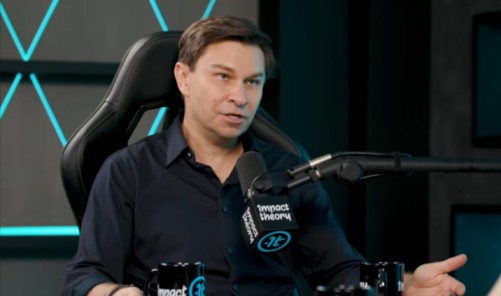
Editor’s Notes: In this fascinating episode, Tom Bilyeu sits down with Harvard geneticist Dr. David Sinclair to discuss how AI is revolutionizing longevity research by compressing 160 years of work into just a few years. Dr. Sinclair explains how his lab used AI to screen billions of molecules to find chemicals capable of reversing the aging process, potentially turning expensive gene therapies into affordable daily treatments. The conversation delves into the “Information Theory of Aging,” exploring how cells can be reprogrammed to regain their youthful function and the exciting human trials on the horizon for 2026. (April 16, 2026)
TRANSCRIPT:
AI’s Role in Accelerating Aging Research
TOM BILYEU: You are at the intersection of my absolute fascination with health, which is where it’s intersecting right now with AI. I’ve heard you say that AI is making things possible in human longevity that previously weren’t. So what specifically has AI put on the table that wasn’t possible before?
DR. DAVID SINCLAIR: Well, the big thing is the speed that we can do things. We currently have technology that can reverse aging in animals, and we’ll find out this year if it works in people. But it’s an expensive technology. It uses genes and we have to introduce genes into the body or the eye in this case. That’s potentially hundreds of thousands of dollars to do that.
So what we wanted to do in my lab was democratize this technology. So how do you do that? Well, AI is helping. We’ve now screened probably about 8 billion virtual chemicals for one that will reverse aging so that instead of introducing genes, which is expensive, we could take a pill or rub it on our hair or our skin.
And I asked one of the AI sites, “How long do you think this would have taken in a normal world, pre-AI?” And it estimated it would have taken about 160 years for my team to have finished that experiment, and the cost would have been in the many billions of dollars.
TOM BILYEU: Why is that? Is AI just crunching numbers, pattern recognition? What is it that makes AI able to shorten the timeline?
DR. DAVID SINCLAIR: Yeah, well, the big one was we need to thank Demis Hassabis and his team, of course, for elucidating the structure of all of the proteins in the body. We didn’t have that until about 4 or 5 years ago. And now that we have those structures, those proteins, we can virtually dock billions of molecules into each of those proteins and find ones that modulate those proteins.
TOM BILYEU: Is this based on shape or mostly—
DR. DAVID SINCLAIR: —and charge. So we know the behavior of atoms and small molecules, and now we know proteins, and proteins are vibrating, so it’s a little complicated.
Understanding What AI Actually Does in Biology
TOM BILYEU: You say “we know.” So one of the things I want to know about AI is, is AI getting to the point where it understands the fundamental rules that govern biology, or is it just learning all of the patterns in the literature?
DR. DAVID SINCLAIR: Oh, it’s more than in the literature. It’s understanding the patterns in biology and how to extrapolate from atoms to molecules to proteins. That’s a big jump. We couldn’t do that more than 5 years ago. And now AI is really using that.
I mean, it’s partly AI, it’s partly brute force, just mathematics. But on top of that, you can add now intelligent agents that can take the results from those screens, as we call them. And we typically get hundreds of thousands of hits, as they’re called.
TOM BILYEU: And the hit is this shape matches this shape and allows the chemical reaction to transpire.
DR. DAVID SINCLAIR: Exactly. In this case, what we’re doing is virtually impossible — at least 5 years ago it was impossible. And that is that we’re trying to find one chemical that does the work of three that we currently have. So when we reverse aging in a mouse, we give it a cocktail down its throat of three chemicals.
And in drug development, finding one better chemical can cost hundreds of millions of dollars and years of work. And I’m asking my team and our collaborators, “Find one molecule that does what those three do and even better.” And then once you’ve found those hundreds of thousands, which ones are most likely to work? Because in the lab, it’s not that easy, and it’s very expensive to order and synthesize thousands, and especially hundreds of thousands of molecules.
TOM BILYEU: Order meaning online? Yes, I need to get some of these molecules in the lab so I can get the mouse to eat it.
DR. DAVID SINCLAIR: Well, we don’t test it on a mouse initially. That would be prohibitively expensive.
TOM BILYEU: What do you test it on?
DR. DAVID SINCLAIR: Cells. And that’s also where AI comes in. We’ve got an AI system we developed. It’s machine learning with a layer of AI that can look at cells from humans that we grow in the lab and we paint them so they’ve got colors and so we can see different shapes and things that are happening inside the cells live, or we kill them and stain them.
And then we use visualization to say, “Is that cell from a 92-year-old going back to look more like the cells from a 20-year-old?” And we’ve been working for about 3.5 to 4 years on that.
TOM BILYEU: Did you guys have to train your own model?
DR. DAVID SINCLAIR: Yes, we absolutely did. So we got the cells from these people who are young and old, and we trained the model and it took a long time to get that right.
TOM BILYEU: And it was just like, “This cell young, this cell old, this cell young, this cell old.” And then it gets to the point where you don’t have to tell it anything.
DR. DAVID SINCLAIR: Yeah, fascinating.
TOM BILYEU: Okay, so when people talk about large language models, they’re talking about billions of parameters. How many cells did you guys have to feed it in order to get it to be able to discern a cell?
DR. DAVID SINCLAIR: We looked at millions, but these days we can actually train very quickly. The models have gotten better at learning.
TOM BILYEU: Who’s doing the underlying models?
DR. DAVID SINCLAIR: My lab at Harvard.
TOM BILYEU: You guys are starting from scratch.
DR. DAVID SINCLAIR: Yeah. Damn, that’s why it took a few years, but we’re there now. So my team used to be just biologists who wrangled a yeast cell and now a mouse, but I’ve had to build up my team with real bioinformatics and AI expertise.
The Presuppositions Behind the Science
TOM BILYEU: Okay, you just gave me the chills. So here’s the thing I’m trying to get people to understand — that we’re living through the weirdest moment in human history ever, and that when we think about the direction of travel — and I’ll press you on timelines, but I know they’re going to be wrong. Don’t worry about that. I just want people to understand that things are moving faster than they realize.
I did not realize that individual labs were able to train this from the ground up, which is utterly fascinating. But okay, so I’m going to lay out what I think are the presuppositions that will make this interview make sense to people. I want them to understand the perceived direction of travel as of today. Of course, it’s going to be wrong in the fullness of time. I understand that. I’m sure you understand that. But it gives people a direction of travel.
So I’ll give you what I think you’re saying. If any of this is wrong, let’s correct it now so that as we go through the interview, people can understand what you’re actually trying to achieve. Okay, so this is me trying to channel what I think you’re saying in a very simple, direct way.
So: biology abides by a set of rules, which means that AI is going to be able to understand it. Like the laws of physics, we may not know what they are, but there are rules. Those rules are ultimately going to be knowable. Same thing with biology. AI is ridiculously good at identifying the patterns inherent to these rules, giving AI predictive powers over biology. So if you fold a protein this way, then it will do this.
Next: aging is a disease caused by information degradation over time, but cells store the original healthy information in a kind of backup. So far, so good?
DR. DAVID SINCLAIR: Yes, with a little footnote, which is that’s the theory that my lab works on — that we came up with. It’s not universally agreed upon that there is a backup copy, but it has to be there because we use it every day to achieve what we do in the lab.
TOM BILYEU: Okay, so that one may be a little bit controversial, but this is the point of science — we’re going to find out. Okay, so next: any disease tied to a breakdown in information integrity theoretically can be effectively treated if you can get the cell to start reading this somewhat controversial healthy backup data again.
DR. DAVID SINCLAIR: That’s correct.
TOM BILYEU: Okay, therefore AI is going to dramatically accelerate the effective treatment of many, if not all, information-related diseases, including aging.
DR. DAVID SINCLAIR: I would say that’s as close to a fact as we could get right now.
TOM BILYEU: These are the presuppositions that you’re operating on. So presumably in time some of this will end up being true, some of this will need to be modified, whatever. But these are the things that give you the courage and momentum to go down this path.
DR. DAVID SINCLAIR: Yes. And even if some of it isn’t 100% true, we’re still going to achieve the goal because we can do it. We’re just trying to figure out how the heck it’s working because we’re getting results that are nearly unbelievable and we have to figure out how is that possible. So the nuances, we’ll argue probably for the next 50 years, but it doesn’t change the fact that we’re doing it.
The Scientific Method and Falsification
TOM BILYEU: Yeah, that makes sense to me. I’m haunted by — and I can’t remember if it was Max Planck who said it — but whoever said the quote that “science advances not one insight at a time but one funeral at a time.” That winds me up. It drives me absolutely crazy that people cannot go, “Well, there’s obviously something I don’t understand. I’ll figure it out.” This is the whole point of the scientific method.
In business, I literally teach this. I call it the physics of progress. The physics of progress is: make your best guess. You’re going to be wrong to some degree. Run the experiments, figure out in what way you are wrong, adapt, get a little bit better, and then you just run that cycle over and over and over. So I presume that’s what you’re doing as you march down this path, yes?
DR. DAVID SINCLAIR: Yes, with the scientific method, which is fail, fail, fail, and then something works.
TOM BILYEU: Okay, so we know what we believe and what we’re pursuing. It’s the things that I just ran through. What would be the falsification? How would we know if we’re like, “Oh, we just proved that this doesn’t work?”
DR. DAVID SINCLAIR: Well, we’ve been doing those experiments trying to disprove our theory. That’s what we do as scientists.
TOM BILYEU: What would be the kill shot though?
DR. DAVID SINCLAIR: There are two main tests. One is if we degrade the information in the cell in an animal — for instance, take a mouse — and the mouse gets sick and dies but it doesn’t get old, then that’s not aging, that’s just sick. But we did that experiment and the mouse got old, and we published in 2023 that information loss is a cause of aging in mammals, in us.
Then the next test is, can you reverse that process? Can you bring back the information like my hypothesis says we should be able to do, even if we don’t know where it’s stored? And in 2020, on the cover of Nature magazine — which is as good as you can get as a scientist — we published that we could do that, that we could get back that information somehow using 3 genes that embryos usually use to reset their own age from their parents’ age.
So if those had failed, if we couldn’t reset age, if we couldn’t age a mouse forwards, then okay, we’ll move on, we’ll do something else. But the fact is now, Tom, that in my lab we can drive aging in either direction at will using the technologies that we’ve developed, and it’s only going to get better.
From Mice to Monkeys: Moving Toward Human Trials
TOM BILYEU: Okay. In mice.
DR. DAVID SINCLAIR: In mice. And we’ve done it in monkeys. We’ve cured—
TOM BILYEU: As effectively, or is that more complicated?
DR. DAVID SINCLAIR: It’s actually not more complicated in a monkey. If you want to get into the details, there’s a membrane in the monkey that the mouse doesn’t have that might have inhibited the genes getting into the back of the eye, the retina. But it worked fine. And the monkeys got their electrical signals back in their optic nerve, and we believe that that is good enough signal to go into humans to treat blindness, a couple of diseases in humans. And if all goes well, we’ll get ready to start the trial.
The Science of Cellular Reprogramming
TOM BILYEU: Okay, so membrane was a concern but just didn’t end up in practice being a problem, right?
DR. DAVID SINCLAIR: But the fact that it worked in monkeys, where a lot of things in mice don’t translate into primates, was a big deal. And so that raised my confidence level from 50% to about 80-90%.
TOM BILYEU: Okay, but the big question mark right now is you’re reaching into a black box that we don’t quite understand why it’s working because you know the effect is that using those 3 chemicals, enzymes, genes.
DR. DAVID SINCLAIR: Well, we’ve got 3 genes and 3 chemicals.
TOM BILYEU: Okay.
DR. DAVID SINCLAIR: I don’t know why it’s 3, but that’s just what turned out.
TOM BILYEU: Sure.
DR. DAVID SINCLAIR: The 3 genes have a name, OCT4, SOX2, KLF4, OSK we call them. And they were— we could talk about how they were found, but essentially those 3 genes, now we mimic those with 3 chemicals and hopefully, as we discussed, get down to 1 pill that we can take.
TOM BILYEU: Okay, we’ll get to the pill in a second. But, so we administer the genes and the chemicals, which we don’t have to get too specific. I think people will not be able to track, but we’ve got those things, we get them into the system somehow, some way, whether it’s injecting, pill later, whatever, whatever. But we get them into the system where they need to be.
But we don’t know exactly how we’re then able to get the cell to de-age. I don’t know if we’re comfortable with that word, but we know that it happens. And so your best guess is that there is somewhere in there the storage of the youthful, healthy cell, like a backup, and that is somehow getting the cell to reread off of that versus the— I might be jumping ahead here, but the methylated cell that’s sort of gotten the scratches on the CD of the DNA, if you will, over time, which is causing it to, again, I worry about getting too far ahead, but I’m going to say it anyway, the cells begin to dedifferentiate. So an eye cell stops being just an eye cell. Maybe it’s a little bit of a skin cell or a brain cell or whatever. And so it starts getting confused. How’d we do so far?
DR. DAVID SINCLAIR: Brilliantly. Yeah, I couldn’t have said it better myself.
The Information Integrity Theory of Aging
TOM BILYEU: You can and have, but that’s very generous. Okay, but we now, at least hopefully people following along at home, understand what we’re trying to do when we say that we want to take this, we want to take a view of aging, that it is an information integrity problem, that there is something akin to a backup copy of what the cell should look like, but aging is basically, oh, we stop checking the original work and we just start going off of like the repaired house, if you will. And it’s like, well, the repair starts to get weird unto itself, and so now we’re not replicating properly. Okay, you guys have a mechanism to somehow, some way get it to build as if it were a young cell again.
DR. DAVID SINCLAIR: Well, build isn’t the right word. It’s to read the right genes at the right time.
TOM BILYEU: Why do you say build isn’t the right word?
DR. DAVID SINCLAIR: Well, when you reinstall software, I guess you could call that a build, but I don’t mean it’s not physically building.
TOM BILYEU: Cell is being built, which is why I think of it as building.
DR. DAVID SINCLAIR: Oh, well, you’re putting together two theories. My theory is that the cell and aging is information, and the old theory is that the cells just break down, wear out. And so you’re thinking rebuilding, that repair, right? Restoring.
TOM BILYEU: Interesting. The way I’m thinking of it, which is probably messy because I’ve not thought about it like you have, goes something like this. I’m not playing a song, I’m building a house. And so the cell is physical. So when the DNA gets— we’re going to have to explain methylation. Do you want to give people a quick primer on exactly what is breaking down? Like what methylation is, the tight winding, all that. And then we can get back to why I say building.
DR. DAVID SINCLAIR: Sure. And I think where you’re going is that when we restore the information, the cell can now rebuild itself in a useful way.
TOM BILYEU: The cell, when it builds the next one, will build it better and it will be a truly differentiated cell. And not just the next one.
DR. DAVID SINCLAIR: Not just the next one itself. We restore the health and the youth of nerve cells in the eye and elsewhere that don’t divide. The cell itself gets healthy, doesn’t need to even grow. It can just reinstall the software, then it makes new proteins, makes new lipids, makes new—
TOM BILYEU: There were cells that didn’t divide. So there are cells that don’t divide, full stop.
DR. DAVID SINCLAIR: Oh yeah, your heart, your brain, mostly that’s the same cells you had when you were a teenager.
TOM BILYEU: It is wild. Okay, didn’t know that. Thank you.
DR. DAVID SINCLAIR: Yeah.
Understanding DNA Methylation
TOM BILYEU: Okay, so sorry, explain to people methylation just real fast.
DR. DAVID SINCLAIR: Yep. All right, so we’ve got 6 feet of DNA in our cells. Every cell gets wrapped up, and there are 20,000 genes, but not every gene gets turned on in every cell. The cell wouldn’t function. So we need a certain set, let’s say 10,000 nerve genes, and then a different set for skin genes. So it’s like a piano. You’ve got lots of keys. Every piano has the same set of keys, but how you play them makes the difference to the music. The cell works the same way. Same genes, play them differently, you get different cell types, you get a different—
TOM BILYEU: What is the play, just to not be analogy? Is it the creation of proteins?
DR. DAVID SINCLAIR: Mostly, mostly. Not all genes make proteins. Some of them make other things like RNA. But yes, mostly it’s, we’re talking about those proteins that become enzymes that do the work of living and repairing.
TOM BILYEU: Okay, so we are, even in a cell that isn’t dividing, so I was wrong about necessarily what is being built, but the thing that we’re fixing is the building mechanism itself. So we’re building enzymes, which— but I had to look all this stuff up, enzymes like do a thing, they like move around, they’re machines for sure.
DR. DAVID SINCLAIR: They’re really super interesting machines. There are tens of thousands of different ones. Yeah, and they do cool stuff.
TOM BILYEU: That’s so wild.
DR. DAVID SINCLAIR: Including reading the genes themselves. So the DNA is a string of chemicals, right? And the cell has to open up the DNA strand. It’s double-stranded. It’s a helix, like a— think of it like a spiral staircase. It looks like that. But to read it, you have to open up the stairs. Each stair splits in half, and the cell can read that half of the stair. And a gene is about 1,000 or more of those steps. It’ll read that, and the set of 3 of those steps determines which amino acid goes next in the protein.
There’s what’s called a start set. Start codon, and it always starts with the amino acid methionine. So every protein has a methionine— almost every protein has a methionine. But what comes next is dependent on those 3 steps in the rung of that staircase, or in this case, the letters on the DNA: A, T, C, or G. Now that’s a gene, right? 1,000 of those steps in that chemical, and there are 20,000 sets of those that are all encoding proteins at the amino acid level. That’s your blueprint.
But the problem with aging is the cell forgets which genes to read. It actually turns off some genes and for the most part turns on other genes. And now instead of having skin genes turned on, it’s some skin genes and some nerve cell genes, and kidney genes start to look more like liver genes that are coming on. And that inability to read the right music of the cell, I think, is the major reason why we get sick and get old, and that’s reversible.
These methyls are little chemicals that get attached to the rungs of the staircase, the steps. And if you have lots of them on the steps, the cell doesn’t read the gene anymore, shuts it down, and you don’t make protein. So that’s why a nerve cell isn’t turning on skin cells’ genes, because they’ve got a lot of these methyl chemicals on the ladder, on the steps that basically say stop reading or only read this. Don’t read this one, go and read the one you need to go read.
But those methyls, including more complicated structures, larger structures, are what determines when we’re developing in an embryo— go over here and make some skin, but go over here in the skull and make some more brain cells.
TOM BILYEU: Okay, and the methylation has to be redone every time a cell divides or takes damage.
DR. DAVID SINCLAIR: Yes. Every time a cell divides, you should be getting an identical methylation pattern between the daughter and the parent cell. And there are copying mechanisms. We understand how that works. It changes during development, of course, because we’re starting from one cell that has to become hundreds of different types.
The problem is, as we get older, through things that we believe are largely due to cell damage and stress in the cell, those chemicals on the ladder, on the stairs, they get misplaced. They get taken off where they shouldn’t be and put on where they shouldn’t be. And now the cell doesn’t know what to do. It’s reading the wrong music, and it’s a complete disaster. We get gray hair, we get wrinkled skin, we get disease, we die.
TOM BILYEU: Do you have a hypothesis as to what is making the methylation be imperfectly replicated?
The Science of Sirtuins and DNA Repair
DR. DAVID SINCLAIR: We do, and the history is not well known. When I came to the United States, you probably noticed I don’t have a strong American accent, not yet. I went to MIT, and the goal was to figure out why do yeast cells that make things like beer, Vegemite, which I really like— Tom, I’m going to get you some— the yeast cells, they’re microscopic, but they have chromosomes just like we do. And so I figured if we can’t figure it out for yeast cells, we’ll never figure it out for humans.
So for 4 years, I worked under the tutelage of a professor who deserves a lot of credit, Lenny Guarente. And we worked together, he and I, and a team, and we put out a paper, he and I, just on my first big paper in my life, the cause of aging in yeast cells. And that was the blueprint— excuse the pun— for the rest of my career, including the information theory of aging, which we’re talking about now.
And in that I said that what’s largely changing these patterns of gene expression, what we just called the process of aging, is that proteins that should be turning genes on and off— we call them regulators, protein regulators of genes— they get distracted by doing other things. And there’s one set of enzymes and proteins that I’ve worked on my whole career that came from these studies called sirtuins, based on the gene called SIRTU in yeast.
Sirtuins, they actually go to the DNA and they tell the cell, shut this gene off. They see the methyls, they see those chemicals, and those chemicals are really simple, by the way. They’re just a carbon with 3 hydrogens. These methyls are recognized by the sirtuins, and these proteins go in and help shut off the gene and stop the cell from accidentally reading it. They bundle it up. They actually bundle up the DNA like a little package, versus a big loop of open DNA that gets read. So it’s a bundling sirtuin.
And there are a few breakthroughs. One was that the sirtuins get distracted, and one of the major distractions that they have is broken chromosomes. They hate broken chromosomes. Yeast cells and our cells, they can die if they don’t repair a broken chromosome. Or in our case, you can get cancer. So a cell panics when there’s even one break on a chromosome, and it often happens when cells are dividing and they’re trying to separate the chromosomes. They get caught, tangled up, break. Now you’re screwed if you don’t fix it.
So the sirtuins have two roles. One is to control these methyl patterns and genes, but they also go repair DNA, and they’ll prioritize repairing the DNA. They do. Otherwise there’s no cell.
TOM BILYEU: Okay, and so if you’re doing something that breaks your DNA frequently, you’re going to age fast, presumably, because it’s going to be so distracted repairing that that it’s not doing its job with the methylation.
DR. DAVID SINCLAIR: Yes. And remember how I said there was a test of the theory, which was if we cause aging, do we get an old mouse?
TOM BILYEU: So you just go f* up their DNA basically to cause the sirtuins to run over to have to fix it?
The Slime Mold Experiment: Accelerating Aging in Mice
DR. DAVID SINCLAIR: Well, we didn’t— I wouldn’t use the word f*. Because we were very precise, we were surgical about it. We found an enzyme that is in a slime mold found in the forests around here, and it turns out there’s an enzyme that cuts DNA rarely in mouse and human cells. A dozen or so sites, maybe a couple of dozen, but not thousands, because you’d kill the mouse. So we surgically inserted that slime mold DNA into the mouse itself at the stem cell stage. And then we turn that stem cell into a mouse, which is standard procedure for students these days in my lab.
And that mouse— now we could turn on this cutting enzyme from the slime mold and surgically create a few of these broken chromosomes. Not a lot, not enough to kill a mouse, but just enough to distract the sirtuins from their normal job, make the cells panic, and see what would happen. And we did that for 3 weeks in these young mice and nothing happened. It’s like, oh goodness, the experiment’s not going to work. Nothing happened.
But then I thought, when you get an X-ray, you get a lot of broken DNA, but you don’t feel it. So let’s just wait to see what happens. And I went to Australia, and this was the year 2012, and I got a photo on my old iPhone and it was a photo of a sick mouse and the text was, “Should we kill the mouse because it’s looking really sick?” And I said, “Tell me, which is this mouse?” They said, “Oh, that’s the one we treated with the slime mold cutting enzyme.” And I said, “That’s not a sick mouse, that’s an old mouse right there.”
So that was the first evidence that by distracting the sirtuins to broken chromosomes, it leads to an acceleration of aging. And we published that. It took another decade to publish. And this was this big paper I mentioned, was in the journal Cell, which again is pretty hard to get into. And this was the one that said that the change in information, loss of information, was the cause of aging in mammals.
TOM BILYEU: What’s the difference in phenotypical expression between something that’s naturally old and something that ages due to the breaking of the DNA?
DR. DAVID SINCLAIR: Nothing.
TOM BILYEU: Literally nothing. You wouldn’t be able to tell, right?
DR. DAVID SINCLAIR: That was the cool part, except that they were 50% older and we can measure and we did. We measured the methyls across the chromosomes, and we can use those changes as a clock. And in fact, you probably know you can get a DNA methylation clock done these days commercially. So we did it on the mice, and the mice were 50% older. Those methyl changes were the same as an old mouse, just happening 50% faster.
AI’s Role in Accelerating Aging Research
TOM BILYEU: Yeah, okay, wild. So that sets us up well for understanding the thing that we’re chasing. Now, one thing I’ve heard you say about AI is just the timeline speed-up that we get here. So what is the— where are you injecting AI into this process? Is it simulating biology and simulating cells and just running thousands of experiments in the amount of time that we can normally run one? Or where’s the real advantage?
DR. DAVID SINCLAIR: It’s simulating experiments. So normally we would, in the case of finding chemicals, have to make the chemicals, which can take weeks for each one. Imagine trying to do 7 billion or 8 billion. So we don’t have to make them anymore. We can actually— we’re now at the point, and this is new news I think everyone would be interested in hearing, we started doing 8 billion, which we thought 2 years ago, mind-blowing, 8 billion. Normally a pharmaceutical company might screen a couple of million, right? That’s physically— we can now do an infinite number of molecules. We believe that we’re going to cover all possible chemicals, which is an order of magnitude bigger than what we’ve been doing. And that’s only happened in the last year that we could do that.
But what’s speeding it up is the ability to turn physical world into synthetic, virtual. And instead of it taking a year to figure something out, it can be milliseconds in some cases.
TOM BILYEU: And what’s the most complex thing we can simulate? Is it the cell? Can we simulate a liver?
DR. DAVID SINCLAIR: No, biology is so much more complicated than most engineers understand. We still probably only know about 3% of biology, so trying to model it, it’s pretty hard. And then the complexity. I mentioned that it took all of DeepMind and those guys until recently to figure out how to just model a protein of 1,000 amino acids. Even 20 amino acids was a challenge. Trying to model a cell is going to take a lot more work. It’s not impossible because you will make assumptions, but there’s no way in my lifetime that I believe that a cell can be modeled from the ground up, looking at every molecule.
TOM BILYEU: Really? In your lifetime?
DR. DAVID SINCLAIR: Right, and I’m an optimistic guy.
TOM BILYEU: I was going to say, you don’t plan to die too early. That’s wild. So you’re saying we’re what, more than 50 years away? That’s crazy.
DR. DAVID SINCLAIR: To model a cell with every molecule? I mean, you can make assumptions. You can say, okay, generally these proteins are around in this cell and these proteins are around in that cell. But to say— if they can do that, what they should be able to do one day is to take an egg and the genome and what we call the epigenome, those methyl marks, and predict what the human looks like.
The Future of AI and Biological Complexity
TOM BILYEU: Yes. I suppose this is where I confess my base assumptions. My base assumption is that our current quest for intelligence shows no signs of asymptoting. So it’s going to keep getting better. And so as we come up with more efficient algorithms, as we’re able to make bigger and bigger data centers, that AI will get smarter and smarter.
If you can believe that in very narrow ways, we’ve had AI achieve something like 147 IQ, and that’s— what are we, 50 years into real AI development? So it’s like in the next 50 years, given where we’re at, no way. 10 years, I can’t fathom a universe in which 10 years we don’t hit artificial general intelligence. Ray Kurzweil has been right with his predictions, I think 87% of the time. Says 2030, that’s 4 years for anybody keeping score. He says we’ll hit AGI.
The question becomes, is artificial general intelligence, given that at that point it will be able to improve itself— is artificial superintelligence 4 years and 1 day? Like, or does it take longer? But I cannot fathom a universe in which we don’t hit artificial superintelligence in 50 years.
DR. DAVID SINCLAIR: I agree.
TOM BILYEU: But you just said that we won’t be able to map a cell. And so what I’m saying is you’ll get into an upward spiral of intelligence where we can’t imagine doing it now because being locked into, in my case, very low IQ, in your case, better. But as you start pushing this into the— I mean, what does the smartest guy ever clocked? I think it’s like 225 IQ or something, but I’ve seen his tweets. I don’t buy it. So 250, 300, 400, 500, 1,000 IQ, like what does that start looking like?
DR. DAVID SINCLAIR: Well, it’s not IQ that’s the problem. The problem is the compute. Now, maybe with quantum computing we’re going to get there, but using traditional computers to model the interactions in a cell, even for a millisecond, would be more calculations than have ever been performed in a computer to this point.
TOM BILYEU: Yes. So you don’t believe— you think that advancements in computation are going to stall out?
DR. DAVID SINCLAIR: Even if they don’t, it probably would take more molecules than exist in the universe to— without quantum computing— to calculate what happens in a cell within one second. It’s that complex. It’s mind-boggling how complex a cell is. We can model one molecule hitting another, and we can even model— I can imagine modeling a million molecules, but modeling an entire cell with the quantum effects that happen, a lot of it’s unknowable without going in and disturbing it as well. So that’s another issue.
But what I’m not saying is that we can’t model a cell. I think that we will be able to model a cell, and I know very smart people who are doing that or trying to do that right now. It’s just that we don’t know enough about biology yet to make an absolute model from the ground up. There’s a lot of assumptions. We know the fundamentals. We know that there’s DNA and these methyls, and we know that proteins get folded. But I can tell you from work in my lab, there’s a whole area of biology that we’ve been missing that will hopefully allow us to figure out where this backup copy is. And without knowing that, is there—
The Mystery of Cellular Age Reset
TOM BILYEU: Describe the black box into which you’re peering right now. What do you mean? There’s a whole area of biology that we don’t know.
DR. DAVID SINCLAIR: Well, one of the problems with science is we don’t know what we don’t know, usually, and that’s the tough part. But one of the big questions in biology right now is how does a cell de-age? I do like that word. And we know that it de-ages, not just from work in my lab and others like mine, but we know that you can take a skin cell— I could take your skin cell, I could take the DNA out of your cell. It’s going to be old. Not too old.
TOM BILYEU: How dare you.
DR. DAVID SINCLAIR: It’s going to be older than a baby. And I could inject that into an egg, and theoretically— actually it’s not even theoretical. I could turn that into sperm and turn it into an egg. Now I could fertilize you and make a clone out of you. This has been done with simpler organisms, but we can do it with humans, eventually. I think that’s how IVF one day may be done if people want to have children if they don’t produce eggs.
TOM BILYEU: The Chinese doctor that went to jail, I forget his name, but follow him on Twitter, shout out, he cloned humans, right?
DR. DAVID SINCLAIR: No, he genetically modified a baby to be resistant to HIV. But his goal is to— and he’s doing this offshore from the US, of course. But there is the technology to do that.
TOM BILYEU: But let’s just say we haven’t cloned humans.
DR. DAVID SINCLAIR: That’s the punchline. No, but we’ve cloned monkeys. Okay, so let’s just stick to monkeys so it’s not controversial. Although even that’s controversial. How about we talk about Barbara Streisand’s dogs, she’s cloned those. Or Tom Brady, who recently got his. But okay, all right, so we can do that. That was done with old DNA. The DNA gets reset, the information can be reset in that cell.
The other thing we know is that if you have parents who are 30 years old and they have a baby, for the first week of life, that embryo is 30 years old. What? Yeah, we’re not always young when we’re alive. Babies would be born old if there wasn’t a reset switch.
TOM BILYEU: So wait, at what point are you saying this is like, we know this, that embryos are—
DR. DAVID SINCLAIR: People have measured it. Yeah, wild. Okay, it’s a fairly new discovery, which is why it’s shocking, but it will be known one day.
TOM BILYEU: So at some point post-conception—
DR. DAVID SINCLAIR: Exactly, day 7 to day 9, we know that.
TOM BILYEU: Whoa.
DR. DAVID SINCLAIR: And the baby goes back to being age 0 again.
TOM BILYEU: Whoa.
DR. DAVID SINCLAIR: All of us, we were once the age of our parents. So I was— my parents were about 30. I was 30 years old twice in my life: when I was conceived and when I hit 30.
TOM BILYEU: That is wild. Okay. Didn’t know that.
DR. DAVID SINCLAIR: And the same mechanisms— we believe the same mechanisms— are what we’re using to reset the age of human tissue and monkeys and hopefully beyond.
TOM BILYEU: So we got on to this because there’s certain things we don’t know. You’re saying we don’t know why those reset.
DR. DAVID SINCLAIR: We don’t know how it resets. How does the cell know what it was 30 years ago?
TOM BILYEU: And does this feel like it falls into a category of the unknowable or just we don’t know yet?
DR. DAVID SINCLAIR: We have a pretty good idea in my lab, but we haven’t told the world yet.
TOM BILYEU: Okay.
DR. DAVID SINCLAIR: I do text my student often and walk into the lab and say, “Have you figured it out? Have you proven it yet?” But we are doing those experiments.
TOM BILYEU: Someone needs to hack your phone.
The Observer: A Backup Copy of Youth
DR. DAVID SINCLAIR: No, they shouldn’t, but you probably could. With your team out there. But yeah, so Chris Petty deserves great credit. His PhD is on finding what we call the observer, which is what Claude Shannon at MIT in the 1940s called the backup copy.
So what we imagine and are testing is whether there are structures that get laid down when we’re very young, during our youth, that can be accessed later in time in a 60-year-old, 70-year-old to reset the age. We don’t want to go back to zero. That was the breakthrough we had in 2020. You don’t go back to zero. I mean, first of all, who wants to do high school again? But you’d probably get cancer. So we don’t do that.
So we figured out a way using those 3 genes, OSK, to go back 75, 80% and stop. How does that happen? We think there are little messages with new biology structures, chemicals that are new to biology that AI may not have figured out or will not figure out easily. Maybe they would, but that’s where we’re at now. Probably in the next few months we’ll know if we’re right. And I’ve been saying that for about a year now, but we’re close.
One way you do this as scientists is we look for necessity and sufficiency, right?
TOM BILYEU: Necessity from an evolutionary standpoint?
DR. DAVID SINCLAIR: No, from a genetic standpoint. What we do as scientists, geneticists, is if we change something, let’s say if we knock out a gene, is that gene necessary for the reversal of aging? Is that process necessary? And then if we force it to turn on and now we trigger that event, is that sufficient in itself to make the change?
And when you get necessity and sufficiency satisfied, you’re really onto something. It was similar with that mouse, right? We knew that it was necessary that these methylation changes could rewind aging, but also we knew that was sufficient to change those methyl chemicals to cause aging. And that’s why I’m so certain that the information theory of aging is correct.
AI Making Novel Discoveries in Aging Research
TOM BILYEU: Okay, this brings me back to something I asked you earlier, but I want to push on it a little bit. When you interface with AI, I’ve always said if AI can come to understand the fundamental laws of physics, it will be able to make novel breakthroughs, and all bets are off. Technological singularity, the world is unknowable to us. As you’re approaching it, has AI made any novel discoveries, novel insights that aren’t already in the literature, or is it just doing a really good job of recognizing patterns in what we already know about a cell?
DR. DAVID SINCLAIR: We in my lab collaborated with another group out of Stanford who developed an agentic system with multiple agents, about a dozen agents that did different things, and we fed it our data. Interestingly, it’s the data that map those chemicals on the DNA that change with time. And we did mouse. We’ve looked at tissues from mouse at very young age, middle age, about our age, and then even older equivalent.
What happened was the agents went to work, and about a month later— there was some iterations, it probably didn’t take a month— but we got the data back from this group we were collaborating with at Stanford. What was incredible was it didn’t just come up with validating what the field— the smartest people in my field— had done over the last 10 years, which by the way would have been, “Oh yes, you can make a clock out of DNA methylation using these parameters and this Markov modeling and all sorts of what was already known in the literature.” Which is what I was expecting.
What happened was it came back and said, “Hey, did you guys ever think of this before?” And came up with a completely new way of looking at the data and making a new model to predict biological age out of the data we gave it. Not only that, it proved the data, it did the statistics, it wrote the paper up for us and presented us with the finished product, which sucked because we want to be co-authors too. So we changed a few words, but now I’m a co-author with an AI system.
TOM BILYEU: Damn.
DR. DAVID SINCLAIR: It’s up online, but it’s not published yet. But you can find it on bioRxiv if you do Sinclair agentic biological—
TOM BILYEU: What was that like? Was it like, “Holy shit, this has just had a novel insight, and how fast are we going to improve?” Or—
DR. DAVID SINCLAIR: It was a holy shit because I thought that my job was not at stake. The arrogance was I’ve got all this knowledge and experience and gut feeling, and I’m really creative, but here I’m seeing the beginnings of creativity that can be super creativity in the future.
And I think most people who are not like us at the forefront of technology— like discussions with my father who’s 86— “AI can never be creative.” That’s just human arrogance. They definitely are already creative. And it’ll only get better.
How Far Can We Push Age Reversal?
TOM BILYEU: Yeah, that’s encouraging in terms of its capabilities, if it’s actually able to understand the fundamental rule set and then say, “Hey, what about this?” Okay, so you guys have created in your lab a model that is able to actually gain real creative insights based on what it understands about biology and all the cells that it’s seen and all of that.
So where is this pointing? If you don’t have conviction that we’ll be able to simulate a cell in your lifetime, is it that you don’t think we require the understanding or the sophistication in order to profoundly de-age the body? Because the body is the very complex system that you don’t think that we can fully understand. But yet you seem optimistic that we’ll be able to influence these incredibly complicated processes in a way that is both knowable, so we can do it repeatedly, and advantageous for age reversal.
DR. DAVID SINCLAIR: Yes, absolutely. We’re doing it already. There’s no question about that.
TOM BILYEU: Why?
DR. DAVID SINCLAIR: We don’t need to know every molecule.
TOM BILYEU: Okay, so it’s just as long as we understand how to manipulate the output, nothing else matters. And knowing why it works is the hard part. Manipulating it to give us a predictable outcome is hard for sure, but far easier than the simulation.
DR. DAVID SINCLAIR: Yeah, my students, I mean, they’re in their 20s, they have regular tools, they can do it. I could set you up in the lab, you could do it. It’s not that difficult now that we have this hypothesis that appears to be true.
In the same way, I often refer to the Wright brothers because this is our Wright brothers moment for humanity when it comes to aging. And there are skeptics, like in 1904, people were saying— in fact, the New York Times published that it would take a million years or more to figure out how to fly. And then it was like 3 weeks later, Wright brothers.
TOM BILYEU: That’s how I feel when you say that a cell won’t be replicated, but you know, it’s all right.
DR. DAVID SINCLAIR: Yeah, well, we don’t need to know, and we still don’t know how every molecule in an airplane functions. We don’t need to model that. We can make assumptions, we can make generalizations about wind flow and wing structure and metals. Same with the cell, but you still need to know what’s the metal, what’s the wind, how does air work. And there’s still a few missing pieces when it comes to biology to be able to simulate an entire cell. But when it comes to aging, I think the big breakthrough was understanding that aging is information and that it can be reset.
TOM BILYEU: So how far are you going to be able to push that though? I’ll give up, doesn’t matter, we’re not going to be able to simulate the cell, doesn’t seem like it’s relevant to be honest. So now we’ve got, we’re showing great signs that we can improve eyes. I want to feel as good as I did when I was 25. I want to look as good as I did when I was 25. How realistic is it that we can go in and influence multiple systems in the body in coordination with each other and not end up with whatever catastrophe looks like?
So I imagine the catastrophic fail here, which we’ve mentioned, is cancer. That would be one catastrophic fail state where you go back too far and it just all hell breaks loose. Or getting into some sort of decoherence where it’s like, we are telling the cell to move in a direction, we can’t stop it or whatever, and so it just basically becomes a pluripotent mess. So how far can we take this?
DR. DAVID SINCLAIR: Yeah, well, pluripotent is a good word. Just explain it, that that’s a cell that can become any other cell type. So age zero. And that won the Nobel Prize. Shinya Yamanaka deserved the Nobel Prize for figuring out that using his Yamanaka genes, of which we use a subset, can take cells back to being pluripotent.
Miniature Brains, Alzheimer’s, and Cellular Reprogramming
TOM BILYEU: It’s incredible.
DR. DAVID SINCLAIR: And that’s how you make a clone, by the way. But that doesn’t work for human health, because as you said, if your cells lose their identity and become age zero, you’re not going to live very long. And even if you do it in a few cells, you could get cancer. So that was the tough part.
TOM BILYEU: I love the way you always whisper cancer. Yes.
DR. DAVID SINCLAIR: Well, I will say cancer’s been in my family, so it’s not—
TOM BILYEU: I just had skin cancer, so I feel anyone’s pain. Yeah.
DR. DAVID SINCLAIR: Well, the good news is we find that when we reprogram cancer cells, the majority of them slow down or die. So de-aging cancer doesn’t make it worse. It actually makes it die and shrink. So that’s good. I’m not worried actually about cancer anymore.
TOM BILYEU: The Observer — to follow up on that in a minute, but keep going.
DR. DAVID SINCLAIR: I’m going to call it the Observer, the backup copy, because that’s what we call it in the lab. The Observer has a way of stopping the reversal at about 75%, and it works in every tissue that we’ve tested it in. We started with the eye and human skin cells, really not because the eye is easy — it’s because it’s really hard — but it’s an enclosed system, safer to deliver to humans than giving it IV.
TOM BILYEU: Interesting. But it worked in the eye, and that was because you can keep it localized.
DR. DAVID SINCLAIR: Yes, exactly. Okay, so putting genes into the human body is done, but the FDA here in the United States is much more comfortable treating the eye because it’s done every week in patients. So we started with the eye, and it was a Hail Mary experiment.
My student, Wan Cheng Lu, who at one point was ready to give up because it was so difficult and so challenging and things weren’t working, went for the eye. He chose the eye. I let him go for the eye even though I thought it was crazy to try curing blindness. But he did it, and the results were clear that we could reverse the age of the eye — the back of the eye in particular — which is the problem for mice and monkeys. Mice, then monkeys.
And then we’ve moved on since then. So the mice — we were doing that in 2018, right? It was even pre-COVID we had some of these results. So now, how many years? 7 years or so later. We’ve done a lot. We’ve done whole mouse brain. We can reverse the age of the brain. And the results are that old mice get their ability to learn and they even get — we think — some of their memory back from their childhood. Yeah. And that’s in an Alzheimer’s context and just an old age mouse.
TOM BILYEU: Okay, a lot of people just sat up.
DR. DAVID SINCLAIR: Yeah.
TOM BILYEU: Okay, so obviously we haven’t done human trials yet, but does this give you a level of optimism that we’ll be able to positively impact things like Alzheimer’s?
DR. DAVID SINCLAIR: Yes. Now, Alzheimer’s is a big disease.
TOM BILYEU: Yeah.
De-Aging the Brain: A New Approach to Alzheimer’s
DR. DAVID SINCLAIR: And it would be a little bit outrageous for me to say it’s going to be easy to cure Alzheimer’s. That’s crazy. But do I see a path to doing that? And why would I think that my approach is more effective than the tens of thousands of scientists that have come before me — who are probably kind of pissed with me if I say this kind of stuff?
The reason is that we haven’t addressed Alzheimer’s from an aging point of view. Most of Alzheimer’s is aging. You don’t get Alzheimer’s typically when you’re 12 because your brain can fight the disease. Even if you have the genes for Alzheimer’s — ApoE4 allele — you don’t get it till you’re 60, 70, 80. Why? Because the brain has to get old first. And what we’ve discovered is if you de-age the brain, the disease goes away.
TOM BILYEU: Yo.
DR. DAVID SINCLAIR: And we find that true for every disease we’ve tackled so far.
TOM BILYEU: How many diseases have you tackled so far?
DR. DAVID SINCLAIR: Let me try to list them. And it’s just in my lab, and I’m not the only one working on this. We’ve done multiple sclerosis — MS. We’ve published that it is ameliorated by de-aging the nerves. We’ve done kidney, liver disease. A big one is ALS, motor neuron disease — nothing you can do for those patients really — and that looks like it’s working. And skin de-aging. We’re now working on hair and hearing.
TOM BILYEU: Damn, man. Okay, so all of that is incredibly encouraging. You said some positive words about your reduction in fear around cancer, but you haven’t tackled cancer yet. The diseases that you just mentioned — all in mice, or all in mice and monkeys?
DR. DAVID SINCLAIR: In monkeys, we’ve only done the eye.
TOM BILYEU: Okay.
DR. DAVID SINCLAIR: So mostly it’s growing human tissue from scratch. Well, there are two ways we do it. We either grow flat cell layers of human skin. So if I took a biopsy from your skin, back to my lab, I could grow my old skin back to that — your almost middle-aged skin.
TOM BILYEU: I hope I’m only middle-aged.
DR. DAVID SINCLAIR: Yeah, you’re a fair bit younger than me, I think.
TOM BILYEU: I don’t think so. I’m 49.
DR. DAVID SINCLAIR: Yeah, you’re very younger. Yeah, I’m 56.
TOM BILYEU: That makes me want to punch you. I’m inspired.
DR. DAVID SINCLAIR: Blame my parents.
TOM BILYEU: Well, I want to blame your protocols. I’m secretly hoping that this is all something I can learn to do myself.
DR. DAVID SINCLAIR: It’s kind of you, Tom.
TOM BILYEU: So a lot of the testing that we’re doing in labs is basically on just cells.
DR. DAVID SINCLAIR: Correct.
TOM BILYEU: So we build the cells up. So we have, in theory, tested on human cells — we just grew them ourselves.
DR. DAVID SINCLAIR: Yes. Okay, that’s our standard. And human cancers we grow in the lab — lung, colon cancer, melanoma — we grow those. But we go one step better, somewhere towards a monkey. Even better, in some cases we could — we do. And we could take your cells, instead of making them flat, we could re-differentiate them into organs or tissues. And we do that in my lab. We grow miniature brains.
TOM BILYEU: Get the f* out of here. You have miniature human brains?
DR. DAVID SINCLAIR: Yeah. And you give them Alzheimer’s? We make them old.
TOM BILYEU: What?
DR. DAVID SINCLAIR: And then we de-age those with our chemicals.
TOM BILYEU: Wait, do they look like brains?
DR. DAVID SINCLAIR: Yeah, of course. Yeah. If you cut them through, they’ve got all the structures.
TOM BILYEU: But hold on — if I look at it, do I feel like I’m looking at a GI Joe brain that actually has all the structure of a human brain? They’re like little blobs, right?
DR. DAVID SINCLAIR: They’re blobs, but with the same structures.
TOM BILYEU: Do they look like a brain? I need to know if they look like the f*ing thing that is on the Sistine Chapel — it’s got the shape and all that. Is that what we’re talking about?
DR. DAVID SINCLAIR: The Sistine Chapel?
TOM BILYEU: Yeah, you know that God is sitting inside of a thing that’s a brain that’s been vivisected, surely.
DR. DAVID SINCLAIR: I don’t know that.
TOM BILYEU: What? Okay, anyway, so the brain has a super recognizable shape. You’re saying it’s in that shape. This is wild. It’s a little pink ball of stuff. I’m coming to your lab.
DR. DAVID SINCLAIR: Come, come.
TOM BILYEU: Later today.
DR. DAVID SINCLAIR: Come.
TOM BILYEU: This is crazy.
DR. DAVID SINCLAIR: Let’s have someone from my lab take a photo and send it over. And sometimes they grow little black dots, which are eyes that grow. You get two little dots.
TOM BILYEU: This is incredible.
DR. DAVID SINCLAIR: And you can measure the brainwaves.
TOM BILYEU: Can I ask, what are the ethics on this?
DR. DAVID SINCLAIR: It’s fine. Are they conscious? I don’t know, but they have brainwaves. We don’t know what they’re thinking.
Brain Organoids: Watching Aging in Real Time
TOM BILYEU: This is insane. Okay, now I’m totally fascinated. We have to put a pin in this because I need to ask — okay, so you guys are able to replicate microbrains. How do you make them small?
DR. DAVID SINCLAIR: Well, we grow them from single cells. We turn them into stem cells.
TOM BILYEU: Would they just keep growing and growing and growing if you fed them?
DR. DAVID SINCLAIR: They reach a certain size where they don’t keep growing because they don’t have blood vessels.
TOM BILYEU: Do they have a pituitary gland?
DR. DAVID SINCLAIR: They don’t have blood vessels. I don’t know if they have a pituitary gland.
TOM BILYEU: How do they stay alive?
DR. DAVID SINCLAIR: We shake them in liquid and the oxygen diffuses through. But if they get too big, the core becomes hypoxic and doesn’t grow well. But what we need to do is to mix them with blood vessel cells, which people are working on, and then we could grow them really big.
TOM BILYEU: This is so interesting. Oh my God. Oh my God.
DR. DAVID SINCLAIR: And then there are ethical questions about if you can grow a brain from scratch — should you teach it something? Should you give it something to think about?
TOM BILYEU: Yes.
DR. DAVID SINCLAIR: Anyway, it’s a good model for aging.
TOM BILYEU: So wait — it’s my understanding there’s AI that right now can do these really rough readings, like “this person is thinking about this,” and it shows you like a horse, and you’re like, it’s kind of a horse, it’s just sort of blobby shapes. We need to apply immediately this AI to these brains. I need to know if these things are like screaming out, “I’m bored, bro. Come on, give me something to do.”
DR. DAVID SINCLAIR: They might be.
TOM BILYEU: This is wild. Okay.
DR. DAVID SINCLAIR: And here’s the other thing — we see them get old. They lose their firing and we can look at them in real time. You see these sparks, like looking at fireworks. When they get older, there are fewer and fewer sparks.
TOM BILYEU: How are you monitoring the brains?
DR. DAVID SINCLAIR: Well, you put them under the microscope and we can see calcium changes. When calcium gets—
TOM BILYEU: These are the fireworks.
DR. DAVID SINCLAIR: The nerve cells, when they get calcium, they—
TOM BILYEU: Under the microscope, though — are they now dying at this point?
DR. DAVID SINCLAIR: No, they’re living. We can put them back.
TOM BILYEU: Wow.
DR. DAVID SINCLAIR: Okay, so we see the calcium changes, and wherever calcium comes in — which is what’s happening in our brains right now with the firing — it lights up with a dye. Not naturally; we have to give them a dye that lights up. But you can see that. And so you see with the old brains that are a year old — that’s old for a brain organoid — if we give them our genes or our chemical cocktail, our 3-chemical cocktail, the firing comes on again.
TOM BILYEU: Hmm.
DR. DAVID SINCLAIR: And we did that to a mouse, as I mentioned, and the mouse’s brain would run like the human brain now. Well, we hope — how close do I — we hope to be testing this in humans. For the brain as well.
TOM BILYEU: Adult humans, you’re saying?
DR. DAVID SINCLAIR: Adult humans, yeah.
TOM BILYEU: I don’t know that I want to leave the baby brains yet, but okay — so adult humans, what condition would they have to have to subject themselves to this? Because this sounds experimental.
DR. DAVID SINCLAIR: Well, the 3 chemicals are — we’re getting permission to give them to people in a clinical trial to see what would happen.
TOM BILYEU: But people just like, “Hey, I’m Bob, I’m doing fine, but hit me with the 3 chemicals, let me see what happens?”
DR. DAVID SINCLAIR: Yeah.
TOM BILYEU: Wow. Yeah, people do that all the time. This is amazing.
DR. DAVID SINCLAIR: It’s called a phase 1 clinical trial.
TOM BILYEU: Wow. Yes. Okay. Hey, cool. That’s amazing. And so people are going to volunteer to have these? How are you getting the chemicals into their brain?
DR. DAVID SINCLAIR: Oh, you swallow it.
TOM BILYEU: You can take it in a pill.
DR. DAVID SINCLAIR: That’s the goal.
TOM BILYEU: That’s wild. How does this survive metabolism?
DR. DAVID SINCLAIR: Well, it’s— at least two of these molecules have been taken by humans already, so we know— maybe all three actually by now.
TOM BILYEU: Wow.
DR. DAVID SINCLAIR: We know that they’re metabolized. But we need AI to improve that three chemical cocktail, right? So I don’t think that’s the ultimate drug that I’m going to put on the market. I think though, if I mention those three molecules, you could bet that people will be out buying this stuff already.
TOM BILYEU: Yeah, didn’t you say them at the top?
DR. DAVID SINCLAIR: No, I said the genes. Those are OSK genes.
TOM BILYEU: Very careful. Smart.
DR. DAVID SINCLAIR: I have to be. I mean, hopefully people won’t go and inject them with some solvent.
TOM BILYEU: Oh, it will, apparently. They’ll even just sign up for a clinical trial because why not?
DR. DAVID SINCLAIR: Okay, I do know some people have injected themselves with OSK already, which is okay.
TOM BILYEU: So people are injecting themselves with this stuff.
DR. DAVID SINCLAIR: Fascinating.
TOM BILYEU: Because they think this de-aging thing will work?
DR. DAVID SINCLAIR: Yes.
TOM BILYEU: Okay, even though you’re saying there’s more to it than just that.
DR. DAVID SINCLAIR: Well, just to be clear, these are not FDA-sanctioned clinical trials. There is a fringe.
TOM BILYEU: I think people should be able to do their own body what they want.
DR. DAVID SINCLAIR: Do you think so? Then it’s a few people in the world that are willing to try anything not to age. But getting back to really mainstream science and drug development— I was having so much fun with the baby brains, and we can go anywhere you want, Tom, it’s your show. I do want to say though that I’ll just tick off the diseases that have worked well.
TOM BILYEU: Yes, please.
DR. DAVID SINCLAIR: No, I already did that.
TOM BILYEU: You’re talking about in the baby brain though, or— I thought those were like thin sheets.
DR. DAVID SINCLAIR: Yeah, I know what I wanted to tell you, that we don’t just grow brains. We grow other things.
TOM BILYEU: Such as?
DR. DAVID SINCLAIR: Well, we’re growing a uterus.
TOM BILYEU: Why not? Are we impregnating said uterus?
DR. DAVID SINCLAIR: No.
TOM BILYEU: Why a uterus? Why are we building a uterus? Because to see if you can reverse fertility problems.
DR. DAVID SINCLAIR: Yes.
TOM BILYEU: Let’s go.
Reversing Female Fertility and Growing Organs in the Lab
DR. DAVID SINCLAIR: Well, in all public disclosure, I have one X chromosome and one Y chromosome, so I’m a male.
TOM BILYEU: Yes.
DR. DAVID SINCLAIR: So we males are fairly dumb when it comes to female health.
TOM BILYEU: Yes.
DR. DAVID SINCLAIR: And my partner Serena is much more expert in female fertility. That said, I’m a scientist, and so I want to be able to help women have children for longer. And even have children after they’ve gone through menopause.
TOM BILYEU: Let’s go.
DR. DAVID SINCLAIR: And so we’ve already shown a number of years back that using a sirtuin— remember the sirtuins?
TOM BILYEU: I do.
DR. DAVID SINCLAIR: A sirtuin activating molecule that we could reverse infertility in old, very old mice, female mice, and they could produce fresh eggs and have children. That we published. That’s real. But I want something more potent than that. That will truly reverse the age of all parts of the female reproductive system, including the uterus. And I have a student, Maria, who is working on that. That’s her project.
TOM BILYEU: Damn. So this is wild. Okay, so we grow— give me just a quick timeline for this stuff to work its way through the FDA. Like, when are we talking about a 65-year-old woman de-aging her uterus and having babies?
DR. DAVID SINCLAIR: Well, you don’t actually fully have to de-age a uterus. You can have a surrogate. So I could hear people screaming at us that we don’t need to fix the uterus. What we need is healthy eggs and healthy sperm. And that’s—
TOM BILYEU: Wait, I’m not tracking the caveat. So you just said you want to help de-age the uterus. Well, I do, because that’s how we’re trying to soften it for the screaming people, the chattering masses in the comments section. But talk to me about when— got it. There are other things that people can do right now today. Yay. But I’m saying, when are we going to de-age a woman who’s 65? She’s been through menopause for a decade. When are we going to get her producing eggs again and a womb that can house a healthy baby to term? Ballpark me.
DR. DAVID SINCLAIR: The uterus is early stages. We’re still growing those in the lab and looking at menstrual fluid and that kind of stuff.
TOM BILYEU: Wild. Is this a full-size uterus? This isn’t flat cells. This is like— I would actually recognize the uterus.
DR. DAVID SINCLAIR: Yeah, we grow it from scratch and it’s three-dimensional and it’s in the dish. Yes. And then we’re going to age them and hopefully de-age them, obviously. But what I can predict with more certainty, because I can see where we’re going with more clarity, is that this discovery that we made in the mice is now being tested by others in humans already.
TOM BILYEU: —so it’s to activate—
DR. DAVID SINCLAIR: the sirtuin activator. It was, I think, about 8 years ago we published that raising the levels of a sirtuin activator called NAD— that chemical which we make less of as we get older— by raising that, the eggs became produced and fresh again, just from NAD in a month, from raising NAD.
And just last week I saw a study testing women who were not very fertile, receiving for 10 weeks an IV each week of NAD+. And if there’s no placebo—
TOM BILYEU: egg count—
DR. DAVID SINCLAIR: of egg count, egg quality, embryo quality. Very rigorous, actually. And although it’s the first of hopefully many studies, it was extremely promising. There was a dramatic difference, 2-3-fold difference, between those that got the NAD+ IV and those that didn’t.
TOM BILYEU: I have a feeling you want me to let go on the timeline, but I’m not going to. So ballpark me, knowing— certainly I know that whatever you say isn’t going to be accurate, it’ll just be directional. But if you had to swag me—
DR. DAVID SINCLAIR: If that study is true— again, be cautious, it’s one study. But let’s say it’s true, then I think it’s likely that NAD IVs are going to help women who want to get pregnant.
TOM BILYEU: Yeah, yeah, but timeline. We’re rejuvenating uteri here.
DR. DAVID SINCLAIR: Well, the uterus is different. The uterus is more challenging, but the egg story— 10 years? 20 years?
TOM BILYEU: 30 years? Already. Okay, so NAD for somebody that’s sort of on the cusp. But I want to know when we’re— When’s the uterus? Yeah, I’m talking, I’m giving you the very specifics that I’m chasing.
DR. DAVID SINCLAIR: Sounds like you really need a fresh uterus.
TOM BILYEU: No, but this is so interesting that— never did I think that already on the sort of pipeline of things to be tried would we be growing actual mini brains in a lab, actual uterus in a lab. Like, this is thrilling, exciting, shocking, but this was not on my bingo card. So now I want to know, because it’s clearly closer than I thought. Given that we have to get through all the FDA and all that, like, are we talking 30 years? Are we talking 15 years?
DR. DAVID SINCLAIR: All right, well, there’s actually two options. One is the FDA route, which is novel molecule, AI gives it to us, we take that. I’ve got a company, Life Biosciences, that’s ready to go, and they’re all set to go. So that usually takes 5 years to get through the FDA with a small molecule that’s been shown to work in animals.
TOM BILYEU: But do we have 20 years of discovery still on the de-aging of the uterus, or are we already pretty deep in that process?
DR. DAVID SINCLAIR: Well, we’re going parallel. We’re going AI to find the molecule. And I said, we’ve already done a lot of that. And then we’re building the uteri in the dish right now. And we’ll just put those two together when they’re ready.
TOM BILYEU: This is so wild.
DR. DAVID SINCLAIR: And then if that works and the mice work, then we can apply to test this in humans with adequate safety studies in animals. The safety studies take a couple of years.
Ketones, Brain Health, and the DNA Connection
TOM BILYEU: That’s wild. All right. I want to go back to the brain. The brain is my thing. If ever there was something I wanted a fresh new one, it would be to keep my brain healthy forever. So there are things that people do now. You’ve got stuff like ketones. I will take ketone supplements. I will take caffeine, obviously nicotine. So I do things to sharpen my brain now. How does that stuff compare to what you’re talking about?
DR. DAVID SINCLAIR: Well, right now I think stuff like ketones are excellent for the brain.
TOM BILYEU: Similar mechanism or totally unrelated?
DR. DAVID SINCLAIR: We don’t know. It’s possible that they’re related because beta-hydroxybutyrate can actually not just affect energy in the brain. And that’s why I drink— actually, there’s a group that I’m collaborating with scientifically as well that are doing good studies at Ketone IQ. The science looks really good. The brain is what I use it for. I chug it before I do recording of the podcast that I’m relaunching— season 2 coming up. But yeah, I find that when I’m stressed and I’m having to basically take 15 pages and remember it in a few minutes, then I need that extra fuel. And we know that ketones are very good for the brain.
But you’re asking me, is it related to my work? What’s interesting is that these ketones— and one is related to keto-related molecules— they’re kind of related to vinegar. These molecules actually go in and they change the structure of how the DNA is packaged to help with the methyls. It’s so acute though.
TOM BILYEU: It’s not like I can take one shot of ketones and my brain is better for a month. It’s very, at least for me, very short-acting.
DR. DAVID SINCLAIR: Yeah, so that’s probably two things happening. The first is the ketones are good fuel for your brain. What we know is when we’ve fasted for, let’s say, about 15 hours, ketone levels will go up because we run out of glycogen from the liver. And then the clarity, mental clarity— you might be a little angry because you’re hungry, but the clarity is there. We’ve probably all done this. If we study and we’re not eating a lot, we can focus. I know I need that because I get distracted by every little bug around me. But the focus is there, and the ketones really help with the focus. And I can mimic fasting, and I can even enhance my fasting. I try to do intermittent fasting as best I can. And some of these ketones, if you take them with fasting, can actually improve your ketosis.
TOM BILYEU: Those sound like separate mechanisms to me. One feels very acute and is a— hey, there’s this molecule that you put into your brain. I’m fumbling for the mechanism here, and it essentially like giving it food to run its processes faster. The other is reaching into this black box and finding these magical— the observer— and getting that to work its magic.
DR. DAVID SINCLAIR: Yeah, let’s just take a pause on “you are what you eat,” and it’s not just energy, it actually does modify the DNA and the structures that package the DNA. So let’s just get back—
TOM BILYEU: the ketone, or—
DNA Packaging, Ketones, and Gene Expression
DR. DAVID SINCLAIR: Well, the ketones like beta-hydroxybutyrate, these molecules actually get attached. So let me briefly explain to you how DNA is packaged in the cell, because that determines whether a gene is on or off. We talked about these methyls. When it’s methyl, it’s blocked. But it’s not just a string with chemicals on it, it’s actually wrapped up tightly in proteins that are like balls, tennis balls, and the tennis balls come together. So now you’ve got this big structure. If you look at them, it’s called a chromosome.
So these balls, they aren’t just tennis balls, they actually have flags on them. Imagine a tennis ball with little flags that say, “read me” or “ignore me.” Some of these flags are methyls as well, on the DNA and on the balls, the protein balls called histones. But there are other things. There’s a whole semaphore of flags that tells the cell what to do at that point in the genome.
And two of those chemicals— one is butyrate that gets attached to the ball, the other is acetate attached to the ball on amino acids, lysines usually. And these histones have tails, so it’s a tennis ball with a tail, protein amino acid tail, and it’s that tail that accepts these little flags.
So when we know this for a fact, that if you drink acetate or butyrate or molecules like we’re talking about, these ketones, you can change the pattern on these little flags in ways that are healthy. So that’s another reason why fasting may give you a buzz or focus for a while, but long term, if you do it for months, you will actually change your gene expression and slow down— I believe slow down the rate of aging as well.
TOM BILYEU: Okay, so we have reason to believe that’s true through fasting. Can you supplement your way there?
DR. DAVID SINCLAIR: We don’t know, but there’s no reason to believe that that wouldn’t work, because what we’re drinking in these bottles, like the 1,3-butandiol, is naturally there in our body anyway. We’re just giving the body more of it. These are breakdown products of fat, right? So after 15 hours of fasting, we get these fatty acids out of our fat. That’s how the body uses fat, turns them into these ketones that give fuel but also change the regulation of genes, some temporarily, some long-term.
Alzheimer’s, Amyloid Plaque, and the Brain
TOM BILYEU: Okay, so that’s the exogenous stuff that may or may not have long-term sort of stacking effects. But what you guys are doing now on the brain. The brain is insanely complicated. I’ve always assumed that part of the problem with Alzheimer’s— not that the amyloid plaque is the cause, but that you would have built up so much plaque, I don’t see how you start unwinding that if you’re not clearing the plaque out. Do you think the brain knows how to get around it, or does it get cleared in some way? Like, how would this look?
DR. DAVID SINCLAIR: That’s a really great question and one that we are addressing. The reason I don’t know the answer yet— and I can tell you what I think is going on based on other experiments in different tissues which do clear out proteins like beta amyloid— but we don’t know in the brain for sure. And the reason we don’t know is we don’t get a lot of plaque in the mouse model. We get all these other problems. There’s a protein called tau, phosphotau. We do see that. And we turn that on in the brain. But we don’t know for sure yet if the plaque goes away or if the brain just can handle it better.
TOM BILYEU: What about all of our little mini brains? We haven’t run—
DR. DAVID SINCLAIR: No, the mini brains are not getting plaque.
TOM BILYEU: They just get dysfunctional with the ApoE4 because you’re like racing forward their aging so much.
DR. DAVID SINCLAIR: Well, it’s partly that, but also the ApoE4 is producing this ApoE protein, which can cause problems inside the cell. You don’t need to have these collections, these crystals outside the cell, to be defective.
TOM BILYEU: But doesn’t that tell you that there’s something different going on? So if Alzheimer’s were just pure aging, and part of the phenotypical expression— which is a fancy word for what does it look and act like— if the expression of aging is the— some damage occurs that causes the buildup of amyloid plaque, if you artificially— I’ll put that in air quotes— but if you artificially age it and it does not build up amyloid plaques, then we know there’s some different mechanism happening for sure.
DR. DAVID SINCLAIR: Not everybody gets Alzheimer’s, but we all get old. Yes. So the Alzheimer’s is accelerating the aging of the cell and causing it to be dysfunctional. But what we know is that we don’t need to be clearing any plaque for the animals to get better memory. And it may not be necessary in humans as well. But you bring up something.
TOM BILYEU: But sorry, just to really beat this to death, and maybe this is what you were just about to say, but how do you interpret the fact that I get two different results? When I age up my mini-brain, it does not build up plaque. Human life seems to build up plaque.
DR. DAVID SINCLAIR: You might be right that the mini-brains don’t age 80 years, which is what humans do. Maybe we’re only aging them to 40. And we don’t get there. It’s not a perfect—
TOM BILYEU: The direction to travel.
DR. DAVID SINCLAIR: But yeah, every model in the lab has its caveats. You’ve got to take what you can get. And right now the state of the art is mini brains getting old but not getting plaque. But we do put those genes in there and they do get dysfunctional quicker.
Reversing Aging: Regrowing Nerves and Clearing Proteins
DR. DAVID SINCLAIR: I think it’s interesting to point out that the age reversal may clear out the plaque. And the reason that I’m optimistic that it would in humans is because we’ve done this in other tissues. The eye, for instance, builds up proteins— lipofuscin— causes macular degeneration. And to my surprise, when we reversed the age of the retina in a mouse that had those protein inclusions, they went away, and the retina regrew and became flat and nice and functional again.
So what we’re finding is it’s not just reversing aging, it’s actually rebuilding the body to be young again. And the best test of that was we actually pinched optic nerves and destroyed them. That’s one way to test this. And what we found was the optic nerve regrew back to the brain. So even something as bad as crushing nerves causes them to regrow like they were embryos again.
TOM BILYEU: Whoa, hold on. My whole life I believed that nerves don’t regrow. They don’t. So this really is like, if this ends up being predictably repeatable, this would be huge.
DR. DAVID SINCLAIR: Well, that’s why in part it got the cover of Nature, which was, “Oh my God, we’re able to regrow nerves again.” And it’s huge not just for the eye, of course. Anyone who’s broken or— could—
TOM BILYEU: What about spinal injuries?
DR. DAVID SINCLAIR: Yeah, that’s right. That’s low-hanging fruit as well, huh?
TOM BILYEU: Are there people right now— because let me tell you, if I was a quadriplegic, I’d be like, “Yes, I’m first in your trial, inject the life out of me, give me whatever you need to give me.” Do we have people lining up for that one? And is there a reason that we’re not already doing that?
DR. DAVID SINCLAIR: It’s regulation that’s stopping us from doing it because we need to make sure it’s safe.
TOM BILYEU: Are you by any chance connected— you must be, you know so many of those same people. Are you connected to Elon Musk? No. I don’t know him at all, but I know Peter Diamandis knows him well. I know you know Peter well. Yeah. Just because obviously what they’re doing with trying to sort of bypass all that stuff, maybe they wouldn’t care. Maybe it’s even contrary to their business model. But being able to fix somebody who broke their back would be obviously massive. Yeah.
DR. DAVID SINCLAIR: It’s not technology that’s holding us. It’s safety and rigor and regulations. Yeah, I think we’re there. It probably would work, because the eye is no different than the spine.
TOM BILYEU: How profoundly is the nerve regrowing? Well, you’re right, nerves don’t regrow.
DR. DAVID SINCLAIR: And there have been some small advances over the years. Other labs have regrown nerves maybe 5%. We got 100%.
TOM BILYEU: What the f*, man? This is one of those— there’s always such a big gap between what works in the lab and what works in real life. So I’m aware of that. But this is very interesting. If you’re able to— so my wife’s grandmother, I think she actually died from cancer, but she had Alzheimer’s for the last God knows how many years of her life. Absolutely tragic. My great fear is losing my brain. The thought of being paralyzed has always been so hopeless my entire life. The thought that you can regrow nerves is absolutely wild.
ALS, Nerve-Muscle Junctions, and the Path to Human Trials
DR. DAVID SINCLAIR: Yeah. And for a disease like ALS, where the nerves that are holding on to your muscle are retreating, degrading, regressing, we’re finding that we can regrow those. One of the reasons people have falls and can’t control themselves physically when they’re older and maintain balance is that problem. The nerve-muscle junction. Get retraction, these nerves go away. We’ve got images in my lab when we treat with our chemical cocktail, those nerves then regrow for the first time ever in biology to go back to where they came from.
TOM BILYEU: What’s going to stop this from being real? Like this, when something seems to be too good to be true, it is too good. So what’s the catch in all this?
DR. DAVID SINCLAIR: Making a drug, period, whether it reverses aging or not, is hugely challenging from bench to bedside, as they say. There are biological issues, so you might be wrong about the theory. Don’t think that’s the case. It may not be relevant to humans, it could just be in rodents or mice. Don’t think that’s true because it’s working in monkeys already. There could be safety issues, right? But we’ve ticked all those off so far.
So what’s left? Well, there’s funding. You need hundreds of millions of dollars, so I spend a fair amount of my time traveling with Serena around the world to raise money to do these trials. And thank you to all the investors that have come in to help us with that. The company is called Life Biosciences, which I’m chairman of the board of. That company has a great team. You’ve got to have a great team because you can mess up a clinical trial and not get great results. You’ve got to do it the right way with the right controls.
And then it does— it works or it doesn’t. And if you’re wondering what’s the chance now, I’ve pegged it at at least 80%, given that it’s worked well in the monkeys multiple times.
TOM BILYEU: In that you’re clamping down on the nerve, effectively killing it, and then regrowing it. What nerve are you clamping down on?
DR. DAVID SINCLAIR: The entire optic nerve.
TOM BILYEU: Okay, so you make them blind and then unblind them, then they can see again. That is wild.
DR. DAVID SINCLAIR: Okay, so by the way, that’s not— that’s required by law. It’s not something I want to do.
TOM BILYEU: What do you mean?
DR. DAVID SINCLAIR: Well, the government makes us drug developers do these safety studies in animals before we can touch a human.
TOM BILYEU: Meaning they force you to blind and unblind the monkey?
DR. DAVID SINCLAIR: Yeah, I wouldn’t want to do that, but that’s what we’ve done. Unfortunately, it worked. Cured them. They’re all good. And it’s wild. Yeah.
TOM BILYEU: Okay, and so are you just clamping the nerve and the pressure is what makes them blind and just unclamping it by any chance?
DR. DAVID SINCLAIR: No, it’s done differently than a clamp because it’s harder to do with a clamp. It was done with a bright light, so you burn the nerve essentially. I don’t know if you don’t like that word choice. It’s not really burning, but it is permanently damaged. They’re not going to see again unless we treat them.
TOM BILYEU: Okay, are you doing it just by shining a light into their eye?
DR. DAVID SINCLAIR: It’s a laser.
TOM BILYEU: Interesting. Okay, so we are overloading, frying, whatever word feels accurate, the optic nerve, and then you’re able to regrow it. That is crazy. Okay, so—
Treating Glaucoma: The Real Human Application
DR. DAVID SINCLAIR: Let me say, in humans, we’re not treating laser-induced blindness. We’re treating glaucoma, which is the leading cause of blindness in the world.
TOM BILYEU: Is that nerve-related?
DR. DAVID SINCLAIR: Oh yeah, people think it’s the pressure, but it’s actually the pressure that’s just disrupting the function of the nerves at the back of the eye, which we can—
TOM BILYEU: Don’t you have to alleviate the pressure first, or do you just have to keep doing this?
DR. DAVID SINCLAIR: The pressure may come back, but there are good drugs already to lower pressure. But even if you lower the pressure, the nerves are still not going to work.
Consumer Products and the Path to Democratizing Age Reversal
TOM BILYEU: Wild, wild. Why do you have a guess as to why nerves don’t regrow? I’ve never understood that. Like so many other things in the body do, but it’s like, oh, you broke your back, sorry, done.
DR. DAVID SINCLAIR: Yeah, well, that’s unfortunately the cruelty of evolution. If it’s not 100% necessary for a person to survive, and it’s rare enough. Pretty necessary. If all of us on the savannas of Africa were getting back damage, we would have figured out how to regrow. But it was so rare.
TOM BILYEU: By the time you broke your back, you were getting eaten.
DR. DAVID SINCLAIR: So that’s sort of— one of us is expendable, but you got to keep the children coming. And it was mostly men who were getting broken backs anyway, probably. Yeah, from war and whatever. We’re expendable.
TOM BILYEU: That’s so wild.
DR. DAVID SINCLAIR: Yeah, but there are some species that do regrow their nerves and regrow arms even. Salamanders.
TOM BILYEU: Yeah, yeah, I thought you were saying for humans for a second. I was like, wait, I wish.
DR. DAVID SINCLAIR: Not yet, but we know that it’s possible in biology, and we actually have evidence that what we’re tapping into to regrow the optic nerve and fix the liver and skin is the same process as lizards and salamanders use to regrow limbs.
Targeting Aging: FDA Path vs. Consumer Products
TOM BILYEU: Interesting. Okay, so what’s the approach with skin? How do we— same idea, it doesn’t matter the cell type, we’re going to get these three. So wait, can you then— if it’s not an injection and we do turn this into a pill, is it just everything that can’t be positively impacted by this will be? How will that work in terms of— flash me forward, it’s 10 or 15 years from now, we’ve identified the single molecule or the best combination of these. And are we— do you see this as a targeted thing where we go in and say, okay, this is the optic nerve treatment, this is the broken back treatment, this is the liver treatment, or is it just like take this thing and it goes and de-ages all your cells?
DR. DAVID SINCLAIR: Yes is the answer. What I mean by that is I talked about two paths. The first path is FDA, which takes a decade or more. Fortunately, we’re in the clinic this next quarter, so we’ve come a long way. That’s on its way.
But there’s another path to getting this technology to everybody and democratizing it and making it cheaper and available, and that’s the non-FDA path, which is going down the consumer product route and just making it—
TOM BILYEU: What, like a supplement?
DR. DAVID SINCLAIR: It could be a supplement, could be a cream, could be a spray. It could be even an IV. I guess that’s not too consumer, but it’s— there are some IVs that are, if it’s a natural molecule, you can get delivered like a supplement.
So where we’re at now is, we’ve formed a company to spin out the molecules that we’re finding. We have a patent already that’s been filed and spun out, Paradigm 88, with Serena, who’s the CEO. My partner, and we are developing consumer products that we hope will not be 10 years, it may be a lot less, pretty soon, that we have natural, safe versions of the super drugs that we’re developing that will be available much sooner and cheaper. And it could be something for the hair, for the skin, could be a drink, could be something like that. I won’t reveal what it is. We’re developing the product right now.
Over-the-Counter vs. Industrial Strength: What’s Possible?
TOM BILYEU: My base assumption is that if it can be delivered in that sort of over-the-counter fashion, that it’s like some bullshit, that it’s not like the real deal. How is it possible that it could be so effective to regrow a nerve and yet be over-the-counter in an IV bag?
DR. DAVID SINCLAIR: Yeah, well, we’re not developing something to cure blindness. That’s super potent gene therapy currently, or gene manipulation. What we’re talking about here— we’re not manipulating anybody’s genes.
What we’re talking about here is something that undoubtedly will be less potent, but you don’t need to cure blindness just to regrow hair or make your skin look better or to feel better. So we’re going to have something, we believe, available that will show by clinical trials— I’m not going to put something out there that isn’t proven to work— that will rejuvenate the body over time that will turn on the same mechanisms that we’re currently working on.
And I believe it’s possible because we already have 3 molecules, some of those are already natural, that we can get it to work. And it works within 4 weeks. And what do we get in the mice? People want to know, what the heck do you see in the mouse? Well, we don’t know about the hair yet because the mice weren’t bald, but we did see— and this was a year ago— we gave it to the mice down their throats for 4 weeks. And what we saw was rejuvenation. So they were better on tests of strength, memory, balance. We have a whole set of tests, about 20 of them, that tell us whether a mouse is young or not. And based on those parameters, the mouse was de-aged in 4 weeks.
TOM BILYEU: Okay, so your job right now is basically to tell the AI, “Hey, here’s what we’ve got in the industrial strength version. I need you to find a natural correlate that I can do over the counter that will work.” And then build the—
DR. DAVID SINCLAIR: You’ve already done that? We’re at the stage of testing, but yes, we have those natural molecules, that list.
TOM BILYEU: Okay. And are you already taking these bad boys?
DR. DAVID SINCLAIR: Some of them.
TOM BILYEU: Interesting, interesting. Well, I got to say, up close and personal, you look good. Hey, thank you. You look good, man. Keep me posted on when these become available. So skin, hair, those are the ones that we’re focusing on right now.
DR. DAVID SINCLAIR: Well, and whole body for the— because it’s working as a drink in the animal. We’ll see if we can make a drink.
TOM BILYEU: Gotcha. So you’ll feel better, but skin and hair, you’ll be able to see, right? You either have less gray hair or you don’t. That one, the hair is probably the most like non-placebo zone one that you’re going to get.
DR. DAVID SINCLAIR: Yes, and it’s by popular demand everywhere I go. It’s like, “David, what am I going to do for my hair?”
TOM BILYEU: Because it will help people regrow hair or just go from gray to color?
De-Aging Skin and Hair: The Science Behind It
DR. DAVID SINCLAIR: We still have to prove it out, but we’ve de-aged the skin, so we know that the skin gets younger. The hair is next. And the way we’re testing that is one of the tissues that we grow in the lab besides brain and the uterus— is we’re growing skin, human skin, from scratch.
TOM BILYEU: And you age it and then de-age it?
DR. DAVID SINCLAIR: Yeah.
TOM BILYEU: Wild. And it’s pretty cool to see the hair video, anything like that, of this stuff.
DR. DAVID SINCLAIR: Yeah, I could get permission. I mean, my employer, Harvard University, isn’t that keen on sharing pictures of mice growing human hair on their backs.
TOM BILYEU: But maybe we could. I mean, if you want to talk about a great marketing campaign, brother, like if you’re able to show like, here we are aging it up, here we are aging it back down, like people go crazy.
Now, needless to say, people are going to come out of the woodwork and be like, yeah, it’s all good at first, and then you’re going to Benjamin Button or whatever. I guess he was the opposite direction, that there’s going to be some complication that only manifests itself 10 years down the road. And the immediate one is going to be, well, if the catastrophic fail state is cancer, how do I know this isn’t going to give me cancer in 10 years?
DR. DAVID SINCLAIR: Well, that’s why we don’t rush into these things and why I think it’s too early to be trying this systemically in our whole body. We’ll start with the eye and see how that goes.
TOM BILYEU: You said you’re already taking some of this stuff?
DR. DAVID SINCLAIR: Oh, the natural molecules, yeah. And some of these molecules have been in ancient medicine for a while, so I’m not too worried. The safety is known. I’m not taking anything where—
TOM BILYEU: So you’re saying there’s sort of two grades of this stuff? There’s the hardcore stuff. Is it the hardcore stuff that’s going to de-gray your hair, or is it the over-the-counter ancient herbal Chinese medicine that’s going to de-gray the hair?
DR. DAVID SINCLAIR: My expectation is that we’ll find natural versions in the tens of thousands of molecules that have been in the human food supply, that the right combination of those, or maybe one, will be sufficient to fix hair. Because in skin it’s working beautifully. Those wrinkles go away, the thin skin gets thicker.
TOM BILYEU: What’s the— I mean, I guess you’re saying we’re reaching into the black box and we’re just getting it to solve the information problem. This isn’t like, oh, it’s collagen, right?
DR. DAVID SINCLAIR: It’s a lot more powerful than that. You hit a good point just there. The approach with disease and cosmetics up until this point is, “Let’s fix one thing that’s missing or overproduced.” We’re fixing everything. We’re going in and changing the biology back to what it was when it was young, which affects tens of thousands of processes with a single treatment.
It’s crazy. It’s crazy that it works. Yeah, it’s crazy that it’s so far safe. I mean, it’s a gift to humanity. Maybe that’s the best proof that we’re in a simulation, that this stuff is actually happening. Because in the real world, you’re like, what’s the chance that you get AI and you get age reversal? Come on. But it’s happening. So whoever’s watching and making this happen, maybe they’re having fun. It’s bananas.
David Sinclair’s Father: A Living Case Study
TOM BILYEU: Did your dad age as well as you?
DR. DAVID SINCLAIR: He’s aging better than me.
TOM BILYEU: But I’m saying like before you came up with all this stuff, like, because if Dad looked like you at whatever, 50-ish you are, yeah, then okay, you just have good f*ing genes. But if Dad looked like a normal 55-year-old, there’s more hope.
DR. DAVID SINCLAIR: Well, my mother did better off though. She died of cancer, lung cancer. She had good skin and not a lot of gray. But my father, yeah, he looks like— when he was my age, 56, he looked like a 56-year-old, right? Though it slowed down.
TOM BILYEU: Anyone who’s seen the photos out there, he slowed down over the last 20 years, his aging, because of working with protocols that you’ve been advising him on, or—
DR. DAVID SINCLAIR: Well, I’m not experimenting on my dad. He’s a scientist as well. But he listens and he takes a few of the things that I do. About 5 of them.
And he physically doesn’t look like he’s aging. And at 86, he’s in better health than he has been in decades. No aches or pains. If you see him walk, he doesn’t walk like an 86-year-old. We just climbed the Harbour Bridge in Sydney, which is a massive thing for anybody. And for him, it’s no big deal. Actually, Serena and I, we did like 20,000 steps around the city before we climbed the bridge.
And at 86, most men are in the ground or gone. My father’s run out of friends his age that he can hang out with and go for walks because they’re all very frail. And he’s like, “What’s the big deal? I got nothing wrong with me and I’m going out every night.”
So it might be coincidence. It’s an N of 1, which is basically you can’t draw any conclusions. But like you say, he was old at my age looking. He’d lost his hair, it was all gray in his 50s and 60s, but physically he hasn’t changed since then, since he started working on it, which is about 25 years of work.
The Future of Cosmetics: A New Approach
TOM BILYEU: Yeah, well, if you can regrow hair, you’ve got a monster hit. If you can de-gray hair, you’ve got a hit. And man, if you can make especially women’s skin look younger, oh buddy.
DR. DAVID SINCLAIR: I’m really optimistic that we will have a new approach to cosmetics. Like, what products out there— they all say they de-age skin, but which ones like permanently de-age skin? None.
TOM BILYEU: And you might understand, you’re saying it permanently de-ages if you keep using it, because my understanding was that you have to pulse this stuff so that as you use it, it de-ages, but then it starts aging again, then you use it again.
The De-Aging Treatment Timeline
DR. DAVID SINCLAIR: Right, but it’s not like collagen or moisturizer where a week later you don’t see it, or Botox, which is gone in months or whatever. What we see in our studies is, in the case of the mouse, we cured its glaucoma, it could see again, and then it wasn’t for another third of its life that it lost its sight again. But the good news is we could turn it back on again.
So the timeline for us is you treat and then you treat maybe 5, 10 years later and you just keep treating. And the treatment is interesting that we’ve engineered it so that you don’t need to get an injection every time. You just take a drug to turn on the genes and de-age the eye or de-age the body. And that’s a proprietary system.
We used a molecule, doxycycline. It’s used to treat Lyme disease, but we’re using it over a matter of a few weeks, or really 6 weeks, to turn on those 3 genes, OSK. And so really the de-aging comes down to one shot and then antibiotic treatment for as often as you need it.
TOM BILYEU: And is that an altered variation of the antibiotic or literally if you want to de-age, go take Lyme medication?
DR. DAVID SINCLAIR: Yeah, it is the drug and we chose it because it was well established as a gene inducer. The way it was engineered. Ideally, we want to change that and get away from an antibiotic because, of course, you want your gut bacteria. Yeah, I was going to say, my wife has been hammered from too many antibiotics. Yeah.
That said, it was the most reliable system, and if it works, we will engineer a new system. But we know we need to make sure it works. If it fails, we’re going to set the field back by years. So we’ve got to make sure it works, then we can use something else to turn it on besides doxycycline. That said, if you’re a paraplegic or you’ve lost your eyesight, you’ll take some probiotics, right, to restore your gut.
Personal Protocols and Biomarkers
TOM BILYEU: Yeah, yeah. Wild. Okay, talk to me about personal protocols.
DR. DAVID SINCLAIR: When I take a molecule, I see what happens to me before I take something else. I’m very scientific about it. So it’s taken me 25, 30 years to get to the point where I’m taking a core set of things, and I know what each one does, and in combination taking a lot more simultaneously. And when you do that, it’s impossible to know exactly what the interactions are, what’s affecting what exactly, right? So it’s different. And so it’s hard to figure out if you take something, what is the effect of that molecule alone, which is the way science is generally done.
TOM BILYEU: Now, do you trust that, like, if I could run a similar protocol in terms of being able to afford it, if I were to go that crazy, are you like, yeah, if you’re taking 80 things but you’re looking at these 36 biomarkers or whatever, if those biomarkers are going in the right direction, I can’t tell you which one of the 80 things is actually doing the work or what combination, but yeah, those are the biomarkers?
DR. DAVID SINCLAIR: Go for it. Well, I want to be cautious because there could be long-term negative consequences that you can’t see with a blood test. So first of all, it’s not for everybody. It does require doctor supervision and testing. Otherwise, if you start taking that stuff, you could react very badly.
You can measure the rate of aging by looking at how these methyls change over time, and it’s called a DNA methylation clock if you want to look it up. I would say that there’s not one clock to rule them all, but it’s still an association. The association is never conclusive in science. The association, though, mostly from my good friend Steve Horvath, who developed these clocks originally — he found that people with slower rates of change in those clocks, or had less age in those clocks, tended to live longer and have fewer diseases. That’s pretty good, but we don’t know if changing the rate of your clock midlife makes a difference. Probably, right? But I’ve got to, you know, you’re very rigorous in what’s bullshit and what’s not. So I’m being very careful about delineating what we know and what we don’t.
The Possibility of Living Forever
TOM BILYEU: His major assertion is I’m slowing my aging down because I believe that AI on a long enough timeline is going to make it so that humans can live forever. Do you see a stopper in biology that will make that impossible? Obviously nobody knows how to do it yet, but do you see anything where it’s like, because of that, there’s no way we’re going to be able to do this? Or to you is it just, I don’t know, it’s in between?
DR. DAVID SINCLAIR: I’m not a kind of guy that — I’m not stupid. I don’t want to bet against Ray Kurzweil too much. He’s been right a lot, and he’s talking about singularity. Do you remember the dates? In the mid, 2045, I think. Yeah, it’s something like that.
Now I’d be the happiest person on the planet if our stuff works and we can live forever. That’s not a bad day. But I think that being at the forefront of this change, there is something that concerns me that may prevent us within that time frame of becoming, you know, living for a thousand years at least. Immortality, I think, is so far out there. I think it’s better to talk about — is there going to be a small change of 5 years? Or is it going to be hundreds of years or thousands?
And one of the problems with aging is that there are two types of information. There’s the methyls, which is the epigenetic information, and I know how to reverse that 75% multiple times. Probably eventually we’ll lose information eventually. There’s no way it’s 100% pure reversal. So there’s noise in the system, even if I reverse it.
But where we’re not very good at reversing is the genetic information loss, right? Epigenetic is cool. There’s a backup copy. We’ve found that. But if you’ve lost both copies of the gene for X in a cell, there’s no backup. And so trying to do that for those cells is very difficult right now. We do know how to edit genes. We can fix genes. But doing that on a cell-by-cell basis is beyond current imagination and technology, even imagining technology to do that.
TOM BILYEU: But you can’t just flood the body with stem cells or whatever?
DR. DAVID SINCLAIR: Not currently, no, because the stem cells that people inject, they stick around but they don’t find their niche. You can’t yet cure gray hair, as far as I know, by injecting stem cells. And the reason is you have to get them into that very small, almost microscopic niche hole where they sit, right? So no, not yet.
But hopefully someone will come up with either a type of stem cell or a type of gene therapy that can go into a cell, figure out what’s missing or broken, and correct the genome. And then my stuff will come along and reverse the epigenome, and then I could imagine living thousands of years. Because I can imagine it. People say, “A thousand years, that’s crazy.” The reason that I think it’s doable is there are already living things that last that long. Why? Because they have very stable information.
There’s a plant in the Namib Desert that lasts for — it’s been around since the pyramids, some of these plants.
TOM BILYEU: Whoa.
DR. DAVID SINCLAIR: And when you look at their genome, they have a very special genome that protects the information and preserves it for thousands of years. We lose our information pretty fast. We kind of lost a lot of our information by age 80, whereas these plants, and somewhere in between a whale, preserves information even better than we do. It’s incredible.
Predictions: 3 Years and 20 Years From Now
TOM BILYEU: Okay, give me one prognostication. Where do you think this goes in the — call it near term? So what are we looking at? What changes will we actively experience in the next 3 years, and then I’ll really give you some wiggle room and tell me what it looks like 20 years from now.
DR. DAVID SINCLAIR: The next few months are critical. I’m going to find out if this gene therapy — I shouldn’t call it gene therapy, it’s more of a gene introduction — the age reversal technology, if it works in people. The world will probably find out a year from now. I’m going to be sworn to secrecy. I’m not even going to be able to wink, it’s that important. But I’m going to know in a few months if this works.
TOM BILYEU: Wow.
DR. DAVID SINCLAIR: But anyway, let’s say a year from now everyone knows that it works. This is best case scenario, and again, it’s — I think 80-90% chance. Then the world goes nuts. That’s a ChatGPT moment for biology, for aging, because we’ve got it to work in humans. Now the question is, now what do you do with that technology?
There’s going to be a gold rush. Already there are billions of dollars spread across my company and others, competitors — Sam Altman’s company, Brian Armstrong, even Jeff Bezos is in this. There’s going to be a massive gold rush to try and catch up, to break my patents, to get around them, and to treat other things besides vision. And just like AI is now — what is it, it’s only 3 years since ChatGPT came?
TOM BILYEU: Yeah, it’s crazy, crazy.
DR. DAVID SINCLAIR: So there’s going to be that kind of a momentum if this works, where the world will just be listening to every result, every pundit on this topic. That’s my prediction for the short term. In 20 years, I think that whether I’m successful or not, we’re still going to have somebody achieve what I’m talking about. And it could be age reversal for many organs. And again, there’s billions of dollars put to this. So it’s —
TOM BILYEU: Does everyone just look 25? Like, what does that actually look like?
DR. DAVID SINCLAIR: It’s possible that my father, who looks 86, could look like us after treating himself for a few months.
TOM BILYEU: That’s wild. So you think though it’s shave maybe 30 or 40% off your life? It’s not you go back to looking 25, because like fat storage, the type of fat, where it’s stored, all that stuff matters.
DR. DAVID SINCLAIR: It’s not just skin. Exactly. So I’m hedging my bets here saying that he’s going to look middle-aged, right?
TOM BILYEU: So it’s going to be far more complicated. It’s not like you take an IV drip and like “Death Becomes Her,” like her boobs get perky again and her ass tucks up and her skin changes. It’s not — yeah, it’s not going to quite be that.
DR. DAVID SINCLAIR: We don’t know. We really don’t know. I’ve seen nothing to suggest that that won’t happen. It’s just we’re at the beginning. It’d be like asking again the Wright brothers, “Do you imagine that there’ll be a Concorde jet that can fly around the world?” They’re like, “Yeah, of course, but we’re still building the right flyer right now.”
So it’s coming, no question. We’ve shown the biology is there and we can do it, but it’s going to take some work to get to that kind of a molecule. I think we can take a pill and truly regenerate our entire body back to being 20.
That said, you do want to stick around because this technology is coming, and if you start early now, eventually imagine the drug — I don’t know if it’ll ever be over the counter, but imagine that it is. You can go down to your local store and get this stuff. It might be $5 a pill, something like that. And start when you’re 25 and you just stay 25 for a while, for a long while, right? De-aging my father from 86 is much more challenging than starting at 25.
What You Can Do Right Now
TOM BILYEU: Yeah, hurry please. Okay, so given that we’ve got to buy ourselves a little bit of time while the technology gets finalized, proven, all of that, how should people be approaching their health with things that they can do right now today?
DR. DAVID SINCLAIR: I want to start by saying I do some experimental stuff and some regular stuff. So I’ll tell you as much as I can tell everybody. One of the reasons that I’m starting, restarting my podcast is because every day, literally on the street, people say, “When’s your podcast starting?”
TOM BILYEU: Yeah, brother, it is about time.
David Sinclair’s Supplement Stack and Personal Health Regimen
DR. DAVID SINCLAIR: Yeah, thanks. I’ve been busy working on these drugs, but now that they’re in the clinic— yeah, yeah, I’ve got the time now. The future is set, it’s going to happen or not. So I want to start re-educating everybody about what have we— what’s happened recently that everyone needs to know about. So that’s coming. We’re just editing now. So that’s exciting, man. Very exciting. Very exciting. And it’s new and improved, so you’ll see.
Also I just want to remind everybody that the stack that I had when my book came out in Lifespan— the book Lifespan— is still true. I’m still taking what’s on page 304, but I’ve added a few things which we’ll talk about.
All right, so let’s start with the fundamentals. That my father takes and I take, and we’ve been taking them for over a decade. So far so good. I’m still alive. He’s still alive, which is good. When we started taking them, by the way, people said, “What are you taking that stuff for? It’s not known.”
All right, so now 10 years later, first one is NMN. NMN, do not confuse with M&M’s, right? Very different. Not making much to my dismay. Yeah, yeah. And I heard your podcast about sugar the other day. Yeah, not a fan. Me neither. No.
We should talk about what to avoid actually, but what you should consider taking— what I’ve started taking with my father is NMN. I take a gram of that as capsules every day, and you just want to make sure it’s really pure. It should either taste slightly sour, like a Sour Patch Kid if you’re in the US, or there’s a form of it that tastes a bit like sweet popcorn.
TOM BILYEU: Do you have— well, say more. Do you have a brand that you can recommend, or is that weird given your position?
DR. DAVID SINCLAIR: Yeah, what happens, Tom, is if I mention a brand, it’s all over the internet. Now I’m used to sell millions of dollars of product. Yeah, yeah, that’s not fair to anybody. And even if I don’t mention it, my name is all over the products as well. So I don’t want to endorse a product, but I will guide people to say look for GMP pure, and you can look for it. It should be pure white. If it’s not pure white, it’s not pure. And it should taste like those two things, and that’s the best thing. But I won’t mention brands. I don’t want to be lumped in. Already people think I sell supplements for a living, which is BS. I don’t want to make that worse. I’m just a scientist developing medicines.
TOM BILYEU: Yeah, but you’re on the internet.
DR. DAVID SINCLAIR: Well, yeah, you and I know how AI is getting crazy.
TOM BILYEU: It’s wild. I can only imagine how many AI David Sinclair’s are out in the world.
DR. DAVID SINCLAIR: There’s a number, and the biggest one where there were millions of views got taken down last week. Thank God. Yeah, yeah. But that’s the future. So everyone listening, beware of fake versions of me giving out health advice. Lifespan.com and the Lifespan Podcast is the original. It’s going to be real.
Resveratrol and Alcohol
So there’s NMN. Next one is resveratrol. That’s a staple of mine for 15 years. Resveratrol is that red wine molecule, but I don’t drink red wine anymore. Serena told me it’s better not to drink, and I don’t—
TOM BILYEU: Smart.
DR. DAVID SINCLAIR: Yeah, and you don’t drink alcohol either, so it is smart. I’m not as funny as I used to be, but I do have mental clarity like never before since my 20s.
TOM BILYEU: Now it’s rough. I love alcohol. If it was optimizing me, I would do it all the time. It is very enjoyable, but alas. Yeah.
DR. DAVID SINCLAIR: So what you want to do is take out the molecule and take it without the alcohol, which is what I do. I take a small spoonful. It’s about a gram of resveratrol. Again, look for white or slightly gray. If it’s brown or brownish, throw it away. It’s contaminated with other stuff that can give you diarrhea. Fun. Yeah.
So there’s plenty of resveratrol out on the supplement market. And again, look for 98, 99% pure stuff. And I mix that with something that dissolves it because if you put it into a cup of water, it’ll sink to the bottom and it will just go straight through your tract. Most of it, you will not get absorbed. You can increase that fivefold by mixing it with either olive oil or a bit of yogurt.
TOM BILYEU: I do either. Is it fat soluble? Is that why?
DR. DAVID SINCLAIR: Yeah, yeah, it’s like brick dust. So most people don’t know that, and even clinical trials that have been done on resveratrol have failed because they just gave it to them with water.
TOM BILYEU: Interesting. Yeah, all these little details matter. Yeah. Okay.
Glucose-Lowering Medicines and Diet
DR. DAVID SINCLAIR: The third thing is a glucose-lowering medicine or supplement.
TOM BILYEU: Why not just eat low sugar?
DR. DAVID SINCLAIR: That too. The combination—
TOM BILYEU: Because people don’t do it. Or even if, like me, my glucose is low because I am a disciplined freak, and if I decide I’m not eating something, that’s that. So my glucose lives in the mid-80s. You’re saying even there I should take something to push it down even more?
DR. DAVID SINCLAIR: Well, mid-80s, you could go slightly lower, but I mean, if it was fasting 80— no, I don’t fast at 80.
TOM BILYEU: If I’m fasted, it’s mid to low 60s.
DR. DAVID SINCLAIR: I see. Okay, then you’re good. It might actually be too much for you to take one of these things. You might get hypoglycemia, though that’s not common. I, on the other hand, have diabetes in my family, and without a very strict diet and one of these medicines, I’m probably going to be about 100.
TOM BILYEU: Really? What are you eating?
DR. DAVID SINCLAIR: And then fasted.
TOM BILYEU: Well, wait, hold on, because you’re like super veggie-forward, right? Yeah, so you’re probably intaking a lot more carbs than I am.
DR. DAVID SINCLAIR: Yeah, well, I don’t know exactly your diet, but I am taking a lot more vegetables than I used to, for health reasons. But I’m taking in the plants because I want the polyphenols in the plants as well as part of my diet, which meat does not have.
TOM BILYEU: Okay, give me percentage of total calories over a year, meat versus vegetable matter.
DR. DAVID SINCLAIR: 95% plant.
TOM BILYEU: Wow. Okay.
DR. DAVID SINCLAIR: Yeah, and I changed the plants because Serena is actually vegan, and I tried it, and within 30 days the inflammation in my body came way down and glucose came down actually. But I was measured by C-reactive protein.
TOM BILYEU: What were you measuring for the inflammation?
DR. DAVID SINCLAIR: C-reactive protein was the big one that came down, but I’m also measuring things like TNF-alpha, IL-1 beta, IL-6. Yeah, CRP is a good way to get it down— I cut out dairy and I cut out meat for a while. I still occasionally eat meat. I’m not total vegan anymore. Yeah, yeah.
TOM BILYEU: But 5% over a year, that’s not a lot. Okay, cool.
DR. DAVID SINCLAIR: I will say that I have an advantage, which is that Serena is in LA and I’m in LA. Yeah, a fair bit. It’s great food in this city. Boston, not so much. But I also can afford good food, so I buy the best quality foods, fresh, organic, good restaurants that cook, don’t overcook the food.
TOM BILYEU: Listen, my wife and I eat from a vegan restaurant routinely. I just put meat on it. I’m not kidding. But their stuff is so flavorful that I’m like, give me more. Yeah, but I gotta add meat. Yeah.
Metformin, Berberine, and Cardiovascular Health
DR. DAVID SINCLAIR: So the drug that people typically take is metformin. I think that’s pretty well known. And you can get that online or from a doctor, but it is prescription. You need to talk to a doctor and you want to monitor your blood glucose levels accordingly and your liver.
TOM BILYEU: Now, from other podcasts, you go on and off metformin. You don’t stay on metformin.
DR. DAVID SINCLAIR: I do a couple of things that are worth noting. The metformin that I get in the US wreaks havoc on my stomach. I’m one of the 40% of people that have a stomach upset. The stuff that I don’t get from the US, let’s put it that way— when I’m acting like an Australian, for example, their version is coated and I don’t get that problem. So that’s actually one of the reasons that I change from metformin to this other more natural, or totally natural, form called berberine.
TOM BILYEU: Okay, same idea though. Yeah, berberine over the counter.
DR. DAVID SINCLAIR: Yeah, yeah, I take Serena’s supplement because I can trust her supplements being pure. But yeah, berberine has been shown clinically to reduce blood glucose very similar to what metformin does.
So those are 3 big ones. You good with those? Yeah, yeah. So my father’s on that. We recently added a couple of things to my father’s regimen— not we, he did. One is nattokinase, which is an enzyme that comes from fermented soybeans, just like powder format.
TOM BILYEU: It’s a capsule powder.
DR. DAVID SINCLAIR: Yeah. Okay. I have cardiovascular disease in my family. Okay. And my father also has cardiovascular risk.
TOM BILYEU: Do you have a marker that you look for? Are you getting ultrasounds, or what?
DR. DAVID SINCLAIR: I do. And actually I want to qualify, if you get really, really low LDL-C, you can also reverse some plaque. So it’s not the only thing, but it’s the most natural way. And yes, I get carotid ultrasounds and look at the IMT. You know about that?
TOM BILYEU: No, not by that name.
DR. DAVID SINCLAIR: So that measures the thickness of the wall of the—
TOM BILYEU: And the flexibility and all that. I’ve had my arteries scanned before, years ago. How often do you do it?
DR. DAVID SINCLAIR: Yearly.
TOM BILYEU: Okay. And have you seen an improvement, or it just stays steady?
DR. DAVID SINCLAIR: Not yet, because I’ve not been on it for a year.
TOM BILYEU: Gotcha. Okay, report back.
Niacin, Lp(a), and Family History of Heart Disease
DR. DAVID SINCLAIR: Yeah, I will. Good. So there’s nattokinase. I’m also taking half a gram of niacin, vitamin B3, these days because I have high levels of something that everybody should measure called Lp(a).
Okay, it is a lipoprotein that carries cholesterol in the bloodstream and is thought to be responsible for the deposition of cholesterol and inflammation in the artery. And it was first found just by association. People had high levels of this lipoprotein, Lp(a), and were susceptible to cardiovascular disease. But over the last 10 years, it’s been steadily showing that people with high levels are really at risk, inasmuch as having high LDL-C levels.
And so much so that there’s a lot of money being spent in the pharmaceutical industry to make a drug that will lower Lp(a) levels. Of course. And there’s one that’s in phase 3 that looks promising.
But I’m one of the people— my father is, because of our Ashkenazi Jew heritage— that we have a version of the Lp(a) that is highly expressed. So my levels were 34, and you’d want it to be more like 10 or less. Yo. So I immediately increased the levels of the statin, and I know there’s pluses and minuses for statins, but I’ve been on a statin successfully since I was 29. What? My grandmother had a stroke at 30, bro. The fact that I’m still alive is good news.
TOM BILYEU: Jesus. Yeah. Was this like a stress-induced— was she like in World War II? Like, what are we talking about? Might be that. Yeah, because 30’s young.
DR. DAVID SINCLAIR: She— well, she didn’t have a very healthy childhood because she grew up after the Depression in Hungary. Then there was the Second World War where part of our family was wiped out.
TOM BILYEU: Yeah, she Ashkenazi as well?
DR. DAVID SINCLAIR: No, we haven’t been Jewish for the last 4 or so generations, but I recently did my family tree and could trace back 1,000 years. Oh snap. So I’m one of probably many descendants of some of the most famous rabbis from the Middle Ages. Didn’t know that till this season. But anyway, the point is that gene coming from that line makes me highly susceptible to heart disease, and I’ve had to fight it since I was 29.
TOM BILYEU: Statin, though, doesn’t make your joints hurt and stuff like that? Like, I hear horror stories about statins.
Skin Cancer, Prevention, and What to Avoid
DR. DAVID SINCLAIR: Not for me, no. I of course make sure that I’m okay on a particular drug because we’ll react differently. And for me, the statin’s been great. It’s not for everybody, of course. And there are actually alternatives now that are not statins. There’s PCSK9 inhibitors, which are really effective for lowering LDL. And there’s more to come. The drugs that are getting there for blood pressure, for cholesterol, and now for blood sugar are amazing. We really shouldn’t be dying from those diseases anymore.
That’s wild. Yeah. And even cancer — the prevention for cancer is getting to the point where getting scans, getting DNA blood tests. We’re at a point where you have to be really unlucky to get cancer. So I just got cancer.
TOM BILYEU: Yeah. So say more about that. Skin cancer. I have lived my whole life with an abundance of caution around the sun. So nobody — I’ve been clowned on by my wife for decades because I stay out of the sun. I wear hats, like ridiculous hats.
DR. DAVID SINCLAIR: I’ve never seen you with a tan, bro. Yeah, so we barely need lights in here.
TOM BILYEU: Yeah, so what the f*? Like, yeah, any guesses?
DR. DAVID SINCLAIR: Well, people can get lung cancer without ever smoking. There is a skin cancer —
TOM BILYEU: You’re getting skin cancer without overexposure to the sun? For real?
DR. DAVID SINCLAIR: Like, it can happen.
TOM BILYEU: For real? For real? Like, what do I — how do we fight that fight? What’s the protocol?
DR. DAVID SINCLAIR: Well, the start is stay out of the sun, which you’ve done your whole life.
TOM BILYEU: Well, first of all, I grew up in Tacoma, Washington, so there is no sun. Yeah. And then here I’ve always stayed in the shade. Now, because my wife is Greek and loves the sun more than anything in this universe, there’s no doubt that I’m sun adjacent a lot. So I’ll be under the umbrella while my wife suntans, but I can burn in the shade, just to give you an idea of where we’re at here. So I’ve had to be paranoid because I will burn so easily.
DR. DAVID SINCLAIR: Do you have any family history?
TOM BILYEU: My dad has had skin cancer multiple times.
DR. DAVID SINCLAIR: If I did your genome — have you done your genome? No. See, because you could be susceptible in some ways.
TOM BILYEU: Well, apparently I am susceptible.
DR. DAVID SINCLAIR: Yeah, and that’s another good reason for getting your genome done if you can afford it. It can really make sure that you do the right thing. Now, besides staying out of the sun, you can also, with your diet, maybe not prevent but reduce your chances of getting certain types of cancer, including skin cancer. Like, I thought you’d ask.
TOM BILYEU: Are we in the avoid mechanism here now? You said we should talk about what to avoid.
DR. DAVID SINCLAIR: For sure, avoid. That’s the easy stuff.
TOM BILYEU: Is that where we’re headed with skin cancer?
DR. DAVID SINCLAIR: No, I was going to say what you can take. Say more. So the polyphenols in plants — one of the reasons I take a lot of plants, especially colored ones. Serena says take, eat the rainbow.
TOM BILYEU: Isn’t there a ton of polyphenols in olive oil?
DR. DAVID SINCLAIR: Yes. Okay, so olive oil, most olive oil, and green tea, matcha, the thick dark green stuff with matcha. Those are highly anti-cancer, and they’re preventing DNA damage, they’re reducing inflammation — that all can drive cancer.
TOM BILYEU: Interesting. Yeah, about to go hard on matcha then.
The Role of Diet in Cancer Prevention
DR. DAVID SINCLAIR: So we do, Serena — again, you can tell Serena played a big role in my life. The matcha we drink every morning, at least one, and I don’t drink coffee much anymore instead. And then throughout the day I’m drinking tea and eventually caffeine-free tea after lunch, but I’m always with liquids. And the matcha has been a great change to my life. And I don’t own shares in any matcha companies, by the way, but I do love it.
And so the kind of foods — I mean, there are some good books about that, about how to eat to prevent cancer or treat cancer as well. And if you do have cancer, look into it. We talked about ketosis and drinking ketones. Those have anti-cancer properties. Yeah, there are certain types of cancers. Cancer loves sugar, just like the brain. Yes, but they don’t — just like the brain, but not like the brain. They don’t like ketones.
So what often is recommended for someone — I’ll give you an example. My neighbor developed prostate cancer, very common in men. Of course, most of us, my age, we have something coming along. He went immediately, and he was — he’s an expert. I say was because he’s not around anymore, but he specialized in oncology.
TOM BILYEU: Oh God.
DR. DAVID SINCLAIR: And he immediately went on a keto diet. Yeah.
TOM BILYEU: And took loads of metformin. Yeah, yeah, we studied this back at Quest. Yep. But he died, so the punchline here is not great unless he was hit by a bus and totally unrelated to the prostate cancer.
DR. DAVID SINCLAIR: He didn’t die from cancer.
TOM BILYEU: Really? What’d he die from?
DR. DAVID SINCLAIR: I don’t know if I should say, but it —
TOM BILYEU: I’m too curious now.
DR. DAVID SINCLAIR: It was depression.
TOM BILYEU: Really? Oh shit. Okay. Yeah, secondary effect of the cancer though, like the treatments. Yeah.
DR. DAVID SINCLAIR: What happened to him — and of course I haven’t mentioned his name, so I think it’s okay to talk about it. He was on testosterone therapy, anti-testosterone therapy, which for men is tough. And he lost libido, he lost will to live.
TOM BILYEU: It was in the middle of — in coming off of it?
DR. DAVID SINCLAIR: No, while on the drug knocking down the levels of his hormones so that the tumor wouldn’t thrive. Right, right, right. Because he lost his manhood. Yeah. And went into depression because of it. It’s common. And it was the middle of the pandemic too.
TOM BILYEU: Oh God.
DR. DAVID SINCLAIR: So he didn’t choose to stick around.
TOM BILYEU: Yo, that’s rough.
Full Body Scans and Early Detection
DR. DAVID SINCLAIR: Okay, so on that note, yeah, do what you can to prevent cancer. Get yourself scanned.
TOM BILYEU: Have you got that? I — well, I’ve obviously now I get visually scanned routinely, but no, I have not done the full body. I’m waiting for Peter Diamandis to open his LA branch. He’s been trying to get me out to Florida or wherever the other ones are, which — now obviously when I got the skin cancer I was like, damn it.
DR. DAVID SINCLAIR: Well, get that scan for sure. MRI scans are good. Serena and I get one of those every year, and that’s full body. It won’t pick up melanoma most likely because it’s small. So you do need to be visually scanned. You can either get that done by your physician or by — this wasn’t melanoma.
TOM BILYEU: Melanoma, I would have been like, this is a diet problem. This was another one, I forget what it’s called. But they say this is from sun exposure.
DR. DAVID SINCLAIR: Oh, so it was on a place which is exposed then? Yeah, yeah, because they’re not always — that’s good. That’s probably —
TOM BILYEU: Yeah, that’s good. No, no, that’s not good.
DR. DAVID SINCLAIR: I don’t think I said that’s good. I said that makes sense that it was on your face. If I said that’s good, I didn’t mean that. It’s all right. I’m glad that’s consistent.
TOM BILYEU: Happy for my — no, facial. But it’s gone now and I can’t see.
DR. DAVID SINCLAIR: Yes, it’s gone. Now, did you — is it okay if I ask you about it?
TOM BILYEU: Yeah, go crazy.
DR. DAVID SINCLAIR: Did you treat it with any cream?
TOM BILYEU: No. So we looked at that option and it was going to be like 3 weeks of open sore on my face and then may not work. And so they were saying, listen, you should just get it removed. And then I was like, I don’t trust you, I need to go get another opinion. And so I went and did a deep dive on what are the pros and cons. And given that it itself can leave a scar because it’s basically like chemotherapy topically, hydroxyurea, I was like, ah, yeah. So I said, let’s just go to the one that’s like 98% cure rate. So I did that, and yeah, so far so good.
DR. DAVID SINCLAIR: So, okay, good. Yeah, this cream is tough. Yeah, it’s probably 5-fluorouracil, which gets stuck in the replicating strand of DNA and kills cells that are dividing. That’s wild. Yeah, actually, my father recently, for the same reason, skin cancer on his head, his bald head, put the cream on. So yeah, if you are losing your hair, be careful, wear a hat. Yeah, it went okay, but you peel and it’s not good.
TOM BILYEU: Did it get rid of it?
DR. DAVID SINCLAIR: He had a surgery as well.
TOM BILYEU: Yeah, see, that’s why I was like, I don’t want to do the one-two punch. It’s like, if I’m going to have the surgery, let’s just do the surgery. Yeah, but he also put the cream on everywhere because just in case, to get some early stage stuff.
DR. DAVID SINCLAIR: That’s what’s often done. Got it. And a friend of mine did it all over his face. It was like a — yo, burning your face. But he had a few, and just to try and get rid of what’s left, they do that in case there’s little ones that you can’t see. But I’d recommend you do a blood test as well.
TOM BILYEU: I’ve done the blood test. Yeah. And the great irony was like, I knew I — it had already been diagnosed, like I’d had the biopsy. And so when I got the blood test back and it’s like, “you’re fine,” I was like, well, then I know this thing isn’t 100% because I actively have it right now.
DR. DAVID SINCLAIR: Yeah. Well, that’s also something that everyone should know is that these are adjuncts, that these tests, these blood tests — if they say you’re cancer-free, doesn’t mean you’re cancer-free.
TOM BILYEU: It means you don’t have anything that we know how to detect.
DR. DAVID SINCLAIR: Yes. Yeah. And there’s also false positives as well. So I use the test as a warning sign, not as a diagnosis.
TOM BILYEU: Very smart.
DR. DAVID SINCLAIR: But still, if you can afford it and you really want to put money into your health rather than, I don’t know what toys, then it’s a good way to invest. Get the full body MRI and get a blood test for cancer. And you may miss something, but you may pick something up as well.
But there are also probably doctors who are listening to this saying, “Great, everyone’s going to go out and get an MRI and find that they’ve got some disease that isn’t real.” There is some truth to that, that on an MRI, you can find things that are not going to kill you, and you might want to investigate. My personal view about that, as a scientist, not as a doctor — I’m a PhD — is that more data is better in biology, in health. And that’s why I science the shit out of myself. And I’m also a guinea pig in that I want to learn and educate. But I don’t want to shy away from learning something, even if I find a false positive. I’d rather not live in ignorance.
TOM BILYEU: Yeah, no, I’m with you on that.
DR. DAVID SINCLAIR: And then you get a baseline. So my baseline over the last few years has been perfect health. But if something changes, AI will — the doctor will detect it. So it’s better to get a baseline before you’re sick, in my view.
What to Avoid: Smoking, Alcohol, and Lifestyle Choices
TOM BILYEU: No doubt. All right, you just gave us a bunch of stuff that we should do. What about the things we should not do?
DR. DAVID SINCLAIR: Oh, well, the easy ones are: if you smoke, please quit. My mother did not, and she is no longer with me, and she would be if she didn’t smoke. Do not. I know you don’t smoke. I never have. But don’t live in denial that you’ll be one of the lucky ones. It’s the best thing you can do for your health is to not smoke. You’ll age prematurely too, and you’ll look like shit at my age.
Drinking — occasional drink, okay, but don’t drink consistently. I was drinking red wine every day. That was too much. We know that people who drink even just one glass of alcohol a day tend to have smaller brain size.
TOM BILYEU: Oh, f* that.
DR. DAVID SINCLAIR: Yeah, there’s scatter in the plot. Not everybody has this, but the trend line is down with the more alcohol you drink. And the more you drink, the smaller your brain will be.
TOM BILYEU: No thanks.
DR. DAVID SINCLAIR: Yeah, so skip alcohol, smoking, sedentary behavior. We’re all prone to it. We’re doing it right now. Get a standing desk at a minimum. Walk, take the stairs. And if you can run, lose your breath 3 times a week at least. I don’t care what kind of exercise you’re doing. I can think of some fun ways. There are fun ways, and you only need 10 minutes. You don’t need to be a marathon man. Yeah, you’re like, is 2 minutes enough? But 10 minutes will be fine for us. And even if it’s a rowing sport, it’s all great, but lose your breath 3 times a week if you can.
I joke that my exercise is running to the terminal to catch a plane. Yeah, it’s kind of like that. And that does make it difficult. But got to move. Got to move. Don’t sit. And at work, if you come — I hope you come see me in the lab — I’ll be at a standing desk most days. And people on Zoom think that I’m floating in space because I’m doing this, but I’m not still throughout the day. I even hold meetings while I’m standing. I just pace around and they think I’m crazy. But sitting is the new smoking, as they say. So those are the big do-nots.
TOM BILYEU: You left out one that I think is massive, which is sugar.
The Dangers of Sugar and Its Impact on Aging
DR. DAVID SINCLAIR: Thank you. For me, it’s just a way of life, so that’s why I didn’t think of it. I avoid sugar like the plague, like you do. I think of it as a toxin. It’s not really a toxin, but long-term it is. It will attach physically. Glucose will attach to your proteins. HbA1c — that’s a prediction for diabetes. If you probably know this, not everyone knows — HbA1c is what your doctor tests for diabetes. That’s literally glucose attached to your hemoglobin as a bellwether, as a canary in the coal mine for glucose attaching to all the proteins in your body. You don’t want that. Glucose attached to proteins will make them dysfunctional, and who knows what else is going wrong. But we know that that causes diabetes.
Glucose also will give you a spike. It’ll give you a real high initially. But anyone who’s worn a glucose monitor will know the consequences. You will have a crash, brain fog, hunger, distraction. Whereas if you don’t eat sugar, you have this steady flow of glucose coming out of your liver through gluconeogenesis, which is the term for making glucose naturally. And my liver is much smarter than my mouth. It will make pure minimal amounts of glucose that my body needs and supplement that with ketones by a drink, and it’s bliss. I power through the day. I rarely get tired.
If your kids are eating a lot of candy, please give them something else. No joke. Because by the way, kids’ epigenomes — the methyls on their body, in their cells — those marks are laid down during the teenage years as well, and it’s known that kids that eat badly will have consequences decades later because of this memory in how the genes are turned on and off. And kids today are aging faster than they used to.
TOM BILYEU: That is not a surprise.
DR. DAVID SINCLAIR: And I think it’s because of the diet. No doubt. And it’s no surprise that girls are getting fertile more, more earlier.
TOM BILYEU: That one is distressing because they’re getting older earlier.
DR. DAVID SINCLAIR: We are aging our children. And it starts at birth. Aging actually begins at the second week of conception. So we’re not immune. Even when we’re in our 20s and we eat pizza and a lot of us experiment with drugs and alcohol, that’s aging us. And you feel it at our age.
TOM BILYEU: Thankfully, I didn’t do drugs and alcohol, but I did a lot of junk food. Woof. All right, man, now that I’ve got you, is there anything else, any parting shots you want to leave people with? Super secret thing they should be doing or know about, pay attention to, anything like that?
Final Advice: Sleep, Stress, and the Long Game
DR. DAVID SINCLAIR: There’s sleep, but there’s a lot of experts on that. Make sure you get good deep sleep. Deep sleep will clear out the proteins in your brain that you need to get rid of, including probably the Alzheimer’s protein, A-beta. Another thing that would be important to mention would be that stress in your life is a killer.
TOM BILYEU: Yeah, and it’s difficult — shortening my life.
DR. DAVID SINCLAIR: For sure. High achievers are the worst. And if you’re a high achiever — and I am by choice trying to be a high achiever — I spent the first 50 years of my life on edge almost every day. Even if I’d go for a walk in the forest, I was thinking about the mistakes that I’d made the day before. That kind of guy in the shower, I’m swearing to myself, “You’re an idiot.” Almost all of that is gone. Again, Serena was a big influence. She taught me how to calm my mind, not worry about things so much. But it’s hard. It’s super hard because we are by nature — many of us are driven and we want to be perfect. We’ll never be perfect and we’ll always have stress. So try to think about life in the long run. Treat it like a game. It’s not that serious. It may not even be real, as we discussed. So go for it, have fun, but don’t worry too much.
And get sleep, because if you don’t sleep enough or get deep sleep, you will have a higher heart rate. You will feel stressed throughout the day. And I have times during the day now that I breathe, I shut my eyes, I do box breathing. I’ve even on occasion set an alarm at 11 o’clock — I’m going to take time out to lower my nervous system down again. And it’s been great.
TOM BILYEU: Very smart. All right. Well, you’ve got the podcast Rebooting. Where can people follow along and engage with you?
Where to Find Dr. David Sinclair
DR. DAVID SINCLAIR: Hey, thanks. Well, it’s Lifespan.com. And on social media you can find me. I’m pretty prominent on most of those platforms, I would say. I like educating, so I tell people about the latest findings in science there and what I’m doing. And then I’ve got a Friends of Sinclair Lab to fund my lab now that all the government funding got terminated. And so if you’re interested, check out friendsofsinclairelab.org. You’ll find me there.
TOM BILYEU: Love it, man. This is awesome. Thank you so much for taking the time. It’s wonderful to sit across from you again, and I could not be more excited about the things you’re working on. Fingers crossed that they get across the finish line. Be incredible.
DR. DAVID SINCLAIR: Cross your fingers for us, really, because it’s a pivotal year for humanity if it works.
TOM BILYEU: No doubt. Thanks. All right, everybody, if you haven’t already, be sure to subscribe. And until next time, my friends, be legendary. Take care. Peace.
Related Posts
- Mel Robbins Podcast: w/ Dr. Brennan Spiegel on Gravity Intolerance (Transcript)
- FO518 Raj Shamani: w/ Neuroscientist Vidita Vaidya – Billionaire Brain & Addictions (Transcript)
- The Forgotten 5,000-Year-Old Science of the Human Body w/ Dr. Vasant Lad (Transcript)
- Mel Robbins Podcast: w/ Dr. Tara Narula on Building Resilience (Transcript)
- How to Maintain Optimal Blood Glucose Levels – Dr. Michael Snyder (Transcript)