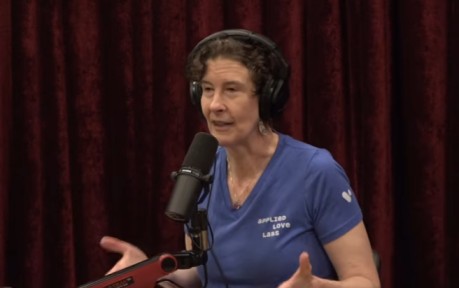
Read the full transcript of cognitive neuroscientist Julia Mossbridge’s interview on Joe Rogan Experience #2496, May 8, 2026.
Editor’s Notes: In this episode of the Joe Rogan Experience, Joe sits down with Julia Mossbridge, a cognitive neuroscientist and computer scientist who specializes in the study of time and precognition. Together, they explore the fascinating world of “exceptional human performance” and the challenges scientists face when investigating topics like intuition and telepathy within traditional academia. Mossbridge also discusses her work with Applied Love Labs, highlighting a unique “time machine” project designed to help individuals heal from trauma through audio journaling and self-compassion. It’s a thought-provoking conversation that bridges the gap between hard science and the unexplained, emphasizing the power of curiosity over ego.
Introduction
JOE ROGAN: All right, so Julia.
JULIA MOSSBRIDGE: Hello Joe.
JOE ROGAN: Pleasure to meet you.
JULIA MOSSBRIDGE: Yeah, I’m very excited.
JOE ROGAN: So you said you had questions for me? We can start with your questions.
JULIA MOSSBRIDGE: Excellent.
JOE ROGAN: First of all, tell everybody what you do. Okay, let me just change the angle of this just so folks just tuning in right now are going to be like, “Who is this young lady?” Thank you.
JULIA MOSSBRIDGE: I’m a year younger than you.
JOE ROGAN: Then you’re young.
JULIA MOSSBRIDGE: Nice.
Julia’s Background: Neuroscience, AI, and Precognition
JULIA MOSSBRIDGE: What do I do? I was trained as a scientist, cognitive neuroscience and computer science, and did some AI stuff, did some stuff with the human brain in terms of trying to understand how time works in the human brain. And then I got really interested in how funky time works in the human brain, like precognition, which is of course predicting future events in ways that we don’t normally think.
JOE ROGAN: That’s how I found out about—
JULIA MOSSBRIDGE: That’s you, is the Popular Mechanics article.
JOE ROGAN: Yeah, I believe so.
JULIA MOSSBRIDGE: Yeah.
JOE ROGAN: And then a bunch of other stuff that I looked at.
JULIA MOSSBRIDGE: And then a bunch of other stuff. Yeah. And then I got interested in just the idea of what we call exceptional human performance. I actually don’t think it’s that exceptional. I think people have these capacities and they’ve been dampened down and they’re in us and they can be developed, and some people have them just sort of naturally.
I’m a person who has some of them just naturally, not all of them, but there are people all over who have these different gifts. And how does that work? And so that became a question that was interesting to me.
The Challenge of Studying the Unexplained
JOE ROGAN: Well, it’s always interesting when this question is asked by an actual scientist. So you approach it by, let’s try to gather data. Let’s try to find out what we can actually show. Because so many people have feelings that there’s something else. Like there’s — you have intuition, you have some sort of pre-knowledge of events and some feeling of something. You’re thinking of someone and they call you. Is that real? You know, that kind of stuff has always puzzled people. So it’s always fascinating when someone like yourself actually spends a lot of time studying it and trying to gather data and trying to show what’s real and what’s not and what you can actually show.
JULIA MOSSBRIDGE: I agree it’s fascinating. I’m not sure it matters. My experience has been that sort of regardless of how much time I spend studying it and how much I see it and how much I can test different controls to make sure it’s not this, that, or the other thing, and that it really is getting information from the future or it really is telepathy — people still kind of don’t, in the science world, tend to just ignore it. Or it actually is actively suppressed.
I mean, there’s some papers that I’ve published that just won’t get listed in Google Scholar, even though they’re in peer-reviewed journals with other articles that do get listed in Google Scholar. So there’s — it’s frustrating. And who cares? Because it’s just an academic complaining. But I’m also not an academic. I also want to build things. I’m into making stuff.
So I got my PhD at these Tier 1 research institutions like Northwestern. I got my master’s at UCSF San Francisco. I did my postdoc at Northwestern. So fancy-dancy institutions. So I learned a lot about how to think and how to write and how to do these kinds of experiments. And I know what I’m seeing. And I keep seeing it. And other people who study the same stuff keep seeing it.
But there’s something inside of me that wants to create things with this. Okay, so this is happening. People have these capacities. They’re actually useful. What can we do with them? And it turns out you can do a lot with them if you feel like you are allowed to have them, if it doesn’t feel like it’s verboten, if it doesn’t feel like shameful, which is part of the cultural piece.
JOE ROGAN: Or foolish.
JULIA MOSSBRIDGE: Or foolish, which is part of the questions I wanted to ask you.
JOE ROGAN: Okay.
Julia’s Questions for Joe: Culture, Sensitivity, and Shifting Awareness
JULIA MOSSBRIDGE: So what I notice when you talk with people is you seem like a tough guy, but you’re really sensitive. Like, you’re an incredible, obviously an incredible listener. And you learn all these things. And you’re putting together — just this is my impression — you’re putting together a kind of a map of the world, like a map of knowledge of the world through all these different people’s eyes.
And my question for you is, how do you see culture shifting? Because I think you’re really sensitive to it. And I think you’re kind of like one of these signal fish that are at the — you notice what’s happening in the environment and you’re going to guide a school of fish accordingly. So do you think that the culture is shifting towards sort of better use of these, I guess, exceptional or these natural capacities that we already have?
JOE ROGAN: That’s a good question. Okay. So I think that because of conversations like the ones that you’ve had and the ones that I’ve had, the ones that are available online, I think people get a much deeper understanding of so many different topics and so many different things than has ever been available through whatever you want to call the mainstream media.
And when you have these inherent prejudices in higher learning, whether it’s people that don’t want to be foolish, so they don’t want to entertain certain notions, or they don’t want to accept certain things because it goes against things that they’ve taught and things they wrote about — we have a problem of ego and ego becoming a wall to gathering more information or getting a better detailed map of the landscape.
And I think there’s way more people that are pondering these ideas and having these conversations and thinking about these things than has ever been before. And I think that’s one of the really beautiful things about the internet. The internet has made much more information available and many more people are thinking about these things in ways that, if you were in an environment where your career depended upon you following certain lines and certain narratives, you wouldn’t pursue that because that would be detrimental to your own personal interest.
Like if you wanted to get ahead in academia and all of a sudden you’re talking about psychics and premonition, people are like, “Oh, Julia’s a f*ing loon.” But you’re courageous and you see value in these things. And because you can come on here and talk about it instead of just addressing a class or selling a book that’s going to reach a few thousand people, we can have a conversation where 10 million people are going to listen.
And so then those 10 million people are going to go to work and they’re going to tell their friends at work like, “Hey, you know how sometimes you know something’s going to happen and it happens? Like, that might be real. And then there was this lady, she was on the Joe Rogan podcast, and she was talking about it.” And so that opens up people to this idea that you don’t have to worry about being a fool, because that’s what a lot of people are worried about.
It was a big hurdle talking about aliens, UFOs. All my life, I’ve always been fascinated by UFOs and aliens, but I don’t mind being a fool. I was fascinated by Bigfoot forever. Kind of abandoned that for the most part, but I like weird stuff. I’m interested in it, and I don’t — I’m not a person that needs to be taken seriously. It’s not my job. I’m literally a comedian. Like, you can make fun of me, I’ll make fun of me, it’s fine. My future doesn’t rely on people taking me seriously.
So I think having that ability to have conversations about all kinds of different things has really changed the way the entire world is discussing just reality. Everything about reality, from quantum computing to alien life to international politics to the way human beings misrepresent each other purposefully for their own gains. What is all this like? And why? Why has it taken so long to have so many discussions about this? So I think that’s — if I have a purpose in this world, it’s like I’m an antenna for that.
The Wonder of Discovery: Science, Academia, and Building Things
JULIA MOSSBRIDGE: I’m just clapping because it’s such a great purpose. Because the reason I fell in love with science was it’s about discovery. It’s about not knowing. It’s about being foolish.
I was just thinking today about this amazing high school biology teacher who had us go outside and he gave us these little note cards. And he said, “On one side of the note card, I want you to write a question about your environment. Look around, the plants or whatever. Pick something, the dirt, whatever, and write a question you think Einstein would ask about this.” And then he said, “Okay, now flip it over and I want you to write a question that a 2-year-old would ask, if a 2-year-old could write.”
And my favorite side was the 2-year-old. And at the end he said, “Now Einstein was more like the 2-year-old.” He said, “Einstein was full of wonder and confusion and uncertainty, and he just asked questions and imagined things. And that’s how I want you all to learn to be.” And I was just like, “Yes!” That was an amazing teacher.
And so then when I went to graduate school and I went in the world of academia, there’s all this pressure. You write your grant after you’ve done about 3/4 of the work so that as soon as you get the grant, then you can publish the papers that go with the grant. So you’re not really discovering anything. You’re kind of talking about, “Here’s what I already know, but I’m acting like I haven’t looked at it yet.”
And there’s pressure to follow, as you said, follow the line of thinking for both funding and for your career. I was told very nicely by wonderful people who wanted to support me that if I took the stuff about psychic stuff off my resume, I would have a perfectly good resume for academia. And I was like, “Are you crazy? This is the stuff that’s actually interesting. Why would I want to take it off?”
But that’s what took me away from academia and made me realize I had to put one foot in building things. I could leave a foot in academia, but I had to build stuff because academia is so slow. They can learn something, and then 10 years later they’re like, “Do you think it’s true?” And then 20 years later they’re like, “Maybe we can make something with it.”
But at the same time, you have to be careful. You don’t get to just say, “Well, I just know people are psychic, and therefore, screw it.” So there’s this dance. But when you were saying this thing about people afraid to be foolish, I wonder how much it helps me to come from a family of very foolish, eccentric people.
JOE ROGAN: I’m sure it helps a lot.
JULIA MOSSBRIDGE: Because I’m not afraid to be foolish. In fact, I just know that I am. And so—
JOE ROGAN: Well, I think intelligent, kind people don’t mind talking to people that occasionally say foolish things.
JULIA MOSSBRIDGE: Well—
JOE ROGAN: Or things that could be perceived as foolish, because they’re willing to take chances and look at these obscure topics and strange phenomenon and not worry about the stigma that’s attached to these subjects that keeps supposedly intelligent or serious people — people that want to be considered as serious people — from discussing.
JULIA MOSSBRIDGE: Well, like when you said the thing about Bigfoot, and I laughed a little bit, that was like a reflex laugh from academia.
JOE ROGAN: Well, it’s a fun one. Bigfoot’s a fun one.
Science, Politics, and the Problem with Ideological Tribes
JULIA MOSSBRIDGE: It is, and I have friends who study Bigfoot and other cryptids in a scholarly way, and I had to learn not to laugh. Like, it’s like we have our little discomfort and then we laugh because, “Oh, I want to be taken seriously and stuff.” But, you know, interestingly, the UFO whole world got accepted into the mainstream land of things that possibly exist before the psychic world. But the psychic world has been studied, like, by the intelligence community, etc., since— openly since, like, the ’50s, right? Whereas the UFO world was supposed to be, “Oh, we don’t care about that,” and then only recently has come to the fore.
So it’s really interesting to see this balance. They’re both related, and they both have their own processes of disclosure. But it’s just interesting— culturally, it’s interesting to see this instinct to be right, as you called it. And I feel like that’s— I was— there’s the PBS convention is in town right now in the hotel where I’m staying. And I got to say, I think that’s still largely a very left-leaning organization. And I was raised up in a really left-leaning household.
But the thing that really pisses me off about the left is this wanting to be smart and proving that you’re smart. And the thing that pisses me off about the right is wanting to be right. And I feel like both of those things fail.
JOE ROGAN: Yes.
JULIA MOSSBRIDGE: I mean, neither of them allows us to just discover, okay, what’s next? Like, how can we actually— how can we actually solve the problems that are going on instead of just wanting our team to win?
JOE ROGAN: Yeah.
JULIA MOSSBRIDGE: And so it’s interesting to me how the cultural change with science also relates to our politics.
JOE ROGAN: Yeah, I grew up in a very left-leaning household as well. My parents are still very left. And I think that there is a real problem with ideologies where, especially in this country, we’re so polarized. We have a right and a left, and I think most people are kind of in the middle somewhere, and I’m certainly in the middle. I’m like middle-left. That’s where I kind of see myself. But if you read about me, I’m like far right somehow or another, which is—
JULIA MOSSBRIDGE: I know, it’s interesting. I’m now independent. I’m officially independent because I’m like, screw it. Yeah, I don’t— I do think most people are in the center. And I think we need to get clarity on that. You get to say something that’s different from what either side is saying.
JOE ROGAN: Yeah, the problem with either side is you have to accept— if you’re going to accept, if you’re going to join one of their teams— I had a bit about it in my last comedy special, that if you’re going to join their team, you have to believe all the things.
JULIA MOSSBRIDGE: Right. And you have to kind of display them, perform it like you’re performing.
JOE ROGAN: Very good point. Right?
JULIA MOSSBRIDGE: You have to say all the right words. And if you say the wrong words, you’re canceled. And that happens on both sides.
JOE ROGAN: 100%. And you know, the right was always complaining about the left doing it, but now the right’s doing it. They’re canceling each other about all kinds of stupid things. And it’s just a— it is a— it’s, you know, Marc Andreessen’s talked about this, that they display all of the behavior that you get from cults. It’s the same thing.
JULIA MOSSBRIDGE: Totally.
JOE ROGAN: Excommunication. Yeah. Extreme following of doctrine with no deviation whatsoever. Everyone’s very performative that they are more in line with the doctrine than you are.
JULIA MOSSBRIDGE: Ew. Yeah. And by the way, academia is a lot like that.
JOE ROGAN: Oh, it’s very much like that. That’s very disturbing.
JULIA MOSSBRIDGE: It is disturbing because these people, you’re supposed to be open-minded because how are you going to get to truth? I mean, the idea is to get to truth, right?
JOE ROGAN: Yes.
JULIA MOSSBRIDGE: How are you going to get to truth if you’ve decided, “Well, that person’s asking this question, that’s an inappropriate question?”
The Problem with Gatekeepers and Expert Ego
JOE ROGAN: Yes. Yeah. And it’s also, there’s this thing about people being gatekeepers of information. So, like, if you’re an expert in a very particular subject and someone disagrees with that, people are like, “I am a PhD in this subject. Let me tell you about this, and I know what’s going on.”
JULIA MOSSBRIDGE: Like that.
JOE ROGAN: Yeah.
JULIA MOSSBRIDGE: It’s crazy. It’s so irritating. And actually, that bothers me when I go on shows and people say, “Oh, but you’re a scientist and you study this.” And it’s like, yeah, but could we not revere me for that reason? Could we instead ask the question like, does she do good work? Does she have interesting thoughts? Does this seem reasonable? Does it seem like she’s after the— moving towards the good? Those are really the standards regardless of your degree.
And so, it worries me that we put so much reverence in scientists or whatever, or experts. And I also see that there can be this problem where you go, “Oh, experts are all full of shit.” And then, you know, you have to get brain surgery and you’re like, “I would like a really good neurosurgeon.” So there’s kind of both.
JOE ROGAN: Oh, 100%. There’s both. I think the problem is human ego. And the problem is that even people that have deeply studied subjects, the wanting the reverence and wanting people to defer to you wholly with no questions whatsoever, like as if you have the entire database on whatever this thing— “This thing is settled, this is settled science, we know everything about it.” And that doesn’t seem to be the case very often. There’s very few things that seem to be completely settled.
And it’s much more interesting to me when I talk to someone that their perspective is, “I’m a person that has spent an inordinate amount of time going over this stuff, and this is what I know. I might not know all of it, but this is what we know, and this is why we think this is what it is.” So instead of having this ego— and I see it, God, I see it from so many— it’s a very male thing too. It’s a very male ego thing to be like the dominant force of the narrative. That they’re the enforcer of the narrative and very dismissive and very rude, saying insulting things about anybody that deviates from it instead of just saying, “This is why I think this is the case and this is what we’ve learned over the years.”
But having humility when you’re dealing with, especially when you’re dealing with something like anything involving consciousness, anything involving the human mind— it’s so complex. There’s so much going on and it’s so biologically variable. There’s so many different people that have different ways of thinking and their mind works differently. One of the more illuminating things about doing this podcast is having so many different people in here and so many different conversations, so many unique and fascinating people, but they’re all different.
JULIA MOSSBRIDGE: Yeah. Yeah, you’re like tasting from all the different flavors of humanity. And it’s a delight to listen to, but I sort of want to know what it’s like to be in your brain as you start to soak. It’s like you’re a sponge and you’re soaking in all these points of view. So the model that you’re building, I wonder a lot about what it’s like to be different people. And I imagine the model that you’re building of the world is really well-informed. Hey, Jamie, could you turn down my—
JOE ROGAN: Oh, you could do it. There’s a little thing right there. Oh.
JULIA MOSSBRIDGE: Oh.
JOE ROGAN: We’re like professionals.
JULIA MOSSBRIDGE: That’s like your whole show. But yeah, I think the model that you’re building could be put to some really powerful use. So I’m here to convince you to run for president.
JOE ROGAN: Oh God. Trying to get me killed, Julia? How dare you? No, I’m not interested in any job in any government whatsoever.
Masculinity, Insecurity, and Emotional Maturity
JULIA MOSSBRIDGE: I like doing this. Okay, I get it. That’s it. What you said about it’s a really male thing, I think it’s better said to say it’s a really insecure male thing. Or it’s an insecurity thing that happens more probably to men because there’s such a standard of you’re supposed to be alpha. Everyone’s supposed to be alpha. And for women, there’s not that standard. And so there’s more insecurity because everyone can’t be alpha. And what the heck is alpha?
And so I feel like I have a desire for someone who has a sense of their own— like, is secure in their own masculinity and their own femininity, which I think you have both. I hope you don’t mind me calling you out on that. But I know that you have this reputation of being like, total guy, guy. But you have this— I mean, because you’re a deep listener, that’s already a feminine trait. And so is it really? Yeah. Oh yeah.
JOE ROGAN: Okay.
JULIA MOSSBRIDGE: Yeah.
JOE ROGAN: I didn’t know that. I never thought of listening as being masculine or feminine.
JULIA MOSSBRIDGE: Listening is a deeply feminine trait because you have to be relatively humble to want to listen.
JOE ROGAN: And humility is a feminine trait?
JULIA MOSSBRIDGE: No, it’s just, I don’t know. I don’t think of it as a feminine trait. Yeah.
JOE ROGAN: I don’t think listening is a feminine trait.
JULIA MOSSBRIDGE: Yeah. Maybe I’m wrong.
JOE ROGAN: I think it’s a kind of—
JULIA MOSSBRIDGE: Women are generally better listeners.
JOE ROGAN: I mean, that’s really—
JULIA MOSSBRIDGE: Yeah, no, it depends on if you’re in a relationship with them or not.
JOE ROGAN: Depends on who you’re talking to.
JULIA MOSSBRIDGE: I don’t know if that’s true.
JOE ROGAN: I don’t know if that’s true.
JULIA MOSSBRIDGE: Let me see where I’m getting there.
JOE ROGAN: I think curious people, genuinely curious people are better listeners. That’s what I think. And I don’t think women or men are genuinely more curious.
JULIA MOSSBRIDGE: You’re right. And I think that there’s a thing if you’re always trying to prove that you’re alpha, and I think men are more susceptible to that, where you could not be a good listener because you want to make sure you say the right thing.
JOE ROGAN: That’s an insecurity thing.
JULIA MOSSBRIDGE: And then I think there’s more insecurity among men because of those standards that are ridiculous. And so maybe that’s what I’m talking about. But you’re definitely right. I can definitely think of men and women who are both crappy listeners and good listeners. So it’s about the insecurity. It’s about the emotional maturity.
JOE ROGAN: I think it’s also a learned thing that, you know, people have this desire to show everyone how intelligent they are and how dominant they are in any particular subject. And it’s one of the most infuriating things about having conversations where people aren’t really talking to you. They’re just trying to win whatever little verbal game you’re playing. They’re trying to one-up you and they’re trying to—
JULIA MOSSBRIDGE: I’ve seen that.
JOE ROGAN: Yeah, it’s gross.
JULIA MOSSBRIDGE: And also just like it makes you want to leave.
JOE ROGAN: Yeah, it’s not fun. It’s not a fun conversation. I love talking to people way smarter than me. Yeah, it’s fun too. Like, I don’t need— I can’t be the smartest person. I’m friends with Elon. I’m definitely not the smartest person.
JULIA MOSSBRIDGE: I know that.
JOE ROGAN: I’m friends with a lot of people that are f*ing way smarter than me. So I’m just curious, and I think the world would be a lot better place if more people were curious and embraced it and not— and just squash that insecurity that makes you want to puff your chest up and—
JULIA MOSSBRIDGE: See, I don’t think you could squash it. Like, I get it. I also think the world would be a better place if more people were curious. But I think the solution is— I don’t think squashing anything works. Like, I think you have to work through it.
JOE ROGAN: That’s a better way to say it than squashing it.
JULIA MOSSBRIDGE: Squashing it just means it’s going to come up later as garbage.
JOE ROGAN: Yeah, that’s— yeah, no, you said it better. Yeah, it’s really just addressing why you’re insecure. And for a lot of men, there’s just physical insecurity. And the physical insecurity is a real problem. But some of my favorite people are martial artists. And one of the reasons why is because they’re the least insecure. Everyone’s insecure in some way, but martial artists are dealing with that insecurity literally on a daily basis. So like, say jiu-jitsu, for instance. If you’re training jiu-jitsu, if you go from white belt to black belt, you have to get humiliated thousands of times.
JULIA MOSSBRIDGE: You have to get—
The Importance of Humility and Intellectual Dominance
JOE ROGAN: There’s no ifs, ands, or buts about it. If you’re a white belt and you train with a black belt, you’re going to get humiliated or dominated. You’re going to lose. You have no chance. And so by learning over and over and over and over again that you’re not really special and it’s really just about the time you put in and then about getting better and having the ability to objectively assess your position, who you are in this room of people that are trying to strangle each other, who you are in the world itself.
And I think a lot of people don’t ever address that. And so they run around trying to posture and pretend they’re something they’re not, pretend they’re smarter than they are, they’re more of an expert, a subject. They’re the one who should talk. You should listen. You know, there’s a lot of that. Whenever people say, “Just shut up and listen,” I’m like, that’s not— I’m not going to do that. And I don’t want to talk to anybody who wants to. I don’t ever want anybody to do that if I’m talking.
JULIA MOSSBRIDGE: Well, yeah, because then you’re not having a conversation. That person doesn’t exist.
JOE ROGAN: Exactly.
JULIA MOSSBRIDGE: You’ve just decided that person doesn’t exist. They don’t matter.
JOE ROGAN: You just— you’ve asserted dominance in the dumbest way possible, which is intellectual. Yeah.
JULIA MOSSBRIDGE: Yes, it is the dumbest way possible.
JOE ROGAN: Sure.
JULIA MOSSBRIDGE: And the funny thing is, culturally, we kind of think that it’s the smartest way possible.
JOE ROGAN: But it’s just a bunch of fools. Well, yeah, yeah, yeah.
Academia, Love, and the Limits of Intellect
JULIA MOSSBRIDGE: And so what? Fools with a lot of information. Okay. But let’s talk about what a better world would be. So, in a better world, if you’re going to assert dominance, you would— like the martial art, what I love about martial art is, first of all, it’s all mental, almost all mental. And then second, it’s very similar to what happens when you go through and get your PhD, right? You get beaten down and you realize you’re not the smartest person in the room. And you’re hanging out with all these other super smart people. You’ve got to learn to be like, “Okay, that’s not what matters.” So that’s the good part of going nuts with school.
But there’s this false information that reminds me of when I was at UCSF and I went to go see this talk by this famous scientist. I think he won a Nobel Prize. I forget his name. But he was an asshole. And he gave his brilliant talk, but I couldn’t pay attention to it because he was an asshole. He was being rude to people who asked questions. He was just dickish. I mean, I don’t know how else to say it, just like arrogant.
JOE ROGAN: Yeah.
JULIA MOSSBRIDGE: And I walked out and someone said to me, one of my mentors said to me, you know, you have to learn to separate the personality from the information that they’re giving. And I said, you know, no, I don’t. Like, he’s giving me all the information in his personality, right? I don’t need to learn to listen to that. I need to learn to say, unlike all of you all, I need to learn to say, “I’m not going to hang out with people and put myself in the presence of people who are rude like that. That’s more important than their amazing intellect.”
And I somehow, somehow we got to a place culturally where we think you can be really mean or dismissive or rude and arrogant. And that’s fine because you’re winning. And I feel like a better world would acknowledge that what’s more important is love, which is this connection where you actually acknowledge there’s someone else there, even if you think they’re an asshole. But still, yeah, you know, like, I wasn’t practicing love. I wasn’t accepting him who he was. But I was in a place where the environment wanted me to just ignore the information I was getting about who this guy was. And just say, no, all that matters is his intelligence.
JOE ROGAN: Yeah. Now, sometimes you can learn a lot from people that are gross.
JULIA MOSSBRIDGE: Yeah.
JOE ROGAN: You know, and it’s valuable to be able to put their personality aside and listen to the actual information.
JULIA MOSSBRIDGE: But still, in that moment, though, I wasn’t—
JOE ROGAN: You don’t want to. Yeah.
JULIA MOSSBRIDGE: Well, in that moment, I was like 24 and I was a woman in a field where there are a lot of guys and I was feeling like I have to have boundaries, you know. I have to learn to have boundaries. And then later, when I’m, you know, like now I’m postmenopausal, and you know how postmenopausal women are, we have much more confidence.
JOE ROGAN: We’re not playing that game anymore.
JULIA MOSSBRIDGE: Yeah, no, right, exactly. It’s just like, now I’m like, I can listen to some asshole, listen to what he’s saying. But at the time, it’s like, no, like, I have to stand up for something that I think is important, right? You know? I’m not saying I’m better than. I’m saying I had that experience that made me see that there was this level of import placed on the intellect. And that had always been the case. My family had always placed all this level of import on the intellect. And I just kind of walked out of that.
The Messenger Matters as Much as the Message
JOE ROGAN: Well, it has to be balanced. Like, I think putting all of the emphasis on the intellect itself and ignoring the personality is kind of— like the messenger is important. Like, the message is important, but the messenger sucks. That, you know, if someone was yelling out the most amazing information in the world, but they were singing it like a Slayer song— I don’t know if that’s a bad example, but you know what I mean? Like, you know those death metal bands where they just scream?
JULIA MOSSBRIDGE: Yeah.
JOE ROGAN: And you’re like, oh geez, I gotta get out of here. It’s not my thing, right? But it could be like the most interesting information, but the messenger sucks. It’s not fun to listen to. It’s not exciting. Or the messenger’s arrogant or the messenger’s rude or it ruins the message.
JULIA MOSSBRIDGE: Yeah, you need both.
JOE ROGAN: Human beings need to communicate. And in order to communicate, we need to establish that we’re just two people, you know? And if you have some information that I don’t have, I want to hear it. I don’t want to like, oh, she’s saying too many smart things. I want to say something smart to show I’m smarter than her. Well, hold on there. You know, there’s a lot of that. And that’s a lot of that in academia because that is their entire identity.
JULIA MOSSBRIDGE: It’s a chess game.
JOE ROGAN: Yes.
JULIA MOSSBRIDGE: Yeah.
JOE ROGAN: But it’s a chess game with pieces that are stunted, like they’re not allowed to freely move.
JULIA MOSSBRIDGE: No kidding. Yeah, it is a cult. I mean, that’s the cult part.
JOE ROGAN: Yes.
JULIA MOSSBRIDGE: That’s where you leave and people feel sorry for you and you’re like, I have my freedom. I’m so excited. And they’re like, I’m so sorry for you.
JOE ROGAN: Yeah. It’s social hierarchies. It’s gross.
JULIA MOSSBRIDGE: Yeah.
JOE ROGAN: And, you know, I mean, I think that’s going to exist whenever there’s ego, whenever there’s these— the human dynamics of these bizarre creatures that we are, where we’re territorial apes with weapons. You know, they’re like, we’re weird and we’re always establishing some kind of dominance, whether it’s intellectual dominance or wealth dominance or social hierarchy dominance. Like, people love that stuff. They love it.
Do We Really Love Dominance, or Are We Just Lost?
JULIA MOSSBRIDGE: Is it— do we? Or so I—
JOE ROGAN: They love to play it. They love to pretend.
JULIA MOSSBRIDGE: We love to pretend it. But do— I mean, do we really?
JOE ROGAN: Well, that’s why people name-drop. That’s why people want to have the fanciest cars and the nicest watches.
JULIA MOSSBRIDGE: I know, but is that really making them happy?
JOE ROGAN: No, it’s not.
JULIA MOSSBRIDGE: So I don’t know that people love it. I think people do it because they think it’s going to make them happy, but I don’t think they love it.
JOE ROGAN: Yeah, there’s something to that. There’s probably something that some sociopaths feel. If they show up with a million-dollar watch and a million-dollar car and they pull up in front of a giant house that’s bigger than anybody’s, like, “Wow, look at me. I did it.” But I think, yeah, would—
JULIA MOSSBRIDGE: But that’s rare. I think that’s rare. Yeah.
JOE ROGAN: I think it’s not lasting either. And then there’s also a bunch of people that are on f*ing pills. They don’t even know what they like. They’re just running around in the fog of pharmaceutical clouds.
JULIA MOSSBRIDGE: But that’s the way they’re dealing with it. So it’s like, I guess if we see it as like, there’s this big problem, which is that— I call this the human problem. No one knows how to be with themselves or others in any kind of harmony.
JOE ROGAN: Harmony. That’s a good word.
JULIA MOSSBRIDGE: We don’t know how to get to harmony. Right. And so one way is drugs, and one way is prayer, and one way is the big car and the dominance, and one way is being addicted to your phone. You know, none of them work. But all of— I mean, that’s not true. I think prayer works. But I think the only one that works is love, and I think that’s what prayer is about, earnest prayer.
But we have to try. I mean, we’re built to try to get to harmony, apparently, because we keep trying. And so part of me wants to say, I’m of two minds. Part of me just says, like, we’re trying the best we can, and we have all these faults. And then there’s a part of me that says, “And we can do better.”
JOE ROGAN: Well, we definitely can. And I think that’s one of the reasons why people hunger for conversations, because we’re all trying to figure out how to do better. The human mind is one of the most extraordinary things that’s ever been studied. And yet there’s no guidebook on how to use it.
The Mystery of the Human Mind
JULIA MOSSBRIDGE: Because we still don’t know. Do you know how much we don’t know? We know about as much about the human mind now as we knew in 1991 when I first went to graduate school. I mean, in neuroscience, I mean, the brain, we know a lot more about the brain. We still don’t know that much about it. We’re still missing some basic pieces of things like, what’s the neural code? How do these neurons actually communicate? How do we actually learn? How do we actually represent things in memory? But we know more.
But in terms of the mind, wow, we’re just beginning. I mean, I guess I’m differentiating the brain and the mind. Like, the brain is this physical chunk of stuff that’s related to the mind. But the mind is what we are doing.
JOE ROGAN: Right.
JULIA MOSSBRIDGE: Well, the thinking, feeling, emoting, wondering, all that stuff is mind stuff. And that’s super mysterious.
JOE ROGAN: And super difficult to manage for almost everybody.
JULIA MOSSBRIDGE: Yeah.
JOE ROGAN: And again, no guidebook. Yeah. You’re giving the most complex instrument known to man, which is the human mind. And everybody’s like, “Figure it out.” And you’re like, “F*, maybe I’ll become a Moonie. Maybe I’ll go into Scientology. What do I do? I have to do something. I have to do something. Someone else knows. I know. I’m the one who knows. Follow that guy.” You know? It’s like, that’s what we do.
JULIA MOSSBRIDGE: Do these 10 things and you’ll be okay. Yes.
JOE ROGAN: That’s how cults get started.
JULIA MOSSBRIDGE: We do those 10 things because we’re so nervous.
JOE ROGAN: We can’t figure it out.
Birth, Death, and the Instruction Book for the Human Mind
JULIA MOSSBRIDGE: Yeah, yeah. Have you ever seen a baby be born?
JOE ROGAN: Sure.
JULIA MOSSBRIDGE: Yeah. So have I, my own, but also I was a doula for a couple of friends who had babies. And, you know, everyone should just see a baby be born.
JOE ROGAN: It’s very psychedelic.
JULIA MOSSBRIDGE: It’s psychedelic. And it also puts you in that liminal space where it’s like you’ve seen beyond the veil. You’ve seen the borderland between life and death. And it feels to me like that experience, which is much more rare for people to have now, most people can avoid seeing a baby being born. But that experience is— and also seeing someone die. That experience, I think, helps train us in— it is the instruction book for the human mind. I don’t know why I’m saying that. I look at you, you know, you’re wrinkling your brow, and I’m like, also, why am I saying that?
JOE ROGAN: No, I’m only wrinkling my brow because I’m listening.
JULIA MOSSBRIDGE: I never— but I—
JOE ROGAN: the face of someone who’s always upset, but it’s not true.
JULIA MOSSBRIDGE: No, I don’t know why I said that. I’ve never had that thought before, but it occurred— I guess I was looking at this little, like, you’ve got this little idol thing.
The Aztec Death Whistle
JOE ROGAN: Oh, that is an Aztec death whistle. Don’t do it. You’ll— last time we did it, the pandemic started.
JULIA MOSSBRIDGE: Close enough. Okay.
JOE ROGAN: Yeah, with the antivirus thing going on, don’t blow it.
JULIA MOSSBRIDGE: Okay.
JOE ROGAN: Yeah, it’s just a meme online because my friend Brian Cowan was in the podcast studio and he blew this Aztec death whistle, literally— was it like a week before the f*ing pandemic kicked off? It was way too close. And the meme was Brian Callen kicking off the pandemic with the Aztec death whistle.
JULIA MOSSBRIDGE: Okay, well, I didn’t blow it.
JOE ROGAN: Yeah.
JULIA MOSSBRIDGE: I saved everybody.
JOE ROGAN: Do you know what Aztec death whistles are?
JULIA MOSSBRIDGE: I imagine it’s really scary.
JOE ROGAN: It sounds horrible. And they would play them at night while their enemy was camped. They would haunt them so they couldn’t sleep. They would stand on the mountaintops and make that noise.
JULIA MOSSBRIDGE: Wow.
JOE ROGAN: And it’s very high-pitched and it carries like a crying baby. Well, no, it’s like demons.
JULIA MOSSBRIDGE: It sounds like demons, like people. Yeah.
JOE ROGAN: And you just think, “This is the last day of my life.” Here’s what it says: “Aztec soldiers will blow while charging into battle and during human sacrifices. But how does a whistle make that horrifying sound? When air is blown into the tube, the airflow splits into a big and small chamber, each making a different noise you’re about to hear. Click here to see me try the world’s loudest.”
JULIA MOSSBRIDGE: Did that guy survive this video?
JOE ROGAN: I don’t know, he might not even be real in this world. That might be AI.
The Veil Between Life and Death
JULIA MOSSBRIDGE: Well, that’s true. So no wonder I was thinking about the veil between life and death, because I was looking at that thing and there’s something that is like a reset when you see a baby be born or you see someone die. It’s like you get to what matters. And it’s not whatever the dominance thing, and it’s not the insecurity thing, and it’s not any of that.
JOE ROGAN: Yeah.
JULIA MOSSBRIDGE: So I think that’s the instruction book. And so we’re sort of given these little resets that allow us to get in touch with what really matters. But the more we get away from them in the modern world, maybe the fewer instructions we have. I don’t know. Never had that thought before.
Getting Out of Your Own Head
JOE ROGAN: Yeah. I think it would benefit almost everyone to do something that takes you out of your own thoughts. And I think that physically difficult things are the very best at that. Like yoga is one of the very best things at that because it’s very physically difficult to do. It requires a lot of willpower and concentration while you’re doing it. You’re balancing yourself, you’re sweating, you’re straining, and because it’s so difficult, you can’t think of anything else other than it while you’re doing it.
And I think that cleans your mind out and purges you of all this weirdness that’s inside of you that is constantly battling with everything around you, and allows you to just be. Just exist.
JULIA MOSSBRIDGE: Yeah, yoga. I mean, childbirth is very physical. Dying is very physical.
JOE ROGAN: Yeah, but the thing is, you can’t voluntarily do that every day.
JULIA MOSSBRIDGE: No, you can’t. But I do sort of think, like, childbirth for women who go through it, are lucky enough to go through it, is kind of like boot camp for men. I mean, it really pushes you to your limit, and then puts you in an altered state where—
JOE ROGAN: Oh, for sure, you just had a human come out of your body. It’s alive and you love it more than anything.
JULIA MOSSBRIDGE: Yeah, and it brings this incredible— I’m looking at this UFO guy behind you— it brings this incredible self-transcendent experience of like, “Whoa, this is not about me.” And so yeah, same with people who play team sports. I was never one of them, but I hear that that experience happens.
JOE ROGAN: Yes.
JULIA MOSSBRIDGE: Or like when you’re practicing a musical instrument.
JOE ROGAN: I think anything difficult.
JULIA MOSSBRIDGE: Yeah.
JOE ROGAN: When I was talking about martial arts— martial arts will help you in that regard. But I think anything that’s hard to do gets you out of your head.
JULIA MOSSBRIDGE: Yeah.
JOE ROGAN: And helps you. And just getting an understanding that whatever you’re doing in life, if you concentrate on it and focus on it, you’ll get better at it. And that gives you confidence and an understanding of how the world works. And then you could also apply that to being a person. Like, you’re not the same person you were when you were 20 years old, right?
JULIA MOSSBRIDGE: Why?
JOE ROGAN: Because you’re better at being a person because you’ve lived a lot. You’ve had a lot of experiences. You made a lot of mistakes and you’re constantly practicing and learning. And I think other things that you can do other than just being a person will enhance your ability to be a person.
JULIA MOSSBRIDGE: Yeah. Being a person who is applying yourself to something.
JOE ROGAN: Yes. My martial arts instructor had this thing that he told me when I was very young. He said that “martial arts are a vehicle for developing your human potential.” But I think that could be guitar playing, that could be tennis.
Flow States and Selflessness
JULIA MOSSBRIDGE: When I used to teach remote viewing, we used to call it a mental martial art. It’s anything that’s hard, on which you have to concentrate, that puts you in that space of flow. And the flow means— you know that Mihaly Csikszentmihalyi idea— I don’t know if I pronounced his name right— but this idea of timelessness, and you’re just sort of having to surf whatever’s happening. And that could happen in any field, right?
Whenever you have to apply your whole self to something, then— it’s so ironic because you apply your whole self to something, and then what that allows to happen is that you become selfless. Like, you’re almost like a tube.
JOE ROGAN: Right. You’re not thinking about you anymore. You’re thinking about the thing.
JULIA MOSSBRIDGE: Yeah. And there’s neuroscience to back that up, right?
JOE ROGAN: Yeah.
JULIA MOSSBRIDGE: Yeah.
JOE ROGAN: Yeah. I think anything difficult— I feel that when I practice archery, I feel that when I play pool, I feel that when I work out. Anything difficult where you lose yourself. But in doing that, you have a better understanding of yourself, which is odd.
JULIA MOSSBRIDGE: Yeah. And it’s almost like you come into consciousness more.
JOE ROGAN: Yeah.
Julia’s Journey into Premonition Research
JOE ROGAN: I’m really fascinated by the remote viewing and I want to get to that, but I want to start with how did you begin studying this stuff. So you’re involved in neuroscience, you’re trying to pick which lane you’re going to really pursue all your interests in. How did you get involved in this idea of premonition and psychic ability and that there’s a real something there?
JULIA MOSSBRIDGE: Yeah, I sort of hid my agenda from myself. Really? Yeah. I discovered it later in life. Because when I was a kid, my first precognitive dream that I remember was when I was 7. And it was very clear. I dreamt that my friend— I knew which friend, Eshane— what would happen: she would lose her watch. Where would it happen? On the playground. And then the next day that happened. It was very specific. It wasn’t like you have to be metaphorical about it. What does it mean? It meant that Shane lost her watch on the playground the next day. And so—
JOE ROGAN: Did you tell your parents?
JULIA MOSSBRIDGE: Yeah. My very eccentric family would always talk about dreams at the breakfast table. My mom is a therapist and a learning disability specialist. My dad was a physicist. My sister’s an artist. And we would all talk about dreams. So I mentioned this, and my dad, the physicist, says, “Well, that’s a coincidence.” And my mom, the therapist, says, “You should get a dream journal and write them down.” And so I did that.
JOE ROGAN: Your dad just dismissed it as a coincidence?
JULIA MOSSBRIDGE: You know, he has come around.
JOE ROGAN: That’s a very specific coincidence.
JULIA MOSSBRIDGE: It’s 3 factors. And I always like to say, if you have 2 or more factors, it’s likely precognitive.
JOE ROGAN: But just the one— lost the watch. And then she loses her watch.
JULIA MOSSBRIDGE: But she did just get her watch. We were 7 years old. She got a watch from her father. You could predict, as someone who’s good at figuring out what kids do, that they might lose the watch, right? So that could be a coincidence. You have to think about all the possible things that could happen to a 7-year-old and the watch that they just got. Losing it is up there.
JOE ROGAN: Yeah, but you thought about it the day before she lost it.
JULIA MOSSBRIDGE: I dreamt it the day before she lost it.
JOE ROGAN: Yeah.
Ball Lightning in the Family Home
JULIA MOSSBRIDGE: Yeah, so he did dismiss it as a coincidence, but we also had ball lightning and weird orbs in our house, and he also dismissed that as not actually having happened.
JOE ROGAN: Wait, you had ball lightning in your house?
JULIA MOSSBRIDGE: Yeah, we were in this old farmhouse in Libertyville, Illinois, where I grew up, and we lived with my grandparents there. Ball lightning came inside the house, and my mother stood up for it. My mother said, “Ed”— my dad’s name— “didn’t you see that lightning zipping around the house last night?” And my dad said, “That couldn’t have happened.” Did he see it? Of course he saw it.
JOE ROGAN: But he just wanted to dismiss it.
JULIA MOSSBRIDGE: But he didn’t have an explanation for it. What does your dad do? He was a theoretical physicist. For his dissertation, he was at University of Chicago. He discovered or showed somehow the electron layer on the moon, that there’s this atmosphere of electrons on the moon. And—
JOE ROGAN: How can he say that that couldn’t happen?
The Precognitive Dreams and the Path to Science
JULIA MOSSBRIDGE: So one of the reasons— people are so complex with the reasons they go into particular fields. My experience with physicists, my dad included, is they tend to go into this field of physics because the whole job of physics is to simplify everything into a few equations. Right? There’s the standard physics joke of, like, all right, let’s figure out the volume of a cow. You know, let’s just estimate it. It’s a sphere. And so it’s like you cut off the legs and the head and the tail, and all of a sudden you’re just calculating a sphere, which doesn’t give you the volume of the cow.
And so I think there’s a desire to simplify everything, and I think there’s a desire to control things. And many, many, many physicists have OCD and have control issues. My dad had severe, severe OCD. And so in his mind, it couldn’t have happened because all his circuits would fry, because he didn’t know how to explain it. And my mother just stood up for it and said, “Well, it did happen, and you saw it, and I saw it.” And it hit the edge of my room and then went out. And there was still the brown mark where it was burned in the corner of the room. So we had plenty of evidence. So there was stuff going on.
And there was this push-pull with my mom, who just believed in the primacy, I guess, or the importance of experience, like we saw it. And the pull from my dad, who believed in— if you didn’t understand, if you didn’t have a theory for something, it couldn’t exist. And so I was living in that.
So what I did was I kept a dream journal sort of the rest of my life. I still write every morning my dreams. And started to notice that I was really good at precognitive dreaming. And it would happen again and again and again. And I would have experiences at school that reminded me that I had this capacity. And then I hid it from myself when I realized I wanted to go to graduate school and actually be a scientist.
By which I mean, I just sort of said, “Well, all of that stuff’s crap,” even though I was still having those experiences. I had to kind of split off. This is a thing that you have to do if you think, “Okay, I have to ride the academic train,” right? And the academic train says, “I’m going to do hard science. I’m going to go to the best neuroscience school.” And then, by the time I was in my late 20s, and I was in my second graduate school getting my PhD at Northwestern, I started to remember.
And it’s not like I had really forgotten, but it’s like it just wasn’t allowed to be real. I started to study timing in the auditory system because I was into understanding how the auditory system managed things in time. And then I started to ask myself, why am I so interested in time? Why am I so interested in the nature of time and how it works? And then boom, oh right, because I keep having these precognitive dreams. There’s obviously something we don’t understand about how time works, because these are so consistent and clear.
And at that point, I knew that was happening because I knew I wasn’t making it up. I could look at my journal and I could see it. So that’s when I started saying, “All right, I’m old enough to choose my own path, and I’m going to start asking these questions.”
Calling Dean Radin and Entering the Field
And when you started asking them and trying to apply it using the scientific method, how did you first attempt to do that? Well, I called— I’m kind of fearless when it comes to cold calling people, especially scientists, because very few people call scientists. So I called up Dean Radin. I had read some of his work from the Institute of Noetic Sciences. I called him up and I said, “Hi, my name’s Julia, and I was thinking of going into this field, and I think precognition is real.” He was like, “Oh, okay.” And I remember where I was sitting when I called him. And he said, “The thing you have to do is get your PhD in a field that is not this. So finish your PhD. And then as a postdoc, start to investigate it.”
So I did. I finished my PhD while I was studying all this other stuff and understanding the field. And then as soon as I got into my postdoc years, I found a sympathetic advisor at Northwestern in the cognitive neuroscience program and just said, “I’m going to start studying this stuff.”
So at the same time, I had one foot in more mainstream stuff about timing and the auditory and the visual system. And then the other foot was in this purely basically psychic stuff, trying to understand it. And I made an experiment. There’s a foundation called the Biala Foundation in Portugal. And I wrote an application to them. And they funded my postdoc so I could study the sense of being stared at with closed-circuit TV monitors. And I could study how the skin physiology, skin conductance or sweat, changes just before you get a response right on a random psychic task. And so that’s kind of precognition or presentiment.
The Gender Difference in Presentiment Studies
And then I got really interested in presentiment because I saw that it was real. And I also saw there was a big gender difference that was fascinating to me, which is that before men got their first trial correct— and this is just a guessing game, so it’s randomly selected— their skin conductance would go crazy like they just won the lottery. And when they were incorrect, it would just kind of peter along. So they were anticipating at a very high level what the future was going to bring, whether they were going to win or not.
Whereas women, practically but not totally, showed the opposite. Regardless of what happened, whether it was correct or incorrect, they were much lower than men. So men were really excited about the future correct thing. At least their physiology showed that. So I got fascinated by that and pulled together a bunch— worked with a couple other people at different institutions and pulled together 26 studies over the prior 40 years that looked at this kind of physiological change that predicts essentially a random future event and just analyzed it.
JOE ROGAN: Do you have a theory as to why men have that response and women don’t?
JULIA MOSSBRIDGE: I kind of think it’s cultural. You were talking about the importance of winning. And we know that gambling addicts are twice as likely, maybe 3 times as likely to be men as women.
JOE ROGAN: Really?
JULIA MOSSBRIDGE: Yeah. And the importance of winning— well, I don’t know if it’s biological or cultural, but in any case, the importance of being alpha or the importance of winning, I think it’s a big deal. It’s a big deal to men.
JOE ROGAN: Do you think that goes back to tribal war?
JULIA MOSSBRIDGE: I think it goes back to, like, chimpanzees.
JOE ROGAN: Yeah, which do tribal war. Yeah. I mean, it kind of makes sense that the importance in winning is literally survival or death.
JULIA MOSSBRIDGE: You will get kicked out of your little chimpanzee colony.
JOE ROGAN: Not only that, the ability to predict things that are going to happen would probably keep you alive. Yeah. Like, if you were running into an ambush, you know, like, I don’t like this. Or something is wrong, something’s off, or now’s the time to go, like I feel it.
JULIA MOSSBRIDGE: Yeah, so those combined. But there are other tasks that aren’t about winning that are just about, are you going to see a picture that’s scary versus a picture that’s neutral, where women and men both show the effect. But in this particular task, it was just very clear. And then I replicated it in heartbeat. So that first one was in skin conductance, and then I looked at heart rhythms. And I replicated that same thing where men are like, “Oh, yeah, here we go,” and women are like, “Da-da-da-da.” If something doesn’t matter so much to you in the future, I don’t think it matters so much to you in anticipating it.
Consciousness Before Language
JOE ROGAN: Now, here’s the question about this stuff. Do you think that this is an emerging phenomenon in human consciousness, or do you think it’s something that has atrophied? That was available before language?
JULIA MOSSBRIDGE: Very clearly available. Before language.
JOE ROGAN: Okay. That’s what I think. I’ve been thinking that a lot lately. And one of the things that I’ve been thinking is— I think phones and the internet and computers are an amazing thing. You can acquire so much information. You can learn about things. You can encounter new people. There’s so much stuff that’s great about the internet. The bad thing is a lot of people have a much shorter attention span now because of social media. And now they’re demonstrating that through use of large language models, a lot of people are actually getting dumber.
JULIA MOSSBRIDGE: Yes, I’ve noticed it already.
JOE ROGAN: Well, it’s been studied, and especially children— they’re actually less capable of solving problems themselves because they always turn to a computer and have the computer solve a problem. And the more I think about that, the more I look at that, I go, well, what is language? Language is a technology, and language is a technology that allows you to say things with your mouth and I know what you’re thinking.
Maybe before that existed, we had an understanding of what we were thinking. Maybe there’s some sort of a weird psychic connection that we all believe people have with each other in some way or form, and some of it you could demonstrate, but most of it is just intuition and feeling. And I always wonder, is this atrophied? Like, before we could talk, when we were just these bipedal hominids with larger brains than all the other mammals and these weird abilities to be curious and figure out things and develop tools— what was consciousness like before language, before written language? You didn’t have a word for dog and tree. What was going on in your head?
If you don’t— like, you think in your head. I think in my head in a voice. Yeah. And they say some people don’t have an internal voice.
JULIA MOSSBRIDGE: You don’t have an internal voice? I have pictures.
JOE ROGAN: Oh, that’s interesting. Yeah, really?
JULIA MOSSBRIDGE: Yeah, I sometimes wonder about that, if that’s why I can do the remote viewing. Only pictures? Feelings?
JOE ROGAN: Oh, I have a whole dude in my brain.
JULIA MOSSBRIDGE: Yeah, I’ve heard that most people have that.
JOE ROGAN: No, I don’t think it’s most people. Really? Is it your voice? Oh, it’s not me, no. I mean, it may be me.
JULIA MOSSBRIDGE: Is he like your dad?
JOE ROGAN: No, no, no, no. Is it a guy? Yeah, it’s like a general. Oh. It’s like someone’s going, “Shut the f* up. Go to work, do this. What are you talking about?”
The Inner Voice and Self-Correction
JULIA MOSSBRIDGE: “Why are you being such a bitch?” So he’s kind of a jerk?
JOE ROGAN: No, no, no, no, no, he’s right, always. My inner self-correcting voice is always correct. It’s always right. I mean, if you wanted to get really crazy, you would say it’s like a guardian angel in your brain that’s steering you in the right direction. But if I’ve done something wrong in my life, made a mistake in my life, said something I shouldn’t have said, that voice berates me.
JULIA MOSSBRIDGE: Wow. So that seems hard.
JOE ROGAN: No, it’s good. It’s great. I mean—
JULIA MOSSBRIDGE: No, you got to get over it.
JOE ROGAN: Well, but that’s how you learn.
JULIA MOSSBRIDGE: Well, let’s talk about that. Because when people go through hard things, one way to learn is berating. But that’s kind of not as sustainable as forgiving yourself and deciding that you can— figuring out how you can do better. I mean, is berating really the best?
JOE ROGAN: I think you have to feel pain. Pain from mistakes.
JULIA MOSSBRIDGE: But don’t you already feel the pain?
JOE ROGAN: No, you gotta really feel it.
JULIA MOSSBRIDGE: Do you feel like the only way—
JOE ROGAN: I don’t like making mistakes twice. And the best way to not make a mistake twice is have the first one suck so bad that you never want to go through that again. For sure. If it doesn’t really suck, make it suck in your head.
JULIA MOSSBRIDGE: But does it already? Does it? I feel like it already sucks without a guy telling you that it sucks.
The Self-Correcting Conscience
JOE ROGAN: Well, it’s not necess— I mean, I’m kind of exaggerating. It’s not just that, but it’s like it’s not even like you’re— it’s not pejoratives. It’s not, you know, insults. “You’re a fing loser.” It’s like, “You fed up. You did this. You were supposed to do that. You were supposed to get something done. You didn’t get it done. You were supposed to do this, but you fed it up. Don’t f it up again. This is what you did wrong. Don’t do that again. I get it. This is what you could have done right.”
It’s like your conscience. It is like a conscience, but it’s very strong. It’s very loud. And I have to learn how to sometimes ignore it and just calm— otherwise I won’t sleep. It’s going to be too harsh. But it doesn’t— I don’t hate myself or anything like that. It’s not that, but it’s just like honest. It’s just an honest assessment of everything that I’ve ever done. Ever. That sounds—
JULIA MOSSBRIDGE: That’s like instant karma.
JOE ROGAN: Yeah. In a way. Yeah. But it works. It works. And I think it makes me a better person. I’m better than I would have been if I didn’t have that self-correcting mechanism.
JULIA MOSSBRIDGE: There’s this poem by this mystic, and I forget her name, but at the end of it, she says, “At the end of the day, I always bring to my mind all the people that I was kind to, and then I can fall asleep.” And so if you know— that’s another way to do it, right? If you know that at the end of the day you have to look in the face of all the people that you were kind to so you can fall asleep, then that kind of makes your day.
JOE ROGAN: No, definitely. And I think I always tell people that being kind and being generous is kind of selfish. Because exactly that. Because you feel better. You feel better about yourself. You feel better about life. You feel better about everything. It’s actually a good thing to do, to be kind and generous.
And that’s like, counter to like, “You shouldn’t think that way. You should just be kind and generous.” But also, you benefit from it. And I think the more people understand that you benefit, the more people are likely to behave in that way, and it’d be better for everybody.
Language, Psychic Suppression, and the Brain
JULIA MOSSBRIDGE: So back to the language thing. This actually, to me, relates to the language thing. If you develop language, you are more aware of what you’re thinking in a certain sense, if you think linguistically. But you also, in a way, sort of dampen down, as you say, and I agree with you that there’s a trade-off there. You dampen down the sort of instant knowledge of how people around you are feeling, like that telepathy thing.
So I keep looking at this skull, right? And so what we know— I don’t think we’ve lost it. So you had this idea that we’ve lost that psychic stuff. I think it’s absolutely there, and I think it’s neuroscientifically defensible that it’s there, but that language actually suppresses it.
JOE ROGAN: Yeah. Atrophies it.
JULIA MOSSBRIDGE: It doesn’t atrophy it. No? It’s like you can actually use— so, okay, so there’s this cool result from this guy in Baycrest. His name’s Morris Friedman, and he’s a neurologist there up in Canada. And he noticed in his stroke patients that if they had lesions here— so their stroke kind of messed up this area here, left frontal orbital area of the brain in the cortex— that they seem to be more psychic. Like, he didn’t know how to explain it.
So he did an actual experiment where he tried to get people to move with their minds an arrow on a computer screen. So there was no mouse, there was no way to move it. They just had to look at the arrow and say, “Move to the left,” or “Move to the right,” and wish it to happen, and using their intention, right? So the people who had the strokes there were able to do it statistically significantly. People who had the strokes over here were not able to do it.
JOE ROGAN: So can I pause you here? What was actually moving the cursor?
JULIA MOSSBRIDGE: So he had a random number generator hooked up to the direction— so the cursor was kind of like shaking, and the random number generator would make it deviate to the left or to the right. So the person was effectively changing the random number generator.
JOE ROGAN: How often?
JULIA MOSSBRIDGE: Enough so that it was statistically significant.
JOE ROGAN: What is statistically significant?
JULIA MOSSBRIDGE: Sure, you would have a control. So you have the try period where you say to the person, “Try to move it to the left. Try to move it to the right.” And then you have the control period where you say, “Read a book,” like you’re not trying. And you compare the distance and the amount of time it’s spent in the intended direction to the reading-a-book time. And if it’s— you can, you know, there’s statistical tests you can use to determine whether it was spending time in the intended direction more often when it was intended.
JOE ROGAN: But how much more often?
JULIA MOSSBRIDGE: A number that’s statistically significant. So I guess, so it’s like imagine—
JOE ROGAN: 5%? 10%?
JULIA MOSSBRIDGE: Oh, I forget what the actual quantitative number is.
JOE ROGAN: That would be interesting to know.
JULIA MOSSBRIDGE: It totally would.
JOE ROGAN: And whether or not it would change with different humans.
Transcranial Magnetic Stimulation and Psychic Ability
JULIA MOSSBRIDGE: I agree, but then he replicated it. Instead of looking at stroke patients, he used transcranial magnetic stimulation, which turns down activity. So he put that over here, so he’s putting that over the left area, to turn that down. And again, these are not people who have had strokes, just regular people, you and I. They were able to do this with their minds. So it’s just sitting there.
What his explanation is, is that the front left orbital frontal area is— we know that it inhibits the right frontal area, and we know that the right orbital frontal inhibits the left. And his explanation is this stuff is going on in the right hemisphere, or at least is dominated by that. And when you suppress it, you’re not as psychic. And when you release the suppression, you are more psychic. And it’s just right under the surface. It’s right there.
And so when I work with non-speaking autistic kids, it feels to me like that’s a pretty good explanation of what’s going on. They’re not activating this part as much. Not that I’ve proven this. This is a hypothesis. And I’m not the only one with the hypothesis. But they’re not activating this part as much. We know that because this is where speech is over here, right? These areas in the left. And so therefore this area can be a little bit more free, so the psychic stuff is coming out.
JOE ROGAN: Huh. Well, that’s one of the weird things that they’ve demonstrated about certain psychedelics like psilocybin. You would think that it just like turns on your mind and all the synapses are firing.
JULIA MOSSBRIDGE: No, dampens.
JOE ROGAN: Yeah, yeah. Which is very weird. So because it makes you think like, what are we doing with the mind? The brain, I should say, not the mind.
The Filter Theory of Consciousness
JULIA MOSSBRIDGE: Well, and the brain is related to the mind in ways we don’t understand. And then it’s sometimes not related to the mind, right? Like in the psilocybin results, you’re having all these experiences, but the brain is dampened. What’s going on?
And there’s the filter theory of consciousness that says, well, consciousness is kind of like out there, almost like a radio signal, and your brain’s kind of filtering it. So that then you have this simple, like, “Oh, pick up the cup and say the words.” And you can kind of live your life without realizing that person over there is having this experience, and that’s going on, and then in the future this will happen. So it makes sense to me that it’s like our conscious minds, in order to just deal with daily life, have to be kind of stupid.
JOE ROGAN: And then, right, because otherwise you’d be overwhelmed by all the data and possibilities. It’s so much.
JULIA MOSSBRIDGE: You’re in the universe and it’s so much data.
JOE ROGAN: It’s multicellular creatures all around you and subatomic particles.
JULIA MOSSBRIDGE: Well, yeah. And when we’re working with— I work with a whole team that works with non-speaking autistic kids, like in Telepathy Tapes. And when we’re working with them, they get distracted by that stuff. Like, they’ll say, you know, “I’m distracted.” When I say “say,” I mean they’re, you know, typing on a letterboard or a keyboard. “There’s spirits in the room,” or, “I’m thinking about what you did earlier today that I didn’t know about, but I do know about because I’m telepathic.” And so it’s like a lot of information that makes it pretty hard to be in the here and now.
Non-Speaking Autistic Kids and Impossible Knowledge
JOE ROGAN: Have any of those non-verbal autistic kids ever wrote something down where they couldn’t possibly have known it?
JULIA MOSSBRIDGE: Yeah.
JOE ROGAN: Like what?
JULIA MOSSBRIDGE: Oh, I can give you many examples.
The Telepathy Trials: Testing Non-Speakers with Rigorous Methods
JULIA MOSSBRIDGE: In fact, do you want to— I have a video of that.
JOE ROGAN: Oh sure.
JULIA MOSSBRIDGE: Okay, I have to walk you through the video. Okay. Yeah, do you have that over there? I gave you like 18 things.
JOE ROGAN: Oh.
JULIA MOSSBRIDGE: Give me a second, sorry. Okay. So let me explain the context. Okay. So I met my research team partially through people I had already worked with and partially folks who Kai Dickens, creator of the Telepathy Tapes, introduced me to.
JOE ROGAN: I had her on.
JULIA MOSSBRIDGE: Yeah, I know. It was a great show. Very interesting. And so I wanted to ask that question. Can we use rigorous methods to have folks write down, non-speakers or spellers, whatever we want to call them. I think non-speakers or spellers are preferred. Non-verbal kind of implies that they don’t have language at all. But the reality is they may speak, but they don’t speak to communicate. They use letter boards or keyboards.
I wanted to understand, they’re doing all these tests where they’re repeating numbers and letters. And that’s interesting. But it doesn’t really, to me— I mean, the whole world of testing people for psychic abilities, it’s not very interesting. And if we presume that these students are actually pretty smart, it’s got to be boring for them. And so I thought, well, let’s give them an opportunity to really show their stuff.
And so I set up this whole rigorous trial set. And even the non-speakers came on board and actually told us what they would like to see the stimuli be. We want videos, we want music, we want words in the videos that are sung. I mean, they just told us all these things that they wanted. And by, again, using the letter boards. And we said, okay, we can do all that. But the catch is the person who’s sending the information is going to be in another room, maybe like 30 yards away with a closed door. And you can work with your communication partner, but she is not going to know what the target is, and she’s going to have no idea what the target could be, because she’s never going to see any of the target videos that we’ll use.
The “Beautiful Sky” Incident
And so we were preparing for this, and we were getting our software ready. We were preparing for the formal trials that would be filmed for the documentary. And so we were doing that on Zoom. We weren’t yet in person. But the non-speaker that I’m about to tell you about was with his communication partner, Maria Welch, who’s a speech and language pathologist. And he was getting ready to do the trial. We were explaining it to him. And I was in Virginia. Maria and the student were in Illinois. And then Jeff Tarrant, another co-investigator, another neuroscientist, was in Oregon.
And so the person who was going to send the video, in other words, just intend to send the video, like in a telepathy experiment, was going to be Jeff. The non-speaker chose Jeff. And then we did it. We turned off our cameras. We were on Zoom. We turned off our cameras. We turned off our microphones. Jeff sent the video. Maria and the student started intending to receive it. And then the student said he was ready. He spelled that he was ready.
And then Maria asked the question that I thought I had put in the Zoom chat for her because we didn’t have our software set up. So I had to send her a question in the Zoom chat. And the way we traditionally did it at that time was I asked multiple choice. Is it a this, this, this, or this? But the thing is, by mistake, I sent that to Jeff because I had a private chat with him going. So I didn’t realize that she didn’t have the questions.
Meanwhile, the student starts to spell on the letterboard. He says, “I’m ready.” He says, “It’s a beautiful sky.” And she had not seen the questions. It was a beautiful sky. Of all the videos in the world that he picked to describe that way, it was a video of the tops of trees and then above them, like northern lights that had been colored by an artist to look even more cool. And then there’s like a time lapse. And he said, “It’s art of a beautiful sky.” And that was a really great description. And statistically, there’s almost no way to calculate how statistically likely that is because it could have been any video in the world. And we didn’t even give him the multiple choice.
JOE ROGAN: Whoa.
JULIA MOSSBRIDGE: Yeah. So actually, that’s not the video I’m going to show you. I just realized that I wanted to answer the question more directly.
The Telepathy Train: Students Sharing Information Across Sessions
The video I want to show you, if you can find it, is one of what we call a telepathy train, where the students— and this happened more than once when we were physically in town, in Chicago as a team— where one student comes in and says something, leaves, and the next student comes in with their mom. And they check in, Maria always asks them, “Would you like to check in?” And then they refer to the thing the last student was talking about.
And it happened in a really compelling way in this video, because there was also a discussion that the first student who comes in, which I believe I’m calling Participant 4, just for anonymity. So Participant 4 comes in and says he wants to go on a double date with Participant 5. And his girlfriend. And then he says, “Tell his mom.” And then when Participant 5 comes in, he says, “Tell my mom I want to go on a double date with Participant 4 and his girlfriend.” So they clearly had already discussed this telepathically because they’re non-speakers. They’re not talking to each other. Their parents haven’t talked to each other about this. The parents don’t know each other.
So that happened. And then they also passed on this— I said this stuff kept happening. They also passed on this idea of slamming a beach ball on the ground in order to identify each of the videos because they wanted to get the telepathy signals right, but they were missing them on the formal trials. So they discussed between themselves, apparently telepathically, if you slam a beach ball on the ground before we do the trial, then we’ll focus on it in time, and we’ll go to the right timeline to talk about this. This is what they write down to get to the video in our minds.
And so that’s the video that I wanted to show you, if it’s here, because I don’t include the double date stuff in it because it’s too private, and they say too many names of other students.
JOE ROGAN: Here’s a link, but there’s no link that I can find.
JULIA MOSSBRIDGE: Oh, you know what, if you go back to what you just saw. And then say, I worked with my team to get out this response right away. It includes a link to this video as well. I had that open. Yeah. So that’s the— on the available, right? Then if you go down. I didn’t see a video. Go up. Go down. You’re going too fast here.
JOE ROGAN: Sorry, I’m just going to the top and then—
JULIA MOSSBRIDGE: Yeah, so that’s my mom and my other mom. All right, scroll all the way down. Do doo doo doo doo doo doo doo! You got it. Keep going— this is all about the science stuff. Okay, now stop right there. Slow down… And then now go a little bit more down. Alright? There? OK, go up.
JOE ROGAN: Yeah! Video of the debrief?
JULIA MOSSBRIDGE: You’ve got it.
JOE ROGAN: This is it? Yeah. OK.
Watching the Video: The Beach Ball Idea
VIDEO CLIP BEGINS:
JULIA MOSSBRIDGE: And that’s Jeff and me on the right, and that’s Maria. Maybe someone else has questions to ask. I was wondering if— the best way to present the video so that the timing doesn’t become a factor. Like, maybe he saw a video at a different time, but how could we make this one stand out so you know that’s the one we’re talking about?
UNIDENTIFIED SPEAKER: Yeah, great. That’s kind of what I was going to ask.
JULIA MOSSBRIDGE: And that’s Natalia on the very left.
JOE ROGAN: And so he’s typing something into a keyboard right now.
JULIA MOSSBRIDGE: He’s typing into the keyboard. It’s got electronic voice. And the electronic voice is hard to hear, so she’ll repeat it, and then I also have a little slide that shows what he said.
JOE ROGAN: What did the voice say? S-L-A-M. Slam. Slam. Slam.
JULIA MOSSBRIDGE: Hey.
JOE ROGAN: Slam a ball.
JULIA MOSSBRIDGE: This is where he’s giving us this idea to slam a ball on the ground to get him to the right timeline in telepathy trials. It was his idea. We never— it never occurred to us. That’s before. I picked up the F. I don’t know why. Before, right? By the way, Maria has a big crush on you. She knows you’re married, but she told me not to tell you.
JOE ROGAN: Thanks.
JULIA MOSSBRIDGE: Tara said thanks. Video. Okay, who should— where or which person would be helpful to do that for the video?
JOE ROGAN: So this is the transcript of it. Slam a ball before sending. That’s what he’s saying.
JULIA MOSSBRIDGE: Yeah.
JOE ROGAN: Natalia says, who should do that before the video is sent? He says, sender. What kind of ball? Slam a beach ball. Why would you draw your— why would that draw your attention to this timeline? He says, because I could see and hear it when looking in the future. Does it matter how many times she slams it? He says before each video, once.
VIDEO CLIP ENDS:
JOE ROGAN: So the slamming of the ball allowed him to look into the future, is what he was saying?
JULIA MOSSBRIDGE: He was hoping that would work because he had just failed a telepathy trial, and he said, “I was on a different timeline.” And we said, so how can we get you on this timeline? And he said he made up this idea of slamming a beach ball. And what we found fascinating about it was, you know, that’s an original idea that none of us thought about. But then we also found it fascinating because of what you’ll see next, which is the next person who comes in, who of course hadn’t heard any of this. This is another participant, Participant 5, and Natalia’s—
Participant 5 Independently Mentions the Beach Ball
VIDEO CLIP BEGINS:
UNIDENTIFIED SPEAKER: [SPEAKING RUSSIAN]
UNIDENTIFIED SPEAKER: Participant 4 arrives after Participant 5 leaves. He asks to go on a double date with Participant 5 and his girlfriend, something Participant 5 asked about Participant 4 already. He also brings up something Participant 5 mentioned about how to make the telepathy work better.
VIDEO CLIP ENDS:
JOE ROGAN: What is that voice?
JULIA MOSSBRIDGE: That’s him. He’s able to type and do this sort of sing-song talking at the same time. Did you see how Natalia just does that little shrug?
JOE ROGAN: It would be good to try the beach ball slam. So now he didn’t hear that other conversation at all. He wasn’t in the room.
JULIA MOSSBRIDGE: Where was he? So he was at home with his mom. So he came in after we had a 20-minute break between the participants.
JOE ROGAN: So he wasn’t anywhere near the building.
JULIA MOSSBRIDGE: No, there’s no way he could have known.
JOE ROGAN: That’s why Natalia gave that shrug.
JULIA MOSSBRIDGE: She and Maria see this all the time where students will all be talking about the same thing. And they just—
JOE ROGAN: So he just comes in and says the beach ball slam would be a good idea?
JULIA MOSSBRIDGE: Yeah.
JOE ROGAN: So he somehow— It’s as if he was in that conversation.
A Shared Conversation Beyond Words
JULIA MOSSBRIDGE: Whoa. Yeah. And this is— it is like they are all in the same conversation. And it is so— it’s hard to think about what it would be like. But it’s becoming more and more clear to me that it would be very difficult to just be in this conversation where the words are coming out of our mouths if you also are just having all these conversations with other people. I mean, it’s like an incredible focus.
And so the work that he has to do to type, and then he’s also using his singsong voice, and he’s clearly having some kind of conversation in his head. It’s incredible focus that they’re actually having to do. And many of them have dyspraxia. So their bodies, it’s hard for them to control their bodies, which is part of the speech issue. And so I just think they’re all gifted. I mean, at this point, right?
JOE ROGAN: But there’s that thing that they kept talking about in the Telepathy Tapes where they all meet on the hill.
JULIA MOSSBRIDGE: Yeah, yeah, yeah.
JOE ROGAN: So I had— they all talk about it independently, like it’s not something that has been taught to them. Like, do you meet on the hill? Oh yeah, I do. No, they’ve talked about it independently, which is very weird, right?
Telepathy, Dreams, and Non-Speaking Students
JULIA MOSSBRIDGE: And one way— so that concept— well I turn on my scientist hat when I think about that, and I think, “Okay, well, they could have heard it on the telepathy tapes, and then they started talking about it.” But that’s not how it seemed to have worked.
But I have my own experience of that particular student. I forget whether I called him Participant 4 or Participant 5 at the end. He and I became— I had a good understanding of his mind, and we had some good conversations. And I had a dream one night where he came to me and all he did was show me this, like, it was like a sun where you could see the sunspots, and it was just slowly turning, and it was beautiful. And he just gave it to me.
And then the next day I was working with him over Zoom. And so I asked Maria, I said, “Can I ask him a question?” And she said, “Sure.” And I said, “Last night you gave me a shape. What was the shape?” Because I hadn’t told Maria about the dream or anyone else. It was just my dream that I wrote in my journal. And I was thinking he would say ball or sphere, and that would either be a good guess or it would be telepathy.
But he goes— I still can’t get over this— “I sent you a pre-revolutionary orb with 4 stars on it slowly rotating.” What does a pre-revolutionary orb mean? I don’t f*ing know. I don’t know. With 4 stars on it slowly rotating.
JOE ROGAN: But that’s not exactly what you saw in the dream.
JULIA MOSSBRIDGE: Well, there were these sunspots. So, see, there’s a poetic license that they have. I would say that’s 80% correct. So it was slowly rotating. And there were these sunspots that I was calling sunspots, he was calling stars. And it was definitely an orb. What does pre-revolutionary mean? I don’t know.
They talk about, and I talk about in my book, The Love Revolution, this idea that we’re moving towards a time when we can actually use love in our lives to communicate and to connect people. But maybe that’s what he means.
And then, so that’s one instance. So I sort of go, “Okay, that was interesting.” And it kind of blew my mind that he used that language. He’s very gifted at interesting language.
Reading Minds: The 3i Atlas Experiment
And then this other non-speaker who worked with Natalia, who was the young woman you saw on the left who also works with a lot of spellers, just decided to start reading my mind. We did it. He started— I asked Natalia, I said, “Can we just do an experiment where I’ll be doing something, and I’ll know what I’m doing at that time, and you just ask one of your students to read my mind? And then no one else will know what I’m doing, and she won’t know what I’m doing.”
And so what I was doing was doing this remote viewing for a friend. And so I knew exactly what I was doing during that time and what I was thinking. But what I was thinking about was, remember that comet, 3i Atlas? So I was kind of obsessively thinking about 3i Atlas, like, what is it? What’s the deal? It was during that exact time in December last year.
And he comes back with some stuff I don’t understand, like poetic license. I call it poetic license, or just it’s wrong, that I don’t understand where it came from. And then he says, “Oh, and 3i Atlas.” And he talks about this owl that I saw in a video when I was doing the remote viewing. And I was like— so Natalia didn’t even know what 3i Atlas was. She had to look it up. And the parent didn’t know what 3i Atlas was. And he spelled it 3-E-Y-E Atlas. Right? So it was phonetic.
And then later, a couple weeks ago, I get a text from Natalia that the same student, who apparently has now felt perfectly fine reading my mind, tapped into my mind when I was thinking about a medication that my stepmom was taking. And he used her name, which Natalia didn’t know, and told me that she would be okay on the medication, that it would help her, and then told Natalia to text me.
JOE ROGAN: And so she did. The 3i Atlas, in writing it as E-Y-E, is very strange. That’s hard, because that’s not how it’s written anywhere. Right? So the fact that he wrote it E-Y-E means he was hearing you.
JULIA MOSSBRIDGE: It’s how you would hear it.
JOE ROGAN: What the hell? Yeah. How weird.
JULIA MOSSBRIDGE: So there’s no way I can explain. Oh, also, he came up with my son’s name, which Natalia didn’t know. So that could have been from her, but still, he read her mind.
JOE ROGAN: Did you ask him more about this pre-revolutionary orb with 4 stars? Like, why did you give me that?
The Pre-Revolutionary Orb and the Gift of Language
JULIA MOSSBRIDGE: What does that mean? I wish I did. One thing I know with this particular participant is that he’s so gifted and his family asks him a lot, like, about to do mediumship stuff, like, “What does Grandpa think about this?” or whatever.
JOE ROGAN: Grandpa’s dead?
JULIA MOSSBRIDGE: Yeah. And to him, there’s not a lot of difference. And so, yeah. And they also, like, the grandmother had a lung transplant, and they asked who the donor was, and he identified a probable donor who lived in the area who had died that day. They won’t know for a year if it was the actual donor because it takes time to learn who the donor is, but they’re pretty sure that it probably is.
JOE ROGAN: Boy, if it turns out that he’s right, and you can’t find out for another year, or they won’t release the information for another year—
JULIA MOSSBRIDGE: Well, my husband had a double lung transplant. It just takes a while. Everyone has to agree that they want to release the information. But in any case, he’s just really good at this. He’s very skilled. And I didn’t want him to feel like he was a show pony. And I wanted to get on with his lesson. And so I didn’t want to ask other questions. I feel like he’ll probably just show up in my dream and tell me at some point.
JOE ROGAN: Yeah, but do you think that he even would think of himself as a show pony? Like, wouldn’t it just be communication?
JULIA MOSSBRIDGE: He doesn’t. But I didn’t— also, I wanted— like, I feel like I would want to know, why’d you give me a skull? Of course I wanted to know. But also, what’s pre-revolutionary?
JOE ROGAN: I agree.
“Aphorizes the Masses”: A Word from the 1600s
JULIA MOSSBRIDGE: He’s a kid who— I mean, we worked with 6 kids. They’re all gifted and amazing. But he’s one that showed up in the telepathy tapes as— I don’t know if you remember this story. It’s so wonderful.
His teacher, Submaria, what she does is they’ll read a paragraph about a topic. And then she’ll ask the students, “Okay, let’s talk about the topic,” just like in school. But he has to spell out his answers. And so I think the topic was Gothic art. And she says, “So, what was the purpose of Gothic art?” And he said, “Oh, it aphorizes the masses.” And she says, “I don’t think that’s a word.” And then she thinks, “Well, I better look it up,” because he says it’s a word.
And so she looked it up, and it was only a word that was used in the 1600s. And it means, like, it appeases them. So he wrote out, it means it calmed them down. And she said, “Well, how do you know about the word? It was only used in the 1600s,” or the 1400s or something. And he writes out, “Oh, I was talking with a magistrate from that time period.”
So, like, what do you do with that? What do you do with that? Except for maybe state that there’s something going on we don’t understand and it deserves more study, and these students shouldn’t be dismissed.
JOE ROGAN: Now, is he— I don’t know if you’ve even asked this, but is he communicating with people in a different timeline? Or is he communicating with disembodied souls that no longer live in that timeline but still contain consciousness?
Consciousness Beyond the Physical Realm
JULIA MOSSBRIDGE: So, my experience of him and several other people who are non-speakers is that there’s really not a lot of distinct— like, it’s hard for them to know if someone’s alive or dead because they’re not spending too much time in the physical realm. We spend all this time in the physical, and that’s what seems to be real and important to us. But to them, it’s like— when I brought up that someone he mentioned, he said, “Oh, I was just talking to JP,” who was another non-speaker. And I said, “Oh, were you sad when JP died?” And he said, “Oh, I didn’t know he was dead.” Because he was just talking to him.
And it does seem to be on this timeline because there’s information that they say— well, again, this is their experience, but their experience is that they get contemporary information. Like, JP saw his mother do this and he’s happy that she’s doing that, and that happened 2 years after he died.
JOE ROGAN: So JP was relaying information about his mom 2 years after he died.
JULIA MOSSBRIDGE: He gets around.
JOE ROGAN: God, that’s so weird. Oh, and that was the student’s—
JULIA MOSSBRIDGE: It’s so hard not to say his name— but that was the student’s story about it. But as we know from people who study mediumship, like the Windbridge Institute or the Windbridge Research Center and places like that that study mediumship, there’s this big argument about their experiences: are they talking to dead people, are they actually just tapping into some kind of informational substrate that underlies everything, or are those the same thing?
JOE ROGAN: Right. So we’re trying to differentiate so we could exist in this consciousness, in this form, in this reality, and we think that this is it, this is it, this is locked down, this is the box, and it’s not.
JULIA MOSSBRIDGE: It apparently— I mean, it looks like it’s not.
JOE ROGAN: It seems like it’s not to them. So then the question is, what is it about being non-speaking that allows them to have access to this? Is it, you know, is it like one of those things where people that can’t see, apparently they can hear much better? You hear about that?
Singing Mice and the Nature of Communication
JULIA MOSSBRIDGE: Yeah, sure. There was this cool article recently that came out in the New York Times about these singing mice. So Cold Spring Harbor researchers are studying these mice that sing at a frequency that humans can hear. All mice vocalize at ultrasonic frequencies when they’re close to each other. But when they’re far away from each other, these singing mice will do this singing. And I guess they call it singing because it sounds like singing to us. It’s really communication, of course.
But they take turns. “I’ll sing and then you sing. I’ll sing and then you sing,” just like you would in a conversation. And they looked at what the difference was between regular laboratory mice who don’t do this and these singing mice, because they were thinking these ones have speech and these ones just do this other thing. And there was very little difference. They saw, like, some more fibers, but that’s it.
JOE ROGAN: So when you say singing mice, what do they do? Like, Jimmy, play that. Here we go. I don’t hear anything. Do you hear it?
JULIA MOSSBRIDGE: Yeah, you want to hear that chirping? You hear that chirping? Watch the—
JOE ROGAN: With the audio wave here, it’ll pop up here.
JULIA MOSSBRIDGE: Look at the spectrogram on the left. It’s like it starts right after the 4-second mark. That.
JOE ROGAN: God, I barely hear that. I need to turn my thing up. I’ll try it again. Oh, my thing’s really low. Oh yeah, now I hear it. Okay, that’s it. Okay, my volume is really low. That’s what I mean. So that’s singing mice. They just make a little chirp chirp.
Telepathy, Babies, and Language Acquisition
JULIA MOSSBRIDGE: Yeah, and so the reason I’m bringing that up is because if we can understand what gives mice the capacity to have this kind of communication and other mice the capacity that they don’t have it, maybe we can understand non-speaking autism versus, you know, sort of speaking autism or people who can — are neurotypical. But it turns out that the difference just is in degree. In other words, just a few more fiber tracts.
And so that’s why I keep saying I don’t think it’s about something that’s atrophied. It’s just like a slight difference allows us to speak. Most people have that ability to speak. People who don’t are, I think, very much like that. That you get to be in contact with this information that is generally sorted out if you’re using language more actively.
Like, I almost think that babies are probably telepathic. I think I’m wondering if that’s how we learn language. I keep thinking like, we have so few exposures compared to an LLM. We have very few exposures of like, you know, a death whistle. Like how many times do you hear that before you have to learn it? If you’re a baby, I have to, like, know that when you say apple, you’re talking about the thing in your hand and not the 8,000 other things that are going on. And I don’t hear it that many times before I get that that’s what an apple is. And so —
JOE ROGAN: Can you imagine if you could just go back and be a baby again before you learned language, just to exist and understand what thinking is like?
JULIA MOSSBRIDGE: Well, I think, and then you wouldn’t be able to understand it because everything would be like William James said, like blooming, buzzing confusion. I mean — Right.
JOE ROGAN: But it would probably be — if you could just — I mean, if you could access that memory to a time where you didn’t understand language, but could you even do that? I don’t know. The thing is, like, the problem is you already understand language. So how would you even be able to access it?
JULIA MOSSBRIDGE: It’s like those movie fantasies where you go back in time and you have all the wisdom you have now, but you get to experience being a kid again. Like, that’s the fantasy. That would be amazing.
JOE ROGAN: That’s a coward’s dream.
JULIA MOSSBRIDGE: But isn’t it nice sometimes to be a coward?
JOE ROGAN: No. Nope. Nope. That’s a coward’s dream because it’s like no one wants to make the mistakes that they made in high school. “Oh, if I could go back now, I’d be the king of the school.” Like, no, you’d be a cheater. You’d be playing video games on God mode.
JULIA MOSSBRIDGE: I mean, that’s how I made it through trauma as a kid. That’s how I made it through abuse. I mean, like, that time travel therapy is a thing.
JOE ROGAN: So going back and, like, reliving your life as an adult who knows better and has information — it really helps people.
JULIA MOSSBRIDGE: Interesting. Because you can love yourself from the future. I think you’re talking about a different thing, right?
JOE ROGAN: You’re talking about abuse and getting over abuse. What I’m talking about is just general sucking at life. Like, boy, if I could go back and do it again, I’d be so much better.
Time Travel Therapy and the Wiser Self
JULIA MOSSBRIDGE: Oh, I understand. That’s different. Now, this isn’t going back and doing it again. This is almost like the opposite. This is like you’re still there, back experiencing it, making the bad choice or abuse or whatever it is, but then your wiser self who’s survived and who gets that it was a bad choice or who gets that it was abusive — if you go back in time mentally and you see yourself. So you’re still there doing it, but a second character is introduced in the timeline. You see yourself and you go, “You know what? You’re going to learn from this. Things are going to get better. You are loved. It’s going to be okay.” And that works regardless of whether it’s a bad choice or whether it’s abuse. It’s like you’re doing the best you can no matter what.
JOE ROGAN: Right. That seems to make sense. Like, you’re a human being that understands language back then. If you go back to being a baby — Oh, yeah. Then you don’t know language, but then people would be talking. So what would you hear?
JULIA MOSSBRIDGE: What would the sound — I think you’d feel things telepathically.
JOE ROGAN: Right. You would probably feel their intention or feel where they’re coming from.
JULIA MOSSBRIDGE: You feel their vibes. It’s like, you know, like, you know how babies and even dogs will — like, someone will give off vibes and they’ll just be like, “Meh, nope.” Yeah. You know?
JOE ROGAN: Yeah, yeah. I think it’s like that. Yeah, dogs are really good at that. Some dogs, not my dog. I have a golden retriever. Everybody’s the best.
JULIA MOSSBRIDGE: Oh, everyone’s awesome. He thinks everybody’s amazing. Oh, no wonder you can have like a general in your brain. You have a golden retriever who will love you forever.
Marshall the Golden Retriever
JOE ROGAN: Oh, he’s the best. He loves everybody — everybody’s his best friend. Like if he was in the room, he would just go from you, get pet by you, go over to Jamie, get pet by Jamie, come over to me. He would just make the rounds. You should bring him — I do sometimes. He’s on the floor. It’s a carpet. Oh, see right there? That’s Marshall. Oh, he’s wonderful.
JULIA MOSSBRIDGE: Golden Retrievers are the best emotional support animals.
JOE ROGAN: Oh, they’re so sweet. They just love people. Yeah, they love everybody. Yeah, I have a little dog too, a little King Charles Cavalier Spaniel. Yeah, and all he does is like attack Marshall, like bite his face, and Marshall’s so tolerant. He just lays there. This dog’s licking his ear, licking his eyeballs, licking his face, and just kissing him and biting him. And he just never gets upset, never growls, never says get off me, just deals with it.
I love that. Oh, he’s the sweetest. Yeah, I want a dog. They’re the best. I know, I love them. I had a weird dream about my little dog. My little dog was so little that I could hold him in my hand. He’s not that little, he’s pretty little, he’s like that big, but he was so little that I could hold him in my hand and he was running into traffic and so I had to run into traffic and risk dying to grab this dog and pick him up and hold on to him and somehow not get hit by a car. Oh, wow. It was a very strange dream. Was this recent? Mm-hmm. Yeah. Wow. But he didn’t even look like him. He looked like a Chihuahua, but I knew it was Charlie. Huh.
JULIA MOSSBRIDGE: Isn’t that funny how in dreams you just know it’s someone even if it could be someone else?
JOE ROGAN: Yeah, I knew it was Charlie, but it didn’t look like Charlie because he was so tiny. He was like a mouse. Like, literally, I was holding him in my hand like a little baby mouse.
The Soul, Essence, and the Informational Substrate
JULIA MOSSBRIDGE: You know, that reminds me of that dream quality of someone being someone, like having the essence of them but not looking like them. Reminds me also of something I’ve noticed in the non-speakers where they’re not very good at labeling animals. Like camels and kangaroos might be the same. It’s like the physical form is not what’s important. It’s just not what’s important. It’s like the feeling. Yeah, on the inside. To me, it’s like proof of a soul or something.
I really think we ought to start studying souls scientifically. Because if we can show that — this is — I didn’t think we were going to talk about this, but, well, I’m sure that happens a lot. But if we could start understanding what a soul is, right?
JOE ROGAN: How would you quantify it?
JULIA MOSSBRIDGE: Yeah, I don’t know. Right? I mean, I think —
JOE ROGAN: I think maybe it’s one of those things you just can’t. Maybe. But you can’t study.
JULIA MOSSBRIDGE: But if you understand — I guess I’m always coming back to the informational substrate because that’s my favorite concept. But if you understand that underneath — if this is true, I sort of think this is true — that underneath all of what we call physical reality, so space-time, matter, energy, is this informational substrate that it’s almost like has all the information from the beginning of the universe to the end of the universe, like all of it. It, including, like, what you’re thinking, feeling, etc., at this moment or other moments.
And if you could, I guess, insert information into it and read information from it, then I think maybe that means you have a soul. Maybe that’s what a soul is — is that which inserts information into that informational substrate, so you change things in the world, and reads things from it. You perceive things in the world. And maybe if you can do both of those things, it means that’s what a soul is?
JOE ROGAN: What makes you think that there’s an informational substrate that contains all the information from the beginning of time to the end of time?
JULIA MOSSBRIDGE: Yes, that’s a very good question. It’s just a feeling I have. I’m not saying I’m right either, but I’m not saying I’m wrong. It’s aesthetically pleasing to me to — okay, it does seem like people, whether they’re non-speakers or people who are particularly gifted at remote viewing or whatever, can go to different times in space-time or different places in space, different times in time, and get information that seems like in this physical world you shouldn’t be able to get, right?
I mean, that’s what I’ve been studying, and I’ve shown that that’s the case at a rate greater than chance, especially if people are in a place of self-transcendence or feeling love. And so that suggests that there’s this sort of link about what we call God or love or universal love or this ineffable force. I don’t know what to call it. Universal love, I’ll call it. It suggests that there’s a link between sort of what happens in the universe and what we experience and what we do and what we intend and this universal love force.
So I want to — as a scientist, I’m like, how do you make a physics of love? So I want to think about it as something that I can think of as what I could do physics or math on. And that would — and the way that comes out is like this informational soup or something that has all that information there. And then it is — we play with it throughout our lives.
The Akashic Records and Non-Linear Time
JOE ROGAN: Right. But how would it have all the information from now to the end?
JULIA MOSSBRIDGE: Because time doesn’t work in this linear way that we’re used to experiencing, right? Like, that’s what precognition is showing us. If you can get information about future events at a rate above chance, and I can do that, and other people can do that, and actually most people can do that according to the statistics, and they’re just not conscious of it — you know, if your physiology is changing, then that means that sort of information can leak backwards from the future.
JOE ROGAN: Right, but can it leak backwards an infinite amount of time? Like, could it link backwards all the way to the end of the universe where it dies of heat death? And so Jamie’s bringing up this — Oh, the Akashic Records here, right? I was going to bring that up. Yeah, it’s a modern esoteric term, the idea of a cosmic library that stores every event, thought, feeling, and intention that has ever occurred, often said to be accessible through psychic or mystical means. That’s — that has ever occurred, but what about forever in time, in the future, the potential future? Yeah, so in theosophy and anthroposophy —
JULIA MOSSBRIDGE: Yeah, what is that word? Anthroposophy. What does that word — what does it mean?
JOE ROGAN: Yeah, what does that mean?
JULIA MOSSBRIDGE: I don’t know. I don’t get whether anthroposophy — there are all these anthroposophists and they’re related to the Waldorf people, but I don’t totally understand.
JOE ROGAN: They’re described as a non-physical compendium of all universal events, thoughts, words, emotions, and intent spanning past, present, and potential future. So potential future meaning forever. So the idea that we’re somehow or another, when these people are able to sense something that’s going to happen or know about an image that’s going to be displayed, that this small leap in the future of a few seconds or a minute or whatever it is, it’s also accessible forever. It’s like there’s no distance. That’s —
Quantum Computing, Photons, and the Double-Slit Experiment
TIPPETT: If you just think about time as a landscape, imagine time as a landscape. There’s a mountain, there’s a waterfall, there’s a tree. And we’re used to just walking in single file in one direction in the landscape. But if you fly a plane above, you could say, “Oh, I see on the other side of the mountain, there’s this waterfall.”
And so flying the plane above is like doing any of these mystical practices, like with the Akashic Records or doing remote viewing or accessing that information, accessing the landscape in a different way, not through this linear sort of physical dimension or reality or whatever you want to call it, but through some other— like maybe you go to a different dimension. I don’t know how to think about it mathematically. Maybe you go to a different dimension.
JOE ROGAN: The thing about memory and consciousness and just the idea of future and time at all. Everything is made out of matter, right? We are made out of atoms.
JULIA MOSSBRIDGE: Ideas aren’t made out of matter.
JOE ROGAN: No, but I’m going to get to that. So the idea is that if we are made out of atoms, well, that means subatomic particles exist inside of us. Subatomic particles are made out of magic. Like, what they do is they exist in superposition. They’re moving and they’re still at the same time. They can be quantumly connected to other particles that are nowhere near. So why wouldn’t we think consciousness that exists supposedly, at least, if not exists, is tuned in by our own minds, that somehow or another that’s probably connected in some weird spooky action at a distance way?
JULIA MOSSBRIDGE: Well, it’s not even weird. As you said, it’s exactly what we’re made of. Right. So we call it weird because we’re trapped in this— Monkey mind. We’re trapped in this linear, “Oh, it works like this. Oh, the ball will always go in this direction.” We’re trapped in that, but we are made of quantum particles, as you said, quantum wave particles.
And even, by the way, at the larger level than the subatomic particles, you have chemicals in our body that are actually in quantum coherence or superposition. And in birds and in leaves. I mean, that’s how photosynthesis works.
Don’t get me started on quantum computing because I get a little pissed off about this because— okay, I know we were talking about consciousness. Should I? Yeah, go ahead. All right, I’ll just go on my little train. My heartbeat is going wild. Is it? Yeah, because this is really something that is really important to me for some reason that I don’t understand.
Quantum computing is? Our mistake, our current mistake with quantum computing, what I believe to be the current mistake, misunderstanding. So a leaf is using essentially quantum computing to do photosynthesis in a way that we can’t replicate right now. I mean, at room temperature, above room temperature if it’s out in the sun, right? It’s keeping these chemicals in superposition. It is able to trap energy from photons better than anything that we have. It’s doing quantum computing without a lot of expense.
So when we go and we decide that we want to be the first in quantum computing and we’re going to invest all this money in supercooling systems and very difficult-to-understand error correction methods and all these things, working on trapping single particles at the subatomic level, and that’s how we’re going to have to do it to force it into these patterns. Like, come on, we’re doing something wrong. A leaf can do it outside in the sun and does it all the time. We’re doing something wrong.
So I started thinking that way, like, 12 years ago and got really passionate about photons and how photons are kind of like this, almost like a link. This is another thing that I’m going to say you’re going to be like, “Why do you think this?” But regardless, it came into my mind that photons are kind of like a link between mind and matter. Like, they’re not really— like you said, they’re made of magic. They’re not really matter. They don’t have any mass.
And they’re actually bosonic particles. So there’s two types of particles. One is fermionic, named after Enrico Fermi. And those are things we’re used to, like protons, neutrons, electrons. And then there’s bosonic particles, which are things that generally, I think none of them have any mass, and they’re very different. Like, the Higgs boson is one. Photons are another example. I think there’s a version of helium that’s also bosonic.
But what makes it bosonic is it could be in the same place at the same time as another bosonic particle, and then another one, and another one, and another one. So they kind of don’t exist in physical reality. It’s like we have this idea that two electrons can’t be in the same place at the same time, but these can. And so it’s almost like they’re interacting in another dimension that’s less physical.
And it seems just interesting to me that we think a lot about what a photon would feel. And I just keep thinking that there’s some connection between what we call mind and what we call brain that has to do with photons. So anyway, I got obsessed with photons, and I started thinking about the double-slit experiment. Does your audience know what that is?
JOE ROGAN: Probably, but a refresher would probably be good for everybody. Okay.
The Double-Slit Experiment
JULIA MOSSBRIDGE: Yeah. So when I first told my husband about the double-slit experiment— he’s an artist— he’s like, “Hahaha, double slit.” I’m like, “That never occurred to me,” because I’m all ready to explain it to him, and he couldn’t get off— but anyway, it was pretty—
JOE ROGAN: Beavis and Butt-Head.
JULIA MOSSBRIDGE: Yeah, exactly. You said double slit. So imagine there’s like a flashlight at one end of a tube. And then there’s like a photon detector at the other end of the tube. And in between the flashlight and the photon detector are two slits. And they could be in cardboard or metal or whatever. So there’s two slits here. And they’re very skinny. And the reason I say they’re skinny is because they’re so skinny that if you turn down the light enough, only one photon’s going to get through, and it’s going to have to choose between this slit or that slit.
And the weird thing is, if you do this over time, you’ll see the pattern at the photon detector at the other end of the tube. It’ll look like an interference pattern. What does that mean? Oh, look at you!
JOE ROGAN: Yeah, here it is. Yeah, so the electron beam gun— electrons goes through the double slit, and at the end of it you get this very bizarre pattern. Yeah, and this pattern—
JULIA MOSSBRIDGE: And so I was talking about photons, but yeah, you can do it with electrons, you can do it with larger particles. But if you hear that one double slit up there is really good. That’s a good one. Yes. So there’s two pieces of it that are weird.
The first bullet up there that you can’t see on the screen, but it’s going to say that when you send a single particle one at a time, it has to choose between the slits, but it still seems to interfere with itself in space. It’s like it goes through both slits. One particle goes in two places at once. It’s called non-local in space. It’s non-local. In other words, it’s not behaving like we’re used to. It’s not behaving like a billiard ball. It’s going— one thing is going through two slits. Fluids.
So I kept looking at this and saying, well, it might be non-local in space, but it could be non-local in time. And by that I mean that if you put an electron or a photon in there, it could be interfering from the future, like with another electron or another photon that happens in the future. And there’s actually an experiment you can do to test that, and I wanted to do the experiment.
So first of all, did you understand what I just said? Mm-hmm. Okay. So the way you could test that is, look, if the photon— I’m just going to pretend I’m a photon. I don’t really like thinking of photons traveling because I don’t think they really travel. But anyway, I’m going to pretend I’m a photon. I just got shot out of this flashlight or this light bulb. I’m traveling towards a slit, and I interfere with another photon that wasn’t just shot out of the light bulb. It’s going to be shot out of the light bulb in the future, but it’s just sort of hanging out there because it’s floating around in time.
JOE ROGAN: Is the actual light able to do one photon at a time?
JULIA MOSSBRIDGE: Yeah, if you turn it down enough, it is.
JOE ROGAN: How could you measure whether it’s one photon?
JULIA MOSSBRIDGE: You calculate— you can just calculate the expected amount of light that should come through with the detector.
JOE ROGAN: And it’s that accurate, down to a single photon?
JULIA MOSSBRIDGE: You can calculate based on the speed of light and the emission and where the detector is. Yeah, so you can turn it down to that level. And I think this experiment is almost 100 years old. So they were able to do that way back then.
And so imagine this photon gets shot out of this flashlight. It interferes with another photon just like it from the future. Just imagine that’s possible. If that’s true, then in experiments where you have a lot of photons available to interact from the future— in other words, the light is on for a long time— the interference pattern should show a different sort of pattern than if you don’t have very many photons in the future, so the light’s not going to be on a long time.
The Retrocausality Experiment
So the experiment I wanted to do, and that I did, was: just randomly determine how long this experiment’s going to last. How long are you going to leave this light on into the future? And then look at the very first period of time, like look at the first 30 seconds. And after 30 seconds, you randomly choose, are you going to turn this light off, or are you going to leave it on for another 2 minutes? In the first 30 seconds, can you determine what the choice is going to be based on the pattern? If you can, that means this thing is interfering in time. And it turns out you could.
So I ended up replicating that and replicating that and replicating that. And then a friend at UC Berkeley who teaches the advanced physics lab there said, “I want to set up my own equipment, do the exact same experiment. I’m going to run it over a year and I’m going to see if I get the same result.” So he sent me his data. He walked away. I analyzed the data, and I figured out the equation that relates the amount of future time after the decision to the detection pattern before the decision.
And so that’s the kind of result that I think is going to actually shift quantum computing, because you’re working at room temperature with groups of photons rather than trying to trap them, and you’re treating them more like a giant unit, this unit in time rather than this unit in space. And so actually, can I name-drop my new company? Yeah, what was the results of his data? Oh, that the same result happened. I mean—
JOE ROGAN: So it really was that somehow or another the photons were able to predict the future.
JULIA MOSSBRIDGE: Well, if you think of a box, okay, so think of a really deep well. Let’s think of a well with water on the bottom. You cannot see, you can’t look over the edge. It’s so deep, you don’t know how deep it is. So you might drop something in it, and then you listen for the ding, and you can have a sense of how deep it is. It’s a little like this. You can’t know in sort of with our eyes how long that experiment’s going to last. But you’re getting a little reverberation from the future in the photons. It’s like they’re telling on themselves, like, “We’ve got a lot of future photons to interfere with, so we’re going to behave in this way,” or, “We don’t have so many future photons to interfere with, we’re going to behave in this other way.”
JAD: One of the things that people are very familiar about that know about the double-slit experiment is the idea of the observer and how the observer changes reality.
JOE ROGAN: Yeah. What do you think is going on there?
JULIA MOSSBRIDGE: The word change is super telling because when you think of— when you were asking about timelines before. So, hey, can you pull up like a picture of timelines and retro— like a picture of retrocausality? Can you look at retrocausality and put up a picture? I want to say something about the word change because we have this idea of— it was supposed to be like this, whatever it is. It was supposed to be like— that’s a kind of a complicated one. Oh gosh, there’s all these complicated ones. There’s the— look, that path diagram. No, that’s— why are they all so complicated?
JOE ROGAN: Let’s do this. No. Well, what is it about them that’s so complicated?
The Observer Effect and Mind-Photon Connection
JULIA MOSSBRIDGE: Well, because people don’t really know how it works, and so they make all these different pictures of it. Okay, I’m just— let’s ignore that. I’m just going to make a picture in our heads. Okay, okay. Imagine a figure 8. All right. So we normally think of things just going like this. Figure 8 goes, oh, I go back like that. I get the information here and I bring it back. Exactly. And so it’s more like time is doing that, or events are doing that, right?
So I guess, what was your original question though? I got obsessed with pictures of timelines, change. Observer. Yeah. So the thing about changing something is if it was all, if it was, I like to use the word influence because if it was already always going to happen, you didn’t change anything. It’s not like you’re on a different timeline.
JOE ROGAN: That the future influenced the past. Right, but the observer influences reality in the results of the tests. So if you do an experiment—
JULIA MOSSBRIDGE: Yeah, no, I— let me explain that effect. So with the double-slit experiment, the result is, if you— that indicates this— if you put a little detector by one of the slits, because you say, I’m going to trap one of those— I’m going to trap a photon or an electron, I’m going to figure out which slit it’s going through. So you put a detector at one of the two slits. If it— if you get a bing, it means it went through that. If you don’t get a bing, it went through the other one, right?
What happens is the actual outcome now looks different. You don’t get the same interference pattern. You get a single-slit interference pattern, as if it didn’t— it wasn’t non-local in space or time. It didn’t interfere with itself, and it just kind of like went through like a billiard ball. And so that’s where the observer effect comes in. There’s this idea that you have observed, you’ve tried to trap the photon during its flight.
So that’s the other reason why I think that mind and photons are related is because there’s something about the knowledge. I almost again think of it informationally, but it’s like you just gained knowledge about this system as our knowledge mechanisms of our mind. Mind, you’ve just gained knowledge and it has now changed. It’s almost like the photons are part of mind, so of course mind is affecting mind.
JOE ROGAN: And so mind observing the photon changes the path of the photon, it changes mind, it changes the behavior of the photon, changes what we see as a result. It’s like, like affects like.
JULIA MOSSBRIDGE: So photons are like mind, and mind interacts with mind. Now both minds are— you have gained this knowledge. The photon has gone into this different place. Hmm.
JOE ROGAN: It’s the problem with it. It’s so weird and so weird to think of that, and observing something changes it, that it makes people start to consider, okay, like, if that’s the case, how much of observing the known universe is a part of it existing. All of it. It’s like this figure-eight.
JULIA MOSSBRIDGE: That’s the thing is that that’s just a great example, it seems to me, of mind observing mind. Your mind and my mind will never be the same after observing each other, just like with every other person we meet. Right? We’re constantly changing, like influencing. We’re constantly influencing each other. And it is like this figure-eight thing, carrying it back back. So I don’t think there’s any difference. It’s just that photons behave more like our minds, so they’re showing it to us. And electrons and, you know, anything that’s doing the quantum thing.
Quantum Computing and Retrocausality
JOE ROGAN: And so why do you think that we have a bad understanding of quantum computing?
JULIA MOSSBRIDGE: Oh, I mean, no, I shouldn’t—
JOE ROGAN: This is how we started this.
JULIA MOSSBRIDGE: Yeah, not that we have a bad understanding of quantum— we have great understanding of what we are currently considering quantum computing.
JOE ROGAN: Or maybe there’s just the way they’re talking about it.
JULIA MOSSBRIDGE: It’s the approach. No, it’s the approach. It’s this approach of, we’re going to trap a single particle/wave. We’re going to trap a single photon. We’re going to trap a single ion. We’re going to have it behave in ways repeatedly according to these commands, these gates, these gating functions that they do. And we understand that.
The problem is, it seems to me it’s forcing something that shouldn’t behave that way, that doesn’t naturally behave that way, to behave that way. It’s like we’re trying to imitate classical computers with quantum computers. And we’re not taking into account these group classical-level properties that clearly a leaf uses when it’s doing photosynthesis. It has to. To do. It’s not building a supercooling system and trapping ions. It’s functioning in this really wet physiological environment. And it’s doing just fine with quantum computation. So it’s more like the approach needs to become more naturalistic. And I think it needs to take into account these non-local, temporarily non-local phenomena like the one I described.
JOE ROGAN: Well, aren’t they considering that at least partially, at least it’s being discussed, this many worlds interpretation of the results of quantum computing, that something’s happening that you can’t account for in the known universe. Something’s happening with the scale of the equations that it’s able to solve in the time span in which it’s able to solve. It’s not possible that the same sort of process is going on that would occur if it was happening right here and right now, that it seems that it’s gathering the computing power— yeah, that’s great.
JULIA MOSSBRIDGE: That’s the whole point of quantum computing is to capture that. And yes, it could be multiple universes. It could also be retrocausality. And people, some people don’t like the retrocausality answer. I think that’s actually more likely.
JOE ROGAN: So the retrocausality thing would be that all time is happening in this figure-eight loop, and then somehow or another, this quantum computer is able to tap into that and have this infinite access to all potential future and past information.
JULIA MOSSBRIDGE: Right. And then I just think it’s easier to do quantum computing if you take into account— excuse me— if you take into account this retrocausality piece and these group properties of particles at room temperature that can tell us about the future.
JOE ROGAN: So the idea that this— does that include a many-worlds interpretation of the universe? Does that— is that also there? Is it possible that not only do you get the time of all time available instantaneously, that it— because it is a part of a loop and somehow another quantum computer is able to tap into that, but not just this timeline in this loop in this universe but multiple universes, infinite in fact, that all of their time is also available. You know, maybe the thing is—
JULIA MOSSBRIDGE: Sorry, I’m just going to have to drink more water.
JOE ROGAN: No, that’s okay. There’s water there in the glass too, if you want. Yeah.
JULIA MOSSBRIDGE: Want some of this coffee? I get so excited about this stuff. The thing is— Good. Great. The thing is, you don’t need both. And so it could be both. I was just thinking this morning about how it could be both. It could be both. You could have these loops with the information retrocausally bringing it back, and you could have multiple universes of those loops.
JOE ROGAN: Infinite loops.
JULIA MOSSBRIDGE: But it’s kind of like saying— like, you know how physicists really like to simplify things? It’s kind of like saying we could do whatever we want. We could paint a picture of a fairy who also does some, you know, and then there’s a gnome over here that does something. But if you don’t need those things, you throw them out, right? And so, it’s like, usually either people talk about multiple universes or retrocausality, but not both, because they’re solving the same problem.
JOE ROGAN: Hmm. But it is possible that even with our little monkey minds trying to understand retrocausality, that we’re not taking into account the possibility that retrocausality might exist in infinite timelines. Yep.
JULIA MOSSBRIDGE: Certainly. Certainly the universe works in ways that we don’t understand.
JOE ROGAN: And the deeper we look, the more confused we get.
Physics, Mind, and the Hippies Who Saved Physics
JULIA MOSSBRIDGE: Yeah. And also, you find yourself looking right into mind. I really do think there’s something to the more you look into physics, the more you look into mind. I mean, all the physicists from— did you ever read that book, How the Hippies Saved Physics? No. Sweet. Yeah. Sweet. Good book about like the ’70s and Esalen and physicists. Oh, okay. Realizing like—
JOE ROGAN: That’s the real hippies. That’s where the acid was flowing.
JULIA MOSSBRIDGE: Yeah. They’re all tripping. And they had this experience of like, if we really understood quantum mechanics, we just get it that it’s mind looking into mind.
JOE ROGAN: How do you think that aligns with this whole extraterrestrial thing?
Disclosure, Inner Space, and the Alien Question
JULIA MOSSBRIDGE: You’re pointing at my book. Yeah, yeah. So this cover, my husband did the art.
JOE ROGAN: Have a nice disclosure.
JULIA MOSSBRIDGE: Yeah, it’s like a little quirky, like, uh, alien face. Engaging. It took him 5 minutes. I love it. Yeah, so this book is not about aliens, and some people get disappointed. It has an alien on the cover because people think of disclosure with aliens right now. But it’s really about what you know, what we can find out by going into our inner space, like what we can find out by tapping into our own wisdom and our own experience and not waiting for some authority figure to say, “Hey, this is what’s true, and now we will reveal the great secret.” Because honestly, when that happens, which could be literally tomorrow— It might be today. It might be today with the release of the files.
JOE ROGAN: Know what they’re going to tell us.
JULIA MOSSBRIDGE: Yeah, I think there’s going to be a lot of redacted stuff and flood the zone with shit. But yeah, but, but when that happens, it does— it’s not going to matter. Because when someone tells you something and they say it’s true, it doesn’t matter until you experience it, you know? It doesn’t matter until it matters to you, right?
JOE ROGAN: And so that’s a good point.
JULIA MOSSBRIDGE: And so I think that disclosure, if you want to have a nice disclosure, it’s really about— it’s about learning what matters to you and disclosing all your own weird shit to yourself. You know, all the weird thoughts, like you’re talking about that guy in your head, all those weird thoughts that we have and the weird experiences we’ve had in our lifetimes that we sort of bury.
We say that, like the thing about the ball lightning, I still forget that and I’ve talked about it several times. We sort of say, “Well, that’s not normal. That’s not usual. So maybe it didn’t happen somehow.” But it did, you know? Or people who have experienced seeing UAP or UFOs, or people who are psionic assets, or people like me who have psychic experiences all the time. And how I suppressed it so that I could go in to get my PhD, and then it came up as a flower later.
I think that the movement has to switch, like we need a Copernican revolution where we’re not looking for some authority figure to tell us what’s true.
JOE ROGAN: I would agree with that, but I also think it really helps if someone who knows more than you, who’s honest, can tell you what’s true. What I was kind of getting into— Well— I agree with that. What I was kind of getting into is this idea of retrocausality. If all timeline exists in the future, these things that people keep experiencing, which if you just extrapolated from what we understand about evolution from ancient hominids to current human beings to what do you think we’re going to look like? Well, that’s what I think we’re going to look like. Yeah. Very frail things that don’t need muscles. Big heads.
JULIA MOSSBRIDGE: Very big heads. Kind of like weird arms.
JOE ROGAN: And communicate telepathically. Yeah. It seems like, and they don’t have any gender. Seems like that’s the direction that the human species is moving in. Like, so if you thought of this whole idea of time going in this figure-eight loop, then you would consider, oh, is that us?
JULIA MOSSBRIDGE: Yeah. Well, so I— that hypothesis is one of the many hypotheses, but I think that’s a really good one, at least for the Greys. Yeah. At least for what people describe as the Greys. I think people have described other kinds of beings or creatures. And there’s this guy, Michael Masters, who studies that.
JOE ROGAN: Yeah, I’ve had him on.
Ideas, Consciousness, and the Muse
JULIA MOSSBRIDGE: Yeah, yeah. And so, if someone— the thing is, okay, so what if someone says that’s the truth? It’s still like— it’s the same problem I have when I tell people, like, look, all of us can basically get information from the future. And so can photons. Like, it doesn’t matter until it matters. It doesn’t matter until you make something. Like, you show that something works that uses this principle, then people believe it. It’s like general relativity. Lots of people don’t know what it is, but we have GPS, you know? So we kind of have to say that’s real. But someone’s saying something, seeing and making something with it are two different things.
And so I’m very impressed with what people like Anna Brady Estevez, who used to be at the National Science Foundation, is doing. She made this company called— it’s a— I guess I don’t know much about money companies. It’s like a fund, some kind of fund, investment fund called American Deep Tech. And she’s like, “I’m going to reverse engineer UFOs.” Because that’s making something from these principles.
JOE ROGAN: Well, there’s a lot of people that believe that’s already being done.
JULIA MOSSBRIDGE: Well, yeah, but she wants to do it in the private sector outside of, you know, the big contracting companies.
JOE ROGAN: How is she attempting to reverse engineer the UFO?
JULIA MOSSBRIDGE: Well, she’s not. She’s building a fund that’s trying to invest in different companies that are using these kind of principles like alternative propulsion or, you know, informational time travel. Or these kind of principal spacetime metric. And so she’s one of many people who recognize that we have to get sort of out of the top 5 contracting companies who are holding all the knowledge about this stuff. We have to build things and just go forward. Hmm. I know. What are you thinking?
Retrocausality, UFOs, and Donated Artifacts
JOE ROGAN: If this retrocausality idea about aliens in the future does exist, one of the weirder things is the back-engineering part, because part of the back-engineering, there’s— do you know who Diana Pasulka is? Yeah, yeah. Yeah, so her work is very interesting. You’ve had her on the show. Yes, very interesting.
JULIA MOSSBRIDGE: And I love her new book too. Yeah, her books are great.
JOE ROGAN: One of the things that she talked about though was that the idea that these things are donations. Yes. Yeah.
JULIA MOSSBRIDGE: Jacques Vallée talks about that. Yes. Yeah. Yeah.
JOE ROGAN: And so does Gary Nolan. Yeah. So it’s this weird— the people that have examined the physical characteristics of them, they’re very strange. Yeah. Like when they’ve gotten these little bits, like weird metals that we don’t have.
JULIA MOSSBRIDGE: Yeah.
JOE ROGAN: Atomically layered, you know, somehow or another printed in these very strange alloys that would cost billions of dollars to make. And they found this craft in 1976? Like, it doesn’t make any sense.
JULIA MOSSBRIDGE: No, they seem like little— to me, they seem like little acupuncture points, like, in the history of humanity. Like, little acupuncture, like, “Ooh, let’s put a needle there.” Maybe they could have an iPhone. Maybe they could figure out how to cure cancer. Maybe they could figure out how to do faster-than-light travel. So it does feel like, yeah, a little acupuncture, and it can be done with artifacts, like people find.
And I’m, you know, reading Diana Pasulka’s book American Cosmic. She talks about finding these artifacts and how she’s like not even sure she believes in them. And I totally get it. I think I would feel the same way. But then there’s this other side to it that’s not artifactual. It’s about consciousness. It’s about some kind of mystical awareness. You can also do acupuncture that way, right? You could put into someone’s mind— like, I’m not sure how I had the idea as a cognitive neuroscientist to do this experiment with photons. I think you could put into someone’s mind information that will be helpful to the future. And I think that happens to people all over, inventors all over. That’s the muse. Yeah. And the muse could come from the future, right? Yeah. Eric Wargo talks about that.
Ideas as a Life Form
JOE ROGAN: I’ve thought about that with ideas that almost— it’s almost like ideas are a life form. And this is the thought that I had. Like, if you think about everything that exists today that human beings have created, all that stuff came from an idea. Like, the idea then manifests itself in physical form, and we want to take credit for it. We want to say, “Oh, I made that, you know, steam engine.” And you did, right? But how the f* did you do that? Like, where did the idea come from?
Because ideas— anybody that’s really honest about their ideas will tell you, like, “Boy, I don’t even know if that’s my idea. It just came out of the ether.” Every great thought that I’ve ever had, every great joke that I’ve ever written, all that stuff just came out of space, came out of some weird place. And I’ve always thought of that, like, what if ideas are a different type of life form? And it’s a life form that manifests itself through us in physical space.
And that’s Marshall McLuhan’s thought in a book from the 1960s. He said, “Human beings are the sex organs of the machine world.” Isn’t that amazing? That’s amazing. Isn’t that an amazing quote?
JULIA MOSSBRIDGE: What came into my head— so I love that idea. I always thought of science as like a living being, like it has its desire, and if you don’t do the experiment, someone else is going to do the experiment.
JOE ROGAN: Right, and it possesses you.
JULIA MOSSBRIDGE: And songwriters talk about that too. “If you don’t write— I’m not going to write the song, someone else is going to write the song.” And the image I had in my head, because I think in images, was of— do you remember those Play-Doh heads that would have holes in them, and you would turn the crank and the Play-Doh would come out? Oh, yeah, yeah. Shave and haircut.
JOE ROGAN: Give them haircuts, that’s right, yeah.
JULIA MOSSBRIDGE: That’s what came into my head. Like, it’s just coming out of whatever hole isn’t blocked, and it just has its own momentum. And then, like, what if one of those little holes said, “Oh, look what I did, I grew this hair.” And it’s like, well, okay.
JOE ROGAN: Yeah, right? I know. That’s what it’s like. I mean, most people that I’ve talked to that are singers, songwriters, authors in particular, they’ll tell you that these ideas just sort of come out of nowhere, and you just got to be there to receive them.
Pressfield wrote a great book about it called The War of Art. Steven Pressfield? No, I don’t know. He wrote The Legend of Bagger Vance, and he’s a screenwriter, and just a brilliant guy. But his book, The War of Art, is really like a masterpiece because I have a stack of them and I give them to comedians. I just say, “Read this,” because it talks about the muse and it talks about like treating it as if it’s like a real deity that you are summoning and you do the work, you show up every day, you have this intention to do this. And if you do that, it will be real. And it is— like, these are things that come from somewhere else into your head. Well, especially in comedy.
Being Present: Comedy, Telepathy, and the Now
JULIA MOSSBRIDGE: You have to be in the moment. You’re not thinking. I mean, even if you write your whole show ahead of time, right? Mike Birbiglia talks about this on Working It Out, right? Even if you write your whole show ahead of time, if you’re not in the moment, the timing is going to be off.
JOE ROGAN: Not only that, it’s not just the timing’s off. The audience knows. Yeah, they can tell. You could say things exactly correctly with the right timing. Yep. But they’re animals. They smell it. Yeah. Like, if you’re thinking about your laundry or something else, like, they know. Right. Like, they know if you’re really thinking about a thing. It’s hypnosis.
JULIA MOSSBRIDGE: Yeah. Or it’s like telepathy. They could— I, when I was this morning, I’m like, “Oh God, I just have to take a nap because I’m thinking too much about what I’m going to say on Joe Rogan’s show, you know?” And that’s just the worst when you’re thinking about what you’re going to say. Yeah. Because then if you say it, everyone could just tell.
JOE ROGAN: Well, you’re thinking about—
JULIA MOSSBRIDGE: It’s like you’re reading a line.
JOE ROGAN: You’re thinking about a result instead of thinking about the process. Yeah. Or you’re just not in the process. Right, right, right.
JULIA MOSSBRIDGE: Yeah, yeah. Which is so funny because we’re sitting here talking about retrocausality and these figure-eight things and the multiple worlds, and then we’re talking about how important it is to be in the now, which kind of like doesn’t exist physically, but sure exists psychologically. Like, it’s all that exists.
JOE ROGAN: And we were also talking before about ego, and I think that’s a part of the problem with the way people can create or not create, is that you got to learn how to get out of your own way. And everybody talks about that. Writers always talk about that. Like, “You have to just get out of your own way.” And that’s really what’s going on with this wrestling match with the mind. Yes. It’s like we’re trying to just be clear.
And I think that’s where probably some of this nonverbal, these non-speaking people, that’s where they have this advantage. Yes. They don’t have the same perception of themselves the way we do, I bet.
JULIA MOSSBRIDGE: Not at all.
JOE ROGAN: Or so they’re free in that regard, that they don’t have that monkey on their back.
JULIA MOSSBRIDGE: Well, but then they have another monkey on their back, which is they live in this culture in which people think they’re idiots because we read each other’s bodies and we say there’s something wrong with the way you’re moving your body, you can’t talk, you’re making these sounds. And so you’re free in your mind, but you’re not free in your body.
JOE ROGAN: And we’re giving off negativity, “Oh, what’s wrong with this guy?” And they hear it.
Telepathy, Prayer, and Filming Kai’s Documentary
JULIA MOSSBRIDGE: And so when we were filming for Kai’s documentary, we all got together with the sound people and the camera people before our first non-speaker came in for their trial. And we said, “They’re telepathic, so we’re going to do a little prayer right now that we can all be in a proper positive state when they come in.” And our first student came in and said, “It was really great walking through the hall and feeling that good.” And not like we told them we did that, but it was just validation. That that was there. And then getting out of your own way, like, God, I think that’s less of a problem for these students.
JOE ROGAN: Is that a part of the book?
Writing the Book: A Discovery Process
JULIA MOSSBRIDGE: Well, the reason I’m looking, I guess, at the book is that the first 2 chapters popped out of me. I didn’t know I was writing a book until I was on the second chapter. What did you think you were writing? I’m like, “I’m writing words on a page.” It was this weird story about a guy who hears the walls start talking, and he’s like, “What’s going on?” And it’s in the second person, like I’m saying, “You, this is happening to you.” And I’m like, “What am I?” I’ve never written like that before. And the second chapter, I’m like, “I think I’m writing a book and I don’t know what this is about.” And by the third chapter, I’m finally like, “What the f*? What is going on?”
And so it was a discovery process. So the whole first half of the book is this discovery process of like, what am I trying to communicate? And I had to get everything out of the way in terms of all the scholarly stuff, like, “Well, I better not say that.” Nope, didn’t get to. Nope, just had to say the things that were coming up, had to do it all just exactly as it was, like I was writing a song.
And then what it kind of did was work on me, like it had its own process that I didn’t think it was going to have. Like, I thought it would work on other people. I don’t know what I thought. I just had to write the words. And then I just, I guess, in the back of my mind, I’m like, “It’s going to make people feel their own inner space in a way that’s going to be unique to them.” And then it turns out I ended up feeling my own inner space in a way that was unique to me. And then I had to write about that.
So I ended up talking about this Gifted and Talented program I was in and all the receipts I had from that and what the heck was going on with that. It’s funny to me how sometimes I’ll swear, sometimes I’ll say heck. I don’t know why. It’s like, why? Like, sometimes I’ll say, “What the f*?” And sometimes I’ll be like, “Gosh darn it.” Yeah. I don’t know what the difference is.
JOE ROGAN: Oh, I think about that all the time.
Gifted Programs, Memory Lapses, and Government Surveillance
JULIA MOSSBRIDGE: Yeah. But anyway, it’s a weird, weird book. But what it did was open up for a lot of people who were in these weird gifted and talented programs, opened up a lot of memories. And I ended up starting a support group for people who had these experiences and kind of don’t know what to do with them and still feel the surveillance and the sort of the feeling of being studied throughout your whole life. And not knowing if your gifts are your own or if they were taught to you in some kind of way that you’ve forgotten.
So anyway, I don’t know why I brought that up. I guess about the getting out of your own way thing. I had to write all that down. It’s the best book I’ve ever written. I’ve written other books. They’re good. But this one is everything I wanted to say, nothing I didn’t want to say. And I got it all out there. And I have a security clearance that I was afraid that it would get taken away from me if I said all these things.
JOE ROGAN: Because you talked about remote viewing?
JULIA MOSSBRIDGE: No, because I talked about the intelligence community potentially being involved in— Gifted programs?
JOE ROGAN: Yeah. Well, of course they are. I would imagine they are. I would imagine they were trying to get talent in any way they can, especially if they actually invested time and energy, and we know they have, in remote viewing and things along those lines.
JULIA MOSSBRIDGE: Yeah. But the problem is they were doing these— I mean, of course, I’m impressed with and know many good people in the intelligence community. And at the time that they were doing these programs and giving students these weird drinks and doing some kind of mechanism to remove memory of certain things, they were not asking for parental consent. So yes, looking for talent, understood. Yes, doing— trying to look for psychic— I mean, the intelligence community has always been interested in psychic capacities. Not asking for parental consent— bad. And so they were giving you guys drinks.
JOE ROGAN: Do you know what was in it?
JULIA MOSSBRIDGE: No. I remember a pink drink that was chalky. It’s the same kind of drink everyone talks about.
JOE ROGAN: And then what was the effect of that pink drink?
Memory Blackouts and the SOAR Program
JULIA MOSSBRIDGE: I don’t know. So here’s— there’s two memory lapses that are very consistent. One was in 7th grade when I was explicitly told I was in a gifted program rather than my earlier years when I just had these pull-outs and things. So in 7th grade, I’m in what’s called the SOAR program. This was in like ’80, ’81. This is before GATE, Gifted and Talented Education. I think it’s just a predecessor to GATE. And I was pulled out every week, I think about every week, to go see a counselor. But the counselor was really two people, a man and a woman. Maybe it was sometimes just her, but I think it was both of them. And they would see me in the small rooms.
But all I remember is walking. I remember walking down the hallway to the room, dreading that, opening the door. I know which door it was. I can picture it. Shutting the door. There’s stuff over the window. And then I black out, like, every time. And I don’t mean, like, I’m 57 years old and I don’t remember what happened in the 7th grade. What I mean is when I would then leave, I remember going back to class and not remembering what happened in the room. So there’s some kind of— and this is not different from what many other people will report who were in that program. I think some amnesiac. Either the drink was the amnesiac or the drink is something else and they did hypnosis to make us forget or whatever.
The other time was when I was an adult. I was adult-ish. I was 20-ish. And I took some time off of college to go hang out in Palo Alto because I had a boyfriend out there. I previously had a boyfriend out there and I was kind into the Stanford world. I wasn’t at Stanford, but I was just into hanging out there. And I needed a job. And so— it was the time when word processing was like, you could get paid to be a word processor. And I understood computers, and I was like, “I’ll be a word processor.”
So I either saw an ad in the newspaper at Lockheed Martin, or my dad told me, “I know someone you should talk to at Lockheed Martin for a job.” I end up at Lockheed Martin for an interview in the morning. They hire me on the spot. Then I remember sitting and talking to the guy during the interview. Just, I could see the parking lot behind him. I see the desk behind me. I’m vaguely sensing in memory some kind of weird equipment, but again, no memory of that.
Then I remember the end of the day when I’m typing on a computer. My hands are shaking, and I’m crying. And I don’t remember what happened between the morning and the night. In that moment, I don’t remember. And I feel like I’m typing up a resignation letter. But in my memory, it could have just been the thing I was typing up, like word processing. But I hand it to the boss, and I go, “I can’t work here.” And he said, “Oh, I thought you would have a great future at Lockheed Martin.” I’m like, “Why would you say that to a 20-year-old who you know is going back to college in, like, 3 months?” What a weird thing to say to a word processor who you just hired on that day. And then I left. So I don’t know what to say about those instances. My memory is usually pretty photographic and my auditory memory is excellent.
JOE ROGAN: So do you think that the people at Lockheed Martin somehow or another had record of you being a part of this other program? I think that’s one of the reasons why they hired you.
Parents, Federal Government, and the Pattern of Recruitment
JULIA MOSSBRIDGE: I figure, or my dad knew that, and maybe the memory of him telling me was a real memory. I mean, so he was working for Department of Energy when I was a kid. And when I recently had a support group meeting like 2 days ago with the folks who were in these programs, someone asked the question, “Who here had parents who worked for either the public school system or federal government?” And everyone raised their hand. And then I said, “Who here didn’t?” Like, let’s just make sure. And no one didn’t. And so—
JOE ROGAN: Whoa. So the federal government is mining people’s children— Wow. —to see who’s exceptional so that they can use them for whatever they’re trying to accomplish.
JULIA MOSSBRIDGE: Well, or their contractors. And maybe it’s like— excuse me, I get burpy when I talk about stuff that’s hard. You know, maybe like, I wanted to work for the federal government and I got a job offer and everything and went through the security clearance process and then DOJ happened. But I was recruited 4 days after I filed a FOIA to try to get information about that program. And then a couple days later— more burpy— a couple days later, after I passed the first interview, I got a note from the FOIA people saying, “Are you sure you want us to continue this FOIA request?” 4 days later. I mean, that’s fast for FOIA. Like, FOIA is not super rapid. And then I said, “No, I guess maybe not.” Maybe the people who were going to hire me maybe didn’t want me to have an outstanding FOIA request. So I said, “Maybe not.” And then 3 minutes later, I got a call from the recruiter saying, “OK, you’ve passed to the next level.”
So I think that there’s— I don’t mean to sound— so the thing that I think was wrong, unethical, was giving students things to ingest, and doing experiments that removed their memory without consent of parents and the students, right?
JOE ROGAN: And this is universal amongst all the other students? They all said that they lost memory?
JULIA MOSSBRIDGE: Not universal. Nothing’s universal. Some actually remember horrible abuse that I can’t repeat here. But many of them don’t have amnesiac periods.
JOE ROGAN: And was the same with all of them, was it a similar result that they were trying to achieve? Was it some sort of exceptional powers that these children had, or exceptional ability, exceptional cognitive ability? Like, what was it?
JULIA MOSSBRIDGE: It looks like they were looking for exceptional cognitive ability and leadership ability, creative ability, and psychic ability. But no, so that’s— so, I mean, I just want to say, like, that’s not nefarious to want those things. But it is from children, right? And so this is the thing that is just like, okay, you’re just taking children and making—
JOE ROGAN: Doing experiments on them. It’s like you’re fing weirding them out. They’re supposed to be playing with their friends and having fun and living a normal life. You’ve all of a sudden changed all of that by introducing them to scientific experiments and making them drink fing Pepto-Bismol or whatever they’re giving you, some amnesiac, whatever pink or some radioactive thing.
A Prophetic Dream and the Nuclear Connection
JULIA MOSSBRIDGE: I don’t know. So I had this dream.
JOE ROGAN: X-Men type s*. Sorry.
JULIA MOSSBRIDGE: Well, right. And so the reason I bring that up is I had this— so I know already that I’m gifted at dreaming telepathically and precognitively, right? And so I know that’s true. And then I have this dream after I moved to Washington, D.C., and I’m starting to think about working for the federal government. I have this dream. I don’t have a job yet, or even a job offer. But this car is following me in the dream. It’s a red convertible. And there’s a guy in the convertible, and it has a little FBI badge on it, on the car. And I’m like, “Why are you following me?” So I just speed up, and he keeps following me. He says, “Hey, we like how spunky you are, but call the office.” And I go, “Call the office? I don’t have a job.” And he goes, “Call the office.” He’s very adamant.
And so I’m pissed, and I crawl up on the hood of the car, and I look at him, as he’s driving, as one does in one’s dream. I’m very aggressive. And I said, “Give me the phone number.” So he gives me the phone number, and I immediately wake up. I write it down. It’s the only time it’s ever happened to me in a dream that a phone number actually corresponds to a phone number of a government agency.
So I look it up, and it corresponds to a government agency that monitors radiation exposure. And the first document I find online is this document about these tests of radiation exposure in humans that started in the ’70s. And they were like, “Look, we can’t do these tests on animals. We have to do them on humans.” It didn’t say, like, “Let’s give people radiation,” or it didn’t say, “Let’s give people things that soak up radiation and help heal them.” It didn’t say either of those things. It just said, “We have to do this on humans.” It was from the Nuclear Defense Agency.
And so that made me start asking questions about whether this has to do with trying to understand the effect of radioactivity. And so I looked into a bunch of history, and I found out that my mom grew up really poor. Both her parents worked at a uranium mining facility in Denver. And of course, her mother was a secretary, but her father was a miner, and he would come home with uranium dust on his boots. And so there’s intergenerational exposure, right? So if you’re a parent, if you’re a mother, especially because the eggs are— she was like 7 or so. But if the eggs are in you your whole life as a woman, right? And so if they get mutated, I could see now, oh, I would potentially be studied and my sister as well.
So then I started looking at all these places where these programs developed. The very first SOAR program was in the ’70s and started in Aiken, South Carolina. I found a bunch of newspaper articles about it. SOAR at the time stood for— get this— Students on Active Research. Like, let’s just call it what it is. Out loud, publicly. That’s crazy. Yeah. So by the time it got to me up in Illinois, it was called Scholarly Opportunities in the Academic Realm.
JOE ROGAN: “Active Research” is too creepy for people?
JULIA MOSSBRIDGE: Oh yeah, maybe.
JULIA MOSSBRIDGE: But anyway, Aiken, South Carolina is right next to the Savannah River nuclear facility that processed plutonium. And then there were a bunch of people who were in the SOAR program in Nevada, which is obviously a nuclear test site. And then I talked to a friend who knows a bunch of Special Forces guys, but he grew up in a place where they had these weird radioactivity, like, actual containers, like, in their school, like, storage bins in their school, which is just weird. And he was in one of these programs, and his friend was in one of these programs.
So I think there might be something related to that. And I don’t know how all this stuff ties in, but the story I’m— again, this is just speculation and based on the receipts that I found and putting things together. Could all be wrong. And some of my good friends in the intelligence community think it’s pretty nuts. But regardless, I would want to understand the effects of radiation on the human mind. Maybe it could make positive things happen, like the—
JOE ROGAN: At low levels. Right.
JULIA MOSSBRIDGE: Right? I mean, as a cognitive neuroscientist, I get it. But you just have to ask for consent. You have to talk about the risks. You have to be clear about it. And it’s clear that there’s a file that kind of follows you, right, when you’re in these programs.
MKUltra, Unethical Experiments, and Childhood Trauma
JOE ROGAN: Well, it’s also very clear that if you look at the history of MKUltra, their whole mode of operandi was just do everything you want to do. Don’t ask for permission. Do it to people. Operation Midnight Climax, all those crazy things that they were doing.
JULIA MOSSBRIDGE: But they shut it down. They were doing it to a lot of intelligence community officers. They said, “Okay, don’t do that anymore.” So let’s do it to prisoners. “Okay, don’t do that anymore.” Let’s do it to children. Who’s going to— who’s going to— it’s the ’70s. Who’s going to say anything?
JOE ROGAN: I bet foster kids.
JULIA MOSSBRIDGE: Well, yeah, and people like me whose families were breaking up. And also, you’re in the public school and your parents are trying to hold their sh together. So they don’t know what’s going on. So yeah, it’s unethical. Probably illegal. And I understand that it may be for good reasons. I mean, I think all those things are true.
And I think it’s interesting that if you talk to kids who went to the gifted programs in the D.C. area in that same generation, they say none of this stuff happened to them, which is a red flag. It’s like, you wouldn’t want to do it to the— the executives are living in the D.C. area, right? The executives in the intelligence community and in those contractors. So you wouldn’t want to do it to those kids because those are the kids of the executives. Ooh. I know. Ew. I know.
JOE ROGAN: But I mean, isn’t that always the case? Like, that’s also why those are the ones that don’t get drafted.
JULIA MOSSBRIDGE: Yeah. No, it’s the privilege.
JOE ROGAN: Yeah. Yeah. It’s creepy.
Healing Through Love and Forgiveness
JULIA MOSSBRIDGE: Yeah, I know. It can go down a really bad rabbit hole. But that’s what made me want to— all this kind of difficulty in my early childhood brought some clarity. And also, I guess, probably my psychic abilities or my precognitive abilities as an adult has brought some clarity around what really matters and what we can do to make the world a better place and how we can heal all that.
Because every single person in that equation was doing the best they could, even if they were making sh*y choices. Like, someone— I could imagine the counselor who knows what’s going on, whatever they’re doing to me in that room. I can imagine she felt like, “Okay, I have to do this for the country.” To get results, to find out. “We need to do this for the country, and we need to do this for humanity.” And so there’s a lot of forgiveness. Like, every once in a while, I’ll just send love back in time.
JOE ROGAN: Well, that’s a very balanced view. Now I understand why what you were talking about, like your youthful experience, that you would want to live it over again so you could forgive people and get over the trauma of it. Now I understand. Yeah.
JULIA MOSSBRIDGE: Yeah. Yeah. Well, that’s why I’m wearing this shirt because I started—
JOE ROGAN: Applied Love Labs. Yeah.
JULIA MOSSBRIDGE: I started that nonprofit in 2019. And what we do is we apply love, weaving it through time, in technology and events and curricula. So I would love to show off one of our coolest things. Can you go to timemachine.love? We built a time machine. Whoa. So we actually use this with some native tribes and with some— there it is.
JOE ROGAN: “Enter your time machine.” So what is this?
The Time Machine: An Audio Journaling App
JULIA MOSSBRIDGE: So this is like a journaling, an audio journaling app that essentially prompts you to give messages to yourself. And it says it’s going into your time machine, and then later it comes out and you hear yourself. And it has a bizarre— in the future. It has a bizarre impact because what happens is we’re not used to hearing— we’re used to getting little messages from ourselves, like written.
JOE ROGAN: But not your actual self talking to yourself.
JULIA MOSSBRIDGE: Yeah, and it changes people. And it seems to be a real favorite of veterans and people who’ve experienced addiction and abuse and any kind of situation where they could say, like, “I’m going to be here tomorrow, and these are the choices I’d like to make, and I’d like to love myself, and I’d like to feel love for other people.”
So we’ve used it at the Cook County Jail with a group of people there, who really found it powerful, and with a couple of Native tribes who would like to change it a little bit and make it fit their culture a little better. But still, it looks like unconditional love itself— like, from the math, if you look at the statistics of the results of this experiment we did, it looks like unconditional love itself caused a huge shift, along with someone’s time perspective, in which they started to include more, like, started to love themselves over time more. Like, it’s like a big bubble that extends over time.
JOE ROGAN: That makes sense. Yeah, yeah, it makes sense.
JULIA MOSSBRIDGE: It totally makes sense. And it’s how I handled— I sort of wanted to make that up because that’s how I handled my childhood abuse. Can I get your book again?
JOE ROGAN: Yeah, yeah. I feel like we just scratched the surface here.
JULIA MOSSBRIDGE: We’ve already killed 3 hours, but I feel like it’s been 3 hours.
JOE ROGAN: Close to it. Yeah. I feel like you and I could do a bunch of these. So let’s do another one.
JULIA MOSSBRIDGE: I would love that.
JOE ROGAN: Most definitely. Because I feel like we didn’t even talk about remote viewing.
JULIA MOSSBRIDGE: Oh, let’s just do a whole show on that because I was a teacher of it and then I’m an experimenter and then I have a team.
Wrapping Up and Book Recommendation
JOE ROGAN: Next time you come in, for sure. Okay. We’ll do that. Yeah. Thank you very much. This is a lot of fun. I really enjoyed it. And the book is called Have a Nice Disclosure, Julia Mossbridge, PhD, right there. Go get it. Did you do audiobook? Did you read it?
JULIA MOSSBRIDGE: I gave you a free copy. It’s me. Yes! I don’t like audiobooks where it’s not the person.
JOE ROGAN: I agree. It’s like so stupid, and the publishing companies will tell you, “No, you have to have this actor do it.”
JULIA MOSSBRIDGE: And I’m like, “No,” because you can hear when you listen if it’s that person.
JOE ROGAN: Exactly. Yeah. I agree. I’m glad you did it.
JULIA MOSSBRIDGE: Yeah. All right. I’ll listen to it. Cool. Thank you.
JOE ROGAN: Bye, everybody.
JULIA MOSSBRIDGE: Bye.
Related Posts
- TRIGGERnometry: w/ Ex-Climate Activist Lucy Biggers (Transcript)
- Tucker Carlson Show: w/ Kevin O’Leary on Dystopian AI Future (Transcript)
- The Basement: Luigi Vendittelli – Why Bob Lazar Skipped Congress to Film in Montreal (Transcript)
- PBD Podcast #795: w/ Robert Pape – ‘NATO Is DEAD’ (Transcript)
- Interesting Times: Ray Dalio’s Theory of American Decline (Transcript)